Nonpreference of the Lace Bug
Leptopharsa heveae
Drake & Poor
(Heteroptera: Tingidae) for Rubber Tree clones
Fernando M. Lara1 and Marcel R. Tanzini1
1Departamento de Entomologia e Nematologia, FCAV/UNESP, Campus de Jaboticabal,
Rodovia Carlos Tonanni, km 5, 14870-000, Jaboticabal, SP.
An. Soc. Entomol. Brasil 26(3): 429-434 (1997)
Não-Preferência do Percevejo-de-Renda Leptopharsa heveae Drake & Poor (Heteroptera: Tingidae) por Clones de Seringueira
RESUMO - Objetivou-se verificar a resistência de clones de seringueira (Hevea brasiliensis) a Leptopharsa heveae Drake & Poor (Heteroptera: Tingidae) em Itiquira, MT, de 1994 a 1995, comparando-se os clones: AVROS 2037, Fx 4037, GT 1, HARBEL, IAC 207, IAN 4493, IAN 717, IAN 873, RO 38 e RO 46. Foram realizados ensaios de preferência para oviposição e alimentação, com e sem chance de escolha, em condições de campo e laboratório. Efetuaram-se as avaliações através de: notas atribuídas aos sintomas causados pelo inseto, número de excrementos, número de ovos/fêmea/folíolo, percentagens de mortalidade e número de insetos/folíolo. Pode-se concluir que os clones Fx 4037, RO 38 e RO 46 revelaram-se resistentes, apresentando resistência do tipo não-preferência para alimentação e oviposição, enquanto GT 1 e IAN 873 foram os mais suscetíveis.
PALAVRAS-CHAVE: Insecta, Hemiptera, Hevea brasiliensis, resistência de plantas, antixenose.
ABSTRACT - To determine the resistance of rubber tree clones (Hevea brasiliensis) to Leptopharsa heveae Drake and Poor (Heteroptera: Tingidae) a trial was held in Itiquira, MT, in 1994/95 by comparing the following clones: AVROS 2037, Fx 4037, GT 1, HARBEL, IAC 207, IAN 4493, IAN 717, IAN 873, RO 38, and RO 46. Free choice and no choice trials involving preference for oviposition and feeding were carried out under field and laboratory condi-tions. The symptoms caused by the insects, number of excrements, number of eggs/female/leaflet, mortality rate, and number of insects/leaflet were scored. The results showed that clones Fx 4037, RO 38 and RO 46 were resistant by nonpreference for feeding and oviposition, whereas GT and IAN 873 were the most susceptible.
KEY WORDS: Insecta, Hemiptera, Hevea brasiliensis, host plant resistance, antixenosis.
The lace bug Leptopharsa heveae Drake and Poor (Hemiptera: Tingidae) was first de-scribed by Drake & Poor (1935) as one of the
con-sidered the insect to be a pest in the State of Mato Grosso, in São José do Rio Claro re-gion. Batista Filho et al. (1995) detected the insect in São Paulo State, in Buritama County, on rubber clones PR 261 and GT 1.
The habit of both nymphs and adults of L. heveae is to remain on the lower surface of young and adult rubber tree leaves where they suck the sap and destroy the parenchyma; chlorophyll function of the tree is affected and lesions are produce that favor the attack of microorganisms (Carrera 1973). Comparing rubber trees infested and not infested with L. heveae, Moreira (1985) noted that infestation caused a 27.7% reduction in growth and a 43.5% reduction in the diameter of the tree.
Several methods have been used for the control of tingids, such as injections of insec-ticide into the stem of Platanus for protec-tion against Corythuca ciliata (Say) (Mauri 1989), or systemic application through the roots in palm trees (Elaeis guineensis) for the control of Leptopharsa gibbicarina (Froeschner) using monocrotophos and dicrotophos (Reyes et al. 1988). Treatment of azaleas (Rhododendron) with Safer Soap (a product containing potassium salts and many fatty acids) and 0.125% acefate (Orthene) for the control of Stephanitis pyrioides (Scott) provided a control of 80 and 100%, respectively, (Gill 1988, Gill & Raupp 1989). The use of Sporotrix insectorum Hoogs & Evans isolated from L. heveae showed 73% effectiveness in the laboratory and 43% ef-fectiveness in the field against L. gibbicarina (Giraldo 1993). In view of the difficulty in controlling the pests of rubber trees due to their height, alternative methods have been sought, among them the use of resistant vari-eties. This represents an excellent perspective because resistant varieties reduce insect populations levels , do not interfere with the ecosystem, have cumulative and persistent effects, do not involve increased production costs and do not require specific knowledge by farmers (Lara 1991).
The objective of this study is to test the resistance of rubber tree clones to L. heveae.
Material and Methods
The study was conducted using different rubber tree clones on the Plantações E. Michelin Farm, in Itiquira County, MT, dur-ing 1994/95. Cuttdur-ings were grafted onto clone GT 1; this clone was seeded plastic bags con-taining red yellow latossol fertilized with 0-30-15 NPK (16 g/bag). In May 1994, the clones AVROS 2037, Fx 4037, GT 1, HARBEL, IAN 4493, IAN 717, IAN 873, PB 235, RO 35 and RO 46 were grafted.
Field Trials. For the determination of feed-ing and oviposition preference, a free choice trial was set up using cages (2 x 1.8 x 1 m) covered with white nylon netting into which ca. 1000 adults were released. After 1, 2 and 7 days, numbers of insects and eggs/leaflet were counted and the symptoms caused by the insects on the leaflets were scored ac-cording to the following scale: 1 <25% symp-toms; 2 = 26 to 50%; 3 = 51 to 75%, and 4 >75%. The mean temperature and RH during the trial were 20.6°C and 73%, respectively. The experimental design consisted of randomized blocks with five replications (cages), and the data were transformed to square root of (x).
Another trial (no choice) for oviposition preference was set up using red-eyed adult insects (teneral adults) collected from the clone PB 235 and maintained on Petri dishes throughout the pre-oviposition period. One pair of insects was maintained on a leaf by 72 h using a minicage (Lara et al. 1979). The infested leaflets were removed and taken to the laboratory to count the number of eggs/ female. The data were transformed to square root of (x+0.5) and analysed in a randomized block design with 30 replications (minicages).
randomized with six replications and the data were duly transformed for statistical analysis by the F test. The means were compared by the Tukey test (P ≤ 0.05).
Results and Discussion
Field Trials. Significant differences in the time needed to determine differences betwen the clones were detected seven days after in-festation, with the insects showing higher pref-erence for clone IAN 873 (68.5 adults/plant), lower preference for clones IAN 4493 (2.6 adults/plant) and IAN 717 (9.8 adults/plant), and intermediate preference for RO 38 and Fx 4037 (Table 1).
GT 1 were the most preferred for feeding (score > 2.0), and RO 38 and Fx 4037 were the least preferred (score < 1.0) (Fig. 1); again this suggests that the clones of Brazilian ori-gin are more resistant. In general, the clones IAN 873 and GT 1 were the most preferred in both feeding and oviposition, whereas RO 38 and Fx 4037 revealed resistance of the nonpreference type. These results support previous data, indicating that the most attrac-tive clone, IAN 873, was also the most pre-ferred for feeding and oviposition.
Oviposition was the highest in clone GT 1 (7.1 eggs/leaflet), followed by IAN 873 (5.2 eggs/leaflet), and the insects had no prefer-ence for clones Fx 4037, RO 38, HARBEL
There was higher oviposition preference for clone IAN 873 (16.8 eggs/leaflet), fol-lowed by GT 1 (11.4 eggs/leaflet), and lack of preference for clones RO 38, Fx 4037 and IAC 207 (1.2 to 2.8 eggs/leaflet) (Fig. 1). This shows that clones from Asiatic ancestors were greater preferred for oviposition, whereas some clones of Brazilian origin proved to be more resistant.
Clones IAN 4493, IAN 873, AVROS and
or RO46 (2.9 to 3.7 eggs/leaflet) (Fig. 2). These results confirm most of the data ob-tained in the free choice trial (Fig. 1), with nonpreference being observed mostly in clones of Brazilian origin.
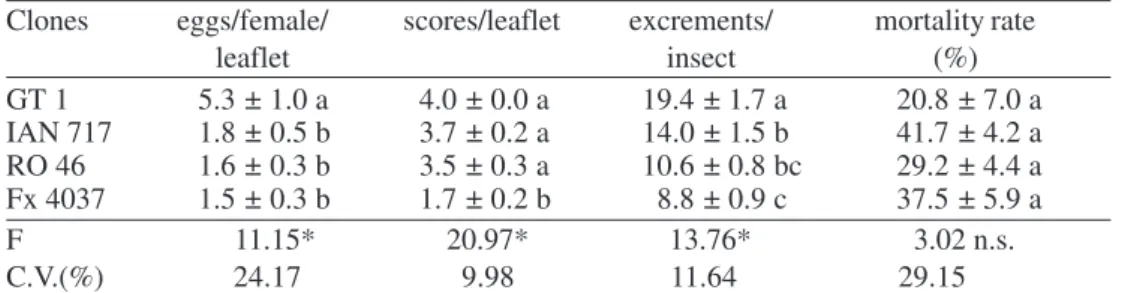
Laboratory Trials. Clone GT 1 was the most preferred for oviposition (5.3 eggs/leaflet), whereas Fx 4037, RO 46 and IAN 717 were avoided, being chosen practically four times Table 1. Mean number (± SE) of Leptopharsa heveae adults per rubber tree clones in a free choice field trial, Itiquira, MT, 1995.1
Days after infestation
Clones 1 2 7
IAN 873 124.3 ± 13.7 97.0 ± 31.4 68.5 ± 19.1 a
IAC 207 92.8 ± 33.9 58.8 ± 27.6 56.3 ± 27.0 ab
Fx 4037 165.0 ± 66.6 50.8 ± 17.2 30.5 ± 10.1 ab
RO 38 64.5 ± 17.4 50.3 ± 17.1 20.0 ± 4.1 ab
GT 1 65.8 ± 22.6 61.5 ± 18.8 16.0 ± 4.7 ab
AVROS 76.5 ± 5.0 70.0 ± 15.8 14.8 ± 2.7 ab
IAN 717 50.0 ± 14.8 23.3 ± 10.4 9.8 ± 7.3 b
IAN 4493 60.3 ± 37.4 56.6 ± 41.5 2.6 ± 0.4 b
F 1.22 ns 0.67 ns 3.23*
C.V.(%) 79.96 86.29 46.44
1Means followed by the same letter in each column do not differ using Tukey test (P ≤ 0.05)
less (1.5 to 1.8 eggs/leaflet) (Table 2). The scoring of symptoms and accumulated excrements/insect for the determination of
feeding preference showed that clone Fx 4037 was the least preferred, followed by RO 46, whereas clone GT 1 was the most preferred. Figure 1. Mean scores attributed to the symptoms caused by Leptopharsa heveae in rubber tree clones and number of eggs/leaflet in a free choice field trial after seven days of infestation, Itiquira, MT, 1995. Columns with the same letter (capital letters for eggs/leaflet, small letters for scores) do not differ using Tukey test (P ≤ 0.05).
No significant difference in adult mortality rate was observed among the studied clones. These data suggest that none of these four materials had an antibiotic effect on lace bug adults.
On the basis of the results obtained, it may be concluded that the most preferred clones by L. heveae, in both feeding and oviposition tests, were GT 1 and IAN 873. Clones Fx 4037, RO 38 and RO 46 showed resistance of the nonpreference type for feeding and oviposition.
Acknowledgments
The authors wish to thank CNPq and CAPES for fellowships, to Plantações E. Michelin Farm for the materials and facilities provided and Dr. Richard C. Froescher, of the Smithsonian Institute, for the identification of the species.
References Cited
Batista Fº, A., L.G. Leite & A.P., Silveira. 1995. Ocorrência da mosca-de-renda, Leptopharsa heveae, em Buritama, SP. Arq. Inst. Biol. 62: 81.
Carrera, M. 1973. Entomologia para você.
4a ed. São Paulo, Edart, 185p.
Drake, C.J. & M.E., Poor. 1935. An undescribed rubber tingitid from Brazil (Hemiptera). Insetos do Brasil 25: 283-284.
Gill, S.A. 1988. Insecticidal soap as an azalea lacebug control. J. Amer. Rhododendron Soc. 42: 103-104.
Gill, S.A. & M. Raupp. 1989 Control of azalea lace bug using insecticidal soap and neem. J. Amer. Rhododendron Soc. 43: 216-217.
Giraldo, A.I.D.H.O. 1993. Sporotrix insectorum: biological control method of the lace bug Leptopharsa gibbicarina in oil palm culture in Latin America (Hemiptera: Tingidae). Bull. Soc. Entomol. France 98: 77-85.
Lara, F.M. 1991. Princípios de resistência de plantas a insetos. 2ª ed., São Paulo, Icone Ed., 336p.
Lara, F.M., A. Coelho & J. Mayor Jr. 1979. Resistência de variedades de couve a Brevicoryne brassicae (L., 1758). II. Table 2. Mean number of Leptopharsa heveae eggs/female/leaflet of rubber tree clones, scores/leaflet, number of excrements/insect and mortality rate of adults/plate in no choice laboratory assays (± SE), Itiquira, MT, 1995.1
Clones eggs/female/ scores/leaflet excrements/ mortality rate
leaflet insect (%)
GT 1 5.3 ± 1.0 a 4.0 ± 0.0 a 19.4 ± 1.7 a 20.8 ± 7.0 a IAN 717 1.8 ± 0.5 b 3.7 ± 0.2 a 14.0 ± 1.5 b 41.7 ± 4.2 a RO 46 1.6 ± 0.3 b 3.5 ± 0.3 a 10.6 ± 0.8 bc 29.2 ± 4.4 a Fx 4037 1.5 ± 0.3 b 1.7 ± 0.2 b 8.8 ± 0.9 c 37.5 ± 5.9 a
F 11.15* 20.97* 13.76* 3.02 n.s.
C.V.(%) 24.17 9.98 11.64 29.15
1Means followed by the same letter in each column do not differ using Tukey test (P
≤ 0.05) (the data were duly transformed for analysis).
Antibiose. An. Soc. Entomol. Brasil 8: 217-223.
Kuffner, J.R. 1986. Aspectos relevantes dos sistemas de explotação utilizados por pequenos produtores. In: Encontro Nac. Exp. Org. Seringais de Cultivo, 1. Brasília, SUDHEVEA, p. 67-71.
Mauri, G. 1989. Control trial against the american plane tiger (Corythuca ciliata) by injection of the trees. Rev. Hort. Suisse 62: 165-170.
Moreira, I.P.S. 1985. A Leptopharsa heveae (Drake & Poor) e seus danos às mudas de Hevea brasiliensis (Muell.). Tese de mestrado, UFPR, Curitiba, 48p.
Reyes, A.R., M.A. Cruz & P. Genty. 1988. The root absorption technique for controlling oil palm pests. Oleagineux 43: 363-370.