Vol. 10, No. 1, Jan/Apr., 2013 pp.61-80 ISSN online: 1807-1775
DOI: 10.4301/S1807-17752013000100004
_____________________________________________________________________________________ Manuscript first received/Recebido em 20/03/2012 Manuscript accepted/Aprovado em: 17/01/2013 Address for correspondence / Endereço para correspondência
Luís Kalb Roses, Doctor in Administration by the Post-Graduation Program in Administration of the Federal University of Rio Grande do Sul, Porto Alegre/ Brazil – and in Management Science by the Applied Research Center in Management of the Pierre Mendès-France University – Grenoble, France. Professor at Catholic University of Brasília – Brasília, Brazil – where he teaches and researches IT Governance in the Stricto Sensu Post-Graduation Program in Knowledge and IT Management. The main lines of research include IT outsourcing governance models, IT service quality, IT-Business strategic alignment, agile methods for software development, and IT project management. In one of the 10 largest American banks, he is IT manager. Address: SGAN 916 Norte, Modulo B, Sala A128, 70790-160, Brasília (DF), Brazil. Telephone: (61) 3448-7137.E-mail: [email protected]
STRATEGIC PARTNERSHIP BUILDING IN IT OFFSHORE
OUTSOURCING: INSTITUTIONAL ELEMENTS FOR A BANKING
ERP SYSTEM LICENSING
Luís Kalb Roses
Catholic University of Brasília, DF, Brazil
__________________________________________________________________________
ABSTRACT
The purpose of this paper is to design a conceptual model of institutional elements for the building of a client-supplier strategic partnership in IT outsourcing, involving an ERP system licensing. This model resulted from a case study in a Brazilian transnational bank, which is one of the 10 largest American banks in terms of assets volume. Qualitative content analysis technique evaluated the data collected from interviews, documents, and observations. The results show the importance of a multidimensional institutional perspective with a set of regulative, normative, and cognitive elements to structure a client-supplier partnership. The data analysis confirmed elements predefined in the theory developed, as well as identified new ones.
Keywords: Offshore IT outsourcing; strategic partnership; ERP system; institutional
theory.
1. INTRODUCTION
The IT outsourcing arrangement of particular interest to this study is the licensing of an ERP (Enterprise Resource Planning) system. The ERP is “a comprehensive body of activities sustained by several modules of application software [IS] which help the industrialist or another business manager to manage important parts of his/her
business…” (Foldoc, 2011). Standardizing and speeding up processes, standardizing human resources information, integrating financial information, integrating customer order information and reducing inventory are the five major reasons why companies decide for an ERP project (Nazemi, Tarokh, and Djavanshir, 2012).
The licensing of ERP systems shows a failure average rate above 60% in terms of implementation time, costs over budget and benefits realization, according to a research performed by Panorama Consulting Group (2011) in the second half of 2010, involving 185 organizations from 57 countries. The situation can be worse if the client chooses an offshore supplier (located in another country), when several barriers can arise for client-supplier relationship, being among them (Simon, Poston and Kettinger, 2009; Momoh and Shehab, 2010; Sousa, Giardino and Trezza, 2011; Khan, Niazi and Ahmad, 2011; Amid, Moalagh and Ravazan, 2012): mismatch in culture, value, and norms; geo-politics instability; imperfect information about the suppliers; unrealistic expectations on cost savings; differences in time zones; knowledge transfer difficulties in both directions (client-supplier); layoff and loss of human capital; location of client and supplier team members; lack of project management; lack of protection for intellectual property rights; lack of due diligence resulting from offshore bandwagon mindset; lack of top management support; lack of technical capability; high system complexity; and key users with poor skills.
Moreover, Lee and Kim (1999) posit that organizations (clients) face difficulties to form and manage the relationship with their suppliers when a relationship based only
on a contract (arm’s length) is changed to a partnership one. Partnership is a cooperating
relationship alternative (Tomlinson, 2005), mainly when the focus is the quality of the services or products involved (Collins, 1997). Macedo-Soares (2011) asserts that firms are more and more competing globally through partnerships, despite new paradigms and managerial tools to manage them. Klepper (1995) considers client-supplier strategic partnership in IT outsourcing as a complex phenomena and suggests a close examination to understand and manage this relationship dynamics, through the integration of a set of elements derived from several theories.
Kern and Willcocks (2002) suggest further an investigation about the institutionalization process of the client-supplier relationship in IT outsourcing, when they applied the Interaction Model (Hakansson, 1982) to explore this relationship in 12 client organizations. IT governance is about institutionalized practices through processes (ITGI, 2012) and the adoption of an institutional theoretical perspective contributes with elements from economic, political, and social orders (DiMaggio and Powell, 1991).
In this context of institutionalization process and banking sector, the following question guides this research: What are the institutional elements for the successful building of a client-supplier strategic partnership in IT outsourcing through the licensing of a transnational banking ERP system? To answer this question, this research adopted the strategy of a single case study in a transnational Brazilian bank.
2. STRATEGIC PARTNERSHIP IN IT OUTSOURCING
Anderson and Narus (1990, p. 46) describe relationship satisfaction as “a focal
consequence of a working partnership” between a client and a supplier. In the IT outsourcing context, Grover, Cheon and Teng (1996) define partnership as interactive relationships of long standing that contribute to client-supplier relationship success. The essential characteristic of a strategic partnership is the cooperation of the partners (Das
and Teng, 1998; Tomlinson, 2005). Morgan and Hunt (1994) say “cooperation
promotes the success of the [client-supplier] relationship.”
The cooperation of the partners occurs when the “business partner wish to pursue mutual compatible interests in the alliance, instead of acting in an opportunistic way”
(Das and Teng, 1998, p. 492). Opportunism links to egotistical behavior and bad faith (Williamson, 1975, p. 26-27). Thus, there must be incentives in the client-supplier cooperation to inhibit opportunism and promote an environment of trust in their
relationship (Collins, 1997). To Blumberg (2001, p. 828), “commitments can reduce the motivations to opportunism while establishing additional costs to such behavior.”
Commitment means the goodwill to exert a maximum effort towards the continuation of the long-standing partnership (Wilson, 2000, p. 250). Hagen and Choe (1998, p. 589-590) define trust as the “expectation that one can depend on the promises of the other and that the other will act in a cooperative spirit towards the one who
trusted him in unforeseen circumstances”. Ring and Van de Ven (1992) sustain the need of a strong trust in strategic partnerships. ERP implementations that meet clients´ process needs normally are not fast and the client-supplier cooperation in this scenario is very critical (Anderson, Banker, Menon and Romero, 2011) for the partnership between them.
2.1 Commitment-trust theory
In the context of the commitment-trust theory, Morgan and Hunt (1994, p. 22)
consider that “commitment and trust lead directly to cooperative behaviors, which are
pointers to the success of the partnership [in the long run]”. They point out the reduction of opportunism, communication quality, and shared values in the generation of trust between client and supplier from a partnership perspective. Shared values are also a factor that generates commitment in this kind of partnership. One partner commits only to whom he or she trusts, explaining the positive influence of trust on commitment. Coercive power, when one part imposes itself upon the dependent one, results from the costs of change and from the benefits generated by the partnership, besides being a destructive factor for both commitment and trust.
significant information (technical, strategic or operational), which engenders trust between them (Lewicki and Bunker, 1996). Lee and Choi (2011) identify on-going trust in client-supplier relationship as a requirement to IT outsourcing benefits.
2.2 Model of the institutional elements
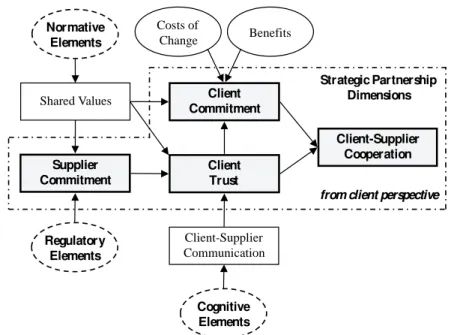
The commitment-trust theory does not explore in depth the perspective of either partner, since commitment and trust dimensions do not discriminate their influence in a specific partner, be client or supplier. Thus, based on the commitment-trust theory model (Morgan and Hunt, 1994), this study presents a model of institutional elements with the aim of outlining the client view regarding IT client-supplier strategic partnership, according to Figure 1. An institutional approach gives the opportunity to identify and integrate regulatory, normative and cognitive elements derived from several theories (Scott, 2001, p. 51) - the purpose of this study - to institutionalize the process of client-supplier relationship.
Client Commitment
Shared Values
Supplier Commitment
Client Trust
Client-Supplier Communication
Normative Elements
Cognitive Elements Regulatory
Elements
Costs of
Change Benefits
Client-Supplier Cooperation Strategic Partnership
Dimensions
from client perspective
Figure 1 - Model of the institutional elements of the IT strategic partnership
The reduced opportunism of the supplier is represented by its commitment to the partnership with the client. This commitment exerts a positive influence on client trust (calculative trust), there being neither the need for opportunism consideration with its negative influence on the client trust, nor for regulatory elements to mitigate its existence. Nor is the coercive power considered, since the model outlines the relationship between partners and the commitment-trust theory itself treats its influence as a non-assessed hypothesis.
2.2.1 Regulatory Elements
Regulatory elements aim at controlling behavior, which is rational and moved only by the interests of the parties (Williamson, 1975). This control occurs through the establishment of rules that punish through penalties or that reward through incentives, according to a formal agreement signed by the parties - client and supplier. The power that characterizes the regulatory dimension must be legitimized based on a “normative
frame that both restricts and supports the use of power” (Scott, 2001, p. 53), which
makes the regulatory and normative dimensions interdependent.
(Williamson, 1985, p. 60, 62, 167; Williamson, 1996, p. 124), as a consequence of opportunism (Williamson, 1985, p. 32): multiple sourcing (or alternative suppliers); reciprocal exposure when investing in assets (or hostage); periodic contract renewal; and reputation. The mechanism of multiple sourcing puts the suppliers in a competitive environment to serve the client, which induces the quality of the goods and services involved in the transaction between them (Williamson, 1985, p. 61).
Hostage occurs when they invest in assets dedicated to their relationship, which demonstrate the actual commitment of both to the future of their exchanges, mitigating the exposure of the one of them to the opportunism of the other, since they will share possible value losses of those assets. Examples of supplier investments are material assets, new facilities, and personnel training (Bahli and Rivard, 2003). Also, if the contract is flexible to face unforeseen events and permits agreements through its periodical reviews (Williamson, 1985, p. 62), it generates economies at the transaction cost level for the client-supplier relationship.
Further, depending on the idiosyncrasy of the assets involved in the services agreed, the long-term duration of the contract indicates the importance attributed to the relationship by the partners, as foreseen in the game theory applied to Political Science (Axelrod, 1984). The development of IS (or software) is an idiosyncratic service (Aubert, Rivard and Patry, 2004). This is the situation of a client licensing an ERP system from a supplier, which involves IS development by the latter as a service to the former, mainly in the process of this system customization for the client needs and the client participation in the management of its implementation.
The reputation effect to the partners happens when one of them does not fulfill what the agreement establishes, having a negative effect on the present and future businesses of the given partner (Williamson, 1985, p. 395). But, reputation effect happens only if the lack of fulfillment is open to public knowledge, its consequences are clear and provable, and the part that suffers the lack of fulfillment of the agreement penalizes the responsible one.
The agency theory strives to identify the most efficient form of contract to the agency relationship, in a situation of potential divergence of interests between principal and agent, which strengthens the conditions of opportunism and uncertainty outcome to
the fulfillment of the expected results (Eisenhardt, 1985). Thus the “control system
[about the behavior and/or results] evaluates and pays [based on performance], motivates behavior [as established by the economic theory regarding transaction costs]
and also alters the standard of risk sharing” (Eisenhardt, 1985, p. 137), which becomes
more balanced between the principal and the agent and, in this way, motivates cooperating efforts between them in the relationship. The pricing model must fit these aspects.
Furthermore, regarding the pricing model, the use of service level agreement is common in the IT client-supplier relationship. This corresponds to the mandatory acceptance by the supplier to reach certain levels of performance agreed with the client, as well as supplying rights and solutions to the client (Click and Duening, 2005, p. 119). Thus, the following propositions are posited:
P1a: Alternative suppliers are a regulatory element in the IT strategic partnership;
P1b: Hostage is a regulatory element in the IT strategic partnership;
P1d: Long-term contract is a regulatory element in the IT strategic partnership;
P1e: Reputation is a regulatory element in the IT strategic partnership;
P1f: Pricing model is a regulatory element in the IT strategic partnership; and
P1g: Service level agreement is a regulatory element in the IT strategic partnership.
2.2.2 Normative Elements
The prescriptive concept of the institutions derives from Emile Durkheim and Talcott Parsons sociological studies, as seen in their focus on family groups, social classes, religious systems and voluntary associations, where beliefs and common values are more often than not present (Scott, 2001, p. 55). The reference standards emphasize
the “normative rules that introduce a prescriptive, evaluative and mandatory dimension to social life” involving both values as norms (Scott, 2001, p. 54). Durkheim (1984, p. 28-29) postulates that the order component of social solidarity is the authority of the legal rules, as defined either formally or by common use.
These rules offer a positive contribution that is a cooperative contribution derived essentially from work division (Durkheim, 1984, p. 77). Law, however, is not the only form to regulate cooperation between the parties. There is another element that comes from moral aspects (Durkheim, 1984, p. 162). While the contractual relationship lasts, both parties must respect the rules either in a direct or indirect way. These rules, whose order is social (as is that of the law), even if not sanctioned by a legal code, also carry a binding character, although in a diffuse way.
Thus, rules of a purely moral character or collective practices under the protection of public opinion follow legal rules. These rules of moral order compel individuals to act according to the ends that are not their own, implying mutual allowances, agreeing to commitments and considering the interest of the others as superior to their own (Durkheim, 1984, p. 173). In other words, this kind of rules imposes flexibility on self-interests (Durkheim, 1984, p. 174). Macneil (1980) characterizes these rules as
relational norms. They involve behavioral expectations which “occur in relations, must
occur in relations if the relations are expected to last and must occur as long as their
continuation is prized [by the parties]” (Macneil, 1980, p. 64).
Dunning and Lundan (2010, p. 1229) state the multiplication of uncertainties in the human environment, “primarily due to the incommensurability and/or opaqueness of the norms and values that guide decision-making processes and that provide the rationale for the design of the formal institutional system”. Parsons (1964a, p. 118-119), who learned from cognitive psychology, refers to value as the orientation element that is common to social interaction. Values are normative standards that describe a desired social system, while norms contextualize these standards to specific situations and members, defining the desired expectations and the rewards or penalties to apply (Parsons, 1964b, p. 124).
The norms, nomenclature adopted in this paper (legal norms and relational norms), have the power to reduce the political manipulation by the individual on their own interest, binding them not only to the laws but also to the description of jobs, procedures for activity performances, standards of quality, etc. (Scott, 2001, p. 55). Thus, the following propositions are posited:
P2b: Relational norms are normative elements in the IT strategic partnership.
2.2.3 Cognitive Elements
The cognitive dimension of the institutions exploits “the central role performed by
the construction socially mediated by a common referential frame of meanings” (Scott, 2001, p. 58), while cognitive elements refer to the “shared assumptions which constitute
the nature of social reality and the frames through which the meaning is built”. Hence, emphasis is on “the cognitive dimensions of human existence” (Scott, 2001, p. 57), where the relationship between culture and cognition arises from the fact that external cultural environment models the internal interpretative processes of the individuals.
The cultural-cognitive perspective comes from the cognitive science studies developed at the Carnegie School (USA) by Herbert Simon and James March (DiMaggio and Powell, 1991, p. 18), as well as by Harold Garfinkel in ethnomethodology studies, a student of Parsons (DiMaggio and Powell, 1991, p. 19) who based his work on the studies of Alfred Schultz in phenomenology (Garfinkel, 1967, p. 76). In ethnomethodology, Garfinkel (1967, p. 76) considers that “descriptions from the point of view of the interests of the collectivity members in the management of
their practical affairs” are the bases of social life. These descriptions are the knowledge
shared and used by the collectivity members to communicate with each other (Garfinkel, 1967, p. 77). Giddens (1984, p. 29) mentions communication as one of the dimensions that structures social interaction from a shared cognitive perspective.
Hakansson (1982) highlights the importance of communication during the institutionalization of a long-standing client-supplier relationship, while Dey, Clegg and Bennett (2010) point out communication as a major risk factor to an ERP implementation. In this context, Khan et al. (2011), through an extensive literature review regarding offshore software development outsourcing, identified language and cultural issues as an outstanding barrier for client-supplier relationship success in IS development outsourcing.
In an interdependent relationship between the parties, typical of a strategic partnership, Sheppard and Sherman (1998) consider essential the capacity to exchange information. Sharing meanings and interpretations, or cognitive sharing, allows communication of a better quality (Lander, Purvis, McGray and Leigh, 2004) and contributes to a framework of trust between the partners (Lewicki and Bunker, 1996, p.
121). It provides “the necessary basis to a non-opportunistic behavior”, while avoiding the development of asymmetric power (Hardy, Phillips and Lawrence, 1998, p. 69). Willcocks, Lacity and Kern (1999) mention the risks of power asymmetry development that benefits the supplier in the post-transitional phase of IT outsourcing, while Kwahk and Ahn (2010) point out the negative impact of client-supplier misfits due to different countries on ERP implementation success. Thus, the following proposition is posited:
P3: Common language is a cognitive element in IT strategic partnership.
3. RESEARCH METHOD
The nature of this research is descriptive-exploratory through a single case study strategy, as the phenomenon under study is contemporary, not easily dissociable from
“contributes in a unique way to the understanding of individual, social and political
phenomena” (Yin, 2001, p. 67), which includes organizational processes.
Further, this research follows both Miles and Huberman (1994, p. 34) criteria for a case study adoption: a) a politically important case, because of its relevant characteristics to the moment, as its is related to a bank strategy to a better position in international markets; b) a timely case, when the aim is the one of investigating new trends or unexpected events, as the unit of analysis is related to a strategic project under occurrence; and c) a convenient case, considering the aspects of less time, cost and effort, as the researcher has easy access to the case study data.
3.1 Place and unit of analysis
Brazilian banks are relevant to this research because they strongly use IT in the distribution of their products and services, as well as in the automation of their internal affairs. In 2010, according to Febraban (2010), Brazilian banks expended an amount of US$ 11.8 billion in IT and invested US$ 895 million in the acquisition of third-party software and applications, this last one representing a growth of 8% in relation to the previous year.
The Brazilian bank under study, which this study identifies as BANK, is among the three largest Brazilian banks and one of the 10 largest in America in terms of assets volume; has a base of more than 50 million customers; has a working staff of over 100 thousand employees; in 2010 had net profits of over US$ 10 billion and total assets of over US$ 800 billion; and has more than 10 thousand service points with automated teller machines (all services and operations are made in real time). This level of automation characterizes BANK as the one that invests in IT the most. In 2011, it invested about US$ 650 million, which represented approximately a quarter of the volume invested by the Brazilian banking sector (US$ 2.66 billion).
The unit of analysis – the case – is the building process of the client-supplier strategic partnership in the IT outsourcing, involving licensing of a banking ERP system by BANK (client) from an offshore supplier. The purpose of this licensing is the businesses processes automation of BANK´s international branches. A specific project of BANK conducted the process of licensing of the ERP system, identified in this paper as SYSINTBRAN – System for the Automation of the International Branches [of BANK]. The acquisition and implementation costs of the system, including hardware and telecommunication infrastructure, will be above US$ 25 million.
3.2 Procedures for data collection, analysis and reliability
Documents, observation and interviews were the data sources for analysis purposes of this study. The documents studied were BANK´s IT policy for its international branches, minutes of the meetings between BANK and ERP systems suppliers that were candidates in the selection process, ERP system requirements listed by BANK, software license agreement signed by BANK and the supplier selected, and other documents from the SYSINTBRAN project, mainly those used to support its steering committee´s decisions.
Between October 2007 and February 2008, the researcher´s observation happened during BANK´s meetings with the ERP system supplier better ranked in the selection process, as well as during a workshop organized by BANK with this supplier for the presentation of its ERP system. From 2009 to 2011, the researcher´s observation happened as a participant during the implementation process of the ERP system in BANK´s European Branches. In August 2008, BANK signed the license agreement contract to implement this ERP system in its international branches. This implementation is under way in the European Branches and is scheduled to happen in the Branches located in other continents – South America, North America and Asia - until 2014.
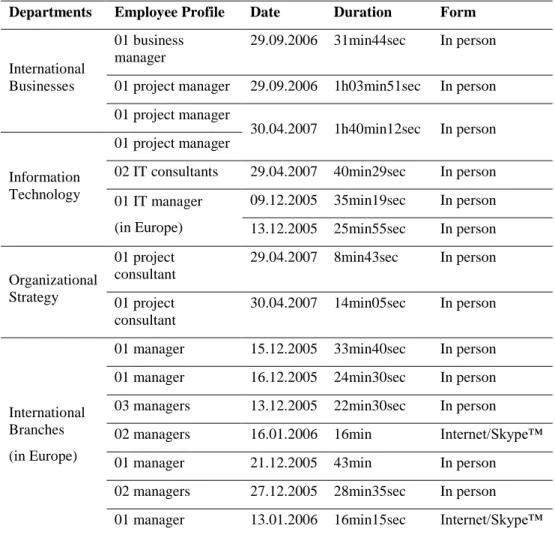
In total, the researcher interviewed 20 BANK´s employees with direct or indirect involvement in the SYSINTBRAN project, during the period between December 2005 and April 2007. These employees authorized the researcher to record the interviews, who transcribed them for analysis purposes. Table 1 shows the profile of the employees interviewed according to their departments, as well as the date, duration and the interaction form of the interview (i.e., whether the researcher was personally present or
performed Internet/Skype™ calls).
For the analysis of the data collected from the documents, interviews and researcher observation, this study applied qualitative content analysis technique through categorical analysis (Bardin, 1977, p. 153). The unit of significance, or register, was themes (thematic analysis). In this way, the categorization criterion was semantic and not syntactic (aggregating verbs, adjectives, pronouns, etc.) or lexical (aggregating by the sense of the words) (Bardin, 1977, p. 118). The themes are clippings of units with variable length extensions, including several sentences.
Table 1 - Characteristics of the interviews
Departments Employee Profile Date Duration Form
International Businesses
01 business manager
29.09.2006 31min44sec In person
01 project manager 29.09.2006 1h03min51sec In person
01 project manager
30.04.2007 1h40min12sec In person
Information Technology
01 project manager
02 IT consultants 29.04.2007 40min29sec In person
01 IT manager
(in Europe)
09.12.2005 35min19sec In person
13.12.2005 25min55sec In person
Organizational Strategy
01 project consultant
29.04.2007 8min43sec In person
01 project consultant
30.04.2007 14min05sec In person
International Branches
(in Europe)
01 manager 15.12.2005 33min40sec In person
01 manager 16.12.2005 24min30sec In person
03 managers 13.12.2005 22min30sec In person
02 managers 16.01.2006 16min Internet/Skype™
01 manager 21.12.2005 43min In person
02 managers 27.12.2005 28min35sec In person
01 manager 13.01.2006 16min15sec Internet/Skype™
The regulatory elements of the category-system are: alternative suppliers (Williamson, 1985; Hagen and Choe, 1998), hostage (Williamson, 1985; Somaya, Kim and Vonortas, 2010), periodic contract renewal (Williamson, 1985; Bahli and Rivard, 2003), long-term contract (Axelrod, 1984), reputation (Williamson, 1985), pricing model (Lacity and Willcocks, 2001, p. 168) and service level agreement (Cullen and Willcocks, 2003, p. 73); the normative elements are legal norms (Durkheim, 1984) and relational norms (Macneil, 1980); and the cognitive element is the common language (Ge and Voβ, 2009; Khan et al., 2011).
4. RESULTS AND ANALYSIS
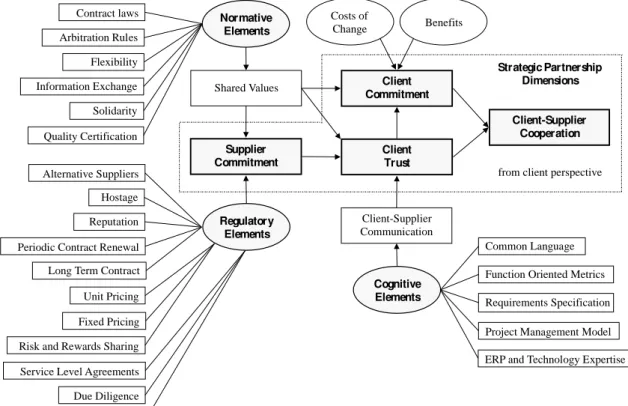
From BANK´s perspective (client), Figure 2 illustrates the model of the institutional elements of the strategic partnership in IT outsourcing, as a result of the analysis. The model is segmented into regulatory, normative and cognitive institutional elements, which are the ones for establishing a strategic partnership between BANK and
its ERP system supplier (“... in a philosophical view, what we are going to search is a partnership relationship where I open a market for an enterprise and it brings me a good solution and helps me to build things which I will need over time… ” – a quotation from one of the project managers).
Periodic Contract Renewal Hostage
Reputation
Long Term Contract Alternative Suppliers
Unit Pricing
Risk and Rewards Sharing Fixed Pricing
Sequential Implementation Due Diligence Service Level Agreements
Strategic Partnership Dimensions
from client perspective
Client Commitment Client-Supplier Cooperation Shared Values Supplier Commitment Client Trust Client-Supplier Communication Normative Elements Cognitive Elements Regulatory Elements Costs of
Change Benefits
Quality Certification Information Exchange Arbitration Rules Solidarity Contract laws Flexibility
Project Management Model Common Language
Function Oriented Metrics
Requirements Specification
ERP and Technology Expertise
Figure 2 - Model of the institutional elements of the strategic partnership in IT outsourcing
4.1 Regulatory categories
Data analysis confirmed the regulatory elements – alternative suppliers, hostage, periodic contract renewal, long-term contract, reputation, pricing model, and service level agreement – all of them pertaining to the category-system and related to the propositions P1a to P1g, respectively. Although the analysis confirmed periodic
contract renewal category, it is specific for maintenance services (“… error-corrections, procedural questions, recovery and backup information, and general consultation
exist...” – maintenance clause of the contract), not for the survival of the software license agreement, which is perpetual. Thus, both client and supplier consider the importance of their relationship future.
the supplier gains a percentage of client profits, if the performance of the service provided is optimal and supports client business objectives. This last form of pricing is typical in client-supplier strategic partnership involving IT outsourcing (Lacity and Willcocks, 2001, p. 168) and is related to distributive fairness in the relationship, meaning contributions shared according to the value produced by each of the partners (Ariño and Ring, 2010).
There are four forms of pricing in the agreement negotiated between BANK and the selected supplier: a) a license fee, that entitles BANK to use the system pursuant to the agreement and as per the scope defined, based on a limit of concurrent users, customer accounts, and Internet subscribers (BANK´s customers accessing the ERP system through Internet Banking investments); b) maintenance charges, a percentage (22%) over the license fee that must be paid annually; and c) customization charges that BANK must pay for any customization it requests to be developed by the supplier in the system, as those to explore new business opportunities or to comply with norms, be internal (internal controls) or external (central banking norms) to BANK. If concurrent users, customer accounts, or Internet subscribers increase or decrease to certain levels established in the license agreement, BANK pays an additional license fee or receives a discount, respectively. This study considers license fee and annual maintenance charges in the fixed pricing subcategory; customization charges in the unit pricing subcategory; and the possibility of BANK paying more or receiving discounts over the license fee (levels of concurrent users, customer accounts, and Internet subscribers) in the risk and reward sharing subcategory.
The data analysis identified due diligence as a new category, meaning the inspection or auditing of the information provided by the supplier (Click and Duening, 2005, p. 94-109). This category encompasses BANK´s visits to the supplier’s clients; the workshop when the supplier presented the functionalities and technical architecture of the ERP system and when BANK could identify gaps for its requirements; and ERP performance tests by specialized companies. A final regulatory category is the sequential implementation of the ERP system. This manner of implementation is adequate when the ERP system is not uniform in its functionalities to serve different
countries (Madapusi and D’Souza, 2005), as it is the situation of BANK´s international branches. Furthermore, it allows a controlled implementation tied to the payments by BANK to the supplier, which is an instrument for BANK´s decision to continue in the relationship in case of dissatisfaction with the supplier services.
4.2 Normative categories
Data analysis confirmed legal norms and relational norms categories, which are related to the propositions P2a and P2b, respectively. The exploration of these categories, however, allowed for the identification of contract laws and arbitration rules subcategories linked to legal norms; and flexibility, information exchange, and solidarity, bounded to the relational norms. The contract laws enforce the agreement´s credibility. Besides the British law, the agreement considers the German, American, and Indian laws in regulating its long-term duration.
and the supplier select by the SYSINTBRAN project. In this way, contract laws and arbitration rules categories provide the legal norms for client-supplier solidarity.
Based on Macneil (1980) relational norms, Heide and John (1992) identify three elements: a) flexibility, as a bilateral expectation or willingness in making contract adaptations according to circumstantial changes; b) information exchanges, as a bilateral expectation that the parties will proactively supply useful information among themselves; and c) solidarity, as a bilateral expectation that the relationship is of high importance, prescribing behaviors directly related to its continuation.
Scott (2001, p. 52) mentions certification as a normative element when moral recognition supports institutionalization. Thus, the norms of quality certification are
“standards through which structures or behaviors can be compared and valued” (Scott,
2001, p. 54-55) or “the understanding of fair practices in business” (Scott, 2001, p. 55). Thus, this study identifies the quality certification category as a new normative element, since BANK considers the importance of the suppliers having ISO 9001 and CMM-I certifications, which induces quality in their software development processes.
4.3 Cognitive categories
Data analysis confirmed the common language category related to proposition P3. It represents the sharing of meanings that permits conversations during the communication process (Lander et al., 2004), and, thus, information exchange between the parties involved (Sheppard and Sherman, 1998; Simon, Poston and Kettinger, 2009). It links to the need of a common language to establish the communication between
BANK and the suppliers’ representatives. The suppliers’ representatives did not speak the native language (Portuguese) of BANK´s representatives, but spoke English. In this context, one crucial requirement from BANK´s side to exchange information with the suppliers was the use of the English language as a common language.
English fluency of the last manager of the SYSINTBRAN project was decisive to speed up the conclusion of the relationship building process, through the selection of one of the ERP systems. This manager considered English fluency as an important criterion to select members to SYSINTBRAN project, because of the need to establish
conversations with the suppliers (“… in some cases, I consider English fluency more important than technical abilities to understand what the suppliers say…” – a quotation from the last SYSINTBRAN project manager). Ge and Voβ (2009) have already highlighted the importance of cultural and language aspects to ERP implementation success.
Four new categories were identified in this study - function point metrics, requirements specification, project management model, and ERP and Technology Expertise. Function point metrics are productivity metrics that allow projections of the cost and effort in the software development process (Pressman, 1995, p. 64, 105). Thus, knowledge sharing with regard to the development efforts of the supplier for new functionalities in the ERP system allows the client to evaluate how fair the service is, avoiding situations of opportunism by the latter. Function point metrics supports unit pricing, being an example of the integration between regulatory and cognitive elements.
BANK already adopts function point metrics to estimate about inputs, outputs, data files, queries and external interfaces (Leffingwell and Widrig, 2000, p. 105) of an IS. The supplier who signed the license agreement with BANK adopts this kind of
Requirements specification is the basis to agree about services requests from BANK related to ERP customizations by the supplier. The requirements of the system are the criteria by who develops (supplier) an IS and who demands (client) it can assess the respective quality of the service (Pressman, 1995, p. 232). Requirements are the client´s needs or what the system must comply with (Leffingwell and Widrig, 2000, p. 231). They must be documented in such a way to facilitate a common understanding between client and supplier to assure deliverables by the latter according to the former´s expectations.
UML – Unified Modeling Language –, e.g., is a kind of requirements specification language whose purpose is to “specify, visualize, document and design artifacts of a system and can be used with all processes along with the development cycle [of an IS or software, including ERP customizations] and through several implementation technologies” (Furlan, 1998, p. 33). The supplier uses its own model of document to specify the requirements and share them with BANK for analysis and agreement purpose. Sometimes, requirements documents are exchanged several times between the supplier and BANK until they agree on them.
The third new category identified - project management model - involves the establishment of a process to organize the communication between client and supplier. This model must encompass a plan to follow up schedule, deliverables, staff allocation, etc., of the project implementation. It can be based on traditional frameworks as PMBOK (PMI, 2008). BANK has a Program Management Office based on PMBOK practices. Nevertheless, a common set of documents, decision structure and meetings were established to facilitate a common follow-up of the project progress with the supplier.
The fourth and last new cognitive category found - ERP and Technology Expertise – has a major impact on the ERP implementation, as it is related to the availability of the appropriate knowledge and skills about the ERP and related technology from both supplier and client. The allocation of unskilled personal from the supplier side was seen by the SYSINTBRAN project as a factor of many delays in the
ERP implementation, as well as to several quality issues (“… the system didn´t reach
the expected quality by Bank, which caused the systematic of reprogramming the
implementation due dates.” – quotation in the project document to review the expenditures and implementation dates, as observed by the researcher). On the other hand, it was observed that the client staff training on the ERP functionalities and this staff allocation with IT and business background skills linked to the ERP business processes and technology was a critical success factor, sometimes helping to compensate for the deficiencies of the supplier´s staff skills. Ilfinedo (2011) highlights the importance of the ERP external expertise to support the client during its implementation, besides the client having internally related skills.
5. FINAL CONSIDERATIONS
institutional elements as key factors for client-supplier partnership success in IT outsourcing.
Client trust has three dimensions, according to the institutional elements: calculative, normative, and cognitive. The categories alternative suppliers, hostage, periodic contract renewal, reputation, long-term contract, pricing model (fixed pricing, unit pricing, and risk and reward sharing), service level agreement, due diligence, and sequential implementation are regulatory institutional elements that contribute to the supplier commitment in the relationship with the client. Also, supplier commitment is an inductive factor for calculative trust of the client in the supplier.
The categories legal norms (contract laws and arbitration rules), relational norms (flexibility, information exchange, and solidarity), and quality certification are normative institutional elements, which contribute to the normative trust of the client in the supplier. The categories common language, function-oriented metrics, requirements specification, project management model, and ERP and Technology Expertise are cognitive institutional elements. The first allows information exchange between BANK and the foreign suppliers that participated in the ERP selection process; the second, permits BANK to foresee the real costs of the supplier services; the third, supports the management of the day-to-day interaction with the supplier regarding the follow-up of the activities going on and that must be set to achieve the project implementation, as well as resources allocation, services payments, structure of management, project status reports, etc.; and the fourth, to support the ERP implementation in terms of its technological infrastructure and support for user acceptance tests.
The results of this study contribute to a client-supplier relationship in IT outsourcing, through the application of a multidimensional perspective based on the institutional theory. From this standpoint, it highlights elements from several theories and integrates them as drivers to the supplier commitment and to the client trust in their relationship, starting from the commitment-trust theory as a theoretical basis. The results also contribute to organizational practice, since it explores a contemporary phenomenon and identifies elements that serve as references for the successful institutionalization of the IT outsourcing in the context of ERP system licensing. In this sense, it is important to posit that a successful ERP implementation from a technical and relational standpoint will have a positive impact on its use for business purposes (Zhu, Li, Wang and Chen, 2010; Velcu, 2010; Law, Chen and Wu, 2010).
The institutional elements here identified may improve the management processes to sustain an offshore client-supplier relationship in IT outsourcing. From an international business perspective, Dunning and Lundan (2010, p. 1229) assert “the complex interdependencies resulting from the overlapping of different institutional
systems are increasingly difficult to predict and manage.” The model of the institutional
elements here developed aims to support a better governance of a cross-border IT outsourcing, as the partnership building process is the main one for the success of this kind of client-supplier relationship (Bahli and Rivard, 2003). In a strict sense, the banking industry can benefit from the results of the present study in the IT offshore licensing processes.
to question, since the analysis of the content, as a whole, is not exhaustive (Bardin, 1977, p. 115). Nevertheless, its potential remains precisely in exploring the reduced corpus of data and establishing more discriminating categories.
Finally, this study suggests three opportunities for future research, based on the model of the institutional elements developed. First, quantitative research projects with part of its elements, as they are several, when the use of exploratory and confirmatory factor analysis may be of great relevance. The model may require some modifications to assure its suitability for the observations collected through statistical significance. The second opportunity is the development of a similar model from the supplier perspective, as this work explored only the client perspective. The results may indicate a more holistic model to explain the client-supplier relationship in IT outsourcing. Finally, the third opportunity is to compare the results of this study with those of studies developed in a similar context.
REFERENCES
Amid, A., Moalagh, M., & Ravazan, A. Z. (2012). Identification and classification of ERP critical failure factors in Iranian industries. Information Systems, 37(3), 227-237.
Anderson, J. C., & Narus, J. A. (1990). A Model of Distributor Firm and Manufacturer Firm Working Partnerships. Journal of Marketing, 54(1), 42-58.
Anderson, M., Banker, R. D., Menon, N. M., & Romero, J. A. (2011). Implementing enterprise resource planning systems: organizational performance and the duration of the implementation. Information Technology and Management, 12(3), 197-212.
Ariño, A., & Ring, P. S. (2010). The Role of Fairness in Alliance Formation. Strategic Management Journal, 31(10), 1054-1087.
Aubert, B., Rivard, S., & Patry, M. (2004). A transaction cost model of IT outsourcing. Information & Management, 41(7), 921-932.
Axelrod, R. M. (1984). The Evolution of Cooperation. New York, NY: Basic Book.
Bahli, B., & Rivard, S. (2003). The information technology outsourcing risk: a transaction cost and agency theory-based perspective. Journal of Information Technology, 18, 211-221.
Bardin, L. (1977). Análise de Conteúdo. L. A. Reto and A. Pinheiro Reprinted (Trans.). Lisboa: Edições 70.
BCBS (Basle Committee on Banking Supervision). (2004). International Convergence of Capital Measurement and Capital Standards: A Revised Framework. Basel, Switzerland.
Blumberg, B. F. (2001). Cooperation Contracts between Embedded Firms. Organization Studies, 22(5), 825-852.
Click, L., & Duening, T. N. (2005). Business Process Outsourcing: The Competitive Advantage. Hoboken, NJ: John Wiley & Sons.
Cullen, S., & Willcocks, L. (2003). Intelligent IT Outsourcing: Eighth building blocks to success. Oxford: Elsevier.
Das, T. K., & Teng, B. S. (1998). Between Trust and Control: Developing Confidence in Partner Cooperation in Alliances. Academy of Management Review, 23(3), 491-512.
Deakin, S., Lane, C., & Wilkinson, F. (1997). Contract Law, Trust Relations, and Incentives for Co-operation: A Comparative Study. In: S. Deakin & J. Michie (Eds.), Contracts, Co-Operation, and Competition: Studies in Economics, Management, and Law (pp. 105-139). New York, NY: Oxford University Press.
Dey, P. K., Clegg, B. T., & Bennett, D. J. (2010). Managing enterprise resource planning projects. Business Process Management Journal, 16(2), 282-296.
DiMaggio, P. J., & Powel, W. (1991). Introduction. In: W. Powell and P. J. DiMaggio (Eds.), The New Institutionalism in Organizational Analysis (pp. 1-38). Chicago, IL: The University of Chicago Press.
Dunning, J. H., & Lundan, S. M. (2010). The institutional origins of dynamic capabilities in multinational. Industrial and Corporate Change, 19(4), 1225-1246.
Durkheim, E. (1984). The Division of Labor in Society. New York, NY: The Free Press.
Eisenhardt, K. M. (1985). Control: Organizational and Economic Approaches. Management Science, 31(2), 134-149.
Febraban (Brazilian Banking Federation). (2010). Banking Sector in Numbers.
Retrieved on April 17th, 2011, from
http://www.febraban.org.br/Acervo1.asp?id_texto=214&id_pagina=85&.
FOLDOC (Free On-line Dictionary of Computing). (2011). Retrieved on April 21th, 2011, from http://dictionary.reference.com/search?q=ERP.
Furlan, J. D. (1998). Modelagem de Objetos através da UML: Análise e Desenho Orientados a Objeto. São Paulo: Makron Books.
Garfinkel, H. (1967). Studies in Ethnomethodology. New Jersey, NJ: Prentice-Hall.
Giddens, A. (1984). The Constitution of Society. Berkeley, CA: University of California Press.
Ge, L., & Vo, S. (2009). ERP application in China: An overview. International Journal of Production Economics, 122(1), 501-507.
Grover, V., Cheon, M. J., & Teng, J. T. C. (1996). The Effect of Service Quality and Partnership on the Outsourcing of Information Systems Functions. Journal of Management Information Systems, 12(4), 89-116.
Hagen, J. M., & Choe, S. (1998). Trust in Japanese Interfirm Relations: Institutional Sanctions Matter. Academy of Management Review, 23(3), 589-600.
Hakansson, H. (1982). International Marketing and Purchasing of industrial goods: An interaction approach. Retrieved on April 4th, 2006, from
http://www.impgroup.org/uploads/books/InternationalMarketing.pdf. Chichester: John
Wiley & Sons.
(Eds.), Trust within and Between Organizations: Conceptual Issues and Empirical Applications (64-87). New York, NY: Oxford University Press.
Heide, J. B., & John, G. (1992). Do norms matter in marketing relationships? Journal of Marketing, 56(2), 32-44.
Hirschheim, R., & Lacity, M. (2000). The Myths and Realities of Informations Technology Insourcing. Communications of the ACM, 43(2), 99-107.
Ilfinedo, P. (2011). Examining the influences of external expertise and in-house computer/IT knowledge on ERP system success. Journal of Systems and Software,
84(12), 2065-2078.
ITGI (IT Governance Institute). (2012). COBIT - Control Objectives for Information and Related Technology (version 5). Rolling Meadows, IL: IT Governance Institute.
Kern, T., & Willcocks, L. P. (2002). Exploring relationships in information technology outsourcing: The Interaction Approach. European Journal of Information Systems, 11(1), 3-19.
Khan, S. U., Niazi, M., & Ahmad, R. (2011). Barriers in the selection of offshore software development outsourcing vendors: An exploratory study using a systematic literature review. Information and Software Technology, 53(7), 693-706.
Klepper, R. (1995). The Management of Partnering Development in IS Outsourcing. Journal of Information Technology, 10(4), 249-258.
Kwahk, K.-Y., & Ahn, H. (2010). Moderating effects of localization differences on ERP use: A socio-technical systems perspective. Computers in Human Behavior, 26(2), 186– 198.
Lacity, M. C., & Willcocks, L. P. (2001). Global Information Technology Outsourcing: In Search of Business Advantage. Chichester: John Wiley & Sons.
Lander, M. C., Purvis, R. L., McCray, G. E., & Leigh, W. (2004). Trust-building mechanisms utilized in outsourced IS development projects: a case study. Information & Management, 41, 509-528.
Law, C. C. H, Chen, C. C., & Wu, B. J. P. (2010). Managing the full ERP life-cycle: Considerations of maintenance and support requirements and IT governance practice as integral elements of the formula for successful ERP adoption. Computers in Industry,
61(3), 297-308.
Lee, J. N., & Kim, Y. G. (1999). Effect of Parnership Quality on IS Outsourcing Success: Conceptual Framework and Empirical Validation. Journal of Management Information Systems, 15(4), 29-61.
Lee, J. N., & Choi, B. (2011). Effects of initial and ongoing trust in IT outsourcing: A bilateral perspective. Information & Management, 48(2-3), 96-105.
Leffingwell, D., & Widrig, D. (2000). Managing Software Requirements: A Unified Approach. New York, NY: Addison-Wesley object technology series.
Lewicki, R. J., & Bunker, B. B. (1996). Developing and Maintaining Trust in Work Relationships. In: R. M. Kramer & T. R. Tyler (Eds.), Trust in Organizations: Frontiers of Theory and Research (pp. 114-139). Thousand Oaks, CA: Sage Publications.
Macedo-Soares, T. D. L. A. (2011). Ensuring dynamic strategic fit of firms that compete globally in alliances and networks: proposing the Global SNA — Strategic Network Analysis –framework. Revista de Administração Pública, 45(1), 67-105.
Macneil, I. R. (1980). The New Social Contract: An Inquire into Modern Contractual Relations. New Haven, CT: Yale University Press.
Madapusi, A., & D’Souza, D. (2005). Aligning ERP Systems with International
Strategies. Information Systems Management, 22(1), 7-17.
Marshall, C., & Rossman, G. B. (1995). Designing Qualitative Research. Thousand Oaks, CA: Sage Publications.
Miles, M. B., & Huberman, A. M. (1994). Qualitative Data Analysis: An Expanded Sourcebook. London: Sage Publications.
Mohr, J., & Spekman, R. (1994). Characteristics of Partnership Success: Partnership Attributes, Communication Behavior, and Conflict Resolution Techniques. Strategic Management Journal15(2), 135-152.
Momoh, R. R., & Shehab, E. (2010). Challenges in enterprise resource planning implementation: state-of-the-art. Business Process Management Journal, 16(4), 537-565.
Morgan, R. M., & Hunt, S. (1994). The Commitment-Trust Theory of Marketing Relationship. Journal of Marketing, 58(3), 20-38.
Nazemi, E., Tarokh, M. J., & Djavanshir, G. R. (2012). ERP: a literature survey. The International Journal of Advanced Manufacturing Technology, 61(9-12), 999-1018.
Panorama Consulting Group. (2011). 2011 ERP Report. Retrieved on April 22th, 2011, from http://panorama-consulting.com/resource-center/2011-erp-report/.
Parsons, T. (1964a). Durkheim's contribution to the theory of integration of social systems. In: K. Wolf (Ed.), Essays on sociology and philosophy (pp. 118-153). New York: Harper and Row.
Parsons, T. (1964b). The Social System. London: The Free Press.
PMI – Project Management Institute. (2008). PMBOK - Guide to The Project Management Body of Knowledge. 4th ed. Pensilvania (USA).
Pressman, R. S. (1995). Engenharia de Software (6a ed.). São Paulo: Makron Books.
Ring, P. S., & Van de Ven, A. H. (1992). Structuring Cooperative Relationships Between Organizations. Strategic Management Journal, 13(13), 483-498.
Scott, W. R. (2001). Institutions and Organizations. Thousand Oaks, CA: Sage Publications.
Scott, W. R., & Meyer, J. W. (1991). The Organization of Societal Sectors. In: W. W. Powell, P. J. Dimaggio (Eds.). The New Institutionalism in Organizational Analysis (pp. 108-140). Chicago, London: Chicago University Press.
Sheppard, B. H., & Sherman, D. M. (1998). The Grammars of Trust: A Model and General Implications. Academy of Management Review, 23(3), 422-437.
Somaya, D., Kim, Y., & Vonortas, N.S. (2010). Exclusivity in Licensing Alliances: Using Hostages to Support Technology Commercialization. Strategic Management Journal, 32, pp. 159-186.
Souza, W. H. de S., Giardino, A., & Trezza, M. A. H. (2011). Journal of Information Systems and Technology Management, 8(1), 05-24.
Tashakkori, A., & Teddlie, C. (1998). Mixed Methodology: Combining Qualitative and Quantitative Approaches. London: Sage Publications.
Tomlinson, F. (2005). Idealistic and Pragmatic Versions of the Discourse of Partnership. Organization Studies, 26(8), 1169-1188.
Velcu, O. (2010). Strategic alignment of ERP implementation stages: An empirical investigation. Information & Management, 47(3), 158–166.
Willcocks, L. P., Lacity, M. C., & Kern, T. (1999). Risk in IT Outsourcing Strategy Revisited: Longitudinal Case Research at LISA. Journal of Strategic Information Systems, 8(3), 285-314.
Williamson, O. E. (1975). Markets and Hierarchies: Analysis and Antitrust Implications. New York, NY: The Free Press.
_____. (1985). The Economics Institutions of Capitalism. New York, NY: The Free Press.
_____. (1996). Credible Commitments: Using Hostages to Support Exchange: In O. E. Williamson, The Mechanisms of Governance (pp. 120-144). New York, NY: Oxford University Press.
Wilson, D. T. (2000). An Integrated Model of Buyer-Seller Relationships. In: J. N. Sheth & A. Parvatiyar (Eds.), Handbook of Relationship Marketing (pp. 245-270). Thousand Oaks, CA: Sage Publications.
Yin, R. K. (2001). Estudo de Caso: Planejamento e Métodos (2nd ed.). Porto Alegre, RS: Bookman.