Evaluation of the impact of collaborative work by teams
from the National Medical Residency Committee and
the Brazilian Society of Neurosurgery. Retrospective and
prospective study
Avaliação do impacto do trabalho conjunto das equipes da Comissão
Nacional de Residência Médica e da Sociedade Brasileira de Neurocirurgia.
Estudo retrospectivo e prospectivo
Renato Antunes dos Santos
I, Linda Snell
II, Maria do Patrocínio Tenório Nunes
IIIFaculdade de Medicina da Universidade de São Paulo (FMUSP), São Paulo, Brazil
ABSTRACT
CONTEXT AND OBJECTIVE: Training for specialist physicians in Brazil can take place in diferent ways.
Closer liaison between institutions providing this training and assessment and health care services may improve qualiications. This article analyzes the impact of closer links and joint work by teams from the Na-tional Medical Residency Committee (Comissão Nacional de Residência Médica, CNRM) and the Brazilian Society of Neurosurgery (Sociedade Brasileira de Neurocirurgia, SBN) towards evaluating these programs.
DESIGN AND SETTING: Retrospective and prospective study, conducted in a public university on a pilot
project developed between CNRM and SBN for joint assessment of training programs across Brazil.
METHODS: The literature in the most relevant databases was reviewed. Documents and legislation
pro-duced by oicial government bodies were evaluated. Training locations were visited. Reports propro-duced about residency programs were analyzed.
RESULTS: Only 26% of the programs were immediately approved. The joint assessments found problems
relating to teaching and to functioning of clinical service in 35% of the programs. The distribution of pro-grams in this country has a strong relationship with the Human Development Index (HDI) of the regions and is very similar to the distribution of specialists.
CONCLUSION: Closer collaboration between the SBN and CNRM had a positive impact on assessment
of neurosurgery medical residency across the country. The low rates of direct approval have produced modiications and improvements to the quality of teaching and care (services). Closer links between the CNRM and other medical specialties have the capability to positively change the structure and function of specialty training in Brazil.
RESUMO
CONTEXTO E OBJETIVO: A formação do médico especialista no Brasil pode ocorrer por diferentes vias.
A aproximação das instituições que realizam essas formações e avaliam os médicos e as instituições de saúde pode trazer benefícios na qualiicação. Este artigo analisa o impacto dessa aproximação e o trabalho conjunto das equipes da Comissão Nacional de Residência Médica (CNRM) e da Sociedade Brasileira de Neurocirurgia (SBN) na avaliação desses programas.
TIPO DE ESTUDO E LOCAL:Estudo retrospectivo e prospectivo, conduzido em uma universidade pública,
sobre projeto piloto elaborado entre CNRM e SBN na avaliação conjunta dos programas de treinamento pelo Brasil.
MÉTODOS: Revisão de literatura nas principais bases de dados, documentos e legislações produzidas por
órgãos oiciais governamentais, visitas aos locais de formação e análise dos relatórios e pareces produzidos sobre os programas de residência médica.
RESULTADOS:Apenas 26% dos programas foram aprovados diretamente. As avaliações conjuntas
encon-traram problemas relacionados ao ensino e ao funcionamento do serviço em cerca de 35% dos progra-mas. A distribuição dos programas no país tem forte relação com o Índice de Desenvolvimento Humano (IDH) das regiões e é muito semelhante à distribuição dos especialistas.
CONCLUSÃO:A aproximação da SBN com a CNRM teve impacto positivo na avaliação das residências
mé-dicas em neurocirurgia no país. Os índices baixos de aprovação direta forçaram a realização de modiicações e melhorias na qualidade de ensino e assistência (serviço). A aproximação da CNRM e das demais especia-lidades médicas pode alterar positivamente a estrutura e o funcionamento da formação médica no país.
IMD. Doctoral student, Universidade de São
Paulo (USP), São Paulo, Brazil. Psychiatrist at the University Hospital of Brasília, Universidade de Brasília (UnB), Brasília, Brazil. Visiting Professor at McGill’s Centre for Medical Education, Montreal-Canada.
IIMD. Professor of Medicine, Core Member of
McGill’s Centre for Medical Education and Senior Clinician Educator at the Royal College of Physicians and Surgeons of Canada.
IIIMD, PhD. Full and Associate Professor, Discipline
of General Practice and Propaedeutics, Department of Internal Medicine, Universidade de São Paulo (USP), São Paulo, Brazil.
KEY WORDS: Education, medical. Internship and residency. Educational measurement. Program evaluation. Neurosurgery.
PALAVRAS-CHAVE: Educação médica. Internato e residência. Avaliação educacional.
INTRODUCTION
he world is currently facing a lack and poor distribution of healthcare professionals.1 Many institutions and oicial
bod-ies around the world have been studying and planning work-force supply and strategies, such as the European Union’s Joint Action on Health Workforce Planning and Forecasting,2
Australian Medical Advisory Committee,3 Netherlands Advisory
Committee on Medical Manpower Planning, Belgian Health Workforce Planning Unit, International Medical Workforce Collaborative and others. he task of determining the distribu-tion, specialist types, quantity and quality of healthcare profes-sionals has been started around the world, in order to plan the future healthcare workforce.4-6
he training process for healthcare professionals is very long and complex. For physicians, the time span from the beginning of medical school until entering the labor market may be more than 12 years.7 Understanding the specialization processes and
distribution of medical specialists seems to be essential for good workforce planning.
Aside from all the general complexity, there are diferent mechanisms for training medical specialists in Brazil. here are also singular regulations for the accreditation process of medical specialization:8,9
1) Medical Residency. his is considered to be the gold stan-dard method with nationally uniied laws, rules and cri-teria. Medical residency is administered by the National Medical Residency Committee (Comissão Nacional de Residência Médica, CNRM), which is located within the Ministry of Education and is composed of representatives of the Ministry of Education, Ministry of Health, Brazilian Medical Association, Medical Union, Federal Medical Council, National Residents Association, Municipal Health Departments and State Health Departments, thus constituting the plenary body of the CNRM.
2) Medical Specialization Courses. hese are courses accred-ited by specialist medical societies that are used to train new specialists. he models for such courses have vari-able criteria that are approved by the Scientiic Council of the Brazilian Medical Association. his training process historically has had a signiicant role in Brazil. It usually involves the same length of training and part of the con-tent of medical residency programs. he specialist medi-cal societies apply an evaluation process at the end of the training period, although with variable criteria.
Ater new graduates receive the formal degree of physician, Brazilian law allows them to practice any medical specialty, as long as they feel able to do so. Ater a validated and well-docu-mented period of a few years of practice in well-reputed services,
under the supervision of experts, physicians can apply to take tests administered by the Brazilian Medical Association, in order to receive a certiicate in a specialty. he same certiicate is vali-dated at the end of medical residency training.
Regardless of the path taken, physicians’ certiicates need to be registered at the Federal Medical Council, which, according to a speciic law,10 has the power to regulate and supervise
medi-cal practice.11
Even today, the Brazilian healthcare and educational authori-ties are still trying to identify the real number of specialists in the country and the actual requirements in each of the 53 medical specialties recognized in this country,12 in accordance with
epide-miological data and international parameters. It is also necessary to bring training methods together through recognizing histori-cal Brazilian medihistori-cal practices and specialist training processes.
he CNRM13,14 has started to work in this direction with
the specialist medical associations. he intention was to unify the training process, so as to avoid the possibility that diferent learn-ing material (knowledge, skills and attitudes) might be provided for the same specialist qualiication. Among the 53 recognized Brazilian medical specialties, neurosurgery was chosen for the pilot project of this study.
Neurosurgery was chosen because the Brazilian Society of Neurosurgery (Sociedade Brasileira de Neurocirurgia, SBN) was will-ing to participate and because access to its Neurosurgery Assessment Committee was facilitated. he SBN has a well-organized evaluation process that covers institutions, their residency programs and resi-dents. It was taken into account that it is virtually impossible to prac-tice neurosurgery without formal training and oicial recognition.
he CNRM and SBN started by working together, planning an assessment tool and visiting neurosurgery residency programs and neurosurgery services throughout the country.
OBJECTIVE
his study had the aim of assessing the current situation of medi-cal residency programs in neurosurgery in Brazil, in the light of the partnership between the CNRM and SBN. It also aimed to analyze the locoregional distribution of medical residency pro-grams within neurosurgery, the distribution of specialists in this ield and the current situation now that the SBN-CNRM collabo-ration has come into practice.
METHODS
legislation relating to evaluation, regulation and supervision that had been published by government bodies such as the Ministries of Health and Education, or by medical associations, the Federal Medical Council or other similar entities, were also included.
Focusing on the quality of neurosurgical residency, a single assessment instrument was developed by the CNRM and SBN in relation to the supervised in-service educational process, which aimed to investigate the following factors: infrastructure and characteristics of the institution; educational program; care pro-ile; staf qualiications; whether the staf worked exclusively for the institution in question; clinical demands (number and vari-ety of cases in accordance with the competencies to be developed over the period of the residency program); and development (apprenticeship) of medical residents.
The process of on-site educational evaluation took place as follows:
1) he instrument was sent to the institutions to be evaluated in accordance with criteria that had been established jointly by CNRM and SBN.
2) No more than two weeks ater the instrument had been sent out, institutions across the country were visited by at least two appraisers (at least one person from CNRM and another from SBN), in accordance with a predetermined schedule. he evaluation team assessed the conditions of the wards, outpatient clinics, surgical center, radiological unit, hemody-namic unit, laboratory, emergency room, intensive care unit, all necessary tools (including microscopes), numbers and types of operations performed within the last six months, library provision, access to electronic libraries and compli-ance with theoretical programs and legislation.
3) he evaluation team held meetings separately with the man-agement of each institution, the coordinators and supervisors of the medical residency programs and the medical residents for the purpose of ascertaining the strengths and weaknesses of the program.
4) A inal report was produced by the evaluation team. 5) he reports thus produced were analyzed by a CNRM
tech-nical council, which deliberated on corrective measures to be proposed for residency programs.
6) he plenary body of the CNRM deliberated on the measures suggested by the technical council.
7) he institutions were notiied of the measures that needed to be implemented over a certain period of time that was set by the plenary body of the CNRM.
8) Compliance with the changes was veriied at the end of the period proposed by the plenary body of the CNRM.
We evaluated all the assessments that were made and all the opinions issued by the CNRM technical council, and attempted
to check their impact on the recent history of each program and the consequences for the healthcare provided at the institution and for medical education decisions.
Meetings between representatives from SBN and CNRM were held to establish goals and work processes; to unify crite-ria and evaluation instruments; and to train the evaluation team. hese meetings were held between April 2010 and February 2011. he assessment visits took place between April 2011 and January 2014. Over this period, and until April 2014, the CNRM technical council analyzed the reports, the CNRM plenary body deliberated on the measures suggested and the institutions were notiied of the actions to be implemented within the prescribed period. Finally, the changes implemented were checked at the end of the proposed period.
RESULTS
Brazil has 26 states and one federal district. It was found that seven states do not have any neurosurgery programs: Acre, Amapá, Rondônia and Roraima (northern region); and Maranhão, Paraíba and Piauí (northeastern region). hese seven states without neu-rosurgery programs correspond to regions with low Human Development Index (HDI).15
Neurosurgeons are distributed through the regions of Brazil: 94 in the north, 245 in the northeast, 171 in the center-west, 1197 in the southeast and 362 in the south, as demonstrated in previ-ous studies.16,17 If these numbers are correlated with population
sizes, the shortages of neurosurgeons can be better understood. he number of neurosurgeons per 100,000 inhabitants, accord-ing to Brazilian region, as deined by the Brazilian Institute for Geography and Statistics (Instituto Brasileiro de Geograia e Estatística, IBGE, 2010),18 is as follows: 0.59 in the north, 0.47 in
the northeast, 1.49 in the southeast, 1.40 in the south and 1.22 in the center-west. he average number of neurosurgeons per 100,000 inhabitants for the whole country was 1.09.
Across the country, there were 154 vacancies for admission to medical residency programs in neurosurgery, distributed in 105 programs. Again dividing Brazil according to regions, the num-ber of medical residency programs in neurosurgery per 100,000 inhabitants was 0.03 in the north, 0.03 in the northeast, 0.12 in the southeast, 0.10 in the south and 0.06 in the center-west. he average number of medical residency programs in neurosur-gery per 100,000 inhabitants for the whole country was 0.08.18
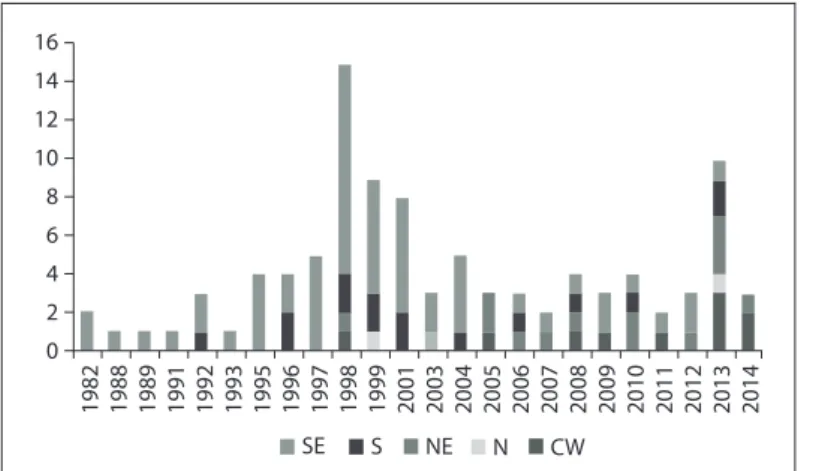
Seventeen new neurosurgery programs were created during the study period and represented 14.6% of the total. hree were in the south, four in the southeast, three in the northeast, four in the center-west and three in the north.
show that in the 1980s and 1990s, there was a heavy concentration of NMRPs in the southeastern and southern regions. Over that period, new program startups in other regions were exceptional. From 1999 to 2003, new NMRPs emerged in other regions. Over the past three years, the distribution of neurosurgery residency positions according to region has started to change. In particular, there was greater diversity in NMRP startups in 2012, with good responses in the northeastern and central-western regions.
he CNRM recognizes that 127 neurosurgery programs have existed historically. At the time of the present evaluation process, there were 105 programs. Twenty-three neurosurgery programs had been canceled before the data analysis process took place, or were canceled during it.
Ater the assessment, it was possible to approve 28 NMRPs without any restrictions, corresponding to 26.7% of the total. Twenty-two of these programs are located in the southeast, ive in the south and one in the north. Table 1 shows the situation of the 105 neurosurgery programs ater the CNRM/SBN evalu-ation. hirty-seven programs were placed under supervision for correction of irregularities (Table 1): eight in the south, twenty in the southeast, ive in the northeast, and two each in the center-west and north. Four neurosurgery programs had to be closed immediately due to lack of appropriate conditions for teaching and medical care: three in the southeast and one in the northeast. For one program that was placed under supervision by the tech-nical board, corrections were made quickly and it was approved by the inal CNRM plenary session. Four programs continued to be out of date by the end of the period covered by this study. Fourteen were still waiting for assessment visits and no impact or results can be presented because they were irst visited just a few weeks before the project began and could not be evaluated within ive years.
he most common problems found in the inal reports of the evaluation, technical papers and CNRM plenary body are shown in Tables 2 and 3. hese problems observed in the results can be divided into two groups:
• Service faults (structure, processes and outcomes), subdi-vided into the classical triad of healthcare service assessment drawn up by Donabedian,18,19 here with 19 diferent kinds of
important problems found.
• Learning faults, concerning information and assessments used by the Ministry of Education to analyze medical resi-dency, with 12 diferent important features found.
We deined structure as the materials (infrastructure, equip-ment and supplies) needed to conduct the residency program. Processes were deined as the relationship between human resource management, learning and healthcare. he results rep-resented the ability and eiciency of surgery and clinical care.
he main problems found within teaching and learning related to deiciencies in internships, but there were also short-ages of supervision and theoretical programs. Table 3 summa-rizes the teaching and learning problems identiied during the CNRM/SBN evaluation.
DISCUSSION
here is huge inequity with regard to economics, culture, health, educational performance and access, HDI and other factors among the the diferent regions.15,20 It is known that
economics and HDI are linked to human capital, development and empowerment.21 here is a relationship between HDI and
the numbers of neurosurgery programs and neurosurgeons. Neurosurgeons and neurosurgery residency vacancies are con-centrated in the regions with best HDI. here seems to be a “snowball” of growth in inequity. Worse HDI correlates with services that have poor structure. his scenario is unattractive,
0 2
1982 1988 1989 1991 1992 1993 1995 1996 1997 1998 1999 2001 2003 2004 2005 2006 2007 2008 2009 2010 2011 2012 2013 2014
4 6 8 10 12 14 16
CW N NE S SE
SE = southeast; S = south; NE = northeast; N = north; CW = center-west
Figure 1. Neurosurgery residency training programs installed over the last 30 years in the ive Brazilian regions.
Classiication impact Number of
programs
Approved 28
Changes made before inal evaluation 1
Closed 4
Corrections and supervision 37
New program 17
Out of date 4
Awaiting visit 14
Total 105
Healthcare outcomes Brazilian regions (number of neurosurgery programs)
NE (9) CW (2) SE (23) S (9) Total (43)
Lack of information about operations 1 0 6 0 7
Annual number of surgical procedures less than 300 4 0 6 1 11
Insuicient intensive care beds 1 0 1 0 2
Low number of pediatric procedures 2 0 5 5 12
Low number of vascular procedures 1 0 4 2 7
Low number of functional procedures 1 0 2 4 7
Low number of tumoral procedures 0 0 1 3 4
Low number of spinal procedures 1 0 0 1 2
Low number of peripheral nerve procedures 0 0 1 1 2
Lack or deiciency of outpatient clinic 1 0 1 1 3
Structure NE CW SE S Total
Lack or deiciency of materials to perform surgery 2 0 4 2 8
Lack or insuiciency of neuroimaging resources 0 0 2 1 3
Lack of basic library 1 0 0 0 1
Process NE CW SE S Total
Lack of human resources or materials, or diiculty in scheduling the operating room 2 1 0 0 3
Lack of diary for making appointments with physician team 1 0 1 0 2
Medical residents doing shifts at a long distance away 2 0 4 0 6
Internships and weekly agenda incorrect, according to CNRM rules 1 1 9 4 15
Lack of minimum working conditions and disregard of the number of hours/week per resident 1 1 8 3 13
Lack of institutional organizational documentation 0 0 2 0 2
Table 2. The most common problems found in the inal reports from the evaluation, technical papers and National Medical Residency Committee (Comissão Nacional de Residência Médica, CNRM) plenary body regarding services
NE = northeast; CW = center-west; SE = southeast; S = south.
Teaching and learning outcomes Brazilian regions
NE CW SE S Total
Lack or deiciency of emergency service internship 1 0 3 1 5
Lack or deiciency of supervision or preceptorship 5 1 8 2 16
Lack or deiciency of neurology internship 1 0 3 5 9
Lack or deiciency of neuroanatomy and experimental microsurgery internship 2 0 4 3 9
Lack or deiciency of theoretical, teaching or didactic program 1 1 5 3 10
Lack or deiciency of clinical visits 1 0 0 1 2
Lack or deiciency of anatomical/clinical, pathological/clinical or radiological/clinical sessions 1 0 4 1 6
Lack or deiciency of clinical case discussions 1 0 2 1 4
Excess of residents to be trained in relation to the service features 1 0 3 0 4
Lack or deiciency of interventional neuroradiology internship 0 0 6 0 6
Lack or deiciency of resident assessment 0 0 4 1 5
Lack or deiciency of intensive care unit internship 0 0 2 0 2
Table 3. The most common problems found in the inal reports from the evaluation, technical papers and National Medical Residency Committee (Comissão Nacional de Residência Médica, CNRM) plenary body regarding education
NE = northeast; CW = center-west; SE = southeast; S = south.
and sometimes makes it impossible to practice neurosurgery specialization. he lack of specialists and structure make res-idency positions impossible, or even undesirable. Without medical residency training, there will be fewer specialists and less structure.22
here has been a federal government policy to induce res-idency programs since 2009, including for neurosurgery. his policy, called “ProResidência”, is an important initiative by the
Ministries of Health and Education.23 ProResidência provides
Other strategies are being implemented, such as supervision and assistance between institutions that want to improve their programs or start new ones and experienced universities.25 his
strategy is a tentative government initiative, and its results have not yet been assessed. It is known as “matriciamento” (matrix support)26 and was designed to reformulate the process of
health-care work and used also for teaching and learning.
CONCLUSION
Only about a quarter (26%) of the programs were immediately approved through this evaluation project. he evaluation team from the CNRM was well prepared to address the educational and legal aspects of medical residency in general, and this knowl-edge was brought to bear in these joint evaluations. he evalua-tions team of the SBN added value with regard to developing the content of the residency programs and technical issues relevant to the specialty.
CNRM and SBN have uniied their evaluation criteria, showing very complex results, with large numbers of needs and weaknesses. It seems clear that although the isolated and paral-lel evaluation processes used in Brazil today are important, uni-ication makes a diference with regard to improving the quality of teaching, clinical services and future medical practice.
REFERENCES
1. Sheldon GF, Ricketts TC, Charles A, et al. The global health workforce shortage: role of surgeons and other providers. Adv Surg. 2008;42:63-85. 2. Leonardi G. Joint action health workforce planning and forecasting. Available from: http://www.euhwforce.eu/web_documents/JAHWF-PA-1/PA1_MDS_a_WP5.pdf. Accessed in 2014 (Dec 30).
3. Australian Institute of Health and Welfare. Medical workforce 2011. Canberra: Australian Institute of Health and Welfare. Available from: http:// www.aihw.gov.au/WorkArea/DownloadAsset.aspx?id=60129542629. Accessed in 2014 (Dec 30).
4. López-Valcárcel BG, Pérez PB. Diicultades, trampas y tópicos en la planiicación del personal médico [Diiculties, pitfalls and stereotypes in physician workforce planning]. Gac Sanit. 2008;22(5):393-5. 5. López-Valcárcel BG, Pérez PB. Oferta y necesidad de médicos
especialistas en España (2006-2030). Grupo de Investigación en Economía de la Salud, Universidad de Las Palmas de Gran Canaria; 2007. Available from: http://www.msssi.gob.es/novedades/docs/ necesidadesEspeciales06_30.pdf. Accessed in 2014 (Dec 30). 6. O’Brien-Pallas L, Birch S, Baumann A, Murphy GT. Integrating workforce
planning, human resources, and service planning. Geneva: World Health Organization; 2001. Available from: http://www.who.int/hrh/ documents/en/Integrating_workforce.pdf. Accessed in 2014 (Dec 30). 7. Crisp N, Chen L. Global supply of health professionals. N Engl J Med.
2014;370(10):950-7.
8. Conselho Regional de Medicina. Resolução CFM no 1.634/2002.
Dispõe sobre convênio de reconhecimento de especialidades médicas irmado entre o Conselho Federal de Medicina CFM, a Associação Médica Brasileira – AMB e a Comissão Nacional de Residência Médica – CNRM. Publicada no D. O. U. de 29 de abril de 2002, seção I, p. 81. Alterada pela Resolução CFM no 1666/03 (Anexo
II) Seção 1, p. 265-66 Alterada pela Resolução CFM no 1.659/03.
Available from: http://www.portalmedico.org.br/resolucoes/ cfm/2002/1634_2002.htm. Accessed in 2014 (Dec 30).
9. Sampaio SAP, Mazza T. A formação de médicos especialistas e a demanda por assistência hospitalar no Sistema Único de Saúde no Estado de São Paulo [Specialist medical training and demanda for medical care at the hospitals of the Uniied Health System in the State of Sao Paulo, Brazil]. São Paulo Perspect. 2008;22(2):104-19. 10. Conselho Federal de Medicina. PROCESSO-CONSULTA CFM no
10.239/11 - PARECER CFM no 18/12. Atuação de proissionais atuantes
no Serviço de Oncologia Pediátrica. Available from: http://www. portalmedico.org.br/pareceres/CFM/2012/18_2012.pdf. Accessed in 2015 (Jan 5).
11. Brasil. Presidência da República. Casa Civil. Subcheia para Assuntos Jurídicos. Lei no 3.268, de 30 de setembro de 1957. Dispõe sobre os
Conselhos de Medicina, e dá outras providências. Available from: http:// www.planalto.gov.br/ccivil_03/leis/L3268.htm. Accessed in 2015 (Jan 5). 12. Conselho Federal de Medicina. Resolução CFM no 2.005/2012
(Publicada no D.O.U. 21 dez. 2012. Seção I, p. 937 a 940) (Nova redação do Anexo II aprovada pela Resolução CFM no 2068/2013)
Dispõe sobre a nova redação dos Anexos II e III da Resolução CFM no 1.973/2011, que celebra o convênio de reconhecimento
de especialidades médicas irmado entre o Conselho Federal de Medicina (CFM), a Associação Médica Brasileira (AMB) e a Comissão Nacional de Residência Médica (CNRM). Available from: http:// www.portalmedico.org.br/resolucoes/CFM/2012/2005_2012.pdf. Accessed in 2015 (Jan 5).
13. Brasil. Presidência da República. Casa Civil. Subcheia para Assuntos Jurídicos. Decreto no 80.281, de 5 de setembro de 1977. Regulamenta
a Residência Médica, cria a Comissão Nacional de Residência Médica e dá outras providências. Available from: http://www.planalto.gov.br/ ccivil_03/decreto/1970-1979/D80281.htm. Accessed in 2015 (Jan 5). 14. De Toni Jr CN. Análise do IDH do Brasil, de suas regiões e de
outros países: um enfoque comparativo [Dissertation]. São Carlos: Universidade Federal de São Carlos; 2010. Available from: http:// www.bdtd.ufscar.br/htdocs/tedeSimpliicado//tde_busca/arquivo. php?codArquivo=2980. Accessed in 2015 (Jan 5).
16. Schefer M, Cassenote A, Biancarelli A. Demograia Médica no Brasil. Volume 2. Cenários e indicadores de distribuição. São Paulo: Conselho Federal de Medicina; 2013. Available from: http://www.cremesp.org. br/pdfs/DemograiaMedicaBrasilVol2.pdf. Accessed in 2015 (Jan 5). 17. Brasil. Instituto Brasileiro de Geograia e Estatística. Indicadores sociais
mínimos. Aspectos demográicos – Informações gerais. Available from: http://www.ibge.gov.br/home/estatistica/populacao/condicaodevida/ indicadoresminimos/tabela1.shtm. Accessed in 2015 (Jan 7).
18. Donabedian A. The quality of care. How can it be assessed? JAMA. 1988;260(12):1743-8.
19. Donabedian A. Criteria, norms and standards of quality: what do they mean? Am J Public Health. 1981;71(4):409-12.
20. Galeano EAV, Mata HTC. Diferenças regionais no crescimento econômico: uma análise pela teoria do crescimento endógeno. Revista Econômia do Nordeste. 2009;40(4):669-83. Available from: http://www.bnb.gov.br/projwebren/exec/artigoRenPDF.aspx?cd_ artigo_ren=1158. Accessed in 2015 (Jan 5).
21. Cooper RA. It’s time to address the problem of physician shortages: graduate medical education is the key. Ann Surg. 2007;246(4):527-34. 22. Nunes MPT, Michel JLM, Brenelli SL, et al. Distribuição de vagas de residência médica e de médicos nas regiões do país. Cadernos ABEM. 2011;7:28-34. Available from: http://www.abem-educmed.org.br/ pdf/caderno_abem7.pdf. Accessed in 2015 (Jan 5).
23. Petta HL. Formação de médicos especialistas no SUS: descrição e análise da implementação do programa nacional de apoio à formação de médicos especialistas em áreas estratégicas (Pró-Residência) [Training of medical specialists in SUS: description and analysis of the implementation of the national programme to support the training of specialists in strategic areas (Pro-Residencia)]. Rev Bras Educ Méd. 2013;37(1):72-9.
24. Estação de Pesquisa de Sinais de Mercado em Saúde – EPSM. Avaliação nacional da demanda de médicos especialistas percebida pelos gestores de saúde. Belo Horizonte, Mar 2009. Available from: https://www.nescon.medicina.ufmg.br/biblioteca/imagem/2466. pdf. Accessed in 2015 (Jan 5).
25. Granja GF, Zoboli ELCP, Francolli LA. O discurso dos gestores sobre a equidade: um desaio para o SUS [The discourse of managers on equity: a challenge for Brazil’s Uniied Health System (SUS)]. Ciênc Saúde Coletiva. 2013;18(12):3759-64.
26. Campos GWS, Domitti AC. Apoio matricial e equipe de referência: uma metodologia para gestão do trabalho interdisciplinar em saúde [Matrix support and reference team: a methodology for interdisciplinary health work management]. Cad Saude Publica. 2007;23(2):399-407.
Sources of funding: Coordenação de Aperfeiçoamento de Pessoal de
Nível Superior (CAPES) Scholarship process number: 6103-14-6
Conlict of interest: None
Date of irst submission: September 8, 2014
Last received: November 18, 2014
Accepted: November 25, 2014
Address for correspondence:
Renato Antunes dos Santos
Faculdade de Medicina da Universidade de São Paulo (FMUSP) Hospital das Clínicas — Prédio dos Ambulatórios (PAMB) Av. Dr. Enéas de Carvalho Aguiar, 155 — 8o andar — bloco 3