Roberta Roggia FriedrichI
Ilaine SchuchII
Mário Bernardes WagnerI
I Programa de Pós-Graduação em Saúde
da Criança e do Adolescente. Faculdade de Medicina. Universidade Federal do Rio Grande do Sul (UFRGS). Porto Alegre, RS, Brasil
II Departamento de Medicina Social.
Faculdade de Medicina. UFRGS. Porto Alegre, RS, Brasil
Correspondence: Roberta Roggia Friedrich Faculdade de Medicina da UFRGS R. Ramiro Barcelos, 2400, 4º andar Santa Cecília
90035-003 Porto Alegre, RS, Brasil E-mail: [email protected] Received: 8/24/2011
Approved: 1/8/2012
Article available from: www.scielo.br/rsp
Effect of interventions on the
body mass index of school-age
students
ABSTRACT
OBJECTIVE: To evaluate the effect of intervention programs using nutritional education, physical activity or both on the reduction of body mass index in school-age students.
METHODS: The systematic review with meta-analysis included randomized controlled studies available from the following electronic databases for the years 1998 to 2010: PubMed, Lilacs, Embase, Scopus, Web of Science and Cochrane Library. The descriptors were: randomized controlled trial, overweight, obesity, body mass index, child, adolescent, physical activity, nutrition education and Schools. A weighted average was based on the standardized means difference and used a 95% confi dence interval. The inconsistency test was utilized to evaluate the heterogeneity of studies.
RESULTS: Initially, 995 studies were identifi ed, of which 23 were included, and 3 meta-analyses were performed. Isolated physical activity interventions did not present a signifi cant reduction in body mass index, with a standardized mean difference of -0.02 (95%CI: -0.08; 0.04). A similar result (n= 3,524) was observed in the isolated interventions of nutritional education, with a standardized mean difference of -0.03 (95%CI: -0.10; 0.04).When the interventions with physical activity and nutritional education were combined, the result of the meta-analysis (n= 9,997) presented a statistically signifi cant effect in the reduction of body mass index in school-age students, with a standardized mean difference: -0.37 (95%CI: -0.63; -0.12).
CONCLUSIONS: The interventions that combined physical activity and nutritional education had more positive effects in the reduction of body mass index among school-age students than when they were applied individually.
DESCRIPTORS: Child. Adolescent. Obesity, prevention & control. Body Mass Index. Food and Nutrition Education. Physical Education and Training. Motor Activity. Weight Reduction Programs. Meta-Analysis.
INTRODUCTION
Obesity is a condition where the accumulation of body fat increases and results in harm to health.a Despite being an ideal, this defi nition is diffi cult to apply
due to the limited availability of easy to administer methods to evaluate body composition.8 Body mass index (BMI) is used to defi ne obesity. The World
Health Organization published the new child growth standards in 2006 and made
a World Health Organization. Obesity: Preventing and Managing the Global Epidemic. Report of
information about BMI available in graphic and tables with percentile values and Z scores, simplifying their use at a population level.47 The increasing prevalence
of obesity threatens the health of an increasing portion of the population. It is a challenge to health services and necessitates practical methods of diagnosis and monitoring that are low cost.
The most current national level data on the nutritional status of Brazilian children age 5 years and less is the Pesquisa de Orçamentos Familiares (POF – Household Budget Survey) from 2008-2009 and the Pesquisa Nacional sobre Demografi a e Saúde (PNDS – National Demographic and Health Survey) of 2006. The results of the POF show that the prevalence of overweight varied from 32% to 40% in children age
fi ve to nine years in the Southeast, South and Central-West regions and from 25% to 30% in the North and Northeast regions, which was the age group for which the increased prevalence of obesity was most dramatic.b
There was an increased prevalence of overweight in the population age 10 to 19 years, from 3.7% to 21.7% among boys and from 7.5% to 19.4% among girls between the periods of 1974-1975 and 2009-2009.b The
PNDS recorded a national prevalence of overweight of 6.6%, with the highest proportion in the South (8.8%) and the lowest in the North (5.2%).c
Lifestyle changes (a diet composed of industrialized, sugar and fat rich foods and the reduced consumption of fruits and vegetables) combined with little physical activity (increased television and videogame time and reduced practice of physical activity) in addition to lifestyle factors, contribute to the continual increase in the prevalence of overweight and obesity among children and adolescents.41-44
Although there is no consensus on which interventions are more adequate to decrease obesity, the approaches tend to center on changes in lifestyle, nutritional educa-tion and promoeduca-tion of physical activity.10 Schools are
a strategic place to promote through education the formation of daily habits in physical activity and proper nutrition.
The objective of this study was to evaluate the effects of interventions using physical activity, nutritional education or both on the reduction of BMI in school-age children.
METHODS
A meta-analysis was performed with a criteria-based search strategy for studies published between 1998 and
b Instituto Brasileiro de Geografi a e Estatística. Pesquisa de Orçamentos Familiares 2008-2009: antropometria e estado nutricional de crianças,
adolescentes e adultos no Brasil. Rio de Janeiro; 2010.
c Ministério da Saúde (BR). Pesquisa nacional de Demografi a e Saúde da Criança e da Mulher – PNDS 2006: dimensões do processo
reprodutivo e da saúde da criança. Brasília (DF); 2009. (Série G. Estatística e Informação em Saúde).
August of 2010, in the following electronic databases: Lilacs, PubMed, Web Of Science, Scopus, EMBASE and Cochrane Library. The following key words were used: randomized controlled trial, overweight, obesity, BMI, child, adolescent, physical activity, nutrition education and schools. Campbell et al5 performed a
systematic review in 2001 with studies published until 1998, which explains our decision to include studies beginning in that year. A search was performed from the bibliographic references of the relevant studies and of the systematic reviews concerning the topic of interest. The inclusion criteria were: randomized controlled studies with students age four to 19 years and with baseline and endline measurement of BMI, in addition to interventions using nutritional educa-tion, physical activity or both for a minimal duration of three months. The internal quality of the study was evaluated by criteria of blinded randomization proposed by Cochrane19 and complemented by the Jadad Scale.22
The studies were classifi ed into four categories by the criteria of blinded randomization: Category A or Adequate (adequate randomization process); Category B or Undetermined (undescribed randomization process but the text mentions the study is randomized); Category C or Inadequate (randomization process inadequately described); Category D or Not Utilized (non-random study). Studies classifi ed as A and B, by the analysis of blinded randomization, were included. Studies classifi ed as C and D were excluded from review because they were considered inadequate experiments.
The criteria described by Jadad et al22 for evaluating
internal quality were randomization, double-blinding and loss to follow-up and exclusions. The results were presented by scoring (maximum of fi ve points). A study is considered of poor quality if it receives a score ≤ three.
The information was independently extracted by two reviewers. The results were matched to verify concor-dance and the discordant results were resolved by consensus. The evaluation by the reviewers was not blinded from the authors and the study results.
A summary measure based on the standardized mean difference (SMD) was used. The calculation of this summary measure and its 95% confi dence interval was according to the fi xed effects model or the random effects model, depending on the heterogeneity between the studies. The test of inconsistency (I2) was used to
evaluate heterogeneity between the studies and random effects model was used for I2 > 50%.20,21 The effect
The statistical analyses was performed using the soft-ware program Review Manager version 5.1, produced by Cochrane Collaboration, and results were presented through use of Forest Plot graphics.
RESULTS
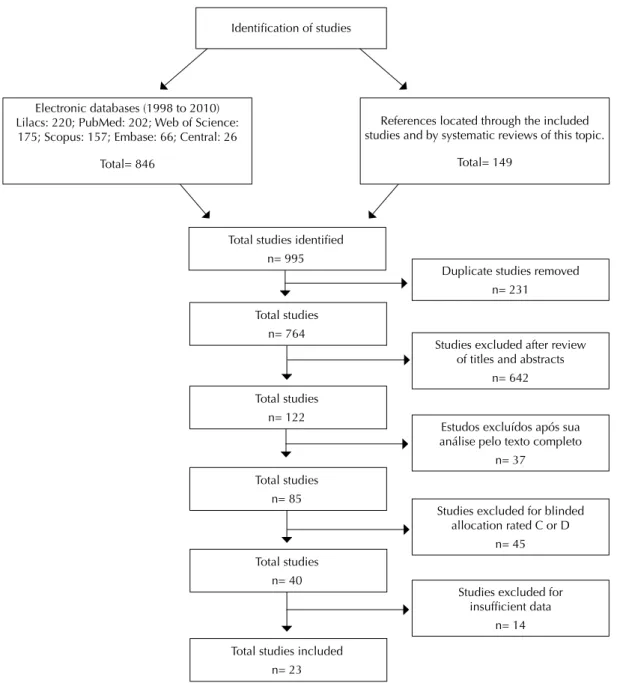
There were 995 studies identified, including 231 duplicates; 642 were excluded after analysis of titles and abstracts because they did not meet the inclusion criteria. The full text was analyzed for 122 articles of which 37 were excluded because they did not meet the inclusion criteria. Eighty-fi ve studies were analyzed and classifi ed by the criteria of blinded randomiza-tion;19 and 40 studies were classifi ed as A or B and
selected. Of these, 17 were excluded for not presenting suffi cient data, for a fi nal total of 23 included studies (Figure 1; Table).
Of the 23 studies, 16 evaluated the effect of physical activity and nutritional education as an intervention to reduce BMI, fi ve evaluated physical activity and two evaluated nutritional education. The majority of prevention programs promoted physical acti vity4,9,11-12,14,16,24,26-29,38,40,46,50,51,53 and two programs
recom-mended physical activity.15,55 All the studies included
programs that encouraged healthy dietary habits through presentations and didactic materials. Of these studies, seven had interventions with school meals and cafeterias.4,14,26-28,52-53
Identifi cation of studies
Electronic databases (1998 to 2010) Lilacs: 220; PubMed: 202; Web of Science: 175; Scopus: 157; Embase: 66; Central: 26
Total= 846
Total studies identifi ed n= 995
Duplicate studies removed n= 231
Studies excluded after review of titles and abstracts
n= 642
Estudos excluídos após sua análise pelo texto completo
n= 37
Studies excluded for blinded allocation rated C or D
n= 45
Studies excluded for insuffi cient data
n= 14 Total studies
n= 122
Total studies n= 40 Total studies
n= 764
Total studies n= 85
Total studies included n= 23
References located through the included studies and by systematic reviews of this topic.
Total= 149
Seven studies were considered adequate in their randomization procedure, and it was not described in 16 studies, although the text mentioned that the study was randomized. Twenty-two studies were considered poor quality and one as good quality (Table).
Three meta-analyses were performed to evaluate the effect of interventions that isolated or combined physical activity and nutritional education about BMI among students:
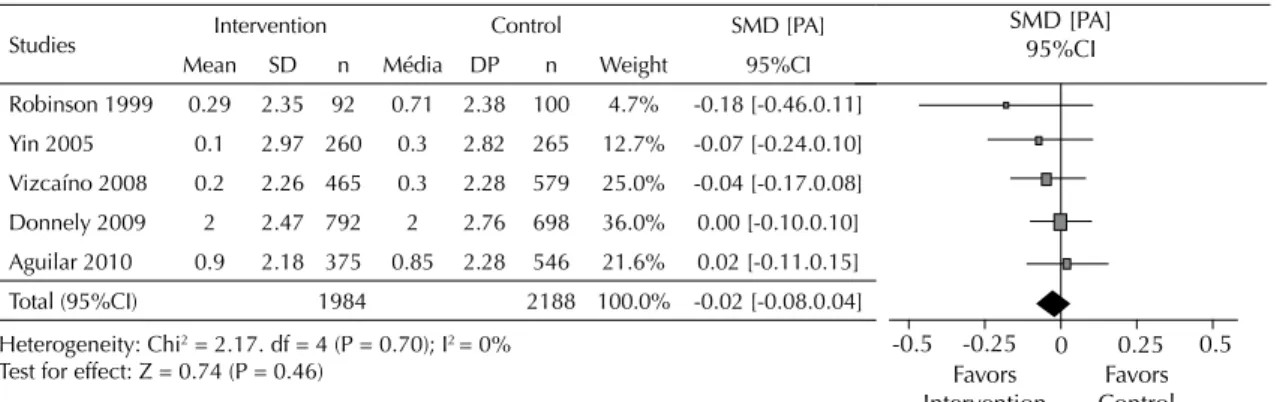
Five studies were grouped to evaluate the effect of the interventions with physical activity among students. The results with 4,172 participants did not show a statistically signifi cant effect of the intervenitons with physical activity in the reduction of BMI, with SMD (fi xed effects): -0.02 (95%CI -0.08;0.04), p = 0.46, between the intervention group (IG) compared to the control group (CG), with a trivial effect magnitude. There was no heterogeneity between studies (I2 = 0%)
(Figure 2).
Two studies involving interventions with nutritional education were included and the results grouped for a total 3,524 participants, and the analysis demonstrated no statistically significant effect in the reduction of BMI, with a SMD (fi xed effects): -0.03 (95%CI -0.10;004), p = 0.39 between the IG compared to the CG, with an effect magnitude considered trivial. There was heterogeneity between stuides, with low variability (I2 = 36%) (Figure 3).
To evaluate the effect of interventions with physical activity and nutritional education among students, 16 studies were grouped. The results with 9,997 partici-pants presented a statistically signifi cant effect of the interventions with physical activity and nutritional education together upon the BMI, with SMD (random effects): -0.37 (95%CI -0.63;-0.12), p < 0.01, between the IG compared to the CG with a small effect magni-tude. There was heterogeneity between the studies, with high variability (I2 = 97%) (Figure 4).
Table. Characteristics of studies included in the systematic review.
1st Author Year Location Age (years) n Intervention Intervention
period (months) Blinding Rating Jadad
Robinson50 1999 USA ± 9ª 192 PA 6 B 2
Caballero4 2003 USA 7 to 10 1.409 PAPA+NE 36 B 2
Neumark-Sztainer46 2003 USA ± 15ª 190 PA+NE 4 B 2
Story54 2003 USA 8 to 10 53 PA+NE 3 B 3
James23 2004 England 7 to 11 574 NE 12 A 2
Kafatos29 2005 Greece ± 7ª 541 PA+NE 72 B 2
Yin55 2005 Georgia ± 9ª 525 PA 8 B 2
Haerens16 2006 Belgium 11 to 15 1.562 PA+NE 24 B 2
Eliakim12 2007 Israel 5 to 6 101 PA+NE 4 B 2
Jiang24 2007 China ± 8ª 2.425 PA+NE 36 B 2
Johnston26 2007 USA 10 to 14 66 PA+NE 3 B 2
Johnston27 2007 USA 10 to 14 57 PA+NE 6 B 2
Singh52 2007 Netherlands 12 to 13 1.053 PA+NE 8 A 2
Foster14 2008 USA ± 11ª 844 PA+NE 24 B 2
Vizcaino38 2008 Spain 9 to 10 1.044 PA 9 A 2
Donnelly11 2009 USA 7 to 8 1.490 PA 36 B 2
Gentile15 2009 USA ± 10ª 1.201 PA+NE 6 B 2
Muckelbauer45 2009 Germany ± 8ª 2.950 NE 8 B 2
Peralta48 2009 Australia 12 to 13 32 PA+NE 6 A 5
Aguilar51 2010 Spain 9 to 11 921 PA 18 B 2
Johnston28 2010 USA 10 to 14 54 PA+NE 12 A 2
Mihas40 2010 Greence 12 to 13 208 PA+NE 3 A 2
Singhal53 2010 India 15 to 17 201 PA+NE 6 A 2
ª Mean age
DISCUSSION
The results of the meta-analysis for the isolated inter-ventions with physical activity or nutritional education did not show a statistically signifi cant effect on the reduction of BMI among students. A similar result was presented in a meta-analysis by Harris et al18 that
evalu-ated the effect of interventions with physical activity on BMI of children in school setting, with a SMD: -0.05 (95%CI -0.19;0.10).
Isolated interventions did not result in changes of BMI, which can be partially explained by recognition that changes to body mass do not occur in a short period. The studies included in these analysis implemented interventions with a duration longer than three months and the meta-analysis were limited by the reduced number of studies included.
There was a reduction in BMI for the meta-analysis of interventions that combined interventions with physical activity and nutritional education. A similar result was also observed by Katz32 for combined interventions and
decreased body mass with SMD: -0.29 (95%CI -0.45;-0.14) among students. This suggests that strategies to reduce and prevent obesity should focus on dietary consumption patterns and caloric expenditure through
physical activity, aspects that should be prioritized in the planning of public policies for health.
Studies about the effect of interventions upon BMI should be interpreted with caution, since the evaluation of nutritional status using this index among adolescents should consider the stage of sexual maturation. Changes in body mass can be characteristic of certain develop-mental phases and not the result of inadequate dietary consumption, inadequate physical activity or both.
Although it does not measure physical composition, the widespread use of BMI in epidemiologic studies as an indicator for nutritional status is justifi ed by its ease of measurement, large availability of data on body mass, in addition to its relationship with morbidity and mortality.2
When analyzed individually, the studies included in this review demonstrated positive results from life-style changes that reduced television, videogame and computer screentime,14-15,50 that increased the
consump-tion of fruits and vegetables14-15 and that reduced the
consumption of foods rich in fat.4,14 These fi ndings
reinforce the importance of developing actions and programs to change lifestyles among this age group, since their lifestyles are in formation.
Studies Intervention Control SMD [PA]
Mean SD n Média DP n Weight 95%CI
James 2004 0.6 1.48 295 0.8 1.71 279 16.4% -0.13 [-0.29.0.04]
Muckebauer 2009 0.39 1.83 1641 0.41 2.02 1309 83.6% -0.01 [-0.08.0.06]
Total (95%CI) 1936 1588 100.0% -0.03 [-0.10.0.04]
Heterogeneity: Chi2 = 1.57, df = 1 (P = 0.21); I2 = 36% Test for effect: Z = 0.86 (P = 0.39)
Figure 3. Forest Plot for the studies comparying the IG with CG for interventions with nutritional education and BMI among students.
SD: Standard deviation; n: Sample size; SMD [PA]: standardized mean difference for fi xed effects: CI: Confi dence interval; I²: Inconsistency test
0,5 DMP [EF]
95% CI
-0,5 -0,25 0 0,25
Favors Intervention
Favors Control
Figure 2. Forest Plot for the studies comparying the IG with the CG for interventions with physical activity and BMI among students. SD: Standard deviation; n: Sample size; SMD [PA]: standardized mean difference for fi xed effects: CI: Confi dence interval; I²: Inconsistency test.
-0.5 -0.25 0 0.25 0.5 SMD [PA]
95%CI
Favors
Intervention ControlFavors
Studies Intervention Control SMD [PA]
Mean SD n Média DP n Weight 95%CI
Robinson 1999 0.29 2.35 92 0.71 2.38 100 4.7% -0.18 [-0.46.0.11]
Yin 2005 0.1 2.97 260 0.3 2.82 265 12.7% -0.07 [-0.24.0.10]
Vizcaíno 2008 0.2 2.26 465 0.3 2.28 579 25.0% -0.04 [-0.17.0.08]
Donnely 2009 2 2.47 792 2 2.76 698 36.0% 0.00 [-0.10.0.10]
Aguilar 2010 0.9 2.18 375 0.85 2.28 546 21.6% 0.02 [-0.11.0.15]
Total (95%CI) 1984 2188 100.0% -0.02 [-0.08.0.04]
The literature documents the benefits of physical activity and of healthy nutrition upon skeletal health (mineral consent and bone density)34-36,55 increased
fl exibility and aerobic capacity6,30,55 and in the inverse
relationship with cardiovascular risk factors.6,17,33,39,49
The practice of regular physical activity, when begun in childhood or adolescence, protects adults against physical inactivity.1,3,37
The most challenging aspect for health promotion strategies is adherence outside of schools, since health is negatively impacted by the food industry through advertisements and commercials for calorie-dense foods. Technological advances such as videogames and computers attract children to a lifestyle of little physical activity and increased calorie consumption. Researchers foresee growth in high-speed internet and videos on screens (cable TV, VCR, DVD, videogames, computer games), according to a conference by the National Institutes of Health in the United States, and these changes will continue to incentivize lifestyle changes among children and adolescents.25 Strategies
to prevent obesity should focus on factors that prevent its development.
Interventions with families, especially parental involvement in the promotion of healthy habits, should
be contemplated and estimulated by interventional programs. Children are infl uenced by their parents’ habits; therefore, recommendations introduced in schools should be followed at home through the positive example of parents for their children, through healthy nutrition and the regular practice of physical exercise. Interventions have better results when the strategy includes a family component.13,31
The 23 studies included in the meta-analysis have limitations, since the majority were performed with a small sample and were considered of low quality by the Jadad scale because they did not describe the allo-cation randomization procedure, blinding, losses and exclusions. This implies a need for more well-designed randomized controlled clinical studies. No Brazilian study was included in this review since they did not meet the inclusion criteria.
This systematic review is subject to publication bias, since it is easier to publish studies that report benefi cial effects for a given intervention, in detriment to studies that do not describe benefi cial effects.
This study suggests a need for randomized controlled studies with well-designed methodologic criteria in order to evaluate the effect of interventions, especially Figure 4. Forest Plot for studies comparying IG and CG for interventions with physical activity and nutritional education on BMI among students.
SD: Standard deviation; n: Sample size; SMD [PA]: standardized mean difference for fi xed effects: CI: Confi dence interval; I²: Inconsistency test.
Studies Intervention Control SMD [PA]
Mean SD n Média DP n Weight 95%CI
Story 2003 -0.2 5.15 26 2 2.55 27 5.4% -0.54 [-1.09.0.01]
Neumark 2003 -0.96 6.14 84 0.75 4.75 106 6.5% -031 [-0.60.-0.03]
Caballero 2003 3 2.02 727 3.1 2.02 682 7.0% -0.05 [-0.15.0.06]
Kafatos 2005 3.45 2.59 284 4.15 2.5 257 6.9% -0.27 [-0.44.-0.10]
Haerens 2006 1.18 2.37 971 1.35 2.18 591 7.0% -0.07 [-0.18.0.03]
Singh 2007 0.45 1.82 600 0.45 2.01 453 7.0% 0.00 [-0.12.0.12]
Eliakin 2007 0 0.68 54 0.3 0.86 47 6.1% -0.39 [-0.78.0.01]
Jiang 2007 0.6 1.76 1029 2.8 2.04 1396 7.0% -1.14 [-1.23.-1.06]
Johnston 2007 -0.56 0.69 38 0.31 0.52 19 5.1% -1.34 [-1.95.-0.74]
Gentile 2007 0.6 2.94 582 0.5 2.94 619 7.0% 0.03 [-0.08.0.15]
Johnston 2007 -0.34 0.77 44 0.17 0.83 22 5.5% -0.64 [-1.16.-0.11]
Foster 2008 1.99 4.72 479 2.1 4.75 365 7.0% -0.02 [-0.16.0.11]
Peralta 2009 0.3 2.63 16 0.6 2.59 16 4.7% -0.11 [-0.81.0.58]
Mihas 2010 -0.1 1.99 107 0.2 2.2 101 6.6% -0.14 [-0.41.0.13]
Johnston 2010 -0.2 1.1 37 1.6 1.2 17 4.9% -1.57 [-2.22.-0.92]
Singhal 2010 -0.07 0.71 99 -0.06 1.11 102 6.3% -0.01 [-0.29.0.27]
Total 5177 4820 100.0% -0.37 [-0.63.-0.12]
Heterogeneity: Tau2 = 0,24; Chi2=509,31, df = 15 (P = 0.00001); I2 = 97% Test for effect: Z = 2,86 (P = 0,004)
SMD [PA] 95%CI
-2 1 0 1 2
Favors Intervention
among Brazilian population. The results can help in calculating sample sizes during the planning of future studies to evaluate the effect of structured interventions among an intervention and control group. Interventions
that combine physical activity and nutritional education present better effects on the reduction of BMI among students, as a strategy to prevent and control obesity, than if applied in an isolated manner.
1. Aarnio M, Winter T, Peltonen J, Kujala UM, Kaprio J. Stability of leisure-time physical activity during adolescence: a longitudinal study among 16-, 17- and 18-year-old Finnish youth. Scand J Med Sci Sports. 2002;12(3):179-85. DOI:10.1034/j.1600-0838.2002.00250.x
2. Anjos LA. Índice de massa corporal (massa corporal. estatura-2) como indicador do estado nutricional de adultos: revisão da literatura. Rev Saude Publica. 1992;26(6):431-6. DOI:10.1590/S0034-89101992000600009
3. Azevedo MR, Araújo CL, Silva MC, Hallal PC. Tracking of physical activity from adolescence to adulthood: a population-based study. Rev Saude Publica. 2007;41(1):69-75. DOI:10.1590/S0034-89102007000100010
4. Caballero B, Clay T, Davis SM, Ethelbah B, Rock BH, Lohman, T et al. Pathways: a school-based, randomized controlled trial for the prevention of obesity in American Indian schoolchildren. Am J Clin Nutr. 2003;78(5):1030-8.
5. Campbell K, Waters E, O’Meara S, Summerbell C. Interventions for preventing obesity in childhood: a systematic review. Obes Rev. 2001;2(3):149-57. DOI:10.1046/j.1467-789x.2001.00035.x 6. Carrel AL, Clark RR, Peterson SE, Nemeth BA,
Sullivan J, Allen DB. Improvement of fi tness, body composition, and insulin sensitivity in overweight children in a school-based exercise program: a randomized, controlled study. Arch Pediatr Adolesc Med. 2005;159(10):963-8. DOI:10.1001/ archpedi.159.10.963
7. Cohen J. Statistical power analysis for the behavioral sciences. 2.ed. Hillsdale: Lawrence Erlbaum; 1988. 8. Cole TJ, Bellizzi MC, Flegal KM, Dietz WH.
Establishing a standard defi nition for child overweight and obesity worldwide: international survey. BMJ. 2000;320(7244):1240-3.
9. Danielzik S, Pust S, Müller MJ. School-based interventions to prevent overweight and obesity in prepubertal children: process and 4-years outcome evaluation of the Kiel Obesity Prevention Study (KOPS). Acta Paediatr Suppl. 2007;96(454):19-25. DOI:10.1111/j.1651-2227.2007.00165.x 10. Dehghan M, Akhtar-Danesh N, Merchant AT.
Childhood obesity, prevalence and prevention. Nutr J.
2005;4(1):24. DOI:10.1186/1475-2891-4-24 11. Donnelly JE, Greene JL, Gibson CA, Smith BK,
Washburn RA, Sullivan DK, et al. Physical Activity Across the Curriculum (PAAC): a randomized controlled trial to promote physical activity and diminish overweight and obesity in elementary school children. Prev Med. 2009;49(4):336-41. DOI:10.1016/j.ypmed.2009.07.022
12. Eliakim A, Nemet D, Balakirski Y, Epstein Y. The effects of nutritional-physical activity school-based intervention on fatness and fi tness in preschool children. J Pediatr Endocrinol Metab. 2007;20(6):711-8.
13. Epstein LH. Family-based behavioural intervention for obese children. Int J Obes Relat Metab Disord. 1996;20(Suppl 1):S14-21.
14. Foster GD, Sherman S, Borradaile KE, Grundy KM, Vander Veur SS, Nachmani J, et al. A policy-based school intervention to prevent overweight and obesity.
Pediatrics. 2008;121(4):e794-802. DOI:10.1542/ peds.2007-1365
15. Gentile DA, Welk G, Eisenmann JC, Reimer RA, Walsh DA, Russell DW, et al. Evaluation of a multiple ecological level child obesity prevention program: Switch® what you Do, View, and Chew. BMC Med. 2009;7(1):49. DOI:10.1186/1741-7015-7-49 16. Haerens L, Deforche B, Maes L, Stevens V, Cardon G,
De Bourdeaudhuij I. Body mass effects of a physical activity and healthy food intervention in middle schools. Obesity (Silver Spring). 2006;14(5):847-54. DOI:10.1038/oby.2006.98
17. Hansen HS, Froberg K, Hyldebrandt N, Nielsen JR. A controlled study of eight months of physical training and reduction of blood pressure in children: the Odense schoolchild study. BMJ.
1991;303(6804):682-5.
18. Harris KC, Kuramoto LK, Schulzer M, Retallack JE. Effect of school-based physical activity interventions on body mass index in children: a meta-analysis. CMAJ. 2009;180(7):719-26. DOI:10.1503/cmaj.080966 19. Higgin J, Green S, editors. Cochrane handbook for
systematic reviews of interventions. Chichester: The Cochrane Collaboration; John Wiley & Sons; 2008. (Cochrane Book Series).
20. Higgins JP, Thompson SG. Quantifying heterogeneity in a meta-analysis. Stat Med. 2002;21(11):1539-8. DOI:10.1002/sim.1186
21. Higgins JP, Thompson SG, Deeks JJ, Altman DG. Measuring inconsistency in meta-analyses.
BMJ. 2003;327(7414):557-60. DOI:10.1136/ bmj.327.7414.557
22. Jadad AR, Moore RA, Carroll D, Jenkinson C, Reynolds DJ, Gavaghan DJ, et al. Assessing the quality of reports of randomized clinical trials: is blinding necessary? Control Clin Trials. 1996;17(1):1-12. DOI:10.1016/0197-2456(95)00134-4
23. James J, Thomas P, Cavan D, Kerr D. Preventing childhood obesity by reducing consumption of carbonated drinks: cluster randomised controlled trial. BMJ. 2004;328(7450):1237. DOI:10.1136/ bmj.38077.458438.EE
24. Jiang J, Xia X, Greiner T, Wu G, Lian G, Rosenqvist U. The effects of a 3-year obesity intervention in schoolchildren in Beijing. Child Care Health Dev. 2007;33(5):641-6. DOI:10.1111/j.1365-2214.2007.00738.x
25. Johnson-Taylor WL, Everhart JE. Modifi able environmental and behavioral determinants of overweight among children and adolescents: report of a workshop. Obesity (Silver Spring). 2006;14(6):929-66. DOI:10.1038/oby.2006.109
26. Johnston CA, Tyler C, Fullerton G, Poston WSC, Haddock CK, McFarlin B, et al. Results of an intensive school-based weight loss program with overweight Mexican American children. Int J Pediatr Obes. 2007;2(3):144-52. DOI:10.1080/17477160701305864 27. Johnston CA, Tyler C, McFarlin BK, Poston WSC,
Haddock CK, Reeves RS, et al. Weight loss in
overweight Mexican American children: a randomized, controlled trial. Pediatrics. 2007;120(6):e1450-7. DOI:10.1542/peds.2006-332
28. Johnston CA, Tyler C, McFarlin BK, Poston WSC, Haddock CK, Reeves RS, et al. Effects of a school-based weight maintenance program for Mexican American children: results at 2 years. Obesity (Silver Spring). 2010;18(3):542-7. DOI:10.1038/oby.2009.241
29. Kafatos A, Manios Y, Moschandreas J. Health and nutrition education in primary schools of Crete: follow-up changes in body mass index and overweight status.
Eur J Clin Nutr. 2005;59(9):1090-2. DOI:10.1038/ sj.ejcn.1602216
30. Kahn EB, Ramsey LT, Brownson RC, Heath GW, Howze EH, Powell KE, et al. The effectiveness of interventions to increase physical activity: a systematic review. Am J Prev Med. 2002;22(4 Suppl):73-107. 31. Katz DL, O Connell M, Njike VY, Yeh MC, Nawaz H.
Stratrgies for the prevention and control of obesity in the school setting: systematic review and meta-analysis. Int J Obes (Lond). 2008;32(12):1780-9.DOI: 10.1038/ijo.2008.158
32. Katz DL. School-based interventions for health promotion and weight control: not just waiting on the world to change. Anu Rev Public Health. 2009;30:253-72. DOI:10.1146/annurev.publhealth.031308.100307 33. Krause MP, Hallage T, Gama MP, Goss FL, Robertson
R, Silva SG. Association of adiposity, cardiorespiratory fi tness and exercise practice with the prevalence of type 2 diabetes in Brazilian elderly women. Int J Med Sci. 2007;4(5):288-92. DOI:10.7150/ijms.4.288 34. Linden C, Ahlborg HG, Besjakov J, Gardsell P, Karlsson
MK. A school curriculum-based exercise program increases bone mineral accrual and bone size in prepubertal girls: two-year data from the pediatric osteoporosis prevention (POP) study. J Bone Miner Res. 2006;21(6):829-35. DOI:10.1359/jbmr.060304 35. MacKelvie KJ, Khan KM, Petit MA, Janssen PA, McKay
HA. A school-based exercise intervention elicits substantial bone health benefi ts: a 2-year randomized controlled trial in girls. Pediatrics. 2003;112(6 Pt 1):e447-52.
36. MacKelvie KJ, Petit MA, Khan KM, Beck TJ, McKay HA. Bone mass and structure are enhanced following a 2-year randomized controlled trial of exercise
in prepubertal boys. Bone. 2004;34(4):755-64. DOI:10.1016/j.bone.2003.12.017
37. Maia JAR, Lefevre J, Claessens A, Renson R, Vanreusel B, Beunen G. Tracking of physical fi tness during adolescence: a panel study in boys. Med Sci Sports Exerc. 2001;33(5):765-71.
38. Martinez Vizcaíno V, Salcedo Aguilar F, Franquelo Gutiérrez R, Solera Martinez M, Sánchez Lopez M, Martinez Serrano S, et al. Assessment of an after-school physical activity program to prevent obesity among 9- to 10-years-old children: a cluster randomized trial.
Int J Obes (Lond). 2008;32(1):12-22. DOI:10.1038/ ijo.0803738
39. Mcmurray RG, Harrell JS, Bangdiwala SI, Bradley CB, Deng S, Levine A. A school-based intervention can reduce body fat and blood pressure in young adolescents. J Adolesc Health. 2002;31(2):125-32. 40. Mihas C, Mariolis A, Manios Y, Naska A, Arapaki A,
Mariolis-Sapsakos T, et al. Evaluation of a nutrition intervention in adolescents of an urban area in Greece: short- and long-term effects of the VYRONAS study.
Public Health Nutr. 2010;13(5):712-9. DOI:10.1017/ S1368980009991625
41. Mondini L, Monteiro CA. Mudanças no padrão de alimentação da população urbana brasileira (1962-1988). Rev Saude Publica. 1994;28(6):433-9. DOI:10.1590/S0034-89101994000600007 42. Mondini L, Monteiro CA. The stage of nutrition
transition in different Brazilian regions. Arch Latinoam Nutr. 1997;47(2 Suppl 1):17-21
43. Monteiro CA, Mondini L, Souza AL, Popkin BM. The nutrition transition in Brazil. Eur J Clin Nutr. 1995;49(2):105-13.
44. Monteiro CA, Mondini L, Costa RB. Changes in composition and appropriate nutrition of family diet in the metropolitan areas of Brazil (1988-1996). Rev Saude Publica. 2000;4(3):251-8.
45. Muckelbauer R, Libuda L, Clausen K, Reinehr T, Kersting M. A simple dietary Intervention in the school setting decreased incidence of overweight in children.
Obes Facts. 2009;2(5):282-5. DOI:10.1159/000229783 46. Neumark-Sztainer D, Story M, Hannan PJ, Rex J. New
Moves: a school-based obesity prevention program for adolescent girls. Prev Med. 2003;37(1):41-51. DOI: 10.1016/S0091-7435(03)00057-4
47. Onis M, Blossner M, Borghi E. Global prevalence and trends of overweight and obesity among preschool children. Am J Clin Nutr. 2010;92(5):1257-64. DOI:10.3945/ajcn.2010.29786
48. Peralta LR, Jones RA, Okely AD. Promoting healthy lifestyles among adolescent boys: The Fitness Improvement and Lifestyle Awareness Program RCT. Prev Med. 2009;48(6):537-42. DOI:10.1016/j. ypmed.2009.04.007
49. Perichart-Perera O, Balas-Nakash M, Ortiz-Rodríguez V, Morán-Zenteno JA, Guerrero-Ortiz JL, Vadillo-Ortega F. Programa para mejorar marcadores de riesgo cardiovascular en escolares mexicanos. Salud Publica Mex. 2008;50(3):218-26. DOI:10.1590/S0036-36342008000300005
trial. JAMA. 1999;282(16):1561-7. DOI:10.1001/ jama.282.16.1561
51. Salcedo Aquilar F, Martinez-Vizcaíno V, Sánchez López M, Solera Martinez M, Franquelo Gutiérrez R, Serreno Martinez S, et al. Impact of an after-school physical activity program on obesity in children. J Pediatrics. 2010;157(1):36-42. DOI:10.1016/j.jpeds.2009.12.046 52. Singh AS, Chin APMJ, Brug J, Van Mechelen W.
Short-term effects of school-based weight gain prevention among adolescents. Arch Pediatr Adolesc Med. 2007;161(6):565-71. DOI:10.1001/ archpedi.161.6.565
53. Singhal N, Misra A, Shah P, Gulati S. Effects of controlled school-based multi-component model
Research funded by the Conselho Nacional de Desenvolvimento Científi co e Tecnológico (CNPq –National Council for Scientifi c Development; Process No.: 559560/2009-5).
Work based on the Master’s dissertation by Friedrich RR presented to the Universidade Federal of Rio Grande do Sul in 2011. The authors declare no confl ict of interests.
of nutrition and lifestyle interventions on behavior modifi cation, anthropometry and metabolic risk profi le of urban Asian Indian adolescents in North India. Eur J Clin Nutr. 2010;64(4):364-73. DOI:10.1038/ejcn.2009.150
54. Story M, Sherwood NE, Himes JH, Davis M, Jacobs Jr DR, Cartwright Y, et al. An after-school obesity prevention program for African-American girls: the Minnesota GEMS pilot study. Ethn Dis. 2003;3(1 Suppl 1):S54-64.
55. Yin ZN, Gutin B, Johnson MH, Hanes Jr J, Moore JB, Cavnar M, et al. An environmental approach to obesity prevention in children: Medical College of Georgia FitKid Project year 1 results. Obes Res.