. ABSTRACTS AND REPORTS 397
diagnosis of microfilaremia. Japan J Exp Med 47(6): counting chamber and thick smear methods of
529-530, 1977. counting microfdariae. Tram R Sot Trap Med Hyg
(4) Denham, D. A., D. T. Denis, T. Pon- 65:521-526, 1971. nudurai, G. S. Nelson, and F. Guy. Comparison of
MALARIA PROGRAM IN BRAZIL’S AMAZON REGION
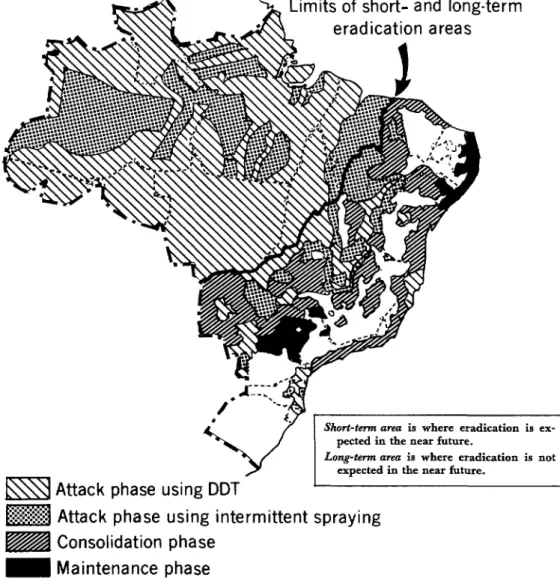
Amazonia accounts for 73 per cent of the malarious area of Brazil (see Figure l), but it contains only 20 per cent of the total Brazilian population. Eradicating malaria from the Amazon region is considered a long-term undertaking, owing to factors that make it dif- ficult to control the disease and that favor transmission.
The obstacles to malaria control include low demographic density, dispersion of the population, existence of nomadic groups, dif- ficult access to areas close to the tributaries and subtributaries of major rivers during the dry period in the second half of the year, and flooding of fields in the second half of the year. Continuous migratory flows from areas free of transmission to Amazonia are assuming con- siderable importance in the epidemiology of malaria and are responsible for the heighten- ing of the endemia in various parts of the region.
The factors that favor malaria transmission are associated with environmental conditions propitious to the maintenance of the ende- mia-such as temperature, humidity, and rainfall-which influence the life and develop- ment of the vectors. In this regard, special mention should be made of the ramshackle construction of houses in the region, which allows the entry of man-biting mosquitoes, thereby contributing to transmission and maintenance of the endemia.
Technical Problems
Technical malaria control problems in Amazonia are associated with parasites, vec- tors, and people.
In regard to parasites, studies initiated in
1961 in five states and territories (AmapP, Amazonas, Par& RondGnia, Roraima) proved the existence of chloroquine-resistant strains of Plasmodium falciparum.
Insofar as vectors are concerned, Anopheles darlingi is the most important vector species. Though susceptible to DDT, in some places where unwalled or uncompleted houses pre- dominate it is able to transmit malaria- because there are no potential landing places that can be sprayed.
Problems related to man, his habits, and his environment also have a marked influence on the epidemiology of malaria. In keeping with Brazil’s overall development policy and the aim of increasing the population density in hitherto uninhabited areas, the Government is promoting and conducting agricultural, settle- ment, mining, and hydroelectric projects, as well as highway construction. These projects have attracted migratory flows of workers and their families from other regions. Some of the migrants later return to their places of origin, and some thereby spread malaria to areas or regions where it was no longer being transmit- ted.
398 PAHO BULLETIN l vol. 14, no. 4, 1980
Figure 1. Areas and phases of the malaria eradication program, Brazil, 1978.
Limits of short- and long-term
eradication
areas
Long-tm area ia where eradication is not
Kl
Attack phase using DDT
w
Attack phase using intermittent
spraying
m
Consolidation phase
m
Maintenance
phase
1-1
Nonmalarious area
show the number of DDT house sprayings zonia, as well as the possibility that such (2g/m2) and the parasite rates in 1978. problems may become more serious, studies
of the types listed below are urgently needed:
Malaria Control Studies l Malaria chmzotherafiy: Study of the susceptibility
l ABSTRACTS AND REPORTS 399
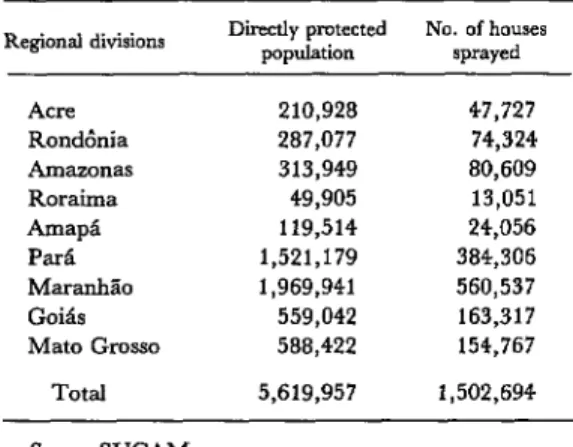
Table 1. Data on spraying, 1978 (long-term area). Regional divisions Directly protected population No. of houses sprayed
Acre 210,928 47,727
Rondhnia 287,077 74,324
Amazonas 313,949 80,609
Roraima 49,905 13,051
AmapP 119,514 24,056
P& 1,521,179 384,306
MaranhPo 1,969,941 560,537
Goib 559,042 163,317
Mato Grosso 588,422 154,767
Total 5,619,957 1,502,694
Source: SUCAM.
Table 2. Number of slides examined, number positive, and parasite indexes, 1978.
R+Xlal divisions
No. of slides Index of AlXlUal p;OS~
Examined Positive I Pgz; Acre RondBnia Amapa Pam MarauhZo Go& Mato Gross0
Total
32,779 6,331 96,045 27,989 81,699 4,698 29,971 7,233 21,494 6,829 289,140 30,150 313,967 13,593 34,796 1,993 61,711 6,815 961,602 105,631
19.3 23.2 29.1 175.0 5.1 4.0 24.1 136.0 31.7 42.4 10.4 10.7 4.3 3.8 5.7 2.3 11.0 8.7 10.9 10.7 Source: SUCAM.
l Immunolo~: Serologic tests for use in diagnosis and epidemiologic surveillance.
l Vectors: Study of the ecology and biology of vectors.
l Contsol methook Application of new insecticides in various epidemiologic situations, biological con- trol of vectors, and combined application methods.
Aware of these needs, SUCAM, with ad- visory assistance from PAHOfWHO, is undertaking the following research: a general study of the problem areas of Amazonia in order to determine the reason for difficulties in applying control measures and to propose new methods in this field; and tests of a new
antimalaria drug (mephloquine) for use against chloroquine-resistant strains of I?
fakipancm.
The Amazonia Development Superinten- dency (SUDAM), which is responsible for coordinating regional development, has also undertaken a study--together with the ministries of health, social welfare, education and culture, and labor--to define the mini- mum health and education services to be pro- vided for workers in companies operating within the Amazon region.
Article 2 of Resolution 3, 750179 of the
Governing Board of SUDAM reads as
follows:
The minimum health and sanitation services to be provided to company personnel shall have the following objectives:
l Protect the population against regional endemias and prevent the introduction of endemic diseases not present in the region, through measures with collective coverage.
l Promote individual medical care, for which purpose the officers of the companies included within the scope of this article shall:
1. Promote, in collaboration with the Superin- tendency of Public Health Campaigns (SUCAM/ MS), the training of employees for the performance of malaria and schistosomiasis prevention, diagno- sis, and treatment activities and for vaccination against jungle yellow fever.
2. Install a small laboratory on the premises of the company for diagnosis of malaria and schistoso- miasis in accordance with specifications provided by SUCAMIMS.
3. Build, close to the laboratory, a dwelling pro- perly covered with mosquito netting and having complete vertical walls, for malaria examination and treatment of patients.
4. Construct dwellings and houses which, even if rustic or temporary, have complete vertical walls on all sides; these should be situated in places well- removed from pools of stagnant water or vector breeding grounds and be surrounded by an area with a radius of about 50 m having no vegetation.
5. Supply SUCAM/MS with detailed informa- tion on the routes of access roads to the ,‘.ea of the company, the annual program, the times at which clearing operations are carried out, the number of workers to be used, and their probable date of ar- rival at the worksite.
The Association of Amazonia Businessmen (AEA) has signed an agreement with
400 PAHO BULLETIN l vol. 14. no. 4. 1980
SUCAM with the aim of combating malaria 3. Antimalaria drugs provided by SUCAM at the site of agricultural projects. The follow- should be administered in all cases in accordance ing three clauses of that agreement are par- with the treatment scheme recommended by
titularly worthy of note: SUCAM.
1. An AEA employee should be assigned to SUCAM to carry out the spraying and the epide-
miologic activities. Source: Pan American Health Organization, Epidemio-
2. A small laboratory should be installed in the IosicaZ Bulletin 1(3):6-8, 1980. Based on material from the Ministry of Health of Brazil, Boletim Epidemiohigico 9(X), project area for malaria diagnosis. 1979.
IMMUNIZATION LEVELS IN CALIFORNIA SCHOOLCHILDREN
In recent years it has become apparent that rigorously enforced school and preschool child care center immunization laws are the most effective means of further reducing the in- cidence of vaccine-preventable diseases in the United States. School and preschool entry im- munization requirements have the potential for ultimately eliminating these diseases as public health problems.
In 1977 California passed legislation strengthening and systematizing requirements that children attending school must have diphtheria, tetanus, pertussis, poliomyelitis, and measles immunizations. In the ensuing three years, California schools, with very little outside financial assistance, have made a con- certed effort to bring all pupils into com- pliance with these requirements. This year, school entry immunization requirements for rubella and mumps will take effect in Califor- nia, focusing primarily on entrants at the kindergarten level and below.
Some data on progress in implementing these laws are available. Between 1977 and the present an effort was made to assess immuni- zation levels for the more than four million pupils in the state’s public and private schools. As of 30 July 1980, immunization records of over 96 per cent of the pupils had been review- ed. The percentages reported as being ade- quately immunized were as follows: DTP/Td (4 or more doses of DTP or 3 or more doses of
Td), 91 per cent; polio (3 or more doses), 92 per cent; measles, 94 per cent; rubella, 55 per cent; and mumps, 48 per cent. Immunization against the last two diseases was not required at the time of this assessment. Also, not all of the schools reported on immunization levels for mumps and rubella.
Annual assessments are made of the state’s over 330,000 kindergarten entrants. In the fall of 1979, percentages of entrants adequately immunized against the above diseases were as follows: DTP/Td, 85 per cent; polio, 89 per cent; measles, 91 per cent; rubella, 82 per cent; and mumps, 78 per cent. Several regional surveys have provided estimates on the completeness of the follow-up of inade- quately immunized kindergarten entrants. After follow-up the percentages of adequately immunized kindergarten children rose to the following levels: DTP/Td, 93.5 per cent or higher; polio, 95 per cent or higher; and measles, 98 per cent. One reason why the levels for DTP/Td and polio were not higher is that some schools have not carried out the legal mandate to order exclusion of pupils re- maining inadequately immunized. Com- parable data are not yet available for rubella and mumps immunizations.