The small mammals of the highly impacted North-eastern
Atlantic Forest of Brazil, Pernambuco Endemism Center
Paulo Henrique Asfora1,2 & Antonio Rossano Mendes Pontes1,3
1Laboratório de Estudo e Conservação da Natureza, Departamento de Zoologia,
Centro de Ciências Biológicas, Universidade Federal de Pernambuco – UFPE, Rua Prof. Moraes Rego, 1235, Cidade Universitária, CEP 50740-620, Recife, PE, Brazil,
http://www.ccb.ufpe.br/ppgba
2Laboratório de Mastozoologia, Departamento de Zoologia, Instituto de Ciências Biológicas,
Universidade do Estado do Rio de Janeiro – UERJ
Rua São Francisco Xavier 524, PHLC, Sala 513a, Maracanã, CEP 20550-013, Rio de Janeiro, RJ, Brazil
3Corresponding author: Antonio Rossano Mendes Pontes,
e-mail: [email protected], www.ppg-ecoevol.uerj.br
ASFORA, P.H. & PONTES, A.R.M. The small mammals of the highly impacted North-eastern Atlantic
Forest of Brazil, Pernambuco Endemism Center. Biota Neotrop. 9(1): http://www.biotaneotropica.org.br/
v9n1/en/abstract?article+bn00409012009.
Abstract: The Atlantic forest of Brazil is nowadays reduced to less than 8% of its total original area and yet many species remain to be described. The Atlantic Forest north to the São Francisco river – The Pernambuco Endemism Center (CEPE) - has less than 2% of its original forest cover and yet the knowledge on small mammals is scarce. Aiming to assess the small mammal community of this region surveys were carried out in 12 forest fragments of different sizes in distinct geographic areas of the CEPE. The capture-mark-recapture technique was used with live-traps set along linear transects. We recorded 15 species, two of which are in the IUCN Red List, but not in the Brazilian List of Threatened Species. The highest richness and abundance indices were recorded in medium-sized fragments and in the rainy season. More marsupial species were recorded compared to rodents. Our results suggest that fragmentation caused the extinction of those most specialized species, currently remaining only those most tolerant to fragmentation and urbanization. It is recommended that urgent measures should be taken to reconnect and restore these fragments to allow recolonization and reestablishment of the gene flow among the populations.
Keywords: Atlantic forest, forest fragments, Pernambuco Endemism Center, small mammals.
ASFORA, P.H. & PONTES, A.R.M. Os pequenos mamíferos da altamente impactada Floresta Atlântica do
Nordeste do Brasil, Centro de Endemismo Pernambuco. Biota Neotrop. 9(1): http://www.biotaneotropica.
org.br/v9n1/pt/abstract?article+bn00409012009.
Resumo: A Floresta Atlântica do Brasil encontra-se hoje reduzida a menos de 8% da sua área original e contém
várias espécies ainda desconhecidas. Sua porção ao norte do Rio São Francisco, o Centro de Endemismo Pernambuco (CEPE), possui atualmente menos de 2% de sua área original e o conhecimento sobre pequenos mamíferos é escasso. Com o objetivo de conhecer melhor a comunidade de pequenos mamíferos desta região foram realizados levantamentos em 12 fragmentos de diferentes tamanhos em áreas geográficas distintas do CEPE. A técnica de captura-marcação-recaptura foi utilizada, com armadilhas de captura viva dispostas em transectos ao longo dos fragmentos. Foram registradas 15 espécies, das quais duas estão inclusas na lista vermelha da IUCN, embora não na lista de espécies ameaçadas do IBAMA. Os maiores índices de riqueza e abundância foram encontrados nos fragmentos de tamanho médio, e durante a estação chuvosa. Foram registradas mais espécies de marsupiais do que de roedores. Os resultados sugerem que a fragmentação causou a extinção daquelas espécies mais especializadas, persistindo atualmente apenas aquelas mais tolerantes à fragmentação e urbanização. Recomendamos que medidas urgentes sejam tomadas para re-conectar e restaurar estes fragmentos, tornando possível sua re-colonização pelas espécies e o aumento do fluxo gênico entre as populações.
Introduction
The Atlantic Forest of Brazil, considered one of the most impor-tant biodiversity hotspots (Myers et al. 2000), had its original pristine forest reduced to a group of small forest fragments isolated in a matrix of plantations, cattle ranches, and urban areas, which comprises only between 5 and 7% of its original area (Brown & Brown 1992, Viana et al. 1997, Tabarelli et al. 2005). However, it harbors an astonish-ingly high biodiversity, and new mammal species are still described (Weksler et al. 1999, de Oliveira & Bonvicino 2002, Leite 2003, Mendes Pontes et al., 2006, Costa et al. 2007).
In the North-eastern Atlantic forest of Brazil, north to the São Francisco river, considered an important endemism center in South America – The Pernambuco Endemism Center (hereafter CEPE) (Prance 1982, 1987, Silva & Casteletti 2003), the situation is even more critical, with only 2% of its original forest remaining (Brown & Brown, 1992). In most cases, fragments are not larger than 10 ha (Ranta et al. 1998). In this region, studies on the diversity and abun-dance of small mammals remain scarce.
In fragmented landscapes, some small mammal species may form isolated populations, others may form metapopulations, with individuals moving between fragments, and yet others may be adapted to highly disturbed environments, or even to urban areas (Adler et al. 1997, Vaughan & Hawkins 1999, Quental et al. 2001, Pires et al. 2002). Umetsu & Pardini (2007) showed also that the destruction of the pristine forest may benefit those generalist or invasive species. This matrix tolerance may determine which species currently occur in the fragments, and is one of the main attributes associated with the vulnerability to fragmentation (Stevens & Husband 1998, Pires et al. 2002, Castro & Fernandez, 2004).
No studies were available on the small mammal community of the coastal forests of the Pernambuco Endemism Center. The only previous study available had been carried out at the altitudinal forests (Souza et al. 2004), which comprise a different biogeography unit of the CEPE. Thus, we carried out a series of single rapid surveys to determine the local small mammal community, its diversity and abundance.
Material and Methods
1. Study area
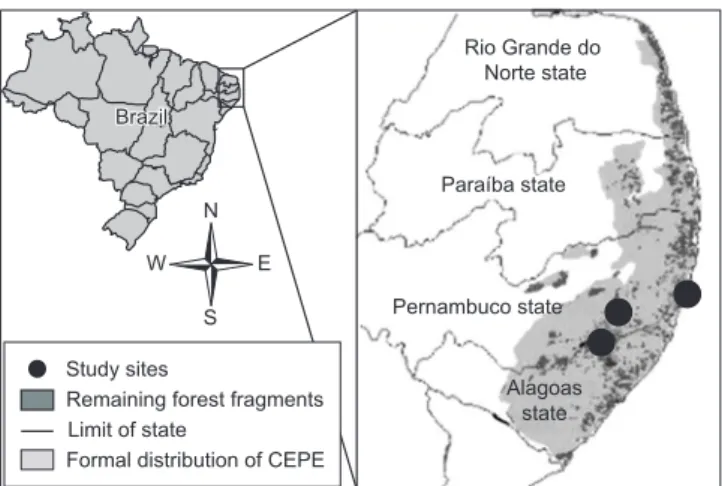
The Pernambuco Endemism Center is the biogeographical area of the Atlantic Forest located to the north of the São Francisco river, which encompasses the States of Alagoas, Pernambuco, Paraíba and Rio Grande do Norte (Figure 1). The CEPE has a long history of fragmentation, which starts in 1500 with the Brazil wood cycle, and was subsequently intensified with the sugar cane exploitation cycle. Although no precise records are available on the age of the sampled fragments, human activities in the Frei Caneca Private Reserve started as early as in 1884, and in the Serra Grande Mill, in 1927.
The study was carried out in 12 fragments of the Atlantic forest of the CEPE, classified into three size classes, which were 1) small (≤100 ha), 2) medium-sized (101-1,000 ha), and 3) large (>1,000 ha). Four of these fragments were located in the Gurjaú Ecological Re-serve (1077.10 ha, 8° 15’ 00” S and 35° 05’ 00” W): Café Forest (118 ha), São Brás Forest (50 ha), Cuxiu Forest (38 ha), and Xangô Forest (6 ha); other four fragments were located in the Frei Caneca Private Reserve of the Natural Patrimony (630.42 ha, 08° 42’ 37” S and 35° 50’ 01” W): Serra do Quengo Forest (500 ha), Fervedouro Forest (300 ha), Ageró Forest (50 ha), and Espelho Forest (50 ha); the last four fragments studied were located in Serra Grande Mill (35° 52’ 12” W and 9° 00’ 00” S), a privately owned property that
holds the largest areas of the Northeastern Atlantic Forest at CEPE, with 8,000 ha. The fragments in Serra Grande Mill were Coimbra Forest (3,400 ha, the only remnant of more than 1,000 ha), Cachoeira Forest (200 ha), Aquidabã Forest (50 ha), and Bom Jesus Forest (10 ha).
Forest types varied from evergreen to semi-decidual tropical rainforest, all subject to some level of human-induced disturbance. The CEPE temperature averages 24 °C, and annual rainfall, 1,300 to 2,400 mm, with a wet season from March to September (Veloso et al. 1991).
The study was carried out between January and September 2003. Each fragment was sampled once during five consecutive nights dur-ing this period. Two fragments were sampled durdur-ing the dry season and the others, during the wet season (Table 1).
2. Surveys
The small mammal community was studied through the capture method adapted from Cerqueira et al. (1993) and Pires & Fernandez (1999). In each fragment, 80 wire live-traps (40 x 17 x 17 cm) baited with pineapple and peanut butter were distributed along single linear transects, which encompassed 40 trapping stations, 20 m from each other. Two live traps, one on the forest floor and another one fixed on tree branches, at an approximate height of 2 m, were set in each sta-tion. Due to prohibitive logistics, no traps were set in the canopy.
Traps were inspected daily at dawn. The animals trapped were preliminarily identified in situ based on literature and had the follow-ing information taken: total length, tail length, ear length, rear foot length, weight, sex, and reproductive conditions (pregnant, lactating, testis position). They were also individually marked in the ear follow-ing a code of cuts, after which they were released. Voucher specimens of each morphotype were also deposited in the mammal collection of the Federal University of Pernambuco, and used for appropriate identification of individuals. Dr. A. Langguth and MSc F. Oliveira, from UFPB, examined specimens and confirmed identifications. Dr. A. Percequillo, from ESALQ-USP, confirmed identification of specimens of Rhipidomys mastacalis.
3. Data analysis
For each fragment, species richness (S) was considered the total number of recorded species, and abundance, the total number of
Rio Grande do Norte state
Paraíba state
Pernambuco state
Alagoas state Brazil
Study sites
Formal distribution of CEPE Remaining forest fragments Limit of state
N
S
W E
Figure 1. Location of the Pernambuco Endemism Center and of the three main study sites where the 12 fragments are located.
captured individuals of a given species (n). Species diversity (H’) was calculated with the Shannon Index (base 2), and correlations between richness/diversity and area of the fragment were determined with the Spearman’s correlation coefficient.
Results
1. Checklist and conservation status of the
small mammals of the CEPE
As a result of 4,082 trap-nights, 92 individuals were trapped (trap-ping success of 2.25%) in the 12 forest fragments. A total of 15 spe-cies were recorded, being eight marsupials: Caluromys philander
Linnaues, 1758, Didelphis albiventris Lund, 1840, Didelphis
aurita Wied-Neuwied, 1826, Marmosa murina Linnaeus, 1758,
Metachirus nudicaudatus É. Geoffroy, 1803, Micoureus demerarae
Thomas, 1905, Monodelphis Americana Muller, 1776, Monodelphis
domestica Wagner, 1842, and seven rodents: Akodon cursor Winge,
1887, Necromys lasiurus Lund, 1840, Nectomys squamipes Brants,
1827, Oecomys bahiensis Hershkovitz, 1960, Hylaeamys oniscus
Thomas, 1904, Cerradomys subflavus Wagner, 1842, and Rhipidomys
mastacalis Lund, 1840.
Two of the 15 recorded species are in the IUCN Red List of Threatened Species (2007), Caluromys philander and Monodelphis
americana, both considered “Lower Risk/ Near Threatened (LR/nt),
due mainly to habitat destruction. None of the species, however, are in the List of the Brazilian Animals Threatened of Extinction, published by IBAMA (2003).
2. Species composition and abundances
Total species richness (S) recorded for CEPE was 15, ranging from zero in Cachoeira and Bom Jesus forest, to nine in Fervedouro. Species diversity (H’) varied from zero in the fragments of Serra Grande Mill to 2.77 in Fervedouro (Table 1).
The highest richness and abundance were recorded during the wet season, with two of the surveys conducted at the dry season re-cording no captures. Species richness was highest in medium-sized
fragments (mean richness = 4.75), followed by small fragments (mean richness = 3.29). More specifically, the highest richness was recorded in those fragments that measured between 300 and 500 ha. Fragment size and species richness, however, did not present any statistically significant correlation (rs = 0.11, p = 0.73).
The most abundant species recorded for the CEPE were Micoureus
demerarae (n = 17, 19%), Metachirus nudicaudatus (n = 15, 16%)
and Rhipidomys mastacalis (n= 9, 11%) whereas the least abundant
were Akodon cursor (n= 1, 1%), Necromys lasiurus (n = 1, 1%),
Nectomys squamipes (n = 2, 2%), Caluromys philander (n= 1, 1%)
and Monodelphis americana (n= 2, 2%) (Figure 2).
Table 1. Richness (S), diversity (H’), species list and abundance of small mammals for each surveyed fragment at the Pernambuco Endemism Center, and for all fragments combined.
Tabela 1. Riqueza (S), Diversidade (H’), lista de espécies e abundância de pequenos mamíferos de cada fragmento estudado at The Pernambuco Endemism Centre, and for all fragments comnbined.
Fragment (ha) S H’ Season
C. philander M. americana D. aurita M. domestica D. albiv
entris
M. murina M. nudicaudatus M. demerarae A. cursor N. lasiurus N. squamipes O. bahiensis C. subflavus R. mastacalis H. oniscus
Cachoeira Forest (200) 0 - Dry - - -
-Bom Jesus Forest (10) 0 - Dry - - -
-Coimbra Forest (3400) 3 1.449 Wet - - - 3 - - - 1 3 - 2
Aquidabã Forest (50) 3 1.371 Wet - - - - 1 - - - 2
-Espelho Forest (50) 6 2.503 Wet - - 1 2 - - 2 - - - - 1 1 1
-Ageró Forest (50) 4 1.549 Wet - - - 1 1 - - - 2 - - 2
-Fervedouro Forest (300) 9 2.774 Wet - - 1 1 1 1 1 5 1 1 - 1 1 2 -Serra do Quengo Forest (500) 7 2.471 Wet - 2 2 - 1 1 6 6 - - - 2
-Xangô Forest (6) 3 1.5 Wet - - - - 2 1 - 1 - - -
-São Brás Forest (50) 4 1.842 Wet - - - 1 2 3 1 - - -
-Cuxiu Forest (38) 3 1.522 Wet 1 - - - 2 2 - - -
-Café Forest (118) 3 1.5 Wet - - - - 1 1 2 - - -
-Pernambuco Endemism Center 15 3.213 - 1 2 4 4 8 8 15 17 1 1 2 3 5 9 2
18
16
14
12
10 8
6
4
2
0
1 1
3 3
6 6
7 5
1 1 1 1
3 3
5 Abundance of small mammals from
Pernambuco Endemism Center
Number of individuals
Didelphidae C. philander
M. americana
D. aurita
M. albiventris
M. murina
M. nudicaudatus
M. demerarae
Rodentia A. cursor
N. lasiurus
N. Squamipes
H. oniscus
O. bahiensis C. subflavus R. mastacalis
M. domestica
Figure 2. Abundance of small mammal species found at the Pernambuco Endemism Center. The numbers above the bars are the number of fragments where each species occurred.
None of the species were present in all the 12 fragments.
Metachirus nudicaudatus was recorded in seven fragments, and
Marmosa murina and Didelphis albiventris were found in six
frag-ments. Most of the species were present in less than half of the stud-ied fragments, and Caluromys philander, Monodelphis americana,
Akodon cursor and Necromys lasiurus were found in only one
frag-ment (Table 1).
Discussion
The number of small mammal species recorded for all of the CEPE is relatively lower than what was recorded in many single localities, specially from the Southeastern Atlantic Forest of Brazil (Fonseca & Robinson 1990, Leite et al. 1996, Stevens & Husband 1998, Pires et al. 2002, Castro & Fernandez 2004, Pardini et al. 2005; see Pardini and Umetsu, 2006, for a comprehensive review). Moreo-ver, small mammal diversity was distributed among many fragments across the CEPE, which is in agreement with Pardini et al. (2005), which concluded that habitat loss and fragmentation lead to less abundant, less rich and more spatially variable communities.
We recorded most of the marsupial species referred to the CEPE (Souza et al. 2004, Oliveira and Langguth 2004). The only exception
was Gracilinanus agilis, a species never collected at the CEPE
Atlan-tic coast, but only in the Altitudinal Forest enclaves in the Caatinga. On the other hand, despite the fact that we had the first record of
Rhipidomys mastacalis in the CEPE Atlantic coast of Pernambuco,
only six of the 11 species of rodents cited by Souza et al. (2004) were recorded in this study. Although Tribe (1996) stated that Rhipidomys
mastacalis is distributed from the Atlantic Forest of Pernambuco to
Rio de Janeiro, he only analyzed material from altitudinal forests at CEPE and Oliveira and Langguth (2004) stated that the genus
Rhipidomys did not occur in the Pernambuco Atlantic forest.
According to the literature (Fonseca & Robinson 1990, Leite et al. 1996, Stevens & Husband 1998, Pires et al. 2002, Castro & Fernandez 2004, Pardini et al. 2005), the number of individuals trapped seems also to be relatively low in CEPE. Although comparisons are restricted by differences in sampling protocol and sampling effort, which was relatively low in each of the fragments and did not include pitfall traps in the present study, the absence of rodents at Gurjaú Ecological Re-serve, the site with the smallest and most disturbed forest fragments, indicates that populations are small in the fragments of CEPE.
Contrary to the expected according to literature (Pardini et al. 2005), we did not find any statistically significant relationship between richness and diversity and fragment size in the CEPE, which suggest that specialized and vulnerable species have gone extinct even from the largest fragments. The highest values of richness and diversity in this study were recorded in medium-sized fragments, which may harbor a higher diversity of microhabitats, including a mosaic of forest edge and interior (Asfora, personal observation), allowing the co-existence of species from both forest interior and open areas. In fact, forests in earlier stages of regeneration or subjected to high levels of disturbance may benefit those species not dependent on specific resources (Pardini et al. 2005).
The higher abundance of marsupials compared to rodents in CEPE, may be related to the fact that marsupials are less vulnerable to fragmentation (Pardini et al. 2005, Castro and Fernandez 2004) and more favored by secondary forests due to their broader diets (Fonseca 1989). According to Pardini et al. (2005) and Castro and Fernandez (2004), terrestrial rodents are the small mammal species most affected by the fragmentation of the Atlantic forest.
In fact, most rodent species recorded in the CEPE are either habitat generalists, occurring in open or disturbed forests, xerophytic vegetation, present broad feeding habits, or are arboreal (Oliveira
and Bonvicino, 2006). Akodon cursor, Cerradomys subflavus and
Necromys lasiurus are terrestrial species that visit open areas, being
common in xerophytic vegetation types, such as Cerrado, Caatinga, and also disturbed areas (Pardini 2004, Figueiredo and Fernandez 2004, Gentille et al. 1997, Weksler et al. 2006, Oliveira et al. 2003).
Rhipidomys mastacalis is an arboreal rodent that occurs in high
abun-dance in the altitudinal forests in Caatinga (Oliveira et al. 2003) and in secondary forest and cacao plantations in Bahia (Pardini 2004).
Hylaeamys oniscus is a terrestrial species that is common in gallery
forest and Cerrado, and also in isolated patches of humid forests (Weksler et al. 2006). Pardini (2004) showed that in south Bahia rodent species of the genus Akodon and marsupials of the genus
Marmosa and Micoureus are found in forest edges, secondary forests,
and also in cacao plantations.
Thus, our results are in agreement with the idea that the long-term survival of small mammal populations in small fragments (<15 ha) depends on the recolonization events, which can only take place if the species originally present in the fragments are able to cross or occupy the surrounding matrix (Krohne 1997, Pires & Fernandez 1999, Boyett et al. 2000, Pires et al. 2002, Castro & Fernandez, 2004). The occurrence of Oecomys bahiensis, however, which is an
arboreal frugivore rodent, and a matrix-avoiding species that has a tendency to disappear from altered areas (Figueiredo and Fernandez 2004), suggests that some habitat specialist species still persist in the CEPE and should receive enough attention before they go regionally extinct.
Considering that 1) the 2% that was left of the forests of the CEPE are mainly distributed in fragments of about 10 ha (Brown & Brown 1992, Ranta et al. 1998) and that 2) these fragments are totally isolated by large distances of agricultural fields, villages, cities and bare land, we hypothesize that re-colonizations are rare, with local and even regional extinctions taking place. Finally, our results suggest that the long history of deforestation of the CEPE has ultimately caused the local extinction of those more specialized species, resulting in a new, less diverse community composed only by those most resilient species.
Acknowledgements
The authors thank The Brazilian Ministry of Environment – MMA, The Brazilian National Research Council – CNPq, and the Center for Research and Studies on Environment of North-eastern Brazil – CEPAN, for the financial support to this study. We are grateful to Dr. L. P. Costa, B. M. de A. Costa, I. C. Normande, and C. M. Brazil for crucial help in the field and to Dr. A. Langguth, MSc F. Oliveira and Dr. A. Percequillo for crosschecking species identifications. We are also indebted to the owners of Serra Grande Estate and Frei Caneca Private Reserve of Natural Patrimony for their permission to study the area, and to The National Environmetal Office – IBAMA for granting permission to study Gurjaú Ecological Station.
References
ADLER, G.H., ARBOLEDO, J.J. & TRAVI, B.L. 1997. Population dynamics of Didelphis marsupialis in northern Colômbia. Stud. Neotrop. Fauna
E. 32(1):7-11.
BOYETT, W.D., ENDRIES, M.J. & ADLER, G.H. 2000. Colonization-extinction dynamics of opossums on small islands in Panama. Can. J. Zool. 78(11):1972-1979.
CASTRO, E.B.V. & FERNANDEZ, F.A.S. 2004. Determinants of differential extinction vulnerabilities of small mammals in Atlantic forest fragments in Brazil. Biol. Conserv. 119(1):73-80.
CERQUEIRA, R., GENTILE, R., FERNANDEZ, F.A.S. & DANDREA, O.S. 1993. A five year population study of an assemblage of small mammals in Southeastern Brazil. Mammalia, 57(4):507-517.
COSTA, L.P., PAVAN, S., LEITE, Y.L.R. & FAGUNDES, V. 2007. A new species of Juliomys (Mammalia: Rodentia: Cricetidae) from the Atlantic forest of southeastern Brazil. Zootaxa, 1463:21-37.
FIGUEIREDO, M.S.L. & FERNANDEZ, F.A.S. 2004. Contrasting effects of fire on populations of two small rodent species in fragments of Atlantic Forest in Brazil. J. Trop. Ecol. 20:225-228.
FONSECA, G.A.B. 1989. Small mammal species diversity in Brazilian tropical primary and secondary forests of different sizes. Rev. Brasil. Zool. 6:381-422.
FONSECA, G.A.B. & ROBINSON, J.G. 1990. Forest size and structure: competitive and predatory effects on small mammal communities. Biol. Conserv. 53:265-294.
INSTITUTO BRASILEIRO DO MEIO AMBIENTE E DOS RECURSOS NATURAIS RENOVÁVEIS – IBAMA. 2003. Lista da fauna silvestre brasileira ameaçada de extinção. http://www.mma.gov.br/port/sbf/fauna/ index.cfm (último acesso em 24/10/2007)
INTERNATIONAL UNION FOR CONSERVATION OF NATURE – IUCN. 2003. IUCN Red List of Threatened Species. http://www.redlist.org (último acesso em 24/10/2007)
KROHNE, D.T. 1997. Dynamics of metapopulations of small mammals. J. Mammal. 78(4):1014-1026.
LEITE, Y.L.R., COSTA, L.P. & STALLINGS, J.R. 1996. Diet and vertical space use of three sympatric opossums in a Brazilian Atlantic forest reserve. J. Trop. Ecol. 12:435-440.
LEITE, Y.L.R. 2003. Evolution and systematics of the Atlantic Tree Rats, Genus Phyllomys (Rodentia, Echimyidae), with description of two new species. Univ. Cal. Pub. Zool. 132:1-118.
MENDES PONTES, A.R., Malta, A.J.R. & Asfora, P.H. 2006. A new species
of capuchin monkey, Genus Cebus Erxleben (Cebidae, Primates): found
at the very brink of extinction in the Pernambuco Endemism Centre. Zootaxa, 1200:1-12.
MYERS, N., MITTERMEIER, R.A., FONSECA, G.A.B. & KENT, J. 2000. Biodiversity hotspots for conservation priorities. Nature. 403:853-858. OLIVEIRA, J.A. & BONVICINO, C.R. 2002. A new species of sigmodontine
rodent from the Atlantic forest of eastern Brazil. Acta Theriol. 47(3): 307-322.
OLIVEIRA, J.A. & BONVICINO, C.R. 2006. Ordem rodentia. In Mamíferos do Brasil (N.R. dos Reis, A.L. Peracchi, W.A. Pedro & I.P. de Lima, eds.). Universidade Estadual de Londrina, Londrina, p. 347-406.
OLIVEIRA, J.A., GONÇALVES, P.R., BONVICINO, C.R. 2003. Mamíferos da caatinga. In Ecologia e conservação da caatinga (I.R. Leal, M. Tabarelli & J.M. Silva, eds.). Editora da Universidade Federal de Pernambuco, Recife, p. 275-334.
OLIVEIRA, F.F. & LANGGUTH, A. 2004. Pequenos mamíferos (Didelphimorphia e Rodentia) de Paraíba e Pernambuco, Brasil. Rev. Nordestina Zool. 18:19-85.
PARDINI, R. 2004. Effects of forest fragmentation on small mammals in an Atlantic Forest landscape. Biodivers. Conserv. 13:2567-2586. PARDINI, R., SOUZA, S.M., BRAGA-NETTO, R. & METZGER, J.P. 2005.
The role of forest structure, fragment size and corridors in maintaining small mammal abundance and diversity in a tropical forest landscape. Biol. Conserv. 124:253-266.
PARDINI, R. & UMETSU, F. 2006. Pequenos mamíferos não-voadores da Reserva Florestal do Morro Grande – distribuição das espécies e da diversidade em uma área de Mata Atlântica. Biota Neotrop. 6(2): http:// www.biotaneotropica.org.br/v6n2 (último acesso em 18/12/2008).
PIRES, A.S. & FERNANDES, F.A.S. 1999. Use of space by the marsupial
Micoureus demerarae in small Atlantic Forest fragments in South-eastern
Brazil. J. Trop. Ecol. 15:279-290.
PIRES, A.S., LIRA, P.K., FERNANDEZ, F.A.S., SCHITTINI, G.M. & OLIVEIRA, L.C. 2002. Frequency of movements of small mammals among Atlantic Coastal Forest fragments in Brazil. Biol. Conserv. 108:229-237.
PRANCE, G.T. 1982. Forest refuges: evidences from woody angiosperms. In Biological diversification in the tropics (G.T. Prance, ed.). Columbia University Press, New York, p.137-158.
PRANCE, G.T. 1987. Biogeography of neotropical plants. In Biogeography and quaternary history in tropical America (T.C. Whitmore & G.T. Prance, eds.). Claredon Press, Oxford, p.175-196.
QUENTAL, T.B., FERNANDEZ, F.A.S., ROCHA, F.S. & DIAS, A.T.C. 2001.
Population dynamics of the marsupial Micoureus demerarae in small
fragments of the Atlantic forest in Brazil. J. Trop. Ecol. 17(3):339-352. RANTA, P., BLOM, T., NIEMELA, J., JOENSUU, E. & SIITONEN, M. 1998.
The fragmented Atlantic rain forest of Brazil: size, shape and distribution of forest fragments. Biodiv. Conserv. 7:385-403.
SOUZA, M.A.N., LANGGUTH, A. & GIMENEZ, E.A. 2004. Mamíferos dos brejos de altitude da Paraíba e Pernambuco. In Brejos de altitude em Pernambuco e Paraíba: história natural, ecologia e conservação (K.C. Porto, J.J.P. Cabral & M. Tabarelli, eds.). Ministério do Meio Ambiente, Brasília, p.229-254.
STEVENS, S.M. & HUSBAND, T.P. 1998. The influence of edge on small mammals: evidence from Brazilian Atlantic forest fragments. Biol. Conserv. 85:1-8.
SILVA, J.M.C. & CASTELETTI, C.H.M. 2003. Status of the biodiversity of the Atlantic Forest of Brazil. In The Atlantic Forest of South America: biodiversity status, threats, and outlook (C. Galindo-Leal & I.G. Câmara, eds.). CABS and Island Press, Washington, p. 43-59.
TABARELLI, M., PINTO, L.P., SILVA, J.M.C., HIROTA, M. & BEDE, L. 2005. Challenges and opportunities for biodiversity conservation in the Brazilian Atlantic Forest. Conserv. Biol. 19(3):695-700.
TRIBE, C.J. 1996. The Neotropical rodent genus Rhipidomys (Cricetidae: Sigmodontinae) – a taxonomic revision. Tese de Doutorado, University College London, London.
UMETSU, F. & PARDINI, R. 2007. Small mammals in a mosaic of forest remnants and anthropogenic habitats evaluating matrix quality in an Atlantic forest landscape. Landscape Ecol. 22:517-530.
VAUGHAN, C.S. & HAWKINS, L.F. 1999. Late dry season habitat use of
common opossum, Didelphis marsupialis (Marsupialia: Didelphidae) in
neotropical lower montane agricultural areas. Rev. Biol. Trop. 47:263-269. VELOSO, H.P., RANGEL-FILHO, A.L.R. & LIMA, J.C.A. 1991.
Classificação da vegetação brasileira adaptada a um sistema universal. IBGE, Rio de Janeiro.
VIANA, V.M., TABANEZ, A.J. & BATISTA, J.L. 1997. Dynamics and restoration of forest fragments in the Brazilian Atlantic moist forest. In Tropical forest remnants: ecology, management, and conservation of fragmented communities (W.F. Laurance & R.O. Bierregaard Jr, eds.). The University of Chicago Press, Chicago, p.351-365.
WEKSLER, M., GEISE, L. & CERQUEIRA, R. 1999. A new species of Oryzomys (Rodentia, Sigmondontinae) from southeast Brazil, with
comments on the classification of the O. capito species group. Zool. J.
Linn. Soc-Lond. 125:445-462.
WEKSLER, M., PERCEQUILLO, A.R. & VOSS, R.S. 2006. Ten new genera of Oryzomyine rodents (Cricetidae: Sigmodontinae). Am. Mus. Novit. 3537:1-29.