Molecular characterization of lactobacilli isolated from fermented
idli
batter
Perumal Jayaprabha Agaliya, Kadirvelu Jeevaratnam
Department of Biochemistry & Molecular Biology, School of Life Sciences, Pondicherry University, Pondicherry, India.
Submitted: April 2, 2012; Approved: April 4, 2013.
Abstract
Lactic acid bacteria are non pathogenic organism widely distributed in nature typically involved in a large number of spontaneous food fermentation. The purpose of this study was to characterize the bacteriocinogenic lactobacilli from fermented idli batter which can find application in biopre-servation and biomedicine. Eight most promising lactobacilli were chosen from twenty two isolates based on their spectrum of activity against other lactic acid bacteria and pathogens. The eight lactobacilli were characterized based on the various classical phenotypic tests, physiological tests and biochemical tests including various carbohydrate utilization profiles. All isolates were homo fermentative, catalase, and gelatin negative. Molecular characterization was performed by RAPD, 16S rRNA analysis, 16S ARDRA, and Multiplex PCR for species identification. RAPD was carried out using the primer R2 and M13. Five different clusters were obtained based on RAPD indicating strain level variation. 16S rRNA analysis showed 99 to 100% homology towards Lactobacillus plantarum.The restriction digestion pattern was similar for all the isolates with the restriction en-zyme AluI. The subspecies were identified by performing Multiplex PCR using species specific primer. Among the five clusters, three clusters were clearly identified asLactobacillus plantarum subsp.plantarum, Lactobacillus pentosus, andLactobacillus plantarumsubsp.argentoratensis.
Key words:Idlibatter, bacteriocin,Lactobacillus plantarumsubsp. argentoratensis,Lactobacillus plantarum, Lactobacillus pentosus.
Introduction
Lactic acid bacteria (LAB) are non pathogenic organ-ism widely distributed in nature. LAB have an important role in the preservation of foods and fermented products and are designated as GRAS (Generally regarded as safe). The genus Lactobacillus is the largest group among the Lactobacteriaceae, and contains over 100 species (Can-chayaet al., 2006). They are characterized as Gram-posi-tive rods, anaerobic but aero tolerant, non-sporulating and catalase negative. They are commercially used as starter cultures in the manufacture of dairy products, fermented vegetables, fermented dough, alcoholic beverages, and meat products (De Vuystet al., 2007).
The primary antimicrobial effect exerted by lacto-bacilli is by the production of lactic acid and reduction of pH. However, there are other metabolic products such as hydrogen peroxide, diacetyls, propionic acid, acetic acid,
carbon dioxide, reuterin, and bacteriocins reported to con-tribute to their antimicrobial activity (El-Ghaisha et al., 2011). Lactobacilli also display antifungal activity (Yang and Chang, 2010). Lactobacilli living as commensal in the intestinal environment might possess probiotic activity (Zagoet al., 2011). They may have anti-tumoral activity (Paolilloet al., 2009), reduce cholesterol level (Wanget al., 2012), alleviate lactose intolerance, stimulate the immune system, and also they may be able to stabilize the micro flora of the gut (O’Flaherty and Klaenhammer, 2010). These various possible attributes of lactobacilli promote beneficial effects to human health. Thus, lactobacilli are now a focus of intensive research worldwide and new spe-cies are being reported.
In the majority of fermented foods, particularly tradi-tional foods of India, the nature of fermentation is by LAB associated with the cereals and legumes (Agrawalet al.,
Send correspondence to K. Jeevaratnam. Department of Biochemistry and Molecular Biology, School of Life Sciences, Pondicherry University, Pondicherry 605 014, India. E-mail: [email protected].
2000).Idlibatter is traditionally prepared from pre-soaked parboiled rice (Oryza sativa) and dehulled black gram (Phaseolus mungo) and allowed for a natural yeast-lactic fermentation for 18-30 hours, while idlis are made by steaming the fermented batter. However, the preparation of idlibatter varies from region to region in south India espe-cially, the proportion of rice and black gram as well as the duration of soaking and fermentation of the batter. Previous reports showed the prevalence of yeast such as Saccharomyces cerevisiae, Debaryomyces hansenii, and Hansenula anomalaand the lactic acid bacteria such as Leuconostoc mesenteroides, Streptococcus faecalis, Lactobacillus fermentum, and Pediococcus cerevisiae in the fermented batter (Soni and Sandhu, 1989), althoughL. mesenteroidesandS. faecalisare considered essential for leavening of the batter and for acid production (Mukherjee et al., 1965; Purushothaman et al., 1993). Recently, Pediococcus pentosaceous or Enterococcus faecalis in combination with yeast theCandida versatiliswere tried as starter cultures foridlibatter fermentation (Srideviet al., 2010). However, the lactobacilli isolated fromidlibatter have been least explored, as well as delineation of the iso-lates to sub-species level has not been reported.
In general, the classical protocols of morphological and biochemical characterizations of microbial cultures are in use to identify bacteriocinogenic culture. The develop-ment of PCR-based methods using random amplification of polymorphic DNA (RAPD) (Nigatuet al., 2001), analysis of rRNA gene homology, amplified 16S rDNA restriction analysis (16S-ARDRA) (Rodaset al., 2003), and species specific primers (Chagnaudet al., 2001) have proved
use-ful for identification of various species of lactobacilli. Thus, the present study was focused on isolation and char-acterization of bacteriocinogenic lactobacilli from fer-mented idli batter by both classical and PCR-based molecular methods to identify the isolates to sub-species level which may help to formulate starter culture as well as in the biological preservation of foods.
Materials and Methods
Isolation of lactobacilli
Theidlibatter was prepared from rice (Oryza sativa) and black gram (Phaseolus mungo), a legume. The ingredi-ents were washed, soaked, grounded, and allowed to fer-ment overnight (Vijayendraet al., 2010). The fermented idli batter was serially diluted with saline, plated on De Man Rogosa Sharpe (MRS) agar (Himedia, Mumbai, In-dia) and incubated anaerobically at 37 °C for 24-48 h. The colonies on MRS agar which were milky white, circular, convex, elevated and non- pigmented were chosen and fur-ther sub cultured. The colonies were streaked on MRS agar to check for purity. The pure cultures were overlaid with glycerol and preserved for further study (Palet al., 2005).
Antimicrobial activity of the isolates
Various indicator strains (Table 1) for antimicrobial activity determination were obtained from the Microbial Type Culture Collection (MTCC) of the Institute of Micro-bial Technology, Chandigarh. The lactobacilli isolates were propagated in MRS broth and its cell free supernatant (CFS) from 48 h culture was collected. The CFS was
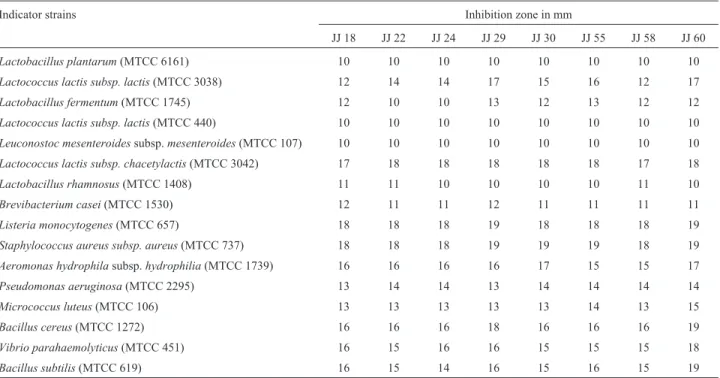
ad-Table 1- Antimicrobial activity against LAB and various pathogens Diameter of the well is 6 mm.
Indicator strains Inhibition zone in mm
JJ 18 JJ 22 JJ 24 JJ 29 JJ 30 JJ 55 JJ 58 JJ 60
Lactobacillus plantarum(MTCC 6161) 10 10 10 10 10 10 10 10
Lactococcus lactis subsp. lactis(MTCC 3038) 12 14 14 17 15 16 12 17
Lactobacillus fermentum(MTCC 1745) 12 10 10 13 12 13 12 12
Lactococcus lactis subsp. lactis(MTCC 440) 10 10 10 10 10 10 10 10
Leuconostoc mesenteroidessubsp.mesenteroides(MTCC 107) 10 10 10 10 10 10 10 10
Lactococcus lactis subsp. chacetylactis(MTCC 3042) 17 18 18 18 18 18 17 18
Lactobacillus rhamnosus(MTCC 1408) 11 11 10 10 10 10 11 10
Brevibacterium casei(MTCC 1530) 12 11 11 12 11 11 11 11
Listeria monocytogenes(MTCC 657) 18 18 18 19 18 18 18 19
Staphylococcus aureus subsp. aureus(MTCC 737) 18 18 18 19 19 19 18 19
Aeromonas hydrophilasubsp.hydrophilia(MTCC 1739) 16 16 16 16 17 15 15 17
Pseudomonas aeruginosa(MTCC 2295) 13 14 14 13 14 14 14 14
Micrococcus luteus(MTCC 106) 13 13 13 13 13 14 13 15
Bacillus cereus(MTCC 1272) 16 16 16 18 16 16 16 19
Vibrio parahaemolyticus(MTCC 451) 16 15 16 16 15 15 15 18
justed to pH 5 with 3N NaOH and the antimicrobial spec-trum was carried out against various indicator LAB and pathogens by agar well diffusion method (Jamuna and Jeevaratnam, 2004). Similarly, the CFS treated with prote-ase (1 mg/mL) (Sigma, Saint Louis, USA) for 2 h adjusted to pH 5 was also evaluated for the antimicrobial activity (Vijayendraet al., 2010). The zone of inhibition (in mm) was measured against all the indicator strains (Jamuna and Jeevaratnam, 2004).
Classical characterization of bacteriocinogenic isolates
Growth was assayed in MRS broth at various pH (3.5, 4.5, 8.5, and 9.5), temperatures (15, 37, and 45 °C), and salt concentrations (4, 6.5, and 10% of NaCl) (Palet al., 2005). Gelatin hydrolysis, catalase production, starch hydrolysis, acetoin production, ammonia production, carbon dioxide production, slime production, homo-hetero fermentation were analyzed for the isolates as described by Palet al. (2005). Carbohydrate utilization profile was determined using HiCarbo kit (Himedia, Mumbai, India). The optical nature of the isomer of lactate was also determined.
RAPD analysis
Genomic DNA was isolated by the procedure as de-scribed by de Los Reyes-Gavilanet al.(1992). RAPD anal-ysis was carried out using the primers R2
5’-GGCGACCACTAG 3’ and M13 5’
GAGGGTGGCGGTTCT-3’ (Bonomo et al., 2008). The PCR cocktails (50mL) consisted of 50 pM of the primer, 50 ng of DNA, 1x Taq DNA polymerase buffer, 2 U of Taq polymerase, 0.4 mM of each dNTP, and 3 mM of MgCl2
(Genei, Bangalore, India). Amplification conditions were initial denaturation at 94 °C for 5 min, 40 cycles of 94 °C for 1 min, annealing at 38 °C for R2 and 40 °C for M13 for 45 s, and elongation at 72 °C for 1 min, followed by a final elongation at 72 °C for 10 min (Bonomoet al., 2008). The pattern was analyzed by running in 1.5% agarose gel elec-trophoresis with DNA ladder (Sigma, Saint Louis, USA).
Molecular characterization by 16S rRNA gene analysis
Amplification of 16S rRNA gene was performed from genomic DNA of the isolates using universal primers fD1 (5’-GAGTTTGATCCTGGCTCA-3’) and rP2 (5’-ACGGCTACCTTGTTACGACTT-3’), as described by Naik et al. (2008). PCR cocktails (50mL) contained 50 pM of primer, 50 ng of genomic DNA, 1x Taq DNA polymerase buffer, 1 U of Taq DNA polymerase, 0.2 mM of each dNTP, and 1.5 mM MgCl2. Amplification was
per-formed in a DNA thermo cycler at 94 °C for 3 min, fol-lowed by 30 cycles of 10 s at 94 °C, 1 min at 56 °C and 30 s at 72 °C with an extension of 72 °C for 5 min. Purified PCR products were sequenced with automated DNA sequencer with specific primers using the facility at Macrogen Inc.
(Macrogen Inc., Seoul, Korea). Phylogenetic analysis for the isolates was performed for the isolates using MEGA software v5.05 (Yuet al., 2011).
16S ARDRA
Restriction digestion of PCR amplified product was performed with the restriction enzymeAluI for overnight at 37 °C in 20mL volumes of incubation buffer containing 5 U of the restriction enzyme and adequate DNA (Rodaset al., 2005). The pattern was analyzed by running in agarose gel electrophoresis with 100 bp DNA ladder (Sigma, Saint Louis, Missouri, USA).
Multiplex PCR assay
A multiplex PCR assay was performed with therecA gene-based primers paraF (5’-GTC ACA GGC ATT ACG AAA AC-3’), pentF (5’-CAG TGG CGC GGT TGA TAT C-3’), planF (5’-CCG TTT ATGCGG AAC ACC TA-3’), and pREV (5’-TCG GGA TTA CCA AAC ATC AC-3’), as described by Torrianiet al.(2001). PCR cocktails (50mL) contained 0.25 mM of primers, 50 ng of genomic DNA, 1x Taq DNA polymerase buffer, 1 U of Taq DNA polymerase, 0.2 mM of each dNTP, and 1.5 mM MgCl2. PCR were
per-formed with initial denaturation at 94 °C for 3 min, 30 cy-cles of denaturation at 94 °C for 30 s, annealing at 56 °C for 10 s, and elongation at 72 °C for 30 s, and final extension at 72 °C for 5 min (Torrianiet al., 2001). The PCR products were visualized in agarose gel electrophoresis with 100 bp ladder.
Accession number
These sequence data have been submitted to the GenBank database (http://www.ncbi.nlm.nih.gov/ genbank/) under accession number JN573601 to JN573608.
Results and Discussion
Staphylococcus aureuswhich were earlier reported to be common contaminants in idli batter fermentation (Jama and Varadaraj, 1999). Additionally, the lactobacilli showed potent inhibition againstListeria monocytogenesand Esch-erichia coliwhich are common food pathogens (Luoet al., 2011). An earlier report has demonstrated that addition of bacteriocin, plantaricin LP84 from Lactobacillus plantarumNCIM 2084 to idlibatter exerted antagonistic effect against organisms likeStaphylococcus aureus, Ba-cillus cereus andEscherichia coli (Jama and Varadaraj, 1999). In the present study, the native lactobacilli isolated from idli batter exhibited good antimicrobial activity against the above mentioned food pathogens (Table 1) sug-gesting their use as protective cultures in food industry. The inhibitory potential of these isolates against other patho-gens likeAeromonas, Pseudomonas, Micrococcus, and Ba-cillus (Table 1) suggests its application in biopharma-ceutical industry.
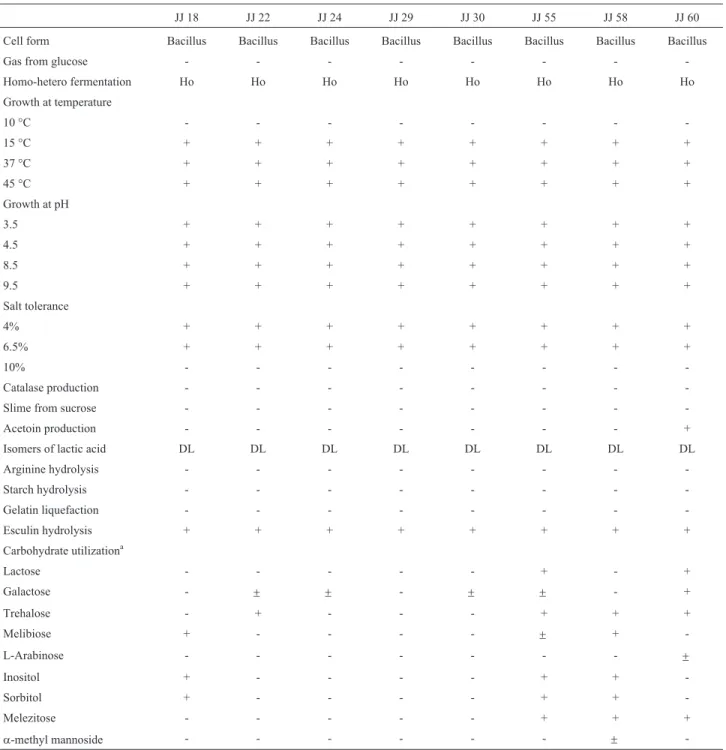
The 8 lactobacilli were characterized by classical methods. All the isolates were Gram positive and were neg-ative for slime production. Various physiological tests were carried for the lactobacilli. The 8 lactobacilli showed good growth at 15, 37, and 45 °C whereas no growth was ob-served at 10 °C, indicating their mesophilic character (Kan-dier and Weiss, 1996). The lactobacilli were able to tolerate salt concentration of 6.5%, but were unable to grow at 10%. The lactobacilli were able to grow in acidic as well as in al-kaline pH. The similarity among 8 lactobacilli in pheno-typic and physiological tests may probably be due to the fact that the isolates were from similar ecological niche. The biochemical properties such as catalase production, gelatin, starch, and arginine hydrolysis were negative for all the 8 lactobacilli. All the isolates were negative for acetoin production with the sole exception of the strain JJ 60. All the bacilli were homo-fermentative exhibiting DL lactic acid configuration (Table 2). The conventional
char-acterization of the isolates showed that the isolates could be Lactobacillus plantarum(Kandier and Weiss, 1996; Palet al., 2005). However, this characterization is not sufficient to distinguish the sub-species ofLactobacillus plantarum. Therefore, PCR based molecular tools were carried out to identify the sub-species.
RAPD analysis was performed initially to cluster the isolates using two different primers R2 and M13. JJ 18, JJ 22, JJ 29 and JJ 30 having similar pattern in the RAPD anal-ysis belonged to a single group, while JJ 24, JJ 55, JJ 58, and JJ 60 having different patterns clustered in to different groups (Figure 2). Thus, five different clusters were clearly observed based on the RAPD analysis. The sugar utiliza-tion pattern was also different for all the five groups indi-cating strain level variation among these isolates (Table 2).
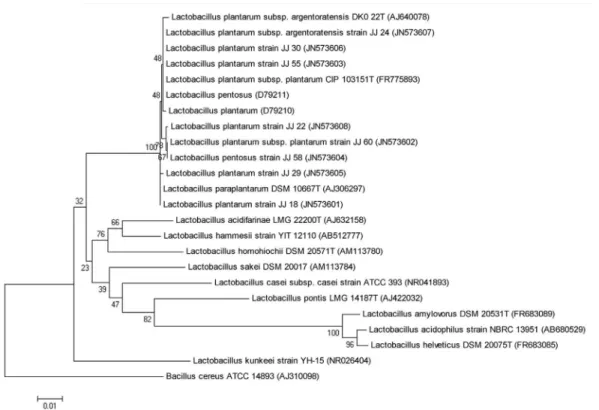
The 16S rRNA were analyzed for the five different clusters of isolates. The PCR products were sequenced and were subjected to nucleotide BLAST. The isolates showed 99 to 100% homology towardsLactobacillus plantarum. Multiple sequence alignment was carried out by CLUSTAL W and later phylogenetic analysis was per-formed using software MEGA v5.05. All the isolates were phylogenetically closely related to Lactobacillus plantarum and Lactobacillus pentosus(Figure 3). Thus, other molecular methods were carried out to clearly iden-tify the species.
The different clusters obtained as a result of RAPD indicated strain level variation among the isolates. As 16S ARDRA is a rapid and reliable tool for strain identification, the same was performed withAluI restriction enzyme.AluI is generally used in differentiating Lactobacillusspecies (Rodaset al., 2003). The digestion pattern was similar for all the 8 lactobacilli (Figure 4). The results showed high homology of the ribosomal genes (Rodaset al., 2005). Gen-erally, the Lactobacillus pentosus and Lactobacillus plantarumare genotypically closely related and show high homology in the 16S rRNA gene sequence (Rodaset al., 2003). However, the differential utilization of carbohy-drates by the isolates (Table 2) further prompted us to carry
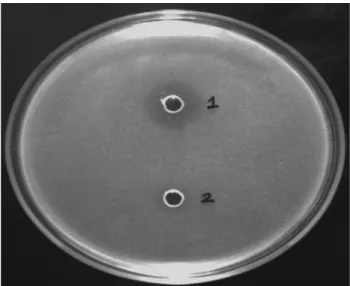
Figure 1- Antimicrobial activity of JJ 18 againstStaphylococcus aureus. (1) CFS adjusted to pH 5 (2) CFS treated with protease.
out sub-species level identification by other PCR method, usingrecA gene as it can also be used as a phylogenetic marker (Ghotbiet al., 2011; Torrianiet al., 2001). TherecA gene codes for a small protein (352 amino acids in Esche-richia coli) implicated in homologous DNA recombina-tion, SOS inducrecombina-tion, and DNA damage-induced mutagene-sis (Torriani et al., 2001). Multiplex PCR with recA
gene-derived primers was carried out to identify the sub-species of the lactobacilli.
The isolate JJ 24 was identified as Lactobacillus plantarumsubsp. argentoratensis based on its amplicon around 318 bp and 120 bp. Moreover, JJ 24 could not me-tabolize melizitose which is a key factor in identification of Lactobacillus plantarumsubsp. argentoratensis. JJ 58 was
Table 2- Phenotypic, physiological and biochemical characterization of the isolates.
JJ 18 JJ 22 JJ 24 JJ 29 JJ 30 JJ 55 JJ 58 JJ 60
Cell form Bacillus Bacillus Bacillus Bacillus Bacillus Bacillus Bacillus Bacillus
Gas from glucose - - -
-Homo-hetero fermentation Ho Ho Ho Ho Ho Ho Ho Ho
Growth at temperature
10 °C - - -
-15 °C + + + + + + + +
37 °C + + + + + + + +
45 °C + + + + + + + +
Growth at pH
3.5 + + + + + + + +
4.5 + + + + + + + +
8.5 + + + + + + + +
9.5 + + + + + + + +
Salt tolerance
4% + + + + + + + +
6.5% + + + + + + + +
10% - - -
-Catalase production - - -
-Slime from sucrose - - -
-Acetoin production - - - +
Isomers of lactic acid DL DL DL DL DL DL DL DL
Arginine hydrolysis - - -
-Starch hydrolysis - - -
-Gelatin liquefaction - - -
-Esculin hydrolysis + + + + + + + +
Carbohydrate utilizationa
Lactose - - - + - +
Galactose - ± ± - ± ± - +
Trehalose - + - - - + + +
Melibiose + - - - - ± +
-L-Arabinose - - - ±
Inositol + - - - - + +
-Sorbitol + - - - - + +
-Melezitose - - - + + +
a-methyl mannoside - - - ±
-(+) indicates growth/sugar utilization, (-) indicates no growth/no sugar utilization and (±) indicates weak positive growth.
aAll isolates gave positive for the sugars maltose, sucrose, salicin, ribose, cellobiose, inulin, fructose, dextrose, and mannose, while negative for the sugars
identified asLactobacillus pentosusbased on its amplicon around 218 bp and JJ 60 asLactobacillus plantarumsubsp. plantarumbased on its amplicon around 318 bp. JJ 55 had an additional amplicon around 200 bp in addition to 318 bp and 120 bp. The carbohydrate utilization profile of JJ 55 was almost similar to JJ 58, except for lactose utilization. Probably, JJ 55 must be closely related to Lactobacillus pentosus.Similarly, JJ 18, JJ 22, JJ 29, and JJ 30 had an ad-ditional amplicon above 400 bp in addition to 318 bp and 120 bp (Figure 5). Based on the sugar utilization profile, JJ 18, JJ 22, JJ 29, and JJ 30 were not able to metabolize melizitose which is a key character in identifying Lactobacillus plantarumsubsp.argentoratensis(Torriani
et al., 2001). The sugar utilization profile of other sugars was also similar to that of JJ 24 (Table 2). Probably, the four isolates JJ 18, JJ 22, JJ 29 and JJ 30 were closely related to Lactobacillus plantarum subsp. argentoratensis. There-fore, it is evident that in addition to various classical physi-ological, biochemical and sugar utilization profile, a combination of molecular methods can be used success-fully for sub-species level identification ofLactobacillus isolates from fermentedidlibatter.
Figure 3- Phylogenetic tree with the 16S rRNA gene using the MEGA v5.05 program by neighbor-joining (NJ) method.
Figure 4- 16S-ARDRA usingAluI restriction enzyme for the isolates. M is the 100 bp marker.
Figure 5- Multiplex PCR usingrecAspecies specific primer. JJ 18, JJ 22, JJ 29 and JJ 30 wereLactobacillus plantarumwith subspecies unidenti-fied. JJ 24 isLactobacillus plantarumsubsp. argentoratensis.JJ 55is Lactobacillus plantarum with subspecies unidentified. JJ 58 is
Bacteriocins produced by Lactobacillus plantarum are the subject of intense research because of their antibac-terial activity against food borne pathogens and are being employed directly for preservation of food. LAB are natu-ral food isolates which can be exploited in food industry as a tool to control undesirable bacteria. Lactobacillus plantarumis a versatile lactic acid bacterium, which is en-countered in a range of environmental niches including dairy, meat and vegetable fermentations.
Conclusion
The bacteriocinogenic lactobacilli explored in this study can facilitate arriving at a consortium of lactobacilli as standard inoculums (starter cultures) to prepareidli bat-ter having many beneficial effects. Further studies elucidat-ing their probiotic and beneficial properties may pave way for commercial preparation ofidlibatter, biological preser-vation of foods, and biomedical applications.
Acknowledgments
The present study was supported by the grants re-ceived from Defence Research Development Organization (DRDO), New Delhi (ERIPR/ER/996). Ms. P. Jayaprabha Agaliya, JRF thanks DRDO for the financial support.
References
Agrawal R, Rati ER, Vijayendra SVN, Varadaraj MC, Prasad MS, Nand K (2000) Flavour profile of idli batter prepared from defined microbial starter cultures. World J Microbiol Bio-technol 16:687-690.
Bonomo MG, Ricciardi A, Zotta T, Parente E, Salzano G (2008) Molecular and technological characterization of lactic acid bacteria from traditional fermented sausages of Basilicata region (Southern Italy). Meat Sci 80:1238-1248.
Canchaya C, Claesson MJ, Fitzgerald GF, Sinderen DV, O’Toole PW (2006) Diversity of the genusLactobacillusrevealed by comparative genomics of five species. Microbiology 152:3185-3196.
Chagnaud P, Machinis K, Coutte LA, Marecat A, Mercenier A (2001) Rapid PCR-based procedure to identify lactic acid bacteria: application to six commonLactobacillusspecies. J Microbiol Meth 44:139-148.
de Los Reyes-Gavilán CG, Limsowtin GK, Tailliez P, Séchaud L, Accolas JP (1992) ALactobacillus helveticus-specific DNA probe detects restriction fragment length polymorphisms in this species. Appl Environ Microbiol 58:3429-3432. De Vuyst L, Leroy FF (2007) Bacteriocins from lactic acid
bacte-ria: production, purification, and food applications. J Mol Microbiol Biotechnol 13:194-199.
El-Ghaisha S, Ahmadovaa A, Hadji- Sfaxia I, El Mecherfia KE, Bazukyane I, ChoisetaY, Rabesonaa H, Sitohya M, Popove YG, Kuliev AA, Mozzig F, Choberta JM, Haertle T (2011) Potential use of lactic acid bacteria for reduction of allergenicity and for longer conservation of fermented foods. Trends Food Sci Tech 22:509-516.
Ghotbi M, Soleimanian-Zad S, Sheikh-Zeinoddin M (2011) Iden-tification of Lactobacillus pentosus, Lactobacillus
paraplantarum and Lactobacillus plantarum in Lighvan cheese with 4 month ripening period by means ofrecAgene sequence analysis. Afr J Biotechnol 10:1902-1906. Jama Y H, Varadaraj MC (1999) Antibacterial effect of
plantaricin LP84 on foodborne pathogenic bacteria occur-ring as contaminants duoccur-ring idli batter fermentation.World J Microbiol Biotechnol15:27- 32.
Jamuna M, Jeevaratnam K (2004) Isolation and characterization of lactobacilli from some traditional fermented foods and evaluation of the bacteriocins. J Gen Appl Microbial 50:70-90.
Kandier O, Weiss N (1996) GenusLactobacillus, Bergey’s man-ual of systematic bacteriology. USA, p. 1208-1234. Luo F, Feng S, Sun Q, Xiang W, Zhao J, Zhang J, Yang Z (2011)
Screening for bacteriocin-producing lactic acid bacteria from kurut, a traditional naturally-fermented yak milk from Qinghai- Tibet plateau. Food Control 22:50-53.
Mukherjee SK, Albury MN, Perderson CS, Van Veen AG, Steinkraus KH (1965) Role ofLeuconostoc mesenteroides
in leavening the batter of Idli, a fermented food of India. Appl Microbiol 13:227- 231.
Naik PR, Raman G, Narayanan KB, Sakthivel N (2008) Assess-ment of genetic and functional diversity of phosphate solubilizing fluorescent Pseudomonads isolated from rhizospheric Soil. BMC Microbiol 8:230.
Nigatu A, Ahrne S, Molin G (2001) Randomly amplified poly-morphic DNA (RAPD) profiles for the distinction of
Lactobacillusspecies. Antonie van Leeuwenhoek 79:1-6. O’Flaherty S, Klaenhammer TR (2010) The role and potential of
probiotic bacteria in the gut, and the communication be-tween gut microflora and gut/host. Int. Dairy J 20:262-268. Pal V, Jamuna M, Jeevaratnam K (2005) Isolation and character-ization of bacteriocin producing lactic acid bacteria from a South Indian special dosa (appam) batter. J Cult Collect 4:53-60.
Paolillo R, Carratelli CR, Sorrentino S, Mazzola N, Rizzo A (2009) Immunomodulatory effects of Lactobacillus plantarum on human colon cancer cells. Int Immunopharmacol 9:1265-1271.
Purushothaman D, Dhanapal N, Rangaswami G (1993) Indian idli, dosa, dhokla, khaman, and related fermentations.In: Steinkraus, K.H. (Ed.), Handbook of indigenous fermented foods. Marcel Dekker, New York, USA, p. 149-165. Rodas A M, Ferrer S, Pardo I (2003) 16S-ARDRA, a tool for
iden-tification of lactic acid bacteria isolated from grape must and wine. Syst Appl Microbiol 26:412-422.
Rodas AM, Ferrer S, Pardo I (2005) Polyphasic study of wine
Lactobacillusstrains: taxonomic implication. Int J Syst Evol Microbiol 55: 197- 207.Soni SK, Sandhu DK (1989) Fer-mentation of idli: effects of changes in raw materials and physico - chemical conditions. J Cereal Sci10:227-238. Sridevi J, Prakash M Halami PM, Vijayendra SVN (2010)
Selec-tion of starter cultures for idli batter fermentaSelec-tion and their effect on quality of idlis. J Food Sci Technol 47:557-563. Torriani S, Felis G, Dellaglio F (2001) Differentiation of
Lactobacillus plantarum,L. pentosusandL. paraplantarum
by recAgene sequence analysis and multiplex PCR assay withrecAgene- derived primers. Appl Environ Microbiol 67:3450-3454.
vancomycin sensitiveEnterococcus faeciumisolated from idli batter. Indian J Microbiol 50:243-246.
Wang J, Zhang H, Chen X, Chen Y, Bao MQ (2012) Selection of potential probiotic lactobacilli for cholesterol-lowering properties and their effect on cholesterol metabolism in rats fed a high-lipid diet. J Dairy Sci 95:1645-1654.
Yang EJ, Chang HC (2010) Purification of a new antifungal com-pound produced byLactobacillus plantarumAF1 isolated from kimchi. Int J Food Microbiol 139:56-63.
Yu J, Du X, Wang W, Zhang J, Liu W, Sun Z, Sun T, Zhang H (2011) Phenotypic and genotypic characteristics of lactic acid bacteria isolated from sour congee in inner Mongolia of China. J Gen Appl Microbiol 57:197-206.
Zago M, Fornasari MA, Carminati D, Burns P, Suàrez V, Gabriel Vinderola G, Reinheimer J, Giraffa G (2011) Characteriza-tion and probiotic potential of Lactobacillus plantarum
strains isolated from cheeses. Food Microbiol 28:1033-1040.