619 619 619 619 619 Mem Inst Oswaldo Cruz, Rio de Janeiro, Vol. 92(5): 619-623, Sep./Oct. 1997
Effects of Bayluscide WP 70
on the Survival and
Water-leaving Behaviour of
Biomphalaria straminea
, Snail Host of
Schistosomiasis in Northeast Brazil
Otília Sarquis, Otávio S Pieri
+, José Augusto A dos Santos
Laboratório de Ecologia e Controle de Moluscos Vetores, Departamento de Biologia, Instituto Oswaldo Cruz, Av. Brasil 4365, 21045-900 Rio de Janeiro, RJ, Brasil
The toxic and behavioural effects of niclosamide (Bayluscide WP 70) on Biomphalaria straminea
from a highly endemic area of schistosomiasis in northeastern Brazil were investigated through labora-tory bioassays. The LD50 and LD90 were 0.114 mg/l and 0.212 mg/l, respectively. Water-leaving behaviour occurred among 14% to 30% of the snails in the presence of sublethal doses of niclosamide and among 16% of the controls. It was concluded that both the relatively low susceptibility to niclosamide and water-leaving behaviour of local B. straminea may be responsible for the recolonization of transmission foci after mollusciciding. It was suggested that recently improved measures of snail control, such as controlled-release formulations of niclosamide and plant molluscicides should be considered in areas where snail control is recommended.
Key words: schistosomiasis - snail control - molluscicide - Bayluscide - Biomphalaria straminea
The sugar-cane zone of Pernambuco, northeast-ern Brazil, has long held high prevalence levels of schistosomiasis despite sucessive control cam-paigns based mainly on chemotherapy (Pieri 1995). Thus, it can be recommended that auxiliary mea-sures such as snail control should be used in con-junction with chemotherapy to reduce transmission to manageable levels. However, a recent study in the area showed that Biomphalaria straminea, the local snail host, is capable of recolonizing the breeding places shortly after niclosamide applica-tion, and that monthly mollusciciding is necessary to reduce the snail population satisfactorily (Pieri et al. 1995).
As long-term, repeated application of niclosamide may not be cost-effective in such en-demic areas, a laboratory investigation was car-ried out aiming to identify the factors responsible for recolonization of transmission sites by
B. straminea after molluscicide treatment. Two possible factors are considered in the present pa-per: (i) low susceptibility of the local snail host species to niclosamide and (ii) occurrence of wa-ter-leaving behaviour.
MATERIALS AND METHODS
The assay snails were collected from transmis-sion sites in Camorim, a rural village situated in the municipality of São Lourenço da Mata, sugar-cane zone of the State of Pernambuco. After be-ing individually screened for cercarial emergence as described by Favre et al. (1995), groups of 50 negative snails measuring 5-8 mm in shell diam-eter were transferred to 5 l glass aquaria contain-ing 4 l of dechlorinated filtered tap-water, fresh lettuce and a substrate of earth, calcium carbonate and oyster powder (Rozemberg et al. 1992). These snails were kept up to 24 hr for acclimatization in environmental chambers (FANEM, São Paulo, Model 347-CDG) set at 25º ± 1ºC, 12 hr light, 12 hr dark. Two assays were carried out, one for sus-ceptibility and other for water-leaving behaviour. In the assays, groups of 10 snails were randomly transferred to 1 l beakers containing 0.8 l of either dechlorinated filtered tap-water (control groups) or varying doses of Bayluscide WP 70 (experi-mental groups), and left in the environ(experi-mental cham-bers for 24 hr of exposure. Based on the median lethal dose (LD50) of 0.06 mg/l obtained by Souza et al. (1992) for a laboratory colony of
B. straminea, the following doses of niclosamide were used: (i) 0.04, 0.06, 0.08, 0.10, 0.12, 0.14, 0.16 and 0.18 mg/l for the susceptibility assay, and (ii) 0.01, 0,02, 0.03, 0.04, 0.05, 0.06, 0.07, 0.08, 0.09, 0.10 and 0.11 mg/l for the behaviour assay. In the former assay, a lid of nylon mesh was placed at the water/air interface to prevent the snails from leaving the water, whereas in the latter the lid was This investigation received financial assistence from the
UNDP/World Bank/WHO Special Programme for Re-search and Training in Tropical Diseases, and from CNPq.
+Corresponding author. Fax: +55-21-290.1146
620 620 620 620
620 Effects of Bayluscide on Snail Survival • O Sarquis et al.
placed 4 cm above the water-air interface to allow water-leaving behaviour. In the susceptibility as-say 20 snails were tested in each dose, the same number being used as controls. In the behaviour assay at least 30 snails were used in each dose. After the exposure period the snails found out of the water in each dose of the behaviour assay were identified and counted for calculating the escape index (Jurberg et al. 1995). All snails were then rinsed and placed in individual 250 ml glass vials containing 100 ml of dechlorinated filtered tap-water and fresh lettuce, and allowed to recover in the environmental chambers for 24 hr before be-ing checked for mortality. The LD50 and LD90 values, as well as their 95% confidence intervals, were determined through probit analysis (Finney 1971) of the mortality data from the susceptibility assay. Two-by-two contingency tables (Wilkinson 1990) were used to test the significance of differ-ences in water-leaving behaviour and in mortality between the control group and each experimental group from the behaviour assay.
RESULTS
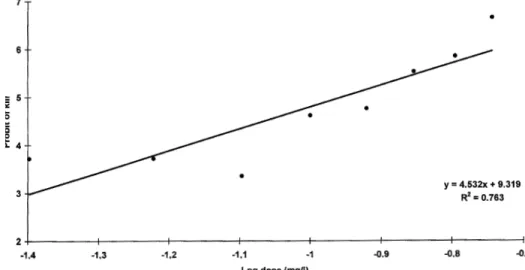
Table I and Fig. show the results of the suscep-tibility assay obtained through probit analysis. The LD50 and LD90 values and their 95% confidence intervals were 0.114 (0.099-0.131) mg/l and 0.212 (0.162-0.369) mg/l, respectively.
Tables II and III show the results of the behaviour assay. Water-leaving behaviour occurred in all of the sublethal doses of niclosamide tested and also in the control group. The escape index varied from 12% at 0.01 mg/l to 30% at 0.09 mg/l. There was no significant differences in water-leav-ing behaviour between the control group and each
TABLE I
Susceptibility of Biomphalaria straminea from Camorim to niclosamide, evaluated through probit analysis. Twenty snails were assayed in each dose.
No snail died in the control group
Dose (mg/l) % mortality Log dose Probit
0.04 10 -1.398 3.717
0.06 10 -1.222 3.717
0.08 5 -1.097 3.353
0.10 35 -1.000 4.614
0.12 40 -0.921 4.746
0.14 70 -0.854 5.525
0.16 80 -0.796 5.843
0.18 95 -0.745 6.647
Relation between probit of kill of Biomphalaia straminea from Camorim and dose of niclosamide, showing probit regression line, linear equation and regression coefficient (R2).
TABLE II
Occurrence of water-leaving behaviour in
Biomphalaria straminea from Camorim
Dose Snails Snails alive Escape χ2 (mg/l) assayed out of the water index (%)
Control 50 8 16 —
0.01 50 7 14 1.00 NS 0.02 50 11 22 0.61 NS
0.03 50 6 12 0.77 NS
0.04 50 8 16 0.78 NS
0.05 50 8 16 0.78 NS
0.06 50 7 14 1.00 NS
0.07 30 8 26 0.38 NS
0.08 50 7 14 1.00 NS
0.09 30 9 30 0.23 NS
0.10 50 7 14 1.00 NS
0.11 30 6 20 0.87 NS
621 621621 621621 Mem Inst Oswaldo Cruz, Rio de Janeiro, Vol. 92(5), Sep./Oct. 1997
of the experimental groups. Of the 490 snails ex-posed to any dose of niclosamide, 87 (17.8%) were found out of the water, of which only 3 (3.4%) were dead at the end of the recovery period. In contrast, of the 403 snails remaining in the water from the experimental groups, 53 (13.2%) were dead. Mortality was significantly less among the snails which left the water than among those which remained in the water during the exposure period (χ2 = 5.73; P<0.05).
DISCUSSION
Susceptibility - The LD50 and LD90 values of niclosamide obtained for B. straminea from Camorim are more than twice those reported for both B. straminea and B. glabrata from the labo-ratory (Souza et al. 1992) , as well as for B. glabrata
from the field (Souza et al. 1982, Souza & Mendes 1991), tested under similar conditions. This strongly suggest that B. straminea from the present study area is relatively less susceptible to niclosamide than snail hosts from southern endemic areas in Brazil. It is interesting to note that a labo-ratory colony of B. straminea also originated from Pernambuco was shown to be significantly less susceptible to the plant molluscicide Euphorbia splendens than a laboratory colony of B. glabrata
from the same state (Baptista et al. 1994). Differing susceptibility of snail hosts to mol-luscicides are probably due to differences in natu-ral tolerance among geographic isolates rather than to selection of resistant strains as a result of con-tinuous treatment of breeding places. Although some resistance to niclosamide can be induced under extreme conditions of genetic selection
(Sullivan et al. 1984), there is no evidence of that occurring after years of continuous use in the field (Sturrock 1995). As low susceptibility to mollus-cicide may require higher doses of the product, it is advisable that snail populations be assayed, and lethal doses determined, before being subjected to control campaigns.
Behaviour - Sublethal doses of niclosamide had no repellency effect on B. straminea, as water-leav-ing behaviour occurred at a similar proportion in the control and the experimental groups. These results are in constrast with those obtained for
B. glabrata by Jurberg et al. (1995), who found a repellency range between 0.01 mg/l and 0.03 mg/ l of niclosamide, and no water-leaving behaviour in the control group. Since the present study fol-lowed the same procedures as that by the above authors, it can be concluded that B. straminea is more liable to leave the water than B. glabrata ir-respective of the presence of sublethal doses of niclosamide.
Water-leaving behaviour apparently increased the survival of B. straminea exposed to sublethal doses of niclosamide. Thus, mortality was 3.7 times less among the snails found out of the water at the end of the exposure period than among those found in the water. This is not unexpected, as leav-ing the water prevents prolonged contact with molluscicide. Increased survival due to water-leav-ing behaviour was also reported for B. glabrata
exposed to the plant molluscicide Phytolacca dodecandra (Jurberg et al. 1988).
B. straminea from northeastern Brazil is known to be highly resistant to desiccation, provided there are favourable micro-habitat conditions out of the TABLE III
Mortality among Biomphalaria straminea snails from Camorim in relation to water-leaving behaviour
Dose Snails out of the water Snails in the water N % of total
(mg/l) Total Dead % Total Dead % dead
Control 8 0 0 42 0 0 50 0
0.01 7 0 0 43 1 2.3 50 2
0.02 12 1 8.3 38 0 0 50 2
0.03 6 0 0 44 0 0 50 0
0.04 8 0 0 42 2 4.8 50 4
0.05 8 0 0 42 3 7.1 50 6
0.06 7 0 0 43 6 14 50 12
0.07 8 0 0 22 0 0 30 0
0.08 7 0 0 43 9 21.8 50 18
0.09 9 0 0 21 1 4.8 30 3
0.10 7 0 0 43 18 41.8 50 36
0.11 8 2 25 22 13 59.1 30 50
Total 95 3 3.2 445 53 11.9 540 10.9
622 622 622 622
622 Effects of Bayluscide on Snail Survival • O Sarquis et al.
water (Olivier & Barbosa 1956). Thus, it is likely that some snails may escape mollusciciding by leaving the water and survive long enough to re-colonize the transmission foci after the toxic ef-fects are over.
The epidemiological importance of water-leav-ing behaviour by snail hosts of schistosomiasis in relation to molluscicides has been well emphasized (Pieri & Thomas 1986, 1992, Jurberg et al. 1988, 1995, Dussart 1991, Green et al. 1992, Dannemann & Pieri 1993). However, the occurrence of other patterns of protective behaviour which could ham-per the chemical control of snail hosts should also be considered. For instance, burrowing behaviour by B. glabrata has been implicated in the recolonization of breeding places after mollusci-cide application (Paraenseet al. 1954, Souza & Mendes 1991). Although B. straminea is appar-ently unable of active burrowing, it can penetrate a few centimetres in the soft substrate in the course of normal locomotor activity (Olivier & Barbosa 1956) and eventually escape molluscicide action.
Snail control - Recolonization of breeding places soon after niclosamide application clearly indicates that snail control needs to be permanent. As the continuous application of niclosamide in the sugar-cane areas of Pernambuco may not be cost-effective (Pieri et al. 1995), decisions about undertaking snail control in such areas must be preceded by an evaluation of the local epidemio-logical situation. Thus, repeated mollusciciding can be recommended if the following conditions are met in the target area: (i) prevalence among school-aged children are over 50% despite chemo-therapy; (ii) water contact remains intense irrespec-tive of educational strategies; (iii) there is no per-spective of improved sanitation and safe water sup-ply in the short term. Unfortunately, several rural villages in the sugar-cane zone of Pernambuco currently meet the above conditions (Pieri 1995). Probably due to some equivocal beliefs about molluscicides (Webbe & Jordan 1993), research on snail control has been regrettably underrated. Luckily, there are recent attempts to improve snail control through controlled-release formulations (Emara 1994) and plant molluscicides (Baptista et al. 1994). Both alternatives are worth considering in the highly endemic areas of schistosomiasis in northeastern Brazil, particularly those subjected to recolonization by snail hosts after the application of conventional molluscicides.
ACKNOWLEDGMENTS
To Dr E Coutinho and Dr CS Barbosa for providing facilities at CPqAM-FIOCRUZ, Recife, and to the tech-nical staff of the Estação de Biologia Experimental de São Lourenço da Mata.
REFERENCES
Baptista DF, Vasconcellos MC, Lopes FE, Silva IP, Schall VT 1994. Perspectives of using Euphorbia splendens
as a molluscicide in schistosomiasis control pro-grams. Southeast Asian J Trop Med Public Health 25: 419-424.
Dannemann RDA, Pieri OS 1993. Prolonged survival out of water of polymorphic Biomphalaria glabrata
(Say) from a seasonally drying habitat of Nort-east Brazil. J Moll Stud 59: 263-264.
Dussart GBJ 1991. Effects of molluscicide on the sur-facing and flow resistance of several species of fresh-water gastropods, p. 259-265. In C Meier-Brook, Proc 10th Int Malac Congr., Institute for Tropical Medicine, Tübingen.
Emara LH 1994. The development of slow-release mol-luscicide in a biodegradable gelatin matrix. J Con-trolled Release 31: 255-261.
Favre TC, Bogéa THP, Rotenberg L, Silva HS, Pieri OS 1995. Cercarial emergence of Schistosoma mansoni
from Biomphalaria glabrata and Biompha-laria straminea. Mem Inst Oswaldo Cruz 90: 565-567.
Finney DJ 1971. Probit Analysis. 3rd ed. Cambridge University Press, Cambridge, xv + 333 pp. Green P, Dussart GBJ, Gibson C 1992. Surfacing and
water-leaving behaviour of the freshwater pulmo-nate snails Lymnaea peregra (Müller),
Biomphalaria glabrata (Say) and Bulinus jousseaumei (Dautzenberg). J Moll Stud 58: 169-179.
Jurberg P, Barbosa JV, Rotenberg L 1988. The role of behavior in the survival of Biomphalaria glabrata
in biossays with the plant molluscicide Phytolacca dodecandra. Mem Inst Oswaldo Cruz 83: 41-46. Jurberg P, Sarquis O, Santos JAA, Ferreira RCR 1995.
Effect of niclosamide (Bayluscide WP 70),
Anacardium occidentale hexane extract and Euphor-bia splendens latex on behavior of Biomphalaria glabrata (Say, 1818), under laboratory conditions.
Mem Inst Oswaldo Cruz90: 191-194.
Olivier L, Barbosa FS 1956. Observations on vectors os schistosomiasis mansoni kept out of water in the laboratory. II. J Parasitol42: 277-286.
Paraense WL, Pereira O, Pinto DB 1954. Re-invasion of breeding places by snails. Trans R Soc Trop Med Hyg 48: 540.
Pieri OS 1995. Perspectivas no controle ambiental dos moluscos vetores da esquistossomose, p. 239-252. In FS Barbosa, Tópicos em Malacologia Médica. Editora FIOCRUZ, Rio de Janeiro.
Pieri OS, Thomas JD 1986. Polymorphism in a labora-tory population of Biomphalaria glabrata from a seasonally drying habitat in north-east Brazil.
Malacologia 27: 313-321.
Pieri OS, Thomas JD 1992. Induction of morphologi-cal, behavioural and physiological changes in a poly-morphic population of Biomphalaria glabrata by an environmental factor of predictive value. J Med Appl Malac 4: 43-56.
623 623623 623623 Mem Inst Oswaldo Cruz, Rio de Janeiro, Vol. 92(5), Sep./Oct. 1997
of northeast Brazil. Mem Inst Oswaldo Cruz 90: 535-536.
Rozemberg B, Rey L, Pieri OS 1992. Fecundity of
Biomphalaria straminea and Biomphalaria glabrata
in the laboratory: a twelve-month comparative study.
Mem Inst Oswaldo Cruz 87: 223-232.
Souza CP, Azevedo MLL, Rodrigues MS, Pereira JP 1982. Estudo comparativo da suscetibilidade de populações de Biomphalaria glabrata de Belo Horizonte (MG), à infecção com Schistosoma mansoni e a moluscicidas. Rev Inst Med Trop São Paulo24: 342-348.
Souza CP, Mendes NM 1991. Repovoamento de criadouros de Biomphalaria glabrata após tratamento com niclosamida. Rev Inst Med Trop São Paulo33: 297-302.
Souza CP, Mendes NM, Jannotti-Passos LK, Pereira JP 1992. O uso da casca da castanha do caju,
Anacardium occidentale, como moluscicida alternativo. Rev Inst Med Trop São Paulo34: 459-466.
Sturrock RF 1995. Current concepts of snail control.
Mem Inst Oswaldo Cruz 90: 241-248.
Sullivan JT, Cheng TC, Chen CC 1984. Genetic selec-tion for tolerance to niclosamide and copper in
Biomphalaria glabrata (Mollusca: Pulmonata).
Tropenmed Parasit 35: 189-192.
Webbe G, Jordan P 1993. Control, p. 405-451. In P Jor-dan, G Webbe, RF Sturrock (eds), Human schisto-somiasis. CAB International, Wallingford. Wilkinson L 1990. SYSTAT: the system for statistics.
624 624 624 624