Rev Bras Anestesiol CLINICAL INFORMATION 2011; 61: 4: 474-478
474 Revista Brasileira de Anestesiologia
Vol. 61, No 4, July-August, 2011 Received from the Serviço de Cirurgia Torácica of Hospital São Lucas. Pontifícia
Universi-dade Católica do Rio Grande do Sul, PUCRS – Porto Alegre (RS) Brazil.
1. MD, Professor of the Disciplina de Anestesiologia, Chief of the Serviço de Anestesiologia of Hospital São Lucas, PUCRS
2. MD, Resident of the Serviço de Cirurgia Torácica of Hospital São Lucas, PUCRS 3. MD, Thoracic Surgeon of the Serviço de Cirurgia Torácica of Hospital São Lucas, PUCRS
4. MD, Associate Professor of the Disciplina de Cirurgia Torácica, PUCRS
5. MD, Professor of the Disciplina de Cirurgia Torácica, Chief of the Serviço de Cirurgia Torácica of Hospital São Lucas, PUCRS
Submitted on November 28, 2010. Approved on January 31, 2011.
Correspondence to: Dr. Frederico Krieger Martins Rua José Sanguinetti, 130 Ipanema
91760490 – Porto Alegre, RS, Brazil E-mail: [email protected]
CLINICAL INFORMATION
Retrograde Orotracheal Intubation with a Double-Lumen Tube
Jayme da Rocha Heck
1, Frederico Krieger Martins
2, Maria Teresa Ruiz Tsukazan
2, Vivian Cristofoli
2,
Maurício Pipkin
3, Marner Lopes da Silveira
3, Jayme de Oliveira Rios
4, José Antônio Lopes de Figueiredo Pinto
5Summary: Heck JR, Martins FK, Tsukazan MTR, Cristofoli V, Pipkin M, Silveira ML, Rios JO, Pinto JALF – Retrograde Orotracheal Intubation with a Double-Lumen Tube.
Background and objectives: Difficult airway management in thoracic surgeries is a peculiar subject due to the demands of monopulmonary ventilation with double-lumen tubes. Flexible bronchoscopy guidance is extremely important, but it is not always available. The objective of this report was to describe a case of retrograde selective orotracheal intubation in the absence of specific endoscopy equipment for the procedure.
Case report: This is a patient with a history of retosigmoidectomy, admitted for a right thoracotomy for a lung lesion. Preoperative anesthetic evaluation did not reveal any clinical and physical exam particularities. After anesthetic induction and ventilation with face mask, two attempts of orotracheal intubation under direct laryngoscopy were ineffective due to difficult visualization of the vocal folds (Cormack-Lehane grade III). Due to the unavailability of specific material for selective endoscopic intubation it was decided to use the retrograde technique using the double-lumen tube. The patient was extubated in the operating room shortly after the end of the surgery without complications secondary to the alternative technique.
Conclusions: Retrograde selective orotracheal intubation is a minimally invasive technique, low cost, safe, and extremely useful whenever fle-xible bronchoscopy is not available.
Keywords: Intubation, Intratracheal; Equipment Failure; Airway Management; Thoracotomy.
[Rev Bras Anestesiol 2011;61(4): 474-478] ©Elsevier Editora Ltda.
INTRODUCTION
Difficult airway management is always a delicate situation for the medical team, since failure of planned procedures can cause prolonged hypoxia resulting in severe complications. In thoracic surgery selective orotracheal intubation for monopul-monary ventilation makes this issue even more complex be-cause it demands greater ability of anesthesiologists to handle double-lumen tubes 1. Flexible bronchoscopy is an important tool in most cases. However, whenever it is not available the use of alternative procedures is justified 2.
The objective of this report was to describe a case in whi-ch retrograde orotrawhi-cheal intubation was used, proven to be effective, inexpensive, and safe. It is considered an important alternative technique.
CASE REPORT
This is a 51 year-old male who underwent retosigmoidectomy for a malignant neoplasia two years ago who was admitted for surgical approach of an expansive lesion in the inferior lobe of the right lung, most likely metastatic. Pre-anesthetic assessment did not reveal any predictive factor for difficult intubation, neither the past medical history nor the physical exam.
Thiopental (5 mg.kg-1) and cisatracurium (0.20 mg.kg-1) were used for anesthetic induction. The patient was ventilated through a face mask with a mixture of oxygen and isoflurane for 3 mi-nutes, an adequate time to achieve muscular relaxation for tra-cheal intubation. On direct laryngoscopy the epiglottis remained immobile and superimposed on the glottis hindering visualization of the vocal folds (Cormack-Lehane grade III). Thus, the patient was once more ventilated with a face mask. The second attempt to intubate him was also ineffective. It was then decided to use retrograde orotracheal intubation.
RETROGRADE OROTRACHEAL INTUBATION WITH A DOUBLE-LUMEN TUBE
Revista Brasileira de Anestesiologia 475
Vol. 61, No 4, July-August, 2011
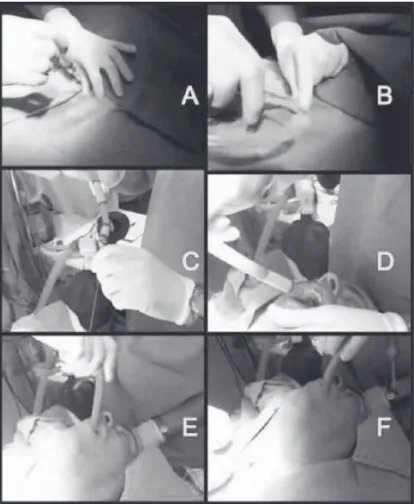
had reached the site where the guide-wire was introduced into the airways. At this moment, the guide-wire was removed and the procedure continued as a selective intubation 4. While advancing the tube it was rotated first at 180° counterclockwise to pass the hook through the vocal folds followed by a 90° clockwise rota-tion (Figure 1). Interruprota-tion of the progression suggested proper positioning of the hook in tracheal carina, which was confirmed both by pulmonary auscultation and capnography, especially if flexible bronchoscopy is not available.
Intercurrences were not observed during surgery. The pa-tient was extubated in the operating room shortly after the end of the procedure. He did not develop complications secondary to the alternative intubation technique used, and he was dis-charge from hospital on the fourth postoperative day in good clinical conditions.
DISCUSSION
Ensuring a safe airway is one of the basic rules of anesthesiolo-gy. Most often, orotracheal intubation is performed without inter-currences; however, some times one can be faced with difficult airways. Thus, anesthesiologists must be familiar with alternati-ve techniques of orotracheal intubation, since none of them has proven to be superior or effective in all cases. The main
techni-ques used are direct laryngoscopy, retrograde, and guided by flexible bronchoscopy.
Since a consensus on the definition of difficult airway does not exist in literature, in order to unify the language to confront results with greater accuracy the American Society of Anesthe-siologists has defined difficult airway as the clinical situation in which a properly trained anesthesiologist has difficulty with face mask ventilation and difficulty in performing tracheal intubation, or both 5.
In thoracic surgical approaches, monopulmonary ventilation allows good exposure of the surgical field and less traumatism to the lung parenchyma during manipulation while protecting the dependent lung, justifying the use of selective double-lumen tu-bes 1,6. Thoracotomies in which ipsilateral lung collapse is not achieved result in increased surgical duration and inadequate surgical field. Thus, a difficult airway in thoracic surgery is even more complex. In addition to obtaining a safe airway the anes-thetic team has to perform, preferentially, selective intubation to contribute with the surgical team plans. These situations demand experience and adequate training.
In the present study we described a case in which selective retrograde orotracheal intubation was indicated. Despite the wide experience and well-established routines for flexible bronchos-copy for tracheal intubation, specific materials for endoscopic po-sitioning of double-lumen tubes were not available. Thus, after two unsuccessful attempts in ideal conditions by a competent professional a decision for an alternative method was made.
Although very efficient and less invasive, flexible bronchos-copy has some hindrances. Selective endoscopic intubation re-quires costly materials: a double-lumen tube with a wide lumen made of polyvinyl and flexible bronchoscopy of small caliber. Note that the wear of fiberoptic fibers caused by the trajectory of the tube can damage the device and render it useless 7,8. Al-though widespread, bronchoscopy still is an expensive techno-logy inaccessible to several institutions and health care systems, especially in developing countries. A global survey on the acces-sibility of flexible bronchoscopy-guided orotracheal intubation on services of thoracic surgery does not exist in the literature. In the institution where the procedure was carried out, a flexible bronchoscope with a small enough caliber to go through a Car-lens tube, a rigid tube with a small lumen, was not available and, therefore, it was not appropriate for endoscopy 9.
The most common complication related to the retrograde te-chnique is sore throat affecting 60% of patients. Complications of higher clinical importance are rare, and among them we could mention: soft tissue infection, hematoma, hemorrhage, subcu-taneous emphysema, pneumomediastinum, and upper airways trauma 4,10.
The importance of this report is based on the fact that the ma-nagement of difficult airway is widely documented in literature; however, material on this situation in the presence of monopul-monary ventilation with double lumen tube especially when ac-cess to flexible bronchoscopy is not available is extremely rare.
Thus, retrograde access was more feasible. The procedure was performed without complications demonstrating to be a safe and low cost alternative technique of intubation.
Figure 1 – Retrograde Selective Orotracheal Intubation.
478 Revista Brasileira de Anestesiologia Vol. 61, No 4, Julho-Agosto, 2011 HECK, MARTINS, TSUKAZAN E COL.
REFERÊNCIAS / REFERENCES
01. McRae KM, Bussières JS, Campos JH et al. – Anesthesia for Gen-eral Thoracic Surgery, em: Patterson GA, Cooper JD, Deslauriers J et al. – Pearsons Thoracic & Esophageal Surgery, 3rd Ed, Philadelphia, Churchill Livingstone Elsevier, 2008;39-67.
02. van Stralen D, Perkin RM – Retrograde intubation difficulty in an 18-year-old muscular dystrophy patient. Am J Emerg Med, 1995;13:100-101.
03. Oh JH, Kim SE, Lee SJ – Successful retrograde tracheal intubation using a central venous catheterization set: two cases. Emerg Med Australas, 2009;21:233-236.
04. Burbulys D, Kiai K – Retrograde intubation. Emerg Med Clin North Am, 2008;26:1029-1041
05. American Society of Anesthesiologists Task Force on Management of the Difficult Airway – Practice guidelines for management of the
difficult airway: an updated report by the American Society of An-esthesiologists Task Force on Management of the Difficult Airway. Anesthesiology, 2003;98:1269-1277.
06. Heck JR – Princípios de Anestesia para Cirurgia Torácica, em: Pinto Filho DR, Cardoso PFG, Pinto JALF et al. – Manual de Cirurgia Torá-cica, 1ª Ed, Rio de Janeiro, Revinter, 2001;83-96.
07. Mehta AC, Curtis PS, Scalzitti ML et al. – The high price of bronchos-copy. Maintenance and repair for the flexible fiberoptic bronchoscope. Chest, 1990;98:448-454
08. Rozman A, Duh S, Petrinec-Primozic M et al. – Flexible bronchoscope damage and repair costs in a bronchoscopy teaching unit. Respira- Respira-tion, 2009;77:325-330.
09. Pires AMD – Ventilação Monopulmonar em Cirurgia Torácica, em Ca-valcanti IL, Cantinho FAF, Assad A – Medicina Perioperatória, 1ª Ed, Rio de Janeiro, SAERJ, 2006;449-455.
10. Gill M, Madden MJ, Green SM – Retrograde endotracheal intubation: an investigation of indications, complications, and patient outcomes. Am J Emerg Med, 2005;23:123-126.
Resumen: Heck JR, Martins FK, Tsukazan MTR, Cristofoli V, Pipkin M, Silveira ML, Rios JO, Pinto JALF – Intubación Orotraqueal con Tubo de Doble Lumen por la vía Retrógrada.
Justificativa y objetivos: El manejo de la vía aérea difícil en cirugía torácica es un asunto peculiar, debido a las exigencias de la venti-lación monopulmonar con el uso de tubos de doble lumen. El auxilio de la broncoscopia flexible es de enorme importancia, sin embargo no siempre está disponible. El objetivo de este relato, es describir un caso de intubación orotraqueal selectiva retrógrada en la ausencia de un equipo de endoscopia específico para el procedimiento.
Relato del Caso: Paciente con historial previo de retosigmoidecto-mía que fue ingresado para el abordaje quirúrgico de la lesión pulmo-nar por toracotomía derecha. La evaluación anestésica preoperatoria no revelaba particularidades ni en la historia clínica ni en el examen físico. Después de la inducción anestésica y ventilación con máscara facial, en la laringoscopia derecha dos intentos de intubación orotra-queal no tuvieron el efecto esperado debido a una difícil visualización de las cuerdas vocales (Cormack-Lehane grado III). En función de la indisponibilidad de un material específico para la intubación selectiva endoscópica, se optó por la técnica retrógrada utilizando un tubo de doble lumen. El paciente fue desentubado en quirófano enseguida que terminó la operación y no presentó complicaciones provenientes de la técnica alternativa.
Conclusiones: La intubación orotraqueal selectiva retrógrada fue una técnica alternativa mínimamente invasiva de bajo coste, segura e incluso extremadamente útil cuando no se cuenta con la ayuda de la broncoscopia flexible.