Original Article
Rev. Latino-Am. Enfermagem2014 Nov.-Dec.;22(6):973-9
DOI: 10.1590/0104-1169.3565.2505
www.eerp.usp.br/rlae
Copyright © 2014 Revista Latino-Americana de Enfermagem This is an Open Access article distributed under the terms of the Creative Commons Attribution Non-Commercial License (CC BY-NC).
This license lets others distribute, remix, tweak, and build upon your work non-commercially, and although their new works must also acknowledge you and be non-commercial, they don’t have to license their derivative works on the same terms.
Objective: to relate neck circumference with metabolic syndrome and its criteria among college
students. Method: cross-sectional study conducted with 702 college students in Fortaleza, CE,
Brazil from September 2010 to June 2011. Socio-demographic data, waist circumference and
neck circumference were collected together with blood pressure, fasting blood sugar, triglyceride
levels, and HDL-C. Results: 1.7% of the studied sample presented metabolic syndrome. Of these,
58.3% presented altered neck circumference (p<0.006). As neck circumference decreases,
pressure levels improve (p<0.001). Additionally, college students with high fasting blood sugar
(p=0.003) and high triglyceride levels (p<0.001) presented higher values of neck circumference.
Conclusion: neck circumference is a potential predictive marker in the detection of metabolic
syndrome and its components among college students.
Descriptors: Anthropometry; Neck Circumference; Nursing; Diabetes Mellitus.
Corresponding Author: Maria Lúcia Zanetti
Universidade de São Paulo. Escola de Enfermagem de Ribeirão Preto Departamento de Enfermagem Geral e Especializada
Av. Bandeirantes, 3900 Bairro: Monte Alegre
CEP: 14040-902, Ribeirão Preto, SP, Brasil E-mail: [email protected]
1 Supported by Conselho Nacional de Desenvolvimento Científico e Tecnológico (CNPq), Brazil, process # 474902/2009-9.
2 MSc, Professor, Faculdade de Juazeiro do Norte, Juazeiro do Norte, CE, Brazil.
3 PhD, Adjunct Professor, Instituto de Ciências da Saúde, Universidade da Integração Internacional da Lusofonia Afro Brasileira, Redenção, CE,
Brasil.
4 PhD, Adjunct Professor, Departamento de Enfermagem, Universidade Federal do Piauí, Floriano, PI, Brazil.
5 PhD, Associate Professor, Escola de Enfermagem de Ribeirão Preto, Universidade de São Paulo, WHO Collaborating Centre for Nursing Research
Development, Ribeirão Preto, SP, Brazil.
6 PhD, Adjunct Professor, Faculdade de Farmácia Odontologia e Enfermagem, Universidade Federal do Ceará, Fortaleza, CE, Brazil.
Neck circumference as a potential marker of metabolic syndrome
among college students
1Dayse Christina Rodrigues Pereira
2Márcio Flávio Moura de Araújo
3Roberto Wagner Júnior Freire de Freitas
4Carla Regina de Souza Teixeira
5Maria Lúcia Zanetti
5Rev. Latino-Am. Enfermagem 2014 Nov.-Dec.;22(6):973-9.
Introduction
The National Priorities for Research and the Research Agenda in the health ield gives priority in one of its sub-agendas to non-communicable diseases
(NCDs), such as hypertension, diabetes mellitus and
obesity(1). Metabolic syndrome (MS) is also added
to this context, the diagnosis of which may include
these diseases; the disease also increases the risk
for developing cerebrovascular and coronary artery
diseases(2). Metabolic syndrome is deined as a separate
entity based on risk factors for cardiovascular diseases
and type-2 diabetes mellitus (DM2). Factors related
to MS include visceral obesity, dyslipidemia, arterial
hypertension, and insulin resistance. MS should be
recognized before the clinical manifestation of DM2 in
order to implement primary prevention through lifestyle modiications and should speciically treat each of the syndrome components(3-4).
There are various sources providing criteria for
identifying MS(3-4), however, those established by
the National Cholesterol Education Program - Adult
Treatment Panel III (NCEP ATP III) and recommended
by the I Brazilian Guideline for the Diagnosis and
Treatment of Metabolic Syndrome, are more frequently
used in clinical studies due to their practicality. These
programs consider the presence of three or more
criteria to indicate the presence of metabolic syndrome,
namely: waist circumference greater than 88cm in
women and 102 cm in men, triglycerides above 150mg/
dl, HDL cholesterol below 40 mg/dl in men or 50mg/
dl in women, blood pressure above or equal to 130/85
mmHg, and circulating glucose greater than or equal to
110 mg/dl(3).
The search for easily applicable clinical criteria to
identify MS led researchers to consider the importance
of investigating other anthropometric parameters
to integrate or replace some of those already
established(5). Therefore, neck circumference (NC)
began to be investigated under the argument that
there are limitations in regard to waist circumference
measurement (i.e. lack of a standard measurement
technique, variations in certain health conditions)
and also because neck measurements, under normal
conditions, do not oscillate throughout the day(6-8).
Hence, neck circumference is now considered a risk
marker for MS, even though further investigation with
different populations is still recommended(8-11).
In Brazil, neck circumference was investigated as
part of the Brazilian Metabolic Syndrome Study (BRAMS)
that included adult outpatients (between 18 and 60 years
old) undergoing treatment for DM2, metabolic syndrome
and/or obesity. The results found so far show that neck
circumference is an innovative and additional parameter
to determine the distribution of body fat, which is
associated with visceral fat, to metabolic syndrome’s
components and insulin resistance, especially among
women(12).
The city of Fortaleza, CE, Brazil was included in
BRAMS, but neck circumference as an MS marker has not
yet been studied in predominantly young populations.
Hence, considering anthropometry as a tool to be used
in Nursing consultations and also that the National
Priorities for Research and the Research Agenda in the health ield point to the need to develop and use health-promoting methods in addition to preventive, diagnostic,
and early treatment methods(1), this study’s objective
was to relate neck circumference to metabolic syndrome
and its criteria among college students.
This study is justiied by the scarcity of studies addressing this topic in Brazil and because it can support
improved healthcare delivery, regardless of the context
in which these actions are developed.
Method
This cross-sectional study was performed at the
Federal University of Ceará (UFC) in the campuses of
Fortaleza, CE, Brazil. The sample was calculated using a formula for ininite populations. A prevalence of 50% was adopted because it provides the maximum sample size, with a level of signiicance of α=0.05 and an absolute sampling error of 4%. To minimize potential losses, 10%
was added to the sample size (n=702 college students). The participants were distributed in the following ields: human sciences, exact sciences, agricultural sciences,
health sciences, sciences and technology. Based on the population per ield of knowledge, the sample was stratiied in such a way that 143, 116, 98, 106, 127 and 112 students were studied, respectively.
Students from the following programs participated
in the study: Pedagogy, Social Sciences and Letters in
the area of the human sciences; Business, Economy and
Accounting Programs from the exact sciences; Animal
Science, Agronomy, and Fishing Engineering from the
agricultural sciences; from the Nursing and Pharmacy
programs from the health sciences; and Chemistry,
Geography from the sciences; biological sciences and
technology; and Electrical, Metallurgical, and Civil
Inclusion criteria were: being properly enrolled in
brick-and-mortar undergraduate programs in daytime
hours; living in Fortaleza, CE, Brazil; and having a
phone number and email. Pregnancy was an exclusion
criterion.
Socio demographic variables included: sex (male
and female); age (16-58 years old); race (Caucasian,
biracial, Afro-descendant, Asian); marital status
(married/stable union, single, widowed, separated/
divorced); occupational situation (whether only study
or also work); grade (current semester); beginner (is attending irst half of the program); senior (is attending second half of the program); economic situation (A1,
A2, B1, B2, C, D, E according to the Criteria of Brazil Economic Classiication established by the Brazilian Association of Business and Research)(13), and with
whom the individual lives with (parents, relatives,
friends, spouse/partner, alone).
The following were established for anthropometric,
clinical and biochemical variables: central obesity (waist
circumference [WC] greater than 102cm for men and
88cm for women); neck circumference [NC] greater than
or equal to 39cm for men and greater than or equal to
35cm for women)(12); high blood pressure (greater or
equal to 130/85 mmHg); high triglycerides level (greater
or equal to 150 mg/dl); low HDL cholesterol level (below
40mg/dl for men and below 50mg/dl for women); and
circulating glucose greater than or equal to 110mg/dl)(3).
The researcher assistants (two doctoral and
two master’s students along with two undergraduate
students) responsible for collecting data received 30
hours of training to ensure the reliability of data. Data
collection was performed from September to November
2010 and from February to June 2011 in private rooms
on the university’s premise.
The students were recruited in classrooms after the study’s objectives and methodology was clariied. Those who consented signed free and informed consent
forms and completed a questionnaire addressing
socio-demographic data. The day and time for measuring
neck circumference (NC), waist circumference (WC) and
blood pressure (BP), and collecting blood samples, was
also scheduled. The researchers contacted the students
on the day before the scheduled time to remind them of
the need to fast for 12 hours.
The participants stood erect with their heads
positioned in the Frankfurt horizontal plane at the time
of measuring NC. An inelastic metric tape was placed at
the midpoint of the neck’s height. The measure was taken
immediately below Adam’s apple(14-16) among the male
participants. Waist circumference (WC) was measured
with an inelastic tape placed on the skin at the midpoint
between the iliac crest and the last rib at the end of the
expiratory breathing(16-17). Blood pressure was measured
in accordance with Brazilian guidelines(18). The collection
of a venous blood sample was performed by technicians
from a specialized laboratory in accordance with standards
guiding the preservation of samples and the safety of
individuals. A free snack was provided after blood sample
collection. The project was approved by the Institutional
Review Board guiding research with human subjects at
the Federal University of Ceará (Protocol No. 208/10).
Data were triple-entered into Excel and then
imported into IBM-SPSS, version 14.0. Statistical
measures, average, standard deviation, and odds ratios were computed with their respective conidence intervals of 95% (CI95%). Before comparing averages, we veriied
the normality of data and equality of variances using
the Kolmogorov-Smirnov and Levene tests, respectively.
NC averages were analyzed using Student’s t-test for
independent data and Snedecor’s F-test. In the latter, when
p<0.05, multiple comparisons were performed using the
Tukey test (if variations were equal) or the Games-Howell
test (if variances were not equal). Associations among NC
and risk groups were analyzed using the Chi-square (c2).
Results
Of the 702 college students, 62.7% were women;
53.3% were aged between 20 and 24 years old
(21.5±1.57); 49.3% were biracial; 92.3% were single; 69.1% were in their irst to the ifth semester; 71.2 % lived with their parents; and 65.2 % studied only. There
was a predominance of socioeconomic classes B and C
(39.5%), with monthly family income of U$ 1,705 dollars
(SD=200). This variable presented an asymmetric
distribution at right (Kolmogorov Sminorv com p<0.001).
When comparing the averages of association
between NC and the socio-demographic data, statistically signiicant association was found in regard to sex (p<0.001), age (p=0.009), and occupational situation (p<0.001). Therefore, male students aged ≥ 25 years old and those who worked besides studying
presented the highest measure of neck circumference.
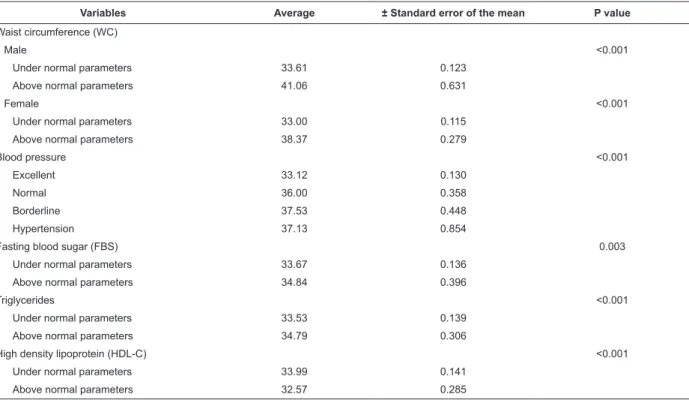
The NC of men and women who presented high
WC was greater than that of individuals with normal NC
(p<0.001). Additionally, as NC decreases, the BP of the
participants improves (p<0.001). Individuals with high
FBS (p=0.003) and TG (p<0.001) presented higher NC,
Rev. Latino-Am. Enfermagem 2014 Nov.-Dec.;22(6):973-9.
The percentages of students with changes
simultaneously between NC and the biochemical criteria
of MS, that is, FBS (p< 0.005), TG (p< 0.001) and HDL-C
(p<0.004), were 33.3%, 32.1% and 9.8%, respectively.
These values were lower among those with normal
biochemical measures and NC (Table 1).
Table 1 – Association between Neck Circumference and the components of Metabolic Syndrome. Fortaleza, CE, Brazil,
2011
Variables
High Under normal limits
RC: CI95% P value
n % n %
Waist circumference (WC) under normal limits
Male 128 18.8 554 81.2 1.7; 1.2-2.5 <0.001
Female 68 11.4 528 88.6 1
High waist circumference (WC)
Male 18 100 - - 1.3; 1.1-1.4 <0.017
Female 78 75.0 26 25.0 1
Blood pressure
Hypertension 12 55.0 9 45.0 7.5; 2.8 – 20.8 <0.001 Borderline 14 45.2 17 54.8 4.6; 2.0 -10.4 <0.001
Normal 36 40.4 53 59.6 3.8; 2.2 -6.3 <0.001
Excellent 84 15.0 475 85.0 1
Fasting blood sugar (FBS)
Under normal parameters 28 33.3 56 66.7 2.0; 1.2 – 3.5 <0.005 Above normal parameters 117 19.3 489 80.7 1
Triglycerides (TG)
Under normal parameters 51 32.1 108 67.9 2.1; 1.4 – 3.3 <0.001 Above normal parameters 94 17.7 436 82.3 1
High density lipoprotein (HDL-C)
Under normal parameters 8 9.8 75 90.2 0.3; 0.1 – 0.7 <0.004 Above normal parameters 137 22.6 469 77.4 1
Table 2 – Comparison of averages concerning association between Neck Circumference and the components of
Metabolic Syndrome. Fortaleza, CE, Brazil, 2011
Variables Average ± Standard error of the mean P value
Waist circumference (WC)
Male <0.001
Under normal parameters 33.61 0.123 Above normal parameters 41.06 0.631
Female <0.001
Under normal parameters 33.00 0.115 Above normal parameters 38.37 0.279
Blood pressure <0.001
Excellent 33.12 0.130
Normal 36.00 0.358
Borderline 37.53 0.448
Hypertension 37.13 0.854
Fasting blood sugar (FBS) 0.003
Under normal parameters 33.67 0.136 Above normal parameters 34.84 0.396
Triglycerides <0.001
Under normal parameters 33.53 0.139 Above normal parameters 34.79 0.306
High density lipoprotein (HDL-C) <0.001
Under normal parameters 33.99 0.141 Above normal parameters 32.57 0.285
Only 1.7% of the sample present MS, 58.3% of
which simultaneously presented MS and altered NC
(p< 0.006). Additionally, individuals with MS presented
higher NC in regard to the other participants (p<0.001)
Discussion
The relationship between NC and sex showed that
men presented higher neck circumference values. Other
studies, however, found this association in both sexes and this issue has not been totally clariied(9,12,14). It is possible that the predominance of excess weight among
women explains the greater female vulnerability to
higher NC(19).
Despite the prevalence of MS being low among college students, a signiicant association was found with high NC. Additionally, those with one or two MS
components, also presented a higher average NC;
however, more robust evidence was detected in regard
to NC and WC, NC and BP, and NC and TG. In this sense,
this study’s results are in agreement with those found in
recent literature(20-23).
Hence, the measurement of NC may help to
diagnose MS and various health problems, such as
central obesity, pre-hypertension, hypertension and
dyslipidemia, in addition to indicating the condition of
being overweight and obese(24). One study addressing
the relationship between NC and relative muscle force
and cardiovascular risk factors among sedentary women
showed that NC predicts cardiovascular risk(25). On the
other hand, another study with nursing professionals
indicates that NC is not sensitive enough to capture
metabolic deviations related to blood lipoprotein, as in
other measures of body composition(26).
The measurement of NC is a simple, reliable and
low cost procedure that enables it to be implemented in
primary care by any health worker, whether to prevent
diseases or to identify them, reaching large and different
populations.
Because this is a cross-sectional study, however,
we cannot draw causal relationships, not even for the MS components with statistically signiicant associations. The criteria used to identify MS may underestimate
the number of cases, as they consider the difference
of values among criteria established by organizations in
regard to central obesity(27).
A lack of Brazilian studies addressing this topic,
regardless of the segment of population, as well as of
international investigations involving college students,
hindered a deeper discussion and comparisons with
literature, though it may contribute to BRAMS.
At the same time, this study points to the need to
develop further studies including various and different
populations in terms of ethnicity, age, health conditions,
and other criteria for the diagnosis of MS, to enable
comparisons and better clarify NC as an MS marker.
Additionally, this study guides those interested in the
topic to review current, established criteria to classify
MS and avoid underestimation of cases, as well as to
consider the possibility of including neck circumference
as a marker for metabolic syndrome.
Conclusions
Neck circumference was associated with MS and all
its criteria according to NCEP/ATP III. Therefore, NC is
a potential marker as an additional parameter to screen
for MS among college students.
References
1. Agenda Nacional de Prioridade de Pesquisa em Saúde.
Brasil; 2008.
2. Alberti KG, Zimmet P, Shaw J. Metabolic
syndrome--a new world-wide definition. A Consensus Statement
from the International Diabetes Federation. Diab Med.
2006;23(5):469-80.
3. Expert Panel on Detection, Evaluation, and
Treatment of High Blood Cholesterol in Adults.
Executive Summary of the Third Report of The National
Cholesterol Education Program (NCEP) Expert Panel on
Detection, Evaluation, And Treatment of High Blood
Cholesterol In Adults (Adult Treatment Panel III).
JAMA. 2001;285(19):2486-97.
4. International Diabetes Federation (IDF). International
Diabetes Federation consensus worldwide definition of
the metabolic syndrome [Internet]. 2008; [acesso 31 Table 3 – Association between Neck Circumference and Metabolic Syndrome among college students. Fortaleza, CE,
Brazil, 2011
Variables
Above normal parameters
Under normal
parameters RC: CI
95% P value Mean
Standard error
of the mean P value
n % n %
Metabolic Syndrome < 0.006 < 0.001
Yes 7 58.3 5 41.7 5.4; 1.4-22.1 37.04 1.199
Rev. Latino-Am. Enfermagem 2014 Nov.-Dec.;22(6):973-9.
mar 2014]; Disponível em: http://www.idf.org/webdata/
docs/IDF_Metasyndrome_definition.pdf.
5. Schommer VA, Barbiero SM, Cesa CC, Oliveira R,
Silva AD, Pellanda LC. Excess Weight, Anthropometric
Variables and Blood Pressure in Schoolchildren aged 10
to 18 years. Arq. Bras. Cardiol. 2014;102(4):312-8.
6. Wang Y, Rimm EB, Stampfer MJ, Willett WC, Hu FB.
Comparison of abdominal adiposity and overall obesity
in predicting risk of type 2 diabetes among men. Am J
Clin Nutr. 2005;81:555–63.
7. Wang J, Thornton JC, Bari S, Williamson B, Gallagher
D, Heymsfield SB, et al. Comparisons of waist
circumferences measured at 4 sites. Am J Clin Nutr.
2003;77(2):379-84.
8. Sjöström CD, Lissner L, Sjöström L. Relationships
between changes in body composition and changes in
cardiovascular risk factors: the SOS Intervention Study.
Swedish Obese Subjects. Obesity Res. 1997;5(6):519-30.
9. Guang-ran Y, Shen-yuan Y, Han-jing F, Gang W,
Liang-xiang Z, Xiang-lei B, et al. Neck Circumference Positively
Related With Central Obesity, Overweight, and Metabolic
Syndrome in Chinese Subjects With Type 2 Diabetes:
Beijing Community Diabetes Study 4. Diabetes Care.
2010;33(11):2465–7.
10. Ben-Noun L, Sohar E, Laor A. Neck Circumference as
a Simple Screening Measure for Identifying Overweight
and Obese Patients. Obesity Res. 2001;9(8):470–7.
11. Ben-Noun L, Laor A. Relationship between changes
in neck circumference and cardiovascular risk factors.
Exp Clin Cardiol. 2006;11(1):14–20.
12. Stabe C, Vasques AC, Lima MM, Tambascia MA,
Pareja JC, Yamanaka A, et al. Neck circumference as a
simple tool for identifying the metabolic syndrome and
insulin resistance: results from the Brazilian Metabolic
Syndrome Study. Clin Endocrinol. 2013;78(6):874-81.
13. Associação Nacional de Empresas de Pesquisas
(ANEP). Critério de Classificação Econômica no Brasil.
[Internet] 2009. [acesso 14 fev 2009]. Disponível em:
www.anep.org.br.
14. Preis SR, Massaro JM, Hoffmann U, D’Agostino RB Sr,
Levy D, Robins SJ, et al. Neck circumference as a novel
measure of cardiometabolic risk: the Framingham Heart
study. J Clin Endocrinol Metab. 2010;95(8):3701-10.
15. Vasques AC, Rosado L, Rosado G, Ribeiro
RC, Franceschini S, Geloneze B. Anthropometric
indicators of insulin resistance. Arq. Bras. Cardiol.
2010;95(1):e14-e23.
16. World Health Organization (WHO). Obesity:
preventing and managing the global epidemic. Report
of a WHO Consulation. Geneva: WHO Technical report
series 834. World Health Organization; 2000.
17. Gomes MB, Ferreira SDG. Síndrome metabólica,
diabetes e risco cardiovascular: aspectos clínicos e
terapêuticos. Posicionamento Oficial Sociedade Brasileira
de Diabetes; 2009. n. 2/09.
18. Sociedade Brasileira de Cardiologia. VI Diretrizes
Brasileiras de Hipertensão. Arq Bras Cardiol.
2010;34:1926-31.
19. Fox CS, Massaro JM, Hoffmann U, Pou KM,
Maurovich-Horvat P, Liu CY, et al. Abdominal visceral and
subcutaneous adipose tissue compartments: association
with metabolic risk factors in the Framingham Heart
Study. Circulation. 2007;116(1):39-48.
20. Hingorjo MR, Qureshi MA, Mehdi A. Neck circumference
as a useful marker of obesity: a comparison with body
mass index and waist circumference. J Pak Med Assoc.
2012;62:36-40.
21. Fitch KV, Stanley TL, Looby SE, Rope AM, Grinspoon
SK. Relationship between neck circumference and
cardiometabolic parameters in HIV-infected and
non-HIV-infected adults. Diabetes Care.
2011;34:1026-31.
22. Kurtoglu S, Hatipoglu N, Mazicioglu MM, Kondolot M.
Neck circumference as a novel parameter to determine
metabolic risk factors in obese children. Eur J Clin Invest.
2011;42:623-30.
23. Guo X, Li Y, Sun G, Yang Y, Zheng L, Zhang X, et al.
Prehypertension in children and adolescents: association
with body weight and neck circumference. Intern Med.
2012;51:23-7.
24. Ben-Noun L, Sohar E, Laor A. Neck Circumference as
a Simple Screening Measure for Identifying Overweight
and Obese Patients. Obesity Res. 2001;9:470–7.
25. Tibana RA, Teixeira TG, Farias DL, Silva AO, Madrid
B, Vieira A, et al. Relação da circunferência do pescoço
com a força muscular relativa e aos fatores de risco
cardiovascular em mulheres sedentárias. Einstein.
2012;10(3):329-34.
26. Alexandria FG, Paraguassu ALS, Maciel AP, Araújo
MS, Machado LMM, Filho JAP. Correlações entre
circunferência do pescoço, o índice de massa corporal e o
perfil lipídico de mulheres, profissionais de enfermagem,
de um hospital universitário em Belém, Pará, Brasil.
27. Halpern A. Bases fisiológicas e critérios diagnósticos
da síndrome metabólica. In: Síndrome metabólica:
aspectos etiopatogênicos, clínicos e terapêuticos.
Posicionamento Oficial Sociedade Brasileira de Diabetes;
2009. n. 2/09.