PRIMARYOSTEOSARCOMAOFTHEBREAST: PATHOLOGICALANDIMAGINGFINDINGS
REV ASSOC MED BRAS 2015; 61(6):497-499 497
IMAGE IN MEDICINE
Primary osteosarcoma of the breast: pathological and imaging
findings
O
STEOSSARCOMA PRIMÁRIO DA MAMA:
ACHADOS PATOLÓGICOS E DE IMAGEMDÉLIO MARQUES CONDE1*, LARISSA CUNHA MORAIS2, CRISTIANE FAGUNDES PACHECO2, ROGÉRIO BIZINOTO FERREIRA3, ÉRIKA PEREIRA
DE SOUSA-E-SILVA3, ALINE REGINA NUNES4, SEBASTIÃO ALVES PINTO5, PAULO SÉRGIO PERES FONSECA6
1MD, PhD – Mentor, Medical Residency Training Program in Breast Disorders, Breast Clinic, Hospital Materno Infantil, Goiânia, GO, Brazil 2Resident Physician in Breast Disorders – Resident Physician in Breast Disorders, Breast Clinic, Hospital Materno Infantil, Goiânia, GO, Brazil 3MD, MSc – Mentor, Medical Residency Training Program in Breast Disorders, Breast Clinic, Hospital Materno Infantil, Goiânia, GO, Brazil 4Resident Physician in Breast Disorders – Resident Physician in Breast Disorders, Breast Clinic, Hospital Materno Infantil, Goiânia, GO, Brazil 5MD, MSc – Pathologist, Pathology Service, Instituto Goiano de Oncologia e Hematologia (INGOH), Goiânia, GO, Brazil
6Medical Specialist – Pathologist, Pathology Service, Hospital Materno Infantil, Goiânia, GO, Brazil
Study conducted at Hospital Materno
Infantil de Goiânia, Goiânia, GO, Brazil
Article received: 3/26/2015
Accepted for publication: 5/16/2015
*Correspondence:
Address: Rua R-7, esquina com Avenida Perimetral, S/N. Setor Oeste
Goiânia, GO – Brazil Postal code: 74530-020
http://dx.doi.org/10.1590/1806-9282.61.06.497
Financial support: none
S
UMMARYPrimary osteosarcoma of the breast (POB) is an extremely rare and aggressive tumor. Differential diagnosis of POB includes osteosarcoma of the chest wall and metaplastic breast carcinoma. Imaging tests that exclude the existence of a direct connection between the tumor and chest wall, as well as histopathologi-cal and immunohistochemihistopathologi-cal studies that rule out the presence of an epitheli-al component are required for the diagnosis of POB. We report a case of a 69-year old woman with POB. Imaging and pathological findings are presented. Therapeutic approach is discussed in the light of current knowledge, including potential complications.
Keywords: breast, breast neoplasms, sarcoma, immunochemistry.
A 69-year-old woman presented with a 6-month history of a palpable, painless mass in her left breast. Clinical ex-amination revealed a hard, mobile, well-circumscribed, 10 cm mass, occupying practically the entire left breast. Contralateral breast, axilla or nipples showed no abnor-malities. She denied having any history of breast trauma, radiotherapy, or breast cancer.
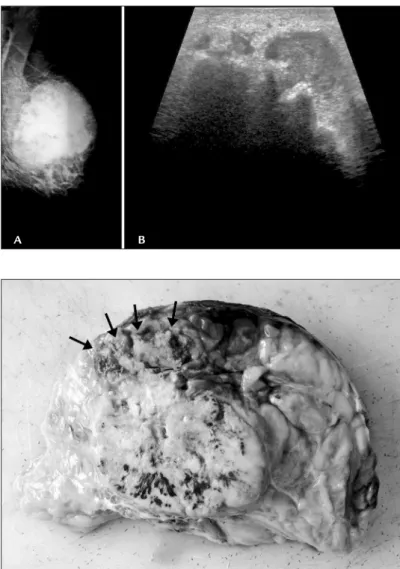
Mammography revealed a relatively well-defined, hy-perdense irregular mass without calcifications, uncon-nected to the underlying sternum and ribs (Figure 1A). Ultrasound revealed a hypoechoic irregular mass with hy-perechoic areas, indistinct margins, and posterior acous-tic shadowing (Figure 1B). Core needle biopsy was per-formed and microscopy showed a malignant poorly differentiated mesenchymal tumor.
Thoracic and abdominal computed tomography showed no distant metastasis. The patient underwent simple mastectomy and sentinel lymph node biopsy. Grossly, the cut surface of the tumor was white, hard, with
a stony consistency in the center and well-defined mar-gins. The tumor measured 10x9x7 cm (Figure 2).
Microscopy showed a malignant immature
mesen-chymal bone-forming tumor. There were foci of necrosis
di-CONDE DM ETAL.
498 REV ASSOC MED BRAS 2015; 61(6):497-499
FIGURE 1 Imaging findings. (A) Mammogram showing a relatively well-defined, irregular, hyperdense mass. The tumor was unconnected with the underlying sternum and ribs; (B) Ultrasound demonstrating an irregular, hypoechoic mass with hyperechoic areas and diffuse posterior acoustic shadowing.
FIGURE 2 Cut surface of the tumor revealed a solid, white mass with well-defined margins. Tumor margin (arrows).
ma are differential diagnoses of POB. In this case, the tu-mor was not connected directly to the underlying ster-num and ribs, excluding a diagnosis of osteosarcoma arising from the chest wall. Immunohistochemistry showed no epithelial component, ruling out the diagno-sis of metaplastic carcinoma.
Carcinogenesis of POB is unknown. It has been sug-gested that POB may arise from totipotent mesenchymal cells of the breast stroma or from transformation of
pre-existing phyllodes tumor or fibroadenoma.2,3
Further-more, there may be an association between a history of
trauma or irradiation and POB.2 Our patient had none
of these conditions.
POB is managed similarly to other sarcomas. Surgery is aimed at achieving tumorfree margins, since margin
status is the major risk factor for recurrence.4 Routine
ax-illary dissection is not indicated, since lymphatic spread
is unusual.2,4,5 The use of radiotherapy and
chemothera-py is controversial. Radiotherachemothera-py improves local control.5
agnosed and the tumor was classified as osteoblastic sub-type (Figure 3).
Clinical oncologists treated the patient with chemo-therapy, administering doxorubicin plus cisplatin. After the second course of chemotherapy, she developed neu-tropenia, severe sepsis and died, despite therapy.
POB is an extremely rare and aggressive tumor,
ac-counting for less than 1% of all breast malignancies.1 It
is classified as fibroblastic, osteoblastic and osteoclastic, according to cell composition. In the largest series of POB published up to now, including 50 cases, 56% of POB cas-es were of the fibroblastic subtype, followed by osteoclas-tic (28%) and osteoblasosteoclas-tic (16%) subtypes. Prognosis in patients with POB is poor, and a 5-year overall survival
rate of 38% has been reported.2
From 2010 to 2014, 345 women with breast cancer were treated in our institution. One case of POB was de-tected during this period, accounting for 0.3% of all breast cancers. Skeletal osteosarcoma and metaplastic
PRIMARYOSTEOSARCOMAOFTHEBREAST: PATHOLOGICALANDIMAGINGFINDINGS
REV ASSOC MED BRAS 2015; 61(6):497-499 499
Patients with large (> 5cm) and/or high-grade tumors may benefit from chemotherapy, using drugs such as doxorubicin, cisplatin, methotrexate, and ifosfamide that
show anti-tumor activity in osteosarcoma.6 It is worth
mentioning that chemotherapy has toxicity that may
re-sult in death.7 This aspect needs to be taken into
consid-eration in therapeutic planning.
R
ESUMOOsteossarcoma primário da mama: achados patológicos e de imagem.
O osteossarcoma primário da mama (OPM) é um tumor extremamente raro e agressivo. O diagnóstico diferencial do OPM inclui o osteossarcoma da parede torácica e o carcinoma metaplásico da mama. Exames de imagem que excluam a existência de uma conexão direta entre o tu-mor e a parede torácica, e estudos histopatológico e imu-no-histoquímico que descartem a presença de um com-ponente epitelial são necessários para o diagnóstico de OPM. Relatamos um caso de OPM em uma mulher de 69 anos de idade. Os achados de imagem e patológicos
são apresentados. A abordagem terapêutica é discutida à luz do conhecimento atual, incluindo potenciais compli-cações.
Palavras-chave: mama, neoplasias da mama, sarcoma, imuno-histoquímica.
R
EFERENCES1. Szajewski M, Kruszewski WJ, Ciesielski M, Smiałek-Kusowska U, Czerepko M, Szefel J. Primary osteosarcoma of the breast: A case report. Oncol Lett. 2014;7:1962-4.
2. Silver SA, Tavassoli FA. Primary osteogenic sarcoma of the breast: a clinicopathologic analysis of 50 cases. Am J Surg Pathol 1998;22:925-33. 3. Remadi S, Doussis-Anagnostopoulu I, Mac Gee W. Primary osteosarcoma
of the breast. Pathol Res Pract. 1995;191:471-4.
4. Adem C, Reynolds C, Ingle JN, Nascimento AG. Primary breast sarcoma: clinicopathologic series from the Mayo Clinic and review of the literature. Br J Cancer. 2004;91:237-41.
5. McGowan TS, Cummings BJ, O’Sullivan B, Catton CN, Miller N, Panzarella T. An analysis of 78 breast sarcoma patients without distant metastases at presentation. Int J Radiat Oncol Biol Phys. 2000;46:383-90.
6. ESMO/European Sarcoma Network Working Group. Bone sarcomas: ESMO Clinical Practice Guidelines for diagnosis, treatment and follow-up. Ann Oncol. 2014;25 Suppl 3:iii113-23.
7. Collins M, Wilhelm M, Conyers R, Herschtal A, Whelan J, Bielack S, et al. Benefits and adverse events in younger versus older patients receiving neoadjuvant chemotherapy for osteosarcoma: findings from a meta-analysis. J Clin Oncol. 2013;31:2303-12.
FIGURE 3 Pathology findings. (A) Immature mesenchymal bone-forming neoplasm (HE, 40x); (B) atypical spindle-cell neoplasm and immature osteoid matrix (HE, 200x); (C) mesenchymal neoplasm producing osteoid matrix surrounded by osteoclast-like giant cells and atypical mesenchymal cells (HE, 400x); (D) osteoclast-like giant cells were CD68-positive (200x) (arrows).
A B