Health and nutrition in public and private schools in the city of Recife
Myrtis de Assunção Bezerra 1
Eduardo Freese de Carvalho 2
Juliana Souza Oliveira 3
Vanessa Sá Leal4
1,2Centro de Pesquisas Aggeu Magalhães. Fundação Oswaldo Cruz. Av Prof. Moraes Rego, s.n. Campus UFPE. Cidade Universitária. Recife, PE, Brasil.
CEP: 50.740-465. E-mail: [email protected]
3,4Universidade Federal de Pernambuco. Recife, PE, Brasil.
Abstract
Objectives: to analyze the implementation of initiatives and environments promoting healthy feeding as well as the practice of physical activity in public and private schools in Recife.
Methods: the schools selected in the City of Recife (n=39) are part of the sample in the Study of Cardiovascular Risks in Adolescents (ERICA). The degree of implementation was estimated by means of interviews with the school manager emphasizing the following compo-nents: community participation, presence of healthy environments, partnership with the health segment, monitoring of nutritional status and nutrition policies. The variables selected were assigned points whose sum rated them as satisfactory implementation, poor implemen-tation and critical implemenimplemen-tation.
Results: the promotion of healthy eating as well as the practice of physical activity was satisfactorily implemented in 13.8% of public schools. However, no private schools obtained such rating. Public schools, when compared to private schools, showed themselves to be more structured, concerning the policies and environments promoting healthy eating and school community participation, however, they showed greater fragility regarding the promotion of physical activity practice and nutritional status monitoring. A few schools had satisfactory implementation in the partnership with the health segment.
Conclusions: public and private schools have presented barriers which compromise the full implementation of initiatives and environments promoting healthy eating and physical activity practice.
Introduction
Chronic non-communicable diseases (CNCD), particularly cerebrovascular accident, heart attack, diabetes and arterial hypertension, constitute health problems with greater magnitude in the global scope. For the period between 2010 and 2020, the World Health Organization (WHO) projections indicates an increase of 15% in mortality caused by this group of diseases.1 In Brazil, CNCD are responsible for
72.7% of the deaths,2emphasizing that overweight
and obesity are the main contributors for the charge of chronic diseases in the population.3
Researches show that part of these health pro-blems has its origins in the childhood or adoles-cence.4,5In the perspective defined by life course
epidemiology, early preventive strategies are empha-sized so that they guarantee, for example, appropria-ted nutrition during the phases and actions which build favorable environments to health and also support healthy choices.1,5,6
From this framework, besides primary preven-tion, health promotion has been configured as theo-retical and practical alternative, necessary to face these complex factors which constitute the current epidemiological framework of the CNCDs.7,8 To
consider, beyond the biological aspects, the environ-mental, cultural and social contexts promotes a broader approach, more coherent with the health promotion.8-10
For gathering together the majority of adoles-cents in a country, school environment represents a privileged space for developing these actions.11,12
The promotion of health in school constitutes a world-class initiative which makes possible a greater interaction between teachers and health profes-sionals for inter-sectorial and collaborative actions which deal with the situations of vulnerability of adolescent’s health, including parental support and cooperation and stimulating policies in this commu-nity.13-14
In Brazil, such objectives are endorsed in the National Policy of Health Promotion and the Health Program at School (PSE - Programa de Saúde da Escola), which has intersecto-riality as one of its main guidelines.15These initiatives can be evaluated
based on three interrelated components:1) integral health education, 2) creation and maintenance of physical and psychosocial healthy environments, 3) and the offer of health services, healthy eating and active life.14
The presence of these components in schools may promote healthy eating behaviors and the prac-tice of physical activity, which are fundamental
measures for a healthy life and for the prevention of chronic non-communicable diseases in adult life.13,16,17
Consideringscarce the information on state of implementation of health promoting measures in schools in Recife city, and considering obesity, sedentary behavior and adoption of inappropriate eating habits as some of the main factors of morbidity in adolescents, the present study aims to evaluate the implementation of initiatives and health promoting environments, focused in healthy eating and the practice of physical activity aimed to adoles-cents in public and private schools in Recife.
Methods
This sectional study is part of a nationwide multicen-tric research, “Study of Cardiovascular Risk in Adolescents” (ERICA- Estudo de Riscos Cardiovasculares em Adolescentes). ERICA had as objective to estimate the prevalence of cardiovas-cular risk factors and metabolic syndrome in adoles-cents (12 to 17 years old) attending private and public schools from 273 municipalities with over 100 thousand inhabitants in Brazil.
Data related to the municipality of Recife (PE) were selected for the present article. Data collect occurred in the period between July and November, 2015. Criteria of eligibility include public and private schools from urban areas, from elementary school (last years) and/or high school which contributed with ERICA.
The sampling process tried to preserve the distri-bution of schools for administrative dependence, (public or private). In the sample, inside each geographical stratum, the method of systematic selection PPT (Size proportional probability) (PPT-Probabilidade Proporcional ao Tamanho) was used, with previous assortment of schools from the selec-tion registry by geographical stratum, situaselec-tion and administrative dependence. Thus, 39 representative schools were selected for adolescent students from Recife municipality. The manuscript in which are described more details of the schools sampling is available in the Vasconcelos et al.18article.
A theoretical operational model was elaborated based on the instruments proposed by Silva et al.10
and by “Cuestionario The Health Behaviour in School-aged Children HBSC”.19This model oriented
which would lead, in long term, to the reduction of obesity and its cardiovascular complications (Figure1). The adapted version of the questionnaire was applied to the managers by means of interviews in each chosen school.
The questionnaire composed by opened and closed questions was divided in five components: 1) participation of the school community (parents, teachers and students) in the school activities; 2) presence of healthy environments; 3) fellowship with the health sector; 4) monitoring of the nutri-tional state and 5) nutrition policy of the school. In addition of these components, it was also evaluated manager’s perception regarding the main problems of the districts and the visible barriers to implemen-tation of health promotion in the school.
In order to verify the level of implementation of health promotion in the schools, a score system was used. Each item received a positive score (1,0) when had this item accomplished, or null (0,0) when it didn’t. For items with more than one answer option, the score were categorized according to the level of relevance of the action, and it may receive 0,1 or 2 score. To consider as positive the items referring to “average number of meetings with the school
community), answers which were superior to the average found in the sampling were used. Missing data were considered null and scored as “0” in the analysis. In the end, the maximum sum of every items from each positively answered component was of 40 points, distributed in 24 variables with maximum score of 1,0 point each and 8 variables with maximum score of 2,0 each.
By means of a simple rule of three, from the maximum score of the components (40 points) and the score obtained by each school, the level of imple-mentation of each component was calculated, being defined as satisfactory when presented 70-100% of the implemented initiatives, unsatisfactory when 50-69.9% and critical <50%. The joint analysis of these components made possible to estimate the degree of suitability of the initiatives promoting health eating and the practice of physical activity in the schools. The data analysis was executed using STATA 14.0 statistic software.
This study was approved by the Committee of Ethics in Research from the Research Center Aggeu Magalhães/FIOCRUZ 31446314.6.1001.5190. All the participants signed the Consent Form.
Figure 1
Theoretical operational model of promotion of healthy eating and physical activity practice in the school context.
Component
Participation of school community
Presence of healthy environments
Nutrition Policies
Monitoring of the nutritional status
Involvement of the health sector
Intermediate results
Healthy behaviors
Eating Behavior (energetic consumption)
Practice of physical activity (energetic expenditure)
Reduction of Overweight / Obesity
Dyslipidemia Insulin resistance Hypertension Other comorbidities
Results
From 39 selected schools, 38 participated in the study (29 public schools and 9 private schools). A manager from a private school (3.8%) was not inter-viewed due to the finishing of the school activity in the unit. Among the interviewees, 76.3% (n=29) were principals, 13.2% (n=5) coordinators and 10.5% (n=4) deputies.
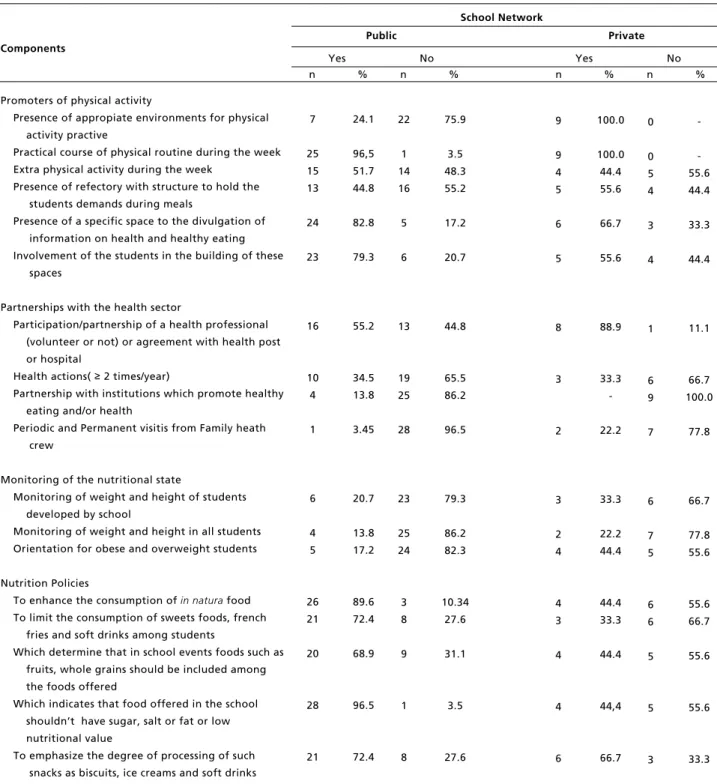
The average of meetings held by public and private school networks, in order to approach the thematic of healthy eating with the parents was of 1.1 ± 0.3 and 1.3 ± 0.5 meetings/year, respectively. With the employees the average of meetings was of 5 ± 1.2, during the school year; in the private schools this average was of 0.8 ± 0.3. The suggestions made by the members of the school community were considered in the building of the Political Pedagogical Project (PPP) in 96.5% (n=28) of the public schools and 66.6% (n=6) of the private schools (Table 1).
Regarding the health topics, 24.1% of the public schools and 22.2% of the private ones did not include the healthy eating topic in the curriculum. The physical activity topic was inserted in 96.5% (n=28) of the public schools and 100% (n=9) of the private ones. General health topics were found included in 100% of the approached schools (Table 1). Such discussions as prevention of sexual trans-mittable diseases (96.5% vs100%), prevention on the drug use (93.1% vs100%), prevention of early pregnancy (89.6% vs 77.7%), neglected diseases (75.8% vs88.8%) and prevention of non-communi-cable chronic diseases (75.5% vs 88.8%) were approached in the majority of private and public schools, respectively.
66.7% of the private schools were evaluated with critical implementation for the component presence of health eating promoting environments (Table 2). Only 11.1% (n=1) used the commercial space of health eating promotion (Table 1). Few schools had satisfactory implementation (13.8%) regarding the presence of environments promoting health eating (Table 2) and a minority presented commercial snack bar inside (n=3; 10.3%). In contrast, “street vendors and local nearby commerce” were observed in 93.1% (n=27) of the public schools(Table 1).
75.9% of the public schools had its physical environments to support physical activity considered inappropriate or in a bad state of conservation by the managers (Table 1). Only public schools presented critical degree regarding the implementation of this component in the school environment. (Table 2). The
Family Health Crews (ESF) from the Public Health System (SUS) did not hold periodical nor permanent visits in 96.5% (n=28) of the public schools. Besides, 58.6% of the public school network managers reported not knowing the Health in School Program. From the 29 public schools, only two reported to be participating PSE. In the private school network, 100% had fellowship with other institutions which promote healthy eating and/or health (Table 1).
The monitoring of weight and height was an item held in only 13.8% (n=4) and 22.2% (n=2) of public and private schools, respectively. In the same way, the orientation for the students in overweight/ obesity, developed by school, was reported by 17.2% (n=5) of the public managers and 44% (n=4) of the private managers (Table 1). This was a component with critical implementation on 79.3% of the public schools and 77.8% in the private school network (Table 2).
The item “Increase the consumption of in natura food” was a nutrition policy found in 89.6% (n=26) and in 44.4% (n=4) of the public and private schools, respectively. In the public school network, 96.5% (n=28) presented policies for not including food with abundant sugar, sodium and fat and/or with low nutritional value. In the private network, 44.4% preferred to apply this kind of policy (Table 1). This component was implemented satisfactorily in 37.9% of the public schools, whilst in public network, 88.9% of schools had critical rating (Table 2).
In the joint evaluation of the components, it was observed that four public schools (13.8%) were clas-sified as satisfactory, and, because of this, can be considered, according to the criteria followed in the present study, healthy eating and physical activity promoting schools. None of the private schools had satisfactory rating in this component (Figure 2).
Among the identified barriers for the implemen-tation of health promotion, build fellowships with the health sector was the main difficulty referred in 20 public schools and 2 private schools. Also, inap-propriate physical structure, resistance from the adolescents to adhere a healthy eating, the lack of training and incentive for the teachers regarding health topics, low participation from the parents in the school activities and the media influence in sti-mulate the consumption of low nutritional value food were highlighted points.
Table 1
Frequency of schools according to the accomplishment of items for the development of community school participation, health environments, fellowship with the health sector, monitoring of nutritional state and nutrition policy. Recife (PE), Brazil, 2015.
continue aAverage: 1,1 meetings/year in public schools; 1,3 meetings/year in private schools; bAverage: 5 meetings/year in public schools; 0,8 meetings/year in private schools; cAverage: 2,4 teachers in public schools, 1,6 teachers in private schools; *PPP= Political pedagogical
Components
School Network
Yes No Yes No
Participation of school community Meetings/training (year)
Meetings with parents to approach the healthy eating topic above the averagea
Meetings with employees to approach the healthy eating topic above the averageb
Training for teachers about healthy food and health
Building of PPP*
Suggestions from meeting were considered in the building of PPP*
Involvement of school community in the building of PPP *
Involvement of teachers, principals,and coordinators in the building of PPP*
Estimates of involved teachers in the building of PPP above the averagec
School Curriculum
Inclusion of the healthy eating topic on the school curriculum
Inclusion of physical education on the school curriculum
Inclusion of health topic in the school curriculum
Healthy environments Promoters of healthy eating
Presence of refectory with capacity to meet the demand of students during the meals Presence of a specific space to the divulgation of
information on health and healthy eating Involvement of the students in the building of these
spaces
Permanent destination of these specific spaces by school
Presence of space for the execution of culinary activities
Presence of school vegetable garden that promotes healthy food
Presence of commercial snack bar which promotes healthy eating
Absence of snack bar in the school
Absence of street vendors and/or local trade nearby school 7 12 7 28 26 29 27 22 28 29 13 24 23 10 8 4 1 26 2 24.1 41.3 24.1 96.5 89.7 100.0 93.1 75.9 96.5 100.0 44.8 82.8 79.3 34.5 27.6 13.8 3.4 89.7 6.9 3 0 3 6 6 2 5 7 9 9 5 6 5 3 6 3 1 0 3
Public Private
n % n % n % n %
Table 1 concluded
Frequency of schools according to the accomplishment of items for the development of community school participation, health environments, fellowship with the health sector, monitoring of nutritional state and nutrition policy. Recife (PE), Brazil, 2015.
aAverage: 1,1 meetings/year in public schools; 1,3 meetings/year in private schools; bAverage: 5 meetings/year in public schools; 0,8 meetings/year in private schools; cAverage: 2,4 teachers in public schools, 1,6 teachers in private schools; *PPP= Political pedagogical Project
Components
School Network
Yes No Yes No
Promoters of physical activity
Presence of appropiate environments for physical activity practive
Practical course of physical routine during the week Extra physical activity during the week
Presence of refectory with structure to hold the students demands during meals
Presence of a specific space to the divulgation of information on health and healthy eating Involvement of the students in the building of these
spaces
Partnerships with the health sector
Participation/partnership of a health professional (volunteer or not) or agreement with health post or hospital
Health actions( ≥2 times/year)
Partnership with institutions which promote healthy eating and/or health
Periodic and Permanent visitis from Family heath crew
Monitoring of the nutritional state
Monitoring of weight and height of students developed by school
Monitoring of weight and height in all students Orientation for obese and overweight students
Nutrition Policies
To enhance the consumption ofin naturafood
To limit the consumption of sweets foods, french fries and soft drinks among students
Which determine that in school events foods such as fruits, whole grains should be included among the foods offered
Which indicates that food offered in the school shouldn’t have sugar, salt or fat or low nutritional value
To emphasize the degree of processing of such snacks as biscuits, ice creams and soft drinks
7 25 15 13 24 23 16 10 4 1 6 4 5 26 21 20 28 21 24.1 96,5 51.7 44.8 82.8 79.3 55.2 34.5 13.8 3.45 20.7 13.8 17.2 89.6 72.4 68.9 96.5 72.4 9 9 4 5 6 5 8 3 2 3 2 4 4 3 4 4 6
Public Private
n % n % n % n %
Table 2
Frequency of schools according to the degree of implementation of the components of the school community participation, healthy environments, partnership with the health sector, monitoring of the nutritional state and nutrition policy. Recife (PE), Brazil, 2015.
Components
School Network
Satisfactory Unsatisfactory Critical Satisfactory Unsatisfactory Critical
Participation of school community Presence of healthy environments
Healthy eating Physical activity practice Partnership with the health sector Monitoring of the nutritional state Nutrition policies
14
14 16 6 4 7
48.3
48.3 55.2 20.7 13.8 24.1
1
6 0 3 7 8 Public Private
n % n % n % n % n % n %
3
11 10 17 23 11
10.3
37.9 34.5 58.6 79.3 37.9
22.2
11.1 22.2 11.1 22.2
-6
2 7 5 0 1
11.1
66.7 -33.3 77.8 88.9 12
4 3 6 2 11
41.4
13.8 10.3 20.7 6.9 37.9
2
1 2 1 2 0
66.7
22.2 77.8 55.6 -11.1
Figure 2
Frequency of public and private schools according to the degree of implementation of initiatives and environments promoting healthy eating and practice of physical activity. Recife, PE, Brazil, 2015.
10.5%
31.6%
57.9%
13.8%
37.9%
48.3%
0.0%
11.1%
88.9%
Public and Private Public Private
and alcohol consumption in public places”. The “violence or vandalism” nearby school were pro-blems related by 34.8% and 22.2% of the public and private schools, respectively. The remaining managers referred not being aware of these problems in the vicinity of the schools.
Discussion
The school can act as an enabling environment for the promotion of healthy eating behaviors and the practice of physical activity.1,6,3,17The high
preva-lence of schools which had unsatisfactory rating or explicit criticizing that the managers, the school community and the health sector have been facing barriers in the articulation and execution of these initiatives in the school environment.
The participation of the community is one of the requisites for classifying a school as a health promoter.14,19In this study, the majority of managers
referred that parents and employees were involved in the meetings and actions regarding health and healthy eating topics. However, the average number of meetings was considered low when compared to other studies.10,20
The involvement of the school community repre-sents a main role in social support to children and adolescents. This support is made available by friends, teachers and family, and can improve the school environment13 as well as influence in the
practice of physical activity and health eating behavior.21-25Silva et al.,10 which also evaluated the
participation of parents and teachers, indicate a low execution of these initiatives for the group of adoles-cents, which demonstrates the necessity of a higher guidance for this age group.
As it was established in the National Curricular Parameters, health topics were included in the curriculum of the majority of the analyzed schools, but it is not known if this inclusion operates in a transversal, contextualized and systematic way.10
Despite of the concerning from the educators about these extracurricular and school activities, it is noted that the tasks developed in classroom are, in general, based in the particular understanding which each teacher possesses about what health is, with isolated, overlapping and discontinuous actions.22,12These
teachers experience an array of difficulties in the elaboration and execution of health education. The discussion about the role of the teacher in this process, as well as his or her training, are necessary procedures in order to conduct the promotion of healthy behaviors in the school environment.
Internationally, agencies as WHO12and PAHO14
recommend policies or rules of nutrition which determine the types of food available in schools, being aware that these are measures which stimulate healthy choices.16,17,23,24
The nutrition policies were found in the majority of public schools in Recife, however, in a few ones from private network. This framework is justified by the fact that in public schools, besides the offering of healthy food and the restriction of selling food considered non-healthy, there was an magnification of the actions in the teaching-learning context, which assume a pedagogical practice of educational action focused on the promotion of health.25 However,
according to National Research of Student’s Health (PeNSE 2012 - Pesquisa Nacional de Saúde do Escolar) appointment,11these policies are not well
established in Brazilian private schools. This research reveals that the presence of snack bars and alternative spots of food selling was much higher in the private schools than in the public school network, and that these places offer a snacks of bad quality.
The contribution of school snacks can represent 25 to 50% of the total amount of nutrients ingested daily,26 and when they show low nutritional value and elevated caloric density, they can be considered as an important predictive factor for overweight and such comorbidities as hypertension, type 2 diabetes, and dyslipidemias in adolescence.8,13,27 In this
context, the building of policies and environments which stimulate the choice of healthy food and restrict the selling of non-healthy food is a necessary measure for the promotion of health in schools.
The accessibility to places destined to sportive practice and school physical educationis recognized as an important facilitator for an active life.22,28,29
Studies in this area have been verifying that inter-ventions of physical activities in school environment reduce the body mass index (BMI), and is regular practice represents an important change in the nutri-tional state of this group.13,29However, in about a
half of the public schools from the municipality, the managers realized the structure of physical activity support as being inappropriate. In both of the school networks there were a reduced number of regular practical classes. Similar findings were described in the National Research of Student’s Health.11
It is important to highlight that the school envi-ronment itself does not necessarily implies the participation of these students andthe adoption of more active behaviors. According to Santos et al.,22
may include internal factors (individual characteris-tics and minor priority to physical activity) as well as external factors (influence of someone or of the family, inaccessibility, safety and cost).
The feeling of insecurity, due to the violence in the districts where the schools are located, was rea-lized as one of the main problems by several managers in Recife municipality. This and other problems which the school community experience should be identified, debated and considered in the implementation of health promoting measures, once is very difficult to modify risk behaviors without changing social determinants that influence them.7,22,28,30
To monitor the nutritional state of the adoles-cents in school environment is considered a measure of prevention and of integral care regarding the aggravations related to eating and nutrition which focuses the reduction of overweight and obesity prevalence, as well as the CNCBs.4,10,11,27In this
study, few schools executed the monitoring of nutri-tional state of the adolescents. One of the main chal-lenges for the health monitoring of the adolescents is to recognize that this group needs a greater health-care and that the school and the health sector need to advance in the consolidation of an inter-sectorial model.
The lack of support of the health sector in public schools represent a problem of great magnitude which reflects the difficulty of the sector in dealing with the complexity of the health problems from the adolescents life stage. According to Reis et al.,9the
Family Health Crews (ESF) which are responsible to perform periodic and permanent visits to the schools participating the Health in School Program, related that the main types of behaviors which make it diffi-cult to approach this group were aggressiveness, refractoriness and transgression.
The PSE has intersectoriality as its main guide-lines, which aims to articulate public schools and the basic health network to bring actions of prevention, promotion and healthcare to the public network
students.9,30 However, the results of this study
demonstrate that over the half of managers of the state public school network related not knowing PSE, which indicates a low concreteness between the fellowships among health and education sectors in the municipality.
It is necessary to rethink the way of develop these actions in the public network schools, as well as to support these initiatives in the private schools, for the vulnerabilities to the health of adoles-cents.9,14,30as well as the current epidemiological
framework regarding the overweight in this group,3,4,6demand measures of prevention to the
aggravations associated to obesity and more inte-grated initiatives promoting health.
Besides the findings referred to previously, some limitations and its possible repercussions over the results should be discussed. First, the schools in this study represent the first stage of selection in a repre-sentative sample of the adolescent students from Recife.18Secondly, all the measures were obtained
by means of a questionnaire and may present bias of answer. Despite of it, this is a field yet to be build, with few Brazilian studies, being necessary more researches to deepen the researched components, encompassing the evaluation, as well as the school community and the health crews involved.
In conclusion, the results of this study demons-trate that despite of the implementation still inci-pient and the existing barriers, the schools are, in a certain level, developing initiatives promoting healthy eating and/or practice of physical activity. In this respect, it is stressed that it is necessary to comprehend the reality of each school, to support the communication between the health and education sectors, to train managers, teachers, street vendors and snack bar owners, as well as stimulate the family involvement in the action destined to the adoles-cents. Probably, only from this process it will be possible to accomplish the necessary changes for the school environment to be a promoter of health atti-tudes and practices.
References
1. WHO (World Health Organization). Global status report on noncommunicable diseases 2014. Geneva. 2014 [acesso 4 dez 2015]. Disponível em: www.who.int/nmh/publica-tions/ncd_report_full_en.pdf
2. Malta DC, Moura L, Prado RR, Escalante JC, Schmidt MI, Duncan BB. Mortalidade por doenças crônicas não trans-missíveis no Brasil e suas regiões, 2000 a 2011. Epidemiol Serv Saúde. 2014; 23(4): 599-608.
3. Kearns K, Dee A, Fitzgerald AP, Doherty E, Perry IJ. Chronic disease burden associated with overweight and obesity in Ireland: the effects of a small BMI reduction at population level. BMC Public Health. 2014; 14: 143. 4. Bibiloni MM, Pons A, Tur JA. Prevalence of Overweight
5. Ben-Schlomo Y, Kuh D. A life course approach to chronic disease epidemiology: conceptual models, empirical chal-lenges and interdisciplinary perspectives. Int J Epidemiol. 2002; 31 (2): 285-93.
6. Duncan BB, Chor D, Aquino EML, Bensenor IM, Mill JG, Schmidt MI, Lotufo PA, Vigo AB, SandhiM . Doenças crônicas não transmissíveis no Brasil: prioridade para enfrentamento e investigação. Rev Saúde Pública. 2012; 46 (Suppl. 1): 126-34.
7. Fontbonne A, Cesse EÂP, Sousa IMC, Souza WV, Chaves VLV, Bezerra AFB, Carvalho EF. Risk factor control in hypertensive and diabetic subjects attended by the Family Health Strategy in the State of Pernambuco, Brazil: the SERVIDIAH study. Cad Saúde Pública. 2013; 29 (6): 1195-204.
8. Ribeiro AG, Cotta RMM, Ribeiro SMR. A promoção da saúde e a prevenção integrada dos fatores de risco para doenças cardiovasculares. Ciênc Saúde Coletiva. 2012; 17 (1): 7-17.
9. Reis DC, Almeida TAC, Coelho AB, Madeira AMF, Paulo IMA, Alves RH. Family health strategy: health care and vulnerabilities in the adolescence. Rev Espaço Saúde. 2015; 15 (1): 47-56.
10. Silva JRM, Schmitz BAS, Rodrigues MLCF, Gabriel CG. Promotion of healthy eating at schools in the Federal District of Brazil. Rev Nut. 2013; 26 (2): 145-58. 11. Brasil. Ministério da Saúde. Instituto Brasileiro de
Geografia e Estatística. Pesquisa Nacional de Saúde do Escolar. RJ: 2012. [acesso 2 jun 16]. Disponível em: http://www.ibge.gov.br/home/estatistica/populacao/pense/2 012/comentarios.pdf
12. WHO (World Health Organization). What is a Health Promoting School? Geneva: WHO. 2006 [acesso 2 dez 2015]. Disponível em: http://www.who.int/school_youth_ health/gshi/hps/en/print.html
13. Langford R, Bonell CP, Jones HE, Pouliou T, Murphy SM, Waters E, Komro KA, Gibbs LF, Magnus D, Campbell R. The world health organization’s health promoting schools framework: a cochrane systematic review and meta-analysis. BMC Public Health. 2015; 15: 130.
14. Ippolito-Shepherd J, Cerqueira MT, Ortega DP. Iniciativa regional escuelas promotoras de la salud en las Américas. Inter Union Health Promo Educ. 2005; 12 (3-4): 220-9. 15. Brasil. Ministério da Saúde. Secretaria de Vigilância em
Saúde. Secretaria de Atenção à Saúde. Política Nacional de Promoção da Saúde. 3 ed. Brasília, DF; 2010. [acesso 14 ago 2015]. Disponível em: http://dab.saude.gov.br/ portaldab/
16. Silveira JA, Taddei JA, Guerra PH, Nobre MR. Effectiveness of school-based nutrition education interven-tions to prevent and reduce excessive weight gain in chil-dren and adolescents: a systematic review. J Pediatr. 2011; 87: 382-92.
17. Zota D, Dalma A, Petralias A, Lykou A, Kastorini CM, Yannakoulia M, Karnaki P, Belogianni K, Veloudaki A, Riza E, Malik R, Linos A. Promotion of healthy nutrition among students participating in a school food aid program: a randomized trial. Int J Public Health. (2016) 61: 583-92. 18. Vasconcellos MTL, Silva PLN, Szklo M, Kuschnir MCC,
Klein CH, Abreu GA, Barufaldi LA, Bloch KV. Desenho da amostra do Estudo do Risco cardiovascular em Adolescentes (ERICA). Cad Saúde Pública. 2015; 31 (5): 921-30.
19. Roberts C, Freeman J, Samdal O, Schnohr CW, de Looze ME, NicGabhainn S, Iannotti R, Rasmussen M. The Health Behaviour in School-aged Children (HBSC) study: method-ological developments and current tensions. Int J Public Health. 2009; 54 (Suppl 2): 140-50.
20. Santos KF, Bógus CM. A percepção de educadores sobre a escola promotora de saúde: um estudo de caso. Ver Bras Crescimento Desenvolv Hum. 2007; 17 (3): 123-33. 21. Bauman A, Craig CL. The place of physical activity in the
WHO Global Strategy on diet and physical activity. Int J Behav Nutr Phys Act. 2005; 2: 1-6.
22. Santos MS, Hino AAF, Reis R S, Rodriguez-Añez, CR. Prevalência de barreiras para a prática de atividade física em adolescentes. Rev Bras Epidemiol. 2010; 13 (1): 94-104.
23. Silva DCA, Frazão IS, Osório MM, Vasconcelos MGL. Percepção de adolescentes sobre a prática de alimentação saudável. Ciênc Saúde Coletiva. 2015; 20(11): 3299-308. 24. McKenna ML. Policy Options to Support Healthy Eating in
Schools. Canadian Public Health Association. 2010; 101, (Suppl. 2): S14-7.
25. Peixinho AML. A trajetória do Programa Nacional de Alimentação Escolar no período de 2003-2010: relato do gestor nacional. Ciênc Saúde Coletiva. 2013; 18 (4): 909-16.
26. Carvalho CA, Fonsêca PCA, Oliveira FP, Coelho AA, Arruda SPM. Consumo de energia e macronutrientes no lanche escolar de adolescentes de São Luís, Maranhão, Brasil. Cad Saúde Coletiva. 2014; 22 (2): 212-7.
27. Sichieri R, Souza RA. Estratégias para prevenção da obesi-dade em crianças e adolescentes. Cad Saúde Pública. 2008; 24 (Supl. 2): S209-S34.
28. Dias DF, Loch MR, Ronque ERV. Barreiras percebidas à prática de atividades físicas no lazer e fatores associados em adolescentes. Ciênc Saúde Coletiva. 2015; 20 (11): 3339-350.
29. Kirby J, Levin KA, Inchley J. Associations between the school environment and adolescent girls’ physical activity. Health Education Research. 2012; 27 (1): 101-14. 30. Queiroz MVO, Lucena NBF, Brasil EGM, Gomes ILV.
Cuidado ao adolescente na atenção primária: discurso dos profissionais sobre o enfoque da integralidade. Rev Rene. 2011; 12 (n. esp.): 1036-44.