The paradoxical efects of
analgesics and the development
of chronic migraine
Marcelo E. Bigal
ABSTRACT
In a subgroup of individuals episodic migraine evolves into a stage where individuals have headaches on more days than not. Among the risk factors for chronification, excessive use of analgesic medications figure prominently and reviewing this topic is the scope of this article. The issue of causality is discussed and evidence suggesting that specific medications, at critical doses, are risk factors for chronic migraine (CM) is reviewed. The concept of critical dose of exposure for different classes is presented and biological plausibility and putative mechanisms are reviewed.
Key words: migraine, chronic migraine, medication overuse headache, migraine progression.
Migrânea crônica e os efeitos paradoxais dos analgésicos
RESUMO
Fração não desprezível de pacientes com migrânea episodica evolve para um estágio em que cefaléias acontecem na maior parte dos dias. Dentre os fatores de risco para esse processo de cronificação, o uso excessivo de analgésicos tem importância particular e é o tema desse artigo. A causalidade da associação é discutida, assim como a especificidade da associação. Evidência sugerindo que doses críticas de exposição podem ser inferidas também é revisada, assim como a plausibilidade da associação e mecanismos da mesma.
Palavras-chave: migrânea, migrânea crônica, abuso de analgésicos.
Correspondence
Marcelo E. Bigal Merck & Co., Inc., 351 N. Sumneytown Pike
North Wales, PA, United States, 19454 [email protected]
Received 22 February 2011 Received in final form 11 March 2011 Accepted 23 March 2011
MD, PhD Head of the Merck Investigator Studies Program and Scientific Education Group Office of the Chief Medical Officer - Merck & Co., Inc, North Wales, PA, U.S.; Department of Neurology, Albert Einstein College of Medicine, Bronx, NY, U.S.
he natural history and the prognosis of migraine have not been well described, but evidence and clinical observation sug-gest 4 patterns of evolution1. In some,
mi-graine suferers clinically remit, becoming symptom-free over prolonged periods of time (Clinical Remission). In others, mi-graine gets less typical over time, resem-bling probable migraine or even tension-type headache, rather than full-blown migraine (Partial Clinical Remission). In many, migraine has an unremitting course (Clinical Persistence). Finally, in some, mi-graine progresses (Progression)1.
The progression of migraine from an episodic into a chronic form (CM) has several characteristics. First, it does not happen abruptly. Indeed,
transfor-mation is often gradual, where individ-uals move from a stage where they have low frequency episodic headaches into a high frequency stage, and eventually into CM2-5. Second, transformation is neither
inexorable, nor irreversible. Spontaneous or induced (by health interventions) re-missions are possible and common2.
Third, transformation happens in some but not most individuals; nonetheless, the inal end of transformation, CM, is rela-tively frequent1,2. Population studies show
that around 3% of the individuals with ep-isodic migraine transform into CM in a typical year6.
change from episodic into CM is of extreme interest and should be seen as a priority in headache research1. hese
risk factors provide insights into the mechanisms of dis-ease as well as a foundation for interventions intended to modifying the course of illness.
Among the risk factors for CM, excessive use of an-algesic medications igure prominently7-10. Excessive use
of analgesics is a modiiable risk factor for migraine pro-gression, since guidelines may provide clear recommen-dation about proper use. Nonetheless, the issue is of rel-evance. Taking opioids as a prototype, their potency and use has expanded over the past few decades11. At a given
time, 2.2% percent of U.S. adults (over 5 million persons) report regular use of prescribed opioids12. Use of
pre-scription opioids for musculoskeletal pain patients in the U.S. has doubled in recent years (from 8% to 16%)13.
Accordingly, doctors treating migraine face a serious dilemma. Although analgesics are effective and must play an important role in the treatment of migraine14, if
excessively used, they may indeed exacerbate migraine, justifying public health interventions that include rec-ommendations on the judicious use of symptomatic medications together with early use of preventatives15.
A second dilemma faced by doctors regards ad-dressing causality. Doctors often see patients that come with daily headaches and daily use of medications. he immediate doubt that arises as to whether the daily use of analgesics is indeed the cause of the chronic daily headaches (CDH), or if the use of analgesics happened in an individual that was developing CDHs because of another reason16,17. Finally, for many years, the evidence
linking excessive medication use and paradoxical in-crease of pain has been questionable or controversial. Accordingly, the aim of this paper is to review the ev-idence linking medication overuse to CM. Since some studies did not study CM as currently deined, the terms CM and CDH are used interchangeably. he issue of cau-sality is discussed and evidence suggesting that speciic medications, at critical doses, are risk factors for chronic migraine is presented. he issue of biological plausibility and putative mechanisms to explain the relationship is also discussed.
A brief discussion on classiication
Discussing the classiication of the frequent headache syndromes is beyond the scope of this review and the readers are referred to the following papers:18-20. In brief,
chronic daily headaches refer to primary headaches that occur for ≥4 hours a day on ≥15 days a month over >3 months21.
Primary CDHs have been traditionally divided fol-lowing the criteria proposed by The Silberstein and Lipton in transformed migraine (TM), chronic
tension-type headache (CTTH), new daily persistent headache (NDPH) and hemicrania continua (HC), and sub-classify each of these into subtypes “with medication overuse” or “without medication overuse”21. Of these, the First
Edi-tion of the InternaEdi-tional ClassiicaEdi-tion of Headache Dis-orders (ICDH-1)22 included only CTTH while the second
edition (ICHD-2)23 has detailed diagnostic criteria for all
four types of primary CDH of long duration. he term chronic migraine was introduced in place of TM, and has a very diferent deinition, as discussed below. hough vastly improved, recent studies show that the ICHD-2 remains cumbersome for the classiication of adults with CDH24. More recently, the ICHD-2 has considering
re-vising the CM criteria, moving it to the appendix.
Evidence linking excessive use of medication and CM
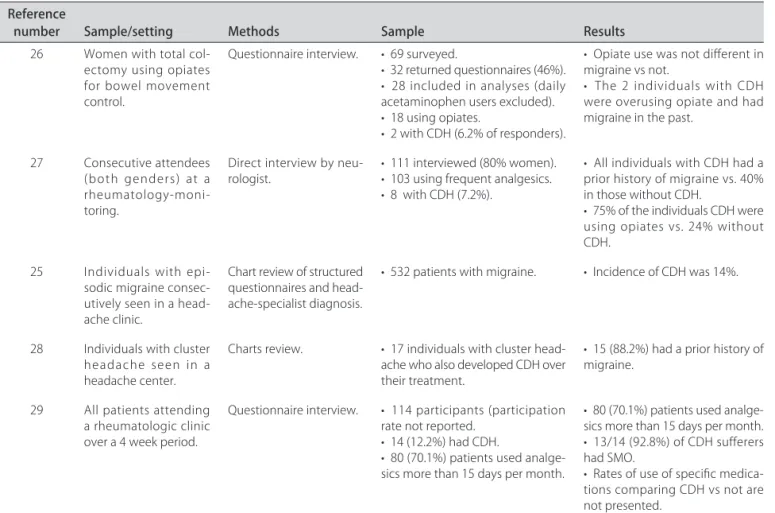
Evidence from clinic based studies – Several clinic-based studies have assessed the relationship between symptomatic medication overuse (SMO) and migraine progression (Table 1). hese studies are often limited by the selection bias that leads people to seek care in the research setting under investigation, but of attention is the uniformity of the indings. Furthermore, a series of these studies addressed the importance of analgesic use when used for non-headache causes in individuals with migraine.
he best evidence that medications are a risk factor for new onset chronic daily headache comes from a longitudinal headache clinic-based study conducted in Essen, Germany. Katsavara and associates showed that among persons with episodic migraine, use of acute medication was associated with a frequency of use de-pendent increase in the new onset daily headache over the course of a year. In multivariate models, both head-ache frequency and days of medication overuse were in-dependent and potent predictors for the development of new onset CDH. Among the medications overused, opioid was the strongest risk factor25.
As mentioned, a number of clinic-based studies ex-amined the inluence of medication use for reasons other than headache in persons with and without migraine. One study looked for CDH in 28 patients who under-went total colectomy for ulcerative colitis, treated with daily opioids to control bowel movements, not for pain. Two patients had CDH starting after surgery. Both used daily opiates following surgery and both had a prior his-tory of migraine. he other six patients who used opi-ates daily did not have a history of migraine, and did not develop CDH. he authors concluded that opioid use may be a risk factor for CDH just in those with pre-ex-isting migraine26.
using one or more analgesics regularly for their ar-thritis27. Of this group, 8 (7.6%) had CDH, each of whom
reported a history of migraine. Five of those with regular use of analgesics had been taking an opiate-based prep-aration. Two had been on a combination of acetamin-ophen and a nonsteroidal anti-inlammatory drug. he minimum number of tablets per week was 7, and the mean was 48 (range, 7 to 87).
More recently, in a retrospective series of 17 pa-tients (13 men, 4 women) with cluster headache who also developed CDH, an association with overuse of a wide range of monotherapies (for cluster headaches) was found. hey included varying combinations of simple an-algesics (n=9), cafeine (n=1), opioids (n=10), ergotamine (n=3), and triptans (n=14). he common denominator in 15 patients was a personal or family history, or both, of migraine28.
Finally, a recent study assessed the development of CDH in individuals with chronic use of analgesics due to rheumatologic problems. Among 114 rheumatology patients, 12% fulilled criteria for CDH. Comparisons of medication intake among those who developed CDH vs not were not reported29.
Interpretation of the clinic-based studies – Taken together, these studies suggest that use of acute
med-ications, particularly opioids, is associated with an in-creased risk of CDH in persons with migraine. here is little evidence that these medications are associated with CDH in persons free of a personal and family history of migraine. hese data suggest a diathesis stress model for CDH. When the diathesis, migraine, is combined with the stress, pattern of medication use, CDH may develop2.
Evidence from population-based studies
Population-based studies reduce the problem of se-lection bias which limits the clinic-based studies. Herein we consider cross-sectional, case-control and cohort designs. hough each design has limitations, indings across these designs are robust and complementary.
Cross-sectional data – Since individuals with chronic migraine have more days of headache per month than individuals with episodic migraine, analgesic con-sumption is predictably higher in those with CM. Pat-terns of disproportionate use may be informative. In 2005, the American Migraine Prevalence and Prevention (AMPP) Study, sent mailed questionnaires to 24,000 se-vere headache suferers drawn from a much larger pop-ulation survey30. As a part of the survey, subjects were
asked to report the speciic medications currently used for their most severe headaches, dose, and number of Table 1. Summary of clinic based studies.
Reference
number Sample/setting Methods Sample Results
26 Women with total col-ectomy using opiates for bowel movement control.
Questionnaire interview. • 69 surveyed.
• 32 returned questionnaires (46%). • 28 included in analyses (daily acetaminophen users excluded). • 18 using opiates.
• 2 with CDH (6.2% of responders).
• Opiate use was not diferent in migraine vs not.
• The 2 individuals with CDH were overusing opiate and had migraine in the past.
27 Consecutive attendees (both genders) at a rheumatology-moni-toring.
Direct interview by
neu-rologist. • 111 interviewed (80% women).• 103 using frequent analgesics. • 8 with CDH (7.2%).
• All individuals with CDH had a prior history of migraine vs. 40% in those without CDH.
• 75% of the individuals CDH were using opiates vs. 24% without CDH.
25 Individuals with epi-sodic migraine consec-utively seen in a head-ache clinic.
Chart review of structured questionnaires and head-ache-specialist diagnosis.
• 532 patients with migraine. • Incidence of CDH was 14%.
28 Individuals with cluster headache seen in a headache center.
Charts review. • 17 individuals with cluster head-ache who also developed CDH over their treatment.
• 15 (88.2%) had a prior history of migraine.
29 All patients attending a rheumatologic clinic over a 4 week period.
Questionnaire interview. • 114 participants (participation rate not reported.
• 14 (12.2%) had CDH.
• 80 (70.1%) patients used analge-sics more than 15 days per month.
• 80 (70.1%) patients used analge-sics more than 15 days per month. • 13/14 (92.8%) of CDH sufferers had SMO.
days per month using medication. Several diferences were seen between the acute treatment of CM and ep-isodic migraine in the population. Barbiturates were more commonly used by those with CM [crude odds ratio (OR)=2.46, 95% conidence interval (CI)=1.9-3.2)], as were opioids (OR=2.1, 95% CI 1.9-2.6). Triptan use was non signiicantly increased in CM (OR=1.22, 95% CI 0.98,1.51). Non-steroidal anti-inflammatory drugs (NSAIDs) and combination of over-the-counter medi-cations (OTCs) were less frequently used by those with CM than migraineurs31.
his study suggested an association between speciic classes of medication (barbiturates and opioids) and CM. Causal inferences are weak because patterns of medica-tion may be a consequence of rather than a risk factor for CM. At cross-section we can not determine the tem-poral sequence.
Case-control studies – Case-control studies take temporal sequence into account by focusing on expo-sures prior to the onset of the condition of interest. As a part of the Frequent Headache Epidemiology Study32,
in-dividuals with CDH and controls (episodic or no head-aches) were identiied in the population, and estimates of medication consumption (for headache and other forms of pain) were obtained33.
CDH individuals were signiicantly more likely to be current users of compounds containing cafeine [27.1% vs. 16.1%; odds ratio (OR)=1.6, 95% confidence in-terval (CI)=1.0-2.7)], and were twice more likely to be using compounds containing opiates (13.3% vs. 6.1%; OR=2.0, 95% CI=0.9-4.5). For barbiturates, they were also twice more likely [to what - to have CDH, or use other drugs??], but, as for opiates, signiicance was not achieved likely due to sample size limitations. Aspirin was less common in CDH in crude analyses but not in adjusted. Naproxen was non-signiicantly increased in individuals with CDH (OR=1.5, 95% CI=0.7-2.8).
When medications for headache and pain were pooled together, in crude comparisons, CDH was as-sociated with current use of OTC/cafeine combination products, triptans, butalbital compounds, opioids com-pounds, and ‘other’ prescription pain medications. Use of aspirin was protective. However, after adjustment, only aspirin remained protective to CDH , while opioid com-pounds remained associated with CDH.
Longitudinal studies – Two large scale longitu-dinal population studies have assessed the relation-ship between medications and CM or CDH. As a part of the Head-HUNT study, a large, longitudinal, popu-lation-based study assessing the relationship between acute medication overuse and CDH, as well as to other chronic pain syndromes, analgesic use was assessed in 32,067 adults in 1984-1985 and again 11 years later 34.
hose who used analgesics daily or weekly at baseline had a higher risk ratio (RR) for chronic migraine (13.3), chronic non-migrainous headache (RR=6.2) and chronic neck pain (RR=2.4) at follow-up. he authors concluded that overuse of analgesics predicted the development of overall CDH in the population.
In this study, information on medication overuse was collected at baseline and at follow-up. However, because the authors did not collect information on the headache status at baseline, they could not exclude the possibility that frequent analgesic use was simply a marker for fre-quent headache. Nor could they determine if SMO was associated with CDH just in those with migraine at base-line, or in everyone.
Using longitudinal data from the American Migraine Prevalence and Preventions study, the probability of tran-sition from episodic migraine (EM) in 2005 to CM in 2006 was modeled as a function of acute medication use in 200535 using acetaminophen as the reference, after
ad-justing for covariates. Below we discuss the results for the fully adjusted models highlighting various aspects of the analysis.
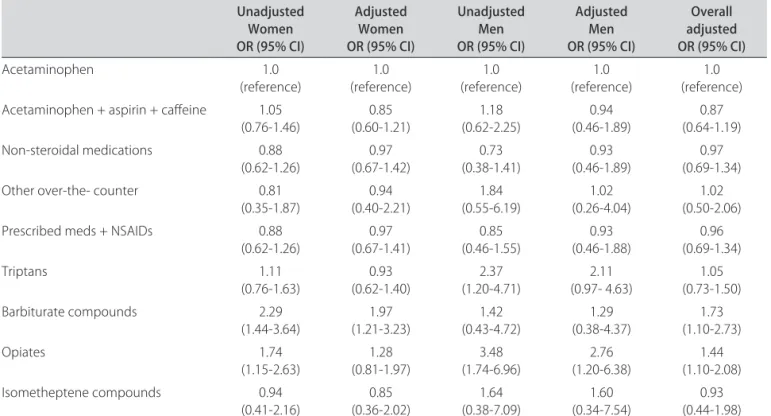
[1] Use of opioids or barbiturates was associated with an increased risk of new onset CM: Table 2 sum-marizes the risk of new onset CM by medication class. In unadjusted analyses, compounds containing barbi-turates and opiates were associated with a two-fold in-creased risk of CM in 2006 vs. maintaining an episodic migraine status (Barbiturates OR=2.06, 95% CI=1.3-3.1; opiates OR=1.98, 95% CI=1.4-2.8). he other classes of medications were not associated with a signiicant risk of new onset CM overall. (Table 2). In the adjusted anal-ysis the efects or barbiturates and opioids are attenuated somewhat but remain statistically signiicant (Table 2).
[2] he inluence of medication varies according to the baseline headache frequency as well as drug class: To disentangle the inluence of headache frequency and medication use, we adjusted for the number of head-ache days per month among other factors, using acet-aminophen as a reference group. In these adjusted anal-yses, those using barbiturates (OR=1.73, 95% CI=1.1-2.7) or opiates (OR=1.4, 95% CI=1.1-2.1) were at increased risk of incident CM compared to those using acetamino-phen. hose using triptans (OR=1.05, 95% CI=0.8,1.6) or NSAIDs (OR=0.97, 95% CI=0.7-1.34) were not. Results were similar for women and men, except that the risk of incident CM associated with use of opioids was higher in men (OR=2.76) compared to women (OR=1.28).
monthly headache frequency was associated with higher probability of development of CM. his efect is illus-trated for barbiturates in Figure. Note that increased bar-biturate use increases the probability of CM for all head-ache frequencies, but the magnitude of the efect varies depending on the baseline number of attacks.
Odds of transition to CM increased with elevated monthly barbiturate exposure (OR=1.25, 95% CI=1.1-1.4) controlling for the efects of gender and monthly headache frequency. Similar indings were seen for opi-ates [– can “opioids” and “opiopi-ates” be used interchange-ably??} (OR= 1.44, 95% CI=1.1-1.8). For opioids, there
was a signiicant main efect of gender and efects were higher in men than in women, although signiicant in both (OR=2.82, 95% CI=1.1 -6.90).
Triptans did not increase the risk of CM (OR=1.07, 95% CI=0.89-1.29) overall. However, gender efects were seen, and triptans were associated with CM in women with more than 10 days of headache per month at baseline. Finally, NSAIDs were protective against transition to CM at low to moderate monthly headache days, but were associated with increased risk of transition to CM at high levels of monthly headache days. No gender efects were seen for NSAIDs.
Table 2. Association of medication use for migraine in 2005 as a predictor of headache status in 2006 stratiied by gender. After37 - is this
referring to after age 30? Wasn’t clear what after (30) means. Unadjusted
Women OR (95% CI)
Adjusted Women OR (95% CI)
Unadjusted Men OR (95% CI)
Adjusted Men OR (95% CI)
Overall adjusted OR (95% CI)
Acetaminophen 1.0
(reference)
1.0 (reference)
1.0 (reference)
1.0 (reference)
1.0 (reference) Acetaminophen + aspirin + cafeine 1.05
(0.76-1.46)
0.85 (0.60-1.21)
1.18 (0.62-2.25)
0.94 (0.46-1.89)
0.87 (0.64-1.19) Non-steroidal medications 0.88
(0.62-1.26)
0.97 (0.67-1.42)
0.73 (0.38-1.41)
0.93 (0.46-1.89)
0.97 (0.69-1.34) Other over-the- counter 0.81
(0.35-1.87)
0.94 (0.40-2.21)
1.84 (0.55-6.19)
1.02 (0.26-4.04)
1.02 (0.50-2.06) Prescribed meds + NSAIDs 0.88
(0.62-1.26) (0.67-1.41)0.97 (0.46-1.55)0.85 (0.46-1.88)0.93 (0.69-1.34)0.96
Triptans 1.11
(0.76-1.63) (0.62-1.40)0.93 (1.20-4.71)2.37 (0.97- 4.63)2.11 (0.73-1.50)1.05 Barbiturate compounds 2.29
(1.44-3.64) (1.21-3.23)1.97 (0.43-4.72)1.42 (0.38-4.37)1.29 (1.10-2.73)1.73
Opiates 1.74
(1.15-2.63) (0.81-1.97)1.28 (1.74-6.96)3.48 (1.20-6.38)2.76 (1.10-2.08)1.44 Isometheptene compounds 0.94
(0.41-2.16) (0.36-2.02)0.85 (0.38-7.09)1.64 (0.34-7.54)1.60 (0.44-1.98)0.93
Considerations about the causality of the association
he framework for assessing the causal link between a speciic risk factor and a disease is well established36
and discussed herein for the relationship between anal-gesic use and migraine progression.
he temporal relationship is a irst key aspect that needs to be assessed, since exposure always precedes the outcome (excessive medication use precedes CM), and this relationship was supported by a clinic-based longitu-dinal study and a population-based longitulongitu-dinal study33,35.
Despite this evidence, we can not exclude the possi-bility of reverse causation. hat is, treatment frequency may be escalated because headaches are worsening.
Accordingly, speciicity of indings is of importance. If reverse causation is true, it would happen regard of class of medication and that is not what has been found. Additionally, the strength of association has been well quantiied and is diferent according to classes (opioids and barbiturates > triptans > NSAIDs).
As a third relevant point, studies found a critical dose of exposure and a dose-response relationship that varies per drug (5 days for barbiturates, 8 for opioids, 10 for triptans, and only in speciic situations for NSAIDs)35.
A fourth relevant point regards the consistency of the indings. he association has been replicated in clinic-based and population-clinic-based studies using both case con-trol and cohort designs25-27,35.
Finally, the alternative hypothesis (medication use increases as a consequence of increased headache fre-quency) has been considered in the design of the most recent studies37. he fact that removing overused
medi-cations is followed by headache improvement supports the hypothesis that certain medications may cause CM9,38
However, reverse causality also occurs, as some patients clearly develop increased headache frequency without ever using opioids.
Considerations about the biological plausibility
Although not unequivocally demonstrated, plausible mechanisms have been proposed and at least partially demonstrated39,40. Recent preclinical studies exploring
the neuroadaptive changes following sustained expo-sure to morphine may give some insights into possible causes of why opioids induce migraine progression. Pe-ripherally, exposure to morphine increased expression of calcitonin gene-related peptide (CGRP) in trigeminal primary aferent neurons41. CGRP is a neuropeptide
in-volved with pain transmission and with the pathophysi-ology of migraine. Centrally, they include increased ex-citatory neurotransmission at the level of the dorsal horn and nucleus caudalis41,42. Critically, these neuroadaptive
changes persist for long periods of time and the evoked
release of CGRP is enhanced following morphine pre-treatment. Stimuli known to elicit migraine, such as ni-tric oxide donors or stress, produce hyperalgesia in mor-phine- but not in saline-pretreated rats even long after the discontinuation of the opiate. Furthermore, studies have demonstrated increased excitability of the nocicep-tive pathway in migraine suferers, and CGRP receptor antagonists have been shown to be efficacious in mi-graine pain. hus, such persistent neuroadaptive changes may be relevant to the processes that promote medica-tion overuse headache (MOH)41.
Clinical studies support the preclinical indings as well. In humans, exposure to opioids is associated with hyperalgesia, cutaneous allodynia and with the develop-ment of a “pain memory state,” when suferers become refractory to other forms of therapy43-46.
Neuroimaging studies ofer an important opportu-nity to elucidate the mechanisms of medication-induced headache. In a study measuring glucose metabolism with 18-FDG PET, Fuwal et al. compared individuals with CM and analgesic overuse before and 3 weeks after medica-tion withdrawal and compared the data with those of a control population. Before withdrawal, the bilateral thalamus, orbitofrontal cortex (OFC), anterior cingulate gyrus, insula/ventral striatum and right inferior parietal lobule were hypometabolic, while the cerebellar vermis was hypermetabolic. All dysmetabolic areas recovered to almost normal glucose uptake after withdrawal of analge-sics, except the OFC where a further metabolic decrease was found. They concluded that medication overuse headache is thus associated with reversible metabolic changes in pain processing structures like other chronic pain disorders, but also with persistent orbitofrontal hy-pofunction47.
For other medications, such as the triptans, the plau-sibility is sustained on fewer studies. It is well known that triptans induce transient cutaneous allodynia in hu-mans48, and that allodynia is an important risk factor for
CM44,49. In animals, sustained or repeated
administra-tion of triptans to rats also elicited time-dependent and reversible cutaneous tactile allodynia that was main-tained throughout and transiently after drug delivery50.
Triptan administration increased labeling for CGRP in identiied trigeminal dural aferents that persisted long after discontinuation of triptan exposure50, suggesting
that overuse of these medications could induce neural adaptations that result in a state of latent sensitization, which might increase increased propensity for the de-velopment of CM.
Lessons from therapy
is combined with the stress, pattern of medication use, CDH may develop. Accordingly, based on the model, removing the stress (MOH) should be associated with improvement of the disease (migraine). In other words, the condition can be altered (prevented or amelio-rated) by an appropriate experimental regimen. This has been extensively demonstrated. Detoxiication is in-deed associated with an increased chance of TM/CM remission7,9,10,51,52.
Although high quality clinical trials testing the ben-eits of medication withdrawal are yet to be conducted, the indings are not only plausible, but also supported by neuroimaging studies. Functional magnetic resonance imaging (fMRI) may indeed be a useful technique for obtaining information on particular neuronal changes in the pain network involved in this condition. In a study where fMRI was conducted before and after medication withdrawal, it was found that before withdrawal, the right supramarginal gyrus, the right inferior and supe-rior parietal cortex were hypoactive. Activity recovered to almost normal 6 months after withdrawal of the of-fending medications. Data suggest that MOH is associ-ated with a a modiication of the pain network, and that these changes are reversible with therapy53.
As a inal comment, if excessive use of medication induces the appearance of CM, and withdrawal is as-sociated with improvement, recidivism of exposure should be associated with increased risk for developing CM once more. In this regard, Sances et al studied 215 patients consecutively admitted to a headache center for an inpatient detoxification treatment. One year after withdrawal, they were able to re-interview 172 patients (80%): 38 of these patients (22%) had relapsed into overuse and 134 (78%) had not. Factors associ-ated with relapse were intake of more than 30 doses/ month (P=0.004), smoking (P=0.012), alcohol consump-tion (P=0.037), non-conirmaconsump-tion of MOH diagnosis 2 months after detoxification (P=0.000), and return to overused drug(s) (P=0.000). Recidivism was associated with redevelopment of CDH54.
REFERENCES
1. Bigal ME, Lipton RB. The prognosis of migraine. Curr Opin Neurol 2008;21: 301-308.
2. Bigal ME, Lipton RB. Clinical course in migraine: conceptualizing migraine transformation. Neurology 2008;71:848-855.
3. Boes CJ, Black DF, Dodick DW. Pathophysiology and management of trans-formed migraine and medication overuse headache. Semin Neurol 2006; 26:232-241.
4. Mathew NT, Reuveni U, Perez F. Transformed or evolutive migraine. Headache 1987;27:102-106.
5. Mathew NT. Transformed migraine. Cephalalgia 1993;13(Suppl 12):S78-S83. 6. Scher AI, Stewart WF, Ricci JA, Lipton RB. Factors associated with the onset
and remission of chronic daily headache in a population-based study. Pain 2003;106:81-89.
7. Mathew NT. Transformed migraine, analgesic rebound, and other chronic daily headaches. Neurol Clin 1997;15:167-186.
8. Goadsby PJ. Is medication-overuse headache a distinct biological entity? Nat Clin Pract Neurol 2006;2:401.
9. Zeeberg P, Olesen J, Jensen R. Discontinuation of medication overuse in headache patients: recovery of therapeutic responsiveness. Cephalalgia 2006;26:1192-1198.
10. Bigal ME, Rapoport AM, Sheftell FD, Tepper SJ, Lipton RB. Transformed migraine and medication overuse in a tertiary headache centre: clinical characteristics and treatment outcomes. Cephalalgia 2004;24:483-490. 11. Ballantyne JC, Mao J. Opioid therapy for chronic pain. N Engl J Med 2003;
349:1943-1953.
12. Sullivan LE, Chawarski M, O’Connor PG, Schottenfeld RS, Fiellin DA. The practice of oice-based buprenorphine treatment of opioid dependence: is it associated with new patients entering into treatment? Drug Alcohol Depend 2005;79:113-116.
13. Caudill-Slosberg MA, Schwartz LM, Woloshin S. Oice visits and analgesic prescriptions for musculoskeletal pain in US: 1980 vs. 2000. Pain 2004;109: 514-519.
14. Silberstein SD. Practice parameter: evidence-based guidelines for migraine headache (an evidence-based review): report of the Quality Stan-dards Subcommittee of the American Academy of Neurology. Neurology 2000;55:754-762.
15. Fontanillas N, Colas R, Munoz P, Oterino A, Pascual J. Long-term evolu-tion of chronic daily headache with medicaevolu-tion overuse in the general population. Headache 2010;50:981-988.
16. Dodick DW. Debate: analgesic overuse is a cause, not consequence, of chronic daily headache. Analgesic overuse is not a cause of chronic daily headache. Headache 2002;42:547-554.
17. Tepper SJ, Tepper DE. Breaking the cycle of medication overuse headache. Cleve Clin J Med 2010;77:236-242.
18. Lipton RB, Bigal ME, Steiner TJ, Silberstein SD, Olesen J. Classiication of primary headaches. Neurology 2004;63:427-435.
19. Silberstein SD, Olesen J, Bousser MG. The International Classification of Headache Disorders, 2nd Edition (ICHD-II)-revision of criteria for 8.2 Medication-overuse headache. Cephalalgia 2005;25:460-465.
20. Olesen J, Bousser MG, Diener HC, et al. New appendix criteria open for a broader concept of chronic migraine. Cephalalgia 2006;26:742-746. 21. Silberstein SD, Lipton RB, Sliwinski M. Classiication of daily and near-daily
headaches: ield trial of revised IHS criteria. Neurology 1996;47:871-875. 22. Classiication Committee of the International Headache Society.
Classiica-tion and diagnostic criteria for headache disorders, cranial neuralgias and facial pain. Cephalalgia 1988.
23. Classification Committee of the International Headache Society. The International Classiication of Headache Disorders. 2nd Edition. Cephalalgia 2004;24(Suppl 1):S1-S149.
24. Bigal M, Rapoport A, Sheftell F, Tepper S, Lipton R. The International Classiication of Headache Disorders revised criteria for chronic migraine-ield testing in a headache specialty clinic. Cephalalgia 2007;27:230-234. 25. Katsarava Z, Schneeweiss S, Kurth T, et al. Incidence and predictors for
chronicity of headache in patients with episodic migraine. Neurology 2004;62:788-790.
26. Wilkinson SM, Becker WJ, Heine JA. Opiate use to control bowel motility may induce chronic daily headache in patients with migraine. Headache 2001;41:303-309.
27. Bahra A, Walsh M, Menon S, Goadsby PJ. Does chronic daily headache arise de novo in association with regular use of analgesics? Headache 2003; 43:179-190.
28. Paemeleire K, Bahra A, Evers S, Matharu MS, Goadsby PJ. Medication-overuse headache in patients with cluster headache. Neurology 2006;67: 109-113.
29. Williams L, O’Connell K, Tubridy N. Headaches in a rheumatology clinic: when one pain leads to another. Eur J Neurol 2008;15:274-277.
30. Lipton RB, Bigal ME, Diamond M, Freitag F, Reed ML, Stewart WF. Mi-graine prevalence, disease burden, and the need for preventive therapy. Neurology 2007;68:343-349.
31. Bigal ME, Serrano D, Lipton RB. The acute treatment of episodic and chronic migraine in the United States. Cephalalgia 2009;29:891-897.
32. Scher AI, Stewart WF, Liberman J, Lipton RB. Prevalence of frequent head-ache in a population sample. Headhead-ache 1998;38:497-506.
34. Zwart JA, Dyb G, Hagen K, Svebak S, Holmen J. Analgesic use: a predictor of chronic pain and medication overuse headache: the Head-HUNT Study. Neurology 2003;61:160-164.
35. Bigal ME, Serrano D, Buse D, Scher A, Stewart WF, Lipton RB. Acute migraine medications and evolution from episodic to chronic migraine: a longitu-dinal population-based study. Headache 2008;48:1157-1168.
36. Himsworth H. Bradford Hill and statistics in medicine. Stat Med 1982;1: 301-303.
37. Bigal ME, Lipton RB. Excessive acute migraine medication use and migraine progression. Neurology 2008;71:1821-1828.
38. Bigal ME, Sheftell FD, Tepper SJ, Rapoport AM. Discontinuation of medi-cation overuse in headache patients: recovery of therapeutic responsive-ness. Cephalalgia 2007;27:568.
39. King T, Ossipov MH, Vanderah TW, Porreca F, Lai J. Is paradoxical pain induced by sustained opioid exposure an underlying mechanism of opioid antinociceptive tolerance? Neurosignals 2005;14:194-205.
40. Yamamoto T, Nair P, Vagner J, et al. A structure-activity relationship study and combinatorial synthetic approach of C-terminal modiied bifunctional peptides that are delta/mu opioid receptor agonists and neurokinin 1 receptor antagonists. J Med Chem 2008;51:1369-1376.
41. De Felice M, Porreca F. Opiate-induced persistent pronociceptive trigem-inal neural adaptations: potential relevance to opiate-induced medication overuse headache. Cephalalgia 2009;29:1277-1284.
42. Edelmayer RM, Vanderah TW, Majuta L, et al. Medullary pain facilitating neurons mediate allodynia in headache-related pain. Ann Neurol 2009;65: 184-193.
43. Perrotta A, Serrao M, Sandrini G, et al. Sensitisation of spinal cord pain pro-Sensitisation of spinal cord pain pro-cessing in medication overuse headache involves supraspinal pain control. Cephalalgia 2010;30:272-284.
44. Bigal ME, Ashina S, Burstein R, et al. Prevalence and characteristics of
allodynia in headache suferers: a population study. Neurology 2008;70: 1525-1533.
45. Jakubowski M, Levy D, Kainz V, Zhang XC, Kosaras B, Burstein R. Sensiti-zation of central trigeminovascular neurons: blockade by intravenous naproxen infusion. Neuroscience 2007;148:573-583.
46. Jakubowski M, Levy D, Goor-Aryeh I, Collins B, Bajwa Z, Burstein R. Termi-nating migraine with allodynia and ongoing central sensitization using par-enteral administration of COX1/COX2 inhibitors. Headache 2005;45:850-861. 47. Fumal A, Laureys S, Di Clemente L, et al. Orbitofrontal cortex involvement
in chronic analgesic-overuse headache evolving from episodic migraine. Brain 2006;129:543-550.
48. Burstein R, Collins B, Jakubowski M. Defeating migraine pain with trip-tans: a race against the development of cutaneous allodynia. Ann Neurol 2004;55:19-26.
49. Lipton RB, Bigal ME, Ashina S, et al. Cutaneous allodynia in the migraine population. Ann Neurol 2008;63:148-158.
50. De Felice M, Ossipov MH, Wang R, et al. Triptan-induced latent sensitiza-Triptan-induced latent sensitiza-tion: a possible basis for medication overuse headache. Ann Neurol 2010; 67:325-337.
51. Andrasik F, Grazzi L, Usai S, Kass S, Bussone G. Disability in chronic migraine with medication overuse: treatment effects through 5 years. Cephalalgia 2009;29:13-17.
52. Grazzi L, Andrasik F, Usai S, Bussone G. Treatment of chronic migraine with medication overuse: is drug withdrawal crucial? Neurol Sci 2009;30 (Suppl 1):S85-S88.
53. Grazzi L, Chiapparini L, Ferraro S, et al. Chronic migraine with medication overuse pre-post withdrawal of symptomatic medication: clinical results and FMRI correlations. Headache 2010;50:998-1004.