Complications Following Urethral Reconstructive Surgery: A Six
Year Experience
Neema Navai, Bradley A. Erickson, Lee C. Zhao, Onisuru T. Okotie, Chris M. Gonzalez
Department of Urology, Feinberg School of Medicine, Northwestern University, Chicago, Illinois,
USA
ABSTRACT
Purpose: We present a single institutional experience over 6 years of intra and postoperative complications following urethral reconstructive surgery, and the impact of these complications on overall results.
Materials and Methods: From June 2000 through May 2006, 153 consecutive urethral reconstructive procedures were performed on 128 patients by one surgeon (CMG). Complication rates were determined, and subgroups were categorized based on stricture etiology, patient age, length of stricture, location of stricture, type of repair, and presence of various co-morbid conditions.
Results: Overall, 23 of 153 cases (15%) had an intra or postoperative complication with a mean follow-up time of 28.3 months (range 3 to 74). The most common complications were related to infection (n = 9). Other complications included repair breakdown (n = 4), bleeding (n = 4), istulae (n = 3), thromboembolic (n = 2), positioning-related (n = 2), and Foley catheter malfunction (n = 1). Complication rates for anastomotic and substitution urethroplasty were 9.1% (4/44) and 17% (19/109), respectively. The number of patients with at least one year of follow-up who had a complication and eventual stricture recurrence was 20% (4/20), while only 7.4% (7/95) of those who did not have a complication recurred (p = 0.08).
Conclusions: Complications following reconstructive surgery for urethral stricture disease were mostly related to infection or repair breakdown in the immediate postoperative period. It does not appear that an intra or postoperative complication following urethral reconstructive surgery impacts the chance of eventual stricture recurrence at intermediate follow-up.
Key words: urethral stricture; urethroplasty; complications; recurrence
Int Braz J Urol. 2008; 34: 594-601
INTRODUCTION
Reconstructive urethral surgery has been shown to be an effective treatment for urethral stric-ture disease with durable results (1-4). However, there
are few major studies speciically analyzing compli -cations following or during urethral reconstruction surgery. In a series of 60 patients, Al-Qudah et al. reported complication rates as high as 48%, though
most of these events were classiied as minor (5).
In one of the largest reconstructive series to date,
Andrich et al. reported that complications following reconstructive surgery have ranged from as low as 7% for excision and primary anastomosis to as high as 33% following substitution urethroplasty (1).
We assessed our experience with 153 con-secutive urethral reconstructive cases over a 6-year period by a single surgeon within the same institution. A retrospective review of all urethral reconstructions, complications and recurrences over a 6-year period was performed. Our purpose was to determine the
that can occur during or after a variety of urethral reconstructive procedures, along with the impact these associated complications may have on disease
recurrence. Speciic patient demographics, co-morbid
conditions, stricture characteristics, and reconstructive techniques were analyzed for complication rates.
MATERIALS AND METHODS
We evaluated patients who underwent urethral reconstructive surgery by a single surgeon (CMG) from June 2000 through May 2006. Follow-up was through July 2006 to ensure at least 60 days of fol-low-up per patient. All research activities met the approval of the Institutional Review Board. A total of 128 patients underwent 153 consecutive urethral reconstructive procedures during this period. Patients who underwent two-staged repairs account for the discrepancy between the number of reconstruc-tive procedures and the number of patients. Patient characteristics, type of surgical procedure, stricture location, stricture length, stricture recurrence, patient age, complications, and presence of co-morbid con-ditions were prospectively entered into a database. Additionally, all inpatient and outpatient records were
retrospectively analyzed to conirm the indings. The
type of reconstructive procedure was determined by the surgeon after preoperative radiographic and en-doscopic evaluation of the stricture, and ultimately after surgical evaluation of the stricture extent. Pro-cedures were either done in dorsal lithotomy, supine or in exaggerated lithotomy. To prevent neurologic complications in patients placed in the exaggerated
lithotomy position we utilized Yelloins® stirrups (Al -len Medical Systems), and a 1 L saline bag wrapped in a blue towel to support the lumbar spine. Following urethral reconstruction a Foley catheter was routinely maintained indwelling for 3 weeks in those patients undergoing substitution urethroplasty with a graft or
lap, and for 2 weeks in those men undergoing primary
anastomosis, including those undergoing repair for urethral erosions. We made no distinction between perceived minor or major complications.
Complica-tions were classiied as infection-related, bleeding,
thromboembolic (deep vein thrombosis and pulmo-nary embolism), positioning-related, surgical repair
breakdown, istula formation, and Foley malfunction.
Stricture recurrence rates were also evaluated, which
we deined as the endoscopic identiication of the
urethral lumen at the repair site of less then 18 F in diameter.
All postoperative patients were screened for recurrence through assessment of subjective voiding symptoms, ultrasound post-void residual, and urine culture. Routine invasive monitoring with cystoscopy and retrograde urethrogram was not performed. Sexu-al dysfunction was not included as a complication in
our study. Speciic co-morbid conditions evaluated in
this study included neurogenic bladder, prior renal or pancreas transplantation (enteric or bladder drained), penile or urethral lichen sclerosis including balanitis xerotica obliterans, previous hypospadias repair, and diabetes mellitus. Additionally, the etiology of stric-ture disease was recorded if it could be determined from the patient’s initial history or previous medical record. Those strictures with no known etiology
were classiied as idiopathic. All patients received
intravenous ampicillin (clindamycin or vancomycin
if penicillin allergic) and gentamicin (ciproloxacin if renal failure or insuficiency) peri-operatively, and all urine cultures were conirmed negative prior
to surgery. For deep venous thrombosis prevention, compression stockings and sequential compression devices were used for patients in the supine and low lithotomy position, with only compression stockings used for those in the exaggerated lithotomy posi-tion.
RESULTS
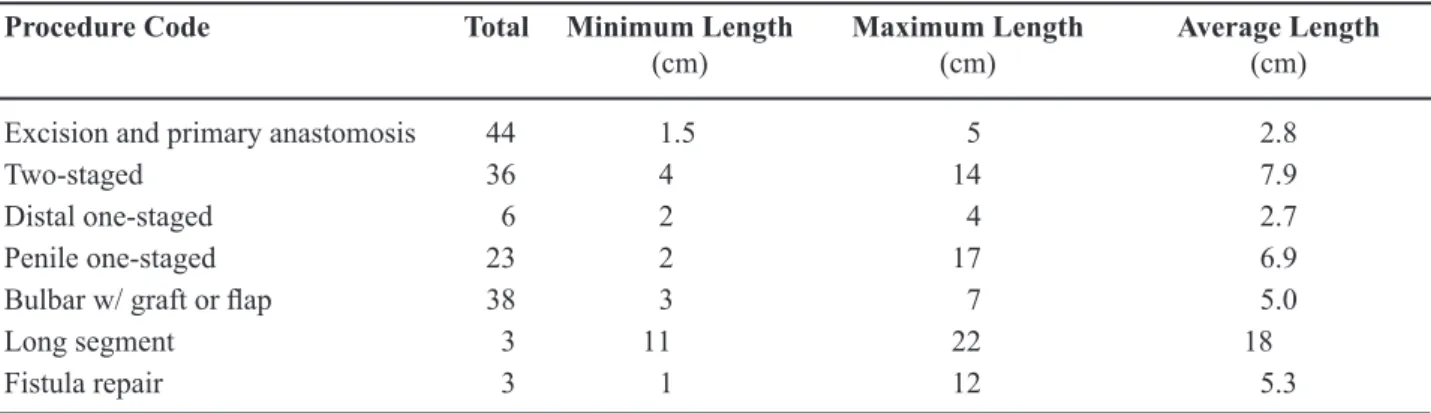
Table-1 shows the distribution of types of repair and their associated complication rates. Mean patient age was 41.5 years (15 to 79 SD 14.5 years), with a mean follow-up of 28.3 months (SD 19.1 months). The average stricture length was 5.5 cm (1 to 22 SD 3.7 cm). Table-2 shows the distribution of
stricture length by type of repair. Grafts and laps used
were as follows; 74 buccal grafts, 4 posterior auricular grafts, 2 scrotal skin grafts, 1 abdominal wall skin graft, 4 penile skin grafts, 5 circular fasciocutaneous
laps, 3 penile skin laps, and 65 cases were done with
used in all cases exceeded the number of procedures
secondary to the use of multiple grafts and /or laps
for long segment stricture repair.
Of the 153 cases, 23 cases had complications (15%). Two of these cases had multiple complica-tions for a total of 25 recorded adverse events. There were no perioperative deaths. The most common type of complication was infection-related. Five of these were wound complications, including a scrotal abscess and a necrotizing glans penis infection in a patient with insulin dependent diabetes. Three of the infection-related complications were asymptomatic urinary tract infections, and there was one incident of postoperative urosepsis in a patient with a neu-rogenic bladder. Bleeding complications occurred in 4 patients, including one episode of excessive
intraoperative bleeding requiring transfusion. Of the 3 complications that did not receive transfusions, 2 patients a developed perineal hematoma postopera-tively and one had an episode of excessive bleeding from the buccal mucosa harvest site, which was managed conservatively with epinephrine-soaked packing. Four patients that underwent urethral erosion repairs secondary to chronic indwelling Foley catheter use suffered partial repair breakdown distally with an additional 3 patients developing a postoperative
urethrocutaneous istula; 2 of these spontaneously
healed with Foley catheter drainage after one week. There were 2 thromboembolic events, including one patient with a deep vein thrombosis and another with a pulmonary embolism, which were related to a previously undiagnosed prothrombin gene mutation.
Table 1 – Complication rate by type of urethral stricture repair.
Type of Repair Total Procedures Procedures with
Complications (%)
Anterior urethral excision and primary anastomosis (EPA) 33 2 (6)
Posterior urethral EPA 8 1 (13)
Diverticulum EPA 3 1 (33)
Bulbar urethral repair with buccal mucosa graft 38 5 (13)
Two-staged repair 36 7 (19)
Penile one-staged with graft or lap 23 5 (22)
Distal one-staged 6 1 (17)
Panurethral 3 1 (33)
Fistula repair 3 0
EPA = excision and primary anastomosis.
Table 2 – Stricture length by type of surgical repair.
Procedure Code Total Minimum Length
(cm)
Maximum Length (cm)
Average Length (cm)
Excision and primary anastomosis 44 1.5 5 2.8
Two-staged 36 4 14 7.9
Distal one-staged 6 2 4 2.7
Penile one-staged 23 2 17 6.9
Bulbar w/ graft or lap 38 3 7 5.0
Long segment 3 11 22 18
Of the 89 patients who underwent reconstruction in the high lithotomy position, only 2/89 (2.2%) had a
complication related to positioning. In one of the irst
cases completed in this series, a young man suffered a severe femoral neuropathy most likely as a result of an operative time in the exaggerated lithotomy
position in excess of ive hours. The other patient
had a temporary lateral foot paresthesia, which re-solved spontaneously after three days. There were no positioning-related complications in patients who underwent repair in the dorsal lithotomy (n = 15) or supine positions (n = 49).
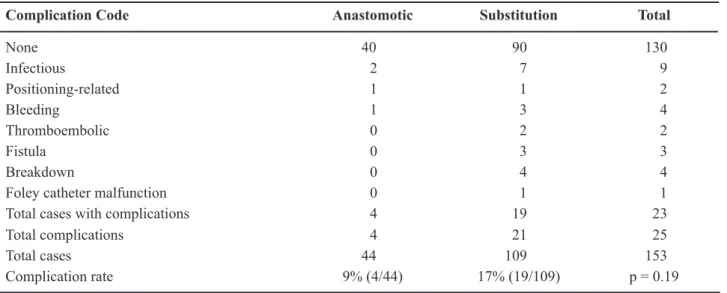
Table-3 shows the distribution of overall com-plications for the anastomotic and substitution urethral reconstructive cases. There was a complication rate of 9% (4/44) associated with anastomotic urethroplasty which included bulbar urethroplasty, membranous urethroplasty, and diverticulum repair when primary anastomosis was feasible. Substitution urethroplasty cases were found to have a complication rate of 17% (19/109). Chi-squared analysis was performed on these data, and although there was a trend towards more complications in the substitution urethroplasty
subset, statistical signiicance was not achieved (p =
0.19). Table-4 shows complication data, which was
stratiied by patient characteristics, including age,
stricture location, stricture etiology, and the presence of co-morbid conditions. These factors did not appear
to impact upon the overall complication rate; however, given the limited number of complications within each subgroup, statistical analysis could not be made in most cases. To assess if complications during or following surgery impacted upon eventual stricture recurrence, we evaluated all men with at least one year of follow-up in this series. These men experienced an overall com-plication rate of 17% (20/115 cases), with an overall recurrence rate of 10.9% (11/101 men). The mean time to stricture recurrence for these men was 130 days (17 to 287, SD 134 days) with an average overall follow-up time of 35 months (12 to 74, SD 17 months). Strictures repaired with excision and primary anastomosis had a 7.7% (2/26) recurrence rate, whereas those repaired with substitution urethroplasty had a 10.1% (9/89) recurrence rate. Overall, 20% (4/20) of patients that suffered postoperative complications of any type had stricture recurrence, while only 7.4% (7/95) of those who did not have a complication recurred. Chi-squared
analysis of these two groups showed a nonsigniicant
trend towards more recurrences in patients with com-plications (p = 0.08).
COMMENTS
We sought to elucidate and describe compli-cations following 153 consecutive reconstructive
pro-Table 3 – Types of complications for anastomotic and substitution repairs.
Complication Code Anastomotic Substitution Total
None 40 90 130
Infectious 2 7 9
Positioning-related 1 1 2
Bleeding 1 3 4
Thromboembolic 0 2 2
Fistula 0 3 3
Breakdown 0 4 4
Foley catheter malfunction 0 1 1
Total cases with complications 4 19 23
Total complications 4 21 25
Total cases 44 109 153
Table 4 – Complication rate by age, etiology of stricture, co-morbid disease, and stricture location.
Age Group (years) Total Patients Complications (%)
< 20 5 1 (20)
21-30 32 4 (13)
31-40 40 6 (15)
41-50 37 3 (8)
51-60 20 4 (20)
> 60 19 5 (26)
Etiology of stricture
Idiopathic 73 9 (12)
Infectious 6 4 (67)
Erosion 7 1 (14)
Instrumentation 15 4 (27)
Lichen sclerosis 9 1 (11)
Hypospadias 20 2 (10)
Prior urethroplasty 9 2 (22)
Trauma 13 0
Other 1 0
Co-morbid disease
None 95 12 (13)
Neurogenic bladder 12 2 (17)
Transplant 8 4 (50)
Lichen sclerosis / BXO 8 0
Hypospadias 24 4 (17)
Both transplant and neurogenic bladder 1 0
Diabetes mellitus 5 1 (20)
Stricture location
Fossa navicularis 8 1 (13)
Penile 58 12 (21)
Bulbar 79 9 (11)
Membranous 5 0
Panurethral 3 1 (33)
BXO = balanitis xerotica obliterans.
cedures for urethral stricture disease and the impact of these events on disease recurrence. With recent studies lending credence to broadening the use of formal urethral reconstruction (6,7) we believe a more complete understanding of complications following the multitude of available procedures for stricture dis-ease is necessary for appropriate patient counseling.
Additionally, for the purposes of this study, we deined
Postoperative sexual dysfunction was not included in this analysis as we have previously reported on these data from this same series (8).
The complication rate for anastomotic and substitution urethroplasty in this series was 9% and 17%, respectively. A comparison of these two groups did not reach a statistical difference (p = 0.19); howev-er, a similar trend of complications following primary anastomosis and substitution urethroplasty has been previously reported at 7% and 33%, respectively (1). It is unclear why there were more complications in the substitution urethroplasty group as compared to the anastomotic group despite grouping posterior ure-throplasty cases into the primary anastomosis group; however, contributing factors such as increased length of stricture and the need for harvest and interposition of graft tissue in the substitution urethroplasty group
may factor into these indings. We also analyzed
the number of complications related to one-stage 6/29 (21%) versus two-stage 7/36 (19%) procedures involving the penile urethra and fossa navicularis. Despite the fact that most of the strictures requiring two-stage procedures were more complex in etiology (i.e. hypospadias failure, failed prior reconstruction),
no signiicant difference between the two groups was
found (p = 0.90).
The high lithotomy position for urethral reconstructive surgery has been associated with com-plication rates between 10-16% (9-12). In our study, complications related to the high lithotomy position were limited and only occurred in two (2.2%) of the 89 cases performed. Major factors responsible for the limited number of positioning-related complications in this series included the self imposed limit of hav-ing the patient in exaggerated lithotomy for less than
ive hours, the use of specialized stirrups, lower back
support, and high patient volume. Positioning-related complications in the supine and dorsal lithotomy posi-tion did not occur in this series.
The majority of complications in our series were related to infection. Despite the administration of peri-operative antibiotics, and a negative preoperative urine culture, wound-related infections accounted for 5/153 (3.2%) cases. Despite the relative frequency of these occurrences in this series, these data are com-parable to wound infection rates reported for similar procedures including perineal prostatectomy (1.6%),
circumcision (1.3%) and hydrocele repair (4%) (13-15).
Finally, we attempted to evaluate whether a complication following urethral reconstructive surgery increased the chance of eventual stricture recurrence. In order to avoid underestimation of recurrence, all men with less then one year of follow-up in this series were excluded. A recurrence rate of 10.9% was found in these men, which is similar to that of previously reported data (16,17). Although 20% of men with a complication eventually experi-enced a recurrence at a mean follow-up time of just
less than three years, a statistically signiicant dif -ference could not be found between those without a complication and those with an eventual recurrence.
Long-term data are needed to conirm these indings
at intermediate follow-up.
One of the major limitations of this study was the inability to perform statistical analysis on some of the subgroups due to the limited number of complications. We pooled similar subgroup for analysis when applicable; however, because of the relatively low number of events, meaning-ful statistical analysis could not be performed in some subgroups. Multi-institutional studies would be helpful in providing the appropriate statistical power necessary to determine if some of these po-tential co-morbidities may predispose a patient to a complication, thus allowing the employment of appropriate preventative measures. Nonetheless, to the best of our knowledge, this is one of the larg-est series of complications reported in consecutive patients undergoing urethral reconstruction surgery for stricture disease.
CONCLUSION
Complications following reconstructive surgery for urethral stricture disease were minor and mostly related to infection and repair breakdown in the postoperative period. Positioning-related and bleeding complications were relatively rare. It does not appear that intra or postoperative complications
following urethral reconstructive surgery signiicantly
CONFLICT OF INTEREST
None declared.
REFERENCES
1. Andrich DE, Dunglison N, Greenwell TJ, Mundy AR: The long-term results of urethroplasty. J Urol. 2003; 170: 90-2.
2. Andrich DE, Mundy AR: Urethral strictures and their surgical treatment. BJU Int. 2000; 86: 571-80. 3. Barbagli G, Palminteri E, Bartoletti R, Selli C, Rizzo
M: Long-term results of anterior and posterior urethro-plasty with actuarial evaluation of the success rates. J Urol. 1997; 158: 1380-2.
4. Santucci RA, Mario LA, McAninch JW: Anastomotic urethroplasty for bulbar urethral stricture: analysis of 168 patients. J Urol. 2002; 167: 1715-9.
5. Al-Qudah HS, Santucci RA: Extended complications of urethroplasty. Int Braz J Urol. 2005; 31: 315-23; discussion 324-5.
6. Rourke KF, Jordan GH: Primary urethral reconstruc-tion: the cost minimized approach to the bulbous urethral stricture. J Urol. 2005; 173: 1206-10. 7. Wright JL, Wessells H, Nathens AB, Hollingworth W:
What is the most cost-effective treatment for 1 to 2-cm bulbar urethral strictures: societal approach using decision analysis. Urology. 2006; 67: 889-93. 8. Erickson BA, Wysock JS, McVary KT, Gonzalez CM:
Erectile function, sexual drive, and ejaculatory func-tion after reconstructive surgery for anterior urethral stricture disease. BJU Int. 2007; 99: 607-11.
9. Bildsten SA, Dmochowski RR, Spindel MR, Auman JR: The risk of rhabdomyolysis and acute renal failure with the patient in the exaggerated lithotomy position. J Urol. 1994; 152: 1970-2.
10. Moses TA, Kreder KJ, Thrasher JB: Compartment syndrome: an unusual complication of the lithotomy position. Urology. 1994; 43: 746-7.
11. Anema JG, Morey AF, McAninch JW, Mario LA, Wes-sells H: Complications related to the high lithotomy position during urethral reconstruction. J Urol. 2000; 164: 360-3.
12. Angermeier KW, Jordan GH: Complications of the exaggerated lithotomy position: a review of 177 cases. J Urol. 1994; 151: 866-8.
13. Audry G, Johanet S, Achrai H, Lupold M, Gruner M: The risk of wound infection after inguinal incision in pediatric outpatient surgery. Eur J Pediatr Surg. 1994; 4: 87-9.
14. Jakse G, Manegold E, Reineke T, Borchers H, Brehmer B, Wolff JM, et al.: Expanded, radical perineal pros-tatectomy. Urologe A. 2000; 39: 455-62.
15. Krieger JN, Bailey RC, Opeya J, Ayieko B, Opiyo F, Agot K, et al.: Adult male circumcision: results of a standardized procedure in Kisumu District, Kenya. BJU Int. 2005; 96: 1109-13.
16. Barbagli G, Palminteri E, Lazzeri M, Guazzoni G, Turini D: Long-term outcome of urethroplasty after failed urethrotomy versus primary repair. J Urol. 2001; 165: 1918-9.
17. Wood DN, Andrich DE, Greenwell TJ, Mundy AR: Standing the test of time: the long-term results of urethroplasty. World J Urol. 2006; 24: 250-4.
Accepted after revision: August 6, 2008
Correspondence address: Dr. Chris M. Gonzalez Department of Urology
675 North Saint Clair Street, Suite 20-150 Chicago, IL 60611
EDITORIAL COMMENT
The authors reported on intra and postopera-tive complications of reconstrucpostopera-tive urethral surgery performed by a single surgeon. Data consisted of 153 procedures performed on 128 patients including a variety of techniques, as well as use of grafts and
laps. The authors included in the series one stage and
two-stage repairs.
The authors stated that their “study was a ret-rospective review of all urethral reconstructions over a 6 year span and their goal was to provide descriptive data from a large single institution experience which
stratiies complications after various reconstructive
procedures and their impact on stricture recurrence”. My contribution as a reviewer is to wonder about today’s impact on knowledge of heterogeneous single-institution series like this. Notice for instance that only 4 of 9 clinical subgroups listed included more than 20 patients on it. If the authors had limited their evaluation to only those series of patients they
could probably achieve more conclusive results even
though still not statistically signiicant.
We accept the authors’ comment that “in the arena of urethral reconstruction, single surgeon series of enough volume to draw statistical conclusion are
very dificult to come by”. On the other hand, only if patients with urethral stricture are classiied according
to clinical characteristics and type of surgery we can truly rely on results and use this data to counsel our patients before surgery.
In conclusion the authors deserve merit for their paper but we acknowledge the need of coop-erative studies to better evaluate the role of different urethral surgeries in regards to overall success and complications.
Dr. Antonio Macedo Jr.
Federal University of São Paulo Sao Paulo, Brazil E-mail: [email protected]EDITORIAL COMMENT
The take-home message from the manuscript by Navai et al. is that urethroplasty can be accom-plished with high success rates and few complications. The authors also ask several important questions that seek to better understand the factors associated with complications after urethroplasty. Yet, there are
several issues that make these questions dificult to
answer. First, many of the variables examined by the authors and others in similar manuscripts are cor-related with one another. For instance, the etiology of stricture (e.g. history of hypospadias repair) can be linked with the location of stricture (e.g. penile urethra), the length of stricture, type of repair (e.g. two-stage repair with buccal graft), patient positioning and operative time. Hence, to really understand what factors predict complications, these covariates would be better examined in a multiple logistic regression model. Second, most urethroplasty series are small as the disease is not common and is frequently managed by other means. This combined with the fact that the
outcome of interest, in this case complications, is
also rare makes it dificult to then do subset analyses
to understand the predictors of the outcome. As the authors suggest, we will be better prepared to explore these issues when we approach them through a multi-institutional collaborative database.
Still, the important lesson here remains that re-stenosis and complications are infrequent after urethroplasty. It remains the gold standard for the management of urethral stricture disease. The number
of centers where patients can receive excellent deini -tive care for their urethral stricture continues to grow, as evidenced by Dr. Gonzales’s experience.