FREE THEMES
1 Faculdade de Ciências Médicas e da Saúde, Pontifícia Universidade Católica de São Paulo. [email protected]
Family clustering of secondary chronic kidney disease
with hypertension or diabetes mellitus. A case-control study
Abstract In Brazil hypertension and type 2 di-abetes mellitus are responsible for 60% of cases of end-stage renal disease in renal replacement therapy. In the United States studies have iden-tified family clustering of chronic kidney disease, predominantly in African-Americans. A single Brazilian study observed family clustering among patients with chronic kidney disease when com-pared with hospitalized patients with normal re-nal function. This article aims to assess whether there is family clustering of chronic kidney disease in relatives of individuals in renal replacement therapy caused by hypertension and/or diabetes mellitus. A case-control study with 336 patients in renal replacement therapy with diabetes melli-tus or hypertension for at least 5 years (cases) and a control matched sample group of individuals with hypertension or diabetes mellitus and nor-mal renal function (n = 389). Individuals in renal replacement therapy (cases) had a ratio of 2.35 (95% CI 1.42-3.89, p < 0.001) versus the control group in having relatives with chronic renal dis-ease, irrespective of race or causative illness. There is family clustering of chronic kidney disease in the sample studied, and this predisposition is irre-spective of race and underlying disease (hyperten-sion or diabetes mellitus).
Key words Chronic renal insufficiency,
Hyperten-sion, Diabetes mellitus, Heredity, Epidemiology Fernando Antonio de Almeida 1
Giuliano Serafino Ciambelli 1
André Luz Bertoco 1
Marcelo Mai Jurado 1
Guilherme Vasconcelos Siqueira 1
Eder Augusto Bernardo 1
Maria Valeria Pavan 1
A
lme
ida F
Introduction
Chronic Kidney Disease (CKD) is a worldwide
public health problem1-3. Renal Replacement
Therapies (RRT) in the end-stage of the disease
(glomerular filtration rate < 15 ml/min/1.73m2)
include haemodialysis, peritoneal dialysis and
kidney transplant1,3. The causes of end-stage
CKD are multiple. However, the most common causes over the last two decades have been hy-pertension and type 2 diabetes mellitus which are responsible for 63.5% of cases in Brazil and over
70% of cases in the United States2,3. When these
diseases are associated with CKD they present a common ethiopatogenetic link that increases the chances of cardiovascular complications, which in turn are the main causes of hospitalisations
and death in individuals undergoing RRT2,4.The
prevalence of patients in Brazil undergoing dial-ysis increased from 333 patients per million pop-ulation (pmp) in 2004 to 483 pmp in 2010 and is expected to continue to increase at an annual rate
of 6.5%5. Over 85% of Brazil’s RRT patients are
treated under the Unified Health System which is currently on the verge of saturation point and experiencing difficulties in meeting the demand of patients with end-stage CKD. The total esti-mated cost to the health system of meeting this
demand in 2008 was R$200 million3,5,6. For these
reasons, individuals with incipient renal lesions, hypertension and diabetes mellitus are target-ed by CKD prevention campaigns in Brazil and
worldwide7,8.
Certain primary renal diseases, such as renal autosomal dominant polycystic kidney disease, Alport syndrome and primary glomerulopathies, are clearly genetically transmitted, which in some
ways facilitates their prevention 9,10.
However, the association between predispo-sition to renal lesion and diseases that show fa-milial aggregation, such as hypertension and type 2 diabetes mellitus, but whose hereditary deter-minants are multigenetical, remains unclear. Studies carried out in states on the West Coast of the United States identified familial aggrega-tion of chronic kidney disease, regardless of the cause disease, and observed that it is was more
common in African Americans11-13: around 23%
of CKD patients undergoing RRT in this
popula-tion had positive family history of the disease12.
Furthermore, the prevalence of hypertension, di-abetes mellitus, proteinuria or renal insufficien-cy was greater among family members of CKD
patients13. The only study to date on this topic
in Brazil, carried out in Rio de Janeiro, observed
familial aggregation of CKD among patients un-dergoing RRT. However, the study did not
identi-fy any association with skin colour14.
Where familial aggregation of a disease is con-firmed, direct family members of CKD patients should also be preferential targets of research and intervention measures directed towards primary and secondary prevention of CKD.
The objective of this study is therefore to de-termine the existence of familial aggregation of CKD among individuals with hypertension and/ or type 2 diabetes in the municipalities of Soro-caba and Votorantim in the State of São Paulo, which have a combined population of 800,000 inhabitants. The evaluation parameter used was prevalence of CKD in family members of CKD patients undergoing RRT using individuals with hypertension or type 2 diabetes with normal kid-ney function as a control.
Methods
Study type
This research project consists of a case-con-trol study using frequency pairing in a sample of CKD patients undergoing RRT (“cases”) in Sorocaba, São Paulo. The cause of CKD in these patients was confirmed by the assistant nephrol-ogist as being hypertension or type 2 diabetes. Patients with hypertension and/or type 2 diabe-tes mellitus but with normal kidney function and treated under the Hypertension and Diabetes Programme at primary health care units (HCUs) in Sorocaba and Votorantim were used as “con-trol cases”.
Patient selection
aúd
e C
ole
tiv
a,
20(2):471-478,
2015
following medical history or diagnosis were ex-cluded: polycystic kidney disease, primary glo-merulopathies, tubulo-interstitial diseases, re-flux and obstructive nephropathy, and unknown causes.
The control cases were selected from patients diagnosed with hypertension and/or type 2 dia-betes mellitus who had been under treatment in a HCU for at least six months prior to the study and whose medical records showed normal levels of creatinine in the blood (< 1.4 mg/dl in men and < 1.2 mg/dl in women) for the six months prior to the study. All patients answered a ques-tionnaire in order to obtain the following in-formation: personal information (age, sex, skin colour); relevant medical history (CKD cause and length of time after hypertension and/or di-abetes mellitus diagnosis); anthropometric data (weight and height); clinical and laboratory test information (blood pressure, plasma creatinine) taken from the last monthly control registered in the patient medical chart; and family history of CKD and RRT. Skin colour categories were de-fined based on the Brazilian Institute of Geogra-phy and Statistics classification: “white”, “black”,
“brown”, “yellow” or “indigenous”15.
Sample size calculation and pairing
Using an alpha error of 5% and beta error of 20% (power of 80%) and an odds ratio of 5.7 based on the above mentioned study in Rio de Janeiro, we calculated a sample size of 304
“cas-es” and 304 “control cas“cas-es”14. A final sample size
of 335 was defined assuming a loss rate of 10%. “Cases” and “control cases” with type 2 diabetes mellitus and/or hypertension were paired based on the cause disease (hypertension or type 2 di-abetes mellitus), sex and age. The control cases were paired based on the frequency of cases to
ensure a balanced distribution in each sample16.
Research location
Patients undergoing RRT (cases) were select-ed and evaluatselect-ed in the following RRT centers in Sorocaba: the Dialysis and Kidney Transplant Center in the Santa Lucinda Hospital (belong-ing to the Pontifical Catholic University of São Paulo), the RRT unit of the Leonor Mendes de Barros Hospital (belonging to the State of São Paulo Secretary of Health), the Sorocaba Insti-tute of Haemodialysis (an independent unit as-sociated to the Sorocaba Evangelic Hospital) and the RRT unit of the UNIMED Sorocaba
Hospi-tal. The control cases were selected and evaluated from eight HCUs in Sorocaba and four HCUs in Votorantim. These units were chosen to ensure a proportionally representative sample of the pop-ulation respecting the poppop-ulation distribution of both cities.
Ethical considerations
The study was carried out in accordance with the principles of the Declaration of Helsinki and was approved by the Research Ethics Committee of the Faculty of Medical and Health Sciences of the Pontifical Catholic University of São Paulo. All participants read and signed an informed consent form and agreed to participate in the study before procedures commenced.
Statistical analysis
Data was inputted into an Excel spread sheet and later exported to the software program STA-TA 10.0. The continuous variables of the “cases” and “control cases” were compared using the Stu-dent’s t-test. The categorical variables were com-pared using the odds ratios based on a 95% con-fidence interval. Statistical significance (p-value) is shown below and in the tables. A statistical analysis of the association between prevalence of end-stage CKD/RRT and specific risk factors was carried out using the Mantel-Haenszel method and multiple logistic regression analysis. Condi-tional logistic regression was not used since it is
not necessary in frequency pairing16.
Results
The group “cases” comprised 336 CKD patients undergoing RRT and living in Sorocaba or Voto-rantim. The proportion of cases with type 2 di-abetes mellitus and hypertension was 50.9% and 49.1%, respectively, while the proportion of con-trol cases (n = 389) with these diseases was 46,5% and 53.5%, respectively. Table 1 shows the results of pairing. No major differences were found be-tween the two groups regarding the pairing crite-ria used. Statistically significant differences were observed only with the variables diastolic blood pressure and plasma creatinine, which was ex-pected given the inclusion criteria.
A
lme
ida F
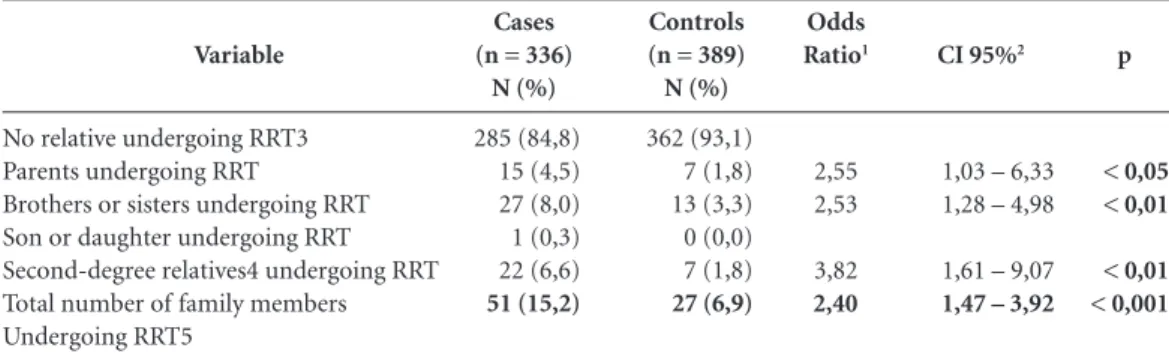
undergoing RRT, compared to only 27 control cases (6.9%) (OR 2.40; CI 95% 1.47 – 3.92; p < 0,001). Prevalence of CKD undergoing RRT was greater among family members of the cases re-gardless of degree of relationship (first-degree: parents, brothers and sisters, or second-degree: grandparents, uncles and aunties and nieces and nephews). Since the disease is more common in individuals over the age of forty, only one young-er family membyoung-er was undyoung-ergoing RRT among
the cases (the child of one of the participants), which was not sufficient for statistical analysis. Ten cases had two relatives that were undergoing RRT and two cases had three relatives under-going RRT, while none of the control cases had more than one family member undergoing RRT.
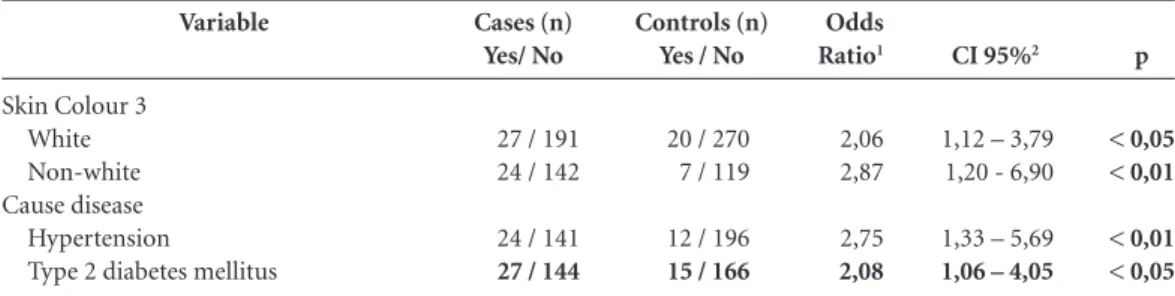
Table 3 shows prevalence of CKD undergo-ing RRT among family members of both groups by skin colour (white and non white) and cause disease. A separate analysis of whites and
non-Sex Male Female Cause disease
Type 2 diabetes mellitus Hypertension
Skin colour White Black Brown Yellow Age (years)
< 50 years 50–59 years 60–69 years 70–79 years 80 or + years
Systolic Blood Pressure (mmHg) Diastolic blood pressure (mmHg) Plasma creatinine (mg/dL)
Cases (n=336)
198 (58,9%) 138 (41,1%)
171 (50,9%) 165 (49,1%)
191 (56,8%) 70 (20,8%) 66 (19,7%) 9 (2,7%) 58,8 ± 12,3b
68 (20,2%) 97 (28,9%) 107 (31,8%) 57 (17,0%) 7 (2,1%) 142 ± 26b
80 ± 15b
9,47 ± 3,25b
Controls (n=389)
216 (55,5%) 173 (44,5%)
181 (46,5%) 208 (53,5%)
270 (69,4%) 50 (12,9%) 67 (17,2%) 2 (0,5%) 59,3 ± 12,0 73 (18,8%) 118 (30,3%) 119 (30,6%) 65 (16,7%) 14 (3,6%) 141 ± 19 88 ± 12 0,94 ± 0,25
Table 1. Demographic characteristics and results of pairing by cause disease, sex, age, clinical and laboratory parameters.
p
0,356
0,240
0,904
0,603
0,33 < 0,001 < 0,001
a = based on the Brazilian Institute of Geography and Statistics classification; b = mean ± standard deviation.
p
< 0,05 < 0,01
< 0,01 < 0,001 Variable
No relative undergoing RRT3 Parents undergoing RRT
Brothers or sisters undergoing RRT Son or daughter undergoing RRT Second-degree relatives4 undergoing RRT Total number of family members Undergoing RRT5
Cases (n = 336) N (%)
285 (84,8) 15 (4,5) 27 (8,0) 1 (0,3) 22 (6,6)
51 (15,2)
Controls (n = 389) N (%)
362 (93,1) 7 (1,8) 13 (3,3) 0 (0,0) 7 (1,8)
27 (6,9)
Table 2. Prevalence of chronic kidney disease undergoing renal replacement therapy among cases and controls and association with degree of relationship.
1 = Likelihood; 2 = 95% confidence interval; p = level of statistical significance; 3 = RRT- Renal Replacement Therapy (haemodialysis or peritoneal dialysis); 4 = Second-degree relatives were considered grandparents, uncles/aunties or nieces/nephews; 5 = Total number of individuals with at least one family member undergoing RRT.
Odds Ratio1
2,55 2,53
3,82
2,40
CI 95%2
1,03 – 6,33 1,28 – 4,98
1,61 – 9,07
aúd
e C
ole
tiv
a,
20(2):471-478,
2015
whites resulted in a statistically significant odds ratio: 2.06 (CI 95% 1.12–3.79; p < 0.05) and 2.87 (CI 95% 1.20-6.90; p < 0.01), respectively. A joint analysis of black and brown skin colour showed resulted in an OR of 3.01 (IC 95% 1.23–7.32; p < 0,01). The results showed that people in the black and brown skin colour category were not more likely to have family members with CKD undergoing RRT (OR = 1.11; CI 95% 0.60-2.06) than white individuals (OR = 1.0). The same can be said of the yellow skin colour group, which showed a high OR (3.04) but was not statistically significant (CI 95% 0.72-12.88). It should be not-ed however that the proportion of individuals in this category was low in both groups (cases n = 9;controls n = 2).
Hypertension and type 2 diabetes mellitus remained statistically significant as cause diseas-es after a separate analysis of thdiseas-ese two variabldiseas-es. The OR of the variable type 2 diabetes mellitus was slightly lower than that of hypertension (Ta-ble 3). Although type 2 diabetes mellitus was shown to be the most common cause disease, the likelihood of this disease causing end-stage CKD among relatives of patients undergoing RRT was not greater than that of hypertension (OR = 1.10; CI 95% 0.61 – 2.01).
The likelihood of case family members hav-ing end-stage CKD undergohav-ing RTT was still greater after carrying out multiple logistic re-gression analysis adjusted by sex, age, skin colour, cause disease, and length of time after diagnosis of hypertension and diabetes mellitus (OR = 2.35; CI 95% 1.42 – 3.89; p < 0,001). This associ-ation was statistically significant showing that fa-milial predisposition is an independent risk fac-tor for kidney failure related to hypertension and type 2 diabetes mellitus even after controlling for known end-stage CKD risk factors.
Discussion
This case-control study identified that members of the case group were twice as likely to have family members with CKD undergoing RRT than members of the control group, showing familial aggregation and familial predisposition to renal lesion in this representative sample of individuals with end-stage CKD associated with hypertension or type 2 diabetes mellitus. Similar studies carried out in the southeast of the United States have demonstrated familial aggregation of CKD among a predominantly African American
population11-13. The present study only included
cases where the cause disease was type 2 diabetes mellitus or hypertension, thereby excluding indi-viduals with diseases that show a Mendelian pat-tern of inheritance, such as autosomal dominant polycystic kidney disease in adults, or for which familial aggregation is documented, such as some hereditary glomerulopathies (Alport
syn-drome) or focal segmental glomerulosclerosis9,10.
A recent studied carried out in China observed a 29.7% prevalence rate for urinary alterations and renal insufficiency in first-degree relatives of CKD patients; however, this study included all
renal diseases, including glomerulopathies16. The
present investigation is the first study in Brazil to show that familial predisposition is an inde-pendent risk factor for end-stage CKD associated with both hypertension and type 2 diabetes mel-litus, regardless of skin colour.
This is the second study of this type to be carried out with a sample of the Brazilian pop-ulation. The first study, also a case-control study, was carried out in Rio de Janeiro a decade ago. The control group comprised inpatients with normal levels of plasma creatinine but the study
did not select the cause diseases for CKD14. The
Variable
Skin Colour 3 White Non-white Cause disease
Hypertension
Type 2 diabetes mellitus
Cases (n) Yes/ No
27 / 191 24 / 142
24 / 141
27 / 144
Controls (n) Yes / No
20 / 270 7 / 119
12 / 196
15 / 166
Table 3. Prevalence of chronic kidney disease in family members undergoing renal replacement therapy among cases and controls stratified by skin colour and cause disease.
1 = Likelihood; 2 = 95% confidence interval; p = level of statistical significance, 3 = skin colour based on the Brazilian Institute of Geography and Statistics classification15.
Odds Ratio1
2,06 2,87
2,75
2,08
CI 95%2
1,12 – 3,79 1,20 - 6,90
1,33 – 5,69
1,06 – 4,05 p
< 0,05 < 0,01
A
lme
ida F
study showed that the likelihood of family mem-bers of case patients having CKD and RRT was
5.7 greater than among control patients14. The
likelihood observed by the present study was lower (OR = 2.4) but still significant. The most reasonable explanation for this difference is the fact that the present study selected cases where the cause disease was type 2 diabetes mellitus or hypertension, making it possible to choose an ap-propriate control sample comprised of individu-als with the same cause diseases paired by gender, age and cause disease. In the afore mentioned study, the cause disease was glomerulonephritis in 12.1% of the cases and unknown in 32.9% of the cases. In the control group, hypertension or diabetes mellitus was the cause disease in 26.7%
of hospitalized patients14.
Case-control studies are subject to assess-ment and selection bias. However, the risk of as-sessment bias and recall bias was limited in this study due to the specific characteristics of CKD and the cause diseases whose selection was based on sound criteria which ensured that all sample members, including the control sample, were participating in treatment programmes for these diseases. It is important to highlight that the etiological diagnosis of hypertension and type 2 diabetes mellitus related to end-stage CKD is invariably assumption-based since a renal biopsy is not carried out during this stage of the disease. Furthermore, reverse causality is not uncommon in this type of study because family members of known CKD patients are often more likely to be examined for renal lesions, even in initial stages. This does not apply to this study, since we con-sidered patients with end-stage CKD undergoing RRT.
The greater likelihood of CKD and RRT among case family members remained signifi-cant even after a separate analysis of patients by disease cause (type 2 diabetes mellitus or hyper-tension) and after carrying out a multiple logis-tic regression analysis to adjust for known risk factors for end-stage CKD (sex, age, skin colour, cause disease, length of time after hypertension and/or diabetes mellitus diagnosis). In other words, the results indicate that familial predispo-sition to both hypertension and type 2 diabetes mellitus is an independent risk factor for kidney failure. This is yet another explanation for the high prevalence of these diseases as worldwide
causes of end-stage CKD1-6. A number of
stud-ies produced over the last two decades regard-ing the common physiopathological features of these diseases, including its genetic features, have
shown that they are frequently concomitant and
commonly diagnosed as a metabolic syndrome18.
Contrary to the findings of the aforemen-tioned study carried out in the United States, we did not find a greater predisposition to end-stage CKD associated with black or brown skin
co-lour11,12,20. A possible explanation is that the
seg-regation of the genes linked to hypertension and type 2 diabetes may not be related to race, which makes it impossible to identify their importance.
The authors do not discard the possibility that cultural habits and socioeconomic con-ditions may also explain familial aggregation. Publications show divergent findings regarding this issue. While some studies suggest that low socioeconomic status and lack of access to ade-quate health facilities are associated with great-er prevalence of end-stage CKD, othgreat-ers did not observe such an association and reinforce that a genetic predisposition in the family is the main
contributing factor to familial aggregation20-23. In
this respect, recent studies have discovered cer-tain genes which explain familial predisposition to chronic kidney disease associated with both
hypertension and diabetes mellitus24-26.
Previous studies show that periodic moni-toring of arterial pressure, blood glucose levels, levels of plasma creatinine, albuminuria and pro-teinuria are strategic preventative interventions
for this risk group27-31.
aúd
e C
ole
tiv
a,
20(2):471-478,
2015
cannot be extrapolated to other regions. Howev-er, we hope that the results of this study will stim-ulate the implementation of correlative studies in other regions in Brazil.
Collaborations
FA Almeida and RJ Gianini participated in proj-ect conception, data analysis and interpretation, and the writing of this article and approved the final submitted version of this article. GS Ciam-belli, AL Bertoco, MM Jurado, GV Siqueira e EA Bernardo participated in project conception, data collection, analysis and interpretation, and in the critical revision and approval of the final submit-ted version of this article. MV Pavan participasubmit-ted in project conception, data analysis and interpre-tation, and in the critical revision and approval of the final submitted version of this article.
Acknowledgements
We are grateful to the Institutional Scientific Initiation Grant Programme of the Pontifical Catholic University of São Paulo (PIBIC-PUC/ SP) and to the National Council for Scientific and Technological Development (CNPq) for the grants for scientific initiation awarded to the stu-dents that participated in this study.
References
KDIGO. Clinical Practice Guideline for the Evaluation and Management of Chronic Kidney Disease. Defini-tion, identificaDefini-tion, and prediction of CKD progres-sion. Kidney Int 2012; (Supl. 3):63-72.
U.S. Renal Data System. USRDS 2013 Annual Data Report: Atlas of Chronic Kidney Disease and End-Stage Renal Disease in the United States. National Institutes of Health, National Institute of Diabetes and Digesti-ve and Kidney Diseases, Bethesda, MD, 2013. [acessa-do 2013 out 9]. Disponível em: http://www.usrds.org/ reference.aspx
Sesso RC, Lopes AA, Thomé FS, Lugon JR, Santos DR. Diálise crônica no Brasil - Relatório do censo brasileiro de diálise, 2011. J Bras Nefrol 2012; 34(3):272-277. KDIGO. Clinical Practice Guidline for the Evaluation and Management of Chronic Kidney Disease. Other complications of CKD: CVD, medication dosage, pa-tient safety, infections, hospitalizations, and caveats for investigating complications of CKD. Kidney Int 2012; (Supl. 3):91-111.
Sesso R, Gordon P. Dados disponíveis sobre a doença renal crônica no Brasil. J Bras Nefrol 2007; 29(Supl. 1):9-12.
Sesso RC, Lopes AA, Thomé FS, Lugon JR, Santos DR. Relatório do censo brasileiro de diálise de 2010. J Bras Nefrol 2011; 33(4):442-447.
1.
2.
3.
4.
5.
A
lme
ida F
World Kidney Day. [acessado 2013 out 8]. Disponível em: http://www.worldkidneyday.org
Dia Mundial do Rim 2013. [acessado 2013 out 8]. Dis-ponível em: http://www.sbn.org.br/index.php?Noticia &pagina=&dado_id=1420
Harris PC, Torres VE. Polycystic kidney disease. Annu Rev Med 2009; 60:321-337.
Zunino D. Glomerulopatias hereditárias. In: Riella MC, organizador. Princípios de nefrologia e distúrbios hidro-eletrolíticos. Rio de Janeiro: Guanabara-Koogan; 2010. p. 754-764.
Freedman BI, Soucie JM, McClellan WM. Family his-tory of end-stage renal disease among incident dialysis patients. J Am Soc Nephrol 1997; 8(12):1942-1945. Freedman BI, Volkova NV, Satko SG, Krisher J, Jurko-vitz C, Soucie JM, McClellan WM. Population-based screening for family history of end-stage renal disease among incident dialysis patients. Am J Nephrol 2005; 25(6):529-535.
Lei HH, Perneger TV, Klag MJ, Whelton PK, Coresh J. Familial aggregation of renal disease in a popula-tion-based case-control study. J Am Soc Nephrol 1998; 9(7):1270-1276.
Madeira EPQ, Santos OR, Santos SFF, Silva LA, In-nocenzi AM, Santoro-Lopes G. Familial aggregation of end-stage kidney disease in Brazil. Nephron 2002; 91(4):666-670.
Instituto Brasileiro de Geografia e Estatística (IBGE).
Conceitos. [acessado 2013 out 6]. Disponível em: http:// www.ibge.gov.br/home/estatistica/populacao/condi-caodevida/indicadoresminimos/conceitos.shtm Schlesselman JJ. Case-control studies. Oxford: Oxford University Press Inc; 1982.
Wei X, Li Z, Chen W, Mao H, Li Z, Dong X, Tan J, Ling L, Chen A, Guo N, Yu X. Prevalence and risk factors of chronic kidney disease in first-degree relatives of chro-nic kidney disease patients in Southern China. Nephro-logy (Carlton) 2012; 17(2):123-130.
Alberti KG, Eckel RH, Grundy SM, Zimmet PZ, Cle-eman JI, Donato KA, Fruchart JC, James WP, Loria CM, Smith SC Jr; International Diabetes Federation Task Force on Epidemiology and Prevention; Natio-nal Heart, Lung, and Blood Institute; American Heart Association; World Heart Federation; International Atherosclerosis Society; International Association for the Study of Obesity. Harmonizing the metabolic syn-drome: a joint interim statement of the International Diabetes Federation Task Force on Epidemiology and Prevention; National Heart, Lung, and Blood Institute; American Heart Association; World Heart Federation; International Atherosclerosis Society; and Internatio-nal Association for the Study of Obesity. Circulation
2009; 120(16):1640-1645.
Bergman S, Key BO, Kirk KA, Warnock DG, Rostant SG. Kidney disease in the first-degree relatives of Afri-can-Americans with hypertensive end-stage renal dise-ase. Am J Kidney Dis 1996; 27(3):341-346.
Byrne C, Nedelman J, Luke RG. Race, socioeconomic status, and the development of end-stage renal disea-se. Am J Kidney Dis 1994; 23(1):16-22.
Perneger TV, Whelton PK, Klag MJ. Race and end-stage renal disease (socioeconomic status and access to he-alth care as mediating factors). Arch Intern Med 1995; 155(11):1201-1208.
Ward MM. Socioeconomic status and the incidence of ESRD. Am J Kidney Dis 2008; 51(4):563-572.
7. 8.
9. 10.
11.
12.
13.
14.
15.
16. 17.
18.
19.
20.
21.
22.
Song EY, McClellan WM, McClellan A, Gadi R, Hadley AC, Krisher J, Clay M, Freedman BI. Effect of commu-nity characteristics on familial clustering of end-stage renal disease. Am J Nephrol 2009; 30(6):499-504. Kao WH, Klag MJ, Meoni LA, Reich D, Berthier-Schaad Y, Li M, Coresh J, Patterson N, Tandon A, Powe NR, Fink NE, Sadler JH, Weir MR, Abboud HE, Adler SG, Divers J, Iyengar SK, Freedman BI, Kimmel PL, Knowler WC, Kohn OF, Kramp K, Leehey DJ, Nicholas SB, Pahl MV, Schelling JR, Sedor JR, Thornley-Brown D, Winkler CA, Smith MW, Parekh RS; Family Investigation of Nephropathy and Diabetes Research Group. MYH9 is associated with nondiabetic end-stage renal disease in African Americans. Nat Genet 2008; 40(10):1185-1192. Freedman BI, Parekh RS, Linda Kao WH. Genetic basis of nondiabetic end-stage renal disease. Semin Nephrol
2010; 30(2):101-110.
Bowden DW, Freedman BI. The challenging search for diabetic nephropathy genes. Diabetes 2012; 61(8):1923-1924.
de Jong PE, Brenner BM. From secondary to pri-mary prevention of progressive renal disease: the case for screening for albuminuria. Kidney Int 2004; 66(6):2109-2018.
Astor BC, Matsushita K, Gansevoort RT, van der Velde M, Woodward M, Levey AS, Jong PE, Coresh J; Chronic Kidney Disease Prognosis Consortium, Astor BC, Mat-sushita K, Gansevoort RT, van der Velde M, Woodward M, Levey AS, de Jong PE, Coresh J, El-Nahas M, Eckardt KU, Kasiske BL, Wright J, Appel L, Greene T, Levin A, Djurdjev O, Wheeler DC, Landray MJ, Townend JN, Emberson J, Clark LE, Macleod A, Marks A, Ali T, Flu-ck N, Prescott G, Smith DH, Weinstein JR, Johnson ES, Thorp ML, Wetzels JF, Blankestijn PJ, van Zuilen AD, Menon V, Sarnak M, Beck G, Kronenberg F, Kollerits B, Froissart M, Stengel B, Metzger M, Remuzzi G, Rug-genenti P, Perna A, Heerspink HJ, Brenner B, de Zeeuw D, Rossing P, Parving HH, Auguste P, Veldhuis K, Wang Y, Camarata L, Thomas B, Manley T. Lower estimated glomerular filtration rate and higher albuminuria are associated with mortality and end-stage renal disease. A collaborative meta-analysis of kidney disease popu-lation cohorts. Kidney Int 2011; 79(12):1331-1340. Hellemons ME, Denig P, de Zeeuw D, Voorham J, Lam-bers Heerspink HJ. Is albuminuria screening and tre-atment optimal in patients with type 2 diabetes in pri-mary care? Observational data of the GIANTT cohort.
Nephrol Dial Transplant 2013; 28():706-715.
Hoerger TJ, Wittenborn JS, Zhuo X, Pavkov ME, Bur-rows NR, Eggers P, Jordan R, Saydah S, Williams DE. Cost-effectiveness of screening for microalbuminuria among African Americans. J Am Soc Nephrol 2012; 23(12):2035-2041.
Low eGFR and high albuminuria predict end stage kid-ney disease and death at all ages. BMJ 2012; 345:e7478.
Article submitted 09/04/2014 Approved 19/06/2014
Final version submitted 21/06/2014 23.
24.
25.
26.
27.
28.
29.
30.