Cognitive rehabilitation
Literature review based on levels of evidence
Patricia Regina Manzine
1, Sofia Cristina Iost Pavarini
2Abstract – The aim of this study was to review the scientific publications on cognitive rehabilitation in Alzheimer’s disease by year published and methodology employed. The principles of systematic review by the Brazilian Cochrane Center were used. Reviews conducted by this Center were identified together with those held on the LILACS and Medline scientific databases. Nine levels of evidence were considered for analysis and a total of 37 articles were found. The results showed a growing number of publications from 2001 onwards, with majority being published early this decade. Few studies have been published on cognitive rehabilitation, with an average of three articles published per year during the study period (1985–2008). The highest levels of evidence were observed in the more recently published studies. Cognitive rehabilitation can yield greater benefits in rehabilitating patients when associated with other forms of intervention. The latest studies demonstrating greater scientific evidence concluded that results remain limited and that further studies on the topic are needed.
Key words: elderly, dementia, Alzheimer’s disease, rehabilitation.
Reabilitação cognitiva: um estudo de revisão baseada em níveis de evidência
Resumo – O objetivo foi revisar publicações científicas sobre reabilitação cognitiva na doença de Alzheimer segundo ano de publicação e rigor metodológico. Foram utilizados pressupostos da revisão sistemática do Centro Cochrane do Brasil. Foram identificados estudos de revisão já realizados por este Centro e incluídos estudos das bases LILACS e Medline. Nove níveis de evidência foram considerados para análise. Foram encontrados 37 artigos. Os resultados mostram uma crescente incidência de publicação a partir de 2001, com maior concentração no início desta década. São poucas ainda as publicações sobre reabilitação cognitiva, sendo uma média inferior a três artigos por ano no período estudado (1985–2008). Os maiores níveis de evidência foram observados nas publicações mais recentes. A reabilitação cognitiva quando em associação com outras intervenções pode apresentar maiores benefícios na reabilitação dos pacientes. Os estudos mais atuais e de maior evidência cientifica apontam que os resultados ainda são limitados e novas investigações são necessárias.
Palavras-chave: idoso, demência, doença de Alzheimer, reabilitação.
1Student in Nursing of the Federal University of São Carlos, São Paulo, SP, Brazil. FAPESP Grantholder. 2Nurse, Associate Professor of the Department
of Nursing and Post-graduate Program in Nursing of the Federal University of São Carlos, São Paulo, SP, Brazil. Coordinator of the Graduate Course in Gerontology.
Sofia Cristina Iost Pavarini – Federal University of São Carlos - Rodovia Washington Luis km 335 - 13565-905 São Carlos SP - Brazil. E-mail: [email protected]
Disclosure: The authors report no conflicts of interest. Received July 01, 2009. Accepted in final form August 17, 2009.
Introduction
The different dementia types all have the inherent
char-acteristic of hampering the ability to learn new concepts
and knowledge (Brandt and Rich, 1995). Alzheimer’s
dis-ease (AD) is the leading type of dementia in terms of
num-ber of cases diagnosed, and the disease has been identified
as a looming public health issue.
One of the forms of Non Pharmacologic Treatment
available is Neuropsychological Rehabilitation, an approach
which encompasses a combination of psychotherapy, the
therapeutic environment, family learning groups, schemes
to instruct patients and cognitive rehabilitation. These
pro-posals are all practiced and based on a multidisciplinary
context.
and to cope with, lessen or overcome the deficiencies and
cognitive changes caused by neurologic lesions (Wilson,
1996; Ávila and Miotto, 2002). The focus of the majority
of interventions proposed is to stimulate memory more
ef-fectively (Caliman and Oliveira, 2005). Cognitive
rehabili-tation “…
involves identifying and guiding individual goals
and needs, where this process calls for strategies to obtain new
information or compensatory mechanisms such as the use of
memory aids”
(Clare and Wood, 2008, pg.2).
When used alone, these interventions have proven to be
effective in many cases by avoiding or restricting the use of
drugs, yet when combined with psychotropic medication,
their benefits are potentially greater and can allow
medica-tion to be reduced or withdrawn altogether (Engelhardt et
al., 2005). In addition, a balanced diet, physical exercises
and supervision of daily activities are conducive to
cogni-tive, behavioral and psychological rehabilitation (Bottino
et al., 2002).
Thus, caring for AD patients entails a systematic and
organized method, in a bid to provide individualized care
focusing on the individual and group solutions. The
ex-ecution of each step in assisting to care for AD patients
implies evidence-based practice both in terms of the data
gathered from the demented patient as well as the
clini-cal decisions on the most efficacious treatment
interven-tion (Galvão CM, Sawada NO, Rossi LA., 2002). The study
of evidence-based practices first emerged in 1990 in the
United Kingdom, the United States and Canada. In Brazil,
this approach was first adopted in the medical community
within the country’s larger states and in São Paulo, Rio de
Janeiro and Rio Grande do Sul State universities (Galvão
C.M., Sawada N.O., Mendes I.A.C., 2003).
Evidence-based practice emerged with the aim of
reach-ing consensus on the most relevant clinical data drawn
from the results of studies and from information available
on data bases, thus enabling explicit and criteria-based
decision-making on specific care provided to individual
patients or patient groups (Driever M.J., 2002).
The hierarchical organization of scientific evidence is
dictated by the type of study design employed, i.e. of the
methodological approach applied in the study (Humpris
D., 1999). A classification which determines the
quantita-tive and qualitaquantita-tive structure of studies is based on the
cat-egorizing of
The Cochrane Collaboration
, an international
network which develops and disseminates systematic
re-views on the effects of health interventions. Founded in
1993 in Oxford, this group comprises nine centers
distrib-uted world wide, one of which is the Cochrane Center of
Brazil located in the city of São Paulo.
The methodology of the Cochrane Center of Brazil
con-siders eight levels of evidence: Level 1, Systematic review and
Meta-analysis of controlled studies; Level 2, Randomized
clinical trials; Level 3, Cohort studies; Level 4, Case-control
studies; Level 5, Case series studies; Level 6, Case studies;
Level 7, Research in animals and Level 8, Opinion of
re-spected authorities/specialists (Higgins JPT, Green S., 2008).
Implementation of evidence-based practice enables the
quality of care given to patient and family to be improved
since this practice has a direct bearing on clinical decisions.
Moreover, the professional also needs to develop the
neces-sary skills and know-how to obtain, interpret and integrate
evidence derived from studies based on the patient’s data
and clinical observations.
In a bid to find elements which can contribute to the
implementation of public policies on care in demented
elderly based on more explicit and qualified scientific
de-cisions, this study sought to review scientific publications
by assessing year of publication and levels of evidence on
the theme of cognitive rehabilitation in elderly individuals
with Alzheimer’s disease.
Methods
An analytical bibliographic review was conducted based
on the principles of the quantitative method of investigation.
This study was supported by the funding body – Fundação
de Amparo à Pesquisa do Estado de São Paulo (FAPESP).
The principles of the systematic review of the Cochrane
Center of Brazil were used, whose objective is to pool and
critically assess studies published on specific themes,
de-termining the best levels of evidence. The first step of this
study was to identify the Systematic Reviews conducted by
the Cochrane Center of Brazil. For the target theme, the
full Systematic Review entitled “
Cognitive Rehabilitation
and Cognitive Training for early-stage Alzheimer’s disease
and vascular dementia
” was found on La Biblioteca
Co-chrane Plus and was duly included in this study along with
its online references. Subsequently, studies retrieved from
the LILACS and Medline primary data bases (1966–1996)
and (1997–2008) were included, respectively. These data
bases were chosen for their wide scope of national and
in-ternational scientific articles available in the health area,
and for their powerful search tools.
To perform the search, the key search words were first
defined according to the Virtual Health Library (http://
www.bireme.br/php/index.php) at the DeCS link – Health
Terminology (http://decs.bvs.br/
)
using the structured
vo-cabulary in three languages (Portuguese, Spanish and
Eng-lish). The search strategy employed the terms
“rehabilita-tion”, “cognitive therapy”, “combined therapy”, “Alzheimer’s
disease”, “elderly” and “elderly aged 80 years or older”.
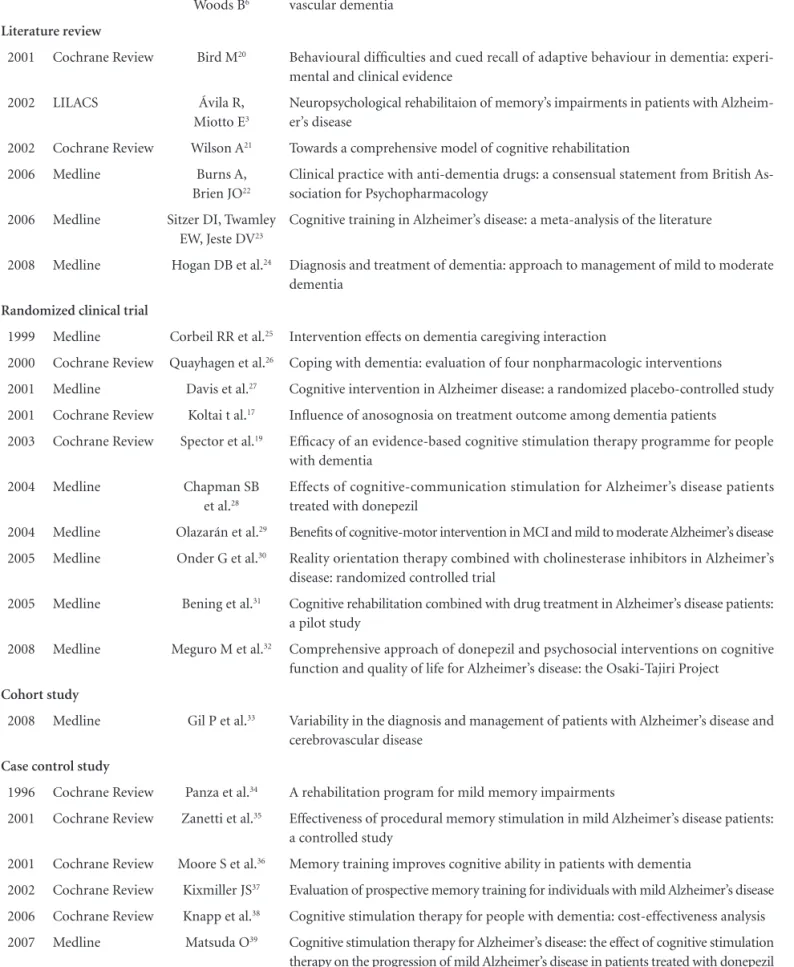
Table 1. Articles published, by level of evidence.
Systematic review and meta-analysis
2008 Cochrane Review Clare L,
Woods B6
Cognitive rehabilitation and cognitive training for early-stage Alzheimer’s disease and vascular dementia
Literature review
2001 Cochrane Review Bird M20 Behavioural difficulties and cued recall of adaptive behaviour in dementia:
experi-mental and clinical evidence
2002 LILACS Ávila R,
Miotto E3
Neuropsychological rehabilitaion of memory’s impairments in patients with Alzheim-er’s disease
2002 Cochrane Review Wilson A21 Towards a comprehensive model of cognitive rehabilitation
2006 Medline Burns A,
Brien JO22
Clinical practice with anti-dementia drugs: a consensual statement from British As-sociation for Psychopharmacology
2006 Medline Sitzer DI, Twamley
EW, Jeste DV23
Cognitive training in Alzheimer’s disease: a meta-analysis of the literature
2008 Medline Hogan DB et al.24 Diagnosis and treatment of dementia: approach to management of mild to moderate
dementia
Randomized clinical trial
1999 Medline Corbeil RR et al.25 Intervention effects on dementia caregiving interaction
2000 Cochrane Review Quayhagen et al.26 Coping with dementia: evaluation of four nonpharmacologic interventions
2001 Medline Davis et al.27 Cognitive intervention in Alzheimer disease: a randomized placebo-controlled study
2001 Cochrane Review Koltai t al.17 Influence of anosognosia on treatment outcome among dementia patients
2003 Cochrane Review Spector et al.19 Efficacy of an evidence-based cognitive stimulation therapy programme for people
with dementia
2004 Medline Chapman SB
et al.28
Effects of cognitive-communication stimulation for Alzheimer’s disease patients treated with donepezil
2004 Medline Olazarán et al.29 Benefits of cognitive-motor intervention in MCI and mild to moderate Alzheimer’s disease
2005 Medline Onder G et al.30 Reality orientation therapy combined with cholinesterase inhibitors in Alzheimer’s
disease: randomized controlled trial
2005 Medline Bening et al.31 Cognitive rehabilitation combined with drug treatment in Alzheimer’s disease patients:
a pilot study
2008 Medline Meguro M et al.32 Comprehensive approach of donepezil and psychosocial interventions on cognitive
function and quality of life for Alzheimer’s disease: the Osaki-Tajiri Project
Cohort study
2008 Medline Gil P et al.33 Variability in the diagnosis and management of patients with Alzheimer’s disease and
cerebrovascular disease
Case control study
1996 Cochrane Review Panza et al.34 A rehabilitation program for mild memory impairments
2001 Cochrane Review Zanetti et al.35 Effectiveness of procedural memory stimulation in mild Alzheimer’s disease patients:
a controlled study
2001 Cochrane Review Moore S et al.36 Memory training improves cognitive ability in patients with dementia
2002 Cochrane Review Kixmiller JS37 Evaluation of prospective memory training for individuals with mild Alzheimer’s disease
2006 Cochrane Review Knapp et al.38 Cognitive stimulation therapy for people with dementia: cost-effectiveness analysis
2007 Medline Matsuda O39 Cognitive stimulation therapy for Alzheimer’s disease: the effect of cognitive stimulation
Table 1. Continuation.
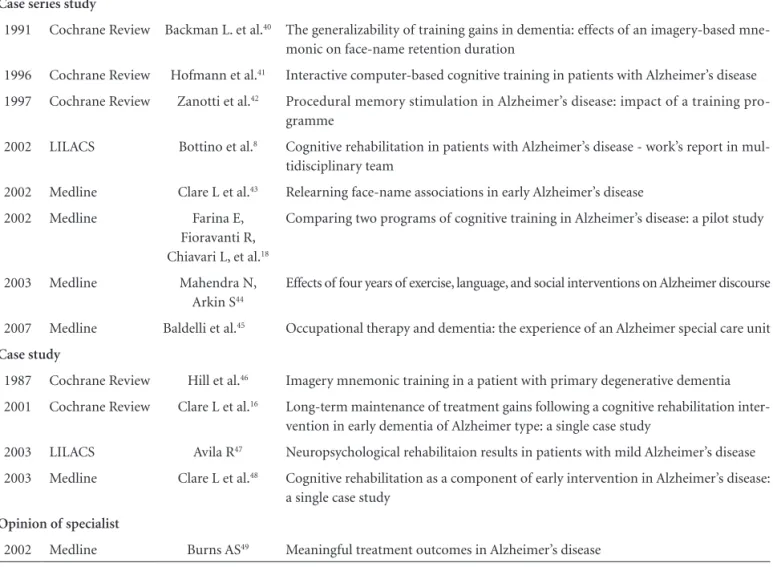
Case series study
1991 Cochrane Review Backman L. et al.40 The generalizability of training gains in dementia: effects of an imagery-based
mne-monic on face-name retention duration
1996 Cochrane Review Hofmann et al.41 Interactive computer-based cognitive training in patients with Alzheimer’s disease
1997 Cochrane Review Zanotti et al.42 Procedural memory stimulation in Alzheimer’s disease: impact of a training
pro-gramme
2002 LILACS Bottino et al.8 Cognitive rehabilitation in patients with Alzheimer’s disease - work’s report in
mul-tidisciplinary team
2002 Medline Clare L et al.43 Relearning face-name associations in early Alzheimer’s disease
2002 Medline Farina E,
Fioravanti R, Chiavari L, et al.18
Comparing two programs of cognitive training in Alzheimer’s disease: a pilot study
2003 Medline Mahendra N,
Arkin S44
Effects of four years of exercise, language, and social interventions on Alzheimer discourse
2007 Medline Baldelli et al.45 Occupational therapy and dementia: the experience of an Alzheimer special care unit
Case study
1987 Cochrane Review Hill et al.46 Imagery mnemonic training in a patient with primary degenerative dementia
2001 Cochrane Review Clare L et al.16 Long-term maintenance of treatment gains following a cognitive rehabilitation
inter-vention in early dementia of Alzheimer type: a single case study
2003 LILACS Avila R47 Neuropsychological rehabilitaion results in patients with mild Alzheimer’s disease
2003 Medline Clare L et al.48 Cognitive rehabilitation as a component of early intervention in Alzheimer’s disease:
a single case study
Opinion of specialist
2002 Medline Burns AS49 Meaningful treatment outcomes in Alzheimer’s disease
were added to connect the key words and synonyms of
each language.
Outline of search strategy
The inclusion criteria of articles comprised:
publica-tions between January 1985 and December 2008, theme
of cognitive rehabilitation in the context of dementia
(Alzheimer) in the elderly, and presentation in the form
“Full text free”. Nine levels of evidence were considered
for analysis. Given the current divergence in the concepts
of Systematic Review and Literature Review, we elected to
differentiate these two methodologies for the purposes of
analysis, by assigning them separate categories. This gave
the following nine levels: Systematic review and
Meta-anal-ysis, Review of the literature, Randomized clinical trial,
Co-hort study, controlled study, Case series studies,
Case-study, Research in animals, and Opinion of specialist.
Results
Table 1 presents the 37 articles matching the study
inclusion criteria. From among these (Systematic Review
included), 15 were reference studies retrieved by the
Sys-tematic Review, 18 were articles found on the Medline data
base (1997–2008) and three were found on the LILACS
data base. No articles from the Medline data base (1966–
1996) met the inclusion criteria.
The data found revealed that a mean of approximately
2.64 articles were published per year over the period
span-ning 1985 to 2008. Regarding the distribution of annual
publications, the standard deviation was 1.94, a figure
which denotes data spread centered around the mean
(Pa-gano and Gauvreau, 2004).
The data showed that publications on cognitive
rehabil-itation remain low, with a mean of less than three articles
published annually for the study period. In line with that
proposed by other authors, there is a need for further
stud-ies on this subject seeking more in-depth evidence.
No studies were found for the years not listed above.
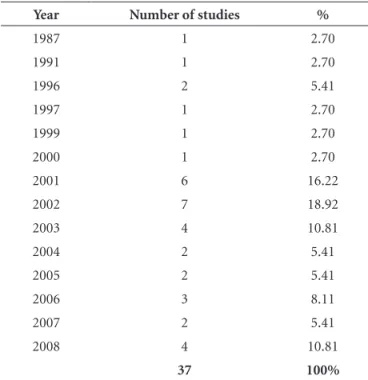
A growing rate of publication on the subject was
ob-served after the turn of the twenty first century, with
arti-cles found for each year thereafter (2000, 2001, 2002, 2003,
2004, 2005, 2006, 2007 and 2008), representing the opposite
pattern to the preceding nineteenth century during which,
articles presented greater time intervals between
publica-tions (1987, 1991, 1996, 1997 and 1999), thus
demonstrat-ing the growdemonstrat-ing importance and concern of scientific
out-put on the topic of care for AD patients and those involved
(caregivers, family members, researchers) over recent years.
The results indicate a trend toward more frequent studies
from 2001 onward.
The data show a linear growth trend in the number of
studies published each year, as illustrated in Figure 1.
It is important to note that, of the six articles published
in 2001, five were from the same specific period and that
the present study found no reason for the high number of
publications in 2002.
In terms of levels of evidence, of the 37 studies found,
a mean of approximately 4.12 studies per level of evidence
were obtained, with a respective standard deviation of
ap-proximately 3.58.
One study presented the highest level of
epidemiologi-cal evidence from the scientific literature, namely, the
Sys-tematic Review study, where this accounted for 2.7% of the
articles. The same statistical proportion of 2.7% was seen
for Cohort studies and Opinion of Specialist levels.
In decreasing order of methodological merit, after the
Systematic Review studies, the studies with the greatest
number of quantitative findings were as follows: the
Lit-erature Review level with 16% (N=6), Randomized
clini-cal trials with 27% (N=10), Case-Control study (N=6),
accounting for 16%, and Case Series studies representing
22% of the total (N=8).
The Case study articles represented 11% of the sample
found (N=4), as shown in Table 3 and Figure 2. In
ad-dition, no articles for the Research in Animals level were
found (N=0).
Overall, the scientific output for the subject of
cogni-tive rehabilitation in AD patients presented a balanced
dis-Table 2. Relationship between number and year of studies basedon search methodology.
Year Number of studies %
1987 1 2.70
1991 1 2.70
1996 2 5.41
1997 1 2.70
1999 1 2.70
2000 1 2.70
2001 6 16.22
2002 7 18.92
2003 4 10.81
2004 2 5.41
2005 2 5.41
2006 3 8.11
2007 2 5.41
2008 4 10.81
37 100%
1987
1991199619971999200020012002200320042005200620072008 0
1 2 3 4 5 6 7 8
Year
N
u
m
b
e
r
o
f
s
tu
d
ie
s
Number of studies over time Linear trend of growth
Figure 1. Relationship between number and year of studies found based on the search methodology.
Table 3. Relationship between number and levels of evidence of studies found based on search methodology.
Levels of evidence
Number of
studies %
Systematic review or meta-analysis 1 2.70%
Review of the literature 6 16.22%
Randomized clinical trial 10 27.03%
Cohort study 1 2.70%
Case-control study 6 16.22%
Case series study 8 21.62%
Case study 4 10.81%
Research in animals 0 0.00%
Opinion of specialist 1 2.70%
tribution of evidence levels of greater and lesser research
relevance. However, articles employing better planned and
designed scientific methodologies are needed based on the
investigations currently available on the subject (Opie et
al., 1999; Clare et al., 2001; Koltai et al., 2001; Farina et al.,
2002; Spector et al., 2003; Clare L., Woods B., 2008)
.
The data obtained revealed that few studies on cognitive
rehabilitation were published in the twentieth century.
Stud-ies published during this period included: one
Random-ized Clinical Trial (1999), one Case Control study (1996),
three Case Series studies (1991, 1996 and 1997) along with
the earliest study found (1987) which was a Case Study.
The results demonstrated that the only article with a
high level of evidence (Systematic Review) was published
in 2008. The first Review of the Literature study was
pro-duced in 2001 (N=1) followed by two further articles in
2002, two in 2006 and one in 2008.
In decreasing order of scientific relevance, nine
Random-ized Clinical Trials were found (one in 2000, two in 2001,
one in 2003, two in 2004, two in 2005 and one in 2008), plus
one Cohort Study (2008), five Case-Control Studies (two in
2001, one in 2002, one in 2006 and one in 2007), five Case
Series Studies (three in 2002, one in 2003 and one in 2007),
three Case Studies (one in 2001 and two in 2003), while no
studies at the Research in Animals level was found. Only
one study for Specialist Opinion level was found (2002).
The results showed an increase in scientific output from
the beginning of the twenty-first century on the theme of
cognitive rehabilitation in the elderly with Alzheimer type
dementia, while the highest levels of evidence were
ob-served in the more recent publications.
Notably, among the studies analyzed, the association
between pharmacologic therapy and cognitive
rehabilita-tion was described at various different levels of scientific
evidence since 2001.
The majority of researchers suggested that cognitive
re-habilitation can better benefit patient rere-habilitation when
combined with other interventions such as pharmacologic
treatment, interventions involving family members and
environmental interventions. The latest studies
demon-strating greater scientific evidence concluded that results
of studies remain limited and that further investigation on
the topic is needed.
Discussion
The increased prevalence of dementias has driven the
need for further research in this area. The results
demon-strated an increase in scientific output from 2001 on the
theme of cognitive rehabilitation in the elderly with
Al-zheimer type dementia.
The highest levels of evidence were observed in the
more recent publications, thereby demonstrating the
grow-ing importance and concern in recent years of the
scien-tific output addressing the care and assistance of patients
with Alzheimer’s disease as well as of caregivers, family and
health professionals involved with the disease.
Further-more, these findings support the development and growth
of implementation of evidence-based practices across all
Figure 2. Relationship between number and level of evidence of studies found based on searchfields of health research, so as to ensure more qualified and
scientifically-based care and intervention.
Future studies are needed investigating cognitive
re-habilitation in Alzheimer Disease patients, to pool and
disseminate the aspects and concepts present among the
highest levels of evidence, both in the context of data and
information acquired from demented individuals, as well
as towards implementing the best treatment interventions
through well-informed clinical decisions.
More in-depth studies are warranted to build on the
contributions made by these articles to cognitive
rehabilita-tion and its applicability in caring for demented elderly.
Grant supports –
Study carried out with financial
sup-port of FAPESP. Health and Aging Research Group – CNPq
References
1. Brandt J, Rich JB. Memory disorders in the dementias. In: Baddeley AD, Wilson BA, Watts FN, Editors. Handb-bok of Memory Disorders. Chichester: John Wiley & Sons Ltd; 1995.
2. Prigatano GP. Learning from our Successes and Failures: Reflec-tions and Comments on “Cognitive Rehabilitation: How it is and How it Might Be”. J Int Neuropsychol Soc 1997;3:497-499. 3. Ávila R, Miotto E. Reabilitação neuropsicológica de déficits de memória em pacientes com demência de Alzheimer. Rev Psiq Clín 2002;29:190-196.
4. Wilson BA. Reabilitação das deficiências cognitivas. In: Ni-trini R, Caramelli P, Mansur LL, Editores. Neuropsicologia das bases anatômicas à reabilitação. Clínica Neurológica 1996; 314-343.
5. Caliman GT, Oliveira RMW. Novas perspectivas no tratamen-to da doença de Alzheimer. Iniciação Científica CESUMAR 2005:141-162.
6. Clare L, Woods B. Cognitive rehabilitation and cognitive training for early-stage Alzheimer’s disease and vascular de-mentia (Cochrane Review). The Cochrane Library 2008;4. Oxford: Update Software.
7. Engelhardt E, Brucki SM, Cavalcanti JL, Forlenza OV, Laks J, Vale FA. Departamento de Neurologia Cognitiva e do Envel-hecimento da Academia Brasileira de Neurologia. [Treatment of Alzheimer’s disease: recommendations and suggestions of the Scientific Department of Cognitive Neurology and Aging of the Brazilian Academy of Neurology. Arq Neuropsiquiatr 2005;63:1104-112
8. Bottino C, Carvalho I, Alvarez, et al. Reabilitação cognitiva em pacientes com doença de Alzheimer: relato de trabalho em equipe multidisciplinar. Arq Neuropsiquiatr 2002;60:70-79. 9. Galvão CM, Sawada NO, Rossi LA. A prática baseada em
evidências: considerações teóricas para sua implementação
na enfermagem perioperatória. Rev Latino-Am Enfermagem 2002;10:690-695.
10. Galvão CM, Sawada NO, Mendes IAC. A busca das melhores evidências. Rev Esc Enferm USP 2003;37:43-50.
11. Driever MJ. Are evidence-based practice and best practice the same? West J Nurs Res 2002;24:591-597.
12. Humpris D. Types of evidence. In: Hamer S, Collinson G, Editors. Achieving evidence-based practice: a handbook for practitioners. Baillière Tindall; 1999:13-40.
13. Higgins JPT, Green S. (editors). Cochrane Handbook for Systematic Reviews of Interventions Version 5.0.1 [updated September 2008]. The Cochrane Collaboration, 2008. Avail-able from www.cochrane-handbook.org.
14. Pagano M, Gauvreau K. Princípios de Bioestatística, 2ª ed. São Paulo: Pioneira Thomson Learning; 2004.
15. Opie J, Rosewarne R, O’Connor DW. The efficacy of psychoso-cial approaches to behaviour disorders in dementia: a system-atic literature review. Aust N Z J Psychiatry 1999;33:789-799. 16. Clare L, Wilson BA, Carter G, Hodges JR, Adams M. Long-term maintenance of treatment gains following a cognitive re-habilitation intervention in early dementia of Alzheimer type: a single case study. Neuropsychol Rehabil 2001;11:477-494. 17. Koltai DC, Bohmer KAW, Schmechel DE. Influence of ano-sognosia on treatment outcome among dementia patients. Neuropsychol Rehabil 2001;11:455-475.
18. Farina E, Fioravanti R, Chiavari L, et al. Comparing two pro-grams of cognitive training in Alzheimer’s disease: a pilot study. Acta Neurol Scand 2002;105:365-371.
19. Spector A, Thorgrimsen L, Woods B, et al. Efficacy of an ev-idence-based cognitive stimulation therapy programme for people with dementia. Brit J Psychiatry 2003;183:248-254. 20. Bird M. Behavioural difficulties and cued recall of adaptive
behaviour in dementia: Experimental and clinical evidence. Neuropsychol Rehabil 2001;11:357-375.
21. Wilson BA. Towards a comprehensive model of cognitive re-habilitation. Neuropsychol rehabil 2002;12:97-110. 22. Burns A. Meaningful treatment outcomes in Alzheimer’s
dis-ease. J Neurol Neurosurg Psychiatry 2002;73:471-472. 23. Sitzer DI, Twamley EW, Jeste DV. Cognitive training in
Al-zheimer’s disease: a meta-analysis of the literature. Acta Psy-chiatr Scand 2006;114:75-90.
24. Hogan DB, Bailey P, Black S, et al. Diagnosis and treatment of dementia: Approach to management of mild to moderate dementia. CMAJ 2008;179:787-793.
25. Corbeil RR, Quayhagen MP, Quayhagen M. Interventions ef-fects on dementia caregiving interaction: a stress-adaptation modeling approach. J Aging Health 1999;11:79-95.
26. Quayhagen MP, Quayhagen M, Corbeil RR, et al. Coping with Dementia: Evaluation of Four Nonpharmacologic Interven-tions. Int Psychogeriatr 2000;12:249-265.
Alzheimer Disease: A Randomized Placebo-Controlled Study. Alzheimer Dis Assoc Disord 2001;15:1-9.
28. Chapman SB, Weiner MF, Rackley A, Hynan L, Zientz J. Ef-fects of Cognitive-Communication Stimulation for Alzheim-er’s Disease Patients Treated With Donepezil. J Speech Lang Hear Res 2004;47:1149-1163.
29. Olazarán J, Muniz R, Reisberg B, et al. Benefits of cognitive-motor intervention in MCI and mild to moderate Alzheimer disease. Neurology 2004;63:2348-2353.
30. Onder G, Zanetti O, Giacobini E, et al. Reality orientation therapy combined with cholinesterase inhibitors in Alzheim-er’s disease: randomized controlled trial. Br J Psychiatry 2005; 187:450-455.
31. Bottino C, Carvalho I, Alvarez AM, et al. Cognitive rehabili-tation combined with drug treatment in Alzheimer’s disease patients: a pilot study. Clin Rehabil 2005;19:861-869. 32. Meguro M, Kasai M, Akanuma K, Ishii H, Yamaguchi S,
Me-guro K. Comprehensive approach of donepezil and psycho-social interventions on cognitive function and quality of life for Alzheimer’s disease: the Osaki-Tajiri Project. Age Ageing 2008;37:469-473.
33. Gil P, Ayuso JLD, Marey JM, Antón M, Quilo CG. Variability in the diagnosis and management of patients with Alzheimer’s disease and cerebrovascular disease. Clin Drug Invest 2008; 28:429-437.
34. Panza F, Solfrizzi V, Mastroiani F, Nardó GA, Cigliola F, Capurso A. A rehabilitation program for mild memory im-pairments. Arch Gerontol Geriatr 1996;22(suppl 1):51-55. 35. Zanetti O, Zanieri G, Giovanni GD, et al. Effectiveness of
proce-dural memory stimulation in mild Alzheimer’s disease patients: A controlled study. Neuropsychol Rehabil 2001;11:263-272. 36. Moore S, Sandman CA, McGrady K, Kesslak JP. Memory training improves cognitive ability in patients with dementia. Neuropsychol Rehabil 2001;11:245-261.
37. Kixmiller JS. Evaluation of prospective memory training for individuals with mild Alzheimer’s disease. Brain Cogn 2002; 49:237-241.
38. Knapp M, Thorgrimsen L, Patel A, et al. Cognitive stimulation
therapy for people with dementia: cost-effectiveness analysis. Br J Psychiatry 2006;188:574-580.
39. Matsuda O. Cognitive stimulation therapy for Alzheimer’s disease: the effect of cognitive stimulation therapy on the progression of mild Alzheimer’s disease in patients treated with donepezil. Int Psychogeriatr 2007;19:241-252.
40. Backman L, Josephsson S, Herlitz A, Stigsdotter A. The gener-alizability of training gains in dementia: effects of an imagery-based mnemonic on face-name retention duration. Psychol Aging 1991;6:489-492.
41. Hofmann M, Hock C, Kuhler A, Muller-Spahn F. Interactive computer-based cognitive training in patients with Alzheim-er’s disease. J Psychiat Res 1996;30:493-501.
42. Zanetti O, Binetti G, Magni E, Rozzini L, Bianchetti A, Trabuc-chi M. Procedural memory stimulation in Alzheimer’s dis-ease: impact of a training programme. Acta Neurol Scand 1997;95:152-157.
43. Clare L, Wilson BA, Carter G, Roth I, Hodges JR. Relearning face-name associations in early Alzheimer’s Disease. Neurop-sychology 2002;16:538-547.
44. Mahendra N, Arkin S. Effects of four years of exercise, lan-guage, and social interventions on Alzheimer discourse. J Commun Disord 2003;36:395-422.
45. Baldelli MV, Pradelli JM, Zucchi P, Martini B, Orsi F, Fabbo A. Oc-cupational therapy and dementia: the experience of an Alzheim-er special care unit. Arch GAlzheim-erontol GAlzheim-eriatr 2007;(Suppl 1):49-54. 46. Hill RD, Evankovich KD, Sheikh JI, Yesavage JA. Imagery
mnemonic training in a patient with primary degenerative dementia. Psychol Aging 1987;2:204-205.
47. Ávila R. Resultados da reabilitação neuropsicológica em pa-cientes com doença de Alzheimer leve. Rev Psiq Clín 2003; 30:139-146.