AR
TICLE
1 Escola Nacional de Saúde Pública, Fiocruz. R. Leopoldo Bulhões 1480, Manguinhos. 21041-210 Rio de Janeiro RJ Brasil. [email protected]
Health policies and federative gaps in Brazil:
an analysis of regional capacity of services delivery
Abstract This paper analyzes Brazilian health regions according to their service delivery capac-ity from the debate on the crisis of cooperative federalism in the SUS that resulted from decen-tralizing process established in the 1988 Consti-tution. Service delivery capacity tracer indicators were selected by regions and statistical analyses evidenced greater regional capacity in hospital care and large asymmetries with regard to the availability of physicians, high complexity equip-ment and private insurance coverage. In conclu-sion,we argue that further solutions are required to strengthen governmental capacity to reduce regional inequalities throughincreased central co-ordination.
Key words Health regions, Service delivery,
Fed-eralism José Mendes Ribeiro 1
Marcelo Rasga Moreira 1
Assis Mafort Ouverney 1
R
ib
eir
Introduction
Decentralization of health care in the Unified Health System (SUS) is one of the main policy objectives expressed in governmental regulations and shared by most of the officers, leaders and specialists in the health sector. In international experience, the term decentralization reflects a variety of policies typical of each particular sys-tem. Its effects depend on specific contexts and pathways, and the lack of solid evidence of their advantages prevents them from becoming gener-al guidelines. It is a fact, however, that decentrgener-al- decentral-ization processes of different scopes are observed in the main health systems. Such policies respond to rationalist expectations (planning for the use of scarce resources), devolution of powers, ad-ministrative deconcentration to smaller groups and strategies for reducing regional inequalities.
Analysis of the national literature shows high adherence to decentralization and regionaliza-tion. Such analyses differ in the outline of obsta-cles and policy orientations. Regionalization is seen as one of the solutions to curb the country’s huge internal inequalities. There are no propo-sitions towards a national centralized system as in some European countries. This is explained by the health reform of the 1980s, which dis-mantled the old Brazilian social insurance with centralized features. The maximum observed in terms of accepting the leading role of the federal government refers to policy-inducing functions, and even in mitigated conditions of centraliza-tion, many advocate the exclusive management of these funds by federative regional collegiates.
The SUS decentralization policy agenda is as-sociated with municipalization and operational norms, familiar to leaders since the 1990s, and are diffuse solutions to promote equalization among the unequal. Incentives provided by the Ministry of Health (MS) budget represent to date the tool available to its leaders to induce some local co-operative action or adherence to care protocols.
In this context, Decree 7.508/20111
creat-ed the Public Action Organizational Contract (COAP) as a basis for regionalization. Positive expectations were generated by the direct pres-idential sanction and the fast adherence of the States of Ceará and Mato Grosso do Sul. How-ever, inertia is now threatening to minimize COAP’s agenda.
As demonstrated in a recent survey that guid-ed the analysis carriguid-ed out in this paper2,
accord-ing to a baseline drawn up in 2015, there was widespread initial adherence of municipalities
and states to the COAP for the stages of expres-sion of interest and regional planning measures. However, the political process was increasingly developed in the states in a fragmented way and was interrupted when nearing commitments and contracts. Likewise, data obtained through a study with the municipal secretaries of the Bi-partite Interagency Committees (CIB) show that the obstacles to the COAP agenda are mainly in the demand for additional financial resources by state and federal governments and the low par-ticipation of the party-political system and State and municipal executives in the process. This picture differs from the greater activism of the political system observed in the 1980s and 1990s.
Following this line of investigating regional-ization’s hardships, this paper aims to analyze the capacity of Health Regions (HR) to have the re-sources to enable regionalization and decentral-ization to sectoral politics. Hence, we performed an analytical review of the national debate on their theoretical implications, as well as an analy-sis of data collected on the installed capacity and the production of services aggregated by HR. We addressed client mobility through the migration of hospitalizations and services of Renal Replace-ment Therapy (RRT) in the SUS.
This study shows the strong regional inequal-ity in spite of policies implemented since the 1990s. In this line of action, planning was unable to achieve the objectives of equalizing and reduc-ing regional asymmetries. As a result, debate on decentralization of the SUS must be resumed.
Methodological aspects
We performed the analytical review on de-centralization in the SUS from national journals found in the SciELO database (www.scielo.org). After analyzing all the published studies, we se-lected those most directly related to decentral-ization policies, care networks, regionaldecentral-ization, consortia and political hurdles. We established the trends of the national debate as per scholars from public and private institutions. The im-portant health journal Ciência e Saúde Coletiva was the most prevalent in the dissemination of this sectoral agenda.
e C
ole
tiv
a,
22(4):1031-1044,
2017
handled as tracers and facilitated the analysis of the fundamentals of public policy from the na-tional administrative bases, as is usual in sectoral studies3.
HRs were the basic computation unit for the analysis of available health care resources. HRs are defined under the coordination of the MS by territorial criteria, availability of services and movement of individuals. Their definition fol-lows SUS planning parameters and local agree-ments established by consensus between levels of government. HRs should secure funds required for care according to levels of complexity and, where there is no extreme scarcity, these funds are expected to meet most of their demand for services. This criterion is relevant, since, in case of supply-demand adequacy, the hypothesis about the success, albeit partial of the regional-ization of the SUS would be strengthened.
Secondary data sources were those adminis-tered by the MS: Hospital Information System (SIH-SUS), Outpatient Information System (SIA-SUS), National Supplementary Health Agency (ANS) and National Register of Health Establishments (CNES).
Data were collected according to municipali-ties and then aggregated by HRs. Thus, the most disaggregated unit of analysis of totals, means and rates calculated here was the HR. This study is descriptive and analytical when exploring sec-ondary data. Dialogue with the national political debate and consolidated theories about federal-ism also vests the analytical realm. Documentary sources were limited to the main norms related to SUS regionalization and accessed at SaúdeLe-gis/MS website (www.saude.gov.br).
The selection of indicators drew on the anal-ysis of the national literature, from the experi-ence of the research team, and was consolidated through workshops with managers and experts of the Interfederative Action Department (DAI), until recently linked to the Secretariat of Partic-ipatory Management (SGEP/MS) and now di-rectly linked to the Executive Secretariat/MS. The challenge in this study design was to select the main tracers of regional cooperation in a pletho-ra of direct and synthetic indicators used in SUS management. The selected regional capacity in-dicators were: (i) mean value of the total value of Hospitalization Authorizations (AIH) and total Renal Replacement Therapy (RRT) sessions of residents and nonresidents in the HRs(migration and non-migration) and that indicate the capac-ity to make local agreements of financial ceilings, care quotas and patient pathways; (ii) coverage
of physicians in the public and private sector and indicating the ability to receive HR users; (iii) coverage of private health insurance, which in-dicates the existence of health services markets in the HRs, with repercussions for the production chain; (iv) coverage of mammography, magnetic resonance and ultrasound services, indicating the ability to provide high complexity services, the existence of regional flows and the possibility of local cost and benefit agreements.
For the analysis of the production of services, we collected the AIH for 2013 and the RRT ses-sions for 2014, all through consultation to the MS website. In order to obtain the distribution of physicians and specialties and for MRI, ultra-sound and mammography equipment by munic-ipalities aggregated in HRs, a direct consultation with DATASUS was required for aggregations not available on the website for the year 2015. We ob-tained data on insurance coverage in 2015 directly from the website of the National Supplementary Health Agency (ANS) – www.ans.gov.br. For the statistical analysis, we used Stata SE software ver-sion 14.2 and massive data were collected and re-grouped according to HRs using the R software4.
Federalism and implications for SUS regionalization
Since the 1988 Constitution and the subse-quent infra-constitutional legislation, the co-operative elements of Brazilian federalism are essential for the development of consensus de-mocracy as will be addressed here. In the health sector, several federal government regulations emphasize these aspects incrementally, which aim to induce cooperation in the midst of de-fining responsibilities and attributions among federative entities. However, the relationship be-tween Brazilian federalism and sectoral policies is ridden with controversies and the asymmetry between the participants in the federative pact is its mark and its starting point.
Modern federalism dates back to American independence and state and national conven-tions, which in 1789 transformed the fragile confederation system into a solid federative con-figuration. The classic foundations were debated from the trials published in the local press and compiled in order to highlight the positions of leaders and theorists who influenced the final constitutional document whose foundations are still in force5.
devel-R
ib
eir
opment of control institutions over the concen-tration of powers known as checks and balances. This classic configuration of federalism compos-es the model defined by Dahl6 as Madisonian
democracy, as opposed to populist democracy based on the rule of majorities. Analyzing the facilities of these two democratic models, Dahl proposes to combine decision-making mecha-nisms founded between majority rules in elec-toral periods and contradictory processes in the intermediate cycles, which he called polyarchical democracy.
For the purposes and the limits of this paper, polyarchies are deemed convergent to the stan-dard of consensus democracy of Lijphart7,
high-lighted below, and that works as reference for the analysis of the crisis of the Brazilian cooperative federalism in the health sector.
Thus, elements of US federalism must be considered in what implies political decentral-ization at the state level, clear delimitation of attributions and responsibilities between enti-ties and judicial review of federal conflicts. This pure form of federalism is not the only successful configuration of development, since centralized parliamentary systems in unitary countries (such as the United Kingdom) also represent solutions to reduce regional disparities through quite dif-ferent institutions.
There is no definite empirical proof of the advantages of a pure form – concentration or de-concentration of powers – over the other, and the way in which “tyranny of majorities and minori-ties” is controlled can occur through successive elections or institutional counterweights6. The
historical and institutional development of some influential countries, however, show that a series of hybrids, such as polyarchies, have developed from polar models, and studies seek to establish the best social results according to rules of con-centration or deconcon-centration of political pow-er. On a seesaw basis, centralized countries with majority regimes implement some reforms in the name of greater decentralization and vice versa.
In the well-known study, Lijphart7 compared
democracies subject to routine (consensus-based) pacts as opposed to majority ones. Decentralized power systems may occur in unitary or federa-tive countries, but in its typical forms, consensual democracy involves the existence of multipartite institutions inherited from neo-corporatism or regions endowed with distinct cultures within nations. In these cases, the majority rule does not command the main political solutions and, even with a slower decision-making process, is
associ-ated with better social protection and socioeco-nomic development. Western European arrange-ments of this type, with few exceptions, formed the basis of the post-war Welfare State.
With regard to social policies, Costa-Font and Greer8 point to the lack of conclusive
empir-ical results on the benefits of pure decentraliza-tion. This stems from factors such as the unique national pathways that hinder the creation of ad-equate standards such as good policies guidelines in the normative sense. Territorial decentraliza-tion is observed in federative countries cohabit-ing with centralized policies and, in turn, unitary countries evidence decentralized policies. Among these extremities, a mosaic of institutional de-signs emerges and, among them, is the Brazilian case and its federal crisis in the health sector.
In the Brazilian case, these political agendas intertwine. Adherence of national health sec-tor leaders to institutional designs of consen-sus-based democracy was expressed in the ide-ology of the health reform and its influence was reflected in the institutional design of the SUS. Political decentralization is repeatedly affirmed as the main organizing principle of the SUS9. The
advantages of governance and agreement in the implementation of policies have been highlight-ed in recent literature as a model to be assesshighlight-ed in each case10. The participatory realms of
democ-racy in the light of health policies, an important element of consensual democracy, have been analyzed around the organizational innovations represented by health councils11 and their
reper-cussions on the Brazilian context12.
In Brazil, in general terms, the republic of 1889 was formalized according to federal and Madisonian principles. Vargas’ New State emp-tied this model in favor of an authoritarian cen-tralization that reached the very annulment of symbols and subnational functions and to the appointment of state interveners. The repercus-sions of this national trend favored hybrid insti-tutional arrangements incapable of promoting an adequate overcoming of patrimonialism in favor of full universalist standards13. After the
short redemocratization of the postwar period, the military dictatorship of 1964 reinforced po-litical centralization, later revoked by radically opposing guidelines of the 1988 Constitution. Abrúcio14 analyzed the role of the National
e C
ole
tiv
a,
22(4):1031-1044,
2017
showed the seesaw historical nature of the Brazil-ian political decentralization.
Debate on decentralization develops in the health sector according to this pathway and the political context of 1988.
Regionalization in the Brazilian debate
The analysis of the national debate, made here by an analytical review of the literature, shows a high convergence around decentraliza-tion of public sector policies, services and finan-cial resources. Decentralization, regionalization and municipalization are addressed as associated processes. When decentralization is handled as outsourcing services, this consensus falls apart and many authors consider it as actions to reduce the role of the State in the economy. To outline this debate, decentralization and regionalization are treated here on a territorial or federative ba-sis.
The conclusions can be summarized in five topics: (i) there is a strong consensus on the advantages of decentralization or regionaliza-tion and the need to comply with constituregionaliza-tional provisions; (ii) proposals are quite normative, although there is no evidence in favor of the advantages of decentralization over centralized systems; (iii) there are no proposals in favor of greater political centralization and federal co-ordination of the health system, as observed in several countries with comprehensive public sys-tems; (iv) delay in the decentralization of SUS since the 1990s has been noted and, in the name of its strengthening, several policy orientations are made; and (v) more inductive policies of the MS are advocated or, conversely, greater empha-sis on municipalization and delegation of powers to federative collegiates are required to curb per-sistent centralization.
A series of studies around these items reveal the complexity of the SUS political process. The most important aspects of this debate are dis-cussed below.
The main studies address the facilitating as-pects and obstacles to regionalization and their association with socioeconomic factors or de-velopment policies15-21. Investigations were made
about the existence of determinants of munici-palization, in which municipal party-political dynamics and legislative-executive dynamics showed no association with such processes15. In
turn, studies16 outlined regional types associated
with economic development, human develop-ment and health system capacity, showing clear
North-South macro-regional inequality and the existence of pockets of low economic develop-ment in the richest regions.
There were positive expectations in the 2000s regarding the induction of cooperative dynamics through representatives of federative entities in the form of a political pact. This type of inflection has been highlighted17, but adherence of the
sub-national entities did not generate a strengthening of the regionalization due to the lack of capacity of the collegiates and unique state pathways.
Another element refers to social inequalities as hindrances to access to services. A detailed analy-sis has shown18 that these are strongly influenced
by the social condition of individuals and their place of residence. Residents in the South and Southeast regions had greater access than in the other regions and the improvement in this item was higher in the more developed regions, which increased gaps between the large regions. Social inequalities in the South are very high, while de-clining in the North and Northeast, despite lower access to health services. Such variability compro-mises the construction of standards.
Viacava and Bellido19 set up historical series
from 1998 to 2013, demonstrating that the na-tional improvement of access indicators did not negate the fact that the North and Northeast re-gions had the worst self-evaluation of their health status, greater activity restriction and less use of public services by the respondents, despite the increase in coverage of health programs. Piola et al.20 show that regional inequalities were little
af-fected despite the general increase of nominal and proportional health expenditure, greater resourc-es invresourc-ested by the three federative spherresourc-es (con-solidated and per capita) and increased propor-tional participation of UFs and municipalities.
This results from regionalization being de-pendent on dynamics outside the health sector. Vianna et al.16 argue that decentralization was
not embedded in a development model, regional planning was not prioritized and decentraliza-tion followed the federative municipality-cen-tered model, disregarding the state spheres and not leading to more cooperative health arrange-ments. Gadelha et al.21 resumes criticism of
health regionalization policies in Brazil since the 1990s due to its subordination to the policies of monetary stabilization.Cordeiro22 also highlights
R
ib
eir
transnational economic project and another one of rights’ universalization23.
Tax aspects should be considered in relation to regional inequalities. Dain et al.24 show that
the 1988 protection model was not fully imple-mented in fiscal terms in the 1990s. The fiscal waiver for private insurance cases and the re-placement of tax sources throughout the 1990s were detrimental to the health sector. Tax sources were replaced by contribution revenues to the detriment of the increase in the contribution of revenues to social security from the social contributions established or expanded in 1988. The very Provisional Contribution on Financial Transactions (CPMF) did not generate addition-al revenue for the MS. Lima25 believes this derives
from the distribution of tax competencies and is aggravated by the distribution of federal trans-fers according to installed capacity. This con-figuration shapes the dynamics of cooperation and conflict between federative stakeholders that would be unfavorable to subnational entities, generating expectations about the federal financ-ing of the health policy. Trevisan and Junqueira26
consider that inadequate financial resources, lack of definition of the administration responsible for compliance, the definition of the power to transfer resources to decentralized management and the reactions of the traditionally centralized federal bureaucracy are most relevant obstacles to decentralization.
Vilaça27 proposes care networks as a response
to the Brazilian health framework that is not in line the international standards of epidemiolog-ical transition. A “triple burden of disease” com-bines infections, malnutrition and reproduc-tive health with chronic diseases and the strong growth of external causes. When associated with the fragmented nature of the Brazilian health system, this profile has a negative impact on the establishment of networks and solutions would rely on setting political coalitions in favor of the expansion of the public system.
In the opposite direction to what prevails in the national literature on decentralization stand the experiences of consortia between municipal-ities. This debate reached its apogee in the 1990s and lost its centrality after its autarchic regula-tion in the form of public consortia28 because of
its linkage to administrative procedures similar to those of direct administration over its con-tractual realm. The advantages of cooperation by free association of municipalities for regional management as parastatal associations were in their greater autonomy for the recruitment of
professionals, laboratories, hospitals and diag-nostic imaging. These associations are governed by mayors’ councils and operated by health sec-retaries’ councils, often in partnerships with local councils. They were studied as successful innova-tions in which political coaliinnova-tions were shown to be sustainable29,30. To a certain extent, regulation
of consortiums met an institutional gap defined in the Organic Health Law. As Cordeiro22
point-ed out, the complex agreements between unions, states and municipalities became complicated in the implementation of the SUS due to the estab-lishment of many levels of autonomy – federal, state, inter-municipal consortia, municipalities and districts.
Despite these considerations, it should be emphasized that both in the specialized litera-ture and recent legislation based on important normative provisions1,31, the search for granting
political survival to constitutional-based coop-erative federalism is strong and representative. However, as Ribeiro and Moreira32 point out,
po-litical initiatives should consider that the current framework in the country reveals a clear crisis re-garding the cooperative aspects of federalism in the Brazilian health sector.
In conclusion, the mentioned discursive convergence of the national literature can be summed up in the following items: (i) decentral-ization and regionaldecentral-ization are virtuous and fun-damental objectives to achieve goals of the SUS; (ii) the problems observed are not inherent to the institutional design of the SUS, but rather to factors within the operation of the system (inter-federative relations, financing and institutional capacity) or exogenous (fiscal adjustments, re-forms of the State apparatus); and (iii) the lack of proposals for sectoral reform toward central federal government role or centralized command through institutions of national character.
Analysis of health regions and local capacity
complexi-e C
ole
tiv
a,
22(4):1031-1044,
2017
ty of the cases and may reflect an advanced pat-tern of regional cooperation. In analytical terms, correlation studies and factor analysis show that inequalities between regions have asymmetric characteristics regarding health care resources when comparing the distributions of physicians and hospital admissions with the other resources of high complexity diagnosis and therapy.
The data show that, despite the positive cor-relations between the indicators, the great het-erogeneity among the HRs represents an import-ant difficulty for the definition of standards and requires that the analytical models include vari-ables exogenous to the health sector and of so-cioeconomic character. This converges with what several studies cited here have pointed out15,16,19,21.
Data obtained are consistent with the thesis of the failure of federative cooperation discussed here. These data and the theoretical-conceptual development stem from the said research on the implementation of COAP for the period 2013-20162.
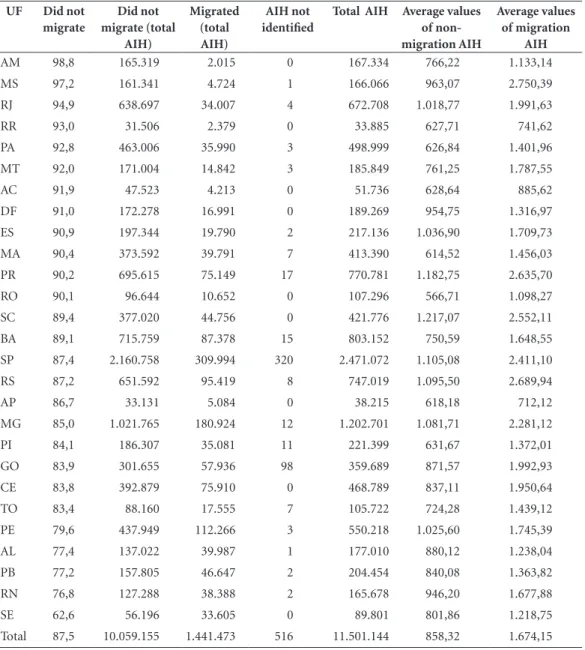
In terms of virtuous systemic rationality, de-spite asymmetries in the distribution of resourc-es in larger aggregations, Table 1 summarizresourc-es the AIH distributions calculated from the HRs and consolidated by UF. The dominant pattern is the non-migration of public system customers. Non-migration means that these clients were serviced in one of the 438 health regions. These results are reproduced for all MRs and for most HRs. In addition, the mean values of AIHs that migrated are markedly higher in all UFs. Thus, there is a stabilization where cases of greater complexity are attended at hubs.
Table 2 shows that data consolidated by ICD-10 chapters for the mean AIH values of migra-tion out of HRs were always higher in all MRs and according to their chapters. This shows the regional capacity to meet, at least in part, its hos-pital demand and to distribute cases of greater complexity to other regions. This rationality in hospitalizations spreads throughout more than 80% of HRs. As will be seen later, in terms of re-gionalization, the binomial physicians-hospitals seem to work better than the other health re-sources studied, although the national distribu-tion of hospital beds and diagnostic-therapeutic resources is also known to be asymmetric3.
The mean value of AIH represents the de-gree of complexity of the hospital services used, in an indirect form of case-mix. Figure 1 shows that the heterogeneity in terms of health care re-sources in each HR appears in a generalized way according to the distribution of the coefficients
of variation of the AIH mean values. There is a strong positive correlation between higher AIH mean values and higher coefficients of variation in all HRs, and this process is more intense in re-gions with higher resources, as is the case of the South and Southeast of the country.
In all HRs, the mean AIH values express very high coefficients of variation, which shows het-erogeneity and imbalances within HRs. This is a serious challenge to outline regional profiles. This is due not only to aspects associated with devel-opment, but also to the availability of reference services within HRs. Somehow, this is expected in terms of regional balance and the fact that mi-gration outside the HRs has a selective character suggests the existence of a regionalization logic.
Regarding RRT, which is another user supply and mobility tracer, data collected by HR show large gaps in the provision of these services in the public system regarding renal failure. Data ana-lyzed by MR, UF and HR converge in the same direction, following their socioeconomic charac-teristics.
For 2014, 1,646,855 RRT sessions were reg-istered outside the home health regions, which were distributed over 293 HRs and SUS total expenditure in this case was R$ 299,799,304.37. On the other hand, 11,525,743 RRT sessions were registered within the home HR, which were dis-tributed over 297 HRs,with SUS total expendi-ture of R$ 2,084,029,418.00
Thus, 142 HRs did not register RRT sessions or the referrals of users with acceptance to oth-er regions. Thoth-ere is a clear access barrioth-er. It is expected that, due to the nature of renal failure and the indication of RRT, the user will seek care even in regions farther from his home. Although several small-sized municipalities may not have reported renal failure cases, data shown here sug-gest that, in 142 HRs (a scale above 20 million in-habitants), diagnosis and case referrals represent a gap of the public system.
R
ib
eir
for plans in the Southeast (500) attest to the pos-sibility of organizing health services and shar-ing with the private sector. The huge differences between means and medians in all MRs and for both indicators reinforce the thesis of the high variability among HRs. This should be under-stood as a further challenge for the construction of HRs profiles.
In exploratory terms, analyses were performed to define HR profiles. Table 4 shows results of analyses performed among tracers with regard to the variable availability of physicians per
inhab-itant and the relationship between the variables was measured through Spearman’s Correlation Coefficient. It is noted that, in all cases, there are positive correlations of indicators of equipment, existence of private health insurance and complex hospitalizations. However, there are important variations between these correlations, and the ra-tio between the coefficient of medical plans per inhabitant and the availability of physicians per inhabitant is the strongest (87.6%). These associa-tions should be seen on an exploratory basis since, although they were significant, some were weak.
Table 1. Distribution of AIH by migration in health regions and by Federal Units, 2013
UF Did not
migrate
Did not migrate (total
AIH)
Migrated (total AIH)
AIH not identified
Total AIH Average values
of non-migration AIH
Average values of migration
AIH
AM 98,8 165.319 2.015 0 167.334 766,22 1.133,14
MS 97,2 161.341 4.724 1 166.066 963,07 2.750,39
RJ 94,9 638.697 34.007 4 672.708 1.018,77 1.991,63
RR 93,0 31.506 2.379 0 33.885 627,71 741,62
PA 92,8 463.006 35.990 3 498.999 626,84 1.401,96
MT 92,0 171.004 14.842 3 185.849 761,25 1.787,55
AC 91,9 47.523 4.213 0 51.736 628,64 885,62
DF 91,0 172.278 16.991 0 189.269 954,75 1.316,97
ES 90,9 197.344 19.790 2 217.136 1.036,90 1.709,73
MA 90,4 373.592 39.791 7 413.390 614,52 1.456,03
PR 90,2 695.615 75.149 17 770.781 1.182,75 2.635,70
RO 90,1 96.644 10.652 0 107.296 566,71 1.098,27
SC 89,4 377.020 44.756 0 421.776 1.217,07 2.552,11
BA 89,1 715.759 87.378 15 803.152 750,59 1.648,55
SP 87,4 2.160.758 309.994 320 2.471.072 1.105,08 2.411,10
RS 87,2 651.592 95.419 8 747.019 1.095,50 2.689,94
AP 86,7 33.131 5.084 0 38.215 618,18 712,12
MG 85,0 1.021.765 180.924 12 1.202.701 1.081,71 2.281,12
PI 84,1 186.307 35.081 11 221.399 631,67 1.372,01
GO 83,9 301.655 57.936 98 359.689 871,57 1.992,93
CE 83,8 392.879 75.910 0 468.789 837,11 1.950,64
TO 83,4 88.160 17.555 7 105.722 724,28 1.439,12
PE 79,6 437.949 112.266 3 550.218 1.025,60 1.745,39
AL 77,4 137.022 39.987 1 177.010 880,12 1.238,04
PB 77,2 157.805 46.647 2 204.454 840,08 1.363,82
RN 76,8 127.288 38.388 2 165.678 946,20 1.677,88
SE 62,6 56.196 33.605 0 89.801 801,86 1.218,75
Total 87,5 10.059.155 1.441.473 516 11.501.144 858,32 1.674,15
e C
ole
tiv
a,
22(4):1031-1044,
2017
In order to reduce dimensionality, we per-formed a factorial analysis and we observed that variances of the tracer group are not simply re-ducible to substitutive factors.
Despite the limits indicated, there is rele-vance in the positive and significant correlations between all indicators and explanations can be elaborated for these observations. The availabil-ity of physicians in HRs, especially in the less developed and farther away from large urban centers, can occur without the availability of high complexity diagnostic resources and only the complexity levels of hospital admissions, which form a predictable pair of resources in the HRs. What can be deduced from the analysis of these tracers is that HRs have high diversity of
resourc-es and their distribution is heterogeneous. If on the one hand, this speaks in favor of the need for greater political action to equalize the supply of services and their sharing in the HRs, on the oth-er hand, it evidences the political hardships to compensate for the inequitable allocative profile of these markets.
Considering the positive correlations be-tween the variables in Table 4, we performed a factorial analysis to verify the existence of factors that replace the indicators of health care resourc-es in HRs for purposresourc-es of subsequent compar-ison with indicators of socioeconomic develop-ment. According to literature, these operate as variables that affect the HRs positions in terms of these resources. Variables included in the matrix
Table 2. Distribution of mean values of AIH by migration to health regions and by major regions and ICD, Brazil, 2013.
ICD Yes No Yes No Yes No Yes No Yes No
I
M
id
w
est
1.693,93 722,03
N
o
rthe
ast
1.600,75 591,23
S
ou
th
2.391,22 1.224,67
No
rt
h
1.350,39 517,29
S
ou
the
ast
2.561,37 1.488,64 II 2.056,96 1.378,84 2.544,38 1.756,31 2.220,62 1.680,97 1.616,48 1.264,56 2.446,31 1.628,78
III 804,95 447,47 848,04 433,60 3.125,52 561,32 568,71 396,37 1.442,00 566,96
IV 933,55 438,95 955,07 494,93 3.539,22 893,83 971,37 494,70 2.060,60 595,53
V 894,53 827,81 1.056,76 994,75 1.013,49 865,96 777,22 651,51 1.053,40 959,60
VI 1.512,44 1.283,75 1.556,96 1.054,75 1.675,78 1.164,94 1.690,94 945,58 2.003,22 1.446,19 VII 1.825,04 988,83 1.168,77 1.014,16 1.577,84 1.215,88 1.068,90 1.140,94 1.156,01 861,94 VIII 4.328,07 1.677,04 4.935,78 2.422,47 3.985,48 976,90 3.441,69 400,23 7.058,87 1.664,73 IX 4.293,62 1.892,29 3.075,71 1.423,63 4.787,01 2.152,83 2.903,12 1.228,37 4.722,48 1.934,43 X 1.530,38 875,68 1.886,26 799,81 1.876,75 953,25 1.371,77 690,41 1.680,92 1.019,46
XI 1.086,64 704,40 1.396,77 703,42 2.291,02 927,62 970,96 609,77 2.123,40 898,86
XII 817,91 635,57 753,25 543,74 794,33 551,64 728,42 484,61 708,83 528,83
XIII 3.481,72 1.596,73 1.527,90 1.062,33 3.337,00 2.195,48 1.656,79 898,38 2.462,89 1.498,41 XIV 1.399,86 515,90 1.328,78 581,53 3.220,19 744,12 977,45 423,34 2.577,35 692,19
XV 667,16 553,29 662,72 557,48 586,32 562,72 630,74 541,51 661,01 570,82
XVI 4.677,08 2.034,57 3.088,49 1.936,34 6.977,24 3.606,46 2.840,82 1.448,12 5.524,22 2.640,26 XVII 3.778,75 3.074,23 3.230,94 2.343,81 4.404,47 2.460,16 3.210,84 1.535,18 4.067,66 2.374,50 XVIII 1.117,69 624,59 927,83 656,63 1.472,78 985,78 1.297,94 727,43 1.062,28 726,95 XIX 1.556,46 911,08 1.325,55 935,14 2.168,80 1.226,77 1.128,04 751,20 1.931,75 1.085,73
XX 1.213,54 440,59 631,17 403,37 2.821,04 1.040,63 773,55 440,89 1.147,06 826,87
XXI 476,31 277,77 559,74 349,64 1.242,09 460,58 265,93 265,71 1.116,28 440,48
XXII - - - 66,32 -
R
ib
eir
Figure 1. Diagrams of dispersion of AIH mean values and coefficients of variation in the Health Regions by
major regions, Brazil, 2013.
Source: SIH/SUS/MS.
Midwest Northeast North
Southeast South
AIH mean values, health regions adjusted values y = AIH mean values, x = coefficients of variation
Table 3. Summary measurements for the number of physicians and private health insurance in HRsby major
regions, Brazil, 2015.
Physicians* North Northeast Southeast South Midwest Brazil
Total 57.074 266.388 794.160 258.191 103.813 1.479.626
Mean 1.268,31 2.002,92 5.190,59 3.796,93 2.661,87 3.378,14
Median 457 700 1.865 1.923 683 1.186
Minimum 69 108 112 565 45 45
Maximum 12.503 35.720 139.554 34.774 19.280 139.554
Per million inhabitants 3.260,54 4.709,82 9.261,82 8.833,03 6.722,67 7.235,96
Private health insurance* North Northeast Southeast South Midwest Brazil
Total** 1.818.929 6.747.733 30.588.815 7.066.435 3.141.095 9.363.007
Mean 40.420,64 50.734,83 397.257,34 03.918,16 82.660,39 12.958,83
Median 7.220 6.725 50.977 40.069 18.053 23.093
Minimum 506 750 500 6.267 563 500
Maximum 548.818 1.101.750 30.588.815 1.389.922 938.043 6.470.086
Per 100 inhabitants 10,39 11,93 35,67 24,18 20,34 24,14
Population*** 17.504.446 6.560.081 85.745.520 9.230.180 15.442.232 04.482.459
*Data calculated as per the 437 current Health Regions. **Totals do not include 11,368 for which there are no information on regions. ***Estimated population for 2015, IBGE.
e C
ole
tiv
a,
22(4):1031-1044,
2017
were the mean AIH values, proportional cover-age of health plans and the number of physicians, mammography, MRI and conventional ultraso-nography equipment, all of them per million in-habitants. Six factors were generated, the differ-ences observed were significant and three of them showed positive values and considered according to the usual criteria (kaiser). Regarding the calcu-lated eigenvalues, factor 1 is responsible for the highest matrix variance load (2.25888) and the highest total variance relative weight (1.0116). As for factor loads, only factor 1 resists the criterion above 0.5 in relation to the six variables includ-ed in the model. If we apply the stricter criterion of 0.7, we will notice that this factor represents only the physicians and AIH mean values vari-ables. The table becomes clearer when analyzing the specificities (error), where (by the maximum limit rule at 0.5) both physicians and AIH means are accepted as represented by factor 1. This cov-ers the fact that the criterion of factor loads are set at 50% or 70%.
Therefore, only factor 1 would be accept-able to explain matrix variance. However, its use would be restricted to the distribution of physi-cians and mean AIH, following the 80.5% cor-relation shown in Table 4. This leaves out of the factor private equipment and insurance, which would have to undergo a new factor analysis, compromising the explanatory capacity of the analysis.
As the results show, the heterogeneity (vari-ances) is high and the development of models that are more comprehensive and alternative to those of health resources is required.
Final considerations
Decentralization of Brazilian federalism involves competition for tax and inductive resources, as
well as the imposition of barriers to access local services by neighbors or distant citizens. While there are many successful examples of regional cooperation, dynamics between cooperation and competition is one of the main failures in SUS implementation.
Cooperative federalism is a process that is contradictory and with no preset pathways. Co-operation between subnational and regional entities often takes place through a formalist ad-herence to a model that is politically appropriate. There is no evidence that cooperation has be-come a dominant pattern in Brazil, and the suc-cessful experiences of consortia, health districts and regional collegiates say more about mod-el potentials than a sustained and widespread pattern.Diverse factors should be considered as compromising the official cooperative rhetoric. These include mayor- and governor-centered investment decision; low accountability of fed-erative entities for the observed results; positive sum game for the Federal Government, states and municipalities by inertia in terms of health responsibility. SUS standards express a concep-tion of responsibility where the reciprocal coop-eration proclaimed hides direct and particular accountability.
Regional inequalities at all levels – major re-gions, federative units and health regions – are singled out by the specialized literature as a strik-ing fact of our health care system. Data present-ed and analyzpresent-ed in this paper corroborate these characteristics in relation to major regions and federal units and generate evidence to explain that inequality within HRs and between them-selves is intense and shows greater complexity and interweaving of services.
SUS regionalization is clearer in relation to the provision of hospital services and the avail-ability of hospitals seems to configure, along with that of physicians, the main sorting factor of the system in HRs. The movement of clientele migra-tion out of own HRs by highest degree of com-plexity of cases represents the main positive evi-dence observed here in terms of regional access resulting from government planning. However, in terms of HRs, local and regional inequalities are convergent to that highlighted by specialized literature.
Contrary to the hypothesis of a mutual charging of health care resources, by which hos-pitalizations, the availability of physicians and high complexity equipment and greater coverage of private health insurance would be, according to distribution, strongly correlated and
mutual-Table 4. Correlations between the selected indicators
and the availability of physicians per inhabitant in the HRs, Brazil, 2015.
Variables Correlation Coefficient
(Spearman)
Total mammography 0,6779
Total MRI 0,7356
Total US 0,3204
Plans coverage 0,8760
R
ib
eir
ly reinforcing, the HR study shows that this does not occur, at least comprehensively, due to the deep asymmetries between HRs in states and in major regions.
Correlations between these variables are pos-itive, but the level of association is diverse. De-spite this, the factorial analysis was not satisfac-tory in seeking substitutive factors of the set of variables associated to resources and production of services. The best factor adequately explains only the variables total AIH mean value and the availability of physicians per million inhabitants of HRs. This was also the strongest correlation observed. When the variable physicians was put in evidence, its relationship with private insur-ance and with availability of equipment was shown to be weaker.
The higher level of complexity of hospital services and physicians represent the main aggre-gate factor of distribution of health care
resourc-es. The availability of physicians is more associat-ed with the distribution of private insurance and does not necessarily bring the other diagnostic resources of greater complexity. This fact is con-sistent with the observed experience that physi-cians often arrive in HRs and in the municipali-ties before the remaining care resources.
e C
ole
tiv
a,
22(4):1031-1044,
2017
References
1. Brasil. Decreto nº 7.508, de 28 de junho de 2011. Regu-lamenta a Lei no 8.080, de 19 de setembro de 1990, para dispor sobre a organização do Sistema Único de Saúde - SUS, o planejamento da saúde, a assistência à saúde e a articulação interfederativa, e dá outras providências.
Diário Oficial da União 2011; 29 jun.
2. Fiocruz. Análise da Implementação Nacional do Con-trato Organizativo da Ação Pública (COAP), 2013-2016
[relatório de pesquisa]. Rio de Janeiro: Fiocruz; 2016. 3. Ribeiro JM. Desenvolvimento do SUS e
racionamen-to de serviços hospitalares. Cien Saude Colet 2009; 14(3):771-782.
4. R Core Team. R: A language and environment for sta-tistical computing. Vienna: R Foundation for Statistical Computing; 2016.
5. Hamilton A, Madison J, Jay J. The Federalist Papers. New York: Signet Classics; 2003.
6. Dahl R. Um Prefacio à Teoria Democrática. Rio de Ja-neiro: Jorge Zahar; 1989.
7. Lijphart A. Patterns of Democracy: government and
per-formance in thirty-six countries. New Haven: Yale
Uni-versity; 1999.
8. Costa-Font J, Greer SL, editors. Federalism and
decen-tralization in European health and social care. London:
Palgrave/Macmillan; 2013
9. Fleury S, Ouverney AM. Gestão de Redes: A Estratégia
de Regionalização da Política de Saúde. Rio de Janeiro:
Editora FGV; 2007.
10. Ribeiro JM, Alcoforado F. Mecanismos de governança e o desenho institucional da Secretaria de Saúde do Mu-nicípio do Rio de Janeiro (RJ), Brasil. Cien Saude Colet
2016; 21(5):1339-1349.
11. Moreira MR, Escorel S. Conselhos Municipais de Saúde do Brasil: um debate sobre a democratização da políti-ca de saúde nos vinte anos do SUS. Cien Saude Colet
2009; 14(3):795-805.
12. Moreira MR. Reflexões sobre democracia deliberativa: contribuições para os conselhos de saúde num contex-to de crise política. Saúde em debate 2016; 40(n. espe-cial):25-38.
13. Nunes E. A Gramática Política do Brasil. Rio de Janeiro: Zahar Editor; 1997.
14. Abrúcio FL. Para além da descentralização: os desafios da coordenação federativa no Brasil. In: Fleury S, or-ganizador. Democracia, Descentralização e Desenvolvi-mento: Brasil & Espanha. Rio de Janeiro: FGV Editora; 2006. p. 77-125.
15. Arretche M, Marques E. Municipalização da saúde no Brasil: diferenças regionais, poder de voto e estratégias de governo. Cien Saude Colet 2002; 7(3):455-479. 16. Viana ALA, Lima LD, Ferreira MP. Condicionantes
estruturais da regionalização na saúde: tipologia dos Colegiados de Gestão Regional. Cien Saude Colet 2010; 15(5):2317-2326.
17. Lima LD, Queiroz LFN, Machado CV, Viana ALA. Des-centralização e regionalização: dinâmica e condicio-nantes da implantação do Pacto pela Saúde no Brasil.
Cien Saude Colet 2012; 17(7):1903-1914.
18. Travassos C, Oliveira EXG, Viacava F. Desigualdades geográficas e sociais no acesso aos serviços de saúde no Brasil: 1998 e 2003. Cien Saude Colet 2006; 11(4):975-986.
Collaborations
Authors worked together on the design and out-line of this paper; JM Ribeiro was responsible for writing this paper and analyzing and interpreting data; MR Moreira, AM Ouverney and CFP Silva were responsible for the critical review of the text.
Acknowledgements
R
ib
eir
19. Viacava F, Bellido JG. Condições de saúde, acesso a ser-viços e fontes de pagamento, segundo inquéritos domi-ciliares. Cien Saude Colet 2016; 21(2):351-370. 20. Piola SF, França JRM, Nunes A. Os efeitos da Emenda
Constitucional 29 na alocação regional dos gastos pú-blicos no Sistema Único de Saúde no Brasil. Cien Saude Colet 2016; 21(2):411-421.
21. Gadelha CAG, Machado CV, Lima LD, Baptista TWF. Saúde e territorialização na perspectiva do desenvolvi-mento. Cien Saude Colet 2011; 16(6):3003-3016. 22. Cordeiro H. Descentralização, universalidade e
equi-dade nas reformas de saúde. Cien Saude Colet 2001; 6(2):319-328.
23. Ribeiro P. A descentralização da ação governamental no Brasil dos anos noventa: desafios do ambiente po-lítico-institucional. Cien Saude Colet 2009; 14(3):819-828.
24. Dain S, Faveret ACS, Cavalcanti CE, Carvalho D, Qua-dros WL. Avaliação dos impactos de reforma tributária sobre o financiamento da saúde. In: Negri B, Ferrato G, organizadores. Radiografia da Saúde: 2001. Campinas: Editora Unicamp; 2001. p. 233-288.
25. Lima LD. Conexões entre o federalismo fiscal e o fi-nanciamento da política de saúde no Brasil. Cien Saude
Colet 2007; 12(2):511-522.
26. Trevisan LN, Junqueira LAP. Construindo o “pacto de gestão” no SUS: da descentralização tutelada à gestão de rede. Cien Saude Colet 2007; 12(4):893-902. 27. Vilaça EV. As redes de atenção à saúde. Cien Saude Colet
2010; 15(5):2297-2305.
28. Brasil. Lei 11.107, de 6 de abril de 2005. Dispõe sobre normas gerais de contratação de consórcios públicos e dá outras providências. Diário Oficial da União 2005; 7 abr.
29. Ribeiro JM, Costa NR. Regionalização da assistência à saúde no Brasil: os consórcios municipais no Sistema Único de Saúde (SUS). Planejamento e Políticas Públi-cas 2000; 22:173-220
30. Neves LA, Ribeiro JM. Consórcios de saúde: estudo de caso exitoso. Cad Saude Publica 2006; 22(10):2207-2217.
31. Brasil. Lei Complementar nº 141, de 13 de janeiro de 2012. Regulamenta o § 3º do art. 198 da Consti-tuição Federal para dispor sobre os valores mínimos a serem aplicados anualmente pela União, Estados, Dis-trito Federal e Municípios em ações e serviços públicos de saúde; estabelece os critérios de rateio dos recursos de transferências para a saúde e as normas de fiscaliza-ção, avaliação e controle das despesas com saúde nas 3 (três) esferas de governo; revoga dispositivos das Leis nos 8.080, de 19 de setembro de 1990, e 8.689, de 27 de julho de 1993; e dá outras providências. Diário Oficial da União 2012; 16 jan.
32. Ribeiro JM, Moreira MR. A crise do federalismo coope-rativo nas políticas de saúde no Brasil. Saúde em debate
2016; 40(n. especial):14-24.
Article submitted 06/06/2016 Approved 04/08/2016