A Work Project, presented as part of the requirements for the Award of a Master’s degree in Management from the Nova School of Business and Economics.
THE IMPACT OF INFLUENCER MARKETING ONTO PORTUGUESE CONSUMERS’ VALUE PERCEPTIONS AND PURCHASE INTENTIONS
TOWARDS PREMIUM BEAUTY BRANDS
ANA MARIA LOPES CHAVES, 25950
Work project carried out under the supervision of: Prof. Sofia Kousi
Abstract
The impact of influencer marketing onto Portuguese consumers’ value perceptions and purchase intentions towards premium beauty brands
Motivated by the rising practice of influencer marketing in the beauty industry, this study aims to understand the impact of Social Media Influencers (SMIs) onto Portuguese consumers’ brand value perceptions, purchase intentions and willingness to pay. Through an experimental approach and development of an online survey, a sample of 117 individuals was obtained, whom were either exposed to an Instagram post from the chosen brand or the SMI. The results were not significant, both groups having similar value perceptions, purchase intentions and willingness to pay. Respondents’ perceptions towards the SMI and brand-imagery fit significantly impacted value perceptions and purchase intentions.
Key Words: Influencer marketing, brand value perceptions, purchase intentions, beauty
market
This work used infrastructure and resources funded by Fundação para a Ciência e a Tecnologia (UID/ECO/00124/2013, UID/ECO/00124/2019 and Social Sciences DataLab, Project 22209), POR Lisboa (LISBOA-01-0145-FEDER-007722 and Social Sciences DataLab, Project 22209) and POR Norte (Social Sciences DataLab, Project 22209).
Contents
Abstract ... 1
Contents ... 2
Introduction and Motivation ... 3
Research Questions and Hypotheses ... 4
Literature Review ... 5
The Beauty Market ... 5
Social Media, Social Media Influencers (SMIs) and Masstige Brands ... 6
Methodology ... 10
Research Design and Data Collection ... 10
Data Sample ... 11
Metrics ... 12
Results and Analysis ... 12
Discussion and Theoretical Implications ... 16
Managerial Implications ... 19
Limitations and Future Research ... 20
Conclusion ... 22
References ... 22
Appendix ... 24
Appendix 1: Distributed Survey ... 24
Appendix 2: Sample Demographics ... 27
Appendix 3: Independent t-test results subject to respondents having been exposed to the SMI or the Dior brand post. ... 28
Appendix 4: Percentage Distributions – Personal associations towards the SMI ... 30
Appendix 5: Percentage Distributions – Brand-imagery fit towards the SMI ... 33
Appendix 6: Mean values for items rating the SMI ... 35
Appendix 7: Independent t-test results subject to respondents’ rating of the influencers’ fit with Dior. ... 36
Appendix 8: Independent t-test results subject to whether respondents personally liked the SMI. ... 38
Introduction and Motivation
Nowadays, influencers have transformed the way brands communicate and engage with consumers, together with brand image and consumers’ brand value perceptions (Launchmetrics, n.d.). Consumers who are more susceptible to normative influence develop stronger positive brand attitudes, indicating social influence as an important driver of purchase decisions (Ko & Megehee, 2012). It is crucial for a brand to choose the right influencer, as this decision will impact consumers’ brand value perceptions and affect brand image (Bovykina Katya, 2015; Sharma & Albus, 2017). Choosing the wrong influencer to associate a brand with may lead to “loss of perception of exclusivity” and “dilution of brand image” (Qian & Park, 2018). Consequently, brands should choose endorsers who feature the qualities they would like to be seen transferred to their products (Khamis, Ang, & Welling, 2017; Zafer, 2010).
The use of celebrities as a marketing communication tool has become a common practice for many firms as a supporting tool of brand image (Zafer, 2010). Nonetheless, there is still limited research on this practice, particularly, in what concerns the effect of Social Media Influencers (SMIs) other than celebrities onto consumers’ brand value perceptions, purchase intentions and willingness to pay, in platforms other than YouTube. Nowadays, SMIs are most popular on Instagram (Dhanesh & Duthler, 2019), and have been found to successfully influence consumers’ purchase intentions, who consider these “Instafamous” people to be credible and relatable (Djafarova & Rushworth, 2017). Despite being considered “one of the fastest-growing online photo social web services”, research focused on Instagram is still limited (Dhanesh & Duthler, 2019).
Beauty brands have been amongst the most successful in leveraging influencer marketing (Edelson, 2017), allowing them to “generate brand awareness, boost sales and build brand loyalty” (Launchmetrics, n.d.). Within this market, premium brands have
been growing at a rate five times higher than mass market brands, enjoying high perceptions of prestige and an aspirational image, whilst maintaining a reasonable price premium (Launchmetrics, n.d.). This behavior is in accordance with that of masstige brands, which possess high levels of quality and “command a premium over ordinary products – but are priced well below conventional luxury goods” (Kastanakis & Balabanis, 2012). Masstige brands are seen as “substantially closer to traditional luxury brands in terms of perceived prestige, and substantially closer to middle-range brands in terms of price premium” (Truong, McColl, & Kitchen, 2009). Given the presented literature, this research will therefore consider premium beauty brands to behave in accordance with masstige beauty brands, hence being possible to categorize them as such. The study will focus on this market segment, being one of its objectives to understand how SMIs other than celebrities will affect consumers’ perception of brand prestige, possibly placing the masstige beauty brand closer to a mass market brand.
With this being said, motivation for this research lies in attempting to fill gaps in research, investigating the impact of SMIs who have become known over the internet, share a great deal of their lives with their followers and are seen as highly relatable (Dhanesh & Duthler, 2019) onto Portuguese consumers’ brand value perceptions, purchase intentions and willingness to pay towards masstige beauty brands. Research aims to understand the impact onto masstige beauty brands’ image – which aim to remain perceived as prestigious and aspirational – of associating themselves with an ordinary individual – rather than a luxurious celebrity – whilst focusing on Instagram.
Research Questions and Hypotheses
The goal of the current research is to uncover the effect of SMIs both on 1) consumers’ brand value perceptions of masstige beauty brands (as perceived trustworthiness, quality, uniqueness, prestige, exclusivity, rarity and attainability), and 2) the consequent effects
of these perceptions on purchase intentions and willingness to pay, exposing two respondents’ groups to either an Instagram post from the masstige beauty brand Dior, or from one of the brand’s endorsers, SMI Camila Coelho.
In order to answer the formulated research questions, three hypotheses were formulated:
H1: Consumers’ brand value perceptions will be lower in case the respondent was
exposed to the Instagram post created by the chosen SMI instead of by the brand Dior.
H2: Consumers’ purchase intentions will be higher in case the respondent was exposed
to the Instagram post created by the chosen SMI instead of by the brand Dior.
H3: Consumers’ willingness to pay for the product presented in the Instagram post, will
be lower in case the respondent was exposed to the Instagram post created by the chosen SMI instead of by the brand Dior.
Based on existing literature, it is my current belief that the presented hypotheses will be confirmed, reflecting the fact that SMI’s endorsement will affect consumers’ value perceptions, namely lowering value dimensions as exclusiveness, rarity, uniqueness and prestige whilst possibly increasing trustworthiness and attainability. Previous research indicates that consumers’ purchase intentions are influenced by SMIs when they find them relatable and credible (Djafarova & Rushworth, 2017), therefore increasing them. It is also my belief that willingness to pay will be lower in case the displayed post was by the SMI, passing on a perception of higher accessibility and consequently attainability.
Literature Review
The Beauty Market
The beauty market can be divided within mass market and premium segments, according to brand prestige, price and distribution channel (Łopaciuk & Łoboda, 2013). Given their selective distribution channels, price premium being charged and prestigious environment surrounding them, beauty brands as Dior, Chanel, Yves Saint Laurent, Estée
Lauder and Lancôme belong to the premium segment of this market, having been considered amongst the most influential (Vogue Paris 2019).
Masstige brands belong to a category that lies between mass-market and exclusivity, adopting an innovative strategy that combines prestigious positioning – similar to that of traditional luxury brands – with a reasonable price premium, being accessible to the middle-class consumer, but solely on occasional basis – so that they remain aspirational and appealing and do not risk brand dilution. For this purpose, masstige brands go through substantial lengths to create a prestigious environment around them: namely when it comes to their distribution channels and advertising (Truong et al., 2009). With this being said, it is possible to infer that premium beauty brands have a strategic positioning which allows to characterize them as masstige brands. Given the nature of the beauty market, the price premiums being charged are reasonable so that middle-class consumers can, on occasion, purchase them – going hand in hand with consumption patterns of masstige brands. Additionally, masstige goods can be found in shopping malls or department stores, being “positioned as luxury on those channels” (Kastanakis & Balabanis, 2012), which coincides precisely with the distribution channels of premium beauty brands.
Endorsement has become prevalent in the beauty industry, enabling brands to further reach digitally native consumers, generate brand awareness, boost sales and build brand loyalty. Research shows that 63% of millennials are more likely to trust a SMI’s opinion or user reviews instead of brand generated claims. Beauty brands have had to develop digital marketing strategies that are “capable of generating brand awareness, incrementing sales and building brand loyalty, all at the same time” (Launchmetrics, n.d.).
Social Media, Social Media Influencers (SMIs) and Masstige Brands
Determining the right level of brand-consumer engagement in the online environment without jeopardizing brand value is challenging for masstige brands, as they risk diluting
their exclusivity and aspirational nature (Sharma & Albus, 2017; Truong et al., 2009). A high level of brand-consumer engagement leads to lower psychological distance of the brand, and consequently lower value perceptions by consumers, as social status, uniqueness and quality. This is in accordance with The Construal Level Theory of Psychological Distance (CLT) that suggests that the more distant an object is perceived by an individual, the higher the individual’s construal of it (Park, Im, & Kim, 2018). High levels of entertainment, word of mouth and interaction, characteristic of high-engagement on social media, were found to positively impact purchase intentions for luxury fashion brands (Ko, Costello, & Taylor, 2019). Nonetheless, whilst consumers have higher purchase intentions and loyalty towards brands with high engagement on social media, this does not necessarily translate onto higher brand perceptions (Park et al., 2018). The rapid growth of the media environment constitutes a challenge to traditional media, posing as a new opportunity for brands, enabling users to actively participate in building them (Abidin & Ots, 2015; Dhanesh & Duthler, 2019). Online media is a consumer-centric space in which individuals “actively and autonomously seek out resources they are most interested in” (Khamis et al., 2017). Social media “embraces democracy, diversity and puts everyone on a level platform” (Sharma & Albus, 2017). This led to the rising of SMIs: users previously perceived as just “brand enthusiasts” now see their role institutionalized and engage in endorsing activities with companies (Abidin & Ots, 2015). There are many definitions for what is a SMI. SMIs are opinion leaders that engage in self-presentation on social media, through the creation of online content and sharing of their everyday lives, to attract followers (Dhanesh & Duthler, 2019). They can be defined as “a person who, through personal branding, builds and maintains relationships with multiple followers on social media, and has the ability to inform, entertain, and potentially influence followers’ thoughts, attitudes, and behaviors” (Freberg, Graham, McGaughey,
& Freberg, 2011). SMIs vary on the number of followers – whilst some have more than 1 million followers, micro-influencers can have as little as 10,000. SMIs are different from celebrity endorsers: they are more effective in creating a link with products, as companies have more power in shaping their “persona” (Zafer, 2010). Besides they are seen as more credible, reliable, authentic, accessible and relatable, and more effective in shaping buying intentions (Dhanesh & Duthler, 2019; Djafarova & Rushworth, 2017).
The use of celebrities as a marketing communication tool has become usual for companies (Zafer, 2010). The appearance of “YouTube celebrities” has provided brands with an additional tool to connect with consumers (Lee & Watkins, 2016). The existence of an influencer-follower relationship is positively related to behavioral intentions in terms of purchase and positive e-WOM – word of mouth through online channels – from the consumer (Dhanesh & Duthler, 2019; Djafarova & Rushworth, 2017). Research shows that consumers perceive e-WOM as more credible and relevant than company-generated content, its effectiveness being conditioned by the perceived credibility of the message transmitters (Djafarova & Rushworth, 2017; Godey et al., 2016).
Identifying the right influencer is considered the most important and challenging element of the endorsement for a brand (Edelson, 2017; Zafer, 2010), as consumers associate it with the endorser, adding his/her dimensions of attractiveness, trustworthiness and credibility onto the brand itself (Djafarova & Rushworth, 2017). Choosing the right endorser is key for masstige brands as they “enjoy a reasonable level of perceived prestige which differentiates them from middle-range products” (Truong et al., 2009).
Different theories have been used to explain SMIs’ impact on consumer value perceptions and purchase intentions. Following the Social Comparison Theory, when exposed to vlog content (YouTube videos similar to a blog post being conducted in video format), consumers compare themselves to vloggers and seek to reach their social status
– therefore being motivated to purchase what they possess (Lee & Watkins, 2016). By choosing SMIs that consumers identify with, brands can enhance brand value (overall evaluation of worth of the brand) and band-user imagery fit (match between the consumer and the brand), in turn positively impacting purchase intentions (Lee & Watkins, 2016). The Source Attractiveness Model places the endorser’s physical characteristics as key in shaping consumers’ beliefs and generating purchase intentions (Zafer, 2010). Building on this, the Source Credibility Model explains that an endorsement’s effectiveness depends upon the endorser’s attractiveness, level of expertise and trustworthiness, which in turn influence the consumer’s beliefs and behaviors (Djafarova & Rushworth, 2017; Zafer, 2010). It has been shown that source attractiveness, expertise and trustworthiness build an endorser’s credibility and impact both consumers’ attitudes towards advertising and brand attitudes. While attractiveness positively impacted attitude towards the advertisement consumers were exposed to, trustworthiness and expertise directly impacted consumers’ brand attitudes (Bhatt, Jayswal, & Patel, 2013).
Choosing the wrong SMI may lead to “loss of perception of exclusivity” and “dilution of brand image” (Qian & Park, 2018), in turn negatively affecting consumers’ purchase intentions (Salehzadeh & Pool, 2017). According to the Cognitive Dissonance Theory, when individuals experience dissonance they change their attitudes or behaviors. As such, when a brand collaborates with an influencer who causes dissonance, this negatively impacts consumers’ behaviors (Qian & Park, 2018), which happens when the SMI is seen as having an “inconsistent” image with the brand (Radón, 2012; Zafer, 2010). A study on the Chinese market uncovered that consumers’ perception of the lack of fit between the SMI and the brand hurt brand value perceptions and led to criticism (Qian & Park, 2018).
Companies invest large amounts of money to make sure they align their brands with the right endorsers (Zafer, 2010) and ultimately they should choose the ones who feature the
qualities they would like to be seen transferred to their products and who have desirable aspirational attributes (Khamis et al., 2017).
Methodology
Research Design and Data Collection
In order to answer research questions and test the corresponding hypotheses, an experimental research design was adopted, using an online self-administered, structured and anonymous survey, developed using Qualtrics. The original English survey (Appendix 1) was translated to Portuguese, as it was intended at Portuguese individuals.
Respondents were randomly assigned to one of two conditions depending on whether they were exposed to an Instagram post directly from the Dior brand (the Control Condition – group 0) or from the chosen SMI, Camila Coelho (the Experimental Condition – group 1). Camila Coelho is a Brazilian SMI with 8.5 million followers on Instagram, and was selected due to her significant audience and being one of Dior’s known endorsers, having several endorsed posts for the brand on her Instagram account, besides the one being used for this study. Both posts introduced Dior’s newest product, a lipstick called “Rouge Dior Ultra Care”. Respondents were presented with the same product picture in both scenarios, together with the same post description. The SMI post also included a picture of herself next to the product picture (Appendix 1). This practice enabled to evaluate whether being exposed to either a brand or endorsed post would change respondents’ brand value perceptions, purchase intentions and willingness to pay. Dior was the selected brand due to the fact that it can be considered one of the most recognizable and prestigious brands in the beauty industry, borrowing its high status from its origin in haute couture, back in 1947 (Vogue Paris, 2019; LVMH, 2019).
The survey was composed by eight blocks (Appendix 1). The second block included three screening questions, inquiring about respondents usage of Instagram, following of
SMIs and purchase habits towards premium beauty products. The survey was built so that the following questions would only appear if these were all answered with “Yes”. This allowed to select responses that would be relevant to analyze, as they belonged to masstige beauty consumers or prospective consumers whom were familiarized with and impacted by SMIs. To control for existing Dior brand value perceptions due to personal feelings or perceptions of brand-imagery fit towards the SMI, block 6 was created (and displayed only to the Experimental Condition). It inquired about respondents’ perceptions of the SMI as a person and of her role as Dior’s endorser. Previous research suggests that SMIs provoke a set of “associations” onto consumers, who can transfer them onto the brand being endorsed (Bhatt et al., 2013). The evaluated aspects included perceptions of social status, lifestyle and earning power, considered to be sources of celebrity fit (Bhatt et al., 2013) and presumed to apply to SMIs other than celebrities. Block 7 was dedicated to understanding respondents’ perceptions of Dior, inquiring about several dimensions of brand value perceptions – as trustworthiness, quality, uniqueness, prestige, exclusiveness and rarity – purchase intentions, and willingness to pay towards the product.
All the statistical analysis using the survey’s responses was conducted using SPSS.
Data Sample
This research’s sample was composed by Portuguese individuals. Whilst 452 responses were recorded in total, only 117 (25.88%) were considered valid and analyzed, as these passed the screening criteria. Within the 117 valid responses, 59 respondents were randomly allocated to the Control Condition and 58 to the Experimental Condition.
Females represented 86.3% of the sample and the most represented age group was 20-39 years old (72.6%). The majority of the respondents (46.2%) had finished their Bachelor’s degree at the time of response. Social-demographic information can be found in Appendix 2.
Metrics
Most of the questions employed throughout the survey were in matrix table format, in which a seven-point Likert Scale was used for respondents to rank their opinion in regards to different items, ranging from 1) Completely Disagree to 7) Completely Agree. In addition, some multiple choice questions and an open-ended question were also utilized.
To measure consumer perceptions of Dior (H1), respondents were asked to rate the brand according to how trustworthy, high quality, premium, prestigious, well-known, respected, exclusive, rare, high priced, unattainable, aspirational and unique they considered it. Purchase intentions (H2) were measured by asking respondents to rank items as “I am likely to buy a product from Dior in the near future (e.g. next 2 months)” and “I am likely to buy the product in the post – Rouge Dior Ultra Care from Dior in the near future (e.g next 2 months)”. Lastly, willingness to pay (H3), was measured by the open ended question “How much money, in euros, would you be willing to pay for the presented product, the lipstick Dior Rouge Ultra Care?”.
Results and Analysis
In order to test the hypotheses, an independent t-test was used on SPSS, comparing the means of the two conditions. The objective was to understand whether the mean values obtained across the two different conditions, Control (group 0) and Experimental (group 1), for the defined variables were statistically significantly different.
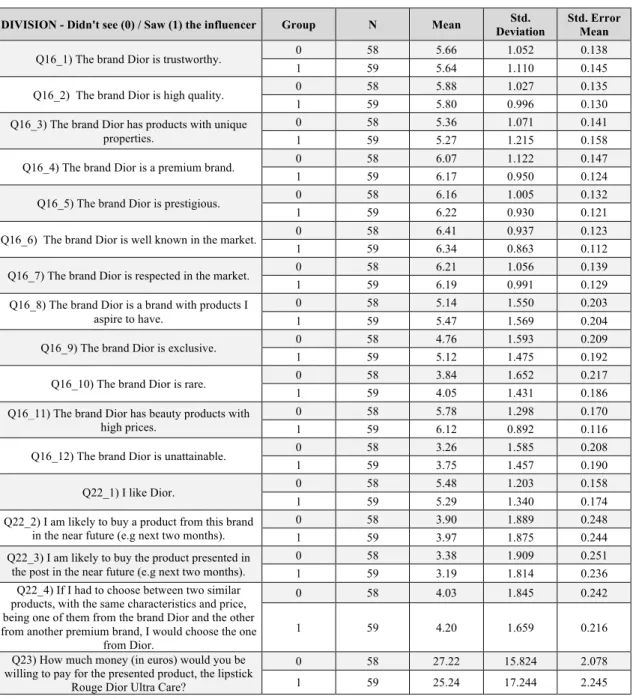
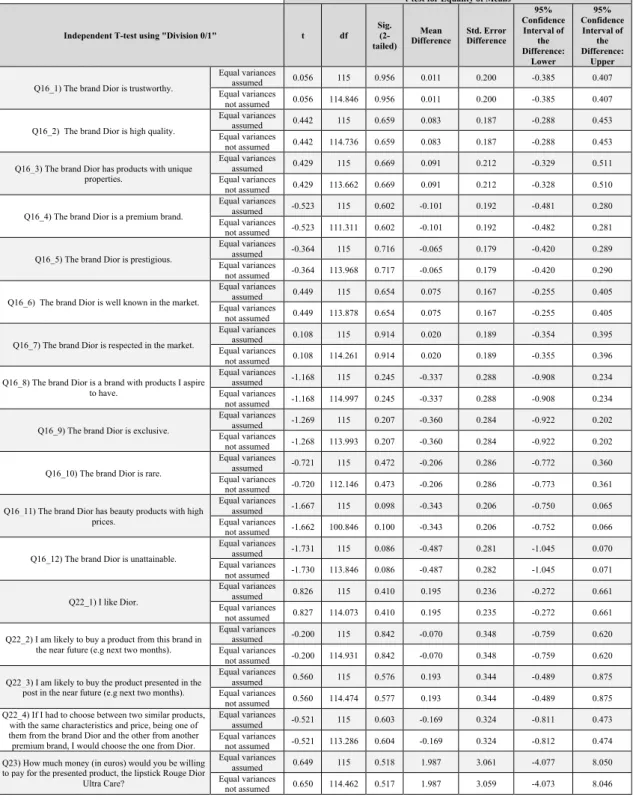
The independent t-test was performed for a total of 17 dependent variables, using as the independent variable whether respondents had been exposed to the brand post or endorsed post – so, if they belonged to the Control or the Experimental condition. The obtained results (Appendix 3, Table 2) indicate that, at a 5% significance level, the difference between the mean values of the responses of the Control and Experimental conditions was not significant, for any of the tested variables. When asked about if they overall liked
the brand Dior, participants in the Control condition, who saw the brand post, (MDior =
5.48, SD = 1.203) and in the Experimental condition, who saw the SMI post, (MInfluencer
= 5.29, SD = 1.340) claimed to equally like it: t (115) = 0.826, p = 0.410. Additionally, when asked about whether they would be likely to buy a product from the brand Dior in the near future, both the Control condition (MDior = 3.90, SD = 1.889) and the
Experimental condition (MInfluencer = 3.97, SD = 1.875) were found to be equally likely: t
(115) = -0.200, p = 0.842. A similar analysis was conducted for all the analysed dependent variables, with non-significant results (Appendix 3).
The fact that whether prospective customers were exposed to the product via the brand or the SMI, brand value perceptions, purchase intentions or willingness to pay are similar, points towards the conclusion that, in this case, the existence of a brand endorser did not add anything to the brand communication. Even though results were not significant, it is relevant to note that the Experimental condition (who saw the SMI post) presented higher mean values than the Control condition in most items measuring value perceptions, namely: Dior being prestigious (6.22 VS 6.16), exclusive (5.12 VS 4.76) and unattainable (3.75 VS 3.26). Group Statistics indicating the obtained mean values across groups for each item can be found in Appendix 3, Table 1.
It is unlikely that this result was tempered by the respondents’ own feelings towards the SMI (Appendix 4) as most claimed to neither like or dislike her (41%), presenting a mostly neutral set of associations towards her (MInfluencer = 4.69, SD = 1.329) (Appendix
6, Table 1), hence not being likely to transfer them onto the brand. Furthermore, 44% agreed or completely agreed (Top 2 box) that they would follow her, highlighting that dimensions as attractiveness, social status and expertise have a more significant weight on this decision than her being nice or trustworthy: 69.5% of the respondents agreed or completely agreed with the SMI being attractive, 45.7% that she seemed to have a high
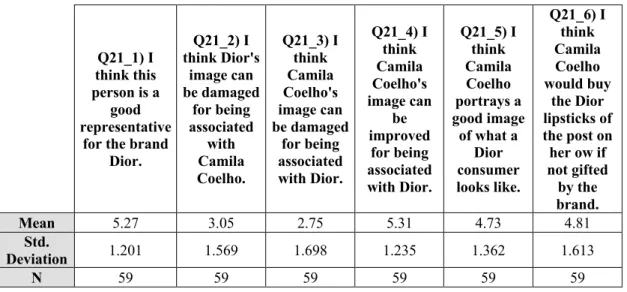
social status and 44.1% with her being an expert. However, 55.9% of respondents claimed to “neither agree or disagree” with her being trustworthy (Appendix 4). The SMI was believed to be a good brand representative (MInfluencer = 5.27, SD = 1.201) (Appendix 6,
Table 2) by 54.3% of respondents, either agreeing or completely agreeing, (Appendix 5) hence there not being a significant bias in results due to lack of brand-imagery fit with Dior. Whilst 30.5% of respondents totally disagree that the SMI’s image could be damaged by Dior, when asked about whether Dior’s image could be damaged for being associated with her, only 11.9% totally disagreed (Appendix 5). This suggests that Dior’s impact in terms of value is stronger than the SMI’s, pointing to unilateral benefits of the endorsement relationship.
Given the non-significance of the performed analysis, it was found to be important to examine the survey’s results through a different lens, paying specific attention to the respondents who saw the influencer (Experimental Condition). The idea would be to divide these respondents depending both on whether they rated the influencer’s fit with the brand Dior highly (answering with 6 or 7) or not, and if they personally liked the influencer a lot (answering with 6 or 7) or not. This would allow to understand whether these two aspects consequently influenced respondents’ brand value perceptions, purchase intentions and willingness to pay. To evaluate these two aspects, two binned variables were created, respectively, and two independent t-tests conducted on SPSS.
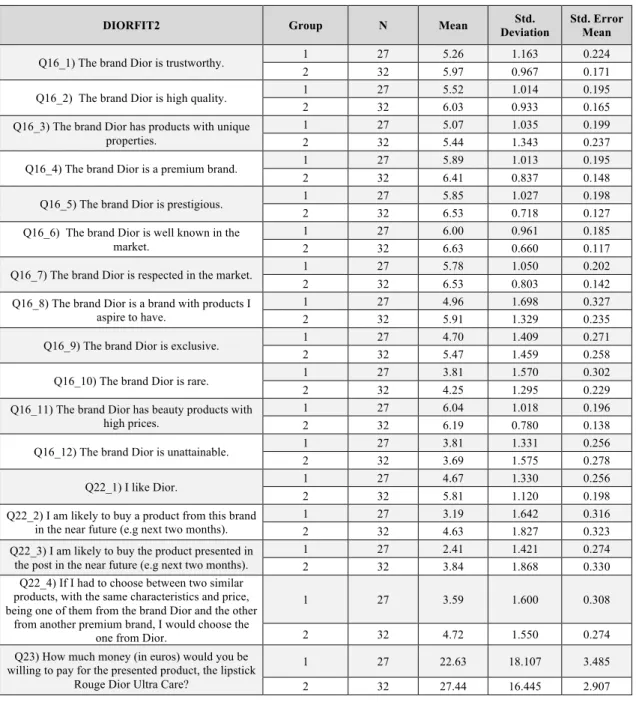
The conducted analysis allowed to conclude that, at 5% significance, how respondents’ ranked the influencer’s fit with the brand was capable of significantly impacting several aspects of brand value perceptions, increasing them from the respondent’s point of view (Appendix 7, Table 6). Individuals with high perceptions of fit considered the brand to be more trustworthy (M6,7 = 5.97, SD = 0.967) than those who did not share this perception
the brand being considered to be more prestigious ((M6,7 = 6.53, SD = 0.718) VS (M1-5 =
5.85, SD = 1.207) : t (57) = -2.980, p = 0.004) and exclusive ((M6,7 = 5.47, SD = 1.459)
VS (M1-5 = 4.70, SD = 1.409) : t (57) = -2.038, p = 0.046) when the SMI was found to
have good fit with the brand. In addition to several other dimensions (Appendix 7), a good perception of brand-imagery fit positively impacted respondents’ overall likability of the brand (M6,7 = 5.81, SD = 1.120) VS (M1-5 = 4.67, SD = 1.330) : t (57) = -3.593, p = 0.001).
Respondents’ assessment of the SMI having a good fit with the brand (M6,7= 4.63, SD =
1.827) significantly impacted purchase intentions, increasing them relatively to Dior’s products when in comparison with those who did not agree with it (M1-5= 3.19, SD =
1.642): t (57) = -3.273, p = 0.002). The same pattern was also verified in relation to the product presented in the post (Appendix 7). This leads for the conclusion that brand-imagery fit significantly influenced brand value dimensions and purchase intentions, reinforcing the importance of brands selecting SMIs with similar values to their own.
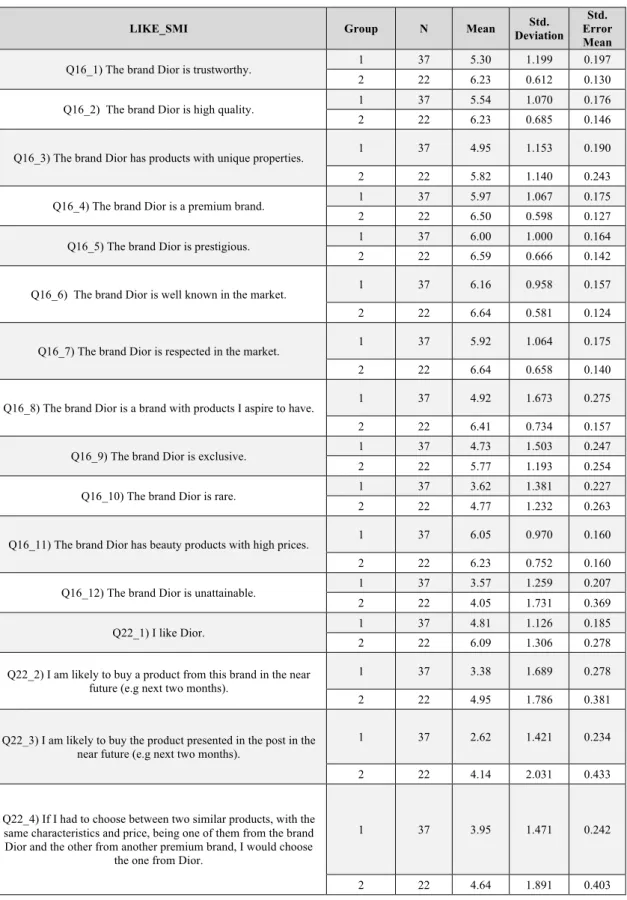
Respondents’ personal feelings and opinions towards the SMI were found to significantly impact several dimensions of brand value perceptions, signalling that more than worrying about brand-imagery fit, brands ought to pay attention to the overall likability of the SMIs they work with and how consumers will react towards them (Appendix 8). Similarly to what happened with brand-imagery fit, respondents who liked the SMI a lot ranked higher in all items of brand value perceptions, purchase intentions and willingness to pay in which impact was found significant. Dior was found to be more trustworthy ((M6,7 = 6.23, SD = 0.612) VS (M1-5 = 5.30, SD = 1.199) : t (57) = -3.378, p
= 0.001), prestigious ((M6,7 = 6.59, SD = 0.666) VS (M1-5 = 6.00, SD = 1.000) : t (57) =
-2.462, p = 0.009), exclusive ((M6,7 = 5.77, SD = 1.193) VS (M1-5 = 4.73, SD = 1.503) : t
(57) = -2.774, p = 0.007), and likable ((M6,7 = 6.09, SD = 1.306) VS (M1-5 = 4.81, SD =
((M6,7 = 4.95, SD = 1.786) VS (M1-5 = 3.38, SD = 1.689) : t (57) = -3.393, p = 0.001) and
willingness to pay ((M6,7 = 33.00, SD = 23.572) VS (M1-5 = 20.62, SD = 9.810) : t (57) =
-2.345, p = 0.027) were also higher in case respondents really liked the SMI (Appendix 8). Results reinforce the importance of brands associating themselves with influencers they believe their prospective customers will like and identify with.
Discussion and Theoretical Implications
Even though literature suggests that in general SMIs other than celebrities are more credible, relatable and effective in shaping buying intentions (Dhanesh & Duthler, 2019; Djafarova & Rushworth, 2017) this was not confirmed in the context of the brand examined in this study. Results show that, for Portuguese consumers contacting with a masstige beauty brand through Instagram, brand or SMI generated content yield brand value perceptions, purchase intentions and willingness to pay that are not significantly different. Several reasons may be offered as for why the obtained results were not significant. First off, it is important to take into account the features of the chosen SMI, Camila Coelho. Being her the only chosen SMI, it is possible that results would be different if the study ought to be conducted using other influencers. Even though it is unlikely that results were biased by respondents’ previous experiences with her, as 44% claimed to neither like or dislike her, it is still important to take into account the possibility that the 56% of respondents that answered differently were somewhat influenced in their responses by their own perceptions of her. Additionally, being that Camila Coelho has 8.5 million followers on Instagram, while she is not a traditional celebrity and has become known through social media, her audience is already significantly large to justify a low level of engagement and interaction between her and her followers. This may be one of the justifications as for why she did not fit in the category of relatable “Instafamous” people who were found to successfully influence consumers’ purchase intentions
(Djafarova & Rushworth, 2017). On the other hand, while her audience is possible large enough to create some distance between her and her followers, she was not found to be significantly powerful to impact a brand as prestigious as Dior, proving the endorsing relationship to have unilateral benefits. This is also possibly a reason as for why the study’s results were not found significant. Secondly, as Dior was the only brand studied, it is possible that respondents’ previous experiences with it influenced their responses. Thirdly, the analysis having been conducted on Instagram may be in the origin of the obtained results: unlike YouTube, on this platform contact between the follower and the endorser is more limited. The fact that respondents were solely exposed to one Instagram post may have possibly limited the endorser’s credibility, relatability and hence her ability to significantly impact value perceptions, purchase intentions and willingness to pay. Being contact more limited through Instagram, the relationship of a SMI with his/her followers is likely built through time and continued exposure to his/her content, which did not happen in this context. Lastly, as the majority of respondents were aged between 20-39 (72.6%), the sample does not fully being fully represent masstige beauty consumers, which may also be a reason as for why results were not significant.
The presented study adds to previous ones on the importance of brand-imagery fit of the SMI and the brand. Literature suggested that identifying the right influencer to partner up with is considered the most important and challenging element of the collaboration for a brand (Edelson, 2017; Zafer, 2010) due to the fact that consumers associate it with the endorser (Djafarova & Rushworth, 2017). As such, companies should choose endorsers who feature qualities they would like to be seen transferred to their products (Khamis et al., 2017; Zafer, 2010). Brand-user imagery fit impacts purchase intentions, which increase after the consumer is exposed to content of a vlogger with whom he/ she identifies (Lee & Watkins, 2016). The presented research supports this theory and extends
it onto endorsement via Instagram in the beauty market: results depict the significant positive impact that brand-imagery has in specific value perceptions – as trustworthiness, high quality, prestige and exclusiveness.
Secondly, results are congruent with the Source Credibility Model, claiming that endorsement effectiveness and consumers’ beliefs and behaviors depend on the endorser’s attractiveness, expertise and trustworthiness (Bhatt et al., 2013; Djafarova & Rushworth, 2017; Zafer, 2010). While 69.5% of respondents agreed or completely agreed with the SMI being attractive, 45.7% with her having high social status and 44.1% with her expertise, only 20.4% found her trustworthy. This suggests that, for masstige beauty brands, trustworthiness is not as important as attractiveness, social status or expertise.
The present research also supports the Social Comparison Theory. Previous studies focused on YouTube vloggers claimed that as consumers compare themselves to vloggers and seek to reach their social status, this translates onto enhanced brand perceptions. As such, brands should choose influencers that consumers can identify with (Lee & Watkins, 2016). Looking at the analysis that focused on how respondents ranked the likability of the SMI, it is possible to confirm that this same theory also applies to SMIs endorsing through Instagram posts, as respondents who liked the SMI a lot (answering with 6 or 7) displayed significantly higher mean values in items related to Dior’s value perceptions – as brand quality, prestige and exclusiveness – purchase intentions and willingness to pay. Moreover, it is possible to verify that overall likability of the SMI was capable of positively impacting more dimensions of brand value perceptions, purchase intentions and willingness to pay than brand-imagery fit.
On a final note, this research increases the current theoretical knowledge on masstige brands by building on the idea that premium beauty brands behave similarly to masstige brands. Looking at the items developed to access respondents’ value perceptions
(Appendix 3, Table 1), it is possible to confirm that premium beauty brands registered mean values ranked above 5 out of 7, for dimensions as trustworthiness, uniqueness, high quality, exclusiveness, being premium, aspirational and prestigious. Additionally, the mean value of 27.22€ obtained for willingness to pay shows that respondents are willing to pay a premium relatively to mass market brands. These conclusions support premium beauty brands behaving similarly to masstige brands, which are substantially closer to traditional luxury brands in terms of perceived prestige and substantially closer to middle-range brands in terms of price premium (Truong et al., 2009). In addition, indicators as rarity and unattainability having mean values lower than 4 out of 7, indicate a perception of accessibility, as happens with masstige brands – they are only occasionally accessible to the middle-class so that they remain positioned as aspirational (Truong et al., 2009). Furthermore, the fact that respondents in both the Control and the Experimental conditions depicted similar brand value perceptions, purchase intentions and willingness to pay suggests that SMI endorsement did not affect the masstige beauty brand’s positioning, not placing it closer to middle class brands.
Managerial Implications
Several relevant and useful considerations for masstige beauty brands’ managers can be taken. On a first note, the analysis revealed that, for the masstige beauty brand Dior, Instagram SMI endorsement had no significant impact onto respondents’ value perceptions – including trustworthiness, uniqueness, quality, exclusiveness, prestige and market recognition – purchase intentions or willingness to pay (Appendix 3). This indicates no apparent benefit of endorsement through SMIs for Dior, being this a time-consuming and costly process for the company. Consequently, managers should be more thoughtful of whether it is worth to perform this investment. Adding to this point, results revealed that indicators as perception of high price or attainability were not found
significant – indicating that it is not worth to hire a SMI, viewed as more relatable by the consumer than a celebrity, to make the brand seem accessible, thus encouraging purchase.
As previously mentioned, results indicate that the benefits of the endorsement are not mutual, and rather show that Dior’s impact onto the SMI’s image is stronger than the other way around. In turn, managers should consider hiring a different SMI – perhaps a celebrity with a larger audience than the brand itself and considered more prestigious and elite – so that she is sufficiently influential and capable of adding value to a brand which is already so valuable and exclusive as Dior – or one of its direct competitors.
Another important takeaway is that when choosing whom to collaborate with, managers should firstly take into account consumers’ personal feelings and affinity towards the SMI, and afterwards evaluate whether he/ she is a good fit for the brand. This is supported by the obtained results, as the analysis performed using the variable that divided respondents accordingly to whether they really liked the SMI a lot or not, significantly impacted more items than the one dividing respondents relatively to whether they perceived the SMI to have excellent fit with Dior or not – even though these variables are likely correlated. Taking this into account will make it so that consumers are not only more likely to buy from the brand, but also, consider it more trustworthy, high quality, premium, prestigious, aspirational and exclusive – improving value perceptions. Nonetheless, as both respondents’ personal feelings and brand-imagery fit perceptions were found to positively impact brand value perceptions and purchase intentions, managers should keep these two aspects at heart when selecting a SMI.
Limitations and Future Research
Several aspects need to be noted when taking conclusions from the presented study. One first limitation lies in its methodology: by recurring to the format of an Instagram post it is not possible to extrapolate results towards different platforms. It is possible that
if respondents were instead exposed to YouTube videos or Instagram stories, the impact of SMIs onto consumers’ perceptions and purchasing intentions of masstige beauty brands would have been significant. A video format comprehends added time of exposure and information, both about the product and the message transmitter – either the brand or the SMI. Higher exposure to the SMI’s speech, gestures, body language and environment could impact the audience’s feelings towards the him/ her and brand-imagery fit, influencing outcomes. With this being said, future research should conduct a similar analysis using a video format and other image based platforms.
Secondly, being the sample composed solely by Portuguese, it is not possible to take cross-national conclusions. Most respondents (72.6%) were between 20-39 years old (Appendix 2). Future research should collect a more uniform set of responses across ages and nationalities, representing a larger segment of consumers of masstige beauty brands. On a final note, it is important to take into account that only one brand was studied, as such, future research could build onto these conclusions by repeating the analysis whilst using a different masstige beauty brand – or a non-existent one. In addition, the impact of a renowned celebrity instead of a SMI who became known through social media should also be measured, together with conducting a similar analysis with other SMIs with both smaller and large audiences, to evaluate the tradeoff between high engagement and credibility – characteristic of smaller audiences – with the SMI being considered prestigious enough to possibly significantly impact over a premium brand as Dior.
Lastly, a similar analysis could be conducted focusing on mass market beauty brands, enabling to evaluate if the SMI’s perceived own social status and prestige are transferred onto mass market brands, elevating brand value perceptions, purchase intentions, and willingness to pay.
Conclusion
This study aimed to increase the comprehension of the use of influencer marketing in the premium beauty market in Portugal. Specifically, the goal was to better understand SMI’s influence over consumers’ brand value perceptions, purchase intentions and willingness to pay for this type of products. Through the development of a quantitative research approach focused on SMI’s endorsement on Instagram, results indicated that SMI’s impact towards several items reflecting brand value perceptions, purchase intentions and willingness to pay was not significant. This suggests the investment made by brands on SMI endorsement to be somewhat not worth it. Notwithstanding, prospective consumers’ personal feelings towards the chosen SMI and perceptions of brand-imagery fit were both proved to reflect upon consumers’ own perceptions of brand value, and consequently, purchase intentions. As such, these aspects must be taken into account when selecting the SMI brands wish to engage in endorsement activities with.
References
Abidin, C., & Ots, M. (2015). The Influencer’s dilemma: The shaping of new brand professions between credibility and commerce. “Media Branding Revised:
Participative Audiences and Their Consequences for Media Branding, 1–12.
Radón, A. (2012). Unintended Brand Endorsers’ Impact on Luxury Brand Image.
International Journal of Marketing Studies, 4(1), 108–115.
https://doi.org/10.5539/ijms.v4n1p108
Bhatt, N., Jayswal, R., & Patel, J. (2013). Impact of Celebrity Endorser’s Source Credibility on Attitude Towards Advertisements and Brands. South Asian Journal
of Management, 20(4), 74.
Christian Dior, haute couture and ready-to-wear - Fashion & Leather Goods - LVMH. (n.d.). Retrieved November 18, 2019, from https://www.lvmh.com/houses/fashion-leather-goods/christian-dior/
Dhanesh, G. S., & Duthler, G. (2019). Relationship management through social media influencers: Effects of followers’ awareness of paid endorsement. Public Relations
Review, 45(3), 101765. https://doi.org/10.1016/j.pubrev.2019.03.002
Djafarova, E., & Rushworth, C. (2017). Exploring the credibility of online celebrities’ Instagram profiles in influencing the purchase decisions of young female users.
Computers in Human Behavior, 68, 1–7. https://doi.org/10.1016/j.chb.2016.11.009
Edelson, S. (2017). Luxury Brands Try Reconciling Influencers’ Impact on Identity.
WWD: Women’s Wear Daily, 4. Retrieved from
t=true&db=buh&AN=131670316&lang=fr&site=ehost-live
Freberg, K., Graham, K., McGaughey, K., & Freberg, L. A. (2011). Who are the social media influencers? A study of public perceptions of personality. Public Relations
Review, 37(1), 90–92. https://doi.org/10.1016/j.pubrev.2010.11.001
Godey, B., Manthiou, A., Pederzoli, D., Rokka, J., Aiello, G., Donvito, R., & Singh, R. (2016). Social media marketing efforts of luxury brands: Influence on brand equity and consumer behavior. Journal of Business Research, 69(12), 5833–5841.
https://doi.org/10.1016/j.jbusres.2016.04.181
Kastanakis, M. N., & Balabanis, G. (2012). Between the mass and the class: Antecedents of the “bandwagon” luxury consumption behavior. Journal of
Business Research, 65(10), 1399–1407.
https://doi.org/10.1016/j.jbusres.2011.10.005
Khamis, S., Ang, L., & Welling, R. (2017). Self-branding, ‘micro-celebrity’ and the rise of Social Media Influencers. Celebrity Studies, 8(2), 191–208.
https://doi.org/10.1080/19392397.2016.1218292
Ko, E., Costello, J. P., & Taylor, C. R. (2019). What is a luxury brand? A new
definition and review of the literature. Journal of Business Research, 99(August), 405–413. https://doi.org/10.1016/j.jbusres.2017.08.023
Ko, E., & Megehee, C. M. (2012). Fashion marketing of luxury brands: Recent research issues and contributions. Journal of Business Research, 65(10), 1395–1398.
https://doi.org/10.1016/j.jbusres.2011.10.004
Launchmetrics (n.d.). Beauty Redefined: How digital marketing is transforming the
cosmetics industry.Retrieved from Launchmetrics:
https://www.launchmetrics.com/resources/whitepapers/beauty-industry-marketing-ebook
Lee, J. E., & Watkins, B. (2016). YouTube vloggers’ influence on consumer luxury brand perceptions and intentions. Journal of Business Research, 69(12), 5753– 5760. https://doi.org/10.1016/j.jbusres.2016.04.171
Łopaciuk, A., & Łoboda, M. (2013). Global Beauty Industry Trends in the 21st Century. Knowledge Management & Innovation Knowledge and Learning, 1079– 1087. Retrieved from http://www.toknowpress.net/ISBN/978-961-6914-02-4/papers/ML13-365.pdf
Park, M., Im, H., & Kim, H. Y. (2018). “You are too friendly!” The negative effects of social media marketing on value perceptions of luxury fashion brands. Journal of
Business Research, (July). https://doi.org/10.1016/j.jbusres.2018.07.026
Qian, J., & Park, J. (2018). The Impact of Brand-endorser Image Congruence on
Chinese Consumers ’ Attitudes and Behavioral Intentions toward Luxury Fashion Brands. 1–4.
Salehzadeh, R., & Pool, J. K. (2017). Brand Attitude and Perceived Value and Purchase Intention toward Global Luxury Brands. Journal of International Consumer
Marketing, 29(2), 74–82. https://doi.org/10.1080/08961530.2016.1236311
Sharma, S., & Albus, T. (2017). Influencer Marketing Strategies for Indie, Mass and Luxury Brands. Global Cosmetic Industry, 186(7), 30. Retrieved from
https://acces.bibl.ulaval.ca/login?url=https://search.proquest.com/docview/202335 1546?accountid=12008%0Ahttp://sfx.bibl.ulaval.ca:9003/sfx_local??url_ver=Z39.
88-2004&rft_val_fmt=info:ofi/fmt:kev:mtx:journal&genre=article&sid=ProQ:ProQ% 3Aabiglobal&atitle=I
Truong, Y., McColl, R., & Kitchen, P. J. (2009). New luxury brand positioning and the emergence of masstige brands. Journal of Brand Management, 16(5–6), 375–382.
https://doi.org/10.1057/bm.2009.1
Vogue Paris. (n.d.). "The top 10 most influential luxury cosmetics brands in the world". Retrieved November 18, 2019, from https://www.vogue.fr/beauty-tips/article/the-top-10-most-influential-luxury-cosmetics-brands-in-the-world
Zafer, B. (2010). Celebrity Endorsement : A Literature Review Celebrity Endorsement : A Literature Review. Journal of Marketing Management, (772858957), 37–41. https://doi.org/10.1362/026725799784870379
Appendix
Appendix 1: Distributed Survey BLOCK 1: Introductory note BLOCK 2: Screening Questions
1) Do you have an Instagram account and use it regularly (at least once a week)? a. Yes b. No
2) Do you know and follow any Social Media Influencers (SMIs) on social media (Instagram, YouTube, Facebook)?
a. Yes b. No
Some examples of premium brands in the beauty & cosmetics market are the following: Chanel, Dior, Yves Saint Laurent, Lancôme, Guerlain, Estée Lauder, La Prairie, La Mer, Shiseido, Giorgio Armani, Helena Rubinstein, Eisenberg, amongst many others.
3) Have you, in the past year, bough any product (makeup, skincare, haircare or perfume) from a premium beauty brand (as the ones mentioned above) or do you intend on buying in the following year?
a. Yes b. No
BLOCK 3: Following of SMIs
1) For each of the following sentences, select on a scale of 1 (completely disagree) to 7 (completely agree) how much you agree with them. I follow a SMI because…
a) … I think this person is attractive b) … I think this person is nice
c) … I identify with this person’s way of thinking d) … I like this person’s lifestyle
e) … I like this person’s pictures and feed
f) … I believe I can learn something with this person
g) … I believe this person will tell me more about a subject I am interested in (makeup, fashion, nature, etc.)
2) What type of SMIs (Social Media Influencers) do you follow? a. Celebrities: actors, actresses, humorists, singers
b. “Youtubers” and “Instafamous” people (people who became famous through social media)
c. both
3) In which platform do you follow more SMIs? b. Instagram b. YouTube c. Facebook d. Other
BLOCK 4: Purchase habits of premium beauty brands
1) For each of the following sentences, select on a scale of 1 (completely disagree) to 7 (completely agree) how much you agree with them, relatively to why you have bought / would buy a premium beauty product (makeup, skincare, haircare or perfume). One of the reasons I would buy a product from a premium brand is…
a. … because I believe it has superior quality to other non-premium brands b. … because I trust the brand
c. … because I like the brand
d. … because I believe it has unique properties e. … because the brand is respected in the market
f. …. because I like the packaging of the product g. … because the brand is considered exclusive h. … because the brand is considered rare
2) For each of the following sentences, select on a scale of 1 (completely disagree) to 7 (completely agree) how much you agree with them, relatively to why you have bought / would buy a premium beauty product (makeup, skincare, haircare or perfume). I am more likely to buy a product from a premium brand if…
a. … the brand is well-known in the market.
b. … a friend/ family / someone I know has recommended it to me
c. … I’ve heard about it in channels as TV, radio, magazines or the internet d. … I’ve heard about it through SMIs (Social Media Influencers)
BLOCK 5: Displaying of Instagram Posts OPTION 1
This is an Instagram post from the brand Dior about its new Rouge Dior Ultra Care Lipsticks (original post from the brand’s @diormakeup account):
OPTION 2
This is an Instagram post from Camila Coelho, a worldwide known SMI with 8.4 million followers, endorsing the new Dior lipsticks Rouge Dior Ultra Care (original post from Camila Coelho’s account):
#RougeDiorUltraCare
BLOCK 6: Accessing influencer perceptions & brand-imagery fit
1) For each of the following sentences, select on a scale of 1 (completely disagree) to 7 (completely agree) how much you agree with them. The sentences refer to the SMI Camila Coelho, author of the post you just saw.
a. I like this person
b. I think this person is attractive / pretty c. I think this person is nice
f. I think this person looks like an expert in the beauty area g. I think this person seems to have high social status h. I follow / would follow this person on social media
2) For each of the following sentences, select on a scale of 1 (completely disagree) to 7 (completely agree) how much you agree with them. The sentences refer to the post published by Camila Coelho that you just saw.
a. I think this person is a good representative for the brand Dior
b. I think Dior’s image can be damaged for being associated with Camila Coelho c. I think Camila Coelho’s image can be damaged for being associated with Dior d. I think Camila Coelho’s image can be improved for being associated with Dior e. I think Camila portrays a good image of what a Dior consumer looks like
f. I think Camila would buy the Dior lipsticks of the post on her own if not gifted by the brand
BLOCK 7: Brand value perceptions, purchase intentions and willingness to pay
1) For each of the following sentences, select on a scale of 1 (completely disagree) to 7 (completely agree) how much you agree with them. The brand Dior…
a. …is trustworthy b. …is high quality
c. … has products with unique properties d. … is a premium brand
e. … is prestigious
f. … is well known in the market g. … is respected in the market
h. … is a brand with products I aspire to have i. … is exclusive
j. … is rare
k. … has beauty products with high prices l. … is unattainable
2) For each of the following sentences, select on a scale of 1 (completely disagree) to 7 (completely agree) how much you agree with them.
a. I like Dior
b. I am likely to buy a product from this brand in the near future (e.g next two months) c. I am likely to buy the product presented in the post in the near future (e.g next two
months)
d. If I had to choose between two similar products, with the same characteristics and price, being one of them from the brand Dior and the other from another premium brand, I would choose the one from Dior.
3) How much money (in euros) would you be willing to pay for the presented product, the lipstick Rouge Dior Ultra Care?
BLOCK 8: Demographics
1) Indicate your age group: a. < 19 years b. 20-39 years c. 40-55 years d. + 55 years 2) Indicate your gender:
a. Female b. Male c. Other:_____ 3) Indicate your school level (already completed):
a. Basic or Elementary School b. High School
c. Bachelor’s Degree d. Master’s Degree e. PhD
Appendix 3: Independent t-test results subject to respondents having been exposed to
the SMI or the Dior brand post.
Table 1 - Group Statistics, using Division 0/1 (Group 0 = Control Condition (saw the brand post), Group 1 = Experimental Condition (saw the influencer post))
DIVISION - Didn't see (0) / Saw (1) the influencer Group N Mean Deviation Std. Std. Error Mean
Q16_1) The brand Dior is trustworthy. 0 58 5.66 1.052 0.138
1 59 5.64 1.110 0.145
Q16_2) The brand Dior is high quality. 0 58 5.88 1.027 0.135
1 59 5.80 0.996 0.130
Q16_3) The brand Dior has products with unique properties.
0 58 5.36 1.071 0.141
1 59 5.27 1.215 0.158
Q16_4) The brand Dior is a premium brand. 0 58 6.07 1.122 0.147
1 59 6.17 0.950 0.124
Q16_5) The brand Dior is prestigious. 0 58 6.16 1.005 0.132
1 59 6.22 0.930 0.121
Q16_6) The brand Dior is well known in the market. 0 58 6.41 0.937 0.123
1 59 6.34 0.863 0.112
Q16_7) The brand Dior is respected in the market. 0 58 6.21 1.056 0.139
1 59 6.19 0.991 0.129
Q16_8) The brand Dior is a brand with products I aspire to have.
0 58 5.14 1.550 0.203
1 59 5.47 1.569 0.204
Q16_9) The brand Dior is exclusive. 0 58 4.76 1.593 0.209
1 59 5.12 1.475 0.192
Q16_10) The brand Dior is rare. 0 58 3.84 1.652 0.217
1 59 4.05 1.431 0.186
Q16_11) The brand Dior has beauty products with high prices.
0 58 5.78 1.298 0.170
1 59 6.12 0.892 0.116
Q16_12) The brand Dior is unattainable. 0 58 3.26 1.585 0.208
1 59 3.75 1.457 0.190
Q22_1) I like Dior. 0 58 5.48 1.203 0.158
1 59 5.29 1.340 0.174
Q22_2) I am likely to buy a product from this brand in the near future (e.g next two months).
0 58 3.90 1.889 0.248
1 59 3.97 1.875 0.244
Q22_3) I am likely to buy the product presented in the post in the near future (e.g next two months).
0 58 3.38 1.909 0.251
1 59 3.19 1.814 0.236
Q22_4) If I had to choose between two similar products, with the same characteristics and price, being one of them from the brand Dior and the other from another premium brand, I would choose the one
from Dior.
0 58 4.03 1.845 0.242
1 59 4.20 1.659 0.216
Q23) How much money (in euros) would you be willing to pay for the presented product, the lipstick
Rouge Dior Ultra Care?
0 58 27.22 15.824 2.078
Table 2 - Independent Samples T-test using Division 0/1, being presented: t the t-value; df - “degrees of freedom”; sig (2-tailed) - 2-tailed p-value; mean difference - absolute difference between the mean values of the two groups; std. error difference the standard error of the difference between the means of the two groups and the limits of the 95% confidence level.
t-test for Equality of Means
Independent T-test using "Division 0/1" t df Sig. (2-tailed) Mean Difference Std. Error Difference 95% Confidence Interval of the Difference: Lower 95% Confidence Interval of the Difference: Upper
Q16_1) The brand Dior is trustworthy.
Equal variances
assumed 0.056 115 0.956 0.011 0.200 -0.385 0.407
Equal variances
not assumed 0.056 114.846 0.956 0.011 0.200 -0.385 0.407
Q16_2) The brand Dior is high quality.
Equal variances
assumed 0.442 115 0.659 0.083 0.187 -0.288 0.453
Equal variances
not assumed 0.442 114.736 0.659 0.083 0.187 -0.288 0.453
Q16_3) The brand Dior has products with unique properties.
Equal variances
assumed 0.429 115 0.669 0.091 0.212 -0.329 0.511
Equal variances
not assumed 0.429 113.662 0.669 0.091 0.212 -0.328 0.510
Q16_4) The brand Dior is a premium brand.
Equal variances
assumed -0.523 115 0.602 -0.101 0.192 -0.481 0.280
Equal variances
not assumed -0.523 111.311 0.602 -0.101 0.192 -0.482 0.281
Q16_5) The brand Dior is prestigious.
Equal variances
assumed -0.364 115 0.716 -0.065 0.179 -0.420 0.289
Equal variances
not assumed -0.364 113.968 0.717 -0.065 0.179 -0.420 0.290
Q16_6) The brand Dior is well known in the market.
Equal variances
assumed 0.449 115 0.654 0.075 0.167 -0.255 0.405
Equal variances
not assumed 0.449 113.878 0.654 0.075 0.167 -0.255 0.405
Q16_7) The brand Dior is respected in the market.
Equal variances
assumed 0.108 115 0.914 0.020 0.189 -0.354 0.395
Equal variances
not assumed 0.108 114.261 0.914 0.020 0.189 -0.355 0.396
Q16_8) The brand Dior is a brand with products I aspire to have.
Equal variances
assumed -1.168 115 0.245 -0.337 0.288 -0.908 0.234
Equal variances
not assumed -1.168 114.997 0.245 -0.337 0.288 -0.908 0.234
Q16_9) The brand Dior is exclusive.
Equal variances
assumed -1.269 115 0.207 -0.360 0.284 -0.922 0.202
Equal variances
not assumed -1.268 113.993 0.207 -0.360 0.284 -0.922 0.202
Q16_10) The brand Dior is rare.
Equal variances
assumed -0.721 115 0.472 -0.206 0.286 -0.772 0.360
Equal variances
not assumed -0.720 112.146 0.473 -0.206 0.286 -0.773 0.361
Q16_11) The brand Dior has beauty products with high prices.
Equal variances
assumed -1.667 115 0.098 -0.343 0.206 -0.750 0.065
Equal variances
not assumed -1.662 100.846 0.100 -0.343 0.206 -0.752 0.066
Q16_12) The brand Dior is unattainable.
Equal variances assumed -1.731 115 0.086 -0.487 0.281 -1.045 0.070 Equal variances not assumed -1.730 113.846 0.086 -0.487 0.282 -1.045 0.071 Q22_1) I like Dior. Equal variances assumed 0.826 115 0.410 0.195 0.236 -0.272 0.661 Equal variances not assumed 0.827 114.073 0.410 0.195 0.235 -0.272 0.661
Q22_2) I am likely to buy a product from this brand in the near future (e.g next two months).
Equal variances
assumed -0.200 115 0.842 -0.070 0.348 -0.759 0.620
Equal variances
not assumed -0.200 114.931 0.842 -0.070 0.348 -0.759 0.620
Q22_3) I am likely to buy the product presented in the post in the near future (e.g next two months).
Equal variances
assumed 0.560 115 0.576 0.193 0.344 -0.489 0.875
Equal variances
not assumed 0.560 114.474 0.577 0.193 0.344 -0.489 0.875
Q22_4) If I had to choose between two similar products, with the same characteristics and price, being one of them from the brand Dior and the other from another premium brand, I would choose the one from Dior.
Equal variances
assumed -0.521 115 0.603 -0.169 0.324 -0.811 0.473
Equal variances
not assumed -0.521 113.286 0.604 -0.169 0.324 -0.812 0.474
Q23) How much money (in euros) would you be willing to pay for the presented product, the lipstick Rouge Dior
Ultra Care?
Equal variances
assumed 0.649 115 0.518 1.987 3.061 -4.077 8.050
Equal variances
Appendix 6: Mean values for items rating the SMI
Table 3 - Mean Values for items regarding items measuring respondents’ personal feelings towards the SMI
Q15_1) I like this person. Q15_2) I think this person is attractive / pretty. Q15_3) I think this person is nice. Q15_4) I think this person is trustworthy. Q15_5) I think this person seems to like beauty products. Q15_6) I think this person looks like an expert in the beauty area. Q15_7) I think this person seems to have high social status. Q15_8) I follow / would follow this person on social media. Mean 4.69 5.64 4.83 4.37 5.97 5.10 5.24 4.66 Std. Deviation 1.329 1.030 1.289 1.202 1.159 1.410 1.304 1.997 N 59 59 59 59 59 59 59 59
Table 4 - Mean Values regarding items measuring perceptions of brand-imagery fit of the SMI with the brand Dior
Q21_1) I think this person is a good representative
for the brand Dior. Q21_2) I think Dior's image can be damaged for being associated with Camila Coelho. Q21_3) I think Camila Coelho's image can be damaged for being associated with Dior. Q21_4) I think Camila Coelho's image can be improved for being associated with Dior. Q21_5) I think Camila Coelho portrays a good image of what a Dior consumer looks like. Q21_6) I think Camila Coelho would buy the Dior lipsticks of the post on her ow if not gifted by the brand. Mean 5.27 3.05 2.75 5.31 4.73 4.81 Std. Deviation 1.201 1.569 1.698 1.235 1.362 1.613 N 59 59 59 59 59 59
Appendix 7: Independent t-test results subject to respondents’ rating of the influencers’
fit with Dior.
Table 5 - Group Statistics, using DIORFIT2, being that respondents who ranked the SMI’s fit with the brand to be very high (answering with 6 or 7) belong to group 2, and those who ranked fit to not be very high (answering with 1-5) belong to group 1.
DIORFIT2 Group N Mean Deviation Std. Std. Error Mean
Q16_1) The brand Dior is trustworthy. 1 27 5.26 1.163 0.224
2 32 5.97 0.967 0.171
Q16_2) The brand Dior is high quality. 1 27 5.52 1.014 0.195
2 32 6.03 0.933 0.165
Q16_3) The brand Dior has products with unique properties.
1 27 5.07 1.035 0.199
2 32 5.44 1.343 0.237
Q16_4) The brand Dior is a premium brand. 1 27 5.89 1.013 0.195
2 32 6.41 0.837 0.148
Q16_5) The brand Dior is prestigious. 1 27 5.85 1.027 0.198
2 32 6.53 0.718 0.127
Q16_6) The brand Dior is well known in the market.
1 27 6.00 0.961 0.185
2 32 6.63 0.660 0.117
Q16_7) The brand Dior is respected in the market. 1 27 5.78 1.050 0.202
2 32 6.53 0.803 0.142
Q16_8) The brand Dior is a brand with products I aspire to have.
1 27 4.96 1.698 0.327
2 32 5.91 1.329 0.235
Q16_9) The brand Dior is exclusive. 1 27 4.70 1.409 0.271
2 32 5.47 1.459 0.258
Q16_10) The brand Dior is rare. 1 27 3.81 1.570 0.302
2 32 4.25 1.295 0.229
Q16_11) The brand Dior has beauty products with high prices.
1 27 6.04 1.018 0.196
2 32 6.19 0.780 0.138
Q16_12) The brand Dior is unattainable. 1 27 3.81 1.331 0.256
2 32 3.69 1.575 0.278
Q22_1) I like Dior. 1 27 4.67 1.330 0.256
2 32 5.81 1.120 0.198
Q22_2) I am likely to buy a product from this brand in the near future (e.g next two months).
1 27 3.19 1.642 0.316
2 32 4.63 1.827 0.323
Q22_3) I am likely to buy the product presented in the post in the near future (e.g next two months).
1 27 2.41 1.421 0.274
2 32 3.84 1.868 0.330
Q22_4) If I had to choose between two similar products, with the same characteristics and price, being one of them from the brand Dior and the other
from another premium brand, I would choose the one from Dior.
1 27 3.59 1.600 0.308
2 32 4.72 1.550 0.274
Q23) How much money (in euros) would you be willing to pay for the presented product, the lipstick
Rouge Dior Ultra Care?
1 27 22.63 18.107 3.485
2 32 27.44 16.445 2.907
Table 6 - Independent Samples T-test, using DIORFIT2, being presented: t the t-value; df - “degrees of freedom”; sig (2-tailed) - 2-tailed p-value; mean difference - absolute difference between the mean values of the two groups; std. error difference the standard error of the difference between the means of the two groups and the limits of the 95% confidence level.
t-test for Equality of Means
Independent T-test using "DIORFIT2" t df Sig.
(2-tailed) Mean Difference Std. Error Difference 95% Confidence Interval of the Difference: Lower 95% Confidence Interval of the Difference: Upper