EUROPEAN ORGANIZATION FOR NUCLEAR RESEARCH (CERN)
CERN-PH-EP/2013-037 2015/12/11
CMS-HIG-13-010
A search for pair production of new light bosons decaying
into muons
The CMS Collaboration
∗Abstract
A search for the pair production of new light bosons, each decaying into a pair of muons, is performed with the CMS experiment at the LHC, using a dataset corre-sponding to an integrated luminosity of 20.7 fb−1collected in proton-proton collisions at center-of-mass energy of√s =8 TeV. No excess is observed in the data relative to standard model background expectation and a model independent upper limit on the product of the cross section, branching fraction, and acceptance is derived. The results are compared with two benchmark models, the first one in the context of the next-to-minimal supersymmetric standard model, and the second one in scenarios containing a hidden sector, including those predicting a nonnegligible light boson lifetime.
Published in Physics Letters B as doi:10.1016/j.physletb.2015.10.067.
c
2015 CERN for the benefit of the CMS Collaboration. CC-BY-3.0 license
∗See Appendix A for the list of collaboration members
1
1
Introduction
In July 2012 the ATLAS and CMS collaborations at the CERN LHC announced the discovery of a particle [1–3] with properties consistent with the standard model (SM) Higgs boson [4–7]. Direct measurements of the production and decay rates of the new particle, using SM decay channels, have so far played a key role in determining whether or not it is indeed consistent with the SM predictions. However, substantially increasing the precision of these measure-ments will require further data. Searches for Higgs bosons through production mechanisms not predicted by the SM, or decay modes involving particles not included in the SM, provide a complementary approach and have the advantage of probing specific types of new physics models with the existing data.
This letter presents a search for the pair production of new light bosons (denoted as ‘a’) de-caying to pairs of isolated, oppositely charged muons (dimuons). One production mechanism for these new bosons is in the decay chain of a Higgs boson h, which can be SM-like or not: h → 2a+X → 4µ+X, where X denotes possible additional particles from cascade decays of the Higgs boson. A range of new physics scenarios predict this decay topology, including the next-to-minimal supersymmetric standard model (NMSSM) [8] and models with hidden (or dark) sectors [9–11].
The NMSSM is an extension of the minimal supersymmetric standard model (MSSM) [12, 13] that includes an additional gauge singlet field. It resolves the so-called µ problem [14] and significantly reduces the amount of fine tuning required in the MSSM [15]. The NMSSM Higgs sector consists of three CP-even neutral Higgs bosons h1,2,3, two CP-odd neutral Higgs bosons
a1,2 and a pair of charged Higgs bosons h±. The h1 and h2 can decay via h1,2 → 2a1, where
either the h1or h2can be the boson observed at 125 GeV. The a1boson can be light and couple
weakly to SM particles with a coupling to fermions proportional to the fermion mass. Therefore it can have a substantial branching fraction B(a1 → µ+µ−) if its mass is within the range
2mµ <ma1 <2mτ[16, 17] (benchmark model 1 in this letter). A search for final states containing
muon pairs provides sensitivity to models of this form.
Supersymmetry (SUSY) models with dark sectors (dark SUSY) offer an explanation for the excess in the ratio of the positron flux to the combined flux of positrons and electrons observed by the satellite experiments [18–20] in primary cosmic rays as well as predict cold dark matter with a scale ofO(1 TeV). A simple realization of these models includes a new U(1)Dsymmetry (the subscript “D” stands for “Dark”) which is broken and gives rise to massive dark photons (denoted as γD). Kinetic mixing of the new U(1)Dwith the SM hypercharge U(1)Yprovides a
small mixing between γD and the SM photon which allows γD to decay to SM particles [21].
Depending on the value ε of the kinetic mixing, the γD may also be long-lived. The lack of
an antiproton to proton ratio excess of the magnitude similar to the positron excess in the measurements of the cosmic ray spectrum constrains the mass of γDto be less than twice the
mass of the proton [22]. If the hidden sector directly or indirectly interacts with the Higgs field, a number of possible scenarios may be realized. One such scenario, denoted in this letter as benchmark model 2, is a model of SUSY where the SM-like Higgs boson can decay via h → 2n1, where n1 is the lightest neutralino in the visible (as opposed to hidden) part of the
SUSY spectrum. The n1 can decay via n1 → nD+γD, where nD is a dark neutralino that
escapes detection. Assuming that γD can only decay to SM particles, the branching fraction B(γD →µ+µ−)can be as large as 45%, depending on the mass of γD[11].
Previous searches for pair production of new light bosons decaying into dimuons were per-formed at the Tevatron [23] and the LHC [24, 25]. Searches for associated production of the light CP-odd scalar bosons have been performed at e+e−colliders [26, 27] and the Tevatron [28].
2 3 Data selection
Direct a1production has been studied at the LHC [29], but this is heavily suppressed by the
typ-ically very weak couplings of the new bosons to SM particles. The constraints on the allowed NMSSM parameter space are driven by the measurements of relic density by WMAP [30] and more recently by PLANCK [31], while specifically for the Higgs sector the most relevant mea-surements come from LEP [32–37], LHC meamea-surements of the SM-like Higgs properties, and direct searches for h→aa [25]. In the framework of dark SUSY, experimental searches for dark photons have focused on their production at the end of SUSY cascades at the Tevatron [38–40] and the LHC [41, 42]. Searches at a range of low energy e+e−colliders ( KLOE [43], BaBar [44]), heavy-ion colliders (PHENIX [45]), fixed-target experiments (APEX [46], A1 at MAMI [47], HADES [48]), as well as cosmological measurements [49–51] and others [52–56] provide con-straints on complementary regions of the available parameter space.
Results are presented in this Letter in the context of the two benchmark scenarios discussed earlier, one in the context of NMSSM and another one in the framework of dark SUSY sce-narios. However, the search has been designed to be independent of the details of these two specific models, and the results can be interpreted in the context of other models predicting the production of the same final states. Compared to the previous version [25], the present analy-sis has been redesigned to be sensitive to signatures with the intermediate bosons traversing a nonnegligible distance before decaying into a pair of muons. Such signatures can be realized in dark SUSY models if the mixing of the dark photon with its SM counterpart is sufficiently weak. In addition, the present analysis uses a dataset four times larger than the previous anal-ysis, and at a higher centre-of-mass energy, further extending the reach for signatures with prompt muons.
2
The CMS detector
This search is based on a data sample corresponding to an integrated luminosity of 20.7 fb−1 of proton-proton collisions at a center-of-mass energy√s = 8 TeV, recorded by the CMS de-tector in 2012. The central feature of the CMS apparatus is a superconducting solenoid of 6 m internal diameter, providing a magnetic field of 3.8 T. Within the solenoid volume are a silicon pixel and strip tracker, a lead tungstate crystal electromagnetic calorimeter, and a brass and scintillator hadron calorimeter, each composed of a barrel and two endcap sections. Muons are measured in gas-ionization detectors embedded in the steel flux-return yoke outside the solenoid. Extensive forward calorimetry complements the coverage provided by the barrel and endcap detectors. Muons are measured in the pseudorapidity range|η| <2.4, with
detec-tion planes made using three technologies: drift tubes, cathode strip chambers, and resistive plate chambers. Matching muon candidates to tracks measured in the silicon tracker results in an accurate measurement of the transverse momentum (pT). As an example, for muons with
pT < 10 GeV the relative pT resolution is found to be 0.8%–3.0% (depending on |η|) and for
muons with 20 < pT < 100 GeV it is 1.3–2.0% in the barrel and better than 6% in the
end-caps [57]. A more detailed description of the CMS detector, together with definitions of the coordinate system used and the relevant kinematic variables, can be found in [58].
3
Data selection
The data were collected with an online trigger selecting events containing at least two muon candidates, one with pT >17 GeV and another with pT > 8 GeV. In this analysis offline muon
candidates are defined as particle-flow (PF) muons [57]. The PF reconstruction algorithm com-bines information from all CMS subdetectors to identify and reconstruct individual particles,
3
such as electrons, photons, hadrons or muons.
Events are further selected by requiring at least four offline muon candidates with pT > 8 GeV
and|η| <2.4 that form two oppositely charged pairs. At least one of these muons must
addi-tionally satisfy the requirement of pT > 17 GeV and|η| < 0.9, which ensures that the trigger
efficiency is high and independent of the event topology, including effects related to overlaps of nearby muon trajectories. Tracks associated with a pair of opposite-charge muon candidates are fit for a common vertex using a Kalman filter algorithm [59]. If the vertex is reconstructed, a muon pair is combined into a dimuon system if its invariant mass measured at the common vertex mµ+µ− <5 GeV and the vertex fit probability Pv(µ
+
µ−) > 1%. Muon pairs failing these
requirements are still retained for the analysis if at the point of closest approach of the two tra-jectories they are within∆R(µ+, µ−) =
q
(ηµ+−ηµ−)2+ (φµ+ −φµ−)2 < 0.01, where φµ± are
the azimuthal angles in radians. This recovery step is designed to compensate for the reduced efficiency of the vertex selection for dimuons in which the two muon tracks are nearly parallel to each other, therefore a good efficiency is maintained for dimuon masses down to the 2mµ
threshold (0.2114 GeV). For dimuons in which this is the case the point of closest approach is selected as the vertex position, with the additional selection requirement that the distance between the tracks be≤0.5 mm. The dimuon kinematic variables are measured at the dimuon vertex position. There is no restriction on the number of ungrouped additional muons. Both dimuons are required to have at least one hit in the first layer of the barrel or endcaps of the pixel detector, and this defines an effective “fiducial” region. This requirement, along with the muon pTand|η|criteria, ensures high trigger (>96%), reconstruction, and selection efficiencies,
with a greatly reduced dependence on the pT, η, or opening angle between the muons.
The projected z coordinate of the dimuon system at the point of the closest approach to the beam line (zµµ) is reconstructed using the dimuon momentum. The requirement|z1µµ−z2µµ| <
1 mm is imposed to ensure that both dimuons are consistent with the same pp interaction; no explicit requirements are made on the impact parameter or the z coordinate at the point of closest approach to the beam line of the individual reconstructed muons to preserve sensitivity to signatures with displaced muons.
To suppress background events in which the muons are produced in the decay of heavy quarks (and thus appear in jets), the dimuons are required to be isolated from other event activity using the criterion Isum < 2 GeV. The isolation parameter Isum is defined as the scalar sum
of the pT of charged tracks with pT > 0.5 GeV within a cone of size ∆R = 0.4 centered on
the momentum vector of the dimuon system, excluding the tracks corresponding to the two muon candidates. The tracks used in the calculation of Isum must also have a z coordinate at
the point of closest approach to the beam line that lies within 1 mm of zµµ. The Isumselection
suppresses the contamination from bb production by about a factor of 40, as estimated using a bb enriched control sample with one dimuon recoiling off a jet containing an unpaired muon, while rejecting less than 20% of events with the signal topology.
The invariant mass m1µµalways refers to the dimuon containing a muon with pT >17 GeV and |η| < 0.9. For events with both dimuon systems containing such a muon, the assignment of
m1µµand m2µµis random for compatibility with the background modeling schema described in
Section 5. The invariant masses of both reconstructed dimuons are required to be compatible within the detector resolution, specifically|m1µµ−m2µµ| <0.13 GeV+0.065(m1µµ+m2µµ)/2,
which defines a diagonal signal region in the plane of the invariant masses of the two dimuons. The numerical parameters in the requirement correspond to at least five times the size of the core resolution in the dimuon mass.
4 4 Signal modeling
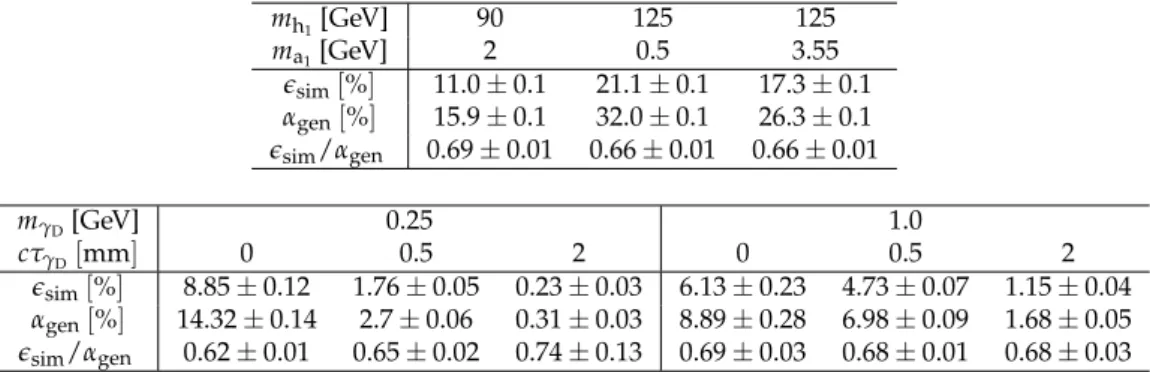
Table 1: Event selection efficiencies esim(mh1, ma1)and esim(mγD, cτγD), as obtained from
simu-lation, the geometric and kinematic acceptances αgen(mh1, ma1)and αgen(mγD, cτγD), calculated
using only generator-level information, and their ratios (with statistical uncertainties), for a few representative NMSSM and dark SUSY benchmark samples. The experimental data-to-simulation scale factor (edata/esim, described later) is not applied.
mh1[GeV] 90 125 125 ma1[GeV] 2 0.5 3.55 esim[%] 11.0±0.1 21.1±0.1 17.3±0.1 αgen[%] 15.9±0.1 32.0±0.1 26.3±0.1 esim/αgen 0.69±0.01 0.66±0.01 0.66±0.01 mγD[GeV] 0.25 1.0 cτγD[mm] 0 0.5 2 0 0.5 2 esim[%] 8.85±0.12 1.76±0.05 0.23±0.03 6.13±0.23 4.73±0.07 1.15±0.04 αgen[%] 14.32±0.14 2.7±0.06 0.31±0.03 8.89±0.28 6.98±0.09 1.68±0.05 esim/αgen 0.62±0.01 0.65±0.02 0.74±0.13 0.69±0.03 0.68±0.01 0.68±0.03
4
Signal modeling
The results from this analysis are designed to be model independent, but are also presented in the context of the two benchmark models introduced earlier. NMSSM simulation samples for benchmark model 1 are generated withPYTHIA6.4.26 [60], using MSSM Higgs boson
produc-tion via gluon fusion gg → H0
MSSM, with the Higgs bosons decaying via H0MSSM →2A0MSSM.
The masses of the MSSM bosons H0
MSSM and A0MSSM are set to the desired values for the h1
mass and a1 mass of the NMSSM bosons, respectively. The mass of H0MSSM is in the range
90−150 GeV (mass below 90 GeV is excluded by LEP [37]) and the mass of A0MSSM is in range 0.25−3.55 GeV. Both A0MSSM bosons are forced to decay promptly to a pair of muons. Dark SUSY simulation samples for benchmark model 2 are generated with MADGRAPH 4.5.2 [61] using SM Higgs boson production via gluon fusion gg → hSM, with mhSM = 125 GeV. The
BRIDGEprogram [62] is used to force the Higgs bosons to undergo a non-SM decay to a pair of neutralinos, each of which decays via n1 → nD+γD, where mn1 = 10 GeV, mnD = 1 GeV,
which is representative of the type of models considered [42]. Dark photons are generated with mγDin the range 0.25–2.0 GeV and a decay length cτγDin the range of 0–20 mm. Each of the two
dark photons are forced to decay to two muons, while both dark neutralinos escape detection. The narrow-width approximation is imposed by setting the widths of the dark photons to a small value (10−3GeV).
All benchmark samples are generated using the leading-order CTEQ6.6 [63] set of parton dis-tribution functions (PDF), and are interfaced withPYTHIA using the Z2* tune [64] for the
un-derlying event activity at the LHC and to simulate jet fragmentation.
The signal samples are processed through a detailed simulation of the CMS detector based on GEANT4 [65] and are reconstructed with the same algorithms used for data. Table 1 shows the event selection efficiencies esimobtained using the simulated benchmark samples for a few
representative choices of(mh1, ma1), and(mγD, cτγD). To provide a simple recipe for future
rein-terpretations of the results in the context of other models, the variable αgenis separately defined
as the geometric and kinematic acceptance of this analysis calculated using only generator-level information. It is defined by selecting events containing at least four muons with pT > 8 GeV
and|η| < 2.4, with at least one of these muons having pT > 17 GeV and|η| < 0.9. The new
light boson must also decay with transverse decay length Lxy <4.4 cm and longitudinal decay
5
region of the analysis. Table 1 shows αgenalong with the ratio esim/αgen.
5
Background estimation
The SM background for this search is dominated by bb production and has small contributions from the electroweak production of four muons and direct J/ψ pair production. The leading part of the bb contribution is due to b quark decays that result in a pair of muons, via either the semileptonic decays of both the b quark and the resulting c quark, or via resonances, i.e.
ω, ρ, φ, J/ψ. A smaller contribution comes from events with one genuine dimuon candidate
and a second dimuon candidate containing one muon from a semileptonic b quark decay and a charged hadron misidentified as another muon.
Using data control samples, the bb background is modeled as a two-dimensional (2D) tem-plate Bbb(m1µµ, m2µµ) in the plane of the invariant masses of the two dimuons. The
tem-plate describing the 2D probability density function is constructed as a Cartesian product B17(m1µµ)B8(m2µµ), where the B17 and B8 templates model the invariant mass distributions
for dimuons with and without the requirement that the dimuon contains at least one muon sat-isfying pT >17 GeV and|η| <0.9 respectively. The B17shape is measured using a data sample
enriched with bb events containing exactly one dimuon and one additional muon, under the assumption that the decay of one of the b quarks results in a dimuon pair containing at least one muon with pT > 17 GeV and|η| < 0.9, while the other b quark decays semileptonically
resulting in the additional muon with pT > 8 GeV. For the B8 shape, a similar sample and
procedure is used but the dimuon is required to have both prongs with pT > 8 GeV, while
the additional muon must have pT > 17 GeV and|η| < 0.9. The two templates are required
as the shape of the dimuon invariant mass distribution depends on the pT thresholds used to
select the muons and whether the muons are restricted to the central (|η| < 0.9) region or
can be in the full acceptance range (|η| <2.4), as a result of the differences in the momentum
resolution of the barrel and endcap regions of the tracker. The B17 and B8 distributions are
fitted with a parametric analytical function using a sum of Bernstein polynomials and Crystal Ball functions [66] describing resonances. These event samples do not overlap with the sample containing two dimuons that is used for the main analysis and they have negligible contribu-tions from non-bb backgrounds. Once the Bbb(m1µµ, m2µµ)template is constructed, it is used
to provide a description of the bb background shape in the signal region. This technique as-sumes that each b quark fragments independently and that if the shapes of these distributions are measured using data samples with kinematics very similar to that of the background events then the effects of residual kinematically-induced correlations are small (albeit weakly induced, the shape depends on the b jet pT and the pT of the two b jets in background bb events tend
to be similar). The background template is validated in a region where both dimuons fail the Isum <2 GeV requirement and good agreement with data is observed.
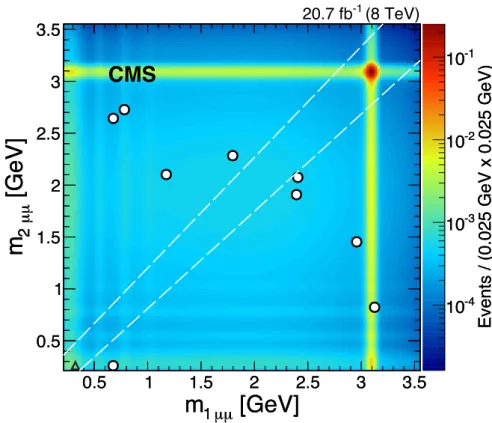
The data events that satisfy all analysis selections but fail the m1µµ ' m2µµrequirement are used
to normalize the Bbb(m1µµ, m2µµ)template. This selection yields nine events in the off-diagonal
sideband region of the(m1µµ, m2µµ)plane, leading in the diagonal signal region to an expected
rate of bb background events of 2.0±0.7. This is essentially(9±√9) ×0.18/0.82, where 0.18 and 0.82 correspond to the integral of the areas under the background template inside and out-side the signal diagonal region, respectively. These nine events in the off-diagonal out-sidebands of the(m1µµ, m2µµ)plane are shown as white circles in Fig. 1.
The contribution from direct J/ψ pair production is estimated using another data control sam-ple. Events are selected with a trigger that requires at least three muon candidates, two of which
6 5 Background estimation
Events / (0.025 GeV x 0.025 GeV)
-4 10 -3 10 -2 10 -1 10
Events / (0.025 GeV x 0.025 GeV)
-4 10 -3 10 -2 10 -1 10
[GeV]
μ μ 1m
0.5 1 1.5 2 2.5 3 3.5[GeV]
μ μ 2m
0.5 1 1.5 2 2.5 3 3.5[GeV]
μ μ 1m
0.5 1 1.5 2 2.5 3 3.5[GeV]
μ μ 2m
0.5 1 1.5 2 2.5 3 3.5CMS
(8 TeV) -1 20.7 fbFigure 1: Distribution of the invariant masses m1µµ vs. m2µµ for the isolated dimuon events
following the application of all constraints except the m1µµ 'm2µµrequirement of compatibility
within the detector resolution. The compatible diagonal signal region (outlined with dashed lines) contains one data event (triangle) at m1µµ = 0.33 GeV and m2µµ = 0.22 GeV. There are
also nine data events (white circles) which fail the m1µµ 'm2µµcompatibility requirement. The
color scale indicates the expected SM background in range 2mµ <m1µµ, m2µµ <2mτ.
have a common vertex and an invariant mass consistent with that of the J/ψ particle. Events are further required to contain at least four reconstructed muons with pT > 3.5 GeV, which
form dimuon pairs. This control sample does not specifically require that the dimuons satisfy the requirement Isum < 2 GeV since Isumis used to separate the contribution of “prompt” and
“nonprompt” (from b quark decays) J/ψ in data. Finally, both dimuons are required to have an invariant mass between 2.8 and 3.3 GeV. Following these requirements the data sample con-sists of events containing prompt and nonprompt J/ψ. To subtract the nonprompt component, two independent methods have been studied: the first one divides the control sample based on the values of the isolation variable Isumfor each of the two dimuons in each event. The number
of events in which both dimuons satisfy the requirement Isum < 2 GeV is extrapolated from
the regions in which at least one of the dimuons fails this requirement. The second approach uses the lifetime of J/ψ candidate, calculated under the hypothesis of it being produced at the beam line, as a discriminating variable. The data distribution is fitted in the isolated region using prompt and nonprompt templates from simulation and nonisolated sideband in data, re-spectively. Both approaches give consistent results within the associated uncertainties and the results of the isolation-based method are used in the final analysis. There are two mechanisms for the production of prompt double J/ψ events: single- and double-parton scattering (SPS and DPS, respectively), corresponding to whether the two J/ψ mesons are produced from one or two independent parton interactions. The number of prompt events in the control region are further separated into SPS and DPS components using the J/ψ rapidity difference as the
dis-7
criminating variable. Finally, the data-to-simulation normalization factor and the fraction of SPS and DPS events are extrapolated from the control to the signal region, resulting in a final estimation for the contribution from prompt double J/ψ events of 0.06±0.03 events.
The contribution from other SM processes (low mass Drell–Yan production and pp→Z/γ∗ →
4µ) is estimated with the CALCHEP 3.6.18 generator [67] using the HEPMDB infrastructure [68], and is found to be 0.15±0.03 events in the entire signal region. The combined expected back-ground contribution to the diagonal signal region is 2.2±0.7 events. This background is repre-sented by the color scale in Fig. 1.
6
Systematic uncertainties
The selection efficiencies for the offline muon reconstruction, trigger, and dimuon isolation requirements are obtained from simulation, and are corrected with scale factors derived from comparison between data and simulation using Z → µµ and J/ψ → µµ samples. The scale
factor per event is found to be edata/esim =0.93±0.07 and it accounts for the differences in the
efficiency of the trigger, the efficiency of the muon reconstruction and identification for each of the four muon candidates, and the combined efficiency of the isolation requirement for the two dimuon candidates. The estimate accounts for correlations associated with the presence of multiple muons per event. The main systematic uncertainty is the offline muon reconstruction (4.1%), which includes an uncertainty (1% per muon) to cover variations of the scale factor as a function of the muon pT and η. Other systematic uncertainties include: the uncertainty in
dimuon reconstruction effects related to overlaps of muon trajectories in the tracker and in the muon system (3.5%), the trigger efficiency (1.5%), the uncertainty in the efficiency caused by the modeling of the tails in the dimuon invariant mass distribution that arises from the requirement that the two dimuon masses are compatible (1.5%), and the dimuon isolation (negligible). The uncertainty in the integrated luminosity of the data sample (2.6%) [69] is also included. All uncertainties quoted above are related to variations in the signal efficiency due to experimental selection and sum up to 6.3%. The uncertainties related to variations in the signal acceptance due to the model include: the uncertainties related to the PDFs and the knowledge of the strong coupling constant αs, which are estimated by comparing the PDFs in CTEQ6.6 [63] with those
in NNPDF2.0 [70] and MSTW2008 [71], following the PDF4LHC recommendations [72, 73]. Using the analysis benchmark samples, they are found to be 3% for the signal acceptance. The variation of the renormalization and factorization scales has a negligible effect. In addition a re-weighting procedure is applied to the Higgs boson pT spectra in the benchmark signal
samples to reproduce the NNLO+NNLL prediction [74] and account for possible changes to the analysis acceptance. Only a weak sensitivity to this is expected and the result of the re-weighting procedure is limited by the statistical uncertainty of the simulated samples (2%), which is therefore included as a conservative systematic uncertainty on this effect. Thus, the total systematic uncertainty in the signal acceptance and selection efficiency is 7.3%.
7
Results
After the full analysis selection is applied to the data sample, one event is observed in the diagonal signal region, as shown in Fig. 1. This is consistent with the expected background contribution of 2.2±0.7 events.
For future reinterpretations of this analysis, the results can be presented as a 95% confidence level (CL) upper limit on σ(pp→ 2a+X) B2(a→2µ)αgen = N(mµµ)/(L¯r), where αgen is the
in-8 7 Results
tegrated luminosityL = 20.7 fb−1and central value ¯r of the ratio r=edata/αgen = 0.63±0.07.
The ratio includes a scale factor correcting for experimental effects not included in the simula-tion and its uncertainty covers the variasimula-tion in the ratio over all the benchmark model points used. The limit is calculated as a function of the dimuon mass using the CLSapproach [75, 76].
The chosen test statistic is based on the profile likelihood ratio and is used to determine how signal- or background-like the data are. Systematic uncertainties are incorporated in the anal-ysis via nuisance parameters with a log-normal probability density function and are treated according to the frequentist paradigm. The overall statistical methodology used in this anal-ysis was developed by the ATLAS and CMS Collaborations in the context of the LHC Higgs Combination Group and is described in [3, 77]. The obtained limit as a function of dimuon mass mµµ can be conveniently approximated as a constant everywhere except the vicinity of
the observed event, where it follows a Gaussian distribution: N(mµµ) ≤3.1+1.2 exp − (mµµ−0.32)2 2×0.032 ! , resulting in σ(pp→2a+X) B2(a→2µ)αgen ≤0.24+0.09 exp − (mµµ−0.32)2 2×0.032 ! ,
where mµµ is measured in GeV and the cross-section limit is expressed in femtobarns. This
limit is applicable to models with two pairs of muons coming from light bosons of the same type with a mass in the range 2mµ < ma < 2mτ, where the new light bosons are typically
isolated and spatially separated (so as to satisfy the isolation requirements).
The weak model dependence of the ratio r allows for a simple reinterpretation of the results in other models. This requires calculating αgen, as defined earlier, and then the full efficiency edata
can be calculated by multiplying αgenby the ratio r.
There are certain subtleties that must be taken into account when reinterpreting the model-independent results of this analysis in the context of other models, particularly with the isola-tion requirement. An event should be considered to satisfy the selecisola-tion requirements if there are at least two well isolated γDdecaying to muon pairs. Experimentally, isolation is based on
charged tracks but it may be insufficient to just require the absence of generator-level charged particles in the isolation cone. For example a neutral pion decaying to a pair of photons, that convert into electrons, may result in the reconstruction of one or more tracks. This would be particularly relevant for models with more than two dark photons produced in the same event, some of which may decay to hadrons or electrons. In this case the safest approach is to require that there are no particles with pT > 0.5 GeV within the γD isolation cone. This restriction
would result in a more conservative limit but it would be robust against these effects.
The results from this analysis are also interpreted in the context of the NMSSM and the dark SUSY benchmark models, and 95% CL upper limits on the product of the cross section and branching fraction are derived. In these models both the Higgs boson production cross section and the branching fractions can vary significantly, depending on the choice of parameters. In the absence of broadly accepted benchmark scenarios, the production cross sections in these examples are normalized to that of the SM Higgs boson with a mass of 125 GeV [78].
In the case of the NMSSM benchmark scenario, the production cross sections and branching fractions for h1 and h2 can vary substantially depending on the chosen parameters. An
9 mass of hi [GeV] 90 100 110 120 130 140 150 ) [fb] μ 2 → 1 (a 2 )B1 2a → i h → (pp σ 0 0.5 1 1.5 2 2.5 3 NMSSM 95% CL upper limits: 1 a m = 3.55 GeV = 2 GeV 1 a m = 0.25 GeV 1 a m ) = 7.7% μ 2 → 1 B(a 125 GeV CMS Reference model: σ(pp→hi→a1a1) = 0.008 × σSM mh < mh = 125 GeV 1 2 hi = h1: 125 GeV = mh ≤ mh 1 2 hi = h2: 20.7 fb-1 (8 TeV) 0.0 0.5 1.0 1.5 2.0 10- 9 10- 8 10- 7 10- 6 10- 5 10- 4 10- 3 10- 2 mass of γD [GeV] Kineti c mixin g parameter ε U70 E137 CHARM Phenix BaBar ATLAS (90% CL) KLOE SN LSND APEX/MAMI s n u R t s e TestRuns T 0.1% 1% 1% 40% 10% 5% 10% 40% 5% CMS (95% CL) pp→h→n1n1→γDγDnDnD B(h→γDγD+X) = 0.1 – 40% 20.7 fb-1 (8 TeV)
Figure 2: Left for benchmark model 1: 95% CL upper limits from this search for the NMSSM scenarios with ma1 = 0.25 GeV (dashed curve), ma1 = 2 GeV (dash-dotted curve) and ma1 =
3.55 GeV (dotted curve) on σ(pp→h1/2 → 2a1) B2(a1 →2µ)as a function of mh1 in the range
86< mh1 <125 GeV and of mh2 for mh2 >125 GeV. As an illustration, the limits are compared
to the predicted rate (solid curve) obtained using a simplified scenario with σ(pp → hi →
2a1) = 0.008 σSM, which yields predictions for the rates of dimuon pair events comparable to
the obtained experimental limits, andB(a1 → 2µ) = 7.7%. The chosenB(a1 → 2µ)is taken
from [17] for ma1 = 2 GeV and tan β = 20. Right for benchmark model 2: 95% CL upper
limits (black solid curves) from this search on σ(pp →h → 2γD+X) B(h→ 2γD+X)(with
mn1 = 10 GeV, mnD = 1 GeV) in the plane of two of the parameters (ε and mγD) for the dark
SUSY scenarios, along with constraints from other experiments [42–56] showing the 90% CL exclusion contours. The colored contours represent different values ofB(h→2γD+X)in the
range 0.1–40%.
generator-level acceptance for each of the two h1,2bosons, and then using the measured upper
limit on the sum of two contributions to derive limits for any choice of NMSSM model param-eters. To present results in a fashion allowing for straightforward interpretation, we note that if one of the two CP-even Higgs bosons is the 125 GeV state observed at the LHC, then the other one is either lighter or heavier. In the NMSSM it is typical that one of the two has approxi-mately the SM production cross section and a small B(hi → 2a), whereas the other one has
a suppressed production rate and largeB(hi → 2a)due to its large singlet fraction. In Fig. 2
(left) the limit at each mass point is calculated taking the CP-even Higgs boson with the corre-sponding mass as the only source of signal events; the curve below 125 GeV applies to NMSSM models in which mh1 < mh2 =125 GeV, with h1 decays dominating the rate of 4µ events. The
limit at mh =125 GeV corresponds to the case where 125 GeV=mh1 <mh2, with h1decays still
responsible for the vast majority of signal-like events. The points above 125 GeV correspond to model points for which only h2 (mh2 > mh1 = 125 GeV) is allowed to have a sizeable rate of
observable 4µ events. Finally, for models with mh2 >150 GeV, the limit at 150 GeV can be used
as a conservative estimate of the production rate limit. In each of these scenarios it is possible that the other Higgs boson also contributes some fraction of the 4µ signal events, in which case the limit shown is more conservative than would be given by an exact evaluation.
10 8 Summary
production cross section and the branching fractions of the Higgs boson (cascade) decay to a pair of dark photons is determined. The limit set in the(mγD, ε)plane from this analysis is
shown in Fig. 2 (right), along with limits from other experimental searches, where the lifetime is directly related to the kinetic mixing parameter ε and the mass of the dark photon mγD via
τγD(ε, mγD) = ε
−2 f(m
γD), where f(mγD) is a function that depends only on the mass of the
dark photon [79]. The significant vertical structures in the limits visible in Fig. 2 (right) arise because the total width of the dark photon varies rapidly in those mass regions due to reso-nant decays to hadrons. This search constrains a large, previously unconstrained area of the parameter space. Unlike the other results in the figure, the CMS and ATLAS limits are model-dependent and only valid under the assumption thatB(h→ 2n1 → 4µ+X) 6= 0. The recent
ATLAS analysis [42] focused on highly displaced objects and these searches therefore probe different regions of the available parameter space.
8
Summary
A search for pairs of new light bosons produced in the decay of a Higgs boson, that subse-quently decay to pairs of oppositely charged muons, is presented. One event is observed in the signal region, with 2.2±0.7 events expected from the SM backgrounds. A model independent upper limit at 95% CL on the product of the cross section, branching fraction, and acceptance is obtained. This limit is valid for light boson masses in the range 2mµ < ma < 2mτ. The
obtained results allow a straightforward interpretation within a broad range of physics models that predict the same type of signature. The results are compared with two benchmark models in the context of the NMSSM and dark SUSY, including scenarios predicting a nonnegligible light boson lifetime.
Acknowledgments
We would like to thank J. Ruderman for his guidance with the theoretically motivated bench-mark samples of dark SUSY. We congratulate our colleagues in the CERN accelerator depart-ments for the excellent performance of the LHC and thank the technical and administrative staffs at CERN and at other CMS institutes for their contributions to the success of the CMS effort. In addition, we gratefully acknowledge the computing centres and personnel of the Worldwide LHC Computing Grid for delivering so effectively the computing infrastructure essential to our analyses. Finally, we acknowledge the enduring support for the construction and operation of the LHC and the CMS detector provided by the following funding agencies: BMWFW and FWF (Austria); FNRS and FWO (Belgium); CNPq, CAPES, FAPERJ, and FAPESP (Brazil); MES (Bulgaria); CERN; CAS, MoST, and NSFC (China); COLCIENCIAS (Colombia); MSES and CSF (Croatia); RPF (Cyprus); MoER, ERC IUT and ERDF (Estonia); Academy of Finland, MEC, and HIP (Finland); CEA and CNRS/IN2P3 (France); BMBF, DFG, and HGF (Germany); GSRT (Greece); OTKA and NIH (Hungary); DAE and DST (India); IPM (Iran); SFI (Ireland); INFN (Italy); MSIP and NRF (Republic of Korea); LAS (Lithuania); MOE and UM (Malaysia); CINVESTAV, CONACYT, SEP, and UASLP-FAI (Mexico); MBIE (New Zealand); PAEC (Pakistan); MSHE and NSC (Poland); FCT (Portugal); JINR (Dubna); MON, RosAtom, RAS and RFBR (Russia); MESTD (Serbia); SEIDI and CPAN (Spain); Swiss Funding Agencies (Switzerland); MST (Taipei); ThEPCenter, IPST, STAR and NSTDA (Thailand); TUBITAK and TAEK (Turkey); NASU and SFFR (Ukraine); STFC (United Kingdom); DOE and NSF (USA). Individuals have received support from the Marie-Curie programme and the European Re-search Council and EPLANET (European Union); the Leventis Foundation; the A. P. Sloan
References 11
Foundation; the Alexander von Humboldt Foundation; the Belgian Federal Science Policy Of-fice; the Fonds pour la Formation `a la Recherche dans l’Industrie et dans l’Agriculture (FRIA-Belgium); the Agentschap voor Innovatie door Wetenschap en Technologie (IWT-(FRIA-Belgium); the Ministry of Education, Youth and Sports (MEYS) of the Czech Republic; the Council of Science and Industrial Research, India; the HOMING PLUS programme of the Foundation for Polish Science, cofinanced from European Union, Regional Development Fund; the Compagnia di San Paolo (Torino); the Consorzio per la Fisica (Trieste); MIUR project 20108T4XTM (Italy); the Thalis and Aristeia programmes cofinanced by EU-ESF and the Greek NSRF; and the National Priorities Research Program by Qatar National Research Fund.
References
[1] ATLAS Collaboration, “Observation of a new particle in the search for the standard model Higgs boson with the ATLAS detector at the LHC”, Phys. Lett. B 716 (2012) 1, doi:10.1016/j.physletb.2012.08.020, arXiv:1207.7214.
[2] CMS Collaboration, “Observation of a new boson at a mass of 125 GeV with the CMS experiment at the LHC”, Phys. Lett. B 716 (2012) 30,
doi:10.1016/j.physletb.2012.08.021, arXiv:1207.7235.
[3] CMS Collaboration, “Observation of a new boson with mass near 125 GeV in pp collisions at√s = 7 and 8 TeV”, JHEP 06 (2013) 081,
doi:10.1007/JHEP06(2013)081, arXiv:1303.4571.
[4] F. Englert and R. Brout, “Broken symmetry and the mass of gauge vector mesons”, Phys. Rev. Lett. 13 (1964) 321, doi:10.1103/PhysRevLett.13.321.
[5] P. W. Higgs, “Broken symmetries, massless particles and gauge fields”, Phys. Lett. 12 (1964) 132, doi:10.1016/0031-9163(64)91136-9.
[6] P. W. Higgs, “Broken symmetries and the masses of gauge bosons”, Phys. Rev. Lett. 13 (1964) 508, doi:10.1103/PhysRevLett.13.508.
[7] G. S. Guralnik, C. R. Hagen, and T. W. B. Kibble, “Global conservation laws and massless particles”, Phys. Rev. Lett. 13 (1964) 585, doi:10.1103/PhysRevLett.13.585. [8] U. Ellwanger, M. Rausch de Traubenberg, and C. A. Savoy, “Phenomenology of
supersymmetric models with a singlet”, Nucl. Phys. B 492 (1997) 21, doi:10.1016/S0550-3213(97)80026-0, arXiv:hep-ph/9611251.
[9] N. Arkani-Hamed, D. P. Finkbeiner, T. R. Slatyer, and N. Weiner, “A theory of dark matter”, Phys. Rev. D 79 (2009) 015014, doi:10.1103/PhysRevD.79.015014, arXiv:0810.0713.
[10] M. Baumgart et al., “Non-abelian dark sectors and their collider signatures”, JHEP 04 (2009) 014, doi:10.1088/1126-6708/2009/04/014, arXiv:0901.0283.
[11] A. Falkowski, J. T. Ruderman, T. Volansky, and J. Zupan, “Hidden Higgs decaying to lepton jets”, JHEP 05 (2010) 077, doi:10.1007/JHEP05(2010)077,
arXiv:1002.2952.
[12] H. P. Nilles, “Supersymmetry, supergravity and particle physics”, Phys. Rept. 110 (1984) 1, doi:10.1016/0370-1573(84)90008-5.
12 References
[13] D. J. H. Chung et al., “The soft supersymmetry-breaking Lagrangian: theory and applications”, Phys. Rept. 407 (2005) 1, doi:10.1016/j.physrep.2004.08.032, arXiv:hep-ph/0312378.
[14] J. E. Kim and H. P. Nilles, “The µ-problem and the strong CP-problem”, Phys. Lett. B 138 (1984) 150, doi:10.1016/0370-2693(84)91890-2.
[15] J. A. Casas, J. R. Espinosa, and I. Hidalgo, “The MSSM fine tuning problem: a way out”, JHEP 01 (2004) 008, doi:10.1088/1126-6708/2004/01/008,
arXiv:hep-ph/0310137.
[16] A. Belyaev et al., “LHC discovery potential of the lightest NMSSM Higgs boson in the h1→a1a1 →4µ channel”, Phys. Rev. D 81 (2010) 075021,
doi:10.1103/PhysRevD.81.075021, arXiv:1002.1956.
[17] R. Dermisek and J. F. Gunion, “New constraints on a light CP-odd Higgs boson and related NMSSM ideal Higgs scenarios”, Phys. Rev. D 81 (2010) 075003,
doi:10.1103/PhysRevD.81.075003, arXiv:1002.1971.
[18] Fermi LAT Collaboration, “Measurement of separate cosmic-ray electron and positron spectra with the Fermi Large Area Telescope”, Phys. Rev. Lett. 108 (2012) 011103, doi:10.1103/PhysRevLett.108.011103, arXiv:1109.0521.
[19] AMS Collaboration, “High statistics measurement of the positron fraction in primary cosmic rays of 0.5 – 500 GeV with the Alpha Magnetic Spectrometer on the International Space Station”, Phys. Rev. Lett. 113 (2014) 121101,
doi:10.1103/PhysRevLett.113.121101.
[20] O. Adriani et al., “Cosmic-Ray Positron Energy Spectrum Measured by PAMELA”, Phys. Rev. Lett. 111 (2013) 081102, doi:10.1103/PhysRevLett.111.081102.
[21] B. Holdom, “Two U(1)’s and e charge shifts”, Phys. Lett. B 166 (1986) 196, doi:10.1016/0370-2693(86)91377-8.
[22] PAMELA Collaboration, “PAMELA results on the cosmic-ray antiproton flux from 60 MeV to 180 GeV in kinetic energy”, Phys. Rev. Lett. 105 (2010) 121101,
doi:10.1103/PhysRevLett.105.121101, arXiv:1007.0821.
[23] D0 Collaboration, “Search for next-to-minimal supersymmetric Higgs bosons in the h→aa→µµµµ, µµττ channels using p ¯p collisions at
√
s=1.96 TeV”, Phys. Rev. Lett.
103(2009) 061801, doi:10.1103/PhysRevLett.103.061801, arXiv:0905.3381. [24] ATLAS Collaboration, “Search for displaced muonic lepton jets from light Higgs boson decay in proton-proton collisions at√s =7 TeV with the ATLAS detector”, Phys. Lett. B
721(2013) 32, doi:10.1016/j.physletb.2013.02.058, arXiv:1210.0435. [25] CMS Collaboration, “Search for a non-standard-model Higgs boson decaying to a pair of
new light bosons in four-muon final states”, Phys. Lett. B 726 (2013) 564, doi:10.1016/j.physletb.2013.09.009, arXiv:1210.7619.
[26] CLEO Collaboration, “Search for very light CP-odd Higgs boson in radiative decays of Υ(1S)”, Phys. Rev. Lett. 101 (2008) 151802,
References 13
[27] BABAR Collaboration, “Search for dimuon decays of a light scalar boson in radiative transitionsΥ→γA0”, Phys. Rev. Lett. 103 (2009) 081803,
doi:10.1103/PhysRevLett.103.081803, arXiv:0905.4539.
[28] CDF Collaboration, “Search for a very light CP-odd Higgs boson in top quark decays from p ¯p collisions at 1.96 TeV”, Phys. Rev. Lett. 107 (2011) 031801,
doi:10.1103/PhysRevLett.107.031801, arXiv:1104.5701.
[29] CMS Collaboration, “Search for a light pseudoscalar Higgs boson in the dimuon decay channel in pp collisions at√s =7 TeV”, Phys. Rev. Lett. 109 (2012) 121801,
doi:10.1103/PhysRevLett.109.121801, arXiv:1206.6326.
[30] WMAP Collaboration, “Nine-year Wilkinson Microwave Anisotropy Probe (WMAP) Observations: Cosmological Parameter Results”, Astrophys. J. Suppl. 208 (2013) 19, doi:10.1088/0067-0049/208/2/19, arXiv:1212.5226.
[31] Planck Collaboration, “Planck 2013 results. XVI. Cosmological parameters”, Astron. Astrophys. 571 (2014) A16, doi:10.1051/0004-6361/201321591,
arXiv:1303.5076.
[32] OPAL Collaboration, “Decay mode independent searches for new scalar bosons with the OPAL detector at LEP”, Eur. Phys. J. C 27 (2003) 311,
doi:10.1140/epjc/s2002-01115-1, arXiv:hep-ex/0206022.
[33] OPAL Collaboration, “Search for a low mass CP-odd Higgs boson in e+e−collisions with the OPAL detector at LEP-2”, Eur. Phys. J. C 27 (2003) 483,
doi:10.1140/epjc/s2003-01139-y, arXiv:hep-ex/0209068.
[34] OPAL Collaboration, “Search for neutral Higgs boson in CP-conserving and CP-violating MSSM scenarios”, Eur. Phys. J. C 37 (2004) 49, doi:10.1140/epjc/s2004-01962-6, arXiv:hep-ex/0406057.
[35] DELPHI Collaboration, “Searches for neutral Higgs bosons in extended models”, Eur. Phys. J. C 38 (2004) 1, doi:10.1140/epjc/s2004-02011-4,
arXiv:hep-ex/0410017.
[36] ALEPH Collaboration, “Search for neutral Higgs bosons decaying into four taus at LEP2”, JHEP 05 (2010) 049, doi:10.1007/JHEP05(2010)049, arXiv:1003.0705. [37] ALEPH, DELPHI, L3, OPAL, LEP Working Group for Higgs Boson Searches
Collaboration, “Search for neutral MSSM Higgs bosons at LEP”, Eur. Phys. J. C 47 (2006) 547, doi:10.1140/epjc/s2006-02569-7, arXiv:hep-ex/0602042.
[38] D0 Collaboration, “Search for dark photons from supersymmetric hidden valleys”, Phys. Rev. Lett. 103 (2009) 081802, doi:10.1103/PhysRevLett.103.081802,
arXiv:0905.1478.
[39] D0 Collaboration, “Search for events with leptonic jets and missing transverse energy in p ¯p collisions at√s =1.96 TeV”, Phys. Rev. Lett. 105 (2010) 211802,
doi:10.1103/PhysRevLett.105.211802, arXiv:1008.3356.
[40] CDF Collaboration, “Search for anomalous production of multiple leptons in association with W and Z bosons at CDF”, Phys. Rev. D 85 (2012) 092001,
14 References
[41] CMS Collaboration, “Search for light resonances decaying into pairs of muons as a signal of new physics”, JHEP 07 (2011) 098, doi:10.1007/JHEP07(2011)098,
arXiv:1106.2375.
[42] ATLAS Collaboration, “Search for long-lived neutral particles decaying into lepton jets in proton-proton collisions at√s=8 TeV with the ATLAS detector”, JHEP 11 (2014) 088, doi:10.1007/JHEP11(2014)088, arXiv:1409.0746.
[43] KLOE-2 Collaboration, “Search for light vector boson production in e+e−→µ+µ−γ
interactions with the KLOE experiment”, Phys. Lett. B 736 (2014) 459, doi:10.1016/j.physletb.2014.08.005, arXiv:1404.7772.
[44] BaBar Collaboration, “Search for a dark photon in e+e−collisions at BaBar”, Phys. Rev.
Lett. 113 (2014) 201801, doi:10.1103/PhysRevLett.113.201801, arXiv:1406.2980.
[45] PHENIX Collaboration, “Search for dark photons from neutral meson decays in p+p and d+Au collisions at√sNN=200 GeV”, Phys. Rev. C 91 (2015) 031901,
doi:10.1103/PhysRevC.91.031901, arXiv:1409.0851.
[46] APEX Collaboration, “Search for a new gauge boson in electron-nucleus fixed-target scattering by the APEX experiment”, Phys. Rev. Lett. 107 (2011) 191804,
doi:10.1103/PhysRevLett.107.191804, arXiv:1108.2750.
[47] A1 Collaboration, “Search at the Mainz microtron for light massive gauge bosons relevant for the muon g-2 anomaly”, Phys. Rev. Lett. 112 (2014) 221802,
doi:10.1103/PhysRevLett.112.221802, arXiv:1404.5502.
[48] HADES Collaboration, “Searching a dark photon with HADES”, Phys. Lett. B 731 (2014) 265, doi:10.1016/j.physletb.2014.02.035, arXiv:1311.0216.
[49] A. Fradette, M. Pospelov, J. Pradler, and A. Ritz, “Cosmological constraints on very dark photons”, Phys. Rev. D 90 (2014) 035022, doi:10.1103/PhysRevD.90.035022, arXiv:1407.0993.
[50] J. B. Dent, F. Ferrer, and L. M. Krauss, “Constraints on light hidden sector gauge bosons from supernova cooling”, (2012). arXiv:1201.2683.
[51] H. K. Dreiner, J.-F. Fortin, C. Hanhart, and L. Ubaldi, “Supernova constraints on MeV dark sectors from e+e−annihilations”, Phys. Rev. D 89 (2014) 105015,
doi:10.1103/PhysRevD.89.105015, arXiv:1310.3826.
[52] R. Essig et al., “Dark sectors and new, light, weakly-coupled particles”, (2013). arXiv:1311.0029.
[53] J. Blumlein and J. Brunner, “New exclusion limits for dark gauge forces from beam-dump data”, Phys. Lett. B 701 (2011) 155, doi:10.1016/j.physletb.2011.05.046,
arXiv:1104.2747.
[54] R. Essig, R. Harnik, J. Kaplan, and N. Toro, “Discovering new light states at neutrino experiments”, Phys. Rev. D 82 (2010) 113008, doi:10.1103/PhysRevD.82.113008, arXiv:1008.0636.
References 15
[55] B. Batell, M. Pospelov, and A. Ritz, “Exploring portals to a hidden sector through fixed targets”, Phys. Rev. D 80 (2009) 095024, doi:10.1103/PhysRevD.80.095024, arXiv:0906.5614.
[56] S. N. Gninenko, “Constraints on sub-GeV hidden sector gauge bosons from a search for heavy neutrino decays”, Phys. Lett. B 713 (2012) 244,
doi:10.1016/j.physletb.2012.06.002, arXiv:1204.3583.
[57] CMS Collaboration, “Performance of CMS muon reconstruction in pp collision events at√ s =7 TeV”, JINST 7 (2012) P10002, doi:10.1088/1748-0221/7/10/P10002, arXiv:1206.4071.
[58] CMS Collaboration, “The CMS experiment at the CERN LHC”, JINST 3 (2008) S08004, doi:10.1088/1748-0221/3/08/S08004.
[59] R. Luchsinger and C. Grab, “Vertex reconstruction by means of the method of Kalman filter”, Comput. Phys. Commun. 76 (1993) 263,
doi:10.1016/0010-4655(93)90055-H.
[60] T. Sj ¨ostrand, S. Mrenna, and P. Z. Skands, “PYTHIA 6.4 physics and manual”, JHEP 05 (2006) 026, doi:10.1088/1126-6708/2006/05/026, arXiv:hep-ph/0603175. [61] J. Alwall et al., “MadGraph/MadEvent v4: the new web generation”, JHEP 09 (2007)
028, doi:10.1088/1126-6708/2007/09/028, arXiv:0706.2334.
[62] P. Meade and M. Reece, “BRIDGE: branching ratio inquiry/decay generated events”, (2007). arXiv:hep-ph/0703031.
[63] P. M. Nadolsky et al., “Implications of CTEQ global analysis for collider observables”, Phys. Rev. D 78 (2008) 013004, doi:10.1103/PhysRevD.78.013004,
arXiv:0802.0007.
[64] CMS Collaboration, “Measurement of the underlying event activity at the LHC with√ s =7 TeV and comparison with√s =0.9 TeV”, JHEP 09 (2011) 109,
doi:10.1007/JHEP09(2011)109, arXiv:1107.0330.
[65] GEANT4 Collaboration, “GEANT4—a simulation toolkit”, Nucl. Instrum. Meth. A 506 (2003) 250, doi:10.1016/S0168-9002(03)01368-8.
[66] M. J. Oreglia, “A study of the reactions ψ0 →γγψ”. PhD thesis, Stanford University,
1980. SLAC Report SLAC-R-236, Appendix D.
[67] A. Belyaev, N. D. Christensen, and A. Pukhov, “CalcHEP 3.4 for collider physics within and beyond the Standard Model”, Comput. Phys. Commun. 184 (2013) 1729,
doi:10.1016/j.cpc.2013.01.014, arXiv:1207.6082.
[68] M. Bondarenko et al., “High Energy Physics Model Database — HEPMDB: Towards decoding of the underlying theory at the LHC”, (2012). arXiv:1203.1488. Included in Les Houches 2011: Physics at TeV Colliders New Physics Working Group Report.
[69] CMS Collaboration, “CMS luminosity based on pixel cluster counting - Summer 2013 update”, CMS Physics Analysis Summary CMS-PAS-LUM-13-001, CERN, Geneva, 2013. [70] R. D. Ball et al., “A first unbiased global NLO determination of parton distributions and
their uncertainties”, Nucl. Phys. B 838 (2010) 136,
16 References
[71] A. D. Martin, W. J. Stirling, R. S. Thorne, and G. Watt, “Parton distributions for the LHC”, Eur. Phys. J. C 63 (2009) 189, doi:10.1140/epjc/s10052-009-1072-5,
arXiv:0901.0002.
[72] S. Alekhin et al., “The PDF4LHC working group interim report”, (2011). arXiv:1101.0536.
[73] M. Botje et al., “The PDF4LHC Working Group Interim Recommendations”, (2011). arXiv:1101.0538.
[74] D. de Florian, G. Ferrera, M. Grazzini, and D. Tommasini, “Higgs boson production at the LHC: transverse momentum resummation effects in the H →2γ, H →WW→lνlν and H →ZZ→4l decay modes”, JHEP 06 (2012) 132,
doi:10.1007/JHEP06(2012)132, arXiv:1203.6321.
[75] T. Junk, “Confidence level computation for combining searches with small statistics”, Nucl. Instrum. Meth. A 434 (1999) 435, doi:10.1016/S0168-9002(99)00498-2, arXiv:hep-ex/9902006.
[76] A. L. Read, “Presentation of search results: the CLstechnique”, J. Phys. G. 28 (2002) 2693,
doi:10.1088/0954-3899/28/10/313.
[77] ATLAS and CMS Collaborations, LHC Higgs Combination Group, “Procedure for the LHC Higgs boson search combination in Summer 2011”, Technical Report
ATL-PHYS-PUB-2011-011, ATL-COM-PHYS-2011-818, CMS-NOTE-2011-005, CERN, Geneva, 2011.
[78] LHC Higgs Cross Section Working Group, S. Dittmaier et al., “Handbook of LHC Higgs Cross Sections: 1. Inclusive Observables”, CERN Report CERN-2011-002, 2011.
doi:10.5170/CERN-2011-002, arXiv:1101.0593.
[79] B. Batell, M. Pospelov, and A. Ritz, “Probing a secluded U(1) at B factories”, Phys. Rev. D
17
A
The CMS Collaboration
Yerevan Physics Institute, Yerevan, Armenia
V. Khachatryan, A.M. Sirunyan, A. Tumasyan
Institut f ¨ur Hochenergiephysik der OeAW, Wien, Austria
W. Adam, E. Asilar, T. Bergauer, J. Brandstetter, E. Brondolin, M. Dragicevic, J. Er ¨o, M. Flechl, M. Friedl, R. Fr ¨uhwirth1, V.M. Ghete, C. Hartl, N. H ¨ormann, J. Hrubec, M. Jeitler1, V. Kn ¨unz, A. K ¨onig, M. Krammer1, I. Kr¨atschmer, D. Liko, T. Matsushita, I. Mikulec, D. Rabady2,
B. Rahbaran, H. Rohringer, J. Schieck1, R. Sch ¨ofbeck, J. Strauss, W. Treberer-Treberspurg, W. Waltenberger, C.-E. Wulz1
National Centre for Particle and High Energy Physics, Minsk, Belarus
V. Mossolov, N. Shumeiko, J. Suarez Gonzalez
Universiteit Antwerpen, Antwerpen, Belgium
S. Alderweireldt, T. Cornelis, E.A. De Wolf, X. Janssen, A. Knutsson, J. Lauwers, S. Luyckx, S. Ochesanu, R. Rougny, M. Van De Klundert, H. Van Haevermaet, P. Van Mechelen, N. Van Remortel, A. Van Spilbeeck
Vrije Universiteit Brussel, Brussel, Belgium
S. Abu Zeid, F. Blekman, J. D’Hondt, N. Daci, I. De Bruyn, K. Deroover, N. Heracleous, J. Keaveney, S. Lowette, L. Moreels, A. Olbrechts, Q. Python, D. Strom, S. Tavernier, W. Van Doninck, P. Van Mulders, G.P. Van Onsem, I. Van Parijs
Universit´e Libre de Bruxelles, Bruxelles, Belgium
P. Barria, C. Caillol, B. Clerbaux, G. De Lentdecker, H. Delannoy, D. Dobur, G. Fasanella, L. Favart, A.P.R. Gay, A. Grebenyuk, T. Lenzi, A. L´eonard, T. Maerschalk, A. Mohammadi, L. Perni`e, A. Randle-conde, T. Reis, T. Seva, L. Thomas, C. Vander Velde, P. Vanlaer, J. Wang, F. Zenoni, F. Zhang3
Ghent University, Ghent, Belgium
K. Beernaert, L. Benucci, A. Cimmino, S. Crucy, A. Fagot, G. Garcia, M. Gul, J. Mccartin, A.A. Ocampo Rios, D. Poyraz, D. Ryckbosch, S. Salva Diblen, M. Sigamani, N. Strobbe, M. Tytgat, W. Van Driessche, E. Yazgan, N. Zaganidis
Universit´e Catholique de Louvain, Louvain-la-Neuve, Belgium
S. Basegmez, C. Beluffi4, O. Bondu, G. Bruno, R. Castello, A. Caudron, L. Ceard, G.G. Da Silveira, C. Delaere, D. Favart, L. Forthomme, A. Giammanco5, J. Hollar, A. Jafari, P. Jez, M. Komm, V. Lemaitre, A. Mertens, C. Nuttens, L. Perrini, A. Pin, K. Piotrzkowski, A. Popov6,
L. Quertenmont, M. Selvaggi, M. Vidal Marono
Universit´e de Mons, Mons, Belgium
N. Beliy, T. Caebergs, G.H. Hammad
Centro Brasileiro de Pesquisas Fisicas, Rio de Janeiro, Brazil
W.L. Ald´a J ´unior, G.A. Alves, L. Brito, M. Correa Martins Junior, T. Dos Reis Martins, C. Hensel, C. Mora Herrera, A. Moraes, M.E. Pol, P. Rebello Teles
Universidade do Estado do Rio de Janeiro, Rio de Janeiro, Brazil
E. Belchior Batista Das Chagas, W. Carvalho, J. Chinellato7, A. Cust ´odio, E.M. Da Costa, D. De Jesus Damiao, C. De Oliveira Martins, S. Fonseca De Souza, L.M. Huertas Guativa, H. Malbouisson, D. Matos Figueiredo, L. Mundim, H. Nogima, W.L. Prado Da Silva, A. Santoro, A. Sznajder, E.J. Tonelli Manganote7, A. Vilela Pereira
18 A The CMS Collaboration
Universidade Estadual Paulistaa, Universidade Federal do ABCb, S˜ao Paulo, Brazil
S. Ahuja, C.A. Bernardesb, A. De Souza Santos, S. Dograa, T.R. Fernandez Perez Tomeia, E.M. Gregoresb, P.G. Mercadanteb, C.S. Moona,8, S.F. Novaesa, Sandra S. Padulaa, D. Romero Abad, J.C. Ruiz Vargas
Institute for Nuclear Research and Nuclear Energy, Sofia, Bulgaria
A. Aleksandrov, V. Genchev2, R. Hadjiiska, P. Iaydjiev, A. Marinov, S. Piperov, M. Rodozov, S. Stoykova, G. Sultanov, M. Vutova
University of Sofia, Sofia, Bulgaria
A. Dimitrov, I. Glushkov, L. Litov, B. Pavlov, P. Petkov
Institute of High Energy Physics, Beijing, China
M. Ahmad, J.G. Bian, G.M. Chen, H.S. Chen, M. Chen, T. Cheng, R. Du, C.H. Jiang, R. Plestina9, F. Romeo, S.M. Shaheen, J. Tao, C. Wang, Z. Wang, H. Zhang
State Key Laboratory of Nuclear Physics and Technology, Peking University, Beijing, China
C. Asawatangtrakuldee, Y. Ban, Q. Li, S. Liu, Y. Mao, S.J. Qian, D. Wang, Z. Xu, W. Zou
Universidad de Los Andes, Bogota, Colombia
C. Avila, A. Cabrera, L.F. Chaparro Sierra, C. Florez, J.P. Gomez, B. Gomez Moreno, J.C. Sanabria
University of Split, Faculty of Electrical Engineering, Mechanical Engineering and Naval Architecture, Split, Croatia
N. Godinovic, D. Lelas, D. Polic, I. Puljak
University of Split, Faculty of Science, Split, Croatia
Z. Antunovic, M. Kovac
Institute Rudjer Boskovic, Zagreb, Croatia
V. Brigljevic, K. Kadija, J. Luetic, L. Sudic
University of Cyprus, Nicosia, Cyprus
A. Attikis, G. Mavromanolakis, J. Mousa, C. Nicolaou, F. Ptochos, P.A. Razis, H. Rykaczewski
Charles University, Prague, Czech Republic
M. Bodlak, M. Finger10, M. Finger Jr.10
Academy of Scientific Research and Technology of the Arab Republic of Egypt, Egyptian Network of High Energy Physics, Cairo, Egypt
A. Ali11, R. Aly, S. Aly, Y. Assran12, A. Ellithi Kamel13, A.M. Kuotb Awad14, A. Lotfy,
R. Masod11, A. Radi15,11
National Institute of Chemical Physics and Biophysics, Tallinn, Estonia
B. Calpas, M. Kadastik, M. Murumaa, M. Raidal, A. Tiko, C. Veelken
Department of Physics, University of Helsinki, Helsinki, Finland
P. Eerola, M. Voutilainen
Helsinki Institute of Physics, Helsinki, Finland
J. H¨ark ¨onen, V. Karim¨aki, R. Kinnunen, T. Lamp´en, K. Lassila-Perini, S. Lehti, T. Lind´en, P. Luukka, T. M¨aenp¨a¨a, J. Pekkanen, T. Peltola, E. Tuominen, J. Tuominiemi, E. Tuovinen, L. Wendland
Lappeenranta University of Technology, Lappeenranta, Finland
19
DSM/IRFU, CEA/Saclay, Gif-sur-Yvette, France
M. Besancon, F. Couderc, M. Dejardin, D. Denegri, B. Fabbro, J.L. Faure, C. Favaro, F. Ferri, S. Ganjour, A. Givernaud, P. Gras, G. Hamel de Monchenault, P. Jarry, E. Locci, M. Machet, J. Malcles, J. Rander, A. Rosowsky, M. Titov, A. Zghiche
Laboratoire Leprince-Ringuet, Ecole Polytechnique, IN2P3-CNRS, Palaiseau, France
S. Baffioni, F. Beaudette, P. Busson, L. Cadamuro, E. Chapon, C. Charlot, T. Dahms, O. Davignon, N. Filipovic, A. Florent, R. Granier de Cassagnac, S. Lisniak, L. Mastrolorenzo, P. Min´e, I.N. Naranjo, M. Nguyen, C. Ochando, G. Ortona, P. Paganini, S. Regnard, R. Salerno, J.B. Sauvan, Y. Sirois, T. Strebler, Y. Yilmaz, A. Zabi
Institut Pluridisciplinaire Hubert Curien, Universit´e de Strasbourg, Universit´e de Haute Alsace Mulhouse, CNRS/IN2P3, Strasbourg, France
J.-L. Agram16, J. Andrea, A. Aubin, D. Bloch, J.-M. Brom, M. Buttignol, E.C. Chabert, N. Chanon, C. Collard, E. Conte16, J.-C. Fontaine16, D. Gel´e, U. Goerlach, C. Goetzmann, A.-C. Le Bihan, J.A. Merlin2, K. Skovpen, P. Van Hove
Centre de Calcul de l’Institut National de Physique Nucleaire et de Physique des Particules, CNRS/IN2P3, Villeurbanne, France
S. Gadrat
Universit´e de Lyon, Universit´e Claude Bernard Lyon 1, CNRS-IN2P3, Institut de Physique Nucl´eaire de Lyon, Villeurbanne, France
S. Beauceron, C. Bernet9, G. Boudoul, E. Bouvier, S. Brochet, C.A. Carrillo Montoya, J. Chasserat, R. Chierici, D. Contardo, B. Courbon, P. Depasse, H. El Mamouni, J. Fan, J. Fay, S. Gascon, M. Gouzevitch, B. Ille, I.B. Laktineh, M. Lethuillier, L. Mirabito, A.L. Pequegnot, S. Perries, J.D. Ruiz Alvarez, D. Sabes, L. Sgandurra, V. Sordini, M. Vander Donckt, P. Verdier, S. Viret, H. Xiao
Institute of High Energy Physics and Informatization, Tbilisi State University, Tbilisi, Georgia
Z. Tsamalaidze10
RWTH Aachen University, I. Physikalisches Institut, Aachen, Germany
C. Autermann, S. Beranek, M. Edelhoff, L. Feld, A. Heister, M.K. Kiesel, K. Klein, M. Lipinski, A. Ostapchuk, M. Preuten, F. Raupach, J. Sammet, S. Schael, J.F. Schulte, T. Verlage, H. Weber, B. Wittmer, V. Zhukov6
RWTH Aachen University, III. Physikalisches Institut A, Aachen, Germany
M. Ata, M. Brodski, E. Dietz-Laursonn, D. Duchardt, M. Endres, M. Erdmann, S. Erdweg, T. Esch, R. Fischer, A. G ¨uth, T. Hebbeker, C. Heidemann, K. Hoepfner, D. Klingebiel, S. Knutzen, P. Kreuzer, M. Merschmeyer, A. Meyer, P. Millet, M. Olschewski, K. Padeken, P. Papacz, T. Pook, M. Radziej, H. Reithler, M. Rieger, F. Scheuch, L. Sonnenschein, D. Teyssier, S. Th ¨uer
RWTH Aachen University, III. Physikalisches Institut B, Aachen, Germany
V. Cherepanov, Y. Erdogan, G. Fl ¨ugge, H. Geenen, M. Geisler, W. Haj Ahmad, F. Hoehle, B. Kargoll, T. Kress, Y. Kuessel, A. K ¨unsken, J. Lingemann2, A. Nehrkorn, A. Nowack, I.M. Nugent, C. Pistone, O. Pooth, A. Stahl
Deutsches Elektronen-Synchrotron, Hamburg, Germany
M. Aldaya Martin, I. Asin, N. Bartosik, O. Behnke, U. Behrens, A.J. Bell, K. Borras, A. Burgmeier, A. Cakir, L. Calligaris, A. Campbell, S. Choudhury, F. Costanza, C. Diez Pardos, G. Dolinska, S. Dooling, T. Dorland, G. Eckerlin, D. Eckstein, T. Eichhorn, G. Flucke,
20 A The CMS Collaboration
E. Gallo, J. Garay Garcia, A. Geiser, A. Gizhko, P. Gunnellini, J. Hauk, M. Hempel17, H. Jung, A. Kalogeropoulos, O. Karacheban17, M. Kasemann, P. Katsas, J. Kieseler, C. Kleinwort, I. Korol, W. Lange, J. Leonard, K. Lipka, A. Lobanov, W. Lohmann17, R. Mankel, I. Marfin17, I.-A. Melzer-Pellmann, A.B. Meyer, G. Mittag, J. Mnich, A. Mussgiller, S. Naumann-Emme, A. Nayak, E. Ntomari, H. Perrey, D. Pitzl, R. Placakyte, A. Raspereza, P.M. Ribeiro Cipriano, B. Roland, M. ¨O. Sahin, J. Salfeld-Nebgen, P. Saxena, T. Schoerner-Sadenius, M. Schr ¨oder, C. Seitz, S. Spannagel, K.D. Trippkewitz, C. Wissing
University of Hamburg, Hamburg, Germany
V. Blobel, M. Centis Vignali, A.R. Draeger, J. Erfle, E. Garutti, K. Goebel, D. Gonzalez, M. G ¨orner, J. Haller, M. Hoffmann, R.S. H ¨oing, A. Junkes, R. Klanner, R. Kogler, T. Lapsien, T. Lenz, I. Marchesini, D. Marconi, D. Nowatschin, J. Ott, F. Pantaleo2, T. Peiffer, A. Perieanu,
N. Pietsch, J. Poehlsen, D. Rathjens, C. Sander, H. Schettler, P. Schleper, E. Schlieckau, A. Schmidt, J. Schwandt, M. Seidel, V. Sola, H. Stadie, G. Steinbr ¨uck, H. Tholen, D. Troendle, E. Usai, L. Vanelderen, A. Vanhoefer
Institut f ¨ur Experimentelle Kernphysik, Karlsruhe, Germany
M. Akbiyik, C. Barth, C. Baus, J. Berger, C. B ¨oser, E. Butz, T. Chwalek, F. Colombo, W. De Boer, A. Descroix, A. Dierlamm, M. Feindt, F. Frensch, M. Giffels, A. Gilbert, F. Hartmann2, U. Husemann, F. Kassel2, I. Katkov6, A. Kornmayer2, P. Lobelle Pardo, M.U. Mozer, T. M ¨uller,
Th. M ¨uller, M. Plagge, G. Quast, K. Rabbertz, S. R ¨ocker, F. Roscher, H.J. Simonis, F.M. Stober, R. Ulrich, J. Wagner-Kuhr, S. Wayand, T. Weiler, C. W ¨ohrmann, R. Wolf
Institute of Nuclear and Particle Physics (INPP), NCSR Demokritos, Aghia Paraskevi, Greece
G. Anagnostou, G. Daskalakis, T. Geralis, V.A. Giakoumopoulou, A. Kyriakis, D. Loukas, A. Markou, A. Psallidas, I. Topsis-Giotis
University of Athens, Athens, Greece
A. Agapitos, S. Kesisoglou, A. Panagiotou, N. Saoulidou, E. Tziaferi
University of Io´annina, Io´annina, Greece
I. Evangelou, G. Flouris, C. Foudas, P. Kokkas, N. Loukas, N. Manthos, I. Papadopoulos, E. Paradas, J. Strologas
Wigner Research Centre for Physics, Budapest, Hungary
G. Bencze, C. Hajdu, A. Hazi, P. Hidas, D. Horvath18, F. Sikler, V. Veszpremi, G. Vesztergombi19, A.J. Zsigmond
Institute of Nuclear Research ATOMKI, Debrecen, Hungary
N. Beni, S. Czellar, J. Karancsi20, J. Molnar, Z. Szillasi
University of Debrecen, Debrecen, Hungary
M. Bart ´ok21, A. Makovec, P. Raics, Z.L. Trocsanyi, B. Ujvari
National Institute of Science Education and Research, Bhubaneswar, India
P. Mal, K. Mandal, N. Sahoo, S.K. Swain
Panjab University, Chandigarh, India
S. Bansal, S.B. Beri, V. Bhatnagar, R. Chawla, R. Gupta, U.Bhawandeep, A.K. Kalsi, A. Kaur, M. Kaur, R. Kumar, A. Mehta, M. Mittal, N. Nishu, J.B. Singh, G. Walia
University of Delhi, Delhi, India
Ashok Kumar, Arun Kumar, A. Bhardwaj, B.C. Choudhary, R.B. Garg, A. Kumar, S. Malhotra, M. Naimuddin, K. Ranjan, R. Sharma, V. Sharma
21
Saha Institute of Nuclear Physics, Kolkata, India
S. Banerjee, S. Bhattacharya, K. Chatterjee, S. Dey, S. Dutta, Sa. Jain, Sh. Jain, R. Khurana, N. Majumdar, A. Modak, K. Mondal, S. Mukherjee, S. Mukhopadhyay, A. Roy, D. Roy, S. Roy Chowdhury, S. Sarkar, M. Sharan
Bhabha Atomic Research Centre, Mumbai, India
A. Abdulsalam, R. Chudasama, D. Dutta, V. Jha, V. Kumar, A.K. Mohanty2, L.M. Pant, P. Shukla, A. Topkar
Tata Institute of Fundamental Research, Mumbai, India
T. Aziz, S. Banerjee, S. Bhowmik22, R.M. Chatterjee, R.K. Dewanjee, S. Dugad, S. Ganguly,
S. Ghosh, M. Guchait, A. Gurtu23, G. Kole, S. Kumar, B. Mahakud, M. Maity22, G. Majumder,
K. Mazumdar, S. Mitra, G.B. Mohanty, B. Parida, T. Sarkar22, K. Sudhakar, N. Sur, B. Sutar, N. Wickramage24
Indian Institute of Science Education and Research (IISER), Pune, India
S. Sharma
Institute for Research in Fundamental Sciences (IPM), Tehran, Iran
H. Bakhshiansohi, H. Behnamian, S.M. Etesami25, A. Fahim26, R. Goldouzian, M. Khakzad,
M. Mohammadi Najafabadi, M. Naseri, S. Paktinat Mehdiabadi, F. Rezaei Hosseinabadi, B. Safarzadeh27, M. Zeinali
University College Dublin, Dublin, Ireland
M. Felcini, M. Grunewald
INFN Sezione di Baria, Universit`a di Barib, Politecnico di Baric, Bari, Italy
M. Abbresciaa,b, C. Calabriaa,b, C. Caputoa,b, S.S. Chhibraa,b, A. Colaleoa, D. Creanzaa,c, L. Cristellaa,b, N. De Filippisa,c, M. De Palmaa,b, L. Fiorea, G. Iasellia,c, G. Maggia,c, M. Maggia, G. Minielloa,b, S. Mya,c, S. Nuzzoa,b, A. Pompilia,b, G. Pugliesea,c, R. Radognaa,b, A. Ranieria, G. Selvaggia,b, A. Sharmaa, L. Silvestrisa,2, R. Vendittia,b, P. Verwilligena
INFN Sezione di Bolognaa, Universit`a di Bolognab, Bologna, Italy
G. Abbiendia, C. Battilana2, A.C. Benvenutia, D. Bonacorsia,b, S. Braibant-Giacomellia,b,
L. Brigliadoria,b, R. Campaninia,b, P. Capiluppia,b, A. Castroa,b, F.R. Cavalloa, G. Codispotia,b,
M. Cuffiania,b, G.M. Dallavallea, F. Fabbria, A. Fanfania,b, D. Fasanellaa,b, P. Giacomellia, C. Grandia, L. Guiduccia,b, S. Marcellinia, G. Masettia, A. Montanaria, F.L. Navarriaa,b, A. Perrottaa, A.M. Rossia,b, T. Rovellia,b, G.P. Sirolia,b, N. Tosia,b, R. Travaglinia,b
INFN Sezione di Cataniaa, Universit`a di Cataniab, CSFNSMc, Catania, Italy
G. Cappelloa, M. Chiorbolia,b, S. Costaa,b, F. Giordanoa, R. Potenzaa,b, A. Tricomia,b, C. Tuvea,b
INFN Sezione di Firenzea, Universit`a di Firenzeb, Firenze, Italy
G. Barbaglia, V. Ciullia,b, C. Civininia, R. D’Alessandroa,b, E. Focardia,b, S. Gonzia,b, V. Goria,b, P. Lenzia,b, M. Meschinia, S. Paolettia, G. Sguazzonia, A. Tropianoa,b, L. Viliania,b
INFN Laboratori Nazionali di Frascati, Frascati, Italy
L. Benussi, S. Bianco, F. Fabbri, D. Piccolo
INFN Sezione di Genovaa, Universit`a di Genovab, Genova, Italy
V. Calvellia,b, F. Ferroa, M. Lo Veterea,b, E. Robuttia, S. Tosia,b
INFN Sezione di Milano-Bicoccaa, Universit`a di Milano-Bicoccab, Milano, Italy