BOLOGNA PARADIGM IN A PORTUGUESE POLYTECHNIC
INSTITUTE - THE CASE OF THE FIRST CYCLE
A.M.R Pires
1, M. Saraiva
2, H. Gonçalves
3, J. Duarte
3 1Polytechnic Institute of Setúbal (PORTUGAL)
2
University of Évora and BRU-UNIDE/ISCTE-IUL (PORTUGAL)
3UNIQUA Polytechnic Institute of Setúbal (PORTUGAL)
[email protected], [email protected], [email protected],
[email protected]
Abstract
In this paper, we describe a study carried out in a Portuguese Polytechnic Institute, aimed to identify and characterize the implementation level of the Bologna Paradigm. The used questionnaire was completed in the academic year of 2008/2009 providing data at curricular unit, course and school levels.
Regarding the changes in teaching learning activities, the answers related to “stopped using” showed that no activity was significantly abandoned. For the answers to “started to use”, the higher percentages were concentrated on: Electronic communications (24%); Tutorial orientation (14%); Presentation with themes for discussion (14%); Participation in on line discussion forum (12%); Information research on line (10%).
Regarding the changes in the evaluation elements, the answers to “stopped using” showed that no element was significantly abandoned. The answers to “started to use” had the higher percentages mainly on: Individual activities on distance learning (12%); Group work related to classroom (8%); Group presentations (8%).
As a more general conclusion, we can say that the most expected changes with the Paradigm of Bologna have had low levels of adoption.
No significant differences were found between the two schools of technology, but visible differences were shown between the school of education and other schools.
This study did not questioned important aspects such as: desired competencies and their achievement, relationships between contents and competencies, coherency between ECTS and total workload, pedagogical approaches adequacy to scientific matters, relationships between school success rates and pedagogical approaches, learning methods adopted by students.
Keywords: Bologna, Paradigm, Quality, System.
1 INTRODUCTION
In this paper, we describe a study carried out in a Portuguese Polytechnic Institute, aimed to identify and characterize the implementation level of the Bologna Paradigm.
The Bologna process has some basics principles such as: teaching-learning processes centred on students; achievement of well-established competencies; strengthening of the autonomous work of students; closer relationships with problems from real life and economic environment [1].
The Polytechnic Institute of Setúbal (IPS) adopted the Bologna paradigm in the academic year of 2006/2007 in the majority of its courses (1st and 2nd cycles). In the academic year of 2008/2009 UNIQUA (IPS Unity for Evaluation and Quality) designed a questionnaire aiming to evaluate the characteristics of the introduced changes in the contents and pedagogic methods, in the 1st cycle courses. The questionnaire presented 17 questions that allowed to profile the innovations at course´s and school´s levels, and was answered by 420 teachers, responsible for the majority of curriculum units (800 curricular units). The results have showed few changes, several limitations and constraints taking in account the expected principles. The questionnaire was field in four schools (Education School, Business School, Setúbal School of Technology and Barreiro School of Technology).
Most of Higher Education Institutions (HEI) are concerned with traditional approaches that promote excellence in education, promoting their degrees, their professional experience, their authorship and
their research activities. So, they are not receptive to new management approaches, like Quality Management Systems (QMS), identified as something that come from companies and, because of that, considered as something that is not applicable to HEI [2].
The IPS is committed to implement a QMS. In a first phase the focus has been in producing relevant data in systematic way using the Information and Communication Technologies (ICT) [3]. In a second phase, some studies were carried out in order to understand the characteristics of students, their learning outcomes, and some associated phenomena like school failure and school dropout [4] [5] [6] [7]. In a third phase, we are deepening some studies and working in the implementation of some organizational procedures. The purpose of this paper focuses on these objectives.
2 OBJECTIVES AND METHODOLOGY
In order to understand some aspects related with the academic success, it was considered important to know the implementation level of the Bologna Process in the Schools of IPS aiming to identify the changes in pedagogical terms, either at the teaching-learning elements level, or at the evaluation methods.
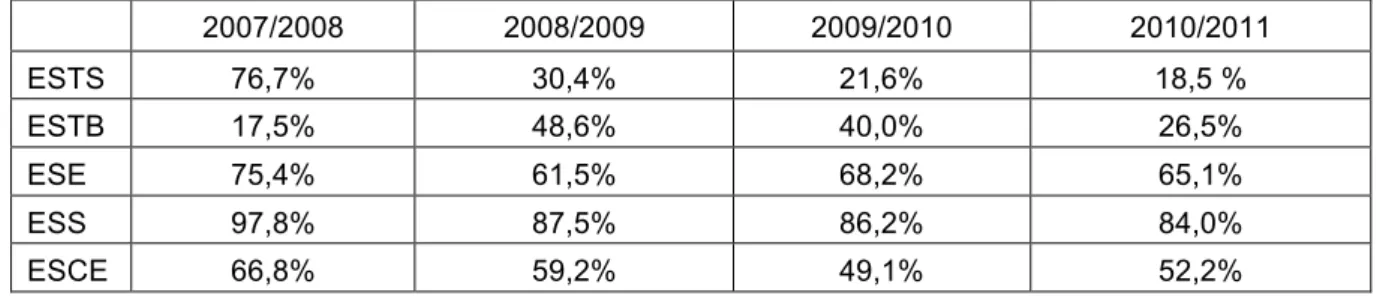
It was expected that the implementation of the Bologna process had positive results in terms of student motivation and their academic achievement. However, some results did not confirm these expectations, so we have to understand the causes, and thus define appropriate measures for improvement. The Table 1 shows that the survive rates (percentage of students finishing in N years – planned years to complete a course) are decreasing after 2006/2007. The highest rates are exceptions because they are related to the transition years (to the Bologna Process), where many students in the 4th and 5th year (in course with more than 180 ECTS) applied for a first cycle diploma [8].
Table 1 – Survive Rates.
2007/2008 2008/2009 2009/2010 2010/2011 ESTS 76,7% 30,4% 21,6% 18,5 % ESTB 17,5% 48,6% 40,0% 26,5% ESE 75,4% 61,5% 68,2% 65,1% ESS 97,8% 87,5% 86,2% 84,0% ESCE 66,8% 59,2% 49,1% 52,2%
ESTS Setúbal School of Technology; ESTB Barreiro School of Technology; ESE Education School; ESS Heath School; ESCE Management School.
So, the study was designed in two parts: the first one is presented in this paper and was aimed to characterize the main pedagogical changes derived from the Bologna Process Implementation. A second part is being planned to identify possible relationships between the pedagogical approaches and the rates of school success/failure.
The questionnaire was completed in the academic year of 2008/2009 and provided data at curricular unit, course and school levels. It had 17 sets of questions (12 closed and 5 open) and the first ones aimed to characterize the teaching learning process, comparing the elements used before and after Bologna process. These elements were related to pedagogical approaches (ex: type of activities carried out in class rooms, autonomous work by students) and with assessment methodologies (ex: final examination, individual work, group work). This way, it was possible to understand which changes were introduced by teachers.
The open questions were related with: the reasons why teachers selected certain elements in the programmes of curricular units; self-evaluation of teachers about the Bologna process changes; improvements in organization and functioning; contributions of each curriculum unit to the global competencies; opinion about the questionnaire itself.
The changes coming from the Bologna process were mainly identified through two main groups of questions: one related to the changes in the teaching learning activities, and other related to the evaluation elements.
The first one had 24 activities in total, and 15 were representatives from the Bologna paradigm. The responsible teachers for the curricular units were questioned to indicate the activities that: a) never used b) continued to use c) stopped using d) started to use.
The questions related to the assessment elements had 28 items and 12 were expected to increase with the Bologna process, namely:
- Individual assessment elements: Performance in practical activities/simulated practice, reports of experimental activities/practices, report of professional placements, investigation/action projects, students participation in several activities during classes, participation in “distant” activities (Ex: Moodle) and self-assessment by students.
- Group assessment elements: Performance in practical activities/simulated practice, reports of experimental activities/practices, written productions (index reading, book reviews, essays, etc.), investigation/action projects and “peer review”.
3 FINDINGS - CHARACTERIZATION OF THE BOLOGNA CHANGES
3.1 Used activities in the Curriculum Units in 2008/2009
With regard to the used activities in 2008/2009, we could verify that all schools, despite their diversity, used some common activities. These activities included the following: A) Lectures content (explaining); B) Interactive Lectures (with students); C) Lectures with examples of reality; E) Lectures using media; H) Application exercises; I) Problem solving.
The same applies to activities not used in 2008/2009, of which there were four common activities between the four schools: P) Professional placements of students; Q) Supervision of Professional placements by the teacher; T) Participation in discussion forums on line; V) Simulated practice; W) Case study.
In short, the data indicated that the four schools in 2008/2009 continued to give greater emphasis to activities more focused on knowledge transfer, to the detriment of activities centred on the students themselves as a key element of their own learning.
3.2 Changes in activities compared to the situation prior to Bologna
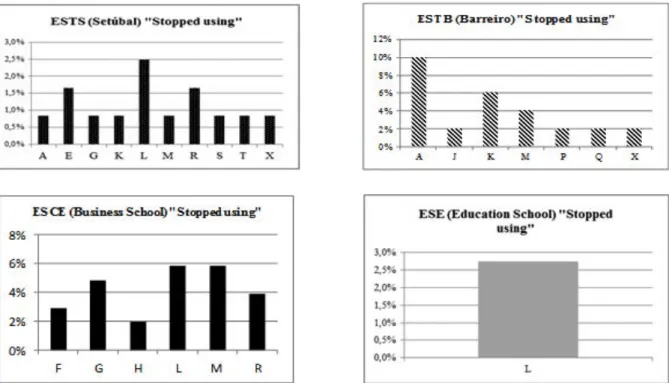
Fig. 1 and 2 reflect that the results obtained from the items “Never used” and “Started to use” don’t
show significant values. So, we can conclude that the changes were not significant. The analysis of the charts allows to state that the School of Education used a greater variety of activities, referring only five that have never been used.
Regarding to activities that were never used, we highlighted two common activities to three schools: P) Professional placements of students; Q) Supervision of Professional placements by the teacher. Note: The answers referred only to the professional placements, not to the existence of professional placements in other CU´s.
The same three mentioned schools continued to use the activities that were already used before the implementation of the Bologna process: A) Lectures content (explanation); B) Interactive lectures (with students); C) Lectures with examples of reality; E) Lectures using media; H) Application exercises; I) Problem solving.
A predominance of expository methods continued to occur, some of them focused on students with a practical component mainly linked to practical exercises, problem solving and gathering information online.
Regarding the item " Stopped Using” the percentages were not significant. The realization of study visits was the activity mentioned by three of the four schools (only the EST Barreiro did not mention it). For activities referred as “Started to use”, two were referred by the four schools, despite their percentages are not significant, including: S) Communication with the teacher and classmates by e-mail as part of homework; U) Research and gather information online.
In implementing the activities described above it seemed to exist a tendency to promote the use of ICT.
Fig. 1 - Change in activities compared to the situation prior to Bologna – “Stopped using”.
3.3 Elements of Assessments used in 2008/2009
Regarding the four schools, there was only one common element in three of the four schools (Education school is not included) that was A) Individual knowledge assessment test.
The Education school was the unique school that used a major diversity of assessment elements in comparison before the Bologna Process implementation.
As regards the assessment elements not used, stand out in the four schools the following ones: F) Individual - Report of professional placements; G) Individual investigation/action projects; O) Group knowledge assessment tests; S) Group written productions.
3.4 Changes in the assessments activities compared to the situation prior to
Bologna
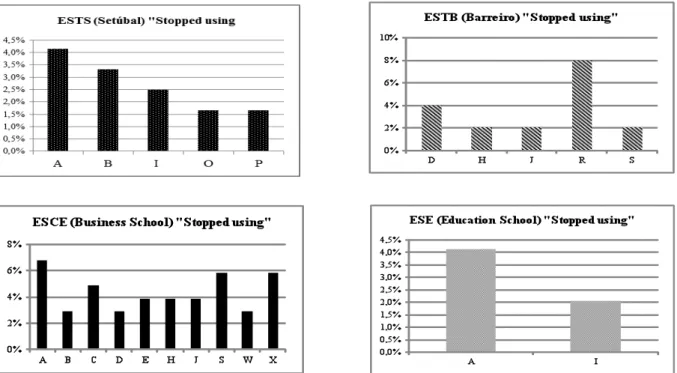
The changes were not significant, since the largest values remained in the items "never used" and "continued to use".
There were some activities referred as "never used" common to three of the four schools (excluding Education School) namely: F) Individual - Report of professional placements; L) Individual assessment by students; M) Individual - "peer review"; N) Individual – portfolio; Z) Group self-assessment by students; AA) Group – “peer review; AB) Group portfolio.
As regards to activities that "continued to use" the only match, was verified in the Technology School (Barreiro) and in the Business School: A) Individual - knowledge assessment tests.
Analysing the item "Stopped using", the only assessment element referred by three of the four schools was A) Individual knowledge assessment test, despite the percentages were not significant. The Business school (ESCE) mentioned the largest number of activities stopped to use.
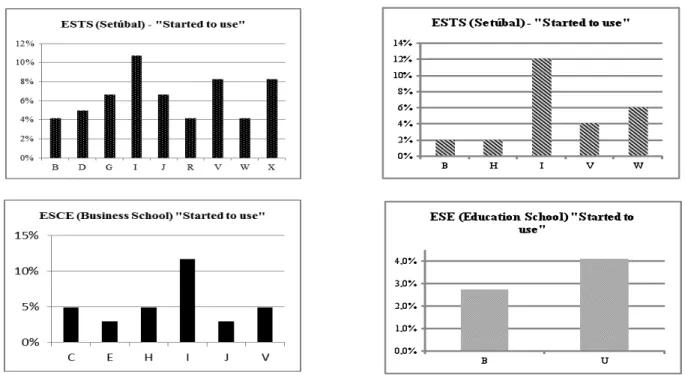
The Engineering School of Setúbal (ESTS) has incorporated a larger number of assessment elements (started to use), although the values were not significant.
It’s not possible to establish a standard for the assessment elements that have been or are no longer used. However, the changes affected virtually all the individual assessment elements. The assessment elements in group were irrelevant.
Fig. 4 - Changes in assessment elements – “Started to use”.
3.5 Tutorial activities
Considering the available data, we can conclude that most of the CU’s included some type of tutorial activities. The Education School presented the largest use of these activities (the tutorial activities were included in about 90% of the CU’s).
Regarding the tutorial activities, it was possible to conclude that they oscillated between: - Clarification on the CU´s contents (Barreiro School of Technology and Business School);
- Aid to activities autonomously produced by students (Setúbal School of Technology and Education School);
- Methodological support to the independently developed activities by the students (Setúbal School of Technology and Education School);
- Advice on general methods of work (Business School).
The tutorial activities were developed in all the schools, either in place, or through on distance learning.
Figure Legends Activities
A-Lectures content (explaining);B-Interactive lectures (with students); C-Lectures with examples of reality; DLectures introducing topics for discussion; E Lectures using media; F -Discussion focused on issues based on analysis of documents in different registers (texts, films, slides, etc.); G-Oral communication by students of the results in different activities; H-Application exercises; I-Problem solving; J-Work project; K-Practical work (laboratory experiments, constructing different products, etc.); L-Study visits; M-Fieldwork; N-Research/action projects; O-Guidance mentoring/tutorial; P-Professional placements of students; Q-Supervision of Professional placements by the teacher; R-Participation in seminars/conferences; S-Communication with the teacher and classmates by e-mail as part of homework; T-Participation in discussion forums online; U-Research and gather information online; V-Simulated practice; W-Case study; X-Diagnostic test at the beginning of the UC.
Assessment Elements
A-Individual – Knowledge assessment test; B-Individual – Knowledge assessment test and its application; C-Individual – Performance in practical activities/simulated practice; D-Individual – Reports of experimental activities/practices; E-Individual – Written productions (index Reading, book reviews, essays, etc.); F-Individual – Report of professional placements; G-Individual – Investigation/action projects; H-Individual – Student participation in several activities during class; I-Individual – Participation in “distant” activities (Ex: Moodle); J-Individual – Oral presentation of papers; K-Individual – Production of materials, modes, art objects, equipment, maps, paintings, collages, posters, prototypes, etc.); L-Individual – Self - assessment by students; M-Individual – “Peer review”; N-Individual – Portfolio; O-Group – Knowledge assessment tests; P-Group – Knowledge assessment test and its application; Q-Group – Performance in practical activities/simulated practice; R-Group – Reports of experimental activities/practices; S-Group – Written productions (index Reading, book reviews, essays, etc.); T-Group – Professional placement report; U-Group – Investigation/action projects; V-Group – Student participation in several activities during class; W-Group – Participation in “distant” activities (Ex: Moodle); X-Group – Oral presentation of papers; Y-Group – Production of materials, modes, art objects, equipment, maps, paintings, collages, posters, prototypes, etc.); Z-Group – Self- assessment by students; AA-Group – “Peer review”; AB-Group – Portfolio.
4 CONCLUSIONS, LIMITATIONS AND FURTHER RESEARCH
Regarding the changes in teaching learning activities, the answers related to “stopped using” showed that no activity was significantly abandoned. For the answers to “started to use”, the higher percentages were concentrated on: Electronic communications (24%); Tutorial orientation (14%); Presentation with themes for discussion (14%); Participation in discussion forum on line (12%); Information research on line (10%).
Regarding the changes in the assessment elements, the answers to “stopped using” showed that no element was significantly abandoned. The answers to “started to use” had the higher percentages mainly on: Individual activities on distance learning (12%); Group work related to classroom (8%); Group presentations (8%).
As a more general conclusion, we can say that the most expected changes with the Paradigm of Bologna have had low levels of adoption.
The percentage of changes summed up to 15 % of the total questioned items. Main changes were concentrated on small changes that increased a little with the Bologna process.
Final examination is no longer the unique evaluation method in 40% of answers (increased from 8%). On the other side, the relative weight between the several evaluation solutions remained very similar. No significant differences were found between the two schools of technology, but visible differences were shown between the school of education and the other schools.
This study did not questioned important aspects such as: desired competencies and their achievement, relationships between contents and competencies, coherency between ECTS and total workload, pedagogical approaches adequacy to scientific matters, relationships between school success rates and pedagogical approaches, learning methods adopted by students.
This study raised the need to clarify the possible relationships between school success rates and the pedagogical/evaluation approaches.
Trying to update the information, the same questionnaire is planned to be filled in 2012/2013 by the teachers responsible for the curricular units that presented the highest school failure rates.
REFERENCES
[1] Cortes, V. (Coord.). Estratégia Institucional: Eixo A – Criação de um Espaço Europeu de Ensino Superior - Relatório de Compatibilização. Setúbal, Instituto Politécnico de Setúbal, 2005. [2] Kells, H.R. Creating a culture of evaluation and self-regulation in higher education
[3] Pires, A.M.R. Quality Management System in a Portuguese Higher Polytechnic Institute - Difficulties and Potentialities, in Proceedings of the 13th Toulon- Verona Conference, (Coimbra, Portugal, September, 2010), Reference A14_ Ramos. Pires.
[4] Pires, A.M.R. How applied research can improve the teaching learning processes and quality management systems, in the Proceeding of the WEE 2011, (Lisbon, Portugal
September/October 2011), 352-358.
[5] Pires, A.M.R., Gonçalves, H. Dropout Study in IPS, in the Proceeding of the 14th Toulon-Verona Conference, (Alicante, Spain, September 2011), Reference Pires-Gonçalves. [6] UNIQUA/IPS. Influência das características sociodemográficas nos resultados académicos,
Polytechnic Institute of Setúbal, 2011.
[7] UNIQUA/IPS. Caracterização do Insucesso Escolar no IPS 1º Ciclo 2007/2008 a 2009/2010. Polytechnic Institute of Setúbal, 2011.