Revista de Gestão em Sistemas de Saúde - RGSS, São Paulo, v. 2, n. 1, p. 26-41, jan./jun. 2013. 26
E-ISSN: 2316-3712
DOI: 10.5585/rgss.v2i1.48
Organização: Comitê Científico Interinstitucional Editor Científico: Marcos Roberto Piscopo
Editora Adjunta:Lara Jansiski Motta e Chennyfer Dobbins Avaliação: Double Blind Review pelo SEER/OJS
Revisão: Gramatical, normativa e de formatação
WEB 2.0 COMO FERRAMENTA PARA GESTÃO DE REDES E ANÁLISE DE PATENTES EM SAÚDE PÚBLICA
WEB 2.0 TOOLS FOR NETWORK MANAGEMENT AND PATENT ANALYSIS FOR HEALTH PUBLIC
Jorge Lima de Magalhães
Pós-doutorado na Université de Provence Aix Marseille, França Professor da Fundação Oswaldo Cruz – Fiocruz
E-mail: [email protected](Brasil)
Luc Quoniam
Doutor em Science de l'Information et de la Communication pela Université Aix Marseille III, França
Professor da Université Du Sud Toulon Var – França
E-mail: [email protected] (França)
Núbia Boechat
Doutora em Química pela Universidade Federal do Rio de Janeiro – UFRJ Diretora Executiva de Farmanguinhos da Fundação Oswaldo Cruz – Fiocruz
Web 2.0 Tools for Network Management and Patent Analysis for Health Public
Revista de Gestão em Sistemas de Saúde - RGSS, São Paulo, v. 2, n. 1, p. 26-41, jan./jun. 2013. 27
WEB 2.0 COMO FERRAMENTA PARA GESTÃO DE REDES E ANÁLISE DE PATENTES EM SAÚDE PÚBLICA
RESUMO
A intensidade em que ocorrem as pesquisas para novas drogas e medicamentos contribui significantemente para a inovação e o desenvolvimento tecnológico da Saúde de uma nação. Nesse sentido, este trabalho objetiva demonstrar como algumas ferramentas de acesso livre da Web 2.0 podem auxiliar os países em desenvolvimento, bem como os não desenvolvidos, na gestão de redes e análise de patentes para apoio na atenção à saúde, especificamente, tendo como exemplo a tuberculose. As correlações de vários especialistas no mundo e em diversas bases do conhecimento podem contribuir na geração de novas abordagens e resultados, no sentido de auxiliar melhor os tomadores de decisão das empresas, governos ou organizações. As publicações e os países onde existem redes de pesquisa em tubérculos são demonstrados em mapa global. Também é descrito um exemplo específico para gestão tecnológica usando patentes em tuberculose.
Palavras-chave: Gestão em Saúde; Web 2.0; Patentes; Doenças Negligenciadas; Inteligência
Competitiva.
WEB 2.0 TOOLS FOR NETWORK MANAGEMENT AND PATENT ANALYSIS FOR HEALTH PUBLIC
ABSTRACT
Intensity in research on drugs and medicines contributes significantly to innovation and technological development in the country's health. Thus, this work aimed evinces how Web 2.0 tools of free access can help developing and undeveloped nations in the network management and patent analysis for health care, in this case for tuberculosis. The co-relation of a lot of experts in the world with several knowledge bases can contribute to generation of new approaches and results as well as assist in better decision making by managers of companies, governments and organizations. Countries and publications by research networks in tuberculosis are listed in worldwide. We also describe a specific example for technological management using tuberculosis patents.
Jorge Lima de Magalhães, Luc Quoniam & Núbia Boechat
Revista de Gestão em Sistemas de Saúde - RGSS, São Paulo, v. 2, n. 1, p. 26-41, jan./jun. 2013.
28
1 BACKGROUND
According to the Organization for Economic Co-operation and Development (OECD), 55% of global wealth is in the knowledge (OECD, 2008). Drucker (Drucker, 2006) points out that the increase in the generation of this knowledge will occur with the increase of knowledge management.
New trends influence the industrial development of a country, such as the knowledge, like a main resource and the learning, like a central process. Therefore, it is essential to broaden the base of expertise in human resources and hence increasing the innovation potential (Lastres & Sarita, 1999).
Formation of competencies for innovation requires previously defined as an intelligence cooperative, which translates as construction of knowledge in collaboration with peers at work. This mindset requires collaborative development processes capable of producing high quality information for scientific and technological knowledge. The experts have unrestricted access to information created by the scientific community, collaborative review of the contributions of members, governance based more on authority than on sanctions, and involvement in integrated levels and responsibilities (Ambrosi, Peugeot, & Pimenta, 2005).
In 1977, Tidd, Pavitt and Bessant discussed innovation as a change in products and services offered by an organization or even a change in the process or in a way to prepare the products or services. It also can be considered the way this organization delivers its products (Tidd, Pavitt, & Bessant, 2005).
Success of the activities of companies, research groups, government and institutions of countries are effective when they attribute value and quality in their information considered critical. These factors will lead the organization to succeed in their internal and external planning such as strategies for short and long term. Thus, the capital of intellectual property plays an important role in enterprises and knowledge becomes increasingly "key" to competitiveness, technology and so economic development. This happens mainly in the sectors of high density technology where knowledge is considered like the most important asset of the company (Quoniam, 2011).
Therefore, it is essential to invest in Research, Development and Innovation (R,D&I) so that an organization stay active and competitive. Information Science provides Web 2.0 tools that can help in the generation, treatment, storage and data management of any activities or processes, providing a better management system for innovation. Due to market system increasingly turbulent
Web 2.0 Tools for Network Management and Patent Analysis for Health Public
Revista de Gestão em Sistemas de Saúde - RGSS, São Paulo, v. 2, n. 1, p. 26-41, jan./jun. 2013. 29
beyond complex and competitive business in which they operate, the use of new approaches such as Intellectual/Industrial Property becomes the guarantee of continuity of their activities (Pierret, 2006).
Search engines have evolved from manual information’s for portals or websites dedicated
(Web 1.0 to Web 2.0i) – passed for a massive amount of information in an automated model. This
new paradigm allows the download of a huge amount of data in different formats, but they cannot do the same processing for the production of indicators for decision making. Hence, studies are needed using the tools of information science such as forecasting in technology trends (Quoniam & Lucien, 2010).
Using this approach is salutary to identify and promote the synergy of these experts to advance science. Thus, the innovation will be achieved through technological development in certain areas. Linking this statement with the approach of this work is expected to contribute in the management area to improving the treatment, alerts and ways for diseases’ eradication (Magalhães, Boechat, & Antunes, 2012a). Therefore, from the democratization of knowledge provided by the Web 2.0 tools using open access, it is possible to demonstrate the use of indicators for non-specialists democratized.
One footstep can be observed in figure 1, a global health map that brings together disparate data sources, including online news aggregators, eyewitness reports, expert-curated discussions and validated official reports, to achieve a unified and comprehensive view of the current global state of infectious diseases and their effect on human and animal health. Each point on the map indicates, in accordance with the color intensity, the highest or the lowest level of a certain disease. Another example is analysis in information from patents that can be incorporated into the competitive technological strategy of companies in a great variety of ways. It serves as an indicator of future developments in technology and gives your own company a decisive lead in its actions.
Jorge Lima de Magalhães, Luc Quoniam & Núbia Boechat
Revista de Gestão em Sistemas de Saúde - RGSS, São Paulo, v. 2, n. 1, p. 26-41, jan./jun. 2013.
30
Figure 1 - A Global Health Map (HealthMap | Global Health, Local Knowledge, 2013).
Reflecting on health, the WHO Constitution enshrines as a fundamental right to health of every human being access to timely, acceptable, and affordable health care of appropriate quality (“WHO | The right to health”, 2012). Accordingly, the global pharmaceutical industry contributes providing medicines through research them. In 2012, medicines sales surpassed US$ 900 billion with trend to reach US$ 1,2 trillion by 2016 (IMS Institute for Healthcare Informatics, 2012) (Magalhães, Quoniam, & Boechat, 2013). However, this volume does not meet properly marketed to most of the world population (WHO, 2008), of which 80% live in middle or low income countries. Corroborates this fact when there is a lack of medicines for neglected diseases (ND), considering that mainly affect populations with low purchasing power and therefore do not provide sufficient incentive for pharmaceutical industry to invest in Research and Development (R&D). WHO estimates that there are about 1 billion people suffering some ND. However, the challenge is best understood when we think of neglected populations, i.e., include not only new treatments for ND, but also access to antimicrobials, affordable medicines for diseases with global impact as diabetes and cancer (Moon, Bermudez, & ’t Hoen, 2012).
Among these diseases forgotten by the pharmaceutical industry, exemplify the tuberculosis (TB). This illness is a global affliction, and the WHO estimates that it affects 2 billion people, which means that a third of the world’s population is infected with the bacillus Mycobacterium tuberculosis (M.tb) (see figure 2). The bacillus is capable of lying dormant in a human body for years until an individual’s immunity system becomes unable to ward off the infection and incapable
Web 2.0 Tools for Network Management and Patent Analysis for Health Public
Revista de Gestão em Sistemas de Saúde - RGSS, São Paulo, v. 2, n. 1, p. 26-41, jan./jun. 2013. 31
of destroying the bacillus. While the majority of people with the latent infection never develop the active form of the disease, between 5% and 10% of the carriers will be afflicted by it during their lives. Over 95% of TB deaths occur in low- and middle-income countries, and it is among the top three causes of death for women aged 15 to 44. In 2011 alone it is estimated that globally over 1.4 million people died as a direct result of tuberculosis while another 8.7 million developed the active form of the disease (“WHO | Tuberculosis”, 2012). Although in some parts of the world incidence rates are falling, in those where poverty is prevalent and HIV/AIDS rates are high the disease has maintained a continuous growth rate, and it is the principal infectious disease responsible for AIDS/HIV mortalities. This global pandemic disease is deepening the chasm which separates rich and poor countries and further accentuating global social stress. For example, in 2009 alone, almost 10 million children were orphaned by parental mortalities caused by tuberculosis (Vasconcellos & Morel, 2012).
Jorge Lima de Magalhães, Luc Quoniam & Núbia Boechat
Revista de Gestão em Sistemas de Saúde - RGSS, São Paulo, v. 2, n. 1, p. 26-41, jan./jun. 2013.
32
Accordingly, use the Web 2.0 tools for help innovation management in health global, mainly ND seems a good way for no-developed countries and other threatened by such disease.
2 METHODS
This work is descriptive, accomplished through databases available on the web. So, numerous tools to improve web information organization has been appearing since O’Reilly (2007) attempts to define and understand the Web 2.0 (O’Reilly, 2007). Thus, there is a massive amount of information in different formats, being necessary subsequent treatments of these data in order to produce indicators for decision making. Hence, the method for obtaining and utilizing the information passes through the Application Programming Interface (API) allowing working data in computer programs, having effectively robust downloading of information using all the possibilities via API in turn explore the potential of Web. Thereby, there is no presumption of bringing new indicator, but demonstrate the use for non-experts.
In this sense, first was held bibliographical survey and theoretical basis through the indexed databases such as PubMed, Science Direct and Web of Knowledge of the Institute for Scientific Information (ISI). Subsequently, researched term "tuberculosis" into PubMed, World Intellectual Property Organization (WIPO) and HealthMap – the data were processed at the own base and later analyzed, as well as patents analysis.
3 DISCUSSION
Need better management of information from the "Knowledge Age" and the technology involved. Should be considered adaptation to actual conditions of each local culture and collaboration of R,D&I through collaborative networks for dissemination of knowledge beyond development and innovation. Work with Information Science for whatever application area comprises a highly structured network (Le Moigne, 1994; Quoniam & Lucien, 2010). Since the processes involved in R,D&I drugs are increasingly complex, there is a need to train multidisciplinary teams in order to establish a systemic view (Ferreira et al., 2013).
Web 2.0 Tools for Network Management and Patent Analysis for Health Public
Revista de Gestão em Sistemas de Saúde - RGSS, São Paulo, v. 2, n. 1, p. 26-41, jan./jun. 2013. 33
Solomon et al. (2012) conceptualize four time points or periods at which disease elimination programmers require diagnostics: 1) Mapping to establish baseline disease prevalence, facilitating targeting of interventions. 2) Impact monitoring after interventions have commenced. 3) The stopping decision, which determines whether the pre-defined elimination target has been reached, allowing discontinuation of interventions. 4) Post-elimination surveillance after intervention has ceased (Solomon et al., 2012). Therefore, Web 2.0 tools can aid in the management of these four periods.
Moreover, several procedures have been suggested to cope with the three types of “health failures”: (a) Science failures (insufficient knowledge prevents the development of health products such as malaria and HIV vaccines): Stimulate basic, fundamental research and technological development, (b) Market failures (high prices prevent access of drugs by needy populations): Price reduction policies (resulting e.g. from negotiations between governments and industry) or creating subsidizing mechanisms leading to lower prices, and (c) Health service failures (inexpensive drugs do not reach the patients): Fighting corruption, reducing inequalities and coping with cultural, religious or infrastructure barriers, etc. that prevent access to cheap or free drugs by poor countries (Morel, Serruya, Penna, & Guimarães, 2009).
Therefore, improving the health of the poorest people in the developing world depends on the development and deployment of many varieties of health innovations, including new drugs, vaccines, devices, and diagnostics, as well as new techniques in process engineering and manufacturing, management approaches, software, and policies in health systems and services (Morel et al., 2005).
Mapping and location of these partnerships encourage better planning of R,D&I for businesses and institutions. Become possible to analyze each and expert information about their work and performance when identifying the current landscape and precede the future. Info planned and organized provides subsidies managers to better define public policies and stimulate research. Likewise, in management of DN field whether in prevention, control, treatments and new technologies (Magalhães, Boechat, & Antunes, 2012b).
Morel et al. (2009) shows that co-authorship network analysis could become an important tool for international organizations or partnerships targeting the elimination or eradication of diseases, providing science-based information relevant to strategic analysis and planning. Lessons from past eradication campaigns demonstrated the importance of maximizing the utilization of
Jorge Lima de Magalhães, Luc Quoniam & Núbia Boechat
Revista de Gestão em Sistemas de Saúde - RGSS, São Paulo, v. 2, n. 1, p. 26-41, jan./jun. 2013.
34
scarce human and financial resources, functioning within existing health service structures and encouraging research at all levels (Morel et al., 2009).
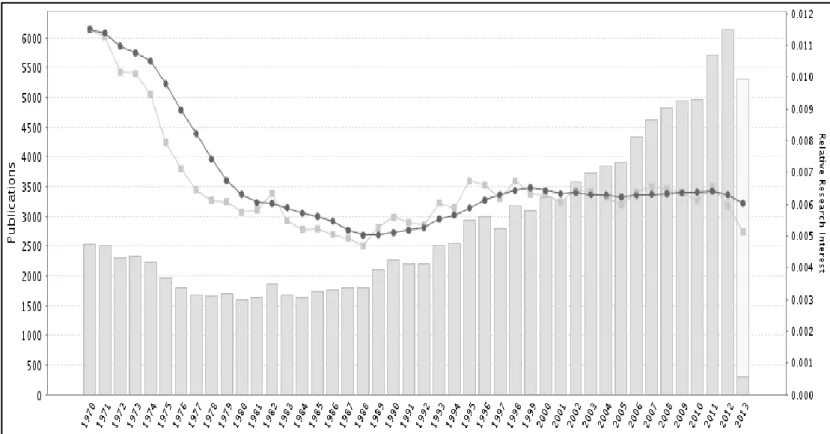
In the biomedical literature base of over millions of PubMed abstracts since 1953, can perform a bibliometric analysis to show a lot of information’s for management, such as: the growth in TB publications over time and respective authors, relations and co-relations on theme, intensity of researchers’ countries, trends etc. Figure 3 shows the evolution of scientific publications on TB
in about 40 years. Noteworthy is the Relative Research Interestii in the early 70s and gradually
falling to the 90s and remain almost stable until the year 2012. Index for Relative Research Interest
(smoothed)iii come in search of a way.
Figure 3 – Scientific papers in PubMed database (“Home - PubMed - NCBI”, 2013).
Figure 4 shows location of the research institutes that are working with TB. Note the intensity of research on the topic in the countries with the highest amount of points on the map.
Web 2.0 Tools for Network Management and Patent Analysis for Health Public
Revista de Gestão em Sistemas de Saúde - RGSS, São Paulo, v. 2, n. 1, p. 26-41, jan./jun. 2013. 35
Figure 4 - Map of the institutions' experts localization (“Home - PubMed - NCBI”, 2013).
191,981 scientific papers have been published related to TB. The five largest producers are the USA with 7.4%, India (3.5%), UK (2.5%), Japan (2.2%) and China (1.6%). Brazil appears 11th in the ranking with 0.9% of the total – 1,680 papers (see figure 5). Although the USA is leading in the polls when looking for cities, London is the main with 2.379 papers publications.
Figure 5 - Number of publications in TB over the years by countries and cities (“Home - PubMed - NCBI”, 2013).
Jorge Lima de Magalhães, Luc Quoniam & Núbia Boechat
Revista de Gestão em Sistemas de Saúde - RGSS, São Paulo, v. 2, n. 1, p. 26-41, jan./jun. 2013.
36
Trends evaluation through patents evolution is a strong indicator of R,D&I (Antunes & Magalhães, 2008). So, when an analyzed patent in the OMPI database shows 2693 patents existing
for TB in the past 10 years, in the PCTiv deposit are 29.6% (797 patents) and 552 in the basis of the
European Community (European Patent Office – EPO), Brazil has 1.7% of total patents. Excluding deposits PCT and EPO, the TOP 10 nations with highest patents number are Russian Federation with 649, Republic of Korea (143), Spain (120), Japan (113), Mexico (90), South Africa (50), Brazil (45), Argentina (32), Israel (30), Singapore (13) and Colombia (9). Figure 6 shows the distribution by countries and groups PCT and EPO.
Figure 6 - Patents distributions’ in OMPI databases.
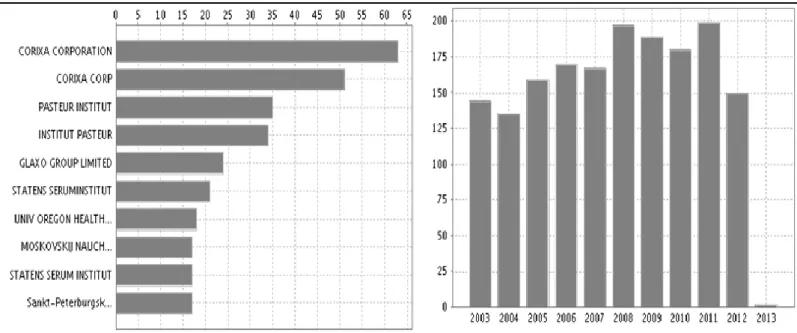
Figure 7 shows major companies holding patents on TB where Corixa Corporation is the principal and Sankt-Peterburgsk less deposits. Beside can see deposits evolution over the years. Even showing an increase between the years 2008 and 2012 can be gauged constancy towards technologies in TB.
Web 2.0 Tools for Network Management and Patent Analysis for Health Public
Revista de Gestão em Sistemas de Saúde - RGSS, São Paulo, v. 2, n. 1, p. 26-41, jan./jun. 2013. 37
Figure 7 - Holding patents and deposit evolution.
Efforts have been made by institutions around the world for solving global health problems, however need for management of technological innovation has been a challenge. Therefore, models to facilitate the management process have been employed using various tools in order to integrate expert networks for common goal. One example of success is the Global Alliance for TB Drug Development (TB Alliance) – a not-for-profit, product development partnership accelerating the discovery and development of new TB drugs that will shorten treatment, be effective against susceptible and resistant strains, be compatible with antiretroviral therapies for those HIV-TB patients currently on such therapies, and improve treatment of latent infection. It works with public and private partners worldwide.
4 CONCLUSIONS
Some bases provide open access democratization of indicators that can be used for the
problems of diseases that do not interest the pharmaceutical labs.
Use of Web 2.0 to analyze the technological forecasting research in TB was effective, given
the growing publication in the area in question, by number of patents observed with protection in PTC countries as well as developing nations.
Jorge Lima de Magalhães, Luc Quoniam & Núbia Boechat
Revista de Gestão em Sistemas de Saúde - RGSS, São Paulo, v. 2, n. 1, p. 26-41, jan./jun. 2013.
38
Mapping of the location of the partnerships promote a better planning of R,D&I and
knowledge uptake by businesses and institutions. Thus, it is possible to analyze each and expert information about their work and performance.
Pioneer country in research by specialists is the same what else inserts patents in the area
(USA) followed by the BRIC countries (Brazil, Russia, India and China).
Acknowledgments
We appreciate the financial support by Capes and infrastructure of the Aix Marseille Université by which it is possible to perform this work.
REFERENCES
Ambrosi, A., Peugeot, V., & Pimenta, D. (2005). Enjeux de mots - Regards multiculturels sur les
sociétés de l’information. France: C&F Editions. Retrieved from
http://www.decitre.fr/livres/enjeux-de-mots-9782915825039.html#table_of_content
Antunes, A. M. S., & Magalhães, J. L. (Orgs.) (2008). Patenteamento e Prospecção Tecnológica no Setor Farmacêutico. INTERCIENCIA.
Drucker, P. (2006). Desafios Gerenciais para o Século XXI. Cengage Learning Editores.
Ferreira, V. F., Rocha, D. R., Silva, F. C., Ferreira, P. G., Boechat, N., & Magalhães, J. L. (2013). Novel 1H-1,2,3-, 2H-1,2,3-, 1H-1,2,4- and 4H-1,2,4-triazole derivatives: a patent review (2008-
2011). Expert Opinion on Therapeutic Patents, 23, 1-13.
doi:doi:10.1517/13543776.2013.749862
HealthMap | Global Health, Local Knowledge. (2013). Retrieved from http://healthmap.org/pt/
Home – PubMed – NCBI. (2013). Retrieved January 18, 2013 from
http://www.ncbi.nlm.nih.gov/pubmed
IMS Institute for Healthcare Informatics. (2012). The Global Use of Medicines: outlook through 2016 (p. 36). Retrieved from www.imshealth.com
Web 2.0 Tools for Network Management and Patent Analysis for Health Public
Revista de Gestão em Sistemas de Saúde - RGSS, São Paulo, v. 2, n. 1, p. 26-41, jan./jun. 2013. 39
Lastres, H. M. M., & Sarita, A. (1999). Informação e Globalização na Era do Conhecimento. Rio de Janeiro: Editora Campus Ltda.
Le Moigne, J. L. (1994). La théorie du Système Géneral: théorie de la modélisation. France.
Magalhães, J. L. de, Boechat, N., & Antunes, A. M. de S. (2012a). Internalizing active pharmaceutical ingredients and medicines for neglected tropical diseases: proposal for interaction among Government – University – Industry. Química Nova, 35(3), 654-660. doi:10.1590/S0100-40422012000300038
Magalhães, J. L. de, Boechat, N., & Antunes, A. M. de S. (2012b). Identification of Brazilian expertise in the fight against some neglected tropical diseases. Revista da Sociedade Brasileira de Medicina Tropical, 45(3), 415-417. doi:10.1590/S0037-86822012000300030
Magalhães, J. L., Quoniam, L., & Boechat, N. (2013). Pharmaceutical Market and Opportunity in the 21st for Generic Drugs: a Brazilian case study of olanzapine. Problems of Management in the 21st Century, 6.
Magalhães, J. L., Antunes, A. M. S., & Boechat, N. (2012). Technological Trends in the Pharmaceutical Industry: the matter of neglected tropical diseases – An overview of the Research, Development & Innovation in Brazil. Synergia Editora. Retrieved from http://www.livrariasynergia.com.br/livros/M39700/9788561325732/tendencias-tecnologicas-no-setor-farmaceutico-a-questao-das-doencas-tropicais-negligenciadas-edicao-bilingue.html
Moon, S., Bermudez, J., & ’t Hoen, E. (2012). Innovation and Access to Medicines for Neglected Populations: Could a Treaty Address a Broken Pharmaceutical R&D System? PLoS Med, 9(5), e1001218. doi:10.1371/journal.pmed.1001218
Morel, C. M., Acharya, T., Broun, D., Dangi, A., Elias, C., Ganguly, N. K., … Yun, M. (2005). Health Innovation Networks to Help Developing Countries Address Neglected Diseases. Science, 309(5733), 401-404. doi:10.1126/science.1115538
Morel, C. M., Serruya, S. J., Penna, G. O., & Guimarães, R. (2009). Co-authorship Network Analysis: A Powerful Tool for Strategic Planning of Research, Development and Capacity Building Programs on Neglected Diseases. PLoS Neglected Tropical Diseases, 3(8), e501. doi:10.1371/journal.pntd.0000501
O’Reilly, T. (2007). What is Web 2.0: Design Patterns and Business Models for the Next Generation of Software (SSRN Scholarly Paper No. ID 1008839). Rochester, NY: Social Science Research Network. Retrieved from http://papers.ssrn.com/abstract=1008839
Jorge Lima de Magalhães, Luc Quoniam & Núbia Boechat
Revista de Gestão em Sistemas de Saúde - RGSS, São Paulo, v. 2, n. 1, p. 26-41, jan./jun. 2013.
40
OECD. (2008). OECD Annual Report 2008 (p. 118). Paris, France: Organisation for Economic Co-operation and Development. Retrieved from http://www.oecd.org/newsroom/40556222.pdf Pierret, J.-D. (2006, fevereiro 28). Methodologie et structuration d’un outil de decouverte de
connaissances basé sur la litterture biomedicale: une application basée sur le MeSH. Université du Sud Toulon Var. Retrieved from http://tel.archives-ouvertes.fr/tel-00011704
Quoniam, L. (2011). Competitive Intelligence 2.0. France: ISTE Ltd and John Wiley & Sons Inc. Retrieved from http://www.iste.co.uk/index.php?f=a&ACTION=View&id=409
Quoniam, L., & Lucien, A. (2010). Intelligence compétitive 2.0: organisation, innovation et
territoire. France: Librairie Lavoisier. Retrieved from
http://www.lavoisier.fr/livre/notice.asp?ouvrage=2139418&pos=8
Solomon, A. W., Engels, D., Bailey, R. L., Blake, I. M., Brooker, S., Chen, J.-X., … Peeling, R. W. (2012). A Diagnostics Platform for the Integrated Mapping, Monitoring, and Surveillance of Neglected Tropical Diseases: Rationale and Target Product Profiles. PLoS Negl Trop Dis, 6(7), e1746. doi:10.1371/journal.pntd.0001746
Tidd, J., Pavitt, K., & Bessant, J. (2005). Managing innovation: integrating technological, market and organizational change by Tidd, Joseph, 1960-, Pavitt, Keith, Bessant, John, 1952- (3rd ed.). John Wiley. Retrieved from http://prism.talis.com/mmu/items/1677998
Vasconcellos, A. G., & Morel, C. M. (2012). Enabling Policy Planning and Innovation Management through Patent Information and Co-Authorship Network Analyses: A Study of Tuberculosis in Brazil. PLoS ONE, 7(10), e45569. doi:10.1371/journal.pone.0045569
WHO. (2008). WHO | Sixty-first World Health Assembly. Retrieved from
http://www.who.int/mediacentre/events/2008/wha61/en/index.html
WHO. (2012). WHO | Global tuberculosis report 2012. WHO. Retrieved January 21, 2013 from http://www.who.int/tb/publications/global_report/en/
WHO. | The right to health. (2012). WHO. Retrieved January 18, 2013, from http://www.who.int/mediacentre/factsheets/fs323/en/
WHO. | Tuberculosis. (2012). WHO. Retrieved January 17, 2013 from
Web 2.0 Tools for Network Management and Patent Analysis for Health Public
Revista de Gestão em Sistemas de Saúde - RGSS, São Paulo, v. 2, n. 1, p. 26-41, jan./jun. 2013. 41
___________________
Data do recebimento do artigo: 11/02/2013
Data do aceite de publicação: 09/04/2013
i Web term (World Wide Web) – Web 2.0 considers the communication that occurs in a collaborative and dynamic, i.e.,
several to several people and taking the Web such as a platform (O’Reilly, 2007).
ii Relative Research Interest is computed as the fraction of the number of articles of that topic (search query) from the
specific year over the total number of articles of that year, such as R(y) = n(y, q) / N(y), where n(y,q) = number of articles for query q in year and y N(y) = number of articles in year y.
iii Relative Research Interest (smoothed) is the relative research interest smoothed by a sliding window of 5 years: S(y)
= mean (R(y-4), R(y-3), R(y-2), R(y-1), R(y)) (not available values are ignored).
iv Patent Cooperation Treaty: allows the company to make a single depositor patent application and in a single language.
This applies to the signatories countries of this treaty. From this single deposit the depositor has up to 12 months to choose the countries where the patent it'll be deposit.