1 A Work Project, presented as part of the requirements for the award of a Masters Degree in Management from the Faculdade de Economia da Universidade Nova de Lisboa.
Physical Strength as a Determinant of Persuasion
A project carried out under the supervision of: Irene Consiglio
May 26th, 2017
Jonas Schindler Student Number: 24775
Physical Strength as a Determinant of Persuasion
Jonas Schindler May 26th, 2017
Abstract
This master work project focuses on the different roles that physical strength might play in persuasion. While the research stream of embodied persuasion points to an influence of various bodily variables on persuasion, the present study is the first to examine the effects of physical strength on the formation of attitude. The Elaboration Likelihood Model of persuasion and the Persuasion Knowledge model served as theoretical foundation. The variables argument
strength, salience of manipulative intent and sense of power were hypothesized to impact the
influence of physical strength on attitudes and tested in an experimental design. The study obtained no significant results in relation to an influence of physical strength on persuasion. This might be due to the unsuccessful manipulation of the salience of manipulative intent in the presented persuasion message.
JEL Classification:
Table of Content
Table of Figures Glossary 1. Introduction ... 1 2. Literature Review ... 3 2.1. Embodied Persuasion... 3 2.1.1. Background ... 32.1.2. The Elaboration Likelihood Model of Persuasion ... 4
2.1.3. Self-Validation ... 5
2.2. Resistance ... 6
2.2.1. Perception of Manipulative Intent ... 6
2.2.2. Motivation as limiting Factor of Resistance ... 7
2.2.3. The Role of Physical Strength in Resistance ... 8
2.3. Summary ... 9
2.4. Hypotheses Statement ... 9
3. Method ... 11
3.1. Design and Subjects ... 11
3.2. Stimulus Materials ... 12 3.3. Procedure ... 14 3.4. Instruments... 15 3.4.1. Independent Variables ... 15 Self-reported elaboration ... 15 Argument Quality ... 15
Salience of Manipulative Intent ... 16
Self-Efficacy ... 17
Mood ... 17
Physical Strength ... 17
3.4.2. Dependent Variable ... 18
Attitude toward HEALTH-i ... 18
4. Analysis and Results ... 18
4.1. Preliminary Analysis ... 18
4.2. Hypotheses Testing ... 21
4.3. Data Exploration ... 22
5. Discussion ... 23
5.1. Summary and Implications ... 23
5.1.1. Summary ... 23
5.1.2. Implications ... 24
5.2. Limitations and Further Directions ... 24
5.3. Conclusion ... 26
TABLE OF FIGURES
Figure 1: Visualization of Hypotheses ……… 9
GLOSSARY
ELM: Elaboration Likelihood Model
PKM: Persuasion Knowledge Model
AQ: Argument Quality
MI: Manipulated Intent
GSE: General-Self-Efficacy Scale
1
1. Introduction
Physical strength is indisputably a vital component in the evolution of mankind. In prehistoric human societies, it was inextricably linked with the chances of survival, reproduction and kin protection as it equipped humans with the capability to protect themselves from physical threats (Cummins, 2005). Physically formidable individuals occupied the top ranks in the social hierarchy which implied control over valuable resources and other community-members (Fiske, 1992; Von Rueden, Gurven, and Kaplan 2008).
Nowadays, social structures are substantially different. With the decrease of primitive combat behaviours and increase of social interactions, persuasion has replaced physical competition as “the most prevalent as well as the most civil means of social control available to governments and to individuals” (Petty and Briñol 2008, 52). It follows that the capability to cope with attempted persuasion rather than the muscular resources for fending off physical attacks is prerequisite to achieve and protect the own goals (Friestad and Wright, 1994). Even though physical strength and muscularity decreased in existential relevance, they are still today associated with certain advantages in social interactions, such as a high control over the environment and the mastering of difficult situations (Darden, 1972; Mishkind, Rodin, Silberstein, and Striegel-Moore, 1986). A control over the environment and mastery of critical situations arguable works out to an individual’s advantage when facing a persuasion attempt. Therefore the question arises if physical stronger people are better equipped for coping with persuasion. Does physical strength carry advantages in mastering persuasion attempts? Can physically stronger people armour themselves against the intangible threat of persuasion? I propose that the opposite might be the case. Depending on the context, a physically strong target (i.e. the person being exposed to the persuasion attempt) could be more susceptible to persuasion than a weaker target. This assumption stems from the idea that the own physical
2 states might serve as symbolic embodiment of self-confidence, efficacy, superiority and a feeling of invulnerability (Darden 1972; Ozer and Bandura, 1990) which could impact people’s attitudes and behaviour. Indeed, the research stream of embodied persuasion provides evidence “that the body contributes to the acquisition, change, and use of attitudes” (Briñol and Petty, 2008a, 2). Even though the influence of numerous variables on persuasion has been tested, physical strength as an objective measure, to the best of my knowledge, hasn’t received any attention.
To close this gap, the present study examined for the first time the role physical strength plays in persuasion. Thereby, as in most persuasion research, persuasion is defined as attitude change in the direction that has been promoted in a persuasive message (Zanna and Rempel, 1988; Briñol and Petty, 2008b). The goal of this study was to provide answers to the question if physically stronger people respond differently to persuasion attempts than physically weaker people. To achieve this goal, several factors (e.g. sense of power, perceived manipulation) identified in prior research appear to be relevant and were therefore tested in an experimental design.
By examining the effects of physical strength on persuasion, the present paper contributes to both research and practice. From a theoretical perspective, the findings in this study can contribute to the research stream of embodied persuasion by extending the knowledge about how bodily variables can influence attitudes. Analog to the established idea that certain body movements (e.g. head nodding) or postures (e.g. sitting slouched) can impact attitudes, it was tested if a person’s mere physical strength affects people’s reaction to persuasion.
From a practical perspective, understanding the role of physical strength on persuasion is important as strength records become increasingly available (e.g. through fitness wearables) with the digital revolution (Kaptein, 2010; Kaptein and Eckles, 2012). If physical strength is found to influence persuasion, the insights from this study can be used to leverage on the
3 available strength records in order to influence people’s attitudes. The ability to tailor more effective persuasion messages based on people’s physical strength opens of new possibilities for use and misuse of persuasion at the same time (Kreuter, Farrell, Olevitch, and Brannan, 2013). Imagine the case of a doctor that leverages on a patient’s strength records to positively influence his compliance with the suggested medical treatment. This would help increase both individual health and public welfare. On the other hand, insights from this study could help policy makers take the right measures to prevent misuse of persuasion adapted to physical strength. Many of the entities that have or can get access to strength records (e.g. Google, Fitbit, Samsung) are profit-driven and could exploit the data, for example, to unethically persuade users to repeated purchases or subscriptions. By providing first insights into the role of physical strength on persuasion, this study contributes to the improvement of ethical use and limitation is unethical misuse.
2. Literature Review
2.1. Embodied Persuasion 2.1.1. Background
Understanding how people form and change their attitudes is the main goal of persuasion research. Since the research stream emerged in the mid 20th century, innumerable variables have been tested on their influence on persuasion (Petty, Briñol, and Tormala, 2002).
”The idea that the body contributes to the acquisition, change, and use of attitudes” (Briñol and Petty, 2008a, 2) is not new to persuasion literature. Prior studies in the field of “embodied persuasion” provide evidence for the notion that bodily movements (e.g. head nodding) and static bodily responses (e.g. sitting upright) can influence people’s attitudes in response to a persuasive message. Briñol and Petty (2003), for example, exposed participants unconsciously
4 to a persuasive message which promoted the implication of a new security system in their school. The authors found that participants who nodded their heads while hearing the persuasive message reported more favourable attitudes toward the security system than participants who kept their heads still. Interestingly, this effect only occurred when the persuasive message contained strong arguments. When the message contained rather weak arguments in favour of the new security system, the effect was reversed such that nodding participant reported more negative attitudes that the control group. Similar effects were observed for different body movements and positions, including writing with the dominant hand (as compared to the non-dominant hand) (Briñol and Petty, 2003) and sitting in an upright position (as compared to slouched position) (Briñol and Petty, 2007). Literature suggests that self-validation processes account for the observed effect (Brinol and Petty, 2003, Brinol and Petty, 2007). To understand the self-validation process and the role the participants’ body played in the formation of attitudes, it is helpful to first understand the general ways in which people form attitudes in response to a persuasive message.
2.1.2. The Elaboration Likelihood Model of Persuasion
The Elaboration Likelihood Model of persuasion (ELM) is among the most widely used frameworks in persuasion research to explain how a persuasive message can influence attitudes (Petty and Cacioppo, 1986). It proposes that any given variable (e.g. physical strength) might change the target’s attitudes by one of five specific processes, depending on the extent to which the target (= person that receives the persuasive message) cognitively scrutinizes the message (Petty, Barden, and Wheeler; 2009; Petty and Briñol, 2008; Sherman et al., 2014). At a high extent of thinking, physical strength is likely to either a) be processed as arguments, b) bias the valence of thoughts, or c) affect self-validation (Petty, Barden, and Wheeler, 2009). In contrast, at a low extent of thinking, physical strength is likely to d) serve as simple associative cue.
5 When the extent of thinking is not constrained by other factors to be high or low, physical strength can also e) affect the extent of thinking (Briñol and Petty, 2008a).
2.1.3. Self-Validation
In contemporary literature, self-validation has received much attention in the context of embodied research (Briñol and Petty, 2008a). As a process that appears to offer the most conclusive approach for examining the influence of physical strength on attitudes, the present study will focus on this process without further elaborating on the other processes identified in the ELM (Briñol and Petty 2008a; Petty, Briñol, and Tormala, 2002).
The self-validation hypothesis (Petty, Briñol, and Tormala, 2002), suggests that, under a high amount of thinking, two factors determine the formation of attitudes: the prevailing direction of thoughts (primarily favourable vs. primarily unfavourable) which people generate about the persuasion object, and the confidence which people have in these thoughts.
It is important to note that a high thought-confidence does not impact the direction nor the number of thoughts but simply magnifies the effect of any salient thought on attitudes (Petty, Briñol, and Tormala, 2002).
Several studies suggest that the observed self-validation effect of certain body movements and postures might stem from an embodied sense of power (Schubert, 2004; Briñol, Petty, Valle, Rucker, and Becerra, 2007; See, Morrison, Rothman, and Soll, 2011; Briñol and Petty 2008a). Schubert (2004), for example, has demonstrated that even unconscious power-related body actions such as making a fist can lead people to feel powerful. Drawing on these insights, there is reason to expect that physical strength per se, even when detached from certain movements or postures, impacts self-validation processes.
As physical strength enhances peoples coping capabilities and performance in various situations, it can be argued that physical strength supplies people with a sense of power
6 (Georgesen and Harris, 1998). Furthermore, physical strength implies the control over valuable (physical) resources which is central to the definition of power (Emerson, 1962). If the self-validation hypothesis holds true for physical strength, it would leave physically stronger people more susceptible to persuasion attempts containing strong arguments, and less susceptible to persuasion attempts containing weak arguments.
2.2. Resistance
However, Knowles and Linn (2004) suggest that attitude formation in response to a persuasion message is not simply the function of thought valence and confidence, but is also determined by the opposed force of resistance. Resistance is defined as the absence of attitude change or even a change in the opposite direction (Knowles and Linn, 2004). In this sense, resistance and persuasion are referred to as the opposite ends on the scale of attitude change.
Indeed, it can often be observed that persuasion attempts are not successfully influencing the target’s attitudes in the desired direction, and in some cases may even backfire in the opposite direction. To examine the roles physical strength may play in persuasion, the mechanisms of resistance need to be understood (Knowles and Linn, 2004).
2.2.1. Perception of Manipulative Intent
A diverse set of research has demonstrated that the notion of being manipulated is inherently resistance inducing (Cosmides and Tooby, 1992; Christensen, 1977; Jones and Wortman, 1973; Fein, McCloskey and Tomlinson, 1997; Campbell, 1995). Literature suggests that resistance is rooted in people’s fundamental need for autonomy and the freedom to unrestrictedly behave and think as they choose (Brehm, 1966; Brehm and Brehm, 1981; Brown and Levinson, 1987). Moreover, people derive a sense of worth from their beliefs and the notion that these are accurate and persistent (Correll, Spencer, and Zanna, 2004). As a manipulation attempt
7 threatens their personal freedom and self-concept, people will engage in resistance to avoid unfavourable consequences of misguided decisions and undesirable self-labels of falling for persuasion, people might be resistant (Sagarin, Cialdini, Rice, and Senna, 2002; Jacks and Cameron, 2003; Steele, 1988).
According to the Persuasion Knowledge Model (PKM), people, throughout their lifespan, develop knowledge about persuasion which they can use to identify, evaluate and cope with persuasion attempts (Friestad and Wright, 1994). When confronted with a persuasion attempt, people use their persuasion knowledge to evaluate both persuasion message and the own coping capabilities in order to deploy the appropriate coping tactics (Friestadt and Wright, 2004). Campbell and Kirmani (2000) have found that the salience of the agent’s persuasion motives is an important determinant for the use of persuasion knowledge. When an ulterior motive is blatant, people draw on their persuasion knowledge to assess persuasion motives and identify undue manipulation attempts (Campbell and Kirmani 2000).
2.2.2. Motivation as limiting Factor of Resistance
However, the perception of manipulative intent does not necessarily lead to resistance. In a study from Sagarin et al. (2002), participants were able to detect a manipulative intent in a persuasion attempt, but still didn’t resist. From the authors’ perspective, the absence of resistance could be explained by a lack of motivation to resist. In consistency with prior findings from Zuwerink and Devine (1996), the authors further propose that resistance has both an affective and a cognitive component (Sagarin et al., 2002). While the effective component is expected to be instantly exerted upon the perception of manipulation, the cognitive component of resistance has been found to be a depletable resource that is rationed in order to be sufficiently available in critical situations (Knowles and Linn, 2004). As cognitive resources generally require motivation, it follows that the extent of resistance is partially determined by
8 the target’s motivation to resist. The motivation in turn, based on the PKM, is influenced by both the target’s assessment of the own coping capabilities and the evaluation of the manipulation attempt (Friestad and Wright, 1994).
2.2.3. The Role of Physical Strength in Resistance
Prior research supports the idea that there is a relationship between physical strength an resistance and revealed several insights pointing to both an overestimation of the personal capabilities, and an underestimation of the threat in a persuasive message. Based on that, I suppose that physical strength can influence resistance through an effect on the target’s motivation to resist.
Jacks and O’Brien (2004) reported that affirming people’s sense of efficacy, self-esteem or confidence reduces their likelihood to resist a persuasive message by increasing their perceived coping capabilities. The study from Sagarin et al. (2002) also supports these findings, demonstrating that increasing people’s sense of efficacy and perceived control by training them to resist illegitimate advertisement, left them less resistant to legitimate advertisement. According to Ozer and Bandura (1990), people’s physiological conditions can affect their self-beliefs of efficacy. Darden (1972) also found that greater physical resources are generally associated with greater control over the environment and even a sense of invulnerability to threat. Mishkind et al. (1986) also suggested that muscular people might embody positive attributes such as self-confidence (source: the embodiment). In sum, these positive attributes, such as self-confidence, self-efficacy and control could arguably build up people’s perceived coping capabilities which in turn reduces their perceived need to resist.
What is more, those people with a high level of self-efficacy and personal control also tend to attribute positive events to themselves (Darden, 1972). As Ozer and Bandura (1990) further
9 suggested that people read their bodies as signs of personal vulnerability, it seems plausible to speculate that physical strength can decrease the perceived threat in a persuasion attempt. If physically strong people not only tend to overestimate their own coping capabilities but also tend to underestimate external risks, this might reduce the perceived need to resist to persuasion. In this case, a lack of motivation would result in lower resistance, as in the Sagarin et al. (2002) study.
2.3. Summary
Prior research in the field of embodied persuasion has demonstrated that certain bodily movements and postures are likely to impact the formation of attitudes through the self-validation process (Briñol and Petty, 2008a). On the other hand, several findings from contemporary literature point to a negative effect of physical strength on resistance. Taking the impact of both opposing forces into consideration, the following hypotheses on the effect of physical strength on attitudes were stated. In figure 1, the hypothesized effects are visualized.
2.4. Hypotheses Statement
10 Under a high amount of thinking, the ELM holds, people scrutinize the attitude-relevant information in a persuasion message carefully. As they are more likely to detect the flaws in weak arguments and merits in strong arguments, they people are expected to form their attitudes accordingly (Petty and Cacioppo, 1986; Canela, Requero, Santos, Stavraki, and Briñol, 2016). Accordingly, strong arguments will elicit primarily favourable thoughts while weak arguments elicit primarily negative thoughts (Petty and Cacioppo, 1986). Drawing on insights from embodied persuasion research, physical strength can be expected to increase the target’s thought-confidence, thus magnify the impact of salient thoughts on attitudes. If the self-validation process applies for physical strength, the following effects should be observed:
H1: Physically stronger targets are more persuaded by strong arguments and less persuaded by weak arguments than physically weaker targets.
Some researchers have argued that a high sense of power can increase participants’ thought confidence and account for the self-validation effect (See et al., 2011; Briñol et al., 2007). As physical strength is generally associated with power, I suppose that:
H2: Physical strength induces a sense of power, which in turn magnifies argument quality effects on attitudes.
Prior research suggests that the perception of being manipulated can inherently trigger resistance to a persuasion attempt (Christensen, 1977; Jones & Wortman, 1973; Fein, McCloskey & Tomlinson, 1997; Campbell, 1995). To identify manipulation attempts, people can use their persuasion knowledge. However, prior research suggests that persuasion knowledge might not be readily accessible unless a manipulative intent is highly salient in the persuasion attempt (Campbell and Kirmani, 2000; Bosmans and Warlop, 2005). Based on the notion that resistance has both a cognitive and an affective component (Zuwerink and Devine,
11 1996), I suppose that the notion of being manipulated will always arouse a certain extent of affective resistance which is expressed in less favourable attitudes:
H3: A blatant manipulative intent generally leads to less persuasion compared to an ambiguous manipulative intent.
On the other hand, the cognitive component of resistance is determined by the motivation to resist to a perceived manipulation attempt. As elaborated earlier, physically strong people in general not only tend to overestimate their own capabilities to cope with external threats, but they are also likely to underestimate their exposure to external threats. Both factors lead to the assumption that physical strength can decrease resistance by diminishing the motivation to resist. This effect, however, depends on people’s use of persuasion knowledge to identify manipulation attempts. In case a manipulative intent is not blatant, I suppose that persuasion attempts will be undetected and attitudes be formed by self-validation processes as hypothesized in H1.
H4: When a manipulative intent is blatant, physically stronger targets are generally more persuaded than physically weaker targets. However, when the manipulative intent is ambiguous, physically stronger targets are more (less) persuaded by strong (weak) arguments than physically weaker targets.
3. Method
3.1. Design and Subjects
A laboratory experiment has been conducted to test the hypotheses stated above and provide an initial examination of the roles that physical strength may play in persuasion. The experiment comprised two parts: a handgrip-test to measure the participant’s physical strength, and an
12 online-questionnaire to assess persuasion and other variables that are expected to influence persuasion.
A 2 x 2 between-subjects factorial design was used, whereas the argument quality in the persuasive message (AQ: strong vs. weak) and the salience of manipulative intent (MI: blatant vs. ambiguous) were manipulated. The argument quality manipulation was included in order to test the self-validation hypothesis. To do so, two distinct conditions were required in which targets either create favourable thoughts (strong AQ condition) about HEALTH-i, or unfavourable thoughts (weak AQ condition). The salience of manipulative intent manipulation was included to create conditions in which targets would use (blatant MI condition) or not use (ambiguous MI condition) their persuasion knowledge.
Eighty-nine students of Nova School of Business and Economics (45 women and 44 men; Mage = 22,16; SD = 2,22) participated voluntarily in the experiment. Among all participants, two equally large groups were distinguished: Group 1 (n = 48) comprises students who participated in exchange for extra class credits. They completed the questionnaire first and performed the handgrip-test after a one-minute break. Group 2 (n = 41) didn’t receive class credits and completed the two parts of the experiment in reversed order. Among both groups, it was controlled for priming effects that might have arisen from completing the handgrip-test prior to the questionnaire.
3.2. Stimulus Materials
A persuasion object of high personal relevance was chosen in order to motivate a high extent of thinking (Maheswaran and Meyers-Levy, 1990). The topic of digital user-data-driven health insurances has recently aroused considerable attention and sparked controversial discussions due to reasonable concerns about self-determination and data privacy. To avoid confound with prior knowledge and attitudes, the fictitious project “HEALTH-i” was contrived based on a
13 context analysis of similar projects. A neutrally explaining information message consisting of text and an illustration was prepared to familiarize subjects with the concept of HEALTH-i. In addition to the neutral message, persuasive messages were created in four distinct conditions that varied orthogonally along the manipulations of argument quality (AQ) and salience of
manipulative intent (MI). It is important to note that all persuasive messages argued in favour
of HEALTH-i, while message length and number of arguments were held equal to preclude the numerosity effect (Pelham, Sumarta, and Myaskovsky, 1994). Both manipulations can be seen in Appendix B1.
The manipulation of argument quality has been pre-tested (n=30) using nine 7-point likert scales which were adopted from Zhao et al. (2011). The results of a paired sample t-test proved that the arguments in the “strong AQ condition” (M = 5,51) were indeed perceived as stronger than those in the “weak AQ condition” (M = 5,22), whereas the difference was marginally significant (p < .082).
The manipulation of salience of manipulative intent has not been pre-tested as the manipulation was based on insights from prior research and was therefore expected to obtain the desired effect (Campbell and Kirmani, 2000; Bosmans and Warlop 2005; Eagly, Wood and Chaiken, 1978; Wood and Eagly, 1981). Findings from Campbell and Kirmani (2000) suggest that people will always draw on their persuasion knowledge when ulterior motives in the persuasive message are highly blatant. By explicitly highlighting the persuasive intent and biased promotion of HEALTH-i in the “blatant MI condition”, persuasion knowledge was expected to be activated (Bosmans and Warlop, 2005; Eagly, Wood and Chaiken, 1978; Wood and Eagly, 1981).
14 3.3. Procedure
Participants in group 1 completed both parts of the experiment in a room provided by Nova SBE to ensure a controlled laboratory-like environment. Attended only by the experimenter, one participant at a time completed the experiment during a timeslot they had registered to beforehand. Participants in group 2 were randomly found in the facilities of Nova SBE. Participant, one at a time, completed the handgrip-test under supervision of the experimenter and were afterwards provided the link to the online-questionnaire with the request to complete the survey within the next 24 hours. Each link was complemented with a randomly assigned personal number which was necessary to anonymously match the strength-record and questionnaire-responses for each participant. To motivate students, a 50 € voucher for Decathlon was raffled among all participants. The response rate among group 2 was moderate at 47% with 41 out of a total of 88 participants completing the online-questionnaire.
Upon arrival in the laboratory room, subjects were informed by the experimenter that they participated in a study which investigates a potential relationship between handgrip and attitudes toward health insurances. Further, subjects were told that the experiment comprises two parts: a quick handgrip-test on a hand dynamometer and an online questionnaire. Subjects in group 1 started with the online questionnaire which after a one-minute break was followed by the handgrip-test; group 2 first completed the handgrip-test with the experimenter and afterwards completed the online-questionnaire in an uncontrolled setting.
When accessing the questionnaire link, participants were randomly assigned to one of the four experimental conditions: strong AQ/blatant MI (n = 22); strong AQ/ambiguous MI (n = 23); weak AQ/blatant MI (n = 22); weak AQ/ambiguous MI (n = 22). One the first page of the questionnaire, participants were provided general information about the procedure of the experiment and were asked to indicated their agreement to participate in both parts of the
15 experiment under the provided modalities. If participants agreed, they saw an information text and illustration to familiarize themselves with the concept of “HEALTH-i” followed by the question if they generally understood the concept. Next, participants were exposed to the persuasive message in their respective condition followed by the assessment of their attitudes toward the persuasion object. To control for timing effects, the assessment of the independent variables was counterbalanced to be presented either directly before the persuasive message or directly after the scales for the dependent variable. At the end of the questionnaire, participants in group 2 were thanked, debriefed and dismissed, while participants in group 1 were thanked debriefed and asked to proceed to the handgrip-test.
The handgrip-test was performed on a Baseline® 12-0240 Hydraulic Hand Dynamometer under the assistance of the experimenter who followed the recommended procedure as outlined by Crosby, Marwan, Wehbé, and Mawr, 1994.
3.4. Instruments
3.4.1. Independent Variables Self-reported elaboration
To check if participants engaged in the expected high amount of thinking, they were asked to report their perceived extent of thinking and attentiveness on two 7-point semantic differential scales adopted from Petty et al. (2002). The two measures were highly correlated (r = ,81 ; p < ,01) and were therefore averaged to a single measure of amount of thinking.
Argument Quality
Participants received a persuasive message containing either strong or weak arguments in favour of HEALTH-i. This manipulation was installed to vary the overall valence of
16 participant’s thoughts elicited by the message which was necessary to test the self-validation hypothesis. An example of a strong (weak) argument is that HEALTH-i users on average spent 80% (5%) less time on medical consultation. A single-item 7-point scale adopted from Zhao et al. (2011) was included in the questionnaire as manipulation check. As additional manipulation check, the argument quality effect on attitudes was assessed. If the manipulation was successful, stronger arguments would be reflected in more favourable attitudes and vice versa, given that the extent of thinking is high (Petty and Cacioppo, 1986).
Salience of Manipulative Intent
Within the same persuasive message that was manipulated along argument quality, the salience
of manipulative intent was manipulated. To avoid interactions between both manipulations, the
manipulation of salience of manipulative intent was included as a heading above the continuous text. In the condition of ambiguous manipulative intent, the heading read: “The following message summarizes the main findings of the pilot study with HEALTH-i. The message was prepared by the German Ministry of Health-Information and Consumer Protection which
independently supervised the pilot study”. In the condition of blatant manipulative intent, the
heading read: “The following message one-sidedly reports the advantages of HEALTH-i revealed in the pilot study. The message is presented to you by an influential Lobby Group
of European Health Insurances which is pushing the implementation of HEALTH-i and
trying to persuade consumers”. A manipulation check based on six 7-point scales adopted from Campbell (1995) was included in the questionnaire.
Sense of Power
Perceived power was assessed on four 7-point likert scales adopted from Anderson and Galinsky (2006). Specifically, the items measured participants’ general sense of power across
17 their social relationships with others (Anderson and Galinsky, 2006). As responses to the four items were highly correlated (r = ,78; p < ,01), they were averaged to form a single sense of power index.
Self-Efficacy
As self-efficacy reflects people’s optimistic self-beliefs about the own capabilities to cope with various challenging situations (Schwarzer and Jerusalem, 1995), it could be argued that not a sense of power but perceived efficacy mediates the influence of physical strength on attitudes. To test for this possibility, perceived self-efficacy was reported by participants on the General-Self-Efficacy Scale (GSE) by Schwarzer and Jerusalem (1995). All ten items were assessed on 7-point scales and ratings were averaged due to high intercorrelation (r= ,81; p< ,01).
Mood
In ELM literature, mood has been associated with heuristic and less systematic message processing (Mackie and Worth, 1989; Schwarz, 1989). To rule out an interaction of mood with physical strength, participants were asked to indicate how they currently felt on a single-item 7-point scale from 1 (very sad) to 7 (very happy).
Physical Strength
Physical strength was operationalized as the maximum score in kilogram that participants achieved in a handgrip test. Handgrip tests are a common assessment of physical strength as they are fast and easy to perform and have been proven valid and reliable in measuring general upper body strength (Mathiowetz, Weber, Volland, and Kashman, 1984; Innes, 1999). In this study, a Baseline® 12-0240 Hydraulic Hand Dynamometer was used to assess participants’ maximum handgrip strength. This instrument is considered to have a high inter-instrument reliability and concurrent validity (Mathiowetz, Weber, Volland, and Kashman, 1984). Under
18 the supervision of the experimenter and following the standard test protocol recommended by Crosby et al., 1994. For simplicity purposes, the study design was slightly adopted, so that all participants performed a maximum-handgrip-test in two consecutive trials. The test was done on the dominant hand and the higher score of both trials was recorded in kilograms.
3.4.2. Dependent Variable Attitude toward HEALTH-i
The degree of successful persuasion was operationalized as the favourability of attitudes which participants held toward HEALTH-i. Immediately following the persuasive message, participants reported their attitudes on six 7-point semantic differential scales adopted from Petty et al. (2002), whereas higher values reflected more favourable attitudes. As ratings were highly intercorrelated (r= ,86; p < ,01), they were averaged to create a composite attitude index.
4. Analysis and Results
4.1. Preliminary analysis
Before selecting the statistical model for the data analysis, the manipulation checks for
argument quality and salience of manipulative intent were conducted. The full SPSS output is
available in Appendix B2.
Manipulation Check Argument Quality
Participants assigned to the “high AQ condition” perceived the arguments in the persuasive message as stronger (M = 5,62, SD = 1,193) than did participants in the “low AQ condition” (M = 5,07, SD = 1,437), t(87) = -1,981, p = ,051). Moreover, a positive main effect of argument
19 Manipulation Check Salience of Manipulative Intent
The manipulation of the salience of manipulative intent didn’t obtain the desired effect. There were no significant differences between participants in the “blatant MI condition” (M = 2,742, SD = ,761) and “ambiguous MI condition” (M = 2,907, SD = ,944), t(87) = 0,907, p = ,367. One probable explanation for the unsuccessful manipulation and the relatively low perception of manipulative intent in both conditions is that participants simply didn’t pay attention to the heading containing the manipulated statement. This seems reasonable regarding the length of the consecutive text below the heading which could arguable have led participants to skip or overlook the heading. Another possible explanation is that people might have allocated much cognitive resources to their topic knowledge in the attempt to understand the provided information about HEALTH-i, thus applying less persuasion knowledge (Friestad and Wright, 1994). As the manipulation of salience of manipulative intent proved unsuccessful in providing distinct conditions of blatant vs. ambiguous manipulative intent, hypotheses H3 and H4 could not be tested.
Mediation Check Sense of Power & Self-Efficacy
In the next step, it was tested if participants’ sense of power, which was hypothesized to mediate the effect of physical strength on attitudes, was correlated with physical strength. The same was done for self-efficacy which could also be a possible mediator. Pearson correlation revealed that neither sense of power r(87) = ,042, p = ,696, nor self-efficacy r(87) = ,086, p = ,420 significantly correlated with physical strength. These findings made the examination of the moderating role of both mentioned variables irrelevant and therefore preliminary rejected H2. Controlling for Likeability
Concerning the assessment of persuasion outcome, a potentially occurring problems was recognized. First, it seemed possible that physically stronger people were not more persuaded
20 by the persuasive message but ex ante held more favourable attitudes toward HEALTH-i. For example could a perceived better health of physically stronger people reduce their concerns about providing their data which in turn makes their evaluation of HEALTH-i more favourable. To control for this effect, participants’ general likeability of HEALTH-i has been assessed prior to the persuasive message. Pearson correlation r(87) = -,180, p = ,092 indeed revealed a marginally significant effect of physical strength on pre-persuasion likeability of HEALTH-i. Counterintuitively, however, the effect was slightly negative. The observation of this negative prejudice entails that likeability was to include as covariate into the statistical model.
Controlling for Timing of Power and Self-Efficacy
As mentioned earlier, the timing of the assessment of sense of power and self-efficacy might have led to biased results. Since neither power nor self-efficacy were significantly influenced by physical strength, timing-effects didn’t play a role in the present study. However, it is worthwhile noting that participants perceived significantly higher power when strength was assessed before the persuasive message (M = 5,457, SD = ,725), than when assessed after the persuasive message (M = 4,988, SD = ,764) (t(87) = 2,966, p < ,05). A possible explanation for this effect is that the questions regarding perceived manipulative intent, when posed before the assessment of sense of power have primed thoughts about the own susceptibility to external influence which in turn could logically have led to a decreased power perception. No significant timing-effects were observed for self-efficacy.
Controlling for Differences between Group 1 and Group 2
Further, it was important to control for possible differences between group 1 and group 2 which could have stemmed from the different environment in which the experiment was completed. No significant differences between both groups occurred for any independent or dependent variable.
21 Self-reported elaboration
As the hypotheses are based on the assumption of a high extent of thinking, it was also important to assess participants’ perceived attention. As expected, participants paid relatively high attention during the course of the questionnaire. The mean of self-reported attention (M = 4,899, SD = 1,187) was significantly greater than the scale midpoint (4), t(88) = 7,141, p < ,005.
4.2. Hypotheses Testing
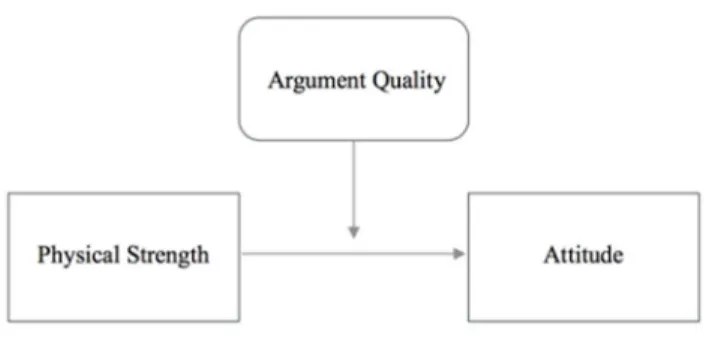
From the preliminary analysis follows that the hypothesized model in this study can be classified as a simple moderation model with a single moderator variable argument quality influencing the size of physical strength’s effect on attitudes (Hayes 2013) (Figure 2).
Figure 2: Simple Moderation (own contribution)
The model was tested in SPSS using the PROCESS macro (model 1) following the procedures as outlined by Hayes (2013). The multiple regression was run with bias corrected 95% bootstrap confidence intervals for conditional indirect effects. In addition to the dependent, independent and moderating variable, likeability was included as covariate, in order to account for confounding of associations.
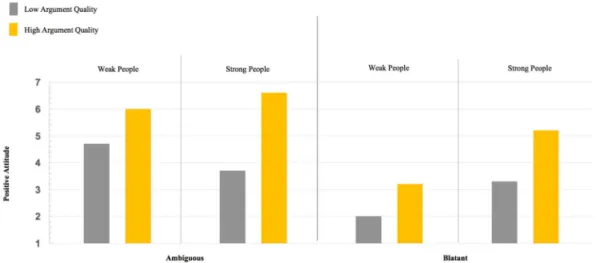
22 To check whether argument quality interacted with physical strength, the results of the simple moderation model (Figure 2) were analysed (Overall model: R2 = ,5774, F(87) = 28,690, p < ,0005). The results reveal that no significant interaction between physical strength and
argument quality emerged (B = -,019, t(87) = -1,511, p = ,135). It follows that H1 needs to be
rejected.
4.3. Data Exploration
Even though H3 and H4 could not be tested, I explored the obtained data to understand if and how the perception of manipulative intent influenced attitudes of physically stronger compared to weaker people. The construct perception of manipulative intent, which was initially included as manipulation check for salience of manipulative intent, could be tested for a main effect on
attitude and a possible interaction with physical strength. Intuitively and in consistency with
resistance literature (Christensen, 1977; Jones and Wortman, 1973; Fein et al. 1997; Campbell 1995), one could expect that the feeling of being manipulated generally leads to less favourable attitudes. However, as argued earlier, due to a lack of motivation, physically stronger people could be less resistant to blatant manipulation attempts than weaker people. A multiple regression with attitude as dependent variable, and physical strength, perceived manipulation,
argument quality and likeability as independent variables indeed revealed a negative main
effect of perceived manipulation on attitude (B = -,327, t(87) = -4,150, p < ,005). Next, it was tested if the negative effect of perceived manipulation was moderated by physical strength. However, no significant interaction occurred (B = ,005, t(87) = ,674, p = ,502). The obtained results lend support to the prediction that the perception of a manipulative intent inherently leads to a considerable extent (-0,327 on a 7-point scale) of resistance. Unlike expected, participants’ physical strength did not moderate the described effect.
23 Finally, even though it was not included in the hypotheses, the data were tested on a main effect of physical strength on attitudes. Unsurprisingly, there was no main effect of physical strength on attitudes (B = ,002, t(87) = ,421, p = ,675.
5. Discussion
5.1. Summary and Implications 5.1.1. Summary
The aim of this study was to examine if physical strength influences persuasion outcome, if the influence is moderated by the targets’ sense of power, and if the variables argument quality and
salience of manipulative intent interact with physical strength.
The results of this study didn’t confirm the expected influence of physical strength on persuasion. More specifically, physical strength was not found to have either direct or indirect significant effects on attitude toward HEALTH-i.
Further, a sense of power does not seem to be related to physical strength, neither does
self-efficacy which was tested as an alternative account for mediation.
Also, the hypothesized interaction between argument quality and physical strength didn’t occur. However, at a marginally significant level, argument quality was found to have a positive main effect on attitude. This is consistent with the ELM which suggests that when people scrutinize a persuasion message carefully, they will find the virtues in strong arguments and flaws in weak arguments, and will form their behaviours accordingly (Petty and Cacioppo, 1986).
Regarding the variable perceived manipulation, the results of this study replicate prior research findings (e.g. Bosmans and Warlop, 2005) that observed significantly less favourable attitudes toward the persuasion object in response to the perception of being manipulated. It is intuitively
24 conclusive that people resist when they have the feeling of being manipulated. A moderating effect of physical strength, as predicted in H4, could not be proven.
I noted that the insignificant results of the present study in relation to physical strength could have been due to a low perceived manipulative intent. Taking the findings from Campbell and Kirmani (2000) into consideration, it can be argued that participants didn’t use their persuasion knowledge which hindered resistance. It can be expected that at a higher perceived manipulative intent, results would have been much more polarized and significant effects could actually have been observed.
5.1.2. Implications
From a theoretical point of view, this research extended the findings about embodied persuasion. While various body movement and positions have been found to influence attitudes, the results of the present work suggest that the mere existence of physical strength does not play a role in the formation of attitudes. These insights are valuable as they define the boundaries of embodied persuasion.
The managerial implications of this work are limited given the observed insignificant effects of physical strength. In this sense, the main implications derived from the findings are that differences in physical strength do not allow for personalized persuasion, neither do they necessitate special handling by policy makers.
5.2. Limitations and Further Directions
Given the lack of significant results, the question must be raised if the hypothesized effects are simply not existent or if they are in fact existent but could not be captured due to limitations of this study. Accounting for the latter case, several limitations were identified.
25 First of all, the sample size (n = 89) was relatively low due to a difficult recruitment and response rate of participants in group 2. Given the manipulation of two conditions (AQ: strong vs. weak), a sample size of n > 100 would have been desirable. It can be assumed that the study design was under-powered and an increase in sample size would have led to more significant effects. I further acknowledge that the distinction of all participants into group 1 and group 2 could have led to confounded results between both groups as participants have not been assigned randomly but were predefined by their participation in the class “Marketing Management” at Nova SBE.
It also needs to be considered that the different environment in which either group completed the experiment could have skewed the results. For example, factors such as background music could not be controlled while group 2 completed the online-questionnaire (Bosman and Warlop, 2005). Further research should therefore be conducted in an equally controlled laboratory setting for all participants. Another limitation is the homogenous sample which only consisted of students and therefore doesn’t allow for the generalization of the obtained results. Among participants for whom physical strength has a higher level of importance (e.g. security guards, policemen, farmers), significant effects of physical strength on attitudes are imaginable. It would be interesting to compare between different subsamples in further research.
Several limitations relate to the chosen persuasion stimulus. The unsuccessful manipulation of
salience of manipulative intent suggests that participants have not processed the heading
carefully enough which could have several reasons. In line with the persuasion knowledge model, it is possible that people paid less attention to the heading as they allocated most of their cognitive resources to the continuous text below in an attempt to understand the concept of HEALTH-i (Friestadt and Wright, 1994). Pre-testing for participants’ perception of a manipulative intent would have helped avoid this problem. Additionally, based on findings
26 from Campbell and Kirmani (2000), priming participant’s persuasion knowledge prior to the persuasion message would probably have increased the likelihood of a successful manipulation. The marginally significant difference between perceived strength of strong and weak arguments suggests that participants didn’t engage in a high extent of thinking. This could be due to the length of the persuasive message which might have decreased participants’ motivation to scrutinize the message’s arguments. While the single-item perceived attention suggests that participants engaged in rather high thinking (M = 4,899), this measure might actually be prone to response bias and therefore not reliable. It would be interesting to observe if another type of persuasion object which participants are familiar with (e.g. lemonades, shoes) and a shorter persuasive message would yield different outcomes.
Shifting the focus to the strength measurement, additional limitations arise. First of all, another method of strength assessment will most probably lead to different strength records. It would have been interesting to deploy an alternative method such as a maximum-benchpress-test in a second study. With regard to the handgrip-test deployed in the present study, it needs to be acknowledged that the used hand dynamometer might not have assessed the maximum strength of each participant as some participants reported a suboptimal and slippery grip. Moreover, any strength assessment that is done in a single session is prone to transient intra-individual variations such as mood, fatigue, stress (Kaptein and Eckles, 2012).
Finally, this work focused only on attitudes as dependent variable. However, it would be interesting to also explore if physical strength influences people’s intention to use HEALTH-i. It could be expected that assessing a behavioural outcome rather than an attitudinal outcome would yield more polarized results due to increased issue involvement (Angst and Agarwal 2009), which in turn could possibly lead to significant coherences with physical strength.
27 This study aimed to fill a gap that has been identified persuasion and resistance literature. Due to several limitations of this study which have been discussed above, no significant results related to an influence of physical strength on persuasion could be found. However, acknowledging the limitations of this study, valuable suggestions could be given to direct further research.
28
6. References
Anderson, Cameron, and Adam D. Galinsky. 2006. "Power, optimism, and risk‐ taking." European journal of social psychology, 36(4): 511-536.
Angst, Corey M., and Ritu Agarwal. 2009. "Adoption of electronic health records in the
presence of privacy concerns: The elaboration likelihood model and individual
persuasion." MIS quarterly, 33(2): 339-370.
Bosmans, Annick MM, and Luk Warlop .2005. "How vulnerable are consumers to blatant
persuasion attempts?."
Brehm, Sharon S., and Jack W. Brehm. 1981. Psychological reactance: A theory of freedom
and control. Academic Press.
Brehm, Jack W. 1966. A theory of psychological reactance. New York: Academic Press, Inc.
Briñol, Pablo, and Richard E. Petty. 2003. "Overt head movements and persuasion: a self-
validation analysis." Journal of personality and social psychology, 84(6): 1123.
Brinol, Pablo, Richard E. Petty, Carmen Valle, Derek D. Rucker, and Alberto Becerra. "The
effects of message recipients' power before and after persuasion: a self-validation
analysis." Journal of personality and social psychology 93, no. 6 (2007): 1040.
Briñol, Pablo, and Richard E. Petty. 2008a. "Embodied persuasion: Fundamental processes by
which bodily responses can impact attitudes." Embodiment grounding: Social,
cognitive, affective, and neuroscientific approaches.” 184-207.
Briñol, P., & Petty, Richard. E. Petty. 2008b. Persuasion. From Single to Multiple to Metacognitive Processes. Perspectives on Psychological Science, 3(2), 137–147.
Brown, Penelope, and Stephen C. Levinson. 1987. Politeness: Some universals in language
usage. Vol. (4). Cambridge university press.
29
inferences of manipulative intent: The importance of balancing benefits and
investments." Journal of Consumer Psychology, 4(3): 225-254.
Campbell, Margaret C., and Amna Kirmani. 2000. "Consumers' use of persuasion knowledge: The effects of accessibility and cognitive capacity on perceptions of an influence agent." Journal of consumer research, 27(1): 69-83.
Cancela, A., B. Requero, D. Santos, M. Stavraki, and P. Brinol.2016. "Attitudes toward
health-messages: The link between perceived attention and subjective strength." Revue
Européenne de Psychologie Appliquée/European Review of Applied Psychology, 66(2):
57-64.
Christensen, Larry. 1977. "The negative subject: Myth, reality, or a prior experimental
experience effect?." Journal of Personality and Social Psychology, 35(6): 392.
Correll, Joshua, Steven J. Spencer, and Mark P. Zanna. 2004. "An affirmed self and an open
mind: Self-affirmation and sensitivity to argument strength." Journal of Experimental
Social Psychology, 40(3): 350-356.
Cosmides, Leda, and John Tooby.1992. "Cognitive adaptations for social exchange." In The
adapted mind: Evolutionary psychology and the generation of culture, 163-228. New
York, Oxford University Press.
Crosby, Carla A., and Marwan A. Wehbé. 1994. "Hand strength: normative values." The
Journal of hand surgery, 19(4): 665-670.
Cummins, Denise. 2005. “Dominance, status, and social hierarchies.” In The evolutionary
psychology handbook, ed. Buss David M., 679-697. Hoboken, NJ: Wiley.
Darden, Ellington. 1972. “Masculinity-femininity body rankings by males and females.”
Journal of Psychology, 80(2): 205-212.
30
communicators and their effect on opinion change." Journal of Personality and Social
Psychology, 36(4): 424.
Emerson, Richard M..1962. "Power-dependence relations." American sociological review,
27(1): 31-41.
Fein, Steven, Allison L. McCloskey, and Thomas M. Tomlinson. 1997. "Can the jury
disregard that information? The use of suspicion to reduce the prejudicial effects of
pretrial publicity and inadmissible testimony." Personality and Social Psychology
Bulletin, 23(11): 1215-1226.
Fiske, John. 1992. ‘‘Cultural Studies and the Culture of Every- day Life.’’ In Cultural
Studies, ed. Lawrence Grossberg, 38–55. New York: Routledge.
Friestad, Marian, and Peter Wright. 1994. "The persuasion knowledge model: How people
cope with persuasion attempts." Journal of consumer research, 21(1): 1-31.
Georgesen, John C., and Monica J. Harris.1998. "Why's my boss always holding me down? A
meta-analysis of power effects on performance evaluations." Personality and Social
Psychology Review 2(3): 184-195.
Haidar, S. G., D. Kumar, R. S. Bassi, and S. C. Deshmukh. 2004. "Average versus maximum
grip strength: which is more consistent?" Journal of Hand Surgery, 29(1): 82-84.
Hayes, Andrew. 2013. “Introduction to mediation, moderation, and conditional process analysis: A regression-based perspective, New York: The Guilford Press.
Innes, E. V. "Handgrip strength testing: a review of the literature. 1999. " Australian
Occupational Therapy Journal, 46(3): 120-140.
Jacks, Julia, and Kimberly A. Cameron. 2003. "Strategies for resisting persuasion." Basic and
Applied Social Psychology, 25(2): 145-161.
Jacks, Julia, and Maureen E. O’Brien. 2004. "Decreasing resistance by affirming the
31
Jones, Edward, Ellsworth, and Wortman, Camille B. 1973. Ingratiation: An attributional
approach. General Learning Press.
Kaptein, Maurits, Joyca Lacroix, and Privender Saini.2010. "Individual differences in
persuadability in the health promotion domain." International Conference on
Persuasive Technology. Springer Berlin Heidelbelberg: 94-105.
Kaptein, Maurits, and Dean Eckles. 2012. "Heterogeneity in the effects of online
persuasion." Journal of Interactive Marketing, 26(3): 176-188.
Knowles, Eric S., and Jay A. Linn. 2004. Resistance and persuasion. Psychology Press.
Kreuter, Matthew W., David W. Farrell, Laura R. Olevitch, and Laura K. Brennan. 2013.
Tailoring health messages: Customizing communication with computer technology.
Routledge.
Mackie, Diane M., and Leila T. Worth.1989. "Processing deficits and the mediation of
positive affect in persuasion." Journal of personality and social psychology, 57(1): 27.
Maheswaran, Durairaj, and Joan Meyers-Levy. 1990. "The influence of message framing and issue involvement." Journal of Marketing research, 27(3): 361-367.
Mathiowetz, V., Weber K., Volland, G., Kashman, N. 1984. „Reliability and validity of grip and pinch strength evaluations”. J Hand Surg Am, 9(2): 222-226.
Mishkind, Marc., Rodin, Judith., Silberstein, Lisa., Striegel-Moore, Ruth. 1986. „The
Embodiment of Masculinity. Cultural, Psychological, and Behavioral Dimensions.“
Amercian Behavioral Scientist, 29(5): 545:562.
Ozer, Elizabeth M., and Albert Bandura. 1990. "Mechanisms governing empowerment
effects: a self-efficacy analysis." Journal of personality and social psychology, 58(3):
472.
Pelham, Brett W., Tin T. Sumarta, and Laura Myaskovsky.1994. "The easy path from many
32
Petty, Richard, and John Cacioppo. 1986. Communication and persuasion: Central and
peripheral routes to attitude change. New York, Springer Science & Business Media.
Petty, Richard E., Pablo Briñol, and Zakary L. Tormala. 2002. "Thought confidence as a
determinant of persuasion: the self-validation hypothesis." Journal of personality and
social psychology, 82(5): 722.
Petty, Richard E., and Pablo Briñol. 2008. "Psychological processes underlying persuasion: A
social psychological approach." Diogenes, 55(1): 52-67.
Petty, R. E., Barden, J., & Wheeler, S. C. 2009. The Elaboration Likelihood Model of
persuasion: health promotions that yield sustained behavioral change. Emerging
Theories in Health Promotion Practive and Research, 71–99.
Reena Kaur Ruprai, S. V. T. N. M. 2016. “Handgrip strength as determinant of upper body strength/physical fitness: a comparative study among individuals performing gymnastics (ring athletes) and gymnasium (powerlifters).” International Journal of Medical Science and Public Health, 5(6): 1167-1172
Sagarin, Brad J., Robert B. Cialdini, William E. Rice, and Sherman B. Serna. 2002.
"Dispelling the illusion of invulnerability: the motivations and mechanisms of
resistance to persuasion." Journal of personality and social psychology, 83(3): 526.
Schubert, Thomas W. 2004. "The power in your hand: Gender differences in bodily feedback
from making a fist." Personality and Social Psychology Bulletin 30(6): 757-769.
Schwarz, Norbert. 1989. "Feelings as information: Informational and motivational functions
of affective states." In Handbook of motivation and cognition, ed. E. Tory Higgins and
Richard M. Sorrentino, 527-61. New York: Guilford.
Schwarzer, Ralf., and Jerusalem, Matthias. 1995. “Generalized Self-Efficacy scale”. In
Measures in health psychology: A user’s portfolio. Causal and control beliefs. John
33
See, Kelly E., Elizabeth W. Morrison, Naomi B. Rothman, and Jack B. Soll. 2011."The
detrimental effects of power on confidence, advice taking, and
accuracy." Organizational Behavior and Human Decision Processes, 116(2): 272-285.
Steele, Claude M. 1988. "The psychology of self-affirmation: Sustaining the integrity of the self." Advances in experimental social Psychology, 21: 261-302.
Von Rueden, Christopher., Gurven, Michael., and Kaplan, Hillard. 2008. „The multiple dimensions of male social status in an Amazonian society.” Evolution and Human
Behavior, 29(6): 402-415.
Wood, Wendy, and Alice H. Eagly. 1981. "Stages in the analysis of persuasive messages: The
role of causal attributions and message comprehension." Journal of personality and
Social Psychology, 40(2): 246.
Zanna, Mark P., and John K. Rempel.1988. “Attitudes: A New Look at an Old Concept”. In
D. Bar-Tal and A. W.Kruglanski (eds), The Social Psychology of Knowledge: 315–34.
Cambridge: CUP.
Zhao, Xiaoquan., Strasser, Andrew., Cappella, Jospeh., Lerman, Caryn., Fishbein, Martin. 2011. “A Measure of Perceived Argument Strength: Reliability and Validity.” Commun
Methods Meas, 5(1): 48-75.
Zuwerink, Julia R., and Patricia G. Devine. 1996. "Attitude importance and resistance to persuasion: It's not just the thought that counts." Journal of Personality and Social