CARTHAGE STUDIES 8
CHRISTOF FLÜGEL: In memoriam Alia Krandel-Ben Younès (1954 – 2014); FRANCISCO J. NÚÑEZ: The Lowest Levels at Bir Massouda and the
Foundation of Carthage. A Levantine Perspective; BOUTHAINA MARAOUI TELMINI: Découverte d’une tombe construite du 8ème siècle av. J.-C., sur le
versant sud-est de la colline de Byrsa à Carthage; BOUTHAINA MARAOUI TELMINI: An Attic Middle Geometric Plate in Euboean Pendent Semi-Circle
Style from Carthage; ROALD DOCTER: Carthage and the Spoils of War: an
update; PHILIP C. SCHMITZ: The Punic Inscription on a Gold Phiale in the
Metropolitan Museum, New York; VÍCTOR MARTÍNEZ HAHNMÜLLER: A
Vessel Worthy of All Gods: Remarks on Religion, War and Gold; PATRÍCIA BARGÃO,ANA MARGARIDA ARRUDA: The Castro Marim 1 Amphora Type:
A West Mediterranean Production Inspired by Carthaginian Models
Gent 2014
C
A
R
TH
AG
E S
TUD
IE
S 8
20
14
Gent 2014
CARTHAGE STUDIES 8
CHRISTOF FLÜGEL: In memoriam Alia Krandel-Ben Younès (1954 – 2014); FRANCISCO J. NÚÑEZ: The Lowest Levels at Bir Massouda and the
Foundation of Carthage. A Levantine Perspective; BOUTHAINA MARAOUI TELMINI: Découverte d’une tombe construite du 8ème siècle av. J.-C., sur le
versant sud-est de la colline de Byrsa à Carthage; BOUTHAINA MARAOUI TELMINI: An Attic Middle Geometric Plate in Euboean Pendent Semi-Circle
Style from Carthage; ROALD DOCTER: Carthage and the Spoils of War: an
update; PHILIP C. SCHMITZ: The Punic Inscription on a Gold Phiale in the
Metropolitan Museum, New York; VÍCTOR MARTÍNEZ HAHNMÜLLER: A
Vessel Worthy of All Gods: Remarks on Religion, War and Gold; PATRÍCIA BARGÃO,ANA MARGARIDA ARRUDA: The Castro Marim 1 Amphora Type:
A West Mediterranean Production Inspired by Carthaginian Models
Advisory Editorial Board
Dr. Babette Bechtold (Graz / Vienna) Dr. Ida Oggiano (Rome)
Prof. Dr. Habib Ben Younes (Tunis) Dr. Josephine Crawley Quinn (Oxford) Prof. Dr. Fethi Chelbi (Tunis) Dr. Joan Ramon Torres (Ibiza)
Prof. Dr. Suzanne Frey-Kupper (Warwick) Dr. Claudia Sagona (Melbourne) Dr. Brien Garnand (Washington DC) Prof. Dr. Thomas Schäfer (Tübingen) Prof. Dr. Nota Kourou (Athens) Prof. Dr. Philip Schmitz (Ypsilanti Michigan) Dr. John Lund (Copenhagen) Dr. Francesca Spatafora (Palermo)
Dr. Karin Mansel (München) Prof. Dr. Susan Stevens (Lynchburg) Dr. Boutheina Maraoui Telmini (Tunis) Dr. Carlo Tronchetti (Cagliari)
Prof. Dr. Dirce Marzoli (Madrid) Prof. Dr. Peter van Dommelen (Providence) Dr. Richard Miles (Sydney) Dr. Nicholas Vella (Msida Malta)
Prof. Dr. Bärbel Morstadt (Bochum) Prof. Dr. Carlos Wagner (Madrid) Dr. Francisco Jesús Núñez Calvo (Zaragoza) Prof. Dr. Paolo Xella (Rome)
Carthage Studies is a peer-reviewed periodical and is published by the
section Mediterranean Archaeology, Department of Archaeology, Ghent University
Still available: Carthage Studies 1 (2007)
Carthage Studies 2 (2008) revised edition Carthage Studies 3 (2009) Carthage Studies 4 (2010) Carthage Studies 5 (2011) Carthage Studies 6 (2012) Carthage Studies 7 (2013) Carthage Studies 8 (2014) Carthage Studies 9 (2015)
Contact address (manuscripts and subscriptions):
Sint-Pietersnieuwstraat 35, B-9000 Gent, Belgium. Fax. (+32).9.33.102.97 Email: [email protected]
CARTHAGE STUDIES 8
edited by Roald F. Docter
Advisory Editorial Board
Dr. Babette Bechtold (Graz / Vienna) Dr. Ida Oggiano (Rome)
Prof. Dr. Habib Ben Younes (Tunis) Dr. Josephine Crawley Quinn (Oxford) Prof. Dr. Fethi Chelbi (Tunis) Dr. Joan Ramon Torres (Ibiza)
Prof. Dr. Suzanne Frey-Kupper (Warwick) Dr. Claudia Sagona (Melbourne) Dr. Brien Garnand (Washington DC) Prof. Dr. Thomas Schäfer (Tübingen) Prof. Dr. Nota Kourou (Athens) Prof. Dr. Philip Schmitz (Ypsilanti Michigan) Dr. John Lund (Copenhagen) Dr. Francesca Spatafora (Palermo)
Dr. Karin Mansel (München) Prof. Dr. Susan Stevens (Lynchburg) Dr. Boutheina Maraoui Telmini (Tunis) Dr. Carlo Tronchetti (Cagliari)
Prof. Dr. Dirce Marzoli (Madrid) Prof. Dr. Peter van Dommelen (Providence) Dr. Richard Miles (Sydney) Dr. Nicholas Vella (Msida Malta)
Prof. Dr. Bärbel Morstadt (Bochum) Prof. Dr. Carlos Wagner (Madrid) Dr. Francisco Jesús Núñez Calvo (Zaragoza) Prof. Dr. Paolo Xella (Rome)
Carthage Studies is a peer-reviewed periodical and is published by the
section Mediterranean Archaeology, Department of Archaeology, Ghent University
Still available: Carthage Studies 1 (2007)
Carthage Studies 2 (2008) revised edition Carthage Studies 3 (2009) Carthage Studies 4 (2010) Carthage Studies 5 (2011) Carthage Studies 6 (2012) Carthage Studies 7 (2013) Carthage Studies 8 (2014) Carthage Studies 9 (2015)
Contact address (manuscripts and subscriptions):
Sint-Pietersnieuwstraat 35, B-9000 Gent, Belgium. Fax. (+32).9.33.102.97 Email: [email protected]
Backorders: www.skribis.be
CARTHAGE STUDIES 8
edited by Roald F. Docter
© 2017 Department of Archaeology, Ghent University
No part of this volume may be translated or reproduced in any form, by print, photo-print, microfilm, or any other means, without written permission of the publisher
ISBN 978 90 736 2643 0 ISSN 1784-343X
Contents
Christof Flügel:
In memoriam Alia Krandel-Ben Younès (1954 – 2014) 1
Francisco J. Núñez:
The Lowest Levels at Bir Massouda and the Foundation of
Carthage. A Levantine Perspective
7
Bouthaina Maraoui Telmini:
Découverte
d’une
tombe
construite
du 8ème siècle av. J.-C.,
sur le versant sud-est de la colline de Byrsa à Carthage 47
Bouthaina Maraoui Telmini:
An Attic Middle Geometric Plate in Euboean Pendent
Semi-Circle Style from Carthage
73
Roald Docter:
Carthage and the Spoils of War: an update
83
Philip C. Schmitz:
The Punic Inscription on a Gold Phiale in the Metropolitan
Museum, New York
103
© 2017 Department of Archaeology, Ghent University
No part of this volume may be translated or reproduced in any form, by print, photo-print, microfilm, or any other means, without written permission of the publisher
ISBN 978 90 736 2643 0 ISSN 1784-343X
D/2017/3988/3
Contents
Christof Flügel:
In memoriam Alia Krandel-Ben Younès (1954 – 2014) 1
Francisco J. Núñez:
The Lowest Levels at Bir Massouda and the Foundation of
Carthage. A Levantine Perspective
7
Bouthaina Maraoui Telmini:
Découverte
d’une
tombe
construite
du 8ème siècle av. J.-C.,
sur le versant sud-est de la colline de Byrsa à Carthage 47
Bouthaina Maraoui Telmini:
An Attic Middle Geometric Plate in Euboean Pendent
Semi-Circle Style from Carthage
73
Roald Docter:
Carthage and the Spoils of War: an update
83
Philip C. Schmitz:
The Punic Inscription on a Gold Phiale in the Metropolitan
Museum, New York
103
In memoriam
Alia Krandel-Ben Younès (1954 – 2014)
Christof Flügel
In November 2014 our colleague and dear friend Alia Krandel-Ben Younès passed away unexpectedly. Her scientific career started as early as 1977, when she obtained her ‘Certificat d’Aptitude à la Recherche’ at the University of Tunis with a study dedicated to the “Artisanat Punique à Carthage” under the supervision of Prof. Mohammed Hassine Fantar. She entered the Institut National d’Archéologie et d’Art (Institut National du Patrimoine/INP) already in August 1978.
Alia Krandel-Ben Younès, January 1954 - November 2014
(Photo: Archive family Ben Younès, Tunis)
Víctor Martínez Hahnmüller:
A Vessel Worthy of all Gods: Remarks on Religion, War
and Gold
111
Patrícia Bargão, Ana Margarida Arruda:
The Castro Marim 1 Amphora Type: A West
Mediterranean Production Inspired by Carthaginian
142
Website British Museum:
http://www.britishmuseum.org/research/collection_online/collection_obj ect_details.aspx?objectId=282407&partId=1&searchText=123919&page= 1 (last accessed 5 January 2017).
Website Cincinnati:
http://www.cincinnatiartmuseum.org/art/explore-the-collection?id=11316032 (last accessed 5 January 2017).
Webiste Coin Archives:
http://www.coinarchives.com/a/results.php?search=%CE%A3I&s=0&re sults=100 (last accessed 5 January 2017).
Website Fitzwilliam:
http://www.fitzmuseum.cam.ac.uk/gallery/goldenfleece/ifs/ (last accessed 5 January 2017).
Website Metropolitan:
http://www.metmuseum.org/art/collection/search/255122 (last accessed 5 January 2017).
Website Pinterest:
https://www.pinterest.com/search/pins/?q=phiale&rs=typed&term_meta %5B%5D=phiale%7Ctyped (last accessed 5 January 2017).
Dr. Víctor Martínez Hahnmüller Department of Archaeology Ghent University Sint-Pietersnieuwstraat 35 B-9000 Ghent – Belgium [email protected] 143
The Castro Marim 1 Amphora Type:
A West Mediterranean Production Inspired by
Carthaginian Models
Patrícia Bargão, Ana Margarida Arruda
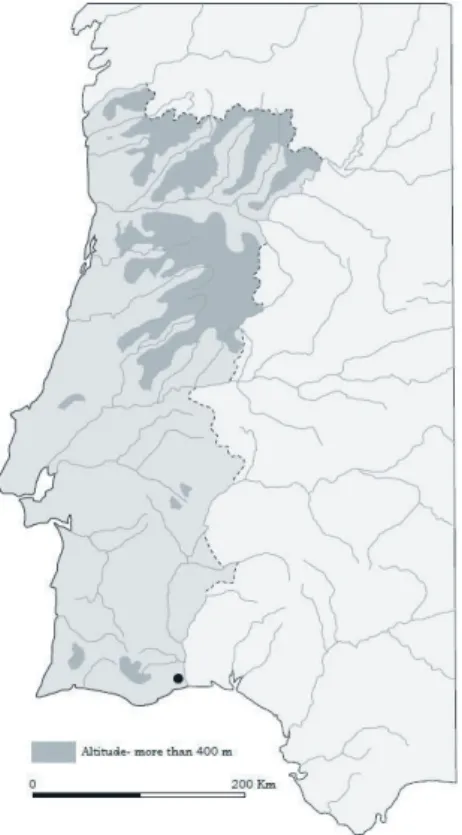
IntroductionCastro Marim is a small village located at the southeast border of the Portuguese territory, on a small hill, which emerges from a swamp area between the southeast Atlantic coast and the mouth of the Guadiana river (Fig. 1).
A Medieval castle is situated in the upper village, at an altitude of over 30 meters above sealevel, where several archeological interventions were undertaken under the direction of one of the present authors (Arruda 1999/2000). The fieldwork revealed a dense occupational history of the Iron Age and Roman periods, the levels and finds of which have been studied and published intensively over the past years.1
Fig. 1. Location of the archaeological site of Castro Marim.
1 See Arruda 1988; 1996; 1999/2000; 2000; 2001; Arruda, Viegas, Bargão 2006; Freitas 2006; Oliveira 2007; Sousa 2009; Viegas 2009, among others.
These archaeological interventions at Castro Marim during the early Eighties yielded a large number of amphora sherds among the pottery ensemble. Within this amphora ensemble different types were found that belonged to the pre-Roman and Roman occupation phases of the site. They were classified according to different well-established amphora typologies, particularly those by M. Pellicer Catalán (1978) and J. Ramon Torres (1995) for the pre-Roman period.
At an early stage of the post-excavation investigations, a distinctive amphora shape was set apart because it could not be fitted in within any of the existing amphora typologies. The closest parallel or at least one of similar shape, was clearly produced in a completely different fabric (Ramon Torres 1995, 196-199). This provoked us to make a detailed description of the vessel type, both in fabric and in shape. As a result, this particular amphora was first and preliminarily presented in 2005 in the frame of a symposium on fish sauce production; it was baptised ‘Castro Marim 1’, having been distinguished first on this site (Arruda, Viegas, Bargão 2006, 263).
Archaeological research since then has provided new information. Within this paper we therefore intend to discuss more fully the main typological features and evolution of this amphora type, both describing its shape, fabric, chronology and diffusion, and tracing its possible typological models.
0 50 100 150 200 Dressel 1
Lamboglia 2 Olive oil Brindisi amphora Haltern 70 Dressel 20 Dressel 12 Oberaden 83 and similis Class 67 Mañá C2 Castro Marim 1 Type D of Pellicer Tiñosa Mañá Pascual A4 Tripolitana Antiga Mañá C2 CCNN
Castro Marim amphora types
North Africa Cádiz Guadalquivir Italy
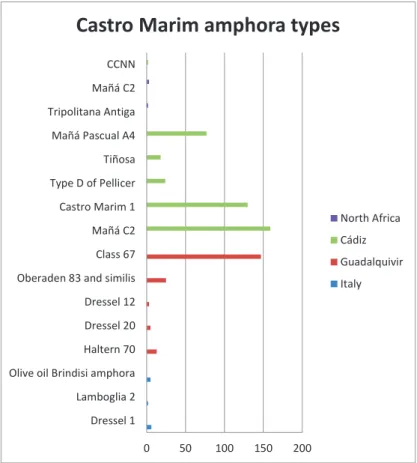
Fig. 2. Distribution of the amphora types found in Roman contexts of Castro Marim (N=621).
Castro Marim I Features
The Shape
Amphorae of this type are characterized by a narrow cylindrical body with a medium width of 26 cm (Fig. 3). They have thin-walled small rims, with diameters of 11 cm or less. The rims are completely horizontal until the shoulder, where the wall drops down vertically at an angle of 90º. The upper parts are therefore shaped like a disk. In general, and based on a high number of rim sherds, one can say that there are only two rim varieties present: some have a completely horizontal upper part, while others show a downward inclination and a soft transition to the shoulder. Rims of the latter variety seem to be related in shape and orientation to the Pellicer D late variants. Despite this, we are as yet unable to determine whether these are random rim variations caused by the natural lack of standardization, normally associated with pre-industrial productions, or if they might have some further meaning in terms of chronology or fabric.
Handle sherds that can be related to the Castro Marim 1 amphora type have not been recovered, or rather recognized, and therefore it is impossible to describe the specific features of this part of the amphora. Equally unknown is the maximum height of these amphorae, since an entire amphora has not yet been found. As the known examples have narrow mouths and narrow shoulders, a narrow cylindrical body with not too thick walls may be reconstructed, corresponding to a medium or small amphora type.
Despite the absence of a full profile, we believe it is possible to connect some base sherds, omphalos in shape, with this particular type (Fig. 4). Several sites in the Algarve, such as Faro, Monte Molião and Castro Marim itself, yielded large numbers of base sherds of hitherto unknown type, of which the maximum diameters corresponded with those of the upper disk parts of Castro Marim 1 type amphorae. Of course, other amphora types with these features would come into question, such as Ramon T-8.2.2.1 and T-9.1.1.1, (Ramon Torres 1995, figs. 102-104) or even some common pottery types, which are frequent in habitation contexts since the 5th century B.C., as e.g. in Camposoto (Ramon Torres et alii 2007, 198). The almost 90º degree angle
between the bottom and the body of the vessel, however, would rather plea for their belonging to amphorae, since there are not many common pottery types shaped like that, if any. Moreover, the limited number of rim sherds that were identified as belonging to Ramon T-9.1.1.1 amphorae in these archeological sites, suggests that the more numerous omphalos-shaped base sherds should have belonged to another
amphora type, i.c. the Castro Marim 1 amphora type. Typological Framing
It is obvious that there must have existed some sort of typological relation between the Mañá D amphora type (Mañá 1951, 207) and the Castro Marim 1 vessels, because these are the only amphorae types that are provided with completely horizontal upper parts (Fig. 5).
144
These archaeological interventions at Castro Marim during the early Eighties yielded a large number of amphora sherds among the pottery ensemble. Within this amphora ensemble different types were found that belonged to the pre-Roman and Roman occupation phases of the site. They were classified according to different well-established amphora typologies, particularly those by M. Pellicer Catalán (1978) and J. Ramon Torres (1995) for the pre-Roman period.
At an early stage of the post-excavation investigations, a distinctive amphora shape was set apart because it could not be fitted in within any of the existing amphora typologies. The closest parallel or at least one of similar shape, was clearly produced in a completely different fabric (Ramon Torres 1995, 196-199). This provoked us to make a detailed description of the vessel type, both in fabric and in shape. As a result, this particular amphora was first and preliminarily presented in 2005 in the frame of a symposium on fish sauce production; it was baptised ‘Castro Marim 1’, having been distinguished first on this site (Arruda, Viegas, Bargão 2006, 263).
Archaeological research since then has provided new information. Within this paper we therefore intend to discuss more fully the main typological features and evolution of this amphora type, both describing its shape, fabric, chronology and diffusion, and tracing its possible typological models.
0 50 100 150 200 Dressel 1
Lamboglia 2 Olive oil Brindisi amphora Haltern 70 Dressel 20 Dressel 12 Oberaden 83 and similis Class 67 Mañá C2 Castro Marim 1 Type D of Pellicer Tiñosa Mañá Pascual A4 Tripolitana Antiga Mañá C2 CCNN
Castro Marim amphora types
North Africa Cádiz Guadalquivir Italy
Fig. 2. Distribution of the amphora types found in Roman contexts of Castro Marim (N=621).
145
Castro Marim I Features
The Shape
Amphorae of this type are characterized by a narrow cylindrical body with a medium width of 26 cm (Fig. 3). They have thin-walled small rims, with diameters of 11 cm or less. The rims are completely horizontal until the shoulder, where the wall drops down vertically at an angle of 90º. The upper parts are therefore shaped like a disk. In general, and based on a high number of rim sherds, one can say that there are only two rim varieties present: some have a completely horizontal upper part, while others show a downward inclination and a soft transition to the shoulder. Rims of the latter variety seem to be related in shape and orientation to the Pellicer D late variants. Despite this, we are as yet unable to determine whether these are random rim variations caused by the natural lack of standardization, normally associated with pre-industrial productions, or if they might have some further meaning in terms of chronology or fabric.
Handle sherds that can be related to the Castro Marim 1 amphora type have not been recovered, or rather recognized, and therefore it is impossible to describe the specific features of this part of the amphora. Equally unknown is the maximum height of these amphorae, since an entire amphora has not yet been found. As the known examples have narrow mouths and narrow shoulders, a narrow cylindrical body with not too thick walls may be reconstructed, corresponding to a medium or small amphora type.
Despite the absence of a full profile, we believe it is possible to connect some base sherds, omphalos in shape, with this particular type (Fig. 4). Several sites in the Algarve, such as Faro, Monte Molião and Castro Marim itself, yielded large numbers of base sherds of hitherto unknown type, of which the maximum diameters corresponded with those of the upper disk parts of Castro Marim 1 type amphorae. Of course, other amphora types with these features would come into question, such as Ramon T-8.2.2.1 and T-9.1.1.1, (Ramon Torres 1995, figs. 102-104) or even some common pottery types, which are frequent in habitation contexts since the 5th century B.C., as e.g. in Camposoto (Ramon Torres et alii 2007, 198). The almost 90º degree angle
between the bottom and the body of the vessel, however, would rather plea for their belonging to amphorae, since there are not many common pottery types shaped like that, if any. Moreover, the limited number of rim sherds that were identified as belonging to Ramon T-9.1.1.1 amphorae in these archeological sites, suggests that the more numerous omphalos-shaped base sherds should have belonged to another
amphora type, i.c. the Castro Marim 1 amphora type. Typological Framing
It is obvious that there must have existed some sort of typological relation between the Mañá D amphora type (Mañá 1951, 207) and the Castro Marim 1 vessels, because these are the only amphorae types that are provided with completely horizontal upper parts (Fig. 5).
Fig. 3. Castro Marim 1 amphorae: rim variants from Castro Marim and Faro.
Fig. 4. Castro Marim 1 amphora bases: omphalos variants from Castro Marim.
Although the Castro Marim 1 type is absent from all known pre-Roman amphora typologies,2 the resemblances with the Pellicer D types, especially the D4 variants, are
evident. In line with this analogy, the Castro Marim 1 type can also be related with Ramon Torres’ Group 5, in particular with some of the later types associated with
2 Pellicer Catalán 1978; Florido Navarro 1984; Molina Fajardo 1984; Ramon Torres 1995, …
Tunisian productions (Ramon Torres 1995, 197-199). In this Group 5, the best known type is T-5.2.3.1, produced in the Central Mediterranean, like the Carthage-Tunis area, and also on Sicily (Azzaro et alii 2006) since the late third century B.C.
until the second century B.C., which was inspired by older Mediterranean amphorae equivalent to Ramon Torres’ Group 4, particularly T-4.2.1.5 (Ramon Torres 1995, 196-197).
Fig. 5. Castro Marim 1 typological features: 1 Pellicer D; 2 Mañá D; 3 Ramon T-9.1.1.1; 4 Castro
Marim 1.
On the basis of the soft rim features the type that is most similar in shape is Ramon Torres’ T-5.2.3.2, produced since the late third century B.C. in coastal Tunisia (Ramon Torres 1995, 199, fig. 64). A possible production of this amphora type on the Iberian Peninsula is as yet unattested, and all variants of these big cylindrical amphorae are exclusively of central Mediterranean origin. Nevertheless, the new amphora type presented here shows that the general shape was also produced in the West.
146
Fig. 3. Castro Marim 1 amphorae: rim variants from Castro Marim and Faro.
Fig. 4. Castro Marim 1 amphora bases: omphalos variants from Castro Marim.
Although the Castro Marim 1 type is absent from all known pre-Roman amphora typologies,2 the resemblances with the Pellicer D types, especially the D4 variants, are
evident. In line with this analogy, the Castro Marim 1 type can also be related with Ramon Torres’ Group 5, in particular with some of the later types associated with
2 Pellicer Catalán 1978; Florido Navarro 1984; Molina Fajardo 1984; Ramon Torres 1995, …
147
Tunisian productions (Ramon Torres 1995, 197-199). In this Group 5, the best known type is T-5.2.3.1, produced in the Central Mediterranean, like the Carthage-Tunis area, and also on Sicily (Azzaro et alii 2006) since the late third century B.C.
until the second century B.C., which was inspired by older Mediterranean amphorae equivalent to Ramon Torres’ Group 4, particularly T-4.2.1.5 (Ramon Torres 1995, 196-197).
Fig. 5. Castro Marim 1 typological features: 1 Pellicer D; 2 Mañá D; 3 Ramon T-9.1.1.1; 4 Castro
Marim 1.
On the basis of the soft rim features the type that is most similar in shape is Ramon Torres’ T-5.2.3.2, produced since the late third century B.C. in coastal Tunisia (Ramon Torres 1995, 199, fig. 64). A possible production of this amphora type on the Iberian Peninsula is as yet unattested, and all variants of these big cylindrical amphorae are exclusively of central Mediterranean origin. Nevertheless, the new amphora type presented here shows that the general shape was also produced in the West.
In this connection it needs to be stressed that the fabrics of the Castro Marim 1 type amphorae are similar to that of Pellicer D type rim sherds or even to that of Roman amphorae of the Lomba do Canho 67 type, both attested on archeological sites in the Algarve (Arruda, Viegas, Bargão 2006, 261, 265; Viegas 2011, 478-481), and known to
have been produced in the Cádiz bay and lower Guadalquivir regions. On the other hand, the omphalos base sherds are usually related to Ramon Torres’ T-9.1.1.1 (Fig. 5), an amphora type also produced in these areas. Therefore, it is possible to establish a connection between shape and fabric, especially since omphalos bases are not very
common in Iron Age amphorae. In fact, we know of only one amphora with this particular feature, from Almería, which J. Ramon Torres included in his T-8.2.2.1 (Ramon Torres 1995, 226).
The Castro Marim 1 type is only rarely attested in the territory of present-day Spain, where it has usually been classified as the amphora types Mañá D, Pellicer D or Pellicer D’s evolved variants. These Late Punic types usually acquire a narrow body (Ramon Torres 1995, figs. 120-121), small diameters, as in Ramon Torres T-12.1.1.1, and in some cases more horizontal rims, as shown in the Pellicer D variants (Arruda 2000, fig. 8; Belén Deamos 2007, fig. 9, nº 324).
As often happens in amphora classifications, it can be difficult to distinguish between types, especially when dealing with small sherds, but we believe it can be accomplished by cross-referencing the known amphora features, such as rim, orientation, maximum diameter and thinness of the walls. The individualization of the Castro Marim 1 Amphora comes from the need to classify and characterize a large number of sherds that don’t fit in any of the above mentioned types.
We believe that the filiations of this shape come from a multiple origin. It is a Turdetanian production, with a Carthaginian inspiration, developed in the Late Punic period, being inspired not in one but in three different models: the Mañá D overall shape, the Pellicer D evolved types, and the new T-9.1.1.1 cylindrical shape with the
omphalos bottom (Fig. 5). Fabric
The fabric is the hardest element to describe, because it has a higher level of subjectivity involved. The establishment of fabric groups was made according to the visual examination with the use of a binocular magnifying glass. Trying to establish its provenance is the main goal we intend to achieve.
The majority of the analyzed sherds present the typical fabric features which allow its integration in an area between the low Guadalquivir and the Campiña regions.
We were able to identify two groups, which suggests the existence of two production areas. Group 1 has a medium hard fabric, with small grain size and tiny white and gold mica inclusions, less than 10% of the total inclusions, the color is greenish or greenish yellow. Group 2 has a hard fabric, medium grain size, frequent medium-sized rounded inclusions, and colours ranging from orange to grey.
Through the comparison of these fabric features with other amphora types we tried to match them with distinctive areas. Group 1 has similar features as the Pellicer D amphorae and some common pottery types usually produced in the lower
Guadalquivir region. From this area we may mention an example of similar shape and fabric recovered in the kilns of Pajar del Artillo (Luzón Nogué 1973, 47, fig 14-B), that we believe to be a Castro Marim 1 type, dating to the 1st century B.C.
As to Group 2, after the visual comparison between the Castro Marim 1 and sherds from Tiñosa, we can confidently say that its origin is in the Campiña area, on the basis of chemical analyses made to the latter group of sherds (Carretero Poblete 2004, 677-696).
Fig. 6. Chronology of the Portuguese ensembles with Castro Marim 1 amphorae.
Chronology
The establishment of a production chronology for the Castro Marin 1 type of amphorae is not an easy task when only so few data are available. If we have enough elements to frame the end of the production and diffusion of this type, the same cannot be said of its beginning.
Based upon its filiation to Mañá D amphorae and the resemblance between the Castro Marim 1 and the T-9.1.1.1 type, it seems unlikely that the production of this Late Punic model has occurred before the end of the 3rd century B.C. The period between the late 3rd century B.C. and the early 2nd century B.C. is associated with major historical events related to the Second Punic War, which must have had a strong impact upon the local communities, changing the rural settlement models and the dynamics involved in the amphora production.
As a result of this, the Carthaginian amphora types, which had been brought to the Iberian Peninsula between the First and the Second Punic War, were now used as models for the new western amphora types, as e.g. in the Ramon Torres group 7 (Ramon Torres, 1995).
Unfortunately, there is not much information available on this first moment. The surface survey made in the Baevipo in the lower Guadalquivir region, revealed two sites
where Castro Marim 1 amphorae were recovered: Manzanete de Bajo and Benitos del Lomo. The dating of these sites was established between the late 3rd and the early 2nd century B.C. on the basis of the associated material recovered (Ferrer Albelda
148
In this connection it needs to be stressed that the fabrics of the Castro Marim 1 type amphorae are similar to that of Pellicer D type rim sherds or even to that of Roman amphorae of the Lomba do Canho 67 type, both attested on archeological sites in the Algarve (Arruda, Viegas, Bargão 2006, 261, 265; Viegas 2011, 478-481), and known to
have been produced in the Cádiz bay and lower Guadalquivir regions. On the other hand, the omphalos base sherds are usually related to Ramon Torres’ T-9.1.1.1 (Fig. 5), an amphora type also produced in these areas. Therefore, it is possible to establish a connection between shape and fabric, especially since omphalos bases are not very
common in Iron Age amphorae. In fact, we know of only one amphora with this particular feature, from Almería, which J. Ramon Torres included in his T-8.2.2.1 (Ramon Torres 1995, 226).
The Castro Marim 1 type is only rarely attested in the territory of present-day Spain, where it has usually been classified as the amphora types Mañá D, Pellicer D or Pellicer D’s evolved variants. These Late Punic types usually acquire a narrow body (Ramon Torres 1995, figs. 120-121), small diameters, as in Ramon Torres T-12.1.1.1, and in some cases more horizontal rims, as shown in the Pellicer D variants (Arruda 2000, fig. 8; Belén Deamos 2007, fig. 9, nº 324).
As often happens in amphora classifications, it can be difficult to distinguish between types, especially when dealing with small sherds, but we believe it can be accomplished by cross-referencing the known amphora features, such as rim, orientation, maximum diameter and thinness of the walls. The individualization of the Castro Marim 1 Amphora comes from the need to classify and characterize a large number of sherds that don’t fit in any of the above mentioned types.
We believe that the filiations of this shape come from a multiple origin. It is a Turdetanian production, with a Carthaginian inspiration, developed in the Late Punic period, being inspired not in one but in three different models: the Mañá D overall shape, the Pellicer D evolved types, and the new T-9.1.1.1 cylindrical shape with the
omphalos bottom (Fig. 5). Fabric
The fabric is the hardest element to describe, because it has a higher level of subjectivity involved. The establishment of fabric groups was made according to the visual examination with the use of a binocular magnifying glass. Trying to establish its provenance is the main goal we intend to achieve.
The majority of the analyzed sherds present the typical fabric features which allow its integration in an area between the low Guadalquivir and the Campiña regions.
We were able to identify two groups, which suggests the existence of two production areas. Group 1 has a medium hard fabric, with small grain size and tiny white and gold mica inclusions, less than 10% of the total inclusions, the color is greenish or greenish yellow. Group 2 has a hard fabric, medium grain size, frequent medium-sized rounded inclusions, and colours ranging from orange to grey.
Through the comparison of these fabric features with other amphora types we tried to match them with distinctive areas. Group 1 has similar features as the Pellicer D amphorae and some common pottery types usually produced in the lower
149
Guadalquivir region. From this area we may mention an example of similar shape and fabric recovered in the kilns of Pajar del Artillo (Luzón Nogué 1973, 47, fig 14-B), that we believe to be a Castro Marim 1 type, dating to the 1st century B.C.
As to Group 2, after the visual comparison between the Castro Marim 1 and sherds from Tiñosa, we can confidently say that its origin is in the Campiña area, on the basis of chemical analyses made to the latter group of sherds (Carretero Poblete 2004, 677-696).
Fig. 6. Chronology of the Portuguese ensembles with Castro Marim 1 amphorae.
Chronology
The establishment of a production chronology for the Castro Marin 1 type of amphorae is not an easy task when only so few data are available. If we have enough elements to frame the end of the production and diffusion of this type, the same cannot be said of its beginning.
Based upon its filiation to Mañá D amphorae and the resemblance between the Castro Marim 1 and the T-9.1.1.1 type, it seems unlikely that the production of this Late Punic model has occurred before the end of the 3rd century B.C. The period between the late 3rd century B.C. and the early 2nd century B.C. is associated with major historical events related to the Second Punic War, which must have had a strong impact upon the local communities, changing the rural settlement models and the dynamics involved in the amphora production.
As a result of this, the Carthaginian amphora types, which had been brought to the Iberian Peninsula between the First and the Second Punic War, were now used as models for the new western amphora types, as e.g. in the Ramon Torres group 7 (Ramon Torres, 1995).
Unfortunately, there is not much information available on this first moment. The surface survey made in the Baevipo in the lower Guadalquivir region, revealed two sites
where Castro Marim 1 amphorae were recovered: Manzanete de Bajo and Benitos del Lomo. The dating of these sites was established between the late 3rd and the early 2nd century B.C. on the basis of the associated material recovered (Ferrer Albelda
2007, 295-296). Although possible and quite logical, we believe that this chronology cannot be established on the basis of surface materials alone, especially when we are dealing with wide chronologic ranges of sites that begin in the early Iron Age in Manzanete de Bajo and end in the Medieval period as for Benitos del Lomo (Ferrer Albelda 2007, 295-296).
In the Spanish territory we also observe some similarities between an amphora rim from Las Redes and the Castro Marim 1 type, but the sherd is too small to have a solid confirmation (De Frutos, Chic, Berriatua 1988, fig. 2, nº 498).
The Niebla excavations yielded some interesting data; some of the rims, which we believe to be of Castro Marim 1 amphorae, have been attributed by the authors to the Ibero-Roman period of the site, which is dated through the presence of Campanian wares and Dressel 1A amphorae to the 2nd century B.C. (Campos Carrasco, Gómez Toscano, Peréz Macias 2007, 273, fig. 277).
In the Portuguese territory, an occupation of similar chronology is lacking, so we can only say with a fair amount of certainty that this type is absent within all Late Iron Age contexts that have been studied in the South (Arruda, Bargão, Sousa 2005; Sousa 2009). Unfortunately, the first half of the 2nd century B.C. in the Portuguese territory is completely void of information, which doesn’t help establishing the beginning of the production. The oldest known 2nd century B.C. contexts in the south of Portugal were found in Castro Marim and in Monte Molião (Arruda, Sousa 2012) and are already associated to the Roman occupation. In the latter archaeological site several Castro Marim 1 sherds were recovered in association with Greco-Italic and Dressel 1 amphorae as well as Campanian wares dating to the late 2nd century and the early 1st century B.C.
Also in Forte S. Sebastião in Castro Marim several Castro Marim 1 amphorae were recovered. Here the associated material suggests a chronology of the last quarter of the 2nd century B.C.: Campanian A wares of the types Lamboglia 5-7, 27, 31, and 55, and “Kuass type” pottery, types II, V, and X of Niveau (Niveau de Villedary y Mariñas 2003; Arruda, Pereira 2008, 391).
There are also a few rim fragments of the Castro Marim 1 type amphorae recovered in the Tagus area, in Santarém (Bargão 2014) and in the surface survey in Porto Sabugueiro (Pimenta, Mendes 2008, 182, fig. 11, nos. 20-21). Although these are surface finds, the authors claim that these amphorae are associated with the last Iron Age occupation at the site, dated between the 5th and 2nd century B.C. (Pimenta, Mendes 2008, 179). In view of the other data that we were able to gather from presence of Castro Marim 1 amphorae on the Iberian Peninsula, it seems more likely that these amphorae belong to the last occupation phase of the site, so to the 2nd century B.C.
By far the most abundant material, however, comes from Late Republican contexts in levels of the mid to late 1st century B.C. of Castro Marim’s castle and from Faro. In both places the amphorae ensemble is large and Punic types dominate with Castro Marim 1, Mañá Pascual A4, Mañá C2, T-9.1.1.1 types, as well as Pellicer type D (Arruda, Viegas, Bargão 2006, 160-165; Viegas 2011, 478-481).
The main features of this late period are the presence of Roman amphorae produced in the Gualdalquivir region such as Class 67 (Fabião 1989) and Haltern 70 (Loeschke 1909; Arruda, Viegas, Bargão 2006, 165-169; Viegas 2011, Est. 1001-104, 106).
The absence of the Castro Marin 1 type amphora in the Augustan or later periods stands out clearly from the available evidence, so we arrived at the inevitable conclusion that its production had ended within the third quarter of the 1st century B.C. The same chronology also holds for other Late Punic amphora types such as T-9.1.1.1 or Máñá C2 (Arruda, Viegas, Bargão 2006, 172).
Contents
We do not know for sure what the Castro Marim 1 type amphora’s contained, since no chemical analysis have been made yet. Despite of this, and in view of the existing economic dynamics of this period, one should perhaps first look at what other products were shipped along with the Punic and Castro Marim 1 amphorae, and in other, recognizable containers: olive oil and Italian wine.
In general terms we believe that the filiations of the Castro Marim type with other Late Punic amphorae suggests fish sauce as its principle or sole content, as has already been proven for those other Late Punic types through the study of stamp iconography (García Vargas 1998; Saéz Romero 2008, 582, fig. 18). The parallellism’s argument is strengthened by looking at the resemblances between the Guadalquivir amphorae such as Dressel 20 and their Italian models from Brindisi, both recognizably used for the transport of olive oil. The same phenomena might thus have occurred in the adoption of recognizable Punic shapes within the local tradition of making containers viz. amphorae, implying that the fish contents would have continued to be associated with Punic types until the end of their production.
One important morphological feature, which does relate indirectly to the contents of the Castro Marim 1 type amphorae, is the omphalos shaped bottom. The main
difference between this amphora and the common pre-Roman types, is that the vessel can stand vertically without any other support. This seems particularly suited for both the transport and storage of these foodstuffs. This particular bottom type addressed the need to produce more functional recipients that would allow the manupilation of the contents without changing recipients between the phases of transport and storage. This seems particularly suited to a more practical use such as the supply of an army, which brings us back to the chronology, strengthening the late appearance of this amphora type by linking it to the period of the Second Punic War.
Diffusion
Most of the data we present concern the Algarve region, where the Castro Marim 1 type amphora seems to be most widely spread.
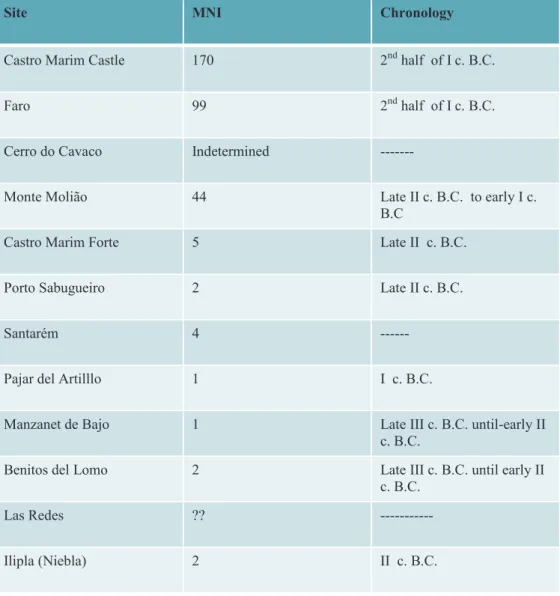
The largest ensemble of these amphorae, with no less than 170 pieces, has been recovered in the Castro Marim Castle, providing this new type with an appropriate name (Arruda, Viegas, Bargão 2006, 163). Also in Faro, 99 pieces could be attributed to this Castro Marim 1 type, which is considerable given the limited size of the
150
2007, 295-296). Although possible and quite logical, we believe that this chronology cannot be established on the basis of surface materials alone, especially when we are dealing with wide chronologic ranges of sites that begin in the early Iron Age in Manzanete de Bajo and end in the Medieval period as for Benitos del Lomo (Ferrer Albelda 2007, 295-296).
In the Spanish territory we also observe some similarities between an amphora rim from Las Redes and the Castro Marim 1 type, but the sherd is too small to have a solid confirmation (De Frutos, Chic, Berriatua 1988, fig. 2, nº 498).
The Niebla excavations yielded some interesting data; some of the rims, which we believe to be of Castro Marim 1 amphorae, have been attributed by the authors to the Ibero-Roman period of the site, which is dated through the presence of Campanian wares and Dressel 1A amphorae to the 2nd century B.C. (Campos Carrasco, Gómez Toscano, Peréz Macias 2007, 273, fig. 277).
In the Portuguese territory, an occupation of similar chronology is lacking, so we can only say with a fair amount of certainty that this type is absent within all Late Iron Age contexts that have been studied in the South (Arruda, Bargão, Sousa 2005; Sousa 2009). Unfortunately, the first half of the 2nd century B.C. in the Portuguese territory is completely void of information, which doesn’t help establishing the beginning of the production. The oldest known 2nd century B.C. contexts in the south of Portugal were found in Castro Marim and in Monte Molião (Arruda, Sousa 2012) and are already associated to the Roman occupation. In the latter archaeological site several Castro Marim 1 sherds were recovered in association with Greco-Italic and Dressel 1 amphorae as well as Campanian wares dating to the late 2nd century and the early 1st century B.C.
Also in Forte S. Sebastião in Castro Marim several Castro Marim 1 amphorae were recovered. Here the associated material suggests a chronology of the last quarter of the 2nd century B.C.: Campanian A wares of the types Lamboglia 5-7, 27, 31, and 55, and “Kuass type” pottery, types II, V, and X of Niveau (Niveau de Villedary y Mariñas 2003; Arruda, Pereira 2008, 391).
There are also a few rim fragments of the Castro Marim 1 type amphorae recovered in the Tagus area, in Santarém (Bargão 2014) and in the surface survey in Porto Sabugueiro (Pimenta, Mendes 2008, 182, fig. 11, nos. 20-21). Although these are surface finds, the authors claim that these amphorae are associated with the last Iron Age occupation at the site, dated between the 5th and 2nd century B.C. (Pimenta, Mendes 2008, 179). In view of the other data that we were able to gather from presence of Castro Marim 1 amphorae on the Iberian Peninsula, it seems more likely that these amphorae belong to the last occupation phase of the site, so to the 2nd century B.C.
By far the most abundant material, however, comes from Late Republican contexts in levels of the mid to late 1st century B.C. of Castro Marim’s castle and from Faro. In both places the amphorae ensemble is large and Punic types dominate with Castro Marim 1, Mañá Pascual A4, Mañá C2, T-9.1.1.1 types, as well as Pellicer type D (Arruda, Viegas, Bargão 2006, 160-165; Viegas 2011, 478-481).
151
The main features of this late period are the presence of Roman amphorae produced in the Gualdalquivir region such as Class 67 (Fabião 1989) and Haltern 70 (Loeschke 1909; Arruda, Viegas, Bargão 2006, 165-169; Viegas 2011, Est. 1001-104, 106).
The absence of the Castro Marin 1 type amphora in the Augustan or later periods stands out clearly from the available evidence, so we arrived at the inevitable conclusion that its production had ended within the third quarter of the 1st century B.C. The same chronology also holds for other Late Punic amphora types such as T-9.1.1.1 or Máñá C2 (Arruda, Viegas, Bargão 2006, 172).
Contents
We do not know for sure what the Castro Marim 1 type amphora’s contained, since no chemical analysis have been made yet. Despite of this, and in view of the existing economic dynamics of this period, one should perhaps first look at what other products were shipped along with the Punic and Castro Marim 1 amphorae, and in other, recognizable containers: olive oil and Italian wine.
In general terms we believe that the filiations of the Castro Marim type with other Late Punic amphorae suggests fish sauce as its principle or sole content, as has already been proven for those other Late Punic types through the study of stamp iconography (García Vargas 1998; Saéz Romero 2008, 582, fig. 18). The parallellism’s argument is strengthened by looking at the resemblances between the Guadalquivir amphorae such as Dressel 20 and their Italian models from Brindisi, both recognizably used for the transport of olive oil. The same phenomena might thus have occurred in the adoption of recognizable Punic shapes within the local tradition of making containers viz. amphorae, implying that the fish contents would have continued to be associated with Punic types until the end of their production.
One important morphological feature, which does relate indirectly to the contents of the Castro Marim 1 type amphorae, is the omphalos shaped bottom. The main
difference between this amphora and the common pre-Roman types, is that the vessel can stand vertically without any other support. This seems particularly suited for both the transport and storage of these foodstuffs. This particular bottom type addressed the need to produce more functional recipients that would allow the manupilation of the contents without changing recipients between the phases of transport and storage. This seems particularly suited to a more practical use such as the supply of an army, which brings us back to the chronology, strengthening the late appearance of this amphora type by linking it to the period of the Second Punic War.
Diffusion
Most of the data we present concern the Algarve region, where the Castro Marim 1 type amphora seems to be most widely spread.
The largest ensemble of these amphorae, with no less than 170 pieces, has been recovered in the Castro Marim Castle, providing this new type with an appropriate name (Arruda, Viegas, Bargão 2006, 163). Also in Faro, 99 pieces could be attributed to this Castro Marim 1 type, which is considerable given the limited size of the
excavation (Viegas 2009, 187). A smaller group of 44 rim sherds was recovered in Monte Molião, and in Cerro do Cavaco this type was also identified.
It is important to stress that in the Algarve region this amphora is always associated with other amphorae produced in the same area, like Máñá C2, Pellicer type D and Ramon Torres T-12.1.1.1 (Arruda, Viegas, Bargão 2006, 160-165; Viegas 2009).
Site MNI Chronology
Castro Marim Castle 170 2nd half of I c. B.C.
Faro 99 2nd half of I c. B.C.
Cerro do Cavaco Indetermined ---
Monte Molião 44 Late II c. B.C. to early I c. B.C
Castro Marim Forte 5 Late II c. B.C. Porto Sabugueiro 2 Late II c. B.C.
Santarém 4 ---
Pajar del Artilllo 1 I c. B.C.
Manzanet de Bajo 1 Late III c. B.C. until-early II c. B.C.
Benitos del Lomo 2 Late III c. B.C. until early II c. B.C.
Las Redes ?? ---
Ilipla (Niebla) 2 II c. B.C.
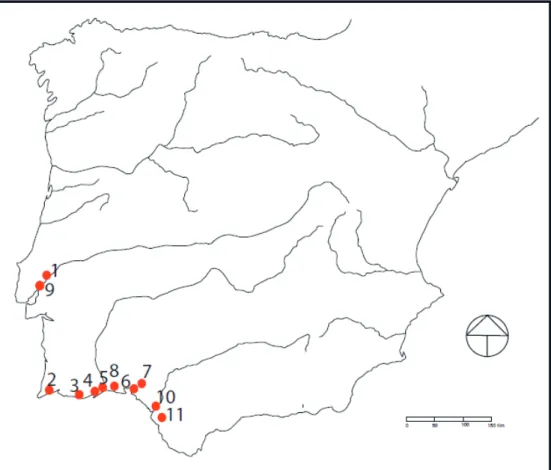
Fig. 7. Diffusion of the Castro Marim 1 amphorae on the Iberian Peninsula (see also Fig. 8).
Fig. 8. Diffusion map of Castro Marim 1 amphorae on the Iberian Peninsula: 1. Santarém, 2.
Monte Molião, 3. Faro, 4. Cerro do Cavaco, 5. Castro Marim, 6. Cadiz area, 7. Pajar del Artillo, 8.
Ilipla, 9. Porto Sabugueiro.
The available data almost exclusively come from sites where research projects have been conducted, leaving us uninformed about the situation in the remaining areas. This lacuna seems, therefore, to be more related to a lack of research and publication than to a real absence of evidence.
More to the north, the amphora type was also recovered on the north shores of the Tagus river, in Santarém city (Bargão 2014). In the Spanish territory we were able to identify this type within the published materials of three different sites: in the kilns of Pajar del Artillo (Luzón Nogué 1973), in Manzante Bajo (Ferrer Albelda 2007, 312), Benitos de Lomo (Ferrer Albelda 2007, 314), in the recovered material of Ilipla (Niebla) (Bélen Deamos 2007, figs. 241, 247), and maybe in Las Redes (Frutos, Chic, Berriatua 1988, fig. 2).
The diffusion map is obviously unfinished and incomplete; we consider the identification and characterization of this new amphora type as the first step towards a
152
excavation (Viegas 2009, 187). A smaller group of 44 rim sherds was recovered in Monte Molião, and in Cerro do Cavaco this type was also identified.
It is important to stress that in the Algarve region this amphora is always associated with other amphorae produced in the same area, like Máñá C2, Pellicer type D and Ramon Torres T-12.1.1.1 (Arruda, Viegas, Bargão 2006, 160-165; Viegas 2009).
Site MNI Chronology
Castro Marim Castle 170 2nd half of I c. B.C.
Faro 99 2nd half of I c. B.C.
Cerro do Cavaco Indetermined ---
Monte Molião 44 Late II c. B.C. to early I c. B.C
Castro Marim Forte 5 Late II c. B.C. Porto Sabugueiro 2 Late II c. B.C.
Santarém 4 ---
Pajar del Artilllo 1 I c. B.C.
Manzanet de Bajo 1 Late III c. B.C. until-early II c. B.C.
Benitos del Lomo 2 Late III c. B.C. until early II c. B.C.
Las Redes ?? ---
Ilipla (Niebla) 2 II c. B.C.
Fig. 7. Diffusion of the Castro Marim 1 amphorae on the Iberian Peninsula (see also Fig. 8).
153
Fig. 8. Diffusion map of Castro Marim 1 amphorae on the Iberian Peninsula: 1. Santarém, 2.
Monte Molião, 3. Faro, 4. Cerro do Cavaco, 5. Castro Marim, 6. Cadiz area, 7. Pajar del Artillo, 8.
Ilipla, 9. Porto Sabugueiro.
The available data almost exclusively come from sites where research projects have been conducted, leaving us uninformed about the situation in the remaining areas. This lacuna seems, therefore, to be more related to a lack of research and publication than to a real absence of evidence.
More to the north, the amphora type was also recovered on the north shores of the Tagus river, in Santarém city (Bargão 2014). In the Spanish territory we were able to identify this type within the published materials of three different sites: in the kilns of Pajar del Artillo (Luzón Nogué 1973), in Manzante Bajo (Ferrer Albelda 2007, 312), Benitos de Lomo (Ferrer Albelda 2007, 314), in the recovered material of Ilipla (Niebla) (Bélen Deamos 2007, figs. 241, 247), and maybe in Las Redes (Frutos, Chic, Berriatua 1988, fig. 2).
The diffusion map is obviously unfinished and incomplete; we consider the identification and characterization of this new amphora type as the first step towards a
future update of the shape, both with regard to classification and diffusion. Hopefully, it will allow the understanding of the role played by this amphora type within the distribution of foodstuffs in the southeast of the Iberian Peninsula.
Fig. 9. Castro Marim 1 amphorae from Castro Marim (after Arruda, Viegas, Bargão 2006) and
Santarém (after Bargão 2014) (see Fig. 8).
154
future update of the shape, both with regard to classification and diffusion. Hopefully, it will allow the understanding of the role played by this amphora type within the distribution of foodstuffs in the southeast of the Iberian Peninsula.
Fig. 9. Castro Marim 1 amphorae from Castro Marim (after Arruda, Viegas, Bargão 2006) and
Santarém (after Bargão 2014) (see Fig. 8).
155
Fig. 11. Castro Marim 1 amphorae from Monte Molião (see Fig. 8), after Arruda, Sousa 2012, 117.
156
Fig. 11. Castro Marim 1 amphorae from Monte Molião (see Fig. 8), after Arruda, Sousa 2012, 117.
157
Bibliography
Arruda A.M., 1988, Nota acerca da ocupação romana républicana do Castelo de Castro Marim, in: Actas do 5º Congresso sobre o Algarve (Montechorro,1988) I,
Silves, 13-17.
Arruda A.M., 1996, O Castelo de Castro Marim, in: De Ulisses a Viriato. O Primeiro Milénio A.C., Lisboa, 95-100.
Arruda A.M., 1999-2000, Los fenícios en Portugal: Fenícios y mundo indígena en el centro y sur de Portugal (siglos VIII-VI a.C.) (Cuadernos de Arqueología Mediterránea
5-6), Barcelona.
Arruda A.M., 2000, As cerâmicas de importação do Castelo de Castro Marim: no âmbito do comércio ocidental dos séculos V a III. a.C., in: Aubet M.E.,
Barthélemy M. (eds.), Actas del IV Congreso Internacional de Estudios Fenicios y Púnicos, Cádiz, 2 al 6 de Octubre de 1995 II, Cádiz, 727-735.
Arruda A.M., 2001, Importações púnicas no Algarve: cronologia e significado, in: Os Púnicos no Extremo Ocidente. Actas do colóquio internacional (Lisboa, 27 e 28 de Outubro de 2000), Lisboa, 69-98.
Arruda A.M., Bargão P., Sousa E., 2005, A ocupação pré-romana de Faro: alguns dados novos, Revista Portuguesa de Arqueologia 8,1, 177-208.
Arruda A.M., Viegas C. Bargão P. Pereira R., 2006, As importações de preparados de
peixe em Castro Marim: da Idade do Ferro à época romana, Setubal
Arqueológica 13, 153-176.
Arruda A.M., Pereira C., 2008, As ocupações antigas e modernas do Forte de São Sebastião, Castro Marim, Xelb 8, 365-395.
Arruda A.M., Sousa E., 2012, Ânforas republicanas de Monte Molião (Lagos, Algarve, Portugal), SPAL 21, 99-133.
Azzaro E., Barone G., Belfiore C., Mazzoleni P., Montana G., Pezzino A., Spagnolo G., Toti M.P., 2006, Indagini minero-petrografiche e geochimiche su anfore del V e IV sec. a.C., in: Atti del convengo di Caserta dell’Associazione Nazionale di Archeometria, Bologna, 219-228.
Bargão P., 2014, As ânforas pré-romanas da Alcáçova de Santarém, in: Arruda A.M. (ed.), Fenícios e Púnicos, por Terra e Mar 2. Actas do VI Congresso Internacional de Estudos Fenícios e Púnicos II, Lisboa, 748-755.
Belén Deamos M., 2007, Ánforas de los siglos VI-IV en Turdetania, SPAL 5,
217-246.
Campos Carrasco J., Gómez Toscano F., Perèz Macias J., 2007, Ilipla Niebla. Evolución Urbana y ocupacción del Territorio, Huelva.
Carretero Poblete P.A., 2004, Las ánforas tipo “Tiñosa” y la explotación agrícola de la Campina Gaditana entre los siglos V y III a.C. (PhD Dissertation Universidad
Complutense de Madrid), Madrid.
De Frutos G., Chic G. Berriatua N., 1988, Las anforas de la factoria prerromana de salazones de «Las Redes» (Puerto de Santa Maria, Cádiz), in: Actas do 1º Congreso peninsular de História Antigua, Santiago de Compostela, 295-306.
Ferrer Albeda E., 2007, El território de la ciudad Bástulo-púnica de Baesippo, in: López Castro J.L. (ed.), Las ciudades fenicio-púnicas en el Mediterráneo Occidental,
Almería, 282-314.
Florido Navarro C., 1984, Ánforas prerromanas sudibéricas, Habis 15, 419-436.
Freitas V., 2006, A cerâmica de engobe vermelho no Castelo de Castro Matim (Master thesis
Universidade de Lisboa), Lisboa.
García Vargas E., 1998, La Producción de anforas en la Bahia de Cádiz en la Època Romana (Siglos II a.c.- IV d.c.), Sevilla.
Loeschcke S., 1909, Keramische Funde in Haltern, Mitteilungen der Altertumskommission für Westfalen 5, 103-322.
Luzón Nogué J.M., 1973, Excavaciones en Itálica. Estratigrafía en el Pajar de Artillo (Campaña 1970) (Excavaciones Arqueológicas en España 78), Madrid.
Mañá, J.M., 1951, Sobre tipología de ánforas púnicas, in: Crónica del VI Congreso Arqueológico del Sudeste Alcoy 1950, Cartagena, 203-210.
Molina Fajardo F., 1984, La factoría de salazones de El Majuelo, in: Almuñecar. Arqueología e Historia II, Granada, 185-204.
Niveau de Villedary y Mariñas A.M., 2003, Cerámicas Gaditanas “Tipo Kuass”, Madrid.
Oliveira C., 2007, A cerâmica manual do Castelo de Castro Marim (Master thesis
Universidade de Lisboa), Lisboa.
Pellicer Catalán M., 1978, Tipología y cronología de las ánforas prerromanas del Guadalquivir según el Cerro Macareno (Sevilla). Habis 9, 365-400.
Pimenta J., Mendes H., 2008, Descoberta do povoado pré-romano de Porto Sabugueiro (Muge), Revista Portuguesa de Arqueologia 11,2, 171-194.
Ramon Torres J. 1995, Las ánforas fenicio-púnicas del Mediterráneo central y occidental
(Col-lecció Instrumenta 2), Barcelona.
Ramon Torres J., Sáez Espilgares A., Sáez Romero A.M., Muõz Vicente A., 2007, El Taller alfarero tardoarcaico de Camposoto (San Fernando, Cádiz) (Arqueologia
Monografias), Sevilla.
Sáez Romero A.M., 2008, La producción cerámica en Gadir en época tardopúnica (siglos –III/-I) I-II (BAR International Series 1812), Oxford.
Sousa E., 2009, A cerâmica de tipo Kuass no Algarve: Os casos de Castro Marim e Faro
(Cadernos da Uniarq 4), Lisboa.
Viegas C., 2011 A ocupação romana do Algarve – estudo do povoamento e economia do Algarve central e oriental no período romano, Lisboa.
Dr. Patrícia Bargão
Prof. Dr. Ana Margarida Arruda
UNIARQ- Centro de Arqueologia da Universidade de Lisboa Alameda da Universidade; Faculdade de Letras
1600-214 Lisboa Portugal
158
Bibliography
Arruda A.M., 1988, Nota acerca da ocupação romana républicana do Castelo de Castro Marim, in: Actas do 5º Congresso sobre o Algarve (Montechorro,1988) I,
Silves, 13-17.
Arruda A.M., 1996, O Castelo de Castro Marim, in: De Ulisses a Viriato. O Primeiro Milénio A.C., Lisboa, 95-100.
Arruda A.M., 1999-2000, Los fenícios en Portugal: Fenícios y mundo indígena en el centro y sur de Portugal (siglos VIII-VI a.C.) (Cuadernos de Arqueología Mediterránea
5-6), Barcelona.
Arruda A.M., 2000, As cerâmicas de importação do Castelo de Castro Marim: no âmbito do comércio ocidental dos séculos V a III. a.C., in: Aubet M.E.,
Barthélemy M. (eds.), Actas del IV Congreso Internacional de Estudios Fenicios y Púnicos, Cádiz, 2 al 6 de Octubre de 1995 II, Cádiz, 727-735.
Arruda A.M., 2001, Importações púnicas no Algarve: cronologia e significado, in: Os Púnicos no Extremo Ocidente. Actas do colóquio internacional (Lisboa, 27 e 28 de Outubro de 2000), Lisboa, 69-98.
Arruda A.M., Bargão P., Sousa E., 2005, A ocupação pré-romana de Faro: alguns dados novos, Revista Portuguesa de Arqueologia 8,1, 177-208.
Arruda A.M., Viegas C. Bargão P. Pereira R., 2006, As importações de preparados de
peixe em Castro Marim: da Idade do Ferro à época romana, Setubal
Arqueológica 13, 153-176.
Arruda A.M., Pereira C., 2008, As ocupações antigas e modernas do Forte de São Sebastião, Castro Marim, Xelb 8, 365-395.
Arruda A.M., Sousa E., 2012, Ânforas republicanas de Monte Molião (Lagos, Algarve, Portugal), SPAL 21, 99-133.
Azzaro E., Barone G., Belfiore C., Mazzoleni P., Montana G., Pezzino A., Spagnolo G., Toti M.P., 2006, Indagini minero-petrografiche e geochimiche su anfore del V e IV sec. a.C., in: Atti del convengo di Caserta dell’Associazione Nazionale di Archeometria, Bologna, 219-228.
Bargão P., 2014, As ânforas pré-romanas da Alcáçova de Santarém, in: Arruda A.M. (ed.), Fenícios e Púnicos, por Terra e Mar 2. Actas do VI Congresso Internacional de Estudos Fenícios e Púnicos II, Lisboa, 748-755.
Belén Deamos M., 2007, Ánforas de los siglos VI-IV en Turdetania, SPAL 5,
217-246.
Campos Carrasco J., Gómez Toscano F., Perèz Macias J., 2007, Ilipla Niebla. Evolución Urbana y ocupacción del Territorio, Huelva.
Carretero Poblete P.A., 2004, Las ánforas tipo “Tiñosa” y la explotación agrícola de la Campina Gaditana entre los siglos V y III a.C. (PhD Dissertation Universidad
Complutense de Madrid), Madrid.
De Frutos G., Chic G. Berriatua N., 1988, Las anforas de la factoria prerromana de salazones de «Las Redes» (Puerto de Santa Maria, Cádiz), in: Actas do 1º Congreso peninsular de História Antigua, Santiago de Compostela, 295-306.
159
Ferrer Albeda E., 2007, El território de la ciudad Bástulo-púnica de Baesippo, in: López Castro J.L. (ed.), Las ciudades fenicio-púnicas en el Mediterráneo Occidental,
Almería, 282-314.
Florido Navarro C., 1984, Ánforas prerromanas sudibéricas, Habis 15, 419-436.
Freitas V., 2006, A cerâmica de engobe vermelho no Castelo de Castro Matim (Master thesis
Universidade de Lisboa), Lisboa.
García Vargas E., 1998, La Producción de anforas en la Bahia de Cádiz en la Època Romana (Siglos II a.c.- IV d.c.), Sevilla.
Loeschcke S., 1909, Keramische Funde in Haltern, Mitteilungen der Altertumskommission für Westfalen 5, 103-322.
Luzón Nogué J.M., 1973, Excavaciones en Itálica. Estratigrafía en el Pajar de Artillo (Campaña 1970) (Excavaciones Arqueológicas en España 78), Madrid.
Mañá, J.M., 1951, Sobre tipología de ánforas púnicas, in: Crónica del VI Congreso Arqueológico del Sudeste Alcoy 1950, Cartagena, 203-210.
Molina Fajardo F., 1984, La factoría de salazones de El Majuelo, in: Almuñecar. Arqueología e Historia II, Granada, 185-204.
Niveau de Villedary y Mariñas A.M., 2003, Cerámicas Gaditanas “Tipo Kuass”, Madrid.
Oliveira C., 2007, A cerâmica manual do Castelo de Castro Marim (Master thesis
Universidade de Lisboa), Lisboa.
Pellicer Catalán M., 1978, Tipología y cronología de las ánforas prerromanas del Guadalquivir según el Cerro Macareno (Sevilla). Habis 9, 365-400.
Pimenta J., Mendes H., 2008, Descoberta do povoado pré-romano de Porto Sabugueiro (Muge), Revista Portuguesa de Arqueologia 11,2, 171-194.
Ramon Torres J. 1995, Las ánforas fenicio-púnicas del Mediterráneo central y occidental
(Col-lecció Instrumenta 2), Barcelona.
Ramon Torres J., Sáez Espilgares A., Sáez Romero A.M., Muõz Vicente A., 2007, El Taller alfarero tardoarcaico de Camposoto (San Fernando, Cádiz) (Arqueologia
Monografias), Sevilla.
Sáez Romero A.M., 2008, La producción cerámica en Gadir en época tardopúnica (siglos –III/-I) I-II (BAR International Series 1812), Oxford.
Sousa E., 2009, A cerâmica de tipo Kuass no Algarve: Os casos de Castro Marim e Faro
(Cadernos da Uniarq 4), Lisboa.
Viegas C., 2011 A ocupação romana do Algarve – estudo do povoamento e economia do Algarve central e oriental no período romano, Lisboa.
Dr. Patrícia Bargão
Prof. Dr. Ana Margarida Arruda
UNIARQ- Centro de Arqueologia da Universidade de Lisboa Alameda da Universidade; Faculdade de Letras
1600-214 Lisboa Portugal