UNIVERSIDADE DE LISBOA
FACULDADE DE CIÊNCIAS
DEPARTAMENTO DE QUÍMICA E BIOQUÍMICA
Theoretical investigation of the energy of olefin- and sila-olefin
insertion/β-H elimination reactions
of two late transition metals – DFT MO calculations
Rita Leonor Veiga da Silva e Veiga Ferro
Doutoramento em Química
Química Inorgânica
UNIVERSIDADE DE LISBOA
FACULDADE DE CIÊNCIAS
DEPARTAMENTO DE QUÍMICA E BIOQUÍMICA
Theoretical investigation of the energy of olefin- and sila-olefin
insertion/β-H elimination reactions
of two late transition metals – DFT MO calculations
Rita Leonor Veiga da Silva e Veiga Ferro
Doutoramento em Química
Química Inorgânica
2013
Tese submetida nos termos don.º 4 do Artigo 39.º do Diário da República,
i Acknowledgments
I would like to thank my supervisor Prof. Dr. rer nat. Wadepohl from the Ruprecht Karl University of Heidelberg (Germany) for the interesting theme of my investigation and for the good working atmosphere in the department of inorganic chemistry.
A very special thanks to my supervisor Prof. Doutora Maria José Calhorda from the Faculdade de Ciências da Universidade de Lisboa (Portugal) for her support and for the good advice.
I am also grateful to my family for their support, and for the inspiration that comes from Lisbon, the most beautiful city in the world.
And a special thank you to my husband for being there for me, and the interesting and adventurous life we lead together all over the world.
iii Abstract (Portuguese)
A reacção de inserção/migração de uma olefina e a sua reacção inversa, a eliminação- foi estudada recorrendo ao método da Teoria do Funcional da Densidade (Density Functional Theory, DFT).O estudo engloba o cálculo dos mínimos locais (intermediários) e dos estados de transição, com o intuito de delinear um perfil energético para a reacção em estudo.
O primeiro passo da reacção envolve a inserção migratória de um hidrogénio numa olefina e resulta na formação de uma estrutura com uma interacção β-agóstica. O segundo passo da reacção refere-se à isomerização da estrutura β-agóstica dando origem a um composto de etilo electronicamente insaturado. Os estados de transição que caracterizam cada passo da reacção são obtidos mediante o uso inicial de coordenadas reaccionais pré-definidas que definirão um perfil, sendo o máximo da curva usado para calcular o estado de transição.
Foi dada especial atenção à influência no perfil energético da reacção de uma gama de substituintes com diversas propriedades electrónicas e estereoquímicas, em compostos organometálicos de dois metais do grupo IX da tabela periódica, o cobalto e o ródio.
Para o capítulo 3, os cálculos envolvem os compostos neutros [L3M(C2H4)(H)
(M=Co, Rh; L=PMe3, PF3) com uma estrutura trigonal bipiramidal e com um centro
metálico de cobalto(I) ou ródio(I).
As barreiras de energia relativas Eins≠para a reacção de migração/inserção do
hidrogénio dos complexos olefínicos [L3M(C2H4)(H) (M=Co, Rh; L=PMe3, PF3) são
+6.6 kcal/mol (M=Co, L= PF3), +10.4 kcal/mol (M=Rh, L= PF3) e +23 kcal/mol
(M=Rh, L= PMe3). Estes cálculos revelam que para ambos os complexos de Co e Rh,
Eins≠aumenta na mesma ordem que a capacidade dadora de electrões de L. Este
resultado sugere que este passo da reacção é criticamente influenciado pelo carácter electrónico do ligando L. Um centro metálico envolvido por ligandos com substituintes aceitadores de electrões é representado por barreiras energéticas Eins≠
inferiores.
As energias dos compostos com uma interacção β-agóstica situam-se -2.8 kcal/mol para o cobalto (Co) e +0.4 kcal/mol para o ródio (Rh), para L=PF3. Este
iv
tabela periódica e a reacção torna-se cineticamente menos favorável. Para os complexos de cobalto, a interacção β-agóstica representa o mínimo global da reacção.
A isomerização do composto β-agóstico no composto de etilo insaturado ocorre através do estado de transição 2 (TS2). A barreira de energia relativa é mais elevada em relação ao primeiro passo da reacção, e tende a aumentar ao longo do grupo do Co na tabela periódica.
A isomerização do composto β-agóstico conduz à formação do composto de etilo com 16 electrões de valência. Os compostos insaturados de etilo têm energias mais elevadas que o complexo de referência (complexo de etileno neutro inicial). Por se tratar de compostos com 16 electrões de valência, foi levado a cabo um estudo para comparar as energias dos estados singuleto e tripleto. Para o estado singuleto a estrutura mais estável obtida corresponde a uma geometria quadrangular plana distorcida para os complexos de ródio. O estado tripleto é mais estável no caso do cobalto quando adopta uma geometria tetraédrica. Este resultado confirma a tendência de que compostos insaturados de metais de transição 3d têm maior propensão para adoptar estados tripletos. O composto insaturado de etilo é estabilizado de acordo com o poder dador de electrões de L.
No capítulo 4, o estudo envolve os complexos catiónicos [(5
-C5R´5)ML(H)(C2H4)]+ (R´=H, CH3; M=Co, Rh; L=PF3). A reacção de
inserção/migração foi calculada com diferentes métodos computacionais com o intuito de avaliar a coerência dos cálculos com resultados obtidos experimentalmente. O método computacional eleito para a discussão de resultados permanece o B3LYP/SDD. Os cálculos efectuados revelam que Eins≠ se situa +0.03 kcal/mol
(M=Co, L= PF3) e +2.91 kcal/mol (M=Rh e L= PF3) mais elevadas que o complexo de
referência (complexo de etileno neutro inicial). As barreiras energéticas calculadas para complexos análogos são comparáveis com as energias de activação obtidas em estudos experimentais de NMR levados a cabo, que mostram que as barreiras de inserção migratória de hidrogénio Eins≠são praticamente insensíveis relativemente a
L, mas um pouco maiores para R=H do que para R=Me. Os compostos β-agósticos apresentam energias de -7.39 kcal/mol (Co) e -1.22 kcal/mol (Rh), relativas aos complexos de referência.
O capítulo 5 diz respeito ao estudo da reacção de inserção/migração de uma “sila-olefina” e a reacção inversa, a eliminação β-H. A substituição de C1 ou C2 por
v
Si na olefina H2C1=C2H2 vai afectar a energia da reacção de inserção migratória do
hidrogénio para os complexos catiónicos [C5R’5ML(H)(SiR2=CH2)]+ (R´=H, Me;
M=Co, Rh; L=PH3, PF3, PMe3), assim como os parâmetros estruturais das espécies
envolvidas.
A reacção de inserção migratória do átomo de hidrogénio numa “sila-olefina” resulta na formação dos isómeros com uma ligação 2-agóstica, “sililo” (M-SiR2
-CH3), quando o átomo C estiver envolvido na inserção migratória do hidrogénio e
“etilo” (M-CH2-SiR2), quando o átomo Si estiver envolvido na reacção.
Para o complexo com uma conformação em que o C da “sila-olefina” está envolvido na inserção migratória do hidrogénio, Eins≠apresenta valores +1.3 a +1.6
kcal/mol para L= PH3, +0.4 a +0.6 kcal/mol para L= PF3, e +2.0 a 2.7 kcal/mol para
L= PMe3, relativamente à “sila-olefina” de referência correspondente. A barreira de
energia relativa Eins≠ para a inserção migratória do hidrogénio aumenta na mesma
sequência do poder dador de electrões de cada ligando. Os substituintes C5H5 e C5Me5
criam a mesma gama de impacto em Eins≠ do que L. A Eins≠ para o complexo L=PF3
é consideravelmente mais baixa (+0.42 kcal/mol), quando comparada com os compostos olefínicos homólogos (+2.91 kcal/mol).
O mínimo global da reacção exibe uma interacção β-agóstica M_H…C. A
conformação “sila-olefina” vai ser consideravelmente estabilizada (12-14 kcal/mol para L=PH3, 13-16 kcal/mol para L=PF3, 11 kcal/mol para L=PMe3) aquando da
formação da interacção 2-“sililo-agóstico”. A energia calculada para o composto de etileno estudado no capítulo 4 é de -1.22 kcal/mol, relativamente ao composto de referência. O composto “sililo” com 16 electrões de valência só é obtido para os complexos com um centro metálico electronicamente mais rico. Para o composto insaturado de “sililo” com um centro metálico electronicamente mais pobre pode ser originada uma vasta gama de reacções subsequentes, nomeadamente a reacção de 1,2-migração.
Para o complexo com a conformação em que o Si da “sila-olefina” vai estar envolvido na inserção migratória do hidrogénio, a estrutura calculada apresenta uma geometria em que a ligação H2C=SiH2 da “sila-olefina” está distendida e apresenta um
comprimento de ligação entre uma ligação simples e uma ligação dupla. A ligação entre o hidrogénio envolvido na reacção migratória de inserção e o centro metálico Rh está parcialmente distendida. Deste modo não foi possível obter uma barreira
vi
energética de inserção Eins≠relativa à isomerização do composto “sila-olefina” e o
composto com uma interacção β-agóstica, devido às interacções Si-H…M criadas. O composto insaturado “etilo” é destabilizado energeticamente, deste modo não foi conferida muita atenção ao estudo deste composto.
O composto insaturado “etilo” (M-CH2-SiH3) apresenta uma energia
consideravelmente superior à do seu homólogo “sililo” (10 kcal/mol para L=C5R’5 e
25 kcal/mol para L=C5H5). Este composto com 16 electrões de valência é instável pelo
facto da ligação H2C-SiR3 ser polarizada, o que vai criar uma atmosfera electrónica
mais pobre para o centro metálico.
Palavras chave: Inserção migratória de hydrogénio, interacções agósticas, mecanismos reaccionais, complexos de etileno, complexos de alquilo, DFT.
vii Abstract
The energetic of the olefin insertion/ -H elimination processes is going to be studied using density functional theory (B3LYP/SDD, Gaussian 03). The observed trends based on steric and electronic properties of two late transition metals (Co and Rh) and ligands (L) are reproduced.
In a [L3M(C2H4)(H) (M=Co, Rh; L=PMe3, PF3) neutral complex the isomer
with a -agostic metal-H-C interaction becomes stabilized when a rather less electron-donating ligand (e.g. PF3) is involved. Comparison of the activation parameters with
those for other complexes suggests an increase of the barrier of migratory insertion with increasing electron richness of the metal center, which destabilizes species with agostic metal –H-C interactions.
The computed energy barriers obtained for the cationic [C5R5ML(H)(C2H4)]+
(R=H, CH3; M=Co, Rh; L=PF3) complexes compare very well with activation
energies from previously reported NMR studies and confirm that the activation barriers are insensitive to L, but somewhat higher for R=H than R=Me.
The study was extended to the cationic complexes of the type [C5R’5ML(H)(SiR2=CH2)]+ (M=Co, Rh; L=PH3, PF3, PMe3; R=H, Me), in which
either C or Si atoms of the “sila-olefin” are involved in the "sila-olefin" insertion/-H elimination reaction. The "sila-olefin" conformation in which C is involved in the hydrogen migratory insertion is going to be deeply stabilized upon the formation of the "silyl-agostic" bond and the Eins barrier decreases to a greater extent comparing
to the olefin isomer. In the course of these reactivity studies, subsequent rearrangements of the initially formed insertion products gave rise to a large number of different reaction pathways for the unsaturated “silyl” with a facile decomposition, including 1,2-migration to produce silylene.
The study could not be extended the "sila-olefin" conformation in which Si is involved in the hydrogen migratory insertion owing to the role of the Si-H…M non classical interactions.
The unsaturated “ethyl” isomers can be stabilized through a 1,3-migration reaction.
Key words: Hydrogen migratory insertion, agostic interactions, reaction mechanisms, ethylene complexes, alkyl complexes, DFT.
ix Abbreviations
16e 16 valence electrons
6-31G** Pople basis set
ax H positioned on the axial plane
B3LYP
Becke-exchange-3-parameter-Lee-Yang-Parr-correlation
BP86 Becke Perdew 86
CCSD (T) Coupled cluster single double
Cp C5H5
Cp* C5Me5
DFT MO density functional theory molecular orbital
EH extended Hückel
eq H positioned on the equatorial plane
HF Hartree-Fock
IHI Interligand hypervalent interactions
IRC Intrinsic reaction coordinate
Me methyl
NMR nuclear magnetic resonance
QM/MM quantum mechanics/molecular mechanics
ref reference
RB3LYP restricted closed-shell wavefunctions
ROB3LYP restricted open-shell wavefunctions
SDD Stuttgart/Dresden basis set
SISHA Secondary interactions between a silicon
and a hydrogen atom
SP distorted square planar
split split-valence basis set
TH distorted tetrahedral
TS transition state
xi Table of Contents
ACKNOWLEDGMENTS ... I
ABSTRACT (PORTUGUESE) ... III
ABSTRACT ... VII
ABBREVIATIONS ... IX
TABLE OF CONTENTS ... XI
TABLE OF FIGURES ... XV
CHAPTER 1 INTRODUCTION ... 1
CHAPTER 2 THEORETICAL METHODS IN ORGANOMETALLIC CHEMISTRY ... 23
2.1 DENSITY FUNCTIONAL THEORY ... 26
2.2 OPEN SHELL METHODS ... 27
2.3 TECHNICAL DETAILS ... 27
CHAPTER 3 THEORETICAL INVESTIGATION OF THE ENERGY OF THE OLEFIN INSERTION/ -H-ELIMINATION IN [L3M(C2H4)(H)], M=CO; L=PF3 AND M=RH; L=PF3, PME3 COMPLEXES ... 31
3.1 INTRODUCTION ... 33
3.2 DFTMO CALCULATIONS OF THE OLEFIN INSERTION/-ELIMINATION REACTION IN [L3M(C2H4)(H)], M=CO;L=PF3 AND M=RH;L=PF3,PME3 COMPLEXES ... 40
3.2.1 STRUCTURAL PARAMETERS OF THE STATIONARY POINTS ... 41
3.2.2 KINETICS ... 47
[(PF3)3Co(H)(C2H4): Ethylene “Starting-structures” 1ax and 1eq ... 48
[(PF3)3Rh(C2H4)(H)]: Ethylene “Starting-structures” 1ax and 1eq ... 52
[(PMe3)3Rh(C2H4)H]: Ethylene “Starting-structures” 1ax and 1eq ... 56
3.3 16-ELECTRON SINGLET AND TRIPLET STATES OF THE ETHYL MINIMA ... 60
a) Structural parameters and energies ... 60
Distorted square planar (SP) and tetrahedral (TH) singlet (s) and triplet (t) structures of the (PF3)3CoC2H5 ... 61
Distorted square planar (SP) and tetrahedral (TH) singlet (s) and triplet (t) structures of the (PMe3)3CoC2H5 ... 64
Distorted square planar (SP) and tetrahedral (TH) singlet (s) and triplet (t) structures of the (PF3)3RhC2H5 ... 66
xii
Distorted square planar (SP) and tetrahedral (TH) singlet (s) and triplet (t) structures of the
(PMe3)3RhC2H5 ... 69
b) Orbitals ... 71
[(PF3)3CoC2H5] distorted square planar (SP) singlet (s) and triplet (t) ... 72
[(PF3)3CoC2H5] distorted tetrahedral (TH) singlet (s) and triplet (t) ... 74
[(PMe3)3CoC2H5] distorted square planar (SP) singlet (s) and triplet (t) ... 75
[(PMe3)3CoC2H5] distorted tetrahedral (TH) singlet (s) and triplet (t) ... 76
[(PF3)3RhC2H5] distorted square planar (SP) singlet (s) and triplet (t) ... 77
[(PF3)3RhC2H5] distorted tetrahedral (TH) singlet (s) and triplet (t) ... 78
[(PMe3)3RhC2H5] distorted square planar (SP) singlet (s) and triplet (t) ... 79
[(PMe3)3RhC2H5] distorted tetrahedral (TH) singlet (s) and triplet (t) ... 80
3.3.3 SUMMARY ... 80
CHAPTER 4 THEORETICAL INVESTIGATION OF THE ENERGY OF THE OLEFIN INSERTION/ -H-ELIMINATION IN [C5R´5M(L)(H)(C2H4)]+, M=CO, RH, L=PF3, R´=H, CH3 COMPLEXES ... 83
4.1 INTRODUCTION ... 85
4.2 DFTMO CALCULATIONS OF THE OLEFIN INSERTION/-ELIMINATION REACTION IN [C5R´5M(L)(H)(C2H4)]+,M=CO,RH AND L=PF3 AND R´=H,CH3 COMPLEXES ... 89
4.2.1 STRUCTURAL PARAMETERS OF THE STATIONARY POINTS ... 89
4.2.2 KINETICS ... 93
[CpCo(PF3)(H)(C2H4)]+ ... 94
[CpRh(PF3)(H)(C2H4)]+ ... 97
4.2.3 SUMMARY ... 100
CHAPTER 5 THEORETICAL INVESTIGATION OF THE ENERGY OF THE SILA-OLEFIN INSERTION/Β-H ELIMINATION. SILYL AND SILYLENE LIGANDS – DFT CALCULATIONS ... 101
5.1 INTRODUCTION ... 103
5.2 STRUCTURAL PARAMETERS OF THE STATIONARY POINTS ... 112
5.2.1 COMPLEX I(COLEFIN INVOLVED IN THE MIGRATORY-INSERTION REACTION) ... 112
5.2.2 COMPLEX II:(SIOLEFIN INVOLVED IN THE MIGRATORY-INSERTION REACTION) ... 126
5.3 KINETICS ... 135
5.3.1 COMPLEX I(L=PH3):C5R’5RH(L)(SIR2CH2)(H)+R’,R=H,ME COMPLEX ... 136
xiii
5.3.3 COMPLEX I(L=PME3):C5R’5RH(L)(SIR2CH2)(H)+R’,R=H,ME COMPLEXES. ... 143
5.4 SUMMARY ... 145
CHAPTER 6 CONCLUSIONS ... 149
xv Table of Figures
Figure 1: Four general mechanistic proposals for olefin polymerization. ... 4 Figure 2: Olefin polymerization mechanism. ... 5 Figure 3: Olefin polymerization leading to “linear” and “hyperbranched” polymers. ... 6
Figure 4: The two general features that dominate the reactivity patterns of agostic systems. ... 7
Figure 5: -agostic alkyl complex in rapid equilibrium with olefin-terminal hydride and/or the unsaturated alkyl complex. ... 9
Figure 6: Mechanism of the olefin insertion/-elimination reaction. ... 10 Figure 7: Olefin insertion/-elimination reaction mechanisms. ... 11 Figure 8: Hydrogen scrambling processes in ethylene hydride complex and the
-ethyl agostic complex... 12 Figure 9: Structure and dynamics of the cationic Co(III) ethylene hydrides and their Rh (III) congeners. ... 13
Figure 10: The -migratory insertion reaction of metal hydride/alkyl olefin complexes. ... 14
Figure 11: Free energy diagram for systems where the hydride analogue LnM’(H)(C2H4) has a classical terminal hydride structure and GH < GR. ... 15
Figure 12: Free energy diagram for systems where the hydride analogue LnM’(H)(C2H4) is β-agostic; GR (figure 12) < GR (figure 11). ... 16
Figure 13: Insertion products detected in ethylene polymerization, monitored by
13C NMR experimental observations, proposed by Brookhart et al. [19. ... 17
Figure 14: Series of complexes studied, with possible importance in olefin polymerization. ... 18
Figure 15: Angles chosen as approximate reaction coordinates. ... 28 Figure 16: Energy profile of the hydride olefin migration /β-H-elimination reaction. ... 29
xvi
Figure 18: Scrambling of the ligands over all the sites in the five-coordinated complexes. Process I of the dynamic behaviour of the [(PMe3)3Co(C2H4)(H) complex
in solution. ... 35 Figure 19: Rotation of the ethylene which exchanges the two CH2 termini of this
ligand. Process II of the dynamic behaviour of [(PMe3)3Co(C2H4)(H) in solution. ... 36
Figure 20: Hydride migration. Process III of the dynamic behaviour of [(PMe3)3Co(C2H4)(H) in solution... 36
Figure 21: Key structures of the hydride migration of [L3M(C2H4)(H)], M=Co
and L=PMe3 complexes [73, as well as the reverse -hydrogen elimination reaction, by
Bittner et al.. ... 37 Figure 22: Energies E of the stationary points (B3LYP/SDD) pertaining to [(PMe3)3Co(C2H4)H]_ Hax 73 and reaction path for the -migratory insertion of
ethylene into the metal hydrogen bond. ... 38 Figure 23: Key structures of the hydride migration of the [L3M(C2H4)(H)],
M=Co; L=PF3 and M=Rh; L=PF3, PMe3 complexes. ... 41
Figure 24: Optimized structures and relative energies (kcal/mol) of the ethylene complexes (relative to 1ax)... 42
Figure 25: Optimized structures and relative energies (kcal/mol) of the 2 -agostic complexes (relative to 1ax). ... 44 Figure 26: Optimized structures and relative energies (kcal/mol) of the 16e-ethyl complexes (relative to 1ax)... 46
Figure 27: Energy scan scheme over approximated reaction coordinates ( and β), pertaining to 1eq. ... 49
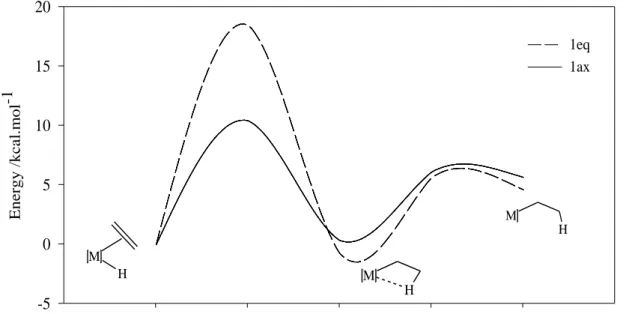
Figure 28: Energy profile of the hydrogen migratory insertion reaction pathway, with reference to 1ax and 1eq (in kcal.mol-1). ... 49
Figure 29: Optimized structures and relative energies (kcal/mol) of the transition state 1 (TS1) complexes. ... 50
Figure 30: Variation of the relevant distances along the hydrogen migratory insertion pathway, with reference to 1ax (solid line) and 1eq (dashed line) (d (Å)). ... 52
Figure 31: Energy profile of the hydrogen migratory insertion pathway, with reference to 1ax and 1eq (in kcal.mol-1). ... 53
Figure 32: Optimized structures and relative energies (kcal/mol) of the transition state 1 (TS1) complexes. ... 54
xvii
Figure 33: Variation of the relevant distances along the hydrogen migratory insertion pathway, with reference to 1ax (solid line) and 1eq (dashed line)(d (Å)). ... 56
Figure 34: Energy profile of the hydrogen migratory insertion pathway, with reference to 1ax ethylene isomer (in kcal.mol-1). ... 57
Figure 35: Optimized structure and relative energy (kcal/mol) of the transition state 1 (TS1) complexes. ... 58
Figure 36: Variation of the relevant distances along the hydrogen migratory insertion pathway, with reference to 1ax (d (Å))... 59
Figure 37: Optimized structures and relative energies (kcal/mol) of [(PF3)3CoC2H5] distorted square planar (SP) and tetrahedral (TH) singlet (s) and b)
triplet (t) structures (relative to the ethylene isomer). ... 62 Figure 38: Optimized structures and relative energies (relative to the ethylene isomer in kcal/mol) of [(PMe3)3CoC2H5] distorted square planar (SP) and tetrahedral
(TH) singlet (s) and triplet (t) structures. ... 65 Figure 39: Optimized structures and relative energies (relative to the ethylene isomer in kcal/mol) of [(PF3)3RhC2H5] distorted square planar (SP) and tetrahedral (TH)
singlet (s) and triplet (t) structures. ... 67 Figure 40: Optimized structures and relative energies (relative to the ethylene isomer in kcal/mol) of [(PMe3)3RhC2H5] distorted square planar (SP) and tetrahedral
(TH) singlet (s) and triplet (t) structures. ... 70 Figure 41: Electronic structure (frontier orbital region) of the singlet (images: HOMO-1 and HOMO-2) and triplet (images: HOMO, HOMO-1, HOMO-2, HOMO-3) distorted square planar [Co(PF3)3C2H5] ethyl isomers. ... 72
Figure 42: Co-H5-bond in [(PF3)3CoC2H5]-SPs (image: 1 and
HOMO-2). ... 73 Figure 43: Electronic structure (frontier orbital region) of the singlet (images: LUMO, HOMO, HOMO-1 and HOMO-2) and triplet (images: HOMO, HOMO-1, HOMO-2, HOMO-3) distorted tetrahedral [Co(PF3)3C2H5] ethyl isomers. The energies
shown for the triplet states were obtained at the ROB3LYP level. ... 74 Figure 44: Electronic structure (frontier orbital region) of the singlet (images: LUMO, HOMO, HOMO-1 and HOMO-2) and triplet (images: HOMO, HOMO-1, HOMO-2 and HOMO-3) distorted square planar [Co(PMe3)3C2H5] ethyl isomers. The
xviii
Figure 45: Electronic structure (frontier orbital region) of the singlet (images: LUMO, HOMO, 1, 2) and triplet (images: HOMO, 1, HOMO-2 and HOMO-3) distorted tetrahedral [Co(PMe3)3C2H5] ethyl isomers. The energies
shown for the triplet states were obtained at the ROB3LYP level. ... 76 Figure 46: Electronic structure (frontier orbital region) of the singlet (images: LUMO, HOMO, HOMO-1 and HOMO-2) and triplet (images: HOMO, HOMO-1, HOMO-2 and HOMO-3) distorted square planar [Rh(PF3)3C2H5] ethyl isomers. The
energies shown for the triplet states were obtained at the ROB3LYP level... 77 Figure 47: Electronic structure (frontier orbital region) of the singlet (images: LUMO, HOMO, HOMO-1 and HOMO-2) and triplet (images: HOMO, HOMO-1, HOMO-2, HOMO-3) tetrahedral [(PF3)3RhC2H5] ethyl isomers. The energies shown for
the triplet states were obtained at a ROB3LYP level. ... 78 Figure 48: Electronic structure (frontier orbital region) of the singlet (images: HOMO, HOMO-1, HOMO-2 and HOMO-3) and triplet (images: HOMO, HOMO-1, HOMO-2, HOMO-3) distorted square planar [(PMe3)3RhC2H5] ethyl isomers. The
energies shown for the triplet states were obtained at the ROB3LYP level... 79 Figure 49: Electronic structure (frontier orbital region) of the singlet (images: LUMO, HOMO, HOMO-1 and HOMO-2) and triplet (images: HOMO, HOMO-1, HOMO-2 and HOMO-3) tetrahedral [(PMe3)3RhC2H5] 16e-ethyl isomers. The energies
shown for the triplet states were obtained at the ROB3LYP level. ... 80 Figure 50: Energy diagram and mechanism illustrating the dynamic behaviour of the 5-C5H5LM(C2H4)(H)+ (M=Co, Rh; L=P(OMe)3) -migratory insertion reaction
proposed by Brookhart et al. [51. ... 86 Figure 51: Optimized structures of the [C5R´5(PF3)M(C2H4)(H)]+ (R´= H, Me
and M= Co, Rh) ethylene minima complexes (B3LYP/SDD). ... 89 Figure 52: Optimized structures of the [C5R´5(PF3)M(C2H4)(H)]+ (R´=H, Me and
M=Co, Rh) β-agostic minima (B3LYP/SDD). ... 90 Figure 53: Optimized structures of the [C5R´5(PF3)M(C2H4)(H)]+ (R´= H, Me
and M= Co, Rh) 16e-ethyl minima (B3LYP/SDD). ... 92 Figure 54: Energy of the stationary points of [CpCo(PF3)(H)(C2H4)]+, estimated
with several Methods/basis set (in kcal.mol-1). BP86/SDD is not depicted in the energy diagram (see table 26)... 94
xix
Figure 55: Optimized structure and relative energy (kcal/mol) of the TS1 (B3LYP/SDD). ... 95
Figure 56: Variation of the coordinates of the stationary points of [CpCo(PF3)(H)(C2H4)]+ (d [Å). ... 96
Figure 57: Energy of the stationary points of [5-C5H5Rh(PF3)(H)(C2H4)]+,
estimated with several methods/basis set (in kcal.mol-1). ... 97 Figure 58: Optimized structure and relative energy (kcal/mol) of the TS1 (B3LYP/SDD). ... 98
Figure 59: Variation of the coordinates of the stationary points of [CpRh(PF3)(H)(C2H4)]+ (d [Å). ... 99
Figure 60: Transition-metal silene complexes LnM(2-R2CSiR’2). ... 103
Figure 61: Sila-olefin intermediates generated by the -hydrogen transfer reaction. ... 104
Figure 62: Transition-metal 2-silene (5-C
5Me5)(PR3)Ru(H)(2-CH2SiMe2)
(R=i-Pr, Cy) complex [119. ... 104 Figure 63: 1,2-Migration reaction. ... 105 Figure 64: Reactions of Cp*(PMe3)Ir(H)(2-Me2SiCH2)+. Role of base-free
silylene complexes in rearrangements of the resulting silicon-based ligands. ... 105 Figure 65: A- Ethylene hydride is the ground state; B - β-agostic ethyl is the ground state. ... 107
Figure 66: Examined model of the olefin insertion/-H elimination, reaction with M-ethyl (Chapters 3 and 4). ... 107
Figure 67: The olefin insertion/-H-elimination of [(C5R’5)M(L)H(CH2=CH2)]+
(R’, R=H, CH3 and M=Co, Rh and L=PF3) ethylene systems studied (see Chapter 4).
... 108 Figure 68: Reaction profile for the olefin insertion/-elimination reaction. .... 108 Figure 69: Examined model of the sila-olefin insertion/-H elimination reaction. ... 109 Figure 70: Complexes C5R’5Rh(L)(SiR2=CH2)(H)+ (R’, R=H, Me and L=PH3,
PF3, PMe3) analysed in this study. ... 109
Figure 71: Sila-olefin insertion for rhodium C5R’5Rh(L)(SiR2CH2)(H)+, R’,
xx
Figure 72: Reaction path of the ”sila-olefin” insertion/-H-elimination with both “sila-olefin”-“starting structures”, complex I- (above) and complex II-isomer (below), intermediates and transition states. ... 111
Figure 73: Optimized structures of „sila-olefin“complexes (I1). E(kcal.mol-1)=0.
... 114 Figure 74: Optimized structures and relative energies (kcal/mol) of “silyl-agostic” complexes (I2).´The calculated energies ΔE are relative to each preceding initial “sila-olefin” isomer (I1). ... 117
Figure 75: Optimized structures and relative energies (kcal/mol) of “silyl” complexes (I3). The calculated energies ΔE are relative to each preceding initial “sila-olefin” isomer (I1). ... 120 Figure 76: 1,2-group migration of R from silicon to rhodium in [C5R’5Rh(L)(SiRCH2)(H)+, R’, R=H, Me and L= PH3, PF3, PMe3 complexes. ... 121
Figure 77: Optimized structures and relative energies (kcal/mol) of “silylene” complexes (I4). The energies ΔE are calculated relative to each preceding initial “sila-olefin” isomer (I1). ... 123 Figure 78: Energy of the silylene isomers (I4), relative to the corresponding sila-olefin structures (I1); (in kcal/mol) (PH3: white; PF3=black; PMe3=dark gray). ... 124
Figure 79: Optimized structures of “sila-olefin” complexes (II1). ... 127 Figure 80: Representations of nonclassical interactions. ... 129 Figure 81: Optimized structures and relative energies (kcal/mol) of „ethyl“ complexes (II3). The energy ΔE is calculated relative to each preceding initial “sila-olefin” isomer (II1). ... 131 Figure 82: Energy of the “ethyl” isomers (II3), relative to the corresponding “sila-olefin” structures (II1), (in kcal/mol) (PH3: white, PF3=black, PMe3=dark gray).
... 132 Figure 83: Optimized structures and relative energies of the II3 L=PF3 (R’,
R=H) and II3 L=PF3 (R’, R=H) “ethyl” isomers and “best view” of the geometry
adopted by these complexes. ... 134 Figure 84: Energy of the stationary points of complex L=PH3 (in kcal/mol). . 136
Figure 85: Optimized structures and relative energies (kcal/mol) of TS1 complexes. ... 137
xxi
Figure 86: Variation of the coordinates of the stationary points of complexes I1 (d [Å): from I1 (R’, R=H) (line: dash-dot), I1 (R’=Me, R=H) (line: solid), I1 (R’=H, R=Me) (line: long dash). ... 139
Figure 87: Energy of the stationary points of L=PF3 complex (in kcal/mol),
relative to “sila-olefin”. ... 140 Figure 88: Optimized structures and energies (kcal/mol) of TS1 complexes... 141 Figure 89: Variation of the coordinates of the stationary points of complexes I2 (d [Å): from I2 (R’, R=H) (line: dash-dot); I2(R’=Me, R=H) (line: solid); I2 (R’=H, R=Me) (line: long dash). ... 142
Figure 90: Energy of the stationary points of L=PMe3 complexes (in kcal/mol),
relative to “sila-olefin”. ... 143 Figure 91: Optimized structures and energies (kcal/mol) of TS1 complexes... 144
1
Chapter 1 – Introduction
3
Introduction
Industrial application of homogenous catalysis plays a major role in chemical industry. The impact of homogenous catalysis on industrial processes has developed to such an extent that organometallic chemistry has expanded into a science.
Acquainted information concerning structure and reactivity of organometallic compounds supported the creation of new catalytic systems. Ziegler-Natta catalysts for ethylene polymerization are good examples, and Wilkinson catalysts for alkene hydrogenation, as well. Improvements on the development of new catalysts will further support advances in industrial chemistry. Thus organometallic compounds with their vast variety of compositions, structures and reactivity present a promising approach.
There are still unresolved questions that require further work, and depend first and foremost on mechanistic insight. There are both new experimental techniques and theoretical approaches still lacking in mechanistic studies due to the intrinsic difficulty of the problem as compared to other areas of organometallic chemistry.
In many cases, extreme conditions or instrumentation are needed to detect short-lived highly reactive intermediates that play a decisive role in important areas of the industry. A greater emphasis should be given to theoretical advances incorporated in mechanistic studies. The understanding of the factors governing activity and selectivity would provide new criteria for the design of catalytic systems.
Many transition metal-catalyzed reactions occur via an alkene -complex intermediate. Mechanisms involving alkene -complex intermediates have been postulated for a number of catalytic systems. Thus, developments in alkene complex chemistry have supported the progress in several industrial processes. Furthermore, alkenes play a role as cheap raw materials in quite a lot of industrial processes in which transition metal-containing catalysts are used. Commercially, the most significant of them include polymerization, hydrogenation, or hydroformylation.
Chapter 1 – Introduction
4
Cossee-Arlman Mechanism (direct insertion)
M P M P
M
P
M P
Green-Rooney Mechanism (hydride shift)
M P H H M H H P M H H P M H H P M P H H
Modified Green-Rooney Mechanism (ground and transition State -agostic interaction)
M P H H M P H H M P H H M P H H M P H H
Transition state -agostic mechanism
M P H H M P H H M P H H M P H H M P H H
Figure 1: Four general mechanistic proposals for olefin polymerization.
A sizeable amount of research in the last 40 years, since the discovery of transition metal catalysts for olefin polymerization by Ziegler and Natta [1,2], has been directed toward understanding the basic mechanistic steps of this important industrial process. The process of monomer enchainment, which is generally considered to occur through olefin coordination [3-5] followed by insertion into a metal-carbon bond, has regularly been under particular scrutiny. Four general mechanistic proposals for the nature of this insertion became known (figure 1).
The first mechanistic possibility is the alkyl migration to the coordinated olefin [6-10] and is known as the Cossee-Arlman mechanism. Rooney and Green [11,12] proposed the second model that consists of an oxidative 1,2-hydrogen shift ( -elimination) from the -carbon of the polymer chain, creating a metal-alkylidene hydride. A metallacyclobutane will then be generated through the reaction with an
Chapter 1 – Introduction
5
olefin, and the sequence is completed with a reductive elimination. A mechanism proposed by Green, Rooney and Brookhart [13-15] where a hydrogen atom on the -carbon of the growing polymer chain interacts with the metal center throughout the catalytic cycle, is seen somewhat as an intermediate to the first two proposals. This three-center, two-electron covalent bond, termed an “agostic interaction” [15,16], happens when the hydrogen atom is simultaneously bonded to a carbon and a metal atom. The fourth is olefin “insertion” where an -hydrogen interacts with the metal center only during the transition state of the C-C bond forming step. This mechanism is a hybrid of the Cossee-Arlman and modified Green-Rooney mechanisms.
Elimination of a hydrogen atom from an ethyl ligand, usually from the carbon atom to the metal (-elimination), is the reverse process of “migratory insertion” of an olefin into a metal hydrogen bond.
For example, during olefin polymerization, -H elimination can be a factor that limits the growth of the polymer chain. Efficient olefin polymerization can occur via the sequence shown in figure 2.
M H R -H elimination M H R migratory insertion re-insertion M H R R
Figure 2: Olefin polymerization mechanism.
Depending on the relative rates of olefin dissociation and re-insertion, further reaction (or decomposition) or isomerisation may occur. With certain catalysts rapid re-insertion leads to “hyperbranched” polymers with unusual physical properties (figure 3).
Chapter 1 – Introduction 6 M R M R M R n migratory insertion re-insertion -H Elimination M H R re-insertion M H R M n R branched polymer linear polymer alkyl migratory insertion
Figure 3: Olefin polymerization leading to “linear” and “hyperbranched” polymers.
Given the importance of -migratory insertion and -elimination processes, it is quite understandable that these reactions have been extensively studied. Experimental and theoretical studies have been undertaken by several authors in order to understand these fundamental transformations.
There are now numerous, well-documented cases where alkene-, polyene-, or polyenyl-metal hydride complexes adopt the bridged or agostic structure containing a three-center, two-electron M-H-C bond rather than the classical, terminal hydride structure.
It is worthwhile to briefly review the syntheses and properties of agostic systems, before discussing this aspect.
Agostic interactions are of general significance in organometallic chemistry since they often lead to C-H activation [17,18. Concerning polymerization catalysts, it has been proposed that an understanding of the factors which control agostic interactions will contribute to a better control of catalyst activity [19 and polymer molecular weights [20-22.
Numerous examples have been documented where agostic complexes are in rapid equilibrium with olefin-hydride and/or the unsaturated 16-electron alkyl species. The metal center should have an empty orbital to receive the two electrons of the C-H
Chapter 1 – Introduction
7
bond, as a minimum prerequisite. This orbital is presumed to be essentially of d character for transition metal compounds. The directionality and energy of this orbital should approach those of the C-H bonding orbitals as much as possible and it should also be a very good acceptor. A metal atom often achieves a maximum coordination number only when all the valence orbitals are occupied. Nonetheless, it is probable from normal considerations of steric restriction that the formation of agostic alkyl groups will be favoured when this bond results in the metal attaining a coordination number of six or less.
The formation of an H agostic group is sterically fairly unchallenging. In the absence of steric constraints it is to be expected that agostic H-hydrogens will be easily displaced from the metal center by another donor group, requiring only a small distortion. The reactivity patterns of agostic systems are dictated by two general features. Strongly donating ligands can often displace the agostic C-H group, as it is regarded as a weak ligand.
M H R -H elimination M H R migratory insertion re-insertion M H R R
Figure 4: The two general features that dominate the reactivity patterns of agostic systems.
Steric factors can favour the agostic system, considering that the agostic C-H interactions are intramolecular, and there are now numerous examples where the equilibrium illustrated in figure 4 favours the M-H-C system.
A second possibility considers that the C-H group in the M-H-C system is interacting with an essentially electrophilic metal center. The agostic hydrogen becomes acidic and, for example, deprotonation reactions can occur. The pKa values
Chapter 1 – Introduction
8
bases are needed. Nucleophilic species are created in anionic systems. Reactions with other electrophiles can end in new C-electrophile bonds and a net overall electrophilic substitution of H.
This expectation raises the question of competition between the formation of a
β-agostic bond and donation by lone pairs of ligands such as halogen atoms or the oxo
ligand. This point is illustrated by [TiMe(dmpe)Cl3, in which those lone-pair
electrons of the three chloride ligands that have suitable symmetry to overlap with the titanium orbitals do not successfully compete with the β-agostic C-H electron pair. Finally, the requirement of an unsaturated 16-electron (or fewer) metal center is a necessary but not sufficient condition for the occurrence of a β-agostic hydrogen. It is known that the 16-electron compound [Ti(-C7H7)(dmpe)(1-Et) does not fulfill
these requisites [23.
By the time a saturated 18-electron species looses a ligand, it yields the unsaturated 16-electron species possessing a low-lying empty orbital. The 16-electron complex is then capable of coordinating a C-H bond (i.e., use the C-H bond as a two-electron donor ligand) to form a bridged species. A small HOMO-LUMO gap is favoured by classical oxidative addition, while β-agostic bonding takes place when the metal center is very electrophilic (i.e. very low lying LUMO) and has a large HOMO-LUMO gap.
Invariably, the bridged β-agostic species is in rapid equilibrium with the classical hydride and the 16-electron species. It suggests the chance that the structure and dynamics of the hydride system species can parallel that of the alkyl analogues.
M-H-C agostic groups may be classified in line with the position of the carbon atom giving rise to the C-H bond relative to the metal center, such as complexes with
- and - and -agostic alkyl groups.
The titanium compound [Ti(2-Me)Cl3(dmpe) [24 was the first example in
the -agostic alkyl groups to be fully characterized. It was demonstrated that the methyl group is tilted in such a way that one hydrogen atom approaches the metal leading to a Ti-C-H angle of 93.5o. An interesting symmetrical distortion has been suggested to happen in the compound [TiMeCl3 [25. The methyl group is apparently
Chapter 1 – Introduction
9
The -agostic interaction is of particular interest since it might dramatically lower the activation barrier to olefin insertion [26 and influence the stereochemical outcome of the olefin insertion step [27-30. Brintzinger has proposed that an -agostic interaction increases rigidity of the transition state of a C2-symmetric catalyst
undergoing propylene insertion, thereby increasing the isotacticity of the resulting polypropylene [27,28. Specifically, the -agostic interaction firmly orients the polymer chain into the open sector of the catalyst structure to minimize interactions between the alkyl substituent of the monomer and the ligand/polymer array during olefin insertion.
The -agostic alkyls can also be viewed as bridged ethylene-hydride complexes and are often in rapid equilibrium with the olefin-terminal hydride and/or the unsaturated alkyl complex, as is clear from dynamic studies summarized below. Those -agostic alkyl complexes that involve early transition metal systems provided evidence to be closer in energy to the 16-electron metal-alkyl formulation (GA <
GB). On the other hand, the structure of later transition metal complexes (dn, n>0)
most likely lie closer in energy to the olefin-hydride formulation (GB < GA)
(figure 5). H LnM G A Process A Process B H LnM G B
Figure 5: -agostic alkyl complex in rapid equilibrium with olefin-terminal hydride and/or the unsaturated alkyl complex.
The first unequivocal example of a -agostic ethyl complex, the do [Ti(2 -Et)(dmpe)Cl3 was reported by Green and co-workers [24. The X-ray crystal structure
confirms a very small distorted Ti-C-C angle of 86o well-suited to a Ti- H-C
interaction. Schrock [31, Bercaw [32 and their co-workers made similar proposals for agostic interactions in high valent early transition metal-alkyl complexes.
Chapter 1 – Introduction
10
The -agostic interaction might serve to stabilize catalytic species (both geometrically and electronically) between the insertion and monomer coordination. Guerra et al. has proposed that the high syndiospecificity of Cs-symmetric catalysts [33 for propylene polymerization results from a -agostic structure which persists in the catalytic species after olefin insertion. Several theoretical studies suggest that -agostic interactions are present following insertion [34, 35 and that these contacts can be relatively long lasting [37-39. The -migratory insertion of transition metal olefin hydride complexes is a fundamental transformation of significance in a number of catalytic processes, including olefin hydrogenations, hydroformylations, and isomerizations. The related -migratory insertion reaction of metal alkyl olefin complexes is the key carbon-carbon bond forming step in metal-catalyzed olefin polymerization reactions and associated oligomerizations and dimerizations 40.
The classical view of the migratory insertion reaction of a metal olefin hydride complex is illustrated in figure 6 with ethylene hydride complex, A, and involves the transformation of this species into a high energy unsaturated ethyl intermediate, C, via a transition state, B, in which hydrogen is half-bridged between the metal and the β-carbon. M H M H M H A B C
Figure 6: Mechanism of the olefin insertion/-elimination reaction.
By measuring the rates of hydrogen scrambling between the metal hydride and olefinic sites through either dynamic NMR studies or, on slower time scales, through H/D scrambling reactions [41, the barriers to such migratory insertion were examined.
The bridged β-agostic species repeatedly proved to be the most stable form of numerous “olefin hydride” complexes (particularly late metal, first row, electrophilic
Chapter 1 – Introduction
11
species) [15, 16, 42, 43. Starting from an ethylene hydride complex, the exchange is believed to occur in the course of a classical mechanism involving a coordinatively unsaturated metal ethyl complex, or passing through a -agostic intermediate.
This undertakes facile “in-place” methyl rotation where the CH3 group keeps
bound to the metal in the transition state for exchange (figure 7).
LnM H LnM CH 3 LnM H1 H2 H3 LnM H2 H3 H1
Figure 7: Olefin insertion/-elimination reaction mechanisms.
There is a strong indication that the scrambling between the β-agostic hydrogen and the terminal hydrogen in such species occurs by an “in-place” rotation around Cα-Cβ and not by formation of a true unsaturated metal alkyl complex, which
displays no β-CH-metal contact [45, 47.
Green and Wong were the first to propose the in-place mechanism by describing the dynamic behaviour of the bis-ethylene hydride complex [Mo(cis-Ph2PCH=CHPPh2)2(C2H4)H+ [45. The dynamics of exo-[Cp2Nb(CH2=CHCH3)H
was investigated by Green, Bercaw et al., who found that the niobium hydride exchanges with the methylene hydrogens ca. twice as fast as it exchanges with the methyl hydrogens [44,47. It is important to note that the dynamic results are also consistent with a classical mechanism involving non-agostic 16-electron alkyl intermediates [44, 48.
Experimental studies are frequently unsatisfactory in attempts at discerning the classical description from the mechanism in figure 7, and computational studies have been modest in enlightening the delicate features of these processes 50.
Chapter 1 – Introduction
12
Nonetheless, a number of facts were cited to support in-place rotation in a β-agostic intermediate (figure 8).
x LnM H LnM CH 3 LnM H' H H LnM H H' H
Figure 8: Hydrogen scrambling processes in ethylene hydride complex and the -ethyl agostic complex.
These facts are certainly exemplified by the structure and dynamics of the cationic Co(III) ethylene hydrides and their Rh(III) congeners 51-53. These d6, 18-electron complexes display geometries which are best portrayed as distorted octahedral. The stable form of the cobalt complexes is the β-agostic structure 50,51. Computational studies indicate that scrambling of the β-agostic H with the terminal hydrogens takes place by in-place rotation and that the 16-electron species is energetically inaccessible.
The -agostic species is calculated to be more stable than the unsaturated ethyl complex 45,47.
An analogous situation occurs for the Rh complexes 52. The global minimum is the olefin hydride species. Computations prove that the scrambling happens via the formation of the β-agostic species, followed by in-place rotation.
The Rh 16-electron ethyl complex is calculated to be very high in energy and less stable than the -agostic isomer 45a (figure 9).
Chapter 1 – Introduction 13 X Co R L H' H H C-C rotation rotation R= H, CH3 L= Phosphine, Phosphite R= H, CH3 L= Phosphine, Phosphite Co R L H H H' Co R L CH 2H' Rh R L H Rh R L H' H H Rh R L H H H' C-C
Figure 9: Structure and dynamics of the cationic Co(III) ethylene hydrides and their Rh (III) congeners.
Similarly, experimental 54 and theoretical 55 studies of d8, 16-electron, square-planar complexes of the type (diimine)M-R+ (M= Ni, Pd, Pt; R= CnH2n+1,
n>1) have shown that β-agostic structures are adopted for M=Ni or Pd, while Pt exhibits a classical olefin hydride structure.
Extended Hückel MO calculations have been performed on the reaction profile for the conversion of the 16-electron [Co(-C5H5)(PH3)C2H5+ to [Co(
-C5H5)(PH3)(-C2H4)H+. The intermediate structure with a β-agostic interaction
proved to be more stable than the ethylene-hydride structure [57.
Brookhart et al. published NMR data of the methyl-substituted compound [Co(-C5Me5)(P(OMe)3)C2H5+ that convey the idea of small energy difference
between the ethylene-hydride and the β-agostic alkyl structures. Model theoretical studies propose Grot to be considerable (> 8-10 kcal/mol), so the energy difference
Chapter 1 – Introduction
14
Over the past years several β-agostic complexes were identified and could offer general insights into migratory insertion reactions and, in particular, the key step of olefin polymerization, the insertion of an olefin into a metal alkyl bond [19.
Since alkyl groups are much poorer bridging groups than hydrogen, the β-agostic complex is not expected to be the most stable species among them, and most likely will always represent the transition state in the alkyl migration reaction or an unstable intermediate.
Brookhart et al. proposed that there exists a parallel between the structure and dynamics of the hydride complexes and the activation energies for alkyl migration reactions of their alkyl analogues. The barriers for these alkyl migration reactions will be lower in cases where the hydride analogues exist as bridged isomers, rather than terminal hydrides. The same factors that favour a bridging over terminal hydride structure will facilitate alkyl migration [58.
An important generalization consists in that the same features that favour bridging rather than the terminal hydride structure should lower the energy difference between the β-agostic and ethyl alkyl complex and thus facilitate alkyl migrations. In other words, the hydride systems can be utilized as a helpful guide in selecting which alkyl systems will experience rapid migratory insertion reactions.
This principle can clearly be relevant to create olefin polymerization catalysts by applying it to simple olefin insertion reactions (figure 10).
LnM H LnM H LnM H LnM R LnM R LnM R
Figure 10: The -migratory insertion reaction of metal hydride/alkyl olefin complexes.
A quantitative measure of the relative migratory capacity of hydride and alkyl groups in the -migratory insertion reaction was carried out for the first time in experiments performed by Brookhart et al. [58. The difference in free energies of
Chapter 1 – Introduction
15
activation of the [Cp*(P(OMe)3)Rh(C2H4)R+ (R= H, CH2CH3) compound (GEt. mig.
- GH mig.) is 10.3 kcal/mol. This value is somewhat smaller than that observed for the
relative rates of –H and –CH3 -migration in [Cp*2Ta(CH2)(CH3) [59. The
divergence in activation barriers for hydride versus alkyl migrations relies on the fact that alkyl migrations are unobserved in ethylene alkyl complexes where the analogous terminal hydride systems involve barriers for migration greater than 17-18 kcal/mol [59,60. Conversely, relative migratory aptitudes of hydride and alkyl groups may vary significantly from system to system. Several such analogous pairs have been characterized [11,61,71.
In such systems stated above: (a) the hydride analogue has a classical terminal hydride structure; (b) hydride migration can be observed and has G > 17 kcal/mol; (c) migratory insertion reactions cannot be detected in any of the alkyl analogues [62.
Along with the fact such alkyl groups are poorer bridging groups, the barriers to alkyl migrations are expected to be substantially greater than barriers to hydride migrations. The concept proves to be particularly helpful for identifying olefin-alkyl complexes that are expected to experience rapid alkyl migratory insertion reactions.
These classical systems should behave qualitatively according to the free energy diagrams depicted in figures 11 and 12.
G G (a) (b) LnM H LnM H LnM R LnM R LnM R LnM H
Figure 11: Free energy diagram for systems where the hydride analogue LnM’(H)(C2H4) has a classical terminal hydride structure and GH < GR.
Chapter 1 – Introduction
16
Figure 11 characterizes a classical system with the expected GH < GR.
There are numerous cases reported in the literature where GH > ~17 kcal/mol, with
the analogous GR being too high for the alkyl migration reactions to be kinetically
accessible at reasonable temperatures [64,68,70.
(a) (b) LnM H LnM H LnM H LnM R LnM R LnM R G G
Figure 12: Free energy diagram for systems where the hydride analogue LnM’(H)(C2H4) is β-agostic; GR (figure 12) < GR (figure 11).
Figure 12 exemplifies the free energy diagram in which the metal center stabilizes the β-agostic alkyl structure. In such systems where the β-agostic structures happen to be the ground state, it has been suggested that there is a significant decrease in the corresponding G for the alkyl migration. It is proposed that for systems where the hydride analogue LnM’(H)(C2H4) is β-agostic, values for GR should be
significantly reduced. If metal complexes of the type LnM’(CH2=CH2)R experience
rapid migratory insertion reactions, they may represent good candidates for catalysts of olefin polymerizations, proceeding according to the normal Cossee-Arlman mechanism.
This idea was first demonstrated using the β-agostic-alkyl complex [Co(5 -C5Me5)P(OMe)3(2-Et)+, which is a catalyst for ethylene polymerization
Chapter 1 – Introduction
17
If alkyl migration is as rapid as postulated, 1 should catalyze ethylene polymerization by successive migratory insertion reactions.
The key results and the proposed mechanism are summarized in figure 13.
Migration 1. Insertion 2. Migration 3. Re-bridging 4a R1= alkyl, R2=R3=H 4b R2= alkyl, R1=R3=H 4c R3= alkyl, R1=R2=H 1 2 3 4 a-c alkyl=butyl etc. polyethylene Re-bridging CH2=CH2 Co R (MeO)3P H Co R (MeO)3P CH2CH3 Co R (MeO)3P CH2CH2CH2CH3 Co R (MeO)3P H R3 H R2 R1
Figure 13: Insertion products detected in ethylene polymerization, monitored by 13C NMR experimental observations, proposed by Brookhart et al. [19.
Indeed, treatment of [C5Me5(P(OMe)3)Co-CH2CH3+ under ethylene pressure
yields linear polyethylene. Following the polymerization by 13C NMR allows detection of first few insertion products [19,56.
A combination of β-agostic complexes 4 a-c is the first observable product in the reaction of the β-agostic complex 1 with ethylene. This reaction is assumed to happen by ethylene coordination to 1 giving rise to the ethylene-ethyl complex 2. Since the equilibrium strongly favours 1, given that the β-agostic structures are the resting state of the catalyst, this complex was never detected. The resting state of the catalyst is not an unsaturated alkyl species such as 3 or an olefin-alkyl complex such as 2, but the β-agostic species 4.
Chapter 1 – Introduction
18
Complex 2 goes through rapid migratory insertion to form the 16-electron n-butyl complex 3. The compound 3 then quickly generates a Co-H-C bond to create the more stable β-agostic structures 4 a-c, which rapidly interconvert by scrambling of the ethyl group between the C and C sites. After that, migratory insertion results in 4 a-c with R1, R2, R3 = n-butyl when a second ethylene molecule coordinates to 4 a-c (R1,
R2, R3 = Et). The alkyl chain continues to grow in this fashion.
Only linear polyethylene is formed so only n-alkyl ethylene complexes ultimately undergo migratory insertion even though branched alkyl substituents could arise by reaction of 4 with ethylene followed by insertion. No -olefins (from -elimination) can be detected by NMR spectroscopy; β-agostic structures 4 are stable under conditions for polymerization. Propylene is not polymerized under similar conditions.
A few general remarks should be made concerning the factors which favour the β-agostic structure over the classical terminal hydride structures. In general, a highly electrophilic metal center seems to be required [15. Most β-agostic species are first row species containing -acid ligands and are often cationic. Third row examples are known, but they are cationic complexes with metals in high oxidation states containing -acid ligands. In this regard, several series of complexes, with possible interest in olefin polymerization, were studied (figure 14). All are octahedral d6 cyclopentadienyl complexes containing a phosphine, ethylene and hydride as the remaining three ligands.
Rh Me3P H Co R5 L H Fe Me5 Me3P H R=Me L=PPh3, PMe3, P(OMe)3
Figure 14: Series of complexes studied, with possible importance in olefin polymerization.
Chapter 1 – Introduction
19
Green and Wong showed that the neutral iron(II) species is a classical, terminal hydride and does not polymerize ethylene [66,67 and the data reported by Werner and Feser [68 suggests that second row Rh(III) complexes are classical terminal hydrides and although treatment with ethylene generates an ethyl ethylene complex no further insertions occur to generate polyethylene. Only the first-row cationic cobalt(III) system is β-agostic (the smallest and most electrophilic metal center) and polymerizes ethylene below 0oC. This series supports the previously made observations and further suggest that first-row systems will favour β-agostic structures relative to their second- and third-row analogues. The observations of Bennett et al. [69 with regard to values of second- and third-row analogues, Rh and Ir, reinforce this view.
DFT calculations done by Bittner et al. clearly show [73 that species (transition states and intermediates) with β-agostic M-H-C interactions are destabilized with an electron rich metal center. Although experimental and theoretical data are still not enough to confirm these predictions, it is proposed that the barrier of the insertion reaction increases in this manner in case of an electron richer (more nucleophile) metal. This happens for [(PMe3)3Co(H)(C2H4)] [73.
Further examples of electron-rich complexes suggest the ethylene-hydride as the most stable structures, from data obtained by NMR experiments, in [W( -C5H5)2(-C2H4)H+ [64, [Ta(-C5H5)2(-C2CHR)H [70,74, [Nb(-C5H5)2(
-C2H4)H [71, [Nb(-C5H5)2(-C2CHR)H [75, [Ru(-C6H6)(PMe3)(-C2H4)H+ [76
Chapter 1 – Introduction
20
Table 1: Experimental activation parameters (H‡ and G‡ in kcal/mol, S‡ in cal.mol
-1 K-1) for -migratory insertion.
complex H‡ S‡ G‡(T) T ref [(C5R5)2Nb(H)(C2H4) R=H 17(1) 318 [48 R=Me 15(1) -11(3) [49a [(C5R5)2W(H)(C3H6)+ 23.7(7) +12(2) [53 [(C5R5)P(OMe)3Rh(H)(C2H4)+ R=H 15.0(1) 0.2(3) [51 R=Me 12 229 [51 [(C5R5)(PMe3)Rh(H)(C2H4)+ R=H 15.0(1) 0.0(3) [51 R=Me 12 224 [51 [(C5R5)(P(OMe)3)Co(2-C2H5)+ 6-8 [51 [(PMe3)3Co(H)(C2H4)] 16.4(6) +8(2) [72
By comparing experimental activation parameters for -migratory insertion with reference to different systems (see table 1), it has been shown that the activation barrier for the neutral cobalt complex [(PMe3)3Co(H)(C2H4)], the neutral niobium
complex [(C5R5)2Nb(H)(C2H4) and the cationic rhodium complex are similar, and
considerably higher than in case of the cationic cobalt complex [(C5R5)(L)Co(2
-C2H5)+.
A few theoretical calculations have been carried out to examine the energetic and dynamic of the -hydrogen elimination. Bittner et al. [72 investigated, in a previously study, two complexes [(C5H5)(PH3)M(H)(C2H4)+ (M=Co, Rh) by DFT
calculations. Their theoretical results are in good agreement with the corresponding experimental findings. The β-agostic structure proved to be the global minimum of the
-hydrogen elimination reaction in the cobalt complex. On the other hand, the Rh analogue confirmed the trend of the second row transition metal, and the ethylene structure represents the global minimum of the reaction.
Chapter 1 – Introduction
21
Bittner et al. [73 further investigated the neutral, greatly electron rich complex
[(PMe3)3Co(H)(C2H4)]. The selection of this complex symbolizes an extreme representation of an antagonism of the electronic requirements expressed to define a good catalyst, and stands for a good model to discuss these predictions.
Their results are a piece of evidence that there are insertion/-elimination
reactions where the β-agostic structure is not an intermediate.
In the present work emphasis will be given to theoretical approaches based on mechanistic studies of experimental techniques, playing a role in catalytic processes. The understanding of the factors governing activity and selectivity will provide new criteria for the design of catalytic systems.
Chapter 1 – Introduction
23
Chapter 2
Theoretical Methods in Organometallic
Chapter 2 – Theoretical methods in organometallic chemistry
25
Theoretical Methods in Organometallic Chemistry
The intention of the present chapter is to describe briefly the main features of the theoretical methods that are currently in use for the study of organometallic compounds, taking special emphasis in those methods used in this thesis.
Qualitative molecular orbital (MO) theory based on extended Hückel (EH) calculations marked the early stages of computational organometallic chemistry. Qualitative methods are not capable of presenting accurate results, like sophisticated modern methods, but their simplicity makes them suitable for the qualitative interpretation of orbital interactions. These studies, although of a qualitative nature, founded the theoretical basis of organometallic chemistry.
The use of ab initio quantum chemistry methods, either based on the Hartree-Fock (HF) theory or on density functional theory (DFT) were instigated soon after semi-quantitative results. Ab initio molecular orbital theory aims at predicting the properties of atomic and molecular systems and stands on the fundamental laws of quantum mechanics. More advanced HF based methods suitable for systems with simplified ligands, such as Møller-Plesset perturbation theory, configuration interaction, or coupled cluster theory, became available. Another major impact in computational chemistry came from the widespread acceptance of density functional theory methods, which yield reliable structures and energies with simpler computations.
The use of hybrid quantum mechanics/ molecular mechanics (QM/MM) methods to replicate steric effects of bulky ligands began to be more popular. A number of QM/MM methods have been reported in the literature [78. In the hybrid QM/MM methods the molecular system is divided in different regions, and each of them is treated at different computational level. In transition metal complexes, an accurate quantum mechanics (QM) method will treat the metal centre (the active region), and the remnants of the system (bulk of the ligands) can be obtained with a much more affordable molecular mechanics (MM) approach.




![Figure 22: Energies E of the stationary points (B3LYP/SDD) pertaining to [(PMe 3 ) 3 Co(C 2 H 4 )H]_ Hax 73 and reaction path for the -migratory insertion of](https://thumb-eu.123doks.com/thumbv2/123dok_br/15621932.1055060/66.892.133.762.115.617/figure-energies-stationary-points-pertaining-reaction-migratory-insertion.webp)
![Figure 23: Key structures of the hydride migration of the [L 3 M(C 2 H 4 )(H)], M=Co;](https://thumb-eu.123doks.com/thumbv2/123dok_br/15621932.1055060/69.892.152.761.108.454/figure-key-structures-hydride-migration-l-m-c.webp)