i
DOCTORAL PROGRAMME IN PHARMACEUTICAL SCIENCES
PHARMACEUTICAL TECHNOLOGY SPECIALITY
Cyclodextrins as excipients in solid
oral dosage forms
Jaime Manuel Guedes Morais da Conceição
D
i
Cyclodextrins as excipients in solid
oral dosage forms
Jaime Manuel Guedes Morais da Conceição
1Pharmacist and Invited Lecturer
Doctoral Thesis in Pharmaceutical Sciences - Pharmaceutical Technology Speciality (240 ECTS credits) submitted to the Faculty of Pharmacy of the University of Porto
Supervisor: Professor José Manuel Correia Neves de Sousa Lobo 2 (PhD), Faculty of
Pharmacy, University of Porto, Portugal
Co-Supervisor: Professor Helena Maria Cabral-Marques 3 (PhD), Faculty of Pharmacy,
University of Lisbon, Portugal
Supervisor of the European Doctorate: Professor Carmen Isabel Alvarez-Lorenzo 4
(PhD), Faculty of Pharmacy, University of Santiago de Compostela, Spain
Porto, Portugal May 2020
____________________________________________________________________________________
iii THIS THESIS IS PUBLICLY SUPPLIED ON CONDITION THAT ANYONE WHO CONSULTS IT IS UNDERSTOOD TO RECOGNISE THAT ITS COPYRIGHT RESTS WITH ITS AUTHOR AND THAT NO QUOTATION FROM THE THESIS AND NO INFORMATION DERIVED FROM IT MAY BE PUBLISHED WITHOUT PROPER ACKNOWLEDGMENT.
v This Doctoral Thesis was supported financially by the Foundation for Science and Technology (FCT, Portugal) and PhD Programme in Medicines and Pharmaceutical Innovation (i3DU) through the research grant [PD/BD/127813/2016].
This Thesis was also supported by the Applied Molecular Biosciences Unit-UCIBIO which is financed by national funds from FCT/MCTES (UID/Multi/04378/2019) and from FCT (UIDB/04378/2020).
vii The experimental work presented in this Doctoral Thesis was performed in the Laboratory of Pharmaceutical Technology, Department of Drug Sciences, of the Faculty of Pharmacy, University of Porto, Portugal, in the Department of Galenic Pharmacy and Pharmaceutical Technology of the Faculty of Pharmacy, University of Lisbon, Portugal, and in the Department of Pharmacology, Pharmacy and Pharmaceutical Technology of the Faculty of Pharmacy, University of Santiago de Compostela, Spain.
ix To my Parents, Esmeralda and Jaime, and my Twin Brother, José João, for everything.
xi
Publications
This section presents all publications published within the scope of the Doctoral Thesis.
Articles published in international peer-reviewed journals
1. Jaime Conceição*, Oluwatomide Adeoye, Helena Maria Cabral-Marques, José Manuel Sousa Lobo. Cyclodextrins as drug carriers in Pharmaceutical Technology: The state of the art. Curr Pharm Des. 2018;24(13):1405-1433, https://doi.org/10.2174/1381612824666171218125431.
2. Jaime Conceição*, Oluwatomide Adeoye, Helena Maria Cabral-Marques, José Manuel Sousa Lobo. Cyclodextrins as excipients in tablet formulations. Drug Discov Today. 2018;23(6):1274-1284, https://doi.org/10.1016/j.drudis.2018.04.009.
3. Jaime Conceição*, Oluwatomide Adeoye, Helena Maria Cabral-Marques, José Manuel Sousa Lobo. Hydroxypropyl-β-cyclodextrin and β-cyclodextrin as tablet fillers for direct compression. AAPS PharmSciTech. 2018;19(6):2710-2718, https://doi.org/10.1208/s12249-018-1115-z.
4. Jaime Conceição, Xián Farto-Vaamonde, Alvaro Goyanes, Oluwatomide Adeoye, Angel Concheiro, Helena Cabral-Marques, José Manuel Sousa Lobo, Carmen Alvarez-Lorenzo*. Hydroxypropyl-β-cyclodextrin-based fast dissolving carbamazepine printlets prepared by semisolid extrusion 3D printing. Carbohydr Polym. 2019;221:55-62, https://doi.org/10.1016/j.carbpol.2019.05.084.
5. Jaime Conceição*, Oluwatomide Adeoye, Helena Cabral-Marques, Angel Concheiro, Carmen Alvarez-Lorenzo, José Manuel Sousa Lobo. Orodispersible carbamazepine/hydroxypropyl-β-cyclodextrin tablets obtained by direct compression with five-in-one co-processed excipients. AAPS PharmSciTech. 2020;21(2):39, https://doi.org/10.1208/s12249-019-1579-5.
xii 6. Jaime Conceição*, Oluwatomide Adeoye, Helena Cabral-Marques, Angel Concheiro, Carmen Alvarez-Lorenzo, José Manuel Sousa Lobo. Carbamazepine bilayer tablets combining hydrophilic and hydrophobic cyclodextrins as a quick/slow biphasic release
system. J Drug Deliv Sci Technol. 2020;57:101611,
https://doi.org/10.1016/j.jddst.2020.101611. * Corresponding author
Communications in international congresses
1. Jaime Conceição, Helena Maria Cabral-Marques, José Manuel Sousa Lobo. Cyclodextrins in tablet and capsule formulations. In: 5th European Conference on
Cyclodextrins (EUROCD 2017) held at the Faculty of Pharmacy of the University of Lisbon, from 3 to 6 October 2017. (abstract and poster presentation)
2. Jaime Conceição, Oluwatomide Adeoye, Helena Maria Cabral-Marques, José Manuel Sousa Lobo. Hydroxypropyl-β-cyclodextrin and β-cyclodextrin as tablet direct compression fillers. In: 29th International Carbohydrate Symposium (ICS 2018) held at
the Faculty of Sciences of the University of Lisbon, from 14 to 19 July 2018. (abstract, flash communication and poster presentation)
3. Jaime Conceição, Oluwatomide Adeoye, Helena Cabral-Marques, José Manuel Sousa Lobo. Cyclodextrins, Pharmaceutical Technology and Medicinal Products. In: 1st
International Congress on the History of Science in Education held at the University of Trás-os-Montes and Alto Douro (UTAD), on 30 and 31 May and 1 June 2019. (abstract and oral communication)
4. Jaime Conceição, Xián Farto-Vaamonde, Alvaro Goyanes, Oluwatomide Adeoye, Angel Concheiro, Helena Cabral-Marques, José Manuel Sousa Lobo, Carmen Alvarez-Lorenzo. Hydroxypropyl-β-cyclodextrin as excipient of 3D printed tablets. In: 4th International Summer School on Cyclodextrins held in the Department of Chemistry,
Materials and Chemical Engineering "Giulio Natta" of the Polytechnic University of Milan (Politecnico di Milano), from 10 to 12 June 2019. (abstract and poster presentation; second prize in the poster competition)
xiii 5. Jaime Conceição, Xián Farto-Vaamonde, Alvaro Goyanes, Oluwatomide Adeoye, Angel Concheiro, Helena Cabral-Marques, José Manuel Sousa Lobo, Carmen Alvarez-Lorenzo. Development of 3D printed tablets via semisolid extrusion containing carbamazepine/hydroxypropyl-β-cyclodextrin inclusion complexes and cellulose ethers. In: 6th European Conference on Cyclodextrins (EUROCD 2019) held at the
Faculty of Medicine of the University of Santiago de Compostela, from 2 to 4 October 2019. (abstract, flash communication and poster presentation)
6. Jaime Conceição, Oluwatomide Adeoye, Helena Cabral-Marques, Angel Concheiro, Carmen Alvarez-Lorenzo, José Manuel Sousa Lobo. Formulation of orodispersible carbamazepine/hydroxypropyl-β-cyclodextrin tablets with five-in-one high functionality excipients for direct compression. In: 12th World Meeting on Pharmaceutics,
Biopharmaceutics and Pharmaceutical Technology, Vienna, Austria, March 23-26, 2020. (abstract and poster presentation accepted for publication (Appendix I); due to the ongoing spread of Corona (SARS-CoV-2) virus, the World Meeting was postponed to 11 to 14 May, 2021)
7. Jaime Conceição, Oluwatomide Adeoye, Helena Cabral-Marques, Angel Concheiro, Carmen Alvarez-Lorenzo, José Manuel Sousa Lobo. Hydrophilic and hydrophobic cyclodextrins as excipients in quick/slow release bilayer tablets. In: 20th International
Cyclodextrin Symposium (ICS2020), Giardini Naxos, Italy, May 26-29, 2020. (abstract (Appendix II) and short presentation accepted for publication; due to the ongoing spread of Corona (SARS-CoV-2) virus, the Meeting was postponed to 7 to 10 June, 2021)
Communications in national congresses
1. Jaime Conceição, Helena Maria Cabral-Marques, José Manuel Sousa Lobo. Cyclodextrins in drug delivery systems: Pharmaceutical applications. In: 9th
iMed.ULisboa and 2nd i3DU Postgraduate Students Meeting held at the Faculty of
Pharmacy of the University of Lisbon, on 13 and 14 July 2017. (abstract and poster presentation)
xiv 2. Jaime Conceição, Helena Maria Cabral-Marques, José Manuel Sousa Lobo. Cyclodextrins in drug delivery systems: Methods to enhance complexation efficiency and regulatory aspects. In: 12th National Meeting (Glupor-12) of the Group of
Carbohydrates of the Portuguese Chemistry Society held at the University of Aveiro, from 11 to 13 September 2017. (abstract and poster presentation)
3. Jaime Conceição, Oluwatomide Adeoye, Helena Maria Cabral-Marques, José Manuel Sousa Lobo. Cyclodextrins as non-complexing excipients of the tablets. In: 10th
iMed.ULisboa Postgraduate Students Meeting and 3rd i3DU Meeting held at the Faculty
of Pharmacy of the University of Lisbon, on July 24 and 25, 2018. (abstract and poster presentation)
4. Jaime Conceição, Oluwatomide Adeoye, Helena Maria Cabral-Marques, José Manuel Sousa Lobo. Oral solid formulations containing cyclodextrins as excipients. In: Annual Meeting of the Applied Molecular Biosciences Unit-UCIBIO held at the Faculty of Sciences and Technology of NOVA University of Lisbon (FCT NOVA), on September 28 and 29, 2018. (flash communication and poster presentation)
5. Jaime Conceição, Xián Farto-Vaamonde, Alvaro Goyanes, Oluwatomide Adeoye, Angel Concheiro, Helena Cabral-Marques, José Manuel Sousa Lobo, Carmen Alvarez-Lorenzo. Formulation of fast-disintegrating 3D printed tablets of carbamazepine containing hydroxypropyl-β-cyclodextrin and cellulose ethers as excipients. In: 11th iMed.ULisboa Postgraduate Students Meeting and 4th i3DU Meeting
held at the Faculty of Pharmacy of the University of Lisbon, on July 15, 2019. (abstract and poster presentation)
xv
Acknowledgements
First and foremost, I would like to deeply express my gratitude to my Supervisor, Professor José Manuel Correia Neves de Sousa Lobo (PhD), for the scientific guidance, transmitted knowledge, consideration and availability, and for having provided me all the conditions to perform this Thesis. His amazing energy and competence absolutely make him an example for me, as a professional and as a person. In addition, I will always be grateful for the invitation to be an Invited Lecturer in the Laboratory of Pharmaceutical Technology, Department of Drug Sciences of the Faculty of Pharmacy of the University of Porto, during the last eight academic years. My eternal gratitude for everything!
I would also like to express my gratitude to my Co-Supervisor, Professor Helena Maria Cabral-Marques (PhD), for the scientific co-orientation, transmitted knowledge, consideration and availability, and for the eight months that I was under her supervision in the Department of Galenic Pharmacy and Pharmaceutical Technology and at the Research Institute for Medicines & Pharmaceutical Sciences (iMed.ULisboa) of the Faculty of Pharmacy of the University of Lisbon from September 2017 to April 2018. I really felt at home and it was a very enriching period of time for me as a Researcher in the cyclodextrin field!
I am very grateful to my Supervisor of the European Doctorate, Professor Carmen Isabel Alvarez-Lorenzo (PhD), for having welcomed me so well in the Department of Pharmacology, Pharmacy and Pharmaceutical Technology of the Faculty of Pharmacy of the University of Santiago de Compostela during six months (three months in 2018 and three months in 2019), for the opportunity to work in the area of three-dimensional (3D) printing, for the teachings and advices, and for all availability and consideration.
I would also like to express my gratitude to Professor Angel Joaquín Concheiro Nine (PhD), from the Department of Pharmacology, Pharmacy and Pharmaceutical Technology of the Faculty of Pharmacy of the University of Santiago de Compostela, for the excellent reception in his laboratory, for all teachings and advices, and for the consideration and sympathy.
I am very thankful to Professor Francisco Javier Otero Espinar (PhD), from the Department of Pharmacology, Pharmacy and Pharmaceutical Technology of the Faculty of Pharmacy of the University of Santiago de Compostela, for the courtesy and sympathy.
xvi I would like to deeply thank to Dr. Oluwatomide Adeoye (PhD), from the Faculty of Pharmacy of the University of Lisbon, for the companionship, friendship and help.
I am very thankful to Dr. Alvaro Goyanes (PhD), from the Faculty of Pharmacy of the University of Santiago de Compostela and from the University College London (UCL) School of Pharmacy, for the teachings on the 3D printer as well as by the consideration and availability.
I also want to thank to Xián Farto-Vaamonde, from the Faculty of Pharmacy of the University of Santiago de Compostela, for the help during the preparation of the 3D printed tablets as well as by the hospitality and kindness.
I would like to thank my Students André Vilaranda, Andreia Vale, Matilde Rodrigues, Sónia Guerra and Yohanna Gabrieli for the help during the preparation of the bilayer tablets in the Laboratory of Pharmaceutical Technology of the Faculty of Pharmacy of the University of Porto.
I acknowledge to Ana Bastos, Ana Mota, Joana Macedo, Inês Santos, Dr. Luciana Alves Pinto (PhD), Nuno Costa, Mrs. Fernanda Carvalho and Eng. Carla Eleutério, from the Faculty of Pharmacy of the University of Lisbon, for the hospitality, consideration and help.
I acknowledge to María Vivero López, Dr. Soledad Anguiano Igea (PhD), Ángela Varela García, Andrea López Ulloa, Claudia Andrea Sanhueza, Dr. Fernando Álvarez Rivera (PhD) and Mariano Marletta, from the Faculty of Pharmacy of the University of Santiago de Compostela, for the hospitality, consideration and help.
I must express my thankfulness to all my Professors that I had throughout my academic career.
I also want to thank to all my Students (about 800) that I have had during the last eight academic years, in particular the about 300 that I have had during my Doctoral Degree (3rd Cycle) in four curricular units and in the Students' Research Nucleus of the Integrated
Master's Degree in Pharmaceutical Sciences of the Faculty of Pharmacy of the University of Porto, because they have been a source of motivation and inspiration.
xvii To Professor Fernando Morais de Sena Esteves (PhD) for the friendship, consideration and advices.
To my Parents, Esmeralda and Jaime, and my Twin Brother, José João, for everything.
To my lovely Fiancée, Marlene, for the love, friendship, understanding and help.
I am very grateful to the Portuguese National Funding Agency for Science and Technology (FCT) and PhD Programme in Medicines and Pharmaceutical Innovation (i3DU) for the financial support through the research grant [PD/BD/127813/2016].
I acknowledge to the Portuguese National Funding Agency for Science and Technology (FCT) for the subsidy for abroad complementary training activities, awarded in April 2018, with the amount of 2550.00 euros. This funding allowed to perform an international stay at the Faculty of Pharmacy of the University of Santiago de Compostela, from May 1 to August 3, 2018.
I acknowledge to the Portuguese National Funding Agency for Science and Technology (FCT) for the subsidy for abroad complementary training activities, awarded in April 2019, with the amount of 2250.00 euros. This funding allowed to perform an international stay at the Faculty of Pharmacy of the University of Santiago de Compostela, from May 1 to July 31, 2019.
I acknowledge to the Applied Molecular Biosciences Unit-UCIBIO, which is financed by national funds from FCT/MCTES (UID/Multi/04378/2019) and from FCT (UIDB/04378/2020), for the financial support.
I am also thankful to the Laboratory of Pharmaceutical Technology of the Faculty of Pharmacy of the University of Porto and all its staff and collaborators for the help, support and consideration. My deep gratitude for everything!
I acknowledge to Roquette®, Meggle Excipients & Technology, JRS Pharma,
FMC Health and Nutrition and Fuji Chemical Industries for supplying free samples of the studied excipients.
I acknowledge to the Materials Centre of the University of Porto (CEMUP) for the expert assistance with the scanning electron microscopy.
xix
Abstract
Cyclodextrins are cyclic oligosaccharides with a hydrophilic outer surface and a hydrophobic central cavity that present several industrial applications. As far as Pharmaceutical Technology is concerned, these compounds are mainly used by the formulation scientists as multifunctional excipients to improve certain properties of drugs such as low in vitro dissolution, low bioavailability and unpleasant taste.
In this Thesis, cyclodextrins were used as complexing and non-complexing excipients in four types of tablet formulations, i.e., in uncoated tablets, three-dimensional (3D) printed tablets, orodispersible tablets and bilayer tablets. Three cyclodextrins were studied, namely β-cyclodextrin, hydroxypropyl-β-cyclodextrin and triacetyl-β-cyclodextrin. In addition, carbamazepine, an antiepileptic and anticonvulsant agent, was used as a model of a poorly soluble drug with poor flowability.
Concerning the uncoated tablets, the ability of hydroxypropyl-β-cyclodextrin and β-cyclodextrin to act as tablet fillers for direct compression was studied evaluating their flow properties, compaction behaviour by using an instrumented alternative tableting machine, and the influence on carbamazepine release characteristics. Moreover, these properties of the cyclodextrins were compared with those from other commonly used direct compression fillers. The obtained results highlighted that: i) the studied cyclodextrins can be used as tablet fillers for direct compression; ii) hydroxypropyl-β-cyclodextrin showed better properties than β-cyclodextrin mainly at the level of the physics of compression (higher values of plasticity index and lubrication efficiency) and of the drug release characteristics (faster and greater dissolution rate and shorter disintegration time); and iii) lactose monohydrate and hydroxypropyl-β-cyclodextrin displayed the best results. As there are people intolerant to lactose, hydroxypropyl-β-cyclodextrin, although its cost is higher, can be considered a good substitute for lactose.
3D printed tablets (also named printlets) are innovative solid dosage forms comprising several therapeutic and technological advantages. Taking these features into consideration, the feasibility of using cyclodextrins to prepare for the first time orodispersible and immediate release 3D printed tablets was explored via semisolid extrusion of wet masses of hydroxypropyl-β-cyclodextrin, carbamazepine and cellulose ethers (hydroxypropyl methylcellulose and croscarmellose sodium). Four main conclusions were obtained: i) hydroxypropyl-β-cyclodextrin was used for the first time to prepare 3D printed formulations (printlets); ii) micro-extrusion 3D printing was revealed as an innovative approach to in situ formation of carbamazepine/hydroxypropyl-β-cyclodextrin complexes; iii) orodispersible and immediate release printlets were successfully prepared with suitable physical and drug release properties for oral delivery; and iv) small changes in cellulose ethers ratio allowed fine tuning of drug release profile.
xx The development of orodispersible tablets for poorly soluble and poorly flowable drugs via direct compression is still a formulation challenge. In this way, orodispersible tablets of carbamazepine were developed by combining hydroxypropyl-β-cyclodextrin that form inclusion complexes to improve wetting and release properties, and directly-compressible five-in-one co-processed excipients (Prosolv® ODT G2 and F-Melt®
type C) able to promote rapid disintegration and solve the poor flowability typical of inclusion complexes. The obtained results showed that orodispersible tablets containing carbamazepine/hydroxypropyl-β-cyclodextrin complex can be prepared by direct compression through the addition of co-processed excipients. The simultaneous use of co-processing and cyclodextrin technologies rendered orodispersible tablets with an in vitro disintegration time in accordance with the European Pharmacopoeia requirement and with a fast and complete drug dissolution. Therefore, the combination of hydrophilic cyclodextrins and five-in-one co-processed excipients may help addressing the orodispersible tablets formulation of poorly soluble drugs with poor flowability, by direct compression and with the desired release properties.
In the last experimental section, the combination of hydrophilic and hydrophobic cyclodextrins to prepare bilayer tablets that can perform as quick/slow biphasic release systems of carbamazepine was studied. This formulation approach is of particular interest for treatments that require a rapid action followed by sustained therapeutic levels. Hydroxypropyl-β-cyclodextrin was chosen as complexing agent in the rapid release layer. Differently, triacetyl-β-cyclodextrin was tested as controlling release agent in the sustained release layer. Furthermore, croscarmellose sodium was utilized as superdisintegrant in the rapid release layer, and sodium stearyl fumarate was applied as anti-adherent lubricant in both layers. The results highlighted the feasibility of the combination of carbamazepine/hydroxypropyl-β-cyclodextrin inclusion complex with croscarmellose sodium in the rapid release layer to achieve fast dissolution for the first 30-45 min, and triacetyl-β-cyclodextrin as controlling release agent in the sustained release layer of the bilayer tablets to obtain a prolonged release during 720 min. On this wise, combinations of hydrophilic and hydrophobic cyclodextrins may help addressing the formulation of poorly soluble drugs in bilayer tablets as fast/slow biphasic release systems.
In conclusion, the outcomes obtained in this Thesis showed that cyclodextrins are multifunctional excipients in 3D printed tablets, orodispersible tablets and bilayer tablets. Additionally, these compounds can act as tablet fillers for direct compression.
Keywords: β-cyclodextrin; hydroxypropyl-β-cyclodextrin; triacetyl-β-cyclodextrin; carbamazepine; tablet formulation.
xxi
Resumo
As ciclodextrinas são oligossacáridos cíclicos, com uma superfície externa hidrófila e uma cavidade central hidrófoba, que apresentam diversas aplicações industriais. No que diz respeito à Tecnologia Farmacêutica, estes compostos são utilizados principalmente pelos cientistas de formulação como excipientes para melhorar determinadas propriedades dos fármacos como, por exemplo, a baixa dissolução in vitro, a baixa biodisponibilidade e o sabor desagradável.
Nesta Tese, as ciclodextrinas foram utilizadas como excipientes complexantes e não complexantes em quatro tipos de comprimidos, a saber, comprimidos não revestidos, comprimidos obtidos por impressão 3D, comprimidos orodispersíveis e comprimidos de dupla camada. Estudaram-se três ciclodextrinas, designadamente a β-ciclodextrina, a hidroxipropil-β-ciclodextrina e a triacetil-β-ciclodextrina. Adicionalmente, a carbamazepina, um agente antiepilético e anticonvulsivante, foi utilizada como modelo de um fármaco pouco solúvel com más propriedades de escoamento.
Em relação aos comprimidos não revestidos, estudou-se a aptidão da hidroxipropil-β-ciclodextrina e da β-ciclodextrina de atuarem como diluentes de compressão direta, avaliando as suas propriedades de escoamento, comportamento durante a compactação através de uma máquina de compressão alternativa instrumentalizada, e a influência nas características de libertação da carbamazepina. Além disso, estas propriedades das ciclodextrinas foram comparadas com as de outros diluentes de compressão direta muito utilizados. Os resultados obtidos evidenciaram que: i) as ciclodextrinas estudadas podem ser utilizadas como diluentes de compressão direta; ii) a hidroxipropil-β-ciclodextrina apresentou melhores propriedades do que a β-ciclodextrina, principalmente ao nível da física da compressão (valores mais elevados de índice de plasticidade e de eficácia de lubrificação) e das características de libertação do fármaco (dissolução mais rápida e superior, e menor tempo de desagregação); e iii) a lactose mono-hidratada e a hidroxipropil-β-ciclodextrina apresentaram os melhores resultados. Como existem pessoas intolerantes à lactose, a hidroxipropil-β-ciclodextrina, apesar do seu preço superior, pode ser considerada um bom substituto para a lactose.
Os comprimidos obtidos por impressão 3D são formas farmacêuticas sólidas inovadoras que apresentam diversas vantagens terapêuticas e tecnológicas. Com base nestas potencialidades, investigou-se a viabilidade do uso de ciclodextrinas para preparar pela primeira vez comprimidos orodispersíveis e de libertação imediata obtidos por impressão 3D por extrusão semissólida de massas húmidas de hidroxipropil-β-ciclodextrina, carbamazepina e éteres de celulose (hidroxipropilmetilcelulose e croscarmelose sódica). Quatro conclusões principais foram obtidas: i) a hidroxipropil-β-ciclodextrina foi utilizada pela primeira vez para preparar comprimidos obtidos por impressão 3D; ii) a impressão 3D por extrusão semissólida foi revelada como uma abordagem inovadora para a formação in situ de complexos de inclusão de carbamazepina/hidroxipropil-β-ciclodextrina; iii) os comprimidos orodispersíveis e de libertação imediata obtidos por impressão 3D apresentaram propriedades físicas e de libertação do fármaco adequadas para a administração oral; e iv) pequenas alterações na proporção dos éteres de celulose permitiram ajustar adequadamente o perfil de dissolução do fármaco.
xxii O desenvolvimento de comprimidos orodispersíveis por compressão direta, contendo fármacos pouco solúveis e com más propriedades de escoamento, ainda constitui um desafio de formulação. Assim, desenvolveram-se comprimidos orodispersíveis de carbamazepina combinando a hidroxipropil-β-ciclodextrina, capaz de formar complexos de inclusão de modo a melhorar as propriedades de molhabilidade e de libertação do fármaco, e excipientes coprocessados cinco-em-um de compressão direta (Prosolv® ODT
G2 e F-Melt® tipo C) capazes de promover uma desagregação rápida e de melhorar o mau
escoamento típico dos complexos de inclusão. Os resultados obtidos mostraram que os comprimidos orodispersíveis, contendo o complexo de inclusão carbamazepina/hidroxipropil-β-ciclodextrina, podem ser preparados por compressão direta através da adição dos excipientes coprocessados. O uso simultâneo de excipientes coprocessados e de ciclodextrinas permitiu preparar comprimidos orodispersíveis com um tempo de desagregação in vitro de acordo com o requisito da Farmacopeia Europeia e com uma rápida e completa dissolução do fármaco. Deste modo, a combinação de ciclodextrinas hidrófilas e excipientes coprocessados cinco-em-um poderá ajudar na formulação de comprimidos orodispersíveis, contendo fármacos pouco solúveis com más propriedades de escoamento, por compressão direta e com as características de libertação desejadas.
Na última parte experimental, explorou-se a combinação de ciclodextrinas hidrófilas e hidrófobas para preparar comprimidos de dupla camada capazes de atuarem como sistemas de libertação bifásica rápida/lenta de carbamazepina. Esta abordagem de formulação é de particular interesse para tratamentos que requerem uma ação rápida seguida de níveis terapêuticos prolongados. A hidroxipropil-β-ciclodextrina foi utilizada como agente complexante na camada de libertação rápida. De modo diferente, a triacetil-β-ciclodextrina foi testada como agente modulador da libertação na camada de libertação prolongada. Ademais, a croscarmelose sódica foi utilizada como superdesagregante na camada de libertação rápida, e o fumarato de estearilo e sódio foi testado como lubrificante antiaderente nas duas camadas. Os resultados evidenciaram a viabilidade: i) da combinação do complexo de inclusão carbamazepina/hidroxipropil-β-ciclodextrina com a croscarmelose sódica na camada de libertação rápida para se obter uma dissolução rápida durante os primeiros 30-45 minutos; e ii) da triacetil-β-ciclodextrina como agente modulador da libertação na camada de libertação prolongada dos comprimidos de dupla camada para se alcançar uma libertação do fármaco durante 720 minutos. Desta forma, a combinação de ciclodextrinas hidrófilas e hidrófobas poderá ajudar na formulação de comprimidos de dupla camada como sistemas de libertação bifásica rápida/lenta de fármacos pouco solúveis.
Em suma, os resultados obtidos nesta Tese demonstraram que as ciclodextrinas são excipientes multifuncionais em comprimidos obtidos por impressão 3D, comprimidos orodispersíveis e comprimidos de dupla camada. Além disso, estes compostos podem ser utilizados como diluentes de compressão direta dos comprimidos.
Palavras-chave: β-ciclodextrina; hidroxipropil-β-ciclodextrina; triacetil-β-ciclodextrina; carbamazepina; formulação de comprimidos.
xxiii
xxv
Table of Contents
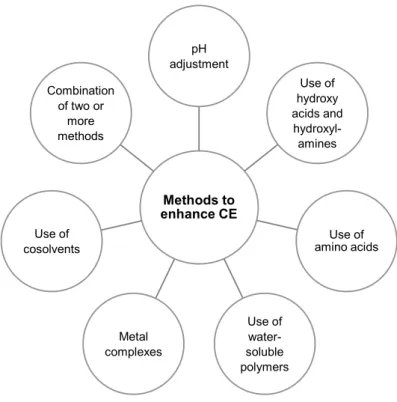
Publications ... xi Acknowledgements ... xv Abstract ... xix Resumo ... xxi Graphical abstract ... xxiii Table of Contents ... xxv List of Figures ... xxxi List of Tables ... xxxv1. INTRODUCTION ... 1 2. CYCLODEXTRINS ... 3 2.1. Cyclodextrins as drug carriers in Pharmaceutical Technology: The state of the art………3 2.1.1. Abstract ... 4 2.1.2. Introduction ... 5 2.1.3. Cyclodextrins ... 6 2.1.3.1. Historical perspective ... 6 2.1.3.2. Natural cyclodextrins ... 8 2.1.3.3. Cyclodextrin derivatives ... 10 2.1.3.4. Inclusion complex formation ... 12 2.1.3.5. Inclusion complexes in solution ... 15 2.1.3.6. Inclusion complexes in solid state ... 17 2.1.3.7. Methods to enhance the complexation efficiency ... 18 2.1.3.7.1. pH adjustment of the complexation medium ... 20 2.1.3.7.2. Formation of multicomponent complexes with hydroxy acids, hydroxylamines and amino acids ... 20 2.1.3.7.3. Formation of multicomponent complexes with water-soluble polymers ... 21 2.1.3.7.4. Cosolvents and metal complexes ... 22 2.1.3.7.5. Combination of two or more methods ... 23 2.1.3.8. Absorption, distribution, metabolism and excretion, and toxicity ... 23 2.1.3.9. Pharmaceutical applications ... 24 2.1.3.9.1. Solid dosage forms ... 26 2.1.3.9.2. Parenteral preparations ... 30 2.1.3.9.3. Emulsions and beads ... 31
xxvi 2.1.3.9.4. Microparticles and nanoparticles ... 32 2.1.3.9.5. Cyclodextrin-based nanogels ... 32 2.1.3.9.6. Cyclodextrin-based nanosponges ... 33 2.1.3.9.7. Liposomes ... 33 2.1.3.9.8. Peptide and protein delivery ... 34 2.1.3.9.9. Site-specific drug delivery (colon and brain) ... 34 2.1.3.9.10. Gene delivery ... 35 2.1.3.9.11. CDs and drug permeation through biological membranes... 37 2.1.4. Regulatory aspects ... 37 2.1.5. Conclusion ... 41 2.1.6. List of abbreviations ... 42 2.1.7. Acknowledgements ... 43 2.1.8. References ... 43 2.2. Cyclodextrins as excipients in tablet formulations ... 81 2.2.1. Highlights ... 82 2.2.2. Abstract ... 83 2.2.3. Introduction ... 84 2.2.4. Functional applications of CDs in tablet formulations ... 86 2.2.5. Functional requirements of CD in tablet formulations ... 96 2.2.5.1. Drug quantity (therapeutic dose) per tablet ... 96 2.2.5.2. Flow properties of the prepared complexes ... 97 2.2.5.3. Regulatory status of CDs ... 98 2.2.6. Conclusion ... 101 2.2.7. List of abbreviations ... 101 2.2.8. Acknowledgements ... 102 2.2.9. References ... 102 3. EXPERIMENTAL SECTION ... 109 3.1. Hydroxypropyl-β-cyclodextrin and β-cyclodextrin as tablet fillers for direct compression ... 109 3.1.1. Abstract ... 110 3.1.2. Introduction ... 111 3.1.3. Materials and Methods ... 112 3.1.3.1. Materials ... 112 3.1.3.2. Methods... 112 3.1.3.2.1. Moisture determination ... 112 3.1.3.2.2. Particle size determination by optical microscopy ... 113
xxvii 3.1.3.2.3. Scanning electron microscopy analysis ... 113 3.1.3.2.4. Flow properties ... 113 3.1.3.2.5. Preparation of tablets ... 114 3.1.3.2.6. Compaction physics ... 115 3.1.3.2.7. Physical characterization of the tablets ... 115 3.1.3.2.8. Drug content in tablets... 116 3.1.3.2.9. Disintegration test ... 116 3.1.3.2.10. Dissolution testing ... 116 3.1.4. Results ... 118 3.1.4.1. Technological characteristics of the materials ... 118 3.1.4.2. Compaction and properties of the tablets ... 120 3.1.4.3. Drug release characteristics ... 124 3.1.5. Discussion ... 125 3.1.6. Conclusion ... 128 3.1.7. List of abbreviations ... 128 3.1.8. Acknowledgements ... 129 3.1.9. References ... 129 3.2. Hydroxypropyl-β-cyclodextrin-based fast dissolving carbamazepine printlets prepared by semisolid extrusion 3D printing ... 133 3.2.1. Highlights ... 134 3.2.2. Abstract ... 135 3.2.3. Graphical abstract ... 136 3.2.4. Introduction ... 137 3.2.5. Materials and Methods ... 138 3.2.5.1. Materials ... 138 3.2.5.2. Methods ... 139 3.2.5.2.1. Preparation of wet masses ... 139 3.2.5.2.2. Preparation of the 3D printed tablets ... 139 3.2.5.2.3. Rheological characterization of wet masses ... 140 3.2.5.2.4. Characterization of the 3D printed tablets ... 140 3.2.5.2.4.1. Physical properties ... 140 3.2.5.2.4.2. Scanning electron microscopy ... 141 3.2.5.2.4.3. Drug content ... 141 3.2.5.2.4.4. Differential scanning calorimetry ... 141 3.2.5.2.4.5. X-ray diffraction ... 141 3.2.5.2.4.6. Disintegration test ... 142
xxviii 3.2.5.2.4.7. CBZ release test ... 142 3.2.6. Results and Discussion ... 142 3.2.6.1. Printlets preparation ... 142 3.2.6.2. Rheological properties of wet masses ... 145 3.2.6.3. Drug state after printing ... 147 3.2.6.4. Printlets properties ... 149 3.2.7. Conclusion ... 152 3.2.8. List of abbreviations ... 153 3.2.9. Acknowledgements ... 153 3.2.10. References ... 154 3.3. Orodispersible carbamazepine/hydroxypropyl-β-cyclodextrin tablets obtained by direct compression with five-in-one co-processed excipients ... 159 3.3.1. Abstract ... 160 3.3.2. Introduction ... 161 3.3.3. Materials and Methods ... 163 3.3.3.1. Materials ... 163 3.3.3.2. Methods ... 163 3.3.3.2.1. Phase solubility studies ... 163 3.3.3.2.2. Preparation of inclusion complex and physical mixture ... 164 3.3.3.2.3. Characterization of CBZ/HPβCD complex ... 164 3.3.3.2.3.1. Differential scanning calorimetry ... 164 3.3.3.2.3.2. X-ray diffraction ... 164 3.3.3.2.3.3. Scanning electron microscopy ... 165 3.3.3.2.3.4. Assay of drug content ... 165 3.3.3.2.3.5. Dissolution studies ... 165 3.3.3.2.4. Evaluation of the flow properties ... 166 3.3.3.2.5. Preparation of the ODTs ... 166 3.3.3.2.6. ODTs characterization ... 167 3.3.3.2.6.1. Physical properties ... 167 3.3.3.2.6.2. Drug content ... 167 3.3.3.2.6.3. Wetting time and water-absorption ratio ... 167 3.3.3.2.6.4. Disintegration tests ... 168 3.3.3.2.6.5. Dissolution testing ... 168 3.3.4. Results and Discussion ... 168 3.3.4.1. Inclusion complexes ... 168 3.3.4.2. Flow properties ... 172
xxix 3.3.4.3. ODTs properties ... 173 3.3.5. Conclusion ... 176 3.3.6. List of abbreviations ... 176 3.3.7. Acknowledgements ... 177 3.3.8. References ... 177 3.4. Carbamazepine bilayer tablets combining hydrophilic and hydrophobic cyclodextrins as a quick/slow biphasic release system ... 183 3.4.1. Highlights ... 184 3.4.2. Abstract ... 185 3.4.3. Graphical abstract ... 186 3.4.4. Introduction ... 187 3.4.5. Materials and Methods ... 189 3.4.5.1. Materials ... 189 3.4.5.2. Methods ... 189 3.4.5.2.1. Preparation of CBZ/HPβCD inclusion complex ... 189 3.4.5.2.2. Evaluation of the flow properties and moisture content of the TAβCD... 189 3.4.5.2.3. Preparation of the bilayer tablets ... 190 3.4.5.2.4. Characterization of the bilayer tablets ... 191 3.4.5.2.4.1. Physical properties ... 191 3.4.5.2.4.2. Scanning electron microscopy ... 191 3.4.5.2.4.3. Drug content ... 191 3.4.5.2.4.4. Differential scanning calorimetry ... 191 3.4.5.2.4.5. X-ray diffraction ... 192 3.4.5.2.4.6. Dissolution testing and data modelling ... 192 3.4.6. Results and Discussion ... 193 3.4.7. Conclusion ... 201 3.4.8. List of abbreviations ... 201 3.4.9. Acknowledgements ... 202 3.4.10. References ... 202 4. CONCLUSION ... 207 4.1. List of abbreviations ... 210 4.2. References ... 210 Appendices ... 213
xxxi
List of Figures
Section 2.1
Fig. 1. Biopharmaceutics Classification System. Adapted from (4). ... 5 Fig. 2. CDs structural characteristics. Adapted from (31). ... 8 Fig. 3. Chemical structures of the CDs monomer (A) and βCD (B). Adapted from (50). .... 8 Fig. 4. The interaction of drug (D) with a cyclodextrin (CD) to form an inclusion complex (D-CD) of 1:1 stoichiometry with a binding constant of KC. Adapted from (145). ... 13
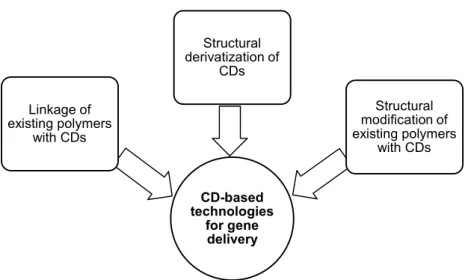
Fig. 5. Phase-solubility diagrams. Adapted from (158). ... 16 Fig. 6. Methods to enhance CE. Adapted from (45, 47, 175, 179, 181). ... 19 Fig. 7. Advantages and drawbacks of the use of CDs. Adapted from (14, 48, 75, 90, 106, 144). ... 25 Fig. 8. Major approaches of employing CDs for applications in gene delivery. Adapted from (85). ... 36
Section 2.2
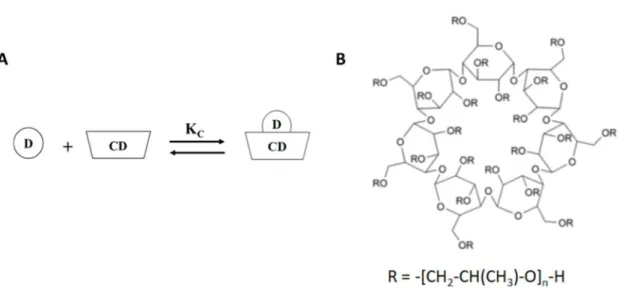
Fig. 1. A) The interaction of drug (D) with a cyclodextrin (CD) to form an inclusion complex (D-CD) of 1:1 stoichiometry with a stability/equilibrium constant of KC; and B) Chemical
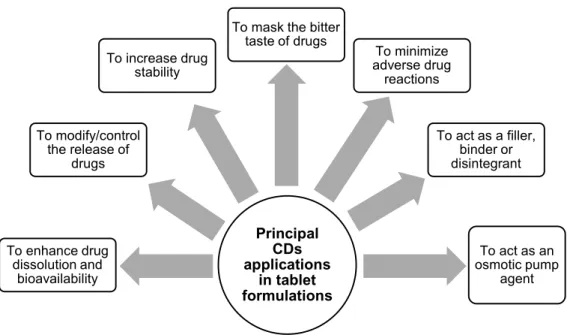
structure of the hydroxypropyl-β-cyclodextrin. Adapted from (1). ... 84 Fig. 2. Principal CD applications in tablet formulations. ... 87
Section 3.1
Fig. 1. SEM images: a) CBZ; b) HPβCD; c) βCD; d) Tablettose® 100; e) Pearlitol® 300 DC;
f) Emcompress® Premium; g) Vivapur® 102; h) Avicel® HFE-102; and i) Cellactose® 80.
... 120 Fig. 2. Physical aspect of the tablets: a) Formula I; b) Formula II; c) Formula III; d) Formula IV; e) Formula V; and f) Formula VIII. ... 121 Fig. 3. Compaction profiles obtained from one tablet of formula I: a) Force (kN)/time (s); and b) Progressive work (J)/displacement of the upper punch (mm). ... 123 Fig. 4. Drug dissolution profiles from the uncoated tablets in distilled water containing sodium lauryl sulphate (1%, w/v) at 37 ºC. ... 124
xxxii
Section 3.2
Fig. 1. The 3D printing setup with an extrusion syringe loaded with the wet mass containing carbamazepine (CBZ; chemical structure in the figure).. ... 140 Fig. 2. SEM images of A) top, B) bottom and C) cross-section of the formulation I; and D) top, E) bottom and F) cross-section of the formulation II. ... 144 Fig. 3. Rheological properties of wet masses used to obtain formulations I and II. ... 145 Fig. 4. DSC curves of CBZ (A); HPβCD (B); HPMC F4M (C); Ac-Di-Sol® SD-711 (D);
formulation I mixture kneaded without wetting (E); formulation I printlets (F); formulation II mixture kneaded without wetting (G); and formulation II printlets (H). ... 148 Fig. 5. X-ray diffractograms: CBZ (A); HPβCD (B); HPMC F4M (C); Ac-Di-Sol® SD-711 (D);
formulation I mixture kneaded without wetting (E); formulation I printlets (F); formulation II mixture kneaded without wetting (G); and formulation II printlets (H). ... 149 Fig. 6. Disintegration of the formulation I in a Petri dish containing distilled water: A) after 5 s; B) after 120 s; C) after 360 s; and D) after 540 s. ... 151 Fig. 7. Drug dissolution profiles from the printlets and pure CBZ powder in distilled water containing sodium lauryl sulphate (1%, w/v) at 37 ºC. ... 152
Section 3.3
Fig. 1. Phase solubility diagram of CBZ/HPβCD in aqueous solutions at 25 °C… ... 169 Fig. 2. DSC curves of CBZ (A); HPβCD (B); CBZ/HPβCD physical mixture (C); and CBZ/HPβCD complex (D). ... 170 Fig. 3. XRD patterns of CBZ (A); HPβCD (B); CBZ/HPβCD physical mixture (C); and CBZ/HPβCD complex (D). ... 171 Fig. 4. A) SEM images of CBZ (A); HPβCD (B); CBZ/HPβCD physical mixture (C); and CBZ/HPβCD complex (D); and B) Drug dissolution profiles from the inclusion complex, physical mixture and pure CBZ powder (25 mg) in distilled water containing sodium lauryl sulphate (1%, w/v) at 37 ºC. ... 172 Fig. 5. A) Physical appearance (A; units in cm) of the ODTs from formula IV and pictures showing one tablet in a Petri dish before (B) and after (C) the water reaches its upper surface; and B) CBZ dissolution profiles from the ODTs in distilled water containing sodium lauryl sulphate (1%, w/v) at 37 ºC. ... 175
xxxiii
Section 3.4
Fig. 1. SEM image of a bilayer tablet obtained from formula VI (side view)….. ... 195 Fig. 2. DSC curves of CBZ (A); HPβCD (B); TAβCD (C); VIVASOL® (D); Pruv® (E); rapid
release layer (physical mixture before compaction) (F); rapid release layer (after compaction) (G); sustained release layer of the formula V (physical mixture before compaction) (H); and sustained release layer of the formula V (after compaction) (I)…. 196 Fig. 3. XRD patterns of CBZ (A); HPβCD (B); TAβCD (C); VIVASOL® (D); Pruv® (E); rapid
release layer (physical mixture before compaction) (F); rapid release layer (after compaction) (G); sustained release layer of the formula V (physical mixture before compaction) (H); and sustained release layer of the formula V (after compaction) (I). ... 198 Fig. 4. CBZ dissolution profiles from the rapid release layer and sustained release layers as independent tablets in distilled water containing sodium lauryl sulphate (1%, w/v) at 37 ºC. ... 198 Fig. 5. CBZ dissolution profiles from the bilayer tablets in distilled water containing sodium lauryl sulphate (1%, w/v) at 37 ºC. ... 199
xxxv
List of Tables
Section 2.1
Table I. Historical perspective of CDs and achievements. ... 7 Table II. Properties of natural CDs. ... 9 Table III. Characteristics of CDs derivatives. Adapted from (68, 110, 111, 113). ... 11 Table IV. Examples of studies with solid dosage forms containing CDs. ... 29 Table V. Commercial products containing CDs. Adapted from (50, 76, 106, 112, 151, 339, 492). ... 39
Section 2.2
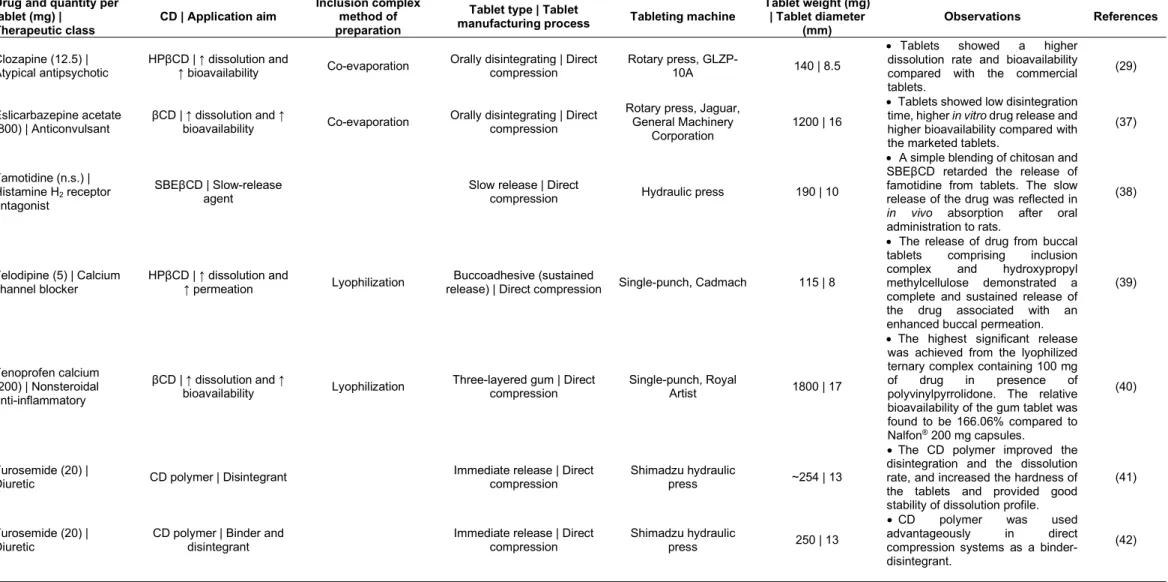
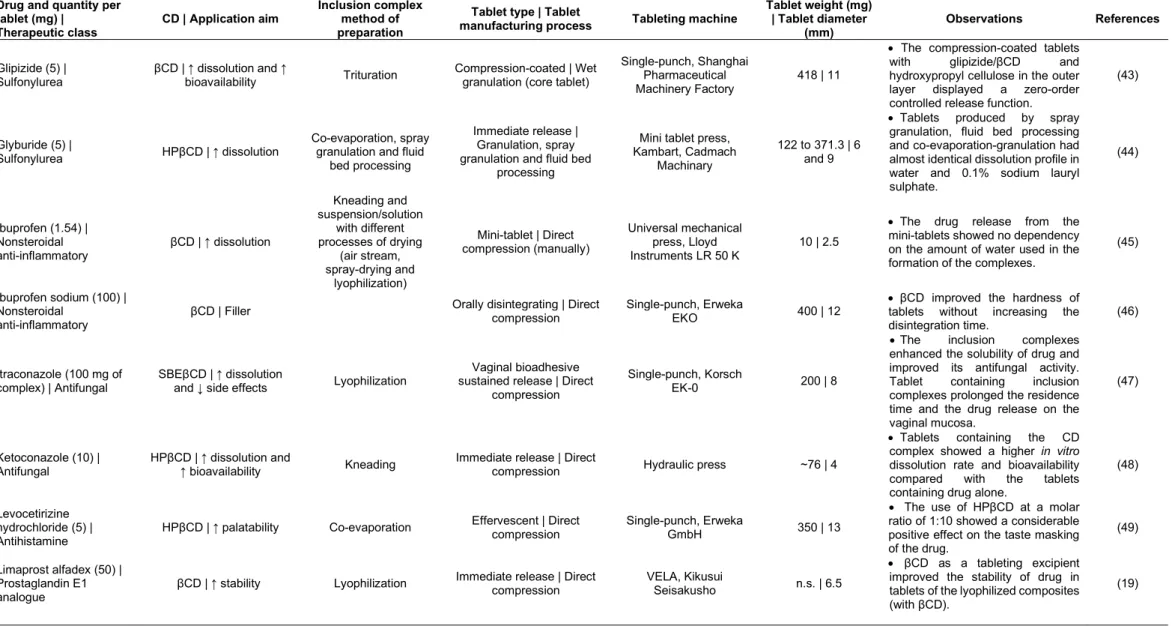
Table I. Examples of studies about tablets containing CDs as excipients……. ... 91 Table II. Examples of commercial tablets containing CDs. ... 100
Section 3.1
Table I. CBZ tablets composition. ... 114 Table II. Apparent densities, flow properties, Martin's diameter, and moisture content .. 119 Table III. Compaction forces and energies, R, PI, time periods of the force/time compression cycle, physical properties, drug content, and disintegration time of the tablets. ... .122
Section 3.2
Table I. Composition of the printlets. ... 139 Table II. Weight, diameter, thickness, breaking force, friability, drug content, and disintegration time of the printlets. ... 150
xxxvi
Section 3.3
Table I. ODTs composition. ... 166 Table II. Flow properties of CBZ/HPβCD inclusion complex, physical mixture, co-processed excipients, and ODTs formulas... 173 Table III. Physical properties, drug content, wetting time, WAR, and disintegration time of the ODTs. ... 173
Section 3.4
Table I. The qualitative and quantitative composition of the CBZ bilayer tablets. ... 190 Table II. Physical properties and drug content of the bilayer tablets. ... 195 Table III. Similarity factor (f2) values calculated for all formulas. ... 200
Table IV. Fitting of the kinetic models for sustained release layers as independent monolayer tablets. ... 200 Table V. Fitting of the kinetic model for all formulas of the bilayer tablets. ... 201
1
1. INTRODUCTION
This Doctoral Thesis in Pharmaceutical Sciences - Pharmaceutical Technology Speciality, entitled “Cyclodextrins as excipients in solid oral dosage forms”, is divided into four main chapters, namely:
i) Introduction, where the outline and main goals of the Thesis are presented; ii) Cyclodextrins, which contains two published review manuscripts concerning the theoretical background of the Thesis theme;
iii) Experimental Section, where four research manuscripts published are described; iv) and Conclusion, which integrates all the obtained results as well as their relevance in the pharmaceutical field.
This Thesis aimed to study and explore the applications of cyclodextrins as excipients in solid oral dosage forms. Tablets were studied as a model of a solid oral dosage form, since they are the most used dosage form in therapy mainly due to their good stability and accurate dosing. Therefore, the following six specific objectives were established:
i) to perform a state of the art review concerning the cyclodextrins as drug carriers in Pharmaceutical Technology highlighting their history, properties and pharmaceutical applications with typical examples;
ii) to carry out a critical review of cyclodextrins as excipients in tablet formulations emphasising their principal pharmaceutical applications, the most relevant technological aspects in pharmaceutical formulation development and their actual regulatory status;
iii) to study the ability of cyclodextrins to act as tablet fillers (non-complexing excipients) for direct compression, evaluating their flow properties, compaction behaviour and the influence on drug release characteristics from uncoated tablets;
iv) to explore for the first time the use of cyclodextrins to prepare three-dimensional (3D) printed tablets (printlets) of poorly soluble drugs via semisolid extrusion;
v) to develop orodispersible tablets of poorly soluble drugs via direct compression by combining cyclodextrins that form inclusion complexes to improve wetting and release properties, and directly-compressible five-in-one co-processed excipients able to promote rapid disintegration and solve the poor flowability typical of inclusion complexes;
vi) and to investigate the combination of hydrophilic and hydrophobic cyclodextrins to prepare bilayer tablets that can perform as quick/slow biphasic release systems of a poorly soluble drug.
In order to achieve these goals, three cyclodextrins were tested, specifically β-cyclodextrin, hydroxypropyl-β-cyclodextrin and triacetyl-β-cyclodextrin. In addition, carbamazepine (C15H12N2O), an antiepileptic and anticonvulsant agent, was used as a
3
2. CYCLODEXTRINS
2.1. Cyclodextrins as drug carriers in Pharmaceutical Technology: The state
of the art
4
2.1.1. Abstract
Background: Cyclodextrins (CDs) are versatile excipients with an essential role in drug delivery, as they can form non-covalently bonded inclusion complexes (host-guest complexes) with several drugs either in solution or in the solid state.
Methods: The main purpose of this publication was to carry out a state of the art of CDs as complexing agents in drug carrier systems. In this way, the history, properties, and pharmaceutical applications of the CDs were highlighted with typical examples. The methods to enhance the complexation efficiency (CE) and the CDs applications in solid dosage forms were emphasized in more detail.
Results: The main advantages of using these cyclic oligosaccharides are as follows: i) to enhance solubility/dissolution/ bioavailability of poorly soluble drugs; ii) to enhance drug stability; iii) to modify the drug release site and/or time profile; and iv) to reduce drug side effects (for example, gastric or ocular irritation). These compounds present favourable toxicological profile for human use and therefore there are various medicinal products containing CDs approved by regulatory authorities worldwide. On the other hand, the major drawback of CDs is the increase in formulation bulk, once the CE is, in general, very low. This aspect is particularly relevant in solid dosage forms and limits the use of CDs to potent drugs.
Conclusion: CDs have great potential as drug carriers in Pharmaceutical Technology and can be used by the formulator in order to improve the drug properties such as solubility, bioavailability and physico-chemical stability. Additionally, recent studies have shown that these compounds can be applied as active pharmaceutical ingredients.
Keywords: cyclodextrins; complexation; drug carriers; solid dosage forms; dissolution; bioavailability.
5
2.1.2. Introduction
With the view to select the best drug candidates for development, physicochemical criteria such as solubility, chemical and physical stability, hygroscopicity, and thermal characteristics need to be studied as soon as possible and balanced against other important parameters such as Pharmacology or Pharmacokinetics (1-3).
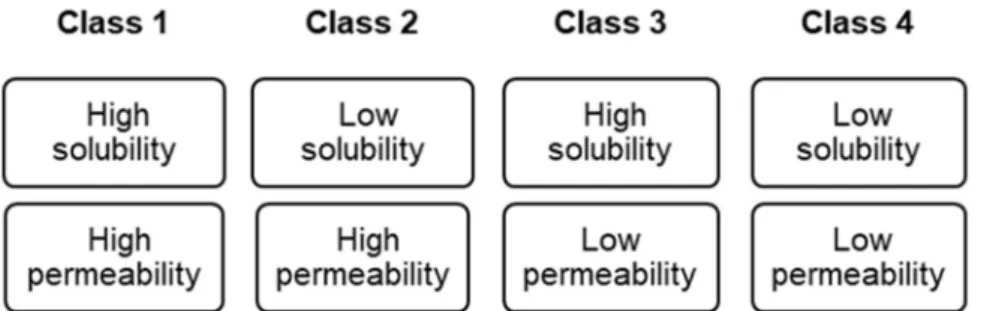
The Biopharmaceutics Classification System (BCS), proposed by Amidon and his collaborators (4), is an important tool in the pharmaceutical field that classifies drugs in four classes according to their water solubility and intestinal permeability (Fig. 1) (4, 5). The poor oral bioavailability arising from poor water solubility (class 2 and 4 drugs of the BCS) should make drug development harder (6). According to the literature, up to 75% of new candidates in drug development have low solubility (7, 8), and around 40% of the marketed drugs are poorly soluble (9, 10).
The need for solubility enhancement through formulation is a well-known but still problematic issue (11-13), because drugs with low aqueous solubility are prone to low and variable oral bioavailability and, hence, to variability in therapeutic effect (13). The drugs that have water solubility less than 10 mg/mL (over the pH range of 1 - 7 at 37 ºC) show the potential bioavailability problems (14). Currently, there are several approaches that are utilized to improve the solubility of poorly water-soluble drugs, such as: i) pH modification and salt forms (15, 16); ii) co-solvency and surfactant solubilisation (17, 18); iii) amorphous forms, solid dispersions, and cocrystals (19, 20); iv) polymeric micelles (21, 22); v) size reduction and nanonization (10, 14); vi) solid lipid nanoparticles (23, 24); vii) liposomes and proliposomes (25, 26); viii) microemulsions and self-emulsifying drug delivery systems (27, 28); and ix) cyclodextrin (CD) complexation (29, 30).
6 CDs are cyclic oligosaccharides largely used as "molecular capsules" in the pharmaceutical (31, 32), cosmetic (33, 34), chemical (35, 36), food (37-39), textile (40, 41), agricultural (42), and environmental (43, 44) industries/fields. In the pharmaceutical area, these compounds are mainly used as excipients in order to solubilize several poorly soluble drugs through the formation of water-soluble drug-CD complexes (45). In addition, CDs complexation generally improves physico-chemical stability, reduces the side effects (for instance, gastric or ocular irritation) or reduces or eliminates unpleasant taste and odour, prevents drug-drug interactions, and converts liquid drugs into powders (29, 46-49). These excipients have great potential and are used in drug delivery systems for oral, parenteral, dermal, ocular, buccal and sublingual, rectal, nasal, and pulmonary drug delivery (46).
The main purpose of this publication was to carry out a state of the art of CDs as complexing agents in drug carrier systems. In this way, the history, properties, and pharmaceutical applications of the CDs were highlighted with typical examples. The methods to enhance the complexation efficiency (CE) and the CDs applications in solid dosage forms were emphasized in more detail.
2.1.3. Cyclodextrins
2.1.3.1. Historical perspective
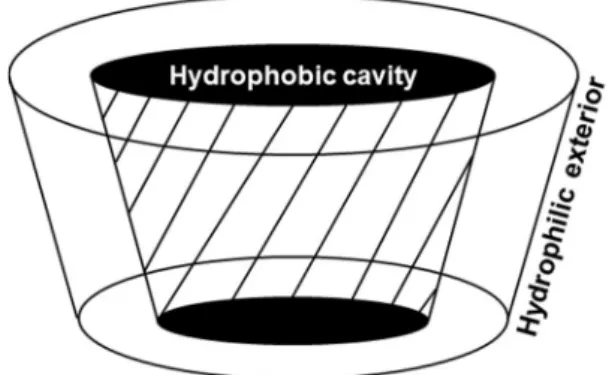
Although CDs are considered by scientists and regulators as a new group of excipients, they have been reported in literature more than one hundred years ago (50). CDs were first isolated by Antoine Villiers (1854-1932) in 1891 as a digest of Bacillus amylobacter on potato starch, and the main events of their history are shown in Table I. CDs are cyclic carbohydrates formed during the bacterial (Bacillus macerans) degradation of starch by CD glucosyltransferase enzyme (CGTase), and they present a hydrophilic outer surface and a hydrophobic central cavity that can trap or encapsulate other molecules (Fig. 2) (14, 51, 52).
According to Grégorio Crini (52), the CDs history can be divided into five quite distinct periods, namely: i) the first period, from 1891 to 1911, covers their discovery by Antoine Villiers and characterization by Franz Schardinger; ii) from 1911 to 1935 came a period of doubt and disagreement, in particular between the laboratories of Hans Pringsheim and of Paul Karrer; iii) the third period, from 1935 to 1950, was marked by the results obtained by Karl Freudenberg, and Dexter French; iv) the period of exploration between 1950 and 1970 focused on inclusion complexes with the work of Friedrich Cramer in the forefront; and v) the period of utilization has been in progress since 1970 and CDs found numerous industrial applications.
7
Table I. Historical perspective of CDs and achievements.
Year Occurrence References
1891 Villiers published his discovery of cellulosine (cyclodextrin) (53)
1903 Schardinger isolated and purified α- and β-CDs (54)
1911 Schardinger did lay the foundation of CD chemistry (55)
1924 Methylation of CDs first described (32)
1935 Freudenberg and Jacobi discovered γCD (56)
1935-1955 Research on structure and function of CDs complexes by Freudenberg,
Cramer, French, Rundle, Saenger, Bender, and Breslow (57-60) 1953 The first CD patent was issued in Germany to Freudenberg, Cramer,
and Plieninger (61)
1954 Cramer’s book on inclusion complexes was published (62) 1957-1965
French described the existence of large natural CDs with up to 12 glucose units. First fundamental review on CDs containing first
misinformation on toxicity of CD was published
(63, 64)
1960-1970 First analytical methods of CDs were developed (65)
1965 Higuchi and Connors published their article about phase-solubility
profiles (66, 67)
1969 Launch DDS Research Institute of ALZA Co. in Kansas University (68)
1975 First publication on CD polymers by M. Furue (29, 69)
1976 Manufacturing of natural CDs using alkaline CGTase in Japan (68) 1976 Approval in Japan of the first pharmaceutical product with PGE2/βCD
(Prostarmon ETM sublingual tablets) (31, 32, 70)
1978 Approval of natural CDs as food additives in Japan (68) 1981 First International CD Symposium organized in Budapest (Hungary) (71)
1981 First CD book is published (29)
1983-1985 Brauns and Müller (Europe) and Pitha (USA) filed for patents on
hydroxypropyl-β-CD (32)
1983 First suggestion of self-association of parent CDs by K. Miyajima (29, 72) 1985 The first patent registering the pharmacological benefits of the
complexation of analgesics compounds in CDs (73)
1987 Approval of benexate HCl/βCD capsules in Japan (68)
1988 Approval of piroxicam/βCD tablets (Brexin®) in Europe (70)
1990 Stella and Rajewski filed for a patent on sulfobutyl ether-βCD (32) 1990 Approval of hydroxypropyl-βCD containing cosmetics in Japan (68) 1994 αCD and βCD listed in Japanese Pharmaceutical Excipients (68) 1997 Approval of itraconazole/hydroxypropyl-βCD oral solution (Sporanox
®)
in United States (74)
1997 Founding of CD Society in Japan (68)
1997 First monograph on βCD appeared in the European Pharmacopoeia (75) 2001 Approval of sulfobutyl ether-βCD containing injections in United States (68)
2005 Publication of “Nanomaterial Cyclodextrin” (68)
2006 First CD Workshop in Japan (68)
2008 Approval of sugammadex (Bridion®) in Europe (76)
2010 Approval of sugammadex (Bridion®) in Japan (76)
2011 Launch DDS Research Institute of Sojo University (Kumamoto) (68) 2015 Approval of sugammadex (Bridion®) in United States (76)
8
Fig. 2. CDs structural characteristics. Adapted from (31).
2.1.3.2. Natural cyclodextrins
The four main chemical groups of carbohydrates are monosaccharides, disaccharides, oligosaccharides, and polysaccharides (77).CDs are enzymatically modified starches with a wide range of applications and they are cyclic oligosaccharides, containing a minimum of six D-(+)-glucopyranose units attached by α-1,4-linkages (78,79). They are produced by the action of the CGTase on a medium containing starch (78, 79). CGTase is a unique enzyme able of converting starch or starch derivates into CDs via the cyclization reaction (80, 81).
Three native/natural/parent CDs available on the market are alpha-cyclodextrin (αCD), beta-cyclodextrin (βCD), and gamma-cyclodextrin (γCD), consisting of 6, 7 and 8 glucose units respectively (Fig. 3, Table II) (82). These compounds are crystalline, homogeneous, and non-hygroscopic substances (71).
9
Table II. Properties of natural CDs.
αCD βCD γCD References
Number of glucose units 6 7 8 (71)
Chemical names Cyclohexaamylose Cyclomaltohexaose Cycloheptaamylose Cyclomaltoheptose Cyclooctaamylose Cyclomaltooctaose (82) Other names Alfadex α-Schardinger dextrin Betadex β-Schardinger dextrin Gammadex γ-Schardinger dextrin (65)
CAS Registry Number 10016-20-3 7585-39-9 17465-86-0 (83)
Molecular weight (g/mol) 972 1135 1297 (14)
Chemical formula C36H60O30 C42H70O35 C48H80O40 (84)
Physical appearance White powder White powder White powder (85)
Odour Odourless Odourless Odourless (85)
Water solubility (g/100 mL
at 25 ºC) 14.5 1.85 23.2 (86)
Water molecules in cavity 6 11 17 (87)
Crystal forms (from water) Hexagonal plates Monoclinic
parallelograms Quadratic prisms (71)
Moisture content (%, w/w) 10.2 13-15 8-18 (88)
Specific rotation [α]D 25 °C 150±0.5 162.5±0.5 177.4±0.5 (71)
Inner cavity diameter (Å) 4.7-5.3 6.0-6.5 7.5-8.3 (89)
Outer diameter cavity (Å) 14.6 15.4 17.5 (89)
Cavity height (Å) 7.9 7.9 7.9 (50)
Cavity volume (Å3) 174 262 427 (80)
pKa at 25 ºC 12.332 12.202 12.081 (90)
Log Poctanol/water at 25 °C -13 -14 -17 (91)
Gibbs free energy of
dissolution (kJ/mol) 15 20 14 (92)
Diffusion constant at 40 °C 3.443 3.224 3.000 (90)
Surface tension (mN/m) 71 71 71 (88)
Hydrogen donors 18 21 24 (91)
Hydrogen acceptors 30 35 40 (91)
Melting temperature range
(ºC) 255-260 255-265 240-245 (93)
Oral bioavailability in rats 1% 0.6% 0.02% (94-96)
Hydrolysis by α-amylase Negligible Slow Fast (97, 98)
Current usage Oral and parenteral formulations
Oral, buccal, rectal, dermal, and ocular
formulations
Dermal and oral
10 CDs are toroidal compounds with a truncated cone shape possessing secondary hydroxyl groups on the C-2 and C-3 atoms located on one side of the torus (wider side), while the primary hydroxyl groups on C-6 are located on the opposite, narrower side of the torus (99). The CH groups carrying the protons H-1, H-2, and H-4 are located on the outside of the molecule, thus the outer surface of CDs are hydrophilic (99). The interior of the torus presents a much lower polarity than water, then it can be seen as a hydrophobic cavity, which is lined by two rings of CH groups (H-3 and H-5) and by a ring of glucosidic “ether oxygens” (O-4), with H-6 situated near the cavity (100, 101). These properties allow several kinds of drugs (“guests”) to be encased originating non-covalently bonded inclusion complexes (102, 103).
Practical use of natural CDs as drug carriers is limited by their low aqueous solubility, especially that of βCD (104). For example, βCD is about seven-fold less soluble than αCD and fourteen-fold less than γCD (105). This is partially attributed to the formation of internal hydrogen bonds between secondary hydroxyl groups, thereby diminishing the capacity of βCD molecules to create hydrogen bonds with contiguous water molecules (32). γCD has the highest water solubility, largest hydrophobic cavity, and the most favourable toxicological profile (83). However, it is described that this CD in parenteral formulations sometimes forms visible aggregates in aqueous solutions (106).
According to the dimensions, αCD complexes low molecular weight compounds or molecules with aliphatic side chains, βCD complexes aromatics and heterocycles, and γCD can include compounds with high molecular weight like macrocycles and steroids (107, 108).
2.1.3.3. Cyclodextrin derivatives
In general, CD derivatives are divided into three groups, namely hydrophilic, hydrophobic, and ionisable (Table III) (68, 104, 109-111). These compounds have been developed with various types of substituents in distinct positions and with several average degrees of substitution to extend physicochemical properties and inclusion ability of natural CDs (48, 65, 112).
11
Table III. Characteristics of CDs derivatives. Adapted from (68, 110, 111, 113).
Derivative Abbreviation Water solubility Possible use References Hydrophilic derivatives
Methylated βCD Soluble in cold water
Oral, dermal, mucosal (114, 115) Randomly-methylated-βCD MEβCD
2,6-di-O-methyl-βCD DMβCD per-O-methyl-βCD TMβCD
Acetylated DM-βCD DMAβCD Soluble Parenteral Hydroxy alkylated βCD Soluble Oral, dermal,
parenteral, mucosal (88, 104, 115-120) 2-hydroxyethyl-βCD 2-HEβCD 2-hydroxypropyl-βCD HPβCD (87, 119, 121, 122) 3-hydroxypropyl-βCD 3-HPβCD 2,3-dihydroxypropyl-βCD 2,3-DHPβCD
Branched βCD Soluble Oral, mucosal, parenteral (115, 123, 124) Glycosyl-βCD G1βCD Maltosyl-βCD G2βCD Glucuronyl-glucosyl-βCD GUGβCD Hydrophobic derivatives
Alkylated βCD Insoluble Oral, parenteral, sustained release of water-soluble drugs
(125-127)
2,6-di-O-ethyl-βCD DEβCD per-O-ethyl-βCD TEβCD
Acylated βCD Insoluble Oral, dermal, sustained release of water-soluble drugs (128) per-O-acetyl-βCD TAβCD per-O-butanoyl-βCD TBβCD per-O-valeryl-βCD TVβCD per-O-octyl-βCD TOβCD Ionisable derivatives Anionic βCD
O-carboxymethyl-O-ethyl-βCD CMEβCD Soluble at pH > 4 Oral, dermal, mucosal, delayed release
(129, 130) β-CD · sulphate Soluble Oral, mucosal
Sulfobutyl ether-βCD SBEβCD Highly soluble Parenteral (131, 132) β-CD · phosphate
Al · βCD · sulphate Insoluble Sustained release
Octakis-S-(2-carboxyethyl)-octathio-γCD octasodium salt
Sugammadex
(Bridion®) Soluble Parenteral (76) Cationic βCD
Trimethyl-ammonium-βCD TMAβCD Sustained release (90) Drug-CD conjugate Delayed release (site-specific release) (90)
12 Whereas that CDs exhibit eighteen (αCD), twenty-one (βCD), or twenty-four (γCD) substitutable hydroxyl groups, the number of possible derivatives is infinite (133). The derivatizations purpose can be (133): i) to enhance the solubility of the CD derivative (and its complexes); ii) to enhance the fitting and/or the association between the CD and its guest, with simultaneous stabilization of the guest, decreasing its reactivity and mobility; iii) to attach specific (catalytic) groups to the binding site such as in enzyme modelling; or iv) to create insoluble, immobilized CD-containing structures, polymers such as for chromatographic purposes.
The hydrophilic or ionisable CDs are mainly used to increase the absorption of drugs, while hydrophobic CDs may act as sustained-release agents of water-soluble drugs, integrating peptides and proteins (128). Anionic CDs show improved characteristics for drug inclusion comparing with natural CDs, that is, they have greater solubility in water and greater cavity, they form stronger inclusion complexes with polar guests or guests bearing positive charge at a given pH, enabling the release of drugs controlled by pH (134).
It should be noted that CD-polymers have been investigated due to their enormous versatility, as their molecular weight, architecture (linear vs. branched), and pendant ligands can be promptly tuned (135, 136). CD-polymers maintain the CDs capability to form inclusion complexes, which can be even increased due to cooperative effects (137, 138). CD polymers can be prepared through different processes, such as (139): i) condensation of CDs with bi- or multifunctional cross-linkers like epichlorohydrin, biepoxides, diisocyanates or polyacids; ii) anchoring of CDs to polymer chains; and iii) polymerization of acrylic/vinyl derivatives of CDs with other monomers. However, the most common synthetic method is cross-linking the CD monomers with epichlorohydrin (137).
2.1.3.4. Inclusion complex formation
The formation of an inclusion complex (host-guest complex)may occur in solution and in the solid state, and after administration, it dissociates, releasing the drug into the organism in a quick and uniform mode (101). CDs can form complexes with several kinds of compounds like inorganic, organic, or organometallic that can be radical, cationic, anionic, or neutral molecules (140). Inclusion constitutes a true molecular encapsulation and no covalent bonds are created or broken during complex formation (141, 142). The driving forces that lead to the CD complexation are electrostatic interaction, van der Waals interaction, hydrophobic interaction, hydrogen bonding, and charge-transfer interaction (143).
13 Overall, there are four energetically favourable connections that help shift the equilibrium to form the inclusion complex, namely (107): i) the displacement of water molecules from the CD cavity; ii) the increased number of hydrogen bonds formed as the displaced water returns to the larger pool; iii) a decrease of the repulsive connections between the hydrophobic guest and the aqueous environment; and iv) a raise in the hydrophobic interactions as the guest inserts itself into the apolar CD cavity.
The formation of an inclusion complex depends on several factors, such as (107, 144): i) sizes of the CD and the drug or some major functional groups within the guest moiety; ii) thermodynamic connections between the different components of the system (CD, guest, and solvent); iii) structure of added substituent to the CD derivative; and iv) location of substituent within the CD molecule.
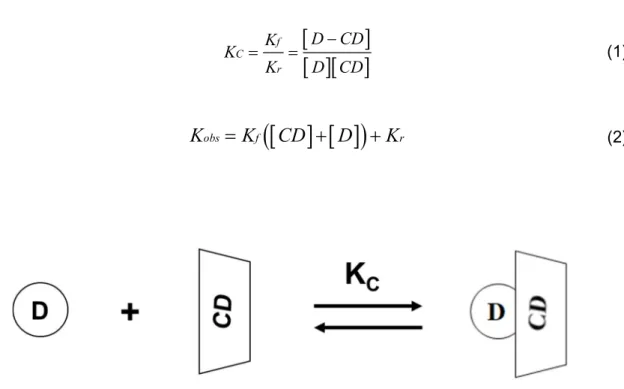
There are two essential parameters that can be determined for the inclusion process (145, 146): i) the complexation strength or stability/equilibrium constant (KC) defined by Fig.
4 and Eq. 1, where [CD] and [D] are the concentrations of free CD and free drug molecule, respectively; and ii) the lifetime (t) of the complex, also defined in Fig. 4, measured when the equilibrium is perturbed. The constants kf and kr are the forward and reverse rate
constants, respectively, and kobs (Eq. 2) is the observed rate constant for the
reestablishment of the equilibrium after it is perturbed. kf is a second order rate constant
while kr is a first order rate constant (145).
(1)
(2)
Fig. 4. The interaction of drug (D) with a cyclodextrin (CD) to form an inclusion complex (D-CD) of 1:1 stoichiometry with a binding constant of KC. Adapted from (145).