D. Kikoła · M. G. Echevarria · C. Hadjidakis ·
J.P. Lansberg · C. Lorc´e · L. Massacrier · C. Quintans · A. Signori · B. Trzeciak
Feasibility Studies for Single Transverse-Spin Asymmetry
Measurements at a Fixed-Target Experiment Using the
LHC Proton and Lead Beams (AFTER@LHC)
Abstract The measurement of Single Transverse-Spin Asymmetries, AN, for various quarkonium states and
Drell-Yan lepton pairs can shed light on the orbital angular momentum of quarks and gluons, a fundamental ingredient of the proton-spin puzzle. The AFTER@LHC proposal combines a unique kinematic coverage and large luminosities thanks to the Large Hadron Collider beams to deliver precise measurements, complemen-tary to the knowledge provided by collider experiments such as at RHIC. In this paper, we report on sensitivity studies for J/ψ, Υ and Drell-Yan ANdone using the performance of LHCb-like or ALICE-like detectors,
com-bined with polarised gaseous hydrogen and helium-3 targets. In particular, such analyses will provide us with new insights and knowledge about transverse-momentum-dependent parton distribution functions for quarks and gluons and on twist-3 collinear matrix elements in the proton and the neutron.
Contents
1 Introduction . . . 1
2 Theory . . . 3
3 Feasibility studies for quarkonium and DY AN . . . 5
4 Conclusions . . . 11
1 Introduction
1.1 Single Transverse-Spin Asymmetries: what for?
The spin is a fundamental quantity of a nucleon, yet its origins are largely unknown. It has been a topic of intense theoretical and experimental studies since the European Muon Collaboration reported that the spin of D. Kikoła
Faculty of Physics, Warsaw University of Technology, Warsaw, Poland M. G. Echevarria
FQA and ICCUB, Universitat de Barcelona, Mart´ı i Franqu`es 1, 08028 Barcelona, Spain C. Hadjidakis, J.P. Lansberg, L. Massacrier
IPNO, CNRS-IN2P3, Univ. Paris-Sud, Universit´e Paris-Saclay, 91406 Orsay Cedex, France C. Lorc´e
CPhT, Ecole Polytechnique, CNRS, Universit´e Paris-Saclay, Palaiseau, France C. Quintans
LIP, Lisbon, Portugal A. Signori
Theory Center, Thomas Jefferson National Accelerator Facility, 12000 Jefferson Avenue, Newport News, VA 23606, USA B. Trzeciak
Institute for Subatomic Physics, Utrecht University, Utrecht, The Netherlands
constituent quarks only accounts for a small fraction of the observed spin, 1/2 [1]. Nowadays, it is accepted that both quarks and gluons as well as their relative motion, via the orbital angular momentum (OAM), contribute to the nucleon spin. For instance, in the case of a longitudinally polarised nucleon, i.e. with helicity +1
2, the spin is given by a sum rule
1 2 =
1
2∆Σ + ∆G + Lq+ Lg, (1)
where 12∆Σ is the combined spin contribution of the quarks and the antiquarks, ∆G is the gluon spin, and Lq,g
are the quark and gluon OAM contributions. Recent experimental data have shown that the spin distributions of quarks and antiquarks only account for about 25% of proton total longitudinal spin [2], and that of the gluons for about 20% for x > 0.05 [3], yet compatible with zero. The remaining proton spin therefore should arise from the relative dynamics of quarks and gluons, i.e. via Lqand Lg. Understanding the parton transverse
dynamics should then shed light on the origin of the proton spin.
The transverse-spin distributions give access to the aforementioned intrinsic properties of the proton con-stituents: their transverse and orbital-angular momenta. Contrary to the quark sector, very little is known about the gluon contributions via ∆G and Lgto the transverse spin. Only recently, COMPASS observed a non-zero
asymmetry on the order of 20% (2σ away from zero) which hints at a non-zero value of Lg [4,5]. Indeed,
whereas Single Transverse-Spin Asymmetries (STSAs), AN, are not directly connected to Lq,g, a non-zero AN
imposes that Lq,gis non-zero.
Such studies require gluon-sensitive observables. Naturally, quarkonium production can serve as such tool, since the gluon fusion is the dominant contribution to these processes in high-energy hadron collisions (see [6–8] for RHIC energies). Thanks to many different experiments performed in the last decades (for reviews see [9–11]), measuring quarkonia via leptonic decays became a relatively straightforward task. The downside remains a lower production cross-section compared to light mesons, which calls for large integrated luminosities. Lastly, accessing transverse-spin physics research requires a polarised target.
At the moment, only the Relativistic Heavy Ion Collider (RHIC) at the Brookhaven National Laboratory provides polarised pp collisions at large enough energies for STSA measurements for quarkonia. Indeed, the PHENIX collabration [12] pioneered the studies of p↑p → J/ψX. The precision of the measurement is
how-ever very limited and did not allow to claim for a non-zero STSA, or to constrain Lg. The COMPASS detector
is probably the other existing experimental set-up where quarkonium STSA can be measured. Measurements of other quarkonium states are extremely important. First, J/ψ production involves a complicated pattern of feed downs and vector quarkonium production is not the easiest case to analyse theoretically. C-even quarko-nia (χc,b, ηc) which can be produced alone without recoiling gluons indeed offer some advantages. We refer
to [13–16] for more details.
1.2 AFTER@LHC: why ?
AFTER@LHC is a proposal [17] for a fixed-target experiment using the LHC proton and heavy-ion beams at high and continuous luminosities, yet parasitic to the other LHC experiments. It bears on a particularly wide range of physics opportunities [15,18–51] thanks to the typical boost of the fixed-target mode between the center-of-mass (c.m.s.) and the laboratory frame converting forward detectors into backward ones, to relatively high luminosities and not too low c.m.s. energies, 115 GeV per nucleon with the 7 TeV proton beam and 72 GeV per nucleon with the 2.76 TeV lead beam. In this energy range, the cross section for quarkonium production is already high and gluon fusion dominates. Larger charmonium, bottomonium, D, B and Drell-Yan pair yields are expected compared to previous fixed-target experiments.
AFTER@LHC will also give access to the target-fragmentation region xF → −1, with detectors similar
to the ALICE or LHCb ones, enabling the exploration of large momentum fractions in the target. Moreover, it is relatively easy to use a polarised gas target [52] in one of the existing LHC experiments keeping high integrated luminosities. Doing so, spin studies in the gluon sector via gluon-sensitive probes become more than possible with the investigation of spin correlations such as the Sivers effect [53–56] or the correlation between the gluon transverse momentum (denoted kT thereafter) and the nucleon spin.
All this allows for measurements of gluon sensitive probes with an unprecedented quality in a region, large x↑, where theory calculations [35] predict that the effect (the observed spin-correlated azimuthal modulation of the produced particles) is the largest. We stress that the same observation obviously holds for open heavy flavour and Drell-Yan pairs.
The structure of the paper is as follows. In the next section, we recall some theoretical concepts related to spin studies with AFTER@LHC. Next, we present feasibility studies for STSAs and prospects for other spin-related measurements. The last section gathers our conclusions.
2 Theory
In order to measure the parton OAM, one should consider observables which are sensitive to both the parton transverse position and momentum. These are usually related to the Generalised Parton Distributions, acces-sible via exclusive processes. However, one can also indirectly obtain information on the orbital motion of partons via STSAs in hard-scattering processes, where one of the colliding hadrons is transversely polarised (see e.g. [55,56] for recent reviews). These asymmetries are naturally connected to the transverse motion of partons inside hadrons [57].
The STSA, denoted by AN, is the amplitude of the spin-correlated azimuthal modulation of the produced
particles: AN = 1 P σ↑−σ↓ σ↑+ σ↓, (2)
where σ↑ (↓) is the differential cross section (or yield) of particles produced with the target spin polarised
upwards (downwards) with respect to the incoming beam direction, and P is the effective target polarisation. Studying ANis of particular interest because leading-twist collinear perturbative QCD predicted it to be small
(AN ∝ mq/pT ∼ O(10−4)), while the measured AN was observed to be ∼ 10% or even larger at high xFin
polarised collisions over a broad range of energies [58–60]. For example, at Fermilab STSAs on the order of 10% were measured in hadronic polarised hyperon production [61,62] and pion production [59,63–65].
Since then, the study of spin asymmetries has rapidly evolved, both from the theoretical and experimental point of view (for detailed insights into spin physics and azimuthal asymmetries, see e.g. [66–76]). This triggered investigations of the hadron structure beyond the collinear parton model, and different mechanisms were proposed to account for spin asymmetries [68,69].
The first interpretation of STSAs relied on a collinear factorisation framework [77,78], involving inter-actions of gluons from the target remnants with the active partons in the initial and final states. This is ac-counted for by collinear twist-3 (CT3) matrix elements, the so-called Efremov-Teryaev-Qiu-Sterman (ETQS) matrix elements. Later, Sivers proposed an explanation [53,79] based on a correlation between the trans-verse momentum of the quark and the polarisation of the proton, introducing the quark transtrans-verse momentum dependent parton distribution function (TMD PDF) f1T⊥(x, k2T) (the so-called Sivers function). The common feature of these two mechanisms is that an imaginary phase required for the non-vanishing asymmetry is gen-erated by taking into account an additional gluon exchange between the active parton and the remnant of the transversely polarised hadron.
The CT3 formalism is valid for processes with only one characteristic hard scale, for instance the trans-verse momentum of a produced hadron, satisfying phT ΛQCD, in a proton-proton collision. The TMD
for-malism [80–84], on the other hand, is suited for processes with two characteristic and well-separated scales (for example, in Drell-Yan process, the mass M and the transverse momentum pT of the produced lepton
pair, where ΛQCD . pT M)1 . When the two relevant scales become comparable, the TMD formalism
can be then reduced to the CT3 one. In practice, this is realised in terms of an operator product expansion, since the Sivers TMD function can be matched onto the ETQS matrix elements at large transverse momenta. Thus, depending on the process, AN should be addressed either using the CT3 formalism through 3-parton
correlation functions, or the TMD formalism through the Sivers function.
One of the most important predictions, shared by both approaches, is the predictable, but non-universal, magnitude of this asymmetry in different process. The experimental check of this feature is one of the mile-stones of the AFTER@LHC spin physics program.
1 See also e.g. [85,86] for what is known in the literature as the generalised parton model, which is an extension of the
collinear perturbative QCD approach to incorporate the transverse dynamics of partons, and resembles the TMD formalism from a more phenomenological perspective.
2.1 Quark Sivers effect
Drell-Yan (DY) lepton-pair production is a unique playground to understand the physics underlying the Sivers effect: it is theoretically very well understood and the quark Sivers function f⊥q
1T(x, k 2
T) enters the differential
cross sections for DY and semi-inclusive deep inelastic scattering (SIDIS) with opposite sign [87]:
f1T⊥q(x, k2T) DY= − f ⊥q 1T(x, k 2 T) SIDIS. (3) f⊥q 1T(x, k 2
T) accounts for the number density of unpolarised quarks carrying a longitudinal fraction x of the
proton momentum and with transverse momentum kT for a given transverse spin of the proton ST. The
ver-ification of this ”sign change” is the main physics case of the DY COMPASS run [88] and the experiments E1039 [89] and E1027 [90] at Fermilab. AFTER@LHC is a complementary facility to further investigate the quark Sivers effect by measuring DY STSAs [35,51] over a wide range of x↑ in a single set-up. With
the high precision that AFTER@LHC will be able to achieve, it will clearly consolidate previous possible measurements. In the case the asymmetry turns out to be small and these experiments cannot get to a clear answer, AFTER@LHC could still confirm or falsify this sign-change prediction and put strict constraints on the Sivers effect for quarks.
In addition, given that this asymmetry can be framed as well within the CT3 approach when the transverse momentum of the produced lepton pair is comparable to its mass, AFTER@LHC will also generate very useful data to constrain the ETQS 3-parton correlation functions. The latter can also be determined by using direct γ production [91].
2.2 Gluon Sivers effect
The gluon Sivers function is more involved than its quark analogue: different processes probe different gluon Sivers functions, due to the inherent process dependence of this TMD function [92, 93]. However all of them can be expressed in terms of only two independent functions [92,94], which will appear in different combinations depending on the process. AFTER@LHC will prove to be extraordinary useful in disentangling them and testing this generalised universality.
Drell-Yan lepton-pair production is the golden process to access the intrinsic transverse motion of quarks in a nucleon. However, there is no analogous process, which is at the same time experimentally clean and theoretically well-controlled, to probe the gluon content. One of the best tools at our disposal is the production of quarkonium states and open heavy-flavour mesons, a major strength of AFTER@LHC. They provide final states with a typical invariant mass (MQ) which is, on the one hand, small enough to be sensitive to the
intrinsic transverse momenta of gluons (kT), and on the other, large enough to realise the hierarchy of scales
(MQ kT), and thus to allow for the TMD formalism to be applied without pollution from higher-twist
effects. To this extent, production of C-even states can be fruitfully investigated [14,15,19,23,84,95]. The hadroproduction of ηc has already been measured by LHCb at high transverse momentum above
pT = 6 GeV [96], as well as non-prompt ηc(2S ) [97]. With an LHCb-like detector, STSAs for χc, χband ηc
are at reach, as demonstrated by studies of various χcstates [98,99] in the busier collider environment down
to pT as low as 2 GeV. At lower energies, the reduced combinatorial background will give access to lower pT.
Moreover, with AFTER@LHC, the production of J/ψ, ψ0and Υ will also allow for accurate measurements of the gluon Sivers effect, as it is shown in the next Section.
The open heavy-flavour production also allows to investigate the process dependence of AN (measuring
charm quarks and anti-quarks separately) [100]. Moreover, it is a unique probe of C-parity odd twist-3 tri-gluon correlators [101,102], for which AFTER@LHC will obtain valuable information.
Finally, momentum imbalance observables also provide a very useful handle to probe the gluon Sivers function and its kT dependnce. J/ψ+ γ production, is probably one of the cleanest from the theoretical point
3 Feasibility studies for quarkonium and DY AN
3.1 Simulation setup
We consider here two possible options for the realisation of AFTER@LHC with a polarised target: using the LHCb detector [104] or the ALICE detector [105]. LHCb is a multi-purpose, single arm detector with a precise microvertexing instrumentation, particle identification systems, electromagnetic and hadronic calorimeters. It has capabilities for an accurate primary and secondary vertex location determination, for a particle identifi-cation (including π, K, p, e and µ) with a good momentum resolution and a high rate data acquisition system. LHCb has already successfully run in the fixed-target mode using its luminosity monitor SMOG (System for Measuring the Overlap with Gas) [106] as a gas target. However, the data taking was done over limited periods of time and limited gas pressures. Additional feasibility studies are needed to address the possibility of installing a polarised gas target. The simulation setup we will use for a LHCb-like detector is described in detail in [34]. We therefore only outline here the most relevant information for Drell-Yan and J/ψ , Υ → µ+µ−
measurements, namely: the single muon tracking and the identification efficiency is ∼ 98% and the kinematic acceptance is 2 < η < 5 and a pTthreshold is set at pT > 0.7 GeV/c. However, for the studies presented in this
paper, we used a more stringent cut of pT > 1.2 GeV/c which usefully reduces the uncorrelated background.
For ALICE, a target can in principle be placed, either at the nominal interaction point (IPZ = 0), or
upstream from the nominal one (for instance at 5 m, IPZ = −5 m). The Muon Spectrometer would then
provide a setup for di-muon pair measurements with a single track acceptance of 2.5 < η < 4 for IPZ = 0, and
3.2 < η < 4.2 for IPZ = −5 m. The Muon Forward Tracker (MFT) [107], which will be installed in the near
future, will add tracking capabilities for muon measurements for IPZ= 0. A typical single track pT threshold
for di-muon pair analysis with the ALICE Muon Arm is pT > 1 GeV/c [108]. In addition, the muon arm is
equipped with an absorber, which reduces the uncorrelated background due to misidentified hadrons in such studies. Moreover, it is possible to install an additional vertexing instrumentation near the interaction point for IPZ = −5 m. Such a vertex detector would improve the precision of Drell-Yan measurements by removing
the background muons from light-hadron and charm/bottom-hadron decays. Indeed, for IPZ = −5 m, the
acceptance of the MFT does not match that of the spectrometer.
To quantify the STSA, we use the amplitude of the spin-correlated azimuthal modulation of the produced particles AN. We consider the following approach to the AN measurement with di-muon pairs. First, a
mi-crovertexing detector will allow to remove the correlated background from charm and bottom hadron decays. Thanks to the boost effect, their decay vertex is well separated from the primary collision point and c → µ and b →µ will be identified and then removed from the pairs used to construct the invariant mass distribution. For the statistical precision evaluation, we assume that the yields σ↑, σ↓are measured separately with a standard invariant mass approach used in high energy experiments for quarkonium studies. We construct an invariant mass spectrum of all di-muon pairs (often called foreground) which contains both signal of interest (J/ψ, Υ, DY) and random pairs (combinatorial background, B). The background yield B is evaluated with a like sign technique: by taking a sum of mass distributions for µ+µ+and µ−µ−, or a geometric mean of like-sign pair yields (2pNµ+µ+Nµ−µ−). Finally, we subtract the background from the foreground to get the signal yield for
a given target polarisation in a given kinematical domain. PHENIX used such an approach in J/ψ AN
mea-surement [12] and their study confirmed that the like-sign pairs represent well the yield and polarisation of the uncorrelated background. The statistical uncertainty δσon the σ↑, σ↓is thus given by δσ =
√
σ + 2B, and the statistical uncertainty on AN reads δAN = P(σ↓2+σ↑)2
p
(δσ↑σ↓)2+ (δσ↓σ↑)2. The factor 2B in δσ definition
accounts for the statistical uncertainty from the combinatorial background subtraction in the AN evaluation.
This approach assumes that the luminosities for each polarisation configuration are the same; if not, then the σ↑, σ↓ need to be corrected for the relative luminosity differences. Similarly, we consider here that the
sys-tematic effects (like detector acceptance) are the same for σ↑
and σ↓, and will cancel out in the ratio. If they are not, this should be accounted for.
3.2 Yields and kinematical range for the AN measurements with a LHCb-like detector
The statistical precision of quarkonium and Drell-Yan measurements with a LHCb-like detector was obtained with realistic p+ p simulations at √s= 115 GeV of correlated and uncorrelated background [34]. First, the invariant mass spectrum of all µ+µ− pairs (MAll) is computed, which includes the signal (correlated pairs),
and the so-called combinatorial background (uncorrelated, randomly combined muon pairs in the analysis). We applied a single-muon pT threshold of pT > 1.2 GeV/c to reduce the background. We estimated the
invariant-mass distribution of the uncorrelated background with the like-sign technique and then subtracted it from MAllto account for the statistical uncertainty owing to the background fluctuations. Figure1shows
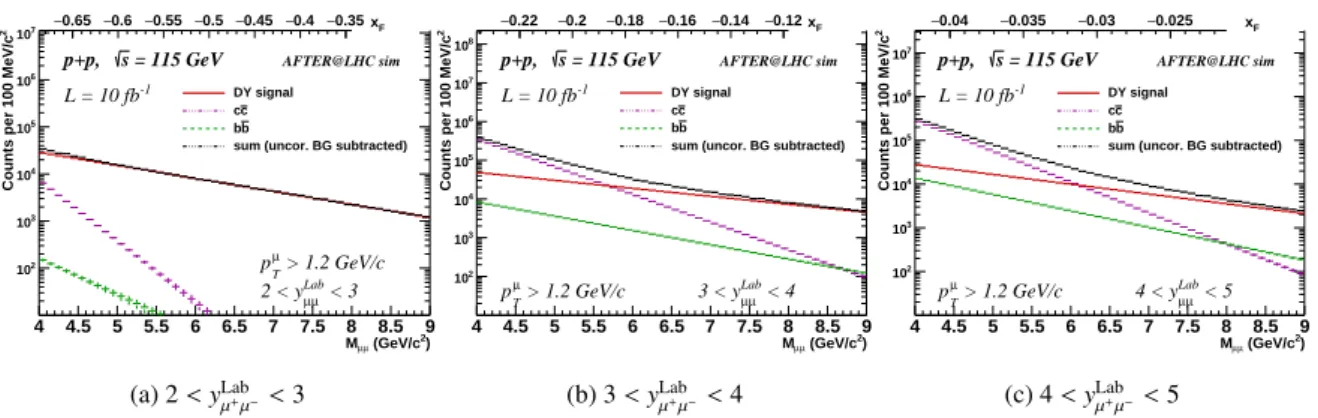
examples of the resulting invariant-mass distributions of the correlated µ+µ− pairs for three rapidity bins: 2 < yLabµ+µ− < 3, 3 < yLabµ+µ− < 4 and 4 < yLabµ+µ− < 5 for a LHCb-like detector. In addition to the Drell-Yan and
quarkonium studies, the double-J/ψ production is of interest because it gives access to the kT evolution of
the gluon Sivers function. The double J/ψ rates are calculated within LHCb-like acceptance [32] assuming a negligible background (which is an acceptable approximation given the background level observed for single J/ψ [34]). Table1&2summarises the expected J/ψ, double J/ψ, Υand Drell-Yan yields for a single data taking year for Lint= 10 fb−1.
) 2 (GeV/c µ µ M 4 4.5 5 5.5 6 6.5 7 7.5 8 8.5 9 2
Counts per 100 MeV/c
2 10 3 10 4 10 5 10 6 10 7 10 0.65 − −0.6 −0.55 −0.5 −0.45 −0.4 −0.35 DY signal c c b b
sum (uncor. BG subtracted)
-1 L = 10 fb = 115 GeV s p+p, < 3 Lab µ µ 2 < y AFTER@LHC sim > 1.2 GeV/c µ T p F x (a) 2 < yLabµ+µ−< 3 ) 2 (GeV/c µ µ M 4 4.5 5 5.5 6 6.5 7 7.5 8 8.5 9 2
Counts per 100 MeV/c
2 10 3 10 4 10 5 10 6 10 7 10 8 10 0.22 − −0.2 −0.18 −0.16 −0.14 −0.12 DY signal c c b b
sum (uncor. BG subtracted)
-1 L = 10 fb = 115 GeV s p+p, < 4 Lab µ µ 3 < y AFTER@LHC sim > 1.2 GeV/c µ T p F x (b) 3 < yLabµ+µ−< 4 ) 2 (GeV/c µ µ M 4 4.5 5 5.5 6 6.5 7 7.5 8 8.5 9 2
Counts per 100 MeV/c
2 10 3 10 4 10 5 10 6 10 7 10 0.04 − −0.035 −0.03 −0.025 DY signal c c b b
sum (uncor. BG subtracted)
-1 L = 10 fb = 115 GeV s p+p, < 5 Lab µ µ 4 < y AFTER@LHC sim > 1.2 GeV/c µ T p F x (c) 4 < yLabµ+µ−< 5
Fig. 1: Invariant mass distribution of the correlated µ+µ−pairs originating from Drell-Yan, cc and bb produc-tion for a LHCb-like detector. The uncorrelated background is estimated with the like-sign method and then subtracted from the overall simulated µ+µ−mass spectrum.
2 < yLab µ+µ− < 3 3 < yLabµ+µ− < 4 4 < yLabµ+µ− < 5 J/ψ 1.69 · 107 1.04 · 108 1.01 · 108 3 < yLab µ+µ− < 4 4 < yLabµ+µ− < 5 3 < yLabµ+µ−< 5 Υ(1S ) 4.85 · 104 8.85 · 104 1.37 · 105 Υ(2S ) 9.57 · 103 1.85 · 104 2.81 · 104 Υ(3S ) 4.35 · 103 8.77 · 103 1.31 · 104 2 < yLab< 5 double J/ψ 780
Table 1: J/ψ, Υ and double J/ψ yields expected with a LHCb-like detector per LHC year with a 7 TeV proton beam on a proton target assuming Lint= 10 fb−1.
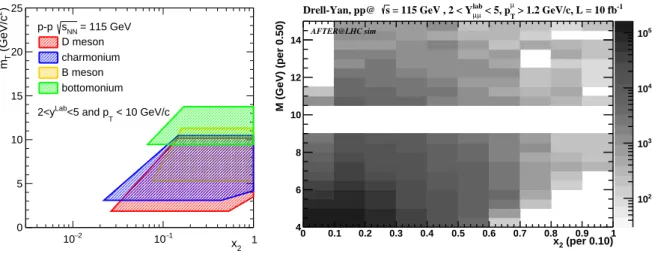
Such an experimental set-up offers a unique kinematic coverage, which allows one to probe a wide range of the momentum fraction x22. Figure2(left panel) shows the range in the transverse mass mT vs. x2that is
2
The momentum fractions of the partons x1, x2are computed with a simplified 2 → 1 kinematics such that x1= eymT/
√ s and x2= e−ymT/ √ swith m2 T= m 2+ p2 T
2 < yLab
µ+µ− < 3 3 < yLabµ+µ− < 4 4 < yLabµ+µ−< 5
Drell-Yan yield 4.32 · 105 9.32 · 105 4.98 · 105
Like-sign pairs yield 5.84 · 105 1.86 · 107 4.53 · 106
Signal-to-Background ratio 0.74 0.05 0.11
Table 2: Drell-Yan yields for 4 < Mµ+µ− < 9 GeV/c2expected with a LHCb-like detector per LHC year with
a 7 TeV proton beam on a proton target assuming Lint= 10 fb−1.
available with the J/ψ, Υ and B and D-meson measurements. Since these are gluon-sensitive probes, they give an unprecedented access to the gluon dynamics over a broad range of 0.02 < x2 < 1. Figure2(right panel)
shows the corresponding kinematic coverage (mass vs. x2) for the Drell-Yan pairs with the yield information.
Any cell in gray contains at least 30 DY events.
2 x 2 − 10 10−1 1 ) 2 (GeV/cT m 0 5 10 15 20 25 = 115 GeV NN s p-p D meson charmonium B meson bottomonium < 10 GeV/c T <5 and p Lab 2<y (per 0.10) 2 x 0 0.1 0.2 0.3 0.4 0.5 0.6 0.7 0.8 0.9 1 M (GeV) (per 0.50) 4 6 8 10 12 14 2 10 3 10 4 10 5 10 -1 > 1.2 GeV/c, L = 10 fb µ T < 5, p lab µ µ = 115 GeV , 2 < Y s Drell-Yan, pp@ AFTER@LHC sim
Fig. 2: Left panel: The range in the transverse mass mT vs. parton momentum fraction x2 accessible in
AFTER@LHC in p+ p collisions at √sNN = 115 GeV with J/ψ, Υ and D-meson measurements. Right
panel: the x2vs. Drell-Yan mass coverage. [Both are for a LHCb-like detector]
3.3 ANin p+ p↑collisions.
Inspired from the performance of the polarised gas HERMES target [52] (which successfully operated for many years with an effective average transverse polarisation P ∼ 80%), we used P = 80% in the following statistical precision projections.
Figure3shows our precision projections for J/ψ and Υ AN as a function of xF. The statistical power of
this measurement reflects the major strength of AFTER@LHC, namely an ideal acceptance with conventional detectors and the large production rates for quarkonium states expected for a single year of data taking (106
Υ and 109 J/ψ). Such a study will only be limited by the systematic uncertainties, which cancel out to a large
extent in AN. Even for a fraction of the expected luminosity (Lint = 1 fb−1), A J/ψ
N can be measured with a
per-mil precision. Moreover, the AΥ(nS )N is a unique observable, which is virtually inaccessible elsewhere and which can be measured with a few per cent accuracy with AFTER@LHC. This level of data quality will allow one to study the size of the asymmetry, its shape and the xF dependence of quarkonium AN. Furthermore,
AFTER@LHC aims at measurements of AN for nearly all quarkonium states, including C-even χc,band ηc,
and their associated production. These processes are sensitive to the gluon content of the colliding hadrons which can then be measured with an outstanding precision.
F x 0.4 − −0.3 −0.2 −0.1 0 0.1 ϒ N A 0.2 − 0.15 − 0.1 − 0.05 − 0 0.05 0.1 0.15 (1S) ϒ (2S) ϒ (3S) ϒ = 115 GeV s p+p = 10 fb-1 pp L = 0.8 P eff. pol.
Stat. unc. projection
F x 0.3 − −0.25 −0.2 −0.15 −0.1 −0.05 0 0.05 0.1 ψ J/ N A 0.2 − 0.15 − 0.1 − 0.05 − 0 0.05 0.1 0.15
= 200 GeV (Phys. Rev. D 82, 112008 (2010)) s
Stat. unc. projection
= 115 GeV s p+p = 0.25 fb-1 pp L = 0.8 P eff. pol.
Fig. 3: Projections for Υ (left panel) and J/ψ (right panel) AN as a function of xF for AFTER@LHC with a
LHCb-like detector. For the J/ψ case, these are compared to existing data from PHENIX [12] in red.
Associated-production channels [13,19,23,40,103,109,110] are fundamental tools to access the Gluon Sivers effect, and also probing the gluon TMD sector and their evolution [84,111]. A few different processes
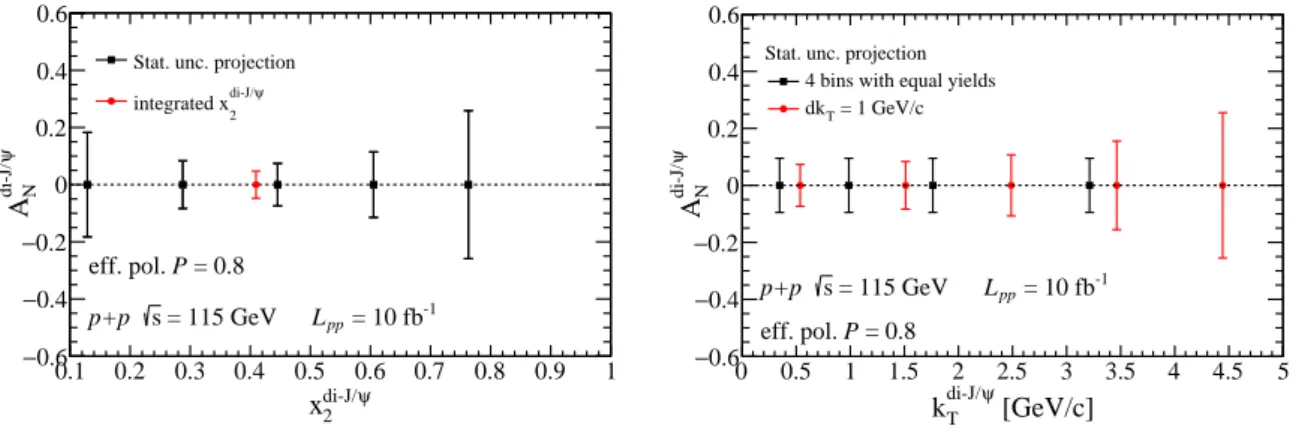
are potentially interesting in this context, for instance J/ψ − J/ψ , J/ψ − γ, γ − γ, Υ − γ. The J/ψ − J/ψ production seems to be the most practical one since the yields are not too small [32] and the measurement is relatively straightforward (compared, for instance, to direct γ studies). Figure4shows the ANfor double J/ψ
production as a function of the pair x2and the pair kT. We consider two scenarios for the analysis of AN as
a function of kT: one with a fixed kT bin width of 1 GeV/c (dkT = 1 GeV/c, red points) and four bins with
equal yields. Here, we model the kT dependence as a Gaussian distribution with the width σ= 2 GeV/c. The
x2-integrated AN will allow for the determination of the STSA with a few percent precision and the AN(kT)
gives access –for the first time– to the kTdependence of the gluon Sivers TMD up to kT ≈ 4 GeV/c.
ψ di-J/ 2 x 0.1 0.2 0.3 0.4 0.5 0.6 0.7 0.8 0.9 1 ψ di-J/ N A 0.6 − 0.4 − 0.2 − 0 0.2 0.4 0.6
Stat. unc. projection
ψ di-J/ 2 integrated x = 115 GeV s p+p = 10 fb-1 pp L = 0.8 P eff. pol. [GeV/c] ψ di-J/ T k 0 0.5 1 1.5 2 2.5 3 3.5 4 4.5 5 ψ di-J/ N A 0.6 − 0.4 − 0.2 − 0 0.2 0.4 0.6 = 0.8 P eff. pol. = 115 GeV s p+p = 10 fb-1 pp L
Stat. unc. projection 4 bins with equal yields
= 1 GeV/c T dk
Fig. 4: Statistical projections for di-J/ψ AN as a function of xFand the pair pT with a LHCb-like detector.
As we mentioned in the previous section, Drell-Yan production is a unique probe of the Sivers effect for the quarks. It is a subject of lively interest with many existing or planned experiments (COMPASS, STAR, E1039). Table3shows a compilation of the relevant parameters of future or planned polarised DY experi-ments. AFTER@LHC is capable of measuring the Drell-Yan AN in a broad kinematic range with exceptional
precision.
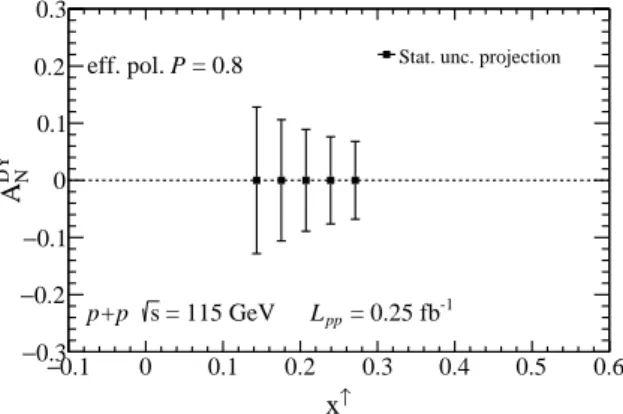
Figure5shows the statistical accuracy expected with a single data-taking year using a LHCb-like detector, for the Drell-Yan pairs satisfying 4 < Mµ+µ− < 9 GeV/c2. The level of uncorrelated background drives the
statistical uncertainties of this measurement. We estimated the background with the robust and commonly used like-sign technique, then we subtracted it from the Mµ+µ− distribution. As explained above, we also
Experiment particles beam en-ergy (GeV) √ s(GeV) x↑ L (cm−2s−1) P eff F (cm−2s−1) AFTER@LHCb p+ p↑ 7000 115 0.05 ÷ 0.95 1 · 1033 80% 6.4 · 1032 AFTER@LHCb p+3He↑ 7000 115 0.05 ÷ 0.95 2.5 · 1032 23% 1.4 · 1031 AFTER@ALICEµ p+ p↑ 7000 115 0.1 ÷ 0.3 2.5 · 1031 80% 1.6 · 1031 COMPASS (CERN) π±+ p↑ 190 19 0.2 ÷ 0.3 2 · 1033 18% 6.5 · 1031 PHENIX/STAR (RHIC) p↑+ p↑ collider 510 0.05 ÷ 0.1 2 · 1032 50% 5.0 · 1031 E1039 (FNAL) p+ p↑ 120 15 0.1 ÷ 0.45 4 · 1035 15% 9.0 · 1033 E1027 (FNAL) p↑+ p 120 15 0.35 ÷ 0.9 2 · 1035 60% 7.2 · 1034
NICA (JINR) p↑+ p collider 26 0.1 ÷ 0.8 1 · 1032 70% 4.9 · 1031
fsPHENIX (RHIC) p↑+ p↑ collider 200 0.1 ÷ 0.5 8 · 1031 60% 2.9 · 1031 fsPHENIX (RHIC) p↑+ p↑ collider 510 0.05 ÷ 0.6 6 · 1032 50% 1.5 · 1032 PANDA (GSI) ¯p+ p↑ 15 5.5 0.2 ÷ 0.4 2 · 1032 20% 8.0 · 1030
Table 3: Compilation inspired from [17,56] of the relevant parameters for the future or planned polarised DY experiments. The effective polarisation (Peff ) is a beam polarisation (where relevant) or an average polarisation times a (possible) dilution factor (for a gas target, similar to the one developed for HER-MES [52,112,113]) or a target polarisation times a dilution factor (for the NH3 target used by COMPASS
and E1039). For AFTER@LHC the numbers correspond to a gas target. F is the (instantaneous) spin figure of merit of the target defined as F = P2eff× L, with L being the instantaneous luminosity.
bottom pair decays. The AFTER@LHC projections are compared to a theory evaluation [35]. This theory prediction based on SIDIS currently exhibit uncertainties much larger than our projected uncertainties, as shown by this example. By delivering high-quality data over a wide kinematic range, AFTER@LHC will thus probe the x↑dependence of the ADY
N and constrain model calculations.
↑ x 0 0.1 0.2 0.3 0.4 0.5 0.6 0.7 0.8 0.9 DY N A 0.3 − 0.2 − 0.1 − 0 0.1 0.2 0.3
SIDIS 1(Sivers effect) < 3 lab µ µ 2 < y < 4 lab µ µ 3 < y < 5 lab µ µ 4 < y 2 < 9 GeV/c µ µ 4 < M 2 dM = 1 GeV/c = 115 GeV s p+p -1 = 10 fb pp L = 0.8 P eff. pol.
Fig. 5: Statistical projections for the Drell-Yan ANmeasurement as a function of x↑with a LHCb-like detector.
Note that the range in x↑ is limited by the bin sizes in y and M. We have checked that measurements can probably be done with an accuracy of 5% up to x↑ ' 0.95 as expected from Fig.2.
Since the statistical precision of ADYN strongly depends on the level of uncorrelated background, such a study can be carried out with lower integrated luminosity if the background is suppressed. The ALICE forward muon arm provides such a possibility. On the one hand, the available integrated luminosity is limited
by the ALICE data taking rate capabilities. An integrated luminosity of 0.25 fb−1can be expected at best for a single year of data taking. On the other, the absorber in front of its muon detector can potentially reduce the background.
To check to which extent ADY
N can be studied with ALICE and if this deserves further in-depth
inves-tigations, we estimated the signal and background yields as follows. First, we assumed that the number of uncorrelated pairs in the DY and charmonium measurements is proportional to the number of charged parti-cles squared, N2
ch. To take into account the track reconstruction efficiency and the background suppression by
the ALICE absorber, we referred to ALICE measurements of the di-muon pairs at forward rapidities in pp collisions at 8 TeV [108]. Since Drell-Yan pairs were not measured by ALICE yet, we turned to J/ψ → µ+µ+ measurements. We calculated the number of uncorrelated pairs Nununder the J/ψ peak and the J/ψ yield and
we normalised them by the luminosity. Then, we used the scaling of charged track density with the collision energy dNch/dη|η∼0 = 0.725s0.23[114] to scale down the Nunto the level expected at
√
s = 115 GeV. Next, we used the energy dependence of the J/ψ cross section as calculated in the FONLL (Fixed Order plus Next-to-Leading Logarithms) framework to scale the J/ψ yield to the value expected at 115 GeV –admittedly this is another approximation. We neglected the change of the shape of dNch/dη and dσJ/ψ/dy distributions with
√
sfor these first estimates. Finally, we assumed that the reconstruction efficiency for J/ψ and DY pairs was similar and the ratio of observed DY to J/ψ pairs would be the same in ALICE and LHCb. We thus used the correlated di-muon spectrum simulated for LHCb-like detector for 3 < yLab
µ+µ− < 4 and scale it to match the
J/ψ yield in the simulation to that expected in ALICE at 115 GeV. Similarly, we normalised the uncorrelated background under the J/ψ peak in the simulations to the Nunestimated for ALICE in a fixed target mode. As a
results, we obtained distributions of DY, cc → µ+µ−, bb → µ+µ−and uncorrelated background pairs expected in the measurements using the ALICE muon arm.
Note that we implicitly assumed the target location to be at z = 0, which is not completely coherent with the location of a polarised target. We nevertheless believe this to be sufficient for such a prospective study. Figure6shows the projections for AN measured with the ALICE-like acceptance of 3 < yLabµ+µ− < 4.
The uncertainties are sizeable but there is room for improvement if tracking and vertex detectors before the absorber are used to reject muons from π, K meson and beauty and charm hadrons decays.
↑ x 0.1 − 0 0.1 0.2 0.3 0.4 0.5 0.6 DY N A 0.3 − 0.2 − 0.1 − 0 0.1 0.2 0.3
Stat. unc. projection
= 115 GeV s p+p Lpp = 0.25 fb-1 = 0.8 P eff. pol.
Fig. 6: Fast statistical projections for Drell-Yan AN as a function of x↑ with a ALICE-like detector. See text
for details.
3.4 Accessing the quark Sivers function in a polarised neutron: p+3He↑collisions.
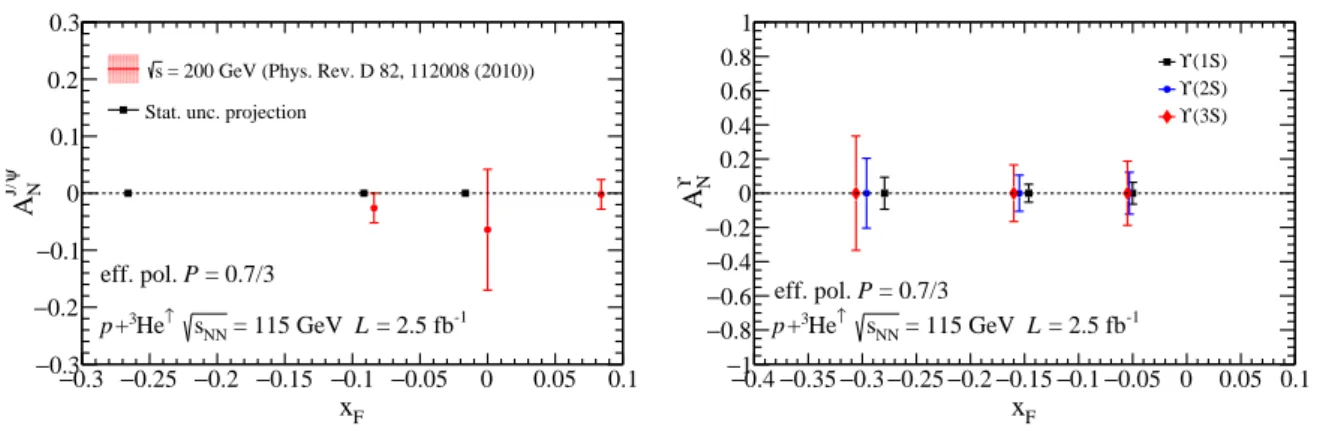
AFTER@LHC with a gas target offers a unique opportunity for studies of STSA in polarised p+3He↑ colli-sions. Such reactions give access to polarised neutrons and thus to the Sivers functions in a neutron which can shed some light on its isospin dependence. Figures7and8show the statistical-uncertainty predictions for DY and quarkonium ANmeasurements. In the case of3He↑, a polarisation of P= 70% can be achieved [112,113].
3He↑
. In addition, the combinatorial background is proportional to the number of binary nucleon-nucleon col-lisions Ncoll, thus the background increases by a factor Ncoll≈
√
3. An additional isospin factor of 9/6 for DY studies is included. The available integrated luminosity of 2.5 fb−1will allow for an exploratory measurement
for DY production and precision study for J/ψ AN.
↑ x 0 0.1 0.2 0.3 0.4 0.5 0.6 0.7 0.8 0.9 DY N A 1 − 0.8 − 0.6 − 0.4 − 0.2 − 0 0.2 0.4 0.6 0.8 1 < 3 lab µ µ 2 < y < 4 lab µ µ 3 < y < 5 lab µ µ 4 < y 2 < 9 GeV/c µ µ 4 < M 2 dM = 2 GeV/c = 115 GeV s ↑ He 3 + p -1 = 0.25 fb L = 0.7/3 P eff. pol.
Fig. 7: Statistical projections for Drell-Yan ANas a function of x↑in p+3He↑collisions at
√ s= 115 GeV. F x 0.3 − −0.25 −0.2 −0.15 −0.1 −0.05 0 0.05 0.1 ψ J/ N A 0.3 − 0.2 − 0.1 − 0 0.1 0.2 0.3
= 200 GeV (Phys. Rev. D 82, 112008 (2010)) s
Stat. unc. projection
= 115 GeV NN s ↑ He 3 + p L = 2.5 fb-1 = 0.7/3 P eff. pol. F x 0.4 − −0.35−0.3−0.25−0.2−0.15−0.1−0.05 0 0.05 0.1 ϒ N A 1 − 0.8 − 0.6 − 0.4 − 0.2 − 0 0.2 0.4 0.6 0.8 1 (1S) ϒ (2S) ϒ (3S) ϒ = 115 GeV NN s ↑ He 3 + p L = 2.5 fb-1 = 0.7/3 P eff. pol.
Fig. 8: Statistical projections for J/ψ and Υ AN as a function of xFin p+3He↑collisions at
√
s= 115 GeV, compared to existing PHENIX data with polarised protons [12].
4 Conclusions
We have presented prospects and sensitivity studies for measurements of the quarkonia and Drell-Yan single transverse spin asymmetry which could be achieved with a fixed-target experiment at the LHC, AFTER@LHC, with a polarised gas target. Owing to its orginal acceptance, high target polarisation and large luminosities, AFTER@LHC can deliver a set of unparalleled, high-quality data that will allow for in-depth studies of the gluon and quark Sivers functions and of the 3-parton collinear twist-3 correlators.
The AN for J/ψ, Υ, C-even quarkonium states and various associated-production channels can be
mea-sured with unprecedented precision. The latter will give access for the first time to the transverse momentum depedence of the gluon Sivers effect. Such studies, along with those of the STSAs for open charm and beauty, make AFTER@LHC the best place to advance –in a close future– our knowledge of gluon and quark dynam-ics in a nucleon and of how they bind together to produce its observed spin 1/2.
Acknowledgements
This research was supported in part by the French P2IO Excellence Laboratory, the French CNRS via the grants FCPPL-Quarkonium4AFTER & TMD@NLO. AS acknowledges support from U.S. Department of Energy contract DE-AC05-06OR23177, under which Jefferson Science Associates, LLC, manages and oper-ates Jefferson Lab. MGE is supported by the Spanish Ministry of Economy and Competitiveness under the Juan de la Ciervaprogram and grant FPA2013-46570-C2-1-P.
References
1. European Muon Collaboration, J. Ashman et al., “A Measurement of the Spin Asymmetry and Determination of the Structure Function g(1) in Deep Inelastic Muon-Proton Scattering,”Phys. Lett.
B206 (1988) 364.
2. D. de Florian, R. Sassot, M. Stratmann, and W. Vogelsang, “Global Analysis of Helicity Parton Densities and Their Uncertainties,”Phys. Rev. Lett. 101(2008) 072001,arXiv:0804.0422
[hep-ph].
3. STAR Collaboration, L. Adamczyk et al., “Precision Measurement of the Longitudinal Double-spin Asymmetry for Inclusive Jet Production in Polarized Proton Collisions at √s= 200 GeV,”Phys. Rev.
Lett. 115no. 9, (2015) 092002,arXiv:1405.5134 [hep-ex].
4. COMPASS Collaboration, K. Kurek and A. Szabelski, “The Gluon Contribution to the Sivers Effect COMPASS results,”J. Phys. Conf. Ser. 678no. 1, (2016) 012055.
5. C. Adolph et al., “First measurement of the Sivers asymmetry for gluons from SIDIS data,”
arXiv:1701.02453 [hep-ex].
6. Y. Feng, J.-P. Lansberg, and J.-X. Wang, “Energy dependence of direct-quarkonium production in pp collisions from fixed-target to LHC energies: complete one-loop analysis,”Eur. Phys. J. C75no. 7,
(2015) 313,arXiv:1504.00317 [hep-ph].
7. S. J. Brodsky and J.-P. Lansberg, “Heavy-Quarkonium Production in High Energy Proton-Proton Collisions at RHIC,”Phys. Rev. D81(2010) 051502,arXiv:0908.0754 [hep-ph].
8. J. P. Lansberg, “QCD corrections to J/psi polarisation in pp collisions at RHIC,”Phys. Lett. B695
(2011) 149–156,arXiv:1003.4319 [hep-ph].
9. A. Andronic et al., “Heavy-flavour and quarkonium production in the LHC era: from proton-proton to heavy-ion collisions,”Eur. Phys. J. C76no. 3, (2016) 107,arXiv:1506.03981 [nucl-ex]. 10. N. Brambilla et al., “Heavy quarkonium: progress, puzzles, and opportunities,”Eur. Phys. J. C71
(2011) 1534,arXiv:1010.5827 [hep-ph].
11. J. P. Lansberg, “J/ψ, ψ ’ and Υ production at hadron colliders: A Review,”Int. J. Mod. Phys. A21
(2006) 3857–3916,arXiv:hep-ph/0602091 [hep-ph].
12. PHENIX Collaboration, A. Adare et al., “Measurement of Transverse Single-Spin Asymmetries for J/ψ Production in Polarized p + p Collisions at √s= 200 GeV,”Phys. Rev. D82(2010) 112008,
arXiv:1009.4864 [hep-ex]. [Erratum: Phys. Rev.D86,099904(2012)].
13. D. Boer, “Gluon TMDs in quarkonium production,”Few Body Syst. 58no. 2, (2017) 32,
arXiv:1611.06089 [hep-ph].
14. A. Schafer and J. Zhou, “Transverse single spin asymmetry in hadronic ηc,bproduction,”Phys. Rev.
D88 no. 1, (2013) 014008,arXiv:1302.4600 [hep-ph].
15. D. Boer and C. Pisano, “Polarized gluon studies with charmonium and bottomonium at LHCb and AFTER,”Phys. Rev. D86(2012) 094007,arXiv:1208.3642 [hep-ph].
16. F. Yuan, “Heavy Quarkonium Production in Single Transverse Polarized High Energy Scattering,”
Phys. Rev. D78(2008) 014024,arXiv:0801.4357 [hep-ph].
17. S. J. Brodsky, F. Fleuret, C. Hadjidakis, and J. P. Lansberg, “Physics Opportunities of a Fixed-Target Experiment using the LHC Beams,”Phys. Rept. 522(2013) 239–255,arXiv:1202.6585 [hep-ph]. 18. S. Koshkarev and S. Groote, “Double quarkonium production at high Feynman-x,”Nucl. Phys. B915
(2017) 384–391,arXiv:1611.08149 [hep-ph].
19. A. Signori, Flavor and Evolution Effects in TMD Phenomenology. PhD thesis, Vrije U., Amsterdam, 2016. http://inspirehep.net/record/1493030/files/Thesis-2016-Signori.pdf. 20. S. Koshkarev, “Production of the Doubly Heavy Baryons, Bcmeson and the Tetra-c-quark at the
Fixed-target Experiment at the LHC with double intrinsic heavy approach,”arXiv:1610.06125
21. J. P. Lansberg et al., “Single-Transverse-Spin-Asymmetry studies with a fixed-target experiment using the LHC beams (AFTER@LHC),” PoS DIS2016 (2016) 241,arXiv:1610.05228 [hep-ex]. 22. J.-P. Lansberg et al., “Physics case for a polarised target for AFTER@LHC,” PoS PSTP2015 (2016)
042,arXiv:1602.06857 [nucl-ex].
23. A. Signori, “Gluon TMDs in quarkonium production,”Few Body Syst. 57no. 8, (2016) 651–655,
arXiv:1602.03405 [hep-ph].
24. C. Pisano, “Momentum Imbalance Observables as a Probe of Gluon TMDs,” PoS QCDEV2015 (2015)
024,arXiv:1512.08143 [hep-ph].
25. R. Vogt, “Gluon Shadowing Effects on J/ψ and Υ Production in p + Pb Collisions at √sNN= 115 GeV
and p+ Pb Collisions at √sNN= 72 GeV at AFTER@LHC,”Adv. High Energy Phys. 2015(2015)
492302,arXiv:1510.03976 [hep-ph].
26. Y. Fengand and J.-X. Wang, “Next-to-Leading Order Differential Cross Sections for , , and Production in Proton-Proton Collisions at a Fixed-Target Experiment Using the LHC Beams,”Adv. High Energy
Phys. 2015(2015) 726393,arXiv:1510.05277 [hep-ph].
27. C. Barschel, P. Lenisa, A. Nass, and E. Steffens, “A Gas Target Internal to the LHC for the Study of pp Single-Spin Asymmetries and Heavy Ion Collisions,”Adv. High Energy Phys. 2015(2015) 463141. 28. D. Kikola, “Prospects for Open Heavy Flavor Measurements in Heavy Ion and p+ A Collisions in a
Fixed-Target Experiment at the LHC,”Adv. High Energy Phys. 2015(2015) 783134. 29. A. B. Kurepinand and N. S. Topilskaya, “Quarkonium Production and Proposal of the New
Experiments on Fixed Target at the LHC,”Adv. High Energy Phys. 2015(2015) 760840.
30. K. Zhou, Z. Chen, and P. Zhuang, “Antishadowing Effect on Charmonium Production at a Fixed-Target Experiment Using LHC Beams,”Adv. High Energy Phys. 2015(2015) 439689,arXiv:1507.05413
[nucl-th].
31. F. Arleo and S. Peign´e, “Quarkonium suppression from coherent energy loss in fixed-target
experiments using LHC beams,”Adv. High Energy Phys. 2015(2015) 961951,arXiv:1504.07428
[hep-ph].
32. J.-P. Lansberg and H.-S. Shao, “Double-quarkonium production at a fixed-target experiment at the LHC (AFTER@LHC),”Nucl. Phys. B900(2015) 273–294,arXiv:1504.06531 [hep-ph]. 33. S. J. Brodsky, A. Kusina, F. Lyonnet, I. Schienbein, H. Spiesberger, and R. Vogt, “A review of the
intrinsic heavy quark content of the nucleon,”Adv. High Energy Phys. 2015(2015) 231547,
arXiv:1504.06287 [hep-ph].
34. L. Massacrier, B. Trzeciak, F. Fleuret, C. Hadjidakis, D. Kikola, J. P. Lansberg, and H. S. Shao, “Feasibility studies for quarkonium production at a fixed-target experiment using the LHC proton and lead beams (AFTER@LHC),”Adv. High Energy Phys. 2015(2015) 986348,arXiv:1504.05145
[hep-ex].
35. M. Anselmino, U. D’Alesio, and S. Melis, “Transverse single-spin asymmetries in proton-proton collisions at the AFTER@LHC experiment in a TMD factorisation scheme,”Adv. High Energy Phys.
2015 (2015) 475040,arXiv:1504.03791 [hep-ph].
36. J. P. Lansberg, L. Szymanowski, and J. Wagner, “Lepton-pair production in ultraperipheral collisions at AFTER@LHC,”JHEP 09(2015) 087,arXiv:1504.02733 [hep-ph].
37. F. A. Ceccopieri, “Studies of backward particle production with A Fixed-Target Experiment using the LHC beams,”Adv. High Energy Phys. 2015(2015) 652062,arXiv:1503.05813 [hep-ph]. 38. V. P. Goncalves and W. K. Sauter, “ηcproduction in photon-induced interactions at a fixed target
experiment at LHC as a probe of the odderon,”Phys. Rev. D91no. 9, (2015) 094014,
arXiv:1503.05112 [hep-ph].
39. K. Kanazawa, Y. Koike, A. Metz, and D. Pitonyak, “Transverse single-spin asymmetries in proton-proton collisions at the AFTER@LHC experiment,”Adv. High Energy Phys. 2015(2015)
257934,arXiv:1502.04021 [hep-ph].
40. J. P. Lansberg, “Back-to-back isolated photon-quarkonium production at the LHC and the
transverse-momentum-dependent distributions of the gluons in the proton,”Int. J. Mod. Phys. Conf.
Ser. 40(2016) 1660015,arXiv:1502.02263 [hep-ph].
41. L. Massacrier et al., “Studies of Transverse-Momentum-Dependent distributions with A Fixed-Target ExpeRiment using the LHC beams (AFTER@LHC),”Int. J. Mod. Phys. Conf. Ser. 40no. 01, (2016)
1660107,arXiv:1502.00984 [nucl-ex].
42. J. P. Lansberg et al., “Spin physics and TMD studies at A Fixed-Target ExpeRiment at the LHC (AFTER@LHC),”EPJ Web Conf. 85(2015) 02038,arXiv:1410.1962 [hep-ex].
43. G. Chen, X.-G. Wu, J.-W. Zhang, H.-Y. Han, and H.-B. Fu, “Hadronic production of Ξccat a
fixed-target experiment at the LHC,”Phys. Rev. D89no. 7, (2014) 074020,arXiv:1401.6269
[hep-ph].
44. A. Rakotozafindrabe et al., “Spin physics at A Fixed-Target ExpeRiment at the LHC (AFTER@LHC),”Phys. Part. Nucl. 45(2014) 336–337,arXiv:1301.5739 [hep-ex].
45. J. P. Lansberg et al., “AFTER@LHC: a precision machine to study the interface between particle and nuclear physics,”EPJ Web Conf. 66(2014) 11023,arXiv:1308.5806 [hep-ex].
46. J. P. Lansberg et al., “Prospects for A Fixed-Target ExpeRiment at the LHC: AFTER@LHC,” PoS ICHEP2012 (2013) 547,arXiv:1212.3450 [hep-ex].
47. C. Lorce et al., “Spin and diffractive physics with A Fixed-Target ExpeRiment at the LHC (AFTER@LHC),”arXiv:1212.0425 [hep-ex]. [AIP Conf. Proc.1523,149(2012)].
48. A. Rakotozafindrabe et al., “Ultra-relativistic heavy-ion physics with AFTER@LHC,”Nucl. Phys.
A904-905 (2013) 957c–960c,arXiv:1211.1294 [nucl-ex].
49. J. P. Lansberg et al., “A Fixed-Target ExpeRiment at the LHC (AFTER@LHC) : luminosities, target polarisation and a selection of physics studies,” PoS QNP2012 (2012) 049,arXiv:1207.3507
[hep-ex].
50. J. P. Lansberg, S. J. Brodsky, F. Fleuret, and C. Hadjidakis, “Quarkonium Physics at a Fixed-Target Experiment using the LHC Beams,”Few Body Syst. 53(2012) 11–25,arXiv:1204.5793 [hep-ph]. 51. T. Liu and B.-Q. Ma, “Azimuthal asymmetries in lepton-pair production at a fixed-target experiment
using the LHC beams (AFTER),”Eur. Phys. J. C72(2012) 2037,arXiv:1203.5579 [hep-ph]. 52. E. Steffens, “Estimation of the performance of a HERMES-type gas target internal to the LHC,” PoS
PSTP2015 (2015) 019.
53. D. W. Sivers, “Single Spin Production Asymmetries from the Hard Scattering of Point-Like Constituents,”Phys. Rev. D41(1990) 83.
54. S. J. Brodsky, D. S. Hwang, and I. Schmidt, “Initial state interactions and single spin asymmetries in Drell-Yan processes,”Nucl. Phys. B642(2002) 344–356,arXiv:hep-ph/0206259 [hep-ph]. 55. U. D’Alesio and F. Murgia, “Azimuthal and Single Spin Asymmetries in Hard Scattering Processes,”
Prog. Part. Nucl. Phys. 61(2008) 394–454,arXiv:0712.4328 [hep-ph].
56. V. Barone, F. Bradamante, and A. Martin, “Transverse-spin and transverse-momentum effects in high-energy processes,”Prog. Part. Nucl. Phys. 65(2010) 267–333,arXiv:1011.0909 [hep-ph]. 57. R. Angeles-Martinez et al., “Transverse Momentum Dependent (TMD) parton distribution functions:
status and prospects,”Acta Phys. Polon. B46no. 12, (2015) 2501–2534,arXiv:1507.05267
[hep-ph].
58. B. E. Bonner et al., “Analyzing Power Measurement in Inclusive pi0 Production at High x(f),”Phys.
Rev. Lett. 61(1988) 1918.
59. E704, E581 Collaboration, D. L. Adams et al., “Comparison of spin asymmetries and cross sections in π0production by 200 GeV polarized anti-protons and protons,”Phys. Lett. B261(1991) 201–206.
60. PHENIX Collaboration, A. Adare et al., “Measurement of transverse-single-spin asymmetries for midrapidity and forward-rapidity production of hadrons in polarized p+p collisions at √s=200 and 62.4 GeV,”Phys. Rev. D90no. 1, (2014) 012006,arXiv:1312.1995 [hep-ex].
61. A. Lesnik, D. M. Schwartz, I. Ambats, E. Hayes, W. T. Meyer, C. E. W. Ward, T. M. Knasel, E. C. Swallow, R. Winston, and T. A. Romanowski, “Observation of a Difference Between Polarization and Analyzing Power in Lambda0 Production with 6-GeV/c Polarized Protons,”Phys. Rev. Lett. 35(1975) 770.
62. G. Bunce et al., “Λ0Hyperon Polarization in Inclusive Production by 300 GeV Protons on Beryllium.,”
Phys. Rev. Lett. 36(1976) 1113–1116.
63. FNAL-E704 Collaboration, D. L. Adams et al., “Analyzing power in inclusive π+and π−production at
high x(F) with a 200 GeV polarized proton beam,”Phys. Lett. B264(1991) 462–466.
64. E704, E581 Collaboration, D. L. Adams et al., “Large x(F) spin asymmetry in π0production by 200
GeV polarized protons,”Z. Phys. C56(1992) 181–184.
65. K. Krueger et al., “Large analyzing power in inclusive π±production at high x(F) with a 22 GeV/c
polarized proton beam,”Phys. Lett. B459(1999) 412–416.
66. V. Barone and P. G. Ratcliffe, Transverse spin physics. River Edge, USA: World Scientific (2003) 294 p, 2003.
67. E. Leader, “Spin in particle physics,” Camb. Monogr. Part. Phys. Nucl. Phys. Cosmol. 15 (2011) pp.1–500.
68. F. Pijlman, Single spin asymmetries and gauge invariance in hard scattering processes. PhD thesis, Vrije U., Amsterdam, 2006.arXiv:hep-ph/0604226 [hep-ph].
http://www.nikhef.nl/pub/services/biblio/theses_pdf/thesis_F_Pijlman.pdf.
69. C. J. Bomhof, Azimuthal Spin Asymmetries in Hadronic Processes. PhD thesis, Vrije U., Amsterdam, 2007. http://inspirehep.net/record/761943/files/8060.pdf.
70. V. Barone, A. Drago, and P. G. Ratcliffe, “Transverse polarisation of quarks in hadrons,”Phys. Rept.
359 (2002) 1–168,arXiv:hep-ph/0104283 [hep-ph].
71. C. Bourrely, J. Soffer, and E. Leader, “Polarization Phenomena in Hadronic Reactions,”Phys. Rept. 59
(1980) 95–297.
72. M. Anselmino, A. Efremov, and E. Leader, “The Theory and phenomenology of polarized deep inelastic scattering,”Phys. Rept. 261(1995) 1–124,arXiv:hep-ph/9501369 [hep-ph]. [Erratum: Phys. Rept.281,399(1997)].
73. Z.-T. Liang and C. Boros, “Single spin asymmetries in inclusive high-energy hadron hadron collision processes,”Int. J. Mod. Phys. A15(2000) 927–982,arXiv:hep-ph/0001330 [hep-ph].
74. M. Boglione and A. Prokudin, “Phenomenology of transverse spin: past, present and future,”Eur.
Phys. J. A52no. 6, (2016) 154,arXiv:1511.06924 [hep-ph].
75. E. C. Aschenauer, U. D’Alesio, and F. Murgia, “TMDs and SSAs in hadronic interactions,”Eur. Phys.
J. A52no. 6, (2016) 156,arXiv:1512.05379 [hep-ph].
76. A. Prokudin, “ANin inclusive lepton-proton collisions: TMD and twist-3 approaches,”EPJ Web Conf.
85 (2015) 02028,arXiv:1410.3867 [hep-ph].
77. A. V. Efremov and O. V. Teryaev, “On Spin Effects in Quantum Chromodynamics,” Sov. J. Nucl. Phys. 36 (1982) 140. [Yad. Fiz.36,242(1982)].
78. J.-w. Qiu and G. F. Sterman, “Single transverse spin asymmetries,”Phys. Rev. Lett. 67(1991)
2264–2267.
79. D. W. Sivers, “Hard scattering scaling laws for single spin production asymmetries,”Phys. Rev. D43
(1991) 261–263.
80. J. Collins, Foundations of perturbative QCD. Cambridge University Press, 2013.
http://www.cambridge.org/de/knowledge/isbn/item5756723.
81. M. G. Echevarria, A. Idilbi, and I. Scimemi, “Factorization Theorem For Drell-Yan At Low qT And
Transverse Momentum Distributions On-The-Light-Cone,”JHEP 07(2012) 002,arXiv:1111.4996
[hep-ph].
82. M. G. Echevarria, A. Idilbi, and I. Scimemi, “Soft and Collinear Factorization and Transverse Momentum Dependent Parton Distribution Functions,”Phys. Lett. B726(2013) 795–801,
arXiv:1211.1947 [hep-ph].
83. M. G. Echevarria, A. Idilbi, and I. Scimemi, “Unified treatment of the QCD evolution of all
(un-)polarized transverse momentum dependent functions: Collins function as a study case,”Phys. Rev.
D90 no. 1, (2014) 014003,arXiv:1402.0869 [hep-ph].
84. M. G. Echevarria, T. Kasemets, P. J. Mulders, and C. Pisano, “QCD evolution of (un)polarized gluon TMDPDFs and the Higgs qT-distribution,”JHEP 07(2015) 158,arXiv:1502.05354 [hep-ph].
85. U. D’Alesio and F. Murgia, “Parton intrinsic motion in inclusive particle production: Unpolarized cross sections, single spin asymmetries and the Sivers effect,”Phys. Rev. D70(2004) 074009,
arXiv:hep-ph/0408092 [hep-ph].
86. M. Anselmino, M. Boglione, U. D’Alesio, E. Leader, and F. Murgia, “Parton intrinsic motion: Suppression of the Collins mechanism for transverse single spin asymmetries in p(up) p —¿ pi X,”
Phys. Rev. D71(2005) 014002,arXiv:hep-ph/0408356 [hep-ph].
87. D. Boer, P. J. Mulders, and F. Pijlman, “Universality of T odd effects in single spin and azimuthal asymmetries,”Nucl. Phys. B667(2003) 201–241,arXiv:hep-ph/0303034 [hep-ph].
88. COMPASS Collaboration, C. Quintans, “Future Drell-Yan measurements in COMPASS,”J. Phys.
Conf. Ser. 295(2011) 012163.
89. A. Klein et al., “Letter of Intent for a Drell-Yan experiment with a polarized proton target.,”. 90. L. D. Isenhower et al., “Polarized Drell-Yan measurements with the Fermilab Main Injector,”. 91. J.-W. Qiu and G. F. Sterman, “Single transverse spin asymmetries in direct photon production,”Nucl.
Phys. B378(1992) 52–78.
92. M. G. A. Buffing, A. Mukherjee, and P. J. Mulders, “Generalized Universality of Definite Rank Gluon Transverse Momentum Dependent Correlators,”Phys. Rev. D88(2013) 054027,arXiv:1306.5897
93. D. Boer, C. Lorce, C. Pisano, and J. Zhou, “The gluon Sivers distribution: status and future prospects,”
Adv. High Energy Phys. 2015(2015) 371396,arXiv:1504.04332 [hep-ph].
94. C. Pisano, D. Boer, S. J. Brodsky, M. G. A. Buffing, and P. J. Mulders, “Linear polarization of gluons and photons in unpolarized collider experiments,”JHEP 10(2013) 024,arXiv:1307.3417
[hep-ph].
95. D. Boer and W. J. den Dunnen, “TMD evolution and the Higgs transverse momentum distribution,”
Nucl. Phys. B886(2014) 421–435,arXiv:1404.6753 [hep-ph].
96. LHCb Collaboration, R. Aaij et al., “Measurement of the ηc(1S ) production cross-section in
proton-proton collisions via the decay ηc(1S ) → p ¯p,”Eur. Phys. J. C75no. 7, (2015) 311,
arXiv:1409.3612 [hep-ex].
97. LHCb Collaboration, R. Aaij et al., “Observation of ηc(2S ) → p ¯p and search for X(3872) → p ¯p
decays,”arXiv:1607.06446 [hep-ex].
98. LHCb Collaboration, R. Aaij et al., “Measurement of the ratio of prompt χcto J/ψ production in pp
collisions at √s= 7 TeV,”Phys. Lett. B718(2012) 431–440,arXiv:1204.1462 [hep-ex].
99. LHCb Collaboration, R. Aaij et al., “Measurement of the cross-section ratio σ(χc2)/σ(χc1) for prompt
χcproduction at
√
s= 7 TeV,”Phys. Lett. B714(2012) 215–223,arXiv:1202.1080 [hep-ex]. 100. Z.-B. Kang, J.-W. Qiu, W. Vogelsang, and F. Yuan, “Accessing tri-gluon correlations in the nucleon via
the single spin asymmetry in open charm production,”Phys. Rev. D78(2008) 114013,
arXiv:0810.3333 [hep-ph].
101. X.-D. Ji, “Gluon correlations in the transversely polarized nucleon,”Phys. Lett. B289(1992) 137–142. 102. H. Beppu, Y. Koike, K. Tanaka, and S. Yoshida, “Contribution of Twist-3 Multi-Gluon Correlation
Functions to Single Spin Asymmetry in Semi-Inclusive Deep Inelastic Scattering,”Phys. Rev. D82
(2010) 054005,arXiv:1007.2034 [hep-ph].
103. W. J. den Dunnen, J. P. Lansberg, C. Pisano, and M. Schlegel, “Accessing the Transverse Dynamics and Polarization of Gluons inside the Proton at the LHC,”Phys. Rev. Lett. 112(2014) 212001,
arXiv:1401.7611 [hep-ph].
104. LHCb Collaboration, A. A. Alves, Jr. et al., “The LHCb Detector at the LHC,”JINST 3(2008) S08005. 105. ALICE Collaboration, K. Aamodt et al., “The ALICE experiment at the CERN LHC,”JINST 3(2008)
S08002.
106. LHCb Collaboration, R. Aaij et al., “Precision luminosity measurements at LHCb,”JINST 9no. 12,
(2014) P12005,arXiv:1410.0149 [hep-ex].
107. “Technical Design Report for the Muon Forward Tracker,” Tech. Rep. CERN-LHCC-2015-001. ALICE-TDR-018, Jan, 2015. https://cds.cern.ch/record/1981898.
108. ALICE Collaboration, J. Adam et al., “Inclusive quarkonium production at forward rapidity in pp collisions at √s= 8 TeV,”Eur. Phys. J. C76no. 4, (2016) 184,arXiv:1509.08258 [hep-ex]. 109. J.-W. Qiu, M. Schlegel, and W. Vogelsang, “Probing Gluonic Spin-Orbit Correlations in Photon Pair
Production,”Phys. Rev. Lett. 107(2011) 062001,arXiv:1103.3861 [hep-ph].
110. D. Boer and C. Pisano, “Impact of gluon polarization on Higgs boson plus jet production at the LHC,”
Phys. Rev. D91no. 7, (2015) 074024,arXiv:1412.5556 [hep-ph].
111. M. G. Echevarria, A. Idilbi, A. Schaefer, and I. Scimemi, “Model-Independent Evolution of Transverse Momentum Dependent Distribution Functions (TMDs) at NNLL,”Eur. Phys. J. C73no. 12, (2013)
2636,arXiv:1208.1281 [hep-ph].
112. E. Steffens and W. Haeberli, “Polarized gas targets,” Reports on Progress in Physics 66 no. 11, (2003) 1887.http://stacks.iop.org/0034-4885/66/i=11/a=R02.
113. R. G. Milner. Private communication.
114. CMS, TOTEM Collaboration, S. Chatrchyan et al., “Measurement of pseudorapidity distributions of charged particles in proton-proton collisions at √s= 8 TeV by the CMS and TOTEM experiments,”
![Table 3: Compilation inspired from [17, 56] of the relevant parameters for the future or planned polarised DY experiments](https://thumb-eu.123doks.com/thumbv2/123dok_br/15568405.1047729/9.892.113.771.147.474/table-compilation-inspired-relevant-parameters-planned-polarised-experiments.webp)