Procedia - Social and Behavioral Sciences 217 ( 2016 ) 764 – 770
1877-0428 © 2016 Published by Elsevier Ltd. This is an open access article under the CC BY-NC-ND license (http://creativecommons.org/licenses/by-nc-nd/4.0/).
Peer-review under responsibility of Future Academy® Cognitive Trading doi: 10.1016/j.sbspro.2016.02.142
ScienceDirect
Future Academy®’s Multidisciplinary Conference
Trainee engagement in the Portuguese Navy
Ana Fradeª*, Feliciano H. Veiga
bºPhD Student, Lisbon University – Education Institute, Portugal
b
Professor Dr, Lisbon University – Education Institute, Portugal
Abstract
It is assumed that promoting engagement in training may shape the effects of organizational resources over performance, well-being and quality of life in general, thus benefitting not only the individuals, but organizations as well. The present study aims to analyzethe differences in engagement regarding personal and context factors of trainees attending the Training Courses for Petty Officers 1st Class (CFS).The study methodology made use of the Utrecht Work Engagement Scale (Schaufeli, Salanova, González-Romá & Bakker, 2002), the Assessment Scale for Trainee Engagement in the Portuguese Navy (Frade & Veiga, 2014), as well as the Assessment Scale for Trainee Self-concept in the Portuguese Navy (Frade & Veiga, in press). The sample was comprised of 149 trainees from the CFS of the Portuguese Navy. The result analysis allowed the finding of relationships between trainee engagement and context and personal variables. There was an intention of getting directions to support the action of the Portuguese Navy in creating a compromise between the individual and the organization by promoting motivation, as well as by engaging its human resources in learning situations and work realization.
© 2016 The Authors. Published by Elsevier Ltd.
Peer-review under responsibility of Future Academy® Cognitive Trading. Keywords: training engagement, adult training, self-concept, military context.
1. Introduction
Student engagement is beneficial to individuals and organizations alike (Schaufeli & Salanova, 2007). To individuals, it plays a fundamental role in promoting student’s health, leads to positive emotions and attitudes regarding work, increases intrinsic motivation, generates greater identification of the subject to their activities, is
* Corresponding author.
E-mail address: [email protected]
© 2016 Published by Elsevier Ltd. This is an open access article under the CC BY-NC-ND license (http://creativecommons.org/licenses/by-nc-nd/4.0/).
related to positive proactive behaviors and performance excellence, encourages learning new resources, fostering self-efficacy. According to Appleton, Christenson and Furlong (2008) “the importance of student engagement with school is recognized by educators, as is the observation that far too many students are bored, unmotivated, and uninvolved, that is, disengaged from the academic and social aspects of school life” (p. 369). To organizations, engagement makes it possible to increase positive organizational behaviors, guides towards the prosecution of human resources management policies (Schaufeli & Salanova, 2007), and contributes to organization success since it is related to positive results at work such as organizational commitment, high performance quality, productivity, low absenteeism, satisfaction and loyalty, lack of desire to change profession and safety (Bakker, Hakanen, Demerouti & Xanthopoulou, 2007). Engagement is seen as a type of motivated action, that is, energized, directed, sustained and highly related to the trainee’s beliefs (Frade & Veiga, 2013). It is thereby important to understand the differences in engagement regarding those beliefs, more specifically self-concept and the relevant sociodemographic variables, so that one may stimulate motivation and engagement among the military personnel in training.
2. Method
The study is presented below, starting with sample subjects, followed procedures and presentation of the instruments applied to assess the engagement and self-concept of the trainees from the Training Course for Petty Officers 1st Class (CFS).
2.1. Sample
This study considered a representative heterogeneous and non-probability sample of the 149 trainees attending the Training Course for Petty Officers 1st Class(CFS)which started in 2011 and 2012. This population consists of
young adults, ages ranging from 25 to 38 (average age of 30,87 and standard deviation of 2,98), of both genders (92,6% male and 7,4% female). Joining the Portuguese Navy meant leaving the residence area to 53,7% of the trainees, having 45% maintained the same residence area. 20,8% of the trainees live on-base, in the barracks,since their residence area is located over 120 km, and they may therefore make use of navy facilities. The Training Course for Petty Officers 1st Class is composed of several classes with seventeen specialties (artilleryman, radar operator,
torpedo man’s mate, machinist’s mate, mechanical automobile driver, electrician’s mate, ship’s serviceman, mess management specialist, marine, gunner’s mate, clerk, electromechanical technician, operations specialist, driver and services).
2.2. Procedure
After research approval by the Chief of Staff of the Portuguese Navy the course directors were asked for permission to conduct the survey. Once the survey was authorized, the data were collected outside working hours, immediately after classes or inside the classrooms, according to the availability of the trainers accompanying the process and without prejudice to the training. The students were told that cooperation was voluntary and anonymity was ensured. Before completing the questionnaires, the survey’s objectives were explained and some particularities of the questionnaire clarified.
2.3. Instruments
To develop the present study three scales were used: two of them to assess engagement and one to assess self-concept. One of the engagement scales considered was the Utrecht Work Engagement Scale (UWES) by Schaufeli et al. (2002). The results from the UWES psychometric analysis, adapted to the Portuguese military context, verify that this instrument presents factorial validity, with the extraction of two significant dimensions (identified considering the original scale – dedication and vigor (DeVi)): sense of significance, enthusiasm, inspiration, pride
and challenge, the latter corresponding to high levels of energy and mental resilience at work, will to invest at work, and persistence in difficult situations; as well as absorption (Abso) – a state of high concentration and time seeming to fly. The other engagement scale considered was the Assessment Scale for Trainee Engagement in the Portuguese
Navy (ASTE-PN), by Frade and Veiga (2014). The results from the ASTE-PN psychometric analysis verify that this
instrument presents factorial validity, with the extraction of three dimensions: cognitive engagement (ECog) – related to motivational goals and self-regulated learning; affective engagement (EAfe) – related to trainee attitude, interests and values; and behavioral engagement (ECom) – related to trainee conduct and behavior expressed towards the institution and in performing the training tasks.
The scale used for self-concept assessment was the Assessment Scale for Trainee Self-Concept in the Portuguese Navy – ASTSC-PN (Escala de Avaliação do Autoconceito – Marinha Portuguesa (EAA-MP)), by Frade and Veiga (in press). The results from the ASTSC-PN – adapted to the Portuguese military context – psychometric analysis verify that this instrument presents factorial validity, with the extraction of five significant dimensions: interpersonal relationships (RIP) – perception of interpersonal relationships established with comrades and other community elements, as well as the perception of safety and integration regarding their relationship with others; competence (COM) – sense of the individual’s trust in one’s own professional abilities, as having the necessary skills to perform the tasks assigned, as well as the sense of ability to solve problems inherent to the performance of the individual’s functions; satisfaction (SAT) – self-assessment regarding work and the performed functions, encompassing the affective and emotional components of individual experiences and beliefs; self-acceptance (SAP) – sense of self-knowledge and the skill to acknowledge one’s own abilities and difficulties; as well as initiative and risk acceptance (ARI) – the individual’s ability to put in effort and face risks.
The considered sociodemographic variables were: age, in which the trainees were divided into two age groups – the younger ones, aged between 25 and 30, and the older ones, between 31 and 36; and the place of residence (POR) – whether or not the trainees where living on-base, inside navy facilities.
3. Results
Next follows the analysis of the engagement results considering self-concept and the sociodemographic variables with which we intended to verify whether the result differentiation – in the considered dimensions – could be due to the interaction of both factors and hereby answer the study’s question: How are engagement and self-concept related, and what factors are they influenced by?
Given the high amount of gathered information, we chose to solely present the cases with statistical significance in the interaction of the independent variables. Hence, the presented tables only highlight these significant values. It is still worth mentioning that, in the cases not presented, the self-concept dimensions expressed a statistically significant effect in all engagement dimensions. Likewise, the place of residence became statistically significant mainly for dedication and vigor, and for affective engagement.
3.1. Engagement differences considering satisfaction and age
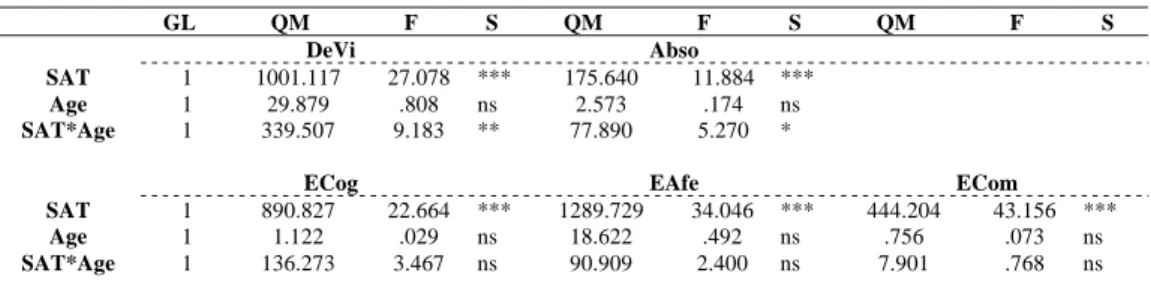
Table 1 presents the variance analyses performed with the “Anova” procedure of SPSS. Considering the main effect of satisfaction, these analyses showed that the engagement differences between the two trainee groups (older and younger) acquired statistical significance in all engagement dimensions: dedication and vigor (F = 27.078; p = .000), absorption (F = 11.884; p = .001), as well as in cognitive (F = 22.664; p = .000), affective (F = 34.046; p = .000), and behavioral (F = 43.156; p = .000) engagement. The variance analyses show that age does not represent a differentiating variable.
In what concerns the interaction effect of variables satisfaction and age, the results from the UWES dimensions show the existence of significant effects as consequence of the interaction of those variables. The interaction of satisfaction and age with dedication and vigor (F = 9.183; p = .003) may be explained considering a further result differentiation between the older subjects, with low satisfaction and presenting less dedication and vigor when compared to the younger subjects, with low satisfaction but with higher dedication and vigor averages (T = 2.172; g.l. = 53; ρ = .034). Regarding the older subjects with low satisfaction, they significantly differ from the highly
satisfied subjects, these latter showing more dedication and vigor (T = -5.627; g.l. = 72; ρ = .000).
Table 1. Analysis of result variance in engagement, considering satisfaction and age.
GL QM F S QM F S QM F S
DeVi Abso
SAT 1 1001.117 27.078 *** 175.640 11.884 ***
Age 1 29.879 .808 ns 2.573 .174 ns
SAT*Age 1 339.507 9.183 ** 77.890 5.270 *
ECog EAfe ECom
SAT 1 890.827 22.664 *** 1289.729 34.046 *** 444.204 43.156 ***
Age 1 1.122 .029 ns 18.622 .492 ns .756 .073 ns
SAT*Age 1 136.273 3.467 ns 90.909 2.400 ns 7.901 .768 ns
* p < .05; ** p < .01; *** p < .001; ns = not significant
The interaction of satisfaction and age in absorption (F = 5.270; p = .023) may be due to a further result differentiation according to the satisfaction of the older subjects – older subjects, with less satisfaction, reach lower levels of absorption. On the other hand, older subjects with higher satisfaction reach significantly higher averages in absorption (T = -3.914; g.l. = 74; ρ = .000).
3.2. Engagement differences considering self-acceptance and age
Table 2 presents the performed variance analyses. Considering the main effect of self-acceptance, these analyses showed that the engagement differences between the two trainee groups are statistically significant in all engagement dimensions: dedication and vigor (F = 15.333; p = .000), absorption (F = 7.075; p = .009), as well as in cognitive (F = 39.320; p = .000), affective (F = 19.522; p = .000), and behavioral (F = 61.547; p = .000) engagement. Once again, age does not represent a differentiating variable.
Table 2. Analysis of result variance in engagement, considering self-acceptance and age.
GL QM F S QM F S QM F S
DeVi Abso
SAP 1 740.616 15.333 *** 112.803 7.075 **
Age 1 13.765 .285 ns 5.225 .328 ns
SAP *Age 1 .836 .017 ns .998 .063 ns
ECog EAfe ECom
SAP 1 1541.586 39.320 *** 884.057 19.522 *** 581.822 61.547 ***
Age 1 16.440 .419 ns 3.537 .078 ns 4.885 .517 ns
SAP *Age 1 19.415 .495 ns 9.138 .202 ns 43.648 4.617 *
* p < .05; ** p < .01; *** p < .001; ns = not significant
In what concerns the interaction effect of variables self-acceptance and age, the behavioral engagement dimension shows significant effects from the interaction of those variables. The interaction of self-acceptance and age with behavioral engagement (F = 4.617; p = .033) may be explained considering a further result differentiation between the older subjects, with high self-acceptance and presenting less behavioral engagement when compared to the younger subjects, with high self-acceptance but with higher behavioral engagement averages (T = -2.925; g.l. = 65; p = 0.005).
Regarding the younger group, those presenting low self-acceptance differ from those with high self-acceptance, since the latter reach higher levels of behavioral engagement (T = -3.837; g.l. = 64; p = .000). Likewise, within the older group, those with low self-acceptance differ significantly from those with high self-acceptance, the latter
reaching higher levels of behavioral engagement (T = -7.419; g.l. = 71; p = .000).
3.3. Engagement differences considering satisfaction and place of residence
Table 3 presents the performed variance analyses. Considering the main effect of satisfaction, these analyses showed that the engagement differences between the two trainee groups (those living on-base and those living off-base) are statistically significant in all engagement dimensions: dedication and vigor (F = 11.095; p = .001), cognitive (F = 9.102; p = .003), affective (F = 14.129; p = .000), and behavioral (F = 16.867; p = .000) engagement, except in absorption. The variance analyses also show that the place of residence does not represent a differentiating variable per si.
Table 3. Analysis of result variance in engagement, considering satisfaction and place of residence.
GL QM F S QM F S QM F S
DeVi Abso
SAT 1 433.813 11.095 *** 45.003 3.009 ns
POR 1 115.011 2.941 ns 15.644 1.046 ns
SAT*POR 1 98.696 2.524 ns 67.284 4.499 *
ECog EAfe ECom
SAT 1 342.986 9.102 ** 527.057 14.129 *** 167. 374 16.867 ***
POR 1 47.062 1.249 ns 89.579 2.401 ns 0.073 .007 ns
SAT*POR 1 24.452 .649 ns 152.076 4.077 * 48.442 4.882 *
* p < .05; ** p < .01; *** p < .001; ns = not significant
The interaction between satisfaction and the place of residence in absorption (F = 4.499; p = 0,036) relates to a further result differentiation regarding the individuals living off-base: those presenting high satisfaction reach higher absorption levels when compared to those with low satisfaction (T = -4.295; g.l. = 108; p = .000).
In what concerns the effect of the interaction of satisfaction and place of residence with behavioral engagement, that effect is statistically significant (F = 4.077; p = .045), and this result is due to a further result differentiation within the group of individuals with low satisfaction: those living on-base reach higher levels of affective engagement when compared to the ones living off-base (T = -2.029; g.l. = 50; p = .048). We also verified a further result differentiation within the individuals who live off-base: subjects with higher satisfaction show higher affective engagement levels (T = -6.207; g.l. = 107; p = .000).
The significant effect of the interaction of satisfaction and place of residence with the behavioral engagement (F = 4.882; p = .029) may be due to a further result differentiation among individuals with high satisfaction: those who live off-base reach higher levels of behavioral engagement when compared to those living on-base (T = 2.159; g.l. = 83; p = .034). There is also a further result differentiation within the group of individuals living off-base: the subjects presenting higher satisfaction show higher levels of behavioral engagement (T = -7.134; g.l. = 106; p = .000).
4. Discussion
The results obtained allow us to state that, in general, the different kinds of engagement are heavily dependent on self-concept. However, age and place of residence were not identified as differentiating variables.
It is important to highlight that younger trainees showing low levels of satisfaction reach higher dedication and vigor values, as well as absorption, when compared to older trainees. This difference may be related to different generation values, in which the younger trainees are more energetic (Arthur & Kram, 1989; Faria, 2002; Wigfield et al., 2006), possess more cognitive predisposition and are more appreciative of new training and self-development opportunities (Taylor, 2005). This may drive the younger ones to vigorously dedicate themselves at work and in
overcoming the arising difficulties, even when experiencing low satisfaction levels. This way, trainee engagement may work as a protective factor (Veiga, 2012) against a low satisfaction that could trigger adjustment issues. It is also assumed that because this course means – to many trainees (mostly the younger ones) – the opportunity to change from a fixed-term contract situation to a permanent staff situation, as well as the possibility for the less senior (usually younger trainees) to gain seniority over the more senior trainees (usually the older ones) of that specialty, these factors may contribute to the dedication and vigorous commitment in learning expressed by the younger trainees.
Also noteworthy is the fact that the younger trainees showing high levels of self-acceptance reached higher behavioral engagement, when compared to the older ones. Considering acceptance as an integrating part of self-concept and similar to self-efficacy, a positive relationship between self-acceptance and engagement is assumed (Llorens, Bakker, Schaufeli & Salanova, 2007; Nogueira & Veiga, 2014; Pinto da Silva & Nogueira, 2008), particularly with behavioral engagement (Costa, Araújo & Almeida, 2014). These results became clearer in younger trainees, maybe because they are more energetic and more cognitively predisposed (Arthur & Kram, 1989; Faria, 2002) which – together with possible dynamic ability beliefs (Dweck & Legget, 1988), and the will to prove their worth to the more senior trainees – may translate into a higher ability to apply effort and persist through learning, hence expressing higher engagement toward training activities and the institution itself.
Furthermore, trainees living on-base and presenting low satisfaction levels showed higher affective engagement levels when compared to trainees living off-base. These results may be associated with the affective connection that the individual living on-base creates with the sheltering institution, which is understood as a provider (Herzberg, 1966; Maslow, 1954; Newstron, 2008); with the assimilation of organizational values and purposes, which favors the relatedness of the subject with the institution (Porter et al., 1974; Rhoades & Eisenberger, 2002); as well as with the fact that individuals living on-base possess few distracting stimuli, which promotes greater engagement from these trainees, particularly affective engagement.
Results show that trainees living off-base and presenting high satisfaction levels showed higher behavioral engagement levels when compared to those living on-base. It is assumed that, because it is possible for them to physically distance themselves from the workplace and return to their families, trainees living off-base may benefit from greater stress release, psychological rest and energy recovery, which may favor a greater engagement with training and the institution.
Lastly, it is noteworthy that situations with higher scores regarding the self-concept dimensions, together with the considered sociodemographic variables, have led to higher scores in the engagement dimensions when compared to situations with lower scores in the self-concept dimensions, and hereby allowing the predictions of a positive and significant relationship between self-concept and engagement, just as expressed by the literature (Fredricks, Blumenfeld & Paris 2004; Veiga et al., 2014).
5. Conclusion
The present study allowed the understanding of trainee engagement regarding self-concept and the relevant sociodemographic variables. Its results confirm that the self-systems act in order to promote or restrict engagement (Skinner, Kindermann & Furrer, 2009). Therefore, self-concept works as a “behavior regulator, which is always present as the individual’s perception of his own different sides, whether the individual is confronting himself in situations soliciting its cognitive-affective system, or when he is interacting with others” (Simões, 2001, p.33). Hence, it is important to promote a positive self-concept in trainees, so that higher engagement levels may be obtained in training and toward the institution. This would significantly benefit both the people and the institution they work for.
References
Appleton, J. J., Christenson, S. L., & Furlong, M. J. (2008). Student engagement with school: Critical conceptual and methodological issues of the construct. Psychology in the School, 45(5), pp. 369–386.
Arthur, M. B., & Kram, K. E. (1989). Reciprocity at work: The separate, yet inseparable possibilit- ies for individual and organizational development. In M. B. Arthur, D. T. Hall, & B. S. Lawrence (eds.), Handbook of career theory (pp. 292–312). Cambridge: Cambridge University Press.
Bakker, A.B., Hakanen, J.J., Demerouti, E., & Xanthopoulou, D. (2007). Job resources boost work engagement, particularly when job demands are high. Journal of Educational Psychology, 99, pp. 274-284.
Costa, A. R., Araújo, A. M., & Almeida, L. S. (2014). Relação entre a percepção da autoeficácia académica e o engagement de estudantes de engenharia. International Journal of Development and Educational Psychology, 2, 307-314.
Dweck, C. S., & Leggett, E. L. (1988). A social-cognitive approach to motivation and personality. Psychological Review, 95, pp. 256-273. Faria, L.. (2002). Diferenças no auto-conceito de competência durante a adolescência, Cadernos de Consulta Psicológica, 17/18, pp. 109 - 118. Frade, A., & Veiga, F. H. (2013). Crenças motivacionais e autoconceito em adultos: um estudo com formandos dos Cursos de Formação de
Sargentos da marinha portuguesa. Atas do XII Congresso Internacional Galego-Português de Psicopedagogia (pp. 5110-5124). Braga: Universidade do Minho, 2013.
Frade, A., & Veiga, F. H. (2014). An assessment scale for trainee engagemen in the portuguese navy. Proceedings of EDULEARN14 Conference, Barcelona.
Frade, A., & Veiga, F. H. (in press). Motivação, envolvimento e autoconceito: um estudo com militares dos cursos de formação de sargentos da marinha portuguesa. In Veiga, F. H. (eds.) Atas do II Congresso Internacional Envolvimento dos Alunos na Escola: Perspetivas da Psicologia e Educação. Lisboa: Instituto de Educação da Universidade de Lisboa, 2016.
Fredericks, J. A., Blumenfeld, P. C., & Paris, A. H. (2004). School engagement: Potential of the concept, state of the evidence. Review of Educational Research, 74, pp. 59 – 109.
Herzberg, F. (1966). Work and the nature of man. Cleveland: World Publishing Company.
Llorens, S., Bakker, A.B., Schaufeli, W.B., & Salanova, M. (2007). Testing the robustness of the job demands-resources model: Erratum. International Journal of Stress Management, 14, pp. 224-225.
Maslow, A. H. (1954). Motivation and personality. New York: Harper and Row.
Nogueira, J. & Veiga, F. H. (2014). Relationships as a basis of engagement? Self-eficacy and school engagement of pupils in school. In Veiga, F. H. (eds.) Envolvimento dos Alunos na Escola: Perspetivas Internacionais da Psicologia e Educação (pp. 373-385). Lisboa: Instituto de Educação, Universidade de Lisboa.
Newstrom, J., W. (2007), Organizational Behavior Human Behavior at Work. New York : McGraw-Hill.
Pinto da Silva, M. R. & Nogueira, J. (2008). A Auto-eficácia: Implicações em contexto militar. Revista de Psicologia Militar, 17, 11-25. Porter, L. W., Steers, R. M., Mowday, R. T., & Boulian, P. V. (1974). Organizational commitment, job satisfaction, and turnover among
psychiatric technicians. Journal of Applled Psychology, 59, 603-609.
Rhoades, L, & Eisenberger, R. (2002). Perceived organizational support: A review of the literature. Journal of Applied Psychology, 87, 698-714. Schaufeli, W.B. & Salanova, M. (2007). Work engagement: An emerging psychological concept and its implications for organizations. In S.W.
Gilliland, D.D. Steiner & D.P. Skarlicki (eds.), Research in social issues in management: Vol. 5. Managing social and ethical issues in organizations. Greenwich, CT: Information Age Publishers.
Schaufeli, W. B., Salanova, M., González-Romá, V., & Bakker, A. B. (2002). The measurement of engagement and burnout: A two sample confirmatory factor analytic approach. Journal of Happiness Studies, 3, 71–92.
Simões, M. F. (2001). O interesse do auto-conceito em educação. Lisboa: Plátano Edições Técnicas.
Skinner, E. A., Kindermann, T. A., & Furrer, C. J. (2009). A motivational perspective on engagement and disaffection: conceptualization and assessment of children’s behavioral and emotional participation in academic activities in the classroom. Educational and Psychological Measurement, 69 (3ªed), pp. 493-525.
Taylor, J. (2005). The next generation of workers in Australia: their views on organizations, work and rewards. International Journal of Human Resource Management, 16, 1919-1933.
Veiga, F. H. (2012). Transgressão e autoconceito dos jovens na escola (3ªed.). Lisboa: Fim de Século.
Veiga, F., Robu, V., Appleton, J., Festas, I., Galvão, D. (2014). Students’ engagement in school: Analysis according to self-concept and grade level. Proceedings of EDULEARN14 Conference, Barcelona.
Wigfield, A., Eccles, J. S., Schiefele, U., Roeser, R., & Davis-Kean, P. (2006). Development of achievement motivation. In W. Damon (Series Ed.) & N. Eisenberg (Volume Ed.), Handbook of child psychology, 6ªEd. Vol.3. Social, emotional, and personality development (pp. 933– 1002). New York: Wiley.