International Sustainable Development
Research Society Conference
Lisbon, Portugal, 13-15 July 2016
Edited by: João Joanaz de Melo, Antje Disterheft, Sandra Caeiro, Rui F. Santos and Tomás B. Ramos Universidade Nova de Lisboa
Campus de Campolide
Proceedings
Proceedings of the
22
nd
International Sustainable Development
Research Society Conference
ISDRS 2016
Rethinking Sustainability Models and
Practices: Challenges for the New and Old
World Contexts
Volume 3 of 3
Edited by:
João Joanaz de Melo, Antje Disterheft,
Sandra Caeiro, Rui F. Santos and Tomás B. Ramos
July 2016
ISRDR 2016 was organized and hosted on behalf of ISDRS
by the Center for Environmental and Sustainability Research,
School of Science and Technology, Universidade Nova de Lisboa
Copyright © International Sustainable Development Research Society (ISDRS) and Faculdade de Ciências e Tecnologia, Universidade Nova de Lisboa (FCT NOVA)
Note: the Proceedings as a whole are subject to copyright by ISDRS and FCT NOVA. Individual authors have the right to self-archive and disseminate their own papers, and are also free to seek their publication in scientific journals.
Edited by: João Joanaz de Melo, Antje Disterheft, Sandra Caeiro, Rui F. Santos and Tomás B. Ramos
Title: Proceedings of the 22nd Annual International Sustainable Development Research Society
Conference
Subtitle: Rethinking Sustainability Models and Practices: Challenges for the New and Old World Contexts
Volume 3 of 3
Published by the International Sustainable Development Research Society and the Center for Environmental and Sustainability Research, School of Science and Technology, Universidade Nova de Lisboa
Digital edition only Lisbon, July 2016
ISBN: 978-972-674-791-8 Cover design: Nuno Videira
CENSE - Center for Environmental and Sustainability Research Faculdade de Ciências e Tecnologia, Universidade Nova de Lisboa 2829-516 Caparica
Portugal
Phone: +351-212948397 Fax: +351-212948554
Email: [email protected], [email protected]
www.cense.fct.unl.pt www.fct.unl.pt
International Sustainable Development Research Society
Creative Practices Around the Production of Cork
António Gorgel Pinto1, Paula Reaes Pinto2, Şölen Kipöz3
1AntónioGorgel Pinto, CIAUD/FAUL, [email protected] 2 Paula Reaes Pinto, CIAUD/FAUL, [email protected] 3ŞölenKipöz, Izmir University of Economics, [email protected]
Abstract
Cork, as a natural product provided by the bark of the cork oak tree, is an important staple of the Portuguese economy and important to Portuguese culture. It is a sustainable product with a positive ecological footprint, from harvesting to industrial production, with the advantage of creating a local economic model through regional labour activity and distribution. Within the balance between nature-human-economy to create a sustainable system, cork production in Portugal represents a human and social dimension. By focusing on that dimension and by creating an awareness of the cultural and social impact of the activity and by re-appraising the meaning of the material within the culture, the study reframes a consideration of the actual place of labour and production. The human, geophysical, historical, social, economic, ecological and cultural aspects of the place are observed as regards their relation to work or labour in that physical space. A pilot study is being developed in the village of Azaruja in the district of Évora, Portugal. In this small locality, cork is very important in terms of the relationships between the physical subsistence of their residents and the local natural resources, because it structures the place in its cultural, social and economical dimensions. This paper outlines the theoretical foundations, the process and the outcomes of the participatory ecodesign project titled Creative Practices Around the Production of
Cork which was initiated by a Portuguese artist/design researcher and developed further through
the collaboration with the other two authors, one a Portuguese visual artist/researcher and the other a Turkish fashion designer/theorist. The investigation focuses on questions that expand the notion of place for artists and designers, filtered through the lenses of manual labourers in order to understand their physical, social, cultural and economic relationship with the environment. To create the process of interaction with the place and the people, a creative collaborative dynamic is developed between the authors with their range of artistic sensibilities and the local population. To adopt a holistic notion of sustainability and cultural identity a process of investigation is designated to: (1) analyse, test and interpret - through the dissemination of life stories, visual representation of the place and the creation of cork objects - the importance of culture related to the labour activity of a local natural resource that determines and structures the region; (2) to give public recognition to those involved, taking into account their sense of belonging to the place and in order to show the value of their sustainable labour activities related to local natural resources; (3) to contribute to the knowledge of the place and to its dynamism through an aesthetic approach to labour activities. With reference to fields of knowledge such as anthropology, the social arts and sustainable design, a practice-based research is conducted with collaborative and participatory design methods to create an open model of interaction which involves local people in the realization of the project. Outcomes of this research will be presented in the paper as a survey analysis with theoretical conclusions.
Keywords: Cork Production; Social Sustainability; Material Culture; Social Arts and Design;
Co-design, Social Innovation
1. Introduction
The project entitled Creative Practices Around the Production of Cork is a transdisciplinary research focused on the design discipline, which is conducted by three researchers - two Portuguese visual artists, António Gorgel Pinto from the Research Centre for Architecture, Urbanism and Design (CIAUD) at the Faculty of Architecture, University of Lisbon (FAUL), and
Paula Reaes Pinto from Art History Centre and Artistic Research (CHAIA) at the University of Évora, and from Research Centre for Architecture, Urbanism and Design (CIAUD) at the Faculty of Architecture, University of Lisbon (FAUL), whose research focuses on the sphere of social design, and Turkish fashion designer, theorist Şölen Kipöz, from the Izmir University of Economics (IUE), who has developed her theoretical and creative work in the field of ethical, social and sustainable fashion design and the transfusions and interactions between fashion, design and contemporary art. The research was initiated by Paula Reaes Pinto as a part of her post PhD studies at FAUL. The idea has emerged due to her interest in the village of Azaruja, which she found relevant to her research in the field of public art and participatory design, sustained by an integrated view of place connecting it with humane, geographical, biophysical, economic, political, social, cultural, historical and ecological dimensions in its locality. This perspective is focused on the relation between labour activities along with the local and natural resources that are expressed in the territory. Within the territory investigation process, this researcher decided to expand the project into a team of researchers including the other authors of this paper, considering that they all share common interests in the sphere of socially engaged art and design (Reaes Pinto, 2013: 24).
The study is based on a consideration of the local place formulated around cork labour activity which represents the social and humane dimension of sustainability. Within this frame, the humane, geophysical, historical, social, economic, ecological and cultural aspects of the place are observed primarily as they are related to the workforce or labour activities in that place. The place plays a key role in the study, because it is a way of learning about the relations of local people amongst themselves and within their environment (Reaes Pinto, 2013: 30).
Azaruja is a village located in the Alentejo region in the south of Portugal, and belongs to the district of Évora - a city located about twenty kilometers from Évora. Since its founding, in the second half of the eighteenth century, with the establishment of cork factories by British and Catalan companies, Azaruja has became the main "cork center" of Alentejo. By the 60s when the "cork crisis" and emigration occurred, the Alentejo village began to lose its population and its importance in the cork processing industry. Currently, there remains a large planted area from which comes some of the best Portuguese cork, some associated industrial units, and a great cultural heritage for generations of the inhabitants of Azaruja.
The aim of the study is to analyse the concepts of social sustainability and social innovation through design as a key feature of community resilience. Correspondingly the value and meaning of cork in relation to its labour activities in the village of Azaruja constitutes a field study for the research. By adopting a method of action research which involves two parts: (1) in the first part, field trips to cork forests and factories, visits to local industrial units, and to the cork industry professionals in their labour activities, in personal interviews with the locals and representatives of stakeholders - contacts made with the chairman of Parish Council, factory owners and workers, the retired people to be found on village streets - to be able to observe and collect information on their biographical stories, the processes and means of cork production from the stripping of trees up to the processing of the product; (2) the state of the art in relation to the local community, as well as the organisation of workshops and creative meetings between researchers, workers and their families, which are conducted by the use of different artistic media and by using co-creation and co-design methods. These workshops, which aimed at creating awareness of the richness and value of local culture, along with the sense of dignity and solidarity of the community members, played a key role in fostering social innovation through creative practices, in which craft skills and the knowledge of design merged. In the paper all the stages of these implementations have been clearly illustrated with their limitations and possibilities. Finally, the further study, which is already planned, will be the development of a design local object with the use of cork, simultaneously utilitarian and symbolic, resulting from the collaboration between a group of local people together with the three authors of the research. This last phase is not covered in the paper because it is a work in progress.
2.1. A Model for Social Sustainability
If sustainability is the measure of resilience and capacity of a system to repair itself when it is damaged (Tonkinwise, 2008: 380), the three components of the human, economic and environmental aspects of the sustainable system are equally important. If we consider that we live in an artificial ecology surrounded by man-made things, it is the responsibility of humans to make this world habitable by creating a balance between the needs of humans, environment and the economic system. If the design is another means of artificial ecology which we, humans, and other living species of the ecosystem survive in, the ultimate responsibility of the designer would be to create a habitable world through design. As Manzini puts: “A habitable world in which human beings not merely survive but also expand their cultural and spiritual possibilities” (Manzini, 1995: 220).
The cultural and spiritual possibilities refer to the social dimension of sustainability which can be rendered as the social conditions of human beings who generate and who use the artificial, as well as the social impact of all the implementations in creating a sustainable design culture. The quality of our lives is very much connected to our natural resources and to our means of material culture as well as to our economic means of survival. Thus, the generation of the social aspect of sustainability and the creation of natural well-being and economic development are equally important. McKenzie (2004: 12) gives a definition of social sustainability as: “a life-enhancing condition within communities, and a process within communities that can achieve that condition”. The indicators of this condition would cover a wide range of features from equity in terms of accessing services, intergenerational relations, cultural integration, participatory citizenship, a strong social cohesion, community responsibility and action for the common good of the society to enhance the “social capital”. Social capital is a public good shared by a number of individuals, refers to the idea that social bonds and social norms play an important part in sustainable livelihoods (Padovan in Andersen and Turker, 2006: 65-85).
Within the field of the production of cork which is both a natural and financial capital in Portugal, regional cork labour activities represent a community-based sustainable model which has been established through continuity and community resilience. It has been indicated that the capacity of production has reduced through the years like all the local production models – according to the chairman of the Parish Council of the Azaruja village in 20 years the number of companies has been reduced from 24 to 5, and social and economic conditions have changed due to political decisions and global market requirements. However, a sustainable model of the know-how of cork production, from harvesting and stripping to cutting, cooking and production of objects from cork, as well as recycling the production waste has not changed for years. Under these conditions this study seeks to show how a society based on regional cork production in Portugal represents a resilient community whose members develop personal and collective capacities that respond to and influence change, sustain and renew the community, and develop new trajectories for the communities’ future (Magis, 2010: 402).
Socially sustainable communities are equitable, diverse, connected, democratic and provide a good quality of life to members (McKenzie, 2004: 18). Understanding the role of design in creating and maintaining sustainability for the social good of these communities is becoming important. Social good is becoming a key driver for design with the rise of social design with more social needs and values are brought into the field of design bringing an ethical dimension to design (Schwarz and Krabbendam, 2013: 12). Dimensions of the social sustainability of cork production labour society as which makes for a resilient community can be discussed as follows.
2.1.1. Equity
Equity refers to equal access to and distribution of society’s benefits and costs, and social justice for all economic and social groups, as well as equality within and between generations (Haq, 1999; Magis and Shinn, 2009; Polese and Stren, 2000 in Magis, 2010: 412). Equal and open access of services requires a shared ownership as “common” which refers to the creation of a pooled community resource, owned by no-one, but used by all (Hardin, 1968; Ostrom, 1990; Goldman,
1998 in Padovan, 2006: 70).
Sustainable development that relies on a commitment to equity with future generations requires intra and intergenerational equity (Weiss, 1992: 1). While the intra generational condition of ensuring equitable access to resources occurs within the current generation, intergenerational equity refers passing the resources that they themselves had inherited to the next generation. Manzini (1995 in Buchanan: 234) referred that the role of designers should be directed not only to present generations but also to future ones with the possibility of leaving them an inhabitable world. According to Weiss, intergenerational equity states that all generations have an equal place in relation to the natural system, and that there is no basis for preferring past, present or future generations in relation to the system (Weiss, 1992: 20). So, as well as we are a part of the natural ecosystem we are a part of a heritage in transmitted in between generations.
The knowledge and experience of cork production inherited in Portugal dates back to the 18th century with the systematic cultivation of cork forests. The know-how of cork through all its processes has come down to us today by passing through different generations. Even the objects made out of cork survived traditionally as a part of Portuguese material culture.
2.1.2. Localism & Crafts
The use of local knowledge in developing hand made cork products of time-tested and durable designs has naturally produced a sustainable and slow model of production which is also dependent on the life cycle and harvesting process of cultivated cork trees. In contrast to the fast commercial global model of harvesting in other industries, the pace of cork production is in tune with natural cycles; it takes 35 years to grow a cork tree and stripping can only be done every 9 years time in order to safeguard the health of the trees.
Due to the use of tacit knowledge which is inherited in this geography, to appropriate the process of cork production and the design of the cork products into the global industrial systems is quite difficult. The knowledge, which refers to the idea of “knowing more than we can tell” by Polanyi is defined as “an art which cannot be specified in detail, cannot be transmitted by prescription, since no prescription for it exists. It can be passed on only by example from master to apprentice. This restricts the range of diffusion to that of personal contacts, and we find accordingly that craftsmanship tends to survive in closely circumscribed local traditions” (Polanyi, 1958: 52 quoted from Decrochers, 2001 in Kipöz, 2015). This kind of knowledge opens a path for a sustainable design epistemology which is shaped by the use of crafts, but more importantly it refers to an accumulation of a wisdom which is transferred in between different generations (Kipöz, 2015:120). The local and traditional knowledge as well as community members’ experience and understanding of the community confer on them has an important role in the community’s well-being (Berkes et al., 2003; Gunderson and Pritchard, 2002 in Magis, 2010: 405) The Portuguese cork industry also implies a glocal model which adopts the idea of “think globally and act locally“ where local becomes a site of resistance against global culture. According to Clark the utilization of localized physical and social resources can provide an alternative to standardization, centralization and moreover to identical products imposed by the global system. This gives rise to a kind of local economy as “distributed economy” where the global is comprised of a network of local systems (Clark, 2008: 430). In addition to this, as Hall referred, strong local institutions and infrastructures creates relations of trust based on face to face contact, and these kind of productive communities historically rooted in a particular place illustrates a strong sense of local pride and attachment (Hall, 1992: 319 quoting Robbins in Clark, 2008: 432).
2.1.3. Collective Memory
A productive community generates its resilience through knowing and re-producing their collective memory with a sense of belonging and attachment to community values. Against to the erosion of cultural and collective memory due to lack of intergenerational equity and to the cultural prejudices of the global system, local communities develop a kind of collaborative action in the form of solidarity and social responsibility. Solidarity refers to union arising from common
responsibilities and interests between the members of the community. For Manzini, within the designer’s ethical conduct, responsibility and solidarity are directed not only to present generations but also to future ones (Manzini in Buchanan, 1995: 234). Expanding solidarity among generations and promoting intergenerational solidarity through building partnerships between youth and elderly people, ensures the transfer of knowledge and culture forward through meaningful exchanges among persons of all age groups (Cruz-Saco and Zelenev, 2010: 10). This can be facilitated through recreational activities which could bring people from different generations together. In developing creative practices in cork production, craft skills and design of cork products could be transformed into contemporary works of do-it–yourself practices (Kipöz, 2013:3) and or a co-creative collaborative design practices in which participants could have a more active role within the system, as illustrated in the following parts of the article.
Finally, addressing the idea of dignity in building the collective memory in relation to social sustainability and community resilience would preserve and create a defense against the fragility of members’ social, economic and cultural conditions. For design, the defense of dignity begins with the recognition of the subjects to whom work is addressed in the public sphere (Dilnot, 2008: 188). Bonsiepe referred to the public domain as the third design virtue in the future through which socially devastating effects of unrestricted private interests have to counterbalanced by public interests in any democratic society (Bonsiepe, 1997: 107 quoted in Dilnot, 2008: 188). Hence the sense of pride and dignity would come from the recognition of the labour force of cork workers in the public sphere, and would be transformed into a value to be socially shared and transmitted on intra and intergenerational levels.
2.2. The Creative Process and Project Development
Design is a practice that involves various protagonists and different methods in various social contexts. These are factors that inform each other and can result in different possibilities of participation and interaction between the designer and the user. Bearing in mind that there is always a relationship between the parties involved in the design process, the concept of participation is something that is at the root of the design culture. Overall, design is developed in two different frames, on the one hand it is an "abstract" logic in which experts in areas such as urban planning, architecture and design, apply their knowledge without the direct involvement of the stakeholders, on the other hand it is a "concrete" form of understanding that encompasses empirical experiences (Lee, 2006: 2).
Under the project in development in Azaruja, the practice used has sought the engagement of a greater number of representatives from the local culture, in particular through the participation of people from different generations, which play the role of empirical designers. Despite not dominating the methods and creative methodologies used by experts of design and visual arts, the majority of those involved have vast knowledge about the cork tradition and all that it involves. In this way, it is hoped that the researchers’ collaboration with a volunteer group in Azaruja results in the production of both useful and meaningful content, both for local culture and for society in general.
In this context, it should be noted the concept of co-design, which brings together various practices of contemporary design, such as participatory design, meta-design, social design, among other ways involving the participation of users in the design project. The presence of the various stakeholders in the problem’s perception and context is important in order to obtain more effective results. It "is a commitment regarding inclusion and power" that proceeds differently in relation to the creation and production of the dominant agents, which are based on a hierarchy that determines and enforces what users supposedly require. Co-design is a logic that “is at the core of a more democratic, open and porous design process and is finding expression in the business and not-for-profit sectors” (Fuad-Luke, 2009: 147).
It was used an empathetic approach as a methodology of interaction and co-design, whose aesthetic is anchored on the paradigm of listening and talking to the local people. After it has been explained what we wanted to do they were encouraged to participate in the project. They were given voice by means of the life stories that they recounted. The development of the project
is being built on the intersubjective vulnerability, since the whole process only exists with the collaboration of the local inhabitants.
2.2.1. Listening to the Other
The non-hierarchical knowledge was valued in this project by sharing the personal experience of each collaborator through listening and trying to understand them. “The predisposition to listen to and, as a consequence, the relational character of the project, has been extended to areas of knowledge extrinsic to art, to be understood in a comprehensive manner and transverse to life itself“ (Reaes Pinto, 2013: 371). The approach of listening to the Other was inspired by the concept of enlightened listening, addressed by the philosopher David Levin (1989: 223), which is based on mutual listening, in the case of this project, between the artists, designers and the participants, stimulating inter-knowledge between both (Figure 1). The theory of the philosopher Gemma Fiumara (1995: 19) is also considered as it contests the rationalist discourse authority of the western culture which doesn´t gives space to listening to the Other. On the contrary, Fiumara defends the processes of listening, anchored on non-hierarchy of cultures, as a way to build knowledge, aiming to equilibrate the speech. Creating an open dialogue to create an equilibrium among members of society and between the members and people outside of the community has a key role within the principle of equity in regards to social sustainability.
As collaboration practices use an ethical approach and principles of reciprocity for giving voice to the difference, weakening the author autonomy, it is considered that the artistic project is developed through the interdependent relationship of all the actors involved. In this way, collaboration is a strategy of the authors that uses intersubjectivity as its medium, involving openness, responsibility, respect and confidence. This notion of collaboration is associated with the concept of connected knowing, which was an expression used, for the first time, in the study “Women’s Way of Knowledge”, by Mary Belenky, Blythe McVicker de Clichy, Nancy Rule Goldberg and Jill MattuckTarule, published in 1986. Connected knowing is developed on the subjective belief that the most credible knowledge comes from personal experience and not from an imposition established. Dialog is the ground of knowledge, through which each participant, sharing his own experience, try to learn from the knowledge of others, by means of an empathic approach. Thus, shared knowledge is learned through the perspective of another person. (Belenky; Clichy; Bygolberg; Tarule, 1986: 112-113).
2.2.2. Fieldwork Methodology
The Creative Practices Around the Production of Cork are “focused on co-design, supported by an integrated perspective of the place, understood in its complexity – combining human, biophysical, geographical, economic, political, social, cultural, historical and ecological aspects that largely characterize local life experiences”. Another important point of this “investigation reframes a consideration of place organized around labour as the core concept” (Reaes Pinto, 2013: 229, 231).
Regarding the methods used, in all the project development phases, the research used the methodologies of fieldwork and interaction design, demanding periods of residence. The fieldwork functioned both as a participatory design methodology and as an art practice, not being a scientific experiment. The methodology of fieldwork, which has been characterised, briefly, by constant dynamic interactions between the researchers and the local inhabitants, their activities and the places where they work, stay or study, also has a relation with what is called research-action, in the way that it is a methodology that "makes the actor researcher, and vice-versa, and leads the action for research purposes. Its starting point is particular, since it bases its dynamic on the action, and considers the actors not as passive objects of research, but as participants". This is an unbroken process which affects all the research (Guerra, 2000: 53).
The singularity of action research is centred on intentional interaction between research and action. Thus, "the knowledge is produced in direct confrontation with the real, trying to transform it, and social knowledge is produced collectively by social actors deconstructing the role of "expert" normally assigned to (investigator)" (Guerra, 2000: 75). This social knowledge produced collectively becomes a way of re-constructing collective memory within the community. The experience of working on the ground can personally change the investigator, as he is exposed to the repercussions of context (Augé; Colleyn, 2004: 79). As a matter of fact we were always enhanced by the experience of the several approaches conducted so far within the community of Azaruja through direct and participatory observation and by a survey of the place through audio, video, and photographic records (Figure 2).
The work was developed from various site visits, during which the authors were creating bonds of familiarity with the population. This direct observation is a case of participant observation, in so far as it results from the permanence of the researcher in the locale, "who attends the largest number of sites as possible in the social context in this study, and has a constant presence in the greatest number of activities possible that occur there, being in a permanent conversation with people that belong there" (Costa, 1986: 137).
2.2.3. Biographical Dimension
So far visits have been made to some local factories operating in cork processing for different purposes, but all of them only work at the level of cork preparation. Among other businesses and activities more or less related to cork, there were visits to a small family cutlery factory with a great tradition in the region. The extraction of cork from the trees was also observed, meeting the workers and getting to know their tasks. Two very early morning visits were made to Serra d’Ossa, which are the surrounding mountains of Azaruja, to observe this seasonal work. The activity must be done in summer in very hot temperatures to peel off the cork more easily and without damage to the tree.
Also important was dialogue with local inhabitants including the Chairman of the Parish Council of Azaruja and with retired cork workers. All of these site visits are marked by a constant relational character, especially through the recording of life stories. According to the anthropologist Daniel Bertaux (1997: 94) “biographical accounts make visible the social element in its multiple sides rather than being a mere reflex of disconnected abstract structures - the social element emerges as an armour made of living experiences.” These experiences that took place stimulated the development of the creative process.
The biographical dimension of the project, based on the collecting of Azaruja’s residents’ life stories, was related, essentially, with our belief that this is the more direct methodology to communicate the realities, either distinct as collective, of these people (Reaes Pinto, 2013: 352-353). The anthropologist Adolfo YanezCasal (1997: 87-88) states that the importance given to life and to the experience of each one tell us about “the humanist profile, plurality and diversity of real individuals living there and of the multiple cultural manifestations led by people; biography allow us to discover the links of a personal story with a social macro-history” (Reaes Pinto, 2013: 353 quoting Casal, 1997: 87-88).
The biographical dimension cannot be dissociated from the relational context, that in the Creative
Practices Around the Production of Cork case focused on the dynamic originated by the
interaction, always in mutation, between the researchers and Azaruja’s inhabitants. Characterised by distance and proximity, this interaction is denominated by anthropologist Susana Durão (1997: 176) as “intermediate space”. Distance marks the beginning of a relation between the investigator[s] and the Other, proximity is being constructed through dialogue that is dissolving distance [and create a place of intimacy] between researcher[s] and local people of Azaruja, with the multiple sharing of complicity (Casal, 1997: 94 e Schneider, 2006: 16). In this sense and in the context of the project concerned, interaction resulted in a real contribution to the creation of ties and mutual learning between investigator[s] and Azaruja´s participants, as well as a means of facilitating the inclusion of local inhabitants in the later stage of co-creation of one or more symbolic and utilitarian objects.
2.2.4. The Project Workshops and Future Steps
Some workshops with the youth population were also organized, in particular in the field of photography and assemblage. On the photography sessions the idea was to represent the Azaruja landscape, and over the assemblage activity the objective was to experiment with different cork materials. At the same time the participants were invited to think about Azaruja’s culture and particularly about the cork tradition.
The photography workshop occurred in the summer vacation. The youngsters started taking pictures using the pinhole process, followed by the use of 35mm and digital cameras. After the safari in and around Azaruja, taking pictures with different machines, the workshop continued in the local primary school where it was improvised a laboratory for developing the pictures. The last workshop activity was related to enhancing the images using Photoshop (Figure 3).
Figure 3. Photography workshop.
Early in 2016, before the assemblage workshop took place, some educational sessions at the same school were also organized in school hours during which some retired cork workers from Azaruja were invited to be interviewed and share their stories of working life with children. This has been very effective way of generating intergenerational equity and intergenerational solidarity among the members of the community. Some of the kids in the class were the same that were part of the photography summer activities. During this period the workshop in the sphere of assemblage was promoted and organized involving, the same children, at the same place. This was followed by the assemblage activities, which were part of a game specially designed for the purpose in question, namely a card game in which each card has some specific information about cork and all that is concerned with its environment.
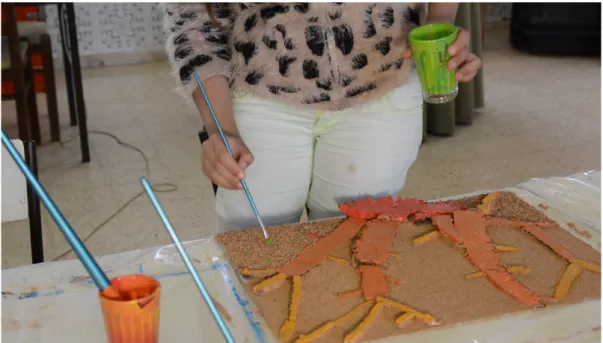
In this context, each child picked up a card with a paragraph and some keywords about the labour activity, or what is associated to it, aiming the production of a cork assemblage work. At the end, some of the kids painted some parts of their works (Figure 4). All of these initiatives were intended as creative strategies for the plastic involvement of young people with cork and other derived materials, as well as raising awareness of the richness of the environment where they live. It is important that they respect the mutual learning between all generations as a means of intergenerational solidarity and responsibility and that they understand and use creativity as a means of knowledge and development. In the course of all approaches, some videos were shot as a way to document the entire process.
Figure 4. Assemblage workshop.
After the involvement with the community and the collection of data through dialogue, as well as the videos and works produced in the workshops, an event to show every intervention was organized, which occurred in a centenary local association, well-known in Azaruja for its recreational and cultural activities. The people involved and represented in every activity were invited to attend the tribute, which was based on a snack with some regional products in order to promote the interaction between people, as well as to stimulate a reflection and dialogue on the issues surrounding the cork and Azaruja’s culture. This symbolic moment was also important to explain the concept of the project, the main objectives, as well as the set of actions that would follow later to those present.
It is also planned to develop the design of one or more utilitarian cork objects of Azaruja's material culture, through the use of contemporary industrial processes of Cork transformation. In this process, along with authors of the research, a group of young people from a local association and several adults, including some cork industry pensioners will be included. The outputs of the Co-design process will be executed as prototypes of the Co-design object(s). This part of the co-creative workshop series would allow us to observe the continuity of the material culture, the intergenerational relations around these objects, and be able to generate possible outcomes as an outcome of crafts and design culture for the future.
3. Results and Discussion
3.1. The Project Symbolic Role and Visual Communication
Co-design is a design hybrid stream that combines different artistic practices, as well as other fields of knowledge, for the benefit of society. It is a culture of design whose practice focuses on the development of ideas, objects and functions, imbued with meaning, based on collaborative processes open to participation of users and non users, even if the contribution made by any participants it is not always constructive. The dialogical form, in creating a culture which listening is equally important to speaking is crucial for the development of this kind of social innovation by design. In this context, in addition to the critical and creative skills, it is important that the expert designer develops his dialogic ability, so that he can interact and optimize the co-design process. The dialogical method should not be used as a tool to control the co-design project, but to stimulate it and maintain it open (Manzini, 2015: 53, 67).
An important aspect in the practice of social design is its dissemination to stimulate society’s thinking on social issues. In this context, there are various ways that usually give visibility to
co-design projects, among which are the mapping of social phenomena, the creation of communication contents, sociological research by collecting life histories and the construction of real or fictional representations. With regard to mapping social phenomena of a particular place or community, the aim is not only the representation of events in space, but also the creation of a reflection tool for the development of the place itself. The creation of media content of the actions occurred is also important, since without this kind of representation, the impact on both the community engaged and on the rest of society would be significantly reduced. The communication resulting from content creation is also relevant because it informs the creative process of collaboration. With regard to the sociological and anthropological research through the collection of life stories, this is an important tool because it enables the transmission of significant personal and collective experiences to the community. Finally, the construction of real or fictional representations is another possibility to spread co-design projects, which results from the projection of a social innovation image to be further discussed among all participants. This approach begins with the definition of a scenario where their motivations are identified and taken up, followed by the development of a detailed strategy with the necessary actions to achieve the conceived idea (Manzini, 2015: 122-132).
In the social engaged art practice currently underway in the village of Azaruja, the visual communication of all project phases is a central element for the whole dynamic being developed. Whether on denotative or connotative terms, the multiple site interventions aim to inform the project itself, as well as its participants, in order to stimulate all the co-design process. The creation of symbolic visual content allowed the participants' achievement of transforming the "tacit knowledge" inherited in their crafts skills of making cork into potential art and design skills, to be rendered visible for other external observers. This visibility has a key role for their dignity and social solidarity in regard to their local culture.
This art and design practice focused on solving problems and simultaneously with a strongly symbolic character, enhances the visual arts vocation for the perception on the many issues that affect the common good. It is the combination of two sensibilities that usually occur independently, notably the ethical and aesthetic senses, whose combination enhances a particular dimension for the interpretation and communication of critical and constructive perspectives in the benefit of society. At the same time “this type of sensory knowledge, subject to reflection and reproduction, produces a fundamental effect for the development of intersubjectivity” (Gorgel Pinto, 2015: 87).
3.2. Limitations and Possibilities of Co-Design Process
One of the limitations of the site visits to Azaruja and its surroundings has been the lack of financial support. Apart from the expenses of the trips between Azaruja and Lisbon – a distance of 280 km - this kind of project requires sufficient time for long-stays, which includes accommodation.
During the meetings in the factories, we faced with a particular problem about interview recording due to the noise produced by the machines. In relation to the dialogues with local people, although through interviews we could provide extensive information and insight about the way the local people think, they could be much more focused.
Within the photography workshop with youngsters, as we could not show, immediately, part of the output of the images they produced right away, we didn’t have their feedback. However they were very interested and very collaborative in the workshop.
Regarding the interviews with elderly people at the local primary school, the results were more descriptive in regards to the processes of their cork labor activities, rather than those related to the telling of their life-stories. For further studies interviews could be re-formulated in a more interpretative way.
The methodology of interaction based on an empathic approach used in this research was one of the strengths of the field work, as a means of bringing the researchers and the local people of Azaruja together, building ties between them and involving them in the collaboration process of the project. This also allowed us to understand their social reality in-depth; to appropriate the life stories told by local people as raw material for the development of the project; to share life
experiences and learn from the biographical knowledge of each one, facilitating the reflection and creative production of knowledge. Another possibility lies in the understanding of the interconnection of the diverse aspects of life with all the routines and activities of social life in Azaruja through a holistic approach, to help us understand the processes, the places and the people involved in cork production. It was, therefore, necessary to make regular visits and stays at the largest possible number of places and engage in an ongoing dialogue with the people involved (Costa, 1986: 137).
In relation to the educational sessions, the strengths are the intergenerational learning, the respect for the richness of the place where they live and the understanding of the creativity as a means of knowledge and progress. The participants embraced the workshops enthusiastically. The elderly people who went to the local primary school to share their experience as cork workers were proudly speaking of their experiences and the children hearing them - some of them were their grandsons and granddaughters – were made aware of their value. Dynamic interaction was created amongst all the people involved - the teacher, the children, the retired cork workers and us (researchers) .The interaction and participation based on dialogue were fruitful both for bringing people together and for preparing children for the make-up and structure of the workshops.
With respect to the exhibition, the importance of its results must be underlined - local people, namely the collaborators of the project, were there. They were very proud of the project as it values the culture of Azaruja and includes local participants in its development. Another possibility achieved was the formation of a local team for the development of a co-design project. In addition to this we also must emphasize the involvement of the residents of Azaruja in preparing the local traditional foods for the event.
4. Conclusions
In this paper, the creative potential of labour practices in Portuguese culture is examined within the frame of social sustainability. An environmentally sound material, cork, has been considered as a paradigm of sustainable culture in Portugal not only for its ecological footprints and economic value but also due to its social and cultural capacity to create resilient communities. The labour activities around cork represent the social and human dimension of sustainability upon which the study focuses. In the first part of the paper, the framework of social sustainability is examined through the concepts of equity in terms of access to services, participatory social system and intra and intergenerational levels; a realization of the value of of local culture and local crafts such as the skill of cork workmanship against the imposition of global culture; and the importance of dignity and solidarity to create a collective memory. In the second part, the field study conducted in the region of Azaruja in the form of the action research through co-creative workshops with the residents and cork labourers of the place. Here the collaboration between professional designers/ artists such as the authors of the research and people who have an extensive knowledge of cork is achieved through reciprocal listening to stimulate non-hierarchical inter-knowledge which equilibrate the speech and dialogue as a means of social equity. In this frame questioning the authorship and deconstructing the role of expert created an open, respectful, responsible and trustful relationship between parties.
The study also challenged the epistemology of creativity - creative practices, transforming the tacit knowledge which is inherited in the local know-how of cork, into a non-hierarchical and connected knowledge through the participatory process. Reconsideration of the place of labour activity within its locality, in which social knowledge is regenerated for the reproduction of collective memory. In particular the photography workshop with children of cork workers allowed the participants to re-identify the place with a sense of belonging and attachment. A dialectic relationship between distance and proximity in regard to the relation between the researcher and the cork worker, has been the driving force of this collaboration. However in these relations the distances are dissolved through the non-hierarchical dialogue between parties. Apart from the dialogue between researchers and the workers, it was observed that the communication between the members of the community which refers to intra-generational equity, and dialogue between different generations of the members which refers to intergenerational equity has been enhanced through the
workshops. The next stage of the fieldwork which is not included in this paper due to time limitations is planned to be the creation and production of a prototype of the design object(s) through the use of cork, which will be developed through a series of collaborative sessions amongst stakeholders. This stage will play a key role in merging the craft skills of local people with the design knowledge and experience of the designers. Finally, with more contributors expected to join the project, from different fields of design and from different cultures, a collaborative co-creative model will be implemented in a transdisciplinary manner.
References
Augé, M. (2004). O Terreno in Marc Augé & Jean-Paul Colleyn. A Antropologia. Edições 70, Lisboa.
Belenky, M.; Clinchy, B.; Goldberger, N.; Tarule, J. (1996). Basic Books, New York.
Bertaux, D. (1997). Suportes teóricos e epistemológicos do método biográfico in Trabalho de Campo, Ethnologia, nova série, no 6, pp. 87-104.
Casal, A. (1997). Suportes teóricos e epistemológicos do método biográfico in Trabalho de Campo, Ethnologia, nova série, no 6 – 8, pp. 87-104.
Clark, H. (2008). Slow+Fashion - an Oxymoron - or a Promise for the Future...? Fashion Theory, vol. 12, issue.4, pp. 427–446. Berg Publishers.
Costa, A. F. (1986). A Pesquisa de Terreno em Sociologia in Metodologia das Ciências Sociais, Edições Afrontamento, Porto, pp. 129-148.
Cruz-Saco, M. (2010). Intergenerational Solidarity. In Intergenerational Solidarity Strengthening Economic and Social Ties, edited by Maria Amparo Cruz Saco and, Sergei Zelenev, Palgrave Macmillan US.
Desrochers, P. (2001). Geographical Proximity and the Transmission of Tacit Knowledge. The Review of Austrian Economics, 14:1, 25–46, Kluwer Academic Pub., The Netherlands.
Dilnot, C. (2009). Ethics in Design: 10 Questions in Design Studies: A Reader. Edited by Clark, H., Brody, D. pp. 180-190. Berg publishers.
Durão, S. (1997). Itinerários Sensíveis do campo: duas experiências pessoais na construção de etnografias in Trabalho de Campo rabalho de Campo, Ethnologia, nova série, no 6 – 8, p. 147-162.
Fiumara, G. (1995). The Other Side of Language. A Philosophy of Listening. Routledge, New York. Fuad-Luke, A. (2009). Design Activism: beautiful strangeness for a sustainable world. EarthScan, London.
Gorgel Pinto, A. (2015). Machine for the Emancipation of Creativity: Art Project in the Neighbourhood of Estrada Militar do Alto da Damaia. IJASOS- International E-Journal of Advances in Social Sciences, Vol. I, Issue 2, August 2015, 81-88.
Guerra, S. (200). Action-Research - To think of the world, do we need to distance ourselves from it or dive into it?, Original Title: Investigação-Acção – Para Pensar o Mundo Temos de nos Distanciar ou de Mergulhar Nele? in Fundamentos e Processos de Uma Sociologia de Acção. O Planeamento em Ciências Sociais, pp. 53-75.
Kipöz, Ş. (2013). Slow Fashion Ethics: Re-production of Memory through Deconstruction, 10th European Academy of Design Conference - Crafting the Future, Gothenburg, http://www.trippus.se/eventus/userfiles/67186.pdf (accessed 15.04.2016).
Kipöz, Ş. (2015). Intergenerational Sustainability and Transferring the Female Wisdom. Original Title: Kuşaklararası Sürdürebilirlik ve Dişil Bilgeliğin Aktarımı. In Sustainable Fashion- original title: Sürdürülebilir moda, edited by Şölen Kipöz, 113-123. Yeni İnsan Yayınevi, İstanbul.
Kristen, M. (2010). Community Resilience: An Indicator of Social Sustainability. Society & Natural Resources. http://dx.doi.org/10.1080/08941920903305674 (accessed 15.04.2016).
Levin, D. (1989). The Listening-Self: Personal Growth, Social Change and the Closure of Metaphisics. Routledge, Minnesota.
Manzini, E. (1995). Prometheus of the Everyday. In Discovering Design: Explorations in Design studies. Edited by Margolin, V., Buchanan , R., pp.219-243. The University of Chicago Press. Manzini, E. (2015). Design, When everybody Designs: An introduction to Design for Social innovation. MIT Press; translated by Rachel Coad.
Mc.Kenzie, S. (2004). Social Sustainability: Towards Some Definitions. Hawke Research Institute. Working Paper Series. No 27., University of South Australia Magill, South Australia, http://www.hawkecentre.unisa.edu.au/institute/ (accessed 15.04.2016).
Padovan, D. (2006). Social Capital, Lifestyles and Consumption Patterns. Proceedings: Perspectives on Radical Changes to Sustainable Consumption and Production (SCP). Edited by Maj Munch Andersen (RISØ) and Arnold Tukker (TNO), Sustainable Consumption Research Exchanges (SCORE).
Reaes Pinto, P. (2013). Uma visão integrada do lugar na arte pública através do design participativo: a relação entre as actividades laborais e os recursos naturais locais nas práticas de interacção com populações periféricas (Unpublished doctoral dissertation). Faculdade de Arquitetura da Universidade de Lisboa, Lisboa.
Schneider, Arnd, Wright Christopher (2006). The Challenge of Practice in Contemporary Art and Anthropology in Contemporary Art. Berg Publishers, New York.
Schwarz, M., Krabbendam.,D. (2013). Sustainist Design Guide. BİSPUBLİSHERS. Amsterdam. Tonkinwise, C. (2008). Ethics and Sustainability. In Design Dictionary: Perspectives on Design Terminology. Edited by Erlhoff, M. and Marshall, T. Birkhäuser Verlag, Basel.
Weiss, E.B. (1992). In Fairness to Future Generations and Sustainable Development. Conference on Human Rights. Public Finance and The Development Process.
School of Science and Technology, Universidade Nova de Lisboa, Lisbon, Portugal, 13-15 July 2016
Sponsors and supporters
1
SPONSORS AND SUPPORTERS
We thank our sponsors for supporting ISDRS 2016!
Faculdade de Ciências e Tecnologia Universidade Nova de Lisboa 2829-516 Caparica
Portugal
Telefone: +351 212 948 300 http://www.fct.unl.pt/
Departamento de Ciências e Engenharia do Ambiente
Faculdade de Ciências e Tecnologia 2829-516 Caparica Portugal Telefone: +351 212 948 397 http://cense.fct.unl.pt/ International Sustainable Development Research Society http://isdrs.org