Coding over Multiple Wireless Interfaces
André Manuel Longo Moreira
Supervisor: Prof. Dr. Daniel Enrique Lucani Roetter Co-Supervisor: Prof. Dr. Luis Miguel Pinho de Almeida
Programa Doutoral em Engenharia Electrotécnica e de Computadores
Faculdade de Engenharia da Universidade do Porto
Coding over Multiple Wireless Interfaces
André Manuel Longo Moreira
Dissertation submitted to Faculdade de Engenharia da Universidade do Porto to obtain the degree of
Doctor Philosophiae in Electronic & Computer Engineering
Este trabalho foi parcialmente financiado pela Fundação para a Ciência e a Tecnologia através da bolsa de doutoramento SFRH/BD/81726/2011, e dos projectos PTDC/EEI-TEL/3006/2012 (CodeStream) e UID/EEA/50008/2013
Aos meus pais e irmão, a ti Ana, e aos amigos.
Abstract
The unique advantages of wireless communications make them an appealing solution to a growing number of applications. Thus, an increased number of devices and new sets of requirements must be satisfied. To support such ubiquitous communications, next generation 5G networks are expected to withstand 1000-times the capacity of current mobile networks and provide much lower end-to-end latencies, among other ambitious requirements. At the same time, the set of coexisting technologies is richer than ever. Our view is that the increased demands for low latency, highly reliable, and high data rate communication requires existing and new systems to explore alternative methods that go beyond a single active wireless communication link to compensate for highly volatile channel conditions. In particular, this work will consider using multiple wireless interfaces simultaneously, possibly with heterogeneous technologies, to boost information transfer. Then, we advocate that packet-level coding, e.g. network coding, is critical to achieve efficient and practical multipath scheduling mechanisms. To assess the validity of our claims, we investigate the delay performance of coded multipath schemes over a single wireless hop, and provide contributions to minimize different kinds of delay.
Our first set of contributions concerns block transmission delays. The first contribution is a practical implementation of file transfer using multiple interfaces on mobile devices. The developed application showcases the challenges as well as the benefits of aggregating multiple interfaces, and the benefits of coding against packet losses. The second contribution provides a fundamental understanding of the transmission of a block of packets. In this case, we derive a lower bound for the amount of information that can be sent with a given reliability over asymmetric and time-constrained interfaces. Leveraging these results, we devise optimal and heuristic policies for a couple of coded schemes, whose evaluation shows that coding and splitting packets across multiple interfaces is at the heart of minimizing the transmission time.
Our second set of contributions deals with stream transmissions and looks at packet level delays. Our first take on this subject considers stream transmission between two nodes over time-varying links and addresses the fundamental trade-off between queuing delay and energy consumption. The proposed solution merges online network coding and opportunistic scheduling under a decision theoretic framework. A key observation is that channel diversity plays a very important role on the individual packet service delay. Finally, we analyze the in-order delivery delay of packets to an application, proposing coded schemes that aim to minimize the worst-case delay in limited feedback conditions.
Based on our observations, we conclude that communicating over multiple interfaces in simul-taneous offers clear benefits that stem not only from (i) increased bandwidth but also (ii) diversity. Also, coding techniques are fundamental in seizing such benefits by (i) ensuring that bandwidth is efficiently utilized in limited feedback conditions, and (ii) greatly simplifying the design of scheduling mechanisms in the presence of asymmetric channel characteristics.
Resumo
As vantagens únicas das comunicações sem fios fazem destas uma solução atrativa para um número crescente de aplicações. Assim, um maior número de dispositivos e conjuntos de requisitos tem de ser satisfeitos. De forma a suportar estas comunicações ubíquas, espera-se que as redes 5G de próxima geração sejam capazes de suportar 1000-vezes a capacidade das redes móveis atuais e apresentar latências ponto-a-ponto reduzidas, entre outros requisitos ambiciosos. Ao mesmo tempo, o conjunto de tecnologias coexistentes nunca foi tão variado. No nosso ponto de vista, as exigências crescentes por comunicações de baixa latência, altamente fiáveis, e com elevadas taxas de transmissão requerem que os sistemas atuais e do futuro explorem métodos alternativos que ultrapassem uma única ligação sem fios ativa, de forma a compensar condições de canal altamente voláteis. Em particular, este trabalho considera o uso de múltiplas interfaces sem fios em simultâneo, possivelmente usando tecnologias heterogéneas, de forma a melhorar a transferência de informação. Depois, defendemos que codificação ao nível do pacote, e.g. codificação em rede, é fundamental para alcançar mecanismos de escalonamento multi-caminho eficientes e práticos. Para avaliar a validade das nossas alegações, investigámos o desempenho em termos de atraso de esquemas de transmissão multi-caminho codificados, ao longo de um único salto de rede, e proporcionámos contribuições para minimizar diferentes tipos de atrasos.
O primeiro grupo de contribuições diz respeito a atrasos de transmissão por blocos. A primeira contribuição é uma implementação prática de transferência de ficheiros usando múltiplas interfaces em dispositivos móveis. A aplicação desenvolvida demonstra os desafios, assim como os benefícios de agregar múltiplas interfaces, e os benefícios de codificar contra as perdas de pacotes. A segunda contribuição, fornece uma compreensão fundamental acerca da transmissão de um bloco de pacotes. Neste caso, derivamos um limite inferior para a quantidade de informação que pode ser enviada com uma dada fiabilidade através de interfaces assimétricas e restringidas temporalmente. Construindo em cima destes resultados, determinamos políticas ótimas e heurísticas para um par de esquemas codificados, cuja avaliação revela que codificar e dividir pacotes por múltiplas interfaces é central para minimizar o tempo de transmissão.
O segundo grupo de contribuições lida com transmissões de fluxos de informação e analisa atrasos a nível do pacote. A nossa primeira investida neste tópico considera uma transmissão entre dois nós através de ligações variáveis no tempo e aborda o compromisso fundamental entre o tempo de espera dos pacotes e o consumo de energia. A solução proposta junta uma variante online de codificação em rede com escalonamento oportunístico num modelo de decisão teórico. Uma observação chave é que a diversidade de canais desempenha um papel bastante importante no atraso de serviço de cada dos pacotes. Finalmente, analisamos a distribuição do atraso de entrega por ordem de pacotes à aplicação, propondo esquemas que procuram minimizar o pior case do atraso em condições de feedback limitado. Baseado nas nossas observações, concluímos que comunicar através de múltiplas interfaces em simultâneo oferece claros benefícios que derivam não só da (i) largura de banda acrescida, mas também
da (ii) diversidade. Mais ainda, técnicas de codificação são fundamentais para capturar tais benefícios (i) assegurando que a largura de banda é utilizada de forma eficiente em condições de feedback limitado, e (ii) simplificando bastante o design de mecanismos de escalonamento na presença de características de canal assimétricas.
Agradecimentos
E lá foram mais cinco anos, a somar a outros tantos nesta casa. Foi um percurso feito de altos e baixos, com muita aprendizagem e muita gente à mistura!
Em primeiro lugar gostaria de agradecer aos meus orientadores, Daniel Lucani e Luis Almeida, sem nenhum dos quais este trabalho teria sido possível. Ao Daniel por ter visto potencial em mim e me ter convidado a iniciar esta jornada, assim como pelos conhecimentos, métodos e confiança que me foi transmitindo. Ao Luis, por me ter acolhido, pela sua simpatia, sinceridade e incentivo, bem como pela sua incansável dedicação ao laboratório DaRTES, fazendo deste não só um local de trabalho mas também um local de convívio saudável e agradável.
Gostaria também de agradecer a todos os meus colegas, Alessandro Rucco, Ana Rita Pereira, Aqsa Aslam, Behzad Zamani, David Gessner, Marlos Marques, Shuai Wan, Sílvia Bessa e Zahid Iqbal, entre outros, que foram passando pelo laboratório, oriundos dos mais variados lugares, e com quem tive a oportunidade de conviver e aprender. Depois, em particular, àqueles com quem mantive uma relação especial de amizade. Ao Carlos Pereira, que iniciou este percurso comigo e com quem tive inúmeras conversas. Ao Luis Oliveira, sempre bem disposto e disposto a ajudar. À Inés Alvarez e ao Sydney Carvalho, pela energia positiva que trouxeram ao nosso grupo e pelos laços de amizade que criaram connosco. Ao Luis Pinto, amigo de infância que tive a sorte de ter também como colega durante esta etapa, tornando o ambiente de trabalho mais familiar. E claro está, aos restantes amigos, Mafalda, Mário, Raquel, Ivo, Iracy, Rui, Daniela, Hugo, assim como aos mais pequenos, Caio, Inês, Sofia e Vasco, que tornaram a minha vida mais alegre.
Naturalmente, quero também agradecer à minha família, à que já tinha e à acrescida. À minha madrinha, Fernanda, que sempre me ajudou e me serviu de exemplo. Ao meu irmão, Rafael, que teve sempre um sorriso amigo para mim e com quem pude contar sempre. E um obrigado do fundo do coração aos meus pais, Cassilda e Manuel, por terem feito de mim o que sou hoje e que me trouxe até aqui!
Por último, um agradecimento muito especial à minha noiva, Ana, que esteve sempre ao meu lado, nos bons e nos maus momentos, dando-me a estabilidade, serenidade e ânimo necessários! ♥
Obrigado a todos! André Moreira
Publications
A. Moreira, D. E. Lucani, “Coded Schemes for Asymmetric Wireless Interfaces: Theory and Practice,” IEEE Journal on Selected Areas in Communications, vol. 33, no. 22, pp. 171–184, Feb. 2015.
A. Moreira, D. E. Lucani, “On coding for asymmetric wireless interfaces,” in Proc. IEEE Int. Symp. Network Coding. Cambridge, MA, June 2012, pp. 149–154.
A. Moreira, D. E. Lucani, “Opportunistic Online Network Coding for Multiple Wireless Channels: Send, Probe, or Wait,” IEEE Transactions on Communications, (submitted)
A. Moreira, L. Almeida, D. E. Lucani, “Merging network coding with feedback management in multicast streaming,” ACM SIGBED Rev., vol. 12, no. 3, pp. 49–52, June 2015.
Contents
Agradecimentos ix
List of Figures xvi
List of Tables xvii
List of Abbreviations xx
1 Introduction 1
1.1 Motivation . . . 1
1.2 The Wireless Mosaic . . . 1
1.3 Thesis Statement . . . 2 1.4 Scope . . . 5 1.5 Outline . . . 7 2 Network Coding 9 2.1 Background . . . 9 2.2 Finite Fields . . . 10
2.3 Linear Network Coding . . . 10
2.4 Knowledge Representation . . . 12
2.5 Code Design . . . 13
2.6 Coding over Generations . . . 16
2.7 Online Network Coding . . . 17
2.8 Conclusion . . . 18
3 Multipath Communication over Heterogeneous Wireless Technologies 21 3.1 Multipath Transport Protocols . . . 22
3.2 Wireless Multihoming . . . 26
3.3 Discussion . . . 28
4 Coded Multipath on Android Devices 31 4.1 Setup . . . 33
4.2 Coding in Practice . . . 34
4.3 Multipath Protocol . . . 36
4.4 Experimental Results . . . 39
4.5 Conclusions . . . 42
5 Coded Multipath for Asymmetric Wireless Interfaces 43 5.1 System Model . . . 45
5.2 Fundamental Limits . . . 48
5.3 Time-Division Duplex Schemes . . . 51
5.4 Numerical Results . . . 59
5.5 Practical Significance . . . 63
5.6 Conclusions . . . 66
6 Coded Multipath for Time-Varying Channels 67 6.1 Preliminaries . . . 69
6.2 System Model . . . 69
6.3 Policies with Complete State Information . . . 73
6.4 Acting with Partial Information . . . 78
6.5 Simulation Results . . . 84
6.6 Conclusions . . . 96
7 Coded Multipath for Streaming 99 7.1 Related Work . . . 101
7.2 System model . . . 101
7.3 Coding Scheme . . . 103
7.4 Preliminary Experimental Results . . . 105
7.5 Numerical results . . . 105
7.6 The Multicast Case . . . 109
7.7 Conclusions . . . 111
8 Conclusions 113 8.1 Thesis Validation . . . 113
8.2 Future Work . . . 115
List of Figures
1.1 Spectrum utilization view of different channel aggregation approaches . . . 3
1.2 Comparison between traditional scheduling and coded scheduling . . . 4
1.3 Reference model . . . 5
1.4 Use cases . . . 5
1.5 Diversity exploited at different communication layers . . . 6
1.6 Thesis outline from a delay perspective . . . 8
3.1 Illustration of TCP/NC operation in a multipath scenario . . . 24
3.2 Overview of coded multipath TCP solutions from a protocol stack perspective . . . . 25
4.1 System Setup . . . 33
4.2 Effect of the number of active generations on goodput and decoding delay . . . 35
4.3 Architecture of the implemented Android multipath protocol . . . 36
4.4 Multipath transmission over 3G and Bluetooth . . . 39
4.5 Multipath transmission over Wi-Fi and Bluetooth . . . 40
4.6 Coded multipath transmission over Bluetooth and Wi-Fi (UDP) with injected losses . . 41
4.7 Uncoded multipath transmission over Bluetooth and Wi-Fi (TCP) with injected losses . 41 4.8 Performance of coded and uncoded transmissions for different packet error rates . . . . 41
5.1 System model . . . 45
5.2 Absorbing Markov chain transmission model . . . 46
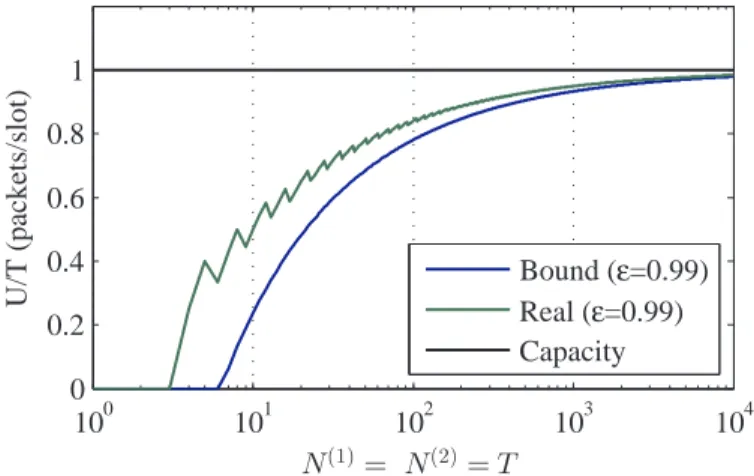
5.3 Convergence of the lower-bound to the network capacity . . . 50
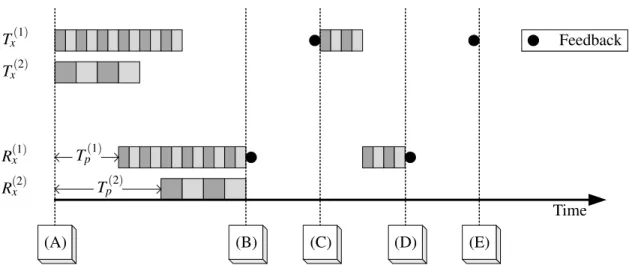
5.4 Schematic of the Coded Blocks scheme . . . 52
5.5 Illustration of the heuristic solution for the Coded Blocks scheme . . . 55
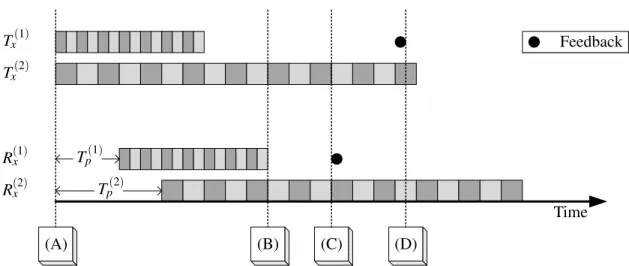
5.6 Schematic of the Coded Streams scheme . . . 56
5.7 Packet arrival pattern of the Coded Streams scheme . . . 57
5.8 Performance of coded and uncoded schemes over symmetric propagation delays . . . . 61
5.9 Performance of coded and uncoded schemes over asymmetric propagation delays . . . 61
5.10 Comparison between optimal and heuristic policies for the Coded Blocks scheme . . 63
5.11 Comparison between optimal and heuristic policies for the Coded Streams scheme . 63 5.12 Measured RTT and PER for different wireless access technologies . . . 64
5.13 Performance of coded and uncoded schemes in a practical scenario . . . 65
6.1 System Model . . . 69
6.2 Probabilistic Graph Model for the MDP . . . 74
6.3 Probabilistic Graph Model for the POMDP . . . 79
6.4 Performance trade-off between packet discard rate and energy . . . 86
6.5 Performance trade-off between delay and energy . . . 87
6.6 Performance comparison between schemes with different observability assumptions . 88 6.7 Snapshot of channel state estimates computed by different schemes . . . 89
6.8 Impact of coherence time on performance . . . 91
6.9 Impact of feedback losses on performance . . . 92
6.10 Impact of feedback delay on performance . . . 92
6.11 Use case comparing single and two channel systems . . . 94
6.12 Use case with two channels with asymmetric coherence and error characteristics . . . 95
6.13 Use case with one high throughput link backed up by a slower but more reliable link 96 7.1 Unicast streaming system model . . . 102
7.2 Experimental measurements of the number of decoded packets over time . . . 105
7.3 Packet delivery delay distributions achieved with the coded and uncoded schemes . . 106
7.4 Rate versus delivery delay performance of coded and uncoded schemes . . . .107
7.5 Rate versus delivery delay performance in single-path and multipath configurations . 109 7.6 Multicast streaming system model . . . 110
List of Tables
5.1 Coded stream scheme interval characterization . . . 57
5.2 Channel model parameters for WiFi and WiMax based interfaces . . . 65
6.1 Base system configuration. . . 85
List of Abbreviations
3G 3rd Generation of Wireless Mobile Telecommunications Technology 4G 4th Generation of Wireless Mobile Telecommunications Technology 5G 5th Generation of Wireless Mobile Telecommunications Technology
ACK Acknowledgment
API Application Public Interface
ARQ Automatic Repeat reQuest
BT Bluetooth
CMT Concurrent Multipath Transfer
CSI Channel State Information
D2D Device-to-Device
FEC Forward Error Correction
FEUP Faculdade de Engenharia da Universidade do Porto
FIFO First-In, First-Out
FSMC Finite-State Markov Chain
GE Gilbert-Elliot
GF Galois Field
MAC Medium Access Control
MDP Markov Decision Process
MIMO Multiple-Input Multiple Output
mmWave Millimeter-Wave
MPTCP Multipath Transmission Control Protocol
NAT Network Address Translation
NC Network Coding
NFC Near-Field Communication
OS Operating System
PEC Packet Erasure Channel
PER Packet Error Rate
PGM Probabilistic Graph Model
POMDP Partially Observable Markov Decision Process
PPTP Point-to-Point Tunneling Protocol
RFCOMM Radio Frequency Communication
RLNC Random Linear Network Coding
RTT Round-Trip Time
SCTP Stream Control Transmission Protocol
TCP Transmission Control Protocol
UDP User Datagram Protocol
VPN Virtual Private Network
WLAN Wireless Local Area Network
Chapter 1
Introduction
1.1
Motivation
Wireless communication stands as one of the core technologies of the modern world. Its nature enables ubiquitous communication and access to information, but also makes it a fragile support for communication. Based on its widespread adoption though, it seems clear that the convenience it provides far compensates the efforts in developing new solutions to attenuate its weaknesses. So much that wireless communication technologies are continuously evolving, as users keep demanding improved performance and more devices become interconnected. To satisfy the needs predicted in the near future, next generation 5G networks are expected to withstand 1000-times the current capacity and provide much lower end-to-end latencies, among other ambitious requirements. In order to achieve these goals, new techniques must be developed and the limits of technology must be pushed. With that in mind, this work leverages coding techniques to exploit the diversity of wireless technologies, in order to improve performance over the wireless segment, with particular emphasis on delay.
1.2
The Wireless Mosaic
Wireless communication serves a myriad of applications such as Internet access, file transfer, messaging, streaming, sensing, and many others. The need to support such a variety of applications along with their different requirements has made it difficult to design a wireless system that can efficiently satisfy all requirements in simultaneous. This led to a fragmentation of wireless technologies and development of a large collection of standards. Today, wireless communication encompasses systems that span from body area networks to global cellular and satellite networks, operating over different frequency bands and employing different transmission techniques. The IEEE 802.11 standard targets wireless local area networks (WLANs), and within it different amendments focus on particular applications. IEEE 802.15 defines standards for wireless personal area networks (WPANs), which have short-range and low-energy
requirements, underlying protocols such as Bluetooth and ZigBee. Cellular networks have their own set of technologies, with LTE being the flagship for the 4th generation of mobile communication technologies. The list continues and this trend is expected to prevail as new technologies are developed and integrated with the existing ones. One striking example is the emergence of millimeter-wave (mmWave) communications, set to operate in the 60 GHz unlicensed band, and expected to play a major role in future networks. This panorama reveals a heterogeneous network architecture where a variety of radio access technologies with distinct characteristics and capabilities coexist with each other [1]. Future 5G networks are expected to further stress this trend with much denser and diverse cell and access point deployments. Moreover, it is not only on the infrastructure side that this trend can be observed. Many devices come equipped with multiple communication interfaces, with smartphones being a clear and familiar example. These small devices bring 4G, Wi-Fi and Bluetooth, which provides them with multiple connectivity options. Despite the variety of resources, the current paradigm consists in establishing communication over a single radio interface. We believe that this solution is not consistent with the unreliable and dynamic nature of wireless links. This work stands for a different approach that is based on exploiting this diversity. To that end, it proposes multipath transmission schemes over multiple wireless interfaces with network coding as a key enabler.
1.3
Thesis Statement
In establishing our claims, we provide a primitive intuition on how the ideas explored in this work are expected to synergize and deliver benefits in the field of wireless communications.
The radio spectrum is a scarce resource that must be wisely managed. It is organized in lim-ited frequency intervals called channels, whose bandwidth inherently limits the maximum rate of communication. Since channel width is standardized for each technology, applications are bound to it, even though some applications require more bandwidth than others. In this context, aggregation techniques offer a flexible and cheap solution to support applications that require higher bandwidth by aggregating multiple channels together. This is the basis for modern channel bonding techniques present in IEEE 802.11n and IEEE 802.11ac, which bundle two adjacent channels together in the same band for data communication (Figure1.1a). With heterogeneous technologies, there is an added benefit in that channels do not need to be adjacent or even in the same band, providing further flexibility and robustness to problems in a particular zone of the spectrum (Figure1.1b). Another major issue with wireless communications is the lack of reliability. The sheer openness of the wireless medium leaves signals susceptible to all kinds of physical phenomena, inducing signal quality changes over time, which are exacerbated in mobility scenarios where connectivity changes are likely to occur. Naturally, these effects are felt in all aspects of communication performance. Besides long-term throughput, nodes need to retransmit information leading to higher energy consumption and packet transmission delay. Clearly, keeping a communication active over multiple channels has the advantage of aggregating the
1.3 Thesis Statement 3
2.4 GHz Band
(a) Channel Aggregation
50 GHz Band
800 MHz Band 2.4 GHz Band
(b) Interface Aggregation
Figure 1.1: Spectrum utilization view of different channel aggregation approaches, comparing tra-ditional channel bonding techniques (1.1a) with interface aggregation techniques (1.1b). The latter provides increased flexibility and robustness by aggregating bands with different characteristics.
bandwidth of both. But on top of that, keeping a diverse set of connections active increases the chances of having at least one channel with good signal quality, especially if these are uncorrelated. Even if the average throughput is not increased, applications benefit from smoother distribution on the joint channel quality, being able to send packets more regularly and thus with reduced delay. These insights lead us to our first claim.
Claim 1. Wireless systems can greatly benefit from exploiting different wireless links in simultaneous to boost performance and robustness.
While interface aggregation techniques look promising, achieving an efficient use of them entails nontrivial challenges. In the first place, there is the wireless nature of the considered paths which by itself imposes considerable challenges, among which we highlight the occurrence of random packet errors and the half-duplex communication constraint which usually implies limited feedback information. This means that scheduling has to be done with limited information about the communication’s state. Then, compared to a single path, the packet scheduling problem gains an extra dimension, as decisions are not just confined to when to send packets and how much redundancy, but also over which interface to send these. Scheduling over this new dimension is a challenging problem in face of the asymmetric path characteristics. Generally, interfaces present different bit rates, round-trip times, packet erasure rates and energy consumption, which turn scheduling into a complex decision problem.
This is where network coding (NC) comes to the rescue. In basic terms, NC involves the mixing of original data packets into units of information called coded packets. In a sense, each coded packet
"What have other sources sent?"
"Some packets were lost... But which ones?"
Lost Packet
(a) Uncoded Scheduling
"I know that this will be useful" "Some packets were lost... Will send some extra ones!"
Lost Packet
(b) Coded Scheduling
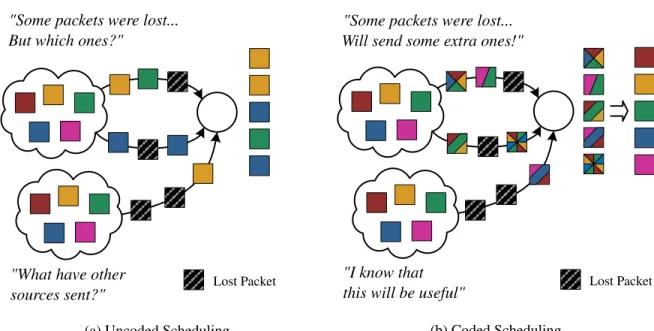
Figure 1.2: Comparison of the packet scheduling problem when using traditional transmissions (1.2a) versus coded transmissions (1.2b) over lossy half-duplex channels.
acts as a wildcard, able to replace any of the original packets encoded in it. The advantages stemming from this very simple idea are multiple. For one, network coding works as a forward error correction mechanism where redundant coded packets can be sent in advance to compensate for lost packets, capable of delivering new information with minimal feedback. Furthermore, the rateless nature of the code, meaning that an arbitrary number of combinations can be generated from the original data, is particularly suitable to wireless communication scenarios where the error rate can change during the transmission. In terms of multipath scheduling, network coding can also greatly simplify the problem. The polymorphic character of coded packets enables stateless schemes, where the source does not need to keep track of which specific packets have been sent over each path (Figure1.2). This is also useful if data is being transmitted from multiple sources as these will not need to coordinate which packets will be sent by each one. This can very well happen in multihoming scenarios where devices receive data from heterogeneous radio technologies. This leads us to our second claim.
Claim 2. Network coding is an enabler to deliver flexible, practical and efficient mecha-nisms to manage multiple heterogeneous communication interfaces.
Our work shall provide the support for these two claims, which are presented separately based on the following reasoning. The first claim, asserts that wireless systems can benefit from interface aggregation mechanisms which, being true, is valid regardless of the underlying techniques employed. Beyond that, it is our belief that network coding techniques are a natural and fitting solution to this problem, and that is what we will also attempt to convey and demonstrate throughout this thesis.
1.4 Scope 5
Sender Receiver
Figure 1.3: Reference model considered in this work, where one sender and one receiver communicate over multiple wireless channels.
Server Client
(a) Multihoming
(b) D2D communication
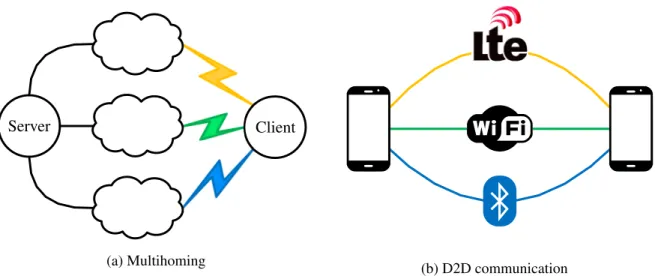
Figure 1.4: Two use cases for our work are multihoming (1.4a) and device-to-device (d2d) communica-tion (1.4b). In either case, wireless plays a major role and multiple technologies are available.
1.4
Scope
This thesis studies wireless communications over a single hop, as represented by the reference model in Figure 1.3. The wireless link is the fundamental building block in many scenarios of interest, such as last mile access (Figure1.4a) and device-to-device communication (Figure1.4b). Therefore, understanding this elementary part is the basis for developing more complex protocols. This seemingly simple setting serves as a magnifying glass to examine communications over multiple wireless links, the most distinctive aspect of this work in terms of network configuration. In this work, we use the terms path and link interchangeably to refer to a logical communication link between two nodes. In turn, the term channel is used to refer to the physical support of a given link.
Tx NIC Rx NIC (a) Physical-layer Rx Tx (b) Link-layer Tx Rx (c) Network-layer
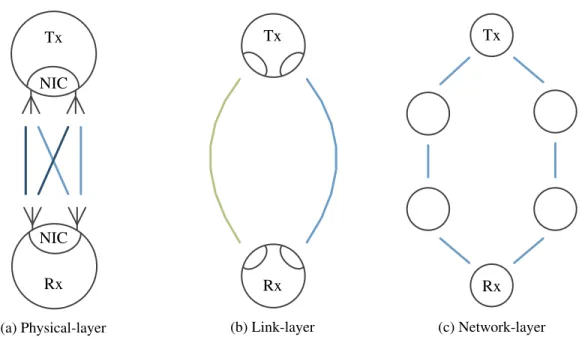
Figure 1.5: Diversity exploited at different communication layers.
The idea of exploiting diversity is not new, but it remains rather unexplored at the link layer (Figure1.5b). At the physical layer (Figure1.5a), MIMO systems use multiple antennas to exploit multipath propagation and thus mitigate problems related to fading. At the network layer (Figure1.5c), wireless protocols exploit multipath routing to circumvent deadspots. Yet, a careful investigation of data transmission over multiple wireless interfaces is lacking. As argued in [2], diversity across all layers can provide enhanced reliability and performance. Indeed, these different diversity layers are not mutually exclusive but can be used in conjunction with each other.
The proposed approach is based on network coding premises which brings several advantages in terms of system design and performance. Although a single hop is considered, such hop may be part of a more complex system, reinforcing the suitability of network coding techniques. Based on this assumption, most of our results can be generalized to the cases where sender and receiver are not necessarily source and sink, but rather intermediate nodes in a network.
Despite the uncertainty that it undertakes, wireless communication is increasingly being adopted in time-sensitive applications, where short response times are not just a matter of convenience but actual effectiveness and safety. Whatever the driving factor, delay is a core metric in today’s fast pacing world, with direct reflection on the perceived quality of communications. But it is also one with multiple scales. Depending on the application, one may be concerned with file transmission times down to individual packet delays. On top of that, coding operations add yet another layer of delay that is related with the extra time needed to decode information. All these aspects need to be jointly considered in the design of adequate solutions.
1.5 Outline 7
1.5
Outline
This work is organized as follows. The background theory on network coding is provided in Chapter2, covering its origins, benefits and main principles of operation. Review of related work follows in Chapter3. After these introductory chapters, a series of four chapters presents the main body of work.
Chapter4starts with a real showcase of the proposed ideas on commercial devices, presenting an Android application for file transfer over multiple interfaces. The architecture of the proposed protocol is presented as well as experimental results that show the benefits stemming from bandwidth aggregation, robustness to individual link failures, and resilience to packet losses. It also discusses the obstacles found in such platforms to implement the intended solution.
Chapter5builds some theoretical foundations for coded transmissions over asymmetric wireless interfaces. In particular, it develops bounds on the amount of information that can be transmitted with some target reliability over multiple interfaces in a limited time interval. These results are used to guide the scheduling of two coded schemes that aim to minimize the time to complete the transmission, subsequently evaluated in the context of high latency links.
Chapter6analyzes online network coding for unicast streaming over multiple channels with time-varying quality. The focus lies on balancing packet transmission delay and energy consumption using opportunistic schemes under imperfect knowledge conditions. The problem is solved with recourse to a decision theoretic framework that yields the policies for different trade-offs of the referred metrics. The results evidentiate that the advantages of using multiple uncorrelated links reach well beyond bandwidth aggregation, and are also a product of more diverse channel conditions.
Chapter7considers a multicast streaming scenario and fills the gap in terms of delay analysis, investigating the distribution of the in-order decoding delay under a limited feedback scenario.
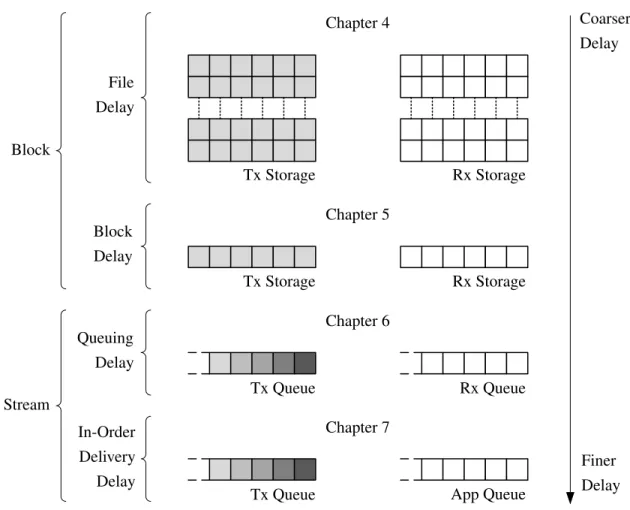
All chapters address different nuances of coded transmissions having delay performance as an anchor point, with each chapter dealing with a different kind of delay. From this perspective, the chapters are organized from coarser to finer kinds of delay, as illustrated in Figure1.6.
Following this presentation, Chapter 8draws the general conclusions, evaluates the thesis and points some directions for future work.
Chapter 4 Chapter 5 Chapter 6 Chapter 7 Coarser Delay Finer Delay Tx Queue Rx Queue
Tx Queue App Queue
Tx Storage Tx Storage Rx Storage Rx Storage Block Delay File Delay Queuing Delay In-Order Delivery Delay Stream Block
Chapter 2
Network Coding
In this chapter we introduce network coding (NC), a technique with unique features introduced by Ahlswede et al. [3]. The essence of the network coding concept is that nodes in a network should combine the packets they receive and transmit those combinations instead of the original packets. This simple idea has been shown to have clear information theoretic benefits, the first one being the possibility to reach the multicast capacity of a network. Yet, it breaks with the traditional store-and-forwardparadigm where intermediate nodes in a network simply forward the packets they receive, suggesting a code-and-forward approach. In order for such a disruptive concept to make it into the well established communication systems, it must provide sound arguments, so its benefits must be well studied in theory and demonstrated in practice. Since its inception, network coding has received an ever growing attention from the research community and a wide collection of works has shown its benefits in different applications and configurations. Throughout this chapter, we will provide an overview of this revolutionary technique, going over the aspects that are most relevant for this work.
2.1
Background
The seminal work of Ahlswede et al. [3] on network coding introduced the class of network information flow problems. The core of these problems is to determine the admissible coding rate region for some network configuration. The main result of this work states that network coding allows to achieve the max-flow min-cut capacity for multicast scenarios with a single source. The question back then was whether and how such codes could be constructed. Three years later, a series of works [4,5,6,7,8,9] provided results that underlie much of today’s practical code constructions. First, Li et al.[4] showed that linear codes are sufficient to achieve the multicast capacity. Afterwards, Koetter et al.[5] provided an algebraic framework for using linear codes. Centralized algorithms for computing codes in polynomial-time were proposed independently by Jaggi et al. [6] and Sanders et al. [7], and later consolidated in [10]. A decentralized solution was given by Ho et al. [8,11], who showed that
codes generated at random in each node are able to asymptotically achieve the multicast capacity, given sufficiently large field sizes. The solution, known as Random Linear Network Coding (RLNC), allies simplicity and high performance, standing as a reference technique in the field. Still, receivers must somehow have knowledge of the encoding functions in order to decode the information. A first practical approach to network coding was then provided by Chou et al. [9], who suggested appending the encoding information to the coded packets, and the grouping of packets into generations. These features allow for completely decentralized and asynchronous operation, providing robustness against varying network conditions.
While these works considered networks with no losses, where throughput benefits are achieved by simply coding at intermediate nodes in the network, they also assembled the core machinery that was subsequently used by future works, who evolved the field and showed the benefits of network coding in different applications.
2.2
Finite Fields
Since its introduction, network coding has expanded from simple XOR operations to more general combinations of packets. These operations involve digital computations carried out over finite fields. A finite field, also known as Galois field (GF), is an algebraic structure with a finite number of elements, and well defined addition (+) and multiplication (·) operations, that obey the traditional rules of arithmetic. As a consequence, methods for solving linear systems of equations, such as Gauss-Jordan elimination, are applicable to finite fields. An appealing property of finite fields in the context of digital systems is their closure under addition and multiplication, i.e., for any given finite field F and all a, b ∈ F, we have that a + b ∈ F and a · b ∈ F. This means that the outcome of an operation is guaranteed to be of the same size of the operands, and thus can be represented using the same number of bits. The number of elements in a finite field is known as its order, also referred to as field size in NC terminology. Only finite fields whose order is a prime power exist, and there exists exactly one finite field for each prime power. The finite field of order pn, where p is a prime and n is a positive integer, is denoted as GF(pn). In the particular case where p = 2, these are called binary fields, and are
particularly relevant in digital systems as they allow for efficient implementation.
2.3
Linear Network Coding
Network coding is a technique based on the combination of information. From this basic principle, one can imagine an arbitrary number of ways to perform such combinations with different levels of complexity. But the most commonly used code construction is simple and based on linear operations. In linear network coding, coded packets are formed as linear combinations of some set of original packets. As shown by Li et al. [4], such constructions are sufficient to achieve the multicast capacity.
2.3 Linear Network Coding 11
Indeed, linear network codes are extremely appealing as they ally powerful results with simplicity. For that reason, our work is itself entirely reliant on linear codes. In this section, we review the basic machinery behind linear network coding, from the perspective of the different roles played by nodes in a network.
2.3.1 Source
Let x = [x1, . . . , xk] be the set of original packets, also known as source block. A coded packet y can be
generated as y= k
∑
j=1 gjxj. (2.1)The coding coefficients can be represented as a coding vector g = [g1, . . . , gk] that describes the
composition of the coded packet in terms of the original packets. In packet erasure networks, a transmitting node typically generates and transmits n = k + r packets, where r is some number of redundant packets to cope with losses. Through different choices of coefficients, deterministic or random, a node can generate a potentially infinite number of coded packets. Hence, since the code rate k/n is not fixed, these codes fall within the class of rateless codes. It is worth noting that coded packets are nothing more than mixtures of the original packets so no new information is created. Therefore, the number of linearly independent packets will always be limited to k, the size of the original information. As will become clear, there is a big advantage in sending such mixtures rather than repeating the original packets.
2.3.2 Sink
On the receiving side, and upon receiving a set of coded packets y = [y1, . . . , ym] along with the
corresponding coding vectors g1, . . . , gm, a receiver can establish the following relationship
y = g11 . . . g1k .. . . .. ... gm1 . . . gmk x = g1 .. . gm x = Gx. (2.2)
From a receiver’s perspective, coded packets can be seen as equations which when put together form a linear system that can be solved for the set of original packets as
x = G−1y. (2.3)
From this last expression it is clear that a receiver is able to retrieve the original data x from the coded data y when the coefficient matrix G is invertible. Since there are k unknowns (the original packets), this implies that the receiver must receive at least k linearly independent combinations to decode the
original information. In other words, it is sufficient to deliver any k coded packets as long as they are linearly independent. This condition is much easier to satisfy than delivering every original packet at least once.
2.3.3 Relay
One key feature of network coding is recoding. Intermediate nodes in the network can generate new linear combinations from coded packets they receive, without decoding them. Let y = [y1, . . . , yk0] be the set of coded packets received by some node, and G the corresponding set of global encoding vectors. As long as k0≥ 2, this node can generate new coded packets as
y0=
k0
∑
j=1
vjyj. (2.4)
with local encoding vector v = [v1, . . . , vk0]. An interesting property is that the new combination is also a combination of the original packets, as shown below
y0= k0
∑
j=1 vj k∑
i=1 gi jxi= k∑
i=1 k0∑
j=1 vjgi j ! xi. (2.5)The corresponding global encoding vector g0= [g01, . . . , g0k] has the coefficients given by
g0= Gv. (2.6)
Recoding is then as simple as applying a linear transformation to both the coded data and global encoding vector. It can thus be said that network codes are composable. In packet erasure networks, this feature allows nodes to adjust redundancy on a hop-by-hop basis with minimum delay. This contrasts with other FEC schemes, which operate end-to-end restricting the creation of redundant packets to the source, or in a hop-by-hop manner requiring blocks of packets to be decoded before encoding again, incurring in additional delay.
2.4
Knowledge Representation
The algebraic framework of network coding described in the previous section lends itself to an elegant representation of the knowledge of a node, when regarded as a vector space defined by the coding vectors it has collected so far, called the knowledge space.
Definition 1 (Knowledge Space). The knowledge space of a node is the vector space spanned by the coding vectors received by that node, i.e., span(g1, . . . , gm).
2.5 Code Design 13
From this perspective, the number of linearly independent packets received defines the dimension of the knowledge space, which is linked to the number of degrees of freedom in that space. Therefore, the following relationship holds.
#DEGREES OF FREEDOM≡ #LIN. INDEPENDENT PACKETS
For this reason, the term degree of freedom is used in network coding literature to refer to a dimension in the corresponding knowledge space. In order to deliver a new degree of freedom and increase the dimension of the knowledge space, a packet has to be linearly independent from all previously received packets, in which case it is called an innovative packet.
Definition 2 (Innovative Packet). A packet is said to be innovative with respect to a given receiver, if it is linearly independent from all previously received packets.
These concepts are widely used in network coding literature for good reason, as they allow to describe the state of receivers in terms of the unintelligible coded information, and therefore are also used throughout this work.
2.5
Code Design
While the framework for constructing linear network codes is well defined, its operation depends on a set of design parameters that can be enumerated as follows.
• Block Size: The block size, denoted as k, corresponds to the number of packets in the source block, and therefore dictates the maximum number of packets that can be coded together.
• Field Size: The field size, denoted as q, corresponds to the number of elements in the finite field over which coding operations are performed, and therefore dictates the number of different combinations that can be generated.
• Density: The code density, denoted as h, corresponds to the ratio of non-zero coefficients in a code, and therefore provides a measure on the percentage of packets within in a block that are effectively coded together.
The settings for these parameters depend on the application requirements and are constrained by practical limitations. In this section, we elaborate on the main compromises that need to be taken into account, and provide some guidelines on code design supported by the existing literature.
2.5.1 Practical Limitations
Instead of delivering information about a single packet, coded packets deliver fractions of information about multiple packets. In particular, coded packets deliver information about the packets participating
in their formation. From an information-theoretic perspective, it is therefore desirable to generate coded packets that are combinations of all original packets, and to have as much of those combinations independent from each other as possible. Theoretically, throughput performance increases with the block size, field size and density. In practice however, there are several aspects that push these parameters down.
• Overhead: In order to decode, receivers must possess the coding coefficients associated with the coded data. A common approach is to append the coding vector to the coded packet. In this case, the overhead corresponds to the size of the coding vector which takes k log2(q) bits for representation. For sparse codes, where most of the coefficients are zero, it might compensate to append only the non-zero coefficients paired with corresponding packet index. In this case case, the average size is hk log2(qk), where h is the code density. In either case, it is clear that the overhead increases with the block and field sizes.
• Complexity: The complexity of coding operations scales with the block size k. Generating one coded packet requires O(k) operations, and decoding a block of k packets involves the inversion of a k-by-k matrix which entails O(k3) operations. It is then clear that coding cannot be performed over arbitrarily large blocks of data. If sparse codes are used then inversion can be done with lower complexity, but sparsity is hard to maintain as packets are recoded over a network. In general, complexity also increases with the field size. A workaround to reduce computation time is to use lookup tables for the multiplication and/or addition operations in the chosen field. Although this solution speeds up computation, the storage required by such tables also scales with the field size. The effects of complexity affect senders and receivers differently. On the encoding side, high complexity may cause the encoding throughput – the maximum rate at which coded packets can be generated – to hinder or even become a bottleneck on the communication performance. On the decoding side, complexity is felt a bit differently since packets are typically decoded in blocks. It is possible for receivers to store coded packets and decode them when possible without stalling the transmission. Still, complexity should allow decoding to be done in feasible time.
• Delay: In general, receivers need to collect a whole block of packets in order to decode the information. This induces a decoding delay that is proportional to the block size. By dividing data in small blocks, or designing proper code structures, it is possible to achieve lower decoding delay at the cost of reduced throughput.
2.5 Code Design 15
2.5.2 Design Guidelines
2.5.2.1 Block Size
If the data to be transmitted consists of a large number of packets, one solution is to split the original data into smaller blocks known as generations. This approach is discussed in greater detail in Section2.6.
2.5.2.2 Field Size
In the context of network coding, the choice of the field is not a trivial one. Since coding coefficients are picked from the chosen finite field, the size of the latter dictates the number of different combinations that can be created. Furthermore, when coefficients are picked at random as in RLNC, the probability of generating linearly independent packets increases with the field size. In practice however, there are also factors that push the field size down, as already discussed. The field size is thus an important design parameter whose choice depends on several factors. The computation capabilities of each device must be weighted and field sizes should be chosen in a way that the coding throughput does not hinder the performance. Interestingly, Lucani et al. [12] have shown that, if the coefficients are chosen at random, the average number of coded packets needed to decode k original packets is upper bounded by k + 2, for any field size. This means that the performance gap between different fields decreases as the block size k increases. In practice, most solutions range between GF(2) and GF(28), with the latter already providing a good compromise between performance, complexity and overhead. Perhaps the biggest challenge however, is that no-size-fits-all, especially given the very different capabilities of modern devices. Recently, Lucani et al. proposed a new class of codes, termed Fulcrum network codes [13], which combine codes with different field sizes in an attempt to merge the best of two worlds.
2.5.2.3 Density
The typical approach to network code construction involves including all packets in a given block into the composition of every single coded packet, i.e., all non-zero coefficients. This greedy approach provides the best throughput possible but poses other problems that have been discussed.
Sparse Codes One of the drawbacks of RLNC compared with other error correction codes is com-plexity. Fountain codes, such as LT [14] and Raptor[15], achieve lower complexity through the use of a sparse code structure, at the cost of considerable overhead on the number of packets required to decode. For network coding, an interesting solution has been presented in [16] which proposes adjusting the code density as transmission progresses. The scheme, named tunable sparse network coding, starts with a sparse code setting and increases the density as transmission progresses. The rationale is that in the beginning receivers have few packets and therefore even sparse packets are innovative with very
high probability. As the receivers accumulate more and more packets the probability of a coded packet being innovative decreases. To compensate for that, the code density is increased.
Structured Codes Rather than just defining a ratio of packets to be included in a given combination, it is possible to go beyond and specify which packets should be included. This could be driven by different reasons such as allowing for earlier partial decoding or delivering specific packets missing by a set of receivers.
Systematic Codes In systematic network coding, transmission has two phases. In the first phase, all source packets are sent uncoded. Since receivers still have not received any packets, it is guaranteed that all packets will be innovative. In the second phase, redundant coded packets are sent to recover from eventual packet losses, using RLNC. This systematic mode can be seen as a special case of tunable sparse NC, with two extreme density settings.
2.6
Coding over Generations
Many applications require transmission of large amounts of data over a network. Consider a large file consisting of M packets. From a theoretical perspective, the most efficient solution is to generate coded packets that are combinations of all M packets. This would make it sufficient to deliver any M linearly independent packets to complete the file transmission. In practice however, coding over a large number of packets becomes prohibitive in terms of complexity and overhead.
One solution to this problem is to divide the original data in smaller blocks called generations. Generations are subsets of original packets with linear combinations confined to packets within the same generation. The simplest approach to build generations is to divide the original data into g = dM/ke disjoint blocks of size k. Each coded packet is then a linear combination of packets within some generation gifor 1 ≤ i ≤ g. This partition changes the problem, no longer being sufficient to deliver
any M coded packets but rather to deliver k coded packets for each of the g generations.
In the absence of perfect information, it is necessary to decide from which generations to send coded packets. This problem has been first addressed in [17] who analyzed the random scheduling of disjoint generations, a tempting mode for distributed operation. The main problem is the uneven distribution of packets received per generation, with some generations receiving more packets than needed while others not receiving enough. In packet erasure networks, this can happen due to some generations experiencing more erasures than others. This motivated the concept of overlapping generations. Different overlapping strategies have been proposed such as grid schemes [18], head-to-toe [19], and random annex codes [20]. The idea behind all of them is to bind generations through a set of overlapping packets, such that generations that receive more packets can help to decode other generations.
2.7 Online Network Coding 17
2.7
Online Network Coding
Coding techniques are eximious at delivering information albeit in a non-intelligible form, and what matters in the end for applications is the original information that is hidden behind the code. In network coding, receivers need to receive a whole block in order to decode the information. The additional time until a node can access the original information is known as decoding delay. For some applications that just need data as whole, e.g., file transfer, this is not a problem. There are however important applications that can benefit from earlier decoding of packets. A good example is online streaming where packets need to be delivered in order, at a certain rate, and with a bounded delay.
2.7.1 Coding On-The-Fly
Coding over generations suggests that a sending node first needs to accumulate enough packets to compose a generation before encoding and transmitting. In terms of delay however, the best strategy is to transmit information as soon as possible. Hence, a better alternative is to generate and transmit coded packets from the packets that are available at a given time. In the same way, a receiver can perform Gauss-Jordan elimination operations as coded packets arrive, attempting to decode packets as soon as possible. This is known as coding on-the-fly. Naturally, it is not feasible to simply add packets to the code indefinitely. One way to cope with this is to keep the concept of generations, adding packets to the code only up to a certain point. The problem is that generations create a boundary over which packets cannot be mixed. In the absence of feedback from the receiver(s) that confirms the complete reception of a generation, this imposes a blind decision on whether to continue on the current generation or advance to the next one. Such decision has a strong impact in the context of delay sensitive applications such as streaming.
2.7.2 Sliding Window
The intrinsic limitations of the block-based operation motivated the development of a network coding variant known as online network coding, where coding is performed over a sliding window rather than fixed generations.
The first work on online network coding can be traced back to [21], where the authors presented powerful concepts to represent the knowledge of receivers. Upon delivering a coded packet, it is not possible to state that a particular original packet has been delivered. One simple solution is to mark an original packet as delivered when it has been decoded. That would mean storing and encoding all packets until they are decoded. As the authors of [21] have shown, that condition is not necessary for decoding. The basic concepts of the proposed approach are presented in the following.
Consider the arrival of packets at the source node, where the i-th packet that arrives is said to have index i. Then a seen packet is defined as follows.
Definition 3 (Seen Packet1). A receiver is said to have seen packet pi if it can compute a linear
combination of the form pi+ w where w is a linear combination including only packets with indices
greater than i.
The concept of seen packet is a powerful one. If a packet pihas been seen by all receivers, then the
source does not need to include it in further combinations. This property stems from the fact that even if receivers obtain only combinations of packets with index greater than i they will eventually be able to compute w, and thus be able to decode pi. Hence, although seen packets are not necessarily decoded,
they can be considered delivered by the encoding node.
This interesting observation enables several things. First, it allows packets to be removed from the buffer even before they are decoded. Moreover, it also means that packets can not only be added to the code but also removed in an online fashion, with encoding operations behaving as a sliding window over the original stream of packets.
A relevant question is under what conditions is a new packet seen. The answer is linked to the algebraic interpretation of coding vectors. As demonstrated in [21], the number of packets seen by a receiver is equal to the dimension of its knowledge space. By definition, delivering an innovative packet increases the dimension of the knowledge space. It then follows that delivering an innovative packet causes a receiver to see a new packet. As such, the following equivalence holds.
#DEGREES OF FREEDOM≡ #LIN. INDEPENDENT PACKETS≡ #SEEN PACKETS
From this, seen packets can be seen as another representation of the knowledge space of a node, that links dimensions of the knowledge space to original packets. As we have seen, this concept allows for better management of the transmission buffer and design of more dynamic codes.
2.8
Conclusion
In this chapter we introduced network coding and its most common forms of application. Some of these techniques will be the basic block to allow us addressing our thesis and fulfilling our claims. In particular, in Chapter4, we use RLNC with disjoint generations for practical file transmissions over multiple wireless channels. We discuss design parameter aspects in the context of mobile devices. We propose a system architecture which includes a configurable generation scheduler and propose a specific scheduler that attempts to deliver each generation in order. In Chapter5, we derive fundamental bounds for the number of coded packets that need to be transmitted to deliver a single block of packets with a given reliability over asymmetric erasure channels. In Chapter6, we consider online coding,
1Originally stated in [21], this is not the only possible definition of seen packet. In Chapter7we use an alternative definition, proposed later by the same authors in [22], that has advantages in terms of keeping track of decoded packets. More generally, upon receiving an innovative packet, the receiver is able to see one new original packet included in the received combination.
2.8 Conclusion 19
with opportunistic transmissions over time-varying channels to balance queueing delay and energy consumption. Coding is used to ease the scheduling over different channels and serve packets faster in face of imperfect feedback. In Chapter7, we analyze the decoding delay of individual packets in a streaming scenario with limited feedback.
Chapter 3
Multipath Communication over
Heterogeneous Wireless Technologies
Different branches on multipath research have sprouted during the years. Our attention lies on a recent line of work that has been motivated by the coexistence of multiple wireless technologies, both at the network and device levels. This class of multipath problems is characterized by a strong component on wireless communications. But unlike other wireless multipath research branches, this one distinguishes itself by the presence of asymmetric link characteristics induced by the very own nature of each technology, and potential for link level multipath through simultaneous communication over multiple technologies. Such features make this set of problems unique in terms of challenges and potential.
Using multiple wireless communication interfaces as a complement to each other has drawn the attention of technological companies. Google for instance, has recently launched Project Fi, a system that dynamically switches between Wi-Fi or one of three different LTE networks in order to provide each user with the best possible connection at a given time and place. Although it just provides access through one interface at a time, it indicates that diversity may be one solution to improve user experience. In terms of simultaneous use of multiple interfaces, Samsung has launched an application named Download Booster that enables downloads using Wi-Fi and LTE together in its devices, whereas a technological start-up named Shoelace Wireless released a couple of similar solutions for Android platforms in general. These latter solutions showcase the throughput benefits of interface aggregation at the application layer. Still, communication over heterogeneous wireless interfaces is a rather recent topic lacking in-depth studies. Therefore, and despite the existence of these real-world demonstrations, there are still important challenges to overcome in order to efficiently coordinate multiple interfaces and seize their full potential.
Our work seeks to provide a comprehensive understanding on communications over multiple wireless links along with novel solutions to these problems. Typical solutions [23,24] either (i) choose a single interface at a time, which limits the throughput of the system, (ii) split the traffic across
interfaces, which introduces challenges for delivering packets in order and in a timely fashion, or (iii) repeat the same content over different interfaces to cope with packet losses, which is an inefficient and static mechanism to add redundancy. This work advocates that packet-level coding, e.g. network coding, is critical to achieve efficient and practical multipath scheduling mechanisms. To this contribute the ability of coding to (i) abstract from individual packets, eliminating the need to specify which packets are sent through each link, and to (ii) recover from packet errors, allowing to continuously deliver informative packets, even in the limited feedback scenarios typical in wireless. In the following, we shall review closely related works that share our view for coded multipath communications, how they address some of the main challenges, and how they relate with our work.
3.1
Multipath Transport Protocols
The central role played by the Internet continues to drive researchers to design compliant solutions with its underlying protocols and work on multipath transmission has been no exception. At the transport layer, TCP remains as the standard protocol but its original design lacks desirable features such as multihoming. This motivated other protocols to be proposed among which the Stream Control Transmission Protocol (SCTP) has gained particular relevance in the context of multipath transmission, precisely due to its native multihoming support. Although SCTP considers multihoming as a simple realibility mechanism where alternative paths are activated in case the primary one fails, effective data transmission over multiple paths has been subsequently enabled through extensions such as Concurrent Multipath Transfer over SCTP (CMT-SCTP) [25]. However, SCTP based protocols still face a major hindrance which lies in their incompatibility with existing systems. Alternatively, TCP extensions for multipath operation have been more recently proposed, composing what is known as Multipath TCP (MPTCP) [26]. Although both SCTP and TCP based multipath protocols are focus of research, TCP based solutions are more likely to become mainstream due to their easier integration with existing systems.
MPTCP is a rather recent extension that is still undergoing validation and improvement. An early evaluation of its performance has been carried out by Nguyen et al. [27], who experimentally measured the throughput performance of MPTCP in three different configurations: Ethernet with Ethernet, Ethernet with WiFi, and WiFi with 3G. One key observation is that while MPTCP over paths with similar characteristics clearly outperforms TCP, the same does not happen when the paths have very different characteristics, where MPTCP can actually perform worse than TCP. These insights reveal that intelligent scheduling mechanisms are crucial to efficiently utilize multiple interfaces. To do that, it is important to understand the reasons that can limit the performance.
A common requirement to transport layer protocols is reliable and ordered delivery of data. These services can severely affect performance and thus require effective mechanisms to support them. In particular, the ordered delivery requirement can lead to what is known as head-of-line blocking, which
3.1 Multipath Transport Protocols 23
happens when a line of packets is stalled because the first packet is missing. When transmitting packets over a single path, this can occur if the head packet is lost. In multipath transmission, the problem is exacerbated as the head packet can also be delayed, due to the different characteristics of the paths over which packets are transmitted. Not only does this delay packets from being delivered to the upper layers but also limits throughput performance by holding the congestion window from advancing. Moreover, both lost and out-of-order packets can trigger false signs of congestion causing the window to be reduced and further reduce throughput.
One solution used in the literature that has shown great potential to mitigate these problems, and the one which we advocate for in this work, is to use network coding. The work by [28] marks the ingress of network coding into the conventional protocol stack. The proposed solution, designated as TCP/NC, requires minimal modifications to the stack by introducing a shim layer between the TCP and IP layers. The motivation behind TCP/NC is to mask losses from the TCP layer, providing significant performance benefits over lossy links such as wireless links. However, the feature that we would like to highlight here is that of having TCP acknowledge degrees of freedom rather than original packets. Indeed, this is the basis for most network coding based transport protocols, including multipath ones and the basic principle is illustrated in Figure3.1. Although the receiver still needs to obtain enough degrees of freedomin order to decode and effectively deliver the data to the application, all coded packets are equally useful towards such objective and thus it does not matter over which path they arrive from. Hence, this simple yet powerful idea masks the aforementioned problems, making TCP based protocols more robust to losses and path heterogeneity.
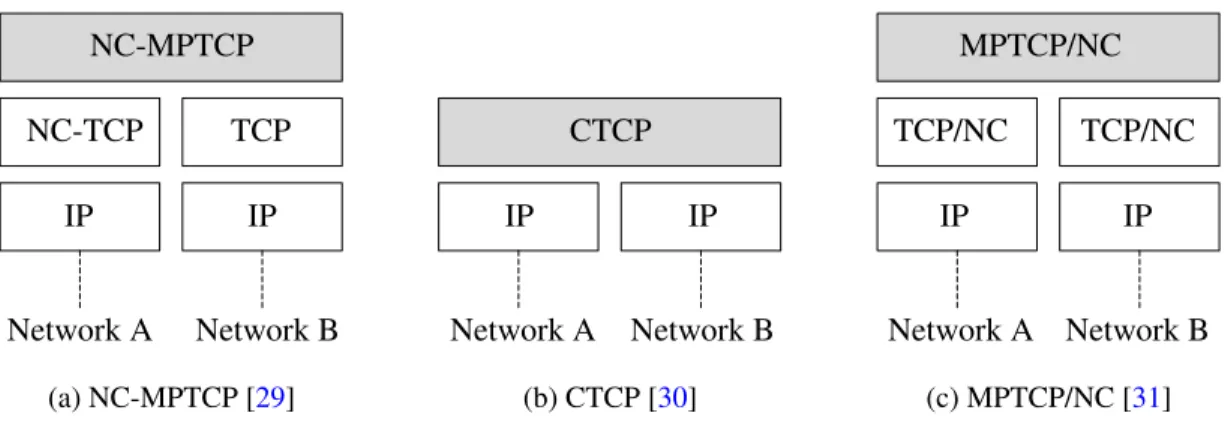
Standing on this, we now review three proposals of multipath TCP using network coding whose overview is presented in Figure3.2.
Li et al. [29] proposed a network coded assisted MPTCP protocol named NC-MPTCP (Figure3.2a). The proposed protocol uses network coding over blocks of packets in one of the paths, typically the fastest one, so that coded packets arriving on that path can help to recover from packet losses and out-of-order arrivals. For each block of K packets, the proposed scheduler calculates the number of coded packets Nc and uncoded packets Nuto send over the respective paths such that, (i) the expected
number of packets delivered is greater than or equal to the block size, i.e., E[Nc] + E[Nu] ≥ K, and
(ii) the packets are distributed proportionally to the rates Rc and Ru of each path, i.e., NcRc= NuRu.
Essentially, the first criterion addresses redundancy, whereas the second levels out the load on each path. The solution to this scheduling problem is given under the form of a closed-form expression for the case of two paths. Simulation results evidentiate the goodput gains of NC-MPTCP compared to MPTCP as the path asymmetries increase in terms of packet loss rate and round-trip time. Nonetheless, as the path asymmetries increase, the performance of NC-MPTCP converges to that of single-path TCP. We can thus conclude that, although NC-MPTCP prevents the slowest path from stalling the transmission, it does not coordinate transmissions well enough to fully utilize multiple asymmetric paths, thus leaving room for improvement.
SEQ _ NO =1 SEQ _ NO =3 SEQ _ NO =5 SEQ _ NO =7 RT T1 t = 0 SEQ _NO =2 SEQ _NO =4 SEQ _NO =6 RT T2 t = 0 p1seen p2seen p3seen p4seen Path A Path B ACK =2 ACK =4 A CK =3 A CK =5 p1+ p2+ p3+ p4 p1+ 2p2+ 2p3+ p4 p1+ 3p2+ p3+ 4p4 p1+ 4p2+ 2p3+ 6p4 3p1+ p2+ p3+ 2p4 5p1+ 2p2+ 2p3+ p4 7p1+ 2p2+ p3+ 3p4
Figure 3.1: This temporal diagram illustrates the principle of operation of TCP/NC applied to a multipath scenario. The sequence numbers of the packets arriving to the receiver have gaps between them arising from losses and path asymmetries. Yet, it is quite interesting to observe that through the use of this coding technique, the receiver sees and acknowledges packets in order.
Kim et al. [30] proposed a coded variant of TCP, coined CTCP (Figure3.2b), that is capable of multipath operation. Rather than building upon MPTCP as [29], the authors designed a new protocol meant to work on top of UDP. Once again, the authors employ coding over blocks of packets rather than a sliding window approach, arguing for bounded decoding delay and complexity. The proposed protocol features congestion control, network estimation, and multipath scheduling algorithms. The scheduler is executed before each packet transmission to decide from which block to transmit the packet. To that end, the scheduler iterates over the blocks in order and for each block it checks whether, in expectation, enough packets have been sent. If not, it transmits a packet from that block, otherwise it proceeds and checks the next block. Up to this point, the mechanism is rather straightforward, in that it transmits packets until the expected number of packets delivered is enough. But on top of this, the scheduler of CTCP adds an important feature. For the current block, i.e., the first unfinished block, the