The effect of User-Generated Content to
promote tourism destinations: the importance
of perceived authenticity and trust.
Camilla Bandinelli
Dissertation written under the supervision of Cláudia Costa
Dissertation submitted in partial fulfilment of requirements for the MSc in Management with specialization in Strategic Marketing, at the Universidade Católica Portuguesa, 15/06/2020
Abstract
Title: The effect of User-Generated Content used to promote tourism destinations: the importance of authenticity and trust.
Author: Camilla Bandinelli
Nowadays, choosing the right travel destination is not easy. Destinations are numerous, as well as the information available, thanks to Internet and the User-Generated Content shared. Moreover, as a shift towards experiential tourism is taking place, accommodation alone is no longer enough to create an experience. A search for authenticity grows, together with the need to trust that what is advertised is actually real. This thesis aims to examine if destinations can increase their competitive advantage if the destination is advertised with UGC and if the effect on travel and sharing intention would be grater due to the perceived authenticity and trust of the content presented.
The hypotheses were tested through an online experimental study using a promotion al video created by the firms’ professional or by travellers. The data have been collected through MTurk measuring perceptions of authenticity, trust and travelling and WOM intentions. A significant higher preference for travelling and recommend were showed when the promotional ad was UGC and a mediation effect was found both for trust and authenticity. Four types of travellers were identified, and the perceived authenticity was found to be higher for the Drifter just compared to the Individual Mass Tourist . Our findings can assist travel companies and tourism bodies to promote their destinations by using UGC in their marketing strategy. Such strategies are perceived as more authentic and overcome consumers mistrust in firm generated marketing communications consequently increasing the intention to visit and to recommend. Limitations and future research are also discussed.
Sumário
Título: O efeito dos conteúdos gerados pelos utilizadores utilizados para promover destinos turísticos: a importância da autenticidade e da confiança.
Autor: Camilla Bandinelli
Hoje em dia, escolher o destino de viagem certo não é fácil. Os destinos são numeros os, assim como a informação disponível, graças à Internet e ao Conteúdo Gerado pelo Utilizador. Além disso, como está a ocorrer uma mudança para o turismo experimental, o alojamento por si só já não é suficiente para criar uma experiência. A procura da autenticidade cresce, juntamente com a necessidade de confiar que o que é anunciado é real. Esta tese visa examinar se os destinos podem aumentar a sua vantagem competitiva se anunciado com a UGC e se o efeito sobre as viagens e a intenção de partilha seria maior, devido à perceção da autenticidade e confiança no conteúdo apresentado.
As hipóteses foram testadas através de um estudo experimental em linha utilizando um vídeo promocional criado pelo profissional da empresa ou por viajantes. Os dados foram recol hidos através do MTurk. Foi demonstrada uma preferência significativamente maior por viajar e recomendar quando o anúncio promocional era UGC e foi encontrado um efeito de mediação tanto para a confiança como para a autenticidade. Foram identificados quatro tipos de viajantes, e a percepção da autenticidade foi mais elevada para The Drifter apenas em comparação com Individual Mass Tourist. As nossas conclusões podem ajudar as empresas de viagens e os organismos turísticos a promover os seus destinos, utilizando a UGC na sua estratégia de marketing. As limitações e a investigação futura são também discutidas.
Palavras-chave: Conteúdo gerado pelo utilizador, Confiança, Autenticidade, Palavra de boca,
Acknowledgments
First of all, a big thank you goes to my advisor, Cláudia Costa, who supported me in
every little step of this path. Without your constant help I would never be able to get to
the end.
To my mother and my father who, since day “one”, have taught me the determination
that made me get here today. Thank you, because without you this would not have been
possible.
To my sister, my example, my greatest pride, thank you for always be by my side and
teaching me life before everyone else.
For those who know me, you know how important friendship is to me. For this reason,
thanks to the family I have chosen, my friends, my best companions in life. Each one
of you knows how essential it was to have you by my side every single day, to support
me, hug me, cry and laugh with me in my best and worst days.
Finally, to all the people who are part of my life who help to make me a better person
every day.
Table of Contents
ABSTRACT ... I SUMÁRIO ... II ACKNOWLEDGMENTS... III LIST OF FIGURES... V LIST OF TABLES ... V LIST OF ABBREVIATION ... VI 1. INTRODUCTION ... 11.1. PROBLEM STATEMENT AND RESEARCH AIM ... 3
1.2. RESEARCH QUESTIONS ... 4
1.3. OVERVIEW OF THE STUDY ... 4
2. LITERATURE REVIEW ... 5
2.1. USER-GENERATED CONTENT (UGC) ... 5
2.1.1. UGC as advertising and sharing tool ... 5
2.2. TOURISM ... 6
2.2.1. Experiential Tourism and Experiential Economy ... 7
2.2.2. Tourism industry and UGC ... 8
2.3. AUTHENTICITY ... 9
2.3.1. Authenticity in tourism ... 10
2.3.2. Authenticity and the impact on tourism sector ... 10
2.3.3. Authenticity and UGC ... 11
2.4. TRUST ... 12 2.4.1. Trust in UGC ... 13 2.5. TYPOLOGIES OF TRAVELLERS ... 14 3. METHODOLOGY ...16 3.1. DATA COLLECTION ... 16 3.2. PILOT STUDY ... 17 3.3. PROCEDURE ... 18 3.3.1. Main Study... 18 3.3.2. Respondents Profile... 20
3.4. MEASUREMENT OF THE VARIABLES ... 20
3.4.1. Manipulation check ... 22
3.4.2. Reliability Analysis ... 23
4. ANALYSIS AND RESULTS...24
4.1. HYPOTHESIS TESTING ... 24
4. DISCUSSION ...32
5. MANAGERIAL IMPLICATIONS ...33
6. THEORETICAL IMPLICATIONS ...34
7. LIMITATION AND FURTHER RESEARCH...35
REFERENCES ...37
APPENDIX ...49
APPENDIX 1 – SURVEY RESPONDENTS DEMOGRAPHICS ... 49
List of Figures
FIGURE 1:OVERVIEW OF THE STUDY ... 4
FIGURE 2:SIMPLE MEDIATION ANALYSIS (MODEL) ... 26
List of Tables
TABLE 1:DISTRIBUTION OF PARTICIPANTS IN EACH SCENARIO ... 20TABLE 2:MEASUREMENTS,SOURCES AND SCALES ... 22
TABLE 3:RELIABILITY ANALSYSIS:CRONACH'S ALPHA AND ITEM CORRELATIONS ... 24
TABLE 4::MEAN RESULTS FOR WOM INTENTION ON DESIGN MODE ... 25
TABLE 5:MEAN RESULTS FOR TRAVEL INTENTION ON DESIGN MODE ... 25
TABLE 6:FACTOR ANALYSIS EXTRACTION ... 28
TABLE 7:FACTORS DESCRIPTION, CORRELATIONS AND CRONBACH’S ALFAS ... 29
TABLE 8:CLUSTERS DESCRIPTION ... 30
TABLE 9:ANOVA RESULTS FOR CLUSTERS ON PERCEIVED AUTHENTICITY ... 31
List of Abbreviation
UGC – User Generated Content FGC – Firm Generated Content WOM – Word of MoutheWOM – Electronic Word of Mouth WTO – World Tourism Organization DR – Drifter
IMT – Individual Mass Tourist EX – Explorer
OMT – Organized Mass Tourist
ICT – Information and Communication Technology UA – Uncertainty Avoidance
1.
Introduction
Over the last decades, tourism has been deeply diversified and has become one of the most important sectors for the global economy. It is closely linked to the development of a country and generates a volume of business equivalent, or higher, to that of oil, food or car exports. According to the World Tourism Organization (2018), the number of international tourists has increased exponentially, from 25 million in 1950 to 1.2 billion in 2016, reaching a forecast of 1.8 billion in 2030.
These figures indicate increasing competition within touristic destinations. Tourists from all over the world have the possibility to choose from a wide range of tourist destinations and this makes the tourists final decision not easy. There are numerous offers to consumers and the choice depends on the value given to the destination by each individual (Petracca, 2019). Thus, in order to seize the opportunity and become the most attractive, destinations will need to find a way to stand out. More precisely, there is the importance to understand what travellers expect from the trips and which type of travellers are present in the market to fully comprehend which is the target to focus on and how to address promotional advertisings.
Nowadays tourism organizations cannot ignore the increasing popularity of advertisements, sites and social media containing User-Generated Content (UGC) and neither the role played in the travel decision-making process of travellers. Indeed, these sites can prove information that influences the final booking plans associated with travel (Cox et al, 2009). Approximately 95% of internet users rely on information from the web for their travel information search process (Pan & Fesenmaier, 2006, and the most consulted online source is for the 83% UGC (FusePump, 2015). Moreover, according to a survey conducted by Stackla (2017), 42% of consumers were influenced by UGC when planning travel.
With the rising of Web 2.0, defined as “the second generation of web-based services that have gained massive popularity by letting people collaborate and share information online in previously unavailable ways” (Reactive, 2007, p.3), a large number of tourists publish their experiences on blogs, travel sites, tourism and non-tourism social networks to document their trip and provide useful information to other readers. These virtual documents are defined as User-Generated content (UGC) and they have become a primary source of information for other tourists who are planning a trip (Petracca 2019; Rushton & Kennell 2015).
Tourism organizations and operators started to take advantage of this trend . Firms realized that people’s recommendations and personal experience are more persuasive than a simple search product (Manap and Adzharudin, 2013), and that firms that strategically integrate UGC with Firm-Generated Content (FGC) produce better business outcomes (Wang, Noble, Dahl, Park, 2019). Involving customers in advertising has provided valuable insights and build a sense of collaboration and engagement with consumers (Thompson & Malaviya, 2011), even if brands have less control and inconsistency over the brand message (Story, 2007). One way to deal with this problem is to use a co-opting strategy, in which firms encourage customers to create ads but retain final say on the message that is broadcasted (Berthon, Pitt and Campbell, 2008). In fact, the good news is that while these new technologies allow consumers to produce and share a wide number of visual contents, the UGC also provides marketers with new avenues for content (co-creation). This not only involves the engaging and reposting of consumer-generated contents but also the active co-construction of visuals ads with consumers (Gretzel, 2017).
For example, Hong Kong launched the “I never knew” campaign which invites both locals and visitors to share their stories about Hong Kong with the aim of co-creating authentic experiences to allow future tourists to tap into local knowledge instead of focusing on the major tourism offering (Hong Kong, 2018). Tourism New Zealand used drone-videos to film tourists while enjoying the ski slopes of New Zealand and could request their drone (a drone-based selfie) video to be emailed to them. Tourism New Zealand then encouraged people to share these videos on social media with the hashtag #NZDronie, ensuring that the campaign led to considerable social media buzz (Gretzel, 2017).
The importance of content generated by the users in tourism arises from the fact that researches shown that, especially among travellers, UGC is considered to be more trustworthy and authentic compared to information provided by companies’ marketing departments or agencies (O’Connor, 2010, Thompson & Malaviya, 2011). In fact, authenticity and trust are considered to be two significant concepts in today’s tourism industry.
Authenticity is getting more and more value in tourism (Dennet et Song, 2016) as part of a broader tourism mega-trend towards “authen-tricity” (authenticity-centricity). In the past, trips were often conceptualised as travelling to an epic distant place to visit the most beautiful monuments around the world and have the own picture taken. In those days, such landmarks had a greater impact to assist decision of the places to visit. Currently, such landmarks are losing its attracti on role as people are bombarded with imagery and open access to information about those objects prior to the effective
attendance, turning such landmarks closer. But while technological and cultural landscapes have changed over time, the conception of what is to travel has resisted change. It is thus not surprising that people feel a sort of emptiness when coming upon a major historical landmark who is been seen and seen a thousand times before through a screen (Horder, 2017). For this reason, authenticity is considered to be essential in tourism because it is important to understand what makes travel meaningful to the modern travellers in order to better address their needs (Horder, 2017). Dennet and Song (2016), stated that tourists are no longer satisfied with standard tourism activ ities, but they are seeking a deeper understanding of the destination. Simplifying, travellers’ thirst for living authentic local customs and culture: what Pine, Pine II, and Gilmore (1999) call the “Experience economy”. As Pine (2004) noted the more the experience economy matures, the more a shift towards authenticity is observed. When choosing to buy or not consumers base their decision on how real they perceive the service to be. Thus, the perception of authenticity will emerge as a driver for tomorrow’s tourist (Yeoman et al 2007).
In addition, every operator in the sector must therefore always remember that its main objective must not only be to generate an immediate economic profit, but to be able to provide value to its customers and to obtain and maintain their satisfaction, bearing in mind that, if you want to achieve good results in the long term, the trust of customers must not be betrayed, but respected and strengthened continuously (ABC Strategies, 2016). Trust is vital to any business and in particular way for the tourism industry - especially when offering a service that is mostly discretionary and where price competition has surged with online shopping, where social media amplify and disseminate every negative experience and where once-trusted intermediaries are being replaced by technology (Klein, 2019). In fact, the degree to which travellers trust the information provided by UGC sites or advertisements when making travel plans will determine how persuasive these sites or advertisements are in influencing the actual travel plans made (Naragajavana, 2017).
1.1. Problem Statement and Research Aim
Being both trust and authenticity two of the main outcomes associated with a UGC message we will investigate whether authentic and trust are enhanced in an UGC ad against the more traditional form of advertising with content produced by the firm. Thus, we expect that an authentic and trustworthy message will influence the traveller’s destination decision and sharing intentions. This would be due to greater authenticity and trust in the content presented. Moreover, it will be examined if there will be the possibility to identifies and segments different typologies of traveller, along a familiarity-novelty continuum suggested by Cohen’s (1972) researches. Once identified, it will be seen if
different types of travellers moderate the effect on the promotional video advertising perceived authenticity.
On the base of that, this communication strategy could be used as a tool to create a competitive advantage for travel companies. Travel destination would also benefit from increase attractiveness for a destination itself, considering the wide range of choices that tourists have today (Petracca 2019).
1.2. Research Questions
As above mentioned, there is a need to find out possible solutions to promote destinations in order to increase attractiveness and create competitive advantage. Subsequently, the research objective of this thesis is to find out if the use of User-Generated content can be the answer. The research questions that need to be answered to reach the research objective are the following:
- Does UGC influence the traveller’s travel decision and the intention to share through eWOM over FGC?
- Can the preference for promotional advertising made by UGC travellers be explained by feelings of authenticity and trustworthy?
- Do all travellers perceive UGC in the same way? Or are there some profiles where communication by UGC is more effective?
1.3. Overview of the study
2.
Literature Review
2.1. User-Generated Content (UGC)
Co-creation is used by management literature to emphasize the role of the customer in the creation of value (Grönroos, 2012). From the point of view of co-creation, suppliers and customers are on the same side of the value creation, interacting with each other in order to develop new business opportunities (Galvano & Dalli, 2014). Prahalad and Ramaswamy (2000) refer to co-creation saying that business competition used to be like a traditional theatre: actors had defined roles and costumers the audience sat in the back passively watching the show. Now the roles have changed: business competition is more like the 1960s and 1970s experimental theatre in which everybody can be part of the action, both actors and spectators.
There are multiple strategies developed to involve consumers in the marketing and production processes such as workshops, crowdsourcing, mass customizations, and open sources (Jain, 2017). One of the most used technique today is the co-creation through User-Generated Content (UGC). User-Generated Content refers to media content created or produced by the general public rather than by paid professionals and primarily distributed on the Internet (Daugherty, Eastin, Bright, 2008). UGC gives the possibility to other consumers to read, learn about, and share the experiences of others (Ukpabi and Kajaluoto, 2018). Blackshaw (2006) defined UGC as “media impressions created by consumers, typically informed by relevant experience and archived or shared online for easy access by other impressionable consumers”. The ways in which UGC are created and shared have evolved during the times into different forms: virtual communities, consumer reviews, blogs, social networks , and media sharing tools (Lu and Stepchenkova, 2014)
2.1.1. UGC as advertising and sharing tool
UGC is considered to be a more reliable source of information compared to other sources because the contents are created by people from the one’s personal network. For this reason, firms are beginning to use UGC in their marketing efforts (Nam, Manchanda, & Chintagunta, 2010) gaining importance in the firm’s advertising campaigns (Walter, 2012). As a result, the conventional marketing model, which is usually publisher-centric, is shifting toward the online information sharing market (Daugherty, Eastin, & Bright, 2008). Extant researches have shown that firms that use UGC in combination with Firm-Generated Content (FGC) are able to produce better business results. (Hewett et al., 2016; Kumar et al., 2016). In 2015, 78% of B2C companies incorporated UGC in their advertising campaigns (Content Marketing Institute, 2015).
Firms engage in UGC campaign through different approaches: consumer can be asked to develop the ad concept which an ad agency then produces, or can be asked to both create and produce the ad. These co-created videos can then be distributed online in several video-hosting sites and social media outlets. (Thompson and Malaviya, 2013). The use of this new way of generating content provides marketers with a new avenue for content co-creation: not just by reposting of UGC but also active co-construction of visual with consumers (Gretzel, 2017) For this reason, the UGC and thus, interaction and engagement have become the new form of marketing which will determine the competitiveness of organizations in the future (Gretzel, 2017).
Some of the main advantages for firms related to UGC are that they allow for creativity, th ey are more credible and especially they are free (Pogliani, 2018). UGC is also described as an electronic form of word-of-mouth marketing (eWOM) (Lu and Stepchenkova, 2014) meaning the extent to which costumers inform others of an experience that was satisfactory to them (Soderlund, 1998). In fact, a powerful role played by UGC for companies is its sharing side. World-Of-Mouth (WOM) is extremely important, especially in tourism sector, as quality of tourism products and services is not known prior to consumption (Litvin, Goldsmith, & Pan, 2008). As most tourism products are intangible, people rely on others who have first-hand experiences to receive relevant information (Wang et al, 2016). WOM intention is also consider as one of the factors that can reflec t the influence of UGC (Li-Shia Huang et al. 2008), and the interestingness of UGC could attract more consumers to disseminate and discuss the information. Having that in mind, the following hypothesis was developed:
H1: Consumers will have a higher WOM intention regarding a travel destination that is advertised
as UGC than when is advertised as FGC.
2.2. Tourism
Tourism is one of the most important sectors, generating over 10 percent of the world's Gross Domestic Product (GDP), and with an employment potential of about 10% of the world's workforce (UNWTO, 2019). This sector is now one of the fastest-growing sectors in the developed economy. In fact, according to the World Tourism Organization (2018), the number of international tourists has increased exponentially, from 25 million in 1950 to 1.2 billion in 2016, reaching a forecast of 1.8 billion in 2030.
The first definitions of tourism date back to the beginning of the 20th century, but since the early 1970s (Burkart and Medlik,1974) authors and experts on the subject distinguished tourism definition in two main groups: technical and concept definitions.
According to the technical approach "tourism is an industry that represents the sum of industrial and commercial activities that produce goods and services consumed in whole or in part by foreign visitors or domestic tourism" (United Nations Conference on Trade and Development 1971).The technical vision had the main intent of measuring the economic consequences of tourism expend iture, tourism has the physiognomy of a single industry: tourist was seen as a simple expenditure unit (Ferrucci, 2011).
On the other hand, the conceptual definition of tourism looks at the essence of the phenomenon, with its heterogeneity of activities and behaviours of all its actors. The conceptual view considers the tourist as an active subject with psychological and sociological aspects. (Ferrucci,2011). Tourism becomes a "market, a movement of people", or a "set of ideas, theories or ideologies of being a tourist, and of people's behaviour in tourist roles, when ideas are put into practice" (Leiper, 1990).
In 2008, Cooper refines Leiper’s definition and defines tourism as “a complex of individuals, businesses, organisations, and locations combine together to produce a travel experience”. In addition, over the years, some institutions have also worked to define tourism: for WTO is “a social, cultural and economic phenomenon which entails the movement of people to countries or places outside their usual environment for personal or business/professional purposes.” (UNWTO).
2.2.1. Experiential Tourism and Experiential Economy
Experiences are pervading our society more and more: for operators they represent a tool of differentiation in the scenario of intense competition in which they operate. Pine an d Gilmore (1998) were the first to elaborate the theory of the “Experience Economy”. The authors define experience as “a distinct economic offering, as different from services as services are from goods ”. Experience as an offer of economic value finds its oldest form in the prolonged use of a product, in fact when a person buys a service he or she buys a series of intangible activities made as a side dish, but when he or she buys an experience, he or she pays to enjoy a series of memorable events. Experiences , therefore, constitute a fourth economic proposal that is quite distinct from services, which in turn are distinguished from goods. Today, experience has become relevant and pervades our society (Pine and Gilmore, 1998). Therefore, in the economy of experience, the company no longer offers only goods and services, but the resulting experience which is rich in sensations and emotions created in the client. In the economy of experience, it is no longer the product at the centre of attention, but the
consumer. The performance and the use the consumer make of that product for the company are fundamental in order to intensify the experience (Ferrucci, 2011).
Regarding the tourism sector, Pine and Gilmore (2000) are among the first authors to study the experience in tourism. In 2000 the authors talk about experiences as a touristic product or service. Their work refers to the creation of value: the object acquires an added value and thus more desirable. For the tourist, the value of the touristic product is given by the depth and uniqueness of the experience he can live. In fact, today there is a wide range of experience tourism products on offer: many tour operators offer a variety of activities and adventures in which individuals can immerse themselves.
2.2.2. Tourism industry and UGC
Internet is the key source of information during the different stages of the travellers’ planning process, (Cox et al., 2009). Web 2.0 has enabled people to create their own on-line information (User-Generated Content) and share it easily through social networks. This growth of social media has inevitably impacted the way consumers’ research and buy products, with the travel and tourism sector at the forefront of such change (Rusthon et al., 2015). Tsao, Hsieh, Shih, and Lin (2015) found that approximately 80% of travellers claim to read reviews about a hotel before embarking on a trip, and 53% say that they will not book a hotel that has no reviews.
Three characteristics lead to a growing importance of UGC in the tourism industry. First, tourism is a hedonic experience and for this reason, when travellers need to make a decision, they want to do the best travel decision to make the most of the experience, and they do it by seeking another fellow costumer’s experience. Second, tourism cannot be experienced before consumption, so consumers need to rely on other’s knowledge. Finally, overall UGC is growing in popularity because third-party advices are deemed to be honest, so consumers rely on them for their travel decision (Ukpabi and Karjaluoto, 2018). In fact, Firm-Generated Content (FGC) usually arouse scepticism, especially in tourism. This happens mostly because travel organizations are looking for financial gain from sharing their experiences with others (Litvin et al.,2008) and the final goal is to “sell” the destination more than advice travellers where to go.
UGC is widely used by tourism and hospitality consumers services both to share information and as source of information for decision-making. Content generated by online customers is perceived as
more up-to-date, reliable, and precise (Gretzel & Yoo, 2008). It is not surprising that, given the intangibility nature of travel and impossibility to assess quality before experiencing the trip travellers are relying on information supplied by other people through UGC (Cox et al, 2009). UGC is considered by consumers a manifestation of individual travel experience, which can include rare and unique insights from their close friends, family, or even strangers around the world (Yu and Zou, 2015). Travellers can take a look at videos, graphics, and photos that some other users, tourists, or experienced travellers have posted online (Manap and Adzharudin, 2013).
According to Manap and Adzharudin (2013) consumers tend to be more influenced by the recommendations of people who already tested a product than from a product search. Therefore, it is expected that it would also apply to the tourism industry. In fact, today, the use of Internet to reach destination information is become increasingly common, and being the websites, social media, and blogs the main channels in which UGC proliferates, consequently more and more people are exposed to UGC when seeking to travel decision-making. Recently researches confirmed that UGC, does influence destination relation decision-making (Rusthon et al., 2015). Since one’s social network usually includes friends and family, it further contributes to the information shared on Internet being perceived as reliable (Zeng & Gerritsen, 2014). As such, UGC could influence others’ attitude and play an important role motivating people to visit a destination (Kim & Stepchenkova, 2015; Litvin et al., 2008) and in particular, UGC is found to influence not only those exposed to it but also the content creators themselves (Rusthon et al., 2015).
H2: Consumers will display higher travel intention when exposed to a destination advertised as UGC
than when FGC.
2.3. Authenticity
From Greek authentikós (principal, genuine), the word “authenticity” indicates a sense of true and it refers to the genuine “real thing” (Robinson, Hitmann and Dieke, 2019) but it can also be associated with tradition and identity, when it allows for the rediscovery of identity and reflects what individuals are or would like to be (Sharpley 1994; Pine and Gilmore 2010).
The concept of authenticity has been studied by authors such as Plato, Dostoevsky, and Freud (Yeoman et al., 2007) and in many different fields (sociology, anthropology, psychology, economy, marketing, etc.) (Antón et al.,2019). Common to all studies is the paramount importance given to authenticity (Yeoman et al., 2007). Throughout time, the term authenticity has shown different facets (Camus, 2003). During the Middle Age, authentic meant famous and notable. Later, it became something original that cannot be changed.
2.3.1. Authenticity in tourism
Authenticity in tourism can be viewed under three different levels: objective, constructive, and existential (Wang, 1999).
Objective authenticity occurs when tourists seek authenticity as an intrinsic quality of the objects they buy or consume. It is therefore an authenticity more easily identifiable and recognizable in the aspects and characteristics of an object, a service consumed, or a place visited. In fact, the authenticity criterion is absolute and objective (Wang 1999).
Constructive authenticity, on the other hand, changes according to the type of tourist, since it is perceived according to his or her beliefs, expectations and preferences, and the way he or she experiences it (Pearce and Moscardo 1985; Littrell and others 1993) In this scenario, authenticity is not an objectively measurable quality of what is being visited (Wang, 1999).
Finally, existential authenticity represents a non-materialistic response to the search for authenticity: it is in fact satisfied through the activities and experiences that individuals carry out with the aim of rediscovering a renewed identity that they have lost in the modern society in which they live (Berger,1973). In this case, authenticity is an existential condition of the individual. The existential authenticity comprises feeling which let people live more freely and spontaneously, far from the dogmas and constraints imposed by society, and express themselves fully. Moreover, individuals live their emotions and feelings in a deep, spontaneous, and natural way, without the limitations, obligations, and responsibilities of everyday life. As, the concept of tourist take into consideration in this study is the experiential tourism, the definition of authenticity which is more in line with the considerations done so far, is the existential authenticity. From an emotional point of view, the experiential tourism can be thought as something that is able to trigger an emotion. Theoretically, it is possible to say that every tourist experience makes people learn something. In particular, they are able to involve tourists on an emotional, physical and intellectual level and make them learn something (Smith, 2006) far away from their routine life, which coincides with the definition of existential authenticity.
2.3.2. Authenticity and the impact on tourism sector
Existential authenticity, in the tourism sector, is related to an experience that involves a sense of self identity activated by the liminality of tourism and informed by both interpersonal (family ties, communities) and intrapersonal dimensions (bodily feelings, self-making) (Wang, 1999). Existential authenticity is experience-oriented; it is associated with the tourist’s perception of the validity of
experiences related with self-disclosure and self-realization as opposed to the genuineness of visited objects (Steiner & Reisinger, 2006).
In the tourism context, authenticity it is argued to be the “holy grail” for tourism because is one of the key drivers for the majority of tourism experiences (Robinson, Hitmann and Dieke, 2011) . The disclosure of authenticity in the tourism studies is to be attributed to Dean McCannell (1973) who was the first arguing about the concept of authenticity and tourism motivation by saying that tourists are looking for authentic experiences which are not available in their travellers’ daily lives (Waller & Lea, 1999). Moreover, today, travellers want to immerse themselves in the local cultures and environments (Dennett and Song, 2016), living real and unique experiences: what Pine, Pine II and Gilmore (1999) call “the experience economy”. A move beyond goods and services to experiences, authentic experience. In fact, Pine (2004) also observed that as the experience economy matures, a shift is identified towards authenticity. The consumers’ buying intention is highly influenced by the perception of a specific product/service to be authentic (Yeoman et al., 2007). Nowadays there is a growing need to seek for experiences and products which are original and real, not contaminated by being fake or impure. These search for authenticity has been translated to the marketing context. In fact, it is common to observe in marketing and promotional statements such as “The Real Italy”, “The Real Greece” ... “The authentic Italian houses” (Waller & Lea, 1998, p.111). with the aim of shows the significance of authenticity in the promotion of authentic experiences (Kuon, 2011). Authenticity is therefore a determining factor in deciding whether or not to buy a tourist product, visit a territory or a destination (McCannell, 1998).
2.3.3. Authenticity and UGC
Jukin Media and The University of Southern California Master's Program in Applied Psychology collaborated in order to develop a research which had the aim to compare the attractiveness of UGC video with professionally produced images. The results found out that video which incorporate UGC are 31% more likely to be described by consumers as “unique”, and “memorable”. Moreover, the ad created with UGC was considered 11% more authentic (Elkins and Webster, 2018).
In line with this finding, the User-Generated Content for marketing purposes is on the rise especially because they are perceived as more authentic, credible and memorable which is exactly what people are looking for today. Particularly since consumers are more and more distrusting of marketing and advertising messages from firms. Majority of consumers report that less than half of brands are able to generate content that resonates as authentic (Stackla, 2017). Thus, authenticity is critical for when deciding what brand supports. Today, social media’s increasing influence and UGC eases
communication and helps establish authenticity (Rickly and Vidon 2018). According to Dittmer (2010) representations are “claim about a places’ characteristics and because consumption is getting more interactive and visual, social networks are better able to let tourists search content and get some sense of what to expect, playing an important role in travel decision. The UGC shared about a destination provides people with contemporary insight into “generated authenticity” based on post underlying experiences and seeking online interaction to gain new knowledge of a destination (Rickly and Vidon 2018). UGC helps shape discourses and influence people’s perception and conveys what it is believed to be an authentic representation of a place and society (Ric kly and Vidon 2018). Furthermore, from a research conducted as a part of Authentic Brands Series of John & Wolfe, 63% of consumers indicate that they would prefer to buy from the companies which they regard as authentic. In addition to this, 59% of them stated that they would recommend such a business to their family and friends (John and Wolfe, 2014).
Since perceived authenticity plays such important role in determining individuals’ travel intentions, and WOM intention, and that the UGC is considered to be a source of greater authenticity and credibility, the following hypotheses have been formulated:
H3a: The effect of advertising source on travel intention is mediated by perceived authenticity. Such
that higher travel intention for consumers exposed to an ad advertised as UGC is explained by higher perceived authenticity than in ads advertised as FGC.
H3b: The effect of advertising source on WOM intention is mediated by perceived authenticity. Such
that higher WOM intention for consumers exposed to an ad advertised as UGC is explained by higher perceived authenticity than in ads advertised as FGC.
2.4. Trust
The concept of trust was first introduced by phycologists in the 1950s and then made its way into many other areas such as sociology (Lewis & Weigert, 1985; Zucker, 1986), management (Das & Teng, 1998; Hosmer, 1995), and marketing (Anderson & Weitz, 1989; Moorman, Z altman, & Deshpande, 1992). Related to the marketing sector, trust appears when one party in a commercial transaction has confidence in certain special features of the other party (Wang et al, 2014). According to a psychological perspective, trust can be useful in order to reduce anxiety in the decision-making process or dilemmas (Kramer, 1999). Gwinner et al. (1998) stated that trust has psychological benefits
which are more important than special treatment or social benefits in the relationship between service firms and costumer.
Trust is a vital element to maintain and develop every type of relationship and for this reason has obtained increasing attention from the hospitality and tourism world (Wang et al, 2014). Since the 1990s researchers started to study trust in the tourism field trying to integrate the intrinsic nature of this field with definitions from other disciplines such as psychology and sociology (Wang et al, 2014). One of the most used definitions is proposed by Moorman, Deshpande, and Zaltman (1993) who define trust as “the willingness to rely on an exchange partner in whom one has confidence” (p. 315).
2.4.1. Trust in UGC
Travelers nowadays heavily rely on friends, family, and other peer groups advice when planning travel to a not yet visited destination (Litvin et al.,2008), especially for the travel intangible nature. In fact, UGC becomes a valuable tourism information resource (Yoo et al., 2009). The posts including videos, photos, and texts done by tourists about their travels, have all improved during the time , and this increases the level of trust in social media (Yoo et al., 2009). Research shows that consumers tend to trust more this type of information compared to commercial content created by travel agents or accommodation operators (Cox et al, 2009), mostly because the information providers are not looking for financial gain when sharing their experiences with others (Litvin et al.,2008). In fact, UGC provides more trustworthy and up-to-date information (Yoo & Gretzel, 2011). According to Yu and Zou (2015), the level of post credibility perceived related to tourism influences consumer’s purchase intention. In addition, the more credible a UGC is perceived, the greater the likelihood of consumers’ favourable behavioural intentions (Narangajavana et al, 2017). Thus, trust in UGC can influence the tourist’s perspective, so that the use of UGC in planning a trip will allow tourists to make a decision with a higher level of knowledge thanks to others’ experiences (Narangajavana et al, 2017). Related to the understanding of how UGC influences the travel decision-making process, trust in information that are posts on the sites is one of the most argued issues (Narangajavana et al, 2017). One of the concerns that are raised is how the consumer can be assured that the reviews are in fact independent and hence trustworthy (Gretzel, 2006). The perceived trustworthiness of third-party information is the central reason why people use UGC in their decision-making process (Akehurst, 2008; Page and Pitt, 2011). Recent studies stated that people trust more in UGC than in information provided by travel company marketing departments (Lo et al., 2011; Zeng and Gerritsen, 2014; Marine-Roig, 2014). This growth in UGC trust doesn’t seem to stop at the expense of FGC. Ultimately, the degree to which travellers trust the information provided by UGC sites when making
travel plans will determine how persuasive these sites are in influencing the actual travel plans made (Naragajavana, 2017).
H4a: The effect of advertising source on travel intention is mediated by perceived trust. Such that
higher travel intention for consumers exposed to an ad advertised as UGC is explained by higher perceived trust than in ads advertised as FGC.
H4b: The effect of advertising source on WOM intention is mediated by perceived trust. Such that
higher WOM intention for consumers exposed to an ad advertised as UGC is explained by higher perceived trust than in ads advertised as FGC.
2.5. Typologies of travellers
This study tries to develop a profile of traveller based on their psychographic makeup, rather than on the geographic variables found in a lot of tourist statistics published by government organizations in several countries. Hassan and Katsanis (1991) stated that the traditional approach using g eographic variables have some important limitations. First of all, it is not based on consumer behaviour pattern, then it supposes total homogeneity of the country segment and finally it neglects the presence of homogeneous sections that exist across national limits. Plog (1994) therefore concludes that a segmentation system made through a psychographic segment if it is successful, produce clearly defined groupings of individuals with similar personalities, lifestyles, and interest pattern. These profiles would differ from each other enough to offer some important guidelines/market-based information for developing an appropriate communication strategies Keng et al (1999).
The use of psychographics variables can overcome the common problem in tourism research which use socioeconomic and demographic variables to segment markets - people who have similar age, income, and occupation do not necessarily possess the travel interest. Strongly related with the use of psychographics in the tourism sector is the development of traveller typologies. One of the better-known tourist typologies is that developed by Cohen (1972), a sociologist of tourism, who used personality traits to identify different expectation when travelling. The author classifies tourists into four types, based on the degree to which travellers seek familiar ity and novelty in a continuum that respects the authenticity of the sought experience: the drifter, the explorer, the individual mass tourist, and the organised mass tourist. According to Żegleń and Grzywacz (2016) and Keng et al (1999), the organised mass tourist is the less adventurous who likes to stay primarily inside his or her "condition bubble" all through the vacation. The organised mass tourist matches closest the cliché picture of the
tourist. The excursion agenda is typically orchestrated ahead of time, with prepared and guided stops. The individual mass tourist is similar to the organised mass tourist because his or her travel is mainly organised with the help of a travel agency but differs in that the former have a degree of control over his or her time and itinerary. Thusly, familiarity is as yet prevailing, yet to some degree less so than in the previous type; the experience of novelty is to some degree more prominent; however, it is frequently of the standard kind. The Explorer arranges his or her trip alone and avoid contact with other tourists and interact with locals. During the vacation, he or she is expecting a certain level of security and benefits. In this case, novelty is dominant but keeping some of basic routines and comforts of his or her way of life. Finally, the drifter is the opposite of the organised mass tourist. He or she identifies with the host community by living and make friends among it. The drifter has no planned itinerary, choose destinations and accommodation on whim and she or he is motivated by the “experience” (Weating and Neil, 2009).
These differences in interaction between typologies of tourist and the social environments can be conceptualized with the linkage to the notion of authenticity (Weating and Neil, 2009). M acCannel (1973) associates’ tourism with religious pilgrimage because both of them are homologous in the seek for authentic experiences. He stated that modern life and the alienation of modern man are surrounded by shallowness and inauthenticity and that the real authenticity are thought to be elsewhere: in other cultures, and in purer and simpler lifestyles. Thus, the continuous search for authenticity induces moderns to become tourist (Apostolopoulos et al, 2013). The organized mass tourist, the individual mass tourist, the explorer, and the drifter supposedly seek different levels of authentic experiences, as similarly outlined in Cohen’s (1988) existential-recreational experience spectrum. The drifter often travels independently without a tour guide and he or she is likely to obtain more authentic experience than Cohen’ s other types of tourists (Kuon, 2011). Because of the fact that UGC lead to a higher perception of authenticity the following hypostasis was stated:
H5: The authenticity perception of the tourism destination promotional video advertising made with
3.
Methodology
3.1. Data Collection
The purpose of this work is to understand whether a consumer is persuaded and influenced in his/her travel decision by watching travel promotions videos made or produced by other consumers. If so, this promotional strategy can be used by companies to gain a competitive advantage as well as for destinations itself in order to be more attractive.
Due to the fact that experimental designs are the best way to evaluate causal hypotheses, to test our hypothesis, an online survey was used (Chambliss and Shutt, 2018). The online survey method was chosen to collect data as it provides several major advantages over the phone interview. Online survey offers a higher probability to receive a wide number of answers in quick time while being a cost -efficiency method and it increases productivity while saving time. Data is instantly available and can easily be transferred into specific statistical software. In addition, online surveys have the capability to replicate the desired experimental procedure with several treatments. A ccording to market research experts, the majority of users prefer to respond to online surveys rather than written questionnaires or telephone interviews. Through online interviews, they provide longer and more detailed answers that better match their thoughts and attitudes (Ilieva & Baron & Healey, 2002).
On the other side, this quantitative research procedure can have some disadvantages that can cause limitations in the study. First of all, the absence of the interview which explores the answer of the responded can lead to inaccurate answers. Secondly, online surveys cannot reach people who have no access to internet so the sample cannot be fully representative of the population. Finally, it needed to take into account that one of the most common problems is survey fraud (Ilieva & Baron & Healey, 2002).
After considered the advantages and disadvantages of online surveys, this method was selected to conduct the study.
A non-probability convenience sampling technique was selected for the present study. In a nonprobability technique, each persons’ probability to be selected for the study is not specific, contrarily to the probability sampling technique, where all the populatio n members have a known probability of being in the sample. The sampling is convenience since all the participants we re conveniently available to participate in the study. According to Malhotra (2010), this sampling technique permits obtaining results with time and cost-efficiency.
Participants were randomly selected in the researcher’s own network by sharing the survey’s link through email and social media and Amazon’s Mechanical Turk (MTurk). MTurk is an online crowdsourcing platform designed to recruit people to complete different tasks (Buhrmester, Kwang, & Gosling, 2011). The platform is very useful for student researchers who are investigating a specific topic because it allows them to find a large number of participants in little time and the sample collected is likely to be more diverse than a sample of students reached by the researcher’s own network, in addition to higher reliability. Finally, Mechanical Turk supports the embedding of other survey software such as Qualtrics which gives the possibility to create the survey just one time in one single platform and then share from there (Buhrmester, Kwang, & Gosling, 2011).
3.2. Pilot study
In order to be sure that the video stimulus in the survey is suitable for the main study, a pilot study was conducted in Qualtrics. The video used as stimuli is a shortcut made from a YouTube video showing the Bali experience (Chris Roger, 2019). 38 respondents took part in the pilot (7 responses were excluded due to missing values). The survey was randomly distributed through the researcher’s own social media network and MTurk. The sample is composed of 57,9% of males, 50% fully employed, 39,5% Italians, 13,2% Americans, and 57,9% with ages between 25 and 34 years old (Millennials).
The participants were introduced with a brief description of the video and then the video was shown. Immediately after, respondents answered questions about the credibility of the video and its ability to promote the specific destination. A 7-point Likert scale with 1=Extremely good/credible … 7=Not good at all/Not credible at all was used to measure respectively credibility and goodness. To better understand the results the scale was reverse thus, instead of considering 1 as the extremely good/credible, it was considered as not good/credible at all and consequently, the whole scale was inverted.
A T-test against the middle point of the scale (4= Neither credible/good nor not credi ble/good) was conducted and it showed that both for credibility (Mcred = 6.00; SD=.899) and goodness (Mgood = 6.089; SD=.804) are above the middle point. The video is thus perceived both credible and good in promoting the destination travel.
Next, to understand the ecological validity of the stimuli we tested whether the firm and users are credible as producers of the video. Respondents rated the likelihood the video has been done by a travel firm and by travellers (1=Extremely Likely and … 7= Extremely Unlikely).
To better understand the results the scale was reverse thus, instead of considering 1 as the extremely likely, it was considered as extremely unlinked and consequently, the whole scale was inverted. The results showed that there is not a statistically significant difference between the two groups (MUGC =5.76, MFGC=5.95, p >.05) Thus, respondents perceived the video done by firms or travellers as equally credible and as such we could confidently proceed with using it in the main study.
3.3. Procedure
The objective of the study is to explore preferences for a destination when it is advertised with video content produced by users or firms. The study uncovers the roles of perceived trust and authenticity. Also, it aims to understand the impact that traveller type has on the perceived authenticity of the promotional video. In order to understand the effects of the outlined framework, a two (User-Generated Content vs Firm-(User-Generated Content) between subject online survey design has been considered as being most suitable to evaluate the impact of the presented independent variable on consumer decisions and intentions. The dependent variables are travelling intentions and likelihood of recommendation (WOM). The independent variable is the design-mode related to who created the content of the advertisement (UGC vs FGC).
Between April 22nd and May 1st, 307 participants conducted an online survey. After the data check, 40 responses were considered invalid because they had missing values or outliers that would jeopardize results and, therefore, were deleted from the sample. Having that in mind, the study complied 268 valid responses.
3.3.1. Main Study
The main survey was developed guided by the pilot’s insights and distributed through Qualtrics. Three main parts informed the survey.
First, participants were introduced to the aim of the study. We also informed about User Generated Content (UGC) and its use in tourism industry since these could not be clear to everyone. Participants read the following:
The User Generated Content (UGC) is any form of content created by users and published on the Internet, often on social networking platforms. Images, videos, blog or social network posts, tweets, podcasts, reviews, Wikipedia contributions are all forms of UGC, which users produce daily and share on the web.
Once clarified the concept of UGC, participants were asked to answer some questions related to the familiarity with UGC and their travel frequency.
In the second part, participants were show the promotional video of a tourism destination which is fit for the study thanks to the pilot study done before. Two different videos (scenarios) were randomly and equally distributed among participants by using the randomizer option available in the program. This gives us the possibility to have an equal number of responses for each scenario. All scenarios saw the same video with the exception of the description, which changed with the method in test: content created by the users (UGC) and contents created by the firm (FGC).
UGC Scenario
Now imagine that you are seeking for information about your next travel destination to visit and your attention falls in the following video about a specific destination. You note that the video is
created by real travellers during their trip.
FGC Scenario
Now imagine that you are seeking for information about your next travel destination to visit and your attention falls in the following video about a specific destination. You note that the video is
created by actors hired by the firm with the only purpose of creating the video.
After viewing the video, participants started the third part of the survey by rating statements according to their perception of authenticity and trust related to the video. Furthermore, questions related to the intention to visit the destination showed in the video, the intention to share and recommend the video
and the destination to others, the influence of UGC in travel decision, and the main purpose in travelling were asked.
At the end, demographics were asked such as age, household income, gender, nationality, and profession.
The table below illustrates how many respondents were assigned to each scenario:
Scenario Frequency Percentage
User-Generated Content
(UGC) 136 50,7
Firm Generated Content
(FGC) 132 49,3
Table 1: Distribution of participants in each scenario
3.3.2. Respondents Profile
The study sample was composed by people with different demographics . Participants are 55,2% male and mostly belong to the Millennials’ generation, aged from 25 to 34 years old (54,1%). The dominant nationalities are Italian (28,9%) and American (22,9%). In terms of occupation, the 51,9% of respondents are employed full time and 19,8% are students. Regarding the household income, 35.4% of the participants said tit hat is less than 10.000 €/year and 1,5% more than 150.000 €/year (See Appendix 1 for the summarized results).
3.4. Measurement of the variables
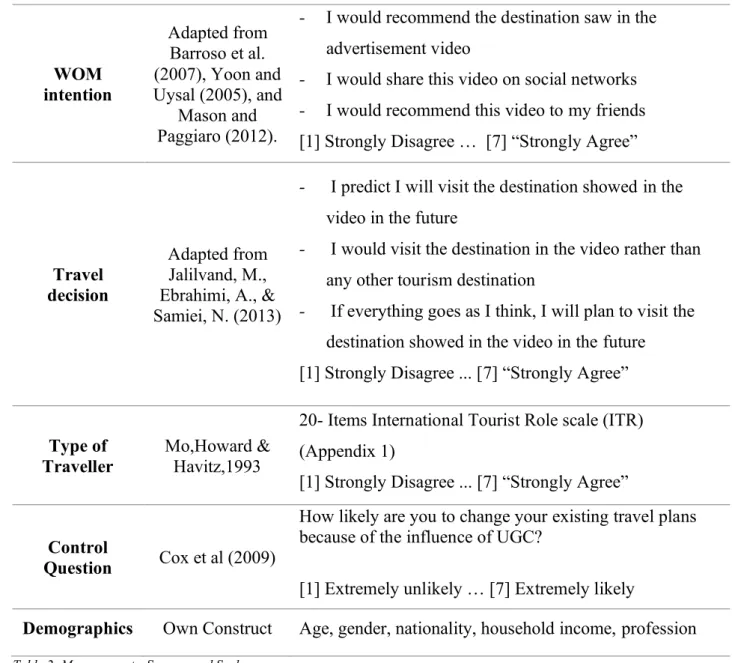
When possible, in order to ensure content validity, items were adopted from past research in the tourism industry and adjusted to the context of the current study. All constructs were measured through a seven-point Likert scale, to maintain the consistency across the study and to make the interpretation and analysis of the results comparable among all dimensions. The only exception was for familiarity with UGC which was measured with a five-point Likert scale. The dependent variables travel intention and WOM intention were measured with three items each adapted from two different studies. The two variables which work as mediators – perceived authenticity and perceived trust – are measured as a mean of respectively six and four items. The construct used to identify the typology of travellers is the so called 20-items International Tourist Role (ITR) (Appendix 2) developed by Mo,
Howard, and Havitz (1993). The manipulation check, demographics and other relevant information about the respondents' travel habits were own constructs.
The Table below summarize the flow of the survey, the source and the items used for each construct.
Construct Source Items
Travel Habits Own Construct
How often do you travel? [1] Never… [7] Once a year
UGC Familiarity
Thompson & Malaviya (2013)
How familiar are you with UGC?
[1] Not at all familiar… [5] Extremely familiar
Design-Mode (Manipulation
Check)
Own Construct
Who created the contents of the video? [1] Travellers/Customer (UGC) [2] Firm (FGC) Perceived Trust Adapted from Cox et al (2009)
- What the video advertisement says about the destination is true
- I feel I know what to expect from the destination shown
- The experiences that people live in the video are reliable
- I think I could be one of the people in the video during my trip
[1] Strongly Disagree ... [7] “Strongly Agree”
Perceived Authenticity
Adapted from Carmen Antón,
Carmen Camarero, Marta
Laguna & Dimitrios Buhalis
(2019)
- The video represents a genuine experience
- The video seems offer a real experience in local’s community
- I think that watching this video gave me better idea of the destination
- The video shows the destination as it is - The video shows a unique experience
- I think I can live the same experience if I will travel in this destination
WOM intention Adapted from Barroso et al. (2007), Yoon and Uysal (2005), and Mason and Paggiaro (2012).
- I would recommend the destination saw in the advertisement video
- I would share this video on social networks - I would recommend this video to my friends [1] Strongly Disagree … [7] “Strongly Agree”
Travel decision
Adapted from Jalilvand, M., Ebrahimi, A., & Samiei, N. (2013)
- I predict I will visit the destination showed in the video in the future
- I would visit the destination in the video rather than any other tourism destination
- If everything goes as I think, I will plan to visit the destination showed in the video in the future [1] Strongly Disagree ... [7] “Strongly Agree”
Type of Traveller
Mo,Howard & Havitz,1993
20- Items International Tourist Role scale (ITR) (Appendix 1)
[1] Strongly Disagree ... [7] “Strongly Agree”
Control
Question Cox et al (2009)
How likely are you to change your existing travel plans because of the influence of UGC?
[1] Extremely unlikely … [7] Extremely likely
Demographics Own Construct Age, gender, nationality, household income, profession Table 2: Measurements, Sources and Scales
3.4.1. Manipulation check
To analyse if the participants understood correctly the two scenarios in the survey-design (video with UGC vs video with FGC), after showing the tourism destination video advertisement with a related brief description was asked to the respondents which they thought create the contents of the video ([0]Travellers/Customer [2] Firm).
Because the sample was randomly distributed between the two different scenarios, meaning that we have two different samples to compare the means, the independent samples t-test was conducted on Design Mode as test variable and the dummy variable Who created the video? (0= Travelers/Customers; 1=Firm) as grouping variable.
After running the independent samples t-test it was possible to conclude that there was a significant difference in the scores for UGC (MUGC=0,23, SD=0.42) and FGC (MFGC=0,65, SD=0.48) conditions (t (199) =6,572, p=0.000). These results suggest that participants perceived the intended differences about who created the video. In particular those who saw the UGC video (N=136) answered mostly that the video was done by UGC (MUGC=0,23) while those who saw the FGC video (N=132) answered mostly the opposite (MFGC=0,65) which was exactly what we expected.
3.4.2. Reliability Analysis
When using a Likert Scale question within the survey it is essential to check the reliability of the scale used, in the sense that the questionnaire should consistently reflect the construct that is measuring. The most commonly used measure of scale reliability is called Cronbach’s alpha, α. The generally accepted cut off point of α is .8 (Field, 2005). Thus, in order to see if the construct’s internal reliability is appropriate the analysis of reliability (Cronbach’s Alpha) was conducted. As well as the total-item correlation. The results show that all the constructs are above .7 and no construct’s items were deleted, which allows to confirm a high internal consistency in the survey. Table 4 summarize the Cronbach’s Alphas r each construct and the item-correlation for each item.
Total-Item correlation Cronbach’s alpha Perceived Trust
What the video advertisement says about the destination is true
.840
.930 I feel I know what to expect from the destination
shown
.846
The experiences that people live in the video are reliable
.872
I think I could be one of the people in the video during my trip
.796
Perceived Authenticity
The video represents a genuine experience .891
.949 The video seems offer a real experience in local’s
community
.842
I think that watching this video gave me better idea of the destination
.862
The video shows the destination as it is .873 The video shows a unique experience .737
Table 3: Reliability Analsysis: Cronach's alpha and item correlations
After conducting the reliability analysis four variables with the means of the items that belonged to the construct in question were created: perceived trust, perceived authenticity, WOM intention and travel decision.
4.
Analysis and results
4.1. Hypothesis testing
In order to test the first hypothesis (H1) where it was argued that consumers will intend recommend a travel destination more when promoted as User-Generated Content than when advertised as Firm-Generated Content, an independent samples t-test with WOM intention as the dependent variable and the two design-mode scenarios as the independent variable. The results illustrate that, when a destination is promoted with UGC, consumers show a significant higher WOM intention, than when advertised with contents generated by the firm (MUGC =5.05; SDUGC=1.62 vs. MFGC=4.22; SDFGC=1.89), t (266) = 3.882, p=0.000. Thus, H1 is supported.
I think I can live the same experience if I will travel in this destination
.864
WOM Intention
I would recommend the destination saw in the advertisement video
.782
.929 I would share this video on social networks .878
I would recommend this video to my friends .926
Travel Intention
I predict I will visit the destination showed in the video in the future
.887
.935 I would visit the destination in the video rather
than any other tourism destination
.828
If everything goes as I think, I will plan to visit the destination showed in the video in the future
Table 4: Mean results for WOM intention on design mode
Moreover, also to test the first hypothesis (H2), another independent samples t-test with travel intention as the dependent variable and the two design-mode scenarios as the independent variable was conducted. Even in this case, results illustrate that consumers did show a significant higher travel intention when the destination is advertised with UGC compared to FGC (MUGC=4.76; SDUGC= 1.61vs. MFGC=4.12; SDFGC=1.84), t(266)=3.045, p=0.003. Thus, our results support H2.
Table 5: Mean results for travel intention on design mode
3.8 4 4.2 4.4 4.6 4.8 5 U S E R G E N E R A T E D C O N T E N T F I R M G E N E R A T E D C O N T E N T WOM INTENTION 4 4.1 4.2 4.3 4.4 4.5 4.6 4.7 4.8 U S E R G E N E R A T E D C O N T E N T F I R M G E N E R A T E D C O N T E N T TRAVEL INTENTION
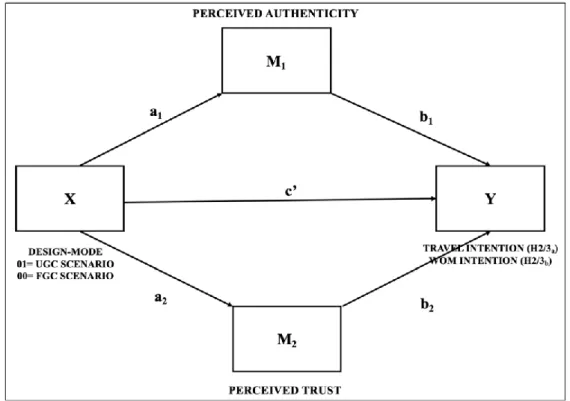
In order to test the third and fourth hypothesis, where it was argued that perception of authenticity (H3) and trust (H4) act as mediators in the relationship between the preference for tourism destination promotional video advertising and intention to travel in the advertised specific destination ( H3a, H4a)
and WOM intention (H3b, H4b), a simple mediation analysis was performed. The mediation effect
analysis was done with PROCESS in SPSS Statistics and Model 4 was chosen. Two mediation analysis was run: the first in which the outcome variable for the analysis was travel intention and t he second one in which WOM intention was used as the outcome variable. The prediction variable used in both cases was design mode recoded as a dummy variable (0=FGC, 1=UGC) and the mediation variables were perceived authenticity and perceived trust. The f igure below summarizes the analysis done.
Figure 2: Simple mediation analysis (model)
Results from the first simple mediation analysis indicated that design mode is indirectly related to travel intention through its relationship with perceived authenticity and perceived trust. UGC advertisement reported higher perceived authenticity than FGC and significant positive coefficient (a1 = .8105, p< .000; MUGC= 5.21,SDUGC=1.32; MFGC=4.40; SDFGC=1.79; p<0.05), and when the perceived authenticity increases, travel intention increases as well because of significant positive coefficient (b1 = .5290, p< .000). The same happened for perceived trust. Higher trust was related to