CERN-PH-EP/2013-057 2013/12/03
CMS-QCD-11-003
Measurement of the ratio of the inclusive 3-jet cross section
to the inclusive 2-jet cross section in pp collisions at
√
s
=
7 TeV and first determination of the strong coupling
constant in the TeV range
The CMS Collaboration
∗Abstract
A measurement is presented of the ratio of the inclusive 3-jet cross section to the inclusive 2-jet cross section as a function of the average transverse
momen-tum, hpT1,2i, of the two leading jets in the event. The data sample was collected
during 2011 at a proton-proton centre-of-mass energy of 7 TeV with the CMS
de-tector at the LHC, corresponding to an integrated luminosity of 5.0 fb−1. The
strong coupling constant at the scale of the Z boson mass is determined to be
αS(MZ) =0.1148±0.0014 (exp.)±0.0018 (PDF)±0.0050 (theory), by comparing the
ratio in the range 0.42< hpT1,2i <1.39 TeV to the predictions of perturbative QCD at
next-to-leading order. This is the first determination of αS(MZ)from measurements
at momentum scales beyond 0.6 TeV. The predicted ratio depends only indirectly on the evolution of the parton distribution functions of the proton such that this mea-surement also serves as a test of the evolution of the strong coupling constant. No deviation from the expected behaviour is observed.
Published in the European Physical Journal C as doi:10.1140/epjc/s10052-013-2604-6.
c
2013 CERN for the benefit of the CMS Collaboration. CC-BY-3.0 license
∗See Appendix A for the list of collaboration members
1
Introduction
As a consequence of the non-Abelian nature of quantum chromodynamics (QCD), the renor-malization group equation (RGE) [1–3] predicts that the strong force becomes weaker at short distances corresponding to large momentum transfers, a property of QCD referred to as
asymp-totic freedom. The strength of the strong force, αS(Q), at a given distance or momentum scale Q
is not predicted and has to be extracted from experiment. Measurements at different Q can then be compared for consistency with QCD via the RGE, which precisely describes the evolution of
αS(µr), where the renormalization scale µris identified with Q. By convention, the consistency
is tested by evolving all values of αS(Q)to the common scale µr= Q= MZ, i.e. the precisely
known mass of the Z boson. The current world average value is αS(MZ) =0.1184±0.0007 [4].
Measurements of the running of αS(Q)provide a stringent test of QCD. Previous collider
ex-periments at LEP and HERA have established the validity of the RGE up to momentum trans-fers Q of 208 GeV [4]. A recent publication by the D0 Collaboration extends this range up to
400 GeV [5]. The determination of αS(Q)from jet cross sections as in [6] or [7] depends directly
on parton distribution functions (PDFs) that have been evolved from small to very high mo-mentum scales via the Dokshitzer–Gribov–Lipatov–Altarelli–Parisi (DGLAP) equations [8–10], which assume the validity of the RGE. This dependence on the evolution of the PDFs can be
reduced by investigating cross section ratios. The ratio R32 of the inclusive 3-jet cross section
to the inclusive 2-jet cross section is proportional to αS(Q)where Q is defined as the average
transverse momentum of the two jets leading in pT,
Q= hpT1,2i =
pT1+pT2
2 . (1)
Many theoretical systematic uncertainties related to the choice of the renormalization and
fac-torization scales, µrand µf, or to nonperturbative effects are reduced in the cross section ratio.
In addition, experimental uncertainties such as those due to the jet energy scale largely cancel
in the measurement of R32. The uncertainty on the integrated luminosity measurement
can-cels completely. The Compact Muon Solenoid (CMS) Collaboration has previously measured
R32[11], and the predictions of various Monte Carlo (MC) event generators were found to be
in general agreement with the measurement.
This measurement is performed using a sample of multijet events, collected during 2011 by the CMS experiment at the Large Hadron Collider (LHC), corresponding to an integrated
lu-minosity of 5.0 fb−1 of pp collisions at a centre-of-mass energy √s = 7 TeV. The transverse
momentum pTand the rapidity y of a jet with energy E and momentum~p= (px, py, pz)(where
pzis the momentum component along the direction of the anticlockwise proton beam) are
de-fined as pT =
√
p2
x+p2y and y = 12ln[(E+ pz)/(E−pz)], respectively. Jets are reconstructed
using the infrared- and collinear-safe anti-kTclustering algorithm [12, 13] with a size parameter
of 0.7. This measurement uses jets with pT>150 GeV and|y| <2.5.
The large number of multijet events collected over a wide range of hpT1,2i, 420 < hpT1,2i <
1390 GeV, allows αS(Q)to be determined with only a small dependence on the evolution of the
PDFs, thus testing the validity of the RGE in an extended range of transverse momenta.
2
The CMS detector
The central feature of the CMS apparatus is a superconducting solenoid, 13 m in length and 6 m in diameter, providing an axial magnetic field of 3.8 T. The field volume of the solenoid
is instrumented with various layers of particle detection systems. Charged particle trajecto-ries are measured by the silicon pixel and strip tracker, with full azimuthal coverage within
|η| <2.5, where the pseudorapidity η is defined as η = −ln[tan(θ/2)], and θ is the polar angle
with respect to the z axis. Surrounding the trackers are a lead tungstate crystal electromag-netic calorimeter (ECAL) with a preshower detector in the endcaps, and a brass and scintillator
hadron calorimeter (HCAL), covering the region|η| < 3. In addition to the barrel and endcap
detectors, CMS has extensive forward calorimetry which extends the coverage to|η| = 5. The
steel flux return yoke outside the solenoid is instrumented with gas-ionization detectors used to identify and reconstruct muons. A more detailed description of the CMS detector can be found in [14].
3
Event selection and reconstruction
The CMS detector records events using a two-level trigger system consisting of a hardware-based level-1 (L1) trigger and a software-hardware-based high level trigger (HLT). In this study, single-jet triggers that reconstruct single-jets from calorimeter energy deposits at L1 and HLT are used to
select events based on three HLT pTthresholds, 190, 240, and 370 GeV. All except the
highest-threshold trigger were prescaled during the 2011 run. The corresponding integrated luminosity
L for each of the three samples is shown in Table 1. The efficiency of each of the triggers is
estimated using lower-pT-threshold triggers. These three jet trigger thresholds ensure 100%
trigger efficiency in the three jet samples forhpT1,2i >215, 269, and 409 GeV.
Table 1: The integrated luminosity for each trigger sample.
HLT pTthreshold (GeV) 190 240 370
L(fb−1) 0.15 0.51 5.0
Each event is required to have at least one offline-reconstructed vertex [15] along the beam line that is within 24 cm of the nominal interaction point. The four-vectors of particle candi-dates reconstructed by the CMS global event reconstruction algorithm (also called particle-flow event reconstruction [16]) are used as input to the jet-clustering algorithm. The clustering is
performed by the FASTJETpackage [13] using four-momentum summation. The global event
reconstruction algorithm reconstructs and identifies each particle with an optimized combina-tion of subdetector informacombina-tion. The energy of photons is obtained directly from the ECAL measurements after being corrected for zero-suppression effects. The energy of electrons is determined from a combination of the track momentum at the main interaction vertex, the cor-responding ECAL cluster energy, and the energy sum of all bremsstrahlung photons attached to the track. The energy of muons is derived from the corresponding track momentum. The energy of charged hadrons is determined from a combination of the track momentum and the corresponding ECAL and HCAL energies, corrected for zero-suppression effects, and cali-brated for the nonlinear response of the calorimeters. Finally, the energy of neutral hadrons is obtained from the corresponding calibrated ECAL and HCAL energies.
Jet energy corrections [17] are derived using simulated events, generated byPYTHIA6.4.22 [18]
and processed through the CMS detector simulation based on GEANT4 [19], and in situ
mea-surements with dijet, photon+jet, and Z+jet events. An offset correction is applied to take into account the extra energy clustered into jets from additional proton-proton interactions within the same or neighbouring bunch crossings (in-time and out-of-time pileup) [17]. Pileup effects
are important only for low-pTjets and become negligible for jets with pT > 200 GeV. The
cur-rent measurement is therefore largely insensitive to pileup effects. The jet energy corrections,
which depend on the η and pT of the jet, are applied to the jet four-momentum vector as a
multiplicative factor. The multiplicative factor is in general smaller than 1.2, approximately
uniform in η, with typical values of 1.1 for jets having pT = 100 GeV and decreasing to 1.0 for
higher values of pT.
To suppress nonphysical jets, i.e. jets resulting from noise in the ECAL and/or HCAL calorime-ters, tight identification criteria are applied: each jet should contain at least two particles, one of which is a charged hadron, and the jet energy fraction carried by neutral hadrons, photons, muons, and electrons should be less than 90%. These criteria have an efficiency greater than 99% for genuine jets.
The selection of multijet events requires two or more jets with transverse momentum greater
than 150 GeV and|y| <2.5. The final sample is extracted by rejecting events if either or both of
the leading jets in pThave|y| >2.5.
4
Measurement of
R
32and comparison with theoretical
predic-tions
The measured ratio R32as a function of hpT1,2iis the ratio of the number of selected inclusive
3-jet events to the number of selected inclusive 2-jet events in each hpT1,2ibin. The ratio R32
is corrected for detector smearing effects and unfolded to stable-particle level. The unfolding
method is the iterative Bayesian method [20], as implemented in the ROOUNFOLD software
package [21]. Unfolding uses a response matrix that maps the true distribution onto the mea-sured one. The response matrix is derived from a simulation, which uses as input the true
R32distribution from PYTHIA6 tune Z2 and introduces the smearing effects by taking into
ac-count thehpT1,2iresolution [17]. After unfolding R32to stable-particle level, the final statistical
uncertainties include the correlation among the varioushpT1,2ibins.
Two main sources of systematic uncertainties on R32are considered. The first is due to the jet
energy scale (JES) and the second due to the unfolding.
The JES uncertainty has been estimated to be 2.0–2.5% for particle-flow jets [22], depending on
the jet pT and η. All mutually uncorrelated JES uncertainty sources are considered following
the procedure described in Ref. [23]. The total systematic uncertainty on R32 due to the JES
uncertainty is 1.2%.
The unfolding method takes into account three different mutually uncorrelated uncertainty sources. The first arises from insufficient knowledge of the simulated inclusive 3-jet and 2-jet
hpT1,2ispectra, which are used to construct the simulated ratio R32used in the unfolding. The
uncertainty is estimated by varying the 3-jet and 2-jet spectra slopes by±10%. This is a
conser-vative estimate and is motivated by the observed difference in the 3-jet and 2-jet spectra slopes
between simulations using the event generatorsPYTHIA6 tune Z2 andHERWIG++ [24] with its
default tune in version 2.3. Simulations of 3-jet and 2-jet spectra using the MADGRAPH[25, 26]
event generator are in agreement with those ofPYTHIA6 . The second uncertainty arises from
the insufficient knowledge of the hpT1,2i resolution and is estimated by varying it by ±10%.
This variation is motivated by the observed difference between data and simulation in the jet energy resolution [17]. Finally, the third uncertainty arises from non-Gaussian components
in thehpT1,2iresolution and is estimated by adding non-Gaussian tails to the simulation. The
originat-ing from the unfoldoriginat-ing technique is studied by comparoriginat-ing the unfoldoriginat-ing result of the Bayesian method with that of the singular-value decomposition (SVD) method [27]. The bias is found to be negligible.
The theoretical calculation of the ratio R32 is based on next-to-leading-order (NLO)
perturba-tive QCD (pQCD) calculations multiplied by a nonperturbaperturba-tive factor, which corrects for
mul-tiparton interactions (MPI) and hadronization effects. The NLO calculations assume Nf = 5
massless quark flavours and are based on the parton-level generator NLOJET++ [28, 29]. The
computations with NLOJET++ are performed within theFASTNLO framework [30, 31] using
the following four PDF sets: NNPDF2.1 [32, 33], ABM11 [34], MSTW2008 [35, 36], and CT10 [37, 38]. In each case the PDF version employing next-to-next-to-leading order (NNLO)
evo-lution code is chosen, and for comparisons the respective default values of αS(MZ), which are
0.119, 0.1134, 0.1171, and 0.118, are used. NNPDF2.1, MSTW2008, and CT10 utilize a
variable-flavour-number scheme with the maximal number of flavours Nf ,max equal to 6, 5, and 5
re-spectively, while the ABM11 PDF set was developed in a fixed-flavour-number scheme with
Nf =5. The renormalization and factorization scales are set to the average transverse
momen-tumhpT1,2i.
The nonperturbative effects are estimated using thePYTHIA6 tune Z2 andHERWIG++ tune 2.3
event generators. The chosen MC models feature different descriptions of the phenomena and are representative of the possible values of the nonperturbative corrections. The
nonperturba-tive correction (NPC) factor is defined as the ratio of R32predicted with the nominal generator
settings to that obtained with the MPI and hadronization switched off. This factor is
calcu-lated considering the average of the two MC generators and has typical values of ≈1.02 for
hpT1,2i =250 GeV, decreasing to 1.0 for higherhpT1,2i. The uncertainty is considered to be half
of the difference between the NPC values obtained using the two MC generators and amounts
to≈0.1%, leading to a negligible influence on the final result.
Finally, uncertainties due to the renormalization and factorization scales are evaluated by
vary-ing from the default choice of µr = µf = hpT1,2i between hpT1,2i/2 and 2hpT1,2i,
simultane-ously in the numerator and denominator of the ratio R32, in the following six combinations:
(µr/hpT1,2i, µf/hpT1,2i) = (1/2, 1/2),(1/2, 1),(1, 1/2),(1, 2),(2, 1), and(2, 2).
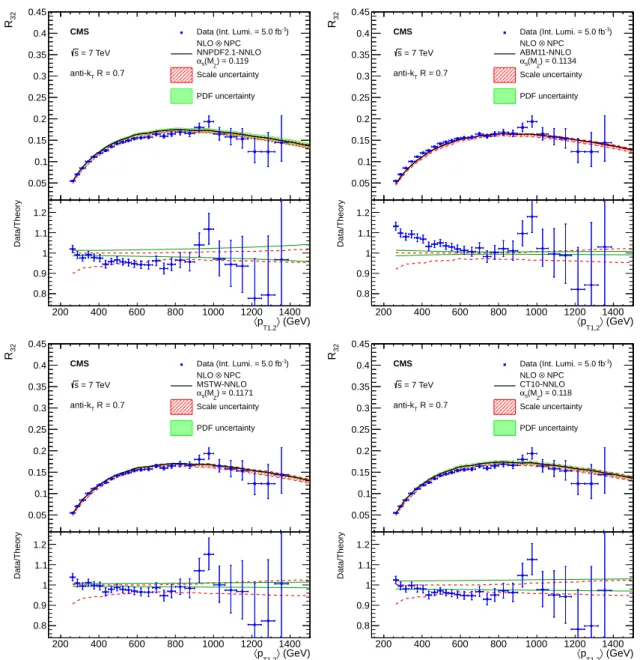
Figure 1 presents the measured ratio R32together with NLO predictions using the NNPDF2.1
(top left), the ABM11 (top right), the MSTW2008 (bottom left), and the CT10 (bottom right)
NNLO PDF sets. The upper panel of each plot shows the ratio R32(solid circles) together with
the NLO prediction (solid line) corrected for nonperturbative effects, the scale uncertainty, and the PDF uncertainty. At the bottom of each plot, the ratio of data over theory is shown together with bands representing the scale (dotted lines) and PDF uncertainties (solid lines). The error bars in the figure correspond to the total uncertainty, for which the statistical and systematic
uncertainties are added in quadrature. For each PDF set the respective default value of αS(MZ)
is used in this comparison as indicated.
The measured ratio rises with increasing hpT1,2ias the phase space opens up for the
produc-tion of a third jet, reaching a plateau value for 600 < hpT1,2i < 1000 GeV. At higher hpT1,2i
R32 decreases again because of the running of αS, smaller gluon fractions in the total parton
luminosity, and because 3-jet configurations reach kinematic limits earlier than dijet events. Scale uncertainties have a very similar behaviour for all PDF sets and dominate the region up
tohpT1,2i ≈ 400 GeV. A comparison to jets with a size parameter of R = 0.5 reveals consistent
results but with larger scale uncertainties.
(GeV) 〉 T1,2 p 〈 200 400 600 800 1000 1200 1400 32 R 0.05 0.1 0.15 0.2 0.25 0.3 0.35 0.4 0.45 ) -1 Data (Int. Lumi. = 5.0 fb
) = 0.119 Z (M s α NNPDF2.1-NNLO NPC ⊗ NLO Scale uncertainty PDF uncertainty CMS = 7 TeV s R = 0.7 T anti-k (GeV) 〉 T1,2 p 〈 200 400 600 800 1000 1200 1400 Data/Theory 0.8 0.9 1 1.1 1.2 (GeV) T1,2 p 200 400 600 800 1000 1200 1400 32 R 0.05 0.1 0.15 0.2 0.25 0.3 0.35 0.4 0.45 CMS = 7 TeV s R = 0.7 T anti-k ) -1 Data (Int. Lumi. = 5.0 fb
) = 0.1134 Z (M s α ABM11-NNLO NPC ⊗ NLO Scale uncertainty PDF uncertainty (GeV) 〉 T1,2 p 〈 200 400 600 800 1000 1200 1400 Data/Theory 0.8 0.9 1 1.1 1.2 (GeV) T1,2 p 200 400 600 800 1000 1200 1400 32 R 0.05 0.1 0.15 0.2 0.25 0.3 0.35 0.4 0.45 ) -1 Data (Int. Lumi. = 5.0 fb
) = 0.1171 Z (M s α MSTW-NNLO NPC ⊗ NLO Scale uncertainty PDF uncertainty CMS = 7 TeV s R = 0.7 T anti-k (GeV) 〉 T1,2 p 〈 200 400 600 800 1000 1200 1400 Data/Theory 0.8 0.9 1 1.1 1.2 (GeV) T1,2 p 200 400 600 800 1000 1200 1400 32 R 0.05 0.1 0.15 0.2 0.25 0.3 0.35 0.4 0.45 CMS = 7 TeV s R = 0.7 T anti-k ) -1 Data (Int. Lumi. = 5.0 fb
) = 0.118 Z (M s α CT10-NNLO NPC ⊗ NLO Scale uncertainty PDF uncertainty (GeV) 〉 T1,2 p 〈 200 400 600 800 1000 1200 1400 Data/Theory 0.8 0.9 1 1.1 1.2
Figure 1: Measurement of R32and NLO predictions using the NNPDF2.1 (top left), the ABM11
(top right), the MSTW2008 (bottom left), and the CT10 (bottom right) NNLO PDF sets. In the
upper panel of each plot, the ratio R32 (solid circles) together with the NLO prediction (solid
line) corrected for nonperturbative effects (NPC), the scale uncertainty, and the PDF uncer-tainty are shown. The bottom panels show the ratio of data to the theoretical predictions, to-gether with bands representing the scale (dotted lines) and PDF (solid lines) uncertainties. The error bars correspond to the total uncertainty. For each PDF set the respective default value of
largest PDF uncertainties, which are of the order of 2% athpT1,2i =400 GeV, increasing to 2.5%
in the 1 TeV region. For the NNPDF2.1 set PDF uncertainties are of the order of 1.5% at 400 GeV, increasing to 2.3% at 1 TeV. Finally, for the MSTW2008 and ABM11 sets PDF uncertainties are of the order of 1% throughout the range of this measurement.
The comparison of data with the predictions of pQCD in Fig. 1 demonstrates that the NLO calculations using the NNPDF2.1, MSTW2008, and CT10 PDF sets are in agreement with the
measured ratio R32throughout the range of this measurement. The NLO result employing the
ABM11 PDF set underestimates R32, especially forhpT1,2i <600 GeV.
5
Determination of α
S(
M
Z)
The measurement of the ratio R32is used for the determination of the strong coupling constant
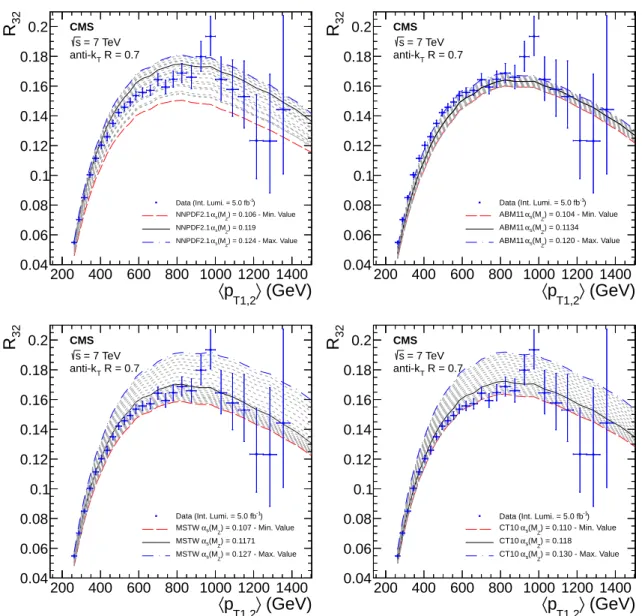
αS(MZ). Figure 2 shows the predictions using the NNPDF2.1 (top left), the ABM11 (top right),
the MSTW2008 (bottom left), and the CT10 (bottom right) NNLO PDF sets for a series of values
of αS(MZ), together with the measured R32. The αS(MZ) value is varied in the range 0.106–
0.124, 0.104–0.120, 0.107–0.127, and 0.110–0.130 in steps of 0.001 for the NNPDF2.1, ABM11, MSTW2008, and CT10 PDF sets, respectively.
From Fig. 2 one observes that the sensitivity of the ratio R32to variations of the strong coupling
by∆αS(MZ) = ±0.001 is different for each of the four PDF sets. This translates into differences
in the experimental uncertainty in the value of αS(MZ)obtained for each PDF set.
The value of αS(MZ)is determined by minimizing the χ2between the experimental
measure-ment and the theoretical predictions. The χ2is defined as
χ2 = MTC−1M, (2)
where M is the vector of the differences between the data (Ri32) and the theoretical values (T32i )
in each bin i,
Mi =Ri32−T32i , (3)
and C is the covariance matrix including all experimental (statistical, JES, and unfolding) un-certainties. C is defined as
C=CovStat+
∑
CovJES Sources+∑
CovUnfolding Sources, (4)where CovStat is the statistical covariance matrix that accounts for the correlations due to
un-folding, and CovJES Sources, CovUnfolding Sources are the covariance matrices that account for the
JES and unfolding systematic uncertainty sources, respectively. Each systematic uncertainty
source for the JES and unfolding is treated as 100% correlated across thehpT1,2ibins.
To avoid the region with large scale uncertainties close to the minimal jet pT requirements,
visible in Fig. 1, αS(MZ)is extracted only forhpT1,2i >420 GeV. The central result is obtained
by minimizing the χ2(Eq. (2)) with respect to αS(MZ)for the NNPDF2.1 PDF set, which is the
only one that permits the propagation of PDF uncertainties to the fits for each value of αS(MZ).
The experimental uncertainties are obtained from the αS(MZ)values for which χ2is increased
by one with respect to the minimum value. The result of a fit to the region of 420–1390 GeV is
(GeV) 〉 T1,2 p 〈 200 400 600 800 1000 1200 1400 32 R 0.04 0.06 0.08 0.1 0.12 0.14 0.16 0.18 0.2 CMS = 7 TeV s R = 0.7 T anti-k ) -1
Data (Int. Lumi. = 5.0 fb ) = 0.106 - Min. Value Z (M s α NNPDF2.1 ) = 0.119 Z (M s α NNPDF2.1 ) = 0.124 - Max. Value Z (M s α NNPDF2.1 (GeV) 〉 T1,2 p 〈 200 400 600 800 1000 1200 1400 32 R 0.04 0.06 0.08 0.1 0.12 0.14 0.16 0.18 0.2 CMS = 7 TeV s R = 0.7 T anti-k ) -1
Data (Int. Lumi. = 5.0 fb ) = 0.104 - Min. Value Z (M s α ABM11 ) = 0.1134 Z (M s α ABM11 ) = 0.120 - Max. Value Z (M s α ABM11 (GeV) 〉 T1,2 p 〈 200 400 600 800 1000 1200 1400 32 R 0.04 0.06 0.08 0.1 0.12 0.14 0.16 0.18 0.2 CMS = 7 TeV s R = 0.7 T anti-k ) -1
Data (Int. Lumi. = 5.0 fb ) = 0.107 - Min. Value Z (M s α MSTW ) = 0.1171 Z (M s α MSTW ) = 0.127 - Max. Value Z (M s α MSTW (GeV) 〉 T1,2 p 〈 200 400 600 800 1000 1200 1400 32 R 0.04 0.06 0.08 0.1 0.12 0.14 0.16 0.18 0.2 CMS = 7 TeV s R = 0.7 T anti-k ) -1 Data (Int. Lumi. = 5.0 fb
) = 0.110 - Min. Value Z (M s α CT10 ) = 0.118 Z (M s α CT10 ) = 0.130 - Max. Value Z (M s α CT10
Figure 2: The NLO predictions using the NNPDF2.1 (top left), the ABM11 (top right), the MSTW2008 (bottom left), and the CT10 (bottom right) NNLO PDF sets for a series of values
of αS(MZ), together with the measured R32. The αS(MZ) value is varied in the range 0.106–
0.124, 0.104–120, 0.107–0.127, and 0.110–0.130 in steps of 0.001 for the NNPDF2.1, ABM11, MSTW2008, and CT10 PDF sets, respectively.
with χ2/Ndof = 22.0/20 at minimum. The experimental uncertainty contains the statistical,
JES, and unfolding sources (Eq. (4)), with the JES uncertainty being the dominant one.
The contribution of PDFs to the uncertainty of the measurement is evaluated by repeating the
fit for each of the 100 PDF replicas of the NNPDF2.1 set at the relevant value for αS(MZ). In
this way 100 determinations of αS(MZ) are obtained, whose distribution corresponds to the
propagation of the underlying probability density from the PDFs to the fitted strong coupling. The PDF uncertainty of the measurement is then computed as the standard deviation of this distribution. A more detailed description of the method can be found in Ref. [39].
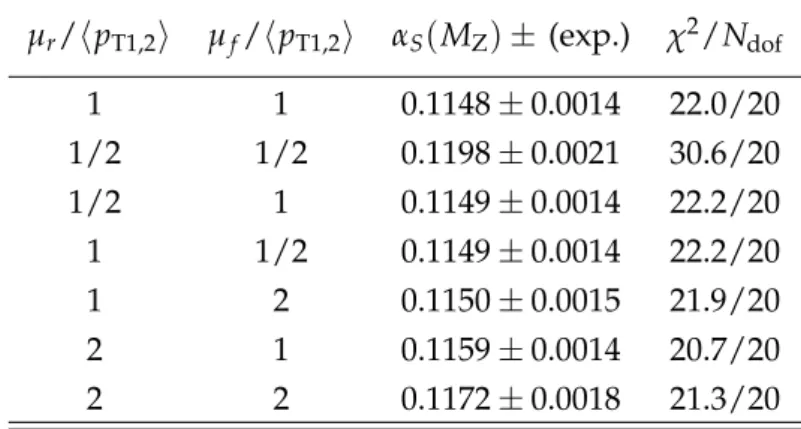
The uncertainties due to the renormalization and factorization scales are treated separately by
varying the default choice of µr = µf = hpT1,2ibetweenhpT1,2i/2 and 2hpT1,2iin six
combi-nations as explained in Section 4. The χ2minimization with respect to α
S(MZ)is repeated for
these six combinations. The contribution from the µr, µf scale variations to the uncertainty in
the measurement is evaluated by considering the differences between the NNPDF2.1 αS(MZ)
central value and the highest and lowest values found in these six scale combinations. Out
of all scale combinations the lowest αS(MZ)value corresponds to the default scale choice of
µr = µf = hpT1,2i and the highest to the scale choice of µr = µf = hpT1,2i/2. The frequent
observation of asymmetric scale uncertainties with larger downward uncertainties in the case of NLO cross sections is transformed into a purely upward uncertainty for the ratio, as can be seen in Table 2.
Table 2: The values of αS(MZ)at the central scale and for the six scale factor combinations.
µr/hpT1,2i µf/hpT1,2i αS(MZ) ± (exp.) χ2/Ndof 1 1 0.1148±0.0014 22.0/20 1/2 1/2 0.1198±0.0021 30.6/20 1/2 1 0.1149±0.0014 22.2/20 1 1/2 0.1149±0.0014 22.2/20 1 2 0.1150±0.0015 21.9/20 2 1 0.1159±0.0014 20.7/20 2 2 0.1172±0.0018 21.3/20
A cross check on the impact of the top quark by imposing Nf = 6 massless flavours in the
NLO matrix elements revealed an increase by+0.0009 in the fitted value of αS(MZ). Further
effects, for example from the evolution of αS and the PDFs with five or six flavours, multijet
production via fully hadronic decays in the reaction pp→t¯t+X, or an incomplete cancellation
of electroweak corrections between numerator and denominator, are estimated to contribute
each at a±1% level to the theoretical uncertainty. These residual effects are taken into account
by symmetrizing the scale uncertainty such that the largest deviation is adopted as the total symmetric theory uncertainty.
The final result is
αS(MZ) =0.1148±0.0014 (exp.)±0.0018 (PDF)±0.0050 (theory), (6)
in agreement with the world average value of αS(MZ) =0.1184±0.0007 [4], with the Tevatron
The determination of αS(MZ), which is based on the NNPDF2.1 PDF set, is also in agreement
with the results obtained using the MSTW2008 or CT10 PDF sets
MSTW2008: αS(MZ) =0.1141±0.0022 (exp.),
CT10: αS(MZ) =0.1135±0.0019 (exp.),
(7)
with χ2/N
dof = 20.6/20 and 21.1/20, respectively. If PDF sets with NLO evolution are used
instead the impact on the results of the fits to the ratio observable R32 is negligible. This is
in contrast to fits to cross sections, where NNLO PDF sets usually lead to smaller values of
αS(MZ)than NLO ones, and confirms the reduced dependence of R32 on details of the PDF
evolution.
In the case of the ABM11 PDFs the series in values of αS(MZ)ends at 0.120, which is insufficient
for a derivation of the complete shape of the χ2 curve at minimum such that a fit value for
αS(MZ)including uncertainties can only be extrapolated to give around αS(MZ) = 0.1214±
0.0020 (exp.) with χ2/N
dof = 20.6/20. For the ABM11 PDF set at NLO with a default value
of αS(MZ) = 0.118, the series in αS(MZ)values ends at 0.130 such that a fit can be performed
which yields αS(MZ) = 0.1214±0.0018 (exp.), consistent with the extrapolation above. The
fit exhibits, however, a somewhat larger value of χ2/Ndof = 28.5/20 compared to the other
results.
It is observed that with ABM11 PDFs a higher value of αS(MZ)is preferred. This is in accord
with the fact that the ABM11 gluon density in the phase space relevant for this analysis is
significantly smaller than that of all other PDF sets. Thus, the fit favors a larger αS(MZ)value
to compensate for this effect. In summary, the ABM11 PDF set does not describe the data as well as the alternative PDF sets, as shown in Fig. 1, which leads to an inferior fit quality and a less consistent result for the strong coupling.
To investigate the running of the strong coupling constant in more detail, the fitted region of
420–1390 GeV is split into three bins ofhpT1,2iand the fitting procedure is repeated in each of
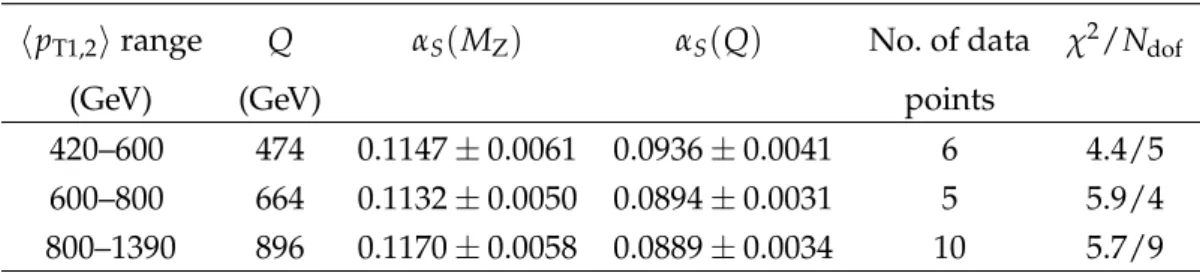
these bins. The three separate extractions of αS(MZ)are reported in Table 3. The experimental
uncertainties in the three obtained values are correlated. These αS(MZ) determinations are
then evolved back to the corresponding values αS(Q)using the 3-loop solution to the RGE
from the NNPDF2.1 set. For each fit region the cross-section-weighted average ofhpT1,2ifrom
the inclusive dijet calculation at NLO with NLOJET++ is chosen as the momentum scale Q and
is computed to be Q = 474, 664, and 896 GeV, respectively. These values, derived again with
theFASTNLO framework, are identical within about 1 GeV for different PDFs and vary at most
by a few GeV when using inclusive 3-jet events.
To emphasize that theoretical uncertainties limit the achievable precision, Table 4 presents the
decomposition of the total uncertainty for the three bins inhpT1,2iinto the experimental, PDF,
and theory components.
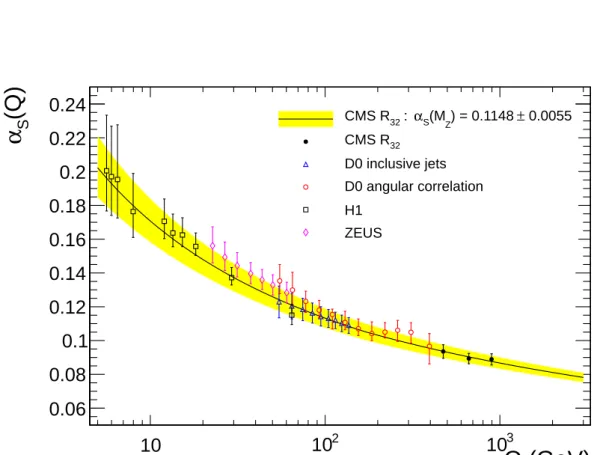
Figure 3 presents the strong coupling αS(Q) (solid line) and its total uncertainty (band) as
evolved from the CMS determination, αS(MZ) = 0.1148±0.0055, using the 3-loop solution
to the RGE from NNPDF2.1, as before. The extractions of αS(Q)in three separate ranges of Q
as presented in Table 3 are also shown. In the same figure the values of αSat lower scales
deter-mined by the H1 [41, 42], ZEUS [43], and D0 [5, 40] Collaborations are shown for comparison.
The results on αS reported here are consistent with the energy dependence predicted by the
Q (GeV)
10
10
210
3(Q)
Sα
0.06
0.08
0.1
0.12
0.14
0.16
0.18
0.2
0.22
0.24
) = 0.1148 ± 0.0055 Z (M S α : 32 CMS R 32 CMS R D0 inclusive jets D0 angular correlation H1 ZEUSFigure 3: The strong coupling αS(Q)(solid line) and its total uncertainty (band) evolved from
the CMS determination αS(MZ) =0.1148±0.0055 using a 3-loop solution to the RGE as a
func-tion of the momentum transfer Q = hpT1,2i. The extractions of αS(Q)in three separate ranges
of Q as presented in Table 3 are shown together with results from the H1 [41, 42], ZEUS [43], and D0 [5, 40] experiments at the HERA and Tevatron colliders.
Table 3: The separate determinations of αSin bins ofhpT1,2i.
hpT1,2irange Q αS(MZ) αS(Q) No. of data χ2/Ndof
(GeV) (GeV) points
420–600 474 0.1147±0.0061 0.0936±0.0041 6 4.4/5
600–800 664 0.1132±0.0050 0.0894±0.0031 5 5.9/4
800–1390 896 0.1170±0.0058 0.0889±0.0034 10 5.7/9
Table 4: Uncertainty composition for αS(MZ)from the determination of αSin bins ofhpT1,2i.
hpT1,2irange Q αS(MZ) exp. PDF theory
(GeV) (GeV)
420–600 474 0.1147 ±0.0015 ±0.0015 ±0.0057
600–800 664 0.1132 ±0.0018 ±0.0025 ±0.0039
800–1390 896 0.1170 ±0.0024 ±0.0021 ±0.0048
6
Summary
The ratio R32of the inclusive 3-jet cross section to the inclusive 2-jet cross section, for jets with
pT > 150 GeV and |y| < 2.5, has been measured in the range 250 < hpT1,2i < 1390 GeV for
proton-proton collisions at a centre-of-mass energy of 7 TeV. The results have been compared with predictions of QCD at NLO obtained with various PDF sets. The NLO calculations using the NNPDF2.1, MSTW2008, and CT10 NNLO PDF sets are in agreement with the measured
ratio R32throughout the range ofhpT1,2istudied. However, calculations using the ABM11 PDF
sets underestimate R32forhpT1,2i <600 GeV.
Measurements of R32 over the range 420 < hpT1,2i < 1390 GeV have been used to determine
the strong coupling constant αSat the scale of the Z boson mass. The final result is
αS(MZ) =0.1148±0.0014 (exp.)±0.0018 (PDF)±0.0050 (theory)=0.1148±0.0055,
where experimental, PDF, and theory uncertainties have been added quadratically to give
the total uncertainty. The result is in agreement with the world average value of αS(MZ) =
0.1184±0.0007 [4] and represents the first determination of the strong coupling constant from
jet measurements with momenta of the order of 1 TeV. The dominant uncertainties are of the-oretical origin and limit the currently achievable precision. The predicted ratio depends only indirectly on the evolution of the parton distribution functions of the proton and consequently
this measurement also serves as a test of the evolution of αS(Q). No deviation from the
ex-pected behaviour is observed.
Acknowledgements
We thank Gavin Salam for his valuable comments to this paper. We congratulate our colleagues in the CERN accelerator departments for the excellent performance of the LHC and thank the technical and administrative staffs at CERN and at other CMS institutes for their contributions to the success of the CMS effort. In addition, we gratefully acknowledge the computing centres
and personnel of the Worldwide LHC Computing Grid for delivering so effectively the com-puting infrastructure essential to our analyses. Finally, we acknowledge the enduring support for the construction and operation of the LHC and the CMS detector provided by the follow-ing fundfollow-ing agencies: BMWF and FWF (Austria); FNRS and FWO (Belgium); CNPq, CAPES, FAPERJ, and FAPESP (Brazil); MEYS (Bulgaria); CERN; CAS, MoST, and NSFC (China); COL-CIENCIAS (Colombia); MSES (Croatia); RPF (Cyprus); MoER, SF0690030s09 and ERDF (Esto-nia); Academy of Finland, MEC, and HIP (Finland); CEA and CNRS/IN2P3 (France); BMBF, DFG, and HGF (Germany); GSRT (Greece); OTKA and NKTH (Hungary); DAE and DST (In-dia); IPM (Iran); SFI (Ireland); INFN (Italy); NRF and WCU (Republic of Korea); LAS (Lithua-nia); CINVESTAV, CONACYT, SEP, and UASLP-FAI (Mexico); MSI (New Zealand); PAEC (Pak-istan); MSHE and NSC (Poland); FCT (Portugal); JINR (Armenia, Belarus, Georgia, Ukraine, Uzbekistan); MON, RosAtom, RAS and RFBR (Russia); MSTD (Serbia); SEIDI and CPAN (Spain); Swiss Funding Agencies (Switzerland); NSC (Taipei); ThEPCenter, IPST and NSTDA (Thailand); TUBITAK and TAEK (Turkey); NASU (Ukraine); STFC (United Kingdom); DOE and NSF (USA).
Individuals have received support from the Marie-Curie programme and the European Re-search Council and EPLANET (European Union); the Leventis Foundation; the A. P. Sloan Foundation; the Alexander von Humboldt Foundation; the Belgian Federal Science Policy Of-fice; the Fonds pour la Formation `a la Recherche dans l’Industrie et dans l’Agriculture (FRIA-Belgium); the Agentschap voor Innovatie door Wetenschap en Technologie (IWT-(FRIA-Belgium); the Ministry of Education, Youth and Sports (MEYS) of Czech Republic; the Council of Science and Industrial Research, India; the Compagnia di San Paolo (Torino); the HOMING PLUS pro-gramme of Foundation for Polish Science, cofinanced by EU, Regional Development Fund; and the Thalis and Aristeia programmes cofinanced by EU-ESF and the Greek NSRF.
References
[1] C. G. Callan, Jr., “Broken scale invariance in scalar field theory”, Phys. Rev. D 2 (1970) 1541, doi:10.1103/PhysRevD.2.1541.
[2] K. Symanzik, “Small distance behaviour in field theory and power counting”, Commun. Math. Phys. 18 (1970) 227, doi:10.1007/BF01649434.
[3] K. Symanzik, “Small-distance-behaviour analysis and Wilson expansions”, Commun. Math. Phys. 23 (1971) 49, doi:10.1007/BF01877596.
[4] Particle Data Group, J. Beringer et al., “Review of Particle Physics”, Phys. Rev. D 86 (2012) 010001, doi:10.1103/PhysRevD.86.010001.
[5] D0 Collaboration, “Measurement of angular correlations of jets at√s =1.96 TeV and
determination of the strong coupling at high momentum transfers”, Phys. Lett. B 718 (2012) 56, doi:10.1016/j.physletb.2012.10.003, arXiv:1207.4957. [6] CDF Collaboration, “Measurement of the Strong Coupling Constant from Inclusive Jet
Production at the Tevatron ¯pp Collider”, Phys. Rev. Lett. 88 (2002) 042001, doi:10.1103/PhysRevLett.88.042001, arXiv:hep-ex/0108034.
[7] B. Malaescu and P. Starovoitov, “Evaluation of the strong coupling constant αSusing the
ATLAS inclusive jet cross-section data”, Eur. Phys. J. C 72 (2012) 2041, doi:10.1140/epjc/s10052-012-2041-y, arXiv:1203.5416.
[8] V. N. Gribov and L. N. Lipatov, “Deep inelastic e-p scattering in perturbation theory”, Sov. J. Nucl. Phys. 15 (1972) 438. [Yad. Fiz. 15 (1972) 781].
[9] G. Altarelli and G. Parisi, “Asymptotic Freedom in Parton Language”, Nucl. Phys. B 126 (1977) 298, doi:10.1016/0550-3213(77)90384-4.
[10] Y. L. Dokshitzer, “Calculation of the Structure Functions for Deep Inelastic Scattering and
e+e−Annihilation by Perturbation Theory in Quantum Chromodynamics”, Sov. Phys.
JETP 46 (1977) 641. [Zh. Eksp. Teor. Fiz. 73 (1977) 1216].
[11] CMS Collaboration, “Measurement of the ratio of 3-jet to 2-jet cross sections in pp
collisions at√s=7 TeV.”, Phys. Lett. B 702 (2011) 336,
doi:10.1016/j.physletb.2011.07.067, arXiv:1106.0647.
[12] M. Cacciari, G. P. Salam, and G. Soyez, “The anti-ktjet clustering algorithm”, JHEP 04
(2008) 063, doi:10.1088/1126-6708/2008/04/063, arXiv:0802.1189.
[13] M. Cacciari, G. P. Salam, and G. Soyez, “FastJet User Manual”, Eur. Phys. J. C 72 (2012) 1896, doi:10.1140/epjc/s10052-012-1896-2, arXiv:1111.6097.
[14] CMS Collaboration, “The CMS experiment at the CERN LHC”, JINST 3 (2008) S08004,
doi:10.1088/1748-0221/3/08/S08004.
[15] CMS Collaboration, “Tracking and Primary Vertex Results in First 7 TeV Collisions”, CMS Physics Analysis Summary CMS-PAS-TRK-10-005, (2010).
[16] CMS Collaboration, “Particle–Flow Event Reconstruction in CMS and Performance for
Jets, Taus, and EmissT ”, CMS Physics Analysis Summary CMS-PAS-PFT-09-001, (2009).
[17] CMS Collaboration, “Determination of jet energy calibration and transverse momentum resolution in CMS”, JINST 6 (2011) P11002,
doi:10.1088/1748-0221/6/11/P11002.
[18] T. Sj ¨ostrand, S. Mrenna, and P. Skands, “PYTHIA6.4 physics and manual”, JHEP 05
(2006) 026, doi:10.1088/1126-6708/2006/05/026, arXiv:hep-ph/0603175. [19] GEANT4 Collaboration, “Geant4—a simulation tool kit”, Nucl. Instrum. Meth. A 506
(2003) 250, doi:10.1016/S0168-9002(03)01368-8.
[20] G. D’Agostini, “A Multidimensional unfolding method based on Bayes’ theorem”, Nucl. Instrum. Meth. A 362 (1995) 487, doi:10.1016/0168-9002(95)00274-X.
[21] T. Adye, “Unfolding algorithms and tests using RooUnfold”, (2011). arXiv:1105.1160.
[22] CMS Collaboration, “Jet Energy Scale performance in 2011”, CMS Detector Performance Summary CMS-DP-2012-006, (2012).
[23] CMS Collaboration, “Measurements of differential jet cross sections in proton-proton
collisions at√s=7 TeV with the CMS detector”, (2012). arXiv:1212.6660.
Submitted to Phys. Rev. D.
[24] M. B¨ahr et al., “Herwig++ physics and manual”, Eur. Phys. J. C 58 (2008) 639,
[25] J. Alwall et al., “MadGraph/MadEvent v4: the new web generation”, JHEP 09 (2007) 028, doi:10.1088/1126-6708/2007/09/028, arXiv:0706.2334.
[26] T. Stelzer and W. F. Long, “Automatic generation of tree level helicity amplitudes”, Comput. Phys. Commun. 81 (1994) 357, doi:10.1016/0010-4655(94)90084-1,
arXiv:hep-ph/9401258.
[27] A. H ¨ocker and V. Kartvelishvili, “SVD approach to data unfolding”, Nucl. Instrum. Meth. A 372 (1996) 469, doi:10.1016/0168-9002(95)01478-0,
arXiv:hep-ph/9509307.
[28] Z. Nagy, “Three-jet cross sections in hadron-hadron collisions at next-to-leading order”, Phys. Rev. Lett. 88 (2002) 122003, doi:10.1103/PhysRevLett.88.122003,
arXiv:hep-ph/0110315.
[29] Z. Nagy, “Next-to-leading order calculation of three-jet observables in hadron-hadron collisions”, Phys. Rev. D 68 (2003) 094002, doi:10.1103/PhysRevD.68.094002, arXiv:hep-ph/0307268.
[30] T. Kluge, K. Rabbertz, and M. Wobisch, “fastNLO: Fast pQCD Calculations for PDF Fits”, (2006). arXiv:hep-ph/0609285.
[31] D. Britzger, K. Rabbertz, F. Stober, and M. Wobisch, “New features in version 2 of the fastNLO project”, (2012). arXiv:1208.3641.
[32] R. D. Ball et al., “A first unbiased global NLO determination of parton distributions and their uncertainties”, Nucl. Phys. B 838 (2010) 136,
doi:10.1016/j.nuclphysb.2010.05.008, arXiv:1002.4407.
[33] R. D. Ball et al., “Impact of Heavy Quark Masses on Parton Distributions and LHC Phenomenology”, Nucl. Phys. B 849 (2011) 296,
doi:10.1016/j.nuclphysb.2011.03.021, arXiv:1101.1300.
[34] S. Alekhin, J. Bl ¨umlein, and S. Moch, “Parton distribution functions and benchmark cross sections at next-to-next-to-leading order”, Phys. Rev. D 86 (2012) 054009,
doi:10.1103/PhysRevD.86.054009, arXiv:1202.2281.
[35] A. D. Martin, W. J. Stirling, R. S. Thorne, and G. Watt, “Parton distributions for the LHC”, Eur. Phys. J. C 63 (2009) 189, doi:10.1140/epjc/s10052-009-1072-5,
arXiv:0901.0002.
[36] A. D. Martin, W. J. Stirling, R. S. Thorne, and G. Watt, “Uncertainties on αSin global PDF
analyses and implications for predicted hadronic cross sections”, Eur. Phys. J. C 64 (2009) 653, doi:10.1140/epjc/s10052-009-1164-2, arXiv:0905.3531.
[37] H.-L. Lai et al., “New parton distributions for collider physics”, Phys. Rev. D 82 (2010) 074024, doi:10.1103/PhysRevD.82.074024, arXiv:1007.2241.
[38] J. Gao et al., “The CT10 NNLO Global Analysis of QCD”, (2013). arXiv:1302.6246. [39] G. Bozzi, J. Rojo, and A. Vicini, “Impact of the parton distribution function uncertainties
on the measurement of the W boson mass at the Tevatron and the LHC”, Phys. Rev. D 83 (2011) 113008, doi:10.1103/PhysRevD.83.113008.
[40] D0 Collaboration, “Determination of the strong coupling constant from the inclusive jet
cross section in p ¯p collisions at√s = 1.96 TeV”, Phys. Rev. D 80 (2009) 111107,
doi:10.1103/PhysRevD.80.111107, arXiv:0911.2710.
[41] H1 Collaboration, “Jet production in ep collisions at high Q2and determination of αS”,
Eur. Phys. J. C 65 (2010) 363, doi:10.1140/epjc/s10052-009-1208-7, arXiv:0904.3870.
[42] H1 Collaboration, “Jet production in ep collisions at low Q2and determination of αS”,
Eur. Phys. J. C 67 (2010) 1, doi:10.1140/epjc/s10052-010-1282-x,
arXiv:0911.5678.
[43] ZEUS Collaboration, “Inclusive-jet photoproduction at HERA and determination of αS”,
Nucl. Phys. B 864 (2012) 1, doi:10.1016/j.nuclphysb.2012.06.006,
A
The CMS Collaboration
Yerevan Physics Institute, Yerevan, Armenia
S. Chatrchyan, V. Khachatryan, A.M. Sirunyan, A. Tumasyan
Institut f ¨ur Hochenergiephysik der OeAW, Wien, Austria
W. Adam, T. Bergauer, M. Dragicevic, J. Er ¨o, C. Fabjan1, M. Friedl, R. Fr ¨uhwirth1, V.M. Ghete,
N. H ¨ormann, J. Hrubec, M. Jeitler1, W. Kiesenhofer, V. Kn ¨unz, M. Krammer1, I. Kr¨atschmer,
D. Liko, I. Mikulec, D. Rabady2, B. Rahbaran, C. Rohringer, H. Rohringer, R. Sch ¨ofbeck,
J. Strauss, A. Taurok, W. Treberer-Treberspurg, W. Waltenberger, C.-E. Wulz1
National Centre for Particle and High Energy Physics, Minsk, Belarus
V. Mossolov, N. Shumeiko, J. Suarez Gonzalez
Universiteit Antwerpen, Antwerpen, Belgium
S. Alderweireldt, M. Bansal, S. Bansal, T. Cornelis, E.A. De Wolf, X. Janssen, A. Knutsson, S. Luyckx, L. Mucibello, S. Ochesanu, B. Roland, R. Rougny, H. Van Haevermaet, P. Van Mechelen, N. Van Remortel, A. Van Spilbeeck
Vrije Universiteit Brussel, Brussel, Belgium
F. Blekman, S. Blyweert, J. D’Hondt, A. Kalogeropoulos, J. Keaveney, M. Maes, A. Olbrechts, S. Tavernier, W. Van Doninck, P. Van Mulders, G.P. Van Onsem, I. Villella
Universit´e Libre de Bruxelles, Bruxelles, Belgium
B. Clerbaux, G. De Lentdecker, L. Favart, A.P.R. Gay, T. Hreus, A. L´eonard, P.E. Marage, A. Mohammadi, T. Reis, L. Thomas, C. Vander Velde, P. Vanlaer, J. Wang
Ghent University, Ghent, Belgium
V. Adler, K. Beernaert, L. Benucci, A. Cimmino, S. Costantini, S. Dildick, G. Garcia, B. Klein, J. Lellouch, A. Marinov, J. Mccartin, A.A. Ocampo Rios, D. Ryckbosch, M. Sigamani, N. Strobbe, F. Thyssen, M. Tytgat, S. Walsh, E. Yazgan, N. Zaganidis
Universit´e Catholique de Louvain, Louvain-la-Neuve, Belgium
S. Basegmez, C. Beluffi3, G. Bruno, R. Castello, A. Caudron, L. Ceard, C. Delaere, T. du Pree,
D. Favart, L. Forthomme, A. Giammanco4, J. Hollar, V. Lemaitre, J. Liao, O. Militaru, C. Nuttens,
D. Pagano, A. Pin, K. Piotrzkowski, A. Popov5, M. Selvaggi, J.M. Vizan Garcia
Universit´e de Mons, Mons, Belgium
N. Beliy, T. Caebergs, E. Daubie, G.H. Hammad
Centro Brasileiro de Pesquisas Fisicas, Rio de Janeiro, Brazil
G.A. Alves, M. Correa Martins Junior, T. Martins, M.E. Pol, M.H.G. Souza
Universidade do Estado do Rio de Janeiro, Rio de Janeiro, Brazil
W.L. Ald´a J ´unior, W. Carvalho, J. Chinellato6, A. Cust ´odio, E.M. Da Costa, D. De Jesus Damiao,
C. De Oliveira Martins, S. Fonseca De Souza, H. Malbouisson, M. Malek, D. Matos Figueiredo, L. Mundim, H. Nogima, W.L. Prado Da Silva, A. Santoro, L. Soares Jorge, A. Sznajder,
E.J. Tonelli Manganote6, A. Vilela Pereira
Universidade Estadual Paulistaa, Universidade Federal do ABCb, S˜ao Paulo, Brazil
T.S. Anjosb, C.A. Bernardesb, F.A. Diasa,7, T.R. Fernandez Perez Tomeia, E.M. Gregoresb,
C. Laganaa, F. Marinhoa, P.G. Mercadanteb, S.F. Novaesa, Sandra S. Padulaa
Institute for Nuclear Research and Nuclear Energy, Sofia, Bulgaria
V. Genchev2, P. Iaydjiev2, S. Piperov, M. Rodozov, S. Stoykova, G. Sultanov, V. Tcholakov,
University of Sofia, Sofia, Bulgaria
A. Dimitrov, R. Hadjiiska, V. Kozhuharov, L. Litov, B. Pavlov, P. Petkov
Institute of High Energy Physics, Beijing, China
J.G. Bian, G.M. Chen, H.S. Chen, C.H. Jiang, D. Liang, S. Liang, X. Meng, J. Tao, J. Wang, X. Wang, Z. Wang, H. Xiao, M. Xu
State Key Laboratory of Nuclear Physics and Technology, Peking University, Beijing, China
C. Asawatangtrakuldee, Y. Ban, Y. Guo, Q. Li, W. Li, S. Liu, Y. Mao, S.J. Qian, D. Wang, L. Zhang, W. Zou
Universidad de Los Andes, Bogota, Colombia
C. Avila, C.A. Carrillo Montoya, J.P. Gomez, B. Gomez Moreno, J.C. Sanabria
Technical University of Split, Split, Croatia
N. Godinovic, D. Lelas, R. Plestina8, D. Polic, I. Puljak
University of Split, Split, Croatia
Z. Antunovic, M. Kovac
Institute Rudjer Boskovic, Zagreb, Croatia
V. Brigljevic, S. Duric, K. Kadija, J. Luetic, D. Mekterovic, S. Morovic, L. Tikvica
University of Cyprus, Nicosia, Cyprus
A. Attikis, G. Mavromanolakis, J. Mousa, C. Nicolaou, F. Ptochos, P.A. Razis
Charles University, Prague, Czech Republic
M. Finger, M. Finger Jr.
Academy of Scientific Research and Technology of the Arab Republic of Egypt, Egyptian Network of High Energy Physics, Cairo, Egypt
Y. Assran9, A. Ellithi Kamel10, M.A. Mahmoud11, A. Mahrous12, A. Radi13,14
National Institute of Chemical Physics and Biophysics, Tallinn, Estonia
M. Kadastik, M. M ¨untel, M. Murumaa, M. Raidal, L. Rebane, A. Tiko
Department of Physics, University of Helsinki, Helsinki, Finland
P. Eerola, G. Fedi, M. Voutilainen
Helsinki Institute of Physics, Helsinki, Finland
J. H¨ark ¨onen, V. Karim¨aki, R. Kinnunen, M.J. Kortelainen, T. Lamp´en, K. Lassila-Perini, S. Lehti, T. Lind´en, P. Luukka, T. M¨aenp¨a¨a, T. Peltola, E. Tuominen, J. Tuominiemi, E. Tuovinen, L. Wendland
Lappeenranta University of Technology, Lappeenranta, Finland
A. Korpela, T. Tuuva
DSM/IRFU, CEA/Saclay, Gif-sur-Yvette, France
M. Besancon, S. Choudhury, F. Couderc, M. Dejardin, D. Denegri, B. Fabbro, J.L. Faure, F. Ferri, S. Ganjour, A. Givernaud, P. Gras, G. Hamel de Monchenault, P. Jarry, E. Locci, J. Malcles, L. Millischer, A. Nayak, J. Rander, A. Rosowsky, M. Titov
Laboratoire Leprince-Ringuet, Ecole Polytechnique, IN2P3-CNRS, Palaiseau, France
S. Baffioni, F. Beaudette, L. Benhabib, L. Bianchini, M. Bluj15, P. Busson, C. Charlot, N. Daci,
T. Dahms, M. Dalchenko, L. Dobrzynski, A. Florent, R. Granier de Cassagnac, M. Haguenauer, P. Min´e, C. Mironov, I.N. Naranjo, M. Nguyen, C. Ochando, P. Paganini, D. Sabes, R. Salerno, Y. Sirois, C. Veelken, A. Zabi
Institut Pluridisciplinaire Hubert Curien, Universit´e de Strasbourg, Universit´e de Haute Alsace Mulhouse, CNRS/IN2P3, Strasbourg, France
J.-L. Agram16, J. Andrea, D. Bloch, D. Bodin, J.-M. Brom, E.C. Chabert, C. Collard, E. Conte16,
F. Drouhin16, J.-C. Fontaine16, D. Gel´e, U. Goerlach, C. Goetzmann, P. Juillot, A.-C. Le Bihan,
P. Van Hove
Universit´e de Lyon, Universit´e Claude Bernard Lyon 1, CNRS-IN2P3, Institut de Physique Nucl´eaire de Lyon, Villeurbanne, France
S. Beauceron, N. Beaupere, G. Boudoul, S. Brochet, J. Chasserat, R. Chierici, D. Contardo, P. Depasse, H. El Mamouni, J. Fay, S. Gascon, M. Gouzevitch, B. Ille, T. Kurca, M. Lethuillier, L. Mirabito, S. Perries, L. Sgandurra, V. Sordini, Y. Tschudi, M. Vander Donckt, P. Verdier, S. Viret
Institute of High Energy Physics and Informatization, Tbilisi State University, Tbilisi, Georgia
Z. Tsamalaidze17
RWTH Aachen University, I. Physikalisches Institut, Aachen, Germany
C. Autermann, S. Beranek, B. Calpas, M. Edelhoff, L. Feld, N. Heracleous, O. Hindrichs, K. Klein, J. Merz, A. Ostapchuk, A. Perieanu, F. Raupach, J. Sammet, S. Schael, D. Sprenger,
H. Weber, B. Wittmer, V. Zhukov5
RWTH Aachen University, III. Physikalisches Institut A, Aachen, Germany
M. Ata, J. Caudron, E. Dietz-Laursonn, D. Duchardt, M. Erdmann, R. Fischer, A. G ¨uth, T. Hebbeker, C. Heidemann, K. Hoepfner, D. Klingebiel, P. Kreuzer, M. Merschmeyer, A. Meyer, M. Olschewski, K. Padeken, P. Papacz, H. Pieta, H. Reithler, S.A. Schmitz, L. Sonnenschein, J. Steggemann, D. Teyssier, S. Th ¨uer, M. Weber
RWTH Aachen University, III. Physikalisches Institut B, Aachen, Germany
V. Cherepanov, Y. Erdogan, G. Fl ¨ugge, H. Geenen, M. Geisler, W. Haj Ahmad, F. Hoehle,
B. Kargoll, T. Kress, Y. Kuessel, J. Lingemann2, A. Nowack, I.M. Nugent, L. Perchalla, O. Pooth,
A. Stahl
Deutsches Elektronen-Synchrotron, Hamburg, Germany
M. Aldaya Martin, I. Asin, N. Bartosik, J. Behr, W. Behrenhoff, U. Behrens, M. Bergholz18,
A. Bethani, K. Borras, A. Burgmeier, A. Cakir, L. Calligaris, A. Campbell, F. Costanza, C. Diez Pardos, T. Dorland, G. Eckerlin, D. Eckstein, G. Flucke, A. Geiser, I. Glushkov, P. Gunnellini, S. Habib, J. Hauk, G. Hellwig, H. Jung, M. Kasemann, P. Katsas, C. Kleinwort, H. Kluge,
M. Kr¨amer, D. Kr ¨ucker, E. Kuznetsova, W. Lange, J. Leonard, K. Lipka, W. Lohmann18, B. Lutz,
R. Mankel, I. Marfin, I.-A. Melzer-Pellmann, A.B. Meyer, J. Mnich, A. Mussgiller, S. Naumann-Emme, O. Novgorodova, F. Nowak, J. Olzem, H. Perrey, A. Petrukhin, D. Pitzl, A. Raspereza,
P.M. Ribeiro Cipriano, C. Riedl, E. Ron, J. Salfeld-Nebgen, R. Schmidt18, T. Schoerner-Sadenius,
N. Sen, M. Stein, R. Walsh, C. Wissing
University of Hamburg, Hamburg, Germany
V. Blobel, H. Enderle, J. Erfle, U. Gebbert, M. G ¨orner, M. Gosselink, J. Haller, K. Heine, R.S. H ¨oing, G. Kaussen, H. Kirschenmann, R. Klanner, J. Lange, T. Peiffer, N. Pietsch, D. Rathjens, C. Sander, H. Schettler, P. Schleper, E. Schlieckau, A. Schmidt, M. Schr ¨oder,
T. Schum, M. Seidel, J. Sibille19, V. Sola, H. Stadie, G. Steinbr ¨uck, J. Thomsen, L. Vanelderen
Institut f ¨ur Experimentelle Kernphysik, Karlsruhe, Germany
C. Barth, C. Baus, J. Berger, C. B ¨oser, T. Chwalek, W. De Boer, A. Descroix, A. Dierlamm,
K.H. Hoffmann, U. Husemann, I. Katkov5, J.R. Komaragiri, A. Kornmayer2, P. Lobelle Pardo, D. Martschei, S. Mueller, Th. M ¨uller, M. Niegel, A. N ¨urnberg, O. Oberst, J. Ott, G. Quast, K. Rabbertz, F. Ratnikov, N. Ratnikova, S. R ¨ocker, F.-P. Schilling, G. Schott, H.J. Simonis, F.M. Stober, D. Troendle, R. Ulrich, J. Wagner-Kuhr, S. Wayand, T. Weiler, M. Zeise
Institute of Nuclear and Particle Physics (INPP), NCSR Demokritos, Aghia Paraskevi, Greece
G. Anagnostou, G. Daskalakis, T. Geralis, S. Kesisoglou, A. Kyriakis, D. Loukas, A. Markou, C. Markou, E. Ntomari
University of Athens, Athens, Greece
L. Gouskos, T.J. Mertzimekis, A. Panagiotou, N. Saoulidou, E. Stiliaris
University of Io´annina, Io´annina, Greece
X. Aslanoglou, I. Evangelou, G. Flouris, C. Foudas, P. Kokkas, N. Manthos, I. Papadopoulos, E. Paradas
KFKI Research Institute for Particle and Nuclear Physics, Budapest, Hungary
G. Bencze, C. Hajdu, P. Hidas, D. Horvath20, B. Radics, F. Sikler, V. Veszpremi,
G. Vesztergombi21, A.J. Zsigmond
Institute of Nuclear Research ATOMKI, Debrecen, Hungary
N. Beni, S. Czellar, J. Molnar, J. Palinkas, Z. Szillasi
University of Debrecen, Debrecen, Hungary
J. Karancsi, P. Raics, Z.L. Trocsanyi, B. Ujvari
Panjab University, Chandigarh, India
S.B. Beri, V. Bhatnagar, N. Dhingra, R. Gupta, M. Kaur, M.Z. Mehta, M. Mittal, N. Nishu, L.K. Saini, A. Sharma, J.B. Singh
University of Delhi, Delhi, India
Ashok Kumar, Arun Kumar, S. Ahuja, A. Bhardwaj, B.C. Choudhary, S. Malhotra, M. Naimuddin, K. Ranjan, P. Saxena, V. Sharma, R.K. Shivpuri
Saha Institute of Nuclear Physics, Kolkata, India
S. Banerjee, S. Bhattacharya, K. Chatterjee, S. Dutta, B. Gomber, Sa. Jain, Sh. Jain, R. Khurana, A. Modak, S. Mukherjee, D. Roy, S. Sarkar, M. Sharan
Bhabha Atomic Research Centre, Mumbai, India
A. Abdulsalam, D. Dutta, S. Kailas, V. Kumar, A.K. Mohanty2, L.M. Pant, P. Shukla, A. Topkar
Tata Institute of Fundamental Research - EHEP, Mumbai, India
T. Aziz, R.M. Chatterjee, S. Ganguly, M. Guchait22, A. Gurtu23, M. Maity24, G. Majumder,
K. Mazumdar, G.B. Mohanty, B. Parida, K. Sudhakar, N. Wickramage
Tata Institute of Fundamental Research - HECR, Mumbai, India
S. Banerjee, S. Dugad
Institute for Research in Fundamental Sciences (IPM), Tehran, Iran
H. Arfaei25, H. Bakhshiansohi, S.M. Etesami26, A. Fahim25, H. Hesari, A. Jafari, M. Khakzad,
M. Mohammadi Najafabadi, S. Paktinat Mehdiabadi, B. Safarzadeh27, M. Zeinali
University College Dublin, Dublin, Ireland
INFN Sezione di Baria, Universit`a di Barib, Politecnico di Baric, Bari, Italy
M. Abbresciaa,b, L. Barbonea,b, C. Calabriaa,b, S.S. Chhibraa,b, A. Colaleoa, D. Creanzaa,c, N. De
Filippisa,c,2, M. De Palmaa,b, L. Fiorea, G. Iasellia,c, G. Maggia,c, M. Maggia, B. Marangellia,b,
S. Mya,c, S. Nuzzoa,b, N. Pacificoa, A. Pompilia,b, G. Pugliesea,c, G. Selvaggia,b, L. Silvestrisa,
G. Singha,b, R. Vendittia,b, P. Verwilligena, G. Zitoa
INFN Sezione di Bolognaa, Universit`a di Bolognab, Bologna, Italy
G. Abbiendia, A.C. Benvenutia, D. Bonacorsia,b, S. Braibant-Giacomellia,b, L. Brigliadoria,b,
R. Campaninia,b, P. Capiluppia,b, A. Castroa,b, F.R. Cavalloa, M. Cuffiania,b, G.M. Dallavallea,
F. Fabbria, A. Fanfania,b, D. Fasanellaa,b, P. Giacomellia, C. Grandia, L. Guiduccia,b,
S. Marcellinia, G. Masettia,2, M. Meneghellia,b, A. Montanaria, F.L. Navarriaa,b, F. Odoricia,
A. Perrottaa, F. Primaveraa,b, A.M. Rossia,b, T. Rovellia,b, G.P. Sirolia,b, N. Tosia,b, R. Travaglinia,b
INFN Sezione di Cataniaa, Universit`a di Cataniab, Catania, Italy
S. Albergoa,b, M. Chiorbolia,b, S. Costaa,b, R. Potenzaa,b, A. Tricomia,b, C. Tuvea,b
INFN Sezione di Firenzea, Universit`a di Firenzeb, Firenze, Italy
G. Barbaglia, V. Ciullia,b, C. Civininia, R. D’Alessandroa,b, E. Focardia,b, S. Frosalia,b, E. Galloa,
S. Gonzia,b, P. Lenzia,b, M. Meschinia, S. Paolettia, G. Sguazzonia, A. Tropianoa,b
INFN Laboratori Nazionali di Frascati, Frascati, Italy
L. Benussi, S. Bianco, F. Fabbri, D. Piccolo
INFN Sezione di Genovaa, Universit`a di Genovab, Genova, Italy
P. Fabbricatorea, R. Musenicha, S. Tosia,b
INFN Sezione di Milano-Bicoccaa, Universit`a di Milano-Bicoccab, Milano, Italy
A. Benagliaa, F. De Guioa,b, L. Di Matteoa,b, S. Fiorendia,b, S. Gennaia,2, A. Ghezzia,b, P. Govoni,
M.T. Lucchini2, S. Malvezzia, R.A. Manzonia,b,2, A. Martellia,b,2, A. Massironia,b, D. Menascea,
L. Moronia, M. Paganonia,b, D. Pedrinia, S. Ragazzia,b, N. Redaellia, T. Tabarelli de Fatisa,b
INFN Sezione di Napoli a, Universit`a di Napoli ’Federico II’ b, Universit`a della Basilicata (Potenza)c, Universit`a G. Marconi (Roma)d, Napoli, Italy
S. Buontempoa, N. Cavalloa,c, A. De Cosaa,b,2, F. Fabozzia,c, A.O.M. Iorioa,b, L. Listaa,
S. Meolaa,d,2, M. Merolaa, P. Paoluccia,2
INFN Sezione di Padovaa, Universit`a di Padovab, Universit`a di Trento (Trento)c, Padova, Italy
P. Azzia, N. Bacchettaa, P. Bellana,b, M. Biasottoa,28, D. Biselloa,b, A. Brancaa,b, R. Carlina,b,
P. Checchiaa, T. Dorigoa, F. Fanzagoa, M. Galantia,b,2, F. Gasparinia,b, U. Gasparinia,b,
P. Giubilatoa,b, F. Gonellaa, A. Gozzelinoa, K. Kanishcheva,c, S. Lacapraraa, I. Lazzizzeraa,c,
M. Margonia,b, A.T. Meneguzzoa,b, F. Montecassianoa, J. Pazzinia,b, N. Pozzobona,b,
P. Ronchesea,b, M. Sgaravattoa, F. Simonettoa,b, E. Torassaa, M. Tosia,b, P. Zottoa,b
INFN Sezione di Paviaa, Universit`a di Paviab, Pavia, Italy
M. Gabusia,b, S.P. Rattia,b, C. Riccardia,b, P. Vituloa,b
INFN Sezione di Perugiaa, Universit`a di Perugiab, Perugia, Italy
M. Biasinia,b, G.M. Bileia, L. Fan `oa,b, P. Laricciaa,b, G. Mantovania,b, M. Menichellia,
A. Nappia,b†, F. Romeoa,b, A. Sahaa, A. Santocchiaa,b, A. Spieziaa,b
INFN Sezione di Pisaa, Universit`a di Pisab, Scuola Normale Superiore di Pisac, Pisa, Italy
K. Androsova,29, P. Azzurria, G. Bagliesia, T. Boccalia, G. Broccoloa,c, R. Castaldia,
T. Lomtadzea, L. Martinia,29, A. Messineoa,b, F. Pallaa, A. Rizzia,b, A.T. Serbana, P. Spagnoloa,
P. Squillaciotia, R. Tenchinia, G. Tonellia,b, A. Venturia, P.G. Verdinia, C. Vernieria,c
INFN Sezione di Romaa, Universit`a di Romab, Roma, Italy
L. Baronea,b, F. Cavallaria, D. Del Rea,b, M. Diemoza, C. Fanellia,b, M. Grassia,b,2, E. Longoa,b,
F. Margarolia,b, P. Meridiania, F. Michelia,b, S. Nourbakhsha,b, G. Organtinia,b, R. Paramattia,
S. Rahatloua,b, L. Soffia,b
INFN Sezione di Torino a, Universit`a di Torino b, Universit`a del Piemonte Orientale (No-vara)c, Torino, Italy
N. Amapanea,b, R. Arcidiaconoa,c, S. Argiroa,b, M. Arneodoa,c, C. Biinoa, N. Cartigliaa,
S. Casassoa,b, M. Costaa,b, G. Dellacasaa, N. Demariaa, C. Mariottia, S. Masellia, E. Migliorea,b,
V. Monacoa,b, M. Musicha, M.M. Obertinoa,c, N. Pastronea, M. Pelliccionia,2, A. Potenzaa,b,
A. Romeroa,b, M. Ruspaa,c, R. Sacchia,b, A. Solanoa,b, A. Staianoa, U. Tamponia
INFN Sezione di Triestea, Universit`a di Triesteb, Trieste, Italy
S. Belfortea, V. Candelisea,b, M. Casarsaa, F. Cossuttia,2, G. Della Riccaa,b, B. Gobboa, C. La
Licataa,b, M. Maronea,b, D. Montaninoa,b, A. Penzoa, A. Schizzia,b, A. Zanettia
Kangwon National University, Chunchon, Korea
T.Y. Kim, S.K. Nam
Kyungpook National University, Daegu, Korea
S. Chang, D.H. Kim, G.N. Kim, J.E. Kim, D.J. Kong, Y.D. Oh, H. Park, D.C. Son
Chonnam National University, Institute for Universe and Elementary Particles, Kwangju, Korea
J.Y. Kim, Zero J. Kim, S. Song
Korea University, Seoul, Korea
S. Choi, D. Gyun, B. Hong, M. Jo, H. Kim, T.J. Kim, K.S. Lee, S.K. Park, Y. Roh
University of Seoul, Seoul, Korea
M. Choi, J.H. Kim, C. Park, I.C. Park, S. Park, G. Ryu
Sungkyunkwan University, Suwon, Korea
Y. Choi, Y.K. Choi, J. Goh, M.S. Kim, E. Kwon, B. Lee, J. Lee, S. Lee, H. Seo, I. Yu
Vilnius University, Vilnius, Lithuania
I. Grigelionis, A. Juodagalvis
Centro de Investigacion y de Estudios Avanzados del IPN, Mexico City, Mexico
H. Castilla-Valdez, E. De La Cruz-Burelo, I. Heredia-de La Cruz, R. Lopez-Fernandez, J. Mart´ınez-Ortega, A. Sanchez-Hernandez, L.M. Villasenor-Cendejas
Universidad Iberoamericana, Mexico City, Mexico
S. Carrillo Moreno, F. Vazquez Valencia
Benemerita Universidad Autonoma de Puebla, Puebla, Mexico
H.A. Salazar Ibarguen
Universidad Aut ´onoma de San Luis Potos´ı, San Luis Potos´ı, Mexico
E. Casimiro Linares, A. Morelos Pineda, M.A. Reyes-Santos
University of Auckland, Auckland, New Zealand
University of Canterbury, Christchurch, New Zealand
A.J. Bell, P.H. Butler, R. Doesburg, S. Reucroft, H. Silverwood
National Centre for Physics, Quaid-I-Azam University, Islamabad, Pakistan
M. Ahmad, M.I. Asghar, J. Butt, H.R. Hoorani, S. Khalid, W.A. Khan, T. Khurshid, S. Qazi, M.A. Shah, M. Shoaib
National Centre for Nuclear Research, Swierk, Poland
H. Bialkowska, B. Boimska, T. Frueboes, M. G ´orski, M. Kazana, K. Nawrocki, K. Romanowska-Rybinska, M. Szleper, G. Wrochna, P. Zalewski
Institute of Experimental Physics, Faculty of Physics, University of Warsaw, Warsaw, Poland
G. Brona, K. Bunkowski, M. Cwiok, W. Dominik, K. Doroba, A. Kalinowski, M. Konecki, J. Krolikowski, M. Misiura, W. Wolszczak
Laborat ´orio de Instrumenta¸c˜ao e F´ısica Experimental de Part´ıculas, Lisboa, Portugal
N. Almeida, P. Bargassa, A. David, P. Faccioli, P.G. Ferreira Parracho, M. Gallinaro, J. Rodrigues
Antunes, J. Seixas2, J. Varela, P. Vischia
Joint Institute for Nuclear Research, Dubna, Russia
P. Bunin, M. Gavrilenko, I. Golutvin, I. Gorbunov, A. Kamenev, V. Karjavin, V. Konoplyanikov, G. Kozlov, A. Lanev, A. Malakhov, V. Matveev, P. Moisenz, V. Palichik, V. Perelygin, S. Shmatov, N. Skatchkov, V. Smirnov, A. Zarubin
Petersburg Nuclear Physics Institute, Gatchina (St. Petersburg), Russia
S. Evstyukhin, V. Golovtsov, Y. Ivanov, V. Kim, P. Levchenko, V. Murzin, V. Oreshkin, I. Smirnov, V. Sulimov, L. Uvarov, S. Vavilov, A. Vorobyev, An. Vorobyev
Institute for Nuclear Research, Moscow, Russia
Yu. Andreev, A. Dermenev, S. Gninenko, N. Golubev, M. Kirsanov, N. Krasnikov, A. Pashenkov, D. Tlisov, A. Toropin
Institute for Theoretical and Experimental Physics, Moscow, Russia
V. Epshteyn, M. Erofeeva, V. Gavrilov, N. Lychkovskaya, V. Popov, G. Safronov, S. Semenov, A. Spiridonov, V. Stolin, E. Vlasov, A. Zhokin
P.N. Lebedev Physical Institute, Moscow, Russia
V. Andreev, M. Azarkin, I. Dremin, M. Kirakosyan, A. Leonidov, G. Mesyats, S.V. Rusakov, A. Vinogradov
Skobeltsyn Institute of Nuclear Physics, Lomonosov Moscow State University, Moscow, Russia
A. Belyaev, E. Boos, M. Dubinin7, L. Dudko, A. Ershov, A. Gribushin, V. Klyukhin, O. Kodolova,
I. Lokhtin, A. Markina, S. Obraztsov, S. Petrushanko, V. Savrin, A. Snigirev
State Research Center of Russian Federation, Institute for High Energy Physics, Protvino, Russia
I. Azhgirey, I. Bayshev, S. Bitioukov, V. Kachanov, A. Kalinin, D. Konstantinov, V. Krychkine, V. Petrov, R. Ryutin, A. Sobol, L. Tourtchanovitch, S. Troshin, N. Tyurin, A. Uzunian, A. Volkov
University of Belgrade, Faculty of Physics and Vinca Institute of Nuclear Sciences, Belgrade, Serbia
Centro de Investigaciones Energ´eticas Medioambientales y Tecnol ´ogicas (CIEMAT), Madrid, Spain
M. Aguilar-Benitez, J. Alcaraz Maestre, C. Battilana, E. Calvo, M. Cerrada, M. Chamizo Llatas2,
N. Colino, B. De La Cruz, A. Delgado Peris, D. Dom´ınguez V´azquez, C. Fernandez Bedoya, J.P. Fern´andez Ramos, A. Ferrando, J. Flix, M.C. Fouz, P. Garcia-Abia, O. Gonzalez Lopez, S. Goy Lopez, J.M. Hernandez, M.I. Josa, G. Merino, E. Navarro De Martino, J. Puerta Pelayo, A. Quintario Olmeda, I. Redondo, L. Romero, J. Santaolalla, M.S. Soares, C. Willmott
Universidad Aut ´onoma de Madrid, Madrid, Spain
C. Albajar, J.F. de Troc ´oniz
Universidad de Oviedo, Oviedo, Spain
H. Brun, J. Cuevas, J. Fernandez Menendez, S. Folgueras, I. Gonzalez Caballero, L. Lloret Iglesias, J. Piedra Gomez
Instituto de F´ısica de Cantabria (IFCA), CSIC-Universidad de Cantabria, Santander, Spain
J.A. Brochero Cifuentes, I.J. Cabrillo, A. Calderon, S.H. Chuang, J. Duarte Campderros, M. Fernandez, G. Gomez, J. Gonzalez Sanchez, A. Graziano, C. Jorda, A. Lopez Virto, J. Marco, R. Marco, C. Martinez Rivero, F. Matorras, F.J. Munoz Sanchez, T. Rodrigo, A.Y. Rodr´ıguez-Marrero, A. Ruiz-Jimeno, L. Scodellaro, I. Vila, R. Vilar Cortabitarte
CERN, European Organization for Nuclear Research, Geneva, Switzerland
D. Abbaneo, E. Auffray, G. Auzinger, M. Bachtis, P. Baillon, A.H. Ball, D. Barney, J. Bendavid,
J.F. Benitez, C. Bernet8, G. Bianchi, P. Bloch, A. Bocci, A. Bonato, O. Bondu, C. Botta, H. Breuker,
T. Camporesi, G. Cerminara, T. Christiansen, J.A. Coarasa Perez, S. Colafranceschi31,
D. d’Enterria, A. Dabrowski, A. De Roeck, S. De Visscher, S. Di Guida, M. Dobson, N. Dupont-Sagorin, A. Elliott-Peisert, J. Eugster, W. Funk, G. Georgiou, M. Giffels, D. Gigi, K. Gill, D. Giordano, M. Girone, M. Giunta, F. Glege, R. Gomez-Reino Garrido, S. Gowdy, R. Guida, J. Hammer, M. Hansen, P. Harris, C. Hartl, B. Hegner, A. Hinzmann, V. Innocente, P. Janot, K. Kaadze, E. Karavakis, K. Kousouris, K. Krajczar, P. Lecoq, Y.-J. Lee, C. Lourenc¸o, N. Magini, M. Malberti, L. Malgeri, M. Mannelli, L. Masetti, F. Meijers, S. Mersi, E. Meschi, R. Moser, M. Mulders, P. Musella, E. Nesvold, L. Orsini, E. Palencia Cortezon, E. Perez, L. Perrozzi, A. Petrilli, A. Pfeiffer, M. Pierini, M. Pimi¨a, D. Piparo, G. Polese, L. Quertenmont, A. Racz,
W. Reece, J. Rojo, G. Rolandi32, C. Rovelli33, M. Rovere, H. Sakulin, F. Santanastasio, C. Sch¨afer,
C. Schwick, I. Segoni, S. Sekmen, A. Sharma, P. Siegrist, P. Silva, M. Simon, P. Sphicas34,
D. Spiga, M. Stoye, A. Tsirou, G.I. Veres21, J.R. Vlimant, H.K. W ¨ohri, S.D. Worm35, W.D. Zeuner
Paul Scherrer Institut, Villigen, Switzerland
W. Bertl, K. Deiters, W. Erdmann, K. Gabathuler, R. Horisberger, Q. Ingram, H.C. Kaestli, S. K ¨onig, D. Kotlinski, U. Langenegger, F. Meier, D. Renker, T. Rohe
Institute for Particle Physics, ETH Zurich, Zurich, Switzerland
F. Bachmair, L. B¨ani, P. Bortignon, M.A. Buchmann, B. Casal, N. Chanon, A. Deisher, G. Dissertori, M. Dittmar, M. Doneg`a, M. D ¨unser, P. Eller, C. Grab, D. Hits, P. Lecomte,
W. Lustermann, A.C. Marini, P. Martinez Ruiz del Arbol, N. Mohr, F. Moortgat, C. N¨ageli36,
P. Nef, F. Nessi-Tedaldi, F. Pandolfi, L. Pape, F. Pauss, M. Peruzzi, F.J. Ronga, M. Rossini, L. Sala,
A.K. Sanchez, A. Starodumov37, B. Stieger, M. Takahashi, L. Tauscher†, A. Thea, K. Theofilatos,
D. Treille, C. Urscheler, R. Wallny, H.A. Weber
Universit¨at Z ¨urich, Zurich, Switzerland
C. Amsler38, V. Chiochia, C. Favaro, M. Ivova Rikova, B. Kilminster, B. Millan Mejias,
National Central University, Chung-Li, Taiwan
M. Cardaci, K.H. Chen, C. Ferro, C.M. Kuo, S.W. Li, W. Lin, Y.J. Lu, R. Volpe, S.S. Yu
National Taiwan University (NTU), Taipei, Taiwan
P. Bartalini, P. Chang, Y.H. Chang, Y.W. Chang, Y. Chao, K.F. Chen, C. Dietz, U. Grundler, W.-S. Hou, Y. Hsiung, K.Y. Kao, Y.J. Lei, R.-W.-S. Lu, D. Majumder, E. Petrakou, X. Shi, J.G. Shiu, Y.M. Tzeng, M. Wang
Chulalongkorn University, Bangkok, Thailand
B. Asavapibhop, N. Suwonjandee
Cukurova University, Adana, Turkey
A. Adiguzel, M.N. Bakirci39, S. Cerci40, C. Dozen, I. Dumanoglu, E. Eskut, S. Girgis,
G. Gokbulut, E. Gurpinar, I. Hos, E.E. Kangal, A. Kayis Topaksu, G. Onengut, K. Ozdemir,
S. Ozturk41, A. Polatoz, K. Sogut42, D. Sunar Cerci40, B. Tali40, H. Topakli39, M. Vergili
Middle East Technical University, Physics Department, Ankara, Turkey
I.V. Akin, T. Aliev, B. Bilin, S. Bilmis, M. Deniz, H. Gamsizkan, A.M. Guler, G. Karapinar43,
K. Ocalan, A. Ozpineci, M. Serin, R. Sever, U.E. Surat, M. Yalvac, M. Zeyrek
Bogazici University, Istanbul, Turkey
E. G ¨ulmez, B. Isildak44, M. Kaya45, O. Kaya45, S. Ozkorucuklu46, N. Sonmez47
Istanbul Technical University, Istanbul, Turkey
H. Bahtiyar48, E. Barlas, K. Cankocak, Y.O. G ¨unaydin49, F.I. Vardarlı, M. Y ¨ucel
National Scientific Center, Kharkov Institute of Physics and Technology, Kharkov, Ukraine
L. Levchuk, P. Sorokin
University of Bristol, Bristol, United Kingdom
J.J. Brooke, E. Clement, D. Cussans, H. Flacher, R. Frazier, J. Goldstein, M. Grimes, G.P. Heath,
H.F. Heath, L. Kreczko, S. Metson, D.M. Newbold35, K. Nirunpong, A. Poll, S. Senkin,
V.J. Smith, T. Williams
Rutherford Appleton Laboratory, Didcot, United Kingdom
L. Basso50, K.W. Bell, A. Belyaev50, C. Brew, R.M. Brown, D.J.A. Cockerill, J.A. Coughlan,
K. Harder, S. Harper, J. Jackson, E. Olaiya, D. Petyt, B.C. Radburn-Smith, C.H. Shepherd-Themistocleous, I.R. Tomalin, W.J. Womersley
Imperial College, London, United Kingdom
R. Bainbridge, O. Buchmuller, D. Burton, D. Colling, N. Cripps, M. Cutajar, P. Dauncey, G. Davies, M. Della Negra, W. Ferguson, J. Fulcher, D. Futyan, A. Gilbert, A. Guneratne Bryer,
G. Hall, Z. Hatherell, J. Hays, G. Iles, M. Jarvis, G. Karapostoli, M. Kenzie, R. Lane, R. Lucas35,
L. Lyons, A.-M. Magnan, J. Marrouche, B. Mathias, R. Nandi, J. Nash, A. Nikitenko37, J. Pela,
M. Pesaresi, K. Petridis, M. Pioppi51, D.M. Raymond, S. Rogerson, A. Rose, C. Seez, P. Sharp†,
A. Sparrow, A. Tapper, M. Vazquez Acosta, T. Virdee, S. Wakefield, N. Wardle, T. Whyntie
Brunel University, Uxbridge, United Kingdom
M. Chadwick, J.E. Cole, P.R. Hobson, A. Khan, P. Kyberd, D. Leggat, D. Leslie, W. Martin, I.D. Reid, P. Symonds, L. Teodorescu, M. Turner
Baylor University, Waco, USA
J. Dittmann, K. Hatakeyama, A. Kasmi, H. Liu, T. Scarborough
The University of Alabama, Tuscaloosa, USA