We will be known by the tracks we leave behind: Exotic lithic raw materials,
mobility and social networking among the Côa Valley foragers (Portugal)
Thierry Aubry
a,⇑, Luís Luís
a, Javier Mangado Llach
b, Henrique Matias
caCôa Parque, Fundação para a Salvaguarda e Valorização do Vale do Côa, Rua do Museu, 5150-610 Vila Nova de Foz Côa, Portugal bDepartament de Prehistòria, Història Antiga i Arqueologia, 1er pis, Despatx 1011SERP (Seminari d’Estudis i Recerques Prehistòriques), Fac. de Geografia i Història, Universitat de Barcelona, C/Montalegre 6-8, 08001 BCN, Spain
cUNIARQ, Centro de Arqueologia, Universidade de Lisboa, Faculdade de Letras, Alameda da Universidade, 1600-214 Lisboa, Portugal
a r t i c l e i n f o
Article history:
Received 23 January 2012 Revision received 19 May 2012 Available online xxxx Keywords: Toolstone sources Upper Palaeolithic Iberia Land-use Mobility Open-air rock art
a b s t r a c t
The aim of this study is to establish different socio-cultural models based on lithic raw material sourcing integrated with regional rock art distributions to infer social behaviours within the context of central Ibe-rian Upper Palaeolithic societies. Specifically, we focus on Upper Palaeolithic hunter–gatherer mobility and social interaction in the Côa Valley. This study relies on a knowledge of regional geology and field work to identify the sources of the lithic raw material found at Côa Valley Upper Palaeolithic sites. We expose the context of use and discard of flint, which is naturally absent from the region, and other local materials. From this, we present a GIS based analysis concerning space, time and least-cost paths trav-elled. This analysis, along with the environmental data available, forms a baseline to evaluate different anthropological models on hunter–gatherer lithic use, mobility, and social networks. We conclude with a three-level model for social interaction, in the context of aggregation activities between different social meta-groups, which involves embedded procurement, long-distance raw material exchange, and sym-bolic community, reflected in the largest known open-air Upper Palaeolithic rock art concentration.
! 2012 Elsevier Inc. All rights reserved.
We will be known by the tracks we leave behind. Dakota proverb Introduction
The interpretation of the spatial of lithic raw material sources used to reconstruct hunter–gatherer landscapes is still a matter of debate among many researchers and multiple interpretations of the same data are often advanced. Moreover, when stressing the importance of raw materials, one should never forget that they reflect a small, even if well preserved, part of the foraging activities of past hunter–gatherer groups. Other resources, namely biotic, that may have played an even bigger role than lithic raw materials, have since been subjected to taphonomic filters, and are inaccessi-ble in our analysis.
In an ecological perspective, lithic raw material sourcing can be used to determine past demography, since, the exploited space should reflect environmental resource supply and forager needs
(Winterhalder, 2001; Hamilton et al., 2007). Besides being
informa-tive of prehistoric population size and territories, raw material
stud-ies can also inform us of changes in pattern of resource exploitation through time - a reflection of forager economic and seasonal vari-ability (Demars, 1982; Féblot-Augustins, 1997). With this approach the distances of displacement, raw material quality and quantities present at a site, and the documentation of different lithic reduction phases leading to artefact abandonment (Geneste, 1985) are essen-cial to reconstruct forager’s mobility. This approach has not only been applied to Anatomically Modern Humans but also to Neander-thal populations (Féblot-Augustins, 1999; Fernandes et al., 2008).
However, when dealing with an eminently social species, terri-tory use, notably reflected in long-distance lithic raw material sources may express non-utilitarian purposes. The raw materials in an archaeological assemblage can therefore be the result, not only of direct procurement (Binford, 1980), but also exchange
(Gamble, 1999). This is the case of long-distance raw materials,
which have been used to define social networks fundamental for human survival (Whallon, 2006). In this case, lithic raw material could be the expression of immaterial behaviours, such as informa-tion exchange.
The aim of this study is to establish different sociocultural mod-els from lithic raw material sourcing and to infer social behaviours within the context of central Iberian Upper Palaeolithic societies, integrating it with rock art distribution. We analyse the role of cultural vs. lithic resource constraints in the choice of reduction se-quences, the mobility patterns of these peoples and their cultural 0278-4165/$ - see front matter! 2012 Elsevier Inc. All rights reserved.
http://dx.doi.org/10.1016/j.jaa.2012.05.003
⇑ Corresponding author. Fax: +351 279769270.
E-mail addresses:[email protected](T. Aubry),[email protected](L. Luís),
[email protected](J. Mangado Llach),[email protected](H. Matias).
Journal of Anthropological Archaeology xxx (2012) xxx–xxx
Contents lists available atSciVerse ScienceDirect
Journal of Anthropological Archaeology
j o u r n a l h o m e p a g e : w w w . e l s e v i e r . c o m / l o c a t e / j a aPlease cite this article in press as: Aubry, T., et al. We will be known by the tracks we leave behind: Exotic lithic raw materials, mobility and social net-working among the Côa Valley foragers (Portugal). J. Anthropol. Archaeol. (2012),http://dx.doi.org/10.1016/j.jaa.2012.05.003
geography. For this purpose we have conducted field surveys to de-fine a raw material data set, macroscopic and microscopic observa-tions were performed to better characterise the geological sources, and a Geographic Information Systems (GISs) approach was used to analyse distances and paths to the lithic sources used. Finally, we compared the Côa Valley toolstone supply with settlement data from sedimentary areas where flint is naturally present, some of which also are used in the Côa Valley, and interpreted the observed archaeological reality in the light of ethnographic data.
Material and methods
Côa Valley Upper Palaeolithic setting and occupation sequence Geomorphologically the core of the Iberian Peninsula corre-sponds to a large plateau, the Meseta, a Cenozoic peneplanation structural surface (Ferreira, 1978), which is divided in two by the Central Mountain System (Fig. 1a). To the west, the Northern
pla-teau is limited by the SSW/NNE Manteigas–Vilariça–Bragança fault system, separating it from the Portuguese Western Mountains
(Ferreira, 1978). Conditioned by this tectonic structure (Aubry
et al., 2012), the Côa river runs deeply gorged a few km east of this
limit (Fig. 1b).
It was in this area, notably in the last 17 km of the Côa Valley, that, during the 1990s, stylistically Upper Palaeolithic open-air rock art was discovered (Fig. 1b), in a region where no evidence of Upper Palaeolithic human occupation had ever been reported before (Zilhão et al., 1995). Subsequently, the discovery and study of an archaeological context for the rock art has enabled us to establish a significant occupation in this region of Iberia, during several periods of the Upper Palaeolithic (Zilhão, 1997; Aubry,
2001, 2002, 2009), partially contradicting the accepted logistic
hunting sites model for the Iberian hinterland’s scarce occurrences
(Davidson, 1986). More than 15 archaeological sites have since
been identified in the Côa Valley (10 of which were tested or exca-vated) for these periods over less than 400 km2along the river’s
Fig. 1. Upper Palaeolithic settlement, rock art and mobile art sites in the study area (a) with detailed vision for the Côa Valley (b) and Portuguese Estremadura (c).
2 T. Aubry et al. / Journal of Anthropological Archaeology xxx (2012) xxx–xxx
Please cite this article in press as: Aubry, T., et al. We will be known by the tracks we leave behind: Exotic lithic raw materials, mobility and social net-working among the Côa Valley foragers (Portugal). J. Anthropol. Archaeol. (2012),http://dx.doi.org/10.1016/j.jaa.2012.05.003
nine last kilometres on both margins of the valley bottom, and on the granitic bedrock of the surrounding plateau (Aubry et al., 2002;
Aubry and Sampaio, 2008a; Aubry et al., 2010).
In Portugal, Upper Palaeolithic remains present some peculiari-ties when compared to central and northern European contexts, in terms of animal species exploited, bone and lithic tool categories, as well as operative schemes (Zilhão, 1997; Bicho, 2000; Almeida,
2000; Aubry, 2009). Contrarily to most of European Upper
Palaeo-lithic Palaeo-lithic stone-tool assemblages all the Portuguese series show systematic and profuse use of quartzite (Pereira, 2010) and quartz. Nevertheless, the typology of diagnostically Solutrean lithic points and of the retouched bladelets recovered on the Côa Valley sites has permitted, by comparison with other dated Portuguese lithic series, the establishment of a chronostratigraphic framework of the Upper Palaeolithic sequence of occupation, confirmed by radio-metric ages obtained at four sites, by luminescence on burnt quartz and quartzite pebbles and sediments (Valladas et al., 2001; Mercier
et al., 2001, 2006) and by14C (Aubry, 2009) (Table 1).
These sites reveal the discard of small quantities of raw materi-als formed in sedimentary environments absent from the regional geological context (Mangado Llach, 2002, 2004; Aubry and
Man-gado Llach, 2003a, 2003b, 2006; Aubry et al., 2002, 2003, 2004).
This environmental constraint to the Upper Palaeolithic settlement in the area provides us a unique opportunity to study the origin and displacement of these materials, which attest long-distance connections with other areas of the Iberian Peninsula, namely Cen-tral Spain and CenCen-tral Portugal, that hint at mobility patterns and long-distance social relations.
A relative chronology of the different phases of the Côa Valley Upper Palaeolithic occupation sequence was established from stratigraphic sequences identified at five sites, where a geoarchae-olological approach was applied (Aubry et al., 2010). Radiometric ages were obtained at four Côa Valley sites, by luminescence ap-plied on burnt quartz and quartzite pebbles and by Optically Stim-ulated Luminescence on sediments, at Cardina 1, Olga Grande 4, Quinta da Barca Sul and Fariseu (Valladas et al., 2001; Mercier
et al., 2001, 2006) (Table 1). The acid soils developed on schist
and granite bedrock of the region do not favour the preservation of macro organic remains. However, Upper Palaeolithic radiocar-bon ages were obtained on radiocar-bones and teeth recovered in strati-graphic level 4 of Fariseu (Aubry et al., 2007; Aubry and Sampaio,
2008b; Aubry, 2009), where faunal remains are unusually
pre-served (Gabriel and Béarez, 2009). Stratigraphic level 9 of this site, bearing a charcoal fragment dated to 19,020 ± 80 14C years BP
(GrA-40167; 22,581–23,174 cal years BP) by AMS demonstrates the potential conservation of Last Glacial Maximum (LGM) macro organic materials preserved in alluvial deposits. The ages obtained at the four sites have confirmed the typological attribution of the stone tool assemblages found therein and indicate human presence during several phases in the 31,000–12,000 BP interval (Table 1). Raw material characterisation and technological analysis
The study of lithic raw material procurement was based on sys-tematic descriptions and comparisons of archaeological and geo-logical samples. The latter were collected specifically for this study during field work based on geological data provided by the Instituto Geológico e Mineiro de Portugal (Carta Geológica de Por-tugal, Scale 1:50,000) and Instituto Geológico y Minero de España (Mapa Geológico de España, Scale 1:50,000) (seeTable 2). The geo-logical data set was established during surveys undertaken by the authors, with the collaboration of Jorge Davide Sampaio and André Santos, between 1997 and 2011.
Archaeological and geological samples were described at differ-ent scales of analysis (macroscopic with stereomicroscope and microscopic thin sections) (Mangado Llach, 2002, 2004; Aubry
and Mangado Llach, 2006). A total of 93,010 lithic artefact remains
recovered at 11 sites were studied and data by C. Gameiro from the Lapa dos Coelhos cave (3932 lithic artefact remains) were also examined (Tables 1, 3 and 4). The geological samples from the Duero/Douro and Tagus basins were studied in terms of texture and structure, mineralogical and palaeontological content, defining 59 categories (Mangado Llach, 2002, 2004; Aubry and Mangado
Llach, 2003a, 2003b, 2006,Table 2), following the genetic and
gyto-logical description proposed byFernandes et al. (2008). The preli-minary systematic macroscopic examination was complemented by a petrographic analysis (mineralogy, texture and fossil content) of archaeological and geological samples collected from the differ-ent sedimdiffer-entary basins (Mangado Llach, 2002, 2004).
Lithic assemblages were classified into lithological types and technological classes corresponding to reduction sequences start-ing with blocks, fragments from veins of siliceous rock, nodules or pebbles, in order to establish the production processes repre-sented for each different raw material, their techniques and pur-poses and blank selection for retouched tools (Leroi-Gourhan and
Brézillon, 1966). An economical interpretation of the data is
pro-posed, based on the production sequences present and absent for each lithological category, as well as on the reconstruction of the techno-morphological objectives underlying the deliberate pro-duction of some flake blanks not designed for retouch (Aubry, 2009). The litho-technological information was complemented by use-wear analysis of a selected sample, representative of the re-touched tools and blanks (Aubry and Araújo Igreja, 2009). Geographical approach
Since resources are sparse and unequally distributed over the landscape, mobility is an essential feature of ancient and present-day hunter–gatherer societies. Used in association with archaeo-logical data, GIS tools, notably cost and time surface analysis, are probably one of the most objective ways to determine routes and tracks that may have structured past hunter–gatherer landscapes. These tools can determine the effort to travel across a certain landscape and optimal paths between two locations, taking into account physical obstacles to movement, namely topography and rivers (Wheatley and Gillings, 2002; van Leusen, 2002). Neverthe-less, they present several limitations, connected with the different algorithms used (isotropic or anisotropic, energy or time models, etc.), that may not accurately translate the reality of human move-ment, but mainly connected with the fact that they are not suited to account for cultural or social constraints to movement, such as liminal areas. These analyses are also strongly dependent on the accuracy and resolution of the Digital Elevation Model (DEM) in which they are based (Wheatley and Gillings, 2002). Therefore, cost surface analysis should be taken not as an absolute but instead as a probabilistic approach to the time and space travelled between two locations (van Leusen, 2002).
Despite its limitations, cost surface analysis represents a major breakthrough, freeing spatial analysis from Cartesian space. It rec-ognises the fact that a straight line is not always the shortest dis-tance between two points. After determining that certain objects travelled from known sources to the Côa Valley, our goal was to probabilistically assess the routes they may have travelled, and the time it would take to effect their transportation. This approach could get us closer to the perception of the landscape held by the human groups involved in this transport.
In our analysis we’ve used the Shuttle Radar Topographic Mis-sion (SRTM) 30 arc-second elevation data (Farr et al., 2007) in order to build our DEM. To reconstruct Last Glacial Maximum coastlines, which were 120 m lower than present day sea level (Lambeck and
Chappell, 2001), we’ve also used bathymetry data from ETOPO1
T. Aubry et al. / Journal of Anthropological Archaeology xxx (2012) xxx–xxx 3
Please cite this article in press as: Aubry, T., et al. We will be known by the tracks we leave behind: Exotic lithic raw materials, mobility and social net-working among the Côa Valley foragers (Portugal). J. Anthropol. Archaeol. (2012),http://dx.doi.org/10.1016/j.jaa.2012.05.003
Table 1
Upper Palaeolithic archaeological lithic series of the Côa Valley and Portuguese Estremadura considered in this study. Site Environment Latitude (N) Longitude
(W)
m.a.s.l. Layer Age (yrs BP) 14C Calibrated
Age (cal yr BP)a Lab code Datingmethod Culturalattribution References
Olga Grande 4 Open air 40"58010.44007"03023.4300510 3 26,800 ± 2300 – GYF-OG4 no. 4 TL Gravettian Valladas et al. (2001) Côa Valley 3 27,200 ± 2300 – GYF-OG4 no. 1 TL Gravettian Valladas et al (2001) 3 28,500 ± 2300 – GYF-OG4 no. 3 TL Gravettian Valladas et al. (2001) 3 30,000 ± 2400 – GYF-OG4 no. 2 TL Gravettian Valladas et al. (2001) 3 31,000 ± 2500 – GYF-OG4
no. 5 TL Gravettian Valladaset al. (2001)
Olga Grande 14
Open air 40"58010.19007"03017.9900510 2c – – – Typology Proto-Solutrean
Aubry (2009)
3 – – – Typology Gravettian Aubry
(2009)
Cardina 1 Open air 40"58046.11007"03023.4300165 4.6 – – – Typology Upper Magdalenian Aubry (2009) 4.7 – – – Typology Upper Magdalenian Aubry(2009) 4.8 – – – Typology Magdalenian/ Solutrean Aubry, 2009 4.9 – – – Typology Magdalenian/ Solutrean Aubry (2009) 4.10 20,700 ± 1300 – GYF-Card no. 5 TL Solutrean Valladas et al. (2001) 4.10 23,400 ± 1500 – GYF-Card no. 8 TL Proto-Solutrean Valladas et al. (2001) 4.10 26,500 ± 1800 – GYF-Card no. 10 TL Recent Gravettian Valladas et al. (2001) 4.10 27,000 ± 1800 – GYF-Card no. 9 TL Recent Gravettian Valladas et al. (2001) 4.10 27,800 ± 1500 – GYF-Card
no. 3 TL RecentGravettian Valladaset al. (2001
4.10 28,000 ± 2100 – GYF-Card no. 4 TL Recent Gravettian Valladas et al. (2001) 4.10 30,100 ± 1500 – GYF-Card no. 7 TL Recent Gravettian Valladas et al. (2001 4.11 – – – Typology Recent Gravettian Aubry, 2009
Ínsula Open air 40"58010.23’’ 6"59028.99’’ 310 2 – – – Typology Recent
Gravettian
Aubry (2009)
Quinta da Barca Sul
Open air 40"59054.01007"06014.0900143 3 11,600 ± 1200 – GYF-QBS no. 3 TL Final Magdalenian Valladas et al. (2001) 3 11,900 ± 1100 – GYF-QBS no. 4 TL Final Magdalenian Valladas et al. (2001) 3 12,700 ± 1000 – GYF-QBS no. 2 TL Final Magdalenian Valladas et al. (2001)
Fariseu Open air 41"02016.64007"06036.5300125 4 9830 ± 130 11,096–11,539 Ua-32645 14C AMS Final Magdalenian Aubry (2009) 4 11,800 ± 900 – GYF-FAR no. 8 TL/OSL Final Magdalenian Mercier et al. (2006) 4 11,000 ± 1100 – GYF-FAR no. 17 TL/OSL Final Magdalenian Mercier et al. (2006) 4 10,800 ± 1700 – GYF-FAR no. 2 TL Final Magdalenian Mercier et al. (2006) 4 10,510 ± 40 12,287–12,621 Beta-213130 14C AMS Final Magdalenian Aubry (2009) 9 19,020 ± 80 22,581–23,174 GrA-40167
14C AMS Solutrean Aubry
(2009) 10 – – – Typology Gravettian/ Solutrean Aubry (2009) Buraca Grande Cave 39"58051.59’’ 8"3300.69’’ 256 8c/
9a – – – Typology Solutrean Aubry et al.(1997) PortugueseEstremadura 9b 23,920 ± 300 28,355–29,255
GifA-93048
14C AMS Gravettian Aubry et al.
(1997)
Buraca Escura Cave 39"58047.55’’ 8"3307.65’’ 223 2ab 21,820 ± 200 25,582–26,634 OxA-5524
14C AMS Recent
Gravettian Aubry et al.(2001)
Vale das Buracas
Open air 40"2046.01’’ 8"29045.10’’ 290 3b, 3/4
– – – Typology Gravettian Aubry et al.
(2008)
4 T. Aubry et al. / Journal of Anthropological Archaeology xxx (2012) xxx–xxx
Please cite this article in press as: Aubry, T., et al. We will be known by the tracks we leave behind: Exotic lithic raw materials, mobility and social net-working among the Côa Valley foragers (Portugal). J. Anthropol. Archaeol. (2012),http://dx.doi.org/10.1016/j.jaa.2012.05.003
(Amante and Eakins, 2009). Elevation data was projected into a metric coordinate system (ETRS 1989 UTM Zone 30N).
From this DEM we’ve estimated anisotropic distances to each settlement site analysed, using ArcGIS’s PathDistance function, where the vertical factor was determined using Tobler’s (1993)
hiking function, as proposed byTripcevich (2007, 2009). This func-tion converts space into time. Therefore, our distances are always determined in minimum time spent, not kilometres walked, thus closer to cognitive space. In our analysis we have not accounted for vegetation or watercourses as an obstacle to movement. To-bler’s hiking function is based on empirical data provided byImhof
(1950). Therefore, it does not account for vegetation obstacles to
displacement, which, nevertheless we consider negligible during the LGM, when herbaceous scrublands dominated (Zilhão, 1997;
Haws, 2011). Although crossing rivers can be a limitation, they
must nevertheless be crossed, and no model at the scale we’ve worked could account for natural fording places. A problem could arise if the least-cost paths would follow mainly stream lines, since they tend to be gently sloped lines (Fábrega Álvarez and Parcero
Oubiña, 2007), but, once the least costs were produced, careful
examination showed that was not the case. From these anisotropic cost surfaces, least-cost paths were generated from each site to each source presented in each archaeological layer. In order to cal-culate used resource areas, polygons were produced with ET Geowizards function, having the raw material sources location used as vertices.
Results
Geological setting and differential toolstone sources potential The Duero/Douro and Tagus River Basins cover one third of the total Iberian Peninsula area, integrating a Mesozoic marine basin (Lusitanian), a Cenozoic basin in the continental crust (Duero, Ma-drid and Lower Tagus), and structural uplifts in the continental crust (Central Mountain System and Western Mountains) (Ribeiro
et al., 1979; Kullberg et al., 2006; de Vicente et al., 2011).
Direct sampling and macroscopic analysis of siliceous rocks col-lected at 79 locations, and the microscopic petrographic and palae-ontological description of siliceous rocks from 27 more outcrops of the Duero/Douro and Tagus basins allowed us to establish a precise and representative data set of the potential lithic raw material sources available in primary and secondary deposits (Table 2and
Fig. 2). A long-term survey has shown there are geographical dense
clusters of outcrops where siliceous rocks nodules are abundant,
available in large sizes and homogeneously spread through the landscape, but there are other regions where usable sources are re-stricted spatially or scarce among siliceous rocks not as suitable for knapping. Experimental knapping on the different siliceous rocks collected allowed us to establish the quality range of each source in terms of its adaptation to produce bladelets (evaluated from 1 [low quality] to 10 [high quality] inTable 2). The geographical dis-tribution of each petrologic variety enabled us to identify raw material sources, and the systematic macroscopic and microscopic analyses in thin section of selected archaeological pieces permitted us to establish the ones used in the Côa Valley Upper Palaeolithic sites (Mangado Llach, 2002; Aubry, 2009).
Coarse-grain Armorican metaquartzites (Lower Ordovician) are ubiquitous rocks in the Central-Iberian Zone of the Iberian Massif
(McDougall et al., 1987) found as narrow crests. These erosion
resistant rocks are one of the most common materials in the com-position of the coarse-grained Duero/Douro and Tagus fluvial deposits. Conglomerates, sandstones, and sandy mudstone varie-ties are less frequent but exist as consolidated fluvial deposits, dat-ing from the Final Cretaceous to the Palaeocene in the Duero/Douro basin (Mediavilla and Dabrio, 1986; Blanco et al., 2008). Quartz is present in its different mineralogical forms, as hydrothermal vein fillings, in the joint/fractures resulting from Variscan tectonic events, and in secondary position in detrital deposits.
Within this area, flint occurs in three main depositional envi-ronments. The first consists of syn-diagenetic siliceous precipita-tions formed in open or barrier reef continental shelf environments identified along the stratigraphic Mesozoic sequence of the Lusitanian basin. The evolution of the western Iberian mar-gin, closely associated with the first opening phases of the North Atlantic, ranges from the Late Triassic to the Early Cretaceous, and its evolution was conditioned by inherited structures from the Variscan basement (Kullberg et al., 2006). The second, more circumscribed, flint source type appears in Miocene lacustrine environment of the Central Mountain System’s northern and southern margins (Bustillo, 1976; Bustillo and Pérez-Jiménez,
2005; Armenteros, 2000). Finally, silcrete composed by amorphous
silica in origin, evolving to opal-CT, occurs in dispersed and restrict outcrops of the northern and southern Meseta (Molina Ballesteros
et al., 1997; Blanco et al., 2008), and in the Lusitanian basin (
Pro-ença Cunha, 2000).
Most of these sources are geographically located and geologi-cally well defined by their sedimentary facies, detrital and palaeon-tological content (Table 2 and Fig. 2). However, several source locations could provide the same raw material type. In this case, we’ve used the most parsimonious hypothesis and assumed the Table 1 (continued)
Site Environment Latitude (N) Longitude (W)
m.a.s.l. Layer Age (yrs BP) 14C Calibrated
Age (cal yr BP)a Lab code Datingmethod Culturalattribution References
Vale dos Covões
Rock shelter 40"2051.74’’ 8"29057.83’’ 275 3 – – – Typology Upper Magdalenian Aubry et al. (2008) 4 – – – Typology Upper Magdalenian Aubry et al. (2008) 5 10,540 ± 95 12,251–12,643 Ua-33479 14C AMS Upper
Magdalenian Klaric et al.(2009)
5 12,340 ± 50 14,174–14,853 Beta-201013 14C AMS Upper Magdalenian Klaric et al. (2009) Lapa dos Coelhos Cave 39"30017.41’’ 8"36055.19’’ 85 3 11,660 ± 60 13,409–13,683 GrN-18376 14C AMS Upper Magdalenian Almeida et al. (2004) Terra do Manuel
Open air 39"20041.72’’ 8"59030.77’’ 110 2s 21,770 ± 210 25,456–26,594 ETH-6038 14C AMS Proto-Solutrean Zilhão (1997) 2s1 – – – Typology Proto-Solutrean Almeida et al. (2010) 2s2 – – – Typology Recent Gravettian Almeida et al. (2010)
a Calibration used CalPal with the Calcurve CalPal_2007_HULU (www.calpal-online.de). All the errors are 1-sigma.
T. Aubry et al. / Journal of Anthropological Archaeology xxx (2012) xxx–xxx 5
Please cite this article in press as: Aubry, T., et al. We will be known by the tracks we leave behind: Exotic lithic raw materials, mobility and social net-working among the Côa Valley foragers (Portugal). J. Anthropol. Archaeol. (2012),http://dx.doi.org/10.1016/j.jaa.2012.05.003
Table 2
Fine-grained siliceous rocks sources sampled and described in the Douro and Tagus basins.
Code Genetic Gytologic Sedimentary Textured Mineralogye Constituents Environmenth Qualityi Refs.j
Typea Typesb Structurec Skeletal grain/bioclastsf Porosity and non-skeletalg
L1 Ca-1 1 LAM MUD mQ, MQ NOTS NOTS MAR 4 1, 2
A1 TJ-1 1 – MUD CQ-mQ (70%), MQ (10%), CAL-LF (10%) – MOL, OF, FEL, MOS, Q-TER MAR-CS 4 1, 2,
3
A2 TJ-2 1 – MUD CQ-mQ (80%), MQ (10%), CAL-LF (5%) – MOL, CaCO3, OF MAR-CS 5 1, 2,
3
B1 J1-1 1 BRE MUD NOTS NOTS NOTS MAR 4 1, 2
C1 J2-1 0 LCR MUD CQ (70%-90), mQ, CAL-LF FOR, ESP-T, BIV FEN, CaCO3, Q-TER MAR 5 1, 2
C2 J2-1 1, 2, 3, 4 LCR MUD CQ (90%), mQ, CAL-LF FOR, ESP-T, BIV FEN, CacO3, Q-TER MAR 6 1, 2
C3 J2-2 0 LCR, PER MUD CQ-mQ (70%), MQ, CAL-LF (10%) ESP-M, FOR, GAS (?), INS FEN, MOL, OF, CaCO3 MAR 5 1, 2
C3 J2-2 1, 2 LCR, PER MUD CQ-mQ (70%), MQ, CAL-LF (10%) ESP-M, FOR, GAS (?), INS FEN, MOL, OF, CaCO3 MAR 5
C3 J2-2 4 LCR MUD CQ-mQ (70%), MQ, CAL-LF (10%) ESP-M, FOR, GAS (?), INS FEN, MOL, OF, CaCO3 MAR 5
C3 J2-2 0, 1 PER WAC CQ-mQ (65%), MQ (5%), CAL-LF (10%) ESP-M (?), ESP-T, FOR, CHA-S, GAS,
INS (?)
FEN, MOL, OF, CaCO3,PEO, MO (?) MAR. 5 1, 2
C4 J2-3 0, 1 MLR, PER MUD, WAC CQ-mQ (75%), MQ (5%), CAL-LF (5%) ESP-M, FOR (?), GAS FEN, MOL (?), OF, CaCO3, MO (?) MAR 5 1, 2
C4 J2-3 1, 2, 3, 4 MLR, PER MUD, WAC CQ-mQ (75%), MQ (5%), CAL-LF (5%) ESP-M, FOR (?), GAS, OST FEN, MOL (?), OF, CaCO3, MO (?) MAR 5
D1 J3-1 0 LCR MUD CQ-mQ (90%), CAL-LF (<5%), MQ (<5%) GAS CaCO3, OF CONT-LAC/
MAR
5 1, 2
D3 J3-1 4 LAM MUD CQ-mQ (90%), CAL-LF (<5%), MQ (<5%) CHA-O (?), CHA-S (?) OF CONT-LAC/
MAR
8 1, 2
D4 J3-2 0 LAM, PER WAC, PAC CQ-mQ (70%), CAL-LF (5%) BIV, ESP-M, OST, GAS, CHA-S CaCO3, MOL, OF CONT-LAC/
MAR
6 1, 2
D2 J3-3 0, 1, 2, 3 PER, BRE,
LAM MUD, GRN CQ-mQ (60–90%), CAL-LS (10–5%), MQ(<5%) GAS, CHA-S, CHA-O, BIV MOL, FEN, INT, PEO, OF, MO, CaCO3, Q-TER CONT-LAC/MAR 7 1, 2
D3 J3-3 4 PER, BRE,
LAM
WAC CQ (55%), mQ(30%), MQ, CAL-LF(5%) BIV OF, TER CONT-LAC/
MAR
8 1, 2
D5 J3–4 0 LCR, PER PAC, GRN CQ-mQ (50%), mQ (5%), CAL-LF (5%) ESP-T, FOR (?), GAS MOL, OF, PEO, Q-TER, MOS, CaCO3, OO
(?)
CONT-LAC/ MAR
5
E1 C2s-1 1 LAM MUD, PAC mQ-cQ, CAL-LF, CAL-LS, OP BIV, OST, CHA-S PEO, PEL, OOI, Q-TER, OF MAR 5 1, 2
E2 C2s-2 0, 1 LAM MUD, PAC CQ (95%), mQ, CAL FOR, ESP-M, BIV, OST, RAD PEO, PEL, OOI?, Q-TER, OF MAR 6 1, 2
E2 C2s-2 4 LAM MUD, PAC CQ, mQ, CAL-LF FOR, ESP-M, BIV, OST, RAD PEO, PEL, OOI?, Q-TER, OF MAR 6 1, 2
E3 C2s-3 0, 1 LAM MUD, PAC CQ, MQ, CAL, OP FOR, ESP-M, BIV PEO, PEL, OOI?, Q-TER, MOS, OF MAR 6 1, 2
E4 C2s-4 4 LAM, PER MUD, PAC CQ, MQ, CAL-LF OST, CHA-S, BIV Q-TER MAR 7 1, 2
E5 C2s-5 1 LAM, PER MUD CQ-mQ (70–90%), CAL-LF FOR, ESP-M, BIV, OST CaCO3 MAR 6 1, 2
E6 C2s-6 4 LAM, PER MUD CQ-mQ (90%), MQ (<5%), CAL (10%) FOR, ESP-M, BIV, OST FEN, OF MAR 9 1, 2
E7 C2s-7 4 LAM MUD CQ, mQ, CAL FOR, ESP-M, BIV, OST NOTS MAR 8 1, 2
F1 ? 3 BRE – NOTS NOTS NOTS CONT 6
F2 O-MC-1 1 – MUD CQ, CAL-LS, OP NOTS Q-TER CONT 6 1, 2
G1 Eo-1 0, 1 BRE MUD OP NOTS NOTS CONT-LAC 6 1, 2
G2 Eo-2 0, 1 BRE MUD CAL NOTS NOTS CONT-LAC 6 1, 2
G3 Eo-3 4 BRE MUD CAL NOTS NOTS CONT-LAC (?) 6
H1 C-Pe-1 0, 1 – CNG, SAN OP-CT, ALU, CAL-LF, KAO, SME – Q-TER, FEL, OF CONT 4 4
H2 C-Pe-2 0, 1 – MUD-san OP-CT, ALU, CAL-LF, KAO, SME – Q-TER, FEL CONT 6 4, 5
H3 C-Pe-2 0, 1 – SAN,
MUD-san
NOTS NOTS NOTS CONT 4
I1 MC-1 0, 1, 2, 3,
4
CONT-LAC 6 1, 2
I2 MC-2 0, 1 – MUD MQ, CAL GAS, CHA-O OF, CaCO3, MO CONT-LAC 6
I2 MC-2 2, 3, 4 – MUD MQ, CAL GAS, CHA-O - CONT-LAC 6
I3 MC-3 0, 1 BRE, LAM WAC, PAC MQ, mQ, CAL CHA-S, CHA-O, GAS, FEN, CaCO3, Q-TER CONT-LAC 6
I3 MC-3 2, 3, 4 BRE, LAM WAC, PAC MQ, mQ, CAL CHA-S, CHA-O, GAS, - CONT-LAC 6
6 T. Aubry et al. /Journal of Anthropological Archaeology xxx (2012) xxx–xxx Please cite this article in press as: Aubry, T. , et al. We will be known by the tracks we leave behind: Exotic lithic raw m aterials, mob ility and social ne t-workin g among the Côa Vall ey foragers (Portugal). J. Anthrop ol. Archaeol .(2012), http://dx. doi.org/1 0.1016/j.j aa.2012.05.0 03
I5 MC-4 0, 1 BRE MUD CQ, CAL-LS – FEN, CaCO3OF, Q-TER CONT-LAC 6 6
I6 MC-5 0, 1 – MUD CQ, MQ, CAL-LS, OP – CaCO3, OF, Q-TER CONT-LAC 6 6
I7 MC-6 3, 4 – MUD, WAC CQ, mQ, CAL-LF, – OF CONT (?) 6 1, 2
I8 MC-7 0, 1 – MUD, WAC MQ, mQ, CAL-LF, CAL-LS – – CONT 6 7
I11 MC-7 4 – MUD, WAC MQ, mQ, CAL-LF, – – CONT 5 1, 2
I9 MC-8 0, 1 – MUD OP-CT, SME – – CONT 6 7
I10 MC-9 0, 1 – MUD MQ, mQ, OP-CT, SME – – CONT 6 7
J1 q-1 0, 1 – – MQ, CAL NOTS OF CONT-HYD 4 1, 2
J1 q-1 5 – – MQ, CAL NOTS OF CONT-HYD 6 1, 2
J2 q-2 0, 1 – – Q NOTS NOTS CONT-HYD 5 1, 2
J3 q-3 4 – – MQ NOTS NOTS CONT-HYD 4 1, 2
J4 q-4 0, 1 – – CAL, mQ NOTS OF, Q-TER (?) CONT-HYD 4 8
J5 q-5 0, 1 – – MQ NOTS Q-TER CONT-HYD 4 1, 2
J6 q-6 3, 4 – – OP NOTS NOTS CONT-HYD 5 1, 2
J7 q-7 0, 1 – – OP NOTS MOS CONT-HYD 4 8
J8 q-8 0, 1 – – Q NOTS NOTS CONT-HYD 4 1, 2
CONT-HYD 2 8
K1 Opc 0, 1 LAM – mQ NOTS OF MAR 5 1, 2
L1 Ca-Fm
BA
0, 1 – MUD MQ, mQ NOTS NOTS MAR 3 1,2
M1 Rp 0, 1, 2, 3 – – Q, TUR NOTS NOTS MAR 5 1, 2
aTypes follow geologic map convention code and a sequential number.
b 0 (In situ outcrop), 1 (subprimary outcrops), 2 (colluvial gathering), 3 (recent river deposits), 4 (old alluvial deposits), and 5 (only observed in archaeological sample). c BRE (brechoidal), LAM (lamination), LCR (liesegang concentric rings), MLR (multiple liesegang rings), PER (peloidal relict).
d CNG (conglomerate), GRN (grainstone), MUD (mudstone), MUD-san (sandy mudstone), PAC (packstone), SAN (sandstone), WAC (wackstone).
eALU (alunite), BIO (biotite), CAL (undetermined chalcedony), CAL-LF (chalcedony length-fast), CAL-LS (chalcedony length-slow), CQ (criptoquartz), CQ-mQ (criptoquartz/microquartz), DOL (dolomite), KAO (kaolinite), MQ (macroquartz), mQ (microquarzt), OP (opal), OP-CT (opal-CT), Q (alpha-quartz), SME (smectite), TUR (turmaline).
f BIV (bivalve), BRA (brachiopod), BRY (Bryozoa), CHA-O (Charophyta gyrogonite), CHA-S (Charophyta stem), CRI (crinoids), DIA (diatom), ECH (echinoid), ESP-M (monoaxone spicule), ESP-T (triaxone spicule), FOR (foraminifer), GAS (gastropod), INS (insertae sedis), OST (ostracod), RAD (radoliarian).
g CaCO3(calcite), FEL (feldspar), FEN (fenestral porosity), INP (intraparticle porosity), INT (intraclast), MO (organic material), MOL (moldic porosity), MOS (moscovite) OF (iron oxide), OOI (ooid), PEL (pellet), PEO (peloid), PIS (pisoid), Q-TER (terrigeneous quartz), SOF (secondary oxide).
h CONT (continental), CONT-AL (alluvial), CONT-HYD (hydrothermal), CONT-Lac (lacustrine), MAR (marine), MAR-CS (marine continental shelf). i Experimental evaluation of knapping quality (1/10).
j 1 (Mangado Llach, 2002), 2 (Aubry, 2009), 3 (Carvalho, 1946), 4 (MolinaBallesteros et al., 1997), 5 (Blanco et al., 2008) 6 (Armenteros, 2000), 7 (Bustillo and Pérez-Jiménez, 2005), 8 (Cerveira, 1951); NOTS (not observed in thin section). T. Aubry et al. /Journal of Anthropological Archaeology xxx (2012) xxx–xxx 7 Please cite this article in press as: Aubry, T. , et al. We will be known by the tracks we leave behi nd: Exotic lithic raw m aterials, m obility and social ne t-workin g among the Côa Valley foragers (Portugal). J. Anthrop ol. Archae ol. (2012), http://dx. doi.org/1 0.1016/j.j aa.2012.05.0 03
closest source to the site. In most cases this choice was not compli-cated once most of the raw materials share the same limited coter-minous regional distribution with the exceptions of type I11 and mostly type I1 (see Table 2). Type I11 corresponds to lacustrine Miocene flint available in primary position outcrops and in second-ary position in the Tagus terraces, detected from El Puente de Arz-obispo to Vila Velha de Ródão, along more than 200 km of the river basin. Type I1 is a ubiquitous siliceous type of rocks that can be found on both sides of the Iberian Central Mountain System, either on the Southern side at Rielves (Bustillo, 1976) or the Northern Pla-teau near Valladolid and Burgos (Armenteros, 2000; IGME, 1982). Once more, we have decided to use the closest source to the sites in calculating regional source use.
Lithic raw material origins in the Côa Valley
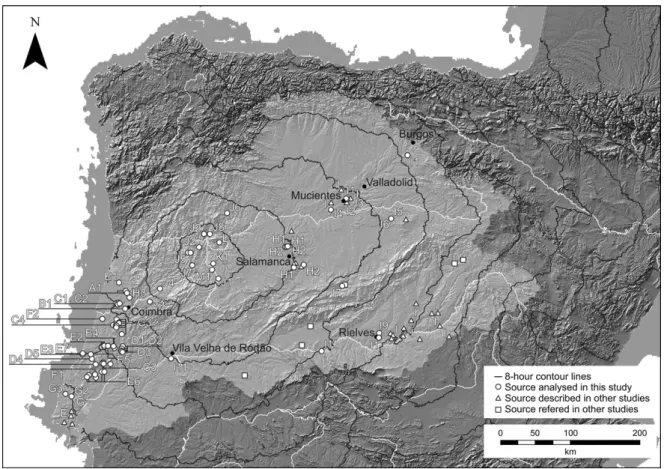
The Côa Valley data reveals the use of raw materials from four different areas of origin. Schist, granite, quartzite, quartz and rock crystal are available locally, in primary or secondary position in the areas surrounding each site, depending on local geology, but all within 1 h radius. Veins of fine-grained siliceous rocks (J1, J2, K1 and M1), are present in very circumscribed sources, corresponding to less than 7 h of walking. Walking away from the Côa Valley, cer-tain raw material sources are located at about 14–15 h, in two opposing directions, to the south-westwards (J4) and eastwards (H1 and H2). Finally, in these same directions, the most distant flint sources are located between 21 and 31 h walking (A1/2, C1/4, D2/3, E2/7 south-westwards; I1, I2/3, I5/6 and I7 eastwards) (Fig. 2).
The data obtained for the Côa Valley reveal that, during all Upper Palaeolithic occupation phases, lithic series are clearly
dom-inated by local quartzite and quartz, but also include a small pro-portion of regional fine-grained siliceous rocks, as well as flint and other fine-grained siliceous rocks from distant sources
(Fig. 2, Table 3). However, despite being suitable for knapping,
some regional lithic raw materials detected to the north of the Douro valley were not used in any of the Upper Palaeolithic series studied (Fig. 2), including the regional sources of spatially localised Precambrian chert (L1), and volcanic opal (J6).
Overall, the occurrences of different local or regional raw mate-rials used from the Gravettian to the Final Magdalenian in the Côa Valley, do not reveal significant differences in their sourcing. All the raw material sources, be they regional or distant, South-wes-tern or EasSouth-wes-tern, continue to be exploited along the Upper Palaeo-lithic sequence in the Côa Valley.
However, one can detect a diachronic trend. Gravettian assem-blages from Olga Grande 4 (Layer 3), Olga Grande 14 (Layer 3), Car-dina 1 (Layers 4, 10 and 4, 11), and Ínsula (Layer 2), have revealed a better representation of quartzite relatively to quartz, when com-pared to Final Magdalenian occupations, such as Fariseu and Quin-ta da Barca Sul assemblages, in spite of the local availability of both materials (Table 3).
In terms of regional and distant fine-grained sources, one also notes some differences. Generally, the same sources continue to be present throughout the entire sequence. However, during the Proto-Solutrean and Final Magdalenian, regional sources tend to overcome distant ones.
Cardina 1, which is the best example for detecting a diachronic trend due to the long stratigraphy and large assemblage, shows that the relative amount of exotic raw material from beyond 197 km (the median of the exotic raw material distances present; Table 3
Effectives of raw material categories defined inTable 2used in the Côa Valley.
Raw materiala Sitesb Distancec Origin Range
OG4 OG14 CAR INS QBS FAR
3 2c 3 4.6 4.7 4.8 4.9 4.10 4.11 2 3 4 9/
10
kmd hrse
Fine-grained rocks
Flint A1/2 – 2 – 1 5 4 2 8 2 – 1 – – 130 21 SW (Portuguese
Estremadura) Long-distance C1/4 8 6 2 42 73 48 60 45 24 4 2 – 5 149 24 D2/3 31 17 – 4 5 4 8 16 9 – – 3 – 180 30 E2/7 14 8 5 21 22 21 18 96 81 11 3 19 – 202 31 F1 – – – – – – – – – – – – – – – F2 – – – – – – – – – – – – – – –
I1 144 16 16 41 85 59 89 402 331 15 6 10 2 212 23 East (Northern Meseta)
I2/3 18 4 5 10 19 13 29 134 85 2 7 – – 212 23 I5/6 – – – 1 1 4 2 32 9 – – – – 268 26 I7 7 3 4 8 8 15 4 49 30 9 2 – – 197 26 I11 – 1 – 3 1 4 2 – – – 2 4 – 159 24 Not determined – 2 – – – – – 96 62 – – – – – – Burnt – 2 – – – – – 20 81 2 – 7 – – – Hydrothermal veins J3/4 – – – – – – – 11 9 1 – 15 – 86 14 SW Intermediate H1 2 – – 4 1 3 1 1 – – – – – 111 15 E H2 6 2 – 5 11 9 8 22 10 – – – 2 109 15 J1 21 – 8 12 26 24 14 11 12 – 32 – – 38 7 Local J2 3 – – 5 4 7 2 5 – 1 22 26 – 28 5 K1 26 16 5 2 5 8 3 7 3 2 – – – 15 3 M1 1 25 3 – – – – 2 6 1 8 2 – 23 5 Coarse-grained
rocks RhyoliteQuartz 7557 1316 25 x19 19 1 – –x –x –x 9817 5967 836 774 4974 195 !1– – 3 3 2 – !1 !1!1 Rock crystal 968 92 108 x x x x 5564 3411 142 16 237 – !1/
25 !1/25 Meta-sediment Quartzite 971 71 174 x x x x 11875 8251 242 118 825 156 !1 !1 aSeeTable 2for raw material description.
b Olga Grande 4 (OG4), Olga Grande 14 (OG14), Cardina 1 (CAR), Ínsula (INS), Quinta da Barca Sul (QBS), Fariseu (FAR). c Determined from the six sites’ mean centre.
d Straight-line Euclidean distances.
eCost distances usingTobler’s (1993)hiking function (see text for details). xpresent but unrecorded.
8 T. Aubry et al. / Journal of Anthropological Archaeology xxx (2012) xxx–xxx
Please cite this article in press as: Aubry, T., et al. We will be known by the tracks we leave behind: Exotic lithic raw materials, mobility and social net-working among the Côa Valley foragers (Portugal). J. Anthropol. Archaeol. (2012),http://dx.doi.org/10.1016/j.jaa.2012.05.003
Table 4
Effectives of raw material categories defined inTable 2used in the Portuguese Estremadura lithic assemblages studied.
Raw materiala Sitesb
BG BE BG/BE Dist VB VC VB/VC Dist LCO LCO Dist TMA TMA Distc
8c/
9a 9b 2ab km
c hrse 3b, 3/
4 3 4 5 6 6/7 7 8b km
c hrse 3 kmc hrse 2s1 2s2 Totald kmc hrse
Fine-grained rocks Flint A1/2 – – – – – – – – – – – – – – – – – – – – – – –
C1/2 4 – – 36 4 7 32 59 55 9 1 4 – 29 4 – – – – – – – – C3/4 83 95 14 3 !1 x 511 828 648 679 27 826 190 1 !1 7 !1/ 11 !1/3 1 1 5 29 7 D2/3 4 10 3 28 5 24 15 37 29 39 1 39 8 34 5 452 25 5 2 – 10 60 13 E2/7 20 32 6 35 5 54 100 261 303 367 16 432 6 44 5 3120 12 3 1310 844 9129 2 !1 F1 – – – – – – – – – – – – – – – 73 12 3 40 11 205 2 !1 F2 – 3 – 23 3 1 6 4 4 1 – – – 25 4 – – – – – – – – I1 – – – – – – – – – – – – – – – – – – – – – – – I2/4 – – – – – – – – – – – – – – – – – – – – – – – I5/6 – – – – – – – – – – – – – – – – – – – – – – – I7 – – – – – – – – – – – – – – – – – – – – – – – I11 – – – – – – – – – – – – – – – – – – – – – – – Not determined 5 – – – – – – – – – – – – – – 280 – – – – – – – Burnt – – – – – – – – – – – – – – – – – – – – – – – Hydrothermal veins J3/4 – – – – – – – – – – – – – – – – – – – – – – – H1 – – – – – – – – – – – – – – – – – – – – – – – H2 – – – – – – – – – – – – – – – – – – – – – – – J1 – – – – – – – – – – – – – – – – – – – – – – – J2 – – – – – – – – – – – – – – – – – – – – – – – K1 – – – – – – – – – – – – – – – – – – – – – – – M1 – – – – – – – – – – – – – – – – – – – – – – – Coarse-grained rocks Rhyolite – – – – – – – – – – – – – – – – – – – – – – Quartz x x 48 3 !1 125 213 394 259 327 21 497 4 4 !1 x 1 !1 844 967 5998 2 Rock crystal – – – – – – – 2 – – – – – ? ? – – – x x x – – Meta-sediment Quartzite – x 5 3 !1 73 40 138 86 194 – 202 3 4 !1 x 1 !1 156 391 1139 2
aSeeTable 2for raw material description.
bBuraca Grande (BG), Buraca Escura (BE), Vale das Buracas (VB), Vale dos Covões (VC), Lapa dos Coelhos (LCO), Terra do Manuel (TMA). c Straight-line Euclidean distances.
d Total sums layers 2, 2s1 and 2s2.
eCost distances usingTobler’s (1993)hiking function (see text for details). xpresent but unrecorded.
T. Aubry et al. /Journal of Anthropological Archaeology xxx (2012) xxx–xxx 9 Please cite this article in press as: Aubry, T. , et al. We will be known by the tracks we leave behi nd: Exotic lithic raw m aterials, m obility and social ne t-workin g among the Côa Valley foragers (Portugal). J. Anthrop ol. Archae ol. (2012), http://dx. doi.org/1 0.1016/j.j aa.2012.05.0 03
Table 3) decreases trough time in the site sequence, as opposed to the raw materials below that distance.
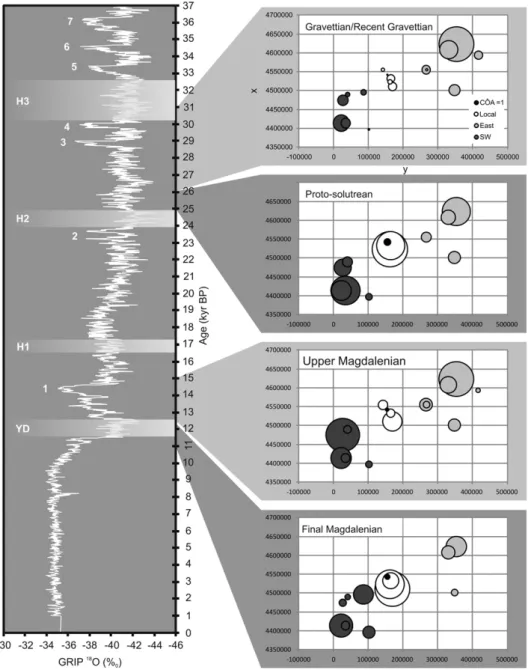
In terms of the two geographic areas, after LGM, the ratio of Eastern sources decreases in favour of South-western flint (Fig. 3). Differential raw material use
As noted earlier, all the lithic assemblages have been studied technologically and selected bladelet and flake tools, as well as non-retouched blanks, were submitted to use-wear analysis (Aubry
and Araújo Igreja, 2009). Each piece was classified into a
technolog-ical scheme: from block, nodule or pebble, to retouched flakes and tools, in order to establish the production processes for each differ-ent lithological group, their techniques and purposes (Fig. 4).
Our interpretation of the different production processes, ham-mer types and techniques (Pelegrin, 2000) used to remove blanks in the Côa Valley series has resulted in an ascription to seven cat-egories. Each sequence was evaluated in terms of its effective rep-resentation at each site and layer. An example of technological description by raw material is presented in Fig. 4. Gravettian assemblages reveal quite complete local quartzite pebble reduc-tion sequences, which are basically represented by the producreduc-tion of flakes. These short and thick flakes were probably used un-re-touched or slightly reun-re-touched as end-scrapers and side-scrapers
(Aubry and Araújo Igreja, 2009). Some pebbles, blocks and cores
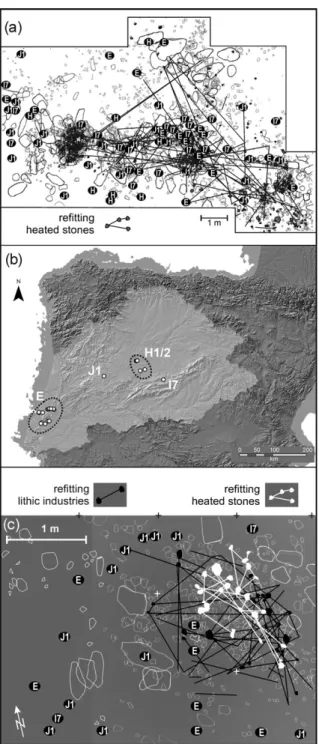
from such productions were also used as heat accumulators on fire-pits, either in the form of pebbles or discarded cores.
Throughout the Côa Upper Palaeolithic, quartz reduction se-quences show the greatest diversity in technical processes of pro-duction, which is probably related to the variety of petrographic characteristics (crystal, fine grain to coarse quartz, milky to translu-cent), in relation to the origin of the material and the type of blocks used (pebbles, vein fragments). In the oldest Upper Palaeolithic
occupation of the region attested in the layers 3 of Olga Grande 4 and 14 the morphology of blanks and numerous refitting reveals that fragments of local large vein quartz were used to produce thick flakes. At Cardina 1, a large range of quartz materials was used, revealing several reduction sequences to produce flakes and blad-elets. At this site, the module of the scrapers made on milky quartz blanks, when compared to by-products of the quartz series, clearly indicates that the blanks were not produced in the excavated area. During the Final Magdalenian, at Fariseu, technological analysis has revealed the same situation: retouched tools made on cortical flakes produced from large quartz pebbles (more than 10 cm of diameter) were not produced on site (Gameiro et al., 2008).
With some exceptions in the numerically small series, the third most common raw material category is rock crystal (Table 3). Translucent rock crystals (from 1 to 3 cm in diameter) were avail-able locally or regionally, while exceptionally large specimens (>5 cm in diameter) and smoked varieties associated to uranium mineralisation are present as veins in local schist and granite bed-rock. They were used as blanks for bladelet and small flake produc-tion, with two distinct operative schemes (Fig. 4). The most common operative scheme is based on anvil bipolar percussion, applied directly on the crystal or on a flake, recognised by the stig-mata observed on the products and cores. The second one, less rep-resented, depends on an unidirectional production sequence, where bladelets are removed either by soft hammer direct percus-sion, using the longer axis and the intersection of the natural faces of the rock crystals, or by burin-type cores. Experimentation with this reduction sequence revealed that the anvil bipolar percussion reduction sequence, when applied on prepared flakes, allows the production of bladelets and a more intensive exploration of vol-umes smaller than 1 cm (Klaric et al., 2009). Based on the techno-logical data available, the possible function of these pieces as intermediary pieces (‘‘pièces esquillées’’) (Le Brun Ricalens, 2006) Fig. 2. Siliceous raw materials available between the Douro and Tagus basins with time costs estimated from a mean centre in the Côa Valley area.
10 T. Aubry et al. / Journal of Anthropological Archaeology xxx (2012) xxx–xxx
Please cite this article in press as: Aubry, T., et al. We will be known by the tracks we leave behind: Exotic lithic raw materials, mobility and social net-working among the Côa Valley foragers (Portugal). J. Anthropol. Archaeol. (2012),http://dx.doi.org/10.1016/j.jaa.2012.05.003
cannot be entirely excluded. However, the reduced module, the morphology and the exclusive use of fine-grained raw material to produce them, argue in favour of the interpretation of these pieces as cores for bladelet and small flake production, and not as inter-mediary tools.
Singularly, at Olga Grande 4, rock crystal is the raw material preferentially used for on-site production of blanks for microgra-vettes and retouched bladelets, by direct soft hammer removal, as well as bladelet and small flake productions, attested by numer-ous by-products probably used without transformation as cutting edge elements of composite projectile points (Fig. 4).
The next category of raw materials by number is composed of several regional fine-grained vein quartz and exogenous flint cate-gories discarded at all the sites ("5% of the total raw material used, on average). The technological study reveals the use of these raw materials to produce blanks for retouched bladelets, following the same reduction sequence as described for rock crystal. How-ever, part of the regional fine-grained siliceous rocks arrived on site in the form of blocks or prepared cores (Fig. 4), differently from the
exogenous flints, which show reduction sequences that correspond essentially to the final phases of bladelet production and the reuse of blanks, flakes or blade-tools (Fig. 4). We could establish some differences between flint productions. In the Gravettian layers of the granitic plateau sites (Olga Grande 4 and 14), they correspond basically to fragments of retouched bladelets, showing diagnostic fractures due to their use as projectiles and damaged tools (e.g., notches, scrapers), discarded or reused as blanks for the prepara-tion of cores by bipolar percussion on anvil. At Cardina 1, a site lo-cated in the valley bottom, the Gravettian layers (4, 10 and 4, 11) present extremely reduced cores and core preparation and rejuve-nation flakes, like tablets, indicating the on-site production of blad-elets by soft hammer percussion on prismatic cores. However, the production of bladelets is essentially related to anvil bipolar per-cussion on flakes, or on small, fragmented retouched blades. These blades, retouched or not, were introduced in the Côa Valley as part of the tool-kit, and were reused after breakage.
During the Final Magdalenian, at Quinta da Barca Sul and Fari-seu, the curved backed points and retouched bladelets were mainly
Fig. 3. Representation of Lusitanian basin and Northern plateau lithic raw material sources in the Côa valley Upper Palaeolithic sequence. The x and y-axis refer to Lisbon Hayford Gauss IGeoE coordinates, and relative abundance is indicated by the size of the circles. For scale purposes the Côa Valley circle size equals to 1.
T. Aubry et al. / Journal of Anthropological Archaeology xxx (2012) xxx–xxx 11
Please cite this article in press as: Aubry, T., et al. We will be known by the tracks we leave behind: Exotic lithic raw materials, mobility and social net-working among the Côa Valley foragers (Portugal). J. Anthropol. Archaeol. (2012),http://dx.doi.org/10.1016/j.jaa.2012.05.003
produced from regional fine grain siliceous vein rocks and some southern flint sources (Gameiro et al., 2008). The lithological diver-sity observed for the local and non local raw materials of the re-touched bladelet tools and the identification of typical fractures suggest discard after use as projectile implements, which were re-placed by tools made from regional fine-grained siliceous sources. Despite these differences in the operative scheme of local and long-distance raw materials, no noticeable technological distinc-tion can be made between materials coming from the East and the Southwest, namely in the Gravettian layers of Cardina 1 and Olga Grande 4, where these materials are numerically important and statistically relevant.
Comparison with Upper Palaeolithic raw material procurement in Central Portugal (Sicó Massif and Serra d’Aire e Candeeiros)
Of the six Upper Palaeolithic archaeological sites considered for comparison, four are located south of Coimbra, in the northern sec-tor of the Meso-Cenozoic deposits of the Western Iberia margin
(Wilson et al., 1989) (Fig. 1c andTable 1), including marine, littoral
and continental sediments, often carbonates, covering the Iberian Hercynian crystalline basement (Ribeiro et al., 1979). Since 1991, a research project allowed us to recognise Middle and Upper Palae-olithic lithic assemblages preserved in occupation layers of caves and rock-shelters formed in the Middle Jurassic geological forma-tions of the Sicó Massif (Aubry et al., 1994, 1997, 2001, 2008,
2010; Almeida et al., 2003), a geological formation bearing poor
quality flint nodules (Aubry et al., 2001; Aubry, 2009). This lime-stone massif rises to less than 600 m above sea level and is pres-ently located 40 km east of the Atlantic (Cunha, 1990).
The sites considered (Buraca Escura, Buraca Grande, Vale das Buracas and Abrigo do Vale do Covões) are caves or rock-shelters located in two fluviokarstic canyons cut in the Middle Jurassic car-bonate formations of the western belt of the Sicó Massif (Cunha, 1990), all yielding flint nodules in limestone outcrops or in conti-nental Cretaceous and Cenozoic deposits covering depression in the bedrock. The cultural attribution of each archaeological assem-blage is based on typological evidence, ages obtained by absolute dating, palaeoenvironmental conditions inferred from the features of sediment and soil formation and its disconformities. This data allow us to propose a correlative framework (Table 1) for the
stratigraphical and archaeological sequence of these four sites pre-serving Middle and Upper Palaeolithic (Gravettian, Solutrean and Magdalenian) occupation levels (Aubry et al., 2010).
The archaeological assemblages of the Sicó massif sites were analysed using the same protocol applied to the Côa Valley series, including systematic survey for locally available primary and sec-ondary sources of lithic raw materials and their comparison with the archaeological record, completed by technological and use-wear analysis on a sample of retouched tools and blanks (Aubry et al.,
2001, 2008; Gameiro et al., 2008; Aubry and Araújo Igreja, 2009).
Raw material procurement patterns revealed the use of the lo-cal quartz and quartzite pebbles, in all the series, despite the prev-alence of a local poor quality flint, available at less than 1 h of walking distance. The data also show a systematic use of exoge-nous fine-grained flint from Upper Cretaceous (E2/7) and Upper Jurassic (D2/3) sources available at less than a 8 h walk distance southwards (Aubry et al., 2001; Gameiro et al., 2008) (Table 4). Technological study reveals that these fine-grained flint categories, having better qualities for knapping and for use in projectile tech-nology than the local Middle Jurassic flint, were preferentially used to produce retouched bladelets. Other tool types were made on by-products of the bladelet production sequence on prismatic or bur-in-cores, or via independent flake production schemes.
The two other sites used for comparison with the Côa Valley series are also located in the Portuguese Estremadura, or Lusita-nian basin, towards the South, in the Serra dos Candeeiros area. Terra do Manuel is an open-air site, firstly excavated in the 1940s and continued in the 1990s (Zilhão, 1997), which identified two Recent Gravettian occupation levels (2s1 and 2s2), very similar to Cardina 1 (4, 10 and 4, 11), confirmed by salvage excavation in the 2000s (Almeida et al., 2010).
This site is located very close to several major Cenomanian sec-ondary flint sources in the Rio Maior region. Like the Sicó sites, Ter-ra do Manuel occupations rely mainly on local flint (less than 1 h). The raw material types are roughly the same as the ones used in the Sicó sites, however, considerable effort was made to obtain the Upper Jurassic flint (D2/3, 13 h) (Table 4).
Two very different typo-technological systems could be identi-fied. The lower level presents a small number of flint cores when compared with the amount of flint debris, as opposed to quartz and quartzite, where pebble cores and flakes are present. These Fig. 4. Operative schemes and on-site representation of their different phases, by raw material type, in the Gravettian occupation layer 3 at Olga Grande 4 (SeeTable 2for raw material categories description).
12 T. Aubry et al. / Journal of Anthropological Archaeology xxx (2012) xxx–xxx
Please cite this article in press as: Aubry, T., et al. We will be known by the tracks we leave behind: Exotic lithic raw materials, mobility and social net-working among the Côa Valley foragers (Portugal). J. Anthropol. Archaeol. (2012),http://dx.doi.org/10.1016/j.jaa.2012.05.003
flakes were used differently according to raw material, quartz was retouched and quartzite used unretouched. The absent flint cores were probably prepared on-site for the production of backed and truncated bladelets, partially explored and then exported. In the upper level non-retouched bladelets and the other bladelet forms were produced from prismatic and thick carinated scraper cores.
Finally, Lapa dos Coelhos is a small cave open in the lower por-tion of the Almonda karstic system (Angelucci and Zilhão, 2009), which was excavated between 1995 and 2007 under the direction of F. Almeida (Almeida et al., 2004). The archaeological sequence, beginning during the Middle Palaeolithic, comprises Solutrean and Upper Magdalenian occupations (Almeida et al., 2004). The lithic assemblage from layer 3 (Table 1) was studied by Gameiro from a lithological and technical perspective (Gameiro et al., 2008). Raw material sources used in this site are generally the same as Terra do Manuel’s, with the advantage of being closer to Middle (C3/4) and Upper Jurassic (D2/3) sources (all within 5 h walks) (Table 4). The different flint sources were used for the on-site production of small convergent bladelets extracted from pris-matic, thick-scraper and burin cores (Gameiro et al., 2008). The blanks for thumbnail and on-flake scrapers consist of sub-products of this bladelet tool production. Quartz and quartzite pebbles were used to produce short flakes following a unidirectional or opposed platform reduction scheme.
Discussion
Palaeoenvironmental forcing
When interpreting the data presented above, a first variable to consider is the impact of climatic variation in ecosystems and re-source distribution and availability just before and after the LGM. Global climatic fluctuations during the Upper Palaeolithic se-quence are well-known from the data established on the Portu-guese continental margin (Lebreiro et al., 1995; Zahn et al., 1997; Bard et al., 2000; Shackleton et al., 2000; Thouveny et al., 2000;
de Abreu et al., 2003; Skinner and Elderfield, 2007). The study of
the last glacial period’s record revealed various events of abrupt change associated with severe changes in surface water tempera-tures ("7 "C in decades;de Abreu et al., 2003) and a periodicity of 1500 years (Bond et al., 1997;Grootes and Stuiver, 1997;Debret
et al., 2007). Several stadial/intestadial cycles have resulted in
mas-sive ice-discharges from the Northern Hemisphere ice sheets
(Heinrich, 1988), every 7000–10,000 years, known as Heinrich
Events (Bond et al., 1993), that have been described in cores along the Portuguese continental margin (Lebreiro et al., 1995; Cayre et al., 1999; Sánchez Goñi et al., 2000; Roucoux et al., 2001; d’Erric-o and Sánchez Gd’Erric-oñi, 2003; de Abreu et al., 2003; Rd’Erric-oucd’Erric-oux et al.,
2005; Sánchez Goñi et al., 2008).
From deep-sea pollen records and forest macroremains occur-ring along the NW Iberia coast in northern Portugal, Zilhão
(1997)has proposed a general picture for the Portuguese
Estrema-dura where scot pine forest is mixed with open herbaceous scrub-lands and patches of temperate deciduous and Mediterranean forest. At the time of Heinrich Events, correlations between marine and continental proxy data evidence a large development of dry climate-type vegetation in western Iberia, with low percentages of arboreal pollen during cold events and herb and shrub vegeta-tion with steppe species dominating. Lowered temperatures and precipitation were also accompanied by intensified winds leading to increased upwelling (Combourieu Nebout et al., 2002; Sánchez
Goñi et al., 2002; Turon et al., 2003).
In central Portugal, faunal remains of Upper Palaeolithic age are known from cave and rock-shelter sites only, and data concerning Late Pleistocene fauna are scarce for all of the Northern Meseta. As
a result of acid soils formed on metasediments and granites of the Côa Valley, as stated earlier, this kind of record is only available for layer 4 of the Fariseu site, an occupation dated by TL, OSL and14C
AMS between 11 and 12,000 BP and assigned to the Younger Dryas
(Aubry et al., 2010). Wild boar (Sus scrofa), red deer (Cervus
ela-phus), chamois (Rupicapra rupicapra), rabbit (Oryctolagus cuniculus), squirrel (Sciurus vulgaris), undetermined cyprinid and shad (Alosa alosa) were identified (Gabriel and Béarez, 2009). Comparison with species presence/absence and dating of layers I–VI of Peña de Este-banvela ("11 to 14,00014C years BP) (Cacho Quesada et al., 2007),
a sequence preserved in a rock-shelter located at the eastern limit of the Northern Meseta (Fig. 1a), reveals the same large mammal species, along with Equidae (Equus caballus and hydruntinus) and few carnivore remains (Felix silvestres, Lynx pardina, Canis lupus and Vulpes vulpes), with rabbit being the most represented species in all layers, despite a better representation of the Equidae remains in layers III and IV.
The faunal record for the Upper Palaeolithic sequence preserved in caves and rock-shelters of Central Portugal is slightly better known (Zilhão, 1997; Aubry, 2001; Davis, 2002; Hockett and Haws,
2009; Haws, 2011). Studies have revealed that rabbit remains
show intentional cut marks and breakage patterns (Hockett and
Bi-cho, 2000) and that the ratio of rabbit to ungulate increases from
the Mousterian to the Magdalenian (Davis, 2002), which is ex-plained as the result of a gradual increase of hunting pressure on the environment, probably due to higher human density. Red deer and wild boar dominate during the Lateglacial as opposed to a bet-ter representation of Equidae, ibex, chamois and aurochs before and during the LGM (Zilhão, 1997; Davis, 2002; Aubry et al.,
2001; Haws, 2011). Thus, both in the Meseta and along the Atlantic
coastline, the variation in animal resources reveals the same eco-logical trends from the end of the LGM to the Lateglacial.
Apparently, biotic resource forcing cannot be directly correlated with changes in the procurement of stone tool raw material over time, since it does not reveal clearly different origins from the Gravettian to Final Magdalenian/Azilian assemblages (Fig. 3). In the Côa Valley sites, local raw materials tend to gain importance over long-distance ones during the Proto-solutrean and the Final Magdalenian/Azilian (Fig. 3) and the predominance of Meseta sources over those from Portuguese Estremadura gradually de-creases. However, all the raw material sources (local, eastern or south-western) were used, which, despite differences over time in their relative importance, implies the existence of a similar spa-tial organisation and social network throughout the Upper Palaeo-lithic. In the current state of knowledge, no correlation can be clearly established between palaeoenvironment and changes in the procurement of raw materials (Fig. 3), so other explanations must be found.
Functional forcing
Functional and technological arguments have been advanced as explanation for the presence of exotics in Central Australian sites, where they present more efficient edge-holding properties (Gould
and Saggers, 1985).
In the Upper Palaeolithic of the Côa Valley, rock crystal, regional fine-grained vein quartz sources and long-distance flint sources were used to produce the same types of retouched bladelets in all the assemblages and with similar technological solutions (anvil bipolar percussion, associated with prismatic core reduction)
(Fig. 4). Other raw materials, which were available locally, less than
50 km away, were used to produce the same specialised tools made on flint coming from distant sources. This fact is a strong argument against a strictly functional interpretation of the use of flint, independently of cultural factors.
T. Aubry et al. / Journal of Anthropological Archaeology xxx (2012) xxx–xxx 13
Please cite this article in press as: Aubry, T., et al. We will be known by the tracks we leave behind: Exotic lithic raw materials, mobility and social net-working among the Côa Valley foragers (Portugal). J. Anthropol. Archaeol. (2012),http://dx.doi.org/10.1016/j.jaa.2012.05.003