Why are caring
masculinities so
difficult to achieve?
Reflections on men
and gender equality
in Portugal
Vanessa Cunha
Leonor Bettencourt Rodrigues
Rita Correia
Susana Atalaia
Karin Wall
13.
introduction
The emergence of caring masculinities in many parts of the world has been assessed in several reports since the early 2000s, all of them highlighting the virtuous impact of this reshape in male identities and practices for gender equality improvements in societies (Connell 2003; Norwegian Ministry for Children and Equality 2009; Scambor et al. 2013; Levtov et al. 2015; Heilman et al. 2017; Santos et al. 2016; Wall et al. 2017). Indeed, after decades of women demanding equal rights and opportunities and for the end of male domination and its harmful costs in their lives, caring masculinities arise as a strong ally against hegemonic masculinity.1
What are caring masculinities? According to a recent attempt to promote the concept, by combining contributions from critical studies on men/masculinities and feminist care theory, caring masculinities “can be seen as masculine identities that exclude domination and embrace the affective, relational, emotional, and interdependent qualities of care (…); a critical form of men’s engagement in gender equality because doing care work requires men to resist hegemonic masculinity and to adopt values and characteristics of care that are antithetical to hegemonic masculinity” (Elliot 2016, 252, 254). So, besides the commitment to care work and gender equality, caring masculinities entail a mindful refusal of hegemonic masculinity and inherent prerogatives (privileges, domination, power), as well as of the plural manifestations of “complicit masculinity” that it assumes (Aboim 2010).
Moreover, an all-inclusive perspective enlightens the manifold dimensions of the transformative process involved in caring masculinities, from care work in family life to care work in professional life, from taking care of others to taking care of oneself. Therefore, caring masculinities come up “in the everyday lives of men, when they take over caregiving practices, especially within families or when they work in ‘feminine’ professions of care (…),
1 The powerful concept of hegemonic masculinity is at the core of Connell’s work on masculinities and patriarchal gender order, and it was recently reappraised by the author (Connell and Messerschmidt 2005). Even if this concept has been criticised in relation to its scope for understanding phenomena from local to global scale, as well as the plurality of masculinities that are lodged under the archway of hegemony (Aboim 2010; Beasley 2008), it’s nevertheless indispensable for comprehending inter/ intra-gender power relations and inequalities. For a thorough insight into Connell’s work, see Aboim (2010).
[which it is crucial to widen] the concept of ‘care’ towards ‘self-care’ (awareness of health or emotional issues, deeper friendships, less risk-taking behaviour, etc.)” (Scambor et al. 2013, 2).
Lastly, this theoretical backdrop has pinpointed the narrow scope of perceiving hegemonic or complicit masculinities exclusively as a place of privilege and power encompassing well-acknowledged costs for women and non-hegemonic men (Aboim and Vasconcelos 2013; Norwegian Ministry for Children and Equality 2009). Indeed, “violence (against others and self), high-risk behaviour, lack of self-care, poor health, and impoverished relationships” (Elliot 2016, 246) are the costs that dominant men have to pay. But even if caring masculinities underpin improvements in men’s physical, mental and interpersonal domains of life (Elliot 2016; Scambor et al. 2013, Levtov et al. 2015), emerging “as a central path forward, and one that is increasingly taken up in practice” (Scambor et al. 2014, 552), this civilizational transformation is far from being fully achieved (as confirmed by persistent gender inequalities). The driving forces of the trade-off in masculinities are far from being fully seized.
Drawing on the above conceptual framework and the assumption that patriarchal gender orders have been challenged in Portugal, both in the public and private spheres, at least since the 1974 Revolution (Almeida 2011), this chapter offers a reflection upon the white paper Men and Gender Equality in Portugal (Wall et al. 2017). The focus here is on the costs of masculinity in men’s lives and the obstacles – interplaying at institutional, relational and individual levels – to the consolidation of caring masculinities.
The white paper is the main product of the project “Men’s Roles from a Gender Equality Perspective”2, which intended to raise awareness on the need to include men in the discussion of gender equality in Portugal. This was done by tracking recent changes in male roles and assessing their contribution to developments in this realm; promoting a major debate with the relevant social agents; and setting out a set of recommendations for decision-makers in order to enhance a gender equality agenda. In line with international reports and findings, the white paper concludes that “abolishing inequalities between
2 This project was undertaken in 2014-2016 within a partnership between the Commission for Equality in Labour and Employment, as the promoter, and the Institute of Social Sciences of the University of Lisbon, as the scientific partner. It was funded by the Financial Mechanism of the European Economic Area, eea Grants, Programme Area pt07 – Mainstreaming of Gender Equality and Work-Life Balance, with the Commission for Citizenship and Gender Equality as the programme operator.
men and women involves profound changes not only in the condition of women but also of men, in particular in terms of identity and the ways of being a man in private life (…), by breaking up the traditional patriarchal model of masculinity and putting forward a new model of masculinity which is more caring and egalitarian” (Wall et al. 2017, 15).
Caring masculinities linked to parenting and partnership are in motion in Portuguese society. This is largely a result of public policy that, from the mid-1980s onwards, has been enrolling men in early childcare, with the aim of improving work-family reconciliation in dual-earner couples with young children and, more recently, explicitly upholding gender equality as a goal written down in leave regulation since 2009.3 Men have been responding to the challenge by increasingly assimilating and displaying a nurturing role in children’s lives (Aboim and Marinho 2006; Wall, Cunha and Marinho forthcoming; Marinho 2011; Santos et al. 2016; Wall 2014, 2015; Wall, Aboim and Cunha 2010; Wall, Aboim and Marinho 2007). The rise in the take-up of parental leave, the trade-off in the time allocated to paid and unpaid work, and the greater share of household tasks are clear evidence of the consolidation of caring and more egalitarian masculinities in Portugal.
This ongoing cultural change, transformative of male identities, parenting practices and family dynamics, is also supported by favourable gender-role attitudes, especially among individuals in family-formation ages with secondary and tertiary education, according to issp20124 (Ramos, Atalaia and Cunha 2016; Wall et al. 2017). In fact, both the ideas of equal sharing of household tasks and of the father’s important role in childcare have been substantially supported. There is also considerable approval of key policy measures that strengthen the father’s caring role. There is extensive recognition of the plentiful benefits of the father’s take-up of parental leave, not only for men’s, women’s and children’s individual and relational well-being, but also as a booster of gender equality and domestic balance among couples. Briefly, major changes are happening in the attitudes towards men as caregivers and partners, as well as in the way fathers display a nurturing role and make sense of it. These
3 The Decree-law 91/2009 of April 9th defines and regulates the protection in parenthood.
4 The Portuguese issp2012 “Family and Changing Gender Roles” was only administered in 2014 and counted on the co-funding of the project “Men’s Roles in a Gender Equality Perspective’” Under this protocol, an additional module was produced on the attitudes of the resident population concerning the national legislation in force, or under discussion, that endorses gender equality in the public and private spheres, including in the field of leave policy.
developments are in tune with “the objectives outlined in the law governing the protection of parenthood, i. e. reconciling family and work on the basis of gender equality, the child’s well-being and the ‘harmonization of career and family responsibilities’ between men and women” (Wall et al. 2017, 40).
However, even if this means that leave policy moved by those principles is essential for promoting men’s involvement in early childcare and upgrading gender equality in family life, the caring masculinities’ revolution is far from achieved. As mentioned above, caring masculinities are not confined to parenting identities and practices, they comprise a much more comprehensive value of care (including self-care) defiant of dominant models of masculinities in different realms of life and frameworks of interpersonal relationships over the life course. From childhood to old age, and in many arenas of men’s identity and daily existence – from school to labour market, from family life to health and violence – men and boys have to cope with the costs of being excluded from socialisation for care work and of being recognised as (competent) caregivers. Caring masculinities remain, therefore, an enterprise full of obstacles.
understanding the obstacles to caring masculinities
Like other reports that appraised men’s contribution to gender equality in different domains of social existence (Norwegian Ministry for Children and Equality 2009; Scambor et al. 2013), the white paper portrayed four main arenas – family and work-family reconciliation, labour market, education, and health/violence. It also unveiled key obstacles that hinder the thriving of caring masculinities: the refusal to giving up hegemonic privileges, like those resulting from male leading position in the labour market; the harmful costs for themselves of dominant forms of masculinity “defined by physical strength, power, domination and aggression” (Scambor et al. 2014, 562); and the institutional and interactional ambivalences or setbacks regarding men’s role in family and professional caregiving. Common to all these obstacles, we may grasp the surreptitious but powerful role of gender stereotypes, which motivates prejudice and discrimination, by excluding men from (self-)care.
Gender stereotypes are defined as a set of structured and shared beliefs based on the specificities of being a man in contrast with being a woman
(Amâncio 1994). They are imputed to sexual differences ( Connell 2002) and refer to characteristics, attributes, behaviour, preferences and roles associated with and believed to be appropriate to the masculine and feminine identities (Deaux and LaFrance, 1998, cited in Laranjeira et al. 2002). Therefore, gender stereotypes take on a descriptive function, whereby male and female characteristics place limits on the roles and responsibilities regarded as suitable for men and women, boys and girls. Additionally, they have a prescriptive function for gender roles as, even implicitly, they convey ways of acting. The internalisation of commonly-shared gender representations – both in interpersonal relationships and at an institutional level – shapes expectations, values, behaviour, decision-making, experiences and opportunities (Cavaco et al. 2015). Therefore, caring masculinities can be seen as a transgressive social demand that challenges deep-rooted gender stereotypes.
boys and socialisation for care
white paper recommendation:
To socialize and educate early in life for gender equality and for the value of male care (Wall et al. 2017, 6).
Primary socialisation usually takes place in the family and has a particularly important role in inculcating stereotypical models of behaviour and identity during early childhood (Fontaine 1990, quoted in Cavaco et al. 2015). Secondary socialisation, in turn, takes place in school, where the child encounters other sets of references and social learning which, through stereotyped messages, lead to the construction of masculinity and femininity (Carrito and Araújo 2013). This section of the chapter highlights the most significant features of family and school contexts that make them key-territories for the reproduction of gender stereotypes and, therefore, for keeping boys away from caregiving skills and caring masculinities.
The central role of parents in socialisation justifies seeing them as powerful players in the gender game, in the sense that they tend to reproduce gender-stereotyped expectations (Lynch and Feeley 2009). From toys to kinds of play, from types of interaction to expected behaviour, skills and choices, the primary socialisation at home shapes boys and girls and determines what being a man or being a woman means (or is expected to mean), and what kind of skills men and women are expected to have. A recent bbc experiment has demonstrated
that when faced with an unknown child, just taking into account the clothes they have on, people make use of a set of gender stereotypes that guide the interaction with the child, the kind of toys chosen and the kind of play used5, clearly showing that both men and women, when interacting with a child with gendered-male clothes, choose more spatial awareness or games and toys requiring physical confidence (robots, cars or puzzle games), while when interacting with a gendered-female clothes child, they often choose a doll or soft toys.
Scientific studies have been producing similar results, supporting the idea that parents and other significant adults reproduce a traditionally gendered childhood (choice of toys, clothes, activities and styles of play), in which they seek to ensure that boys will be boys (Kane 2012), pushing them away from caring-related toys or activities. The impact of this gendered parental influence becomes evident when children show stereotypical toy preferences, which have been proven to occur early in development, at least from 9 months onwards (Alexander, Wilcox and Woods 2009; Todd, Barry and Thommessen 2016). Studies based on infants’ visual preferences (Alexander et al. 2009) and on observations of infants and toddlers “playing alone” (Todd et al. 2016) reveal that boys have more interest and spend more time playing with a car, a truck or a digger toy than with a doll or a cooking pot.
It is interesting to notice that for boys, but not for girls, this preference increases with age (Todd et al. 2016). This sex difference can be explained as a result of the observation of others’ behaviour and expectations in the socialisation process, through which boys, not only increase their knowledge of gender-typed behaviour, but also realise the social criticism that exists around it and which is, across racial and social backgrounds, greater for boys than for girls (Kane 2006). This pressure towards a dominant model of masculinity is highlighted in a National Reading Plan book for the 8th grade on the uneasiness of school-aged children with regard to society’s gender stereotypical expectations.6
5 Available at http://www.bbc.com/news/av/magazine-40936719/gender-specific-toys-do-you-stereo type-children.
6 In this story, an eight-year-old boy tells his six-year-old sister (who is always complaining about women’s gender discrimination): “Have you ever thought that dad is the one who has to work all day long in the store to make money for us? Have you ever thought that he is the one who always arrives home at night, tired and sick of putting up with customers? You’re lucky you are a girl (…). You think being a boy is cool? Do you think I wouldn’t want people to stop annoying me with what is being a man and not being a man?” (Gomes 2017).
Additionally, the literature reveals that even parents who have a progressive attitude to gender equality tend to be “gender trap[ped]” and, thus, influence their children towards gendered identities and skills (Kane 2012) and encourage their school trajectories and vocational choices in a stereotypical way, which, in turn, later on impacts on labour market horizontal segregation (Lynch and Feeley 2009).
As regards school context, there are different environment features that make it a key-territory for reproducing gender stereotypes. To describe its features, one has to refer to the multiple ways through which, both explicitly and implicitly, school environment sends stereotypical messages conveyed by educational practices, namely text books and informal/non-verbal interaction and behaviour. These, along with expectations, activate gender stereotypes by associating masculinity with skills and characteristics such as logical reasoning, assertiveness, pro-activity, competitiveness and aggressiveness that can be more associated with virility and the public sphere; distancing the male role from the private sphere, not promoting more empathic, relational, altruistic, caregiving skills. In contrast, school confines male and female pupils with distinct personalities, attributes, interests and motivations to a single educational strategy and evaluation criteria based on a feminised image of a good student: the one who concentrates on studying, is attentive in class, completes assigned tasks, performs well and whose behaviour reflects calm acceptance of the rules. This representation is close to the stereotypical characteristics of the female: dependence, imitation, passivity and conformity (Cavaco et al. 2015).
Beyond the formal curriculum, which is written down and is objective, schools also have an informal or hidden curriculum, which may reinforce gender stereotypes through personal interaction and the way in which time, space and resources are organised and managed. School practices and routines reveal beliefs and attitudes which incorporate gender discrimination and are evident in: different performance and behavioural expectations; defined learning strategies; the selection and organisation of curricular and extra-curricular activities; and, “the identification of vocational tendencies and orientations characterised by ‘natural’ aptitudes” (Silva and Saavedra 2009; Cavaco et al. 2015). The social pressure towards a hegemonic model of masculinity is also undertaken by peers. For example, 3 or 4-year-old children reveal the influence of peers on gendered-typed behaviour (Serbin et al. 1979; Wilansky-Traynor and Lobel 2008). Under the influence of the hegemonic model, boys in school, both in low and upper classes neighbourhoods, adopt
aggressive behaviour to demonstrate their virility (Amâncio 2004). Indeed, being involved in fights is considered one of the requirements that boys have to meet to demonstrate their masculinity (another one is playing football) (Pereira 2012). The violence in schools is recurrent and occurs on a daily basis, mostly between male pupils (small thefts, aggression, intimidation, persecution and threats), generally by older against younger and stronger against weaker – “Pushing and shoving”, “kicking”, “sandwiching” and “petty theft” (Sebastião, Alves and Campo 2003).
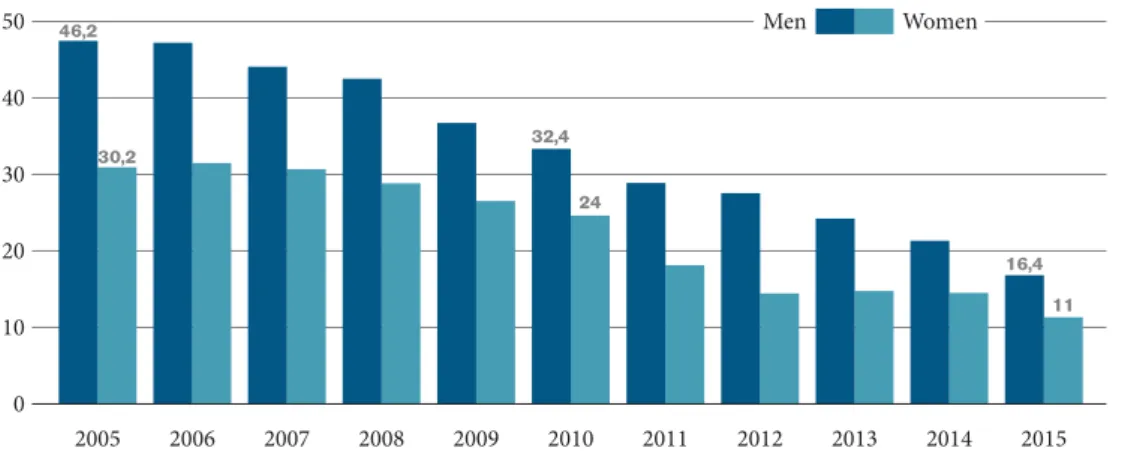
The influence of gender stereotypes on primary and secondary socialisation that occurs in family and school contexts has immediate short-term effects on children’s lives and long-term effects in adulthood. Immediate short-term effects become evident while still at school in, at least, two ways. First, gender stereotypes are salient in boys’ specialisation and vocational choices for more practical, objective disciplines. And second, as a result of the clash between gendered acquired and informally expected attributes and those formally demanded from pupils in the school context, boys’ school trajectories in Portugal are marked by high retention and low performance, which in a gradual, cumulative way leads them to drift away from school. Despite the positive trend of time-series, in 2015 still more than 16% of young male adults aged 18-24 had dropped out of school before completing secondary education and the learning opportunities that it provides (Figure 13.1) (Cavaco et al. 2015; Wall et al. 2017).
Long-term effects become evident in men’s lower educational levels, as compared to women’s, even at young ages (Rodrigues, Cunha and Wall 2017). In 2014, while most women aged 25-34 had completed higher education, most men had completed basic schooling (Figure 13.2). Literature on this topic has shown that, despite all the education policy-related measures adopted in recent decades – e. g. extension of compulsory schooling up to the age of 18 – and an overall increase in educational levels, those sex differences enlarge when socioeconomic background is considered (Almeida and Vieira 2006; Almeida, André and Cunha 2005). Notwithstanding, men’s lower educational attainment level is not a barrier to their insertion in the labour market, even if in disqualified jobs (Almeida and Vieira 2006; Almeida, André and Cunha 2005; Wall et al. 2017). This phenomenon has several implications: it extends and reinforces sex differences in education and male devaluation of schooling as an empowering tool towards knowledge; it promotes dominant models of masculinity linked to a professional and economic identity rather than to a
school and intellectual one; it perpetuates conservative attitudes and values on gender roles and relations, with the persistence of gender inequalities in all spheres of life, as discussed in the sections below.
Early leavers from education and training (18 to 24 years), by sex (%) – Portugal, 2005-2015
Source: Wall et al. 2017 (Calculation based on data from Eurostat [edat_ifse_14]).
Figure 13.1 2005 2006 2007 2008 2009 2010 2011 2012 2013 Men Women 2014 2015 50 40 30 20 10 0 46,2 32,4 16,4 11 24 30,2
Population distribution by level of educational attainment (total and age group 25-34 (%) – Portugal, 2014
Source: Rodrigues, Cunha and Wall 2017 (Calculations based on data from INE/Eurostat, Labour Force Survey)
Secondary Education High Education
10% 20% 30% 40% 50% 60% 0% 70% 80% 90% 100% TOTAL 25–34 W W M M
None Basic Schooling
0,2 25,8 33,3 40,7
0,3 41,9 34,1 23,7
2,4 43,4 25,4 28,8
2,3 57 23,5 17,2
men and professional care
white paper recommendation:
To develop initiatives to support careers for men in traditionally feminized sectors. (Wall et al. 2017, 9)
The crystallised notion that there are feminine and masculine occupations and roles in the workplace collides with the right of both sexes to freely define their career choices. It also affects the management of time allocated to paid work, unpaid work, family life and leisure, and even financial independence. Hereupon, horizontal segregation of occupations – the segmentation of occupational activities into strongly male and female sectors – is a particularly good example of how traditional gender roles corroborate male and female stereotypes in day-to-day practices, and restrain boys’ and girls’ access to certain areas of specialisation and even affect their vocational choices. Those are limited at the outset, based on a differentiation that derives from stereotypes of male and female roles, and not from choices in the true meaning of the term, based on equal rights and opportunities (Connell and Messerschmidt 2005).
Indeed, stereotypical conceptions about manhood – aggressiveness, ambition, domination, strength, endurance, independence and drive to competition, but also being unafraid, having integrity and being prone to conflict – are highly correlated with the career paths society finds suitable for men and which are embodied in men’s professional choices. Also, research shows that men tend to be portrayed as more technically gifted and task and result-orientated, while women are typically seen as caring, emotional and relationship-orientated, which constitutes a pervasive societal bias with important implications in men’s low demand for professions related to care work, namely in Health, Social Work and Education areas.7 Indeed, the Portuguese labour market reflects this trend and has similar patterns to other European countries, in terms of the horizontal segregation of occupation. According to the Census 2011, the industry, construction and retail trade sectors accounted for most of the employed men in Portugal, together with
7 Classification from ec/Eurostat: nace Rev. 2 – Statistical Classification of Economic Activities in the European Community. Human Health and Social Services include: Human Health, Residential Care and Social Work Activities. Education includes all levels of education and educational support activities. (Document available at: http://ec.europa.eu/eurostat/docum ents/3859598/5902521/ks-ra-07-015-en. pdf).
public administration, agriculture, fisheries and transport/storage, and a wide disparity between men and women was shown in sectors like health and social services, education and construction. In 2011, 6% of male workers, as against 27% of female workers were working in health and social services and education (Figure 13.3). Likewise, only 1.3% of women worked in construction, as against 17.3% of men (Wall et al. 2017).
An analysis of this indicator over time in traditionally more segregated sectors shows that between 2008 and 2015, men failed to gain ground in traditionally female occupations (education, human health and social services), the change being minimal (Wall et al. 2017).
Concerning the education sector, in 2014/15, in all levels of education up to secondary, men accounted for less than 30% of the teaching staff, recording 13.8% in the first cycle of basic schooling and less than 1% in pre-school teaching (Figure 13.4). It is important to recall that specific teacher training for kindergarten emerged in Portugal only in the 1950s and, at the time, men weren’t allowed to attend it. Even if this situation changed after the 1974 Revolution, the social readiness of men in regard to this profession has been almost motionless, as the statistics clearly prove. Indeed, the existence of widespread bias against female-dominated occupations has visible consequences on their low social status and on lower wages, which tend to increase men’s resistance to them. Likewise, there is also a low proportion of men in non-teaching staff in pre-school, basic and secondary education, with a percentage of around 14.
The effects of male/female disparity in the school teaching body on pupil performance remain unclear, but special attention has been drawn to the impact of a lack of adult male figures as role models in schools, and its effect in terms of boys’ lack of motivation and involvement (Thornton and Bricheno 2006).
As stated in the white paper, this “horizontal occupational segregation suggests that a gender-based definition of work persists, attributing to (less skilled) men those types of work which demand physical strength, technological mastery and leadership functions (for those best qualified), and to women the types of work related to caregiving, reflecting the essentialist stereotype of the role of the woman as a ‘natural’ carer” (Wall et al. 2017).
When men embrace female-dominated professions, including most care work occupations, there’s a “glass escalator” effect where they tend to have higher wages and faster wage growth compared to their female counterparts (Dill, Price-Glynn and Rakovski 2016; Baughman and Smith 2011).
Employed population in Education and Human Health and Social Services, proportion by sex (%) – Portugal, 2011
Source: Wall et al. 2017 (Calculations based on data from Eurostat, Labour Force Survey).
Figure 13.3
10% 20% 30% 40% 50% 60%
0% 70% 80% 90% 100%
Human Health and Social Services Education
Men Women
22,2 77,8
17,6 82,4
Proportion of male teachers, by teaching level (%) – Portugal, 2004/05 – 2014/15
Source: Wall et al. 2017 (Calculations based on data from dgeec-dsee, 50 Anos de Estatísticas de Educação [50 years of Education Statistics] (2009), Educação em Números [Education in Pre-School Education Numbers] 2015, data updated in November 2015). Figure 13.4 40 30 20 10 0 2004 2005 Pre-School 1st Cycle 2nd Cycle 3rd Cycle and Secundary
2005
2006 20062007 20072008 20082009 20092010 20102011 20112012 20122013 20132014 20142015
Men tend to ride the “glass escalator” in “pink-collar” occupations with a higher likelihood of being promoted, a more strategic choice of career paths by selecting those that have higher wages or higher social recognition, and even being pressured by female colleagues to assume managerial positions8 (Snyder
8 In an article from the daily newspaper, Diário de Notícias (12/11/2016) on male pre-school teachers, this issue was addressed by the interviewees when talking about their experiences.
and Green 2008; Williams and Villemez 1993). Thus, the “glass escalator” reflects again the stereotypical beliefs of men as more suited for managing, well-paid positions, making a good use of their “innate” leadership traits and fulfilling their role as providers. It’s nevertheless important to point out that horizontal segregation has basically focused on women’s disadvantages and on their efforts to break through existing gender patterns, norms and barriers. This has made it more difficult for men to gain ground in “traditionally female” jobs, given that male discrimination has generally been absent from the public agenda (Aboim and Vasconcelos 2013). Adding to these socio-normative constraints, male teachers are confronted with the stigma related to sexual abuse of children that are frequently raised in unsubstantiated ways, or based on extremely rare occurrences (Cameron 2001). Overall, this socially perceived inadequacy of male participation in educational settings tends to be higher for younger children than for older children.
men and family care
white paper recommendation:
To enshrine in the Portuguese Constitution the right to care, associated with the duty of care. (Wall et al. 2017, 6)
Successive studies at national level have been highlighting the ongoing reshaping of fatherhood practices and identities, embedded in expectations and assumptions of a hands-on, emotionally involved and co-responsible role in childcare (Aboim and Marinho 2006; Wall, Aboim and Cunha 2010; Marinho 2011; Wall 2014). But even if this sphere of life is, beyond question, where caring masculinities are making their way, Portuguese men still have to face massive ambivalence, if not resistance, regarding their role as family caregivers and their (constitutional) right to work-family reconciliation at institutional, interactional and individual levels (Wall et al. 2017). Apart from the family and the school, the labour market and the legal order are,
The coordinator of the course of pre-school teaching from the Santarém Higher School of Education, Maria João Cardona, talked of the great impact of gender stereotypes, sometimes from families, in the marginal choice of this course by young men: “Male students that I had, had to fight against families, because there is a lot of prejudice” (Available at: https://www.dn.pt/sociedade/interior/o-diploma-de-pedro-diz-educadora-5493800.html).
most probably, the major institutional settings that mark out and shape daily existence, interaction, opportunities and constraints. Contradictory messages and guidelines on men’s roles in the private and public spheres emerge precisely from these crucial settings of human existence, which sustain the conflict between progressive perspectives on caring masculinities and more conservative ones on traditional or complicit masculinities (Aboim 2010). A conflict with which men have to cope as fathers, partners, and workers.
Indeed, despite the objective developments, since the 1974 Revolution, in women’s full-time employment and in labour legislation promoting gender equality, most indicators on paid work extensively attest to a highly gender-biased labour market, and to the persistently uneven distribution of privileges and rewards of paid work in prejudice of women (Ferreira 2012; Wall et al. 2017). However, the costs of men’s advantageous position in the labour market are less known, namely the persistent expectations stemming from a traditional organisational culture of workplaces that fosters the “androcentric career model” (Lewis 2010). Many men have to comply with this “ideal” of the male employee, fully committed to a demanding and time-consuming professional life and released from family responsibilities (Casaca 2013). As highlighted by several in-depth national studies, most men identify this “androcentric model” as inescapable and as a cost that is hindering their willingness and chance for greater involvement in family life and childcare, therefore experiencing conflicting appeals in the performance of these roles (Aboim and Marinho 2006; Wall, Aboim and Cunha 2010; Wall 2014; Wall et al. 2017).
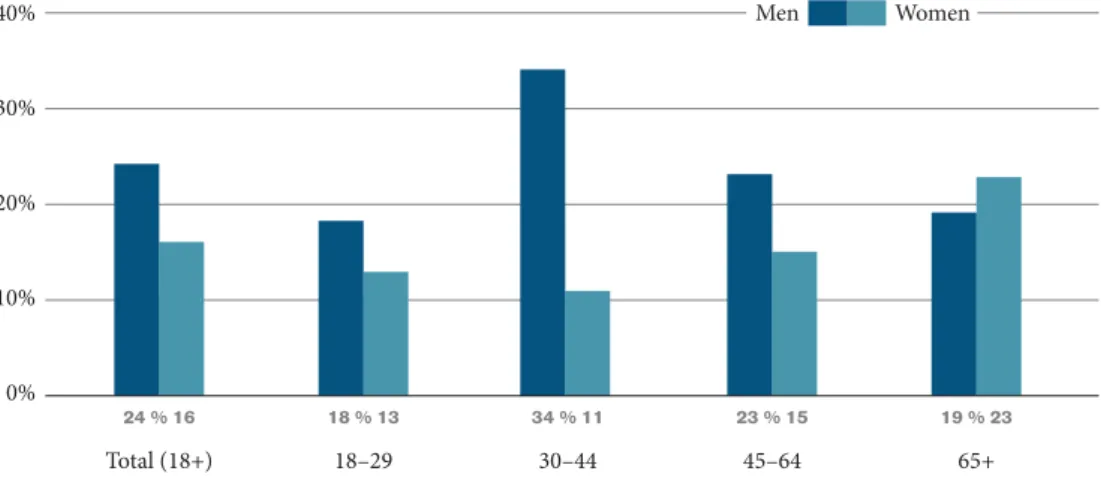
The long-standing and quite stable two-hour/week gap in the average time men and women allocate to full-time employment is the most evident indicator of the higher onus on men in paid work (with well-known costs for women in unpaid work) (Wall et al. 2017). There are, however, other indicators that clearly assess the current conflict surrounding the construction of male identities and roles, such as issp 2012 Family and Changing Gender Roles findings suggest: on the one hand, men recognise that they should do more household tasks and more childcare than they actually do (Ramos, Atalaia and Cunha 2016). On the other hand, many men, especially those in family formation years, are aware of the negative effects associated with the obstacles in workplaces to their caring role as fathers, expressing their disagreement with the idea that “men’s take-up of parental leaves has positive effects in helping the father to keep his job” (Figure 13.5).
Other obstacles to a more far-reaching development of caring masculinities stem from the national legal order, as already mentioned. The leave policy advances towards the endorsement of the father’s right and duty to care for young children, culminated in the 2009 legislation that established the “initial parental leave”, ideally to be shared by both parents, as a further step towards gender equality and shared work-family reconciliation. Despite these progressive principles and guidelines in the law, the mother remained the main recipient of leave policy, not only due to the amount of time available for her, but also due to the fact that the father’s eligibility is dependent on the mother’s eligibility for the initial parental allowance (Cunha, Atalaia and Wall 2017; Rêgo 2012; Wall et al. 2017).
This constitutes a major setback for a broader understanding of men as primary caregivers, with equal entitlements and responsibilities in care work, and a handicap for men to negotiate in the workplace the legitimate right (and duty) to care for their children (or other dependent or sick family members9).
9 Even if recent national research has been focused on male caregiving experiences in regard to dependent ascendants (Silva 2017), this domain of family care remains highly feminised (Wall et al. 2017).
Individuals who disagree that men’s take-up of parental leaves has positive effects in helping the father to keep his job, by sex and age group (%) – Portugal, 2014
Source: Wall et al. 2017 (Calculations based on data from issp 2012).
Figure 13.5 Total (18+) 18–29 30–44 Men Women 45–64 65+ 40% 30% 20% 10% 0% 24 % 16 18 % 13 34 % 11 23 % 15 19 % 23
Moreover, this legal bias echoes a powerful, persistent and long-ranging gender stereotype that is deep-rooted in society: the superior value of women’s care that blossoms out of female “nature” (Gaunt 2006). Indeed, if fathers have definitely made their way in childcare, and are acknowledging it, there is still a non-negligible proportion of men and women that see fathers as less competent or skilled caregivers of small children. Younger generations, though (as well as the most qualified individuals), are challenging the gender stereotype (Figure 13.6), most probably due to the experience of gender deconstruction processes that some couples have been through by sharing initial parental leave (Wall 2014; Wall, Cunha and Marinho forthcoming).
But the foremost objective obstacle that the legal order has set to caring masculinities development in Portuguese society, in the private sphere, concerns the massive retrenchment of the father’s role in children’s lives after divorce or separation. The post-divorce parenthood regulation (Law 61/2008, 31 October), which hosts the legal presumption of shared parental responsibility with maternal residence and paternal alimony and visitation, is sustained by the assumption that there are prescriptive gender roles for men
Individuals who agree that the child suffers when the father does not take part in childcare and that the father is as capable as the mother, by sex and age group (%) – Portugal, 2014
Source: Wall et al. 2017 (Calculations based on data from issp 2012).
Figure 13.6
Total
(18+) 18–29 30–44
The child suffers when the father
doesn’t take part in childcare of taking care of a baby less than one year oldThe father is as capable as the mother
Men Women 45–64 65+ 100% 80% 60% 40% 20% 0% 75 % 75 92 % 83 79 % 79 68 % 76 66 % 64 Total (18+) 18–29 30–44 45–64 65+ 53 % 60 66 % 72 58 % 78 51 % 58 38 % 39
and women in society: the men’s breadwinning role and the women’s caring role. This re-traditionalisation and re-genderisation of post-divorce families, undoubtedly in counter-cycle with most trends of family life, has heavy costs for men, women, and children (Marinho 2017; Marinho and Correia 2017; Marinho 2018). In line with Marinho’s statements, the white paper identified the costs of parenting after divorce for mothers and fathers: “An added ‘exclusive’ responsibility falls on women in day-to-day life, with a strong impact on their position in the labour market, in work-family reconciliation, in managing timetables and the economic well-being of their household. Men find that access to their children is severely constrained, through a system of visits which makes it impossible to share their day-to-day lives and to maintain the relational proximity (…) [and] responsibility ‘for the acts of day-to-day living’ of their children” (Wall et al. 2017, 52-53).
In the absence of better statistical information, the Censuses of 2001 and 2011 portrayed the evolution of lone-parent families with children below age 18. These families increased 48% in this period, largely as a result of the rise in divorce. In both years, lone-father families represented 11% of the total (Marinho 2014). So, the persistence of gender stereotypes in the realm of parenthood brings a drawback in men’s lives, as an increasing number of fathers are being disengaged and excluded from their children’s daily existence after divorce or separation in Portuguese society.
men and self-care
white paper recommendation:
To develop more in-depth studies on the impact of social inequalities on men’s health and undertake awareness campaigns based on the social determinants of men’s health. (Wall et al. 2017, 12)
In contrast to the privileges gathered in other spheres of life, men’s health problems and lack of well-being are regarded as costs of masculinity (Scambor et al. 2014). Although masculinity is not a fixed entity (Connell 1995), boys and men’s physical and emotional well-being have been affected by the social construction of gender (Prazeres et al. 2008; ec 2011). Men are socialised to be strong, independent and self-reliant, which implies physical toughness, risk-taking and heavy drinking. This hegemonic masculinity influences the way
Sex ratio in causes of death mainly affecting men (sex ratio > 200) – Portugal, 2014
Source: Wall et al. 2017 (Calculations based on data from ine/insa, National Health Survey).
boys and men relate to themselves, including to their body and sense of self-care. Following this line of reasoning, being sick is the opposite of what a man should be. Men shouldn’t be weak or, worse, reveal to others their weakness, whether physical or psychological. For that reason, men report less suffering from health problems during their lives than women (ine/insa 2016), in particular chronic illnesses; but have more severe injuries and spend longer periods out of work due to health problems (Wall et al. 2017). In fact, men assess their health status more positively than women do: for every 100 women there were 112 men who stated they were in good or very good health (Wall et al. 2017). At the same time, men resort less to health services in a preventive way, in particular to medical appointments (both general or family practitioner and specialist), diagnosis, and screenings, but have a higher exposure to risk, including occupational risks. Men are major victims of mortal or disabling accidents in the workplace (Scambor et al. 2014) and are most frequently victims of violent deaths, such as suicide and road traffic accidents. This can be seen as a consequence, in men’s life course, of the adoption of risk behaviour and specific lifestyles profoundly related to the social construction of masculinity, such as higher alcohol and tobacco consumption, drug abuse, road accidents, deaths from suicide, deaths from hiv-aids or calorie food intake (Figure 13.7).
Figure 13.7
Mental disturbances and behaviours due to alcohol use 1680
Malignant tumour of the oesophagus 581
Malignant tumour of the lip, mouth cavity and pharynx 531
Transport accidents 403
Chronic illnesses of the liver 396
Malignant tumour of the larynx, tracheia, bronchus and lungs 392
Human hiv-related illnesses 311
Suicides and self-inflicted injuries 310
Malignant tumour of the bladder 276
Accidental poisoning by drugs, medications and biological substances 252
Malignant tumour of the liver and intra-hepatic biliary tract 248
Sex ratio at death, by age group (%) – Portugal, 2015
Source: Wall et al. 2017 (Calculations based on data from ine/insa, National Health Survey)
Figure 13.8 85 or more years 80-84 years 75-79 years 70-74 years 65-69 years 60-64 years 55-59 years 50-54 years 45-49 years 40-44 years 35-39 years 30-34 years 25-29 years 20-24 years 15-19 years 10-14 years 5-9 years 1-4 years Less than 1 year
56 224 199 211 219 221 129 95 254 215 144 182 77 188 262 253 285 191 161 Indeed, some of the most alarming data in this domain refers to men’s premature mortality. Accordingly, although the average life expectancy at birth in Portugal has increased over the last decades for both sexes, statistics from 2014 show that men have on average a six-year lower life expectancy than women (ine/insa 2016); and in 2015, male deaths exceeded female deaths in almost all age groups (Figure 13.8). This fact is particularly visible in the working ages (15-64 years), when the number of male deaths at least doubles female’s (sex ratio > = 200).
Men’s premature mortality deprives society from fathers, partners, sons, brothers, workers, work-colleagues and friends, affecting not only male economic sectors such as industry or construction, but also the social and financial positions of families, namely those in which men are the primary earners of family support (ec 2011).
Nevertheless, in Portugal, as elsewhere in Europe (ec 2011), men haven’t been targeted as a distinct population group in health care strategic planning, and men’s health remains relatively overlooked by public policy. In contrast,
women have been the target of specific programmes and measures since the 1974 Revolution, notably with regard to sexual and reproductive health. The massive use of hormonal contraception by Portuguese women has dismissed men from contraceptive surveillance, particularly in stable heterosexual partnerships. Accordingly, there is the perception, including among health professionals, that sexual and reproductive health doesn’t concern men. In fact, in the National Health Survey 2014 (ine/insa 2016) questions on sexual and reproductive health were addressed to women only.
Improvements in men’s health conditions are mainly a result of eu directives on general health topics such as the end of tobacco consumption and the reduction of traffic accidents, largely associated with drugs and alcohol consumption. Nevertheless, men’s specific health status remains a serious concern in terms of public health that needs urgent attention. As stated in the ec Report, The State of Men’s Health in Europe: “In order to achieve the highest standard of health, health policies must recognise that women and men, owing to their biological differences and their gender behaviour, have different needs, obstacles and opportunities” (ec 2011, 25).
Differences in men’s and women’s health are partly explained by differences in the way men and women live their lives and attend to health and illness. At the same time, however, they are also the result of the conditions in which people grow up and work (ec 2011). In this sense, men’s health is due to: (i) biological sex differences between male and female; (ii) gender differences associated with the social construction of masculinity and femininity (which vary in time and across cultures); and (iii) social determinant impact, such as educational attainment, career, income level, conjugal status and place of residence (Antunes 2010, 2012; Carvalho, Mateus and Xavier 2016; Fernandes et al. 2012; Perelman, Fernandes and Mateus 2012; Santana et al. 2015). These factors seem to affect men’s access to health care, with direct implications on their health status and well-being. That’s probably why the above mentioned causes of male death are more frequent in men from disadvantaged social backgrounds, in which access to adequate medical care and the use of health services are more limited (Antunes 2010, 2012). From this point of view, men’s health “is not just an issue of gender equality but also a more fundamental equity issue, which is the right of all men to be able to live a long and fulfilling life” (ec 2011, 24).
caring masculinities, an incipient enterprise full
of obstacles: concluding remarks on the need
to include men in the realm of care work
[T]here is good reason to use the term ‘the extreme gender’ when referring to men. Men make up both the upper echelons and the lower strata of society. They are over-represented in the power forum, and yet they also top the statistics for violence, criminality and suicide. Eight out of ten pupils with serious behavioural problems in schools are boys. (Norwegian Ministry for Children and Equality 2009, 8)
The main aim of this chapter was to discuss and reflect on the obstacles to the consolidation of caring masculinities in Portuguese society. The theoretical approach framed the concept as a wide-ranging commitment of male identities and practices to care work and gender equality in public and private realms, along with non-conformity or compliance with dominant forms of masculinity and the intrinsic privileges of hegemonic masculinity (Elliot 2016; Scambor et al. 2013, 2014). Drawing on findings and recommendations of the white paper Men and Gender Equality in Portugal (Wall et al. 2017), on different dimensions of male care – socialisation for care, professional care, family care and self-care –, this all-inclusive perspective on caregiving and care work helps us to understand the uneasy path that men, and society as a whole, are slowly taking towards caring masculinities.
Indeed, there have been more assertive steps in parenting practices, identities and values, largely in response to challenging public policies that have been pushing men into early childcare. But in other domains of men’s lives, in their practices and identities as pupils, workers and in self-care, embodying caring masculinities remains an extremely incipient enterprise full of obstacles, lacking social and public visibility and awareness. The rationale for this state of affairs is threefold. Firstly, the “invisibility bespeaks its privilege” (Beasley 2008, 86), i. e. men’s likelihood to accept the benefits of their advantaged position in the labour market, as well as their likelihood to come and go in the realm of unpaid work: this is still “a choice for men but a moral and social imperative for women” (Elliot 2016, 254). Secondly, the invisibility results from the absence of reflexivity concerning the ubiquitous narrative on vocational choice in the educational system and in the labour market, notably men’s lack of calling for “pink-collar” professions. And thirdly, the invisibility is linked to the severe costs of masculinity for men
and boys themselves in fields such as education and health. As if it was the inescapable price they have to pay just because they were born male; a destiny that they have to accept, just like women have to accept their biological calling (Almeida 2003).
Hereupon, gender stereotypes and their scripts for proper boyhood and manhood (Amâncio 1994, 2004), still in line with ground-rules of hegemonic masculinity (Connell and Messerschmidt 2005), remain deeply ingrained in all social strata. From families to schools, from labour market to health and policies, stereotypes are reproducing and legitimating prejudice and discrimination in different spheres of men’s and boys’ lives, by excluding them from the rewards of care work. The social and public neglect of the costs of masculinity for boys and men is even more detrimental as they are doubly cumulative in their lives, underpinning the “extreme gender” (Norwegian Ministry for Children and Equality 2009): costs are cumulative in an intersectional way. They are unevenly distributed among men according to a set of socio-demographic variables, with social contexts infusing different scripts for the display of masculinity. Costs are also cumulative over the life course, from boyhood to older ages, since the growing engagement in complicit masculinities narrows the opportunities of challenging hegemonic masculinity and embracing caring identities and practices (Wall et al. 2017).
By making the costs of masculinity for men visible, as well as the obstacles that hinder their greater commitment to the virtuous circle of gender equality and caring masculinities, it becomes clear that society as a whole is given the potential to change: “A reduction in the harmful costs of hegemonic masculinity can lead to benefits for men, including increased physical and psychological health, longer life expectancy, increased quality of social life, better family relationships, and reduced violence between men” (Elliot 2016, 247). Moreover, the reduction of these costs has obvious benefits for women and for children, but also for societies, as they have to pay heavy prices for the “sub-optimal outcomes” (Esping-Anderson 2009), i. e. the underdeveloped human potential and fulfilment, and, when extreme, the loss of human lives that gender inequalities encompass. Therefore, if it’s already acknowledged that gender equality cannot be accomplished without men’s commitment, women do not benefit from it alone. Men also do. As Scambor and colleagues (2014, 569) wisely claim, “Men need gender equality and gender equality needs men”.
However, achieving this societal desideratum entails overcoming ambivalence towards the rights and duties of men to care for others and for themselves. And this implies a full inclusion of men in the realm of care work: socialising boys and young men to caregiving practices and identities; improving the social value of care work, whether in the family or in the occupational field; and, ultimately, striking at “the heart of the stereotype”.10 In other words, the powerful “conception that caring is a female attribute (…), [which] has kept women captive to their role as caregivers (to small children, but also, by virtue of the role itself, to other sick or dependent family members) and has kept men removed from these tasks” (Wall et al. 2017, 53), and, therefore, from the responsibilities and rewards of hands-on care. As this reflection has underlined, even if caring masculinities are making their way in the realm of parenting, men still have to cope with major obstacles to achieve “optimal outcomes” (Esping-Anderson 2009) in this sphere: the individual stereotypical dispositions resulting from socialisation; and the institutional settings, which frame daily existence (workplace, legal order), and resist embracing caring masculinities.
10 Maria do Céu da Cunha Rêgo, expert consultant on gender equality, Focus Experts (Wall et al. 2017, 51).
____________________________________ vanessa cunha
Instituto de Ciências Sociais, Universidade de Lisboa [email protected]
orcid.org/0000-0003-2576-3111
____________________________________ leonor bettencourt rodrigues
Instituto de Ciências Sociais, Universidade de Lisboa [email protected]
orcid.org/0000-0002-3166-7655
____________________________________ rita correia
Instituto de Ciências Sociais, Universidade de Lisboa [email protected]
orcid.org/0000-0002-2127-0355
____________________________________ susana atalaia
Instituto de Ciências Sociais, Universidade de Lisboa [email protected]
orcid.org/0000-0002-7271-6062
____________________________________ karin wall
Instituto de Ciências Sociais, Universidade de Lisboa [email protected]
orcid.org/0000-0002-6452-8352
____________________________________
references
aboim, S. 2010. Plural Masculinities. The Remaking of the Self in Private Life. Surrey/Burlington: Ashgate.
aboim, S., P. Vasconcelos. 2013. Homens nas Margens: Idade, Etnicidade, Orientação Sexual e
Trajectórias Profissionais na Construção de Masculinidades Não-hegemónicas. Lisbon: ics-ul.
aboim, S., S. Marinho. 2006. Men and Gender Equality: The Role of Men and Fathers in the
Promotion of Reconciliation of Work and Private Life. Report on Portugal. Portugal, Greece,
Norway, Cyprus: cidm/keith.
amâncio, L. 1994. Masculino e Feminino. A Construção Social da Diferença. Porto: Edição Afrontamento.
amâncio, L. 2004. Aprender a Ser Homem. Construindo Masculinidades. Lisbon: Livros Horizonte.
alexander, G. M., T. Wilcox, and R. Woods. 2009. “Sex differences in infants’ visual interest in toys”. Archives of Sexual Behaviour, 38, 427-433.
almeida, A. N. 2003. “Família, conjugalidade e procriação: Valores e papéis”. In Valores
Sociais: Mudanças e Contrastes em Portugal e na Europa. orgs. J. Vala, M. V Cabral, and A.
almeida, A. N., coord. 2011. História da Vida Privada em Portugal: Os Nossos Dias. Lisbon: Círculo de Leitores/Temas e Debates.
almeida, A. N., M. M. Vieira. 2006. A Escola em Portugal: Novos Olhares, Outros Cenários. Lisbon: Imprensa de Ciências Sociais.
almeida, A. N., I. André, and V. Cunha. 2005. “Filhos e filhas: Uma diferente relação com a escola”. In Famílias em Portugal, org. K. Wall, Lisbon: Imprensa de Ciências Sociais, 517--550.
antunes, R. J. S. 2010. Classes Sociais e a Desigualdade na Saúde. Lisbon: cies-iul e-Working Paper. Available at: http://cies.iscte-iul.pt/destaques/documents/cies-wp85Antunes.pdf. issn 1647-0893.
antunes, R. J. S. 2012. Desigualdades na Vida e na Morte: Saúde, Classes Sociais e Estilos
de Vida. Tese de doutoramento. Lisbon: iscte-iul. Available at: http://hdl.handle.net/100
71/6204.
baughman, R., K. Smith. 2011. “Labour mobility of the direct care workforce: Implications for the provision of long-term care”. Health Economics, 21 (12): 1402-15.
beasley, C. 2008. “Rethinking hegemonic masculinity in a globalizing world”. Men and
Masculinities, 11 (1): 86-103.
cameron, C. 2001. “Promise or problem? A review of the literature on men working in early childhood services”. Gender, Work & Organization, 8 (4): 430-453.
carrito, M., H. Araújo. 2013. “A ‘palavra’… aos jovens: A construção de masculinidades em contexto escolar”. Educação, Sociedade & Culturas, 39: 139-158.
carvalho, A., P. Mateus, M. Xavier. 2016. Portugal – Saúde Mental em Números – 2015. Plano
Nacional Para a Saúde Mental. Lisbon: Direcção-Geral da Saúde.
casaca, S. F. 2013. “As novas dinâmicas laborais e os desafios da articulação com a vida familiar”. Sociologia, Problemas e Práticas, 72: 31-52.
cavaco, C., et al. coord. 2015. Abandono e Insucesso Escolar: Construir uma Perspectiva de
Género. Relatório Final. Lisbon: ie-ulisboa.
connell, R. W. 1995. Masculinities. Sydney: Allen & Unwin. connell, R. W. 2002. Gender. Cambridge: Polity Press.
connell, R. W. 2003. The Role of Men and Boys in Achieving Gender Equality. Brasilia: United Nations. Available at: http://www.un.org/womenwatch/daw/egm/men-boys2003/Connel l-bp.pdf.
connell, R. W., J. W. Messerschmidt. 2005. “Hegemonic masculinity: rethinking the concept”.
Gender & Society, 19 (6): 829-59.
cunha, V., S. Atalaia, and K. Wall. 2017. Policy Brief ii: Men and Parental Leaves: Legal
Framework, Attitudes and Practices. Lisbon: ics-ulisboa/cite.
dgeec-dsee. 2017. Educação em Números. Lisbon: dgeec/Ministério da Educação.
dgeec. 2016. Desigualdades Socioeconómicas e Resultados Escolares – 3.º Ciclo do Ensino
Público Geral. Lisbon: dgeec/Ministério da Educação.
dill, J. S., K. Price-Glynn, and C. Rakovski. 2016. “Does the “glass escalator” compensate for the devaluation of care work occupations? The careers of men in low-and middle-skill health care Jobs”. Gender & Society, 30 (2): 334-360.
elliott, K. 2016. “Caring masculinities: theorizing an emerging concept”. Men and
Masculinities, 19 (3): 240-259.
esping-andersen, G. 2009. The Incomplete Revolution: Adapting to Women’s New Roles. Cambridge: Polity Press.
european commission. 2011. The state of men’s health in Europe – Extended Report. Luxembourg: European Commission. Available at: http://ec.europa.eu/health/population_ group s/docs/men_health_extended_en.pdf.
european commission. 2012. The Role of Men in Gender Equality – European Insights and
Strategies. Luxembourg: Directorate-General for Justice. Available at: http://ec.europa.
eu/justice/genderequality/files/gender_pay_gap/130424_final_report_role_of_men_ en.pdf.
fernandes, A. A., et al. 2012. Envelhecimento e Saúde: Uma Análise de Género – Relatório
Final Projecto fct. Lisbon: cesnova/fcsh-unl.
ferreira, V., org. 2012. A Igualdade de Mulheres e Homens no Trabalho e no Emprego em
Portugal. Políticas e Circunstâncias, 2nd ed. Lisbon: cite.
gaunt, R. 2006. “Biological essentialism, gender ideologies, and role attitudes: what determines parents’ involvement in child care”. Sex Roles, 55: 523-533.
gomes, L. C. 2017. Vanessa Vai à Luta. 2.ª ed. Porto: Porto Editora.
heilman, B., et al. 2017. State of the World’s Fathers: Time for Action. Washington, dc: Promundo, Sonke Gender Justice, Save the Children, and MenEngage Alliance. https:// www.ine.pt/xportal/xmain?xpid=INE&xpgid=ine_destaques&DESTAQUESdest_ boui=70987&DESTAQUESmodo=2.
ine. 2001. Inquérito à Fecundidade e Família 1997: Resultados Definitivos. Lisbon: ine. ine. 2002. As Causas de Morte em Portugal 2000. Lisbon: ine. Available at: https://
www.ine.pt/xportal/xmain?xpid=INE&xpgid=ine_destaques&DESTAQUESdest_ boui=70987&DESTAQUESmodo=2.
ine. 2016. Causas de Morte em 2014. Lisbon: Instituto Nacional de Estatística. ine/ffms. 2014. Inquérito à Fecundidade 2013. Lisbon: ine/ffms.
ine/insa. 2016. Inquérito Nacional de Saúde 2014. Lisbon: ine. Available at:https://www. ine.pt/xportal/xmain?xpid=INE&xpgid=ine_publicacoes&PUBLICACOESpub_bou i=263714091&PUBLICACOESmod.
kane, E. W. 2006. “ ‘No way my boys are going to be like that!’ Parents’ responses to children’s gender non conformity”. Gender & Society, 20 (2): 149-176.
kane, E. W. 2012. The Gender Trap: Parents and the Pitfalls of Raising Boys and Girls. New York: New York University Press.
laranjeira, A. R., L. Amâncio, and V. Prazeres. 2002. “Género e comportamentos de risco: o corpo e a mente no masculino”. In Actas do Colóquio Internacional Família, Género e
Sexualidade nas sociedades contemporâneas. org. aps. Lisbon: aps.
levtov, R., et al. 2015. State of the World’s Fathers – Executive Summary: A MenCare Advocacy
Publication. Washington, dc: Promundo, Rutgers, Save the Children, Sonke Gender
Justice, and the MenEngage Alliance.
lewis, S. 2010. “Reflecting on impact, changes and continuities – Restructuring workplace cultures: the ultimate work-family challenge”. Gender in Management: An International
Journal, 25 (5): 348-354.
lynch, K., and M. Feeley. 2009. Gender and education (and employment): gendered imperatives
and their implications for women and men: Lessons from research for policy makers. nesse
Network of Experts. Available at: http://hdl.handle.net/10197/2467.
marinho, S. 2011. Paternidades de Hoje. Significados, práticas e negociações da parentalidade
na conjugalidade e na residência alternada. phd Thesis. Lisbon: ics-ulisboa. http://
marinho, S. 2014. “Famílias monoparentais: linhas de continuidade e de mudança”. In
Famílias nos Censos: Diversidade e Mudança 2011. coords. A. Delgado, e K. Wall. Lisbon:
ine/ Imprensa de Ciências Sociais, 177-195.
marinho, S. 2017. “Separate mothering and fathering: the plurality of parenting within the framework of post-divorce shared parenting norms”. Journal of Divorce & Remarriage, 58 (4), 288-309. http://www.tandfonline.com/doi/full/10.1080/10502556.2017.1305852. marinho, S. forthcoming. “O tempo de residência e de contacto após divórcio ou separação:
experiências de mães e de pais”. Sociologia, Problemas e Práticas.
marinho, S., S. V. Correia, eds. 2017. Uma Família Parental, Duas Casas. Residência Alternada
– Dinâmicas e Práticas Sociais. Lisbon: Edições Sílabo.
norwegian ministry for children and equality. 2009. Men, Male Roles and Gender
Equality – Chapter 1–9 Main contents of a Government white paper. Norwegian Ministry
for Children and Equality. Available at: https://www.regjeringen.no/en/dokumenter/ report-no.-8-to-the-storting-2008-2009/id539104/.
pereira, M. M. 2012. Fazendo Género no Recreio. Lisbon: Imprensa de Ciências Sociais. perelman, J., A. Fernandes, and C. Mateus. 2012. “Gender disparities in health and
healthcare: results from the Portuguese National Health Interview Survey”. Cadernos de
Saúde Pública, 28 (12): 2339-2348.
prazeres, V., et al. coord. 2008. Saúde, Sexo e Género: Factos, Representações e Desafios. Lisbon: dgs.
ramos, V., S. Atalaia, and V. Cunha. 2016. “Vida familiar e papéis de género: Atitudes dos portugueses 2014”. Research Brief 2016. Lisbon: ofap/ics-ulisboa.
rêgo, M. C. C. 2012. “A construção da igualdade de homens e mulheres no trabalho e no emprego na lei portuguesa”. In A Igualdade de Mulheres e Homens no Trabalho e no
Emprego em Portugal. Políticas e Circunstâncias, org. V. Ferreira. Lisbon: cite, 57-98.
rodrigues, L., V. Cunha, and K. Wall. 2017. Policy Brief i – Men, Male Roles and Gender
Equality. Lisbon: ics-ulisboa & cite.
santana, P. coord. 2015. Território e Saúde Mental em Tempos de Crise. Coimbra: Imprensa da Universidade de Coimbra.
santana, P., et al. coord. 2015. A Geografia da Saúde da População. A Evolução nos Últimos
20 Anos em Portugal Continental. Coimbra: cegot.
santos, M. J., et al. 2016. A Situação da Paternidade Envolvida e Não-Violenta em Portugal. Instituto Promundo, Promundo-Europa e Escola Superior de Enfermagem de Coimbra. Coimbra: ces.
scambor, E., K. Wojnicka, and N. Bergmmann, eds. 2013. The Role of Men in Gender
Equality. European Strategies & Insights [study prepared for European Commission, dg
Justice – Unit D2 Gender Equality]”.Luxembourg: Publications Office of the European Union.
scambor, E., et al. 2014. “Men and gender equality: European insights”. Men and Masculinities, 17 (5): 552-577.
sebastião, J., M. G. Alves, and J. Campos. 2003. “Violência na escola: das políticas aos quotidianos”. Sociologia, Problemas e Práticas, 41: 37-62.
serbin, L.A., et al. 1979. “Effects of peer presence on sex-typing of children’s play behaviour”.
Journal of Experimental Child Psychology, 27, 303-309.
silva, C. 2017. Cuidar no Masculino. Transições para Trajetórias de Cuidar de um Familiar
silva, P., L. Saavedra. 2009. “O Poder da linguagem e dos materiais pedagógicos”. In Guião
de Educação, Género e Cidadania. 3.º Ciclo do Ensino Básico. coord. T. Pinto. Lisbon: cig.
snyder, K. A., A. I. Green. 2008. “Revisiting the glass escalator: The case of gender segregation in a female dominated occupation”. Social Problems, 55 (2): 271-99.
thornton, M. E., P. Bricheno. 2006. Missing Men in Education. Trentham Books.
todd, B. K., J. A. Barry, and S. A. O. Thommessen. 2016. “Preferences for ‘gender-type’ toys in boys and girls aged 9 to 32 months”. Infant and Child Development. doi: 10.1002/icd.1986. wall, K. 2014. “Fathers on leave alone: does it make a difference to their lives?”.Fathering, 12
(2): 196-210.
wall, K. 2015. “Fathers in Portugal: From old to new masculinities”. In Fathers Across Cultures:
The Importance, Roles, and Diverse Practices of Dads, eds. J. L. Roopnarine. Santa Barbara
and Denver: Praeger.
wall, K., S. Aboim, and S. Marinho. 2007. “Fatherhood, family and work in men’s lives: negotiating new and old masculinities”. Recherches Sociologiques et Anthropologiques, xxxviii (2): 105-122.
wall, K., S. Aboim, and V. Cunha, coords. 2010. A Vida Familiar no Masculino. Negociando
Velhas e Novas Masculinidades. Lisbon: cite.
wall, K., V. Cunha, and S. Marinho. forthcoming. “Portugal”. In World of Equality: How
25 Couples around the Globe Share Housework and Childcare, eds. F. M. Deutsch and R.
Gaunt.
wall, K., et al. 2017. white paper: Men and Gender Equality in Portugal. Lisbon: cite. wilansky-traynor, P., T. E. Lobel. 2008. “Differential effects of an adult observer’s presence
on sex-typed play behaviour: A comparison between schematic and gender-aschematic preschool children”. Archives of Sexual Behaviour, 37, 548-557.
williams, S. L., W. L. Villemez. 1993. “Seekers and finders: Male entry and exit in female-dominated jobs”. In Doing Women’s Work: Men in Non-traditional Occupations, eds. C. L. Williams. Newbury Park, ca: Sage.
cite this chapter as:
cunha, V. et al. 2018. “Why are caring masculinities so difficult to achieve? Reflections on men and gender equality in Portugal”. In Changing Societies: Legacies and Challenges. Vol. i. Ambiguous Inclusions: Inside Out, Inside In, eds. S. Aboim, P. Granjo, A. Ramos. Lisbon: Imprensa de Ciências Sociais, 303-331. https://doi.org/10.31447/ics9789726715030.13