Universidade Nova de Lisboa
Faculdade de Ciências e Tecnologia
Departamento de Informática
Dissertação de Mestrado em Engenharia Informática 1º Semestre, 2008/2009
Viewpoints and Goals: Towards an Integrated Approach
Manuel Filipe Pimenta Nº 26224
Orientador
Prof. Doutor João Araújo Júnior
Lisboa
1
Nº do aluno: 26224
Nome: Manuel Filipe Prista Lucas Conrado Pimenta
Título da Dissertação:
Viewpoints and Goals: Towards an Integrated Approach
Palavras-Chave:
Engenharia de requisitos orientada a pontos de vista Engenharia de requisitos orientada a objectivos PREview
KAOS
Keywords:
Viewpoint-oriented requirements engineering Goal-oriented requirements engineering PREview
3
Acknowledgments
There are several people I would like to acknowledge regarding this special chapter in my life.
Firstly I would like to thank my supervisor, Prof. Dr. João Araújo for the long hours he put in reading my never-ending texts and straining to cut their sizes in half. His help was essential to keep this document from a length of 500 pages or more, and the constant requests for deliverables kept me on track.
Secondly, to Ana Sofia Penim, who despite having to deliver her own dissertation had the generosity of always being there for me and for my short temper during stressful times. Also, I cannot forget the five years, going on six we spent working side by side in innumerous projects, my rambling and your organization. Thank you, you have ruined every possible team efforts for me in the future. I cannot thank you as a friend for you are much more than that. Thirdly, I would like to thank my parents and closest family for all the support and understanding when all I could think about was finishing this work; especially my brother Nuno, mother Rosário and father António: thank you for understanding my brooding silences and my instantaneous ramblings.
Finally my closest friends: Tiago, my brother of choice; Miguel, my cousin, for always trying to drag me to soccer games and clearing my head; and Pablo for the constant nagging and concern.
I could not end without forwarding a special thank you to my grandfather. My teacher, my hero, my friend. Thank you for watching over me from up there.
5
Resumo
A elicitação e a análise de requisitos têm sido estudadas de acordo com diversas abordagens que diferem maioritariamente na sua "orientação", neste caso baseando-se em objectivos ou
viewpoints.
As abordagens orientadas a objectivos tal como KAOS baseiam-se em objectivos para dirigir o processo de elicitação de requisitos: um objectivo é uma meta que o sistema em consideração deve atingir e representa uma propriedade do mesmo que pode reflectir um requisito funcional (e.g. um serviço oferecido pelo sistema) ou não funcional (e.g. segurança, desempenho); a sua satisfação pode implicar a participação de vários agentes e a resolução de obstáculos que possam surgir. A abordagem KAOS oferece um método inequívoco para a decomposição dos requisitos e pode providenciar um conjunto de heurísticas a abordagens que não o tenham.
Abordagens orientadas a viewpoints tal como PREview focam a recolha de informação relativa ao problema a partir de vários agentes que podem ter perspectivas diferentes, igualmente válidas e incompletas sobre o problema. Estas perspectivas parciais reflectem as suas diferentes responsabilidades, papéis ou interpretações das fontes de informação; portanto a combinação do agente e da sua observação do sistema é chamada um viewpoint. PREview beneficia de uma abordagem particularmente leve à encapsulação de requisitos, mas falha em providenciar um conjunto de heurísticas para dirigir o seu processo de elicitação.
Considerando os factores identificados em cada abordagem, é de verificar que as abordagens são complementares: por um lado, KAOS oferece um conjunto de heurísticas para a elicitação de requisitos através da decomposição de goals; por outro lado, PREview é uma abordagem leve à engenharia de requisitos orientada a viewpoints dirigida especialmente à integração, faltando-lhe no entanto um mecanismo mais sistemático para dirigir o processo de elicitação dos requisitos.
O objectivo desta dissertação é então propôr uma abordagem híbrida que se baseia em PREview e aproveita os benefícios da abordagem KAOS. O resultado é sinergético no que diz respeito ao facto de, por exemplo, a completude ser melhor endereçada providenciando heurísticas de elicitação de requisitos.
7
Abstract
Requirements elicitation and analysis have been studied according to several approaches that differ mostly on their "orientation", in this case relying on goals or viewpoints.
Goal-Oriented approaches such as KAOS rely on goals to direct their process of eliciting requirements: a goal is an objective the system under consideration should achieve and represents a system property that may reflect either a functional (e.g. a service provided by the system) or a non-functional (e.g. security, performance) requirement; its satisfaction may imply the participation of several agents and the resolution of possible obstacles that may arise. The KAOS approach offers an unambiguous method for requirement decomposition and may provide a set of heuristics to approaches where one does not exist.
Viewpoint-Oriented approaches such as PREview focus on gathering information pertaining to the problem from several agents that may have different, often equally valid, and incomplete perspectives on the problem. These partial intakes reflect their different responsibilities, roles, goals, or interpretations of the information sources; hence the combination of the agent and its input on the system is called a viewpoint. PREview benefits from a particularly lightweight approach to requirements encapsulation, but fails to provide a set of heuristics for the process of identifying the system's requirements.
Considering the issues identified in each approach, it is verifiable that both approaches are complementary: on the one hand, KAOS offers a set of requirements elicitation heuristics through goal decomposition; on the other hand, PREview is a lightweight approach to viewpoint oriented requirements engineering, tailored especially for integration, however lacks a more systematic mechanism to guide the requirements elicitation process.
The objective of this dissertation is therefore to propose a hybrid approach that builds on the PREview approach and brings together the benefits of the KAOS approach. The result is synergetic where, for example, completion is better addressed by providing a set of heuristics for requirement elicitation.
9
Table of Contents
Acknowledgments ... 3 Resumo ... 5 Abstract ... 7 List of Figures ... 13 List of Tables ... 15 Chapter 1 Introduction ... 171.1 Context and Problem Description ... 17
1.2 Proposed Solution ... 19
1.3 Main Contributions ... 20
1.4 Document Structure ... 21
Chapter 2 Related Work: Viewpoint-Oriented Requirements Engineering ... 23
2.1 Main Concepts ... 23
2.1.1 What is a viewpoint? ... 24
2.1.2 Why use viewpoints? ... 25
2.1.3 Summary ... 27 2.2 Existing Methodologies ... 28 2.2.1 SRD ... 28 2.2.2 SADT ... 29 2.2.3 CORE ... 30 2.2.4 VOSD ... 31 2.2.5 VA ... 32 2.2.6 VOSE ... 34 2.2.7 VOA ... 36 2.2.8 VORD ... 38 2.3 PREview ... 40
10
2.3.1 The PREview Method ... 40
2.3.2 The PREview Viewpoint ... 43
2.3.3 Viewpoint Concerns ... 43
2.3.4 Case Study: The "Via Verde" System ... 44
2.3.5 The PREview Process ... 45
2.3.6 Summary... 53
Chapter 3 Related Work: Goal-Oriented Requirements Engineering ... 55
3.1 Main Concepts ... 55
3.1.1 What is a Goal? ... 56
3.1.2 Why use Goals? ... 56
3.1.3 Summary... 57 3.2 Existing Methodologies ... 58 3.2.1 NFR Framework ... 58 3.2.2 GBRAM ... 61 3.2.3 I* Framework ... 63 3.2.4 GRL ... 65 3.3 KAOS ... 67
3.3.1 The KAOS Method ... 68
3.3.2 The KAOS Process ... 69
3.3.3 KAOS Goal Model... 70
3.3.3.1 Conflicting Goals ... 72
3.3.4 KAOS Responsibility Model ... 73
3.3.5 KAOS Object Model ... 74
3.3.6 KAOS Operation Model ... 75
3.3.7 Summary... 78
Chapter 4 The Hybrid Approach ... 81
11
4.2 Hybrid Approach’s Heuristics ... 84
4.2.1 Produce List of System Viewpoints ... 85
4.2.2 Develop the System Viewpoints Using Goal Models ... 88
4.2.2.1 Produce List of Viewpoint Goals ... 89
4.2.2.2 Produce a Goal Model for each System Goal in each Viewpoint... 90
4.2.2.3 Obtain Set of Developed Viewpoints... 91
4.2.2.4 Elaborate each Viewpoint’s Set of Requirements ... 94
4.2.3 Produce and Develop the System Concerns ... 96
4.2.3.1 Produce List of System Concerns ... 97
4.2.3.2 Develop Viewpoint Concern Requirements... 98
4.2.3.2.1 Verify Applicability of Generic Goal Patterns ... 98
4.2.3.2.2 Merge System-Wide Concern Goal Models ... 100
4.2.3.3 Register Concern Requirements ... 101
4.2.4 Represent the System’s Obstacles and their Solutions ... 102
4.2.5 Requirements Conflict Analysis... 106
4.2.5.1 Perform Inter-Viewpoint Interaction Analysis ... 106
4.2.5.2 Perform Inter-Concern Interaction Analysis ... 107
4.2.5.3 Perform Viewpoint-Concern Interaction Analysis ... 110
4.2.6 Requirements Negotiation ... 110
4.2.6.1 Produce a Weighted Contributions Table ... 111
4.3 Summary ... 112
Chapter 5 The Br@in Case Study ... 115
5.1 About the Product ... 115
5.2 Context Information ... 116
5.3 Br@in App ... 118
5.4 Br@in and the Hybrid Approach ... 120
12
5.4.1.1 Produce List of System Viewpoints... 121
5.4.1.2 Develop the System Viewpoints using Goal Models ... 124
5.4.1.2.1 Produce List of Viewpoint Goals ... 124
5.4.1.2.2 Produce a Goal Model for each System Goal in each Viewpoint ... 125
5.4.1.2.3 Obtain set of Developed Viewpoints ... 131
5.4.1.2.4 Elaborate each Viewpoint’s set of Requirements ... 132
5.4.1.3 Produce and Develop the System Concerns ... 135
5.4.1.3.1 Produce List of Viewpoint Concerns ... 135
5.4.1.3.2 Develop Viewpoint Concerns Requirements... 139
5.4.1.3.2.1 Verify Applicability of Generic Goal Patterns ... 139
5.4.1.3.2.2 Merge System-Wide Concern Goal Models ... 145
5.4.1.3.2.3 Register Concern Requirements ... 146
5.4.1.4 Represent the System’s Obstacles and their Solutions... 148
5.4.1.5 Requirement Analysis ... 152
5.4.1.5.1 Perform Inter-Viewpoint Interaction Analysis ... 153
5.4.1.5.2 Perform Inter-Concern Interaction Analysis... 154
5.4.1.5.3 Perform Inter-Concern Interaction Analysis... 155
5.4.1.6 Requirement Negotiation ... 156
5.4.1.6.1 Produce a Weighted Contributions Table... 156
5.5 Summary ... 157 Chapter 6 Conclusions ... 159 6.1 Contributions ... 160 6.2 Future work ... 161 References ... 163 Appendixes ... 167
13
List of Figures
Figure 1-1 Tabular Collection ... 31
Figure 1-2 VOSE Templates ... 35
Figure 1-3 The Spiral Model of the Requirements Engineering Process ... 42
Figure 1-4 The PREview Process ... 46
Figure 3-1 Softgoal Interdependency Graph (SIG) ... 60
Figure 3-2 Goal Dependency ... 64
Figure 3-3 Parking Lot Entrance Goal Model ... 71
Figure 3-4 Generic Goal Pattern with Conflict ... 73
Figure 3-5 Entrance Machine Responsibility Model ... 74
Figure 3-6 Parking Lot System Object Model ... 75
Figure 3-7 Parking Lot Entry Operation Model... 77
Figure 3-8 KAOS/Objectiver Modeling Methodology ... 78
Figure 4-1 Conceptual Model Correspondence ... 83
Figure 4-2 Parking Lot Entrance Goal Model for the User Viewpoint ... 91
Figure 4-3 Allow Parking Lot Entrance Goal Model for the Entry Machine Viewpoint 92 Figure 4-4 Allow Parking Lot Exit Goal Model for the Exit Machine Viewpoint ... 93
Figure 4-5 Allow Parking Lot Access Goal Model for the Entry/Exit Machine Viewpoint ... 93
Figure 4-6 Secure System Generic Goal Pattern ... 99
Figure 4-7 Secure Transaction Generic Goal Pattern ... 99
Figure 4-8 Security Concern Goal Model for the Banking Entity Viewpoint ... 99
Figure 4-9 System-Wide Security Concern Goal Model... 100
Figure 4-10 Allow Parking Lot Entrance Goal Model for the Entry Machine Viewpoint with Obstacles ... 104
Figure 4-11 Realize Weekly Debit Goal Model for the Banking Entity Viewpoint with Obstacles ... 104
Figure 4-12 System-Wide Concern Goal Model with Comparative Analysis ... 109
Figure 4-13 Hybrid Approach Process Model ... 113
Figure 5-1 Produce Database Information Goal Model for the Telephonic Central Viewpoint ... 126
Figure 5-2 Produce Specified Reports Goal Model for the User Viewpoint ... 127
14
Figure 5-4 Manage Hierarchical Structure Goal Model for the Administrator Viewpoint
... 129
Figure 5-5 Manage Reports Automation Goal Model for the Administrator Viewpoint ... 130
Figure 5-6 Manage Assets Goal Model for the Administrator Viewpoint ... 131
Figure 5-7 Compatibility Concern Generic Goal Pattern ... 140
Figure 5-8 Compatibility Concern Goal Model for the Telephonic Central Viewpoint 141 Figure 5-9 Correctness Concern Generic Goal Pattern... 141
Figure 5-10 Correctness Concern Goal Model for the User Viewpoint ... 142
Figure 5-11 Usability Concern Generic Goal Pattern... 143
Figure 5-12 Usability Concern Goal Model for the Administrator Viewpoint ... 144
Figure 5-13 Response Time Concern Generic Goal Pattern ... 144
Figure 5-14 Response Time Concern Goal Model for the User Viewpoint ... 145
Figure 5-15 Response Time Concern System-Wide Goal Model... 146
Figure 5-16 Output Call Details Goal Model for the User Viewpoint with Obstacles ... 149
Figure 5-17 Manage Operators Goal Model for the Administrator Viewpoint with Obstacles... 150
Figure 5-18 Produce Database Information Goal Model for the Telephonic Central Viewpoint with Obstacles... 151
15
List of Tables
Table 1-1 Stakeholders of the "Via Verde" System... 47
Table 1-2 Concerns of the "Via Verde" System ... 48
Table 1-3 Response Time Concern ... 49
Table 1-4 Description of the Entry/Exit Machine Viewpoint ... 50
Table 1-5 Entry/Exit Machine Viewpoint ... 51
Table 1-6 Interaction Matrix for Generic Artifacts ... 52
Table 4-1 User Viewpoint Tabular Representation ... 96
Table 4-2 Security Concern Tabular Representation ... 102
Table 4-3 Entry/Exit Machine Viewpoint Tabular Representation ... 105
Table 4-4 Viewpoint-Concern Interaction Analysis ... 110
Table 4-5 Weighted Contributions Analysis ... 111
Table 5-1 Administrator Initial Viewpoint ... 123
Table 5-2 User Initial Viewpoint ... 123
Table 5-3 Telephonic Central Initial Viewpoint ... 123
Table 5-4 Telephonic Central Viewpoint with Requirements ... 133
Table 5-5 User Viewpoint with Requirements ... 134
Table 5-6 Response Time Concern Tabular Representation... 147
Table 5-7 User Viewpoint Tabular Representation with Concern Requirements ... 148
Table 5-8 Telephonic Central Viewpoint Tabular Representation with Obstacles ... 152
Table 5-9 Inter-Viewpoint Comparative Analysis (Admin. vs. Tel. Central) ... 153
Table 5-10 Viewpoint-Concern Interaction Analysis ... 156
Table 5-11 Weighted Contributions Analysis ... 157
17
Chapter 1
Introduction
1.1 Context and Problem Description
System requirements are specifications of what should be implemented regarding the services a system should provide and its operational constraints [23]. Requirements can be classified according to three types:
Functional requirements are statements of services the system should provide [23] and describe how the system should react to particular situations;
Non-functional requirements represent constraints on the system services, defining characteristics the system should reflect and overall qualities it should possess;
Domain requirements come from the system environment and may be functional or non-functional.
Requirements Engineering (RE) entails all activities involved with the elicitation, analysis and management of all types of requirements in a systematic manner, in order to guarantee that requirements are complete, consistent and relevant.
These activities in RE have been studied according to several approaches that differ according to their drive and according to their perspective of the process itself. Although there are many techniques (e.g. Scenarios, Viewpoints, Goals), this work focuses on two of these fields of approaches: Goal-Oriented and Viewpoint-Oriented.
Goal-Oriented approaches, such as KAOS [13], rely on goals to direct their process of eliciting requirements, analyzing the system up for consideration regarding its several
18
organizational, operational and technical aspects and listing the detected problems and opportunities as goals to be achieved through the ensuing requirements.
A goal is an objective the system under consideration should achieve and represents a system property that may reflect either functional or non-functional requirements. By encompassing a set of requirements, a goal can be used for providing rationale for its "children", assessing their completeness and relevance, as well as their identification. Goal satisfaction may imply the participation of several agents and the resolution of possible obstacles that may arise. The KAOS approach's modeling framework offers an unambiguous method for the identification of a system's requirements, the intervening agents and the relations between them, relying on the graphical representation of a requirements model [21]. This requirements model clearly identifies all the requirements in a project in a tree-like representation, detailing the intervening agents, related objects and even the operationalisation of the bottom-level requirements.
However, although KAOS is tailored for use with many differently sized projects, when working with large and complexly structured systems, a requirements document will most likely contain hundreds, if not thousands of requirements, and therefore, the correspondent KAOS models may prove to be too elaborate to be understandable by the system stakeholders. Seeing as one of the main goals of modeling requirements in such a way is to favor stakeholder comprehension of the proposed solution, a conflict of interests emerges. Hence, this approach would probably merit from some additional organizational elements. Viewpoint-Oriented approaches, such as PREview [25], focus on gathering information pertaining to the problem from several agents that may have different, often equally valid, and incomplete perspectives on the problem [5]. These partial intakes reflect their different responsibilities, roles, goals, or interpretations of the information sources; hence the combination of the agent and its input on the system is called a viewpoint.
These approaches also focus on understanding and controlling the complexity of the systems under consideration by separating the interests of various actors, organizing them into hierarchies and formalizing this multi-perspective view into analysis methods. They strive to balance both the preservation of multiple perspectives during system development and the demands for consistency and coherence arising out of group work-focus [9]. This balance is also reflected when dealing with large projects since collecting system information from
19
several sources will inevitably result in a great deal of information to manage and a great deal of perspectives between which consistency must be assured.
However, the considered viewpoint-oriented approach (PREview) fails to provide a set of requirements elicitation heuristics, i.e. a mechanism to aid the analyst through the process, relying on his ability and instincts to understand the requirements that the elicited system concerns should entail and to assure the stakeholders that the requirement set is complete. Systematically deriving requirements from general goals could be a useful strategy for that purpose.
If one were to look at the issues identified in each approach, it is verifiable that both approaches are in some way complementary. On one hand, KAOS offers a set of requirements elicitation heuristics defined as goal decomposition techniques as well as mechanisms to verify the completeness of a given goal. However, it could probably benefit from a means to organize the elicited requirements in a stakeholder-friendly fashion. On the other hand, PREview focuses precisely on understanding and controlling the complexity of the systems under consideration by separating the interests of various actors and formalizing this multi-perspective view into analysis methods. However, it lacks a set of heuristics to guide the elicitation process, relying on the analyst's interpretation of the system's concerns for this task, which may lead to incomplete or ill-defined requirements.
1.2 Proposed Solution
Considering the enunciated problem description, the objective of this dissertation is therefore to propose a hybrid approach that brings together the advantages of both approaches and also solves some of the issues that were identified in each of them, particularly focusing on the PREview approach.
This hybrid approach would be based on the viewpoint oriented requirements engineering technique known as PREview and thus focus on addressing a system’s requirements elicitation efforts from an encapsulation perspective. It would incorporate the knowledge acquisition skills that KAOS provides for the requirements elicitation process and consequent
20
analysis, which would in turn contribute to mitigate PREview's previously referred weakness regarding the management of information and the elimination of redundant requirements, as well as the lack of heuristics for the elicitation process. The approach would also rely on the grouping mechanisms of PREview to bring a greater level of organization into the requirements model, since, in theory, complexity would be better addressed by organizing goals in terms of viewpoints.
Summing up, in this hybrid approach PREview would provide the basis to encapsulate requirements in a user-friendly fashion and address the issue of system complexity, while KAOS provides the requirements decomposition mechanisms required to derive them in a systematic way.
1.3 Main Contributions
As it has been explained thus far, the process of eliciting requirements and presenting them in such a way as to favor stakeholder comprehension has much to gain from the KAOS methodology. It is a clear and concise method for graphically representing the analyst's work and basically provides a map for understanding the way in which the system will achieve the proposed goals.
However, as it was previously explained, large KAOS models can be hard to comprehend, not because of fuzzy concept definition, but because of the quantity of information that might be present in a model at the same time. Furthermore, when defining the non-functional traits of the system, KAOS models can sometimes lack information that might be useful, namely when dealing with conflicts between these non-functional requirements.
On the other hand, although PREview viewpoints constitute useful grouping units regarding a set of requirements, the identification process of these same requirements lacks some form of established guidelines in order to provide insight into this particular step. It is to counteract these problems that this hybrid approach is proposed.
21
A study into the several goal-oriented and viewpoint-oriented approaches is provided, establishing a state of the art and describing in some depth both the KAOS and PREview approaches as main representatives of each requirements elicitation strategy. A suitable case study is used to present some aspects of both the KAOS perspective
and the PREview perspective in order to demonstrate each approach's capabilities and limitations regarding requirements elicitation.
A study into each approach's conceptual-model will be provided, describing in what way a connection between the approaches could be established, namely relating the PREview viewpoints to the KAOS goals and requirements structuring.
The approach will define how to use viewpoints to drive the segmentation of the KAOS requirements model into identifiable and easier to understand sections of the system, i.e. to reduce the complexity of the overall system requirements model.
By associating system goals to system viewpoints, the requirements elicitation effort will be supported by the KAOS goal decomposition mechanism.
1.4 Document Structure
The present dissertation is organized as follows: a survey of the existing Viewpoint-Oriented approaches and the main concepts they entail is shown in Chapter 2; a survey of the existing Goal-Oriented methods and the main concepts involved is present in Chapter 3; the Hybrid approach is proposed and its heuristics are defined in Chapter 4, detailing the several steps based on a demonstrative case study; the application of the Hybrid Approach to a real world industry case study is detailed in Chapter 5, focusing on the advantages brought by the approach; conclusions are drawn in Chapter 6, along with references to future work developments.
23
Chapter 2
Related Work:
Viewpoint-Oriented
Requirements
Engineering
This chapter outlines several of the Viewpoint-Oriented (VO) approaches currently existent or strongly referenced in current work. An introduction to VO methodology is presented, including definition of the generic concept of viewpoint and advantages in its use. Existing methods are then described and its current uses outlined, with a particular emphasis on the PREview methodology.
2.1 Main Concepts
Software development involves a complex combination of activities and generally entails an also complex description or model; knowledge of the application domain is essential, as well as experience in the several areas of software development process, methods, techniques and languages. In order to manage all these activities, one should be able to structure them so as to provide a sustainable organization for the software development process and its consequent specification [7].
Due to these knowledge demands, a software project normally involves many participants, with experts in various aspects of software development and in the application area; each of them being required to perform different roles, acquit certain responsibilities and input various concerns which may change as the software evolves. Also, due to the capture of
24
diverse perspectives from several stakeholders, conflicting opinions, possibilities of errors and omissions will arise [11].
A stakeholder can be a human, role, or organization with an interest in the system and this definition can also include both the customer's and developer's organizations. Developer's viewpoints may also include those of the analyst(s) and other disciplines involved in the system development [24].
In light of this fact, one can conclude that requirements elicitation from a single perspective inevitably focuses one stakeholder's needs at the expense of other viewpoints; similarly, attempting to synthesize multiple stakeholders into a singular perspective would be a very difficult task. Therefore, in order to reduce the risk of overlooking these several stakeholders and their requirements, it is essential to recognize "the distributed nature of the knowledge" they provide [7].
A viewpoint based approach to requirements analysis recognizes this distributed nature and thus provides a technique that adequately captures these different perspectives, their attributes and the relationships between them [11].
2.1.1 What is a viewpoint?
The concept of Viewpoint has evolved and diversified since its original explicit presentation in CORE [17], and even in SRD [18] and SADT [22], where the concept was present although without explicit reference. So, in order to define a viewpoint, one must take from the several proposed approaches their more generic descriptions.
Consider the example of a parking lot management system: what first comes to mind is to consider the user point of view since, at first glance, the only interaction that takes place is between a person entering the parking lot and the entry mechanism that regulates the cars that enter; however if one would elicit a set of requirements based solely on this point of view, one would get an incomplete list of functionalities. This can be explained simply by the fact that the parking lot system envelops not only the user point of view but also the entry-machine's point of view, the sensor that detects passing cars or even the requirements that come from the parking lot manager's responsibilities. As such, it follows that many times, more than one
25
point of view is required in order to encompass the whole scope of a system's functionalities, hence the idea of using viewpoints.
A Viewpoint provides a combination of an agent and its particular view on the system, "a standing or mental position used by an individual when examining or observing a universe of discourse" [14]. It captures the particular role of that agent and the several responsibilities offered by its different perspective, encapsulating only the aspects of the application relevant to that partition of the system's domain.
In software terms, a Viewpoint can be defined as an object, albeit a loosely coupled and locally managed one [8], which contains partial knowledge about the system and its domain, specified in a particular scheme or notation, and also partial knowledge of the design process. Hence, a viewpoint may contain a set of requirements as well as a definition of the viewpoint's perspective, a list of the sources from which the requirements were elicited and a rationale for each requirement [24].
2.1.2 Why use viewpoints?
Many reasons can be supplied that justify the use of viewpoints, the most obvious one being the need to guarantee that no important requirements are overlooked during the elicitation stage; by using viewpoints and allocating time to their explicit identification, it is more likely that a greater number of stakeholders are recognized and consequently their requirements. Regarding expertise and knowledge of the domain, using viewpoints allows for the engineers developing the system that may have experience with similar systems, to suggest requirements derived from that experience. Also, seeing as system maintenance represents a large percentage of the development costs, by collecting contributions from the technical staff that will have to manage and maintain the system, one can simplify system support and therefore greatly reduce the budget allotted for system maintenance.
Viewpoints also provide a clear separation of concerns by permitting the development of a set of partial specifications in isolation from other viewpoints, avoiding conflicts during the elicitation stage and allowing for better informed trade-offs between requirements when necessary.
26
Also, in latter stages of an application's development, there may come a time when requirements need to be traced back to their sources for further clarification, by associating them to separate viewpoints this traceability is greatly enhanced and a task that might have required a great deal of backtracking is reduced to a simple consulting of the Requirements Document [24, 8].
Furthermore, viewpoints are complementary to a number of other requirements engineering practices. In particular, they can help inform the development of system models, seeing as they can be derived from each viewpoint in order to clarify their requirements.
They are useful to partition the domain information and allow for simpler formal representations of software specifications, which are in turn described as configurations of related Viewpoints; this facilitates distributed development, the use of multiple representation schemes and scalability.
Seeing as the several roles may be organizationally defined, Viewpoints can also help prioritize and manage requirements according to some hierarchy or even be used as a way of classifying stakeholders and other sources of requirements according to three generic types [23]:
Interactor viewpoints represent people or other systems that interact directly with the system and are, many times, the first to be elicited since they are the most obvious ones;
Indirect viewpoints represent stakeholders who do not use the system themselves but who influence the requirements in some way through their claim in the application's development;
Domain viewpoints represent domain characteristics and constraints that influence the system requirements and most often generate the non-functional system requirements. As one can see, Viewpoints are not only concerned with human perspectives; beyond being associated with the system's stakeholders, viewpoints may also refer to the system's operating environment or even other systems that will, in some way, interact with the application being developed.
Therefore, Stakeholders are not the only sources of requirements since the system is always installed in an environment that includes other systems or components with which it must
27
exchange data or control and these exchanges impose requirements. For instance, an interfaced system or component has a perspective on the system just as the stakeholder does; hence it makes sense to use a viewpoint to model that particular perspective [24].
In addition, many applications are subject to the influence of the domain that concerns them; in some, the domain-imposed requirements are trivially obvious, constituting explicit concerns from the application environment; in others, they are implicit in the principal stakeholders' requirements and may require a careful analysis of their responsibilities or stakes in the application [24]. They may come from several departments in an organization and many times concern both a favorable image for the organization and product functionality for the user. Nonetheless, domain derived requirements are extremely important to contemplate, since they represent the main factors that differentiate between projects, and they are also the most difficult to appease.
2.1.3 Summary
Viewpoint-based approaches offer a clear understanding of the "distributed nature" of many systems' requirement elicitation by offering a separate but structured way of acknowledging the several stakeholders and their responsibilities in the project being developed. Viewpoints provide a framework for organizing these requirements and improve traceability and scalability in larger applications where following a spiral model, that many times generate constant changes, is required.
In familiar domains where systems are highly constrained by inherent or explicit concerns, viewpoints probably do not offer significant advantages, also with developing systems where there are few or homogeneous sources of requirements, viewpoints may offer little advantage. However, in systems where requirements rework is frequently performed or where there are problems with managing requirements from different sources, then viewpoints may offer significant advantages and provide the "edge" that one needs to make it all work [24].
28
2.2 Existing Methodologies
Since CORE [17], where the use of viewpoints was first made explicit, several requirement definition methodologies have surfaced that are best suited to different activities in the software process. The most relevant methods proposed so far are presented in the following sections.
2.2.1 SRD
The Structured Requirements Definition (SRD) methodology [18] focuses on the structuring of input and output data, which assists the analyst in identifying key information objects and operations on those objects. It stems its name from a book by Ken Orr from 1981, where he gives the basis for what he calls "defining the application context", and details it in a four step process:
1. Construct a user level data-flow diagram (DFD) for each interview performed on organization individuals that perform some form of task relevant to the system, recording the input and output data obtained in the model;
2. Combine all user-level DFDs in order to create an integrated DFD. By compiling all relevant input/output data, it is possible to resolve conflicting data flows at this stage through a careful analysis of the designed model;
3. Construct the application-level DFD by recognizing the part of the organization being analyzed in the combined user-level DFD and underlining it by drawing a dotted line around it;
4. Define the application-level functionalities by listing and relating each activity being performed to its corresponding function in the system.
The SRD perspectives/viewpoints relate to individuals that perform some manual task that requires automation, therefore requirement elicitation can only be done by interviewing those individuals. In highly interactive activities this proves to be a valid approach, seeing as most of the system's requirements are human-derived ones; however, in activities that envelop little
29
human interaction, like the example of the parking lot management system, it is almost impossible to obtain the whole scope of the application from the interview of one individual. Therefore, information that could be obtained from several other systems or even individuals that simply cannot be interviewed is wasted, when it could contribute to the overall understanding of the system since they represent external viewpoints. Thus, SRD presents an intuitive, rather than a defined notion of a viewpoint, and "does not work well if the system being specified does not involve the automation of several manual tasks" [11].
2.2.2 SADT
SADT (Structured Analysis and Design Technique) [22] is a superset of Structured Analysis and was the first graphically oriented method developed for use in performing requirements definition. It was developed in the early 1970s by Ross at SoftTech, initially as a method to provide architecture documentation for large and complex systems, and later as a methodology to deal with system development complexity through a team-oriented approach with textual and graphical support [22, 3].
SADT consists of two basic components: the diagramming language of structured analysis (SA) and the design technique (DT) that offers the discipline of thought and action that is needed to use the SA language. The diagramming language is based on a data-flow model that represents the system's more relevant activities and provides the basis for functional decomposition: a rectangular box representing the system's "most abstract activity", a set of data input, data output and control arrows. Consistency maintenance can be done by checking each level of functionalities with its higher functions, through comparison of their respective input and output information [22, 11].
The SADT viewpoint, however, is not defined; it is derived intuitively from the modeling technique and is not analyzed beyond being seen as a data source or sink. Also, SADT does not provide a framework for associating control information with viewpoints on a broader scale [11].
30
2.2.3 CORE
CORE (COntrolled Requirement Expression) [17] is a "functional requirements definition method" developed for British Aerospace (BA) in the late 70s by System Designers, defined to fit into a set of standards and procedures produced by the same company. Since then, it has been used in several aerospace and defense applications in the United Kingdom (the more notable ones being the EAP in the 80s and the EFA in the 90s) [11].
It is based on the idea of partitioning a system according to the notion of viewpoints, each with an associated client authority [9], having been the first method to explicitly define and adopt them as an element in requirements structuring. CORE defines its viewpoints according to their functional or non-functional aspect on a first level and as bounding or defining, concerning their direct or indirect interaction with the system.
The CORE methodology defines the steps in production of a requirement specification, with particular emphasis on start-up and the link between steps. These steps comprise viewpoint identification and structuring, tabular collection, data structuring, single and combined viewpoint modeling and constraint analysis.
This step-by-step process starts off by identifying possible viewpoints and classifying them as functional or non-functional through means of a brainstorming session composed of the users, buyers and system developers. The final step in viewpoint identification involves dividing functional viewpoints into a set of bounding and defining viewpoints.
Viewpoint structuring provides a framework for the capture and consequent analysis of the system's requirements, iteratively decomposing it into a hierarchy of functional sub-systems, each of them constituting a viewpoint, and placing structurally bounding viewpoints at the same level as the target system. This hierarchy obviously separates the tasks to be analyzed into smaller specification levels, allowing for the amount of detail at each level to be controlled and its analysis simplified.
The use of tabular collection as seen in Figure 1-1 provides a mechanism for collecting and organizing information about a viewpoint with respect to the action it performs, the input data used for these actions, the output data derived and the sources and destinations of the data. Through this, CORE is able to resolve omissions and conflicts related to the exchange of
31
information across viewpoints by checking that outputs from one tabular collection correspond to input data in their destination viewpoints.
Figure 1-1 Tabular Collection
However, CORE presents some weaknesses. The lack of a properly defined notion of a viewpoint, seeing as it can be any entity that exchanges information with the system, makes it a difficult task to say what constitutes a valid viewpoint and what does not. When one considers the distinction between bounding and defining viewpoints, this just contributes to the problem by requiring the differentiation of external entities and sub-processes. Furthermore, despite the previously mentioned guidelines, CORE also acknowledges that two analysts specifying the same problem are likely to come up with different solutions and viewpoints.
Also, CORE concentrates its efforts on analyzing internal (defining) viewpoints. Bounding viewpoints, which represent the system's interaction environment and so being of special interest, are not analyzed beyond being seen as data input or output [11, 17].
2.2.4 VOSD
In Viewpoints-Oriented Software Development (VOSD) [7], Finkelstein argues that developing large software systems involves the participation of many experts, in various aspects of the software development and the application area. Furthermore, each of these participants constitute a constantly changing and evolving set of responsibilities and concerns
32
that follow the software's development, as well as particular knowledge that may provide further insight into the specifications being developed. He further contends that the solution for the management of these distributed activities and sources of knowledge is to provide a structurally sound partitioning method that can accompany the software development process and the subsequent specification.
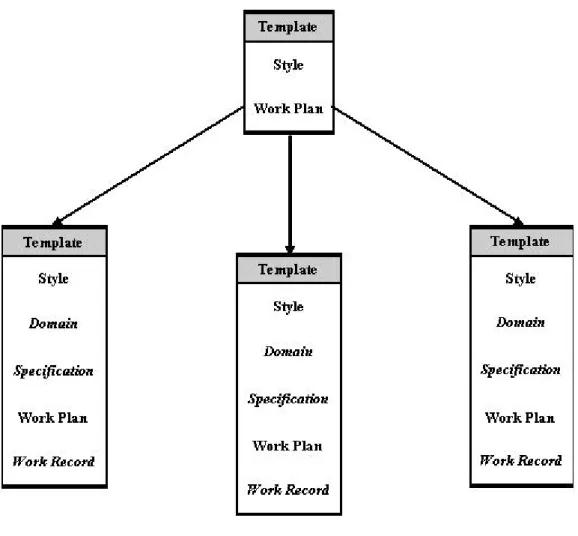
Finkelstein regards viewpoints as a way to capture the role attributed to a participant and the responsibilities it ensues at each stage of the development process. A VOSD viewpoint is defined as a "loosely coupled, locally managed object which encapsulates partial knowledge about the application domain, specified in a particular suitable formal representation, and partial knowledge of the process of software development". It includes information about the domain it relates to, a specification, a work plan that establishes the constraints that the specification must obey and a work record. A viewpoint with information only regarding a style and a work plan is called a template.
The concept of allowing for different representation schemes is an important one in VOSD and much emphasis is placed on the designing of templates that may offer some measure of standardization while allowing for each member of the development team to use the style he or she is most comfortable with or that is best suited for the sub-problem at hand. Viewpoints can therefore be organized in configurations that establish some form of relationships between them.
In a final analysis, Finkelstein fails to provide a firm framework for resolving the conflicts between representation schemes with little correspondence and therefore restricts the development theme to a careful selection of related schemes; for instance, establishing an obvious relationship between object-oriented models and data-flow models may require substantial refactoring in order to be useful. It should also be mentioned that VOSD provides no obvious way of integrating functional and non-functional requirements and capturing the different classes of interacting entities [11, 7].
2.2.5 VA
In [14], Leite studies viewpoint resolution as a means for very early validation in the process of requirements elicitation. By relying on the principle that a greater number of sources of
33
information guarantee a better understanding of the overall problem, one must also be able to guarantee their validity as sources for requirement collecting. Therefore, Leite focuses on the very early validation of viewpoints as a key for the identification and classification of problems related to completeness and correctness.
Leite presents four essential definitions in his proposal:
A Viewpoint is a standing or mental position used by an individual when examining a universe of discourse (the overall context in which the software will be developed, including all the sources of information and all the people related to the project); A Perspective is a set of facts observed and modeled according to a particular aspect
of reality. He considers as modeling aspects: the data perspective, the actor perspective and the process perspective;
A View is defined as an integration of these perspectives, which is achieved by a view-construction process;
A Hierarchy may be defined as a "is-a" hierarchy or a "parts-of" hierarchy of concepts in the universe of discourse.
His approach comprises procedures to formalize viewpoints (method), to analyze the formalized viewpoints (static analyzer) and a viewpoint language (VWPL) to represent them. The method consists of at least two analysts (viewpoints) describing their intake on the universe of discourse using VWPL to express it. Each of them analyses the data, process and actor perspectives, and the hierarchies to improve their own perception, solves the internal conflicts that might arise and integrates the final perception into a view, which is constructed by means of the three perspectives and two hierarchies. After that, both viewpoints are compared and analyzed and a list of discrepancies between perspectives and hierarchies and their types is produced.
The final step is the integration of the perspectives into a view and after two of them are available, it is possible to compare different viewpoints for correctness and completeness [14, 11].
34
2.2.6 VOSE
The VOSE (Viewpoint-Oriented Software Engineering) framework was proposed by Finkelstein et al. [8] and supports the use of multiple perspectives in system development, providing a means for developing and applying methods for system design. It relies on viewpoints to partition the system specification, the development method and the formal representations in which the system is specified.
VOSE starts off by identifying the problems in organizing development in a setting with many actors, diverse domain knowledge and development strategies, but especially several representation schemes. This framework then focuses on the development of heterogeneous and composite systems, in which these settings occur, by allowing the use of these different representation schemes in a structured, organized and recognizable framework, using viewpoints as the basic unit.
A VOSE viewpoint is seen as a building block for the framework; it is thought of as the combination of an actor (a participant) and his role in the development process, including the knowledge he brings to the project. In order to allow heterogeneous representation schemes, VOSE viewpoints have a specific composition:
A representation style, in a notation that is particular to each developer's area or line of work;
A domain that outlines the world in which the scheme is developed; A specification that describes particular domains in the style chosen; A work plan that describes the specification process;
A work record that registers the history and state of development, detailing performed actions.
A work plan is the most complex part of the VOSE viewpoint and is divided into four types of actions: assembly actions are the ones available to the developer to build a specification (add, remove, etc); check actions concern consistency checks done to the specification, be them in-viewpoint that resolve simple inconsistencies, or inter-in-viewpoint checks that must either be "fought out" between developers, or transferred from a specification to another according to a
35
hierarchic structure; viewpoint actions create new viewpoints according to pre-defined templates; and guide actions establish a type of schedule for the developer to follow.
A viewpoint template is also one of the most important VOSE concepts to be introduced. Since that the allowance for different representation schemes may originate truly heterogeneous solutions, the existence of an organizational "standard" is essential to, as previously stated, guarantee some measure of order and consistency maintenance. So, as development proceeds and new viewpoints might be required, a viewpoint template as seen in Figure 1-2 may be created containing the specification, domain and work record slots empty, and that afterwards may be instantiated in different ways.
Figure 1-2 VOSE Templates
Also worthy of reference is the fact that the VOSE framework may not only be used from the method user's perspective, but also from the method developer's perspective; the framework
36
provides means to describe methods like SADT or CORE as configurations of viewpoint templates.
However, some of the advantages that VOSE presents come with clear drawbacks. Its support for managing inconsistency relies on the assumption that the analysts have the ability to write inter-viewpoint consistency rules, also, the automation of these rules' analysis would require them to be written in such a way that allowed for clear and unambiguous understanding (formal notation), which in itself may not suffice to explain all the relationships between requirements.
Another drawback is VOSE's demands of a formal description of each viewpoint, i.e. although it may tolerate some inconsistency, it does not allow for informal process description nor does it allocate space in a viewpoint's description for an informal explanation.
These drawbacks clearly limit the application of VOSE in most projects seeing as they imply a high introductory cost and a cost-ineffective management of constantly evolving requirements [25].
2.2.7 VOA
Viewpoint-Oriented Analysis (VOA) is an object-oriented viewpoint-based approach to requirements definition proposed by Kotonya and Sommerville (K\&S) [11]. It extends the definitions of viewpoints existent until then from its input/output orientations to incorporate viewpoint classification and different aspects of interaction. VOA also supports requirements capture and resolution, classification and analysis of viewpoint-system interaction and integration of functional and non-functional aspects of requirements. It is service-oriented, since it concerns interaction between entities that may exist in the surrounding system environments and in the system itself.
Regarding system viewpoints, VOA defines viewpoint identification, structuring and decomposition, information collection and reconciliation of information across viewpoints as its four main stages. K\&S further state that because of this staging, viewpoints can be used to formulate and structure requirements in a way that lends visibility to the deeper interaction between the system and its environment.
37
Viewpoint identifying normally places most of its reliance on stakeholders (in VOA identified as 'system authorities') so, in an attempt to improve previous viewpoint definitions, VOA adopts a pragmatic one that is both unambiguous and complete: a viewpoint is an external entity that interacts with the system, but does not require its existence in order to define itself. This means that it can interact with the system by receiving one or more services (functional requirements), providing control information to the system in order to start or stop service provision and, finally, providing the system with the data required for service provision. This notion of viewpoint sheds the previous mixed definitions of both internal and external viewpoints in an attempt to simplify the process of requirements formulation; it does this by enabling a direct analysis, capturing the natural interaction between system and environment, distinguishing between types of viewpoint interaction and providing a framework for associating services with their constraints and enabling their reutilization.
VOA also separates viewpoints according to their ability to initiate interaction with the system; active viewpoints normally correspond to the customer's perspective, seeing as they provide control information to the system; passive viewpoints are essentially representative of data stores or sinks and control is directed by the system.
As stated before, the VOA viewpoint definition relies heavily on the integration between functional and non-functional requirements. It acknowledges that in every application, parallel to functional requirements (services), exist the non-functional ones that define the overall qualities or attributes of the resulting solution, called constraints. Each service provided to a viewpoint is therefore associated with the application's constraints (timing, reliability, system costs, etc) in a way that previously did not exist. Furthermore, recognizing that integrating functional and non-functional requirements along different viewpoints may generate conflicts and constraint overlapping, VOA suggests the early validation of these constraints by comparison of all provisions of each service across viewpoints. By identifying and solving these conflicts at an early stage, it aims for easier conciliation of clashes and inconsistencies.
Control information management is addressed by VOA from both the viewpoint and the system's perspective. A viewpoint directs control information by the description of signals and stimuli that start and stop the provision of services; the system provides viewpoints with entities (normally functions) that will relate to them in matters of provision of services.
38
As with CORE, VOA enables viewpoint structuring and decomposition by splitting the analytical tasks associated with viewpoints into a number of specification levels, diminishing the amount of detail that must be analyzed at each level. However, VOA extends the notion of hierarchy to contemplate in-viewpoint levels of abstraction, the top levels being the most abstract. This works in a similar fashion as class inheritance: all sub-levels inherit the services, attributes, control information and constraints of their top levels, being able to specify their own constraints on inherited services and to specify their own service requirements.
Information collection in VOA is handled by means of a form-oriented approach: for a viewpoint a form collects information regarding services specification, control information and data; for a service a form collects information on its constraints. This approach constitutes the basis for checking the completeness and correctness of information across viewpoints and for early constraint validation regarding services provided, thus enabling the information reconciliation stage, and final stage, referred in the beginning.
2.2.8 VORD
Viewpoint Oriented Requirements Definition (VORD) [12] is a method for requirements engineering that covers its process from initial requirements discovery to system modeling. Its authors, having been responsible for the VOA method, recognized that it tended to focus the RE process on the user issues rather than organization concerns, thus leading to incomplete system requirements. In order to encompass organizational requirements and concerns, they extended the concept of viewpoints to consider other inputs apart from direct clients of the system.
As the method it extends, VORD addresses firstly the issues of viewpoint identification, structuring, documentation, requirements analysis and specification. In order to do this, VORD relies on a notion of viewpoint based on the entities whose requirements are responsible for, or may constrain, the development of the intended system, and so they are also called requirements sources. Each of them relates to the system according to its needs and the interaction between them, and they fall into two major classes: direct viewpoints correspond directly to clients in that they exchange control information and services with the
39
system; indirect viewpoints have an interest in some of the services the system provides but do not interact directly with it.
VORD further extends the VOA treatment of viewpoints by generalizing the previous notion of 'system authority' into a set of viewpoint classes organized in a hierarchic structure. There is no generic structure, since each organization must establish its own hierarchy of viewpoint classes based on its needs and the application domain in which the system will exist, then constituting an important resource for the organization.
Viewpoint identification begins with abstract statements of organizational requirements and abstract viewpoint classes; VORD then proceeds with a pruning of the abstract class hierarchy that eliminates irrelevant viewpoint classes and follows by identifying stakeholder representative classes that are not present, sub-systems, system operators and individuals associated with indirect viewpoint classes; for all of these there may be associated viewpoints that must be contemplated in the class hierarchy.
The documentation of viewpoints in VORD is addressed with special attention; seeing as viewpoints are associated with a set of requirements, sources and constraints, and that each requirement is made up of a set or services, non-functional constraints and control requirements, VORD proposes that each viewpoint have an associated template, providing a structure for documenting detailed viewpoint requirements and events depicting its interaction with the proposed system. This offers a framework for formulating very detailed specifications, yet maintaining a clear separation of concerns.
Tracing the exchange of control information was also one of the main issues addressed by VORD. It was necessary to have a simple mechanism to address control requirements from a user's perspective, trace system-level control to viewpoints, expose conflict between control requirements and capture the distributed nature of control. VORD proposes the use of event scenarios, a sequence of events and exceptions that may arise during the exchange of information between the viewpoint and the system.
Event scenarios describe, at a top level, the normal course of events that a specific task might follow, what VORD calls a normal scenario, and as exceptions may occur to the task in question, event scenarios contemplate a branching of the main path in a series of layered sequence of possible events.
40
Viewpoint services specification aims to allow for multiple representations, seeing as a template is accessible to several levels of capabilities; non-technical staff may have to read it and understand it, as well as the need for a formal specification must be faced in order to comply with correctness demands. Therefore, VORD aims for a possibly ambiguous approach to specification, but one that allows for greater readability, which in many cases compensates the previous.
Last but not least, viewpoint analysis is intended to guarantee viewpoint correctness and completeness, but it is a difficult subject for developers to face. For completeness, VORD uses the previously referred template structure to guarantee a maximum of stored data and traceability allowance and this fact also helps with the correctness analysis. VORD incorporates a mechanism for attributing weights to non-functional requirements and comparing them and their use across the several viewpoints; this way, and making use of the traceability advantage, VORD allows for an easier and faster conflict resolution.
2.3 PREview
This particular approach merits a more profound analysis since it will be used in further work. Therefore, the following sections will present a careful description of its process and several stages, finalizing with a summary of the approach and a justification for its choice as basis for future work.
Furthermore, this approach is illustrated by a case study relating the Via Verde system, providing examples along the PREview process of a possible application of this method.
2.3.1 The PREview Method
The PREview (Process and Requirements Engineering Viewpoints) method [25] was proposed by Sommerville et al. in the mid 1990s in an attempt to handle what they called the "messy reality of requirements engineering". According to the authors there was a serious need for improving the quality of requirements specification, and that could be achieved in two ways: by improving the requirements engineering process so as to be less error-prone and
41
by improving the manner in which the specification itself was organized and specified so as to be more validation-friendly.
The use of viewpoints had already tried to address both of these improvement dimensions by collecting and analyzing requirements from multiple perspectives and providing a structure for the requirement elicitation and specification processes. However, the authors state that previous unstructured methods simply could not provide a reasonable support for viewpoint oriented requirements handling, and the ones that provided some structure were simply too rigid.
Also to be considered is the fact that until that time, only CORE had made the leap from theoretical proposal into industrial use, and even so, it was restricted to UK defense contractors. This situation could be explained by several factors, namely the overall inflexibility of the then current viewpoint models, the demand for fixed notations when defining requirements, limited support for both requirement evolution and negotiation, the non-existence of industrial tools that met the support requirements that the then current approaches required, a lack of recognition of the importance of non-functional requirements and also the incompatibility of the approaches with other methods that companies might have already implemented.
It is clear then that although viewpoint-oriented approaches constituted at the time, and still do, an interesting solution for most of the requirements engineering problems, there were also some issues with the introduction of viewpoints into the RE processes; there was a need for a lighter approach that could be introduced at relatively low cost and required an evolutionary, instead of revolutionary, process improvement.
PREview was originally designed to improve the processes of requirements discovery, analysis and negotiation, separating its scope from previous proposals by restricting itself to requirements elicitation. It possesses several key characteristics:
Since requirements may be elicited from different sources with their particular notations, PREview allows for requirements that are associated with a viewpoint to be expressed in any manner. Although natural language and diagrams are the most common, it also admits for structured or formal notations.
Non-functional requirements, or concerns, drive the analytical effort since they represent inherent characteristics of the system. They can be seen as generalizations of
42
the notion of goal, including both organizational goals and constraints that restrict the system.
Viewpoints as basic building blocks possess a limited and explicitly described perspective in order to facilitate their requirements' discovery and analysis.
Because of all of these factors, PREview constitutes an approach that offers the required flexibility and allows users to define viewpoints appropriate to their application, complementing the standard notion of viewpoint with that of an organizational concern and following the more accurate spiral model of the requirements engineering process, as shown in Figure 1-3.