Hélder Lopes Paula Remoaldo Vitor Ribeiro José Cadima Ribeiro Sara Silva
ABSTRACT
The goal of this paper is to contribute to identify a set of resources and tourism products, which can enhance the development and sustainability of tourism in the low density municipality of Boticas, located in the north-east of Portugal. Therefore, this paper tries to: i) produce a first analysis of the tourism potential of the municipality of Boticas; and ii) identify different perceptions of different stakeholders regarding the tourism potential of Boticas. To this end, the content analysis of semi-structured interviews conducted in 2014 to local and regional social and political stakeholders were used. Likewise, in 2015 two focus groups were conducted with main local stakeholders. The results highlight three main facts: first, there are unexplored tourism resources with potential to attract certain niches of tourist demand; second, the region has been investing in the diversification of its supply of leisure and recreational activities, as well as available tourism equipment; and third, the region is facing serious difficulties in creating a local and regional stakeholder network in order to provide an integrated promotion of tourism. We conclude by identifying few policy recommendations on development issues for the municipality of Boticas or other rural areas presenting similar constraints.
Keywords: Tourism, Focus Group, Stakeholders. JEL Classification: Z30, Z32, Z38
1. INTRODUCTION
The cultural and natural resources, which are part of the history of a territory, can be harnessed to enhance the tourism activity. In fact, the creation/maintenance of a sustainable tourist destination requires a diversified offer that values the environmental component in order to preserve the cultural attributes, as well as partnerships with public and private stakeholders in tourism development (Ribeiro & Vareiro, 2007). In light of this, the engagement of the local community as well as visitors’ perceptions are of utmost importance, enabling the identification of the main existing resources and tourists’ interests (Figueiredo & Kastenholz, 2008).
This will increase tourist flows, which will ultimately contribute to: (i) employment creation and growth of the local economy; (ii) mitigate the costs associated with building and maintenance of infrastructures (e.g. roads, sanitation, means of communication); (iii) the creation of other sectors of activity directly or indirectly involved in tourism development;
(e.g. pavilions and recreational spaces, outdoor parks, different commercial spaces, public transports); (v) help in the conservation of cultural resources (including the aesthetics of the primary tourist attractions) and in the preservation of natural resources (Hall & Jenkins, 1999). In addition to the return that may be associated with the tourism activity, the focus on this kind of resources and products can be developed with less investment compared with other (mass) tourism strategies involving large businesses and operators (Wilson et al., 2001).
The focus of this paper is on the municipality of Boticas, located in the north-east of Portugal, a territory facing significant social and economic weaknesses. The respective municipal leaders, aware of these difficulties but also of the existing resource potential, together with a research team from the University of Minho decided to verify the tourism potential of Boticas in order to search for answers to the problems experienced, as well as to contribute to the formulation of a strategy with a view to enhancing the quality of life of its population. This research is the first step in this long journey full of choices.
In concrete terms, this study aims to: (i) make a first analysis of the tourism potential of the municipality; (ii) identify the destination profile and the perceptions of several of its socio-economic and political actors; and (iii) contribute to building a strategy for the development of more participatory and sustainable tourism, taking advantage of existing resources and tourism products.
The goals set herein are part of a broader ongoing project (until 2017) of the team of Lab2PT (Landscape, Heritage and Territory Laboratory) of the University of Minho. This project, entitled “Contribution to sustainable tourism in the municipality of Boticas” has the support of the public authorities of the municipality subject of study. In terms of methodology, the first stage of this study is based on a quality-oriented approach, where semi-structured interviews to local and regional actors were conducted (December 2014), as well as two sessions of focus groups with the participation of socio-economic actors and local and regional politicians (September 2015).
This paper is divided into four sections. The first section addresses the issue of sustainable tourism in rural areas. The second part describes the processes inherent to the involvement of stakeholders in promoting sustainable tourism. The following section presents the methodological approach adopted in the case study, which describes the region with its specificities, as well as the procedures adopted in the semi-structured interviews and focus groups. The final section displays the results of the empirical work, which sustain the findings and policy proposals outlined for the tourism development of Boticas, and the overall development of the municipality.
2. SUSTAINABLE TOURISM IN RURAL AREAS
Sustainable tourism practices have gained great relevance after the publication of the book “Ecological Principles for Economic Development” in 1973 (Bramwell & Lane, 1993), although the definition of sustainable development was only popularised from 1987 onwards with the Brundtland report “Our common future” (Brundtland, 1987). Thereafter conditions were created for sustainable practices in various sectors, particularly in environmental development. The United Nations Conference on Environment and Development, organised in Brazil in 1992, enabled the establishment of various agreements, including Agenda 21, between 180 countries (Crosby & Prato, 2009). This (sustainable) development model, in accordance with the progressive reorientation of economic growth policies and positive environmental reinforcement, gave rise to other relevant concepts: balanced
macro trend, the achievement of the Europe 2020 target requires, in the Portuguese case, the Portugal 2020, the promotion of a smart, sustainable and inclusive growth. With a view to establishing guidelines, the 2030 Agenda for Sustainable Development and the 17 goals proposed aim to enhance the transformation of a great number of geographical areas into more sustainable areas in economic, cultural and social terms. Amongst the main lines of action lies the responsible consumption and production of resources, as well as the importance of an alliance between people, partnerships and prosperity, where networking, the win-win cooperation and consolidation of the multidimensional perspective of networks on a local and regional basis are considered. With regard to tourism in rural areas, there is an increase in a more sustainable promotion of culture and communities, as well as a mitigation of the depopulation phenomena.
The sustainable tourism concept emerged from the idea of a necessary interconnection between tourism development, community participation and environmental conservation. This interconnection leads to the increasing need of integrated strategies related to the environment and economy, a concern displayed in various studies by geographers and other social scientists (Hunter, 1997; Hardy et al., 2002; Richards & Hall, 2003).
The significant importance that sustainability has achieved is specifically addressed by the scientific journal of Sustainable Tourism, which is indexed to major international databases. Hall (2011) in a recent study examined the frequency of the concept “sustainable tourism” in abstracts, keywords or titles of papers published in journals with the highest impact factor for the period from 1989 to 2010. He verified a significant increase in studies on sustainable tourism in recent years. Moreover, several non-governmental organisations (NGOs), international agencies and governments have actively been promoting the improvement of economic, social and environmental performance in tourism (Carter et al., 2015).
Despite the increase of studies focused on this issue, three problems persist: (i) the absence of a precise definition, i.e. encompassing all intrinsic conditions of sustainability; (ii) the non-proportionality in the measurement of impact; and (iii) the deficient analysis and monitoring of social and political effects associated to this issue (Buckley, 2012). Likewise, tourism has increasingly been addressing the adoption of sustainable principles, although their practices have consecutively fallen below expectations.
The concept of sustainable development and practices should be based on the interconnection of three pillars: economic sustainability; sociocultural sustainability; and environmental sustainability. The absence of one concept prevents a balancing potential (Hall, 2011). However, the concept of ‘balance’ should be regarded with reluctance as environmental protection is not often compatible with the economic interests inherent in tourism development (Cater, 1995; Hunter, 2002; Sharpley, 2007).
Although economic interests have typically overridden the environmental balance in rural areas, but not only, the key to the success of tourism lies in revealing the particularities of the territories and refuse strategies aimed to attract mass tourism. (Wilson et al., 2001). For this reason, tourism development should invest in the cooperation between resources and involving agents, i.e. search for synergies between different public and private stakeholders. Only then can tourism gain scale and generate added value for the region in question. In light of this, the local community’s perspective in the future tourism development strategy is very important. In fact, not only the local products are considered as basic tourism products available to visitors, but the community itself is also configured as a central attribute of a unique tourist experience (Ribeiro & Vareiro, 2007).
3. THE INVOLVEMENT OF STAKEHOLDERS IN CREATING SUSTAINABLE TOURISM EXPERIENCES
Studies conducted in tourism have been constantly stressing the need for the cooperation of stakeholders (interested bodies, institutions, organisations or individuals) in order to achieve successful tourism products (Wang & Fesenmaier, 2007). Other studies focus on the importance of establishing networks and partnerships between them (Dredge, 2006; Scott et al., 2008) for the construction of strategies for products/services and marketing.
The collaboration of actors in the strategy is dependent on the expectation of receiving long-lasting benefits from the development activity, i.e. the expectation of improving their quality of life. Collaboration between actors should take place at two levels: “inside-destination” collaboration, which corresponds to the design of strategies that lead to the integration of the various actors at local level; and “inside-target” collaboration, which is the integration of regional actors also interested in increasing the tourist industry (Wang & Fesenmaier, 2007).
The network of stakeholders that cooperate in defining territorial strategies in tourism can identify the results that are fundamental to assume the identity of the region (Cox et al., 2014). Moreover, it is possible to create models of governance inherent in the collaborative processes (Jamal & Getz, 1995; Timothy, 1998; Wang & Fesenmaier, 2007; Wang & Krakover, 2008; Beritelli & Laesser, 2011). Due to the complex nature of the product, the informal or formal networks of tourism stakeholders are very dense (e.g. local people, hotels, restaurants, the local government bodies, various sector associations), although they can be distinguished as primary or secondary stakeholders (Jones, 2005; Sheehan & Ritchie, 2005; Bornhorst et al., 2010). The primary stakeholders have regular interactions, holding a strategic significance, while the secondary stakeholders have a role in specific issues where their participation is clearly needed in shaping the implied tourism and strategies (Jones, 2005).
When defining the strategies to be developed in tourist destinations, it is important to bear in mind three basic dimensions (Figure 1): stakeholders, relationships and resources (Scott et al., 2008). Stakeholders establish connections with each other in order to exchange resources, information and activities that facilitate the process. A particular tourist destination can have several stakeholders, and their size and function contribute to the heterogeneity of the former. They work together (formally or informally) and provide direct answers to contribute to the region’s competitiveness. On the other hand, the resources materialise in knowledge, capital and information that are held by actors in one given destination. The relationship between local parties and resources constitutes a third element. Their relationship defines the networks that are usually determined by links between people, objectives and events (Scott et al., 2008).
Figure 1 – Fundamental dimensions present in the development of strategies of a tourist destination
Source: Based on Scott et al., 2008
The process of tourism planning can have multiple stakeholder consultation methods, including drop-in centres, technical group sessions, citizen enquiries, focus groups, interviews, surveys, and meetings, in order to achieve a certain consensus (Yüksel et al., 2005). The selected method for this purpose should be the one that best suits the proposed goals (Yüksel et al., 2005).
The empirical research that has most appealed to stakeholders mainly gathers a set of results and alternatives that can give substance to a collection of identity products of the region, which obviously can arouse the respective attractiveness. For example, in Ponte de Lima (Portugal) Mota et al. (2012) refer to the creativity as an enhancement of tourism diversification, based on the variety of available resources in the municipality. On the other hand, the research carried out in the cities of Covilhã and Seia in 2013 concluded as main lessons the need to create a network of tourism stakeholders to establish complementary relationships - something that has been verified in both municipalities (85% of interviewees in the city of Covilhã and 81.6% in the municipality of Seia considered that local actors established cooperative relationships), but not between municipalities (Pais & Vaz, 2014).
Scott et al. (2008) studied the network of stakeholders in four Australian destinations with different levels of cohesion and, as a result, they defended the use of the designated split-run technique as the most effective way to determine the success of advertising for tourist destinations. On the other hand, Wang and Ap (2013) understand that the cooperation between government organisations is key to an effective tourism policy. However, in the case study developed in China, stakeholders consider that the centralised system of government posed difficulties to the implementation of tourism policies.
In a study developed by Wilson et al. (2001), the focus group was the adopted methodology. It proved the need for an assertive community leadership and strategic planning, coordination and cooperation between stakeholders and local leadership.
Taking into account the studies and empirical evidence provided by literature, our approach to the Boticas case sought to identify the resources perceived by local actors, the existence of complementary relations between them and the modus operandi adopted for the definition of strategies for tourism. To this end, and as aforementioned, semi-structured
interviews and two sessions of focus groups were conducted with the main local agents of several areas.
4. METHODS AND DATABASE 4.1 Study context
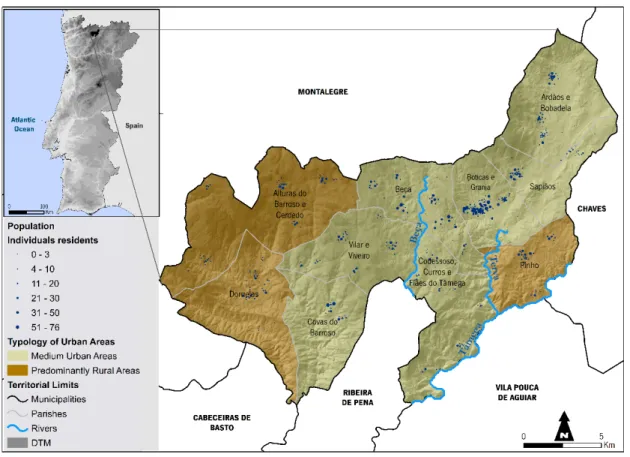
As aforementioned, the region subject of study is the municipality of Boticas, which is located in the district of Vila Real, in NUTS (Common classification of territorial units for statistics) III of Alto Tâmega, north-east of Portugal (Figure 2).
Figure 2 –Territorial context of the municipality of Boticas: population by subsection, classification of urban areas (T.I.P.A.U. 2014) and digital elevation model (D.E.M.)
Cartographic sources: C.A.O.P. 2013 and Environmental Atlas
Statistics sources: Census 2011 and T.I.P.A.U. 2014 (I.N.E. – National Institute of Statistics)
The municipality is subdivided into ten parishes, which comprise an area of 321.96 km2, and according to the Urban Area Typology (TIPAU) for 2014 7 are considered Moderately Urban Areas (AMU) and 3 Predominantly Rural Areas (APR). In 2011 the population of the municipality of Boticas amounted to 5,750 individuals, of which 1,510 inhabitants were located in the Boticas and Granja parish union (central parish of the municipality), corresponding to 26.3% of the resident population. This municipality, as other inland regions in the country, is significantly affected by the concentration of services and activities in coastal regions (Ribeiro et al., 2014).
Boticas has an availability of endogenous resources with a high tourism potential, although they are not being properly exploited, as demonstrated in the document provided
in early 2016 by the Interactive Porto and Northern Portugal Tourism Shop, located in Boticas.
At this moment, due to the embryonic development of tourism in Boticas, the accommodation offer is still sparse, as indicated by the small number of welcome guests. With regard to Hotel activity, the accommodation survey (Inquérito à Permanência de Hóspedes) conducted in 2013 shows that Boticas had 1,329 guests staying for an average of 1.4 night (INE, 2014). However, Portuguese surveys do not include all the accommodation typologies, which in this context could encompass a greater number of tourists staying overnight than registered (Cunha, 2013).
Another weakness in this region’s tourism is related to seasonality, which does not facilitate the economic sustainability of this activity for a great part of the year. Between 2011 and 2015, the months that registered greater inflow of visitors were between June and September.
In the municipalities of the interior of Portugal, such as Boticas, climate greatly influences the tourism sector. For example, in June 2012 the region registered its highest average temperature (maximum and minimum). The value was above the average temperature of 1970-2000 (Instituto de Meteorologia, 2012). Accordingly, the number of visits increased compared with the average of the period between 2011 and 2015.
Boticas reached 5,524 visitors in the last year, especially in the months of July and August, reaching an average of 844 visitors/month. Most of the visitors were Portuguese (97.5%) and 2.5% were foreigners - 38.2% were French and 36.0% were Spanish.
It is expected that the the Boticas Hotel Art and Spa - opened in May 2014 - might contribute to increase visitor numbers. Likewise, the municipality has been active in promoting tourism in the region, mainly in the construction of the Nadir Afonso Arts Centre, the Archaeological Park of Terva Valley and the Boticas Park – Nature and Biodiversity. These elements can attract more visitors and mitigate weaknesses identified in the general lines of action in the PENT - National Strategic Tourism Plan (2013-2015) (Ministério da Economia e Emprego, 2012).
4.2 Sources used in the case study
The case study presented herein arises from a more thorough research. Results of the empirical work must therefore be interpreted as a first approach to the subject of study. The qualitative data was collected from two main data sources: the semi-structured interviews and focus groups. Both the interviews and focus groups were conducted with the main regional and local stakeholders. The selected analytical methods share application advantages, including an increase in flexibility, efficiency and effectiveness (cost-time) for both the interviewee and interviewer (Bristol & Fern, 1996). However, the focus group technique has several additional advantages compared with the semi-structured interviews (Silva et al., 2014). In a focus group, sharing diverse opinions can contribute to a debate with deeper and weighted results, the interviewer has more freedom to respond to stakeholders and even the progress of the debate with peers can lead to the addition of new contributions (Carey, 2015); a fact that does not happen in individual interviews.
However, the disadvantages that may arise from the application of interviews in focus groups must also be taken into account as the costs may be higher (considering the expected results) due to the possible need for additional people for the implementation of the method and/or to ensure the logistics process.
4.2.1 Semi-structured interview
In December 2014 semi-structured interviews were conducted with the main regional stakeholders: ACISAT – Business Association of Alto Tâmega; Porto and Northern Portugal Tourism; Interactive Porto and Northern Portugal Tourism Shop; Nadir Afonso Arts Centre; Town Council of Boticas; and wine cellar Vinho dos Mortos. One stakeholder is part of two institutions (the Interactive Porto and Northern Portugal Tourism Shop and Nadir Afonso Arts Centre).These participants were selected for their active role in tourism activities in the municipality of Boticas.
The interviews were constructed according to six thematic areas, on a top-down perspective. It started with general questions where the interviewees assessed the national tourism context and the general lines of action in the last PENT. Specific issues were then introduced regarding their interaction with the different local stakeholders and the main resources with tourism potential identified in the region. This interview aimed to collect the main strengths and weaknesses of the resources with tourism potential, as well as the elements that help to define a consistent tourism development strategy in Boticas. Finally, the researchers intended to collect data in order to create an image of the tourist destination.
The structure of the interview was not only based on the discourses commonly established for interview surveys, but also on the research work carried out by Bornhorst et al. (2010) and Mota et al. (2012), amongst others.
In order to identify and correct existing limitations in the survey, a pre-test to five persons was conducted, two of which were carried out in local institutions of other municipalities, located in the northern region. This took place in the period between 31 October and 8 November 2014, and an average duration of 28 minutes was estimated. The interviews took place between 6 and 12 December 2014.
4.2.2 Focus group
The application of the focus group technique stems from an effort developed in partnership with the Town Council of Boticas for the recruitment of relevant stakeholders, and took place on 14 September 2015. The main guidelines were: i) analyse the tourism potential of the municipality of Boticas; ii) identify the profile of Boticas as a tourist destination and perceptions of various stakeholders on tourism development, and ascertain if they are willing to have a more active participation in the development of this type of activity (business development related to the sector); and iii) contribute to tourism development in the municipality of Boticas.
This technique was chosen due to the potential inherent in group participation, where relevant information can be produced resulting from the debate amongst several individuals. These sessions counted on the participation of 21 of the expected stakeholders. The selected stakeholders were politicians, members of organisations and socio-economic and cultural associations, entrepreneurs, people working in fields directly or indirectly related to the tourism sector and prominent members of the local community. The stakeholders were divided in advance into two sessions, where the selected topics (14 questions) were freely discussed. The sessions were conducted by members of the research team. Both sessions lasted 2 hours and 30 minutes.
5. RESULTS
The results of the semi-structured interviews and focus groups suggest some lines of action that should be pursued. In particular, we point out i) the need to involve several regional
endogenous resources in tourism, and (iii) the importance of promoting and disseminating the Barrosã identity.
5.1 Involving regional and local stakeholders in the promotion of the region
The relationship between the local stakeholders of Boticas and those from other municipalities located in the same sub-region (Alto Tâmega) is very mediocre. Results show an absence of a close liaison between them and complementary action, which are only concentrated in certain periods of the year. In this regard, we highlight the events organised by the Association of Regional Development of Alto Tâmega (ADRAT), the Intermunicipal Community of Alto Tâmega (CIMAT) and some local authorities [e.g. Boticas Rural Museum, European Centre for Documentation and Interpretation of Castro Sculptures (CEDIEC) and the Archaeological Park of Terva Valley (PAVT)], apart from some private businesses. Moreover, in some specific contexts there are some joint efforts and/or initiatives that take place despite only lasting for the specific event. However, a number of interviewees emphasised the absence of joint strategies that could enhance the region regarding its tangible and intangible assets. In fact, there was a general consensus about the necessity of changing this situation in future events.
Notwithstanding the absence of a broad business community that comprehends the geographical and social context of Boticas, we also concluded that the local government needs to have a synergistic action of tourism promotion and local development.
In order to enhance the fate of pull factors, there is a need to get the commitment of many local actors and, in the case of Boticas, their “interest is unquestionable against the dominant morphology of the northern hinterland, of low population density, critically raising the sustainability issue of these areas, as well as sovereignty issues” (senior technician of the Porto and Northern Portugal Tourism and professor at the Portucalense University).
Several limitations regarding some of the aforementioned aspects (geographic and socio-demographic) were repeatedly listed in the interviews and focus groups. It appears that public institutions from several levels and through multi-sectoral actions need to interconnect to provide a diversified offer and promote existing resources, as opposed to isolated actions, which have often resulted in the overlapping of activities and events. Similarly, in order to mitigate tourism weaknesses in events and festivals, it is crucial to promote local entrepreneurship, encouraging the opening of new tourism developments, or simply contributing to the recovery of the heritage and hiking trails.
5.2 The empowerment of endogenous resources
The observation performed in the region showed the existence of historical and cultural heritage of great value, which was recognised by the interviewed stakeholders. However, one of the identified problems was the lack of dissemination of such heritage, regardless of its value.
Overall, we noticed the presence of several exploited physical resources, including built equipment, in recent years, such as the Archaeological Park of Terva Valley, the Boticas Rural Museum, the Nadir Afonso Arts Centre, the European Centre for Documentation and Interpretation of Castro Sculptures, and the Boticas Park – Nature and Biodiversity. In addition, local stakeholders of Boticas consider that the hot springs of Carvalhelhos and their inn are underused. The lack of a competent authority for the management of their equipment, which is not operating, translates into not only a waste of equipment but also a loss of the attractiveness of the municipality.
of the Pig. On the other hand, there are certain intangible assets that are not currently exploited as they should. With regard to gastronomy, we highlight some dishes, such as cozido barrosão, posta barrosã, fried trout, smoked ham and smoked sausage. This type of gastronomy, not restricted to the municipality of Boticas, is of great importance to the sub-region of Alto Tâmega and especially to Barroso.
Nevertheless, as the town councillor of Boticas stressed: “the region is geographically vast, but has few people and it is not a very rich region as is Chaves, for example. Its spa is an added advantage. In addition, it is a larger city, and has a cultural and commercial offer larger than Boticas”. From the cultural point of view, diversity should be fostered so that visits to the municipality do not become restrictive, “even because I can take a walk, stop in a village, visit the community oven and eat bread; next, I find a house in the village where they are making cozido barrosão, and I stay by the fireplace, warming my hands; I see the cast iron pots and people making smoked pork sausages” (Secretary-general of ACISAT).
According to the owner of the wine cellar Vinho dos Mortos, there are some potentials, such as Vinho dos Mortos, whose marketing has only been done recently, although there are no regional and national promotion practices that are sustainable and that, in the owner’s words, can ensure the establishment of a branding of Boticas.
5.3 Strategy to promote and disseminate the Barrosã identity
In general, the sub-region of Alto Tâmega lacks tourism promotion strategies, except in the case of Montalegre, where tourism promotion is somewhat rooted in this municipality. Apart from Montalegre, Vila Real has also been taking a few steps towards establishing a tourism strategy.
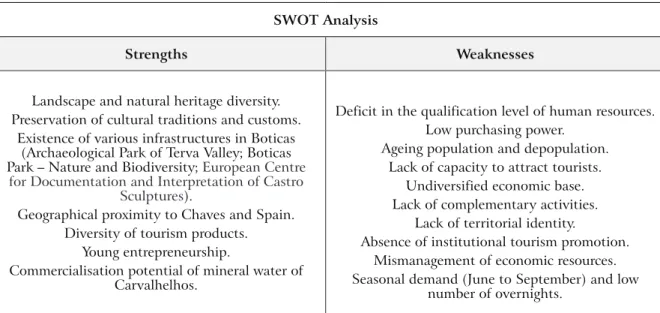
It makes sense that in the sub-region of Alto Tâmega and Barroso tourism policies that integrate the various municipalities start to emerge as a manifestation of the scarce financial resources and the geographic scale needed to achieve visibility. Therefore, it is imperative that the promotion of tourism is not based on individual actions. In this broader framework, the municipality of Boticas and neighbouring municipalities can work together on their resources and attract a wider public. A summary of the strengths and opportunities, and weaknesses and threats (SWOT analysis) that are intrinsic to tourism in the municipality of Boticas, and which resulted from the conducted empirical research, is presented in Table 1.
Table 1. SWOT analysis of the municipality of Boticas
SWOT Analysis
Strengths Weaknesses
Landscape and natural heritage diversity. Preservation of cultural traditions and customs.
Existence of various infrastructures in Boticas (Archaeological Park of Terva Valley; Boticas Park – Nature and Biodiversity; European Centre
for Documentation and Interpretation of Castro Sculptures).
Geographical proximity to Chaves and Spain. Diversity of tourism products.
Young entrepreneurship.
Commercialisation potential of mineral water of Carvalhelhos.
Deficit in the qualification level of human resources. Low purchasing power.
Ageing population and depopulation. Lack of capacity to attract tourists.
Undiversified economic base. Lack of complementary activities.
Lack of territorial identity.
Absence of institutional tourism promotion. Mismanagement of economic resources. Seasonal demand (June to September) and low
Opportunities Threats Use of tourism strategy defined by the Intermunicipal
Community of Alto Tâmega (CIMAT). Changes in tourists and visitors’ motivations in
tourism.
Barroso Eco museum - the importance of supporting the events and dynamics of the Barrosã culture.
Barrosã identity.
Programme V - Community Support Framework (CSF) based on the qualification of human resources.
Macro trend of 2020, where it emphasises inclusive growth.
Inexistence of a complementary culture and joint action.
Institutional gaps in tourism activities. Reduced capacity of action of the regional and
national stakeholders.
Fixing a regional tourism entity (Porto and Northern Portugal Tourism).
Maintaining high toll charges on access roads to the interior (e.g. A24 - Guimarães-Ribeira da Pena: €
6.00; Pedras Salgadas - Vidago: € 1.70). Source: Prepared by authors of the semi-structured interviews and focus groups
As main strengths listed by the stakeholders, we highlight the diversity of heritage and natural landscapes, the preservation of cultural traditions and customs, many of them ancient, and the existence of new infrastructures and equipment, which are intended for cultural events that may energise the city.
However, certain weaknesses were pointed out that must be overcome with a view to boosting the tourism activity in the medium and long term. In fact, stakeholders mentioned the lack of training of human resources, which hinder the implementation of regional policies in tourism, along with an undiversified economic base that jeopardises their ability to meet agents and actions in order to achieve more ambitious strategies.
Nevertheless, some opportunities were recognised, which relate to certain actions that are capable of being developed locally, and others arising from the possible role of the Intermunicipal Community of Alto Tâmega (CIMAT). Moreover, some changes in the motivations of tourists and visitors have also been observed, favouring regions whose tourism practices are not mass-oriented and hold relevant cultural and natural assets.
The main threats faced by these rural areas are the absence of joint efforts and exploitation of complementarities amongst local stakeholders. In fact, the initiatives that arise tend to be quite centralised and monopolised by certain agents that often lobby in the field of public policy.
The strengths, weaknesses, opportunities and threats pointed out must be a central element of the tourism development strategies. In this sense, Boticas’ strategy should first pass through its integration in tourism promotion entities that are above the municipality, including the so-called Porto and Northern Portugal Regional Tourism Entity. This will allow it to join resources and acquire the ability to assess the event planning at various levels to promote the area. The definition of common lines of action with regard to tourism scaled to Alto Tâmega and Barroso seems to be the first investment to be done, allowing the anchoring of key attributes that are common to these regions in order to take the first steps towards defining/consolidating an identity image of the tourist destination.
6. CONCLUSION
The cultural and natural resources, which are part of the history of a region, may enhance the growth of tourism and territorial development in general. Therefore, this paper focused on the reality of the municipality of Boticas, as a first step towards the establishment of a tourism development strategy of the municipality.
The first stage of this study aimed to: (i) analyse the tourism potential of the municipality; (ii) identify the destination profile and the perceptions of several local actors; and (iii) contribute to the development of a strategy for the development of a more participatory and sustainable tourism by taking advantage of existing resources.
Within this context, a literature review was produced, focusing on the issues of sustainable tourism of rural areas and the role of stakeholders in the configuration of resources and strategies for promoting sustainable tourism in these regions. With regard to data collection, semi-structured interviews and focus groups were carried out with several representatives of the “living forces” of Boticas and neighbouring municipalities.
From the analysis of the conducted interviews and focus groups, it can be concluded that the municipality of Boticas has tourism potential that should be promoted and enjoyed, especially regarding the natural, cultural and wellness spheres. Due to the type of resources and geographical location of the municipality and the very idea of sustainability, we cannot equate this type of product with those mass-oriented products.
The empirical research underlined the weaknesses that are felt with regard to the lack of internal and external coordination of tourism stakeholders and the lack of an association that brings together the municipalities of Barroso and Alto Tâmega for event planning and tourism promotion. This questions the feasibility to effectively promote the region and its resources, and promote/consolidate a target image, despite the many identity elements embodying Boticas and the territory of which it is part.
From the recommendations that emerged from the dialogues held with the actors of the region also resulted the need for some entities, perhaps the municipality of Boticas, to develop some kind of action in terms of promoting entrepreneurship related to products/ services that may have tourism potential, and thus enhance the attractiveness of the region and its ability to provide services.
Naturally, this kind of tourism project should be based on its history and cultural and natural resources, while its development should emphasise resource sustainability and environmental preservation, where there are various opportunities for product development, some already in draft stage.
This study presents several weaknesses and we are dealing with the results of a first approach to the potential resources and tourism reality of Boticas. Therefore, the results and the preliminary draft strategy are of exploratory nature. Interpretations of a small number of qualitative elements are questionable, not for their qualitative nature, but they can suffer from bias. Therefore, they should be confirmed by using other data obtained from quantitative approaches. The latter are currently underway with regard to the perceptions of other stakeholders, such as the residents of the municipality of Boticas.
REFERENCES
Beritelli, P. and Laesser, C. (2011). Power dimensions and influence reputation in tourist destinations: Empirical evidence from a network of actors and stakeholders. Tourism Management. 32(6): 1299-1309.
Bornhorst, T., Ritchie, J. B. and Sheehan, L. (2010). Determinants of tourism success for DMOs & destinations: An empirical examination of stakeholders’ perspectives. Tourism Management. 31(5): 572-589.
Bramwell, B. and Lane, B. (1993). Sustainable tourism: An evolving global approach. Journal of Sustainable Tourism. 1(1): 1-5.
Bristol, T. and Fern, E. F. (1996). Exploring the atmosphere created by focus group interviews: Comparing consumers’ feelings across qualitative techniques. Journal of the Market Research Society. 38(2): 185-196.
Brundtland, T. (1987). Brundtland Report. Our Common Future. In: W. C. O. E. A. Development (Ed.), Our Common Future. Oxford. Oxford University Press.
Buckley, R. (2012). Sustainable tourism: Research and reality. Annals of Tourism Research. 39(2): 528-546.
Carey, M. A. (2015). Focus Group. In: Wright, J. (Ed.), International Encyclopedia of the Social and Behavioral Sciences, 2ª ed.. pp. 274 - 279. Elsevier.
Carter, R., Thok, S., O’Rourke, V. and Pearce, T. (2015). Sustainable tourism and its use as a development strategy in Cambodia: a systematic literature review. Journal of Sustainable Tourism. 23(5): 797-818.
Cater, E. (1995). Environmental contradictions in sustainable tourism. Geographical Journal. 161(1): 21-28.
Cox, N., Gyrd-Jones, R. and Gardiner, S. (2014). Internal brand management of destination brands: Exploring the roles of destination management organisations and operators. Journal of Destination Marketing and Management. 3(2): 85-95.
Crosby, A. and Prato, N. (Eds.) (2009). Fundamentos y retos del turismo rural. Barcelona. Laertes.
Cunha, L. (2013). Economia e Política do Turismo. 3ª Ed., LIDEL - Edições Técnica, Lda. Lisboa.
Dredge, D. (2006). Policy networks and the local organisation of tourism. Tourism Management. 27(2): 269-280.
Figueiredo, E. and Kastenholz, E. (2008). O Papel do Turismo no Desenvolvimento Rural em Portugal. A importância da integração das visões dos visitantes e residentes. Paper apresentado nas Actas do 14º Congressso da Associação Portuguesa para o Desenvolvimento Regional. Tomar.
Hall, C. M. (2011). Policy learning and policy failure in sustainable tourism governance: from first-and second-order to third-order change? Journal of Sustainable Tourism. 19(4-5): 649-671.
Hall, C. M. and Jenkins, T. (Eds.) (1999). The policy dimensions of rural tourism and recreation. Wiley: New York.
Hardy, A., Beeton, R. J. and Pearson, L. (2002). Sustainable tourism: An overview of the concept and its position in relation to conceptualisations of tourism. Journal of Sustainable Tourism. 10(6): 475-496.
Hunter, C. (1997). Sustainable tourism as an adaptive paradigm. Annals of tourism research. 24(4): 850-867.
Hunter, C. (2002). Sustainable tourism and the touristic ecological footprint. Environment, Development and Sustainability. 4(1): 7-20.
Instituto da Meteorologia, I.P. (2012). Boletim climatológico mensal – Junho 2012. Lisboa. Jamal, T. B. and Getz, D. (1995). Collaboration theory and community tourism planning.
Annals of Tourism Research. 22(1): 186-204.
Jones, S. (2005). Community-based ecotourism: The significance of social capital. Annals of Tourism Research. 32(2): 303-324.
Ministério da Economia e Emprego (2012). Plano Estratégico Nacional do Turismo: Horizonte 2013-2015. Lisboa
Mota, M., Remoaldo, P. C. A. and Ribeiro, J. C. (2012). Criatividade: a construção de novos cenários para o turismo em Ponte de Lima. Revista Portuguesa de Estudos Regionais, 29(1): 59-70.
Pais, H. and Vaz, M. (2014). Turismo e redes de relações entre stakeholders turísticos: Aplicação da Análise de Redes Sociais (ARS) como metodologia. Revista Turismo and Desenvolvimento. 21/22(3): 35-48.
Ribeiro, J. C., and Vareiro, L. C. (2007). Turismo e desenvolvimento regional: O espaço rural como destino turístico. Paper apresentado nas Actas do 1º Congresso Internacional–Casa Nobre, um Património para o Futuro. Arcos de Valdevez, Arcos de Valdevez.
Ribeiro, V., Remoaldo, P. and Gutiérrez, J. (2014). Measuring the accesibility of bus stops for elderly people: The effects of slope and walking speeds. In: Melhorado-Condeço, A., Regianni, A. and Gutiérrez, J. (Eds.), Spatial Accessibility. 315-327. Edward Elgar Publishing:Londres.
Richards, G. and Hall, D. (2003). The community: a sustainable concept in tourism development? London and New York: Psychology Press.
Scott, N., Cooper, C. and Baggio, R. (2008). Destination networks: four Australian cases. Annals of Tourism Research. 35(1): 169-188.
Sharpley, R. (Ed.) (2007). O turismo e o espaço natural. In Lew, A., Hall, C. M. and Williams, A. M., Compêndio de Turismo. Instituto Piaget: Lisboa.
Sheehan, L. R. and Ritchie, J. B. (2005). Destination stakeholders exploring identity and salience. Annals of Tourism Research. 32(3): 711-734.
Shen, F., Hughey, K. F. and Simmons, D. G. (2008). Connecting the sustainable livelihoods approach and tourism: A review of the literature. Journal of Hospitality and Tourism Management. 15(01): 19-31.
Silva, I. S., Veloso, A. L. and Keating, J. B. (2014). Focus group: Considerações teóricas e metodológicas. Revista Lusófona de Educação. 26: 175-190.
Timothy, D. J. (1998). Cooperative tourism planning in a developing destination. Journal of Sustainable Tourism. 6(1): 52-68.
Wang, D. and Ap, J. (2013). Factors affecting tourism policy implementation: A conceptual framework and a case study in China. Tourism Management. 36: 221-233.
Wang, Y. and Fesenmaier, D. R. (2007). Collaborative destination marketing: A case study of Elkhart county, Indiana. Tourism Management. 28(3): 863-875.
Wang, Y. and Krakover, S. (2008). Destination marketing: competition, cooperation or coopetition? International Journal of Contemporary Hospitality Management. 20(2): 126-141. Wilson, S., Fesenmaier, D. R., Fesenmaier, J. and Van Es, J. C. (2001). Factors for success in
rural tourism development. Journal of Travel research. 40(2): 132-138.
Yüksel, F., Bramwell, B. and Yüksel, A. (2005). Centralized and decentralized tourism governance in Turkey. Annals of Tourism Research. 32(4): 859-886.