XV SEMANA
VI CONGRESSO IBÉRICO
From Hydrochemistry to Chemical Weathering:
models and problems
Da Hidroquímica à Alteração Química: Modelos e Problemas
Van der Weijden, C.H.
1, Pacheco, F.A.L.
21Utrecht University, Faculty of Geosciences—Geochemistry, Utrecht, The Netherlands 2Universidade de Trás-os-Montes e Alto Douro, Vila Real, Portugal
Abstract
In this contribution, we discuss the development and present state of our research efforts to use the chemistry of springs and stream(let)s to estimate rates of chemical weathering of minerals. This water composition is derived from atmospheric and anthropogenic sources, but also from dissolution of primary minerals in a catchment area. W e separated the first two contributions, typically represented by the concentrations of chloride, sulfate and nitrate, from the contribution by weathering, characterized by bicarbonate (B) and dissolved silica (Si). The so-called Si/B algorithm was used to estimate the contributions of the different rock-forming minerals. Next, the hydraulic properties of the drainage area are investigated in order to couple these contributions with the travel time and the effective surface area exposed to the water flowing through the aquifer. By combining all relevant properties of the hydrological regime with the results obtained with the Si/B algorithm, the weathering rates of the different minerals can be estimated. The challenge underneath the study is to reconcile these weathering rates with experimental results. A master variable in the theoretical models is the pH as measured at the sampling site. First, the calculated rates are plotted as a function of the Gibbs energy of weathering of a mineral. It is shown that the rates plot within the expected range of values set by the field-pHs. Second, a model in the occupation of exchange sites by protons and competing cations is tested. We modeled this by using adsorption coefficients for each cation and the results for model-derived and calculated rates are in fair agreement. On the other hand, it is shown that the contribution of cations from sources other than chemical weathering affects the weathering rates. Finally, we discuss problems that we recognize in our model approaches. The major problems lie in the assumption of steady-state weathering profiles and in the assessment of the hydraulic properties of the catchment area.
Keywords:
hydrochemistry, weathering, rates, kinetics, modelsResumo
No presente estudo, discute-se o desenvolvimento e o estado presente dos nossos esforços de investigação na senda de usar o quimismo de nascentes e ribeiros para estimar taxas de alteração química de minerais. A composição destas águas deriva de fontes atmosféricas e antrópicas, mas também da dissolução de minerais primários numa bacia hidrográfica. Nós separamos as duas primeiras contribuições, representadas tipicamente pelas concentrações de cloreto, sulfato e nitrato, da contribuição proveniente da alteração mineral, caracterizada pelo bicarbonato (B) e pela sílica dissolvida (Si). O designado algoritmo Si/B foi utilizado para estimar as contribuições dos diferentes minerais constituintes das rochas. De seguida, as propriedades hidráulicas da bacia de drenagem foram investigadas no sentido de se articularem aquelas contribuições naturais com o tempo de percurso e com a área efectiva da superfície dos minerais exposta ao fluxo da água através do aquífero. Combinando as propriedades relevantes do regime hidrológico com os resultados do algoritmo Si/B, as taxas de alteração dos diferentes minerais puderam ser estimadas. O desafio subjacente ao estudo consiste em conciliar estas taxas com resultados experimentais. Uma variável chave dos modelos teóricos é o pH, tal como medido no local da nascente ou ribeiro. Num primeiro passo, as taxas calculadas foram projectadas em função da energia de Gibbs de alteração de um mineral. Mostrou-se que as taxas se projectam dentro do intervalo esperado de valores, determinado pelos pHs de campo. Em segundo lugar, testa-se um modelo teórico e experimental de ocupação de lugares de troca por protões e catiões competidores. Na modelação utilizaram-se coeficientes de absorção para cada catião e verificou-utilizaram-se que os resultados relativos às taxas calculadas e às derivadas do modelo teórico-experimental são compatíveis. Verificou-se ainda que a contribuição em catiões derivada de fontes não ligadas à alteração afecta as taxas de alteração. Finalmente, discutem-se os problemas que nós reconhecemos nos nossos modelos. Os principais problemas radicam na assumpção de perfis de alteração em equilíbrio estacionário, e no acesso às propriedades hidráulicas das bacias de drenagem
Introduction
The notion ‗weathering‘ comprises the processes of breakdown and alteration of rocks by the action of water and its dissolved acidic reagents (chemical weathering), by plants and microorganisms (biological weathering), by the pressure exerted by the transition of water into ice in cracks and pores or by plants roots, and by differential expansion of rocks by insolation (mechanical weathering). Weathering is a combination of in situ processes and prepares the parent material for transport by wind, water or glaciers. The transporting agents and their loads wear down the land surface (erosion), leading to denudation of the landscape by removal of surficial materials to their ultimate destination—the sea. Chemical weathering, a key process in the geochemical cycle of elements, can be represented by:
primary minerals + water + reactive agents residual + secondary minerals + solutes.
Reactive agents are proton-producing gaseous components such as CO2 and—mostly
anthropogenic—NOx, SO2 and NH3, organic
acids in soils, sulfide minerals in contact with O2,
and NH4+ in fertilizers.
It has to be added that oxidative decay of organic matter in soils and root respiration can produce partial CO2 pressures 10–100 times its
atmospheric value. Another remark is that the other gases have no such large buffer as has CO2 with its atmospheric partial pressure of ~10– 3.5 atm.. In an era of concern about the increase
of the greenhouse CO2, it is interesting to
compare the annual anthropogenic input of CO2
into the atmosphere (~600 Tmol/yr) and the annual consumption of CO2 by chemical
weathering (22 Tmol/yr). Most of this consumption is accounted for by weathering of carbonate rocks and shales. Intrusive and metamorphic rocks share only ~7% of the total weathering. Though unimportant in view of mitigation of the increase of atmospheric CO2,
the study of the processes and conditions involved in chemical weathering of the latter rock types has been and still is a rewarding endeavor. It encompasses laboratory and field studies, as well as hydrological and physicochemical modeling, with the ultimate goal to reconcile the results obtained in the laboratory under controlled conditions and in real-world field conditions. This contribution will draw from much of the work carried out in Portuguese regions with their typical Hercynian granitoids and Paleozoic metasediments.
Hydrochemistry
Sampling
Since the objective of the studies is to relate water chemistry with chemical weathering rates, only running water from springs and stream(let)s
is sampled. Whenever possible, pristine drainage areas should be selected in order to minimize contamination by human activities, but such areas hardly exist in the inhabited regions in Europe. For that reason, additional information about the sampling sites should be carefully noted, because that will be needed to interpret the analytical results. This information includes registration of discharge (not easy to estimate in stream(let)s), color and smell of the water, presence of aquatic vegetation and possible contamination by domestic effluents, fertilization and manuring activities in the drainage area, slope and vegetation of the terrain, etc.. Temperature, pH and usually also electrical conductivity (EC) are measured in the raw water at the sampling site. The water sample is pressure-filtered over 0.4 or 0.2 m membrane filters mounted in syringes and the filtrate is distributed in a number of portions in clean bottles for various analyses in the field or home laboratory. When available, field kits can be used for semi-quantitative measurements of some components that later can be determined in the home laboratory with more accuracy and precision.
Analysis
Over the last couple of decades, tremendous progress has been made in the facilities of multi-element and isotope analyses. In the laboratory, the concentrations of many major-, minor- and trace-elements can be determined simultaneously by Inductively Coupled Plasma Atomic Emission Spectrometry and of their isotopes by Mass Spectrometry (ICP-AES and ICP-MS), with ion-chromatography (IC) the concentrations of quite a few anions can be measured, and by MS the concentrations of light isotopes. Dependent on their concentrations and provided that the best care is taken the preparation and application of standards, the precision with which these concentrations can be measured ranges from a few percent to may be ten or more percent close to the detection limit for a particular element or isotope. Because of its precision, preference is given to titration of carbonate alkalinity. There are only a few methods to check the reliability of the set of concentrations. First, the ion balance (CB) has to be not to far off. We define the balance of the equivalent ionic concentrations as:
CB(%) = 200 [cations][anions] [cations ][anions]
(1) For waters with a low EC, we set a threshold of 10%, for higher EC values the threshold can be set lower; above these values we reject the results. An additional method to check the analytical results is:
[cations]
[anions]0.01EC (2) with [i] i in meq/L and EC in S/cm at 25ºC. This allows checking whether a charge imbalance is caused by the sets of anions or cations.
Solutes
The sources of the solutes are 1) meteoric precipitation (natural + polluted), 2) agricultural and domestic practices, 3) weathering. Solute concentrations are not conservative as a result of evapo(transpi)ration or dilution. The ratios of the different solutes remain unaffected as long as no preferential uptake or precipitation occurs. In the typical pH range of springs and stream(let)s in non-carbonate terrain, the major dissolved ionic or molecular components, usually making up nearly 100% of the water chemistry, are Ca2, Mg2, K, Na, H4SiO4,
HCO3–, Cl–, SO42–, NO3-, (HxPO43–x). In a few
cases, we found that heavy metals contribute to the charge balance. In most springs and stream(let)s, concentrations of truly dissolved Al and Fe are very low. In our studies we combined Cl–, SO42– and NO3-, contributed by sources 1
and 2, and classified them under the definition of ―pollution‖:
―pollution‖ = [Cl-]+[SO42-]+[NO3-] (3)
So, in general, we consider dissolved CO2 as
the key agent in natural weathering processes and HCO3– concentrations as the product of
chemical weathering.
Models
Steady state
This concept is based on the premise that in the weathering system the output (dissolved load) of HCO3––related ions and of dissolved Si
equals the input (chemical weathering of primary minerals in weathering profile). This only holds when the composition and thickness of the soil is constant in time, when there is no net uptake or release by vegetation, when ion-exchange at mineral sites is invariant in time. Other not mentioned processes differently affecting the water composition are considered constant in time as well. When these conditions are met, it is possible to relate the output rate to the chemical weathering rate.
Weathering reactions
In granitoid and schist, the minerals that are most susceptible to chemical weathering are plagioclases and dark micas. An example of a weathering reaction for incongruent dissolution of a plagioclase (An=x) producing kaolinite and dissolved Na, Ca2and Si is
(1–x)NaAlSi3O8·xCaAl2Si2O8 + (1+x)CO2 +
(5.52.5x)H2O
0.5(1+x)Al2Si2O5(OH)4 + (1–x)Na + xCa2 +
(1+x) HCO3– + 2(1–x)H4SiO40 (4)
and similarly of a biotite producing kaolinite and dissolved K, Mg2 and Si.
0.5K2O•3MgO•0.5Al2O3•3SiO2•H2O+ 7CO2 +
7.5H2O 0.5 Al2Si2O5(OH)4 + K + 3Mg2 +
7HCO3–+ 2H4SiO40 (5)
These representations assume that practically all Al is fixed in the secondary mineral phase. Depending on the chemistry of the reacting solution, other secondary minerals may form as well, for instance gibbsite or smectite. Since it can be assumed that the bicarbonate and dissolved silica concentrations are derived from chemical weathering only, their ratios are typical for the weathering reactions of the primary minerals.
Dissolved silica and bicarbonate
ratios (Si/B)
Si/B in reaction (3) is equal to 2(1–x)/(1+x). When gibbsite instead of kaolinite is formed, the ratio would have been (3-x)/(1+x). In both cases,
[Na]/[Ca2] equals (1-x)/(x). In most cases, the
An content (x) of the plagioclase and the composition of biotite are quite well known from rock and mineral analyses. The unknown is the ratio of gibbsite, kaolinite (or halloysite) and eventually smectite formed. An illustration of the relation between B/Si and [Na]/[Ca2] in solutions derived from dissolution of plagioclases with different anorthite content is given in Fig. 1.
Fig. 1: Mole ratio of [Na+]/[Ca2]versus B/Si (mole ratio
of bicarbonate over dissolved SiO2) for incongruent
dissolution of plagioclases (along y-axis from top to bottom representing dissolution of albite to bywtonite) into 1) gibbsite, 2) kaolinite, 3) montmorillonite. Note that in this picture B/Si instead of Si/B are used as in the model. After Garrels (1967).
Similarly, Si/B in reaction (4) is equal to 2/7. When gibbsite instead of kaolinite is formed, the ratio becomes 3/7 and the concomitant [K]/[Mg2]Is equal to 1/3, and for vermiculite as the secondary product the ratio is again different. When the measured Si/B and cation ratios are balanced, it is possible to estimate the contributions to the water chemistry by chemical weathering of the primary minerals. In the real world, more weathering reactions are possible. To handle this problem, the Si/B algorithm was developed (Pacheco and Van der Weijden,1996). In brief, this algorithm handles the stoichiometry of weathering reactions in a stepwise mode. Based on the mineralogical and chemical data available for the rock-forming minerals and soil-forming clays, the method runs loops that iteratively set up weathering reactions of primary minerals (e.g. plagioclase) into end-member secondary products or mixtures of
them, with adjustable percentages. Subsequently, it uses the established stoichiometric relations in combination with the chemical composition of water (e.g. spring water) to solve a set of mole and charge balance equations. In the course of such process some reactions are discarded because the stoichiometric relations do not fit the water compositions. Finally, among the remaining (possible) reactions, the Si/B algorithm selects one set of best-fit reactions, one reaction per primary mineral, by checking all possible sets against some pre-defined boundary conditions, such as the mineralogy of the soils in the weathering profile. In addition to the loops that iteratively change the clay mixture produced by the weathering of each primary mineral, the Si/B method can also iteratively change the composition of one primary mineral. This is useful, for instance, when plagioclase weathering plays a role in rock alteration, because commonly this mineral presents some variability in its chemical composition. Apart from dealing with reactions, the Si/B algorithm has also the ability to handle contributions resulting from atmospheric sources and anthropogenic activity, treated as ―pollution‖ as defined in section 2c. In this briefly described way, contributions of the different sources (section 2c) and of the primary minerals that are most susceptible to chemical weathering, are quite realistically established. The next challenge is to translate this into rates of chemical weathering.
Hydrology
Introduction of the factor time requires analysis of the hydrology of the area that feeds the spring or stream(let). An in-depth discussion on this topic is presented in Pacheco and Van der Weijden (in review) and by Pacheco and van der Weijden (this volume). In brief, the relation between the calculated (by Si/B algorithm) partial contribution of a mineral (M) to the water chemistry and the weathering rate of M is, for a nonlinear evolution of [M] along a flow path, given by
WfM 3.17108 (d M
/dt)(Vd/ AM) (6) where WfM ((mol/m2.s) is the final weatheringrate, t (yr) the travel time of a fluid parcel, d[M]/dt represents the instantaneous variation of [M], Vd
(L/yr) is the volume of groundwater discharging, and Am is the total surface area (m2) of M
exposed to the fluid parcel, and the number converts years into seconds. For linear evolution of [M], the differential term in equation 5 changes into [M]/t and the calculated weathering rate represents the average rate along the flow path. One of the premises in estimating the travel time is that the fluid flow occurs dominantly through macropores and fissures, dominated by its vertical (gravitic) component. Under such circumstances, the travel time depends on the length of the flow path (L [m]), and on the hydraulic conductivity (K [m/s]) and effective porosity (ne) of the aquifer. In case the
flow path has a significant horizontal component, estimation of the travel time has also to account for the associated hydraulic gradient in the mean direction of flow. When M is evenly distributed in the aquifer matrix, AM (f{K,ne}) also depends on
the partial volume of M (M) in the aquifer.
Finally, the base-flow discharge for 1 year, Vd,
can be estimated from a recession plot, a semilogarithmic plot of discharge (Qt) versus t.
All these parameters having been calculated from field observations, they can be used to calculate the surface wetting (Vd/AM) of the
conduits of fluid flow.
Models
Kinetics
A basic expression encompassing the parameters involved in the chemical weathering is the dissolution rate (Rd) of minerals (Lasaga,
1998)
Rd k0AM e-Ea /RTH,adsnH,adsY ,adsnY,adsf (Gr)
(7)
where k0 is a rate constant, Ea the activation energy of dissolution, the first represents the pH-dependent exchange-site occupation by protons, the second the coverage by the competitive inhibitory species, and Gr is the Gibbs energy of dissolution. The dissolution rate of the minerals depends on pH, more specifically on the fraction of protonated reactive surface sites. Competition for surface sites by other cations diminishes the role of protons in the dissolution mechanism. The driving force of a dissolution reaction is often described as
―affinity‖ = –Gr =RTlnKeq/Q (8),
where Q and Keq are the reaction quotients away
from and at the theoretical equilibrium. Q is calculated as the quotient of activities of reactants (denominator) and products (numerator) in the solution, the latter by calculating
Groof a dissolution reaction from tabulated
G fo values:
Gr0 RTlnKeq Gi0 i G0j j (9)where i represents the products and j the reactants of the dissolution reaction.
One of the key parameters in dissolution reaction is the proton activity {H}=10–pH. When,
for instance, a parcel of water infiltrating the aquifer system starts with a pH=4.5 (~log
PCO2~ –1.5) the dissolution rate of albite
decreases by a factor of ~3 till pH5.5, remains about equal till pH6.5 to increase again by a factor of 2; in the plagioclase series, the dissolution rate increases approximately linearly from albite to bytwonite (Blum and Stillings, 1995). For oligoclase in Portuguese granites we observed a decrease by a factor of 5 in the range from pH4,55.5 (Pacheco and Van der Weijden, in review). For biotite dissolution, the rate decreases with a factor of 4±1 from
pH4.55.5. Rate constants can be derived from experimental results.
Rates versus “affiinity” of chemical
weathering
Burch et al. (1993) proposed the following relation between dissolution rates and ―affinity‖ with terms representing two parallel reactions, the first one far and the second one close to equilibrium.
Rd k1{1exp((Gr /RT)m }k2[1expGr RT}n (10)
where Rd is the dissolution rate, k1 and k2 are
rate constants, all chosen in a consistent set of dimensions, and , m and n are dimensionless constants. A plot of Rd versus Gr shows a
sigmoidal curve, with a constant Rd value
(―plateau‖) far from equilibrium, a drastic decrease at a ‗critical‘ Gr value (between –9
and–6 kcal/mol) and becoming linear again close to equilibrium. Examples of such plots are presented in Pacheco and Van der Weijden (this volume) and in Pacheco and van der Weijden (in review). The agreement between the theoretical rates based on laboratory experiments and the calculated rates based on data obtained by fieldwork is good.
Inhibition by pollution
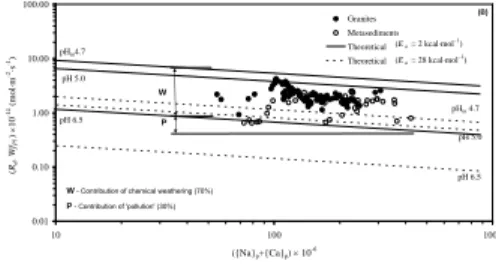
As shown in equation 7, adsorption of protons and competing ions at reactive surface sites influence the dissolution rates. As an example (Fig. 2) we show the decrease of the dissolution rate as a function of ―pollution‖.
0.1 1.0 10.0 100 1000 [Cl–]+2[SO 42–]+[NO3–] (M) Wf Pl 10 -14 (mo l· m -2·s -2) Metasediments Granites
Fig. 2: effect of the ―pollution‖ parameter (eq. 3) on the weathering rates of oligoclases in the Vouga basin (Pacheco and Van der Weijden, in review).
Brantley and Stillings (1996) proposed the following equation that takes the presence of competing, inhibitory ions into account:
Rd kNs [kHads {H}/(1k H ads {H}kyads{Y}]n(11), where kNs is the rate constant with Ns as
the density of sorption sites at the surface exposed to the fluid,
k
iads represents the sorptionconstants for ion i. The authors applied this equation in an experiment with Na as the competing cation and reported the following values for the adsorption constants:
k
H
ads= 10– 0.97 and
k
Na
ads= 103.04 . Dominant cations
matching ―pollution‖ as defined in Eq, 3 also include Ca2+. Considering the difference in charge, we introduced a term
k
Caads2{Ca 2 + }0.5 with
k
Caads2 =104.08. The result is shown in a figure in which the data, obtained for plagioclase weathering rates in the Rio Vouga basin with granites and metasediments, are plotted versus the sum of {Na}p and {Ca2}p, where thesubscript p means contribution from ―pollution‖ (Fig. 3). The boundaries of the field pHs for two values of the activation energy (2 and 28 kcal/mol) of dissolution are also represented in that figure. This demonstrates that human activities can reduce the weathering rates.
0.01 0.10 1.00 10.00 100.00 10 100 1000 ({Na}p+{Ca}p) 10-6 (R d , Wf Pl ) 10 -14 (mo l·m -2·s -1) Granites Metasediments Theoretical Theoretical pH 6.5 P - Contribution of 'pollution' (30%) W - Contribution of chemical weathering (70%)
pH 5.0 pHin4.7 pH 6.5 pH 5.0 pHin 4.7 W P (Ea = 2 kcal·mol–1) (Ea = 28 kcal·mol–1) (B)
Fig. 3: plot of the calculated weathering rates of oligoclases in granites and metasediments in the Rio Vouga basin versus the sum of {Na}
p and {Ca2}p.
Problems
The following problems with these approaches need to be been recognized and, if possible, taken into account. The weakest basis on which the calculations stand is the assumption that the weathering system under study is at steady state. This is most likely not the case, but it is the only way to go by when available time and funds prohibit long-term investigations like the one initiated by Likens and coworkers (1977, and many more recent publications) in the type location at Hubbard Brooke.
Hydrochemistry
Weathering rates calculated from the water chemistry are subject to seasonal variations in moderate climates. In the growing season, nutrients such as K, Mg, Ca and Si are taken up by plants to become partially liberated again in fall and winter. As stated by Velbel (1995), on time-scales of months to even decades and spatial-scales of small catchments, ignoring botanical exchange effects can cause large errors in weathering rates calculated from elemental budgets. For instance, forest clearance increases dissolved nutrients in soil water, groundwater and streams, disturbing steady state in the drainage area. Uptake of nutrients in mature forest differs from that in young rejuvenated forest. In populated areas, farming practices and domestic/industrial effluents upstream of the sampling location, may also affect the water composition. Knowledge of the composition of the most used—depending
on type of crop—fertilizers is of some help in recognizing the presence of excess fertilizer doses washed out of the soil, but some nutrients are eluted faster than others as a result of preferential uptake by plants and (or) sorption.
Si/B
As already mentioned, dissolved silica can be taken up by or released from vegetation. Si is absorbed as H4SiO40 and deposited as
amorphous silica in specialized silica cells of grass, reed, hairs, protective spines, leaves, stems, and roots. Si is a compression-resistant structural component of cell walls. The fraction of Si in terrestrial plants ranges from 1–10% or even higher on dry matter basis. Soil phytoliths, the opaline amorphous silica compounds in plants, are in the annual nutrient cycle the main source of Si for uptake by plants, although the ultimate source of Si is mineral weathering (Farmer et al., 2005). In stream(let)s, Si is used by aquatic plants and freshwater diatoms in summer and liberated in fall and winter. Although these processes are relatively not so important, they need to be considered.
Regarding the B-term, granites may have trace amounts of calcite and upon dissolution this increases the bicarbonate concentrations that in the model are related to dissolution of silicate minerals. In addition, in some regions/areas, carbonate dust, even carried by the wind from quite remote sources, is deposited. Finally, liming of acidic soils is an agricultural practice that also affects the value of B.
In the weathering models, we considered plagioclases and dark micas as the most weatherable, K-spar and muscovites are by far less soluble. For plagioclases we used the solid solution of albite and anorthite but they may also have some K in their structure. For biotite (with K as a major element), microprobe analysis can be used to determine its composition, in other cases we had to assume an ideal composition. The composition of secondary minerals depends on the composition of soil water and drainage rate. When drainage is rapid, an assembly of gibbsite and kaolinite is the most likely product, but in more stagnant situations in combination with higher solute concentrations, smectites or vermiculites come into play as soil constituents, with varying compositions. For that reason, an educated guess has to be made with respect to their compositions.
Hydrology
To derive the parameters mentioned in section 3d a thorough knowledge of the aquifer system in the drainage area is needed. This implies the long-term monitoring of spring discharge rates and the estimation of aquifer thicknesses within the spring‘s watershed, for the calculation of parameters such as hydraulic conductivity and effective porosity, which in turn
are used to calculate the reacting surface area. Precision in the estimation of aquifer thicknesses requires a prior knowledge of the flow path geometry, namely if it crosses or not below the level of the basin‘s outlet, something that is not always available. The thorough hydrologic analysis also involves the assessment to a database of uniformly distributed springs within the study area and the assumption of continuum medium, for the calculation of travel times using the finite-differences method.
Thermodynamic model
In most papers using this conceptual model, authors write chemical weathering reactions for congruent instead of incongruent dissolution. We preferred to abide with the more realistic incongruent dissolution process. In most cases the concentration of Altotal is negligible and does
not play the important role as in the experiments by Oelkers et al. (1994) who used the factor
a H 3n / a Al3 nin their models. Another fundamental problem is that at the weathering conditions, ―equilibrium‖ is only virtual and not real, because the primary minerals will not be precipitated from solution.
References
Blum, A.E., Stillings, L.L. (1995). Feldspar dissolution kinetics. In: A.F. White and S.L. Brantley (eds). Chemical Weathering rates
of Silicate Minerals. Reviews in Mineralogy, Vol. 31.
Mineralogical Soc. Am. 291–351.
Brantley, S.L., Stillings, LL. (1996). Feldspar dissolution at 25ºC. Am. J. Sci. 296. 101–127.
Burch, T.E., Nagy, K.L., Lasaga, A.C. (1993) Free energy dependence of albite dissolution kinetics at 80ºC and pH8.8. Chem. Geol. 105. 137–162.
Farmer, V.C., Delbos. E., Miller, J.D. (2005). The role of phytolith formation and dissolution in controlling concentrations of silica in soil solutions and streams. Geoderma 127. 71-79
Garrels, R.M. (1967). Genesis of some ground waters from igneous rocks. In: P.H. Abelson (ed.). Researches in Geochemistry V.2. John Wiley & Sons, New York, NY, USA, 405–420.
Lasaga, A.C. (1998). Kinetic Theory in Earth Sciences. Princeton Series in Geochemistry. Princeton University Press, Princeton New Jersey. 811 pp.
Likens, G.E., Bormann, F.H., Pierce, R.S., Eaton, J.S., Johnson, N.M. (1977). Biogeochemistry of a Forested Ecosystem. Springer-Verlag, New York etc., 146 pp.
Oelkers, E.H., Schott, J., Devidal, J-L. (1994). The effect of aluminium, pH, and chemical affinity on the rates of aluminosilicate dissolution reactions. Geochim. Cosmochim. Acta, 58: 2011–2024.
Oliva, P., Dupré, B., Martin, F., Viers, J. (2004). The role of trace minerals in chemical weathering in a high-elevation granitic watershed (Estibère, France): Chemical and mineralogical evidence. Geochim. Cosmochim. Acta, 68: 2223–2244. Pacheco, F.A.L., Van der Weijden, C.H. (1996). Contributions of
water–rock interactions to the composition of groundwater in areas with sizeable anthropogenic input. A case study of the waters of the Fundão area, central Portugal. Water Resources Res. 32. 3553–3570.
Pacheco, F.A.L., Van der Weijden C.H. (in review). Hydrologic and kinetic modeling of plagioclase weathering rates in the Vouga basin (Portugal): reconciling field and laboratory rates. Pacheco, F.A.L., Van der Weijden C.H. (this volume). Modeling of
Plagioclase Weathering Rates in the Sordo River Basin (North of Portugal).
Velbel, M.A. (1995). Interaction of Ecosystem processes and weathering processes. In: Trudgill, S.T.(ed.) Solute modeling in Catchment Systems. Wiley&Sons, Chichester etc.. 193–209.
![Fig. 1: Mole ratio of [Na + ]/[Ca 2 ] versus B/Si (mole ratio of bicarbonate over dissolved SiO 2 ) for incongruent dissolution of plagioclases (along y-axis from top to bottom representing dissolution of albite to bywtonite) into 1) gibbs](https://thumb-eu.123doks.com/thumbv2/123dok_br/15884024.1089625/3.892.491.746.556.727/bicarbonate-dissolved-incongruent-dissolution-plagioclases-representing-dissolution-bywtonite.webp)