
Prosodic variation in european portuguese:phrasing, intonation and rhythm in central-southern varieties
204
0
0
Texto
(2)
(3) Universidade de Lisboa Faculdade de Letras Departamento de Linguística Geral e Românica. Prosodic variation in European Portuguese: phrasing, intonation and rhythm in central-southern varieties Marisa Cruz PhD in Linguistics Portuguese Linguistics Supervisor: Sónia Frota 2013.
(4)
(5) This research was developed within the PhD Project BD/61463/2009, funded by Fundação para a Ciência e a Tecnologia..
(6)
(7) Aos meus pais À minha avozinha, a minha segunda mãe.
(8)
(9) Abstract Included within a research project aiming to provide a detailed description of prosodic variation in European Portuguese (EP), the present study analyzes phrasing, intonation and rhythm in central-southern varieties using data from different types of tasks (reading task, Discourse Completion Task, Map Task). Following the Prosodic Phonology view of prosodic structure (e.g., Selkirk 1984, 1986, Nespor & Vogel 1986/2007) and the Autosegmental Metrical (AM) approach within the intonational phonology framework (e.g., Pierrehumbert 1980; Ladd 1996/2008), we examined the prosody of two regions of the south of Portugal (Alentejo – Ale –, and Algarve – Alg) relating to: (i) phrasing; (ii) tonal system and pragmatic meanings of tonal morphemes; (iii) pitch accent distribution, and (iv) rhythmic properties of each variety. The analysis of prosodic phrasing reinforces the relevance of the Intonational Phrase in EP. Segmental phenomena such as Fricative Voicing and Paragoge (the later only in Ale) cue the IP level, and length in number of syllables and syntactic/prosodic branching of phrases impact on intonational phrasing. Intonationally, some general properties can be observed across varieties, such as: (i) similar nuclear contours across speech styles, (ii) the same pitch accent to convey focus in declaratives, (iii) post-focal subordination, and (iv) tonal boundary marking at the IP-level. However, some specificities were also found, namely: (i) a dense pitch accent distribution correlated with intonational phrasing choices in Ale, but not in Alg; (ii) a specific phrasal level in Ale, but not in Alg, that may show tonal edge-marking. The inspection of rhythmic properties showed that Ale presents a mixed rhythmic nature, whereas Alg is clearly stress-timed. Perceptual experiments with listeners from the Standard variety (SEP) showed that central-southern varieties are discriminated from SEP, even when F0 is not preserved in the signal. In contrast with SEP-Alg (different rhythmic properties), the discrimination SEP-Ale (same rhythmic properties) is unexpected. Speech rate is raised as a possible cue being interpreted by listeners, but left open for future research. This work contributes to our knowledge of the prosodic and intonational system of Portuguese, as well as the prosody of other languages, namely in the Romance space. Furthermore, our findings impact on the phonological analysis of prosody and of prosodic variation. The current results may be used as resources for the teaching of European Portuguese as first or second language, for computational applications, forensics, speech therapy, inter alia.. Keywords: prosodic variation, prosodic phrasing, intonation, rhythm, speech styles.. i.
(10)
(11) Resumo da Dissertação Enquadrada num projecto dedicado à variação prosódica no Português Europeu (PE), a presente investigação visa analisar o fraseamento, a entoação e o ritmo nas variedades centro-meridionais, a partir de dados de diferentes tipos de tarefa (leitura, Discourse Completion Task, Map Task). Partindo da abordagem da Fonologia Prosódica à estrutura prosódica (Selkirk 1984, 1986, Nespor & Vogel 1986/2007) e do Modelo Métrico Autossegmental enquadrado na Fonologia Entoacional (Pierrehumbert 1980; Ladd 1996/2008), analisou-se a prosódia de duas regiões do Sul de Portugal (Alentejo – Ale; Algarve – Alg), considerando os seguintes aspectos: (i) fraseamento, (ii) sistema entoacional e significados pragmáticos dos morfemas tonais; (iii) distribuição de acentos tonais e (iv) propriedades rítmicas de cada variedade. A análise do fraseamento prosódico confirma a importância do Sintagma Entoacional (IP) no PE. Fenómenos segmentais como o Vozeamento da Fricativa e a Paragoge (o último apenas no Ale) fornecem evidências para o nível de IP. A extensão frásica (em número de sílabas). e. a. complexidade. sintáctica/prosódica. têm. impacto. no. fraseamento.. Entoacionalmente, observam-se propriedades comuns a todas as variedades: (i) contornos nucleares semelhantes, independentemente do estilo discursivo, (ii) o mesmo acento tonal para o foco, nas declarativas, (iii) subordinação pós-foco, e (iv) marcação tonal da fronteira, obrigatória para o nível de IP. Contudo, também verificámos especificidades, tais como: (i) elevada densidade tonal correlacionada com os padrões de fraseamento entoacional no Ale, mas não no Alg, e (ii) marcação opcional do PhP, apenas no Ale. A análise do ritmo mostra que o Ale apresenta uma natureza mista, enquanto o Alg tem um ritmo acentual. Testes perceptivos com participantes da variedade standard (SEP) mostram que as variedades centro-meridionais são discriminadas do SEP, mesmo quando a entoação não é preservada no sinal acústico. Em contraste com SEP-Alg (propriedades rítmicas diferentes), a discriminação SEP-Ale (mesmas propriedades rítmicas) é inesperada. A velocidade discursiva é sugerida como possível pista usada para a discriminação, aspecto a explorar em trabalhos futuros. Esta investigação contribui para o conhecimento do sistema prosódico e entoacional do Português, bem como para o conhecimento da prosódia de outras línguas, nomeadamente, no espaço Românico. Além de fornecerem informação adicional para os estudos de variação prosódica, os resultados alcançados constituem instrumentos relevantes para outras áreas do conhecimento, tais como o ensino do Português como L1 ou L2, terapia da fala, aplicações computacionais, inter alia.. Palavras-chave: variação prosódica, fraseamento, entoação, ritmo, estilo discursivo. iii.
(12)
(13) Index List of Figures.................................................................................................................................. vii List of Tables .................................................................................................................................. xiii List of Abbreviations and Symbols....................................................................................................xv Acknowledgements ........................................................................................................................ xvii 1. Introduction .................................................................................................................................. 1 2. Prosodic Variation ........................................................................................................................ 5 2.1. An overview .......................................................................................................................... 5 2.2. Variation in European Portuguese .......................................................................................... 7 2.2.1. Non-prosodic variation................................................................................................ 7 2.2.2. Prosodic variation ....................................................................................................... 9 2.3. General methodology............................................................................................................11 2.3.1. Sample .......................................................................................................................11 2.3.2. Tasks .........................................................................................................................13 2.3.2.1.. Interview ......................................................................................................13. 2.3.2.2.. Map Task......................................................................................................13. 2.3.2.3.. Discourse Completion Task (DCT) ...............................................................14. 2.3.2.4.. Reading Task ................................................................................................15. 2.3.3. Procedures .................................................................................................................16 2.3.4. Main annotation criteria .............................................................................................16 3. Prosodic Phrasing ........................................................................................................................21 3.1. General considerations on prosodic structure ........................................................................21 3.2. Prosodic structure in European Portuguese ............................................................................23 3.3. Prosodic Phrasing .................................................................................................................25 3.3.1. Segmental evidence to phrasing .................................................................................26 3.3.2. Suprassegmental evidence to phrasing ........................................................................30 3.4. Experiments .........................................................................................................................32 3.4.1. Segmental evidence for prosodic phrasing ..................................................................32 3.4.1.1.. Experiment 1: Fricative Voicing....................................................................32. 3.4.1.2.. Experiment 2: Paragoge ................................................................................37. 3.4.2. Suprassegmental evidence for prosodic phrasing ........................................................45 3.4.2.1.. Methodology ................................................................................................45. 3.4.2.2.. Dominant phrasing pattern ............................................................................47. 3.4.2.3.. Triggering (S)(VO) phrasing: the effect of syntactic/prosodic complexity ......49. 3.4.2.4.. Triggering (S)(VO) phrasing: the effect of length ..........................................50. 3.5. Conclusions and final discussion...........................................................................................51 4. Intonation ....................................................................................................................................53.
(14) 4.1. The Autosegmental Metrical Model ...................................................................................... 54 4.2. Intonational variation in Portuguese and other Romance and non-Romance languages .......... 56 4.3. Intonational analysis of the central-southern varieties ........................................................... 61 4.3.1. Methodology ............................................................................................................. 61 4.3.2. Results across sentence types and tasks ...................................................................... 65 4.3.2.1.. Nuclear contours ........................................................................................... 65. 4.3.2.2.. Tonal marking of prosodic edges .................................................................. 74. 4.3.2.3.. Prosodic focus and post-focal behavior in early focus cases........................... 76. 4.3.2.4.. Pitch accent distribution ................................................................................ 80. 4.4. Conclusions and final discussion .......................................................................................... 85 5. Rhythm ........................................................................................................................................ 89 5.1. Rhythmic organization of languages: classes or continuum? ................................................. 89 5.2. The correlates of rhythm: different proposals, different measures .......................................... 91 5.3. Rhythmic properties of Portuguese: EP versus BP ................................................................ 93 5.4. Rhythm across European Portuguese varieties: the central-southern varieties ........................ 94 5.4.1. Production ................................................................................................................. 94 5.4.2. Perception................................................................................................................ 102 5.4.2.1.. General methodological procedures ............................................................ 103. 5.4.2.2.. Results ........................................................................................................ 104. 5.5. Final discussion and Conclusions........................................................................................ 108 6. Conclusion................................................................................................................................. 111 6.1. Phrasing ............................................................................................................................. 111 6.2. Intonation ........................................................................................................................... 114 6.3. Rhythm .............................................................................................................................. 118 6.4. Mapping prosodic variation: areas of convergence/divergence with segmental variation ..... 121 References ...................................................................................................................................... 125 Appendix I...................................................................................................................................... A-1 Appendix II .................................................................................................................................. A-15 Appendix III ................................................................................................................................. A-21 Appendix IV ................................................................................................................................. A-23 Appendix V .................................................................................................................................. A-31.
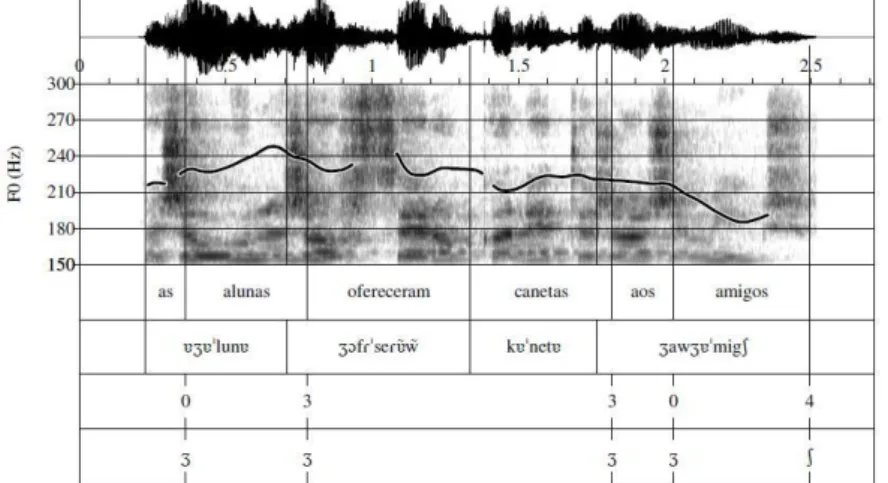
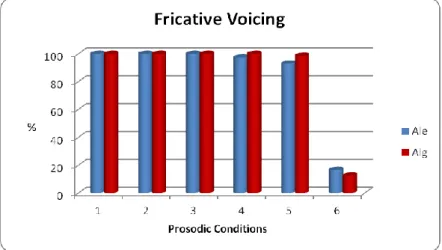
(15) List of Figures Figure 1 – European Portuguese dialects, according to Cintra (1971), adapted by Segura & Saramago (2001). The black solid line splits the northern varieties (in light and dark blue) from the central-southern ones (in brown and white). The red thinner lines signal regions with peculiar linguistics features. ........................................................................................................... 8 Figure 2 – Detail of the Beja district. The selected region for analysis is surrounded by a dark blue line. 12 Figure 3 – Detail of the Faro district. The selected region for analysis is surrounded by a dark blue line. 12 Figure 4 – Image used simultaneously with the oral context transcribed above (1) to elicit a neutral declarative with one single prosodic word (extracted from the Portuguese version of the DCT, available at InAPoP. See also Appendix IV). ................................................................................ 15 Figure 5 – Annotation of a neutral yes-no question produced in SEP (speaker AG). “O pintor retratou uma manhã âmbar?” Did the artist paint an amber morning? .......................................... 18 Figure 6 – Annotation of a continuation rise extracted from the Map Task applied in SEP. ‘Segues em frente até ao bar…’ (Go straight forward until you reach the bar.). The use of parentheses means deletion. Brackets signal insertion. .................................................................................... 19 Figure 7 - Textgrid structure for the analysis of fricative voicing. ‘As alunas ofereceram canetas aos amigos.’ (The students have offered pens to their friends), produced by a speaker from Alg. .. 33 Figure 8 – The realization of the fricative as [], not legitimated in SEP, but present in the centralsouthern varieties: frequency of occurrence. ................................................................................. 34 Figure 9 – Fricative voicing in Alg: the realization of the voiced fricative may vary within the same speaker – [], at the left panel vs. [] (pens to their friends), at the right panel. Both renditions were produced by speaker AZ, in random order.......... 34 Figure 10 – The realization of the voiced fricative by prosodic condition: 1=within PhP; 2=within ‘restructured’ PhP (non-branching complement); 3=across PhP (branching complement); 4=across PhP (≠ from Subject/Verb); 5=across PhP (= Subject/Verb); 6=across IP). ..................... 35 Figure 11 – Effect of length in the fricative voicing process (Ale): left panel – subject with 4 syllables produced as a PhP, thus favoring the occurrence of fricative voicing. ‘As alunas ofereceram pijamas amarelos aos amigos.’ (The students have offered yellow pyjamas to their friends.); right panel – subject with 6 syllables restructured in an IP, thus blocking the occurrence of fricative voicing. ‘As duas alunas ofereceram canetas aos amigos.’ (The two students have offered pens to their friends.). ................................................................................. 35 Figure 12 – Fricative Voicing in Ale with parenthetical structures: the parenthetical form an intonational unit with the previous phrase of the root sentence, which is shown by both intonational analysis (here added to the basic tiers considered for the prosodic analysis of. vii.
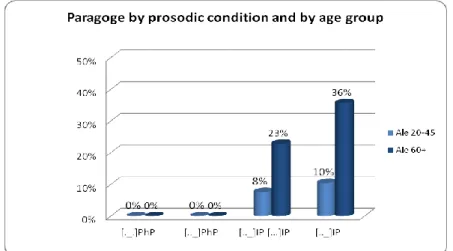
(16) segmental phenomena) and by the Fricative Voicing at the inner IP. ‘As alunas, até onde sabemos, obtiveram boas avaliações.’ (The students, as far as we know, have got good marks.). .. 36 Figure 13 - Fricative Voicing in Alg with parenthetical structures: the parenthetical form an intonational unit with the following phrase of the root sentence, which is shown by both intonational analysis (here added to the basic tiers considered for the prosodic analysis of segmental phenomena) and by the Fricative Voicing at the inner IP. ‘As alunas estrangeiras nos Açores, até onde sabemos, aceitaram vir.’ (The foreign students in Azores, as far as we know, have agreed to come.). ................................................................................................................. 36 Figure 14 – Textgrid structure for the analysis of Paragoge (Ale). ‘A Lina pediu ao António para cantar.’ (Lina asked António to sing). ........................................................................................... 39 Figure 15 – Vowel deletion in SEP (left panel) and vowel realization in Ale (right panel), which is also considered here as the occurrence of a paragogic vowel. ‘Aquela fonte’ (That fountain). This was extracted from the production of the sentence ‘Aquela fonte parece um riacho.’ (That fountain seems like a stream). ...................................................................................................... 39 Figure 16 – Paragoge occurrence depending on the segmental preceding contexts: known ([], /l/, [], []) versus new ([a], [], [], [])............................................................................................. 40 Figure 17 – Distribution of Paragoge in Ale by segmental context. Phonetic symbols follow the SAMPA transcription for Portuguese. .......................................................................................... 40 Figure 18 - Distribution of Paragoge in Ale by age group, considering each final segmental context of target words. Phonetic symbols follow the SAMPA criteria for Portuguese. ............................. 41 Figure 19 – Distribution of Paragoge in Ale by prosodic condition and age group............................. 42 Figure 20 – Subject NP phrased as an IP, which is cued by Paragoge. ‘Aquela flor secava num instante.’ (That flower got dried instantly.). .................................................................................. 42 Figure 21 – Example of an IP edge with no Paragoge. ‘Aquele mar rolava na areia.’ (That sea rolled in the sand.). ...................................................................................................................... 43 Figure 22 - Neutral yes-no question produced by AG (SEP). Epenthesis as a strategy of text-tune accommodation. ‘O poeta cantou uma manhã angelical?’ (Did the poet sing an angelical morning?) .................................................................................................................................... 44 Figure 23 - Neutral declaratives produced in Ale. An intonational tier was added to the basic structure for the analysis of Paragoge. Left panel: speaker LM (20-45 years-old). ‘O Nuno pediu à madrinha para dormir.’ (Nuno asked his godmother to sleep.) Right panel: declarative with a topicalized complement in situ, produced by speaker AC (60+ years-old). ‘A Lina pediu para cantar, ao António.’ (Lina asked (him) to sing. António.) Epenthesis with a nuclear falling contour at the edge of an internal IP. ............................................................................................ 44 Figure 24 - (S)(VO) phrasing. Short non-branching S. ‘A loura mirava morenos.’ (The blond girl looked at dark-haired boys.), produced by a speaker from Ale. ..................................................... 48 Figure 25 - (SVO) phrasing. Short non-branching S. ‘A loura mirava morenos.’ (The blond girl looked at dark-haired boys.), produced by a speaker from Alg. ..................................................... 48. viii.
(17) Figure 26 - (S)(VO) phrasing. Short branching S. ‘A mulher loura maravilhava velhinhas lindas.’ (The blond woman marveled beautiful old ladies.), produced by a speaker from Alg. ................... 49 Figure 27 - (S)(VO) phrasing. Long non-branching S. ‘A boliviana mimava velhinhas.’ (The Bolivian girl spoiled old ladies.), produced by a speaker from Ale. ............................................... 50 Figure 28 – Ale – neutral declaratives produced in the reading task (left panel) and in the DCT (right panel). Left panel: ‘As angolanas ofereceram especiarias aos jornalistas.’ (The Angolan girls offered spices to the journalists.). Right panel: ‘Ela bebe limonada.’ (She drinks lemonade.), extracted from Frota et al. (in press). ......................................................................... 65 Figure 29 – Neutral yes-no questions produced in the reading task: Ale (left panel) and Alg (right panel). ‘Ela foi ver a Maria?’ (Has she gone to see Maria?). ......................................................... 66 Figure 30 - Neutral yes-no questions produced in the DCT: Ale (left panel) and Alg (right panel). ‘Choveu?’ (Did it rain?). .............................................................................................................. 67 Figure 31 – SEP – neutral yes-no question produced in the DCT. ‘Choveu?’ (Did it rain?). .............. 67 Figure 32 – Ale – Vowel epenthesis in a yes-no question (reading task). ‘Ela foi ver o mar?’ (Has she gone to see the sea?)............................................................................................................... 68 Figure 33 – Wh-questions. Left panel: Ale, reading task. ‘Quem cantou uma manhã angelical?’ (Who has sung an angelic morning?). Right panel: Alg, DCT. ‘Que horas são?’ (What time is it?).. 69. Figure 34 – Ale – Wh-question produced in the reading task. ‘Quem pintou uma manhã âmbar?’ (Who has painted an amber morning?). ........................................................................................ 69 Figure 35 – Ale – Request produced in the reading task. ‘Pinta uma manhã âmbar.’ (Paint an amber morning.)........................................................................................................................... 70 Figure 36 – Alg – Commands across tasks. Left panel: reading task. ‘Pinta uma manhã âmbar.’ (Paint an amber morning.). Right panel: DCT. ‘Anda cá.’ (Come here.). ...................................... 70 Figure 37 – Alg – Command produced with an early nucleus. ‘Dá-lhe um porsche.’ (Give him a porsche.). ..................................................................................................................................... 71 Figure 38 – Alg – Greeting call produced in the reading task. ‘Marina.’ (Marina.). ........................... 72 Figure 39 – Alg – Insistent call produced in the reading task. ‘Marina.’ (Marina.)............................. 72 Figure 40 – Vocatives. Left panel: Alg, greeting call with vowel lengthening. ‘Valdemar.’ (Valdemar.). Right panel: Ale, insistent call with vowel split. ‘João.’. (João.). Both figures were extracted from Frota & Cruz (2012). ............................................................................................ 73 Figure 41 – Ale – Tonal edge marking in the reading task: left edge of the last Phonological Phrase of the Intonational Phrase. Left panel: ‘A boliviana memorizava dilemas’. (The bolivian girl memorized dilemmas.). Right panel: ‘A nora da mãe maravilhava velhinhas lindas.’ (Mother’s daughter-in-law marveled beautiful old ladies.). ........................................................................... 75 Figure 42 – Ale – Tonal edge marking across sentence types: neutral yes-no question produced in the reading task. ‘Ela foi ver a Marina?’ (Has she gone to see Marina?). ....................................... 75. ix.
(18) Figure 43 – Ale – Tonal edge marking across speech styles: wh-question produced in the DCT. ‘Quando é que pintas a casa?’ (When will you paint the home?). .................................................. 76 Figure 44 – Alg – Declarative with narrow focus across speech styles. Left panel: reading task. ‘As angolanas ofereceram especiarias aos JORNALISTAS.’ (The Angolan girls offered spices to the JOURNALISTS.). Right panel: DCT. ‘Não, eles vão para LIMA.’ (No, they go to LIMA.). ......... 77 Figure 45 – Ale – Focalized yes-no question produced in the reading task. Left panel: late focus case. ‘Ela foi ver o MAR?’ (Has she gone to see the SEA?). Right panel: early focus case. ‘O poeta cantou uma MANHÃ angelical?’. (Did the poet sing an angelic MORNING?). ................... 78 Figure 46 – Ale – Focalized yes-no question produced in DCT. ‘O Manel vai ser PRESIDENTE?’ (Manel is going to be PRESIDENT?). .......................................................................................... 78 Figure 47 – Alg – Yes-no question produced in DCT. Left panel: broad focus. ‘Choveu?’ (Did it rain?). Right panel: narrow focus. ‘O Manel vai ser PRESIDENTE?’ (Manel is going to be PRESIDENT?). ........................................................................................................................... 79 Figure 48 – Post-focus compression in early focus cases across varieties, sentence types, and speech styles. Left panel: focused declarative produced in Alg, in the reading task. ‘O poeta cantou uma MANHÃ angelical.’ (The poet sang an angelic MORNING.). Right panel: focused yes-no question produced in Ale, in the DCT. ‘O MANEL vai ser presidente?’ (MANEL is going to be president?). ................................................................................................................ 79 Figure 49 - SEP – Sparse pitch accent distribution and (SVO) phrasing. ‘A boliviana levava liras na mala.’ (The Bolivian girl took liras in her purse.). .................................................................... 83 Figure 50 - Ale – Dense pitch accent distribution and (S)(VO) phrasing. ‘A boliviana levava liras na mala.’ (The Bolivian girl took liras in her purse.). .................................................................... 84 Figure 51 - Alg – Dense pitch accent distribution, but (SVO) phrasing. ‘A boliviana manuseava liras na mala.’ (The Bolivian girl handled liras in her purse.). ....................................................... 85 Figure 52 - Segmentation of vocalic and consonantal intervals, following the criteria from Turk et al. (2006) and Frota & Vigário (2001). ‘Os pais aproximaram-se do miúdo sem ruído’. (The parents approach the kid silently.). ............................................................................................... 96 Figure 53 - Δ%C vs. %V for Portuguese varieties. Data for SEP and BP from Frota & Vigário (2001). Left panel: whole adapted corpus for Portuguese (Experiment 1). Right panel: selected sentences for a cross-linguistic analysis (Experiment 2)................................................................ 98 Figure 54 - ΔC vs. %V for Portuguese varieties (selected data), and the 8 languages from Ramus, Nespor & Mehler (1999). Data for SEP and BP were extracted from Frota & Vigário (2001). Circle in red is grouping stress-timed languages/varieties; circle in orange is grouping syllabletimed languages and circle in blue is grouping mixed EP varieties. ............................................. 101 Figure 55 – Boxplot illustrating the discrimination scores in the tasks SEP versus Ale and SEP versus Alg (within-subjects), clustered according to the F0 condition (between-subjects). .......... 106. x.
(19) Figure 56 - Boxplot illustrating the mean Reaction Times (RTs) in miliseconds (ms) in the tasks SEP versus Ale and SEP versus Alg (within-subjects), clustered according to the F0 condition (between-subjects). .................................................................................................................... 107 Figure 57 – Range of duration (ms.) of selected sentences with 15 and 17 syllables across varieties.108 Figure 58 – Dominant phrasing patterns across EP varieties (Reading Task). Only four urban regions were analyzed for this prosodic aspect (red dotted geo points). Data from SEP (Lisbon) and NEP (Braga) from Frota et al. (2007). .................................................................................. 113 Figure 59 – Tonal density across EP varieties (DCT). Four urban regions were analyzed (red dotted geo points). Data for the variety spoken in Oporto (Por), from Frota et al. (2011, in press). ........................................................................................................................................ 116 Figure 60 - Tonal density in wh-questions produced across EP varieties (DCT). Four urban regions were analyzed (red dotted geo points).Data for the variety spoken in Oporto (Por), from Frota et al. (in press). .............................................................................................................................. 117 Figure 61 – Left panel: European Portuguese dialects, according to Cintra (1971), adapted by Segura & Saramago (2001). The black solid line splits the Northern varieties (in light and dark blue) from the Central-Southern ones (in brown and white). The red thinner lines signal regions with peculiar linguistics features. Right panel: areas of prosodic variation, on the basis of two prosodic features (intonational phrasing and tonal density). ........................................................ 122. xi.
(20)
(21) List of Tables Table 1 – Frequency of occurrence of (SVO) and (S)(VO) phrasing patterns in Ale and in Alg. ........ 47 Table 2 - Role of branching in the (S)(VO) phrasing pattern – Ale and Alg. ...................................... 49 Table 3 - Role of syntactic branching in the (S)(VO) phrasing pattern – NEP and SEP (from Frota & Vigário 2007). .......................................................................................................................... 50 Table 4 - Role of length (in number of syllables) in the (S)(VO) phrasing pattern – Ale and Alg. ...... 50 Table 5 – Type of text-tune accommodation strategies per sentence type, across varieties and tasks. ‘ep’ stands for ‘epenthesis’; ‘vs’ stands for ‘vowel split’; ‘vl’ stands for ‘vowel lengthening’; ‘--' stands for ‘do not occur’; blank cells mean that there are no relevant contexts. .......................... 73 Table 6 – Incidence of text-tune accommodation strategies (%) per sentence type, across varieties and tasks. ‘---‘ stands for ‘do not occur’; blank cells mean that there are no relevant contexts. ...... 73 Table 7 – Prosodic focus in the reading task (at the left) and in the DCT (at the right): nuclear configuration and its realization (pitch range – PR) in Alg. ........................................................... 78 Table 8 – Study 1: percentage (%) of pitch accents (PA) per Prosodic Words (PW), excluding both nuclear PA and initial peaks, per sentence type. Left panel – Ale. Right panel – Alg. .................... 81 Table 9 – Reading task: percentage (%) of pitch accents (PA) per Prosodic Words (PW), excluding both nuclear PA and initial peaks, per sentence type. Left panel – Ale. Right panel – Alg. ............ 82 Table 10 – Discourse Completion Test (DCT): percentage (%) of pitch accents (PA) per Prosodic Words (PW), excluding both nuclear PA and initial peaks, per sentence type. Left panel – Ale. Right panel – Alg. Data also reported in Frota et al. (in press). ..................................................... 82 Table 11 - Intonational phrasing and tonal density in NEP and SEP (from Vigário & Frota 2003, Frota & Vigário 2007). ................................................................................................................. 83 Table 12 - Intonational phrasing and tonal density in Ale and Alg. Data on tonal density refers to the reading task. ........................................................................................................................... 84 Table 13 – Nuclear contours across sentence types and speech styles, in Ale and Alg. ...................... 86 Table 14 - Three averaged acoustic measures across Portuguese varieties. Global results for SEP and BP from Frota & Vigário (2001). Gray color signals new data. .............................................. 96 Table 15 - Averaged acoustic measures across Portuguese varieties: same corpus across varieties. Selected results for SEP and BP from Frota & Vigário (2001). Gray color signals new data.......... 98 Table 16 - Averaged acoustic measures across European Portuguese varieties: same corpus. ............ 99 Table 17 –SEP versus Ale and SEP versus Alg: mean percent scores of discrimination, mean reaction times (RTs) and d’ scores. ............................................................................................. 104 Table 18 – Average duration of sentences selected for the perceptual experiments. ......................... 107. xiii.
(22)
(23) List of Abbreviations and Symbols EP BP SEP NEP Ale Alg Por AM BI ToBI SLH NP PAD Syl CL or BI 0 PW or BI 1 or ω CG PWG or BI 2 PhP or BI 3 ip IP or BI 4 IPmin IPmax U [._.]PhP [.._]PhP [.._]IP [.._]IP […]IP S V O C V ep vs vl Hz ms PR PA. European Portuguese Brazilian Portuguese Standard European Portuguese (Lisbon, Lisbon district) Northern European Portuguese (Braga, Braga district) Alentejo (Castro Verde, Beja district) Algarve (Albufeira, Faro district) Porto (Oporto, Oporto district) Autosegmental Metrical framewok Break Indices Tone Break Indices Strict Layer Hypothesis Noun Phrase Pitch Accent Distribution Syllable Clitic Prosodic Word Clitic Group Prosodic Word Group Phonological Phrase Intermediate phrase Intonational Phrase Internal Intonational Phrase of a Compound IP External Intonational Phrase of a Compound IP Utterance Internal position of the PhP Final position of the PhP Final position of the IP Final position of an internal IP Subject Verb Object Consonant Vowel Epenthesis Vowel split Vowel lengthening Hertz Milliseconds Pitch Range Pitch Accent xv.
(24) InAPoP IARI IViE ALEPG CORDIAL-SIN ALLP ALEAç RLD y n %V ΔV ΔC Δ%V Δ%C VarcoV VarcoC PVI nPVI rPVI CCI SDT RT d’ +F0 -F0 L1 L2 [C:] DCT IPA SAMPA. xvi. Interactive Atlas of the Prosody of Portuguese Interactive Atlas of the Romance Intonation English Intonation in the British Isles Linguistic and Ethnographic Atlas of Portugal and Galicia The Syntax-oriented Corpus of Portuguese Dialects Linguistic Atlas of the Portuguese Coast Linguistic and Ethnographic Atlas of Azores Romance Languages Database Yes (presence) No (absence) Duration of vocalic intervals Variability of the duration of vocalic intervals Variability of the duration of consonantal intervals Standard deviation of %V Standard deviation of %C Standard deviation of vocalic intervals Standard deviation of consonantal intervals Pairwise Variability Indices Normalized Pairwise Variability Indices Raw Pairwise Variability Indices Control and Compensation Index Signal Detection Theory Reaction times d-prime with F0 contour without F0 contour Native Language Non-Native Language (Second Language) Written context of sentences in reading task Discourse Completion Task International Phonetic Alphabet Speech Assessment Methods Phonetic Alphabet.
(25) Acknowledgements Along this journey, I came across many people who contributed for my personal and academic identity. However, I will use my native language from now on, so I can express my true feelings, better.. À minha família, devo um profundo agradecimento pelo apoio constante e incondicional. Aos meus pais e à minha avó materna, a quem dedico este trabalho, e que me dão a mão sempre que preciso. Sei que estão sempre aqui e só isso é suficiente para me acalmar! À minha irmã, pelo carinho, pela partilha e, muito importante, pela paciência. Vocês são tudo o que tenho de melhor, o meu porto de abrigo! À minha orientadora, Sónia Frota, por “me levar com ela” e por acreditar em mim. Obrigada pela precisão cirúrgica que tão bem a caracteriza e que emprega em tudo o que faz. Quando crescer, quero ser assim.. À Marina Vigário pelos comentários tão preciosos que foi tecendo ao longo deste e de outros trabalhos. Aprendo muito em poucos minutos de conversa. Não posso deixar de reservar umas quantas linhas para ‘os meus dois rapazes’, o meu apoio nestes últimos tempos. Foram incansáveis no recrutamento de participantes para os meus testes perceptivos e na aplicação dos mesmos. Nuninho e Pedrocas, não sei que seria de mim sem vocês, sobretudo nestes últimos dias. Meus companheiros das recolhas de dados, das discussões prosódicas à mesa, das gargalhadas… Meus amigos, meus confidentes. A boa disposição que vos caracteriza, a solidariedade, a dedicação constante… nada exprime tudo o que recebi de vocês ao longo desta caminhada. Nunca me esquecerei das palavras de alento nestes últimos dias. Agarrei-me a elas e aqui estou eu! Um sincero obrigada por TUDO.. Ao Joe pela leitura integral da tese e pelas correcções importantíssimas. Esteve sempre ali, à espera, e a responder muito prontamente. Joe, it is done now! Many thanks for your eagle eye.. Su, muito obrigada pelas leituras e sugestões. Muito obrigada pelas palavras de apoio.. xvii.
(26) À Cátia, ao Nuno, à Raquel, companheiros desta e de outras caminhadas. Sei que estiveram, estão e estarão aqui, sempre. Nunca me esqueço disso.. À Aninhas pela amizade de anos, pela preocupação que nutre por todos os que a rodeiam. Obrigada por ouvires os meus desabafos, obrigada por seres quem és, na minha vida.. Do outro lado do Oceano, não posso esquecer pessoas que me são muito queridas: a Flávi, a Carol Serra (já de outras caminhadas), a Pri e a Carol Cangemi. À Jô, agora deste lado do Oceano, obrigada pelas mensagens de carinho e desculpa a minha recente ausência.. Aos meninos e meninas catalães, Maria del Mar, Joan, Rafèu, Vèro, que muito bem me receberam durante a minha formação em Barcelona. Ainda à Meghan. Muito obrigada por se cruzarem no meu caminho! Tenho aprendido muito convosco!. À Nádia, um dos membros mais recentes do lab, sempre disposta a ajudar.. A todos os meus informantes, que dispensaram três horas do seu precioso tempo para estarem comigo. A todos os que, de alguma forma, participaram no meu trabalho. Saliento o apoio fundamental da Cátia, bem como da Câmara Municipal de Albufeira. Em Castro Verde, tenho de reconhecer que a família Matos ficou no meu coração. À Paulinha, ao Luís pai e ao Luís filho, muito obrigada pela hospitalidade com que me receberam. Foram dias bem passados! À Susete Bruno, a quem devo o último mapa deste trabalho! Muito obrigada pelo “bom dia” sempre tão bem disposto.. Por fim, mas não de menor importância, a ti, Diogo. Desculpa a rabugice! Foram tempos difíceis, eu sei…. xviii.
(27) «Recordo paisagens e, enquadrados nelas, homens e mulheres. Diversos como os cenários em que se situavam, contavam-me histórias, diversas também. Ao fim de dois ou três dias sentíamo-nos por vezes verdadeiros amigos, quase irmãos. Eu não tinha podido dar-lhes senão um pouco de atenção, de simpatia. Eles tinham-me dado uma lição magnífica, decisiva para o meu modo de sentir e de pensar a partir daquele momento. […] Se mais nada, no vasto terreno da linguística, conservasse um dia interesse para mim, creio que esta experiência seria só por si suficiente para me obrigar a reconhecer e afirmar que vale a pena o ramo de estudos para que a vida me conduziu.» (in Luís F. Lindley Cintra, in ‘Sobre o interesse humano do estudo dos dialectos e falares regionais’, Estudos de Dialectologia Portuguesa, 2ª edição, 1995, pp. 7-15.).
(28)
(29) Introduction. 1.. Introduction. The present research is a contribution to a major ongoing project at the Phonetics Lab & Lisbon BabyLab (CLUL/FLUL), which aims to build an Interactive Atlas of the Prosody of Portuguese (InAPoP – PTDC/CLE-LIN/119787/2010, funded by FCT – Fundação para a Ciência. e. a. Tecnologia).. The. InAPoP. web. platform. is. available. at. http://www.fl.ul.pt/LaboratorioFonetica/InAPoP/ (Frota & Cruz, coords., 2012-2014). This project greatly benefited from three other atlases, developed by Pilar Prieto and collaborators (University Pompeu Fabra, Barcelona) – Atles interactiu de l’entonació del català (Prieto, & Cabré, coords., 2007-2012), Atlas interactivo de la entonación del español (Prieto & Roseano, coords., 2009-2013), and Atlàs interactiu de l’intonacion de l’occitan (Prieto & Sichel-Bazin 2014). Partly based on similar methodologies as the other atlases, the InAPoP allows a close comparison across European and Brazilian Portuguese varieties, and also across Romance languages (Portuguese, Catalan, Spanish and Occitan, as well as French, Italian, Friulian, Sardinian and Romanian, which are included in the ongoing IARI project Interactive Atlas of Romance Intonation (Prieto, Borràs-Comes & Roseano, coords., 20102014). Within this context, we aim to provide a detailed prosodic analysis, which includes phrasing, intonation and rhythm, of the speech of two urban regions belonging to the central-southern variety of European Portuguese (EP), according to Cintra (1971). The two urban regions studied are located in Alentejo and Algarve. With the goal of comparing the prosody of the two central-southern regions with the prosodic and intonational systems already described for Standard European Portuguese (SEP) and Northern European Portuguese (NEP) varieties, the materials used in the prosodic analysis of SEP and NEP (Frota 2000; Frota & Vigário 2001; Vigário & Frota 2003; Frota & Vigário 2007) were reused and extended in order to allow a closer comparison between previous results and those obtained in the current study. This is the first in-depth study of the prosody of southern varieties of EP. Our major goal is to observe similarities and differences in prosodic patterns across EP varieties, in different speech styles, focusing on central-southern varieties. In this sense, we explore the following prosodic aspects: (i) the prosodic organization and characterization of constituents above the Prosodic Word (PW); (ii) the ways sandhi and other segmental phenomena cue prosodic phrasing; (iii) the average size of the Intonational Phrase (IP); (iv) the pitch accent distribution in the Intonational Phrase (tonal density); (v) the tonal inventory and the pragmatic meanings of tonal morphemes (including focalization); (vi) nuclear. 1.
(30) Prosodic variation in EP: phrasing, intonation and rhythm in central-southern varieties. contours for each sentence type (declaratives, yes-no questions, wh-questions, requests and vocatives – greeting call and insistent call); and (vii) the rhythmic properties. The present research is thus a contribution to the knowledge of the prosody of EP, and it also adds information to the understanding of the properties and limits of variation within and across languages, in general. The results will also be of interest for (i) prosodic typology; (ii) studies on syntax-prosody and morphology-prosody interfaces; (iii) language development (prosodic bootstrapping); (iv) language pathologies and disorders; (v) computational purposes, namely for synthesis and speech recognition systems; (vi) and teaching of EP as first or second language, among others. In chapter 2, an overview of prior studies on prosodic variation is presented (section 2.1), and the background on variation in EP is provided (section 2.2). General methodological procedures that were taken into account in this research are mentioned (section 2.3), from the selection of the geographical points for analysis to the annotation criteria adopted. Chapters 3, 4 and 5 are devoted to the analysis of each of the main prosodic aspects covered in this dissertation, respectively phrasing, intonation and rhythm. The first sections of each chapter provide a general background for the prosodic aspect under analysis, followed by a review of previous studies for EP. Then, the analysis of the data from the two centralsouthern varieties is described, followed by discussion and concluding remarks and some of the respective theoretical implications. For the analysis of prosodic phrasing in the Interior Centre and South (Chapter 3), both segmental and suprassegmental evidence was inspected. In line with previous studies on prosodic phrasing in the Standard variety, we decided to explore fricative voicing as a cue for prosodic phrasing patterns (section 3.3.1), as well as the insertion of a paragogic vowel, known to be characteristic of the Interior Centre and South. At the suprassegmental level, syntactic and prosodic complexity and length in number of syllables were also inspected in order to see whether and how these aspects constrain prosodic phrasing (section 3.3.2). The intonational analysis of the Interior Centre and South (Chapter 4) includes the inspection of (i) the main nuclear contours, (ii) tonal marking of prosodic edges, (iii) prosodic focus and the post-focal behavior in early focus cases, and (iv) pitch accent distribution (section 4.3.2). These prosodic aspects were examined in different speech styles and considering several sentence types. Rhythmic properties of the central-southern varieties were inspected on the basis of production and perception experiments. First, an acoustic analysis on the basis of two different metrics is presented (section 5.4). Then, experiments with participants from the Standard variety perceiving manipulated sentences produced by speakers from the Interior 2.
(31) Introduction Centre and South are described (section 5.5). This preliminary study of rhythmic properties across varieties of EP adds to the discussion of the rhythmic organization of languages (and varieties) in classes or along a continnum. Finally, in the conclusion (Chapter 6), we sum up the main results obtained for the analysis of phrasing, intonation and rhythm in the Interior Centre and South. The challenge involved in the carthographic representation of these prosodic aspects and the relevance of this kind of representation for research on prosodic variation are also reported. Furthermore, a parallel with the carthographic representation of segmental and syntactic aspects is considered, and areas of convergence/divergence are proposed. We also discuss hypothetical implications of our results for the knowledge of the European Portuguese prosodic grammar, in particular, and for prosodic typology in general.. 3.
(32)
(33) Prosodic Variation. 2.. Prosodic Variation. 2.1. An overview Studies on prosodic variation are considered as a relevant source of information to determine generalizations and specificities of prosodic systems. General tendencies observed across languages are interpreted as universals of language. Based on the model of prosodic phonology, Vogel (2009) proposes and discusses a series of potential universals, related with general properties of prosodic structure, the geometry of prosodic constituents, and prosodic structure phenomena. By establishing these universals, Vogel (2009) is thus assuming that these aspects do not vary across languages/varieties. However, the author does not discard the possibility of significant deviations relative to the proposed universals. Even though, the proposed universals are considered as general tendencies (widely observed across languages), thus opposed to absolute universals (Vogel 2009). As a first step to establish a prosodic typology, Hirst & Di Cristo (1998), for example, assembled descriptions of the intonation systems of twenty languages. A few years later, based on the prosodic description of thirteen languages, all following the Autosegmental Metrical (AM) framework1, together with data from eight other languages, Jun (2005) proposed a model of prosodic typology. The author shows, among other observations, that: (i) all languages have at least one prosodic unit above the word, and (ii) the number and type of rhythmic/prosodic units at the postlexical level are not predictable from the lexical rhythmic unit of the language, nor from the type of lexical prominence. For instance, in both English and Portuguese, lexical prominence is conveyed by stress. However, the foot is the lexical rhythmic unit in English, which differs from the lexical rhythmic unit of Portuguese – the syllable. Furthermore, these two languages have also different rhythmic/prosodic units at a postlexical level: the intermediate phrase and Intonational Phrase in English, but only the Intonational Phrase in Portuguese. In sum, according to Jun (2005), prosodic similarities and differences across languages are captured by two main aspects, which may define a prosodic typology: prominence and the rhythmic/prosodic pattern of an utterance. According to Ladd (1996/2008), languages can differ intonationally in four possible dimensions: (i) semantic (differences in the meaning/use of phonologically identical tunes); (ii) systemic (differences in the inventory of phonologically distinct tunes, independently of semantic differences); (iii) realisational (different phonetic realizations of the same phonological tune); (iv) phonotactic (differences in tune-text association). For Hirst & Di. 1. For a detailed description of the AM framework, see Chapter 4, section 4.1.. 5.
(34) Prosodic variation in EP: phrasing, intonation and rhythm in central-southern varieties. Cristo (1998: 1-44), the variability in the intonation systems of different languages might reflect the variability across dialects of the same language. Thus, the authors hypothesize that in the intonation system of a given language, some parameters would be anchored in the system while other aspects would be more prone to vary across dialects. Subsequent studies on prosodic variation have included the analysis of varieties of languages, with important consequences for the knowledge of prosodic grammar and for both intonational and rhythmic typologies. Studies on Swedish varieties developed by Bruce and collaborators (Bruce 1977, 2004, 2005, 2007; Bruce & Gårding 1978, Gårding 1982) and the IVie project for British English (Coleman & Kochanski 2003) are among the most relevant studies on prosodic variation across language varieties. As with other Scandinavian languages (Norwegian, Danish), Swedish is characterized by the opposition between two word accents (accent I and accent II). Seven different intonational varieties were found within the Project SweDia 2000 (Bruce 2004, 2005), characterized on the basis of some interrelations, such as between phrasing (less understood, and then interpreted as a kind of pitch course between the two accented types, signaling the coherence between these items) and focal accentuation. In this sense, Swedish speech from the South present a low plateau, while the Northern variety presents a high plateau. Interestingly, varieties with a low plateau (South and Far East) do not distinguish between focal and non-focal accent, in contrast with speakers from the varieties of West, Central, East and North (with a high plateau). The latter varieties are also characterized by a downstepping of post-focal accents, instead of deaccentuation (observed in the former). Within the IVie Project, nine urban varieties of English were analyzed. Cross-variety differences were found in phonetic realization: Cambridge and Newcastle English compress, whereas English spoken in Belfast and Leeds is characterized by truncation. Considering intonational phonology, the production of nuclear accents was shown to vary along three dimensions: (i) variety, (ii) sentence type, and (iii) speaker. For example, declaratives are essentially produced with falling contours, whereas questions are subject to more variation (three or four patterns were observed per variety) (Grabe et al. 2000, Grabe 2004). For several Romance languages, research has also been developed on this field. Besides the individual Atlases developed for Catalan varieties, Spanish varieties, and Occitan varieties (by Prieto and collaborators), a joint Atlas covering nine Romance languages (Catalan, French, Friulian, Italian, Occitan, Portuguese, Romanian, Sardinian, and Spanish) is under construction (IARI - Prieto, Borràs-Comes & Roseano, coords., 2010-2014). However, only intonation is explored within these Atlases. Other prosodic aspects such as phrasing and rhythm were not considered for these cross-variety comparisons. Actually, phrasing is barely described from a variational perspective. Even among Romance languages, phrasing is only 6.
(35) Prosodic Variation explored, in a comparative fashion, in European Portuguese, Spanish, Catalan, and Italian (Elordieta et al. 2003; Elordieta, Frota & Vigário 2005; D’Imperio et al. 2005; Frota et al. 2007). Frota (2012) summarizes the main cues for phrasing (such as phrasal phonological processes, rhythmic phenomena like stress clash resolution strategies, the realization of tonal targets) and illustrates some variation of these cues across languages. More recently, the main intonational patterns of Peninsular and American varieties of Spanish were inspected in a cross-comparison perspective (Hualde & Prieto in press). Falling nuclear contours in declaratives are less common, which is quite different from the intonational pattern of declaratives of other Romance languages (e.g. Italian or Portuguese). Information seeking yes-no questions are produced with a falling-rising configuration in varieties spoken in Madrid or Mexico, but with a rising-falling contour in varieties spoken in the Caribbean or Buenos Aires. Pitch accent distribution in Spanish is known to be high (Hualde 2002), but it is style dependent: in careful speech, every content word tend to carry a pitch accent; in more causal speech, the rate of deaccentuation increases (Hualde & Prieto in press). Aiming at developing research and applications on prosodic, intonational and rhythmic variation in Portuguese, the Interactive Atlas of the Prosody of Portuguese (InAPoP) project covers the analysis of phrasing, intonation and rhythm, and these three prosodic dimensions were thus considered in the present research.. Before presenting these three prosodic dimensions of variation in detail (Chapters 3, 4, and 5), we provide a general description of variation in European Portuguese (section 2.2) from a non-prosodic (section 2.2.1) and a prosodic perspective (section 2.2.2).. 2.2. Variation in European Portuguese 2.2.1. Non-prosodic variation Research on variation in EP was limited, until a decade ago, to segmental and lexical aspects. The proposal for the classification of Portuguese dialects (Cintra 1971), which was more recently adapted by Segura & Saramago (2001), describes a split between two major linguistic areas in Portugal, corresponding to northern varieties and central-southern varieties, illustrated in the map below (Figure 1). Northern varieties are essentially characterized by the presence of more conservative features than central-southern varieties. Northern varieties are separated into two regions: Transmontano and Alto-Minhoto (light blue - Figure 1 below), and Baixo Minhoto, Duriense and Beirão (dark blue). The former is phonetically 7.
(36) Prosodic variation in EP: phrasing, intonation and rhythm in central-southern varieties. characterized by the maintenance of four sibilants – the fricative [s] and its sonorant [z], associated with the graphemes <c(e,i)>, <ç> and <z>, as well as their correspondent apicalalveolar realizations [] and [], associated with the graphemes <s> and <ss>. The latter is phonetically characterized by the reduction of the system of four sibilants to the two apicalalveolar realizations (Cintra 1971:102).. Figure 1– European Portuguese dialects, according to Cintra (1971), adapted by Segura & Saramago (2001). The black solid line splits the northern varieties (in light and dark blue) from the central-southern ones (in brown and white). The red thinner lines signal regions with peculiar linguistics features.. Central-southern varieties are also separated into two regions: Littoral-Centre and Interior Centre and South (brown and white - Figure 1 above). These two regions mainly differ from each other in one segmental feature: the reduction of the diphthong // to [] in the latter. Lisbon, although included in this region, has a phonological behavior similar to the Littoral-Centre because it maintains the diphthong /ej/, produced as [] (Cintra 1971:102; Vigário & Frota 2003). More recently, other studies have been developed. Aguiar (2008) and Aguiar & Vigário (2010) observe phonological phenomena, and phonological units (segments, syllables and stress) in the region known as Terra Quente Transmontana, in the Northeast of the country. Rodrigues (2003) compares the Standard variety (Lisbon) with a specific region from the North (Braga), from a segmental perspective. Both these regions were also analyzed by Vigário & Frota (2003) and Frota & Vigário (2007), but from a suprassegmental point of view, namely the authors observed the main phrasing patterns and nuclear configurations of. 8.
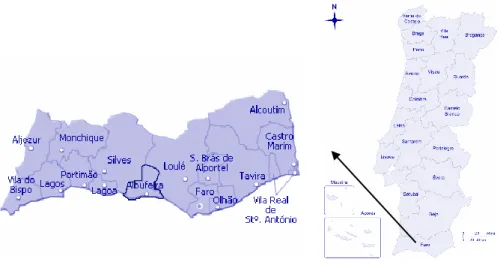
(37) Prosodic Variation declaratives and interrogatives in a cross-comparison fashion (see sections 3.3 and 4.2, respectively, for further details). In line with Cintra’s research, several Atlases focusing on lexicography have being developed since 1970: ALEPG (Saramago coord., 1992-), ALLP (Vitorino coord., 1989-), ALEAç (Saramago coord., 1994-). These materials were then transcribed and annotated for syntactic purposes, and released as a syntax-oriented corpus – CORDIAL-SIN (Martins et al. 2000-). The knowledge of both morphological and syntactic variation in EP have benefited from the use of these resources, namely, Carrilho, Magro & Pereira (2004) developed a morphologic and syntactic annotation of dialectal corpora; Carrilho (2005) observed the expletive ‘ele’ in Portuguese dialects; Lobo (2001, 2003) analyzed adverbial clauses. Based on previous studies describing a geographical distribution of some non-standard syntactic structures (Martins 2003, Pereira 2003, Magro 2007, Lobo 2008, inter alia), Carrilho & Pereira (2011) propose isoglosses for each non-standard syntactic structure. The authors conclude that the geographical distribution of these syntactic structures matches the dialectal areas determined on the basis of phonetic and phonological phenomena (Cintra 1971, Segura & Saramago 2001). For example, gerunds mainly occur in the Interior Centre and South, which corresponds to the geographic area under analysis in the present research. 2.2.2. Prosodic variation In this section, we describe the contribution of prosody to the knowledge of variation in EP. Viana (1987) is known to be the first study to look at intonation in Standard EP, providing a phonological description with phonetic details as evidence. Frota (1993) is the first approach to phonological constituents above the Prosodic Word, providing segmental, durational and intonational evidence for phrasing in EP. This research was developed in Frota (1995), which gives a detailed analysis of sandhi phenomena as a cue for prosodic constituency. The author’s proposals are discussed in subsequent studies (Falé 1995, Vigário 1995). Frota (1998/2000) provides a detailed analysis of prosodic phrasing and intonation on the basis of the comparison between broad and narrow focus utterances. The author further applies the AM model to the study of EP intonation, focusing on tonal association, target alignment and scaling (Frota 2002a, 2002b, 2003). Importantly, all these studies were based on the Standard variety of EP (Lisbon). The first discussion of dialectal variation in EP intonation appears in Vigário & Frota (2003), thus being a fairly recent topic of research. Vigário & Frota (2003) and Frota & Vigário (2007) have compared the Standard variety of EP (SEP) to the Northern variety (NEP), spoken in the region of Braga. These authors have 9.
(38) Prosodic variation in EP: phrasing, intonation and rhythm in central-southern varieties. studied prosodic phrasing, pitch accents and nuclear contour types and pitch accent distribution in these two EP varieties. Since these prosodic aspects are also examined in the central-southern varieties described in this thesis, in the following paragraphs only general information is provided. Thus, introductory sections of chapters 3, 4 and 5 are mandatory for detailed information about previous research on prosodic phrasing, intonation and rhythm across Portuguese varieties. Vigário & Frota (2003) show that SEP and NEP contrast with respect to prosodic phrasing. In SEP declaratives usually correspond to a single Intonational Phrase (IP), except for long subjects (more than 8 syllables long), which correspond to an IP apart from the verb and the object, both grouped together in the same IP – (S)(VO). In NEP, subject, verb and object are usually grouped into two IPs (S)(VO), independently of the subject’s length (Frota & Vigário 2007). Intonationally, the declarative is produced in SEP with a falling nuclear contour (H+L*), while in NEP the nuclear Prosodic Word is produced with a low pitch, followed by a low boundary tone (L* L%). This contour is also used in this variety to produce a wh-question. In SEP, the same nuclear configuration (H+L* L%) can also be found in both declaratives and wh-questions. Yes-no questions are produced in SEP with the nuclear configuration H+L* LH%. By contrast, in NEP, yes-no questions are realized with a low nuclear syllable (L*), followed by a complex falling boundary tone (HL%). As a general observation, Vigário & Frota (2003) show that NEP mainly presents less complex pitch accents types than SEP. To summarize, by comparing these two varieties, the authors conclude that they differ from each other in the four aspects mentioned by Ladd (1996/2008) as domains of intonational variation across languages: (i) systemic – SEP and NEP show different nuclear accents in declaratives and wh-questions (H+L* in SEP vs L* in NEP), and different nuclear contours in yes-no questions (H+L* LH% in SEP vs L* HL% in NEP); (ii) realizational – the alignment of the nuclear L target is later in NEP; (iii) distributional – SEP is characterized by a sparse pitch accent distribution inside the Intonational Phrase (IP), whereas NEP shows a higher tonal density; (iv) semantic – the contour H+L* L% may express a yes-no question in NEP and a declarative in SEP. Studies of rhythmic variation within Portuguese have only examined SEP and Brazilian Portuguese (BP, from São Paulo) in a comparative fashion. Frota & Vigário (2001) have analyzed the rhythm in EP (SEP) and BP, by using the following acoustic measures: %V (duration of vocalic intervals within the IP), ΔC (variability of the duration of consonantal intervals within the IP), and the suggested normalized measures of the variability of intervals 10.
(39) Prosodic Variation (Δ%V and Δ%C). Following Dasher & Bolinger (1982) and Dauer (1983), Frota & Vigário (2001) also explore the relation between these acoustic measures and the phonologic properties of each Portuguese variety. They concluded that %V and Δ%C successfully distinguished between SEP and BP, in accordance with the known phonological properties that set the two varieties apart: vowel reduction in SEP and vowel epenthesis in BP. A crosslanguage comparison with the eight languages studied by Ramus, Nespor & Mehler (1999) showed that SEP clusters with stress-timed languages in the ΔC dimension and with syllabletimed languages in the %V dimension, while BP clusters with syllable-timed languages in the ΔC dimension and is closer to mora-timed languages in the %V dimension (see Chapter 5, section 5.3, for further details). Perception experiments were also run, showing that adult participants were able to discriminate EP from BP (Experiment 1) on the basis of filtered sentences, but only when intonation is preserved. When contrasted with Dutch (Experiment 2), EP and BP are no longer discriminated (Frota, Vigário & Martins 2002a, b). Since phrasing, intonation and rhythm are unexplored in central-southern varieties, and considering our goal of adding knowledge to the current understanding of properties and limits of variation within and across languages, we decided to analyze central-southern varieties on the basis of similar corpora and methods previously used for Standard and Northern varieties. The general methodology applied in the current research is described in the following section.. 2.3. General methodology This chapter concludes with a description of the general methodology used in the thesis, including the selection of the sample (section 2.3.1), the tasks associated to different speech styles (2.3.2), and general procedures applied to the data collection (2.3.3). The main annotation criteria are presented in section 2.3.4. Further details on each corpus and particular procedures used for the analysis of each of the three prosodic aspects studied (phrasing intonation and rhythm) are given in chapters 3 to 5. 2.3.1. Sample Considering the current scenario of studies on prosodic variation in Portuguese we described above, and given that no varieties from the South had been studied, we decided to analyze two regions from the Interior Centre and South group. Although belonging to the same global variety (central-couthern variety - Cintra 1971, Segura & Saramago 2001), the two selected geographical points are located at the extreme south in order to ensure the maximal distance from Lisbon. In this sense, and also considering the geographical coverage 11.
(40) Prosodic variation in EP: phrasing, intonation and rhythm in central-southern varieties. of InAPoP2, we selected two urban areas3 – Castro Verde (Figure 2), from Beja district (Ale), and Albufeira (Figure 3), from Faro district (Alg). The choice of urban areas also matches the criteria determined for all the Romance intonation atlases.. Figure 2 – Detail of the Beja district. The selected region for analysis is surrounded by a dark blue line.. Figure 3 – Detail of the Faro district. The selected region for analysis is surrounded by a dark blue line.. 2. The InAPoP Project covers two geographical points per district: one urban area and one rural area. The. choice of the exact points to be covered was not arbitrary. Based on a comparison between the ALEPG and CORDIAL-SIN Atlases, the common geographical points to the lexicographic Atlas and the syntactic Atlas were considered for the selection of the points to be covered from a prosodic point of view within InAPoP. After that, a classification of these points as being urban or rural was judiciously made on the basis of statistical data available at INE (see Footnote 3). Finally, for the districts barely covered, we decided to add a third point. This is the case for Beja and Faro districts, initially covered in their extreme latitudinal areas. For the geographical distribution to become more homogeneous, one urban area was added to each district, in its centre-south. 3. The classification of geographical points as urban or rural was established on the basis of statistical data. available at the National Institut for Statistics (INE).. 12.
(41) Prosodic Variation We have also collected data from SEP (Lisbon), in order to allow for a full cross-comparison analysis between the two regions from central-southern varieties and the standard variety. In each region, we collect speech data from 6 female speakers, organized into two age groups, according to the InAPoP criteria (Frota & Cruz, coords., 2012-2014): 20-45 and 60 or more years of age. Speakers from the youngest age group may have a variable level of education (from high-school to university) while the eldest should be alphabetized, in order to perform the reading task. When speakers are not illiterate but they do not have good performance (i.e. they are not fluent) in the reading task, only the Interview is considered for analysis (see section 2.3.2 below). All participants are native speakers of the variety spoken in each region. Each participant must give her consent to the processing of personal data, her voice and image included. In this sense, all participants must complete and sign both a personal information form and a consent form, giving their permission to make their data available for scientific purposes. 2.3.2. Tasks Within the InAPoP project, four types of task were considered: Interview, Map Task, Discourse Completion Task, and Reading. In the following sections, the main procedures involved in data collection for each task are described (see also Frota & Cruz, coords., 20122014, under Methodology). 2.3.2.1. Interview In the Interview, participants had to talk about themselves (their infancy/youth, their occupation, their family, traditional aspects of the local where they live, etc.). The researcher should have a minor participation during the 10 minutes of conversation (circa 1600 words per Interview). This task is particularly useful to obtain spontaneous data; however, it is not controlled enough to allow for a comparison of all prosodic aspects across speech styles and/or across varieties. 2.3.2.2. Map Task The Map Task is a cooperation task performed by two subjects – the follower and the giver. Both participants have a map of an imaginary town, with buildings, gardens and other elements, corresponding to specific named places. The giver’s map has a route marked on it and the follower’s map is slightly different from the giver’s: it does not have the route and it. 13.
Imagem
![Figure 16 – Paragoge occurrence depending on the segmental preceding contexts: known ([ ], /l/, [ ], [ ]) versus new ([a], [ ], [ ], [ ])](https://thumb-eu.123doks.com/thumbv2/123dok_br/15463685.1031793/68.892.206.649.197.449/figure-paragoge-occurrence-depending-segmental-preceding-contexts-versus.webp)
+7

Documentos relacionados