UNIVERSIDADE DE LISBOA
FACULDADE DE CIÊNCIAS
DEPARTAMENTO DE BIOLOGIA VEGETAL
Role of long non-coding RNAs in parasite differentiation
Mestrado em Biologia Molecular e Genética
Fábio Pereira Bento
Dissertação orientada por:
Doutora Luisa Miranda Figueiredo (Instituto de Medicina Molecular, Faculdade de
Medicina, Universidade de Lisboa) e Prof. Doutor Jorge Marques da Silva (Faculdade de
Acknowledgments
Em primeiro lugar, obrigado Luísa. Muito obrigado por toda a dedicação e paciência em todos os momentos desde que cheguei ao teu grupo. Agradeço-te pela chefe que és, por tudo o que me ensinaste, por me motivares e estimulares a ter opinião e a ser critico e me fazeres crescer como cientista. Obrigado por fazeres deste grupo uma família única, que me fez crescer não só como cientista mas também como pessoa. Foi um privilégio aprender contigo.
Agradeço ao Professor Jorge Marques da Silva pela disponibilidade ao longo do ano.
Muito obrigado Fabien, foste mais que um coorientador ao longo deste ano e desta tese. Foste incansável e o teu pupilo (ou “pupilho”, seja lá a forma como o dizes) está eternamente grato por todo o teu apoio, dedicação e por tudo o que me ensinaste. Tornaste este projecto possível.
Obrigado a todos os elementos do laboratório que me acolheram e me fizeram sentir em casa, sempre disponíveis em todos os momentos. Obrigado Pena pela disponibilidade e sugestões, sem ti o laboratório é demasiado calmo. Leonor, agradeço-te por todo o apoio, mesmo depois de partir tanta coisa. Obrigado Helena e Daniel pela disponibilidade e ajuda naquilo que só vocês sabem fazer. Sandra agradeço-te pelas amostras de sangue e por todo o apoio. Obrigado Xico por toda a ajuda e disponibilidade sempre que precisei. Obrigado Idálio por todo o apoio e paciência com todas as perguntas que te fazia. Obrigado Margarida por todas as opiniões e sugestões. Filipa, a ti tenho que agradecer não só pelo apoio, mas também pela secretária e pelo ecrã extra (devo dizer que agora estou mal habituado). Agradeço ao mais recente elemento do grupo João (Johnny), também meu colega de curso. Obrigado ao João, Miguel, Eleonora e Jessica por toda a disponibilidade e ajuda.
Obrigado aos nossos vizinhos do MPrudêncio Lab que tornam ambiente no laboratório ainda mais único, especialmente à Carolina e à Marta por todo o apoio.
Agradeço a todos os meus colegas de curso com que me cruzei, especialmente ao Bruno e ao Jota por todas as conversas e todos os momentos únicos. Sem vocês o curso não era a mesma coisa.
Obrigado Vitor, Silvana e Raquel, com quem partilho a casa há 5 anos e me acompanharam ao longo de todo o meu percurso académico.
Agradeço a todos os meu amigos que estiveram lá sempre dispostos a apoiar-me (mesmo quando estavam fartos de me ouvir a falar de trabalho). Não vou listar nomes que vocês sabem quem são.
Quero dedicar todo este trabalho à minha família, a quem eu devo tudo na vida. Um obrigado muito especial aos meus pais que estiveram sempre presentes e com grande esforço e sacrifício tornaram tudo possível e fizeram de mim quem sou hoje. Estou eternamente grato por tudo. Obrigado.
Abstract
Trypanosoma brucei (T. brucei) is the parasite that causes African Human Trypanosomiasis (HAT), also known as sleeping sickness. During its complex life cycle, the parasite alternates between two different hosts, the insect vector and the mammalian host. To adapt and survive in these different environments, the parasite undergoes multiple developmental changes that require coordinated alterations in gene expression. In T. brucei, transcription control of protein-coding genes is scarce and most gene regulation depends on a post-transcriptional regulation. Slender-to-stumpy transition is triggered by an unknown stumpy induction factor (SIF) molecule, which parasites released via quorum-sensing mechanism. Recently, positive regulators of the quorum-sensing pathway have been identified in T. brucei, including an essential protein phosphate 1 (PP1) and stumpy-promoting RNA binding protein (RBP7). Long non-coding RNAs (lncRNAs) are RNAs with more than 200bp that do not encode for protein. In many organisms, lncRNA play important roles in gene regulation, including at post-transcriptional level. Although, our laboratory has recently revealed existence of 946 lncRNA genes in the T. brucei genome, yet any function has been found. We hypothesized lncRNA to control and coordinate gene expression during stumpy formation in T. brucei. The aim of my thesis was to identify lncRNAs that regulate the slender-to-stumpy transition. To that end, we established a reporter cell line, an in vitro culture condition and a gain- and loss-of-function approach to study the function of T. brucei lncRNAs in stumpy differentation. We performed a bioinformatic analysis and selected four lncRNAs based on their genomic location, postulating these lncRNAs to regulate stumpy formation by modulating the expression of their nearby stumpy essential genes. After performing a phenotypic screen for stumpy formation and more detailed experiments, we identified one lncRNA that regulate the slender to stumpy transition of T. brucei. Indeed, while the overexpression of lncRNA5837 promotes stumpy formation, its depletion conversely prevents slender to stumpy transition. Interestingly, the overexpression of lncRNA5837 induces stumpy formation even in absence of external stimulus that promotes parasite differentiation. As a consequence, we identified a new positive regulator of stumpy differentiation in T. brucei.
Finally, using RNA FISH experiment, we observed that lncRNA5837 localized mainly in the nucleus of T. brucei. Strikingly, the slender to stumpy transition is associated with a relocalization of lncRNA5837 from the nucleoplasm into the nucleolus of stumpy forms. Altogether, these results suggest that lncRNA5837 regulate the slender-to-stumpy transition through its function inside the nucleolus.
In this project, we identify and characterize the first function of a lncRNA in human deadly parasite, T. brucei. Indeed, the lncRNA5837 regulates the parasite differentiation from slender to stumpy forms, which is key process for transmission and infectivity of T. brucei parasite.
Keywords: Trypanosoma brucei; long non-coding RNA; stumpy form; differentiation;
Resumo
O Trypanosoma brucei é um organismo eucariota unicelular responsável pela Doença do Sono. O parasita pertence à ordem Kinetoplastida, caracterizada por uma estrutura que contém DNA mitocondrial designada cinetoplasto. A distribuição da doença é condicionada pela localização do vector que transmite o parasita.
A doença é caracterizada por dois estadios: no primeiro, o parasita está restrito ao sangue e ao linfa e, no segundo, o parasita atravessa a barreira hematoencefálica e invade o sistema nervoso central, causando distúrbios no ciclo do sono. Esta doença endémica da África subsariana é letal se não for tratada. Atualmente, não existe ainda uma vacina e o seu tratamento, além de dispendioso, gera efeitos secundários indesejados.
Ao longo do seu complexo ciclo de vida, o parasita alterna entre o seu hospedeiro, um mamífero, e o seu vector, a mosca tsé-tsé. Aquando da picada da mosca tsé-tsé, o parasita entra na corrente sanguínea do hospedeiro e diferencia-se em slender forms. Os parasitas slender forms reproduzem-se assexuadamente por fissão binária, estabelecendo e mantendo a infecção no hospedeiro. O parasita apresenta na sua superfície uma proteína designada glicoproteína variante de superfície (VSG). A rápida e periódica mudança da VSG, designada variação antigénica, permite ao parasita escapar do sistema imunitário do hospedeiro, o que leva a um combate pouco eficiente contra a infecção, já que o parasita consegue persistir durante anos no mesmo hospedeiro. Quando a população do parasita atinge grandes concentrações no sangue, um mecanismo de quorum-sensing permite a diferenciação de slender forms para stumpy forms. Os parasitas stumpy forms são a sua forma transmissível e pré-adaptada para sobrevivência no intestino da mosca tsé-tsé. Ao contrário dos slender forms, os stumpy forms diferenciam-se em procyclic forms, aquando da picada da mosca tsé-tsé, o que leva à transmissão do parasita para o seu vector.
T. brucei apresenta uma expressão génica pouco comum comparando com outros organismos eucariotas, uma vez que os genes estão organizados em unidades transcricionais policistrónicas (PTU) constituídas por vários genes não-relacionados funcionalmente e transcritos a partir de um promotor comum. Uma vez transcrito um RNA percussor policistrónico, o transcrito é processado em mRNA maduros monocistrónicos por reações de trans splicing e poliadenilação. À exceção dos genes de VSG, não existem evidências de regulação transcricional em T. brucei, motivo pelo qual a expressão génica é regulada ao nível pós-transcricional, particularmente por regulação da estabilidade e da tradução do mRNA. Em T. brucei, as estruturas secundárias contribuem para a estabilidade do mRNA e para o recrutamento de proteínas de ligação ao RNA (RBP). Além disso, as RBP podem ligar-se à região 3’UTR dos mRNA para regular a associação do mRNA com a maquinaria de tradução.
Os parasitas stumpy forms resultam da diferenciação irreversível dos slender forms. A transcrição e a síntese proteíca estão geralmente reprimidos em stumpy forms, reforçando o seu estado de células quiescentes. Os stumpy forms são importantes para a transmissão para o vector, bem como para a sua sobrevivência neste último. Além disso, os stumpy forms são igualmente importantes para o prolongamento da infecção no hospedeiro.
A diferenciação dos slender forms para os stumpy forms está relacionada com o aumento da densidade da população no hospedeiro. Esta diferenciação ocorre por comunicação parasita-parasita, através de um mecanismo de quorum-sensing, em que os slender forms secretam uma molécula, designada Factor de Indução de Stumpy (SIF). A molécula em causa acumula-se e estimula a diferenciação para os stumpy forms com o aumento do número de parasitas. Recentemente, foram identificados vários genes essenciais para a via de quorum-sensing, embora apenas tenham sido identificados reguladores positivos que atuam em diferentes etapas da via de sinalização de SIF, incluindo as fosfatases, as cinases e as proteínas envolvidas na regulação génica, como as RBP.
Os RNA longos não codificantes (lncRNA) são RNA com mais de 200 pares de base que não codificam proteínas. Os lncRNA atuam, em diferentes organismos de todos os reinos da vida, como reguladores de expressão génica, através da regulação da transcrição, da estabilidade de mRNA ou da eficiência da tradução, entre outros. Os lncRNA podem atuar in cis ou in trans, assim como em vários compartimentos celulares, nomeadamente no núcleo ou no citoplasma, para regular a expressão génica e a função. Recentemente, foram identificados, em T. brucei, 946 lncRNA, dos quais 567 foram identificados em apenas um estadio do ciclo de vida do parasita, sugerindo, assim, a existência de lncRNA específicos de um estadio. O objetivo desta tese é identificar e caracterizar o papel dos lncRNA na diferenciação dos slender forms para stumpy forms.
Para estudar a diferenciação para os stumpy forms, é necessário estabelecer uma linha celular que os assinale. Para tal, foram criados parasitas que expressam GFP especificamente em stumpy forms, devido ao 3’UTR de PAD1, uma proteína marcadora de stumpy forms, cujo 3’UTR permite a expressão génica específica em stumpy forms. Esta linha celular, designada GP1, foi caracterizada usando dois métodos para a formação de stumpy forms in vitro: meio complementado com metilcelulose e meio complementado com pCPT-cAMP, sendo o número de células na fase G1 foi relacionado com o número de células que expressam GFP. Os parasitas cultivados em meio com metilcelulose e/ou com pCPT-cAMP no final de dois ou três dias apresentam uma acumulação de células na fase G1, característica dos stumpy forms. A linha celular GP1 apenas expressa GFP quando a diferenciação dos stumpy forms é induzida, quer in vitro (meio complementado com metilcelulose e/ou pCPT-cAMP) quer in vivo (sangue recolhido seis dias após a infeção, quando a maioria dos parasitas são stumpy forms). Tal facto confirma que a GP1 é uma
linha celular marcadora de stumpy forms que pode ser usada para estudar a diferenciação destes.
Para selecionar lncRNA potencialmente envolvidos na formação dos stumpy forms, selecionámos lncRNA a jusante e a montante de nove genes essenciais para a formação de stumpy forms, que apresentaram resistência ao SIF in vivo. Assim, propomos que estes lncRNA regulam a expressão e/ou função dos genes essenciais para a formação de stumpy forms, identificando quatro lncRNA localizados imediatamente a jusante ou a montante de três dos nove genes essenciais para formação de stumpy forms. O lncRNA5388 e o lncRNA5389 estão localizados a montante da família de genes NEK, enquanto o lncRNA5837 está localizado a jusante da família de genes RBP7. Por último, o lncRNA6099 está localizado a jusante do gene YAK.
Para caracterizar os lncRNA na diferenciação dos stumpy forms, os lncRNA foram quantificados durante a formação de stumpy forms in vitro. Os níveis de transcritos de lncRNA não apresentaram alterações significativas durante a diferenciação para stumpy forms. Para testar a possibilidade de uma função dos lncRNA selecionados ao nível da formação de stumpy forms, determinámos o fenótipo na diferenciação para stumpy forms causado pela depleção ou sobre-expressão dos lncRNA. Contudo, as experiências apresentaram grande variabilidade e inconsistência, tornando-se difícil interpretar e concluir a função dos lncRNA na diferenciação dos stumpy forms.
Assim, a continuação do estudo incidiu apenas no lncRNA5837, visto que é o lncRNA localizado a jusante de genes essenciais para a diferenciação dos stumpy forms, assim como para a regulação génica, a família génica RBP7. Além disso, este lncRNA apresenta um perfil de expressão semelhante ao RBP7 durante a diferenciação para stumpy forms.
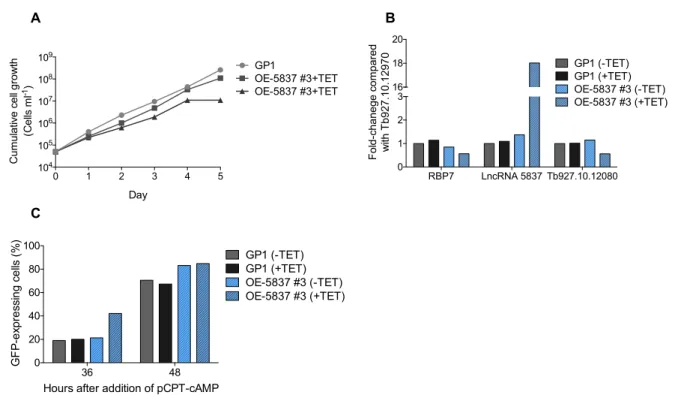
Durante a diferenciação in vitro para stumpy forms, a sobre-expressão de lncRNA5837, tal como a sobre-expressão de RBP7, resultou no aumento de células que expressam GFP, sugerindo isso que há promoção da diferenciação de stumpy forms. Por outo lado, a depleção de lncRNA5837, tal como a depleção de PP1, levou a que menos parasitas se diferenciarem para stumpy forms. Em condições que impedem a formação de stumpy forms, a sobre-expressão de lncRNA5837 é suficiente para induzir os slender forms a se diferenciarem em stumpy forms. Estes resultados são consistentes com o facto de a sobre-expressão de lncRNA5837 levar a uma diminuição da taxa de crescimento dos parasitas, característico da formação de stumpy forms, parasitas em fase G1.
A localização celular do lncRNA5837 foi determinada usando RNA FISH. O lncRNA5837 está localizado no núcleo de T. brucei. Em slender forms, é possível observar diversos sinais de lncRNA5837 no núcleo, um sinal mais intenso no nucléolo e um sinal (por vezes, dois) no nucleoplasma. No entanto, os stumpy forms apresentam apenas lncRNA5837 no nucléolo, ainda que aparentemente mais intenso.
Em suma, estes resultados sugerem que o lncRNA5837 atua na diferenciação para stumpy forms, através da sua função expressa no nucléolo de T. brucei.
Abbreviations
3’UTR – 3’ untranslated region 5’UTR – 5’ untranslated region BSF – bloodstream form bp – base pair
CCA – cis-aconitate
cDNA – complementary DNA CDS – coding sequence
DAPI – 4’,6-diamidino-2-phenylindole DCL – Dicer-like enzyme
DNase I – deoxyribonuclease I ESB – expression site body
FISH – fluorescence in situ hybridization G1 – gap1 phase of cell cycle
G2 – gap2 phase of cell cycle GFP – green fluorescence protein HAT – Human African Trypanosomiasis HMI-11 – Hirumi’s modified Iscove’s
medium 11
Kb – kilobase
lncRNA – long non-coding RNA M – mitosis phase of cell cycle
MAPK5 – mitogen-activated protein
kinase 5
mRNA – menssenger RNA ncRNA – non-coding RNA NLS – nuclear localization signal nt – nucleotide
OE-5388 – mutant that overexpress
lncRNA5388
OE-5389 – mutant that overexpress
lncRNA5389
OE-5837 – mutant that overexpress
lncRNA5837
OE-6099 – mutant that overexpress
lncRNA6099
PAD – Protein Associated with Differentiation
pCPT-cAMP –
8-(4-chlorophenylthio)-cAMP
PCR – polymerase chain reaction PCF – procyclic form
PI – propidium iodide Pol I – RNA polymerase I Pol II – RNA polymerase II Poly A - polyadenylated PP1 – phosphatase protein 1 PTU – polycistronic unit
qPCR – quantitative real-time PCR RBP – RNA binding protein
rDNA – ribosomal DNA RNA-seq – RNA sequencing RNAi – RNA interference
RNAi-5388 – mutant that knock-down
lncRNA5388
RNAi-5389 – mutant that knock-down
lncRNA5389
RNAi-5837 – mutant that knock-down
lncRNA5837
RNAi-6099 – mutant that knock-down
lncRNA6099
RNase A – ribonucelase A RNase H – ribonuclease H
RPKM – reads per kilobase per million
mapped reads
rRNA – ribosomal RNA
S – synthesis phase of cell cycle s.e.m – standard error of the mean seq – sequencing
SILAC – Stable Isotope Labeling of Amino
Acids
siRNA – small-interfering RNA SL – splice leader
TET – tetracycline
TOR4 –target of rapamycin kinase 4 tRNA – transfer RNA
VSG – variant surface glycoprotein ZFK – zinc finger kinase
Table of Contents
ABSTRACT ... IIIRESUMO ... V
ABBREVIATIONS ... IX
INTRODUCTION ... 1
TRYPANOSOMA BRUCEI ... 1
T. brucei life cycle ... 1
Gene expression in T. brucei ... 2
Stumpy differentiation ... 4
LONG NON-CODING RNA ... 8
Non-coding RNAs in trypanosomes ... 9
OBJECTIVES ... 10
METHODS ... 11
RESULTS AND DISCUSSION ... 14
CREATION OF A PLEOMORPHIC REPORTER CELL LINE FOR ANALYSIS OF STUMPY FORMATION ... 14
IN VITRO STUMPY FORMATION ASSAYS AND CHARACTERIZATION OF THE STUMPY-REPORTER CELL LINE ... 14
BIOINFORMATIC IDENTIFICATION OF CANDIDATE LNCRNAS IMPORTANT FOR SLENDER TO STUMPY TRANSITION ... 17
EXPRESSION PROFILE OF THE FOUR CANDIDATE LNCRNAS DURING STUMPY FORMATION ... 18
PHENOTYPIC SCREEN TO STUDY LNCRNA FUNCTION IN SLENDER TO STUMPY TRANSITION ... 19
ROLE OF LNCRNA5837 IN STUMPY FORMATION ... 21
GAIN- AND LOSS-OF-FUNCTION OF LNCRNA5837 ... 22
LNCRNA5837 SUBCELLULAR LOCALIZATION ... 25
CONCLUSION AND FUTURE WORK ... 28
ANNEXES ... 30
REFERENCES ... 34
INTRODUCTION
T
RYPANOSOMA BRUCEITrypanosoma brucei (T. brucei) is a protozoan parasite that causes N’gana in cattle and the fatal human disease, Human African trypanosomiasis (HAT), also known as sleeping sickness. This unicellular parasite is a member of the order Kinetoplastida, characterized by their mitochondrial DNA that forms a structure named kinetoplast. T. brucei brucei (T. brucei from here on) infects only livestock, while T. brucei gambiense and T. brucei rhodesiense, both causing sleeping sickness. Although 97% of cases of HAT are caused by T. brucei gambiense, T. brucei rhodesiense causes a more severe and acute illness. The distribution of the disease is governed by the distribution of the tsetse fly, the blood-feeding dipteran vector (Glossina spp.) that transmits the parasite1.
The disease is characterized by a two stages progression: trypanosomes start to be restricted to the blood and lymph and, in a second stage, trypanosomes cross the blood-brain barrier to invade the central nervous system (CNS) (Fig. 1C), causing disturbance in sleep cycle, which gives the disease its name. Untreated patients can progress to a coma and organ failure, leading to death. Currently, a vaccine is not available and drugs for early-stage or late-early-stage are unavailable orally, frequently toxic and sometimes ineffective2.
T. brucei life cycle
T. brucei parasite has a complex and sophisticated life cycle in two different hosts: a mammal and an insect vector, the Tsetse (Fig. 1).
After a bite of the tsetse fly, the growth-arrested metacyclic trypomastigotes parasites enter in the bloodstream of the mammal host. In the blood, the metacyclic forms differentiate quickly into long, slender trypomastigotes. Slender trypomastigotes reproduce asexually dividing by binary fission, thus establishing and maintaining a bloodstream infection. In the mammalian host, T. brucei evades the host immune system through a mechanism known as antigenic variation, which consists of periodic and rapid changes of the surface coat made of variant surface glycoproteins (VSGs)3. When the parasite population reaches high concentration in the blood, a quorum sensing-like mechanism elicits the differentiation of long slender forms into short stumpy forms, which are irreversibly arrested in their cell cycle.
Stumpy forms are the transmissible form pre-adapted for survival in the midgut of the tsetse vector. Stumpy forms, unlike slender forms that are rapidly killed in tsetse midgut, differentiate to a proliferative procyclic forms (PCF). At this stage the dense VSG coat is replaced by another dense coat of procyclins. Procyclic trypomastigotes initiate a long migration inside the tsetse host from the midgut to the salivary glands (blue line, Fig. 1B). Along the way, procyclic trypomastigotes undergo complex developmental changes and
divide asymmetrically to give rise to one long and one short epimastigote forms. Short epimastigote attaches to epithelial cells following arrival in the salivary glands. Attached epimastigotes are proliferative forms and differentiate into the non-dividing metacyclic trypomastigote to complete the cycle. Metacyclic trypomastigote expresses de novo the VSG coat and therefore are infective for a new mammalian host 4.
Figure 1: T. bucei life cycle. (a) The parasite during his life cycle faces many different environments: enters in the blood of mammalian host by a bite of the tsetse fly, pass to the midgut of the vector in a tsetse blood meal, and then migrate to the salivary glands of tsetse fly to enter in a new mammalian host. (b) Parasite movement inside the tsetse fly. The blue line represents the migration route of procyclic form from the midgut to the salivary gland and the red line indicates the migration route from the salivary gland to the mouthparts. (c) Parasites move out of blood vessels, penetrating the blood-brain barrier to enter the CNS. Adapted from Langousis et al., 20145.
Gene expression in T. brucei
T. brucei genome contains 26Mbp and is divided into 11 large, 3-5 intermediate and 100 mini-chromosomes. Genome architecture of trypanosomes is unusual compared with other eukaryotic cells in which genes are arranged polycistronic transcription units (PTUs)6, long arrays of genes that are transcribed via a common and unique promoter.
Transcription and mRNA processing
Transcription of protein-coding genes in T. brucei differs from other eukaryotes, due to its unusual genome organization. Indeed, once long polycistronic precursor RNA (pre-RNA) is transcribed, the transcript is immediately processed into small mature mRNAs. Pre-RNAs are processed into mature monocistronic mRNAs by trans splicing reaction, which adds a 39 nucleotide spliced leader sequence to the 5’ end, downstream of a pyrimidine rich motif, and
polyadenylation of the 3’ end. Polyadenylation is coupled to the addition of cap 5’ of the downstream ORF7,8.
T. brucei is also the only known eukaryote with a multifunctional RNA polymerase (pol) I which synthesizes both ribosomal and mRNA. Pol I transcribes mRNAs encoding the proteins that cover the surface of the parasite, such as the VSG and procyclin coats9.
Genes within a PTU are most often not functionally related. Except VSG and procyclin genes transcribed by Pol I9, there is no evidence of transcription regulation in T. bucei. Hence, gene expression is controlled at a post-transcriptional level10.
Post-transcriptional control of gene expression
Genome-wide analysis of mRNA abundance between T. brucei life stages shows that parasite differentiation is associated with large changes in gene expression11–15. Notably, it has been recently shown that 40% of the protein-coding gene transcripts are significantly regulated between mammalian and insect stages of T. brucei16. Moreover, a recent proteomic study using stable isotope labeling of amino acids (SILAC) has shown that 45% of T. brucei proteins change in abundance during parasite development17. Surprisingly, only a moderate correlation was found between the transcriptome and the proteome17,18, suggesting the importance of post-transcriptional and translational mechanisms to control protein levels in T. brucei. Hence, in T. brucei, absence of transcriptional control leads to constitutive gene expression10, which are regulated at a post-transcriptional level, notably by mRNA stability and translational control.
mRNA stability and translational control
In metazoan, mRNA stability is controlled by the action of microRNAs and RNA binding proteins (RBPs). In trypanosomes, mRNA turnover results mainly from the balance between RNA degradation (1) and mRNA stabilization by RBPs (2).
(1)T. brucei has two main pathways for mRNA degradation. The first pathway is initiated by deadenylation and then decapping resulting in 5’-3’ exonuclease activity by a cytoplasmic exonuclease, XRNA, and 3’-5’ degradation by a exonuclease complex, the exosome10. The second pathway involves degradation of highly unstable mRNAs dependent on XRNA, without the requirement for deadenylation19,20.
(2) Secondary structures in 3’UTRs (3’ untranslated region) contribute to mRNA stability and recruitment of RBPs. 3’UTR regulatory elements are binding sites for trans-acting RNA binding proteins to regulate mRNA stability.
Besides mRNA turnover, gene expression is controlled at translational level. In addition to regulate mRNA stability, RBPs can bind to 3’UTR of RNA to control association of the mRNA with the translation machinery22,23. For example, procyclic-specific genes in T. brucei have
regulatory regions in 3’UTR that control both translation efficiency and mRNA stability, which cause procyclic-specific genes to be unstable in bloodstream forms24.
Finally, it has been demonstrated a correlation between codon usage and gene expression, suggesting that translational selection through codon bias is an important mechanism of differential gene expression in trypanosomes25
Stumpy differentiation
Stumpy forms
Stumpy forms are produced by irreversible differentiation of long proliferative slender forms1. While long and thin slender form measures on average 29 µm, stumpy forms are thick and short cells with no-free flagellum measuring about 18µm in length. Stumpy forms are cell-cycle arrested in G1/G0 and have a relatively short half-life estimated to be between 48 to 72 hours26. Stumpy forms do not switch VSG, in fact, VSG transcription in stumpy forms is suppressed below the limit of detectability27. Finally, it has been shown that transcription and protein synthesis are globally down-regulated in stumpy forms28, reinforcing their status of quiescent cell.
The slender-to-stumpy transition
The slender-to-stumpy transition is a key process for the success of T. brucei infection and transmission mainly for three reasons: (1) to control parasite growth and host survival, (2) to regulate the host immune system and to “protect” the VSG repertoire of parasite and (3) to enable parasite transmission and infection inside the insect vector.
(1) To control parasite growth and host survival
Stumpy formation relies on a cell-density dependent mechanism. When the number of resident proliferating slender rise above a certain threshold, parasites sense their density and irreversibly differentiate into stumpy forms. At this time of infection, parasitaemia irremediably decrease as newly formed stumpy parasites are non-diving and non-differentiated slender parasites are eliminated by the host immune system through an antibody response against VSG antigen. However, residual slender forms that underwent antigenic variation will be able to escape the host immune response, proliferate and rise up once again the parasitaemia. Thus, the balance of slender and stumpy forms ensures the chronicity of T. brucei bloodstream infection, which is characterized by successive waves of parasitaemia. In contrast, a laboratory adapted cell line of T. brucei, called monomorphic strain, has lost the ability to form stumpy forms in response to cell-density. As consequence, mouse infection
with a monomorphic strain results in a uncontrolled parasite proliferation and consequent rapid death of the host29.
Therefore, equilibrium between slender and stumpy forms within mammalian blood is the key of success for T. brucei infection. While slender forms establish and maintain the infection, stumpy formation controls parasitaemia at a viable level for the host.
(2) To regulate host immune system and “protect” the VSG repertoire
In the chronic phase of T. brucei infection, intermediate and stumpy forms represent 73%-97% of total parasites in the blood30. As consequence, stumpy cells are reducing the overall proportion of proliferative slender forms in the mammalian blood during chronic infections. As proliferative forms are the only forms undergoing productive antigenic variation, reducing their number would decrease the overall frequency of antigenic variation events30. Therefore, antigen repertoire would be preserved, herd immunity restricted and host reinfection frequency increased1.
(3) To promote parasite transmission
Stumpy trypanosomes are pre-adapted forms for life (A), survival (B) and differentiation (C) in the tsetse midgut.
(A) Host environment changes drastically between mammalian blood and insect midgut, notably in their nutrient supplies. Unlike the mammalian blood, insect midgut is a glucose-poor and glucose-poorly oxygenated environment31. As consequence, energy production switches from glycolysis in slender form to proline metabolism in procyclic forms32. Stumpy forms are pre-adapted for metabolic changes as their mitochondria become more elaborated and ramified, developing large christae and expressing crucial enzymes for Krebs cycle, respiratory chain and oxidative phosphorylation function33,34.
(B) Stumpy forms are more robust than slender forms to the host antibody response developed during T. brucei infection. Immunoglobulin-VSG complexes formed at the parasite cell surface are endocytosed twice rapidly by stumpy than slender forms35 which promotes
stumpy survival in the blood and increase time for parasite transmission.
Unlike slender forms, stumpy parasites resist and survive to acidic and proteolytic stress encountered inside the insect vector. Hallmarks of stumpy form, parasite regulates its internal pH to counterbalance the extreme acidic environment of the tsetse midgut and retains vestige of its VSG coat after proteolytic cleavage to “escape” the innate immunity of the insect vector36.
(C) Stumpy forms are uniformly arrested in G1/G0 phase of the cell cycle, which ensures, when taken up by tsetse flies, a coordinated differentiation into procyclic forms and re-entry into the cell cycle. Hence, cell cycle arrest in stumpy form is crucial step for parasite
transmission capacity37. T. brucei respond to citrate or cis-aconitate (CCA) to initiate differentiation to procyclic forms when transmitted to the insect vector. A gene family, PAD (Protein Associated with Differentiation), encoding surface carboxylate transporters was recently identified, including PAD1 and PAD2 that were shown to be required for CCA perception38. PAD1 is expressed only in stumpy forms and PAD2 is also expressed in procyclic forms. This differential expression of PAD proteins between slender and stumpy forms ensures that only pre-adapted stumpy forms are able to perceive the differentiation signal. It was also demonstrated that PAD2 is released to cell surface only at 20°C, consistent with a previous study39 that showed a increase sensitivity to CCA at 20°C. The differential localization of PAD2 at different temperatures ensures that only stumpy cells in the insect vector are able to receive the signal.
Although little is known about the molecular mechanism behind slender to stumpy transition, this transition is a crucial step during T. brucei life cycle because it helps controlling parasitaemia, prolonging host survival and promoting efficient parasite transmission.
Quorum sensing-like mechanism for stumpy formation
The slender to stumpy transition is related with increased cell density inside the mammalian host, but can occur independently of the host40–42. This transition is proposed to operate by a parasite-parasite signaling via a quorum sensing mechanism, in that slender forms secrete a soluble, low molecular weight, heat stable factor, termed Stumpy Induction Factor (SIF), which accumulates and stimulates stumpy formation as parasite numbers increase41.
Cell permeable cAMP analogue, pCPT-cAMP, induces the formation of stumpy-like parasites. Treatment with pCPT-cAMP induces cell cycle arrest, PAD1 expression and promotes a synchronized differentiation to procyclic forms in response to CCA43. Although cells treated with this stumpy-inducing chemical do not develop a full stumpy morphology43, treatment with pCPT-cAMP is a well characterized method to study stumpy formation in vitro.
Quorum sensing signaling pathway
Several genes essential for the quorum sensing signaling pathway were recently identified using a genome-wide RNAi screening strategy44. This screen identified components that positively act at different steps of the SIF signaling pathway, including cell signaling molecules, like phosphatases and kinases, and post-transcriptional gene regulators, such as RNA binding proteins44,45.
Serine/threonine protein phosphatases of type 1 (PP1) and kinases YAK and NEK were all experimentally confirmed to be involved in in vivo stumpy formation. The authors
proposed that these phosphatases may be involved in deactivation of stumpy inhibitors. Protein kinases have been identified as major regulators of T. brucei cell cycle 46. Thus it has been proposed that NEK and YAK may induce cell cycle arrest, as it has been previously shown in other organisms45,47–49.
In trypanosomes, RNA binding proteins (RBPs) have been identified as key players in different life stages50,51 due to their role in post-transcriptional regulation. RBP7 (representing two identical genes: RBP7A and RBP7B) was the only RBP experimentally demonstrated to be necessary for stumpy differentiation. Knock-down of RBP7 promotes upregulation of histone transcripts, reflecting the presence of proliferative slender forms. When overexpressed, RBP7 increased the abundance of others RBPs and transcripts associated with procyclic forms, showing a preparation to the next life stage44. RBP7 and other hypothetical proteins, identified in a recent genome wide screen for post-transcriptional regulators identification52, should regulate genes essential for stumpy formation and differentiation to procyclic forms by post-transcriptional changes.
The RNAi strategy used in the previously mentioned study44 only allowed the identification of positive regulators of slender to stumpy transition. Earlier studies identified negative regulators of stumpy formation such as a zinc finger kinase (ZFK), MAPK5 and a TOR kinase (TOR4)53–55. In all cases, RNAi of each gene drives to stumpy formation in pleomorphic cells. Both ZFK and MAPK5 RNAi increase stumpy formation in vitro, but MAPK5 RNAi phenotype was also seen in vivo. RNAi of TOR4 triggered stumpy formation also in monomorphic cells.
Markers for the stumpy life stage
In previous studies, different markers have been used to identify stumpy forms, including morphology, mitochondrial activation (expression of NADH dehydrogenase and dihydrolipoamide dehydrogenase), disappearance of the small subunit of ribonucleotide reductase, inhibition of growth and DNA synthesis, cell-cycle arrest in G1/G0 phase and the kinetics of transformation to procyclic forms42,56,57. However these methods are not ideal, some of the assays are subjective and time consuming or require population assays, rather than analysis of individual cells. Recently, PAD proteins were identified as transducers of the CCA differentiation signal. These proteins can act as a molecular marker for stumpy formation and a functional marker for transmission38. PAD1 is up-regulated at protein and mRNA levels in stumpy forms13,38. PAD1 mRNA start to be detected in intermediate forms30,43, but protein levels has a more stringent control and protein expression is only found in stumpy forms38. PAD1 3’UTR is sufficient to control stumpy-specific gene expression. This has allowed the creation of a PAD1::GFP reporter strain in which GFP gene is under the control of a PAD1 3’UTR. GFP fluoresces only in stumpy forms43.
Although, in trypanosomes, RBPs have been described as key players in the parasite life stages and important for mRNA stability and translation21,50,51, no miRNAs or other non-coding RNA have been shown to be involved in developmental regulation of trypanosomes. As described in more detail below, the hypothesis of this thesis was that lncRNAs may be involved in T. brucei differentiation from slender to stumpy forms.
L
ONG NON-
CODINGRNA
One of the most surprising discoveries from the last decade has certainly been the finding that the vast majority of eukaryotic genome is transcribed into non-coding RNAs (ncRNAs). Indeed, it is now clear that organism complexity cannot be explained by the number of protein-coding genes that genomes encode, but in its non-coding component.
The most prominent examples of non-coding RNAs are transfer RNA (tRNA) and ribosomal RNA (rRNA), which are both crucial players in mRNA translation process. More recently, a new class of non-coding RNA has been identified as long ncRNAs (lncRNAs). The most common definition of lncRNAs refers to a transcript >200bp in length and that does not encode information for proteins.
LncRNAs can be classified based on their genomic location or/and their transcription orientation with respect to the nearest protein-coding genes: (1) sense or antisense, located on the same or opposite strand of the nearest protein-coding genes; (2) intronic or intergenic, located inside an intron of protein-coding gene or in the region between two protein-coding genes; (3) divergent or convergent, transcribed in divergent or convergent orientation as the nearest protein-coding genes 58,59.
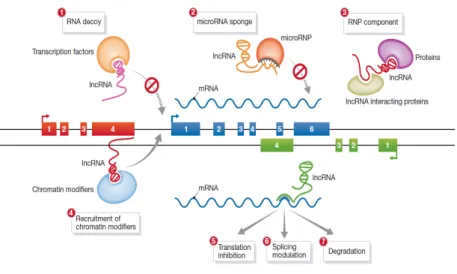
LncRNAs have emerged as master regulators of gene expression in all kingdoms of life, by controlling transcription, mRNA stability or translation efficiency60 (Fig. 2). For example, the lncRNA BACE1AS (BACE1 antisense RNA) increase the stability of its sense mRNA by inhibition of microRNA (miRNA) function. BACE1AS and BACE1 (beta-site APP-cleaving enzyme 1) mRNA form an RNA-RNA duplex, which mask miRNA-binding sites on BACE1 mRNA and prevents its degradation by miRNA-inducing silencing “pathway”61.
LncRNAs can act in cis and in trans as well as within various cell compartments such as the nucleus and the cytoplasm, to regulate gene expression and function62,63. Promoter-associated RNA (pRNA) is a well-studied cis-acting nuclear lncRNA which regulates the expression of ribosomal genes in many eukaryotic cells. pRNA is 250-300 nucleotide transcript originating from the intergenic spacer region of rDNA gene units. pRNA recruits enzymes for heterochromatin formation and mediates transcription silencing of the downstream rRNA gene unit through a cis mechanism64.
Figure 2: Mechanisms of lncRNA function. Studies have described several mechanisms by which lncRNAs regulate their targets: (1) lncRNAs can act as RNA decoys and prevent transcription factors to bind to their DNA targets; (2) at a post-transcriptional level, lncRNAs can act as miRNA sponges that prevent miRNA complexes to degradate their mRNA targets; (3) lncRNAs seem to interact with other proteins, acting as scaffolds of ribonucleoprotein complexes; (4) recruitment of chromatin-modifying complexes of DNA targets is a well characterized function of several lncRNAs; a few lncRNAs seem to act directly at their mRNA targets, including in translation (5), splicing (6) and degradation (7). Adapted from Hu et al., 201265.
Although lncRNAs are not unstable, their half-life are usually shorter than protein-coding RNAs66. Nuclear-localized lncRNAs are less stable than lncRNAs localized in the cytoplasm, suggesting that stability depends on the cellular localization of lncRNAs, rather than on their genomic classification66. The low stability of nuclear-localized lncRNAs is consistent with the model that these lncRNAs act as regulatory molecules, which require a rapid turned over to regulate dynamically gene expression.
LncRNAs are versatile and multifunctional molecules that regulate a myriad of cellular functions from gene expression60 to more complex biological processes such as cell differentiation67.
Non-coding RNAs in trypanosomes
Small non-coding RNAs such as small-interfering RNA (siRNA) have been identified in T. brucei and originated mainly from long double-stranded RNAs from the retroposons INGI and SLACS and from the CIR147 family of satellite-like repeats68,69. The parasite has a functional RNA interference (RNAi) pathway that relies on one single Argonaute protein and two distinct dicer-like enzymes (DCL). Surprisingly, T. brucei has compartmentalized its RNAi pathway between the nucleus and cytoplasm70. Nuclear RNAi pathway and siRNA are believed to be the guardian of genome stability in T. brucei by decreasing retroposon and repeat transcripts and potential retroposon hopping71.
Unlike small non-coding RNAs, little is known about long non-coding RNA in T. brucei. Only a recent transcriptomic analysis has revealed existence of 103 lncRNAs with size ranging from 154–2229bp15. However, no experimental data has confirmed either existence or function of lncRNA in T. brucei.
Luisa Figueiredo laboratory has taken up the challenge to identify and characterize lncRNAs in T. brucei. RNA-seq was performed using two different life cycle stages of T.
brucei (bloodstream and procyclic forms) and using four different RNA isolation procedures
(Nuclear, cytoplasmic, poly A+ and poly A- RNA fractions). Bioinformatic analysis of the RNA-seq data identified 946 lncRNAs, trans-spliced and polyadenylated, with size ranging from 161-9190bp. Interestingly, 567 LncRNAs were identified in only one of the parasite stage (379 lncRNA in bloodstream form, 188 in procyclic form), suggesting the existence of stage-specific lncRNAs.
The discovery of lncRNA genes opens new avenues not only to study how gene expression is regulated in T. brucei, but also to understand the molecular mechanism behind parasite differentiation.
O
BJECTIVESThe aim of this thesis is to study the role of lncRNAs in stumpy formation. For that, we first established in our lab the system that uses a previously published stumpy-reporter cell line and we validated it. Next, we used this assay to test the role of four lncRNAs in slender to stumpy transition and in gene expression during a differentiation process.
The main aims are:
1. To create a stumpy-reporter cell line
2. To identify potential lncRNA involved in stumpy formation 3. To quantify potential lncRNAs during stumpy formation 4. To localize lncRNA inside the cell
5. To determine the role of lncRNA during stumpy formation, using gain or loss of function approaches
METHODS
Strains and cultures. T. brucei AnTat 1.1 90:13 was used in this project. The plasmid p4231
containing a GFP-PAD1 3’UTR cassette was used to create a stumpy reporter cell line, named GP1 (AnTat 1.1 90:13 with GFP-PAD1 3’UTR). The plasmid integrates in β-tubulin locus and uses PolII transcription. A nuclear localization signal (NLS) is downstream of GFP gene to concentrate GFP protein into the nucleus and have a strong GFP signal. AnTat 90:13 was cultivated in HMI-11 with Neomycin 2,5µg ml-1 and Hygromycin 5µg ml-1 at 37°C and 5% CO2. AnTat 90:13 with GFP-PAD1 3’UTR was cultivated in HMI-11 with Neomycin 2,5 µg ml-1, Hygromycin 5µg ml-1 and Blasticidin 5µg ml-1 at 37°C and 5% CO
2. Both cell lines were maintained at <5x10⁵ cells ml-1.
In vitro stumpy formation. We tested two different methods of in vitro stumpy formation: HMI-11 medium with 1.1% of Methylcellulose and HMI-11 medium with 100µM of 8-(4-chlorophenylthio)-cAMP (pCPT-cAMP). To prepare the medium with methylcellulose, 11g of Methylcellulose were resuspend in 366 ml of water and filled with HMI-11 1,6x concentrated up to 1L. Stumpy forms were induced by cultivating the cells (initial concentration: 2x10⁵ cells ml-1) for two to three days at 37°C in methylcellulose-HMI-11 medium or HMI-11 with 100µM of pCPT-cAMP.
Transfection of cells with vectors.72 For the transfection, 10x106 cells were harvested by centrifugation (1800 rpm, 10 minutes at 4°C). The cell pellet was then resuspended in 100 µl of Roditi Buffer (90 mM NaPO4, 5 mM KCl, 50 mM HEPES, 0.15 mM CaCl2, pH7.3) with 2 µg of linearized vector, transferred to Amaxa cuvette and transfected with Amaxa Nucleofector® II using X-001 program. After transfection, cells were immediately transferred into 25 ml of pre-warmed HMI-11 medium. Parasites were plated in 24-well-plate using 1:1, 1:10 and 1:100 dilutions. After six hours incubation, selective drug was added to culture medium. Approximately 5-8 days post-transfection resistant clones became detectable and were transferred to fresh selective media and cell were kept <5x10⁵ cells ml-1.
RNAi-mediated gene knockdown. RNAi fragments were designed to target 300-400bp or
80% of the target gene. To knock-down target lncRNAs, fragments were amplified from AnTat 1.1 90:13 genomic DNA using forward primer containing BamHI restriction site and reverse primer containing HindIII restriction site for cloning into p2T7-177 plasmid73 using In-Phusion HD cloning kit protocol. To knock-down PP1 gene, we used pALC14 plasmid, kindly provided by Keith Matthews44. The plamids were linearized with NotI and transfected into AnTat 1.1 90:13 by electroporation. Transfected cells with pALC14 plasmid were selected in the presence of 1µg ml-1 puromycin and cells with p2T7-177 were selected in the presence of 2,5µg ml-1 phleomycin.
Gene overexpression. To overexpress RBP744 and lncRNAs, we used a pDex577-Y plasmid that produces a high-level expression of a transgene by a tetracycline-inducible T7 promoter74. The DNA sequence of each gene was amplified from AnTat 1.1 90:13 genomic DNA using forward primer containing HindIII restriction site and reverse primer containing BamHI restriction site for cloning into pDex577-Y using In Phusion HD cloning kit protocol. Transfected cells were selected in the presence of 2,5µg ml-1 phleomycin.
Cell cycle analysis. 1x10⁶-2x10⁶cells of BSF were harvested and washed with ice-cold PBS. Cells were resuspended in 1ml PBS/2mM EDTA and fixed by drop wise addition of 2.5ml of ice cold 100% ethanol while vortexing. After 1 hour at 4˚C, the cells were washed and ressuspended in 1ml of PBS with 2mM of EDTA. Subsequently,1µl of RNaseA (10µg µl -1) and 1µl of propidiumiodide (1mg µl-1) were added and cells were incubated 30 min at 37˚C. After PI staining, cells were analyzed by flow cytometry.
Flow Cytometry. 5x10⁵ cells were washed twice with TDB (5mM KCl, 80mM NaCl, 1mM
MgSO4, 20mM Na2HPO4, 2mM NaH2PO4, 20mM glucose, pH 7.4) and resuspended in 500µl of TDB. Percentage of GFP expressing GP1 cells were analyzed using a Becton Dickinson LSR Fortessa Flow cytometer and FlowJo software.
RNA extraction and cDNA synthesis. RNA was extracted from cell pellets using a culture
of 20ml at 5x10⁵ cells ml-1. Cells were harvested by centrifugation (1800 rpm, 10 min at 4°C), resuspended in TRIzol (Life Technologies) and RNA was extracted according to the manufacturer’s instructions. RNA samples were quantified with NanoDrop 200 Spectrophotometer (Thermo Scientific). Purified RNA (2µg) was subjected to DNase treatment prior to cDNA synthesis. Reverse transcription was performed using SuperScript First-Strand Synthesis System for RT-PCR (Invitrogen) and random primers, accordingly to the manufacturer’s protocol with 8µl of RNA (~300ng) in 20µl reaction volume.
Quantitative real-time PCR. qPCR was performed using SYBR Green PCR Master Mix
(Applied Biosystems) and specific primers for each target gene in 10µl reaction volume.
RNA FISH. RNA FISH probes were designed using Stellaris Probe Designer software
available online. 1-5x10⁶ cells were collected by centrifugation (1800 rpm, 10 min at 4°C), washed with 1xPBS (RNase free) and incubated at room temperature in Fixation Buffer (3.7% formaldehyde). After 10 minutes incubation, cells were washed twice with 1xPBS, resuspended in 500µl of PBS and transferred to a FluoroDish (World Precision Instruments, Inc). After 15-20 min, cells adhered and PBS was removed. To permeabilize cells, cells were immersed in 70% ethanol overnight. Ethanol was removed and Wash Buffer A (Biosearch technologies) was added to the cells for 5 minutes at room temperature. Then, Wash Buffer was removed, 200µl of Hybridization Buffer containing 4µl of RNA FISH probe was added
and cells incubated in the dark at 37°C overnight within a humidified chamber. Cells were washed using Wash Buffer A and incubated 30 minutes at 37°C in the dark. Finally, DNA of the parasite were stained using DAPI (5ng/ml DAPI in Wash Buffer A) during 30 min at 37°C in the dark. Zeiss Axiovert 200M wide-field microscope and Metamorph software was used to visualized and acquire images of several samples. Images were post produced using ImageJ.
RESULTS AND DISCUSSION
C
REATION OF A PLEOMORPHIC REPORTER CELL LINE FOR ANALYSIS OF STUMPY FORMATION In previous studies it was shown that PAD1 3’ UTR is sufficient for stumpy-specific expression43. Therefore it is possible to create a stumpy-specific reporter cell line coupling PAD1 3’UTR to a reporter gene. This would provide a method to study stumpy formation in vitro or in vivo.A fluorescent reporter gene, GFP, was coupled to PAD1 3’UTR to create a stumpy-specific reporter gene. This reporter construct was transfected into AnTat 1.1 90:13 pleomorphic cell line. Several clones were collected after transfection and one of the clones, named GP1, was selected after being tested for stumpy differentiation in HMI-11 with methylcellulose.
IN VITRO STUMPY FORMATION ASSAYS AND CHARACTERIZATION OF THE STUMPY
-
REPORTER CELL LINEInduction of stumpy formation in T. brucei has been previously established in vitro using two different protocols (see materials and methods):
1. Culture of a pleomorphic strain of T. brucei in HMI-11 medium supplemented with 1.1% of methylcellulose.
2. Culture of a pleomorphic or monomorphic strain of T. brucei in HMI-11 medium supplemented with 100µM of the stumpy-inducing drug, 8-(4-chlorophenylthio)-cAMP (pCPT-cAMP)43,44.
The suitability and efficiency of these two protocols were compared using the pleomorphic AnTat 1.1 90:13 strain and the stumpy-reporter cell line, GP1, of T. brucei. The two in vitro culture protocols were carried on during a maximum of three days, cells were collected at different time points and the number of stumpy cells were quantified using three different methods, by measuring:
1. the expression of PAD1 mRNA levels using qPCR.
2. the percentage of cells in G1 phase of the cell cycle, using flow cytometry.
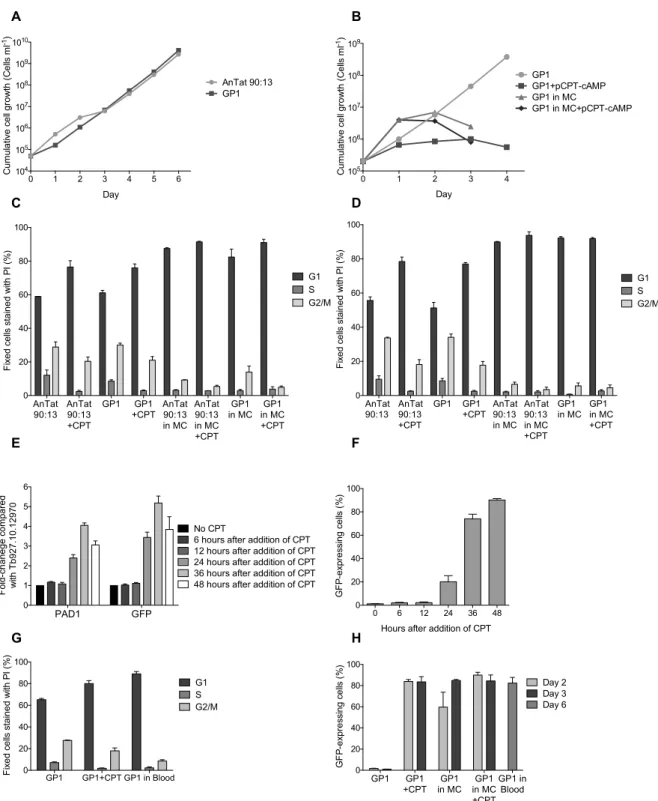
3. the percentage of GFP-positive cells (stumpy-reporter cell line) using flow cytometry. We observed that the stumpy-reporter cell line, GP1, and the parental cell line, AnTat 1.1 90:13, have similar growth rates, showing that the GFP-PAD1 3’UTR construct does not affect GP1 growth (Fig. 3A). After GP1 parasites were exposed to 100µM pCPT-cAMP for 24 hours, we observed an arrest in cell growth compared with control cell cultures without pCPT-cAMP (Fig. 3B). This was expected since pCPT-cAMP induces differentiation of slender forms to G1-arrested stumpy forms. Medium with methylcellulose mimics blood
environment, allowing a faster growth of GP1 cells in the first day. However, proliferation of GP1 parasites reached a stationary phase after one day in methycelluloase medium, suggesting formation of stumpy cells as observed in medium with pCPT-cAMP (Fig. 3B).
AnTat 1.1 90:13 and GP1 cells show the same cell cycle profile in different culture conditions (Fig. 3C, D). After two to three days in medium with methylcellulose and/or pCPT-cAMP, GP1 and AnTat 1.1 90:13 show an accumulation of 18-32% of cells in G1 phase compared with control cultures cultivated without methylcellulose and not exposed to pCPT-cAMP. Growth in medium with methylcellulose promoted higher levels of G1-arrested parasites than exposition to pCPT-cAMP (Fig. 3C, D). Stumpy-reporter cell line GP1 should express GFP only in conditions that promote stumpy formation. Indeed, only GP1 cells cultivated in medium with methylcellulose and/or with pCTP-cAMP express GFP, while no GFP expression is observed in cells cultivated with no supplemented medium (Fig. 3H).
To test the response of GP1 cell line to SIF signal in vivo, mice were infected with GP1 cell line and at 6 days post-infection parasites were collected from the blood, when trypanosomes are predominately stumpy forms30. As expected, parasites show an arrest in G1 phase and the majority of cells (82%) express GFP (Fig. 3G, H). As anticipated, GFP-positive cells are arrested in G1 phase and GFP-negative cells show a normal cell cycle profile, similar to GP1 cells cultivated in HMI-11 medium (Supplementary Fig. 1). Therefore this data shows that GP1 cell line has a stumpy-specific GFP expression both in vivo and in vitro.
PAD1 and GFP mRNA levels were quantified by qPCR and both PAD1 and GFP show the same expression pattern in cells treated with cAMP: in the first 36 hours of pCPT-cAMP exposure, PAD1 and GFP mRNA levels progressively increase compared with the control cells without drug treatment, but after 48 hours with pCPT-cAMP both mRNA levels decrease compared with the 36 hours time point (Fig. 3E). A decrease in gene expression after 48 hours with pCPT-cAMP may be expected due to repression of transcription and translation during transition from slender to stumpy forms28,75,76. Although after a 24h treatment with pCPT-cAMP it is possible to see an increase in PAD1 mRNA, it is not possible to observe a G1 arrest (Supplementary Fig. 2). PAD1 and GFP (under control of PAD1 3’UTR) mRNA levels start to be detected early in differentiation to stumpy forms, while morphological changes are observed in the end of stumpy differentiation process, as previously described30,43.
Based on the cell cycle profile, culture in medium with methylcellulose is the best method to differentiate stumpy trypanosomes and when both methods are combined more G1-arrested cells are observed (Fig. 3C, D). Although methylcellulose medium induces more cell cycle arrested cells than pCPT-cAMP, methylcellulose is a viscous medium that requires several washing steps to prepare the cells for further experimental assays. Moreover, in vitro
induction of stumpy formation in the presence of pCPT-cAMP is well characterized using stumpy-reporter cell lines43. Thus medium with 100µM pCPT-cAMP was the selected method to study stumpy formation.
Figure 3: In vitro differentiation to stumpy forms: cell cycle profile and GFP expression. (A) Growth curve of GP1 and parental cell line, AnTat 90:13 cultivated in 11 medium. (B) Cell growth of GP1 cultivated in HMI-11 medium (GP1) and in medium condition that promote stumpy formation: HMI-HMI-11 supplemented with pCPT-cAMP (GP1+pCPT-pCPT-cAMP), supplemented with methylcellulose (GP1 in MC) and supplemented with methylcellulose and pCPT-cAMP (GP1 in MC+pCPT-cAMP). Cell cycle profile of AnTat 90:13 and GP1 cell line cultivated two days (C) or three days (D) in HMI-11 medium (AnTat 90:13 or GP1), HMI-11 medium with
pCPT-0 1 2 3 4 5 6 104 105 106 107 108 109 1010 Day Cu m ula tiv e ce ll gr owt h (Ce lls m l -1) AnTat 90:13 GP1 AnTat 90:13 AnTat 90:13 +CPT GP1 GP1 +CPT AnTat 90:13 in MC AnTat 90:13 in MC +CPT GP1 in MC GP1 in MC +CPT 0 20 40 60 80 100 Fi xe d ce lls s ta in ed w ith P I ( % ) G1 S G2/M PAD1 GFP 0 1 2 3 4 5 6 Fo ld -c ha ne ge c om pa re d wit h T b9 27 .1 0. 12 97 0 No CPT
6 hours after addition of CPT 12 hours after addition of CPT 24 hours after addition of CPT 36 hours after addition of CPT 48 hours after addition of CPT
GP1 GP1+CPT GP1 in Blood 0 20 40 60 80 100 Fi xe d ce lls s ta in ed w ith P I ( % ) G1 S G2/M 0 1 2 3 4 105 106 107 108 109 Day Cu m ula tiv e ce ll gr owt h (Ce lls m l -1) GP1 GP1+pCPT-cAMP GP1 in MC GP1 in MC+pCPT-cAMP AnTat 90:13 AnTat90:13 +CPT GP1 GP1 +CPT AnTat90:13 in MC AnTat 90:13 in MC +CPT GP1 in MC GP1in MC +CPT 0 20 40 60 80 100 Fi xe d ce lls s ta in ed w ith P I ( % ) G1 S G2/M 0 6 12 24 36 48 0 20 40 60 80 100
Hours after addition of CPT
GF P -e xp re ss in g c el ls ( % ) GP1 GP1 +CPT GP1 in MC GP1 in MC +CPT GP1 in Blood 0 20 40 60 80 100 GF P -e xp re ss in g c el ls ( % ) Day 2 Day 3 Day 6 A B C D E F G H
cAMP (CPT), HMI-11 medium with methylcellulose (MC) and in HMI-11 medium with pCPT-cAMP and methycellulose (MC+CPT) (n=3, mean ± s.e.m.). PAD1 and GFP mRNA levels (E) and percentage of cells expressing GFP (F) after addition of pCPT-cAMP (CPT) in the culture medium. Bars represents mean ± s.e.m; n=3. (G) Cell cycle profile of cells collected from blood 6 days post-infection (GP1 in blood) and cells cultivated two days in HMI-11 medium (GP1) and HMI-11 medium with pCPT-cAMP (GP1+CPT) (n=3, mean ± s.e.m.). (H) Percentage of cells expressing GFP after two and three days of culture in HMI-11 medium (GP1), HMI-11 medium with pCPT-cAMP (CPT), HMI-11 medium with methylcellulose (MC), HMI-11 medium with methylcellulose and pCPT-cAMP (MC+CPT) or cells collected from blood 6 days post-infection (n=3, mean ± s.e.m.).
Altogether, stumpy-reporter GP1 cell line responds to cell density in vivo and in vitro (in medium with methylcellulose) and differentiate with pCPT-cAMP, showing stumpy-specific GFP expression both in vitro and in vivo. Therefore, this data validates GP1 as a reliable stumpy-reporter cell line that allows us to easily follow stumpy differentiation and quantify the number of stumpy forms by measuring the percentage of GFP-positive cells.
B
IOINFORMATIC IDENTIFICATION OF CANDIDATE LNCRNA
S IMPORTANT FOR SLENDER TO STUMPY TRANSITIONThe transcriptome profile of T. brucei slender and procyclic forms was analyzed by RNA sequencing (RNA-Seq) using a paired-end and strand-specific sequencing approach. Using bioinformatic analysis of the RNA-Seq data, Luisa Figuereido’s laboratory identified 946 lncRNAs, in which 379 and 188 lncRNAs were exclusively identified in slender and procyclic forms, respectively.
Recently, a genome-wide RNAi screen identified 30 protein-coding genes essential for T. brucei to successfully differentiate in stumpy forms. Moreover, using a loss-of-function approach the authors validated experimentally that nine of these predicted genes showed resistance to SIF in vivo44.
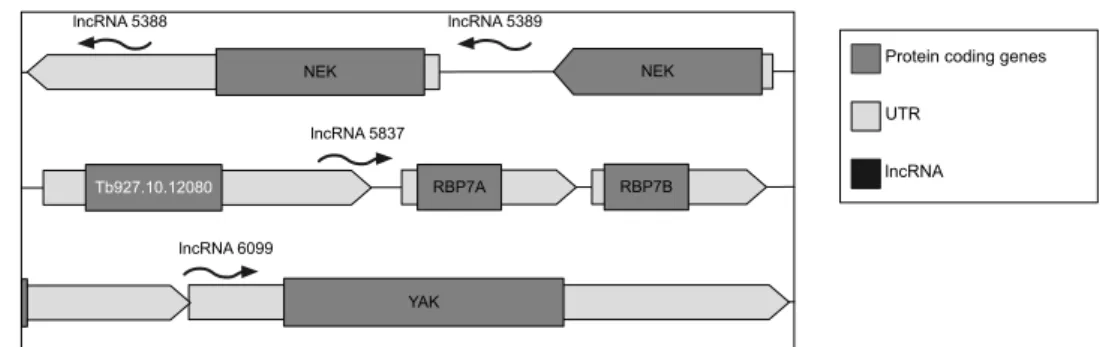
Should any of the T. brucei lncRNAs be important regulators of slender to stumpy transition, we hypothesize them to regulate the expression and/or function of the nine validated genes essential for stumpy formation. We identified four lncRNAs located directly upstream or downstream to three of the nine essential genes for stumpy formation (Fig. 4), suggesting that these lncRNAs could regulate the expression of stumpy essential genes via an in cis mechanism.
LncRNA5388 and lncRNA5389 are located downstream of NEK family genes (Tb927.10.5930 and Tb927.10.5940). LncRNA5837 is located upstream of RBP7 family genes, but located within an upstream gene with unknown function (Tb927.10.12080). LncRNA6099 locates upstream of YAK gene. Moreover, except the lncRNA5389, all the other three lncRNAs overlap partially or completely with the annotated UTR of its nearby gene (Fig. 4).
To confirm that these lncRNAs were independent transcripts and not the result of alternative splicing from the UTR of an adjacent gene, the expression profiles of lncRNAs and its nearby genes were compared using different RNA-Seq data. None of the four lncRNAs showed a positive correlation with its nearby genes, confirming their independency as a transcript (Supplementary Fig. 3). Interestingly, a negative correlation was found between lncRNA6099 and YAK gene (Pearson correlation r = -0.82), suggesting a potential anti-regulation mechanism (Supplementary Fig. 3).
From our bioinformatic analysis, we have selected four lncRNAs and we postulated them to play an important role during slender to stumpy transition by regulating the expression of its nearby genes, essential for stumpy formation, via in cis mechanism.
Figure 4: Genomic localization of candidate lncRNAs. LncRNA5388 is defined as 375bp in length and is located within the annotated 3’UTR of the NEK gene (Tb927.10.5930). LncRNA5389 is defined as 294bp in length and is located between the two NEK genes (Tb927.10.5930 and Tb927.10.5940) but does not overlap within their UTRs. LncRNA5837 is 425bp in length and locates upstream of RBP7 family genes. Moreover, 93% of lncRNA5837 overlap with the 3’UTR of an upstream gene, Tb927.10.12080, which encodes for a protein with an unknown function. LncRNA6099 is 273bp in length and localize partially with the annotated 5’UTR of YAK gene.
E
XPRESSION PROFILE OF THE FOUR CANDIDATE LNCRNA
S DURING STUMPY FORMATION Should, any of our four candidates lncRNA regulate slender to stumpy transition, we expected to see changes in their transcript levels during stumpy formation, as described for two essential genes for stumpy formation: RBP7 and PP112.Expression levels of candidate lncRNAs and their nearby stumpy essential genes were analyzed by qPCR during stumpy formation. pCTP-cAMP was used to induce slender to stumpy transition and RNA was collected 6, 12, 24, 36 and 48 hours after addition of pCPT-cAMP and in a control culture of trypanosomes slender forms were maintained <5x10⁵ cells/ml.
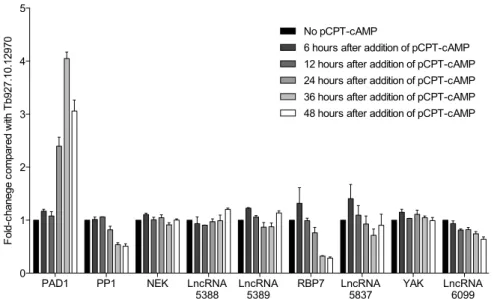
During in vitro stumpy formation, we observed two different expression profiles for the stumpy essential genes: (1) a decrease of transcript levels for PP1 and RBP7 and (2) no changes in their mRNA levels for NEK and YAK (Fig. 5). PP1, RBP7 and YAK transcript levels reproduce microarrays data in the literature12.
NEK lncRNA 5388 NEK lncRNA 5389 RBP7B RBP7A Hypothetical protein lncRNA 5837 YAK lncRNA 6099
Protein coding genes
UTR lncRNA NEK lncRNA 5388 NEK lncRNA 5389 RBP7B RBP7A Tb927.10.12080 lncRNA 5837 YAK lncRNA 6099
Protein coding genes
UTR
In the same way, we observed two expression profiles for the four selected lncRNAs: (1) decrease of transcript levels for lncRNA5837 and lncRNA6099 and (2) no changes in their transcript levels for lncRNA5388 and lncRNA5389 (Fig. 5). Interestingly, lncRNA5837 and its nearby gene RBP7 show a similar expression pattern during stumpy formation. While increasing in the first 6 hours, their transcript levels decrease during the following hours of stumpy formation (Fig. 5).
Figure 5: Transcript levels of candidate lncRNAs and nearby genes during stumpy formation. qPCR data was analyzed with delta-delta-Ct method, using control primers that target an endogenous gene (Tb927.10.12970), due to its stability during life cycle differentiation46. All the samples were normalized with GP1 sample (slender cells not exposed to pCPT-cAMP). Bars represents mean ± s.e.m.; n=3.
Although the expression of the candidate lncRNAs do not show significant changes during in vitro stumpy formation, it does not reflect a lack of function of the lncRNAs in stumpy formation. Indeed, lncRNA function can be controlled by their cellular localization, secondary structure or protein partners77–81.
P
HENOTYPIC SCREEN TO STUDY LNCRNA
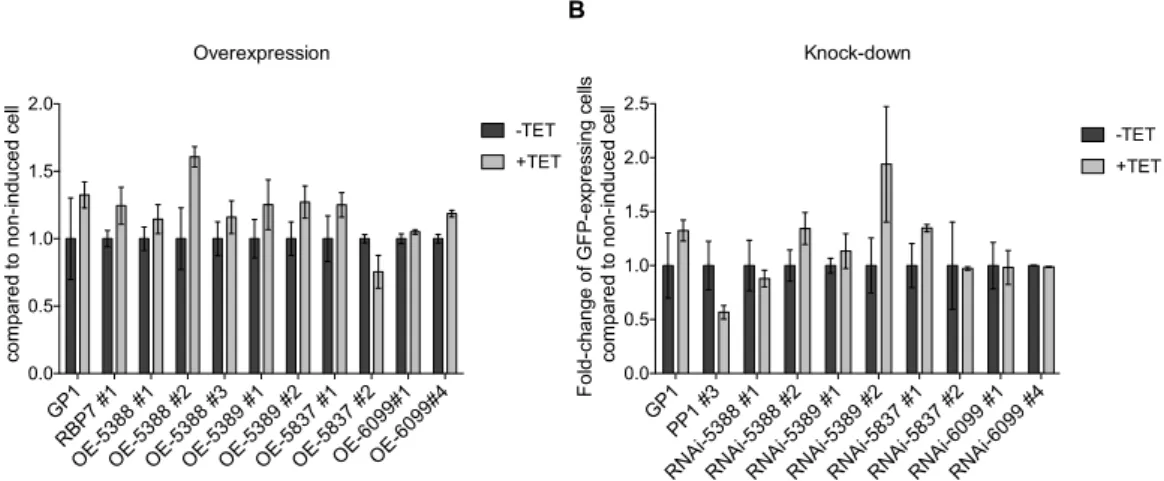
FUNCTION IN SLENDER TO STUMPY TRANSITION We performed a phenotypic screen for stumpy formation to study the role of the four selected lncRNAs, using a gain- or loss-of-function approach with our reporter cell-line, GP1. Internal controls were included by adding RBP7 and PP1 mutant cell lines to the phenotypic screen. Indeed, RBP7 overexpression and PP1 knocked-down lead respectively to an increase and a decrease of stumpy formation44, which provide positive controls for our phenotypic screen.RNA interference or overexpression was induced or not with tetracycline and, after one day, stumpy formation was triggered by adding pCPT-cAMP in the culture medium. Two days after addition of pCPT-cAMP, GFP expression was quantified using flow cytometry.
PAD1 PP1 NEK LncRNA
5388 LncRNA 5389 RBP7 LncRNA 5837 YAK LncRNA 6099 0 1 2 3 4 5 Fo ld -c ha ne ge c om pa re d w ith Tb 92 7. 10 .1 29 70 No pCPT-cAMP
6 hours after addition of pCPT-cAMP 12 hours after addition of pCPT-cAMP 24 hours after addition of pCPT-cAMP 36 hours after addition of pCPT-cAMP 48 hours after addition of pCPT-cAMP