Critical Factors in Make or Buy Analysis:
A Case in the Technical Furniture Industry
Serafim Filipe Silva Rosas de Araújo
Master’s Thesis
Supervisor at FEUP: Prof. Américo Azevedo
Integrated Master’s Degree in Mechanical Engineering 2015-07-01
Resumo
Esta dissertação foi desenvolvida no âmbito da conclusão do Mestrado Integrado em Engenharia Mecânica, pertencente à Faculdade de Engenharia da Universidade do Porto. Este documento foi elaborado no âmbito de um projecto que ocorreu numa empresa de portuguesa que opera na indústria de mobiliário de laboratório e soluções tecnológicas para laboratórios. O rápido crescimento da empresa e diversificação das sua linhas de produtos nos últimos anos levaram a que se considerasse o aumento das capacidades de produção, dando origem ao projeto em que esta dissertação se baseia.
Este projeto foi desenvolvido ao longo de um período de cinco meses e foi organizado em várias fases, sendo a primeira etapa consistituida pela familiarização e análise dos produtos atuais e das capacidades de produção, como maquinaria e colaboradores. Após esta informação ter sido recolhida, o âmbito da análise foi determinado, a fim de identificar onde o investimento considerado seria mais eficaz de forma a melhor atender os objetivos estratégicos da empresa. Seguiu-se uma avaliação das máquinas necessárias, dos seus custos fixos e variáveis, o que posteriormente permitiu a execução de um modelo de custos para cada máquina seleccionada. Estes modelos de custos e a capacidade de calcular vários gastos com a produção permitiram a apresentação de diferentes cenários que resultaram em fatores de decisão quantitativos. Depois de considerar também fatores de decisão qualitativos valorizados pela empresa, o layout final de produção foi proposto, a fim de melhor ajudar nas decisões a que este estudo possa conduzir.
Determinou-se que os produtos mais estratégicos para a empresa eram bancadas e mobiliário técnico (como armários), e as tecnologias em falta nas actuais instalações eram orlagem, encavilhamento e prensagem. Diversas máquinas foram estudadas com a contribuição dos respectivos fabricantes, visitando fábricas que operam com as tecnologias desejadas e consultando elementos experientes dentro da indústria. A selecção de uma orladora, uma encavilhadora e uma prensa de mobiliário conduziu ao apuraramento dos custos relacionados com a aquisição e utilização das referidas máquinas. Tendo determinado estes custos, um modelo capaz de comparar o custo de um produto feito na fábrica com o preço do mesmo produto quando comprado a um fornecedor foi construído, apresentando na generalidade uma diferença positiva de custo favorável à aquisição das novas máquinas. Para melhor ajudar no processo de decisão, o layout atual foi estudado e um novo layout, incluindo a nova maquinaria, foi proposto.
Abstract
This dissertation was developed within the context of the completion of the Integrated Master’s Degree Mechanical Engineering, belonging to the Faculty of Engineering of the University of Porto. The correspondent document was elaborated in the course of a project occurring at a Portuguese company with implementation in the industry of laboratory furniture and technological solutions for laboratories. Given a quick growth of the company and diversification of the product lines in the past few years led to the consideration of the growth of the production capabilities, giving origin to the project in which this dissertation is based.
This project was developed throughout a period with the duration of five months and was organized in several phases. The first stage was the familiarization and analysis of the current production and productive capabilities. After this information was collected, the scope of the further analysis was determined in order to identify where the possible investment would be more effective and would better answer the company’s strategic objectives. This was followed by an evaluation of the necessary machines, its fixed and variable costs, allowing the execution of a cost model for each selected machine. These cost models and the capability to calculate various production costs allowed the presentation of different scenarios that resulted in quantitative decision factors. After considering qualitative decision factors and the weight given to them by the company, the final production layout was proposed in order to better aid in the decisions that this study would lead.
It was determined that the most strategic products for the company to produce were worktops and technical furnishings (cabinets), and the technologies missing in the current facilities were edgebanding, dowel inserting and cabinet pressing. Machines were studied with the contribution of manufacturers, by visiting factories operating with the desired technologies and consulting with experienced staff within the industry. The selection of an edgebander, a dowel inserting machine and a cabinet press lead to ascertain the costs related to the acquisition and operation of those machines. Having determined these costs, a model capable of comparing the cost of a product made in the factory with the price of the same product when bought to a supplier was built, generally presenting a positive cost difference in favour of insourcing. To better aid in the decision process, the current layout was studied and a new layout, including the new machinery, was proposed.
Acknowledgments
The path that led to the execution of this project would have never been possible without the support of numerous people to whom I would like to use this opportunity to thank.
I would like to thank in the first place to Engr. José Branco and Engr. Rafael Silva, for giving me the opportunity to develop this project and providing me with the opportunity to learn from it.
I’m also grateful to Prof. Américo Azevedo for his constant support and attention while helping me organize the structure of this dissertation and suggesting various solutions to the different challenges. I would like to extend this to Prof. Eduardo Martins, for sharing his insight and allowing me to learn from his opinions and work. I’m also thankful to my colleague Filipa Alves Santos, who accompanied me in this experience and always acted as a motivator.
I express my thanks for the company members that made me feel at home and didn’t hesitate to help me, either by sharing their knowledge or by providing essential information, namely Rui Babo, Sérgio Silva, Pedro Rodrigues, Pedro Serra, Vânia Monteiro, Lúcia Rocha, Engr. Rafaela Ferreira, Engr. Rafael Couto, Engr. Ângela Lopes, Engr. Carlos Azevedo, Engr. Filipe Ramos and Engr. Pedro Moreira.
I would like to express my sincere gratitude to my father, António Filipe, for acting as a plumb line in my life and to my mother, Maria Delfina, for always believing in me. I’m specially thankful to my sisters Sofia and Laura, for always guiding me and setting an example in all aspects of my life. Without them, the path that now finishes would have been impossible.
Finally, I would like to thank all my friends for being true, providing so many wonderful experiences over these years and making me grow as a person.
Table of Contents
1 Introduction ... 1
1.1 Project Framework and Motivation ... 1
1.2 Project Goals ... 2
1.3 Research Questions ... 3
1.4 Methodology ... 3
1.5 Thesis Structure ... 4
2 Theoretical Background ... 5
2.1 Make or Buy Analysis ... 5
2.2 Cost Modelling ... 8
2.3 Layout Design ... 11
3 Problem Current State... 13
3.1 Current Production Characterization ... 13
3.1.1Product Analysis ... 13
3.1.2Production Capacity Analysis ... 17
3.1.3Current Shop-Floor Layout Description ... 20
3.2 Scope of the Make or Buy Analysis ... 21
4 Development and Description of the Proposed Solution ... 24
4.1 Machinery Research, Selection and Description ... 24
4.2 Cost Modelling for the Machine Acquisition ... 28
4.2.1Fixed Costs Determination ... 28
4.2.2Variable Costs Determination ... 29
4.2.3Model Execution ... 30
4.3 Scenario Analysis ... 32
4.3.1Quantitative Decision Factors ... 35
4.3.2Qualitative Decision Factors ... 35
4.4 Layout Design ... 37
4.4.1Specific Layout Constraints and Objectives ... 37
4.4.2Proposed Layout Design ... 38
5 Conclusions and Further Work ... 40
References ... 43
ANNEX A: Scope of the Analysis Tables ... 45 ANNEX B: Machine Cost Modelling Tables ... Error! Bookmark not defined. ANNEX C: Scenario Analysis Tables ... Error! Bookmark not defined.
List of Figures
Figure 1 – Main steps in capital budgeting. ... 14
Figure 2 - Example of a woktop assembly. ...13
Figure 3 – Example of cabinet option. ... 15
Figure 4 – Example of a polypropylene sink. ... 15
Figure 5 – Stainless steel exhaust canopy. ... 16
Figure 6 - Example of fume cupboard assembly. ... 16
Figure 7 – Current sliding table saw. ... 18
Figure 8 - Current CNC mill. ... 18
Figure 9 - Fixed table saw. ... 19
Figure 10 – Company’s forklift. ... 20
Figure 11 - Current production layout (ground floor). ... 20
Figure 12 - Current production layout (first floor). . ... 21
Figure 13 - Worktop production options scheme. ... 25
Figure 14 - Technical furnishings production options scheme... 25
Figure 15 - Suggested Edgebander. ... 26
Figure 16 - Suggested Dowel Inserting Machine. ... 27
Figure 17 - Suggested Cabinet Press. ... 27
Figure 18 - Proposed layout design (ground floor). ... 38
List of Tables
Table 1 – Current and desired capacity in worktop production. ... 22
Table 2 – current and desired capacity in cabinet production ... 22
Table 3 - Rent and insurance costs for the company’s warehouse ... 28
Table 4 – Work area occupied by the selected machines ... 29
Table 5 - Space and insurance costs results for the selected machines ... 29
Table 6 - Labour costs ... 29
Table 7 - Electricity costs ... 30
Table 8 – Edgebander Cost Modelling ... 30
Table 9 - Dowel Inserting Machine Cost Modelling ... 31
Table 10 – Cabinet Press Cost Modelling ... 32
Table 11 – Worktop example scenario analysis ... 33
Table 12 – Technical furnishing example scenario analysis ... 34
Table 13 - Simplified time and cost values for a standard cabinet. ... 35
1 Introduction
In this section, the context of the project will be described, as well as the problem that gave origin to it.
A brief presentation of the environment in which the project was developed will also be made. Further on the chapter, the project objectives will be stated, as will the methodologies chosen to reach its goals.
Finally, the structure of the thesis will be explained.
1.1 Project Framework and Motivation
The company1 in which this project was developed operates in the technical furniture business since 1998. It started its activities as a representative for a larger international manufacturer, but gradually it became more independent and started its own business relations and product lines.
In the last half decade of its activity, the company managed to grow, diversifying its product line and acquiring new capacities.
In the current economic panorama the company strategy focussed on higher levels of internationalization, where it can present a better price advantage in comparison with its direct competitors. Also, the company still develops non-standard projects, with custom made solutions which other companies avoid or refuse, sticking to their policy of standard-only components in order to achieve lower unit costs.
Having decided to invest in its own product lines it created the need to slowly acquire production capabilities. Initially, these weren’t technologically advanced, and there was a strong emphasis in outsourcing most of the production process. Even the development of prototypes had to be largely outsourced.
Most of the decision making process until now didn’t follow any scientific method, being largely based on empiric knowledge and what is understood in the company to be a “good
strategic sense”. The current machinery was bought “when the need of them occurred” and so there was no emphasis in elaborate studies in order to justify such investments.
Currently, the company catalogue includes solutions for the most varied applications, from hospitals, to schools, research labs, and veterinary clinics. Such a varied offer translates into a great variability of products and materials adjusted to the needs of each project and the client’s requests and needs.
The most common products consist in tables and stalls of a great variety of dimensions which consist of steel structures and tops made partially or entirely of a great variety of materials, according to their application: Acrylic resins, phenolic compact, Corian®, post forming, MDF, melamine, glass, ceramics and polypropylene. The whole product can also be made of stainless steel in some occasions. The workbenches can be built on castors for greater mobility and can also be height adjustable.
Most support structures consist of bended, machined, and painted steel sheet, as well as aluminium machined and bored profiles.
Also very representative in the product portfolio are the different types of cabinets. These can be made from most of the materials mentioned above and have numerous variations in order to adapt to their functions. The cabinets can be built on castors, suspended or on plinth, and can have multiple combinations of doors, hinges, handles, locks, drawers and shelves. They can also be ventilated for safe storage of acid, alkalis and other reagents.
Fume cupboards as well as other specific laboratory components are also designed, produced and installed by the company.
The company owns a warehouse in Maia industrial zone (in sector 8) where it has its offices and also rents the neighbouring warehouse in order to accommodate production machinery and stock. There is also another rented warehouse, destined to store finished products. Currently there are 6 production workers, who operate a panel-saw, a CNC milling centre and several smaller tools like hacksaws, screwdrivers and drilling apparatus. These resources are far from being able to complete even a small part of the products and therefore, the capacity is limited in terms of production, especially considering the variability of the final product. There is a high dependency on suppliers since the vast majority of the work is outsourced. Also, the vast number of product references and relatively low level of normalization, led the company to consider options in order to achieve a desired level of flexibility, quality and fast response to orders.
Unsatisfied with the difficulties presented by some suppliers to fulfil time and growing quality requirements, and attracted by the possibility of producing their own prototypes and efficiently control production schedules, the company’s administration decided to consider alternatives to their current productive panorama, thus creating the grounds for this project.
1.2 Project Goals
Given the aforementioned framing it is mandatory to establish the goals of the execution of this project. These goals establish the time frame of the project and represent the main necessities of the company regarding this analysis. They are as follows:
To determine in what area of the production to invest is of major importance, deciding what are the affected products and where the investment would be more relevant for the company’s productive capabilities is the first of those questions.
Having decided what is the most relevant area for investment, to ascertain what resources to acquire is the next step in the analysis. This will provide the grounds to correctly determine the costs and charges correspondent to the targeted resources, like machinery.
The cost modelling will provide the basis for a Make-or-Buy analysis that will provide a foreknowledge important to the decision making process. It will, in simple terms, evaluate the worthiness of the investment and predict eventual concerns that might be raised.
Finally, the possibility of obtaining new resources like machinery poses another practical question related to the physical allocation of said resources. Therefore, a layout analysis and new planning is required so that this project can achieve results and properly assist in the decision-making process.
These goals are addressed throughout the dissertation and lead to the research questions that are stated in 1.3.
1.3 Research Questions
Having determined the project goals it is critical to define research questions in order to organize the work required to execute the project. The questions raised are in line with the aforementioned project objectives, guiding the realization of this project. These questions are as follows:
What are the areas of the production to invest?
What resources to acquire?
What are the costs and benefits of acquiring those resources?
How to physically reorganise the layout and include the new resources?
In the next section, the methodologies followed in order to obtain answers to these questions will be presented.
1.4 Methodology
In this project, both empirical and inductive methods were applied in order to determine qualitative and quantitative factors as will be explained.
Analysis of the current situation and production process familiarization. This involved a well based knowledge of the company, its products and its production capabilities and limitations. Close observation of the factory and its resources was required.
Objective identification and limitation of the scope of the analysis. This mainly involved contact with the company decision-makers in order to better understand the wanted strategy for the future.
Having determined the project objectives, the selection of the machines in which to invest was the next evident task. This involved the study of the families of machines, contacts with fabricators, sellers and also the visit to selected factories where these machines could be observed while in operation.
The development of a cost model as a tool to determine the advantages or disadvantages in terms of costs and time for the considered machines. This allowed the evaluation of different scenarios, with different production schedules and requirements, in order to determine the aforementioned advantages and disadvantages in different situations.
New layout study and design. Incorporating the selected machines and considering multiple criteria, a new layout design was projected. In order to better accomplish this objective, a consult of several theoretical references as well as a visit to an actual furniture assembly line was conducted.
1.5 Thesis Structure
The structure of this dissertation follows the phases of the project upon which it is based. In the chapter after this introduction, comes chapter 2, a section dedicate to the theoretical background review of the main themes related to this project. Principles of Make or Buy Analysis, Cost Modelling and Layout Design are presented in order to provide background for the project.
In the third chapter, the current state of the problem is presented. This includes analysis on the current products and production capabilities as well as the current layout of the factory. This section conveniently frames the problem and also limits the scope in which further analysis will focus.
The fourth chapter explains the analysis that was made, presenting the considered machinery, and its associated costs. In this chapter is also presented a scenario analysis for some production capabilities and finally the suggestion of a new layout that includes the new production resources.
The fifth and last chapter refers to the conclusions of the project and future work recommendations considering also its application by the company it was developed in.
2 Theoretical Background
In order to develop this project, a previous theoretical background had to be built. The aim of this chapter is to present that research and provide valuable content for better understand the way the project was orientated.
To meet this end, several sources were consulted, manly other thesis, books, specialty sites and journal articles.
Since this project focus is manly on three areas, this will be reflected in the organization of this chapter. Also, the order of the subchapters is as required by the time frame of the project. First, a theoretical background about make or buy analysis will be presented, followed by cost modelling explanations and finally a short review of about factory layout design.
2.1 Make or Buy Analysis
In a normal make or buy analysis Two main kinds of subcontracting can be identified. These are outsourcing of productive capacity and outsourcing of know-how.
Subcontracting can also be used structurally or for conjuncture reasons, like overcharging of the current production capabilities.
Subcontracting capacity
Subcontracting capacity can be made to one or more subcontractors. This is made when there is an imbalance between load and capacity or when the load exceeds the capacity. The imbalance between the load and the capacity can be cyclical and can happen because orders increased rapidly, unexpectedly or because of losses in equipment (faults) or employees (absenteeism, for example). (Alyson, 2006)
If the structural subcontracting is then it must be the result of a business strategy.
Specialty subcontracting
Forte, R. e Brandão, A. (2007) state that this type of subcontracting the company does not have technical skills or wants to acquire them and therefore uses an expert who has the technical know-how. This decision allows companies to focus on their technical skills and creates a network of relationships and interdependencies between different companies.
This is the type of subcontracting that seeks the lowest unit costs for materials. For this to happen significantly the experts should be allowed participation in research and development of the subjects that lead to the subcontracting.
Decision Criteria
Savoir-faire. Subcontracting allows those who resort to it not to disperse, allowing the company to focus on what it does best. By outsourcing a task that does not possess to a subcontracted part that has the technical capability to perform this task dramatically reduces the problems and risks to quality.
Capacity Policy. As the orders increase the capacity may be exceeded by the load. However the increase in orders can be insufficient to justify investment in more capacity. While the increased workload does not justify the purchase of new equipment hiring new people should be considered subcontracting capacity. If sales forecasts are uncertain, with large fluctuations, its better make defensive choices and not make large investments and subcontract while no reliable forecasts are available.
Work load fluctuations. In some cases, subcontracting can be used to cope with the seasonality or special orders that have random distribution in time.
Control of unit direct costs. Several times, the subcontracted partner can be an expert in a given task, lowering the materials unit costs. This partner may also have a cheaper labour cost which will have similar effects. By working for numerous partners, a subcontracted company can achieve lower unit costs. However, special attention should be had if subcontracting while applying only the criterion of lower unit cost because as the volume of units produced in house lowers, the existing fixed costs will be harder to dilute. If only lower unit costs are considered, there can be a temptation to outsource larger volumes of the production. To the unit costs should be added the costs of providing the subcontractor with studies and developments made indoors, training costs in the subcontracted partner and the cost of controlling the subcontracted capacity. (Grossman et al, 2005)
Treasury management. Another reason for subcontracting may be to not constitute new fixed costs within the company. Trade agreements with the subcontracted partner can lighten the pressure on the treasury of the company as they are transferred to the partner, like purchases of raw materials and wages.
Strategic reasons. Mastering the supply chain can be a reason to vertically integrate the activities and not to subcontract. Vertical integration can enable an integrated planning of activities which will allow a faster response to customers.
Better protection of technological innovation. If technological processes and patents within the company are not known competition and constitute sensitive information that can damage the competitiveness of the company if shared, subcontracting should be carefully considered and done in a way that protects the company's intellectual property.
Quality control. A vertical integration will allow better quality control of work performed and materials used which will become a quality advantage when delivering to the customer. It can be argued that with a refined quality control system and work control it is indifferent whether activities are integrated or are subcontracted regarding the quality of the final product. However these quality control systems take a large amount of time to establish and consume large quantities of resources.
Security in supply. Transportation can introduce further time fluctuations. By outsourcing there is the necessity to add further transportation to the manufacturing cycle of a product. Deliveries may not be reliable, the subcontractor may not have been well selected, and so the need to create buffer stocks to cover fluctuations in deliveries is created. These additional security stocks have costs. These problems can be solved by developing partnerships and implementing policies of just-in-time.
Increase in working capital needs. By outsourcing it is expected to increase the production cycle and the current materials in course also increase. This will bring a modify working capital needs generally increasing them. (González-Díaz et al, 2000)
Being the criteria for deciding between subcontracting or vertically integrating activities are of political and technical nature, such decision cannot be left only to the responsibility of the production management.
The decision to outsource has many financial implications, therefore these should be studied and decision must be made as a team according to the company's strategy. The operation details, once a decision is made, can be delivered to production management and purchases departments, who will select subcontracted partners and determine the volumes to subcontract.
Subcontracting is an activity that has been developed in order to answer the desire of the companies to refocus on its core functions and core business. Subcontracting may include the study, the product development and also its manufacture. (Klein, 2005)
The classic outsourcing develops a link of subordination between those who give the orders of subcontracting and the subcontracted partner. Currently companies look for partnerships in which the subcontracted partner participates in the study and development of the product as well as influences the production planning.
2.2 Capital Budgeting and Cost Modelling
Capital budgeting is required when selecting projects that add value to the company. This can involve any kind of project from acquiring a lot of land to purchasing a new facility or replacing old machinery. Corporations are typically required or recommended to undertake those projects which will increase profitability and thus enhance wealth.
When presented with a capital budgeting decision, the first task is to determine whether or not the project will prove to be profitable. The net present value, internal rate of return and payback period common indicators to project selection. Even though an ideal project budgeting is such that all three metrics will reinforce the decision, these approaches will often produce contradictory results.
According to the company's preferences, strategies and selection criteria, more emphasis will be put on one approach over another.
Payback Period
According to Kenkel (2011), payback period is the length of time required to recover the original investment. If a project requires an initial cash expenditure, the payback period reveals the amount of time required for the cash inflows to equate to that initial cash outflow. Obviously, short payback periods are preferred, indicating that the project will "pay for itself" in a smaller time frame.
These payback periods are typically used when one of the major concerns is liquidity. When a company has only a limited amount of resources, it can be decisive to the number of major projects it assume at a given time. This will call for a heavy focus by the management on recovering initial investment in order to undertake subsequent projects. Another major advantage of using the payback period is that it is easy to calculate once the cash flow forecasts have been established. (Evans, 2012)
Although this is a straightforward method, it presents two major drawbacks to determine capital budgeting decisions. In first place, the payback period does not account for time value of money. Calculating the payback period provides a metric which places the same emphasis on payments received in different years, committing an error that violates one of the basic fundamental principles of finance. This can easily be amended by implementing a discounted payback period model. The discounted payback period factors in time value of money, allowing the determination of how long it would take for the investment to be recovered. The second problem doesn't have a simple solution like the first. Since both, payback periods and discounted payback periods disregard cash flows that occur near the end of a project's life, such as the recover value, the payback period cannot directly measure profitability. Because the payback period does not echo the added value of a capital budgeting decision, it is normally considered the least relevant method of valuation approach, unless liquidity is a vital consideration
Internal Rate of Return
Internal rate of return is the discount rate that would result in a net present value of zero. Since the net present value of a project is inversely related with the discount rate – an increase in the discount rate causes future cash flows to become more uncertain and, therefore, worthless – the standard for internal rate of return calculation is the actual rate used by the firm to discount after tax cash flows. An internal rate of return higher than the cost of capital implies that the capital project is profitable, and vice versa.
The internal rate of return rule is as follows:
If the internal rate of return is higher than the cost of capital, the project should be accepted, otherwise, the project should be rejected.
One of the main advantages of applying the internal rate of return as a decision making tool is that it provides a benchmark figure for every project that can be assessed in reference to a company's capital structure. The internal rate of return calculation will produce the same types of decisions as net present value models allowing companies to compare projects on the basis of returns over invested capital. (Graham, 2001)
Even though internal rate of return is easy to compute with either a financial calculator or software packages, there are some shortcomings to the use of this metric. Similar to the payback period method, the internal rate of return method doesn't provide a true sense of the value that a project will add to a company – although providing a benchmark figure for what projects should be accepted based on the company's cost of capital. The internal rate of return does not allow for an suitable evaluation of mutually exclusive projects. Managers might be able to determine that two different projects are both beneficial to the firm, but they would not be able to make a decision on which one is better if solely based on this method.
One other problem arising with the use of internal rate of return analysis presents itself when the cash flows from a project are unusual, either because there are additional cash outflows following the initial investment or for other reasons. Unusual cash flows can be common in capital budgeting because many projects require future capital spending for improvement and maintenance. In this scenario, an internal rate of return might be inexistent, or there might be multiple internal rates of return, causing confusion.
Internal rate of return is a useful valuation measure when considering individual capital budgeting projects, but not those which are mutually exclusive. It provides a better valuation alternative to the payback period method, but falls short on numerous requirements.
Net Present Value
Net present value approach is possibly the most precise and perceptive valuation approach to capital budgeting problems. Discounting the after tax cash flows by the weighted average cost of capital allows to determine whether a project will be profitable or not. Contrasting the internal rate of return method, net present values disclose exactly how profitable a project will be in comparison to alternatives. The net present value rule states that all projects which have a positive net present value should be accepted while those that are negative should be rejected.
Other major advantages of the net present value approach include the general convenience and easy comprehension by providing a direct measure of added profitability. This allows simultaneously comparisons between multiple mutually exclusive projects and even though the discount rate it subject to change, a sensitivity analysis of net present value can usually indicate any big potential concerns. (Horngreen, 2008). Figure X summarizes the main steps in capital costs budgeting.
2.3 Layout Design
Factory layout design is the disposing of production resources in a defined space. According to (Lee 1998) the layout can be the essence of efficient production, as long as all the workstations are taken into account, resulting in an environment where people, services, products information and technology are well integrated.
The layout determines how materials, people and information flow during the production process. Some of the wastes in the production process can be minimized by a layout optimization. Yang et al., (2000) state that a factory layout has a significant impact on the company performance and directly affects its results, being decisive for its survival in a competitive environment.
The study of the layout is extremely important since it provides choices to streamline processes within the organizations. According to Hajri-Gabouj (2007), the disposition of resources in a facility directly affect productivity and production costs. Also, a rational allocation of resources contributes significantly to increasing the efficiency of operations and reductions in handling costs.
A well-executed layout, adequate to the processes inherent to the company, can reveal itself fundamental to its success. If correctly planed, it influences directly delivery schedules, which influence the company’s performance and its competitiveness. The layout is an indispensable tool for product excellence, as it provides opportunity to eliminate errors and wastes that could occur during the whole production process, prompting improvements in productivity and creating competitive advantages.
Layout Objectives
According to Petrônio G. Martins (2000) the basic objectives of a layout are:
Provide sufficient production capacity;
Reduce the cost of handling materials;
To adapt to the constraints of place and building;
Ensure space for production machines;
Allow high utilization and productivity of hand labour, machines and space;
To ensure space for locker rooms and other personal care operators;
Ensure health and safety for employees;
Allow ease of supervision and maintenance;
Achieve the objectives with the least investment capital;
Promoting efficient loading and unloading of the transport vehicle;
To provide comfort and convenience to the customer;
Provide an attractive environment for customers;
Promote communication between work areas.
The elaboration of a layout
According to F. Robert Jacobs (2014) order to elaborate a layout that ensures a smooth workflow for a given factory there are several inputs that should be considered.
The criteria to be used in the evaluation of the design and its specifications must be careful considered, as well as physical limitations, amount of space required and travelling distances between different elements in the layout.
The layout must be design according to the expectations of the demand of the products (or services) and accommodate for the requirements of those expectations (number of operations and amount of flow between elements).
Finally, the main steps for the elaboration of a layout are:
Determine the amount to be produced;
Plan the whole and after that, the parts;
Plan for the ideal, and then for the practical;
Follow the sequence: the site; the overall layout; the detailed layout;
Calculate the number of machines;
Select the type of layout and prepare the layout considering the process and the machines;
Plan the building;
Develop tools that enable the clear visualization of the layout;
Use everyone’s experience;
Verify the layout and evaluate the solution;
“Sell” the layout;
Implement;
Set goals (quality, quantity);
Establish how to achieve the objectives;
Know the proper distance between the machines, the widths, the traffic lanes, the height of the building, among others;
Keep in mind the flexibility of the layout for future alterations;
3 Problem Current State
In this third chapter the characterization of the company will be displayed. As this document focus mainly on the production capacities of the company, these will be explained, resulting in an analysis of the current product line, production capabilities and shop-floor layout.
Finally, a scope of the make or buy analysis will be made, in order to limit and better conduct the most important targets of this analysis.
3.1 Current Production Characterization
In order to understand the actual state of the company, a presentation of the company product line, production capacities, and the strategic evolutions made throughout the company’s history that changed any of the points mentioned.
It’s important to mention that the company evolved from a national representative of a foreign brand, with no production capabilities, to designing its own product lines and acquiring resources such as space, machinery and know-how in order to be able to answer to a small part of the current production requirements.
3.1.1 Product Analysis
As the basis of this project is to determine whether it is more favourable to the company to increase its production capabilities, it is necessary to properly understand the current product offer.
In order to adapt to extremely different requests and clients, there is a high variability within the product range. This variability and capacity to adapt its products to different projects is considered in the company a competitive advantage and, in various situations, an order winner.
This project is focussed on production analysis, thereby the laboratory accessories like eyewashes, and articulated exhaustion arms, which are purely outsourced items, will not be considered even though they are presented to the clients.
The products under consideration for production are varied in type, function and materials, as follows:
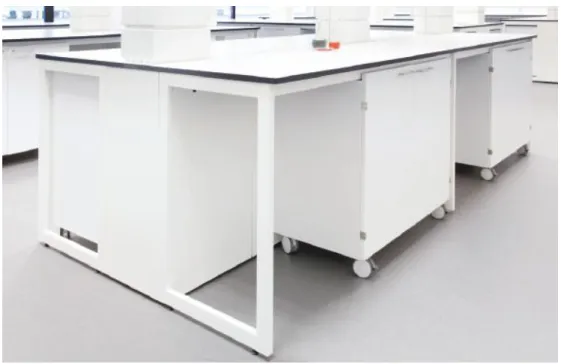
Worktops are supplied to the clients in the desired dimensions, normally cut to fit a specific layout. These are made in different materials according to the requirements of its applications: acrylic resins, phenolic compact, ceramic, glass, polypropylene, melamine, Corian®, MDF, post forming and stainless steel. Supporting structures for the worktops can either be fabricated in steel or stainless steel, and can be soldered or bent as can be seen in Figure . Also connected to the worktops are various options referring to shelving such as shelf tops in glass or phenolic compact, shelf support structures in machined aluminium and steel, shelf chutes in aluminium and technical cells mad from bent and cut steel sheet that accommodate several electrical components as desired by the client.
Figure 2 – Example of a worktop assembly.
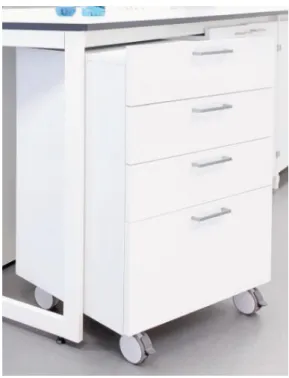
Technical furnishings, such as cabinets, also reflect the great amount of variability available in the product line-up. These can be made out of acrylic resins, phenolic compact, MDF, post forming, steel and stainless steel. Every detail of the furnishing can be customized like dimensions, if it’s a stand-alone item, if it’s supposed to fit under or over a worktop. Other options like colours, doors (how many and what kind of hinges they use), drawers (double sided or single sided), locks, exhaustion, footers, shelves, support (feet or wheels with brakes) provide the adaptability of the product to the requirements of the clients. The example in Figure 3 is one of the many variations of cabinets available.
Figure 3 –Example of cabinet option.
The sinks are also varied depending on their respective applications. They can be applied to worktops or fume cupboards, and are made mainly of stainless steel, propylene or ceramic, according to the functions of the labs they’re destined for. Various sizes and shapes of cups are also available. An example can be seen in Figure 4.
Figure 4 – Example of a polypropylene sink.
Exhaust canopies are used to extract fumes and vapour as seen in Figure 5. Different variations are produced depending on the application demands, like temperature and localization of the fumes and vapours. These can be made either in polypropylene or in stainless steel.
Figure 5 – Stainless steel exhaust canopy.
Fume cupboards are brought together by experts in architecture, mechanical engineering and fluid engineering, with the purpose of developing a reliable, safe and sturdy product. There are also esthetical concerns since these products are vital elements of any modern laboratory and are designed to adapt to different kinds of room, as in old buildings with low room height, or in modern buildings, with high room height.
The fume cupboards, as seen in Figure 6, are designed to be combined with any of the other technical furniture range products and are subjected to tests in order to fulfil the safety requirements for this sort of spaces.
Materials and finishings selection, aim the fume cupboard’s durability against wearing work done inside. The whole interior might be removed, for maintenance, or for its renewal, prolonging its life span.
3.1.2 Production Capacity Analysis
As stated before, the company evolved from representing a larger international manufacturer and gradually it started its product lines. This led to the necessity of new production capabilities. Initially, these weren’t technologically advanced, and there was a strong emphasis in outsourcing most of the production process.
When the investment in the development of new product lines started, it originated the acquiring of production resources.
This led to an obvious increase in the number of employees, as a method of acquiring know-how that allows productive processes, as opposed to the simple managing of outsourcing and installing the laboratories. Some of these staff members were recruited from within the same industry, from companies that had established production lines and processes, and that bring valuable knowledge to the company.
Humanresources
At the moment, the company has a project department capable of dealing with the full development of new prototypes, testing and further design until new products are created. The capability to obtain the industry standard approvals as well as submit new patents and all the procedures related to these activities.
As the capability to adapt its products to the client requirements is a main advantage over its competitors, there are technicians dedicated to redesigning and adapting standard products to special applications.
All these personnel is connected by other professionals specialized in necessity management (production necessities or production necessities) and a purchasing departments, responsible for acquiring the raw materials from the providers.
There are 6 production technicians, with a variable degree of flexibility and knowledge in different tasks and the most common procedures in the industry. They operate the available machinery and tools and are leaded by a production manager, responsible for the whole production activities in the factory and warehouse. Hand in hand with these professionals, four more staff members are assigned to warehouse management, order acceptance and verification.
Even though not related to the production, the company also employs 6 assembling technicians, responsible for the instalment of the laboratories in the client’s facilities. They usually work in teams of two and are equipped with tooling and vehicles necessary for the task they carry out.
Machinery resources
Currently the company possesses machinery that enables the production of a relatively small amount of the products it sells to its clients.
Normally, the first machine in the production process is the sliding table saw as shown in Figure 7. It’s normally operated by two staff members and it’s used to cut acrylic resin, phenolic compact, melamine, and MDF boards into the specific components dimensions.
Figure 7 – Current sliding table saw.
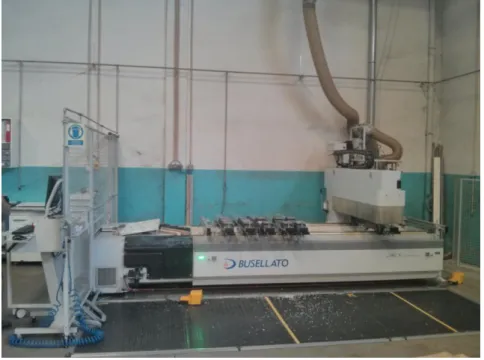
A CNC mill is a critical machine is the company as it allows the use of computerized controls in order to cut the required materials. Specific programs and designs are translated by the machine into movements of different rotation speed, locations and depths. It is not required from the staff to use G-code in this specific machine, which is a standardized programming language that many CNC machines understand. The most frequent operations executed by this CNC mill are face milling, shoulder milling, tapping and drilling. The current CNC mill is shown in Figure 8.
The sliding table saw and the CNC mill are connected to a exhaust system and works as the main shavings extraction method. These connections are required in order for the machines to work properly and safely.
This exhaust system is composed by a silo and ducts that lead to each machine. The silo is located outside the warehouse and inside contains the suction motor and the dust bags, that require removal and exchange when full. The frequency of this maintenance depends on several factors such as workload and the type of material that is being worked in either of the machines connected to the system, as different materials produce different shavings that occupy more or less volume according to their density, size and shape.
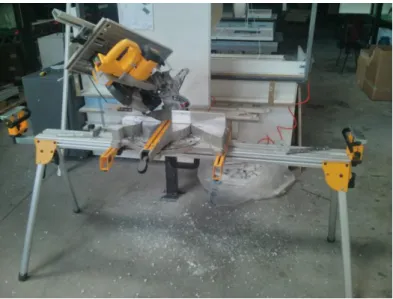
Other than these machines, smaller tools like smaller table saws (Figure 9), routers, various types of drills, soldering machines for metal and polypropylene provide a small capacity for specific crafts and operations. Such as the fabrication of polypropylene sinks, technical cells assembly and even fume cupboards.
Figure 9 - Fixed table saw.
At the moment of the development of the project, the transport system inside the warehouse and assembling facility consists of several stackers of different variations. Manual stackers are used mainly to move small cargo or finished products within the warehouse. Electric stackers are used in larger cargo or to complete pallets ready for shipping.
There is one forklift available, used mainly for its bigger capacity either in weight, freedom of movement and reach (in height). Beyond its normal use unloading supplier cargo and loading finished products it is essential in the movement of board stock (manly phenolic compact, due to its high density and, consequently, high weigh). This forklift can be seen in Figure 10. A steel structured table with wheels helps the staff move these boards mainly around the sliding table saw, for bigger worktops. All the other movement of materials is done by hand.
Figure 10 – Company’s forklift.
In order to fulfil industry standards and better protect the products during shipment, a packing machine also operates in the
3.1.3 Current Shop-Floor Layout Description
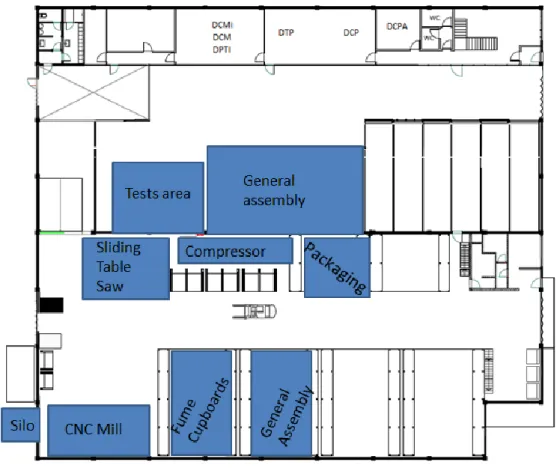
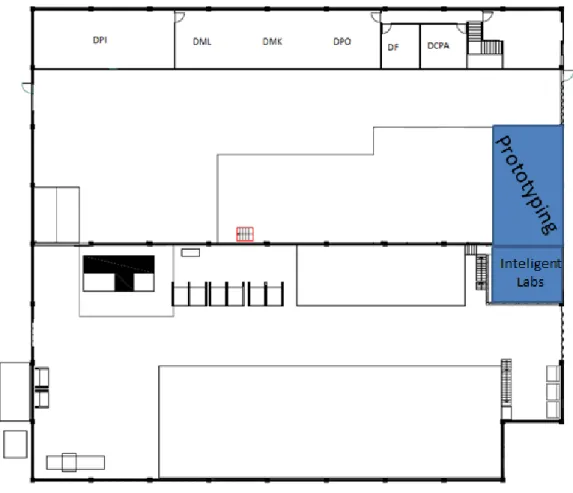
Figure 1 and Figure 2 represent the physical allocation of the aforementioned resources (mainly machinery resources).
It can be observed that the location of the heavier machines is determined by the location of the silo and the fact that the work normally flows from the sliding table saw to the CNC mill, and from there to the various applications or once again to suppliers in case some process unavailable in the factory is required.
Figure 2 - Current production layout (first floor).
3.2 Scope of the Make or Buy Analysis
In order to correctly orientate this project, there was a need to focus the scope of the analysis. After further familiarization with the products, processes available in the company and also current limitations, there was the need to determine what the main goals were for the company regarding possible production increases and the acquisition of new technologies. It is important to mention that, despite the focus of this project being on the physical production processes, the internal processes of the company were acceded and deemed enough for the company to accommodate more production capacity. In other words, the internal processes required to increase and differentiate production exist within the company and are already implemented.
These were influenced by many strategic factors that will be further explained in the qualitative decision factors, on the scenario analysis part of this document.
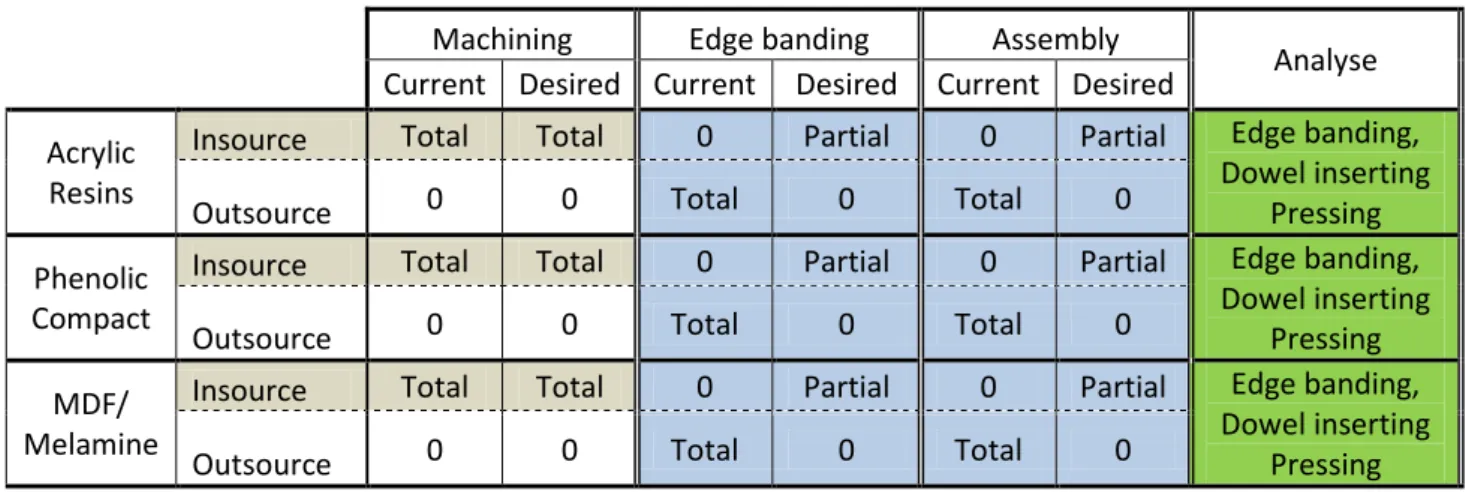
To focus the analysis on the necessities of the company, simple decision tables were created to translate any volition already existent within the company administration and any scenario that would be important to analyse in this project. These tables focus on the products and production capabilities as can be seen in Table 1 and Table 2.
Table 1 – Current and desired capacity in worktop production.
Cutting Machining Edge banding
Analyse Current Desired Actual Desired Actual Desired
Acrylic Resins Insource Total Total Total Total - -
Outsource 0 0 0 0 - -
Phenolic Compact
Insource Total Total Total Total - -
Outsource 0 0 0 0 - -
Ceramics Insource 0 0 0 0 - -
Outsource Total Total Total Total - -
Glass Insource 0 0 0 0 - -
Outsource Total Total Total Total - -
Polypropylene Insource Total Total Total Total - -
Outsource 0 0 0 0 - -
Melamine Insource Total Total Total Total 0 Partial Edge
banding
Outsource 0 0 0 0 Total 0
Corian® Insource Total Total Total Total - -
Outsource 0 0 0 0 - -
MDF Insource Total Total Total Total 0 Partial Edge
banding
Outsource 0 0 0 0 Total 0
Post Forming Insource Total Total Total Total 0 Partial Edge
banding
Outsource 0 0 0 0 Total 0
Table 2 – current and desired capacity in cabinet production.
Machining Edge banding Assembly
Analyse Current Desired Current Desired Current Desired
Acrylic Resins
Insource Total Total 0 Partial 0 Partial Edge banding,
Dowel inserting Pressing
Outsource 0 0 Total 0 Total 0
Phenolic Compact
Insource Total Total 0 Partial 0 Partial Edge banding,
Dowel inserting Pressing
Outsource 0 0 Total 0 Total 0
MDF/ Melamine
Insource Total Total 0 Partial 0 Partial Edge banding,
Dowel inserting Pressing
These tables were edited in order to better fit the purpose of this document and facilitate the understanding of the information.
By analysing these simple tables it becomes apparent which are the products the company wishes to focus this analysis and the correspondent technologies in order to be able to produce them.
In order to fully produce all the worktops, edge banding is the only technology the company does not possess, outsourcing this capability.
The other main focus of the analysis will be technical furnishings, which also require the acquisition of resources in order to provide the company with the capability to completely fabricate a product either to diminish the necessity of outsourcing or to completely produce prototypes. These resources are a dowel inserting machine and a cabinet press.
Edge banding, dowel inserting and furniture pressing will be the main focus of the analysis in the following chapter.
4 Development and Description of the Proposed Solution
In this fourth chapter the various steps of the analysis that lead to the proposed solution will be presented.
Based on the scope of the analysis, a selection of the machinery will be made, followed by a cost modelling for those selected machines. This cost modelling will lead to a scenario analysis that will provide quantitative decision factors such as time advantages and money investments or earnings. Qualitative factors will also be presented, reflecting the company strategy concerning this project and its basis.
Finally, the study of the location of the new resources will be explained and presented in the layout design.
In this chapter, several monetary values are presented for machine cost, supplies, labour and final product. These values are reference value, they might or might not represent the reality of the company in which this project was developed.
4.1 Machinery Research, Selection and Description
In the study of the scope of the make or buy analysis the new production capabilities that would be the focus of this project were determined. The acquisition of this production capabilities mainly correspond to the acquisition of new machinery that will allow the company to answer the requirements it set itself.
Currently, worktops that require edge banding need to be totally or partially outsourced. This capability is one of the main focuses of this study. As can be seen in the scheme in the Figure 3 - Worktop production options scheme. the capacity to perform edge banding would allow the worktops to be completely produced without outsourcing.
Figure 3 - Worktop production options scheme.
The capacity to totally manufacture technical furnishings is other main focus of the analysis. As can be seen in Figure 4 beyond edge banding, the production of this products requires also dowel inserting and the capacity to assemble the furniture.
Figure 4 - Technical furnishings production options scheme.
Taking into account this information, the machines selected will be presented and its functions explained.
These machines are the edgebander, the CNC drilling, gluing and dowel inserting machine, and the hydraulic-mechanic cabinet press.
Edgebander
The edgebander applies a narrow strip of material in order to create durable and aesthetically pleasing trim edges that cover the exposed sides of materials like MDF. This process increases the durability of the product and is essential in laboratorial furniture since it protects the structure of the substrate from reactive chemicals or other degradation factors.
Even though edge banding was a manual process, in modern industry applications, repetitive manufacturing steps such as worktops or general furniture parts, edge banding is applied to the substrate by an automated process using a hot melt adhesive. Hot melt adhesives can be water or solvent based and may consist of various materials.
A specific machine was selected, shown in Figure 15, with the help of the company production manager and a specialized company in the machine sourcing business in order to assure the selected machine would adjust to the specific production requirements. Edgebanders are composed by several internal groups that perform different operations in sequence, as the board slides through them. The selected edgebander can apply an edge with thickness from 0.4 to 8mm, in work pieces up to 60 mm thick, panel pre-milling unit, 2 litter glue pot capacity with heater, vertical butting unit with 2 motors, contour trimming unit, scraper unit with sprinkler for anti-adhesive liquid and glue scraper unit with cleaning buffer for edge cleaning.
Figure 5 - Suggested Edgebander.
Dowel Inserting Machine
Dowel inserting is an important task in giving structural rigidity to the technical furniture products available in the company’s catalogue. This technique allows for solid joints between two pieces.
A dowel inserting machine uses a horizontal drilling head that can punch holes of variable depth according to the dowel to be inserted, a glue inserting unit, a dowel inserting unit, a
operation is being executed. The injection of the glue is automatically timed to the release of the dowel, fixating it inside the hole previously made by the drill.
In the kind of flexible production desired by the company in this project, there were clear advantages in acquiring a dowel inserting machine that had the capability of being adjusted and controlled in a simple way, therefore this machine being a CNC machine. Variables like depth of the boring, distance between holes and functions (the machine can be set to drill, drill and insert dowel, or drill and insert dowel with glue). Figure 6 shows the actual machine that was considered in the analysis.
Figure 6 - Suggested Dowel Inserting Machine.
Cabinet Press
After the insertion of the dowels and glue, the furniture elements normally need to be submitted to a compressing force in order to maintain their dimensional characteristics while also solidifying the fittings previously completed in the dowel inserting machine. This is provided by the cabinet press as shown in Figure 17.
The suggested cabinet press machine was chosen for its capacity to be easily adjusted to several press cycles and being able to press up to four cabinets at the same time, reducing production times.
It has a maximum useful height of 1300mm and a maximum useful length of 2500mm. The beam movement is controlled by hydraulic pumps with motors that allow an accurate adjustment of the pressure and beam speed.
4.2 Cost Modelling for the Machine Acquisition
In this sub-chapter the specifics of the cost analysis of the selected machines will be presented and explained.
Fixed costs like depreciation, costs with space and insurances will be presented, as well as variable costs like labour, maintenance, tooling and energy.
The determination of this costs lead to the execution of a model that allowed the analysis of various scenarios. The main tool used for this was Microsoft Excel, allowing the automation of the calculations and the possibility to present various scenarios as required.
4.2.1 Fixed Costs Determination
In this specific project, the fixed costs involved were the depreciation, the cost of the space occupied by the machines and the cost of the insurances. Depreciation will be considered in a further stage, under Model Execution (4.2.3), when the total cost of each machine is explained.
In Table 3 the rent cost per square meter and the building insurance for the company’s warehouse is presented.
Table 3 - Rent and insurance costs for the company’s warehouse. Warehouse rent 2,50 € [€/m2] per month Warehouse insurance 500,00 € [€] per year
In Table 4, the dimensions of the work area occupied by each machine are presented. To obtain these values, the machine manuals were consulted in order to add to the machine precise dimensions the space necessary to execute the specific work.
Table 4 – Work area occupied by the selected machines. length [m] width [m]
Edgebander 9,8 5,7
Dowel inserting machine 2 3,1
Cabinet press 3 2,7
After consulting with the insurance company that operates with the company for which this project is destined, the values of the insurances for each machine were obtained. They are presented on Table 5, as well as the calculated total cost of space and insurance for each machine per service hour. This value is obtained by adding the total space costs (rent and building insurance) with the individual machine insurance and dividing by the total hours of service of the considered period.
Table 5 - Space and insurance costs results for the selected machines. Individual machine
insurance [€] per year
Occupied work area [m2]
Total cost [€/h of service]
Edgebander 245,90 € 55,86 0,08 €
Dowel inserting machine 126,17 € 6,2 0,01 €
Cabinet press 181,87 € 8,1 0,01 €
4.2.2 Variable Costs Determination
The main variable costs to determine in this analysis were the labour costs, electricity consumption costs, maintenance and tools wear. Although maintenance costs and tools wear are considered in the next sub chapter, these were obtained through consulting specific machines manuals or contacting the manufacturer of the machine.
To determine labour costs several values had to be considered. These values are demonstrated in Table 6, as is the resulting cost per hour of service from the average worker. This value will be taken into consideration in the total cost of the hour for each machine.
Table 6 - Labour costs.
Average gross salary 810,00 €
Social security costs (per month) 23,75% 192,38 €
Workplace accidents insurance (per month) 2,50% 20,25 €
Food allowance (daily) 6,00 € 126,00 €
Monthly cost per worker 1.148,63 €
Annual salaries 14
Annual cost per worker 16.080,75 €
Work days per year 255
Service hours per day 8
Because the company does not adjust its production to the hours of lower energy costs, an average value of 0,12€ per KWh was estimated and used in the calculations of the consumption of electricity. Having consulted the power rating for each machine in the respective manuals, the value for the electricity consumption costs per hour of work for each machine can be calculated, as presented in Table 7.
Table 7 - Electricity costs.
Machine Power [W]
Consumption [Wh/Day]
Consumption
[KW/month] Cost/month [€] Cost/h [€]
Edgebander 11000 88000 2640 312,95 € 1,30 €
Dowel inserting machine 550 4400 132 15,65 € 0,07 €
Cabinet press 1500 12000 360 42,68 € 0,18 €
4.2.3 Model Execution
Table 8 features the cost modelling for the suggested edgebander. In this model, the depreciation costs per year are calculated for different time spans to better present them to the company’s administration. This value is affected by the occupation rate expected for the machines according to the company’s expected production objectives.
Table 8 – Edgebander Cost Modelling. Fixed Costs
Machine Cost 39.800,00 €
Structural alterations 500,00 €
Investment 40.300,00 €
5 years 10 years 15 years 20 years Depreciation/year 8.060,00 € 4.030,00 € 2.686,67 € 2.015,00 €
Occupation rate 85%
Space costs per service hour 0,08 €
Insurance costs per year 245,90 €
Total Fixed Costs/h 1,69 €
Variable Costs
Maintenance (variable intervals) 150,00 €
Tooling Milling Cutter 700,00 €
Labour 7,88 €
Electricity consumption/h 1,30 €
Total Variable Costs/h 9,53 €
In this specific case, the occupation rate translates the expected percentage of working hours that the machine will be operating.
It is important to mention that transport costs as well as installation are responsibilities of the supplier of the machines and are included on the machine cost. Even though many of the production workers of the company already worked with similar machines, their training is also included in these costs and provided by specialists.
Table 9 - Dowel Inserting Machine Cost Modelling. Fixed Costs
Machine Cost 19.600,00 €
Structural alterations 500,00 €
Investment 20.100,00 €
5 years 10 years 15 years 20 years Depreciation/year 4.020,00 € 2.010,00 € 1.340,00 € 1.005,00 €
Occupation rate 85%
Space costs per service hour 0,01 €
Insurance costs per year 126,17 €
Total Fixed Costs/h 0,85 €
Variable Costs
Maintenance (variable intervals) 70,00 €
Tooling Drill bit 500,00 €
Labour 7,88 €
Electricity consumption/h 0,07 €
Total Variable Costs/h 8,19 €
Total Cost/h 8,27 €
Tooling wear costs are calculated according to the known wear of the tools stated by the machine manufacturer and tool providers. The durability of the tools can vary according to the material and work in execution, so the weight of the tool replacement cost was calculated by an approximation of the expected durability in order to translate that specific cost into a value per hour of work. Only the edgebander and the CNC dowel inserting machine present tool wear, as can be seen also in Table 9.
In the formulation of these tables in it was important to keep a high level of flexibility and adaptability to various scenarios. In order to achieve that objective, the spread sheets created to calculate costs were designed to be dynamic and automatically update if any value used within the calculations would be changed. Even the change in small variables like, for example, the daily food allowance given to a designated worker would reflect itself in the