
New Natural Hydraulic Lime mortars – Physical and microstructural properties in different curing conditions.
J. Griloa, P. Fariab, R. Veigac, A. Santos Silvad, V. Silvae, A. Velosaf
a. National Laboratory for Civil Engineering, Av. do Brasil, 101, Lisbon, Portugal, [email protected]
b. Department of Civil Engineering, NOVA University of Lisbon, 2829-516 Caparica, Portugal, [email protected]
c. National Laboratory for Civil Engineering, Av. do Brasil, 101, Lisbon, Portugal, [email protected] d. National Laboratory for Civil Engineering, Av. do Brasil, 101, Lisbon, Portugal, [email protected] e. Department of Civil Engineering, NOVA University of Lisbon, 2829-516 Caparica, Portugal,
f. Department of Civil Engineering, Geobiotec, University of Aveiro, Aveiro, [email protected]
ABSTRACT
The new version of EN 459–1 standard for building limes redefined the classes of hydraulic limes and made the producers reformulate or reclassify their natural hydraulic limes.
This work evaluates the mechanical, physical and microstructural behavior of mortars formulated with a recently produced natural hydraulic lime NHL3.5 that conforms to EN 459-1, submitted to natural marine environment, humid and standardized conditions, and also the benefits and drawbacks of adding metakaolin in partial replacement of lime.
Mortars with NHL3.5 present positive results at young ages. The metakaolin addition increases strength while decreasing the capillary water coefficient. The behavior in an aggressive marine environment seems promising.
Keywords (max. 10 words)
EN 459–1:2010; natural hydraulic lime; mortar; curing condition; metakaolin; laboratory characterization
1. Introduction
There are records and archaeological sites which prove that ancient civilizations used limes with pozzolans for the preparation of mortars with hydraulic characteristics namely to be into contact with water, which contributed to the development of limes with hydraulic properties [1]. With the discovery of hydraulic binders during the 18th century, air limes were gradually replaced by hydraulic limes and by the beginning of the 20th century, mainly by Portland Cement (PC), a binder with a faster hardening and stronger mechanical characteristics [1-5].
Nowadays, it is common knowledge that the PC used in mortars for conservation and repair of old buildings was generally a wrong choice, being responsible for several problems in the repaired area, where it is frequently associated with the origin of the pathology [6,7]. Many buildings are prone to moisture action and particularly to marine environment, which can lead to degradation of rendering systems. This situation urges the need to select adequate mortars to be applied for repair purposes. In the last decades, due to better compatibility with masonries and facades of old buildings, lime mortars are slowly returning to repair works. Bearing this in mind, facing the degradation of the housing stock and the global construction crisis, maintenance of buildings arises as both a work and study opportunity, promoting the development of new and compatible mortars based on lime for the repair of old masonries.
Nowadays natural hydraulic lime NHL3.5 can be produced by calcination at around 900ºC of more or less argillaceous or siliceous limestones, forming calcium silicates and aluminates. The implementation of the new version of European Standard EN 459–1:2010 [8] made some producers reformulate or reclassify some of their building limes [9-11]. The new version of the building lime standard establishes three groups of limes with hydraulic properties: the natural hydraulic limes, NHL, the hydraulic limes HL and the formulated limes, FL. Some of the limes formerly classified as NHL by EN 459– 1:2001 [12] are now classified as HL or FL by EN 459–1:2010 [8] due to more restricted requirements for NHL. This new version of EN 459–1 standard defines three
classes for natural hydraulic limes according to compressive strength developed after 28 days of curing, as well as to Ca(OH)2 content. NHL3.5 limes must present a
characteristic value of compressive resistance between 3.5 MPa and 10 MPa at 28 days and a content of Ca(OH)2 of at least 25 % (weight percentage).
Pozzolans are defined as materials rich in silica and/or alumina in amorphous form, with high specific surface that have the property of reacting with calcium hydroxide, in the presence of water, forming hydraulic products. The pozzolanic materials can be obtained by many ways: they can be natural, originating from igneous rocks and only need to have their particle size reduced, or they can be artificial. Artificial pozzolans can be produced by thermal treatment. This is are the case of ashes resulting from the combustion of vegetal products (like rice husk ashes), of natural materials such as clays for example metakaolin. They may result directly from ground industrial byproducts (e.g. some ceramics or coal and biomass fly ashes) [13-15]. Their use has great advantages, both economic and environmental. Artificial pozzolans from calcinated materials are produced recurring to thermal treatment at temperatures below the sintering temperature of hydraulic binders. Therefore when incorporated in building materials they contribute to diminishing greenhouse gas emissions, which makes them more sustainable materials than common hydraulic binders. Interest concerning the use of pozzolans has been increasing once the mixture of hydraulic binders and pozzolans results in mortars with improved durability characteristics [15,16].
Metakaolin (MK) is a pozzolanic material resulting from kaolinitic clays thermally treated. After calcination and grinding it can become a highly reactive pozzolan with a high potential for mortars based on lime. However, studies of lime-metakaolin mortars and renders are relatively rare (only about 30–40 references in Web of Science during the last 30 years) [17], compared to cement-metakaolin mortars, and are even more so in the case of natural hydraulic lime-metakaolin mortars.
The curing conditions are an important parameter for the mortars’ characterization. Different curing conditions produce changes in characteristics due to the development of chemical reactions in time [16,18] and propitiate different developments in the setting and hardening reactions, which will influence the mortars strength, porosity and microstructure [11,19]. Actually, the onsite curing conditions are completely different from laboratory standardized conditions, so it is important to analyze the influence of this factor, by testing mortars with different curing conditions, either laboratorial or natural.
In this paper, mortars formulated with a new NHL3.5, without and with metakaolin, are characterized in terms of mechanical, water action and porosity behaviour after different curing conditions, one of them being a natural marine environment curing condition in. The influence of metakaolin incorporation and of the curing conditions on the evolution of NHL mortars with ageing is evaluated in terms of their durability characteristics.
2. Experimental study
The experimental study involved hydraulic lime mortars preparation, based on a natural hydraulic lime NHL3.5 with binder:aggregate ratio of 1:5 in weight. The mass of binder was maintained (NHL mortar) or partially replaced by metakaolin (MK) in weight percentages of 10% (NHL_10MK mortar) and 20% (NHL_20MK mortar). The mortar samples were exposed to three different curing conditions, and afterwards tested at different ages, up to 180 days. The weight ratio 1:5 was chosen because it corresponds approximately to a commonly used reference volumetric 1:3 binder:aggregate ratio [14], in which the volume of binder fills the voids between the sand grains,
2.1 Mortars preparation: materials and mixture
The mortars were prepared with a Portuguese natural hydraulic lime NHL3.5 [8] produced by SECIL, and a French metakaolin Argical M1200S produced by IMERYS. The chemical compositions of the NHL and the MK are presented in Table 1. The MK’s Blaine specific surface is 3.38 m2/g, and the particle size distribution d(10%) = 1.53 µm, d(50%) = 4.35 µm and d(90%) = 11.97 µm
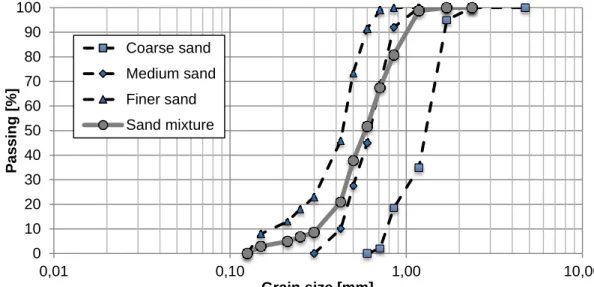
A mixture of three washed and well graded siliceous sands was used as aggregate. The mixture of sands was composed of coarse sand, medium sand and finer sand in a volumetric ratio of 1:1.5:1.5, and intended to reduce the volume of voids between the grains, increasing the loose bulk density. The particle size distribution curves of each sand type and of the corresponding mixture are presented in Figure 1. The loose bulk density of the granular constituents, determined according EN 1097-3:1998 [20], is presented in Table 2. For each NHL-MK mortar, a defined percentage of lime (10% or 20%, in weight) was substituted by the same weight of metakaolin. The mortars’ weight percentage of lime substitution by MK, the volumetric and the weight compositions in terms of NHL+MK:Sand and NHL:MK:Sand, are shown in Table 3.
A quantity of potable water, previously determined to obtain mortars with flow consistency around of 150mm was used. The preparation of the mortars and samples was based on 1015–2:1998/A1:2006 [21] but adapted to lime-based mortars, as follows: each mortar began with the correct weighing and manual homogenization of all dry materials and their introduction into the mechanical mixer container; the mechanical mixer worked at low speed and the water was introduced during the first 15 to 20 seconds; after 150 seconds the machine was stopped to scrape the borders and involve the mortar and turned on for another 30 seconds to complete the mixture.
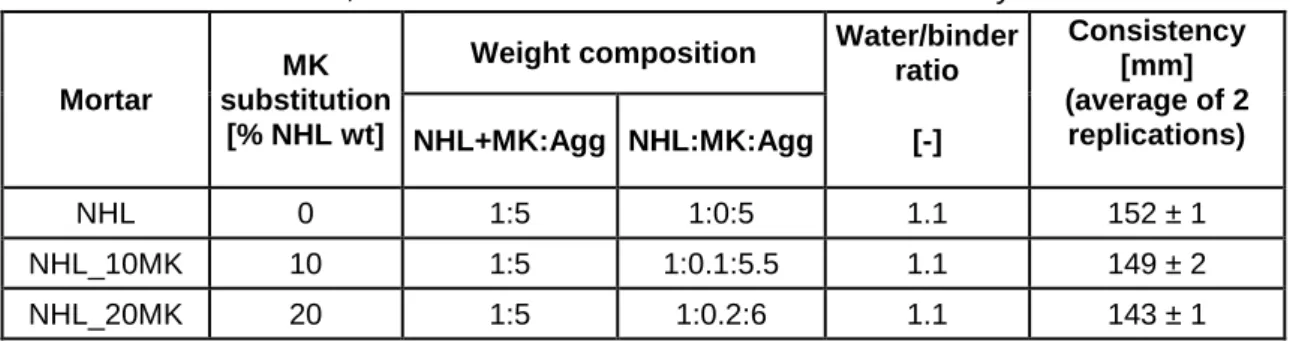
The water/(NHL+MK) ratio of the mortars is presented in Table 3, as well as the flow table consistency, which was determined based on the European Standard EN 1015–3:1999 [22]. The mortars were then cast into metallic prismatic moulds with 40 x
40 x 160 (mm), completed with two layers, each of one mechanically compacted with 20 strokes within a mechanical mortars compacter device.
Table 1 - Chemical composition (in wt. %) of materials used as binder in mortar preparation [11].
Material SiO2 Al2O3 Fe2O3 MnO MgO Na2O K2O TiO2 P2O5 SO3 CaO LOI*
MK 54.39 39.36 1.75 0.01 0.14 – 1.03 1.55 0.06 - - 1.90
NHL 5.70 1.84 1.22 0.02 1.00 0.08 0.49 0.14 0.03 1.00 62.00 26.00
LOI - Loss on ignition
Table 2 – Loose bulk density of the materials.
Loose bulk Density (g/cm3)
MK 0.294 NHL 0.846 Coarse Sand 1.412 Medium sand 1.405 Finer sand 1.388 Sand mixture 1.463
It can be seen from Table 2 that among the different sand types, the finer sand presents the minor loose bulk density value, as expected. As it can be observed by Figure 1 the sand mixture presents an extended particle size distribution with the objective to obtain more compact mortars. In Table 3 the weight proportions of the constituents are presented for all the mortars.
Fig. 1 – Particle size distribution of the sands and its mixture.
0 10 20 30 40 50 60 70 80 90 100 0,01 0,10 1,00 10,00 P as sing [ % ] Grain size [mm] Coarse sand Medium sand Finer sand Sand mixture
Table 3 – Mortar mixes identification, metakaolin weight content, volumetric and weight ratios, water/binder ratio and flow table consistency.
Mortar
MK substitution
[% NHL wt]
Weight composition Water/binder
ratio Consistency [mm] (average of 2 replications) NHL+MK:Agg NHL:MK:Agg [-] NHL 0 1:5 1:0:5 1.1 152 ± 1 NHL_10MK 10 1:5 1:0.1:5.5 1.1 149 ± 2 NHL_20MK 20 1:5 1:0.2:6 1.1 143 ± 1
2.2 Curing conditions
The freshly moulded mortar samples were placed inside polyethylene bags for 7 days for initial curing; after the two first days the samples were demoulded and continued inside the bags. After this pre-curing time, the samples were divided in three groups, each group corresponding to a distinct curing condition. The curing conditions employed were: M - natural marine environment at the experimental station of LNEC in Cabo Raso (Cascais village, Portugal, close to the Atlantic Coast); H – laboratorial controlled humid curing, with temperature (T) = 21 ± 2 ºC and relative humidity (RH) = 95 ± 5%; S - laboratorial controlled standard curing, according to EN 1015–11 [23] where the mortars were placed in T = 20 ± 3 ºC and RH = 65 ± 5%.
The mortar samples exposed to M curing were placed vertically, with the top protected by a ceramic tile to avoid the risk of damage by weather during the first days, and experienced natural salt water spray and salt fog conditions from January to July 2012 (winter and spring time). The average T and RH conditions during this period in the experimental station are presented in Table 4.
Table 4 – Average values of T and RH at marine environment M curing condition
Curing periods Temperature [°C] Relativity Humidity [%]
0-28 days 10.2±3.7 57.0±17.2
29-90 days 13.7±3.4 67.3±17.4
2.3 Testing program: methods and results
Characterization tests of hardened mortars were carried out at 28 days and 180 days of age for all the mortars in all curing conditions. The day before testing, the samples were all conditioned at S curing conditions to guarantee that none was too wet for testing.
Tests were generally performed on a minimum of three samples of each mortar/curing/age, except for mercury porosimetry for which only one sample of each mortar/curing/age was used.
Mortar specimens were initially tested for dynamic modulus of elasticity and flexural strength. After that, each specimen produced two halves. One half was subjected to compressive strength test, which resulted in sufficiently intact parts for the hydrostatic open porosity and mercury porosimetry tests; the other half specimen was subjected to another set of tests, including water absorption capillarity and drying.
2.3.1 Dynamic modulus of elasticity and flexural and compressive strength
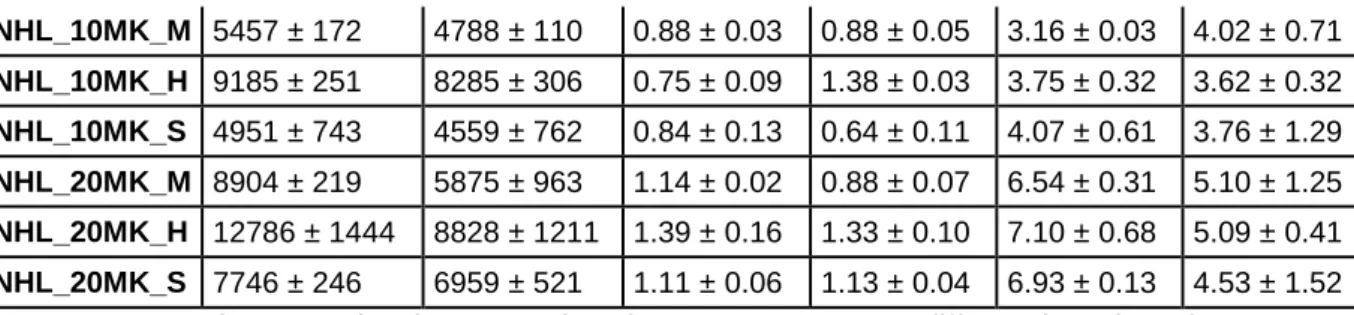
The dynamic modulus of elasticity test was based on EN 14146:2004 [24], with measurement of the longitudinal resonance frequency of the sample performed by a ZEUS Resonance Meter equipment. The flexural (FS) and compressive (CS) strength tests, were based on the European standard EN 1015–11:1999 / A1: 2006 [23], and the flexural and compressive actions were imposed through a universal machine, ZWICK Z050. For flexural test a 2 kN load cell was used while for compressive strength a 50 kN load cell was applied. The test results can be found in Table 5.
Table 5 – Dynamic modulus of elasticity, flexural and compressive strength (average values and standard deviation) of mortars aged 28 and 180 days.
Mortar E [MPa] FS [MPa] CS [MPa]
28 days 180 days 28 days 180 days 28 days 180 days
NHL_M 4142 ± 127 6746 ± 227 0.50 ± 0.02 1.14 ± 0.03 1.19 ± 0.14 2.54 ± 0.37
NHL_H 5181 ± 467 7243 ± 198 0.87 ± 0.05 1.27 ± 0.16 1.51 ± 0.16 2.50 ± 0.12
NHL_10MK_M 5457 ± 172 4788 ± 110 0.88 ± 0.03 0.88 ± 0.05 3.16 ± 0.03 4.02 ± 0.71 NHL_10MK_H 9185 ± 251 8285 ± 306 0.75 ± 0.09 1.38 ± 0.03 3.75 ± 0.32 3.62 ± 0.32 NHL_10MK_S 4951 ± 743 4559 ± 762 0.84 ± 0.13 0.64 ± 0.11 4.07 ± 0.61 3.76 ± 1.29 NHL_20MK_M 8904 ± 219 5875 ± 963 1.14 ± 0.02 0.88 ± 0.07 6.54 ± 0.31 5.10 ± 1.25 NHL_20MK_H 12786 ± 1444 8828 ± 1211 1.39 ± 0.16 1.33 ± 0.10 7.10 ± 0.68 5.09 ± 0.41 NHL_20MK_S 7746 ± 246 6959 ± 521 1.11 ± 0.06 1.13 ± 0.04 6.93 ± 0.13 4.53 ± 1.52
Note: Compressive strength values at 28 days from mortars NHL are different from the values indicated by the producer because the aggregates and the water quantity used in the mortar´s
preparation, as well as mixing procedures, are different from those that are standardized.
2.3.2 Bulk density and open porosity by hydrostatic method
Before the test, mortar samples were placed in an oven at 60°C for a minimum of 24 hours in order to attain mass stabilization. These tests were performed based on stone standard EN 1936:2006 [25], by total saturation with water under vacuum and hydrostatic weighing. Samples were kept dry and under vacuum for 24 hours , maintained under vacuum but immersed in water for another 24 hours and then left for 24 hours immersed at ambiance pressure; after these periods they were hydrostatically and water saturated weighed. The results can be consulted in Table 6.
Table 6 – Bulk density and open porosity by the hydrostatic method (average and standard deviation) of mortars aged 28 and 180 days.
Mortar Open porosity - hydrostatic [%] Bulk density [kg/m
3
]
28 days 180 days 28 days 180 days
NHL_M 28.1 ± 0.2 25.1 ± 0.5 1787 ± 9 1903 ± 8 NHL_H 28.6 ± 0.9 25.9 ± 1.3 1762 ± 19 1902 ± 12 NHL_S 27.9 ± 0.6 25.7 ± 0.5 1783 ± 9 1884 ± 18 NHL_10MK_M 28.3 ± 0.2 26.2 ± 0.6 1735 ± 11 1855 ± 17 NHL_10MK_H 27.9 ± 0.8 26.7 ± 0.6 1755 ± 10 1845 ± 13 NHL_10MK_S 27.7 ± 0.7 26.2 ± 0.9 1759 ± 18 1848 ± 14 NHL_20MK_M 27.7 ± 0.1 26.2 ± 0.2 1733 ± 22 1838 ± 3 NHL_20MK_H 28.0 ± 0.6 26.5 ± 0.3 1750 ± 15 1826 ± 7 NHL_20MK_S 27.1 ± 0.2 26.5 ± 0.5 1753 ± 23 1835 ± 19
2.3.3 Mercury porosimetry
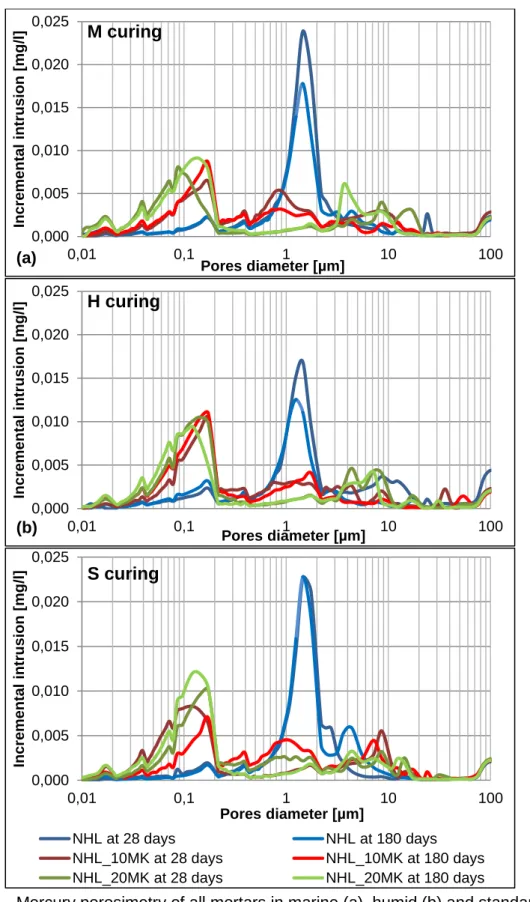
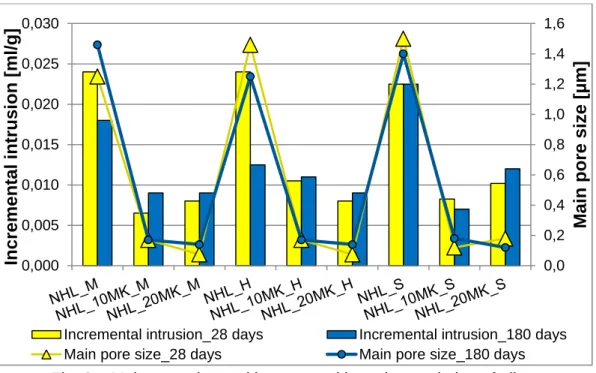
Pore size distribution was determined with a mercury porosimeter Micromeritics Autopore II. The test samples were previously placed in an oven at 40°C for mass stabilization. Penetrometers had a 5 cm3 bulb and total capacity of 1.716 cm3; the samples were prepared in order to occupy the greater part of this volume. Tests began with low pressure testing, ranging from 0.014 MPa to 0.207 MPa, and afterwards high pressure analysis from 0.276 MPa to 206.843 MPa. The range of the micropores is located at 0.1-1µm. Incremental curves are plotted in Figure 2. The pore size diameter is expressed in microns and each step of the mercury intrusion is represented in ml/g. Figure 3 shows the main pore size and incremental intrusion evolution. All curing conditions show a decrease of the main pore size with the increment of MK content.
Fig. 2 – Mercury porosimetry of all mortars in marine (a), humid (b) and standard (c) curing conditions. 0,000 0,005 0,010 0,015 0,020 0,025 0,01 0,1 1 10 100 Incre men tal int ru sion [ mg /l] Pores diameter [µm]
M curing
(a) 0,000 0,005 0,010 0,015 0,020 0,025 0,01 0,1 1 10 100 Incre men tal int ru sion [ mg /l] Pores diameter [µm]H curing
(b) 0,000 0,005 0,010 0,015 0,020 0,025 0,01 0,1 1 10 100 Incre men tal int ru sion [ mg /l] Pores diameter [µm]S curing
NHL at 28 days NHL at 180 days NHL_10MK at 28 days NHL_10MK at 180 days NHL_20MK at 28 days NHL_20MK at 180 daysFig. 3 – Main pore size and incremental intrusion evolution of all mortars.
2.3.4 Capillarity water absorption
The test of water absorption by capillarity was based on the European standards EN 1015–18:2002 [26] and EN 15803:2009 [27]. The mortar specimens were placed in an oven at 60°C for a minimum of 48 hours for mass stabilization. The specimens were laterally wrapped in polyethylene film to waterproof the lateral surfaces, dry weighed and then vertically placed in a watertight box over an open grid, under stable hygroscopic conditions, with water depth of 5 mm. Mortar specimens were weighed after 5, 10, 15, 30 minutes and at each hour until 9 hours of testing, and then weighed every day until the mortars reached a mass difference lower than 1% in 24 hours. Values of absorbed water mass lead to the capillary absorption curve, Figure 4, relating in the abscissae axis the root of time in minutes ( in min1/2
) and in the ordinate axis the mass of water absorption by the base of the mortar specimen in contact with water (ms in kg/m2).
By this curve it was possible to obtain the capillary water coefficient (C in kg/(m2.min1/2)), which expresses the initial speed of capillary absorption and is determined by the slope of the initial linear section of the curve (including the origin),
0,0 0,2 0,4 0,6 0,8 1,0 1,2 1,4 1,6 0,000 0,005 0,010 0,015 0,020 0,025 0,030
M
a
in pore
s
ize
[µm]
Inc
re
me
nt
a
l
intrusi
on [ml/g]
Incremental intrusion_28 days Incremental intrusion_180 days Main pore size_28 days Main pore size_180 days
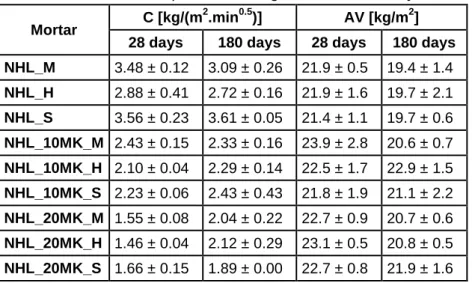
and the asymptotic value (AV in kg/m2) that corresponds to the maximum value of water absorbed by contact area during the test. The results obtained are presented in Table 7.
Table 7 – Capillary water coefficient and asymptotic water absorption (average and standard deviation) of mortars aged 28 and 180 days.
Mortar C [kg/(m
2
.min0.5)] AV [kg/m2]
28 days 180 days 28 days 180 days
NHL_M 3.48 ± 0.12 3.09 ± 0.26 21.9 ± 0.5 19.4 ± 1.4 NHL_H 2.88 ± 0.41 2.72 ± 0.16 21.9 ± 1.6 19.7 ± 2.1 NHL_S 3.56 ± 0.23 3.61 ± 0.05 21.4 ± 1.1 19.7 ± 0.6 NHL_10MK_M 2.43 ± 0.15 2.33 ± 0.16 23.9 ± 2.8 20.6 ± 0.7 NHL_10MK_H 2.10 ± 0.04 2.29 ± 0.14 22.5 ± 1.7 22.9 ± 1.5 NHL_10MK_S 2.23 ± 0.06 2.43 ± 0.43 21.8 ± 1.9 21.1 ± 2.2 NHL_20MK_M 1.55 ± 0.08 2.04 ± 0.22 22.7 ± 0.9 20.7 ± 0.6 NHL_20MK_H 1.46 ± 0.04 2.12 ± 0.29 23.1 ± 0.5 20.8 ± 0.5 NHL_20MK_S 1.66 ± 0.15 1.89 ± 0.00 22.7 ± 0.8 21.9 ± 1.6
Fig. 4 – Water absorption curves of all mortarsin marine (a), humid (b) and standard (c) curing condition. 0 5 10 15 20 25 0 10 20 30 40 A b sr o rb ed W ater [kg/m 2] Time [minutes0,5]
M curing
(a) 0 5 10 15 20 25 0 10 20 30 40 A b sr o rb ed W ater [kg/m 2] Time [minutes0,5]H curing
(b) 0 5 10 15 20 25 0 10 20 30 40 A b sr o rb ed W ater [kg/m 2] Time [minutes0,5]S curing
NHL at 28 days NHL at 180 days NHL_10MK at 28 days NHL_10MK at 180 days NHL_20MK at 28 days NHL_20MK at 180 days (c)2.3.5 Drying test
The drying test was performed based on RILEM specification, Test nº. II.5 [28] and on Italian standard, NORMAL 29/88 [29]. The test was conducted in a stable environment in terms of temperature and humidity (T = 20±3 ºC and RH = 65±5 %). Only the top of the samples was not waterproof and the test began when the capillary test stopped, with the samples completely saturated with water. The samples were weighed in the first hours and daily thereafter up to 480 hours, when all the samples met equilibrium with the environmental conditions. The water content (wt) of the samples was determined by Equation 1:
[Equation 1] wti [%]: water content at instant ti
mi [g]: mass of the sample at instant ti
m0 [g]: dry mass of the sample
The drying curve was built, relating in abscissae the time in hours (t in h) and in ordinate the water content, in percentage (wt in %).
With the water content it is also possible to calculate the drying index (DI), value that reflects the global drying evaluation; a minor value of the drying index reflects a globally easier drying behavior. The drying index can be calculated by equation 2 from the Italian standard [29] and was simplified to Equation 3:
∫ (
)
[Equation 2]
∑
[(
) (
)]
[Equation 3] DI [-]: drying index
tf [h]: total duration of the test
wti [%]: water content in time ti
wmax [%]: maximum water content at initial testing time
f(wt) [-]: water content function of time
Instead of the water content (in %) the drying curve can also be determined with the mass per drying area of the top of the sample (in kg/m2), Figure 5. The drying rate was calculated by the slope of the initial portion of the drying curve and represents the initial velocity of water drying; a higher slope of the curve to the horizontal axis reflects major initial drying rate and faster initial drying (Drying Rate, DR).
The drying index and drying rate results are shown on Table 8.
Table 8 – Drying index and drying rate (average values and standard deviation) of mortars aged 28 and 180 days.
Mortar DI [-] DR [kg/(m
2
.h)]
28 days 180 days 28 days 180 days
NHL_M 0.35 ± 0.02 0.34 ± 0.09 0.13 ± 0.01 0.10 ± 0.02 NHL_H 0.35 ± 0.03 0.34 ± 0.02 0.13 ± 0.01 0.11 ± 0.01 NHL_S 0.34 ± 0.02 0.32 ± 0.07 0.13 ± 0.01 0.09 ± 0.02 NHL_10MK_M 0.40 ± 0.02 0.42 ±0.01 0.14 ± 0.02 0.07 ± 0.02 NHL_10MK_H 0.45 ±0.01 0.41 ± 0.03 0.12 ± 0.01 0.11 ± 0.02 NHL_10MK_S 0.38 ±0.04 0.37 ± 0.00 0.14 ± 0.00 0.10 ± 0.02 NHL_20MK_M 0.49 ±0.02 0.43 ± 0.02 0.12 ± 0.00 0.10 ± 0.02 NHL_20MK_H 0.55 ±0.02 0.40 ± 0.01 0.10 ± 0.01 0.10 ± 0.02 NHL_20MK_S 0.47 ±0.01 0.41 ± 0.03 0.12 ± 0.00 0.10 ± 0.01
Fig. 5 – Drying curves of all mortarsin marine (a), humid (b) and standard (S) curing condition. 0 2 4 6 8 10 12 14 16 0 100 200 300 400 500 A b sr o rb ed W ater [kg/m 2] Time [minutes0,5]
M curing
(a) 0,0 0,2 0,4 0,6 0,8 1,0 1,2 1,4 1,6 0 100 200 300 400 500 A b sro rb ed W at er [kg /m 2] Time [minutes0,5]H curing
(b) 0 2 4 6 8 10 12 14 16 0 100 200 300 400 500 A b sr o rb ed W ater [kg/m 2] Time [minutes0,5]S curing
NHL at 28 days NHL at 180 days NHL_10MK at 28 days NHL_10MK at 180 days NHL_20MK at 28 days NHL_20MK at 180 days (c)3. Discussion
Microstructure
The MIP results show that at 28 and 180 days the mortars with MK present a remarkable pore size reduction when compared with the NHL mortars. At 28 days, the NHL mortars present pores around 1.40 µm, while the NHL_10MK and NHL_20MK mortars mainly present pores around 0.15 µm to 0.11 µm. At 180 days, the mortars without MK present pores around 1.37 µm, while the NHL_10MK mortars present pores around 0.17 µm and 0.13 µm for NHL_20MK mortars. These results also show an improvement of the pore size reduction with the increase of MK content.
The pore size distribution does not register a significantly variation with ageing, although some differences can be seen for MK mortars in humid and marine curing; however the main pore sizes decrease in mortars without MK and increase in mortars with MK.
Values of open porosity and average pore radius are within the range of NHL-based mortars recently studied by Gullota [30].
Mechanical parameters
Results of the three mechanical parameters – flexural strength, compressive strength and dynamic modulus of elasticity have a similar evolution trend, which validates the obtained results. For that reason the discussion of results will focus mainly on compressive strength but, with no major changest, can be extrapolated for E and FS.
At young ages (28 days) the humid curing leads to higher results of CS, as expected considering that a higher value of RH favors a higher hydration degree. With the addition of MK, mortars mechanical behavior is even higher inhumid curing conditions, reflecting the fact that higher values of RH favor both hydration and pozzolanic reactions. These two reactions influence the microstructure evolution,
contributing to the reduction of the main pore size, leading to more compact mortars and consequently to higher CS.
At older ages (180 days) it can be seen that the marine curing leads to equivalent results to those obtained with humid curing. That is a promising result because itpermits to foresee a good performance of these mortars, with or without MK, in exterior marine natural environment even if the initial relative humidity is not very high, as can be noticed by Table 4.
In mortars without MK the CS evolution with curing time shows an increment of strength. That fact can be associated with the evolution both of the hydration and carbonation reactions, and this increase is more noticeable at curing conditions with moisture access (M and H curing). However, mortars with MK show a general strength decrease over time for all curing conditions (except for M curing with 10% MK), suggesting instability of the hydrated compounds that are formed. This fact was discussed elsewhere based on mineralogical and chemical analysis [11] and has already been pointed out for different formulations, with air lime and MK [31] and hydraulic limes [16].
Analyzing the MIP results it is observed that main pores with smaller sizes lead to higher values of CS, Figure 6. This fact is clear in the mortars’ evolution, where mortars without MK present the highest main pore size and smallest CS values, in opposition to the mortars with MK content that have the lowest main pores size and bigger CS values.
Fig. 6 – Main pore size and compressive strengths evolution. Water action behavior
The water behavior of mortars was studied by water absorption by capillary test and drying test.
Mortars without MK show a decrease of asymptotic values with curing time (Table 6 and Figure 4), showing an effect of the porous structure infilling. In fact MIP results show a decrease of pores size and incremental intrusion, particularly in marine and humid curing, which also justifies the CS evolution with curing time. The addition of MK also shows (except for NHL_10MK with humid curing) a decrease of total Cand AV over time in all curing conditions. All the different curing conditions present very similar values for each mortar, although the marine condition should be highlighted for presenting mortars with the lowest values of AV at older ages, possibly due to partial infilling of pores by salts.
The capillary water coefficient shows that, at young ages, mortars with MK addition present the lowest values, similarly to the study by Vejmelková [17]. This fact is consistent with the MIP results, where it can be observed that mortars with MK have pores mainly with smaller dimensions than mortars without MK, resulting in a lower absorption rate; it is also noted that at young ages the humid curing conditions show
0 1 2 3 4 5 6 7 8 0,0 0,2 0,4 0,6 0,8 1,0 1,2 1,4 1,6
CS
[M
P
a
]
M
a
in pore
s
ize
[µm]
Main pore size_28 days Main pore size_180 days
the lowest values. The relationship between C and the main pore size in MIP can be analyzed in Figure 7. Over curing time the evolution in all mortars is not very significant; however the increase of C in mortars with MK can be registered.
Fig. 7 – Capillary water coefficient and main pore size evolution.
In terms of results of drying test and specifically in relation to the drying index, it can be seen that NHL mortars, in all curing conditions, present the lowest values at young and older ages. Such evidence can be explained by the larger pores diameter of the NHL mortars, which allow greater overall drying together with small variation of open porosity. Over time it is possible to observe that drying rate values have a decreasing trend, associated with the refilling of the porous structure that hinders the drying process.
4. Conclusions
The mortars presented in this study were formulated with a new NHL 3.5 and exposed to laboratorial and outdoors marine curing conditions.
The introduction of metakaolin improved the mechanical resistances of the NHL
0,0 0,2 0,4 0,6 0,8 1,0 1,2 1,4 1,6 0,0 0,5 1,0 1,5 2,0 2,5 3,0 3,5 4,0
M
a
in pore
s
ize
[µm]
C [kg/(m
2.m
in
0 ,5)]
C_28 days C_180 daysclear enhancement in terms of lowering capillary water absorption without worsening the drying ability to an inadequate degree. These improvements are also connected to the curing conditions used. At this respect, it is shown that higher RH curing regimes benefits hydration and pozzolanic reactions, and also contributes to voids infilling.
Moisture presence has a great contribute to the infilling of the porous structure of these mortars, shown by the decrease of main pore sizes of the NHL mortars. Considering the global analysis of absorption rate and drying rate, the mortars with MK incorporation present appropriate results, and particularly the NHL_20MK mortars, showing significantly lower capillary coefficient and comparatively similar drying rate.
The mortars described in this study presented interesting results in terms of water action behaviour and mechanical strength that fact found explanation in the analysis of their microstructure. The results obtained in marine curing condition, a natural environment with an aggressive action, very common in Portugal and many other countries with ocean coasts, perspective that this type of mortars, based on a natural hydraulic lime, can be suitable for applications as renders, plasters and repointing mortars in these aggressive conditions. The partial substitution of lime by metakaolin can be useful to adjust the mortars characteristics for different types of supports and applications sites.
Acknowledgements
The authors wish to acknowledge the Fundação para a Ciência e Tecnologia (FCT) for the financial support under project METACAL (PTDC/ECM/100431/2008) and to the companies SECIL and IMERYS for the supply of NHL3.5 and metakaolin used in this work.
References
1. Callebaut K,Elsen J, Balen K, Van Viaene W. Nineteenth century hydraulic restoration mortars in the Saint Michael's Church (Leuven, Belgium) Natural hydraulic lime or cement? Cem. Concr. Res. 2001; 31:397-403.
2. Martínez-Ramírez. S, Puertas. F, Blanco Varela MT. Carbonation process and properties of a new lime mortar with added sepiolite. Cem. and Concr. Res. 1995; 25:39-50..
3. El-Turki A, Ball RJ, Carter MA, Wilson MA, Ince C, Allen GC. Effect of dewatering on the strength of lime and cement mortars. J. Am. Ceram. Soc. 2010; 2081:2074-2081.
4. Maravelaki-Kalaitzaki P, Bakolas A, Karatasios I, Kilikoglou V. Hydraulic lime mortars for the restoration of historic masonry in Crete. Cem. Concr. Res. 2005; 35(8):1577-1586.
5. Sabbioni C, Zappia G, Riontino C, Aguilera J, Puertas F, Van Balen K, Toumbakari EE. Atmospheric deterioration of ancient and modern hydraulic mortar. Atmos. Environ. 2001; 35:539-548.
6. Mosquera MJ, Silva B, Prieto B, Ruiz-Herrera E. Addition of cement to lime-based mortars: Effect on pore structure and vapor transport. Cem. Concr. Res. 2006; 36:1635-1642.
7. Faria-Rodrigues P, Henriques FMA. Current mortars in conservation: an overview. Restor. Build. Monum. 2004; 10(6):609-622
8. CEN. EN 459–1:2010. Building lime. Part 1: Definitions, specifications and conformity criteria. Brussels; 2010.
9. Faria P, Silva V, Grilo J, Carneiro J, Branco T, Mergulhão D, Antunes R. Mortars based on natural hydraulic lime compatibles with historic masonry (in Portuguese) in CIRea - International Conference on Rehabilitation of Ancient Masonry Structures. 2012; 31-40. NOVA University, Lisbon.
10. Elsen J, Van Balen K, Mertens G. Hydraulicity in Historic Lime Mortars: A Review. In RILEM Book Series, Historic Mortars, Springer on-line, 2012, 125-139.
11. Grilo J, Santos Silva A, Faria P, Gameiro A, Veiga R, Velosa A. Mechanical and mineralogical properties of hydraulic lime-metakaolin mortars in different curing conditions. 2013. (submitted for publication)
12. CEN. EN 459–1:2001. Building lime. Part 1: Definitions, specifications and conformity criteria. Brussels; 2001.
13. Faria-Rodrigues P. Resistance to salts of lime and pozzolan mortars. In: RILEM Proceedings pro 067 – International RILEM Workshop on Repair Mortars for Historic Masonry, C.Groot (Ed.), RILEM Publications on-line, 2009, 99-110.
15. Donatello S, Tyrer M, Cheeseman CR. Comparison of test methods to assess pozzolanic activity. Cem. Concr. Comp. 2010; 32(2):121-127.
16. Cachim P, Velosa A, Rocha F. Effect of Portuguese metakaolin on hydraulic lime concrete using different curing conditions. Constr. Build. Mater. 2010; 24(1):71-78.
17. Vejmelková E, Keppert M, Kersner Z, Rovnaníková P, Černý R. Mechanical fracture-mechanical hydric thermal and durability properties of lime–metakaolin plasters for renovation of historical buildings. Constr. Build. Mater. 2012; 31:22-28.
18. Veiga MR, Velosa A, Magalhães AC. Experimental Applications of mortars with pozzolanic additions. Characterization and performance evaluation. Constr Build. Mater. 2009; 23(1):318-327.
19. Borges C, Santos Silva A, Veiga MR. Role of aggregates in the durability of air
lime mortars. Influence of curing conditions. In 3rd Historic Mortars Conference.
2013; 11-14, Glasgow.
20. CEN. EN 1097–3:1998. Tests for mechanical and physical properties of aggregates - Part 3: Determination of loose bulk density and voids; 1998. 21. CEN. EN 1015–2:1998/A1:2006. Methods of test for mortar for masonry - Part
2: Bulk sampling of mortars and preparation of test mortars; 2006. 22. CEN. EN 1015–3:1999. Methods of test for mortar for masonry - Part 3:
Determination of consistence of fresh mortar (by flow table); 1999.
23. CEN. EN 1015–11:1999/A1:2006. Methods of test for mortars for masonry. Part 11: Determination of flexural and compressive strength of hardened mortar; 2006.
24. CEN. EN 14146:2004. Natural stone test methods Determination of the dynamic modulus of elasticity (by measuring the fundamental résonance frequency); 2004.
25. CEN. EN 1936:2006. Natural stone test methods - Determination of real density and apparent density, and of total and open porosity; 2006.
26. CEN. EN 1015–18:2002. Methods of test for mortar for masonry - Part 18: Determination of water absorption coefficient due to capillary action of hardened mortar; 2002.
27. CEN. EN 15803:2009. Conservation of cultural property - Test methods - Determination of water vapour permeability (dp); 2009.
28. RILEM (1980). Recommended tests to measure the deterioration of stone and to assess the effectiveness of treatment methods. Test nº. II.5 – Evaporation Cruve. Materials and Structures. 75:175-253.
29. CNR – ICR. NORMAL 29/88. Measurement of material loss absorbed water by evaporation (in Italian); 1991.
30. Gulotta D, Goidanich S, Tedeschi C, Nijland TG, Toniolo L. Commercial NHL-containing mortars for the preservation of historical architecture. Part 1: Compositional and mechanical characterization. Constr. Build. Mater. 2013; 38:31-42.
31. Gameiro A, Santos Silva A, Veiga R, Velosa A. Hydration products of lime-metakaolin pastes at ambient temperature with ageing. Thermochim. Acta. 2012; 535:36-41.

![Fig. 4 – Water absorption curves of all mortars in marine (a), humid (b) and standard (c) curing condition.051015202501020 30 40Absrorbed Water [kg/m2] Time [minutes0,5] M curing (a) 0510152025010203040Absrorbed Water [kg/m2] Time [minutes0,5] H curing (b](https://thumb-eu.123doks.com/thumbv2/123dok_br/15468946.1033594/14.892.173.722.98.1045/absorption-mortars-standard-condition-absrorbed-minutes-absrorbed-minutes.webp)

![Fig. 5 – Drying curves of all mortars in marine (a), humid (b) and standard (S) curing condition.02468101214160100200 300 400 500Absrorbed Water [kg/m2] Time [minutes0,5] M curing (a) 0,00,20,40,60,81,01,21,41,60100200300400500Absrorbed Water [kg/m2] Time](https://thumb-eu.123doks.com/thumbv2/123dok_br/15468946.1033594/17.892.167.733.88.1093/drying-curves-mortars-standard-condition-absrorbed-minutes-absrorbed.webp)