Evaluation of the efect of learning on the full extent of
inspiratory and expiratory pressure in healthy adults
Beatriz Branco GiulianiI, Glaucia Cristiane OlavoI, Kátia de Souza MachadoI, Luiz Carlos de AbreuII, Vitor Engracia ValentiIII, Rodrigo Daminello RaimundoI,II,IV
DOI: 10.5935/MedicalExpress.2016.01.05
I Faculdades Metropolitanas Unidas, Departamento de Fisioterapia, São Paulo, Brasil
II Faculdade de Medicina do ABC, Laboratório de Delineamento de Pesquisas e Escrita Cientíica, Santo André, Brasil III Faculdade de Filosoia e Ciências, UNESP, Departamento de Fonoaudiologia, Marília, São Paulo, Brasil
IV Faculdade de Saúde Pública da USP, Departamento de Saúde Materno-Infantil, São Paulo, Brasil
BACKGROUND: Measurements of maximal inspiratory and expiratory pressure are used to assess the pressure developed by the respiratory muscles and the passive elastic recoil of the pulmonary system. Such measurements are also used as criteria for weaning from mechanical ventilation, to determine the functional consequences of several systemic diseases and the development of lung diseases and neuromuscular disorders. The test in an outpatient setting is easy to perform, well tolerated and has predictive value.
OBJECTIVE: To verify the presence of a learning efect in measurements of maximal inspiratory and expiratory pressures.
METHODS: We performed 15 sequential measurements of Maximal Inspiratory Pressure and 15 of Maximal Expiratory Pressure in 71 individuals. Results for both series were compared throughout each series.
RESULTS: The comparison between the irst and the other measurements showed no statistically signiicant diferences. (p > 0.05).
CONCLUSIONS: There was no learning efect with 15 repeated measurements of Maximal Inspiratory or Expiratory Pressure in healthy adults.
KEYWORDS: Inspiratory pressure; Learning efect; Respiratory muscles.
Giuliani BB, Olavo GC, Machado KS Abreu LC, Valenti VE, Raimundo RD. Evaluation of the efect of learning on the full extent of inspiratory and expiratory pressure in healthy adults. MedicalExpress (São Paulo, online). 2016;3(1):M160105
Received for Publication on October 13, 2015; First review on November 18, 2015; Accepted for publication on November 25, 2015; Online on January 8, 2016
E-mail: [email protected]
■
INTRODUCTIONAssessment of muscle strength is an important tool to quantify voluntary motor function and physical performance. Currently, there are a variety of tests and scales graduating potency and resistance in muscular structures; respiratory muscle strength may be evaluated through specific tests such as maximal inspiratory pressure
(MIP) and maximal expiratory pressure (MEP).1 The test
that evaluates these pressures reflects the torque generated by the respiratory muscles on the lung parenchyma, in the inspiratory and expiratory gestures, during an active cycle. It is a static maneuver with an occluded airway voluntarily held with the support of a manometer.2
Pressure measurements during the maneuver reflect the pressures developed by the respiratory muscles, in addition to the passive elastic recoil of the pulmonary system including the pulmonary parenchyma and the chest wall.3
The measurements of respiratory strength are considered realistic estimates of isometric and isotonic contraction of the muscles of the rib cage.4 Such
measurements are used to determine the functional consequences of several systemic diseases and the development of pulmonary and neuromuscular disorders; they are also used as criteria for weaning patients from the ventilator.1
The following guidelines were previously established in a standard way:
To measure Maximal Inspiratory Pressure, the following verbal commands were given: “You will expel all the air you can, then you will place the mouthpiece between your teeth and close your lips, to prevent any air escape. Then, pull air in at once, as strongly as you can.” During the course of this maximal inspiration effort, the verbal stimulus “pull, pull, pull,” was repeated.
To measure Maximal Expiratory Pressure, the following verbal command was given: “you will pull in all the air you can, then place the mouthpiece between your teeth and close your lips, so that the air does not escape. Then release the air at once, as fast and as hard as you can. “ During the maximal expiration, the verbal stimulus “push, push, push” was repeated.
Between measurements, the volunteers were instructed to breathe normally, during a monitored interval kept between 20 and 30 seconds.3 All measurement points
were sustained for 1.5 seconds.
The values were recorded on a standard form and kept from the individuals. The subjects were also not informed about the number of measurements still remaining.
Statistical Analysis
For statistical analysis SPSS version 13.0 was used; standard statistical methods were used to calculate the means and standard deviations. The normal Gaussian distribution of the data was verified by the Shapiro-Wilk goodness-of-fit test (z value of > 1.0). For parametric distributions we applied ANOVA for repeated measures test followed by the Bonferroni posttest. The calculation of ANOVA for repeated measurements was used to compare the first measurement with the following ones and showed no statistically significant variance. Comparisons between groups were performed using the paired Student’s t test for parametric sample distribution. The statistical significance level is < 0.05 with a power of 95%, with a confidence interval at 5%.
■
RESULTSTable 1 presents the standard deviation and statistical significance for each MIP measurement along the series of 15 repeats. No statistical significance (p > 0.05) was observed between the first and the subsequent measurements of MIP.
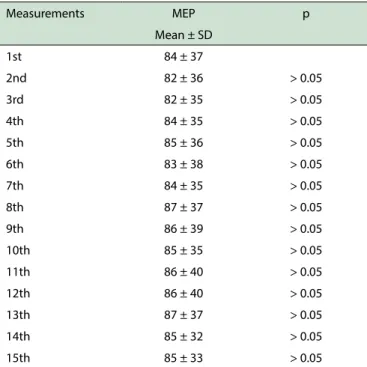
Table 2 presents the standard deviation and statistical significance for each MEP mean measurement. No statistical significance (p > 0.05) was detected between the first and the subsequent measurements of MEP.
Table 3 shows the average minimum and average maximum values for MIP and MEP. The lack of statistical significance (> 0.05) also reflects the lack of individual learning.
therefore they are often used in clinical practice, in the process of functional evaluation or reevaluation of treatment protocols.1,2,4
Today, there are no studies aimed to ascertain whether only three repetitions would be enough to evaluate the maximum values of respiratory pressures of patients; so we aimed to evaluate the effects of learning on the values obtained in the measurement technique of MIP and MEP by recording values found in 15 repetitions for each pressure Our main objective was to verify the presence of any learning effect on maximal inspiratory and expiratory pressures in healthy young adults.
■
METHODThis was a prospective study including 71 volunteers, 9 men (13%), 62 women (87%) with a mean age of 26 ± 6 years, mean height 1.66 ± 0.09m, mean weight 67 ± 13kg
and mean BMI 24 ± 3.5 kg/cm2. The study was approved
by the Institutional Ethics Committee (case # 388 476) and participants signed an appropriate informed consent form. This consent form attested the voluntary nature of their participation with the right to withdraw at any time, without personal loss.
Young adults aged 18 to 35 years, with no pulmonary, cardiac or neurological prerequisites and who agreed to participate voluntarily in the study diseases were included.
The inclusion criterion applied to persons who exert physical activity for at least 30 minutes more often than three times per week; the exclusion criteria applied to persons with infections in the upper and lower airways and drinkers.
Initially it was explained to the participants that 15 measurements of MIP and 15 of MEP would be taken, and that such measurements would be collected noninvasively. A single examiner collected all the measurements in a standardized way.
Anthropometric data were recorded on a standard form (age, sex, weight, height, and BMI). Blood pressure was measured using a sphygmomanometer (Tycos®) previously
calibrated and a stethoscope (Litmann®). Heart rate (HR)
and oxygen saturation were measured using a portable
oximeter (Nonin®). The respiratory rate was obtained
visually and recorded with the aid of a watch.
Maximal respiratory pressures were evaluated by means of a previously calibrated manometer (Commercial Medical®). According to the American Thoracic Society,3
Table 1 - Values of maximal inspiratory pressure
Measurements MIP p Mean ± SD
1st -81 ± 29
2nd -81 ± 29 > 0.05
3rd -77 ± 28 > 0.05
4th -81 ± 28 > 0.05
5th -83 ± 29 > 0.05
6th -82 ± 31 > 0.05
7th -84 ± 30 > 0.05
8th -86 ± 30 > 0.05
9th -82 ± 30 > 0.05
10th -83 ± 33 > 0.05
11th -82 ± 29 > 0.05
12th -83 ± 32 > 0.05
13th -85 ± 30 > 0.05
14th -85 ± 31 > 0.05
15th -85 ± 31 > 0.05
Mean values and standard deviation for MIP (maximal inspiratory pressure). p = statistical signiicance of the ANOVA calculation performed for comparison between the irst and the subsequent measurements.
Table 2 - Values of maximal expiratory pressure
Measurements MEP p Mean ± SD
1st 84 ± 37
2nd 82 ± 36 > 0.05 3rd 82 ± 35 > 0.05 4th 84 ± 35 > 0.05 5th 85 ± 36 > 0.05 6th 83 ± 38 > 0.05 7th 84 ± 35 > 0.05 8th 87 ± 37 > 0.05 9th 86 ± 39 > 0.05 10th 85 ± 35 > 0.05 11th 86 ± 40 > 0.05 12th 86 ± 40 > 0.05 13th 87 ± 37 > 0.05 14th 85 ± 32 > 0.05 15th 85 ± 33 > 0.05
Mean values and standard deviation for MEP (maximal expiratory pressure). p = sta-tistical signiicance of the ANOVA calculation performed for comparison between the irst and the subsequent measurements.
Table 3 - Comparison between the individual measurements
Maximal Inspiratory Pressure
Minimum value
Maximum value pp Mean ± std. dev. -64.71 ± 23.51 -101.76 ±
30.37 > 0.05 Maximal Expiratory
Pressure
Minimum value
Maximum value
Mean ± std. dev. 70.98 ± 32.44 95.98 ± 39.21 > 0.05
Largest and smallest measurements of MIP (maximal inspiratory pressure) and MEP (maximal expiratory pressure) from each of the 71 individuals. Mean and standard deviation of the measurements described above. Paired t-test performed between measurements.
proposed its role in the diagnosis and prognosis of various neuromuscular and pulmonary diseases, associating the values obtained with the general state of health and physical aptitude of patients.2,3
The consensus of respiratory muscle tests published in 2002, reports that there are predictive values for MIP and MEP considering age, gender and weight mass variations, generating wide variations in normal values.3
Black and Hyatt2 and Neder et al.5,6 merely reported that individuals had used a nose clip and had been instructed to avoid air leakage, not specifying whether the subjects were in the standing, sitting or lying position.
Volianitis et al.7 reported that the 18 measurements
of their study were collected in six sets of three efforts. During these measurements, participants were asked to remain in the standing position. Between each of the six sets of measurements participants were allowed to sit and rest for three minutes.
Fiz et al.8 performed 20 consecutive measurements
of MIP but also failed to specify the position of individuals. To the best of our knowledge, no descriptions concerning the positions in which MIP and MEP were collected for more than three consecutive measurements without rest breaks have been reported. In this study, subjects remained seated during the 15 measurements of MIP and the other 15 measurements of MEP. This posture adopts the description of the ATS Statement on respiratory muscle testing3. The position was chosen because the
sequence of 30 measurements would hardly allow participants to remain standing properly erect throughout the time required to perform the complete series.
Another factor that made us choose to perform the measurements with the subjects seated is the fact that the objective of the study is to compare the measurements of each participant with their own results. We had no intention of comparing the participants with each other or with predicted values for biological variables, such as gender and age. These results have been reported by Neder et al.5,6 and defined by the ATS Statement on respiratory muscle testing.3
The ATS recommendation is that the measurement be performed thrice in a row for MIP and thrice in a row
■
DISCUSSIONfor MEP; the highest value for each parameter is then to be adopted;2 however, this is another point of contention,
because some authors refer to the need of a higher number
of repetitions to achieve maximal respiratory pressure.9-12
Volianitis et al.7 conducted 18 separate measurements
in six series of three repetitions with the intention of verifying the influence of a specific respiratory ‘warming-up effect’ after the repeated measurements of the inspiratory muscle strength. They concluded that MIP continued to increase throughout the 18 measurements with significant differences at all stages.
Fiz et al.8 performed 20 consecutive measurements
of MIP and found that maximum values of MIP were achieved between the ninth and tenth repetitions and that between these measurements and the twentieth there was no statistically significant difference.
In a pilot project, we conducted a sequence of 20 repetitions for MIP and MEP with 4 volunteers. At the end of the 20 measurements of MEP, volunteers complained of tiredness and one of them mentioned dizziness. Therefore we chose to reduce the repetitions of each measurement to 15.
The result of the statistical analysis of this study with the ANOVA calculation shows that there is no learning effect when measurements of MIP and MEP are evaluated in the group.
These results disagree with those reported Fiz et al.8
Their study evaluated MIP in 44 chronic obstructive patients. Twenty consecutive maneuvers were performed. Their study showed that at least nine technically acceptable maneuvers of MIP are required to obtain a maximum value in untrained patients with chronic airflow obstruction. In our study there was no statistically significant difference between the first and any other measurement, which leads us to assert that the learning effect in the short term could not be viewed. It
should however be noted that Fiz et al.8 assessed chronic
obstructive patients, whereas we studied healthy subjects. Our results reinforce partial results reported by Black & Hyatt,2 who evaluated normal values of MIP in
120 patients. The effect of learning was only tested in six individuals over three consecutive days, with the completion of three measurements per day. In three of the six subjects, maximum values for MIP were obtained on Day 3 and varied by more than 10% vs. Day 1. In the other three subjects, variations were less than 10%. They concluded
that short-term learning is subtle.2
Larson et al.12 claim that the effect of learning is less
reproducible in older individuals. Our study, conducted with young people also failed to detect any learning.
■
CONCLUSIONWe conclude that there was no learning effect throughout the 15 measurements of MIP and MEP in young adults. To the best of our knowledge this is the first clear-cut demonstration of this for MIP and MEP.
■
CONFLICT OF INTERESTAuthors declare no conflict of interests
■
AUTHOR PARTICIPATIONGiuliani BB, Olavo GC, Machado KS and Raimundo RD participated in the acquisition of data and revision of the manuscript, Abreu LC, Valenti VE and Raimundo RD performed statistical analysis and draft the manuscript. Machado KS and Raimundo RD determined the design, interpreted the data and drafted the manuscript. All authors read and gave final approval for the version submitted for publication.
AVALIAÇÃO DO EFEITO DE APRENDIZADO NA MENSURAÇÃO DAS PRESSÕES INSPIRATÓRIA E EXPIRATÓRIA MÁXIMAS EM ADULTOS SAUDÁVEIS
INTRODUÇÃO: Medidas de pressão inspiratória máxima e pressão expiratória máxima são usados para avaliar a força desenvolvida pelos músculos respiratórios. Tais medidas são também utilizadas como critérios para o desmame da ventilação mecânica, para determinar as con -seqüências funcionais de várias doenças sistêmicas e do de -senvolvimento de doenças pulmonares e neuromusculares.
OBJETIVO: Verificar a presença do efeito de
aprendi-zado nas mensurações de pressão inspiratória e expiratória máximas.
MÉTODO: Foram realizadas 15 medições seqüenciais
de pressão inspiratória máxima e 15 de pressão expiratória máxima em 71 indivíduos. Os resultados para ambas as séries foram comparados ao longo de cada série
RESULTADOS: As comparações entre a primeira
e as demais medidas não apresentaram diferenças estatisticamente significativas (p > 0,05).
CONCLUSÃO: Não houve efeito aprendizado em
15 medidas repetidas de pressão inspiratória máxima ou pressão expiratória máxima em adultos saudáveis.
PALAVRAS-CHAVE: pressão inspiratória máxima;
efeito aprendizagem; músculos respiratórios.
■
REFERENCES1. Steier J, Kaul S, Seymour J, Jolley C, Rafferty GF, Man W, et al. The value of multiple tests of respiratory muscle strength. Thorax. 2007;62:975-80. http://dx.doi.org/10.1136/thx.2006.072884
2. Black LF, Hyatt RE. Maximal respiratory pressures: normal values and relationship to age and sex. Am Rev Respir Dis. 1969;99(5):696-702. 3. American Thoracic Society. ATS Statement on respiratory muscle
testing. Am J Respir Crit Care Med 2002; 166:518-624. http://dx.doi. org/10.1164/rccm.166.4.518
9. Paisani DM, Chiavegato LD, Faresin SM. Lung volumes, lung capacities and respiratory muscle strength following gastroplasty. J Bras Pneumol. 2005;31(2):125-32. http://dx.doi.org/10.1590/ S1806-37132005000200007.
10. Brunetto AF, Fregonezi GAF, Paulin E. Comparação das medidas de pressões máximas (pimáx, pemáx) aferidas através de manuvacuômetro e sistema de aquisição de dados (saqdados). Rev Bras Ativ Fís Saúde 2000; 5(2):30-7. http://dx.doi.org/10.12820/ rbafs.v.5n2p30-37
11. Gibson J, Whitelaw W, Siafakas N. Tests of overall respiratory function. Am J Respir Crit Care Med. 2002; 166:521-6.
12. Larson JL, Covey MK, Vitalo CA, Alex CG, Kim M. Maximal inspiratory pressure. Learning effect and test-retest reliability in patients with chronic obstructive pulmonary disease.. Chest 1993; 104:448-53. http://dx.doi.org/10.1378/chest.15-0236 5. Neder JA, Andreoni S, Castelo-Filho A, Nery LE. Reference
values for lung function tests. I. Static volumes. Braz J Med Biol Res. 1999;32(6):703-17. http://dx.doi.org/10.1590/S0100-879X1999000600006
6. Neder JA, Andreoni S, Lerario MC, Nery LE. Reference values for lung function tests. II. Maximal respiratory pressures and voluntary ventilation. Braz J Med Biol Res. 1999;32(6):719-27. http://dx.doi. org/10.1590/S0100-879X1999000600007
7. Volianitis S, McConnell AK, Jones DA. Assessment of Maximum Inspiratory Pressure. Respiration 2001;68:22–27. http://dx.doi. org/10.1159/000050458