Phytotherapy in primary
health care
Fitoterapia na atenção primária à
saúde
I Programa de Pós-Graduação em Saúde Coletiva. Universidade Federal de Santa Catarina. Florianópolis, SC, Brasil II Departamento de Saúde Pública.
Universidade Federal de Santa Catarina. Florianópolis, SC, Brasil
III Departamento de Saúde Pública. Universidade Federal de Santa Catarina. Florianópolis, SC, Brasil
Correspondence: Gisele Damian Antonio
Rua Mediterrâneo, 270 apto 103 Córrego Grande 88037-610 Florianópolis, SC, Brasil E-mail: [email protected] Received: 6/10/2013
Approved: 2/26/2014
Article available from: www.scielo.br/rsp
ABSTRACT
OBJECTIVE:
To characterize the integration of phytotherapy in primary
health care in Brazil.
METHODS:
Journal articles and theses and dissertations were searched
for in the following databases: SciELO, Lilacs, PubMed, Scopus, Web of
Science and Theses Portal Capes, between January 1988 and March 2013.
We analyzed 53 original studies on actions, programs, acceptance and use of
phytotherapy and medicinal plants in the Brazilian Uniied Health System.
Bibliometric data, characteristics of the actions/programs, places and subjects
involved and type and focus of the selected studies were analyzed.
RESULTS:
Between 2003 and 2013, there was an increase in publications
in different areas of knowledge, compared with the 1990-2002 period. The
objectives and actions of programs involving the integration of phytotherapy
into primary health care varied: including other treatment options, reduce
costs, reviving traditional knowledge, preserving biodiversity, promoting
social development and stimulating inter-sectorial actions.
CONCLUSIONS:
Over the past 25 years, there was a small increase
in scientiic production on actions/programs developed in primary care.
Including phytotherapy in primary care services encourages interaction
between health care users and professionals. It also contributes to the
socialization of scientiic research and the development of a critical vision
about the use of phytotherapy and plant medicine, not only on the part of
professionals but also of the population.
DESCRIPTORS:
Phytotherapy, utilization. Plants, Medicinal. Primary
Health Care. Health Services. Review.
Gisele Damian Antonio
ICharles Dalcanale Tesser
IIThe trajectory of the use of phytotherapeutics and
medicinal plants in primary health care in Brazil has
been stimulated by social movements, guidelines from
various national health conferences and
recommenda-tions from the World Health Organization. The
publica-tion of Resolupublica-tion 971, on May 3, 2006 and Act 5813,
on June 22, 2006, which regulated the
Política Nacional
de Práticas Integrativas e Complementares
(National
Policy on Integrative and Complimentary Practices)
and the
Política Nacional de Plantas Medicinais e
Fitoterápicos
(National Policy on Medicinal and
Phytotherapeutic Plants), were decisive steps towards
introducing the use of medicinal and phytotherapeutic
plants
in the Brazilian Uniied Health System (SUS)
.
9,aBefore these policies, and later stimulated by them,
some states and municipalities institutionalized actions
and programs with medicinal plants in primary health
RESUMO
OBJETIVO:
Caracterizar a inserção da itoterapia em ações e programas na
atenção primária à saúde no Brasil.
MÉTODOS:
Realizou-se levantamento bibliográico de artigos de periódicos
e teses e dissertações nacionais. Foram utilizadas as bases de dados: SciELO,
Lilacs, PubMed, Scopus, Web of Science e Portal de Teses Capes no período
entre janeiro de 1988 e março de 2013. Foram analisados 53 estudos originais
sobre ações, programas e aceitação de uso de itoterápicos e plantas medicinais
na atenção primária à saúde do Sistema Único de Saúde. Foram analisados
dados bibliométricos, características das ações e programas, local e sujeitos
envolvidos na pesquisa, tipo e objetivo dos estudos selecionados.
RESULTADOS:
Entre 2003 e 2013 houve aumento das publicações em
diferentes áreas de conhecimento, comparado ao período de 1990-2002. As
ações e programas de itoterapia inseridos nos serviços de atenção primária à
saúde variaram em objetivos e ações: inserir outras opções terapêuticas, reduzir
custos, resgatar saberes tradicionais, preservar a biodiversidade, promover o
desenvolvimento social, estimular ações intersetoriais,
interdisciplinares, de
educação em saúde
e a participação comunitária.
CONCLUSÕES:
Nos últimos 25 anos houve aumento pequeno da produção
cientíica sobre ações/programas de itoterapia desenvolvidos na atenção primária
à saúde. A inserção da itoterapia nos serviços de atenção primária estimulou a
interação entre usuários e proissionais de saúde. Também contribui para socialização
da pesquisa cientíica e desenvolvimento da visão crítica tanto dos proissionais
quanto da população sobre o uso adequado de plantas medicinais e itoterápicos.
DESCRITORES:
Fitoterapia, utilização. Plantas Medicinais. Atenção
Primária à Saúde. Serviços de Saúde. Revisão.
INTRODUCTION
care. The use of phytotherapy has diverse motives,
such as increasing therapeutic resources, reviving
tradi-tional knowledge, preserving biodiversity, encouraging
agroecology, social development and environmental,
popular and ongoing education.
3Until now there have
been few reviews of studies that record and analyze
these trials, as the topic is relatively seldom valued
within the area of collective health.
The objective of this study was to characterize the
integration of phytotherapy in actions and programs
in primary health care in Brazil.
METHODS
Journal articles and theses and dissertations were searched
for in the following databases: PubMed, Scopus, Web
of Science, SciELO, Lilacs and Portal de Teses Capes,
from January 1988 to March 2013. A combination of
keywords and descriptors were used in the search strategy.
In international databases the following descriptors were
searched for: “Herbal” AND “Primary Health Care”; “Plant
Preparations” AND “Primary Health Care”; phytotherapy
and “Primary Health Care”; “Phytotherapeutic Drugs”
AND “Primary Health Care”; “Herbal” AND “Family
Health”; phytotherapy AND “Family Health”; “Plant
Preparations” AND “Family Health”; “Complementary
Therapies” AND phytotherapy AND “Primary Health
Care”; “Complementary Therapies” AND phytotherapy
AND “Family Health”; “Herbal” AND “Single Health
System”; phytotherapy AND “Single Health System”;
in the databases SciELO, Lilacs and Theses Portal
Capes the keywords searched for were:
itoterapia
AND
“
Saúde Pública
”,
itoterapia
AND “
Saúde da Família
”,
“
Plantas Medicinais
” AND “
Saúde da Família
”, “
Plantas
Medicinais
” AND “
Atenção Primária à Saúde
”, “
Plantas
Medicinais
” AND “
Saúde Coletiva
”. Of the total 511
studies found, only the primary studies that related to/
analyzed the integration of actions/programs and/or
accep-tance/use/prescription of medicinal plants in the context of
primary health care services were selected. The following
were excluded: editorials, journalistic material, studies
evaluating clinical and technical protocols, critical reviews,
commentaries, literature reviews, educational manuals,
personal information, phytochemical or
pharmacogno-sial research, pharmacological and toxicological studies.
Three publications from between 1988 and 1990 were also
excluded as they were not available online or in public
federal or state university archives, as loans or as copies. In
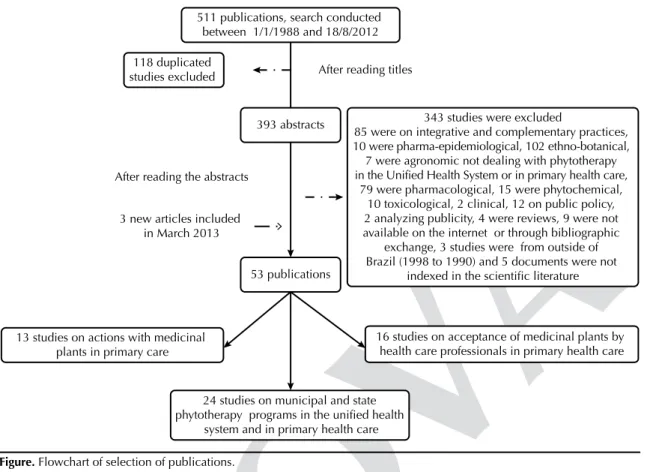
total, 53 publications were selected for analysis (Figure 1).
Tables 1, 2 and 3 show the relationship and
biblio-metric characterization of the selected publications
(author, year of publication, type of study, intervention
reference group and objective/focus of the study). The
characterization of the actions and programs
devel-oped in the context of Brazilian primary health care is
systematized in Table 4. Cases that involved continued
and institutionalized activities in municipalities were
considered as programs. Actions or use of medicinal
plants by medical professionals and users as a
thera-peutic resource (indication/prescription) and/or
educa-tional, interdisciplinary and cross-sectoral activities
developed within primary health care services, were
considered as activities.
RESULTS
In the studies analyzed we observed an increase in the
number of publications after 1990. Between 2003 and
2012 the number of publications produced was greater,
compared to the period between 1990 and 2002. This
could be related to the introduction of the National
Policy on Integrative and Complementary Practices,
band the National Policy on Medicinal Plants,
cin 2006,
which may have been decisive in the development of
integrative practices in primary care. Though small,
there has been an increase in scientiic production on
phytotherapy in primary health care services over the
past 25 years, possibly motivated by the
institutional-ization of the practice by the cited national policies,
b,cwhich developed speciic health legislations that can be
consulted online via the
Agência Nacional de Vigilância
Sanitária
(ANVISA – Brazilian Health Surveillance
Agency) website.
aWith regard to the publications, we observed the
integration of actions and programs using
medic-inal plants with diverse characteristics, objectives
and actions in primary health care, relevant to health
promotion and professional and autonomous care.
We registered 24 phytotherapy programs introduced
and developed in Brazilian states and municipalities
(Table 1), 13 studies on isolated actions developed
by health professionals in the context of primary care
services (Table 2) and 16 studies on the acceptance
and use/prescription of medicinal plants and
phyto-therapy by health professionals in primary health
care services (Table 3). The studies used various
methods. Case studies and experiment reports were
the principle methods used to describe and analyze
the introduction and development of phytotherapy
programs (Table 1), while ethnographic and
ethnobo-tanical studies and quali-quantitative research were
used to analyze actions and acceptance of medicinal
plant use by health care professional in primary care
services (Tables 2 and 3).
The studies on phytotherapy programs (Table 1) and
actions (Table 2) reported that the intregration of
phytotherapeutics and medicinal plants in primary
health care improved access to other therapeutic
options besides combined medicines,
16,17,24,27,29,37,41they
consolidated the implementation of public policies,
25,35local development
10,33and promoted the revival of
the population´s traditional knowledge.
4,10,16,24,29,37,41Additionally, this integration prompted health
profes-sionals to organize educational health
10,17,24,27,33,37,40,43and environmental
16,37actions, as well as cross-sectoral
actions
10,12,16,17,20,24,33,35,38,41(in partnership with
agricul-ture, education, environment) and extension and research
actions with universities.
16,20,41Some studies pointed
out obstacles in consolidating phytotherapy actions
b Ministério da Saúde, Gabinete do Ministro. Portaria n° 971, de 3 de maio de 2006. Aprova a Política Nacional de Práticas Integrativas e Complementares (PNPIC) no Sistema Único de Saúde. Brasília (DF); 2006 [cited 2014 Mar 22]. Available from: http://bvsms.saude.gov.br/bvs/ saudelegis/gm/2006/prt0971_03_05_2006.html
and programs in health services, including the lack of
strategy for registration and accompaniment in clinical
use (to produce clinical evidence),
17,33low investment
in the study of Brazilian medicinal plants,
15,16,29,33,37,41training and qualiication deicits among human reso
urces,
2,3,7,10,13-16,20-22,29,33,36,38,40,43and lack of human
resources.
27,35They also cited the lack of financial
resources and management support
10,12,14,16,17,22,29,30,33,35,37for organizing work spaces and purchasing the
equip-ment and plant supplies required to offer quality
phyto-therapeutics and medicinal plants in suficient quantities
to meet the demand of the population.
10,23,28,34,35Figure. Flowchart of selection of publications.
511 publications, search conducted between 1/1/1988 and 18/8/2012
118 duplicated
studies excluded After reading titles
After reading the abstracts
3 new articles included in March 2013
393 abstracts
53 publications
13 studies on actions with medicinal plants in primary care
16 studies on acceptance of medicinal plants by health care professionals in primary health care
343 studies were excluded
85 were on integrative and complementary practices, 10 were pharma-epidemiological, 102 ethno-botanical, 7 were agronomic not dealing with phytotherapy in the Unified Health System or in primary health care,
79 were pharmacological, 15 were phytochemical, 10 toxicological, 2 clinical, 12 on public policy, 2 analyzing publicity, 4 were reviews, 9 were not available on the internet or through bibliographic
exchange, 3 studies were from outside of Brazil (1998 to 1990) and 5 documents were not
indexed in the scientific literature
24 studies on municipal and state phytotherapy programs in the unified health
system and in primary health care
Table 1. Characteristics of studies on the development and implementation of phytotherapeutic programs in primary health care. Brazil, 1990-2012.
Authors/Year Study type Study location and subjects Study focus
Barbosa (1990)a Case study Goiânia, GO Implementation and development
of phytotherapy in the municipal Ayurvedic therapy hospital. Araújo (2000)4 Qualitative research Londrina, PR; unidentified
patients traditional knowledge on healing with Interaction between biomedical and medicinal plants in the municipality. Negreiro (2002)c
Pharmacology-epidemiological study Pereiro, CE; 64 patients primary health care in the municipality.Use of phytotherapeutic medicines on Teixeira (2003)e Case study Juiz de Fora, MG; unidentified
patients phytotherapy program in the municipality.Implementation and development of a Ogava, Pinto, Kikuchi,
Menegueti, Martins, Coelho et al (2003)29
Experiment report Maringá, PR; unidentified patients
Implementation and development of the phytotherapeutic Verde Vida
program in the municipality. Sacramento (2004)37 Experiment report Vitória, ES; unidentified patients Implementation and development of
a phytotherapeutic and homeopathic program in the municipality. Graça (2004)16 Experiment report Curitiba, PR; unidentified
patients
Continuation Carneiro & Pontes (2004)10
Experiment report Itapipoca, CE; unidentified patients
Use of phytotherapy in primary health care in the municipality. Pires, Borella, Raya
(2004)33
Experiment report Ribeirao Preto, SP; unidentified
patients a phytotherapeutic and homeopathic Implementation and development of program in the municipality. Reis, Leda, Pereira,
Tunala (2004)35
Experiment report Rio de Janeiro, RJ; unidentified
patients Implementation and development of a phytotherapeutic program in the municipality.
Michiles (2004)26 Experiment report State of Rio de Janeiro;
unidentified patients Situational diagnosis of the municipalities within the state of Rio de Janeiro that provide phytotherapeutic services. Guimarães, Medeiros,
Vieira (2006)17
Experiment report Betim, MG; unidentified patients Implementation and development of the Farmácia Viva (Living Drugstore) in
the municipality. Silva, Gondim, Nunes,
Sousa (2006)41
Study on the use of
medicines Maracanaú,CE; 1,095 patients in primary health care in the municipality.Research on the use of medicinal plants Pontes, Monteiro,
Rodrigues (2006)34
Qualitative research Brasília, DF; 3 professionals (1 nurse
and 2 physicians) and 26 patients Use of medicinal plants in the treatment of pediatric health problems in the district. Matos (2006)24 Experiment report Fortaleza, CE; unidentified
patients
Model of Farmácia Viva (Living Drugstore) for integrating phytotherapy into the public health network in the municipality. Diniz (2006)12 Experiment report Londrina, PR; unidentified
patients
Implementation and development of a phytotherapeutical program in the
municipality. Oliveira, Simões,
Sassi (2006)30
Experiment report State of Sao Paulo; unidentified patients
Situation of the phytotherapeutic health care in the state. Silveira (2007)d Study on the use of
medicines Fortaleza, CE; 178 patients reactions to phytotherapeutics within Use and frequency of adverse the Farmácia Viva (Living Drugstore)
program in the municipality. Ministério da Saúde
(2008)b
Experiment report State of Amapá; unidentified patients
Implementation and development of a Center of Reference for natural treatments. Ministério da Saúde
(2008)b
Experiment report Campinas, SP; unidentified
patients Implementation and development of the Botica da Família (Family Drugstore) in the municipality. Brasiliero, Pizziolo,
Matos, Germano, Jamal (2008)8
Study on the use of
medicines Governador Valadares, MG; 2,454 patients Profile of the use of medicinal plants in the Programa Saúde da Família (PSF – Family Health Program) in the municipality. Nagai & Queiróz
(2011)27
Social study Campinas, SP, 37 professionals (11 physicians, 18 nurses, 1 psychologist,
1 occupational therapist, 1 dentist, 1 speech therapist, 1 biomedical
therapist, 1 sociologist
Social study on the perception of traditional, complementary and alternative practices among health
professionals connected to the municipality’s public health network. Santos, Sousa,
Gurgel, Bezerra, Barros (2011)39
Qualitative research Recife, CE; 20 professionals and
managers (focal group) Participation of political figures in the evolution of municipal policies on integrative practices. Bruning, Mosegui,
Viana (2012)9
Qualitative research Cascavel and Foz do Iguaçu, PR; 10 professionals (5 nurses, 3 physicians, 1 nursing assistant
and 1 nursing technician)
Learnings from managers and health professionals (primary health care) on
phytotherapy, in the municipalities.
Total 24 publications
a Barbosa MA, Baptista SS. A fitoterapia como prática de saúde: o caso do hospital de terapia ayurvedica de Goiânia. Rio de Janeiro: Escola de Enfermagem Anna Nery da UFRJ; 1990.
b Ministério da Saúde, Secretaria de Atenção à Saúde, Departamento de Atenção Básica. Práticas integrativas e complementares em saúde: uma realidade no SUS. Rev Bras Saude Fam [Internet]. 2008 [cited 2014 Mar 22];9(Ed. Espec.):3-76. Available from: http://189.28.128.100/ dab/docs/publicacoes/revistas/revista_saude_familia18_especial.pdf
c Negreiros MSC. Uso do medicamento fitoterápico na atenção primária do município de Pereiro-Ceará [specialization monograph]. Fortaleza: Faculdade de Saúde Pública da Universidade Estadual do Ceará; 2002.
d Silveira PF. Perfil de utilização e monitoramento de reações adversas a fitoterápicos do Programa Farmácia Viva em uma unidade básica de saúde de Fortaleza [dissertation]. Fortaleza: Faculdade de Farmácia, Odontologia e Enfermagem da UFC; 2007.
Table 2. Characteristics of studies concerning actions with medicinal plants and phytotherapeutic medicines developed in the context of primary health care services. Brazil, 1990-2012.
Authors/Year Study type Study location and subjects Study focus
Chechetto (2003)c Case study Tubarao, SC; 30 participants from the Câmara Setorial (Sectorial Chamber) and/
or from the Associação Catarinense de Plantas Medicinais (ACPM − Medicinal Plants Association of Santa Catarina)
Implementation and development of the Rede Catarinense de Plantas Medicinais
(Medicinal Plants Network of Santa Catarina).
Bieski (2005)a Ethnobotanical
study Cuiabá, MT; 693 patients Importance of local traditional knowledge for the implementation of medicinal plants programs in the Brazilian Unified Health System (SUS). Damas (2005)d Qualitative
research
Florianópolis, SC; 5 physicians and 20 volunteers from OFVV
Learnings from physicians from the Health Centre and volunteers from the Oficina de Fitoterapia Vida Verde (OFVV – Green
Life Phytotherapy Workshop) regarding phytotherapy and the use of medicinal plants. Leite & Schor
(2005)20
Case study Itajaí, SC; 17 health professionals (3 nursing assistants, 2 physicians, 2 dentists and 1 nurse; 8 patients and
1 extension program coordinator)
Significance of the use of medicinal plants for health professionals and health unit
patients.
Cavallazzi (2006)b Qualitative
research professionals (11 physicians, Florianópolis, SC; 23 health 5 dentists and 7 nurses) 265 patients
Recognition of medicinal plants and phytothe-rapeutic medicines used in primary health care
in the southern zone of the municipality. Tomazzoni, Negrelle,
Centa (2006)44
Ethnobotanic study
Cascavel, PR; 50 families Planning and introduction of the use of phyto-therapeutic medicines in the municipality's
basic health care service. Negrelle, Tomazzoni,
Ceccon, Valente (2007)28
Ethnobotanic study
Cascavel, PR; 50 families Initial diagnosis for establishing the use of phytotherapeutic medicines in the municipality's basic health care service. Guizardi & Pinheiro
(2008)18
Case study Vitória and Vila Velha, ES; 18 representatives from pastoral care in health and the municipal health council
Community phytotherapeutic pharmacies in pastoral health care.
Ministério da Saúde (2008)e
Experiment
report Quatro Varas, CE; unidentified patients the integrated community mental health Implementation and development of movement in the municipality. Piccinini (2008)f Etnobotânico Porto Alegre, RS; 49 patients Initial diagnosis for establishing the use of
phytotherapeutic medicines in public health programs in the municipality. Santos (2008)g Qualitative
research
Rio de Janeiro, RJ; 3 managers (1 physician, 1 agronomist, 1 pharmacist) and 5 health professionals (1 physician, 1 nurse, 1 biologist, 1 pharmacist, 1
health agent) and 14 patients
Interfaces between phytotherapeutic services and the Estratégia Saúde da Família (ESF – Family Health Strategy) in the municipality.
Paranaguá, Bezerra, Souza, Siqueira (2009)32
Quali-quantitative
research
Goiânia, GO; 35 community health agents
Integrative practices used by the population in the Estratégia Saúde da Família (ESF – Family Health Strategy) and patients views
regarding the practices. Santos & Tesser
(2012)40
Participatory
research Florianópolis, SC; unidentified patients Method for implementing and promoting access to integrative and complementary practices including phytotherapy, and an advise facility for the local management in primary health care.
Total 13 publications
a Bieski IGC. Plantas medicinais aromáticas no Sistema Único de Saúde da região sul de Cuiabá-MT [monograph of specialization]. Lavras: Departamento de Agricultura da Universidade Federal de Lavras; 2005.
b Cavallazzi ML. Plantas medicinais na Atenção Primária à Saúde [dissertation]. Florianópolis: Centro de Ciências da Saúde da Universidade Federal de Santa Catarina; 2006.
c Chechetto F. Rede Catarinense de Plantas Medicinais: uma abordagem transdisciplinar para a saúde coletiva [dissertation]. Tubarão: Universidade do Sul de Santa Catarina; 2003.
d Damas FB. A fitoterapia com estratégia terapêutica na comunidade do Saco Grande II, Florianópolis/SC [end of course project]. Florianópolis: Curso de Graduação em Medicina da Universidade Federal de Santa Catarina; 2005.
e Ministério da Saúde, Secretaria de Atenção à Saúde, Departamento de Atenção Básica. Práticas integrativas e complementares em saúde: uma realidade no SUS. Rev Bras Saude Fam [Internet]. 2008 [cited 2014 Mar 22];9(Ed. Espec.):3-76. Available from: http://189.28.128.100/dab/docs/ publicacoes/revistas/revista_saude_familia18_especial.pdf
Table 3. Characteristics of studies on the acceptance of use and prescription of medicinal plants and phytotherapeutic medicines, by health professionals, in the context of primary health care. Brazil, 1990-2013.
Authors/Year Study type Study location and subjects Study focus
Alvim & Cabral (2001)1
Qualitative
research Rio de Janeiro, RJ; 10 nurses Contexts of medicinal plant use in the institutional nursing environment. Alvim et al (2006)2 Qualitative
research Uninformed location, 15 nurses Ethical and legal implications of the use of medicinal plants in nursing. Lima Jr. &
Dimenstein (2006)21
Qualitative
research Natal, RN; 30 dentists surgeons in the municipality, concerning the Acceptance among public service dental-possibility of integrating phytotherapy into
basic health care. Taufne, Ferraço,
Ribeiro (2006)42
Ethnobotanical study
Santa Tereza and Marilândia, ES; 100 patients
Use of medicinal plants by patients from public health units in the municipalities of
Santa Teresa, ES and Marilândia, ES.
França, Marques, Lira, Higino (2007)15
Quali-quantitative
research
Recife, CE; 37 health professionals (16 nurses, 13 physicians, 8
dentists)
The perception held by health professionals from basic health care teams
regarding the use of medicinal plants in oral health.
Fontanella, Speck, Piovezan, Kulkamp (2007)13
Descriptive field survey
Tubarao, SC; 88 families Analysis of knowledge, access and acceptance regarding integrative and complementary health practices in the Brazilian Unified Health System (SUS).
Dutra (2009)a
Quali-quantitative professionals (15 physicians, 71 Anápolis, GO; 220 health nurses, 120 nursing technicians, 5 physiotherapists, 7 pharmacists and
2 dentists) and 380 patients
Use of medicinal plants phytotherapeutic medicines by health professionals and the
population of the municipality.
Bastos & Lopes (2010)7
Quali-quantitative Joao Pessoa, PB; 15 nurses Knowledge of nurses on phytotherapy and difficulties found in implementing this therapeutic approach in family health units. Badke, Bodó, Silva,
Ressel (2011)5
Qualitative
research Unspecified location, Rio Grande do Sul; 10 patients Everyday life of community dwellers attending a family health unit in a municipality of Rio Grande do Sul, relating to the therapeutic use
of medicinal plants in health care. Marques, Vale,
Nogueira, Mialhe, Silva (2011)23
Quali-quantitative
Sao Joao da Mata, MG; 35 patients Knowledge and acceptance of integrative and complementary therapies and pharmaceutical care by Brazilian Unified
Health System (SUS) patients. Rosa, Câmara,
Béria (2011)36
Qualitative
research Canoas, RS; 27 health professionals (physicians) Cases and uses of phytotherapy in basic health care and factors related to the objectives of the therapy.
Tiago & Tesser (2011)43
Exploratory research
Florianópolis, SC; 177 professionals (82 physicians and 95 nurses)
Perceptions held by professionals from the Estratégia Saúde da Família (ESF – Family Health Strategy) regarding integrative and
complementary practices. Machado,
Czermainski, Lopes
(2012)22
Case study
series Porto Alegre, RS; 21 health units coordinators (ESF and UBS) introducing phytotherapeutic medicines in Perceptions held by managers on health care.
Cruz & Sampaio (2012)11
Qualitative research
Unspecified location, 11 health professionals (1 physician, 1 nurse,
2 nursing assistants, 5 community health agents)
Use of complementary practices in a community within the reach of a family
health unity.
Fontenele, Sousa, Carvalho, Oliveira (2013)14
Quali-quantitative
Teresina, PI; 68 health professionals (36 nurses, 18 physicians,
14 dentists)
Knowledge of managers and health professionals on phytotherapy, its use and
public policies involved.
Sampaio, Oliveira, Kerntopf, Brito Jr., Menenzes (2013)38
Qualitative
research Crato, CE; 15 nurses phytotherapy in the Knowledge of nurses on the use of Estratégia Saúde da
Família (ESF – Family Health Strategy).
Total 16 publications
Table 4. Main characteristics of phytotherapy actions and program consolidated in Brazilian primary health care, 1990-2013. Location Basic characteristics of the phytotherapy actions and programs consolidated in primary health care Amapá, APd Reference Center for natural treatment; introduces greater diversity of Integrative and Complementary
Practices in Brazil; institutionalized by state law 10,068/2007. The experience is based on cultural diversity, including indigenous, of the state of Amapá, and also on the biodiversity of the Amazon Rainforest. Interculturality is the background that guides the work practices developed in partnership with midwives, river dwellers and indigenous healers.
Betim, MG17 Appeared due to the need to seek alternatives to control the high cost of medicines and their side effects. As well as increasing interest and need to guide users in the correct use of plant medicine. The program was in partnership with public and private networks in the municipality: Serviço Assistencial Salão do Encontro, Agriculture Secretariat, Environmental Secretariat, Health Surveillance. The inter-disciplinary team was formed of an agronomist, a pharmacist, an agricultural technician, a doctor, nurse, social worker, dentist, community health agents and a physiotherapist.
Campinas, SP27 In Campinas, phytotherapy was implemented through establishing a
Farmácia de Manipulação Botica da Família established by municipal ordinance 13/2001, based on prior history of primary health care initiatives in the municipality. The aim was to respect knowledge, customs and practices, providing education to broaden local culture and stimulate correct use of medicinal plants.
Cuiabá, MTc The practices of cultivating medicinal and herbal plants in Cuiabá take place through the Phytotherapy, Medicinal and Herbal Plant Program, created in July 2004 and regulated by Decree 4,188/2004 by the Cuiabá Health Secretariat in Mato Grosso. The program aims to guarantee access to the rational use of medicinal plants and phytotherapeutic medicines safely and efficaciously and with quality, contributing to the development of this sector in Brazil. Medicinal plant gardens were established in health care units and treatment homes and phytotherapy medicines are distributed through the health care network, community education activities, training for professionals, identifying plants and producing publicity material to promote the program and praise awareness among professionals.
Curitiba, PR16 This was the result of an intersectoral and multi-professional project created in 1997 with the aim of providing medicinal plants with botanical identification and scientifically tested for use in medical and dental prescriptions. Moreover, stimulating the use of medicinal plants in the community followed the recommendations of environmental education. The program was incentivized by the Municipal Environmental Secretariat, which coordinated the Integration Program for children and adolescents in partnership with the Universidade Federal do Paraná and the State Universities of Maringá and Ponta Grossa. The partnerships with the universities contributed to training the pharmacists of the future and stimulated the development of the national pharmaceutical industry in the region.
Florianópolis, SC41 Permanent educational actions regarding medicinal plants in Florianópolis/SC were established in six health care units in 2012. The phytotherapy-related actions were supported by the Didactic Garden of Medicinal Plants of the Hospital Universitário da Universidade Federal de Santa Catarina and by other local associations. The actions that were developed were: workshop for recognizing medicinal plants aimed at community health agents, didactic gardens in primary health care units, permanent education activities on medicinal plants for doctors, dentists, nurses and pharmacists and creating a municipal treatment memorandum. In the Sul de Ilha health care center, the use of medicinal plants is part of the local community culture, a factor that motivates the professionals to become qualified in this area. The phytotherapy workshop by the Associação Vida Verde Florianópolis/SC, created 28 June 1996, was an initiative of the health department of the Paróquia São Francisco Xavier, in Saco Grande II, Florianópolis/SC, in partnership with women in the community (willing to study, produce and distribute phytotherapy products) and the Universidade do Sul de Santa Catarina. The main aim was to spread solidarity in the community, rescuing popular knowledge of medicinal plants and to integrate knowledge in order to improve quality of life.
Fortaleza, CE24 The oldest experience in Brazil, influencing the creation of actions/programs regarding medicinal plants and phytotherapy in primary health care. The project was called Farmácias Vivas. It was created by Francisco José de Abreu Matos of the Universidade Federal do Ceará, in 1984, with the aim of developing methodology of interaction between popular knowledge and science based on a social approach to guide use of medicinal plants based on botanical identification and to create a reference of phytotherapy pharmaceutical formulas accessible to the population of the Northeast. The Farmácias Vivas project includes a set of actions: ethno-botanical field survey or bibliographical research, recording and validating medicinal plants, collecting plants in the field, training human resources, setting up a Farmácia Viva unit, producing informative material and popular education. Farmácia Viva is a great school and a great example to the world of effective social technology that aids treatment of around 80.0% of common illness in primary care, e.g., skin problems, respiratory and digestive problems, rheumatic pain, intestinal parasites and labial and genital herpes. After its creation in the state of Ceará, it became a national reference for the whole country and for structuring ordinance 886/2010.
Continuation
Foz do Iguaçu, PR9 The Itaipu herbalist was created in 2005 and contains 18 types of plants to treat 10 common illnesses. In 2007, the first training pf doctors, nurses, pharmacists and dentists took place in partnership with the Instituto Brasileiro de Plantas Medicinais (Brazilian Institute of Medicinal Plants). In order to produce the primary material, 54 agriculturists were trained and established in 17 units to demonstrate the cultivation of medicinal plants and provide technical assistance and rural extension activities.
Goiânia, GOb The Goiânia Phytotherapy Project was created in 1986 through an agreement between the Goiás Health Secretariat, the Ministry of Health and the Instituto Brasileiro de Ciência e Tecnologia Maharishi. In Goiânia, Ayurvedic phytotherapy was used. In 1987 an outpatient service was established, with a small phytotherpay laboratory. In 1988, the Ayurvedic Phytotherapy Outpatient clinic was transferred to a wing of the former Hospital Juscelino Kubitschek. The Hospital de Medicina Alternativa is recognized throughout Brazil and internationally as a reference for integrated public health practices. The hospital cultivates around 60 species of medicinal plants in its garden to prepare phytotherapies and to preserve them.
Itajaí, SC20 In Itajaí/SC, the insertion of medicinal plants was an initiative of the arterial hypertension control program in partnership with the extension project by the Universidade do Vale do Itajaí, named the university extension in family health project, covering professors and students of speech therapy, psychology, dentistry, medicine, nursing, nursing and pharmacy courses. The program encourages solidarity, exchanging experiences, linking the individual with life and with the health care team, the social group and humanization.
Itapipoca, CE10 Begun in 1999, with the support of the Municipal Health Secretariat, the Universidade Federal do Ceará, the Fundação Cearense de Pesquisa e Célula de Fitoterapia do Estado do Ceará, social reform support program, with the aim of incentivizing women (who use medicinal plants) to make homemade remedies so as to improve their families health and quality of life, based on botanically identified plants and scientific evidence.
Juiz de Fora, MGf In partnership with the Universidade Federal de Juiz de Fora, the Society for improving neighborhoods, children, family and health departments, community associations. The aim of this program was to recover popular knowledge and raise awareness of the correct use of medicinal plants in popular medicine. To do this, it was decided to follow regional medicinal plant based medicine, as well as experimental and scientific proof of therapeutic effects.
Londrinas, PR4,12 Established in 1996. The aim was to establish a dialogue between two culturally different universes: popular knowledge and biomedicine. The backdrop to these discussions was the humanization of popular practices and of universal health care in the official services. The project counted on the partnership of care and educational institutions and resulted in the construction of a plant medicine unit in partnership with a variety of local institutions. The program had therapeutic gardens and six industrialized phytotherapies, three of which were psychiatric remedies, aiming to de-medicinalize psychotropic users.
Maracanaú, CE42 Begin in 1992. Its basic structure was composed of a garden with four plots for cultivating medicinal plants and a laboratory of manipulation. The program dispenses phytoterapy medicines to the community through prescriptions from a family health care strategy health care professional.
Maringá, PR36 Officially established in September 2000. The program is supported by the Universidade Estadual de Maringá. It is a pharmacy, following the format established in Resolution 33/2,000 with the aim of providing the population with safe, effective and cheap treatment alternatives.
Pereiro, CEe Begun in 1995 with the establishment of a medicinal plant garden in which there is a technician with medicinal plant knowledge. In 1997, a bio-chemical pharmacist and an agronomist were contracted and the project was broadened according to the instructions of the Farmácia Viva in Ceará. A memorandum was drawn up and a phytotherapy guide. The aim of the project was to meet the population’s needs, taking into consideration cost-benefit and user satisfaction with the treatment response. Phytotherapy medicines were distributed in primary health units, dispensed by the municipal pharmacy in the hospital. The project was supported by the Universidade Federal do Ceará, the Centro Estadual de Fitoterapia (Fortaleza, CE), municipal prefectures, health secretariats and hospitals and health centers.
Pindamonhangaba, SP37
136 discussions on medicinal plants took place between 1992 and 2010, with 3,626 participants. The municipality provided didactic gardens and phytotherapy medicines. The actions were coordinated by the municipality’s Secretariat of Social Assistance.
Presidente Castello Branco, SCa
The aim of the project was to have plant nurseries of vegetable species in home gardens, in schools and in primary care units in the municipality. The initiative was linked to the “Programa Castellense de coleta seletiva de lixo”, waste collection program that was a multisectoral project (with municipal administration) linking all of the secretariats and carrying out actions aiming at sustainability, recycling waste, producing organic fertilizer and municipal development. In 2013, the municipality began permanent education actions on medicinal plants for health care professionals, linking educational, health and agricultural workers. It is considered a pioneering intersectorial initiative to insert phytptherapy in the east of Santa Catarina state.
The studies into the acceptance of phytotherapy by health
professionals in primary health care services (Table 3)
discovered problems relating to the
prescription/orienta-tion of medicinal and phytotherapeutic plants in clinical
practice among health team doctors, nurses and dentists.
They also cited strategies for training health professionals
through their everyday professional practice.
The absence of technical-practical training relating to
phytotherapy during academic/professional
develop-ment, which in part relects the reality of national
univer-sity teaching,
15,22,36,43was considered the main obstacle
in prescribing phytotheraphy in primary services and
advising users on its application.
2,3,7,10,13-16,20-22,29,33,36,38,40,43The prescription of phytotherapics and medicinal plants
by health professionals could therefore be encouraged
through a continuous and long-term education process
for professionals, as part of health teams’ daily work
routine.
7,36,43Trained professionals would thereby be able
to recognize those medicinal/phytotherapeutic plants
most commonly used by their patients
3,7,13,36and advise
them accordingly. The identiication of local therapeutic
practices and resources could contribute to the
devel-opment of adequate clinical communication strategies
between professionals and users,
1,3,16,25avoiding
inade-quate practices that lead to irrational use, belief in media
propaganda,
11clinical errors and lack of adhesion to
treat-ment.
3Further to this, it was reported that the integration
of medicinal plant actions brings together professionals
using medicinal plants in different contexts, who interact
with primary health care services through dialogue with
users and communities.
4,15,36The integration of
phyto-therapy would presuppose the user’s central role and joint
responsibility in the professional-patient dialogue.
1,3-5DISCUSSION
Although the present article has not undertaken an
exhaustive investigation of the pool of resources
ContinuationQuatro Varas, CE11 Established in 1988 by Airton Barreto. The aim of the project was to reduce use of psychotropic medicines in cases suffering from panic attacks and to defend the human rights of inhabitants of the Pirambú favela. Moreover, it sought to synthesize popular and biomedical actions intervening in health determinants. Recife, CE43 Phytotherapy actions in Recife are developed in a center supporting integrative practices and in primary
health care units. The actions are guided on the theoretical reference model of defending life and the Paidéia method, (Co-management of collectives, Extended Clinic, Home, Singular Therapeutic Projects and Matrix Support)
Ribeirao Preto, SP31,37
Established in 1992 and regulated by municipal law 8,778/2000 supported by the Sao Paulo state Health Secretariat, the Municipal health conferential and the municipal health council. The municipality had a forest garden, a formula manipulation laboratory, Farmácia Viva in schools, crèches, health care units and community bodies together with family health strategy teams.
Rio de Janeiro, RJ29,39
Stimulated by the Programa Estadual de Plantas Medicinais regulated by state law 2,537/1996. It sought to establish public policies in the area of preservation, research and use of medicinal plants. Moreover, the program provided interaction with other public health programs, sectors and services of the health secretariat and other secretariats in the prefecture in Paquetá, working in the Pedro Bruno municipal school garden, where interaction took place between adolescents and the elderly.
Sao Paulo, SP37 The program to produce phytotherapy and medicinal plants was created by municipal law 14,903/2009 and regulated by municipal decree 51,435/2010 instituting the municipal program of phytotherapy and medicinal plant production in the city of Sao Paulo. The city of Sao Paulo has a municipal health secretariat executive group and a coordinator of sub-prefectures, a municipal relation of phytotherapy that conducted a course on medicinal plants in the municipal school of gardening (Parque Ibirapuera), in 2011, with 60 places in the fifth year of the course, 4 multiprofessional courses of 30h in cultivating medicinal plants and a phytotherapy action day in June 2011.
Vila Velha, ES23 Home phytotherapy pharmacy developed by the health department based on solidarity. What the health department did was to establish a counterweight to devices and mechanisms of power that configure the health field, creating new possibilities to constitute citizens’ rights.
Vitória, ES23,41 Established in 1996, by law 4,352. The most notable initiative was the “Cultivando Saúde: Horta em Casas” project, which aimed to prevent disease by establishing gardens in wasteland.
a Antonio GD. Fitoterapia na Atenção Primária à Saúde: interação de diferentes saberes e práticas de cuidado [thesis]. Florianópolis: Centro de Ciências da Saúde da Universidade Federal de Santa Catarina; 2013.
b Barbosa MA, Baptista SS. A fitoterapia como prática de saúde: o caso do hospital de terapia ayurvedica de Goiânia. Rio de Janeiro: Escola de Enfermagem Anna Nery da UFRJ; 1990.
c Bieski IGC. Plantas medicinais aromáticas no Sistema Único de Saúde da região sul de Cuiabá-MT [monograph of specialization]. Lavras: Departamento de Agricultura da Universidade Federal de Lavras; 2005.
d Ministério da Saúde, Secretaria de Atenção à Saúde, Departamento de Atenção Básica. Práticas integrativas e complementares em saúde: uma realidade no SUS. Rev Bras Saude Fam [Internet]. 2008 [cited 2014 Mar 22];9(Ed. Espec.):3-76. Available from: http://189.28.128.100/ dab/docs/publicacoes/revistas/revista_saude_familia18_especial.pdf
e Negreiros MSC. Uso do medicamento fitoterápico na atenção primária do município de Pereiro-Ceará [monograph of specialization]. Fortaleza: Faculdade de Saúde Pública da Universidade Estadual do Ceará; 2002.
available for studies of this nature, it may be taken as
a irst attempt at scientiic production in the area. The
available resources in the Lilacs, SciELO and Thesis
Portal Capes databases proved valuable to the study,
and will also facilitate further studies given their intense
use of information technology.
Due to the small number of publications (53 studies),
under-represented in the 350 Brazilian municipalities
that offer phytotherapy in primary health services in
Brazil, it was not possible to discuss existing trends,
seasonality and signiicance in the output on the topic.
However, the scientiic output on phytotherapy in
primary health care services appears to be increasing.
It is notable that in Brazil, the country with the greatest
biodiversity in the world, continental land area, cultural
richness and medicinal plant knowledge,
6originating
from its three main ethnic groups (Indigenous, African
and European), the primary health care ield and Uniied
Health System (SUS) have so few registered experiments
involving medicinal plant actions available in scientiic
literature at the end of the irst decade of the 21
stcentury.
With regards to the limited literature, and considering
the potential of phytotherapy in health care and
promo-tion, we have formed some hypotheses. In addition to
the fact that actions have been under-reported, it is
likely that there has been little academic interest in the
ield, resulting in a relatively poor body of scientiic
literature in relation to the greater number and
diver-sity of trials involving medicinal plants in primary
health care. This could also be linked to the low level
of government and scientiic support in instigating
dedicated research in the ield. Given the signiicant
potential of the ield and associated knowledge and
technology,
46it may be argued that there has been some
wastage during the trials within primary care services,
in expansion via the
Estratégia Saúde da Família
(ESF
– Family Health Strategy).
Another theory is that the ield of medicinal plants has
been undervalued in Brazil
20due to the widely held
belief that treatment should be focused on chemotherapy.
Medicinal plant use is seen a relic of an underdeveloped,
primitive and archaic era, and not as part of a possible
future involving new (and paradoxically ancient)
sustain-able technology, open to more complex ways of
under-standing how plants affect human beings. Even the
para-digm based on isolating active ingredients is controlled
more eficiently through traditional plant use, making
Brazil´s pioneering potential indisputable.
Another possible hypothesis for the scarcity of literature
on the topic is the lack of integration between different
areas of knowledge (chemistry, biochemistry,
phar-macology, botany, pharmaceutical technology among
others), necessary to obtain an effective result in the
research and development of new phytotherapeutics.
46Additionally, the fact that most journals published on the
topic have been given the lowest quality rating (Qualis)
for
Collective Health may indicate that the subject is
underappreciated, or not prioritized in the editorial lines
of scientiic journals in the area of collective health.
20,46The scientiic relevance of developing research into
phytotherapeutic programs in Brazil is linked to the
importance of building knowledge in an area that is
still underdeveloped, with few researchers in Brazil
or in collective health. Moreover, the integration of
phytotherapeutic and medicinal plant use could improve
access to other therapeutic care options, and promote
liaison and dialogue between different skills areas,
values and practices that, though not scientiically
or administratively regulated by the market, are still
found in communities and are therefore ‘important for
the promotion of health and institutional and
autono-mous care.
3,25The practical and social relevance of the
topic is linked to the need to raise awareness amongst
managers, health professionals and researchers of the
importance of the topic and its implications for
discur-sive, supportive, participative, interdisciplinary and
cross-sectoral practices in a way that is committed to
competent and culturally appropriate
25primary health
1. Alvim NAT, Cabral IE. A aplicabilidade das plantas medicinais por enfermeiras no espaço do cuidado institucional.Esc Anna Nery. 2001;5(2):201-10. 2. Alvim NAT, Ferreira MA, Cabral IE, Almeida Filho
AJ. The use of medicinal plants as a therapeutical resource: from the influences of the professional formation to the ethical and legal implications of its applicability as an extension of nursing care practice. Rev Latino-Am Enfermagem. 2006;14(3):316-23. DOI:10.1590/S0104-11692006000300003
3. Antonio GD, Tesser DC, Moretti-Pires RO.
Contribuições das plantas medicinais para o cuidado e a promoção da saúde na atenção primária à saúde. Interface (Botucatu). 2013;17(46):615-33. DOI:10.1590/S1414-32832013005000014 4. Araújo MAM. Bactris e quebras-pedras.
Interface (Botucatu). 2000;4(7):103-10. DOI:10.1590/S1414-32832000000200008
5. Badke MR, Budó MLD, Silva FM, Ressel LB. Plantas medicinais: o saber sustentado na prática do cotidiano popular. Esc. Anna Nery. 2011;15(1):132-9. DOI:10.1590/S1414-81452011000100019
6. Barreiro EJ, Bolzani VS. Biodiversidade: fonte potencial para a descoberta de fármacos. Quim Nova. 2009;32(3):679-88. DOI:10.1590/S0100-40422009000300012
7. Bastos RAA, Lopes AMC. A fitoterapia na rede básica de saúde: o olhar da enfermagem. Rev Bras Cienc Saude. 2010;14(2):21-8.
8. Brasileiro BG, Pizziolo VR, Matos DS, Germano AM, Jamal CM. Plantas medicinais utilizadas pela população atendida no “Programa de Saúde da Família”, Governador Valadares, MG, Brasil. Rev Bras Cienc Farm. 2008;44(4):629-36. DOI:10.1590/S1516-93322008000400009
9. Bruning MCR, Mosegui GBG, Vianna CMM. A utilização da fitoterapia e de plantas medicinais em unidades básicas de saúde nos municípios de Cascavel e Foz do Iguaçu - Paraná: a visão dos profissionais de saúde. Cienc Saude Coletiva. 2012;17(10):2675-85. DOI:10.1590/S1413-81232012001000017 10. Carneiro SMO, Pontes LML, Gomes Filho VAF,
Guimarães MA. Da planta ao medicamento: experiência da utilização da fitoterapia na atenção primária à saúde no Município de Itapipoca/CE.Divulg Saude Debate. 2004;(30):50-5.
11. Cruz PLB, Sampaio SF, Gomes TLCS. O uso de práticas complementares por uma equipe de Saúde da Família e sua população. Rev APS. 2012;15(4):486-95. 12. Diniz RC. Programa Municipal de Fitoterapia no
município de Londrina, Paraná (PR). Divulg Saude Debate. 2006;(34):73-80.
13. Fontanella F, Speck FP, Piovezan AP, Kulkamp IC. Conhecimento, acesso e aceitação das práticas integrativas e complementares em saúde por uma comunidade usuária do Sistema Único de Saúde na cidade de Tubarão/SC. ACM Arq Catarin Med. 2007;36(2):69-74.
14. Fontenele RP, Sousa DMP, Carvalho ALM, Oliveira FA. Fitoterapia na Atenção Básica: olhares dos gestores e profissionais da Estratégia Saúde da Família de Teresina (PI), Brasil. Cienc Saude Coletiva. 2013;18(8):2385-94. DOI:10.1590/S1413-81232013000800023
15. França WFA, Marques MMMR, Lira KDL, Higino ME. Terapêutica com plantas medicinais nas doenças bucais: a percepção dos profissionais no Programa de Saúde da Família do Recife. Odontol Clin Cient. 2007;6(3):233-7. 16. Graça C. Treze anos de fitoterapia em Curitiba.Divulg
Saude Debate. 2004;(30):36-41.
17. Guimarães J, Vieira LA, Medeiros JC. Programa fitoterápico Farmácia Viva no SUS-Betim-Minas Gerais. Divulg Saude Debate. 2006;(36):41-7.
18. Guizardi FL, Pinheiro R. Novas práticas sociais na constituição do direito à saúde: a experiência de um movimento fitoterápico comunitário. Interface (Botucatu). 2008;12(24):109-22. DOI:10.1590/S1414-32832008000100009 19. Klein T, Longhini R, Bruschi ML, Mello JCP.
Fitoterápicos: um mercado promissor. Rev Cienc Farm Basica Apl. 2009;30(3):241-8.
20. Leite SN, Schor N. Fitoterapia no Serviço de Saúde: significados para clientes e profissionais de saúde. Saude Debate. 2005;29(69):78-85.
21. Lima Júnior JF, Dimenstein M. A fitoterapia na saúde pública em Natal/RN: visão do odontólogo. Saude Rev. 2006;8(19):37-44.
22. Machado DC, Czermainski SBC, Lopes EC. Percepções de coordenadores de unidades de saúde sobre fitoterapia e outras práticas integrativas e complementares. Saude Debate. 2012;36(95):615-23. DOI:10.1590/S0103-11042012000400013
23. Marques LAM, Vale FVVR, Nogueira VAS, Mialhe FL, Silva LC. Atenção farmacêutica e práticas integrativas e complementares no SUS: conhecimento e aceitação por parte da população sãojoanense. Physis. 2011;21(2):663-74. DOI:10.1590/S0103-73312011000200017
24. Matos FJA. O projeto Farmácias-Vivas e a fitoterapia no nordeste do Brasil. Rev Cienc Agrovet. 2006;5(1):24-32. 25. Menéndez EL. Modelos de atención de los
padecimientos: de exclusiones teóricas y articulaciones prácticas. Cienc Saude Coletiva. 2003;8(1):185-207. DOI:10.1590/S1413-81232003000100014 26. Michiles E. Diagnóstico situacional dos serviços
de fitoterapia no Estado do Rio de Janeiro. Rev Bras Farmacogn. 2004;14(Supl.):16-9. DOI:10.1590/S0102-695X2004000300007 27. Nagai SC, Queirós MS. Medicina complementar
e alternativa na rede básica de serviços de saúde: uma aproximação qualitativa. Cienc Saude Coletiva. 2011;16(3):1793-800. DOI:10.1590/S1413-81232011000300015
28. Negrelle RRB, Tomazzoni MI, Ceccon MF, Valente TP. Estudo etnobotânico junto à Unidade Saúde da Família Nossa Senhora dos Navegantes: subsídios para o estabelecimento de programa de fitoterápicos na rede básica de saúde do município de Cascavel (Paraná). Rev Bras Plantas Med. 2007;9(3):6-22.
29. Ogava SEN, Pinto MTC, Kikuchi T, Menegueti VAF, Martins DBC, Coelho SAD, et al. Implantação do programa de fitoterapia “Verde Vida” na Secretaria de Saúde de Maringá (2000-2003). Rev Bras Farmacogn. 2003;13(Supl. 1):58-62. DOI:10.1590/S0102-695X2003000300022 30. Oliveira MJR, Simões MJS, Sassi CRR. Fitoterapia no
Sistema de Saúde Pública (SUS) no estado de São Paulo, Brasil. Rev Bras Plantas Med. 2006;8(2):39-41. 31. Otani MAP, Barros NF. A Medicina Integrativa
e a construção de um novo modelo na saúde. Cienc Saude Coletiva. 2011;16(3):1801-11. DOI:10.1590/S1413-81232011000300016
32. Paranaguá TTB, Bezerra ALQ, Souza MA, Siqueira KM. As práticas integrativas na Estratégia Saúde da Família: visão dos agentes comunitários de saúde. Rev Enferm UERJ. 2009;17(1):75-80.
33. Pires AM, Borella JC, Raya LC. Práticas alternativas de saúde na atenção básica na rede SUS de Ribeirão Preto/SP. Divulg Saude Debate. 2004;(30):56-8. 34. Pontes RMF, Monteiro PS, Rodrigues MCS. O uso de
plantas medicinais no cuidado de crianças atendidas em um centro de saúde do Distrito Federal. Comun Cienc Saude. 2006;17(2):129-39.
35. Reis MCP, Leda PHO, Pereira MTCL, Tunala EAM. Experiência na implantação do Programa de Fitoterapia do Município do Rio de Janeiro. Divulg Saude Debate. 2004;(30):42-9.
36. Rosa C, Câmara SG, Béria JU. Representações e intenção de uso da fitoterapia na atenção básica à saúde. Cienc Saude Coletiva. 2011;16(1):311-8. DOI:10.1590/S1413-81232011000100033 37. Sacramento HT. O programa de fitoterapia do
Município de Vitória (ES). Divulg Saude Debate. 2004;(30):59-65.
38. Sampaio LA, Oliveira DR, Kerntopf MR, Brito Júnior FE, Menezes IRA. Percepção dos enfermeiros da estratégia saúde da família sobre o uso da fitoterapia. REME Rev Min Enferm. 2013;17(1):76-84. DOI:10.5935/1415-2762.20130007
39. Santos FAS, Sousa IMC, Gurgel IGD, Bezerra AFB, Barros NF. Política de práticas integrativas em Recife: análise da participação dos atores. Rev Saude Publica. 2013;45(6):1154-9. DOI:10.1590/S0034-89102011000600018
40. Santos MC, Tesser CD. Um método para implantação e promoção de acesso às práticas integrativas e complementares na Atenção Primária à Saúde. Cienc SaudeColetiva. 2011;17(11):3011-24. DOI:10.1590/S1413-81232012001100018 41. Silva MIG, Gondim APS, Nunes IFS, Sousa FCF.
Utilização de fitoterápicos nas unidades básicas de atenção à saúde da família no município de Maracanaú (CE). Rev Bras Farmacogn. 2006;16(4):455-62. DOI:10.1590/S0102-695X2006000400003 42. Taufner CF, Ferraço EB, Ribeiro LF. Uso de plantas
medicinais como alternativa fitoterápica nas unidades de saúde pública de Santa Teresa e Marilândia, ES. Natureza on line [Internet]. 2006 [citado 2014 mar 21];4(1):30-9. Disponível em: http://www. naturezaonline.com.br/natureza/conteudo/pdf/ Medicinais_STer_Mari.pdf
43. Thiago SCS, Tesser CD. Percepção de médicos e enfermeiros da Estratégia de Saúde da Família sobre terapias complementares.
Rev Saude Publica. 2011;45(2):249-57. DOI:10.1590/S0034-89102011005000002
44. Tomazzoni MI, Negrelle RRB, Centa ML. Fitoterapia popular: a busca instrumental enquanto prática terapeuta. Texto Contexto Enferm. 2006;15(1):115-21. DOI:10.1590/S0104-07072006000100014
45. Viegas Jr C, Bolzani VS, Barreiro EJ. Os produtos naturais e a química moderna. Quím Nova. 2006;29(2):326-37.
DOI: 10.1590/S0100-40422006000200025 46. Villas Bôas GK, Gadelha CAG. Oportunidades
na indústria de medicamentos e a lógica do desenvolvimento local baseado nos biomas brasileiros: bases para a discussão de uma política nacional. Cad Saude Publica. 2007;23(6):1463-71. DOI:10.1590/S0102-311X2007000600021
Article based on the doctoral thesis of Antonio GD, entitled: “Fitoterapia na Atenção primária à saúde: interação de saberes e práticas de cuidado em saúde”, presented to the Universidade Federal de Santa Catarina, in 2013.