Daniela de Rossi FigueiredoI Marco Aurélio PeresI,II,III Carla Antoni LuchiI Karen Glazer PeresI,II,III
I Programa de Pós-Graduação em
Odontologia. Centro de Ciências da Saúde. Universidade Federal de Santa Catarina. Florianópolis, SC, Brasil
II Programa de Pós-Graduação em Saúde
Coletiva. Centro de Ciências da Saúde. Universidade Federal de Santa Catarina, Florianópolis, SC, Brasil
III Australian Research Centre for Population
Oral Health. School of Dentistry. The University of Adelaide. Adelaide SA, Australia
Correspondence: Karen Glazer Peres
Australian Research Centre for Population Oral Health
School of Dentistry The University of Adelaide 122 Frome Street
Adelaide, SA, Australia 5000 E-mail: [email protected] Received: 2/20/2013
Approved: 8/2/2013
Article available from: www.scielo.br/rsp
Chewing impairment and
associated factors among adults
ABSTRACT
OBJECTIVE: The aim of this study was to estimate the prevalence of chewing
impairment according to sex, and its associated factors in adults.
METHODS: A cross-sectional population-based study was carried out with
2,016 subjects aged between 20 and 59 years in Florianopolis, SC, Southern Brazil, in 2009. The sampling was undertaken in two stages, census tracts and households. The outcome ‘chewing impairment’ was obtained from the question “How often do you have chewing impairment due to teeth or denture problems?”. Analyses were carried out with demographics and socioeconomic factors, dental services utilization, and self-related oral health using multivariable logistic regression and stratiied by sex.
RESULTS:The response rate was 85.3% (1,720 adults). The prevalence of chewing impairment was 13,0% (95%CI 10.3;15.8) and 18,0% (95%CI 14.6;21.3) among men and women, respectively. Women and men ifty years old and over, who had ten or fewer natural teeth and those who reported toothache were more likely to have chewing impairment. The combination of tooth loss and toothache on chewing impairment was almost four times higher among women.
CONCLUSIONS: The magnitude of the associations among socioeconomic,
demographics and self-related oral health factors was different according to sex, in general higher for women, with emphasis on toothache. The indings suggest that the impact of oral conditions varies by sex.
DESCRIPTORS: Adult. Mastication. Socioeconomic Factors. Gender and
Mastication is one of the principle oral functions and an impairment in its ability, understood by assessing the individual on dificulty chewing,5 is one of the
most immediate consequences of oral health problems and disorders, such as missing teeth.16 The number of
teeth inluences iber intake, in a positive relationship with chewing: the more teeth, the better the individual can chew and the greater the untake of foods rich in iber, vitamins, folic acid, calcium and protein.11,14,21
Dificulty in chewing iber rich foods can be associ -ated with increased risk of systemic illness, such as cardiovascular disease, and with oral diseases, such as oropharyngeal cancer.14,23 In a health survey of adults
in the South of Brazil, it was highlighted that 27.0% of individuals had dificulty chewing.1 A nationwide
study in Brazil in 2010 showed a 31.0% prevalence of dificulty chewing in adults.a
Mastication perceived as regular or bad in adults is associated with the external environment (for example, location of residence) and with individual character-istics (sex, age, self-reported skin color, income and schooling).6,7 Adults from low income groups, who
reported having black skin color, with low levels of schooling, tooth loss and no use of dental prosthesis reported being more dissatisfied with their ability to chew, compared with their peers.6 Health related
behavior such as making little use of health care services and poor self-perceived oral health have a negative inluence on reports of dificulty chewing.7
Men and women have different attitudes to health related behavior.13 There are differences between sexes
in the rates of prevalence in the assessment of ability to chew, as women more often reported dificulty chewing.7,16,20 Although there are studies on dificulties
chewing,1,6,7,16,20,21 no study was found which
investi-gated these factors according to sex. The pattern of oral health problems may affect mastication in different ways in men and women.
The aim of this study was to estimate the prevalence in adults of dificulties chewing, according to sex, and to analyze associated factors.
METHODS
This is a part of a cross-sectional population based prospective study of adults in the urban zone of Florianópolis, SC, Southern Brazil, named EpiFloripa
INTRODUCTION
Adultos.b The data were collected between September
2009 and January 2010, and the target population of the study (n = 249,530) was composed of adults aged 20 to 59 years old, resident in the urban area of the munici-pality of Florianópolis, state of Santa Catarina, with an estimated population in 2009 of 408,161 inhabitants.c
This age group included approximately 60.0% of the population of the municipality in 2009.
To calculate the sample size the following parameters were taken into consideration: target population (N = 249,530 individuals) 95% conidence interval, preva -lence of unknown outcomes (50.0%), sampling error of 3.5 percentage points, design effect = 2, an additional 10.0% to cover losses and refusals and another 15.0% to control for confounders. The calculated sample size was 2,016 individuals after applying these parameters. The sample size was calculated to test associations of the outcome, stratiied by sex. The inal sample size was 1,720 individuals, and the response rate was 85.3%, suficient to obtain a statistic power of 80.0% or more to test associations between age, income, schooling, number of natural teeth, toothache and difficulty chewing in men and women. Frequency of exposure between 7.0% and 47.0%, an alpha error of 5% and minimum prevalence ratios between 1.6 and 1.7 were considered. Self-reported skin color, most recent dental appointment, place of the appointment, symptoms of dry mouth and wearing full dental prosthesis had a power of < 80.0%.
The urban census tracts, a total of 420, were stratiied according to the head of household income deciles and had values from R$ 192.80 to R$ 13,209.50 (based on the 2000 census). The sampling selection process took place in two stages: selecting irst the census tracts and then the households. First, 60 census tracts were systematically selected, six for each income decile. Residences in these tracts, varying between 61 and 810, were contacted by the research team. Second, to reduce variability between the number of residences in each census tract, some were merged and some were divided, giving a total of 63 tracts. The initial coeficient of variation was 55.0% (n = 60 tracts) and the inal one was 32.0% (n = 63 tracts). Finally, the households were systematically selected, 18 in each tract, totaling 1,134 households.
Losses were deined as refusals to take part or not finding the adult at home after four attempts on
a Ministério da Saúde, Secretaria de Atenção à Saúde, Departamento de Atenção Básica, Coordenação Nacional de Saúde Bucal. Pesquisa
Nacional de Saúde Bucal, SBBrasil 2010: resultados principais. Brasília (DF); 2011.
b The EpiFloripa study aimed to investigate the health and life conditions of the adult population of Florianopolis City, SC, Southern Brazil. The
conditions included: self-assessed health, self-reported comorbidities, self-reported oral health status, use of health services and major risk factors for chronic diseases (demographic and socioeconomic data, dietary habits, physical activity, blood pressure, anthropometric measurements, alcohol and tobacco). Available from: http://www.epifloripa.ufsc.br
different days and at different times during the week, with at least one attempt being made at the weekend and one at night.
Structured face to face interviews were carried out by 35 interviewers with all of the adults residing in the selected households. The interviewers were trained by the study coordinators and supervisors and technicians from the Brazilian Institute of Geography and Statistics (IBGE). The questionnaire was pretested with 30 adults in the same age group as the study in an area of the municipality covered by a primary health care unit. After the interviewers were trained, a pilot study took place with 100 individuals in two census tracts selected, with the results not being included in this study. Data were collected by the interviewers using Personal Digital Assistants(PDA) by face to face interviews, which lasted on average an hour.
Telephone interviews were conducted with nearly 15.0% of the sample (n = 248) using a reduced form of the questionnaire composed of ten questions, in order to control the quality of data. Kappa statistics and intra-class correlation coeficient were calculated, with values between 0.6 and 0.9.
The dependent variable was obtained by asking each of the interviewees: “How often do you have difi -culty eating because of problems with your teeth or dentures?” (never, rarely, sometimes, often, always).12
The outcome was categorized as never and sometimes/ often/always.
The independent variables were age in complete years (20 to 29, 30 to 39, 40 to 49 and 50 to 59), self-reported skin color (white, parda [brown]and black – subjects who referred to themselves as yellow or indigenous were excluded from the analyses due to their low frequency, n = 17 and 20, respectively), per capita household income (in reais) and categorized into terciles (1st tercile: ≤ R$ 560.00; 2nd tercile: R$
561.00 - R$ 1,300.00 and 3rd tercile: ≥ R$ 1,314.00),d
and schooling in completed years of study (fewer than ive years, ive to eight years, nine to 11 years and ≥ 12 years). With regards use of health care services, the selected variables were last visit to the dentist (< 1, one to two and ≥ 3 years) and type of service used (private, public and other). For self-reported oral health, the variables were dry mouth (never/sometimes and often/always),22 wearing full dentures,
dichoto-mized as no (no prosthesis used) and yes (full dentures for at least one dental arch), number of natural teeth (more than ten teeth in dental arches, fewer than ten teeth in at least one arch and no natural teeth) and having experienced toothache in the last six months, dichotomized into no/yes.
d Equivalent dollar: 1st tercile: ≤ US$244.00, 2nd tercile: US$245.00-US$565.00 and 3rd tercile: ≥ US$566.00
Stata 9.0 statistical software was used. Complex sample design and sampling weights were considered in the statistical analyses. Descriptive analysis and asso-ciation of prevalence was carried out according to the exploratory variables stratiied by sex. A 5% value of signiicance was adopted and the Rao-Scott Chi-square test, which adjusts analyses for design effect, was used. Non-conditional logistic regression was carried out in the univariate and multivariable analysis to estimate odds ratios (OR) and respective conidence intervals (95%CI). Potential confounders were those variables identiied as such in the literature and were associated with exposure and with the outcome with p < 0.20.
The determination model based on Victora et al24 and
Bastos et al4 was followed in the multivariable analyses
in order to hypothetically assume a temporal and deter-mination relationship between the exposure variable and the outcome. The demographic variables of age and self-reported skin color may inluence socioeconomic conditions in the case of income and schooling, which in turn inluence use of health care services, which can determine oral health conditions such as dry mouth, use of prosthesis and number of natural teeth, which have a closer relationship with the self-reported condition of dificulty chewing.
Interactions between number of natural teeth (two cate-gories: > 10 teeth in both dental arches < 10 teeth in at least one dental arch) and dichotomized toothache (yes/ no) with dificulty chewing were tested, controlling for confounders. Statistical signiicance was determined by the Wald test and p values below 5% were considered statistically signiicant.
The study was approved by the Research Ethics Committee of the Universidade Federal de Santa Catarina (Process no. 351/2008) and participants were asked to sign a consent form.
RESULTS
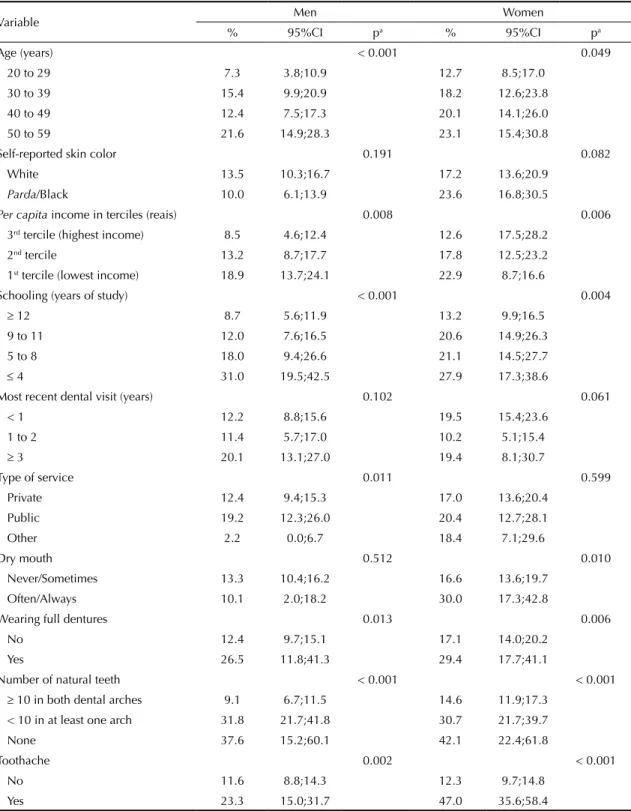
The mean age of the interviewees was 38 years old (standard deviation – SD = 11.6 years) and 55.8% were women. Fewer than half of the men and women had more than 12 years of studies. Most men and women had visited a dentist within the past year and had more than ten natural teeth in both dental arches (Table 1).
years of schooling compared with those with more than 12 years of studies. Higher prevalence was observed among those who wore full dentures, those with fewer than ten natural teeth in at least one dental arch or who were edentulous and those who reported toothache within the last six months. Men who used public dental services
and women who reported dry mouth had a higher preva-lence of dificulty chewing (Table 2).
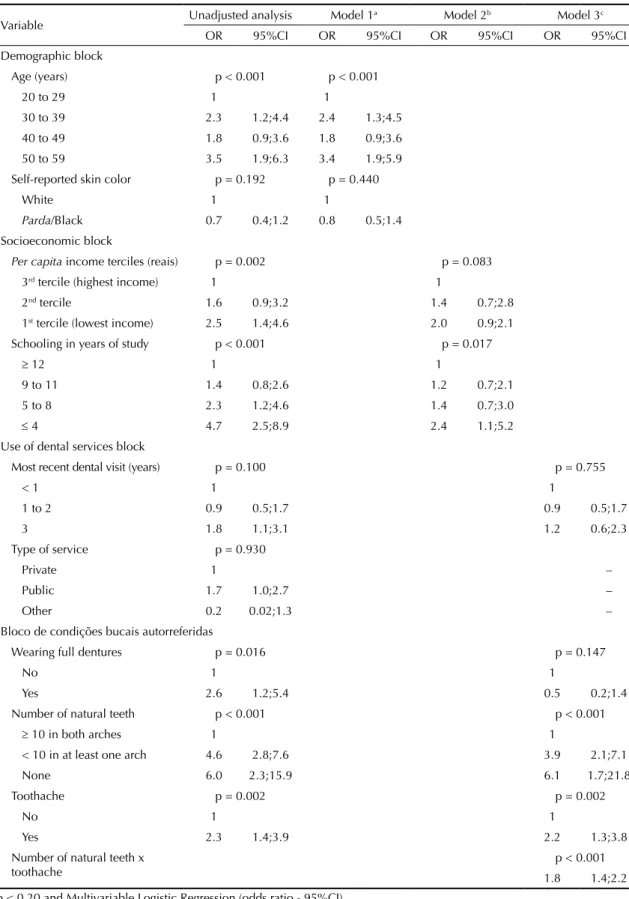
In the multivariable analysis for men, it was observed that those aged between 50 and 59 had an almost three times greater chance of having dificulty chewing
Table 1. Total sample and stratified by sex, according to socioeconomic and demographic characteristics, access to dental services and self-reported oral health condition. Florianopolis, SC, Southern Brazil, 2009. (N = 1,720)
Variable Sample Men Women
n % n % n %
Age (years) (n = 1,720)
20 to 29 540 32.7 260 34.8 280 30.9
30 to 39 392 22.9 172 22.9 220 23.0
40 to 49 438 25.0 181 23.7 257 26.0
50 to 59 350 19.4 148 18.6 202 20.1
Self-reported skin color (n = 1,678)
White 1,444 86.0 642 85.1 802 86.3
Parda/Black 234 14.0 108 14.9 126 13.7
Per capita income in terciles (reais) (n = 1,685)
3rd tercile (highest income) 559 34.1 258 35.7 301 32.9
2nd tercile 562 33.3 258 34.4 304 32.4
1st tercile (lowest income) 564 32.6 229 29.9 335 34.7
Schooling (years of study) (n = 1,716)
≥ 12 737 43.9 318 43.0 419 44.6
9 to 11 568 33.3 263 34.5 305 32.5
5 to 8 253 14.0 108 13.7 145 14.2
≤ 4 158 8.8 69 8.8 89 8.7
Most recent dental visit (years) (n = 1,705)
< 1 1,136 66.9 453 60.2 683 72.2
1 to 2 381 22.4 194 25.5 187 19.9
≥ 3 188 10.7 109 14.3 79 7.9
Type of service (n = 1,707)
Private 1,293 76.3 563 75.1 730 77.3
Public 331 19.0 150 19.3 181 18.7
Other 83 4.7 44 5.6 39 4.0
Dry mouth (n = 1,716)
Never/Sometimes 1,564 91.5 704 93.1 860 90.1
Often/Always 152 8.5 55 6.9 97 9.9
Wearing full prosthesis (n = 1,698)
No 1,575 93.0 711 94.1 864 91.9
Yes 123 7.0 41 5.9 82 8.1
Number of natural teeth (n = 1,717)
≥ 10 in both dental arches 1,394 82.0 629 83.3 765 81.0
< 10 in at least one arch 279 15.6 116 14.7 163 16.2
None 44 2.4 15 2.0 29 2.8
Toothache (n = 1,717)
No 1,463 85.4 661 87.5 802 83.8
Yes 254 14.6 100 12.5 154 16.2
Difficulty chewing (n = 1,712)
Never 1,443 84.2 653 87.0 790 82.0
Sometimes/Often/Always 269 15.8 104 13.0a 165 18.0a
than those aged 20 to 29. Schooling was partially and positively confounded by age and per capita income, attenuating the effect of the OR among those with lower levels of schooling compared with those with 12 or more years of studies. The association between wearing dentures and dificulty chewing ceased to be
signiicant when age, per capita income and schooling were considered. Edentulous males had an OR almost six times greater for having dificulty chewing than those with ten or more teeth in both dental arches. Having reported toothache increased the chance of dificulty chewing by more than two times (Table 3).
Table 2. Prevalence of difficulty chewing in men and women according to socioeconomic and demographic characteristics, access to dental services and self-reported oral health condition. Florianopolis, SC, Southern Brazil, 2009. (N = 1,720)
Variable Men Women
% 95%CI pa % 95%CI pa
Age (years) < 0.001 0.049
20 to 29 7.3 3.8;10.9 12.7 8.5;17.0
30 to 39 15.4 9.9;20.9 18.2 12.6;23.8
40 to 49 12.4 7.5;17.3 20.1 14.1;26.0
50 to 59 21.6 14.9;28.3 23.1 15.4;30.8
Self-reported skin color 0.191 0.082
White 13.5 10.3;16.7 17.2 13.6;20.9
Parda/Black 10.0 6.1;13.9 23.6 16.8;30.5
Per capita income in terciles (reais) 0.008 0.006
3rd tercile (highest income) 8.5 4.6;12.4 12.6 17.5;28.2
2nd tercile 13.2 8.7;17.7 17.8 12.5;23.2
1st tercile (lowest income) 18.9 13.7;24.1 22.9 8.7;16.6
Schooling (years of study) < 0.001 0.004
≥ 12 8.7 5.6;11.9 13.2 9.9;16.5
9 to 11 12.0 7.6;16.5 20.6 14.9;26.3
5 to 8 18.0 9.4;26.6 21.1 14.5;27.7
≤ 4 31.0 19.5;42.5 27.9 17.3;38.6
Most recent dental visit (years) 0.102 0.061
< 1 12.2 8.8;15.6 19.5 15.4;23.6
1 to 2 11.4 5.7;17.0 10.2 5.1;15.4
≥ 3 20.1 13.1;27.0 19.4 8.1;30.7
Type of service 0.011 0.599
Private 12.4 9.4;15.3 17.0 13.6;20.4
Public 19.2 12.3;26.0 20.4 12.7;28.1
Other 2.2 0.0;6.7 18.4 7.1;29.6
Dry mouth 0.512 0.010
Never/Sometimes 13.3 10.4;16.2 16.6 13.6;19.7
Often/Always 10.1 2.0;18.2 30.0 17.3;42.8
Wearing full dentures 0.013 0.006
No 12.4 9.7;15.1 17.1 14.0;20.2
Yes 26.5 11.8;41.3 29.4 17.7;41.1
Number of natural teeth < 0.001 < 0.001
≥ 10 in both dental arches 9.1 6.7;11.5 14.6 11.9;17.3
< 10 in at least one arch 31.8 21.7;41.8 30.7 21.7;39.7
None 37.6 15.2;60.1 42.1 22.4;61.8
Toothache 0.002 < 0.001
No 11.6 8.8;14.3 12.3 9.7;14.8
Yes 23.3 15.0;31.7 47.0 35.6;58.4
Table 3. Association between difficulty chewing in men aged 20 to 59 years and independent variables. Florianopolis, SC, Southern Brazil, 2009. (N = 761)
Variable Unadjusted analysis Model 1
a Model 2b Model 3c
OR 95%CI OR 95%CI OR 95%CI OR 95%CI
Demographic block
Age (years) p < 0.001 p < 0.001
20 to 29 1 1
30 to 39 2.3 1.2;4.4 2.4 1.3;4.5
40 to 49 1.8 0.9;3.6 1.8 0.9;3.6
50 to 59 3.5 1.9;6.3 3.4 1.9;5.9
Self-reported skin color p = 0.192 p = 0.440
White 1 1
Parda/Black 0.7 0.4;1.2 0.8 0.5;1.4 Socioeconomic block
Per capita income terciles (reais) p = 0.002 p = 0.083
3rd tercile (highest income) 1 1
2nd tercile 1.6 0.9;3.2 1.4 0.7;2.8
1st tercile (lowest income) 2.5 1.4;4.6 2.0 0.9;2.1
Schooling in years of study p < 0.001 p = 0.017
≥ 12 1 1
9 to 11 1.4 0.8;2.6 1.2 0.7;2.1
5 to 8 2.3 1.2;4.6 1.4 0.7;3.0
≤ 4 4.7 2.5;8.9 2.4 1.1;5.2
Use of dental services block
Most recent dental visit (years) p = 0.100 p = 0.755
< 1 1 1
1 to 2 0.9 0.5;1.7 0.9 0.5;1.7
3 1.8 1.1;3.1 1.2 0.6;2.3
Type of service p = 0.930
Private 1 –
Public 1.7 1.0;2.7 –
Other 0.2 0.02;1.3 –
Bloco de condições bucais autorreferidas
Wearing full dentures p = 0.016 p = 0.147
No 1 1
Yes 2.6 1.2;5.4 0.5 0.2;1.4
Number of natural teeth p < 0.001 p < 0.001
≥ 10 in both arches 1 1
< 10 in at least one arch 4.6 2.8;7.6 3.9 2.1;7.1
None 6.0 2.3;15.9 6.1 1.7;21.8
Toothache p = 0.002 p = 0.002
No 1 1
Yes 2.3 1.4;3.9 2.2 1.3;3.8
Number of natural teeth x toothache
p < 0.001
1.8 1.4;2.2
p < 0.20 and Multivariable Logistic Regression (odds ratio - 95%CI)
a Model 1: block 1 variables adjusted for variables in the same block.
b Model 2: block 2 variables adjusted for variables in the same block and for age.
c Model 3: block 3 variables adjusted for variables in the same block and for age, income and schooling.
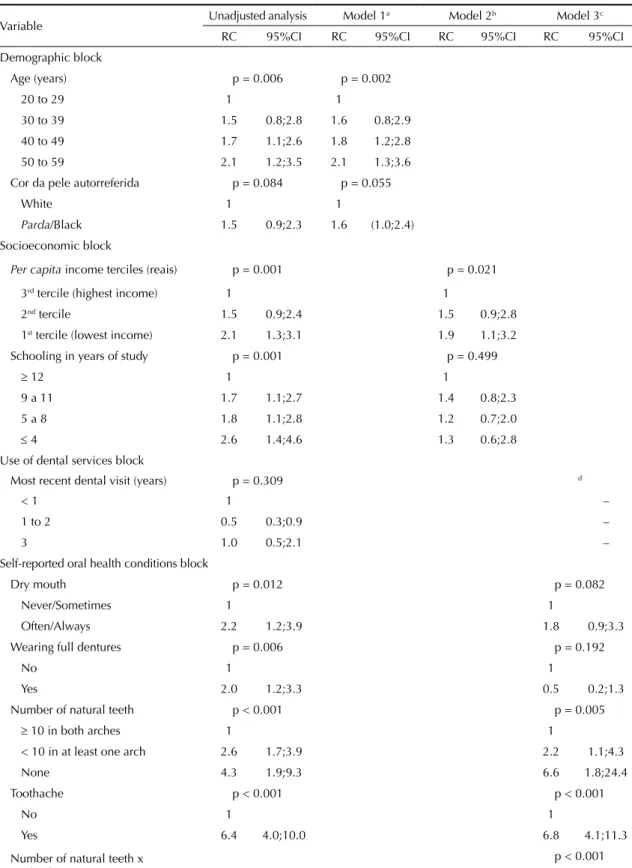
In women, dissatisfaction with chewing increased with age and with decreasing income. Although at the limit of statistical signiicance, women whose self-reported skin color was parda or black had a 60.0% higher chance of being dissatisied with chewing than those whose self-reported skin color was white. Edentulous women had an almost seven times higher chance of the outcome compared with those with ten or more natural teeth in both dental arches. A similar igure was obtained for those who had reported toothache, compared with those without pain (Table 4).
There was signiicant interaction between the number of teeth and toothache in both men and women. However, the magnitude of the association of the combined effect among having more than ten teeth in the dental arches and the presence of toothache was almost four times greater among women (Figure 1).
DISCUSSION
There was a higher prevalence of dificulty chewing among women. Although the factors associated with dificulty chewing were similar between the sexes, the effect of simultaneously having more than ten teeth in both dental arches and toothache was almost four times higher among women.
The prevalence of difficulty chewing in the total sample was lower than the indings in international literature, which indicated prevalence ranging from 20.0% in adults aged 45 and over in Florida20 to 30.0%
in adults aged over 45 in Taiwan.11 The prevalence
of the outcome in adults in Brazil was 31.0%.a The
difference between this study and the indings of the national survey can be explained by living an health care conditions in Florianópolis, which are above average for Brazil.b The rates of prevalence between the
sexes conirm what is found in the literature. A study with adults in the USA20 showed that the prevalence of
dificulty chewing in women was double that in men. In Brazil, the prevalence of this outcome for men was 25.0%, and 34.0% for women.a
The chance of experiencing the outcome increases with age among men, as in the study of adult and older men in the USA.14 This study indicates that, the greater the
age, the more compromised natural dentition is and the lower the intake of food considered to be healthy, such as fruit and iber. Although this study does not assess quality of food intake, previous studies12,14,21,23
have shown a positive association between age and dificulty chewing and stressed that not eating foods deemed healthy affects general health.
Men with lower levels of schooling had a greater chance of being dissatisied with chewing. Men at lower socio -economic levels are more dedicated to providing for
their household than to looking after themselves and make less use of health care services than women.9 In
addition, they are more prone to stressful environments, tend to adopt less healthy lifestyles, with higher alcohol and tobacco consumption. These substances can lead to chronic health problems,10 including mouth cancer,
which is more prevalent among men and produces countless negative impacts on the individual, including dificulty chewing.18
Parda and black women had more chance of having dificulty chewing. Black women tended to report more dificulty chewing20 and more tooth loss than
white women.3 A possible explanation for this is that
black women usually work in poorly paid positions demanding lower qualiications, live in areas with poorer basic infrastructure and experience limitations to health care service use.2 The results of this research
confirm those in the literature. When considering the socioeconomic position of women, skin color is confounded with income and schooling, and remains at the limit of statistical signiicance.
In both men and women, having no natural teeth increases the chance of having dificulty chewing by at least six times, compare with those who have more than ten natural teeth in at least one dental arch. On the other hand, authors have shown differences in reports of satisfaction with chewing between the sexes in the absence of natural teeth. Women wearing conventional dentures show more dissatisfaction with chewing than men and report more perioral sensitivity to the move-ment of the prosthesis.19
The results of this study indicate differences in the magnitude of the association between difficulty chewing and toothache in men and women. A study of adults and the older individuals in Spain showed a greater prevalence of toothache in women than in men.17
There was a stronger association between having more teeth and suffering toothache among women than men. Men and women, due to social and cultural issues, tend to have different concepts of painful sensations and well-being associated with the mouth. Women pay more attention to the fact that missing teeth or tooth-ache can determine quality of life, whether because it affects appearance and mood or whether providing better opportunities in the job market.13 According to
Pan et al,19 difference related to biological aspects in
adult women, such as hormonal alterations, menopause or osteoporosis should be considered in reports of dissatisfaction with chewing.
Tabla 4. Association between difficulty chewing in women aged 20 to 59 years and independent variables. Florianopolis, SC, Southern Brazil, 2009. (N = 959)
Variable Unadjusted analysis Model 1
a Model 2b Model 3c
RC 95%CI RC 95%CI RC 95%CI RC 95%CI
Demographic block
Age (years) p = 0.006 p = 0.002
20 to 29 1 1
30 to 39 1.5 0.8;2.8 1.6 0.8;2.9
40 to 49 1.7 1.1;2.6 1.8 1.2;2.8
50 to 59 2.1 1.2;3.5 2.1 1.3;3.6
Cor da pele autorreferida p = 0.084 p = 0.055
White 1 1
Parda/Black 1.5 0.9;2.3 1.6 (1.0;2.4)
Socioeconomic block
Per capita income terciles (reais) p = 0.001 p = 0.021
3rd tercile (highest income) 1 1
2nd tercile 1.5 0.9;2.4 1.5 0.9;2.8
1st tercile (lowest income) 2.1 1.3;3.1 1.9 1.1;3.2
Schooling in years of study p = 0.001 p = 0.499
≥ 12 1 1
9 a 11 1.7 1.1;2.7 1.4 0.8;2.3
5 a 8 1.8 1.1;2.8 1.2 0.7;2.0
≤ 4 2.6 1.4;4.6 1.3 0.6;2.8
Use of dental services block
Most recent dental visit (years) p = 0.309 d
< 1 1 –
1 to 2 0.5 0.3;0.9 –
3 1.0 0.5;2.1 –
Self-reported oral health conditions block
Dry mouth p = 0.012 p = 0.082
Never/Sometimes 1 1
Often/Always 2.2 1.2;3.9 1.8 0.9;3.3
Wearing full dentures p = 0.006 p = 0.192
No 1 1
Yes 2.0 1.2;3.3 0.5 0.2;1.3
Number of natural teeth p < 0.001 p = 0.005
≥ 10 in both arches 1 1
< 10 in at least one arch 2.6 1.7;3.9 2.2 1.1;4.3
None 4.3 1.9;9.3 6.6 1.8;24.4
Toothache p < 0.001 p < 0.001
No 1 1
Yes 6.4 4.0;10.0 6.8 4.1;11.3
Number of natural teeth x toothache
p < 0.001
2.5 2.0;3.3
p < 0.20 and Multivariable Logistic Regression (odds ratio - 95%CI)
a Model 1: block 1 variables adjusted for variables in the same block.
b Model 2: block 2 variables adjusted for variables in the same block and for age.
c Model 3: block 3 variables adjusted for variables in the same block and for age, income and schooling.
self-reporting questions.b However, the self-reported
number of teeth has been shown to be a valid measure in other contexts.8 Another limitation of the study could
be that it is not possible to generalize it to apply to other contexts, as Florianópolis has better living and health care conditions that most Brazilian cities.b
High internal validity was identiied, as the estimates of the IBGE for sex, age and income for the adult popula-tion of Florianopolis in 2009b were shown to be similar
to those in this study. Although the questions used in this study had not been validated for Brazil, a strong point was using questions that had been used in other
a Context of the final modelling for men and women adjusted for
sociodemographic and economic variables and use of services.
b Comparison with best category ≥ 10 teeth in both arches and
without toothache1
Figure. Interaction between number of natural teeth and toothache on difficulty chewing, in adults according to sex. Florianópolis, SC, 2009. Test for heterogeneity (p < 0.001)
< 10 teeth in at least one dental arch and without toothacheb
< 10 teeth in at least one dental arch and with toothacheb
≥ 10 teeth in both arches and with
toothacheb
Odds r
atio (OR)
a
21.0
16.0
11.0
6.0
1.0
Men Woman
2.5
9.4
6.9 7.3
4.3 3.4
national15,a and international22 surveys. High rates of
reliability were observed between the interviewees for the self-reporting questions and the interviewer guide for the research questions, suggesting that there was no observation bias. The multivariable analysis was guided by a theoretical model that enabled possible confounding factors to be controlled, as well as testing plausible interactions. Moreover, the self-reporting question used in the study: “How often do you have dificulty eating because of problems with your teeth or dentures?” enables systematic assessment to be carried out by a long-term health surveillance system for the outcome in question. It is suggested that this question be included in population surveys. There are different magnitudes in the factors associated with dificulty chewing between men and women, generally higher among women, with toothache standing out. The results suggest that the impact of oral health conditions varies according to sex.
ACKNOWLEDGEMENTS
1. Araújo CS, Lima RC, Peres MA, Barros AJ. Utilização de serviços odontológicos e fatores associados: um estudo de base populacional no Sul do
Brasil. Cad Saude Publica. 2009;25(5):1063-72.
DOI:10.1590/S0102-311X2009000500013
2. Araújo EM, Costa MCN, Hogan VK, Araújo TM, Dias AB, Oliveira LOA. A utilização da variável raça/cor em Saúde Pública: possibilidades e
limites. Interface (Botucatu). 2009;13(31):383-94.
DOI:10.1590/S1414-32832009000400012
3. Barbato PR, Nagano HCM, Zanchet FN, Boing AF, Peres MA. Perdas dentárias e fatores sociais, demográficos e de serviços associados em adultos brasileiros: uma análise dos dados do Estudo Epidemiológico Nacional (Projeto SB Brasil
2002-2003). Cad Saude Publica. 2007;23(8):1803-14.
DOI:10.1590/S0102-311X2007000800007
4. Bastos JL, Peres MA, Peres KG, Araujo CL, Menezes AM. Toothache prevalence and associated factors: a life course study from birth
to age 12 yr. Eur J Oral Sci. 2008;116(5):458-66.
DOI:10.1111/j.1600-0722.2008.00566.x
5. Boretti G, Bickel M, Geering AH. A review of
masticatory ability and efficiency. J Prosthet Dent.
1995;74(4):400-3.
6. Braga APG, Barreto SM, Martins AME. Autopercepção da mastigação e fatores associados em adultos
brasileiros. Cad Saude Publica. 2012;28(5):889-904.
DOI:10.1590/S0102-311X2012000500008
7. Gilbert GH, Foerster U, Duncan RP. Satisfaction with chewing ability in a diverse sample of
dentate adults. J Oral Rehabil. 1998;25(1):15-27.
DOI:10.1046/j.1365-2842.1998.00207.x
8. Gilbert GH, Chavers LS, Shelton BJ. Comparison of two methods of estimating 48-month tooth loss
incidence. J Public Health Dent. 2002;62(3):163-9.
DOI:10.1111/j.1752-7325.2002.tb03438.x
9. Gomes R, Nascimento EF, Araújo FC. Por que os homens buscam menos os serviços de saúde do que as mulheres? As explicações de homens com baixa escolaridade e homens com ensino
superior. Cad Saude Publica. 2007;23(3):565-74.
DOI:10.1590/S0102-311X2007000300015
10. Ho R, Davidson G, Ghea V. Motives for the adoption of protective health behaviours for men and women: an evaluation of the psychosocial-appraisal health
model. J Health Psychol. 2005;10(3):373-95.
DOI:10.1177/1359105305051424
11. Hsu KJ, Yen YY, Lan SJ, Wu YM, Chen CM, Lee HE. Relationship between remaining teeth and self-rated chewing ability among population aged 45 years or
older in Kaohsiung City, Taiwan. Kaohsiung J Med Sci.
2011;27(10):457-65. DOI:10.1016/j.kjms.2011.06.006
12. Hung HC, Willett W, Ascherio A, Rosner BA, Rimm E,
Joshipura KJ. Tooth loss and dietary intake. J Am Dent
Assoc. 2003;134(9):1185-92.
13. Inglehart MR, Silverton SF, Sinkford JC. Oral health-related quality of life: does gender matter? In: Inglehart MR, Bagramian RA, editors. Oral health-related quality of life. Chicago: Quintessence; 2002. p.111-21.
14. Krall E, Hayes C, Garcia R. How dentition status and
masticatory function affect nutrient intake. J Am Dent
Assoc. 1998;129(9):1261-9.
15. Lima-Costa MF, Firmo JOA, Uchôa E. A estrutura da auto-avaliação da saúde entre idosos: projeto
Bambui. Rev Saude Publica. 2004;38(6):827-34.
DOI:10.1590/S0034-89102004000600011
16. Meng X, Gilbert GH. Predictors of change in satisfaction with chewing ability: a 24-month study of
dentate adults. J Oral Rehabil. 2007;34(10):745-58.
DOI:10.1111/j.1365-2842.2006.01701.x
17. Montero J, Bravo M, Vicente MP, Galindo MP, Lopez-Valverde A, Casals E, et al. Oral pain and eating problems in Spanish adults and elderly in the Spanish
National Survey performed in 2005. J Orofac Pain.
2011;25(2):141-52.
18. Pace-Balzan A, Shaw RJ, Butterworth C. Oral rehabilitation following treatment for oral cancer. Periodontology2000. 2011;57(1):102-17. DOI:10.1111/j.1600-0757.2011.00384.x
19. Pan S, Awad M, Thomason JM, Dufresne E, Kobayashi T, Kimoto S, et al. Sex differences in
denture satisfaction. J Dent. 2008;36(5):301-8.
DOI:10.1016/j.jdent.2008.02.009
20. Peek CW, Gilbert GH, Duncan RP. Predictors of chewing difficulty onset among dentate adults:
24-month incidence. J Public Health Dent.
2002;62(4):214-21.
21. Sheiham A, Steele JG, Marcenes W, Tsakos G, Finch S, Walls AW. Prevalence of impacts of dental and oral disorders and their effects on eating among older people; a national survey in Great Britain. Community Dent Oral Epidemiol. 2001;29(3):195-203. DOI:10.1034/j.1600-0528.2001.290305.x
22. Thomson WM, Poulton R, Broadbent JM, Al-Kubaisy S. Xerostomia and medications among
32-year-olds. Acta Odontol Scand. 2006;64(4):249-54.
DOI:10.1080/00016350600633243
23. Touger-Decker R, Mobley CC. Position of the American
Dietetic Association: oral health and nutrition. J Am
Diet Assoc. 2007;107(8):1418-28.
24. Victora CG, Huttly SR, Fuchs SC, Olinto MT. The role of conceptual frameworks in epidemiological
analysis: a hierarchical approach. Int J Epidemiol.
1997;26(1):224-7. DOI:10.1093/ije/26.1.224
REFERENCES
This study was supported by the Conselho Nacional de Desenvolvimento Científico e Tecnológico (CNPq – Process no.
485327/2007-4) and presented at the VIII Congresso Brasileiro de Epidemiologia da ABRASCO, with honorable mention, Sao
Paulo, SP, in 2011.