" ' Rev Saúde Pública 2005;39(3):490-7 www.fsp.usp.br/rsp
Modern cancer epidemiological research:
genetic polymorphisms and environment
Pesquisa epidemiológica contemporânea em
câncer: polimorfismos genéticos e ambiente
Victor Wünsch Filhoa and Marco A Zagob
aDepartamento de Epidemiologia. Faculdade de Saúde Pública. Universidade de São Paulo (USP). São
Paulo, SP, Brasil. bDepartamento de Medicina. Faculdade de Medicina. USP. Ribeirão Preto, SP, Brasil
Correspondence to:
Victor Wünsch Filho
Departamento de Epidemiologia - FSP/USP Av. Dr. Arnaldo, 715
01246-904 São Paulo, SP, Brasil E-mail: [email protected]
Funded by the European Commission (Grant n. IC18CT9702220) and Fundação de Amparo à Pesquisa no Estado de São Paulo (Fapesp - Grant n. 00/06042-7 and 01/12897-8).
Received on 5/4/2004. Reviewed on 28/9/2004. Approved on 1/2/2005.
Revisão
Review
Keywords
Neoplasms, epidemiology. Polymorphism (genetics).
Environmental risks. Epidemiology, molecular.
Descritores
Neoplasias, epidemiologia. Polimorfismo (genética). Riscos ambientais. Epidemiologia molecular.
Abstract
Individual cancer susceptibility seems to be related to factors such as changes in oncogenes and tumor suppressor genes expression, and differences in the action of metabolic enzymes and DNA repair regulated by specific genes. Epidemiological studies on genetic polymorphisms of human xenobiotics metabolizing enzymes and cancer have revealed low relative risks. Research considering genetic polymorphisms prevalence jointly with environmental exposures could be relevant for a better understanding of cancer etiology and the mechanisms of carcinogenesis and also for new insights on cancer prognosis. This study reviews the approaches of molecular epidemiology in cancer research, stressing case-control and cohort designs involving genetic polymorphisms, and factors that could introduce bias and confounding in these studies. Similarly to classical epidemiological research, genetic polymorphisms requires considering aspects of precision and accuracy in the study design.
Resumo
" '
Rev Saúde Pública 2005;39(3):490-7 www.fsp.usp.br/rsp
Cancer contemporary epidemiological research Wünsch Filho V & Zago MA
INTRODUCTION
There is now a consensus that environmental fac-tors often exert their influence through genetic mecha-nisms to promote disease. The large variations of can-cer incidence among populations living in different regions of the world suggest that the majority of ma-lignant tumors are related to environmental factors.25
There is no thorough mapping of cancer incidence, since population-based tumor registries do not cover some regions and information on mortality could be poor. Nevertheless, differences between tumor rates observed in a population compared to another with minimum rates have been assumed as the attribut-able fraction of cancer caused by environmental fac-tors, even though these populations could differ greatly according to gene polymorphisms frequency. According to these assumptions, 80% to 90% of all cancers have determinants such as viruses, soot and fumes inhaled, food and pollutants ingested, as well as chemical substances and radiations, which affect human body.27 Such inferences are consistent with
studies on migrant groups. The first-generation of Japanese immigrants in the city of São Paulo revealed incidence patterns for some cancers distinct from those of the Japanese people and closer to the Brazil-ian population.33 The contribution of hereditary
fac-tors in cancer is considered minor. Certain familial cancer clusters with monogenic pattern are very rare and account for a relatively small proportion (less than 5%) of total cancer.26 The role of heredity on
occurrence of common cancers with non-Mendelian pattern is unclear.38
Several environmental carcinogens have been iden-tified through epidemiological studies during last century, but until recently they altogether disregarded inter-individual variations in response to exposure or, in other words, there were no available technolo-gies in the past to evaluate individual susceptibility. The rapid progress achieved by molecular biology has provided basic tools for geneticists and
epidemi-ologists to go deeper within genotype characteristics and has as well given fresh insights of this influence on cancer distribution within populations.
For this review the first step was the scientific bib-liography systematic assessment from the Medline database using the following keywords: genetic polymorphisms and cancer; gene-environment inter-action and cancer. For the first keywords searched were established some limits: only items in English and with abstracts available from 1/1/1990 to 12/31/ 2003. Only three publications types were examined: clinical trials (n=87); randomized controlled trials (n=29); and meta-analysis (n=24). For gene-environ-ment interactions and cancer keywords all publica-tions types had their abstracts reviewed (n=93). From the abstracts reading, only the relevant complete pa-pers were selected considering their insights on the current rationality of molecular epidemiology in can-cer research, that of simultaneously evaluate envi-ronmental exposures and genetic markers in cancer etiology, particularly focusing the use of common genetic polymorphisms. Additional papers were searched from the most important bibliography refer-ences included in those papers.
ENVIRONMENT AND GENETIC FACTORS IN CANCER
Tobacco smoking is well recognized worldwide as the most important exogenous isolated risk factor for cancer. About 90% of lung cancer cases can be attrib-uted to cigarette smoking, but no more than 20% of smokers develop this type of cancer.39 From the
pio-neering study of Tokuhata & Lilienfeld32 on familial
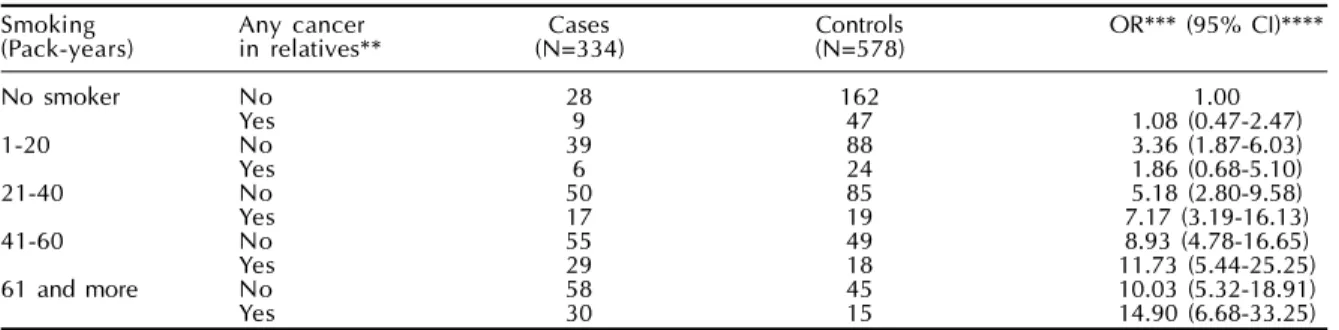
aggregation of lung cancer, several studies have con-sistently demonstrated an increased prevalence of cancer among relatives of lung cancer patients. Table 1 shows data on smoking from a case-control study40
and as can be noted, cigarette smoking has distinct effects on those with or without reported cancer cases in first-degree relatives. A joint effect was detected
Table 1 - Joint effect of smoking and cancer in first-degree relatives on lung cancer.*
Smoking Any cancer Cases Controls OR*** (95% CI)**** (Pack-years) in relatives** (N=334) (N=578)
No smoker No 28 162 1.00
Yes 9 47 1.08 (0.47-2.47)
1-20 No 39 88 3.36 (1.87-6.03)
Yes 6 24 1.86 (0.68-5.10)
21-40 No 50 85 5.18 (2.80-9.58)
Yes 17 19 7.17 (3.19-16.13)
41-60 No 55 49 8.93 (4.78-16.65)
Yes 29 18 11.73 (5.44-25.25)
61 and more No 58 45 10.03 (5.32-18.91)
Yes 30 15 14.90 (6.68-33.25)
*Source: Wünsch-Filho et al,40 with permission **Parents and siblings
" ' Rev Saúde Pública 2005;39(3):490-7 www.fsp.usp.br/rsp
Cancer contemporary epidemiological research Wünsch Filho V & Zago MA
between the variables smoking and cancer in rela-tives on the risk of lung cancer.
Some authors have suggested that genetic predispo-sition may contribute to familial aggregation of lung cancer.6,39 For example, interactions were observed
between pack-years of smoking and the combined GSTM1 null, GSTM3 AA, GSTP1 (AG or GG) geno-type. The combination of three at risk genotypes con-ferred an increased risk of lung cancer among smokers with a history of at least 35 pack-years, but not in lighter smokers,13 suggesting that this genotype increases
sus-ceptibility to lung cancer only in smokers. On the other hand, results of familial aggregation studies may also be explained by the fact that people from the same family tend to share similar habits, such as tobacco smoking, alcohol intake or occupation.
Disentangle genetic and environmental components on the risk of cancer is an old puzzle for epidemiolo-gists.30 Lichtenstein et al19 reported from their twin
cohort some distinctions on environment and genetics in cancer etiology. The rates of sporadic cancers were similar in monozygotic and dizygotic pairs. For five tumors (stomach, colorectal, pancreas, lung and pros-tate) the estimated effects of genetic factors varied from 26% to 42%, the highest for prostate cancer. The ef-fects of environmental factors ranged from 58% to 64%, and authors detected the highest effect due to environ-mental components for breast cancer (73%). Despite these results from Scandinavia, there are some practi-cal limitations, which are, in general, inherent to stud-ies concerning twins:11 the study did not address
infor-mation on screening practices and specific types of
exposure (for example, tobacco and alcohol). Then no interaction among genes and environmental factors could be evaluated. Understanding mechanisms of inherited genetic predisposition, responsible for inter-individual variation in response to xenobiotics, will lead to a better comprehension of carcinogenesis, mo-tivating preventive policies and advances in develop-ment of new intelligent drugs against cancer.38 Research
in molecular biology has given continuous facts con-cerning specific function of biomarkers, which could have complementary acting mechanisms. From cur-rent conceptions, cancer arises from a stepwise accu-mulation of genetic changes. Efforts in molecular bi-ology to unravel the nature of neoplastic transforma-tion, through experimental studies in animals and epi-demiological observational studies in humans, indi-cate the existence of a common set of mechanisms involved in carcinogenesis.8
Genetic factors in cancer encompass a gradient, which involves two extremes, the first of which com-prise high-penetrance gene mutations and individu-als with alleles at risk approaches to 100% of disease incidence, such as familial retinoblastoma – a child-hood cancer inherited in an autosomal dominant pat-tern. On the opposite, genetic polymorphisms, whose variations in gene sequence show low-penetrance, such as GSTM1 null polymorphism and lung can-cer.36,37 Table 2 exhibits comparisons of this spectrum.
Gene mutations linked with recognized familial can-cers are very specific and rare, and is a characteristic particularly of those tumors incident at younger ages (retinoblastoma). Strongly predisposing mutations in
Table 2 - Spectrum of genetic variables according to gene penetrance* in cancer. Characteristic
Genetic variable
Population prevalence Population effect
Individual effect
Relation with environmental factors
Study design approach
Example
*Penetrance: The lifetime risk of developing cancer (usually up to the age of 70 years) Source:
**Narod & Foulkes23 and Peto26 ***Narod & Foulkes23
****Houlston12
*****Gattás & Soares-Vieira5
High penetrance gene mutation
Single gene is the predominant factor on cancer
Simple Mendelian inheritance (Single-gene diseases) Rare
Small cancer proportion (Low attributable risk)
High risk in carriers
Could act with no interactions with environmental factors
Genetic studies:
•
Twins studies•
Segregation analysis•
Linkage analysisBRCA1 and BRCA2 mutations and breast cancer
Penetrance =6.08%**
Population prevalence =0.4%***
Low penetrance gene mutation
Genetic variants (polymorphisms) with modest effect on cancer No Mendelian pathway inheritance (Multifatorial diseases)
Common
Potentially high contribution to cancer considering interaction with environmental variables
(High attributable risk) Low risk in carriers
Gene-environment interactions are intrinsic to mode of action of low-penetrance gene polymorphisms
Epidemiological studies:
•
Case-control•
CohortGSTM1 null and lung cancer Relative risk =1.14****
" ' !
Rev Saúde Pública 2005;39(3):490-7 www.fsp.usp.br/rsp
Cancer contemporary epidemiological research Wünsch Filho V & Zago MA
BRCA1 and BRCA2 genes might be responsible for most multiple-case families (which confer individual risks of around 60-80% by age 70), but for only 2% of all cases at population level.26 The population
preva-lence of BRCA1 and BRCA2 genes mutations is about 0.4%.23 In contrast, prevalence of genetic
polymor-phisms changes according to race5 and population
prevalence could range from 1% to 90%, but the effect on cancer causality seems to be low.
GENETIC POLYMORPHISMS AND CANCER
Evolution has rendered human species capable of metabolizing chemical substances, which if accumu-lated in cells could harm the health, and explain interethnic and inter-individual variability of chemi-cal metabolism. Gene polymorphisms of drug-me-tabolizing enzymes are almost always the rule, not exception.16 Several gene variants, such as single
nucleotide polymorphisms, could be nominated. One first and essential research question is how to sepa-rate those important for evaluation of cancer etiology or cancer prognosis from those to be disregard.
Most of gene polymorphisms pointed thus far in cancer epidemiology codifies for metabolic enzymes involved in phases I or II of chemical metabolism and those responsible for the DNA repair, inflammatory response, cell adhesion and vascular grow as well. In general, environmental proto-carcinogens are con-verted into their reactive electrophilic intermediates through enzymes acting in phase I, much in same fashion as those of cytochrome P450 family (CYP). The effect on distinct tumors of CYP gene polymor-phisms was examined in several populations and eth-nic groups. Considering the association between CYP1A1 and lung cancer, studies appointed to odds ratios (OR) with variation from OR 2.0841 to OR
7.31.22 During phase II, molecule toxicity can be
re-duced through the action of other enzymes, codified by specific genes, which in turn transform xenobiotics in water soluble, easily excretable metabolites. A group of enzymes, as glutathione S-transferase (GST) and N-acetil-transferase (NAT), lead this phase of metabolization process.31 Glutathione S-transferase
(GST) family includes no fewer than four classes of genes: GSTalpha, mu (GSTM), pi (GSTP), and theta (GSTT), the alleles of which have been frequently associated with some types of tumors.1 Studies of GST
genes polymorphisms and lung cancer have found associations lower than three,9 ranging from OR 0.824
to OR 2.7.13 A meta-analysis of combined results of
studies with GST genes revealed a tenuous risk, OR 1.14 (95% CI: 1.03-1.25).12 However, considering
in-cidence of lung cancer and polymorphisms preva-lence the attributable risk may be considerable.2
Studies that merged enzymes acting in phase I and II of metabolism have showed higher associations with lung cancer, but variation of observed risks was wide. Nakachi et al21 reported very high risks of lung
cancer, OR 16.0 (95% CI: 3.7-68.0) for combination of CYPlA1 (Mspl) and GSTM1 deletion polymor-phisms and high cumulative cigarette dose. Other-wise, Le Marchand et al18 achieved an OR 3.1 (95%
CI: 1.2-7.9) for this same conjunction.
Even in studies with statistically significant results, some not always seem biologically plausible.34 The
vast amount of data generated by human genome sequencing and the continuous use and development of arrays and other parallel genomic laboratory tech-nologies20 will assist the practice of epidemiologists.
These may examine more objectively individual sus-ceptibility and conduct studies adjusted to current research demands and in close consonance with bi-ologists and clinicians.
Undoubtedly, one of the main defiance for cancer research within next decades will be unraveling ge-netic basis of multifactorial cancers, which do not show a Mendelian pattern of inheritance. For exam-ining the genetic factors effect modification on the environmental factors in the genesis of cancer, it will be necessary to conduct studies with larger samples sizes in order to reach statistical power. Studies with considerable number of subjects imply attention to a few variables. For example, differences between samples of biological specimens may be significant, taking into account several difficulties, such as vari-ations in sample collecting and laboratory proce-dures.3 Additionally, error in gene polymorphisms
identification may vary depending on laboratory technical details, however, the current genotyping method Taqman has 96% sensitivity and 98% specificity.35
CASE-CONTROL AND COHORT DESIGNS IN CANCER STUDIES INVOLVING GENE
POLYMORPHISMS
" ' " Rev Saúde Pública 2005;39(3):490-7 www.fsp.usp.br/rsp
Cancer contemporary epidemiological research Wünsch Filho V & Zago MA
Hospital-based case-control study seems the most appropriate strategy to easily get participants’ agree-ment to provide biological specimens, such as blood samples or fresh tumor tissue. Controls will also be much more receptive concerning their participation, since they are inside hospital. In contrast, controls se-lected from a population sample could potentially present higher rates of participation refusal, thus in-ducing selection bias. Large variations, inconclusive results and lack of biological plausibility derived from case-control studies on gene polymorphisms and can-cer have been imputed to sample size and lack of power to show statistical significance, control selection and variations in accuracy of laboratorial methods.2,4
In order to have a study powerful enough to test gene polymorphisms effect, calculations of sample sizes depend upon population prevalence, as well as the level of effect to be estimated. If it is known that allele A increases susceptibility for a specific cancer and its prevalence in the population is 15%, a case-control study will need around 200 cases and similar number of controls to estimate the effect of allele A (assuming an odds ratio around 2.0), and considering a Type 1 error of 0.05 and a power of 80%. Moreover, testing interactions between genes and environment factors will require studies with some extra hundreds of participants.
Table 3 displays data from a study of head and neck tumors conducted in the city of São Paulo. It was con-sidered the joint effect of alcohol drinking and CYP1A1 polymorphisms. Study subjects related to alcohol in-take were split in two groups, those with low inin-take (equal or less than 5 grams/liter/day) and those with higher intake. These groups were examined according to deletion presence (heterozygous condition) or pres-ence in both alleles (homozygous condition). The sam-ple size of 103 cases and 102 controls hampered joint effect risk estimation for those with low alcohol drink-ing and CYP1A1 homozygous condition. Those with higher alcohol consumption and presence of CYP1A1 in both alleles have high risk, but the large confidence interval revealed the result inconsistencies and diffi-culties to accept it as valid.
In parallel to statistical power, misclassification, se-lection bias and confounding are problems to be con-sidered in these studies. Misclassification of exposure status can seriously bias assessment of gene-environ-ment interaction.28 Selection bias may occur
accord-ing to ethnic group. If response rates differ between cases and controls due to ethnicity, comparisons of gene frequency across groups will be threatened. Thus, any genetic or environmental exposure whose distri-bution differs between ethnic groups may seem to be disease related, even though there is no causal rela-tionship. To counteract this difficulty, an alternative could be a nested case-control, but the issue is in set-ting cohort study. Confounding is another potential problem caused by ethnicity. The option is matching cases and controls during the study’s recruitment phase or, else, simple population stratification by race in analysis to better control confounding. However, for multiracial populations such as the Brazilian – where crossbreeding of Europeans, Africans and Native In-dian molds about 50% of population – confounding imputed to ethnicity may be minimum.5
Evolutions of case-control design have been pro-posed to study genetic polymorphisms. Case-only study is a choice when the main objective is joint effect of environment and genetic factors estimation. Inability to examine effects of environmental expo-sure or genetic polymorphism alone is a limitation of this approach.2 Nevertheless, there are some
advan-tages, gain in accuracy and cost reduction brought about by not having to test controls. Additionally, case-only design removes the control component from variance, and achieves the same statistical power as a study with a larger number of controls per case.4
Family-based case-control studies have also been pro-posed to evaluate effects of gene polymorphisms in cancer. Families are recruited from a diseased mem-ber, and data on environmental exposures and bio-logical samples are collected from all family mem-bers. The challenges are to collect individual data on gene polymorphisms and environmental exposures and other covariates on all family members in a sam-ple size large enough to allow detecting interaction.7
Some author’s argument that this kind of approach
Table 3 - Joint effect of alcohol and CYP1A1 gene polymorphisms. Oral, pharynx and larynx tumors case-control study.* Alcohol drinking CYP1A1 Cases Controls OR (95% CI)
(g/L/day)** (N=103) (N=102)
≤5 Null 9 24 1.00
Present 6 11 1.45 (0.14-5.11)
Present in both alleles 0 3 0
>5 Null 55 38 3.86 (1.62-9.22)
Present 29 25 3.09 (1.22-7.87)
Present in both alleles 4 1 10.67 (1.05-108.69) *Source: Gattás GJF, Siraque MS, Soares-Vieira JA, Kohler P, Guarniero FB, Carvalho MB, Eluf-Neto J, Wünsch-Filho V. Gene polymorphisms and oral and larynx cancer. (Research project FAPESP 03/07864-9. Unpublished data)
" ' #
Rev Saúde Pública 2005;39(3):490-7 www.fsp.usp.br/rsp
Cancer contemporary epidemiological research Wünsch Filho V & Zago MA
has no advantages on a well conducted matched case-control study.2
Cohort design seems a less attractive option for studies of genetic polymorphisms and cancer etiology. Cohort studies’ main hindrances are defin-ing a well-established population exposed to an en-vironmental carcinogen, such as a group of workers in an occupational setting, and also, convincing par-ticipants to provide biological samples. Those who agree to be involved in the study can be rather small, thus introducing a selection bias, which might com-promise the internal validity of the study and limit the generalization of the estimated associations. But, if a cohort succeeds in achieving a high degree of adherence by participants, there will be virtually no misclassification of exposure status. Cohorts allow planning nested case-control studies, which have various advantages on hospital-based case-control studies, the most important being the confident clas-sification of environmental exposure.17
Cohort strategy could be used for follow-up of pa-tients with tumors stratified according to cell subtype and presence of specific gene polymorphism. This use is probably the most effective application of co-hort approach in studies of molecular epidemiology. The target is to examine implications of genetic poly-morphisms or gene expression on disease prognosis considering death and other endpoints, such as treat-ment responses or clinical evolution. Characteriza-tion of a malignant disease by molecular markers could improve the understanding of clinical course of disease in individual patients and have insights on their prognosis. Some studies have examined the effect of genetic polymorphisms, such as those linked to genes of invasion and metastasis, cell cycle con-trol, DNA repair, and inflammation, on survival of patients with different types of cancer.29
FUTURE PROSPECTS OF MOLECULAR EPIDEMIOLOGY IN CANCER RESEARCH
In recent years numerous single nucleotide poly-morphisms (SNPs) have been identified within hu-man population, some of them related to cancer sus-ceptibility, cancer progress or host response to dis-ease. Gene polymorphisms are involved in several mechanisms, such as inflammatory response genes, chemokine and chemokine-receptor genes, cell cy-cling, and cell metabolism. Research groups are join-ing efforts to identify novel polymorphisms and build testing confirmatory studies to measure the effect of identified gene polymorphisms. Selection of SNPs to be examined through epidemiological studies must be conducted conforming to a few criteria, such as
SNPs belonging to one type of polymorphism com-mon in population (allele frequency higher than 5%) or SNPs of research interest from scientific literature.34
Some of identified SNPs through expanding, less expensive and more powerful genomic technologies will provide more alternatives for cancer etiology stud-ies. A second fraction of them could be important to clarify prognosis of different types of cancer, while some others could guide research for development of new oncological drugs. Additionally, inherited dif-ferences in sensitivity to drugs may be another rea-sonable research goal, important for identification of different individual reactions to cancer therapy. This will lend guidance in administering lower dosages to sensitive patients.10
CONCLUSIONS
By long time it has been debated whether nature or nurture is responsible for individual variation to dif-ferent diseases or, in other terms, how much disease is due to genetics as opposed to environment.30 Cancer
is a disease of complex etiology. Classical epide-miological investigations focused on evaluation of environmental agents and cancer seems to have reached the edge of discovering new carcinogens with important public health impact.15 One of the
propos-als of molecular epidemiology in cancer is to know how environmental effects on cancer risk are modu-lated by genetic polymorphisms.
Single genes, necessary and sufficient to cause can-cer, are rare, with high absolute and relative risks, have virtually no dependence on environmental ex-posures and have low population attributable risk. Conversely, genetic polymorphisms are common, have low absolute and relative risks, so usually exert small effects on cancer. Genetic polymorphisms modu-late the individual susceptibility to cancer and are strongly dependent of environmental mutagens and therefore have high population attributable risks.14
" ' $ Rev Saúde Pública 2005;39(3):490-7 www.fsp.usp.br/rsp
Cancer contemporary epidemiological research Wünsch Filho V & Zago MA
REFERENCES
1.Awasthi YC, Sharma R, Singhal SS. Human glutathione S-transferases. Int J Biochem 1994;26:295-308.
2.Brennan P. Gene-environment interaction and etiology of cancer: what does it mean and how can we measure it? Carcinogenesis 2002;23:381-7.
3.Caporaso N, Rothman N, Wacholder S. Case-control studies of common alleles and environmental factors.
Natl Cancer Inst Monogr 1999;26:25-30.
4.Cuzick J. lnteraction, subgroup analysis and sample size. In: Vineis P, Malats N, Lang M, dErrico A, Caporaso N, Cuzick J, Boffetta P, editors. Metabolic polymorphisms and susceptibility to cancer. Lyon: IARC Press; 1999. p. 109-21. [IARC Scientific Publications, 148]
5.Gattás GJF, Soares-Vieira JA. Cytochrome P450-2E1 and glutathione S-transferase mu polymorphisms among caucasians and mulattoes from Brazil. Occup Med 2000;50:508-11.
6.Gauderman WJ, Morrison JL. Evidence for age-specific genetic relative risks in lung cancer. Am J Epidemiol 2000;151:41-9.
7.Goldstein AM, Andrieu N. Detection of interaction involving identified genes: available study designs.
Natl Cancer Inst Monogr 1999;26:49-54.
8.Hahn WC, Weinberg RA. Modelling the molecular circuitry of cancer. NatRev Cancer 2002;2:331-41.
9.Hatagima A. Genetic polymorphisms and metabolism of endocrine disruptors in cancer susceptibility. Cad Saúde Pública 2002;18:357-77.
10.Holtzman NA, Marteau TM. Will genetics
revolutionize medicine? N Engl JMed 2000;343:141-4.
11. Hoover RN. Cancer. Nature, nurture, or both. N Engl J Med 2000;343:135-6.
12.Houlston RS. Glutathione S-transferase M1 status and lung cancer risk: a meta-analysis. Cancer Epidemiol Biomarkers Prev 1999;8:675-82.
13.Jourenkova-Mironova N, Wikman H, Bouchardy C, Voho A, Dayer P, Benhamou S, Hirnoven A. Role of glutathione S-transferase GSTMl, GSTM3, GSTPI end GSTT1 genotypes in modulating susceptibility to smoking-related lung cancer. Pharmacogenetics
1998;8:495-502.
14.Kisberstis P, Roberts L. Its not just the genes. Science
2002;296:685.
15.Kuller LH. Circular epidemiology. Am J Epidemiol
1999;150:897-903.
16.Lang M, Pelkonen O. Metabolism of xenobiotics and chemical carcinogenesis. In: Vineis P, Malats N, Lang M, dErrico A, Caporaso N, Cuzick J, Boffetta P, editors. Metabolic polymorphisms and susceptibility to cancer. Lyon: IARC Press; 1999. p. 13-22. [IARC Scientific Publications, 148]
17.Langholz B, Rothman N, Wacholder S, Thomas DC. Cohort studies for characterizing measured genes.
Natl Cancer Inst Monogr 1999;26:39-42.
18.Le Marchand L, Sivaraman L, Pierce L, Seifried A, Lum A, Wilkens LR, Lau AF. Associations of CYP1A1, GSTM1, and CYP2E1 polymorphisms with hung cancer suggest cell type specificities to tobacco carcinogens. Cancer Res 1998;58:4858-63.
19.Lichtenstein P, Holm NV, Verkasalo PK, Iliadou A, Kaprio J, Koskenvuo M, Pukkala E, Skytthe A, Hemminki K. Environmental and heritable factors in the causation of cancer analyses of cohorts of twins from Sweden, Denmark, and Finland. N Engl J Med
2000;343:78-85.
20.Lockhart DJ, Winzeler EA: Genomics, gene expression and DNA arrays. Nature 2000;405:827-36.
21.Nakachi K, Imai K, Hayashi S, Watanabe J, Kawajiri K. Polymorphisms of the CYP1A1 and glutathione S-transferase genes associated with susceptibility to lung cancer in relation to cigarette dose in a Japanese population. Cancer Res 1993;53:2994-9.
22.Nakachi K, Imai K, Hayashi S, Watanabe J, Kawajiri K. Genetic susceptibility to squamous cell carcinoma of the lung in relation to cigarette smoking dose.
Cancer Res 1991;51:5177-80.
23.Narod SA, Foulkes WD. BRCA1 and BRCA2: 1994 and beyond. Nat RevCancer 2004;4:665-76.
24.Nyberg F, Hou SM, Hemminki K, Lambert B, Pershagen G. Glutathione S-transferase M1 and N-acetyltransferase 2 genetic polymorphisms and exposure to tobacco smoke in nonsmoking and smoking lung cancer patients and population controls.
Cancer Epidemiol Biomarkers Prev 1998;7:875-883.
25.Parkin DM, Whelan SL, Ferlay J, Teppo L, Thomas DB. Cancer incidence in five continents. vol. VIII. Lyon: IARC Press; 2003. [IARC Scientific Publications, 155]
26.Peto J. Cancer epidemiology in the last century and the next decade. Nature 2001;411:390-395.
27.Rothman N, Wacholder S, Caporaso NE, Garcia-Closas M, Buetow K, Fraumeni Jr JF. The use of common genetic polymorphisms to enhance the epidemiologic study of environmental carcinogens.
Biochim Biophys Acta 2001;1471:C1-C10.
28.Rothtman N, Garcia-Closas M, Stewart WT, Lubin J. The impact of misclassification in case-control studies of gene-interactions. In: Vineis P, Malats N, Lang M, dErrico A, Caporaso N, Cuzick J, Boffetta P, editors. Metabolic polymorphisms and susceptibility to cancer. Lyon: IARC Press; 1999. p. 89-96. [IARC Scientific Publications, 148]
29.Schliephake H. Prognostic relevance of molecular markers of oral cancer: a review. Int J Oral Maxillofac Surg 2003;32:233-45.
" ' %
Rev Saúde Pública 2005;39(3):490-7 www.fsp.usp.br/rsp
Cancer contemporary epidemiological research Wünsch Filho V & Zago MA
31.Taningher M, Malacarne D, Izzotti A, Ugolini D, Parodis S. Drug metabolism polymorphisms as modulators of cancer susceptibility. Mutat Res
1999;436:227-61.
32.Tokuhata GK, Lilienfeld AM. Familial aggregation of lung cancer in humans. J Natl Cancer Inst
1963;30:289-312.
33.Tsugane S, de Souza JM, Costa ML Jr, Mirra AP, Gotlieb SL, Laurenti R, Watanabe S. Cancer incidence rates among Japanese immigrants in the city of Sao Paulo, Brazil, 1969-78. Cancer Causes Control 1990;1:189-193.
34.Tuma RS. Narrowing the field: identifying ways to improve SNP association studies. J Natl Cancer Inst
2004;96:94-5.
35.Vineis P. A self-fulfilling prophecy: are we
understimating the role of the environment in gene-environment interaction researc? Int J Epidemiol
2004;33:945-6.
36.Whittemore AS, Nelson LM. Study design in genetic epidemiology: theoretical and practical considerations.
Natl Cancer InstMonogr 1999;26:61-9.
37.Wild CP, Law GT, Roman E. Molecular epidemiology and cancer: promising areas for future research in the post-genomic era. Mutat Res 2002;499:3-12.
38.Willet WC. Balancing life-style and genomics research for disease prevention. Science
2002;296:695-8.
39.Wood ME, Kelly K, Mullineaux LG, Bunn PA Jr. The inherited nature of lung cancer: a pilot study. Lung Cancer 2000;30:135-44.
40.Wünsch-Filho V, Boffetta P, Colin D, Moncau JE. Familial cancer aggregation and the risk of lung cancer. São Paulo Med J 2002;120:38-44.