# # Rev Saúde Pública 2004;38(4):552-6 www.fsp.usp.br/rsp
D rug abuse among workers in Brazilian
regions
Uso de drogas entre trabalhadores de regiões
do Brasil
O vandir Alves Silva and M auricio Yonamine
Faculdade de Ciências Farmacêuticas. Universidade de São Paulo. São Paulo, SP, Brasil
Correspondence to: Mauricio Yonamine
Faculdade de Ciências Farmacêuticas Toxicologia - USP
Av. Prof. Lineu Prestes, 580, B13B 05508-900 São Paulo, SP, Brasil E-mail: [email protected]
Received on 9/4/2003. Reviewed on 4/12/2003. Approved on 19/2/2004.
Keywords
Occupational health. Workers. Substance-related disorders, prevention & control. Working environment. Occupational health services. Substance-related disorders, diagnosis. Substance-related disorders, urine. Spatial distribution.
D escritores
Saúde ocupacional. Trabalhadores. Serviços de saúde ocupacional. Transtornos relacionados ao uso de substâncias, prevenção e controle. Transtornos relacionados ao uso de substâncias, diagnóstico. Transtornos relacionados ao uso de substâncias, urina. Distribuição espacial.
Abstract
Objective
Many business organizations in Brazil have adopted drug testing programs in the workplace since 1992. Rehabilitation, rather than layoff and disciplinary measures, has been offered as part of the Brazilian employee assistance programs. The purpose study is to profile drug abuse among company workers of different Brazilian geographical regions.
Methods
Urine samples of 12,700 workers from five geographical regions were tested for the most common illicit drugs of abuse in the country: marijuana, cocaine, and amphetamine. Enzyme multiplied immunoassay technique (EMIT) and gas chromatography coupled with mass spectrometry (GC/MS) were the techniques utilized for urine testing. The distribution of collected urine samples according to geographical regions was: 72.0% southeast, 13.8% northeast, 7.9% south, 5.7% central west and 0.6% north.
Results
Of all samples analyzed, 1.8% was found to be positive for drugs: 0.5% from the south region, 1.1% from northeast, 1.2% from central west, 1.3% from north, and 2.2% from southeast. Of these, 59.9% was marijuana, 17.7% cocaine, 14.6% amphetamine, and 7.7% associated drugs.
Conclusions
The distribution of drugs found in the samples shows a regional variation. Marijuana, however, was found in all regions. Cocaine was seen only in central west and southeast regions. Amphetamine was found in northeast, central west, and southeast regions.
Resumo
Objetivo
No Brasil, desde 1992, inúmeras empresas comerciais e industriais vêm adotando programas de controle do uso de drogas de abuso no ambiente de trabalho. Nenhuma medida disciplinar ou demissionária é tomada sem antes se tentar a reabilitação do funcionário. O objetivo do estudo é apresentar o perfil do uso de drogas de abuso entre trabalhadores de diferentes empresas brasileiras.
Métodos
# # !
Rev Saúde Pública 2004;38(4):552-6 www.fsp.usp.br/rsp
Drug abuse among workers in Brazil Silva OA & Yonamine M
utilizadas no País: cocaína, maconha e anfetamina. A técnica de enzimaimunoensaio (EMIT) foi usada como análise de triagem para as substâncias pesquisadas. A confirmação dos resultados foi realizada pela espectrometria de massa associada à cromatografia em fase gasosa (GC/MS). A distribuição das amostras de acordo com as regiões geográficas foi: 72,0% foram coletadas na região Sudeste, 13,8% no Nordeste, 7,9% originaram-se na região Sul, 5,7% no Centro-Oeste e 0,6% na região Norte.
Resultados
Os resultados obtidos foram: 1,8% de todas as amostras analisadas foram positivas para a presença de drogas de abuso, sendo que 0,5% eram provenientes da região Sul, 1,1% da região Nordeste, 1,2% do Centro-Oeste, 1,3% da região Norte e 2,2% do Sudeste. A freqüência com que as diferentes drogas foram encontradas foi: 59,9% para maconha, 17,7% para cocaína, 14,6% para anfetamina e 7,7% para drogas em associação.
Conclusões
A distribuição das drogas de abuso detectadas apresentou variações regionais. A maconha foi encontrada nas amostras de todas as regiões; a cocaína estava presente somente em amostras oriundas das regiões Centro-Oeste e Sudeste. A anfetamina foi detectada nas amostras provenientes do Nordeste, Centro-Oeste e Sudeste.
INTRODUCTION
Brazil is the fifth largest country in the world (terri-torial area of 8,557,403 km2)with a population of approximately 170 million people. Brazil borders drug-producer countries in the west and its large coastland in the east is bordered by the Atlantic Ocean. This geography makes the Brazilian territory the main drug trafficking route to Europe and the United States. From regular drug trafficking route, Brazil turned out to be a potential market of drug users. Drug availability, extreme economic depriva-tion, and lack of effective law enforcement actions in the borders were the preponderant factors which al-lowed for establishing an illicit drug market in the country. Despite significant national efforts, drug abuse remains a serious public health and security problem for the society.
According to studies on drug abuse in Brazil per-formed by the United Nations Office on Drug and Crime (UNODC) during the period of 2000-2001, 5.8% of the population above 15 years old had already used marijuana, 0.8% cocaine, and 0.7% amphetamines.11
An extensive study performed in 2001 among the general population from 107 large Brazilian cities showed that 6.8% reported marijuana use, 2.3% co-caine, and 1.5% amphetamines.1
Employer’s concern with drug use by Brazilian workers and its impact on job-related behavior made some business companies adopt drug testing pro-grams in their workplace. Similar propro-grams are wide-spread in US and are now increasing in importance in
some parts of Europe.12 The organized structure of some companies provides a suitable environment for employee assistance programs to offer rehabilitation rather than layoff and disciplinary measures.
Although it is not mandatory, some Brazilian com-panies have been participating in drug testing pro-grams in the workplace since 1992. Nowadays, more than 300 companies all over the country have been sending periodically their employees’ urine samples to the drug analysis laboratory of Universidade de São Paulo. The standard test protocol includes test-ing for marijuana, cocaine, and amphetamines ustest-ing the recommended cutoffs for screening and confirma-tory results.4
Studies on the prevalence of illicit drug use among employed and unemployed people are relatively scarce in the literature.5,7 A USA study performed from October 1990 through March 1992 showed that, of 2 million workplace drug tests, almost 4% were posi-tive for one or more illicit drugs. Marijuana was the most commonly detected drug (2%) followed by co-caine (1%), opiates (0.6%), and benzodiazepines (0.5%).7 In another study conducted by Normand et al,8 5,465 job applicants to the US Postal Service were tested for drug use. The results were as follows: 9.4% positive for illicit drugs; 6.2% marijuana, 2.6% co-caine, and 0.2% other drugs.
# # " Rev Saúde Pública 2004;38(4):552-6 www.fsp.usp.br/rsp Drug abuse among workers in Brazil
Silva OA & Yonamine M
M ETH O D S
Amphetamine, methamphetamine, benzoylecgonine, and 11-nor-delta-9-tetrahydrocannabinol-9-carboxylic acid were purchased from Radian Corporation (Austin, USA). N-methyltrimethylsilyl-trifluoroacetamide (MSTFA) was purchased from Sigma Chemical Com-pany (St. Louis, MO), and trifluoroacetic anhydride (TFAA) from Aldrich Chemical Company (Milwaukee, USA). Methanol, dichloromethane, diethyl ether, and hexane were of analytical grade obtained from Merck (Darmstadt, Germany).
A total of 12,700 urine samples from adults of both sexes and several job activities were collected in five different Brazilian regions since 1992: southeast (9,139), northeast (1,753), southern (1,003), central west (730), and northern (75). Urine collection was performed under direct observation of sampling of-ficers. Plastic bottles used to collect the samples were sealed with numbered seals. All the administrative route and complete documentation involving the custody chain were rigorously performed according to recommended procedures, assuring sample integ-rity, confidentiality and validity of results.4
EMIT (enzyme multiplied immunoassay technique) analyses of the selected drugs were performed by the automated ETS Plus System from Syva Co. (Palo Alto, CA). The following cutoff values were used in the screening step: cannabinoids 50 ng/ml; co-caine metabolite 300 ng/ml, and ampheta-mine 300 ng/ml.4
The samples were analyzed according to previously published methods GC/MS (gas chromatography/mass spectrometry).6,9,13 The following cutoff values were adopted for the
confirmatory technique: 11-nor-delta-9-tet-rahydrocannabinol-9-carboxylic acid 15 ng/ ml; benzoylecgonine 150 ng/ml, and am-phetamine 200 ng/ml.4
A Hewlett-Packard gas-chromatograph (Palo Alto, CA) (model 6890) with a mass selective detector (MSD 5972) was used in the analyses. Results were processed in a HP 1701AA ChemStation version A. The MSD was operated in the electron impact (EI) mode at 70 eV.
RESU LTS
Figure 1 shows sample distribution accord-ing to geographical Brazilian regions. The largest number of samples analyzed (72%) was col-lected in the southeast region. This is by far the most powerful and developed region of the country where it can be found the most important industrial areas (cities of São Paulo and Rio de Janeiro, Brazil). Urine samples collected in other regions were as follows: 13.8% from northeast, 7.9% southern, 5.7% central west, and only 0.6% from the northern region where it lays the Amazon rain forest.
Samples positive for the studied drugs corresponded to 1.8% of the total. The distribution of positive cases in each geographical region was as follows: south-east (2.2%), northern (1.3%), central west (1.2%), northeast (1.1%), and southern (0.5%) (Figure 2).
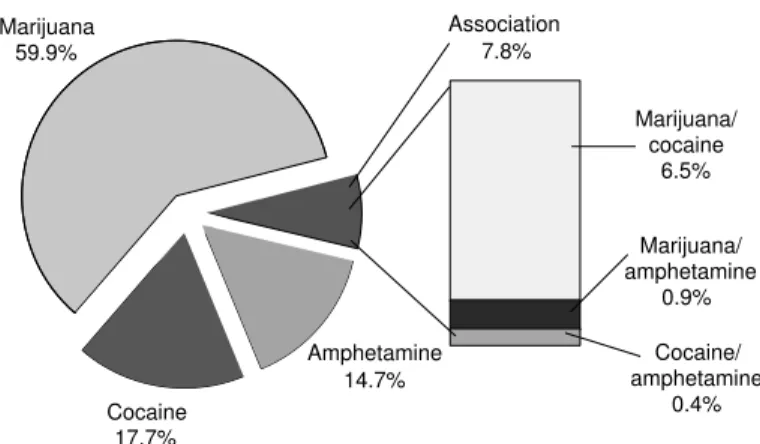
Marijuana was the most commonly detected drug among workers, with 59.9% of all positive results, followed by cocaine (17.7%), and amphetamine (14.6%). Association of two drugs was found in 7.7% of positive results, being 6.5% of marijuana/cocaine, 0.9% marijuana/amphetamine, and only 0.4% co-caine/amphetamine (Figure 3).
Figure 1 – Distribution of samples according to Brazilian geographical
regions.
North 0.6%
Northeast 13.8%
Southeast 72.0%
Central West 5.7%
South 7.9% Brazil
Figure 2 – Percentage of positive samples according to the geographical
regions of Brazil.
percentage of positive results
North
Northeast Central West
Southeast
South
Brazilian region 0
0,5 1 1,5 2
2,5 Associations
Cocaine
Marijuana
# # #
Rev Saúde Pública 2004;38(4):552-6 www.fsp.usp.br/rsp
Drug abuse among workers in Brazil Silva OA & Yonamine M
D ISCU SSIO N
Social, economic and cultural differences are often seen in Brazil due to its large territorial area and clearly affect drug use patterns in the general popula-tion including the workforce. The highest drug use seen in the southeast region can be explained by its high demographic density and high purchase power of its population. The lowest use was seen in the south-ern region.
Marijuana was detected in samples collected in all regions and was also the only drug present in sam-ples from northern and southern regions.
Marijuana is the least expensive of the studied drugs. It is widely distributed throughout the country because cannabis is cultivated in Brazil (northern and north-east regions) and in some other South American coun-tries and is affordable. Besides, the main metabolite of marijuana, tetrahydrocannabinol carboxylic acid, can be detected several days after exposure.
Cocaine was detected in urine samples collected in central west and southeast regions probably because the area is part of the trafficking route of the drug
produced in neighboring countries. Cocaine hydrochloride is the main form of cocaine consumed in the city of Rio de Janeiro. Crack cocaine is more prevalent in the city of São Paulo. In the central west region, the drug is consumed as cocaine paste known as “merla”.
Amphetamine was found in northeast, cen-tral west and southeast regions. It is prob-ably from the use of fenproporex, as ampheta-mine is one of its metabolites.3 Fenproporex is a licit substance for therapeutic use pre-scribed as appetite suppressor. It has been widely used as drug of abuse in some occu-pations in Brazil, like truck drivers who need to drive long distances.10 More than 50% of urine samples collected were from highway transportation companies, what could explain the positive results for amphetamine found in this study.
Marijuana was the most commonly detected drug among workers, with 59.9% of all positive results, followed by cocaine (17.7%), and amphetamine (14.6%). Association of two drugs was found in 7.7% of positive results, being 6.5% of marijuana/cocaine, 0.9% marijuana/amphetamine, and only 0.4% co-caine/amphetamine (Figure 3).
Drug testing in the workplace has been considered a great initiative to minimize the problem associated to drug use. The decision to implement such program in business companies is based on matters of employ-ees’ health and safety. Other considerations involve the attempt to reduce absenteeism in the workplace and incompatibility of drug use with some jobs.2 However, lack of information about a detailed evalu-ation of the program has yielded some criticism. Other epidemiological studies are needed to assess the ef-fectiveness, costs, and benefits of such programs at the workplace and could provide important informa-tion for the development of nainforma-tional drug policies.
Figure 3 – Frequency of drug use among Brazilian workers.
Marijuana/ cocaine
6.5% Association
7.8%
Amphetamine 14.7% Cocaine
17.7% Marijuana
59.9%
Marijuana/ amphetamine
Cocaine/ amphetamine
0.4% 0.9%
REFEREN CES
1. Carlini EA, Galduroz JCF, Noto AR, Nappo S. I Levantamento domiciliar sobre o uso de drogas psicotrópicas no Brasil, 2001. São Paulo: CEBRID; 2002.
2. Cristophersen AS, Morland NJ. Drug analysis for control purposes in forensic toxicology, workplace testing, sports medicine and related areas. Pharmacol Toxicol 1994;74:202-10.
3. Cody JT, Valtier S. Detection of amphetamine following administration of fenproporex. J Anal Toxicol 1996;20:425-31.
# # $ Rev Saúde Pública 2004;38(4):552-6 www.fsp.usp.br/rsp Drug abuse among workers in Brazil
Silva OA & Yonamine M
5. Crouch D. Alternative drugs, specimens, and approaches for non-regulated drug testing. In: Karch SB, editor. Drug abuse handbook. Boca Raton: CRC Press; 1998. p. 776-93.
6. Mule SJ, Casela GA. Confirmation of marijuana, cocaine, morphine, codeine, amphetamine,
methamphetamine, phencyclidine by GC/MS in urine following immunoassay screening. J Anal Toxicol 1988;12:102-7.
7. Normand J, Lempert RO, O’Brien CP. Under the influence? Drugs and the American workforce. Committee on drug use in the workplace, commission on behavioral and social sciences and education, national research council. Washington (DC): National Academy Press; 1994.
8. Normand J, Salyards SD, Mahoney JJ. An evaluation of preemployment drug testing. J Appl Psychol 1990;75:629-39.
9. Pfleger K, Maurer HH, Weber A. Mass Spectral and GC data of drugs, poisons, pesticides, pollutants and their metabolites. Weinhein: VCH; 1992.
10. Silva OA, Yonamine M, Antunes CGL, Greve JMD, Midio AF. Fenproporex abuse by truck drivers in Brazil. In: SOFT-TIAFT 1998. Program and Abstracts. Albuquerque: Society of Forensic Toxicologists, International Association of Forensic Toxicologists; 1998. p. 137. [Abstract, n. 119].
11. United Nations Office on Drugs and Crime. Global illicit drug trend 2003. Vienna; 2003.
12. Verstraete AG, Pierce A. Workplace drug testing in Europe. Forensic Sci Int 2001;121:2-6.
13. Yonamine M, Silva OA. Confirmation of cocaine exposure by gas chromatography-mass spectrometry of urine extracts after methylation of