Elza BerquóI,II
Regina Maria BarbosaII,III Liliam Pereira de LimaI Grupo de Estudos em
População, Sexualidade e Aids*
I Área de População e Sociedade. Centro Brasileiro de Análise e Planejamento. São Paulo, SP, Brasil
II Núcleo de Estudos de População. Universidade Estadual de Campinas. Campinas, SP, Brasil
III Centro de Referência em DST/Aids. Secretaria de Estado da Saúde de São Paulo. São Paulo, SP, Brasil
* (Study Group on Population, Sexuality and AIDS) members: Elza Berquó, Francisco Inácio Pinkusfeld Bastos, Ivan França Junior, Regina Barbosa, Sandra Garcia, Vera Paiva, Wilton Bussab.
Correspondence: Elza Berquó
CEBRAP- Centro Brasileiro de Análise e Pla-nejamento
R. Morgado de Mateus, 615 04015-902 São Paulo, SP, Brasil E-mail: [email protected]
Received: 12/11/2007 Revised: 4/15/2008 Approved: 5/30/2008
Trends in condom use: Brazil
1998 and 2005
ABSTRACT
OBJECTIVE: To analyze the levels, tendencies and sociodemographic differentials of condom use among the Brazilian urban population.
METHODS: The data analyzed was collected in 1998 and 2005, in the study, “Sexual Behavior and Perceptions of the Brazilian Population concerning HIV/ Aids”. The probabilistic samples, in multiple stages, included men and women aged 16 to 65 years old, living in urban areas. Interviews with individuals that had been sexually active during the 12 months preceding the interview were included in the analysis. The univariate models were based on chi-square tests, corrected by sample planning, and odds ratio calculations; multivariate analysis involved adjustment of logistic regression models, controlling all other interest variables.
RESULTS: There was a signifi cant increase in the use of condoms in the 12 months preceding the interview and at the last sexual intercourse. Young people from 16 to 24 years of age protected themselves more in sexual intercourse, particularly with eventual partners. Men used condoms more frequently only when they had an eventual partner. The use of condoms was more frequent among single people. There were no regional differences with respect to the consistent use of the condom. In stable relationships Pentecostals reveal the least amount of protection in sexual intercourse. People who have no religious affi liation or adepts of other religions have higher rates of protection. Level of education, an important differential with respect to the use of condoms in 1998, maintained its prominence in 2005.
CONCLUSIONS: The results indicate the need for greater in depth discussion concerning actions that are geared towards increasing the consistent use of condoms, particularly among populations with lower educational levels and those that are more vulnerable, such as young women or women in stable relationships.
DESCRIPTORS: Condoms. Safe Sex. Unsafe Sex. Sexual Behavior. Socioeconomic Factors. Population Studies in Public Health. Brazil. Condoms use. Cross-section studies.
INTRODUCTION
Concern regarding the need for studies to evaluate the degree of vulnerability of distinct population groups to sexually transmitted diseases has marked the international scenario for the past decades.
Since the mid-1990s the fi rst nationwide studies on sexual behavior and HIV risk perception emerged in Brazil in response to the growing number of diagnosed and notifi ed Aids cases. This tendency was observed likewise in Australia, France, England, the United States, among other countries.4,6,7,a
a ANRS/INSERM/INED. Dossier de presse - Premiers résultats de l’enquête “Contexte de la sexualité en France” (CSF). Available from:
Condom use among the Brazilian population Berquó E et al
Population studies on sexual behavior have also been conducted in Latin America, Chile and Argentina, providing parameters for comparison that are closer to the Brazilian reality.a,b
Until then, information on condom use in Brazil was, in large part, associated to contraception and generally derived from population studies, such as the Pesquisa
Nacional de Demografi a e Saúde (PNDSc – National
Survey on Health and Demography), conducted with reproductive aged married women, or with those co-habiting with a partner. Within this context, condom use was not frequently referred to as a contraceptive method.2 In 1986, only 5% of the women who were
married or cohabiting with a partner stated condom was their current contraceptive method.d
However, when the 1996 PNDS added a module on STD/Aids, it was possible to obtain information on the use of condoms as a means of HIV prevention. Thus, although 4.3% of the sexually active women interviewed in 1996 stated that the condom was their current contraceptive method,c 11% stated they had
used it the last time they had sexual intercourse.e
In order to study behavior, attitudes and sexual prac-tices of the Brazilian population, so as to formulate strategies for preventing STD/AIDS, the Ministry of Health signed an agreement with the Centro Brasileiro
de Análise e Planejamento (CEBRAP) to conduct a
study entitled, “Comportamento Sexual da População
Brasileira e Percepções sobre HIV/Aids” (“Sexual
Behavior of the Brazilian Population and Perceptions of HIV/Aids”).f Conducted in 1998, this was the fi rst
nationwide population survey to produce data on the prevalence of condom use and its sociodemographic differentials among both sexes of the Brazilian urban population aged 16 to 65 years.
In 2003 and 2004, two other national population sur-veys were conducted in order to construct indicators for a systematic evaluation of the performance of the National Coordination of the DST/AIDS Program.g,h
These surveys produced data on the profi le of condom use and its sociodemographic differentials among youth and adults of both sexes.
a Gobierno de Chile. Estudio nacional de comportamiento sexual: primeros análisis, Chile 2000. Chile; 2000.
b Programa de Naciones Unidas para el Desarrollo. Actitudes, información y conductas en relación con el VIH SIDA en la población general. Argentina; 2005.
c Sociedade Civil Bem-Estar Familiar no Brasil. Pesquisa Nacional sobre Demografi a e Saúde 1996. Brasília; 1997.
d Sociedade Civil Bem-Estar Familiar no Brasil. Pesquisa nacional sobre saúde materno-infantil e planejamento familiar - Brasil, 1986. Rio de Janeiro; 1987.
e HIV/AIDS Indicators Database [homepage]. Available from: http://www.measuredhs.com/hivdata [Cited 2008 Apr 2].
f Berquó E, coordenador. In: Comportamento sexual da população brasileira e percepções do HIV/AIDS. Brasília (DF): Ministério da Saúde, Secretaria de Políticas de Saúde, Coordenação Nacional DST e Aids; 2000. (Série avaliação, 4).
g Ministério da Saúde. Coordenação Nacional DST/AIDS. Pesquisa de comportamento, atitudes e práticas na população brasileira de 15 a 54 anos, 2004. Brasília; 2006.
h Paiva V, Venturi G, França-Junior I, Lopes F. Uso de preservativos – Pesquisa Nacional MS/IBOPE, 2003. Available from: http://www.aids. gov.br/data/documents/storedDocuments/%7BB8EF5DAF-23AE-4891-AD36-1903553A3174%7D/%7BC2A7F400-0F86-474D-9B8D-DC20C7B83CDA%7D/artigo_preservativo.pdf [Cited 2007 Jun 25].
i Research coordinated by the Centro Brasileiro de Análise e Planejamento (CEBRAP) and the Ministry of Health.
These studies, as well as specifi c population studies on youth,5 made it possible to produce a set of valuable
data on sexual behavior and condom use among the Brazilian population during the past decade.
The objective of re-editing the survey “Sexual Behavior of the Brazilian Population and its Perception of HIV/ Aids”, 2005,i was to identify changes or continuities in
knowledge regarding HIV/Aids, behavior, attitudes and sexual practices since 1998. Thus, for the fi rst time it becomes possible to draw historical comparisons from data produced from population surveys undertaken with samples and instruments designed for this purpose.
The objective of the present study was to analyze the levels, trends and sociodemographic differentials of condom use among the Brazilian population.
METHODS
Data analyzed refers to the results of the study “Sexual Behavior and Perceptions of the Brazilian Population on HIV/Aids”, conducted in 2005i and compared to a
similar study conducted in 1998.f
The study of the prevalence of condom use in both surveys was based on information on this behavior dur-ing fi rst sexual intercourse and durdur-ing the past twelve months prior to the face to face interview. In the present article, only condom use during the past 12 months was considered for analysis, delimiting sub-samples of 2,578 and 3,960 people, in 1998 and 2005 respectively that represent 77.6% and 78.6% of the respective total samples. Data was analyzed concerning people who stated they had sexual intercourse: only with steady partners, only with eventual partners, and with both kinds of partners. Steady partners were defi ned as married, cohabiting, engaged, boyfriends, girlfriends or lovers, that involves any form of involvement or commitment, and eventual partners were defi ned as a sexual relationship without any kind of bond or com-mitment with regard to continuity. Condom use was considered as affi rmative statements as to its use and that it has been used in at least one sexual intercourse in the 12 months prior to the interview. Consistent use, incorporated only in the 2005 survey, was defi ned as condom use in all sexual intercourse occurring in the past 12 months or if it began to be used always. Condom use or consistent use were defi ned for sexual intercourse with both steady and eventual partners.
Analysis of condom use in the most recent sexual inter-course, possible only with respect to the 2005 survey, was based on a sample of all sexually active individuals and was evaluated according to the kind of sexual prac-tice: “only vaginal” or “vaginal and anal in the same intercourse”, with a steady or eventual partner.
In general, the independent variables analysed cor-responded to sociodemographic characteristics of the people interviewed: sex, age, race/color, educational level, marital status, current religion and region of residence, as well as the calendar year of the study, for information available on both surveys. Regarding educational level, the categories basic (junior high school), middle (high school) and upper (college) level refer to complete and incomplete schooling. People that replied, “does not know how to read and write” were excluded from analysis due to the reduced number of cases. The criteria of self-identifi cation and the catego-ries utilized by the IBGE for race/color were adopted: Whites, Blacks, Mulattoes, Indigenous and Yellows. However, the reduced number of indigenous and yel-lows justifi ed the exclusion of these categories from analysis. The category “Blacks” refers to Blacks and Mulattoes. The denomination “others” in the category current religion refers primarily to Spiritualist, Afro-Brazilian and Buddhist.
The total numbers presented in the tables may not necessarily be the same as the sum of the cases of the different categories of a variable, due to data weight-ing and/or missweight-ing information (“does not recall” or “refuses to reply”). The weighting aforementioned
was undertaken in order to correct the probability of inclusion of the households in the samples.
The statistical treatment of data was based on chi-square tests, corrected by the sample design, and calculations of the odds ratio (OR) was obtained from univariate lo-gistic models. Multivariate analysis involved the adjust-ment of logistic regression models, controlling all other interest variables with the objective of investigating those variables that were more associated with condom use. In order to construct these models, a model with all the main effects corresponding to the independent variables previously described was initially considered. Then each fi rst order interaction was included (one at a time) into the model, with its principal effects. Only those that presented values of p<0.05, were incorpo-rated into the fi nal model. All the logistic models were adjusted considering the sample design. Calculations were made in SPSS v.15 and Stata v.9.
The project of the survey “Comportamento Sexual e
Percepções da População Brasileira sobre HIV/Aids”
was approved by the Ethics Committee of Faculdade de Saúde Pública of Universidade de São Paulo.
RESULTS
The results of the univariate analysis regarding condom use in the 12 months prior to the interview for people with steady partners, eventual partners and both steady and eventual partners are presented on Table 1. For people with steady partners in the 12 months prior to the interview, the proportion of condom use increased from 19.1% in 1998 to 33.1%, in 2005 (p<0.001). In 2005, condom use was not associated to sex and race/ color, but it varied signifi cantly with age, educational level, marital status, current religion and region. A greater percentage of condom use was found among youth aged 16 to 24 years (59.2%), decreasing with age. People who had only reached the basic level of education, having completed it or not, used condoms less frequently (26.2%) than those who had attained higher levels of education (more than 40%). A statistical gradient characterized marital status, being that condom use was more frequent among singles (70.3%). Those individuals who did not have any religious affi liation or who belonged to other religious denominations less frequent in Brazil responded for approximately 41% of the people who stated they used condoms. Finally, the regions where the largest proportions of condom use were declared were the North/Northeastern and Southern regions.
A comparison of the results from the 1998 and the 2005 surveys reveals signifi cant effects of current religion and region only in 2005.
Condom use among the Br
azilian population Berquó E et al
Table 1. Condom use in the 12 months prior to the interview and odds ratio of use and non use according to sociodemographic characteristics. Brazil, 1998 and 2005.* Variables
Stable partnerships only Eventual partnerships only Stable and eventual partnerships
2005 1998 2005 1998 2005 1998
CU(%) N Total OR CU(%) N Total OR CU(%) N Total OR CU(%) N Total OR CU(%) N Total OR CU(%) N Total OR
Sex p=0.199 p=0.638 p=0.023 p=0.651 P=0.720 p=0.612
Male 31.7 1490 18.1 932 81.6 228 2.4** 63.3 147 45.7 278 23.3 267
Female 34.2 1852 19.9 1168 66.0 53 66.7 9 48.8 59 29.6 55
Age group (yrs) p<0.001 p<0.001 p<0.001 p=0.019 p<0.001 p=0.055
16-24 59.2 552 7.9** 34.6 347 7.1** 92.0 137 7.7** 81.7 82 6.9** 59.7 149 6.7** 32.5 146
25-34 41.2 929 3.8** 26.6 627 4.9** 67.2 61 1.5 38.0 50 1.0 45.7 98 3.8** 28.3 82
35-44 28.7 818 2.2** 13.5 571 2.1 70.2 47 1.6 62.5 16 2.7 28.1 52 1.7 10.2 68
45-65 15.4 1043 1.0 6.9 554 1.0 59.5 37 1.0 44.4 9 1.2 18.2 36 1.0 4.1 26
Educational level p<0.001 p=0.017 p=0.003 p<0.001 p=0.006 p=0.039
Basic 26.2 1528 1.0 15.0 1191 1.0 69.9 113 1.0 46.6 88 1.0 32.4 116 1.0 33.2 166 8.5**
High School 40.6 1108 1.9** 23.7 536 1.8** 86.5 111 2.7** 91.3 46 11.8** 57.1 128 2.8** 18.9 107 4.0
College 44.8 507 2.3** 35.0 223 3.0** 94.6 37 8.2** 81.8 11 4.2** 51.9 72 2.2** 5.6 36 1.0
Color p=0.717 p=0.374 p=0.650 p=0.315 p=0.141 p=0.915
White 33.3 1581 21.0 1064 79.8 124 59.8 102 52.1 137 24.5 174
Black 32.6 1661 17.4 893 77.1 153 73.8 42 42.4 195 23.5 132
Marital status p<0.001 p<0.001 p=0.144 p=0.481 p<0.001 p=0.002
Married/cohabiting 24.2 2622 1.0 11.1 1755 1.0 53.3 7 - 0 21.0 125 1.0 11.1 121 1.4
Widowed/separated/divorced 45.9 137 2.7** 47.5 59 7.2** 71.1 37 50.0 16 53.1 29 4.2** 8.2 10 1.0
Single 70.3 583 7.4** 63.1 287 13.8** 80.6 237 65.0 140 62.4 183 6.2** 33.6 191 5.7**
Religion p=0.010 p=0.149 p=0.512 p=0.093 p=0.039 p=0.161
Catholic 32.7 2202 1.2 20.5 1457 76.9 185 64.8 119 54.1 189 3.2** 23.5 220
Protestant 31.9 273 1.2 20.4 125 78.3 20 96.0 4 29.3 19 1.1 42.6 5
Pentecostal 28.1 460 1.0 9.8 236 67.2 15 78.7 6 26.8 47 1.0 58.9 20
None 41.4 259 1.8** 27.0 148 91.2 37 39.1 21 43.9 59 2.1 16.6 71
Others 41.8 147 1.8** 11.0 127 80.1 24 90.9 6 40.3 23 1.8 17.2 6
Region p=0.015 p=0.926 p=0.002 p=0.736 p=0.830 p=0.362
North/Northeast 37.5 813 1.4** 20.0 494 78.4 97 2.1** 68.8 48 44.2 117 33.5 114
Central-West/Southeast 30.4 1003 1.0 19.4 741 64.0 75 1.0 65.9 44 43.9 93 15.0 124
Sao Paulo 30.2 990 1.0 19.5 580 88.3 77 4.5** 52.3 44 49.2 94 28.5 51
South 36.7 537 1.3** 16.1 286 87.9 33 4.7** 70.0 20 51.9 33 21.6 33
Total 33.1 3342 19.1 2100 78.6 281 63.5 156 46.3 337 24.5 322
CU: Condom use
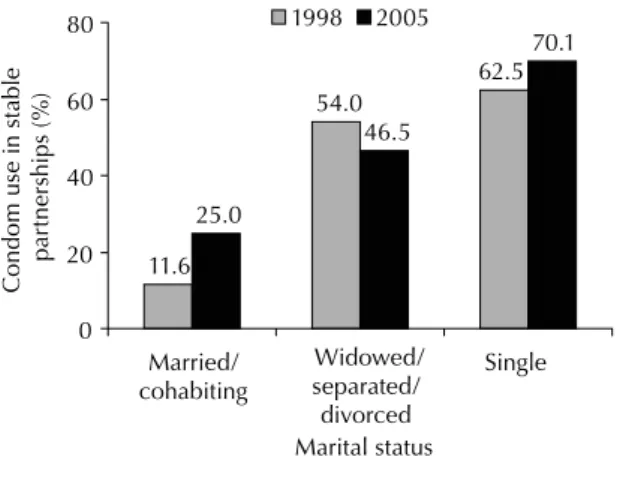
between the year of the survey and marital status. Figure 1 indicates that the greatest increase in condom use be-tween 1998 and 2005 was among married or cohabiting respondents, 11.6% and 25.0% respectively.
Condom use in the 12 months prior to interview among people who reported they only had eventual partners, in-creased from 63.5% to 78.6% between 1998 and 2005, but this was not statistically signifi cant (p=0.065). How-ever, these individuals used condoms more frequently than those who had steady partnerships. (Table 1)
In 2005, condom use among people who declared they only had eventual partners was not associated to race/color, marital status or religion, but was associated to sex, age, educational level, and region of residence. Among men in this category, the rate of condom use was 81.6%, and among women it was 66.0%; it reached the rate of 92% among youth aged 16 to 24 years, which was higher than that found among all other age groups, whose rates were equivalent among themselves. As to the educational level, a signifi cantly lower rate of con-dom use was found among individuals with a basic level of education (69.9%), that is, those who had or had not completed junior high school. There were no signifi cant differences as to condom use among individuals with higher levels of education. The Central-West/South-eastern region presented the lowest rate of condom use (64.0%), statistically lower than all other regions which did not differ among themselves. (Table 1)
A comparison of the results from 2005 and 1998 (Table 1) reveals a similar panorama with respect to the variables associated to condom use. Sex and region of residence are exceptions for in 1998 they did not present signifi cant associations with condom use.
Due to the small number of women who reported they had eventual partners, (nine in 1998 and 53 in 2005), logistic regression analysis considered only single men in this category (98.3% of all the men) and in the age groups 16-24 and 25-34 years. Furthermore, for this sub-sample, educational level and religion were evalu-ated considering only two categories: basic education or high school plus college education, and Catholics or all other religions.
Thus, in 1998, among single men aged 16 to 34 years, condoms were used more frequently among the younger men and those who had a higher educational level. In 2005, condoms were used more frequently among younger single men and those who resided in the South-ern region and in the State of Sao Paulo. (Table 2)
Logistic regression analysis indicated the interaction between educational level and age group (p=0.004) and the main effect of the calendar year (p=0.015). The chance of using condoms in relation to not using them, in 2005, was 1.2 times greater then it was in 1998. In 1998, condoms were more frequently used among
single men with high school and/or college education in both age groups. In 2005, single men aged 16-24 years presented a signifi cant difference with respect to educational level, however this did not hold true for those aged 25 to 34 years. (Figure 2)
For people in stable relationships, but who also had eventual partners in the 12 months prior to the interview, condom use increased from 24.5%, in 1998, to 46.3%, in 2005 (p=0.001). For both years, these rates were closer to those found among respondents with steady partners than to those found among respondents with eventual partners.
The statistical analysis indicated that, in 2005, condom use was associated to age, educational level, marital status and religion. When compared to the results from 1998, the associations with educational level and marital status were maintained. As to educational level, the negative association observed in 1998 looses
Table 2. Condom use among single men aged 16 to 34 years who only had eventual partners in the 12 months prior to the interview and odds ratios of use and non use, according to sociodemographic characteristics. Brazil, 1998 and 2005.*
Variable
2005 1998
CU
(%) TotalN OR CU (%) TotalN OR
Age group (yrs) p=0.002 p=0.011
16-24 93.7 126 7.1** 81.0 81 7.9**
25-34 67.7 44 1.0 35.2 45 1.0
Educational level p=0.092 p<0.001
Basic 78.7 59 41.2 69 1.0
High school/
college 91.9 105 93.1 50 19.2**
Color/race p=0.728 p=0.728
White 88.1 78 62.5 86
Black 85.6 90 75.4 36
Religion P=0.867 P=0.665
Catholic 86.1 109 66.7 96
Others 87.2 65 58.1 30
Region p=0.030 p=0.492
North/
Northeast 85.1 54 2.2 72.9 37
Central-West/
Southeast 72.3 41 1.0 72.7 35
State of São
Paulo 95.8 52 8.8 45.1 35
South 97.1 23 13.0** 69.7 19
Total 86.9 170 64.7 126
CU: Condom use.
* P-value refers to the chi-square test corrected by the sample design.
Condom use among the Brazilian population Berquó E et al
signifi cance (p=0.051) when the category basic educa-tion is compared to a category that unifi es high school and college education. The rate of condom use among individuals in the latter category was 15.6%. (Data not shown in Table)
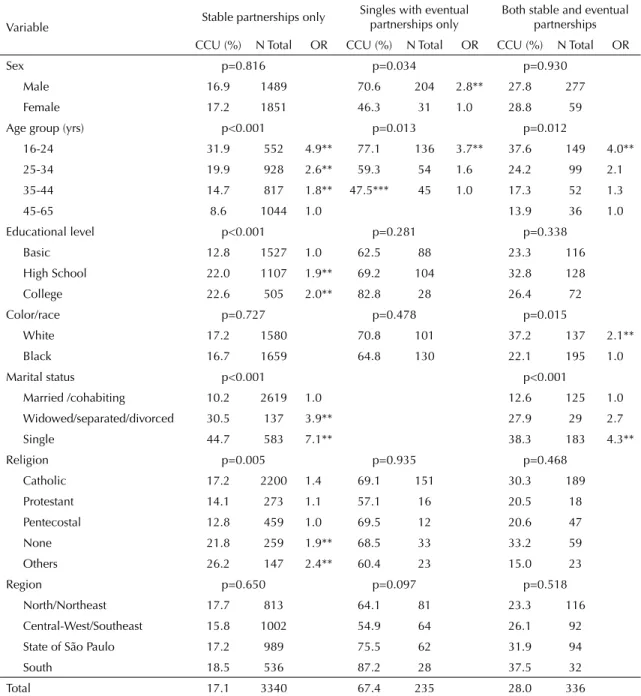
Among respondents who only had steady partners, 17.1% stated they used condoms in a consistent man-ner. This pattern was not associated to sex, race/color or region of residence, however it was associated to
age, educational level, marital status and religion. The largest frequency of consistent condom use, 31.9%, was found among youth aged 16 to 24 years, and this value declined with increasing age. People who had at most completed basic education presented a lower rate of consistent condom use when compared to those who had a higher level of education. Those who had either a high school or college education presented a rate of approximately 22% of condom use. A
statisti-Table 3. Consistent condom use in the 12 months prior to the interview and odds ratios of use and non use, according to sociodemographic characteristics. Brazil, 2005.*
Variable Stable partnerships only
Singles with eventual
partnerships only Both stable and eventual partnerships
CCU (%) N Total OR CCU (%) N Total OR CCU (%) N Total OR
Sex p=0.816 p=0.034 p=0.930
Male 16.9 1489 70.6 204 2.8** 27.8 277
Female 17.2 1851 46.3 31 1.0 28.8 59
Age group (yrs) p<0.001 p=0.013 p=0.012
16-24 31.9 552 4.9** 77.1 136 3.7** 37.6 149 4.0**
25-34 19.9 928 2.6** 59.3 54 1.6 24.2 99 2.1
35-44 14.7 817 1.8** 47.5*** 45 1.0 17.3 52 1.3
45-65 8.6 1044 1.0 13.9 36 1.0
Educational level p<0.001 p=0.281 p=0.338
Basic 12.8 1527 1.0 62.5 88 23.3 116
High School 22.0 1107 1.9** 69.2 104 32.8 128
College 22.6 505 2.0** 82.8 28 26.4 72
Color/race p=0.727 p=0.478 p=0.015
White 17.2 1580 70.8 101 37.2 137 2.1**
Black 16.7 1659 64.8 130 22.1 195 1.0
Marital status p<0.001 p<0.001
Married /cohabiting 10.2 2619 1.0 12.6 125 1.0
Widowed/separated/divorced 30.5 137 3.9** 27.9 29 2.7
Single 44.7 583 7.1** 38.3 183 4.3**
Religion p=0.005 p=0.935 p=0.468
Catholic 17.2 2200 1.4 69.1 151 30.3 189
Protestant 14.1 273 1.1 57.1 16 20.5 18
Pentecostal 12.8 459 1.0 69.5 12 20.6 47
None 21.8 259 1.9** 68.5 33 33.2 59
Others 26.2 147 2.4** 60.4 23 15.0 23
Region p=0.650 p=0.097 p=0.518
North/Northeast 17.7 813 64.1 81 23.3 116
Central-West/Southeast 15.8 1002 54.9 64 26.1 92
State of São Paulo 17.2 989 75.5 62 31.9 94
South 18.5 536 87.2 28 37.5 32
Total 17.1 3340 67.4 235 28.0 336
CCU= Consistent condom use.
cal gradient was observed for consistent condom use and marital status. A higher rate of consistent use was found among singles than among married or cohabiting respondents. As to religion, the highest rate of condom use was found among the categories “none” and “other religions” that did not differ between themselves and the lowest rates of condom use were found among the protestant and Pentecostal religions. (Table 3)
The logistic regression model indicated interaction between marital status and age group (p=0.005) and sex (p=0.002). Whereas, among married/cohabiting respondents, rates of consistent condom use decreases with age, from 17.3% among youth aged 16-24 years to 7.1% among respondents aged 45-65 years, among singles this decline starts among respondents aged 35-44 years. Consistent condom use among widows, widowers, separated and divorced respondents begins to declines at the age of 44 years. However, this last result should be considered with caution due to the small number of cases involved. (Figure 3)
Rates of consistent condom use among men varied from 9.1% for those who were married/cohabiting, to 27.3% for those who were widowed/separated/ divorced and 52.8% for singles. Women presented the same ten-dency, with higher magnitudes of consistent condom use among the single women than single men: 11.7%, 33.4% and 37.2%, respectively.
Considering all respondents who only had eventual partners in the 12 months prior to the interview, the rate of consistent condom use was 65.0%.
Given the small number of respondents in this category (n=279) and the concentration of single men within it (84.2%), analysis of this subsample resulted in a 67.4% rate of consistent condom use, being that this proportion was higher when only men were consid-ered (70.6%) and among young people of both sexes (77.1%) (Table 3).
Adjustment of the logistic model for singles considering the effects of sex, age group and interaction between these variables did not indicate an effect of interaction (p=0.591). Analysis of consistent condom use according to age group, controlling for the sex variable, indicated signifi cance (p=0.020). However, when analyzing sex and controlling for the factor age group this did not occur (p=0.107).
For people with steadye and eventual partners during the 12 months prior to the interview, the rate of con-sistent condom use was 28.0%, and it was infl uenced by age group, marital status and race/color. In order to evaluate the effects of interaction in the multivariate model, the following age groups were analyzed: 16-24, 25-34 and 35-65 years. Considering the results of univariate analysis, religion and marital status were unifi ed under the categories “Catholics” versus “other
religions”, and “not united” (singles, widowed, sepa-rated and divorced) versus “united”.
The multivariate model indicated interaction between sex and age group (p=0.045), as well as signifi cant
Table 4. Condom use in the most recent sexual relation (vaginal sex) considering the last 12 months prior to the interview and odds ratios of use and non use, according to sociodemographic characteristics. Brazil, 2005.*
Variable Use in most recent intercourse (%) TotalN OR
Sex p<0.001
Male 32.5 1922 1.5**
Female 23.7 1892 1.0
Age group (yrs) p<0.001
16-24 55.5 832 9.3**
25-34 29.6 1021 3.1**
35-44 20.5 882 1.9**
45-65 11.9 1080 1.0
Educational level p<0.001
Basic 20.3 1691 1.0
High School 36.6 1299 2.3**
College 36.6 593 2.3**
Color/race p=0.986
White 28.2 1779
Black 28.1 1930
Marital status p<0.001
Married/
cohabiting 13.9 2662 1.0
Widowed/
separated/divor 43.9 204 4.8**
Single 64.7 948 11.4**
Current religion p<0.001
Catholic 28.2 2472 1.5**
Protestant 27.4 311 1.4
Pentecostal 20.9 512 1.0
None 34.8 330 2.0**
Others 36.7 185 2.0**
Type of partner p<0.001
Steady 23.4 3488 1.0
Eventual 79.1 325 12.3**
Region p=0.004
North/Northeast 32.2 988 1.5**
Central-West/
Southeast 23.7 1123 1.0
Sao Paulo 27.7 1102 1.2
South 30.6 601 1.4**
Total 28.1 3814
* P-value of p refers to chi-square test corrected by the sample design.
Condom use among the Brazilian population Berquó E et al
effects for race/color (p=0.025) and marital status (p=0.008). In the multivariate analysis as in the uni-variate analysis, religion and educational level were not signifi cantly associated to consistent condom use among respondents with steady and eventual partners (both with p>0.57). Results indicated that the rate of consistent condom use among men decreased from 42.6% in the 16-24 years age group, to 7.8% for those respondents aged 35 to 65 years. Approximately 24% of the women aged 16-24 years and 25-34 years reported consistent condom use. This rate increased to 36.0%, among older women.
For the 3.814 respondents who practiced only vaginal intercourse in their most recent sexual relationship, 28.1% responded they used the condom. Univariate analysis indicated that all variables except race/color were associated to condom use. More men and younger respondents stated they used the condom in their most recent sexual intercourse. A higher educational level as well as being single or having eventual partners increased the probability of condom use in the
respon-dent’s most recent sexual intercourse. Pentecostals had the lowest percentage of condom use. Residents of the Central-West and Southeastern regions presented the lowest percentage of condom use (23.7%). (Table 4)
Multivariate analysis indicated that condom use was associated to combinations between sex and age group (p=0.003), and between religion and type of partner-ship (p=0.020). Figure 4 illustrates the interaction between sex and age group, with a large difference as to condom use among male and female respondents aged 16 to 24 years.
As to the interaction between religion and type of partnership, Pentecostals with stable unions represented 17.8% of those who used condoms in their most recent sexual intercourse, whereas the rate among Catholics and protestants was 24.0% (average value), and among respondents with other religious affi liations or with no religion it was 29.0%. When the most recent sexual intercourse occurred with an eventual partner the same pattern of interaction was not observed.
11.6 54.0 62.5 25.0 46.5 70.1 0 20 40 60 80 Married/ cohabiting Widowed/ separated/ divorced Single Marital status Co ndom u se in st ab le pa rt ne rsh ip s ( % ) 1998 2005
Figure 1. Condom use among people who only had stable partners in the 12 months prior to the interviews, according to marital status and year. Brazil, 1998 and 2005.
59.3 31.6 85.7 65.0 57.1 65.2 97.7 97.5 0 25 50 75 100 16-24
years 25-34years 16-24years 25-34years
1998 2005 Co ndom u se wit h ev en tu al p ar tn er s ( % )
Basic High school/college
Figure 2. Condom use among single men aged 16 to 34 years, who only had eventual partners in the 12 months prior to the interview, according to educational level and age group. Brazil, 1998 and 2005.
39.3 28.5 10.9 31.5 68.8 19.5 13.6 21.9 0 20 40 60 80
16-24 25-34 35-44 45-65 Age groups (years)
Co ndom u se in th e m os t r ece nt vagi nal in te rco ur se ( % ) Men Women
Figure 4. Condom use in the most recent sexual intercourse (vaginal sex) in the 12 months prior to the interview, according to age group and sex. Brazil, 2005.
12.9 10.1
38.1 34.3 41.7 46.9 47.1 44.6
7.1 17.3 22.3 6.3 0 15 30 45 60
16-24 25-34 35-44 45-65 Age group (years)
Co nsiste nt co ndom use i n stable part nerships (%) Married/
cohabiting Widowed/separated/ divorced
Single
The practice of vaginal and anal intercourse in the same sexual relation was reported by 122 respondents, and only anal sex by fi ve respondents. Analysis of this practice revealed that 41.8% of the respondents used the condom in both vaginal and anal intercourse, 4.9% utilized it in only one of these practices and 53.3% did not use it in either of these practices. Behavior dif-fered according to the type of partner, being condom use in both practices more frequent when the sexual partner was eventual (59.5%) than when it was a steady partner (32.6%).
Univariate analysis of condom use in both vaginal and anal intercourse in the same sexual relation revealed that educational level and marital status presented signifi cant statistical effects, being condom use more frequent among singles and respondents with higher levels of education.
Given the reduced number of cases, it was not possible to perform logistic regression analysis for the combined study of main effects and interactions.
DISCUSSION
Compared with 1998, in 2005 a substantial increase in condom use in the 12 months prior to the interview was observed in all types of partnerships analyzed: approximately 14% among men and women in stable relationships, 15% among those who only had eventual partners and 22% among those who had both steady and eventual partners.
Since there was no data in the 1998 survey on condom use in the most recent sexual intercourse, data from the 2005 survey was compared to data from the PNDS-96.a
It was observed that the proportion of condom use in the most recent sexual intercourse had increased from 11.4%, in 1996,b to 28.1%, in 2005. Youth aged 16
to 24 years reported the greatest increase in condom use during that period, among whom it varied from 19.5%a to 55.5%. No published data was found that
would make it possible to compare this kind of condom use with the type of partnership or consistent condom use over time.
On the other hand, it was observed that a gradient of use according to the kind of partner was maintained over time. Respondents who only had eventual partners kept protecting themselves more than those who had both kinds of partners and the latter, in turn protected them-selves more than people who only had steady partners.
This gradient was also observed with respect to consis-tent condom use in the 2005 survey. Likewise, condom
use in the most recent sexual relation was much more frequent among eventual partners in 2005.
Discussion of the results of the present study in com-parison to those of other studies conducted in Brazil is very diffi cult due, in part, to the reduced number of nationwide studies, in part due to the characteristics of each study and, fi nally due to the fact that analysis of temporal tendencies are non-existent.
Thus, it may be observed that a trend towards an increase in condom use, as indicated in the present study, is cor-roborated by data from Szwarcwald et al,c who studied
condom use by means of self-applied questionnaires among individuals aged 15 to 54 years, living in urban and rural Brazilian macro-regions. These results do not, therefore, corroborate the trend towards decreasing con-dom use identifi ed by Paiva et al,d when analyzing data
produced by the Instituto Brasileiro de Opinião Pública
e Estatística (IBOPE – Brazilian Institute of Public
Opinion and Statistics) in 2003. A possible explanation for these differences is that Paiva et ald utilized data
that referred to the sexually active population in the six months prior to the interview, a design that is not very common in research on sexual behavior.
In the present study the mean frequency of consistent condom use was 21.0%, irrespective of the type of partnership, whereas in Szwarcwald et al’sc study it
was 25.3%.
As to condom use in the most recent sexual intercourse, Szwarcwald et alc reported a proportion of 38.4%, a
value higher than that verifi ed in 2005, of 30.9%. In order to make this comparison, individuals aged 55 to 65 years in the 2005 survey were not considered. However, variations in the sample design, in the defi nition of the variables and in the manner in which the questionnaire was applied in the two studies may explain these differences.
On the other hand, the rate of condom use in the most recent sexual intercourse among youth aged 15 to 24 years was 55.5% in 2005, similar to the rate found by Szwarcwald et al,c of 57.3%, who also observed a
declining tendency with increasing age. In a study with youth aged 18 to 24 years, conducted in 2002 in three Brazilian capitals,8 a 51% rate of condom use in the
most recent sexual relation was observed.
In the present study, in 2005, age, educational level, marital status and type of partnership were associated to condom use in the 12 months prior to the interview and to its use in the most recent sexual intercourse, confi rming the tendency verifi ed in 1998.
a Sociedade Civil Bem-Estar Familiar no Brasil. Pesquisa Nacional sobre Demografi a e Saúde 1996. Brasília; 1997. b HIV/AIDS Indicators Database [homepage]. Available from: http://www.measuredhs.com/hivdata [Cited 2008 Apr 2].
c Ministério da Saúde. Coordenação Nacional DST/AIDS. Pesquisa de comportamento, atitudes e práticas na população brasileira de 15 a 54 anos, 2004. Brasília; 2006.
Condom use among the Brazilian population Berquó E et al
The young population protects itself more frequently in sexual intercourse, for all three modalities of condom use studied. Likewise, the population with a higher level of education also presents higher proportions of condom use. As to marital status, singles, divorced/ separated/widowed and married/cohabiting respondents establish a gradient with larger proportions of condom use among the singles.
The same phenomenon is observed when the type of partnership is taken into consideration, as has already been pointed out: condom use is always greater among eventual partners than among steady partners. These fi ndings are similar to those observed by Szwarcwald et al,a Paiva et alb and in similar studies conducted in
Chile and Argentina.c,d
In sexual relations with eventual partners, men re-ported using the condoms more frequently and more consistently than women, fi ndings also observed by Szwarcwald et ala and Paiva et al,b although there is
no information available concerning the statistical sig-nifi cance of these differences. However, in the logistic model, the associations referring to eventual partners did not maintain their signifi cance, and no articles were found in the national literature that would permit a comparison with these results.
Differences between men and women only confi rmed themselves with respect to condom use in the most recent sexual intercourse. Men tended to use condoms more frequently then women, a result which is similar to the rate of 44.2% among men and 32.5% among women found by Szwarcwald et al.a However, in the
logistic model, the difference found limited itself to the population aged 16-24 years, that is, young men tended to use condoms more frequently than young women. Similarly, according to Teixeira et al,8 56.0% of the
young men and 38.8% of the young women stated they used condoms in the most recent sexual relation.
An understanding of the differences found between men and women as to condom use requires specifi c analysis for each of the sexes, for choices made by men and women in their sexual trajectories are intimately related to existing gender differences regarding con-ceptions as to sexual-affective bonds. These, in turn, are linked to perceptions with respect to the need for protection,8,e which result in the greater diffi culty
confronted by women in negotiating condom use and the statute of the relationship.
Religious affi liation infl uenced condom use in stable relationships. Protestants and Pentecostals used con-doms least frequently, and this result repeated itself among Pentecostals when asked about their most recent sexual relation. The largest rates of protection always corresponded to respondents with “no religion” or adepts of “other” religions. No comparable data was found in the literature on nationwide studies. Teixeira et al8 did not fi nd any association between condom use
among youth and affi liation to any religion, a category that combined all religious creeds, not comparable to the present study. However, in a study with 800 young people in Rio de Janeiro, higher rates of condom use were observed among those with no religious affi liation, approximately 66%, and lower rates, 28%, were found among Pentecostals and Protestants
Self-declared color was only found to be associated to consistent condom use among those who replied they had both steady and eventual partners. No comparable nationwide data was found. One hypothesis that should be tested in future analysis is whether the power to negotiate varies according to the presence or absence of racial homogamy.
As to regional differences, the Central-West/South-eastern region (that does not include the State of São Paulo) tends to present the lowest levels of condom use. From a regional perspective, Pascon et alf found,
in an analysis with no adjustments for other variables, signifi cant differences in consistent condom use with any partner, being that the lowest rates were found in the North/Northeast, which is not corroborated by the 2005 survey.
In conclusion, the results of the present study indicate a signifi cant increase in condom use in the past years, a result of the efforts of the offi cial STD/AIDS preven-tion programs. On the other hand the systematic dif-ferential with respect to educational level and condom use reveals the need to refl ect upon policies regarding access to information and prevention geared towards the population with lower levels of education. Like-wise, more thorough, in-depth discussions concerning action that is geared towards increasing consistent condom use, particularly among the more vulnerable populations such as young women or those in steady partnerships are necessary.
a Ministério da Saúde. Coordenação Nacional DST/AIDS. Pesquisa de comportamento, atitudes e práticas na população brasileira de 15 a 54 anos, 2004. Brasília; 2006.
b Paiva V, Venturi G, França-Junior I, Lopes F. Uso de preservativos – Pesquisa Nacional MS/IBOPE, 2003. Available from: http://www.aids. gov.br/data/documents/storedDocuments/%7BB8EF5DAF-23AE-4891-AD36-1903553A3174%7D/%7BC2A7F400-0F86-474D-9B8D-DC20C7B83CDA%7D/artigo_preservativo.pdf [Cited 2007 Jun 25].
c Gobierno de Chile. Estudio nacional de comportamiento sexual: primeros análisis, Chile 2000. Chile; 2000.
d Programa de Naciones Unidas para el Desarrollo. Actitudes, información y conductas en relación con el VIH SIDA en la población general. Argentina; 2005.
e Barbosa RM. Negociação sexual ou sexo negociado? Gênero, sexualidade e poder em tempos de aids [Doctorate thesis]. Rio de Janeiro: Instituto de Medicina Social da UERJ; 1997.
1. Berquó E, Barbosa RM, Grupo de Estudos em
População, Sexualidade e Aids. [Introdução]. Rev
Saude Publica. 2008;42(Supl 1):7-11.
2. Berquó E, Souza MR. Homens adultos: conhecimento e uso do condom. In: Loyola MA,organizador. Aids e sexualidade. O ponto de vista das Ciências Humanas. Rio de Janeiro: Relume Dumará; 1994. p.161-82. 3. Bussab W de O, Grupo de Estudos em População, Sexualidade e Aids. Plano amostral da Pesquisa Nacional sobre Comportamento Sexual e Percepções
sobre HIV/Aids, 2005. Rev Saude Publica.
2008;42(Supl 1):12-20.
4. de Visser RO, Smith AM, Rissel CE, Richters J, Grulich AE. Sex in Australia: heterosexual experience and recent heterosexual encounters among a representative
sample of adults. Aust N Z J Public Health.
2003;27(2):146-54.
5. Heilborn ML. O Aprendizado da sexualidade: reprodução e trajetórias sociais de jovens brasileiros. Rio de Janeiro: Garamond; 2006.
6. Johnson AM, Mercer CH, Erens B, Copas AJ, McManus S, Wellings K, et al. Sexual behaviour in Britain: partnerships, practices, and HIV risk behaviours.
Lancet. 2001;358(9296):1835-42.
7. Laumann EO, Gagnon JH, Michael RTMS. The social organization of sexuality: sexual practices in the United States. Chicago: The University of Chicago Press; 1994.
8. Teixeira AMFB, Knauth DR, Fachel JMG, Leal AF. Teenagers and condom use: choices by young Brazilians from three Brazilian State capitals in their
fi rst and last sexual intercourse. Cad Saude Publica.
2006;22(7):1385-96.
REFERENCES
Article based on the data from the survey “Comportamento sexual e percepções da população brasileira sobre HIV/Aids (Sexual behavior and perceptions of Brazilian population on HIV/AIDS)”, carried out by Centro Brasileiro de Análise
e Planejamento, supported by the Programa Nacional de DST e AIDS of Brazilian Ministry of Health (Process n. ED
213427/2004).
This article followed the same peer-review process as any other manuscript submitted to this journal, anonymity was guaranteed for both authors and reviewers.