1 Universidade Federal de Uberlândia, Instituto de Biologia, Uberlândia, MG, Brazil 2 Author for correspondence: [email protected]
When hummingbirds are the thieves: visitation eff ect
on the reproduction of Neotropical snowbell
Styrax ferrugineus
Nees & Mart (Styracaceae)
RESUMO
(Quando os beija-flores são os ladrões: efeito da visitação na reprodução de uma planta Neotropical Styrax fer-rugineus Nees & Mart (Styracaceae)). O espectro de visitantes florais associados a uma planta é frequentemente maior que o esperado pelo conceito tradicional de síndromes florais e o papel desses visitantes inesperados tem recebido mais atenção. Os beija-flores freqüentemente visitam flores com síndromes florais distintas, espe-cialmente em alguns ecossistemas pobre em flores ornitófilas como o Cerrado. Investigamos aqui o efeito das visitas de beija-flores na reprodução de Styrax ferrugineus, uma espécie melitófila. As flores foram visitadas por diferentes grupos de insetos e as visitas por beija-flores foram frequentes, especialmente no início das manhãs quando a disponibilidade de néctar foi maior. Os parâmetros de néctar variaram consideravelmente durante a antese, provavelmente afetados pela variação da temperatura durante o dia. Experimentos de exclusão de beija-flores não mostraram efeito sobre a produção de frutos. A incapacidade dos beija-flores em esgotar todo néctar produzido pela planta e a existência de outro recurso floral (pólen) para o polinizador principal (grandes abelhas) são apontadas como razões possíveis para a ausência desse efeito. Embora não tenha sido observado efeito sobre a produção de frutos, o uso de flores não ornitófilas deve ser importante para os beija-flores que são consumidores especializados de néctar.
Palavras-chave: Cerrado, dinâmica de néctar, ladrões de néctar, síndromes de polinização
Pietro Kiyoshi Maruyama1,2, Luciana Nascimento Custódio1 and Paulo Eugênio Oliveira1
ABSTRACT
(When hummingbirds are the thieves: visitation eff ect on the reproduction of neotropical snowbell Styrax ferru-gineus Nees & Mart (Styracaceae)). Th e spectrum of fl oral visitors associated with a particular plant is frequently larger than predicted by the traditional concept of fl oral syndromes and the role that unpredicted visitors play in plant reproduction deserves attention. Hummingbirds are frequently recorded visiting fl owers with distinct fl oral syndromes, especially in some hummingbird fl ower poor ecosystem such as the Cerrado. In this study we inves-tigated the eff ect of frequent hummingbird visits on the reproduction of melittophilous Styrax ferrugineus. Th e fl owers were visited by many diff erent insect groups and visits by hummingbirds were frequent, especially early in the morning when nectar availability was higher. Nectar parameters varied considerably during the fl ower life span, and was probably aff ected by the temperature variation during the day. Hummingbird exclusion experiments showed no eff ect in the fruit-set of the plant. Th e inability of hummingbirds to deplete all of the nectar produced in this mass-fl owering plant, and the existence of another resource (pollen) for the primary pollinator (large bees), are possible reasons why there was no perceptible hindrance of plant reproduction by the hummingbirds. Although no eff ect in the fruit-set was observed, the use of non-ornithophilous fl owers must be important for hummingbirds, which are specialized nectar consumers.
Introduction
Th e sets of fl ower characteristics that defi ne pollination syndromes are easily recognizable in many plant species. Th e frequent convergence of fl ower features shared among species presumably pollinated by the same pollinator group support the concept of the fl ower syndrome as an adaptation to specifi c pollinators (Johnson & Steiner 2000). However, the spectrum of fl ower visitors associated with a given plant is frequently larger than what would be expected based in the concept of pollination syndromes (Waser et al. 1996), and the role these “unpredicted” visitors play in plant reproduction has been studied (Roubik 1982; Lara & Ornelas 2001; Muchhala 2006; Fumero-Cabán & Meléndez-Ackerman 2007; Maruyama et al. 2010).
Hummingbirds are considered the most specialized nectar feeding birds (Stiles 1981) and many plants pres-ent a strict association with them, which is expressed by a set of fl ower characteristics that enhance the effi ciency of pollination (Castellanos et al. 2004). In spite of the close relationship hummingbirds and some plants oft en exhibit, these birds are commonly recorded visiting fl owers that presumably are adapted to be pollinated by another group of animals, such as bees and bats, revealing their opportu-nistic foraging behavior (e.g. Oliveira & Gibbs 1994; Rojas & Ribon 1997; Araujo & Sazima 2003; Muchhala 2006). Hummingbirds frequently act as “nectar thieves”, which, in contrast to “nectar robbers”, do not damage fl owers in order to steal nectar (Inouye 1980), and this opportunistic visiting of fl owers could be crucial for supplying birds with energy for their activities.
Despite these records, the eff ects of hummingbird vis-its on non-ornithophilous plant reproduction are seldom investigated. Considering that interactions between hum-mingbirds and non-ornithophilous plants are common, we investigated the pollination ecology of a non-ornithophilous plant that receives frequent hummingbird visits, and looked for the possible eff ect of the hummingbirds on the fruit-set of the plant.
Material and methods
Styrax L. is the largest genus within Styracaceae, com-prising about 130 species of trees and shrubs distributed in Asia, the Americas and the Mediterranean (Fritsch 1999). Th eir fl owers are frequently pollinated by Bombus and Apis bees, but butterfl ies (Papilionidae), fl ies (Syrphidae), hawkmoths (Sphingidae), wasps and other groups of bees have been recorded visiting the fl owers and collecting both nectar and pollen as fl oral rewards (Huang et al. 2003). In the Cerrado biome, three species of Styrax are found, and S. ferrugineus Nees & Mart is the most common species in the central portion of this biome (Nakajima & Monteiro 1986; Saraiva et al. 1988). Th is species presents white, refl exed petals united at the base, forming a short corolla
tube (around 5mm), and ten exerted yellow stamens with introrse anthers that are positioned around the pistil (Saraiva et al. 1988). From the bottom of the nectar chamber to the stigma on top of the pistil, its fl owers measure 18-20 mm (Saraiva et al. 1988).
Th e study was carried out from 2007 to 2010, mostly from May to July when S. ferrugineus fl owers in the private reserve of Clube de Caça e Pesca Itororó de Uberlândia (CCPIU - 18° 60´S, 48° 18´W) in the state of Minas Gerais, Brazil. In this area, which is approximately 400ha of natural vegetation, the most common plant physiognomy is typi-cal cerrado, a savanna type vegetation with scattered trees where S. ferrugineus mostly occurs. Th e climate in the area is markedly seasonal (Aw type, according to Köppen 1948), with a dry, cold winter (from May to September) and a wet, hot summer (from October to April).
We recorded fl oral attributes, such as fl ower opening time, odor and nectar production, in the fi eld. To determine the fl ower opening time, we marked 10 fl owers per individ-ual on six plants, and followed these fl owers from dawn on. Nectar availability was evaluated by measuring nectar pro-duction and standing crop at diff erent time intervals during the day. We took all samples from fl owers that had opened by 07:00 as a standard, because some fl owers opened later dur-ing the day (but most fl owers opened early in the morndur-ing, see results). Freshly opened fl owers were easily identifi ed by their anthers that had a bright, intense yellow color. We measured accumulated nectar at 07:00-08:00, 10:00-11:00, 16:00-17:00 on the fi rst day and again at 07:00-08:00 on the second day of the life span of the fl owers. Flowers sampled at one interval were not sampled at another. Nectar volume was measured by extracting it with glass micropipettes and sugar concentration measured with a hand refractometer (0-50%, Eclipse ®, UK). Sugar concentration higher than 50% was estimated by diluting nectar with same volume of distillated water and then doubling the result. Th e values of nectar volume and concentration were used to estimate the amount of sugar present in the fl owers, which was based on Galetto & Bernadello (2005). In order to estimate the nectar production and standing crop, we took measurements of fl owers that were isolated from visitors with nylon mesh bags and exposed fl owers, respectively. At least forty isolated and exposed fl owers for each time interval were sampled from 10 individuals, and the sampling was never more than fi ve fl owers for each individual at given time interval and category. Th e parameters of nectar (volume, concentration and sugar content) were compared among the time intervals using ANOVA, aft er log10(x+1) transformation and a post hoc Tukey test (Zar 1999).
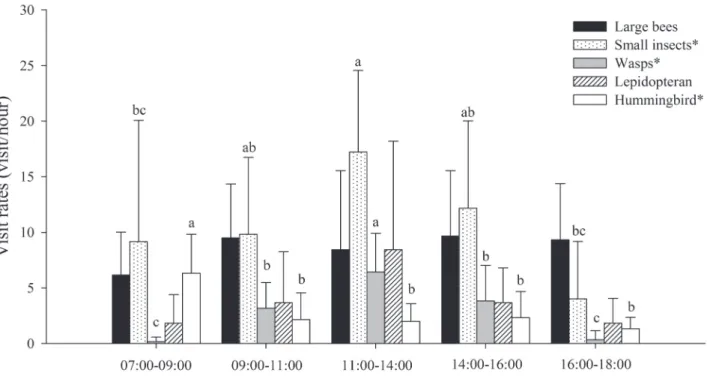
hours of observation. During each observation session we registered the visitation frequency of each visitor group: large bees (at least 2cm, approximately the size of the fl ow-ers), wasps (idem), lepidopterans (butterfl ies and moths), small insects (insects smaller than the fl ower, including bees such as Trigona spp., Syrphidae fl ies and other insects of similar size) and hummingbirds. For two specifi c groups we also conducted qualitative observations in order to char-acterize their behavior in the fl owers: large bees, which are considered the legitimate pollinator of S. ferrugineus (see Saraiva et al. 1988), and hummingbirds. Th e parameters observed were: the number of fl owers probed each visit, the duration of each visit, contact with reproductive structures of the fl ower and agonistic interaction. Whenever possible, insects were captured for identifi cation. Hummingbirds were identifi ed in the fi eld, using binoculars. To assess whether the visitation frequency of each group of fl oral visi-tors was diff erent during the day we used one-way ANOVA considering the time interval as a factor. Time intervals considered were: 07:01-09:00, 09:01-11:00, 11:01-14:00, 14:01-16:00 and 16:01-18:00. Tukey’s multiple comparison test was performed when the null hypothesis was rejected by ANOVA (Zar 1999). Th e fl ower visitor data were log10 transformed before the analyses (Zar 1999). Th e number of fl owers probed and the duration of visits were compared between large bees and hummingbirds by the Student’s t test. Th e duration of visits was log10 transformed before the analysis (Zar 1999).
Th e fl owering phenology was quantifi ed in an area of 1ha where we recorded all fl owering individuals of S. fer-rugineus fortnightly from March 2009 to February 2010. For each individual we counted the number of open fl owers. Th e plant reproductive system was evaluated by hand pollination experiments carried out on eight individuals. Plants chosen for the pollination experiment produced tens of fl owers per day and eight individuals were suffi cient to perform all treatments for all individuals. For the experiment, fl owers were kept isolated using nylon mesh bags, including the pollen donor fl owers. Four diff erent treatments were per-formed on the fl owers: cross-pollination (fl owers of diff erent individuals), self-pollination (diff erent fl owers within the same individual), spontaneous self-pollination (fl owers kept isolated by nylon mesh bags) and agamospermy (previously emasculated fl owers kept isolated). Each treatment was performed on all eight individuals, with at least fi ve fl owers per treatment per individual. Flowers were also marked and kept exposed to pollinators as a control, in order to estimate the natural pollination success. Fruit development was fol-lowed to evaluate pollination treatment success.
In order to estimate the eff ect of hummingbird visits on plant reproduction we conducted an exclusion experi-ment using white blotched, wire mesh (6x8cm) cages. For each plant we marked a control and experimental branch, always trying to use the most distant pair on the plant. Each branch produced more than 100 flowers during
the fl owering season. Th e wire cage on the experimental branch hindered hummingbird visits but not other visitors (observed previously and during the experiment). At least once a week during the fl owering period, we marked open fl owers for each branch, always marking the same number of fl owers in the control and experimental branch of each individual for each day. At least 30 fl owers per category for each individual were marked. We marked seven individuals in 2009 and another seven individuals in 2010, but since results did not diff er among years we grouped the results for the analysis. To verify if hummingbirds had some eff ect on the overall reproduction of the plant, the mean fruit-set of marked fl owers was compared using a paired Student’s t test between the control and experimental branches (Zar 1999).
Results
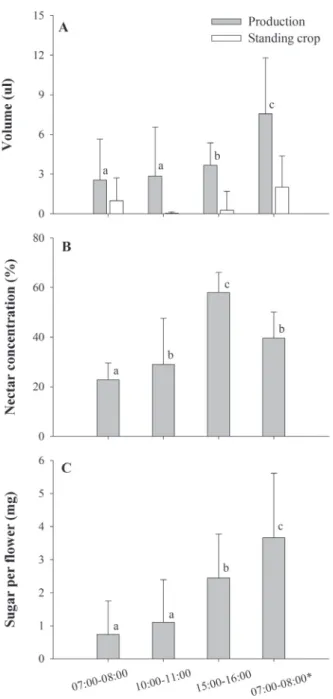
Styrax ferrugineus fl owers opened mostly in the begin-ning of the morbegin-ning, between 06:00 and 07:00 (66.5±11.2%), but some fl owers opened later during the day. Th e fl owers remained open continuously and lastedmore than one day usually wilting and falling aft er 10:00 on the second morn-ing. Flowers produced a sweet scent and nectar production as well as pollen release started when the fl owers opened. Th e nectar volume present in the fl owers was similar dur-ing the morndur-ing and increased slightly in the aft ernoon (F3,216=23.25, p<0.001, Fig. 1A). Flowers isolated from the fl ower visitors averaged a twofold larger nectar volume in the second morning in relation to recently opened fl owers (Fig. 1A). Compared with bagged fl owers, it was possible to observe almost complete depletion of nectar in exposed fl owers during the day, aft er the fi rst sampling period early in the morning. Flowers restored some nectar volume dur-ing the second morndur-ing, which was probably due to lower temperatures during night and lack of nocturnal visitors. Most fl owers had a measurable quantity of nectar but ap-proximately 8% of the bagged fl owers were empty. Th e concentration of nectar varied considerably in S. ferrugin-eus, with the lowest value occurring early in the morning on the fi rst day and the highest peak during late aft ernoon (F3,216=17.80, p<0.001, Fig. 1B). Th e amount of sugar per fl ower increased with the life span of the fl ower (F3,216=54.73, p<0.001, Fig. 1C).
For each visit, large bees probed 22.61±17.44 fl owers (n=62), which was not signifi cantly diff erent (t109=0.202, p=0.84) from the hummingbirds, which probed 21.98±14.95 fl owers per visit (n=49). However, the visits of large bees lasted lon-ger than the visits of hummingbirds (bees: 135.00±125.37s, hummingbirds: 68.08±67.09s, t109=3.88, p<0.001).
Figure 1. Nectar availability in Styrax ferrugineus Nees & Mart at diff erent sampling intervals in the cerrado of Uberlândia – MG. A. Volume of nectar in bagged fl owers (production) and in fl owers exposed to fl oral visitors (standing crop). B. Variation in nectar concentration. C. Amount of sugar per fl ower. At least forty fl owers for each category at each time interval were sampled (ma-ximum of fi ve fl owers for each individual at given time interval and category). Asterisk in the last time interval indicates samples from the second morning. Diff erent letters above bars show signifi cant diff erences among time intervals (ANOVA and post hoc Tukey test, p<0.05).
Of the large bees, we identifi ed species of Xylocopa [e.g., X. hirsurtissima (Maidl 1912), X. subcyanea (Perez 1901) and X. frontalis (Olivier 1789)] and Bombus [e.g., B. atratus (Franklin 1913)] as the principal visitors. Th ese bees were oft en buzzing their body during fl ower visits, and apparently collecting pollen. Among wasps, species of Pompilidae (genus Pepsis and Entypus) and Sphecidae were commonly observed. Considering the lepidopterans, butterfl ies of the family Hesperidae were the most common visitors. Th e most common hummingbirds were Amazilia fi mbriata (Gmelin, 1788)with 36.3% of the visits, Eupeto-mena macroura (Gmelin, 1788)with34.1% of the visits and Chlorostilbon lucidus (Shaw, 1812) with 27.3% of the visits, while Colibri serrirostris (Vieillot, 1816)was observed only twice. Territorial behavior was observed in E. macroura and A. fi mbriata with the former appearing as the hierarchically dominant species. Agonistic interactions were not limited within the hummingbirds, because they frequently repelled other visitors, especially large bees of the genus Xylocopa and Bombus. Nevertheless, territorial hummingbirds seemed to be unable to repel the majority of other insects visitors due to their high abundance, and many large bees tried insis-tently to visit the fl owers even aft er being chased. During the visits, all visitors seemingly contacted the reproductive organs of the fl owers, with the exceptions of small insects and hummingbirds. Pollination seemed more diffi cult for smaller insect visitors because they probed nectar without contacting their body to stigma, although they frequently contacted the anthers and removed pollen. Hummingbirds also frequently contacted the anthers with their bills, thus removing pollen, but since the short corolla of S. ferrugineus does not orient the hummingbird to contact its bill to stigma, pollination was not assured.
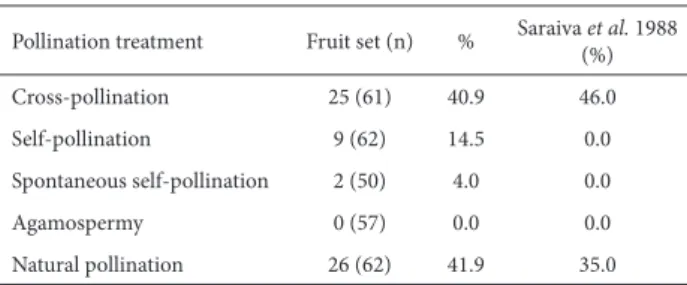
Flowering period extended from May to July during the dry cold season of the Cerrado (Fig 3). During fl owering an individual could present more than 150 fl owers per day but there was considerable variability and the mean fl ower avail-ability per day during peak fl owering was 38.1±30.0 fl owers per individual (Fig. 3). Fruit-set occurred more frequently in the cross-pollination treatment and control fl owers, which had a similar proportion of fruit formation (Tab. 1). Self-pollination and spontaneous self-pollination also formed fruits, but with a considerably smaller frequency. Agamospermy treatments did not set fruits. Th e experiment designed to infer the eff ect of hummingbird visits on plant reproduction showed no dif-ference in the fruit-set between treatments (t13=0.322, p=0.75). When hummingbirds were allowed to visit, 33.14±20.98% of fl owers were converted into fruits whereas in the hummingbird exclusion treatment fruit-set was 32.86±14.95%.
Discussion
what has been observed for other important hummingbird pollinated plants in the Cerrado (e.g. Justino et al. 2012). In studies with the genus Styrax, bees and other insects are always mentioned as visitors and pollinators, but visits by birds have not been recorded (Kato & Hiura 1999; Huang et al. 2003). Even in a previous study with S. ferrugineus from the Cerrado, visits by hummingbirds were not men-tioned (Saraiva et al. 1988). In this particular case, the small sample eff ort devoted and/or the previous assumption of S. ferrugineus being a bee fl ower could probably account for the absence of hummingbirds in the fl ower visitor records. But hummingbird visits to S. ferrugineus are commonly observed and recorded in other studies (e.g. Gottsberger & Silberbauer-Gottsberger 2006).
Th e visitation rates varied diff erently among groups of fl ower visitors and this may be related to diff erences in the importance of factors aff ecting visitation. Hummingbirds visited fl owers more frequently early in the morning when the standing crop was higher, while most insect groups visited or tended to visit fl owers more frequently at noon. While the visits of hummingbirds are frequently associated to nectar availability (Brown et al. 1981; Justino et al. 2012), insect visits are more infl uenced by the temperature than nectar availability (Brown et al. 1981). During the cold dry season in the Cerrado the temperature can be considerably low early in the morning and before dusk, which probably hindered most insect visitors. Activities of larger bees, such as carpenter and bumblebees, seem to be less aff ected by temperature (as in Brown et al. 1981) and these insects were active all day long. Visits of hummingbirds were similar to
visits of large bees when considering the number of fl owers probed, but considering the duration of visits, large bees spent considerably more time in the fl owers. Along with the behavioral diff erences between the two groups in han-dling fl owers, bees may have also spent more time in order to collect pollen. In a previous study, Saraiva et al. (1988) stated that the only resource off ered by S. ferrugineus to its visitors was nectar. However, large bees also seemed to actively collect pollen grains, which was confi rmed by their buzzing behavior and by the presence of S. ferrugineus pol-len grains in the nests of species of Xylocopa in the studied region (Silva 2009).
Th e population of S. ferrugineus in Uberlândia presented a considerable number of fl owers on a daily basis for a relatively short period, of nearly two months. Th is type of mass-fl owering pattern in trees is frequently associated to the attraction of a variety of generalist insects (Johnson & Steiner 2000, Maruyama et al. 2010). Th e hand pollination treatment showed that S. ferrugineus produced more fruits aft er cross-pollination than self-pollination and that there was no pollen limitation since control fl owers presented a similar fruit-set when compared to hand cross-pollination. Th e results of the pollination experiments in this study contrast signifi cantly with the results of Saraiva et al. (1988), who did not record fruit formation aft er self-pollination. Diff erences in the reproductive biology among populations could be responsible for this inconsistency.
Even though its fl owers are considered primarily bee fl owers with an association of other insect groups, hum-mingbird visits were frequent in S. ferrugineus. Th e eff ect
Figure 3. Flowering phenology of Styrax ferrugineus Nees & Mart from March 2009 to February 2010 in the cerrado of Uberlândia - MG. Values above bars indicate the number of fl owering individuals in the sampled area.
Table 1. Results of hand pollination experiments for Styrax ferrugineus Nees & Mart, in a cerrado of Uberlândia-MG. Results for a Corumbataí-SP study (Saraiva et al. 1988) are shown for comparison.
Pollination treatment Fruit set (n) % Saraiva et al. 1988 (%)
Cross-pollination 25 (61) 40.9 46.0
Self-pollination 9 (62) 14.5 0.0
Spontaneous self-pollination 2 (50) 4.0 0.0
Agamospermy 0 (57) 0.0 0.0
Natural pollination 26 (62) 41.9 35.0
that an illegitimate fl ower visitor (nectar robbers or thieves) has on plant reproduction can be negative, neutral or even positive (Maloof & Inouye 2000; Lara & Ornelas 2001; Fumero-Cabán & Meléndez-Ackerman 2007). Plants may show adaptation in order to restrict the access to fl ower resource to those visitors which act as effi cient pollinators (Castellanos et al. 2004). But attraction of a larger, general-ized spectrum of pollinators could be advantageous when considering fl uctuations in pollinator availability over time (Waser et al. 1996). In our case, the exclusion of hum-mingbirds did not change the fruit-set, which means that hummingbird visits apparently had no perceptible eff ect on plant reproduction. Th e eff ect nectar robbers have on plant reproduction depends of many factors, such as the type of pollinator, plant biology, the proportion of nectar removed by robbers and the resources available in the environment (Maloof & Inouye 2000), and these variables may be similar in the case of nectar thieves. Due to the morphological mismatch, hummingbirds probably have a small direct contribution to S. ferrugineus reproduction, as observed for other insect pollinated plants in the Cerrado (Oliveira & Gibbs 1994). On the other hand, their frequent visits probably remove signifi cant amounts of nectar. By stealing nectar, nectar robbers and thieves could induce legitimate pollinators to visit more fl owers or individuals, thus increasing pollination rates (Maloof & Inouye 2000). Whether this is the case with S. ferrugineus, we have no clear evidence. But, when considering our sample unit (branch), fruit-set did not increase.
Th e great variability in nectar volume and concentra-tion observed in S. ferrugineus probably resulted from the diff erent environmental conditions experienced by the fl owers during anthesis. Temperature and humidity can have considerable infl uence on nectar properties, especially for fl owers with short and open corollas (Galetto & Bernadello 2005). Styrax ferrugineus fl owers during the dry and cold season in the Cerrado, when temperatures can vary con-siderably during the day. Th e apparently constant nectar secretion observed, combined with the nectar evaporation due to increasing temperatures during the midaft ernoon increase nectar concentrations, while colder nights interrupt nectar evaporation and may help to dilute the nectar. Th e presence of empty fl owers, as previously observed by Saraiva et al. (1988), had been interpreted as a mechanism to reduce energy expenditure in nectar production and/or to increase the number of fl owers a pollinator visits (Feinsinger 1978). If a pollinator, fi nding several empty fl owers within the same plant, gives up on searching for nectar in additional fl owers and fl ies to the next co-specifi c plant, then the presence of empty fl owers could increase outcrossing rates. In contrast, if a pollinator responds to the presence of empty fl owers by visiting more fl owers within the same individual, the result would be the opposite, increasing the rate of self-pollination. How the presence of empty fl owers in S. ferrugineus aff ects pollinator behavior and consequently plant reproduction remains to be investigated.
Nectar variation and even empty flowers may also affect foraging behavior of hummingbirds. The agonistic territorial defense was restricted to other humming-birds and large, high-energy-demanding bees. Since flower choice and feeding behavior of hummingbirds are strongly related to nectar availability (Justino et al. 2012), territorial behavior was observed mostly early in the morning, when there was a higher nectar standing crop. This contrasts with truly ornithophilous plants, such as Palicourea rigida Kunth in cerrado, which receive frequent visits from hummingbirds and are defended all day long (Justino et al. 2012).
Th e eff ect of illegitimate visitors in pollination is complex and depends on many factors (Maloof & Inouye 2000), and this may explain the absence of a perceptible eff ect of hum-mingbird visits on S. ferrugineus fruit-set. In this sense, more studies seeking to understand the ecological consequence of hummingbird visits on non-ornithophilous plants would be interesting, especially in ecosystems where this seems to be common, such as in the Cerrado region (Oliveira & Gibbs 1994; Araujo & Sazima 2003). From the perspective of the plant (fruit-set), the eff ect of hummingbird visits was minimal and imperceptible. However, these visits may be important for hummingbirds, which specialize in nectar feeding and the contribution of non-ornithophilous fl owers to their persistence cannot be neglected.
Acknowledgements
We are grateful to Maria Margarida M. D. Silva for fi eld support. We thank the CCPIU administration for the permission to carry out studies in its reserve. Th is study was supported by CNPq and FAPEMIG with scholarships and funding. We thank Felipe W. Amorim, Leandro Freitas, Francielle P. Araújo and Amanda F. Cunha for comments on previous versions of the manuscript and Marcela Yamamoto, Solange C. Augusto and Kleber Del-Claro for helping with insect identifi cation.
References
Araujo, A.C & Sazima, M. 2003. Th e assemblage of fl owers visited by hummingbirds in the “capões” of Southern Pantanal, Mato Grosso do Sul, Brazil. Flora198: 427-435.
Brown, J.H.; Kodric-Brown, A.; Whitham, T.G. & Bond, H.W. 1981. Competition between hummingbirds and insects for the nectar of two species of shrubs. Th e Southwestern Naturalist26: 133-145. Castellanos, M.C.; Wilson, P. & Th omson, J.D. 2004. ‘Anti-bee’ and
‘pro-bird’ changes during the evolution of hummingbird pollination in Penstemon fl owers. Journal of Evolutionary Biology17: 876-885. Feinsinger, P. 1978. Ecological interactions between plants and
hummingbirds in a successional tropical community. Ecological Monographs 48: 269-287.
Fritsch, P.W. 1999. Phylogeny of Styrax based on morphological characters, with implications for biogeography and infrageneric classifi cation.
Systematic Botany24: 355-378.
Fumero-Cabán, J.J. & Meléndez-Ackerman, E.J. 2007. Relative pollination eff ectiveness of fl oral visitors of Pitcairnia angustifolia (Bromeliaceae).
American Journal of Botany 94(3): 419-424.
Galleto, L. & Bernardello, G. 2005. Nectar. Pp. 261-313. In: Dafni, A.; Kevan, P.G. & Husband, B.C. (eds.)Pratical pollination biology. Ontario, Cambridge, Enviroquest Ltd.
Gottsberger, G. & Silberbauer-Gottsberger, I. 2006. Life in the Cerrado: a south American tropical seasonal ecosystem II. Ulm, Reta Verlag. Huang Y.; Fritsch, P.W. & Shi, S. 2003. A revision of the imbricate group
of Styrax series Cyrta (Styracaceae) in Asia. Annals of Missouri Botanical Garden90(4): 491-553.
Inouye, D.W. 1980. Th e terminology of fl oral larceny. Ecology61: 1251-1253.
Johnson, S.D. & Steiner, E. 2000. Generalization versus specialization in plant pollination systems. Trends in Ecology and Evolution15: 140-143.
Justino, D.G.; Maruyama, P.K. & Oliveira, P.E. 2012. Floral resource availability and hummingbird territorial behaviour on a Neotropical savanna shrub. Journal of Ornithology, in press.
Kato, E. & Hiura, T. 1999. Fruit set in Styrax obassia (Styracaceae): the eff ect of light availability, display size, and local fl oral density. American Journal of Botany86: 495-501.
Lara, C. & Ornelas, J.F. 2001. Nectar ‘theft ’ by hummingbird fl ower mites and its consequences for seed set in Moussonia deppeana.Functional Ecology15: 78-84.
Maloof, J. & Inouye, D.W. 2000. Are nectar robbers cheaters or mutualists?
Ecology 81: 2651-2661.
Maruyama, P.K.; Amorim, F.W. & Oliveira, P.E. 2010. Night and day service: distyly and mixed pollination system in Faramea cyanea (Rubiaceae).
Flora205: 818-824.
Muchhala, N. 2006. The pollination biolog y of Burmeistera (Campanulaceae): specialization and syndromes. American Journal of Botany93(8): 1081-1089.
Nakajima, J.N. & Monteiro, R. 1986. Estudos fi togeográfi cos com espécies de Styrax L. (Styracaceae) dos cerrados brasileiros. Eugeniana12: 3-10.
Oliveira, P.E. & Gibbs, P.E. 1994. Pollination and breeding systems of some Vochysia species (Polygalales-Vochysiaceae) in Central Brazil. Journal of Tropical Ecology10: 509-522.
Rojas, R. & Ribon, R. 1997. Guilda de aves em Bowdichia virgilioides (Fabaceae: Faboideae) em área de cerrado de Furnas, Minas Gerais.
Ararajuba52: 189-194.
Roubik, D.W. 1982. Th e ecological impact of nectar-robbing bees and pollinating hummingbirds on a tropical shrub. Ecology 63: 354-360. Saraiva, L.C.; Cesar, O. & Monteiro, R. 1988. Biologia da polinização e
sistema de reprodução de Styrax camporum Pohl e S. ferrugineus Nees et Mart. (Styracaceae). Revista Brasileira de Botânica11: 71-80. Silva, C.I. 2009. Distribuição espaço-temporal de recursos fl orais utilizados
por espécies de Xylocopa (Hymenoptera, Apidae) e interações com plantas do cerrado sentido restrito no Triângulo Mineiro. Tese de Doutorado. Universidade Federal de Uberlândia, Uberlândia.
Stiles, F.G. 1981. Geographical aspects of bird-fl ower coevolution, with particular reference to Central America. Annual Missouri Botanical Garden68: 323-351.
Waser, N.M.; Chittka, L.; Price, M.V.; Williams, N.M. & Ollerton, J. 1996. Generalization in pollinations systems, and why it matters. Ecology 77: 1043-1060.
Zar, J.H. 1999. Biostatistical analysis. 4 ed. New Jersey, Prentice-Hall.