Curculionidae: Curculioninae: Rhamphini) on Erythroxylum subsessile
(Erythroxylaceae) with a description of the new species
Monteiro, RF.
a*, Nascimento, MS.
a, Silva, RM.
aand Hespenheide, HA.
baLaboratório de Ecologia de Insetos, Departamento de Ecologia, Instituto de Biologia - IB,
Universidade Federal do Rio de Janeiro – UFRJ, CP 68020, CEP 21941-590, Rio de Janeiro, RJ, Brazil
bDepartment of Ecology and Evolutionary Biology, University of California, Los Angeles, CA, 90095-1606, USA
*e-mail: [email protected]
Received October 31, 2011 – Accepted February 17, 2012 – Distributed November 30, 2012
(With 2 figures)
Abstract
In this study, we describe and present original data on the bionomics and ecology of Tachygonus erythroxyli Hespenheide, New Species, on Erythroxylum subsessile (Mart.). Thirty individuals of E. subsessile were analysed every two months, from October, 2006 to October, 2007 at the National Park of Restinga de Jurubatiba (PNRJ) Carapebus, Rio de Janeiro, Brazil. Females of T. erythroxyli lay their eggs singly on the upper surface of the host’s leaves. The mine of T. erythroxyli
is expanded with three bubbles, each one representing one larval instar. These mines occur throughout the year in at least half of the host plants and are markedly more abundant in summer. We obtained three parasitoid species, making a total of 53% of the rate of parasitism. Cirrospilus sp. (Eulophidae) was the most prevalent and represented 88% of the
parasitoids. The great abundance of Tachygonus mines, their high frequency in their host plant, and local monophagy of this leaf miner weevil suggest a close association between T. erythroxyli and Erythroxylum subsessile.
Keywords:Tachygonus erythroxyli, Erythroxylum subsessile, leaf miner, restinga.
Mina foliar singular induzida por
Tachygonus
sp. n. (Coleoptera: Curculionidae:
Tachygoninae) em
Erythroxylum subsessile
(Erythroxylaceae) com descrição da nova espécie
Resumo
No presente estudo, foram descritos e apresentados os primeiros dados sobre bionomia e ecologia de Tachygonus erythroxyli
Hespenheide, New Species, em Erythroxylum subsessile (Mart.). Trinta indivíduos de E. subsessile foram amostrados a cada dois meses, de outubro de 2006 a outubro de 2007, no Parque Nacional da Restinga de Jurubatiba (PNRJ), Carapebus-Rio de Janeiro, Brasil. Fêmeas de T. erythroxyli colocam ovos isolados na face superior das folhas do seu hospedeiro. A mina de T. erythroxyli é do tipo expandida e apresenta um formato de três bolhas, sendo que cada bolha corresponde a um estádio da larva. Essas minas ocorrem ao longo de todo o ano em pelo menos metade das plantas hospedeiras, sendo marcadamente mais abundantes no verão. Foram obtidas três espécies de parasitoides que, juntas, demonstraram uma taxa de parasitismo de 53%. Cirrospilus sp. (Eulophidae) foi a mais abundante e representou 88%
dos parasitoides. A grande abundância de minas de Tachygonus, a alta frequência em seu hospedeiro e a monofagia local desse besouro minador de folhas sugere uma forte associação entre T. erythroxyli e Erythroxylum subsessile.
Palavras-chave:Tachygonus erythroxyli, Erythroxylum subsessile, minador foliar, restinga.
1. Introduction
The feeding mark within the plant tissue left by leaf-mining larvae is a record that enables researchers to obtain information on the life cycle and population dynamics of the miners, and to observe their associations with parasitoids (Hespenheide, 1991). Despite the convenience of these records for research, and the great species diversity of the group, relatively few tropical leaf-mining species have been studied in detail (Hespenheide, 1991; Sinclair and Hughes, 2010).
2002; Queiroz and Garcia, 2009), and a few have dealt with species found at the Restinga biome, for instance
Senna appendiculata(Vogel) Wiersema (= S. australis
Irwin & Barneby; Leguminosae, Teixeira et al., 1999),
Byrsonima sericea DC. (Malpighiaceae, Flinte et al., 2006)
and Ouratea cuspidata (A.St.-Hil.) Engl. (Ochnaceae, Vanin and Mermudes, 2007).
In studies about insect-plant interactions developed at the National Park of Restinga de Jurubatiba (PNRJ), Rio de Janeiro, we observed very remarkable leaf mines on Erythroxylum subsessile (Mart.) (Erythroxylaceae). A
previously undescribed species of Tachygonus Guérin-Ménéville, 1833 (Coleoptera: Curculionidae: Tachygoninae) emerged from these mines, which we will describe below. Tachygonine beetles share some morphological characteristics such as a dorsoventrally flattened body back and long hind legs (Lima, 1956). Another very similar leaf-mining species, Tachygonidius fluminensis
(Curculionidae), collected by the first author (RFM) from the same restinga had previously been described by Vanin and Mermudes (2007).
The genus Tachygonus features 86 described species distributed in the Nearctic and Neotropical regions (O’Brien and Wibmer, 1982; Wibmer and O’Brien, 1986). Placement of the genus Tachygonus in the Curculionidae is unclear (Jens Prena, personal communication). It and the related Brazilian genus Tachygonidius Champion have at times been placed in a separate subfamily, Tachygoninae (O’Brien and Wibmer, 1982; Wibmer and O’Brien, 1986), but most recently they have been assigned to the tribe Rhamphini of the Curculioninae (Alonso-Zarazaga and Lyal, 1999). Twenty-four species are found in Brazil, although there is no recent revision of the genus and only a few representative specimens are found in national collections. Although Bondar (1947) had previously recorded the leaf-mining habit of
Tachygonus, leaf mines have been recorded for only a few species (Kogan, 1963; Hespenheide, 1992), and very little has been published about the biology of the genus. Some species have been recorded on host plants in the following families: Anacardiaceae, Apocynaceae, Aquifoliaceae, Cecropiaceae, Fabaceae, Fagaceae, Leguminosae, Malvaceae, Myrtaceae, Rhamnaceae and Ulmaceae (Kogan, 1963; see also D’Araújo and Silva et al., 1968; Hespenheide, 1991 and 1992), but none had been recorded on the species of Erythroxylaceae.
Thus, the aim of this study is to describe the new species of Tachygonus and general aspects of its biology and ecology.
2. Material and Methods
This study was conducted at the National Park of Restinga de Jurubatiba (PNRJ) Carapebus, RJ, in a formation of dense clumps, varying in size and interspersed with areas of sand where the vegetation is sparse (Araujo et al., 1998). In that region, the average temperature is 27.9 °C in summer and 23.7 °C in winter. While the average monthly
rainfall reaches 97.7 mm in summer, it drops to 49.2 mm in winter (Flinte and Macedo, 2004).
There are 230 described species of Erythroxylum, of which 187 are native from the Neotropics, including the Restinga biome. Erythroxylum subsessile, host plant of
Tachygonus, is restricted to the state of Rio de Janeiro (Plowman and Hensold, 2004) and at PNRJ it is one of the most abundant plant species (Araujo et al., 2004). Thirty individuals of E. subsessile were surveyed every two months, from October, 2006 to October, 2007. On each randomly sampled plant, we recorded the number of mines and the hosts’ phenology data. We collected some mines to measure larval size and to obtain adult insects.
Leaf mines were kept in plastic pots until adult leaf miners or their parasitoids were obtained. We opened the mines from which no adults emerged in order to ascertain the cause of death, whenever possible. We described the biological characteristics of Tachygonus sp., such as type of mine, shape, oviposition site, part of the plant where the mine occurs and size of larvae and adults. We dissected some mines in order to investigate the number of larval instars and the life stage in which the leaf miner eventually became parasitized. We also evaluated the temporal variation of plants attacked by leaf miner and the number of mines per plant and leaf.
The adult specimens obtained are deposited in the insect collection of the National Museum of Rio de Janeiro (MNRJ) and the collection of H. A. Hespenheide (CHAH).
3. Results and Discussion
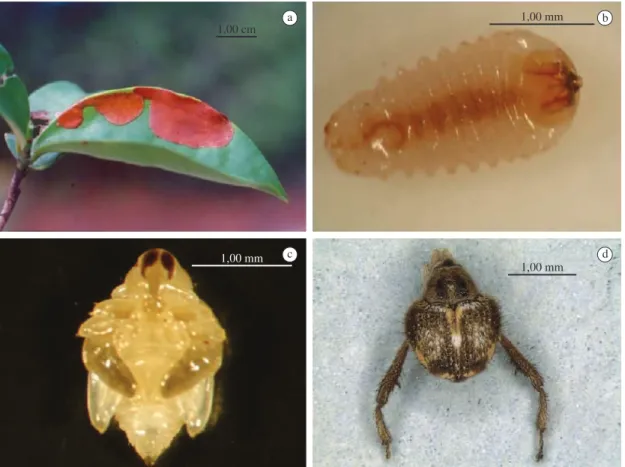
3.1. Tachygonus erythroxyli Hespenheide, new species (Figure 1d)
Head along midline at vertex and rostrum glabrous, rostrum polished; pronotum rather densely punctate, intervals shining. Elytra coarsely punctate, intervals raised, shining. Mesosternum declivous, unmodified. Abdomen more or less uniformly punctate, more sparsely so in middle of ventrites 1-2. Metafemora 1.20 mm long, round in cross-section, increasingly thicker to apical 3/4, with three acute teeth, inner one longest at distal 3/4, outer one shorter on basal 1/2 before middle, third still shorter outer tooth slightly distal to longest tooth; metatibiae 0.70 mm long, weakly arcuately curved and somewhat flattened, slightly twisted outward at apex; metatarsal segment 1 longer than outer segments and claws.
Etymology: Named for the genus of the plant host. Specimens examined: Holotype: Brazil, Rio de Janeiro, National Park of Restinga de Jurubatiba, Carapebus, reared from Erythroxylum subsessile on March 21, 2007 (MNRJ).
Paratypes: nine specimens, sampling period from January to March 2007 (MNRJ, CHAH).
Discussion: This species is one of the smallest known species of Tachygonus. Little variation was seen among the 10 specimens examined. The holotype is paler in coloration than the individual photographed (Figure 1d), especially in having paler hind legs. This is probably because reared specimens of Tachygonus are sometimes relatively teneral at
emergence and take several days to develop full coloration (Hespenheide, unpublished). Tachygonuserythroxyli
differs from other known South American members of the genus by the combination of small size and pattern of setae on the elytra. Many Tachygonus have a small patch of dense setae immediately posterior to the scutellum, but in T.erythroxyli the setae extend along the suture of the elytra and form a conspicuous patch of white setae at the middle of the elytra.
3.2. Ecology and life history
Females of Tachygonus erythroxyli lay their eggs singly on the upper surface of Erythroxyllum subsessile
leaves. The mine is expanded, developing from the base toward the apex of the leaf (Figure 1a). The mine looks like a succession of bubbles, and each bubble is occupied by a different instar of the larva. The mine is visible only on the adaxial leaf surface, and is generally on one side of the midrib, rarely crossing it. The larva consumes the chlorophyllous tissue entirely (from the upper cuticle to the lower).
The solitary larva (Figure 1b) goes through three stages before it pupates (Figure 1c) within the leaf. The larval head capsule has the following dimensions in the first, second and third instars, respectively: 0.3 mm, 0.5 mm and
Figure 1. Mine of Tachygonus erythroxyli with the three bubbles of different sizes in which larvae of the 1st, 2nd and 3rd
instars developed from the base toward the apex (a); third instar larva (b); pupa (c); adult of T. erythroxyli (d).
a b
0.7 mm. Approximately one month after the larval eclosion, the adult (Figure 1d) emerges from the top of the leaf.
First instar mines were found in both mature and young leaves. Of the total number of mines observed (N = 463), 96% were found singly in a leaf, whereas only 4% were found with two or more mines of T. erythroxyli per leaf. These mines were present in 60% of the 210 plants inspected. The average number of mines per attacked plant was 3.7, with a maximum of 17 mines on a plant. Data obtained in 2006/2007, and observations made in 2004/2005, indicate that T. erythroxyli occur throughout the year in at least half of the host plants, being markedly more abundant in summer. The highest abundance and frequency of leaf miners occurred in February, during the rainy season (Figure 2).
From the 90 leaf mines collected, 48 were parasitized (53%) by three parasitoid species. Cirrospilus sp. (Eulophidae) was observed throughout the entire studied period, representing 88% of the parasitized leaf mines. This species, endoparasitoid, emerged from all larval instars, but 67% of the leaf miners were in the third instar, 26% in the second instar, and 7% in the first instar. Parasitoid adults emerged after drilling the adaxial surface of the mine, and from each leaf mine up to seven parasitoids emerged (Mean = 1.95 ± SD = 1.41). The other two species of endoparasitoid larvae obtained from T. erythroxyli, Brasema sp. (Eupelmidae) and Elachertus sp. (Eulophidae), were rare in samples,
together representing 12% of the parasitized leaf mines. Species of the family Eulophidae presents a great variety of eating habits, as well as host (Grissell and Schauff, 1997), however this family seems to represent a major group of parasitoids of immature sheltered in galls, mines or stems (Hespenheide, 1991; Monteiro et al., 1994; Maia and Monteiro, 1999; Maia and Azevedo, 2009). Hansson (2009) reports Horismenus cupreus (Ashmead, 1894)
(Eulophidae)occurs in Brazil and has been reared from
Tachygonus.
During nearly 20 years of studies on insect-plant interaction at Rio de Janeiro restingas, the leaf mine of
T. erythroxyli was only found in Erythroxylum subsessile, although another very abundant and widely distributed species of Erythroxylum (E. ovalifolium Peyr.; Costa and Dias, 2001) occurs in the study area. The great abundance of mines, the high frequency on their host plant and the local monophagy of this leaf miner weevil suggest a close association between T. erythroxyli and
Erythroxylum subsessile. Additional ecological studies on this genus should be conducted in order to investigate the habit and host specificity, verifying if this pattern of close association with the host plant occurs with other species of Tachygonus.
Acknowledgements – We would like to thank Dr. Sérgio A. Vanin for identifying the genus of the leafminer beetle and Dra. Angélica M. P. M. Dias for identifying the parasitoids. We would
also like to thank PELD/Site 5 (CNPq) and Hympar Sudeste (CNPq/CAPES/FAPESP) for the financial support and ICMBio
for permission to research at PNRJ. RF Monteiro received a productivity scholarship from CNPq, MS Nascimento receives a doctorate scholarship from CAPES and RM de Sousa received
an undergraduate scientific project scholarship from CNPq.
References
ALONSO-ZARAZAGA, MA. and LYAL, CHC., 1999. A World Catalogue of Families and Genera of Curculionoidea (Insecta: Coleoptera) (Excepting Scolytidae and Platypodidae). Barcelona: Entomopraxis S. C. P. Edition. 315 p.
ARAUJO, DSD., PEREIRA, MCA. and PIMENTEL, MCP., 2004. Flora e Estrutura de Comunidades na Restinga de Jurubatiba – Síntese
dos Conhecimentos com Enfoque Especial para a Formação Aberta
de Clusia. In ROCHA, CFD., ESTEVES, FA. and SCARANO, FR.
Pesquisas de Longa Duração na Restinga de Jurubatiba: Ecologia, História Natural e Conservação. São Carlos: RiMa. p. 59-76.
ARAUJO, DSD., SCARANO, FR., SÁ, CFC., KURTZ, CB., ZALUAR, HLT., MONTEZUMA, RCM. and OLIVEIRA,
CR., 1998. Comunidades vegetais do Parque Nacional da Restinga
de Jurubatiba. In ESTEVES, FA. Ecologia de Lagoas Costeiras do Parque Nacional da Restinga de Jurubatiba e do Município de Macaé (RJ). Rio de Janeiro: UFRJ/NUPEM. p. 39-62. Figure 2. Temporal variation in the abundance of mines of Tachygonus erythroxyli (dashed line) and number of plants
BONDAR, G., 1947. Notas Entomológicas da Bahia - XIX. Revista de Entomologia, vol. 18, no. 3, p. 273-295.
COSTA, AF. and DIAS, ICA., 2001. Flora do Parque Nacional da Restinga de Jurubatiba e arredores, Rio de Janeiro, Brasil:
listagem, florística e fitogeografia – Angiospermas, Pteridófitas,
Algas continentais. Rio de Janeiro: Museu Nacional. 200 p.
D’ARAÚJO E SILVA, AG., GONÇALVES, CR., GALVÃO, DM., GONÇALVES, AJL., GOMES, J., SILVA, NM. and SIMON, L., 1968. Quarto Catálogo dos Insetos que Vivem nas Plantas do Brasil, seus Parasitos e Predadores. Rio de Janeiro: Fundação IBGE. Parte II – 1º tomo. 622 p.
FLINTE, V. and MACEDO, MV., 2004. Biology and Seasonality
of Fulcidax monstrosa (F.) (Chrysomelidae: Chlamisinae).
The Coleopterists Bulletin, vol. 58, p. 457-465. http://dx.doi. org/10.1649/629
FLINTE, V., ARAUJO, CO., MACEDO, MV. and MONTEIRO, RF., 2006. Insetos fitófagos associados ao murici da praia,
Byrsonima sericea (Malpighiaceae), na Restinga de Jurubatiba
(RJ). Revista Brasileira de Entomologia, vol. 50, no. 4, p. 512-523. http://dx.doi.org/10.1590/S0085-56262006000400012
GRISSELL, EE. and SCHAUFF, ME., 1997. Superfamily
Chalcidoidea. In GIBSON, GAP., HUBER, JT., WOOLLEY
JB. Annotated keys to the genera of Nearctic Chalcidoidea (Hymenoptera). Ottawa: NRC Research Press. p. 45-116.
HANSSON, C., 2009. Catalogue of the Eulophidae in the Neotropical Region. Available from: <http://www.neotropicaleulophidae.com/ pdfs/Catalogue.pdf>. Acess in: 12 feb. 2012.
HESPENHEIDE, HA., 1991. Bionomics of leaf-mining insects. Annual Review of Entomology, vol. 36, p. 535-560. http://dx.doi. org/10.1146/annurev.en.36.010191.002535
-, 1992. A review of the genus Tachygonus (Coleoptera:
Curculionidae) North of Mexico. Proceedings of the Entomological Society of Washington, vol. 94, p. 1-11.
KOGAN, M., 1963. Uma nova espécie do gênero “Tachygonus” Schoenherr, 1833 e observações sobre seus hábitos
minadores (Coleoptera, Curculionidae). Revista Brasileira de Biologia = Brazilian Journal of Biology, vol. 23, no. 1, p. 85-94.
LIMA, AMC., 1956. Insetos do Brasil: Coleópteros. Rio de
Janeiro: Escola Nacional de Agronomia. Série Didática n°12 – 10°
tomo. 373 p.
MAIA, VC. and AZEVEDO, MAP., 2009. Micro-himenópteros
associados com galhas de Cecidomyiidae (Diptera) em Restingas do Estado do Rio de Janeiro (Brasil). Biota Neotropica, vol. 9, no. 2, p. 151-164.
MAIA, VC. and MONTEIRO, RF., 1999. Espécies cecidógenas (Diptera, Cecidomyiidae) e parasitóides (Hymenoptera) associadas
a Guapira opposita (Vell.) Reitz. (Nyctaginaceae) na Restinga da Barra de Maricá, Rio de Janeiro. Revista Brasileira de Zoologia, vol. 16, no. 2, p. 483-487.
MONTEIRO, RF., FERRAZ, FFF., MAIA, VC. and AZEVEDO,
MAP., 1994. Galhas Entomógenas Em Restingas: Uma Abordagem Preliminar. In Anais do III Simpósio de Ecossistemas da Costa Brasileira. Serra Negra, 1993. São Paulo: ACIESP. vol. 3. p. 210-220.
O’BRIEN, CW. and WIBMER, GJ., 1982. Annotated checklist of
the weevils (Curculionidae sensu lato) of North America, Central America, and the West Indies (Coleoptera: Curculionoidea).
Memoirs of the American Entomological Institute, vol. 34, no. 1-9, p. 1-382.
PLOWMAN, T. and HENSOLD, N., 2004. Names, types, and
distribution of neotropical species of Erythroxylum (Erythroxylaceae).
Brittonia, vol. 56, no. 1, p. 1-53.
http://dx.doi.org/10.1663/0007-196X(2004)056[0001:NTADON]2.0.CO;2
QUEIROZ, JM., 2002. Distribution, survivorship and mortality sources in immature stages of the neotropical leaf miner Pachyschelus coeruleipennis Kerremans (Coleoptera: Buprestidae). Brazilian Journal of Biology, vol. 62, no. 1, p. 69-79. http://dx.doi.org/10.1590/ S1519-69842002000100009
QUEIROZ, JM. and GARCIA, MA., 2009. The tritrophic system
Hyptis suaveolens (Lamiaceae) – Agromyzid leafminers (Diptera: Agromyzidae) – Parasitoids (Hymenoptera): Effects of herbivore
density, host plant patch size, and habitat complexity on parasitism rate. Brazilian Archives of Biology and Technology, vol. 52, no. 3, p. 573-580. http://dx.doi.org/10.1590/S1516-89132009000300008
SINCLAIR, RJ. and HUGHES, L., 2010. Leaf Miners: The hidden
herbivores. Austral Ecology, vol. 35, no. 3, p. 300-313. http:// dx.doi.org/10.1111/j.1442-9993.2009.02039.x
TEIXEIRA, CR., MACEDO, MV. and MONTEIRO, RF., 1999.
Biology and ecology of the leaf-mining Hispinae Octuroplata octopustulata. In COX, MI. Advances in Chrysomelidae Biology 1. Leiden: Backhuys Publishers. p. 557-564.
VANIN, SA. and MERMUDES, JRM., 2007. Two new Tachygonidius
species from the Atlantic coast of Brazil (Coleoptera, Curculionidae).
Zootaxa, vol. 1415, p. 57-64.
WIBMER, GJ. and O’BRIEN, CW., 1986. Annotated checklist