Effect of acute nitric oxide synthase
inhibition in the modulation of heart
rate in rats
1Cátedra de Fisiología, Facultad de Farmacia y Bioquímica,
Universidad de Buenos Aires,Buenos Aires, Argentina
2Instituto de Química y Metabolismo del Fármaco (IQUIMEFA), CONICET,
Buenos Aires, Argentina
3Instituto Universitario de Ciencias de la Salud (IUCS), Fundación Barceló,
Buenos Aires, Argentina A.L. Fellet1,2,
C. Di Verniero1,2,
P. Arza1,2, A. Tomat1,2,3,
A. Varela1,2, C. Arranz1,2,3
and A.M. Balaszczuk1,2,3
Abstract
Acute nitric oxide synthase inhibition with NG
-nitro-L-arginine meth-yl ester (L-NAME) on chronotropic and pressor responses was studied in anesthetized intact rats and rats submitted to partial and complete autonomic blockade. Blood pressure and heart rate were monitored intra-arterially. Intravenous L-NAME injection (7.5 mg/kg) elicited the same hypertensive response in intact rats and in rats with partial (ganglionic and parasympathetic blockade) and complete autonomic blockade (38 ± 3, 55 ± 6, 54 ± 5, 45 ± 5 mmHg, respectively; N = 9, P = NS). L-NAME-induced bradycardia at the time when blood pressure reached the peak plateau was similar in intact rats and in rats with partial autonomic blockade (43 ± 8, 38 ± 5, 46 ± 6 bpm, respectively; N = 9, P = NS). Rats with combined autonomic blockade showed a tachycardic response to L-NAME (10 ± 3 bpm, P<0.05 vs
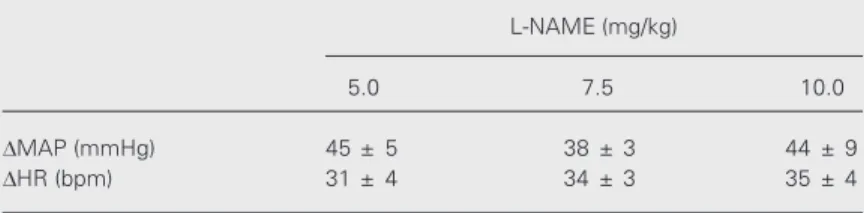
intact animals, N = 9). Increasing doses of L-NAME (5.0, 7.5 and 10 mg/kg, N = 9) caused a similar increase in blood pressure (45 ± 5, 38 ± 3, 44 ± 9 mmHg, respectively; P = NS) and heart rate (31 ± 4, 34 ± 3, 35 ± 4 bpm, respectively; P = NS). Addition of L-NAME (500 µM) to isolated atria from rats killed by cervical dislocation and rats previously subjected to complete autonomic blockade did not affect spontaneous beating or contractile strength (N = 9). In vivo results showed that L-NAME promoted a tachycardic response in rats with complete autonomic blockade, whereas the in vitro experiments showed no effect on intrinsic heart rate, suggesting that humoral mechanisms may be involved in the L-NAME-induced cardiac response.
Correspondence
A.L. Fellet Cátedra de Fisiología
Facultad de Farmacia y Bioquímica Universidad de Buenos Aires (1113) Junín, 956, 7º Piso Buenos Aires
Argentina
Fax: +54-11-4964-8280 E-mail: [email protected]
Research supported by Universidad de Buenos Aires, Fundación Barceló and IQUIMEFA-CONICET, Buenos Aires, Argentina.
Received July 12, 2002 Accepted January 29, 2003
Key words
·Nitric oxide ·Nitric oxide synthase ·Autonomic nervous system ·Heart rate
·Heart
Introduction
Although the role of nitric oxide (NO) in modulating myocardial contractility has been extensively investigated, the effects of NO on heart rate (HR) have received compara-tively little attention (1,2). There is evidence that NO plays an obligatory role in
the data in the literature are contradictory. Previous investigations have demonstrated that NO donors may directly stimulate the pacemaking activity of the sinoatrial node, independently of the arterial baroreflex (9), and others have reported that the NO path-way may inhibit L-type calcium channel and cAMP-stimulated hyperpolarization-acti-vated current(If) (10).
Despite intensive research in this area, however, there are many questions about the underlying mechanisms by which NO modu-lates HR, in particular whether interactions exist between the NO pathways and the au-tonomic nervous system (ANS) in this situa-tion (11-13).
Given the contradictory data about the relations between ANS and myocardial cell NO in the control of HR, the present study was performed to investigate the effects of acute administration of NG
-nitro-L-arginine methyl ester (L-NAME) on the modulation of HR in intact rats, in rats submitted to partial and complete autonomic blockade, and in isolated rat atria.
Material and Methods
Male Sprague-Dawley rats (230 to 260 g body weight) from the breeding laboratories of the Facultad de Veterinaria (Universidad de Buenos Aires, Argentina) were used for each experimental group throughout all ex-periments. Rats were housed in a humidity-and temperature-controlled environment with an automatic 12/12-h light/dark cycle. Rats were fed standard rat chow from Nutrimentos Purina (Buenos Aires, Argentina) and re-ceived tap water ad libitum up to the day of the experiments. Animals were used in com-pliance with the research animal use guide-lines of the American Heart Association.
In vivo studies
Rats were anesthetized intraperitoneally (ip) with urethane (1.0 g/kg body weight)
(Sigma, St. Louis, MO, USA) and anesthesia was maintained with supplemental ip doses throughout the experiment. A tracheotomy was performed and an endotracheal tube (3.5 or 4 mm ID, Portex) was inserted 4 cm into the trachea and secured. After perform-ing the tracheotomy, a polyethylene cannula was inserted into the right and left femoral vein for phenylephrine (PE) infusion and drug administration, respectively. Mean ar-terial pressure (MAP) was measured directly with a cannula inserted into the right femoral artery and connected to a pressure trans-ducer. The blood pressure signal was meas-ured continuously with a Statham P23 ID pressure transducer (Gould Instruments, Cleveland, OH, USA) and recorded with a polygraph (Physiograph E & M Co. Inc., Houston, TX, USA). HR was derived from the pulsatile pressor signal via tachographic beat to beat conversion with a tachograph preamplifier (577-26 tachometer, Coulbourn Instruments, Inc., Allentown, PA, USA). Body temperature was monitored with a rec-tal probe and was maintained at 37.0 ± 0.5ºC with heating lamps. Data were obtained with a data acquisition program (Labtech Note-book, Laboratory Technologies, Wilming-ton, MA, USA).
Experimental design
both sympathetic and parasympathetic traf-fic.
In groups 2 and 4 the administration of hexamethonium was repeated every 20 min to ensure complete blockade of ganglionic transmission during the experiments. Also, PE (4-6 µg kg-1
min-1
, iv; Sigma) was infused during the experiment to maintain MAP within the basal range before L-NAME ad-ministration (13,14).
MAP and HR were monitored continu-ously in all groups. The effects of L-NAME (7.5 mg/kg; Sigma) on MAP and HR were studied by comparing the values obtained 5 min before and after its administration. In addition, in group 4 the pressor and chrono-tropic responses to L-NAME were also as-sessed when HR reached the maximum change after L-NAME injection. In addi-tional experiments (9 rats with complete au-tonomic blockade), a bolus of PE (6 µg/kg, iv) was used to determine the specificity of the response to acute L-NAME administra-tion on the cardiovascular parameters.
Protocol II: Effects of different doses of L-NAME on MAP and HR in rats submitted to complete autonomic blockade. The pres-sor response to L-NAME was monitored in rats submitted to complete autonomic block-ade using increasing doses of L-NAME, i.e., 5.0, 7.5 and 10 mg/kg, N = 9 per group. The animals were studied after complete auto-nomic blockade with hexamethonium (10 mg/kg, iv) and bilateral vagotomy. The ad-ministration of hexamethonium and the in-fusion of PE were as described in protocol I. MAP and HR were recorded continuously over a period of 60 min after L-NAME ad-ministration. Maximum HR and MAP changes after L-NAME injection were used to indicate the magnitude of the response.
In vitro studies
Group 1. Nine male Sprague-Dawley rats (230 to 260 g body weight) were killed by cervical dislocation and the hearts were
re-moved as quickly as possible.
Group 2. Before cervical dislocation, nine anesthetized male Sprague-Dawley rats (230 to 260 g body weight) were subjected to complete autonomic blockade as described for the in vivo experiments.
The atria from groups 1 and 2 were ex-cised and mounted isometrically under a resting tension of 750 mg in 20-ml organ baths. The bathing medium was a Krebs-Ringer bicarbonate solution, pH 7.40 ± 0.05, of the following composition: 120 NaCl, 25 mM NaHCO3, 4.8 mM KCl, 1.33 mM MgSO4, 1.2 mM KH2PO4, 1.6 mM CaCl2, 0.02 mM CaNa2EDTA and 10 mM dextrose. The solution was continuously bubbled with 95% O2-5% CO2 and the temperature was kept at 31ºC. The contraction frequency of spontaneously beating atria was measured from 30-s samples of recorded contractions. After a 60-min recovery period the isolated atria were exposed to L-NAME (500 µM) and subsequent recordings were obtained at 2, 10 and 30 min.
Statistical analysis
Data are reported as means ± SEM and were analyzed statistically by one-way anal-ysis of variance followed by the Bonferroni test. In some cases, the unpaired Student t-test was applied. The 5% probability level was used as a criterion for significance. The Prism software (Graph Pad Software, San Diego, CA, USA) was used for statistical analysis.
Results
In vivo studies
No differences were observed in the pres-sor response to a single bolus injection of L-NAME (7.5 mg/kg) in the four experimental groups of animals (Figure 1). The effects of L-NAME on HR in the four experimental groups are shown in Figure 2. L-NAME-induced bradycardia at the time when MAP
reached the peak plateau was of similar mag-nitude in intact animals and in animals sub-mitted to ganglionic blockade and vagotomy. In contrast, L-NAME administration induced tachycardia after complete autonomic block-ade. Moreover, we observed that in group 4 the maximum tachycardic effect was reached
MAP (mmHg) 140 120 100 80 60 40 20 0
Change in MAP (mmHg)
80 60 40 20 1234 1234 1234 1234 1234 1234 1234 1234 1234 1234 1234 Figure 1. A, Change in mean
ar-terial pressure (MAP) induced by NG-nitro-L-arginine methyl ester
(L-NAME). Acute iv L-NAME (7.5 mg/kg) significantly increased MAP and this response was similar in intact rats (group 1) and in rats with sympathetic (group 2), parasympathetic (group 3) and complete autonomic block-ade (group 4). Data are reported as means ± SEM for 9 rats in each group. There were no sta-tistically significant differences between groups (one-way analy-sis of variance followed by the Bonferroni test). B, Representa-tive tracing of raw data obtained in one experiment for each group showing the effect of L-NAME (7.5 mg/kg, iv) on MAP.
A
B
0
Group 1
Group 1 Group 2 Group 3 Group 4
5 min 5 min 5 min 5 min
L-NAME L-NAME L-NAME L-NAME
Change in HR (bpm)
20 0 -20 -40 -60 1234 1234 1234 1234 1234 1234 1234 1234 1234 1234 Group 1 * L-NAME
L-NAME L-NAME L-NAME
Group 1 Group 2 Group 3 Group 4
5 min 5 min 5 min 5 min
HR (bpm) 320 300 280 260 240 220 320 300 280 260 240 220 320 300 280 260 240 220 320 300 280 260 240 220 Figure 2. A, Heart rate (HR)
re-sponse to NG-nitro-L-arginine
methyl ester (L-NAME, 7.5 mg/kg, iv) in intact rats (group 1) and in rats with sympathetic (group 2), parasympathetic (group 3) and complete auto-nomic blockade (group 4). The L-NAME-induced bradycardia in re-sponse to a similar increase in MAP was quantitatively similar in intact, sympathectomized and vagotomized rats. This effect was abolished by complete auto-nomic blockade. Acute iv injec-tion of L-NAME increased HR in group 4 (*P<0.05 vs group 1, un-paired Student t-test). Data are reported as means ± SEM for 9 rats in each group. B, Represen-tative tracing of raw data ob-tained in one experiment for each group showing the effect of L-NAME (7.5 mg/kg, iv) on HR.
A
B
Group 2 Group 3 Group 4
Group 2 Group 3
at about 30 min after iv L-NAME adminis-tration, from a mean pre-L-NAME value of 288 ± 13 to 322 ± 10 bpm after L-NAME injection (P<0.05).
In completely autonomically blocked rats treated with a bolus injection of PE we ob-served a similar increase in MAP compared with L-NAME administration in group 4 (DMAP at 30 min: 49 ± 4 vs 45 ± 5 mmHg, respectively, P = NS). However, HR was unchanged 30 min after PE administration (361 ± 17 vs 391 ± 18 bpm before PE, respectively, P = NS).
Protocol II. Table 1 shows changes in MAP and HR after different doses of L-NAME (5.0, 7.5 and 10 mg/kg) in rats sub-mitted to complete autonomic blockade. There were no significant differences in the magnitude of increase in MAP and HR ob-tained with the doses tested.
In vitro studies
The data shown in Table 2 indicate that L-NAME did not affect the pacemaker activ-ity of isolated atria. Table 3 shows that the contractile strength was also unchanged by L-NAME compared to basal values.
Discussion
In vivo protocols were used to study the effects of the NO synthase inhibitor L-NAME on MAP and HR of anesthetized rats submit-ted to partial and complete autonomic block-ade. MAP and HR were similar in all groups of animals at the beginning of the experi-ments, reflecting similar hemodynamic con-ditions. A bolus injection of L-NAME (7.5 mg/kg) increased MAP similarly in intact rats and in rats submitted to ganglionic, para-sympathetic and complete autonomic block-ade. This suggests that the effect of L-NAME administration on blood pressure is inde-pendent of sympathetic or parasympathetic influences and is probably due to a direct vasoconstrictor effect caused by the decrease
Table 1. Effects of increasing doses of L-NAME on changes in mean arterial pressure (DMAP) and heart rate (DHR) after complete autonomic blockade.
L-NAME (mg/kg)
5.0 7.5 10.0
DMAP (mmHg) 45 ± 5 38 ± 3 44 ± 9
DHR (bpm) 31 ± 4 34 ± 3 35 ± 4
L-NAME was acute intravenously injected. Data are reported as means ± SEM for 9 rats in each group. There were no statistically significant differences among the responses to different doses (one-way analysis of variance followed by the Bonferroni test).
Table 2. Chronotropic response to L-NAME by isolated atria.
Time (min)
Basal 2 10 30
Group 1 160 ± 6 155 ± 6 158 ± 7 151 ± 5
Group 2 161 ± 5 156 ± 4 153 ± 5 150 ± 4
The concentration of L-NAME in the bath was 500 µM. Data are reported as means ± SEM bpm for 9 rats in each group. Group 1: cervical dislocation; group 2: complete autonomic blockade + cervical dislocation. There were no statistically significant differences among the responses as a function of time (one-way analysis of variance followed by the Bonferroni test).
Table 3. Inotropic response to L-NAME by isolated atria.
Time (min)
2 10 30
Group 1 107 ± 16 109 ± 18 109 ± 20
Group 2 108 ± 18 110 ± 16 111 ± 15
The concentration of L-NAME in the bath was 500 µM. Data are reported as means ± SEM for percent of the basal peak developed tension recorded at the end of the stabilization period. N = 9 rats per group. Groups 1 and 2 are the same as in Table 2. There were no statistically significant differences among the responses as a function of time (one-way analysis of variance followed by the Bonferroni test).
and ganglionic blockaded animals. In con-trast, a significant increase in HR was ob-served in rats with total autonomic blockade. We observed that PE did not induce any increase in HR, confirming the fact that only L-NAME caused an increase in HR in com-plete autonomic blockaded animals. Since the abolition of baroreflex function in rats with complete autonomic blockade is not the cause of L-NAME-induced tachycardia, we were able to assess the chronotropic response to L-NAME independently of the baroreflex response.
The rise in blood pressure that activates baroreceptor afferents results in both direct and indirect activation of the parasympa-thetic vagal innervations of the heart, de-creasing HR in intact and ganglionic block-aded rats. When both vagus nerves are sec-tioned, the bradycardic response still occurs and this chronotropic response may be due to the inhibition of sympathetic tone (16).
Focusing on the immediate L-NAME-induced tachycardia, we determined whether this chronotropic effect persisted in the 5- to 10-mg/kg dose range of the NO synthase inhibitor. The results showed that the differ-ent doses of L-NAME used caused a similar increase in MAP and HR in rats with com-plete autonomic blockade. The tachycardic effect of L-NAME on these animals was perhaps surprising. Other studies have shown contradictory results with respect to the chro-notropic effects of NO synthase inhibition (17) and the antimuscarinic properties of L-NAME in in vivo experiments (18). The mechanism responsible for the L-NAME-induced tachycardia in rats with autonomic blockade is unclear. The results obtained in the present study, which disagree with oth-ers (9,10,13,18) may be due, at least in part, to differences in some methodological con-ditions and/or to differences in the auto-nomic tone of the animals.
NO synthase has been shown to be pres-ent in many sites of the cpres-entral and peripher-al nervous system and is involved in the
autonomic control of cardiovascular func-tion (19,20). Recent studies have indicated that changes of NO in the central nervous system may contribute to the regulation of the cardiovascular system by inhibition of the sympathetic nervous system and modu-lation of the arterial baroreflex (21). Additi-onally, previous reports have demonstrated that 30 to 60 min are required for iv L-NAME to cross the blood-brain barrier and reach a sufficient concentration in the central nervous system to inhibit more than 50% of central neuronal NO synthase activity in the brain (22,23). The chronotropic response induced by L-NAME reached a maximum value at about 30 min after L-NAME admin-istration, suggesting that the activation of humoral mechanisms (endothelins, angio-tensin II, atrial natriuretic peptide, thyroid hormones and others) as well as physical factors such as shear stress or a direct effect of L-NAME may be probably involved in the HR response (24-26).
pres-ent, it is unclear how the intrinsic rate de-pends on NO production within cardiac cells and many in vitro and in vivo studies have illustrated the multiple and sometimes con-tradictory effects of NO pathways on cardiac function.
We have shown that: a) an acute L-NAME bolus of 7.5 mg/kg induced the same pressor response in all experimental groups of ani-mals, and this hypertensive effect of L-NAME was independent of the ANS; b) acute L-NAME administration to intact, va-gotomized and ganglionic blockaded rats pro-moted bradycardia associated with an in-crease in blood pressure; c) iv injection of
L-NAME in rats with complete autonomic blockade induced an immediate positive chronotropic effect; d) L-NAME adminis-tration had no direct effect on the spontane-ous beating or contractile activity of in vitro isolated atria; e) humoral and physical fac-tors may be probably involved in the L-NAME-induced response.
Acknowledgments
The authors wish to thank Ana María Bento Schneider, Associate Teacher of En-glish at the School of Medicine, Universidad de Buenos Aires, Argentina.
References
1. Kelly RA, Balligand JL & Smith TW (1996). Nitric oxide and cardiac function. Circulation Research,79: 363-380.
2. Shah A (1996). Paracrine modulation of heart cell function by endo-thelial cells. Cardiovascular Research,31: 847-867.
3. Balligand JL, Kelly RA, Marsden PA, Smith TW & Michel T (1993). Control of cardiac muscle cell function by an endogenous nitric oxide signaling system. Proceedings of the National Academy of Sciences, USA, 90: 347-351.
4. Han X, Shimoni Y & Giles WR (1994). An obligatory role for nitric oxide in autonomic control of mammalian heart rate. Journal of Physiology, 476: 309-314.
5. Conlon K, Collins T & Kidd C (1996). Modulation of vagal actions on heart rate produced by inhibition of nitric oxide synthase in the anesthetized ferret. Experimental Physiology, 81: 547-550. 6. Elvan A, Rubar M & Zipes DP (1997). NO modulates autonomic
effects on sinus discharge rate and AV nodal conduction in open-chest dogs. American Journal of Physiology,272: H263-H271. 7. Vandecasteele G, Eschenhagen T & Fischmeister R (1998). Role of
the NO-cGMP pathway in the muscarinic regulation of the L-type Ca2+ current in human atrial myocytes. Journal of Physiology, 506:
653-663.
8. Gallo MP, Ghigo D, Bosia A, Alloatti G, Costamanga C, Penna C & Levi RC (1998). Modulation of guinea pig cardiac L-type calcium current by nitric oxide synthase inhibitors. Journal of Physiology, 506: 639-651.
9. De Marco T, Dae M, Yeun-Green MSF et al. (1995). Iodine-123 metaiodobenzylguanidine scintigraphic assessment of the trans-planted human heart: evidence for late reinnervation. Journal of the American College of Cardiology,25: 927-931.
10. Sears CE, Choate JK & Paterson DJ (1998). Inhibition of nitric oxide synthase slows the heart rate recovery from cholinergic activation. Journal of Applied Physiology, 84: 1596-1604.
11. Lacolley PJ, Lewis SJ & Brody MJ (1991). Role of sympathetic nerve activity in the generation of vascular nitric oxide in urethane-anes-thetized rats. Hypertension,17: 881-887.
12. Toda N, Kitamura Y & Okamura T (1993). Neural mechanism of hypertension by nitric oxide synthase inhibitor in dogs. Hyperten-sion,21: 3-8.
13. Pegoraro AA, Carretero OA, Sigmon DH & Beierwaltes WH (1992). Sympathetic modulation of endothelium-derived relaxing factor. Hy-pertension, 19: 643-647.
14. Vargas HM, Ignarro LJ & Chaudhuri G (1990). Physiological release of nitric oxide is dependent on the level of vascular tone. European Journal of Pharmacology,190: 393-397.
15. Radaelli A, Mircoli L, Perlini S, Bolla G, Mori LL, Mancia G & Ferrari AU (1998). Lack of autonomic contributions to tonic nitric oxide-mediated vasodilatation in unanesthetized free-moving rats. Journal of Hypertension, 16: 55-61.
16. Kandel ER, Schwartz JH & Jessel TM (1991). Principles of Neural Science. 3rd edn. Appleton & Lange, Norwalk, CT, USA.
17. Scrogin KE, Hatton DC, Chi Y & Luft FC (1998). Chronic nitric oxide inhibition with L-NAME: effects on autonomic control of the cardio-vascular system. American Journal of Physiology, 274: R367-R374. 18. Koss MC (1997). Effect of N(G)-nitro-L-arginine methyl ester on
functionally characterized muscarinic receptors in anesthetized cats. European Journal of Pharmacology, 335: 199-204.
19. Bredt DS, Hwang PM & Snyder SH (1990). Localization of nitric oxide synthase indicating a neural role for nitric oxide. Nature, 347: 768-770.
20. Dun NJ, Dun SL & Forstermann U (1994). Nitric oxide synthase immunoreactivity in rat pontine medullary neurons. Neuroscience, 59: 429-445.
21. Zanzinger J, Czachurski J & Seller H (1997). Neuronal nitric oxide reduces sympathetic excitability by modulation of central glutamate effects in pigs. Circulation Research, 80: 565-571.
22. Iadecola C, Xu X, Zhang F, Hu J & el-Fakahany EE (1994). Prolonged inhibition of brain nitric oxide synthase by short-term systemic ad-ministration of nitro-L-arginine methyl ester. Neurochemical Re-search, 19: 501-505.
M & Hurn PD (1995). Nitro-L-arginine analogues: dose- and time-related nitric oxide synthase inhibition in brain. Stroke,26: 864-869. 24. Dzau VJ (1993). The role of mechanical and humoral factors in growth regulation of vascular smooth muscle and cardiac myocytes. Current Opinion in Nephrology and Hypertension, 2: 27-32. 25. Masullo P, Venditti P, Agnisola C & Di Meo S (2000). Role of nitric
oxide in the reperfusion induced injury in hyperthyroid rat hearts. Free Radical Research, 32: 411-421.
26. Stepp DW, Merkus D, Nishikawa Y & Chilian WM (2001). Nitric oxide limits coronary vasoconstriction by a shear stress-dependent mech-anism. American Journal of Physiology, 281:H796-H803.
27. Riado SR, Zanesco A, Barker LA, De Luca IMS, Antunes E & De Nucci G (1999). Long-term nitric oxide inhibition and chronotropic
responses in rat isolated right atria. Hypertension,34 (Part 2): 802-807.
28. Musialek P, Lei M, Brown HF, Paterson DJ & Casadei B (1997). Nitric oxide can increase heart rate by stimulating the hyperpolariza-tion-activated inward current, If. Circulation Research, 81: 60-68.
29. Musialek P, Paterson DJ & Casadei B (1999). Changes in extracellu-lar pH mediate the chronotropic responses to L-arginine. Cardiovas-cular Research,43: 712-720.
30. Mohan P, Brutsaert DL, Paulus WJ & Sys SU (1996). Myocardial contractile response to nitric oxide and cGMP. Circulation,93: 1223-1229.