Oligarchy versus Democracy
and Regulation versus Deregulation
under the Globalization Effect
Dumitru-Alexandru BODISLAV Bucharest Academy of Economic Studies [email protected]
Abstract. On capitalism that is created under the pressure of globalization there are created many economic systems that derived into a new model: the asymmetric model created from propriety rights’ perspective and the influence of interest groups, an asymmetric model that is called “oligarchy”(1). For a better understanding of oligarchy we consider an oligarchic society, where the political power is in the hands of the producers of goods, that tend to protect their propriety rights, but this way they create entry barriers, destroying the propriety rights of future potential producers.
Capitalism was and is stressed by the (de)regulation phenomena created by the competition which is shaped through globalization. With ease we can go from (de)regulating to oligarchic pressure, which from the globalization’s perspective can give birth to the lagging or decoupling in the global economic system. This paper researches these two cases and inserts them into the global framework to result the evolution of society’s members’ welfare.
Keywords: democracy; de/regulation; governance; oligarchy; social welfare.
JEL Codes: A13, B22, C70, D23, G38, H70, K21, L13, L51, P51.
REL Codes: 5J, 13H.
Introduction
For the first part of the paper it was chose not to compare capitalism with oligarchy because from the epistemological point of view these two are in parallel conceptual plans. Capitalism has as foundation the economic view on the state, while oligarchy includes the government, the economic and the social component; this way we can observe as a possible comparison between oligarchy and socio-economic governance of capitalism, the democracy. Democracy, where political power is generally distributed, imposes 2nd distribution taxes on producers (to maintain competition at a sustainable standard for new companies) and doesn’t permit the creation of entry barriers. When taxes that are applied in a democracy are at a high level, and the distortions created through entry barriers don’t exist, oligarchic system gains followers for better internal efficiency, but this efficiency is based on a win – lose model(2).
1. The comparative analysis of the oligarchic society versus the democratic society from the perspective of globalization
a distortion in the allocation of resources because they can block the entrance of other economic agents that can have a higher productivity(4).
The exchange between the two types of distortions determines a bigger efficiency for oligarchy or for democracy and generates a bigger aggregate output. The oligarchy isn’t influenced by the negative effects of taxation, but suffers from the created entry barriers. Democracy imposes higher taxation, but creates a better “playground” (without entry barriers). When the taxation from a democracy is at a high level, and the created distortions from entry barriers are low, oligarchy has a better efficiency and generates a bigger output; when “the democratic taxation” is low and entry barriers create a better allocation of resources, this way it obtains a better distribution of income from the oligarchic model. In addition, the democratic society generates a more equitable distribution of income than the oligarchic society, because it shuffles the income between entrepreneurs and workers, while the oligarchic society adopts policies that reduce the labor demand, lower the wages and increase the profits for the entrepreneurs.
It is interesting the exchange dynamics between the political regimes (political, but with economic targets). Primary, the entrepreneurs will be the ones that have higher productivity; this way they acknowledge the fact that they are in a better position if they are part of the producing class, not from the working class, and as a result the distortions created by the oligarchic society will be limited. Although, the advantage that creates the enterprise is eroded through time and it will be lost by the producer that entered the market, but entry barriers created by the oligarchy will maintain the business working although the advantage (the core idea of the business) was lost. An algorithm is seen between the two types of societies: although at the beginning they are identical, the oligarchy will become richer faster, but on the long run will tend to create a lower wealth level than the democratic society, this way the model suggests that democracy, without considering economic distortions, has bigger efficiency on the long run from the economic perspective than the alternative.
purpose: high profits. These profits are in direct convergence with the political power, creating the transition from oligarchy to a difficult democracy, even if entry barriers are proved to be inefficient.
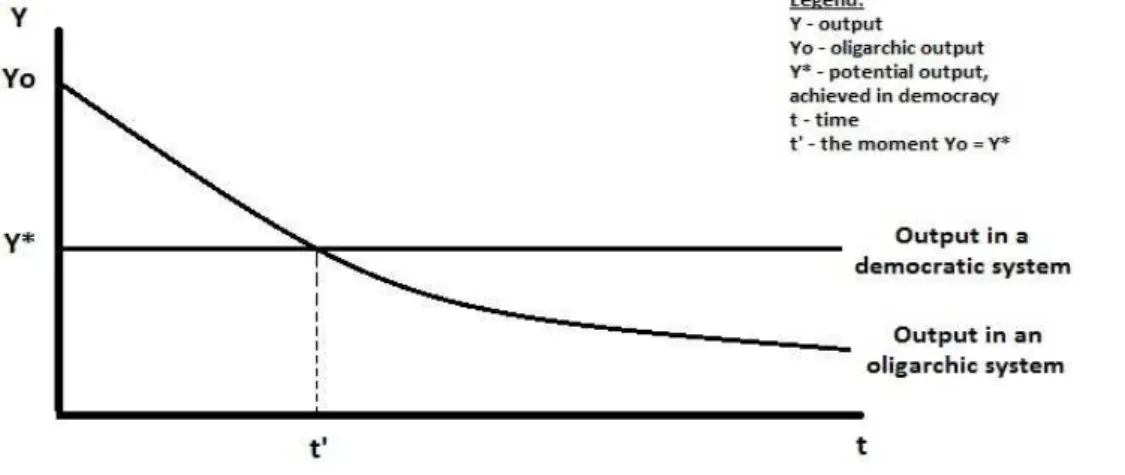
Explained on the graphic through the marginal difference between oligarchy and democracy is the resulted output (Figure 1). If the potential output Y* is the one from a democratic society (understood as capitalism) it results the oligarchic output Yo, that can have results that are under or above the sustainable level. If we have a medium time gap it will result an equilibrium between the oligarchic output and the democratic one in the t’ area, but on the long run the oligarchic one tends to be under optimal (under potential). Another component that creates under-optimal output for the oligarchic system is a derivate resulted from the implementation of entry barriers: the deterioration of the way of allocating skills (6) (a simplified model starting from Acemoglu, 2008, pp. 1-41).
Figure 1. Oligarchy’ output versus democracy’ output
2. The comparative analysis of economic models based on regulating
versus deregulating the market
2.1. The economy of regulation
Before 1970 the economy of regulation was focused on antitrust laws, but could some regulating agencies to achieve the objective of lowering the cost of energy? Stigler had shown “the inability of creating some significant effects of regulating the price of energy” (Stigler, 1971, pp. 3-21).
In 1971 Stigler stressed the idea that regulations have two substantial consequences:
It reallocates wealth;
It creates ballast – costs in the economy.
Interest groups demand regulations from the government and try not to achieve a goal on the expense of the “public good”, but try to involve the government to impose regulations through which they can benefit despite others. “When an industry gets a flow of power from the state, the benefit of the industry will be weak, but the losses will be bigger for the rest of the industry” (Stigler, 1971, pp. 3-21). Politicians create regulations, not to ameliorate the imperfections of the market linked to natural monopoly or to smaller social inequalities; actually they want to answer the needs of interest groups that are in the situation to exchange with other benefits offered to politicians(7). The purpose and character of regulations reflect the interests of groups that are in the situation of influencing politicians. Stigler modeled regulation like an “enterprise that searches profit, where the self interest of the group and individual try to win through the use of coercion”.
Companies like Chicago Commonwealth Edison and AT&T invited the US govern to supervise and regulate the electric energy and telecommunications industries in the desire to assure on the long run market share for their companies. They were the first members of corporate environment that demanded the creation of regulation agencies for the industrial sectors, for regulating market sharing and for regulating entries in regions or in the monopolies market (Schwarz, 2001, pp. 669-684).
marginal maximizing of the regulators utilities. All politically involved groups have a behavior of rent seeking on the dispositions given by the regulator. The competition effect between groups of interests creates an accelerated pressure on economic efficiency and on government regulations. Gary Becker sustained the limits created through the inefficiency of regulations in the economy, because the groups create pressure on politicians from the desire to obtain benefits(8) (Becker, 1983, pp. 371-400).
They observed a parallel between the flow of the regulation regime through continuous investment in lobby to counter attack any attempts of successful anti-regulations and to reduce the pressure of the negative elements of regulations, resulting in the problem of deregulating the economy. Peltzman and Becker extended their economic theory on niche sectors versus relaxed regulation to obtain marginal benefits and to shift the pressure on the initial interest groups. In the past there were some examples of deregulating that led to the decrease of the marginal benefits, through regulations on producers and growth of marginal costs for consumers (Schwarz, 2001, pp. 669-684). This way the political equilibrium shifts, the shift creates a recalibration effect on the regulation regime – the re-reregulation.
We can post here as an example in the favor of the regulated – re-regulated regime from the actual economic environment the solution of the Obama’ administration to (re)regulate the banking and financial services’ system through extra supervising only for those that have a certain income or their assets are above a certain value, fact that can be considered as being inefficient because not regulating those who have a small income creates an inefficiency volume through their failure – the “snowball effect” (we can consider that this system can be compared with the CNS – the central nervous system that is under the Alzheimer illness: banks represent the neurons, and financial services’ companies represent the synapses, these being the ones that are affected and create the perturbation or systemic inefficiency, and the evolution of the disease).
2.2. The trap of total deregulation
The most spectacular case from the resulted lessons perspective was the case of California through its electric energy component. The deregulation of the energy market in the state of California led to the establishment of direct market deployment by the creation of the energy price at the point where the demand meets the offer (9). The contracts on the long run between the producer and the consumer were banned, this way the obligation of contracts conceived on the spot market was created, but through a monopoly company (the ISO – Independent System Operator) (Schwarz, 2001, pp. 669-684). The selling wasn’t executed directly, but only when an up-front volume was achieved, this micro-pseudo-market was created(10).
The Deregulation Law drove to the excessive growth of prices for energy. These costs were determined by the classic regulation system of the energy industry. Practically, the law strengthened regional monopolies (they created entry barriers for new “players” on the energy market and especially for the “green players”). This law represented the emergency brake for energy producing facilities building in the state of California, the interval 1985-2005 represented the period of under-development of electric energy utilities(11), fact that evolved in importing electric energy form Quebec to satisfy the increasing consumption of the state (the lower consumption established after the 2007-2010 crisis, for the year 2011 the consumption being at the same level with the one from 2007).
The deregulation law abrogation took part in 2001, by re-validating the “black swan” theory (Taleb, 2010), that year was vector of many negative factors: an extremely hot summer, an extremely cold winter, the growth of the prices for natural gas (because of unstable production flow) and the exaggerated greed of Enron, this way the effects of the crisis were accelerated. The regulated price for the consumer (ceiled) was surpassed and this way the suppliers stopped the sale of electric energy (Schwarz, 2001, pp. 669-684). That is why the law that should “have destroyed the monopoly and open the electric energy market” (Zajicek, 2001, p. 104) was a total failure(12). The failure to implement (the deregulation was more an implementation of industry micromanagement) and the approach path of regulation establishment led to the failure of the “law of deregulation”, representing a clear example of inefficiency of the deregulation case facing the regulating failure(13).
Politics plays an important part in influencing nature and the performance of regulation, and the speed of implementation of regulation and deregulation (Peltzman, 1989, pp. 1-41). Politicians and their actions will decide if the actual regulation de-satisfaction will lead to deregulation or to re-regulation, but, unfortunately, these have a lag in implementation, representing solutions brought to asymmetries that appeared in the past (Schwarz, 2001, pp. 669-684).
As a conclusion in the deregulation matter, beside some isolated cases, it can lead to smaller costs, improving services and opening industries to competitors that are more efficient. Those isolated cases can be taken in consideration as unregulated innovation by the banking sector (because the regulation of a problem is discovered as being a solution and not a proactive management of the situation).
3. Globalization’s advantage facing the economy’s peculiarity
Globalization can represent a leveling component or even a blur of the political-economic-social problems (oligarchy) or of the government problems (regulation versus deregulation).
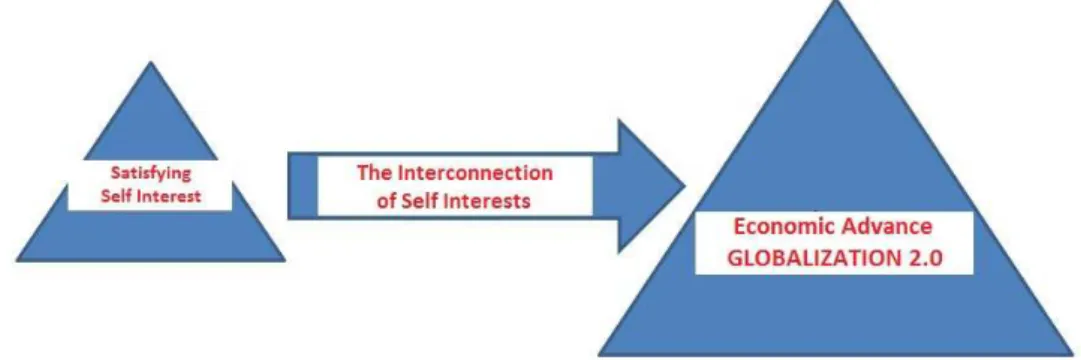
Unions of groups that we talk about as a structural uniformity at microeconomic and macroeconomic level have as a globalized behavior without destroying identities because they innovate the identification path with performance, and reproduce the whole that is bigger than the sum of its components, while the latter ones tend to behave as a whole when we are in fragile steady state, called in the past a favorable disequilibrium (Dinu, 1987). The idea that there are individuals with common interests which form groups of interest can lead to the linear flow of democracy (opposite to oligarchy) and these through their common interest are facing global competition under the sign of deregulation will result in creating the following simplified phenomena:
The phenomena created through obtaining the advance of own interest (under the rule of law) will lead to the advance of the entire society – social welfare. When a group (a union of states or a corporation) becomes a framework of mutual trust, interdependence and collective action, new bridges based on creativity and innovation are shaped(14). At micro level we can find innovations and applications that give the improbability effect in forecasting the future, creating the future with alternative solutions. At this effect we can also add the appearance of leaders that break coherently and synergic the intra-corporative or intra-state limitations this way creating an energizer effect of studied’ economies. Innovation is dependent of blurring the limitations (boundaries), not only internally (micro – on hierarchical levels, on the periphery transfer of decision, resulted from the center – periphery effect), but also on the external plan (macro – the relationship with other members of the group and with opinion makers from the group). For a world that is flattening, the existence of leaders that have as main purpose the blurring of limitations of any kind (be it political, economy, innovational, religious vision, etc.) represents a competitive advantage in front of other groups by offering transformational results, that create the evolution of the globalized economy as we know it – Globalization 2.0.
Conclusions
The completion of this paper touches the basic idea of the actual economy: the economic engine, from the outer perspective, is represented by the individual subatomic unit, the rational being. The rational being follows to obtain a functional economic system based on the free market – capitalism on the expense of economic suboptimal (poverty); this optimality is a result of tracking to satisfy of self interest. With all these added, the capitalist system based on the free market permits the abuse of power as a component of limited functionality after the activations of some exogenous factors. The capitalist system based on the free market emanates a high level of trust and credibility, but if it has permitted the support for some interest, these will grow their exposure in the system causing suffering for the other participants in the economic game.
licensing standards, transparence requirement on stock trading, rules for corporate governance – these can be considered as soft regulations for shaping the game’ framework, this way resulting the moral character of the capitalist system. Although, these soft regulations come with a cost, a cost that is supported by those that cannot handle these kind of “economic development”, such as: restricted access to capital (financial-moral) in poor countries, economic engineering that is in full development, but with the same purpose of manipulating the investor (or the elusion of the fiscal system under which the bad intentioned economic agent works), the short term vision(16) and implementing the obtained advantages only through the marginal cost and with the thought of obtaining immediate profit(17).
As we discussed in the section 2.1 of this paper regulations can create equilibrium, at least in the component of the economic system that is based on incentives, this way resulting a self interest that was passed through the whole’ filter, causing and creating social benefits.
The resulted incentives on the market must have a connection with the economic reality(18); the link with reality can be made by shaping and keeping the regularity of propriety rights (for movables, real estate or patents), respecting contractual terms, stability of the exchange rate, preventing corruption, bankruptcy law, stopping information asymmetry (the punishment of insider trading practices). These incentives must not be oriented for a win-lose yielding, in the purpose to stopp the started practices against competitors. An eloquent theoretical example is given by Adam Smith through the idea that business people tend to ally for eliminating other competitors from the market (the creation of the cartel).
Beyond the law appears the need to appeal to voluntary character of the individual(19), who could be an effective decision-making tool for the delimitation and obtaining of Social-Economic Good. This kind of synergy is resulted from the moral and enlightenment(20), generating value judgments based on the hierarchy of values that is linked with the social-economic reality.
The resulted responsibility through moral awareness of the rational being creates a relationship between protecting personal interest(21) and commitment for the working terms or for the entity with which or for whom it works(22). Through this fact we can deduct the idea that responsibility represents a relation of reciprocity, empowerment and maintenance of self interests, but taking in consideration others’ interests.
of bilateral support between self interest that is in working connection with others’ interest.
The capitalism of the future must sustain the selfish individualism braking and taking in consideration some higher goals, virtually a broader vision on the human global gearing (Dinu, 2010, pp. 96-121), assuming and awareness on the idea of global interconnectivity between all participants in the “economic game”. From this vision we can extract the conclusion that the active global interconnectivity between rational individuals that aim to fulfill their own interests, where these interests intersect with the interests of other active participants at “the economic game”, will result in generating personal advantages (partial fulfillment of self interests) that cumulated will generate the advance of the entire “global village”(23).
The future capitalism will be conceived and designed as a model with “human face”, but it must be thought from “outside the box” because it cannot be implemented on the foundation of a governance state-system coordinated after present principles and of a corporate governance that tries not to cross the boundaries of regulations and morals of laws built in the moment T to a regulate the events from the moment T-1.
Acknowledgements
This work was cofinanced from the European Social Fund through Sectoral Operational Programme Human Resources Development 2007-2013, project number POSDRU/107/1.5/S/77213 “Ph.D. for a career in interdisciplinary economic research at the European standards”.
Notes
(1)
Oligarchyrepresents the governance of the state executed by a group of interests, this being perverted through abuse of power. This form of government represents state governance executed by a segment of the society – group of interests, with similarities based on wealth, kinship, military power or political influence. The word is from the Greek language, “oligo” – few and “arkhos” – to lead.
(2)
(3)
“Oligarchy represents ownership by some men of the government’s levers; democracy, in opposition, the nation and the people lead… When some lead from wealth’s reasoning… then we have to deal with oligarchy, and when the poor lead we deal with democracy”. (Aristotle, 1996).
(4)
Entry barriers can take the shape of direct regulations or the shape of policies that reduce entry costs, especially on capital, for those already in the market, while for those new in the market those entry costs increase. Preferential loans and subsidies are some of those potential and often met entry barriers.
(5)
Underlined phenomena also through the influence of Wall Street on the Obama Administration in our days. The same happened in the 70’s, when Main Street dictated the informal politics at the White House. We can characterize the system as being a soft oligarchic system.
(6)
Through talent we understand the knowledge component from labor’s framework – be it rough work, or be it intellectual work.
(7)
Increasing the chances to be reelected – understood as financial, informational, moral support, etc.
(8)
The benefits can be pecuniary quantified, here being included also erasing the payment of some taxes.
(9)
This relation is possible without benefit losses only on perfect markets.
(10)
These lines should be taken as a “working” warning by the future energy market from Romania created after the concentration of energy operators in only two producing players: Electra and HidroEnergetica, to which is added the secondary intermediate energy market (here can appear the real problem of deregulating).
(11)
Where producers/suppliers can manipulate prices in their advantage. The market reform moved the asymmetry from the market into the traders’ field and led to the appearance of some “players” like Enron and Dynegy.
(12)
Because of the unstable regulation/deregulation problematic.
(13)
The same purpose has in the year 2011 the deregulation of energy trading law in Romania.
(14)
The private sector can present solutions that are more efficient than the state in some cases. That is why should be encouraged the elaboration of the legal framework for the public-private partnership (a framework that is sustainable from the economic perspective, not only from the legal one).
(15)
Reinvention is a new principle with a particular character because it presents a new beginning. The new beginning is dictated by the sum of cycles endings in which we stand, including the industrial one and with the creation of the New Super-Economics (with the sole purpose of clearing the classic global economy’ limits).
(16)
Creating work thresholds: gaps in which the economic game is permitted, once this threshold is passed follows the rectification or the drastic sanction of the sustained or repeated deviation.
(17)
(18)
Reference at the incentives offered in the American banking system, where in crisis time managers with huge losses received performance bonuses of hundreds of million dollars.
(19)
A synergy between common sense and the responsibility of a “guardian of the Republic” (Platon, 1993).
(20)
Here enlightenment has the meaning of mental discipline that creates added value.
(21)
It isn’t wanted to suppress personal’ interests in favor of the group ones because we won’t be part of a capitalist system and economic model, based on the democratic society.
(22)
The resulted deliverable from Principal – Agent Theory: the convention between the two parts, where the Agent is empowered by the Principal to represent its interests and to take action in his name.
(23)
Synergy created through the merger of the Game Theory – J. F. Nash, R. Selten and J. C. Harsany (the Nobel Prize in 1994) and the Global Village Theory (Cairncross, 1997).
References
Acemoglu, D., „The Form of Property Rights: Oligarchic vs. Democratic Societies”, Journal of the European Economic Association, vol. 6, no. 1, 2008, pp. 1-44
Acemoglu, D., Johnson, S., Robinson, J., „The Colonial Origins of Comparative Development: An Empirical Investigation”, American Economic Review, vol. 9, no. 5, 2001, pp. 1369-1401 Aristotel (1996). The Politics and the Consitution of Athens, Editura Cambridge University
Press, New York
Becker, G., „A Theory of Competition among Pressure Groups for Political Influence”,
Quarterly Journal of Economics, no. 98, 1983, pp. 371-400
Becker, G., Becker, N. (1997). The Economics of Life, Editura McGraw-Hill, New York Bodislav, A., „Cunoaştere şi colaborare pentru inovare globală”, Analele Universității
„Constantin Brâncuși” (în curs de publicare), 2011, Târgu-Jiu
Cairncross, F. (1997). The Death of Distance, Editura Orion House, New York
Dinu, M. (2010). Economia de dicţionar. Exerciţii de îndemânare epistemică, Editura
Economică, Bucureşti
Dinu, M. (2004). Globalizarea şi aproximările ei, Editura Economică, Bucureşti
Dinu, M. (1987). Performanţele dezvoltării. Semnificaţiile binomului ştiinţă-economie, Editura Ştiinţifică şi Enciclopedică, Bucureşti
Lama, D. (1999). Ethics for the New Millenium, Editura Penguin Books, New York
Peltzman, S., „The Economic Theory of Regulation after a Decade of Deregulation”, Brookings Papers on Economic Activity, 1989, pp. 1-41
Peltzman, S., „Toward a More General Theory of Regulation”, Journal of Law and Economics, no. 19, 1976, pp. 211-240
Schwarz, J., „Deregulation vs. Regulation”, Journals des Economistes et des Etudes Humaines, vol. 11, no. 4/12.2001, 2001, pp. 669-684
Smith, A. (1994). An Inquiry Into the Nature and Causes of the Wealth of Nations, Editura Random House, New York
Stigler, G., „The Theory of Economic Regulation”, Bell Journal of Economics and Management Science, no. 2, 1971, pp. 3-21
Taleb, N.N. (2010). Lebăda Neagră – Impactul foarte puțin probabilului, Editura Curtea Veche, București